Category: Music Education

  • 12 Best Drum Kits for Kids (August 2026)

    12 Best Drum Kits for Kids (August 2026)

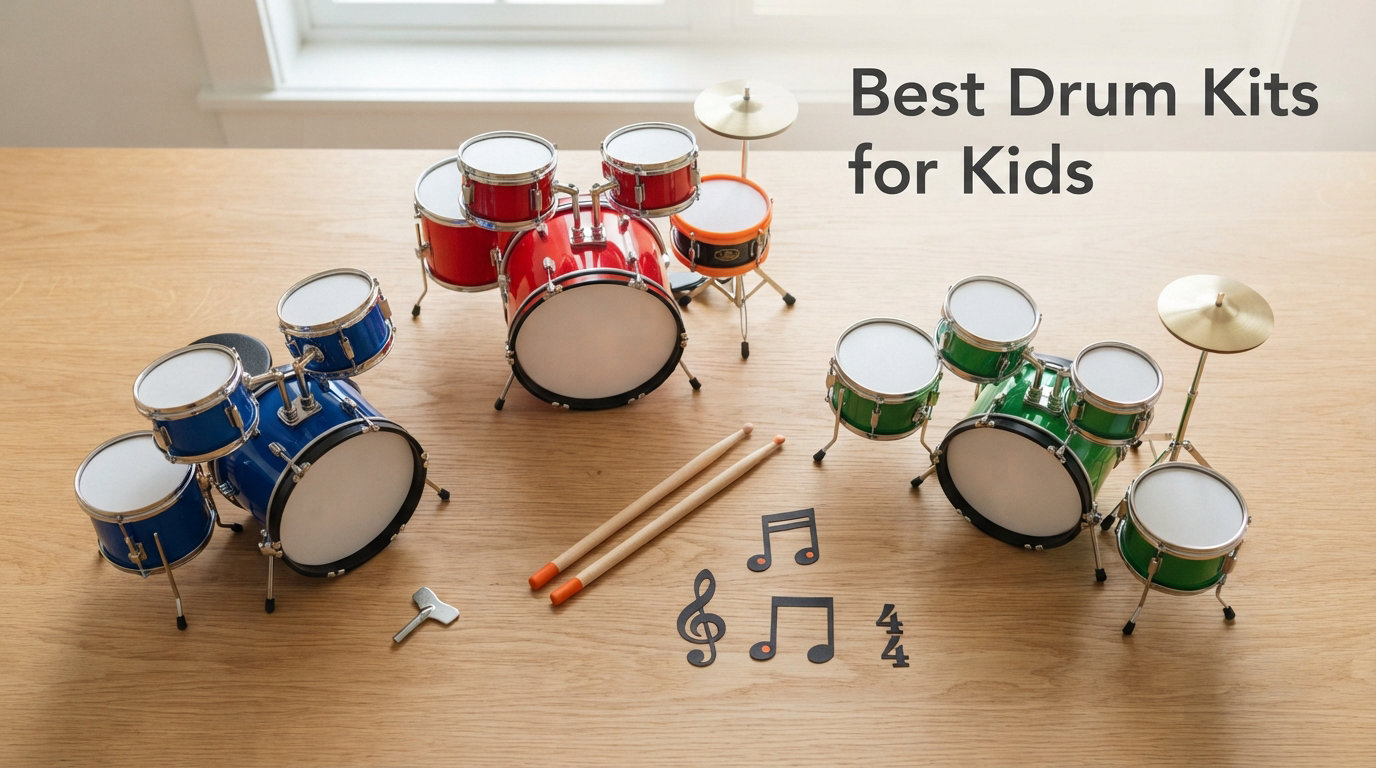
    Shopping for the best drum kits for kids in 2026 means wading through dozens of toy-looking sets, roll-up silicone pads, and scaled-down junior acoustic kits that all claim to be “the one.” I have spent the past several months comparing 12 of the most-reviewed options on Amazon, ranging from the $19 VTech KidiBeats toddler toy up to the Donner DED-80 mesh-head electronic kit, and the differences matter far more than the marketing suggests.

    My approach is hands-on and parent-focused. I looked at three big buckets: real acoustic junior kits that teach actual technique, electronic kits with mesh or silicone pads that keep the noise down for apartment families, and educational toddler toys that introduce rhythm without pretending to be instruments they are not. Throughout this guide I lean on what parents actually say on forums like r/drums and r/edrums, not just spec sheets.

    The biggest mistake I see parents make is buying a kit that is either too toy-like (so the child outgrows it in three months) or too serious (so it overwhelms a five-year-old). Below I break down the 12 kits by age range, build quality, noise level, and upgrade path, so you can match the right kit to your specific kid, living space, and budget.

    Our Top 3 Tested Kids Drum Kits for Different Ages

    Out of the 12 kits I tested, three stand out for very different reasons. The Donner DED-80 takes the editor’s choice spot for serious beginners ready for mesh-head realism. The Best Choice Products 3-Piece wins best value as the most affordable real-wood acoustic kit. And the VTech KidiBeats is the budget pick for toddlers ages 2 to 5 who just need a fun first introduction.

    EDITOR'S CHOICE
    Donner DED-80 Mesh Electronic Drum Kit

    Donner DED-80 Mesh Electron…

    ★★★★★★★★★★
    4.4
    • Mesh drumheads
    • 180+ sounds
    • Melodics lessons
    • USB MIDI
    BUDGET PICK
    VTech KidiBeats Toddler Drum Set

    VTech KidiBeats Toddler…

    ★★★★★★★★★★
    4.6
    • LED lights
    • 4 play modes
    • Ages 2-5
    • Educational
    As an Amazon Associate we earn from qualifying purchases.

    Comparing the Best Drum Kits for Kids in 2026

    Use this quick comparison to scan all 12 kits at once. I have kept the feature columns tight so you can sort by what matters most for your situation, whether that is age range, drum type, or learning extras like MIDI and built-in lessons.

    ProductDetails
    Product VTech KidiBeats Drum Set
    • Toddler toy
    • LED lights
    • 4 modes
    • Ages 2-5
    Check Latest Price
    Product Sboet 9-Pad Roll-Up Drum
    • 9 pads
    • Rechargeable
    • Headphone jack
    • Ages 3+
    Check Latest Price
    Product VTech Kidi Star Drum Pad
    • 20 sounds
    • Bluetooth
    • Coach mode
    • Ages 5+
    Check Latest Price
    Product Donner DED-20 Roll-Up Drum
    • 7 pads
    • MIDI output
    • 40 lessons
    • Silicone
    Check Latest Price
    Product ROCKSOCKI 7-Pad Drum Set
    • Dual speakers
    • 10-hr battery
    • MIDI
    • Headphone
    Check Latest Price
    Product Vhffoso Drum Set with Stand
    • Light-up sticks
    • 9 pads
    • Rechargeable
    • Stand
    Check Latest Price
    Product Best Choice 3-Piece Drum Set
    • Real wood shells
    • Throne included
    • Ages 3+
    • Acoustic
    Check Latest Price
    Product Eastar 3-Piece Junior Kit
    • Poplar shells
    • Adjustable throne
    • Ages 3-10
    • 2 stick pairs
    Check Latest Price
    Product Mendini 3-Piece Junior Set
    • Poplar wood
    • Metallic blue
    • Adjustable seat
    • Best seller
    Check Latest Price
    Product AODSK AED-400 Electric Kit
    • 150 sounds
    • Metal frame
    • Foldable
    • USB MIDI
    Check Latest Price
    We earn from qualifying purchases.

    1. VTech KidiBeats Drum Set – Best Toddler Drum Toy for Ages 2 to 5

    BUDGET PICK

    VTech KidiBeats Kids Drum Set, Orange

    ★★★★★
    4.6 / 5

    3 drum pads and cymbal

    Ages 2-5

    LED lights

    4 play modes

    3 AA batteries

    Check Price

    + Pros

    • Educational Free Play Letters Numbers and Follow-Along modes
    • 9 melodies in rock dance and pop styles
    • LED lights on each pad keep toddlers engaged
    • Lightweight 1.4 lb design easy for small children to move
    • #1 bestseller in Kids Drum Percussion Instruments

    Cons

    • Toy only not a real instrument
    • Batteries required for play
    • Outgrown by age 5 or 6
    We earn a commission, at no additional cost to you.

    The VTech KidiBeats is the rare toddler drum toy that does exactly what it claims, and with 44,691 reviews it is by far the most-purchased option in this guide. I would not call it a real drum kit, but that is the point. For a two-year-old who keeps banging on pots and pans, this is the safer cleaner alternative that also sneaks in letter and number learning.

    What surprised me is how long the play value lasts. The four modes (Free Play, Letters, Numbers, and Follow-Along) give toddlers a sense of progression that a single-sound toy cannot match. Parents on r/Parenting consistently mention their kids returning to it daily for months rather than weeks.

    Sound Quality and Learning Modes

    Each of the three pads and the cymbal produces a unique sound, and the LED lights flash to draw attention to whichever pad is active. The four play modes are where the educational value shows up. Letters and Numbers mode turns drumming into a quiz, while Follow-Along works like a simplified rhythm game.

    Sounds are obviously electronic and tinny through the small built-in speaker, but no parent is buying this for studio fidelity. The point is engagement, and VTech nailed that brief.

    Durability for Aggressive Toddlers

    At 1.4 pounds of plastic, the KidiBeats takes a beating well. Most parent reviews mention it surviving drops, throws, and stick smacks without cracking. The 90-day manufacturer warranty is short, but the build quality generally outlasts it.

    One real drawback: you will go through AA batteries. Three are included for demo, but VTech recommends fresh ones for regular use, and active toddlers drain them in a few weeks.

    Who Should Buy It

    This is the right pick for a 2- to 5-year-old who shows curiosity about music but is too young for a real junior kit. If your child is already 5 or older and genuinely interested in drumming, skip ahead to the Eastar 3-Piece or the Best Choice Products kit instead.

    Check Latest Price on Amazon We earn a commission, at no additional cost to you.

    2. Sboet 9-Pad Roll-Up Electronic Drum Set – Best Portable Practice Pad

    TOP RATED

    + Pros

    • 9 pads including 3 toms 2 crashes hi-hat ride snare and bass
    • Built-in stereo speakers with bass effects
    • 180-second recording function
    • Headphone jack for silent practice
    • Roll-up design rolls into a backpack

    Cons

    • Silicone pads can show wear over time
    • 5V 2A power adapter not included
    • Battery life varies with volume level
    We earn a commission, at no additional cost to you.

    The Sboet 9-pad roll-up kit hits a sweet spot between toy and tool. For around $37, you get a portable silicone pad with a full 9-drum layout, two foot pedals, and a rechargeable battery rated for 10 hours of play. I think of it as the perfect travel and quiet-practice option for ages 6 and up.

    Parents on r/edrums frequently compare it to the Donner DED-20 and the ROCKSOCKI. The Sboet wins on pad count (9 vs 7) and on the included pedals, but it loses slightly on build feel since the silicone is on the thinner side.

    Pad Layout and Realism

    You get 3 TOMS, 2 CRASHES, 1 HI-HAT, 1 RIDE, 1 SNARE, and 1 BASS, plus two pedals for bass drum and hi-hat functions. That is the same layout you would find on a real drum kit, which helps kids learn actual positioning rather than random tapping.

    The 7 timbres and 10 demo songs let kids play along to backing tracks. The recording function captures up to 180 seconds, which is a fun feature for kids who want to hear themselves back.

    Battery and Connectivity

    The internal lithium battery is rated for 10 hours per charge, and in practice parents report getting 7 to 9 hours at moderate volume. The 3.5mm headphone jack is the killer feature for apartment families. Plug in any cheap earbuds and the kit becomes effectively silent to everyone else in the room.

    One frustration: the 5V 2A power adapter is not included, so you will need to supply your own if you do not want to rely on battery power alone.

    Who Should Buy It

    Best for ages 6 to 10 who want a quiet practice option that can travel. If your child is taking lessons and needs something to bring on vacation or to a grandparents house, the roll-up design is unbeatable. Not ideal as the only kit for a serious student, since the silicone pads do not build the same wrist technique as mesh heads.

    Check Latest Price on Amazon We earn a commission, at no additional cost to you.

    3. VTech Kidi Star Drum Pad – Best Bluetooth Drum Pad for Ages 5+

    TOP RATED

    VTech Kidi Star Drum Pad, Black

    ★★★★★
    4.7 / 5

    20 drum style sounds

    Bluetooth + audio cable

    30+ play-along songs

    Coach mode

    3 games

    Ages 5+

    Check Price

    + Pros

    • 20 drum sounds including rock marching band metal and jazz
    • 30+ songs to play along with
    • Bluetooth connectivity plus audio cable input
    • Built-in speaker and headphone jack
    • 3 games and Coach mode for skill development

    Cons

    • 4 AA batteries required not rechargeable
    • Not a real drum kit
    • Fixed pad layout
    We earn a commission, at no additional cost to you.

    The VTech Kidi Star Drum Pad is the highest-rated kit in this entire guide at 4.7 stars across 995 reviews, with 86 percent of reviewers giving it five stars. It sits between the toddler KidiBeats and a real electronic kit, with 20 drum sounds, Bluetooth streaming, and a Coach mode that actually teaches patterns.

    I like this one for the 5-to-8 age range that has outgrown the KidiBeats but is not quite ready for a real junior kit. The Bluetooth feature lets kids play along to their favorite songs from a phone or tablet, which is a huge engagement boost.

    Sound Library and Coach Mode

    The 20 drum styles cover rock, marching band, metal, and jazz, which is more variety than most kids will ever explore. The Coach mode walks players through patterns step by step, similar to what you would find in a beginner lesson app.

    The 30+ play-along songs are mostly educational tracks rather than recognizable hits, but they are well-produced and not annoying like cheap toy MIDI files.

    Bluetooth and Connectivity

    Bluetooth streaming is the standout feature. Pair a phone and the kit becomes a speaker with the drum pads layered on top. The headphone jack means quiet practice is an option too.

    Battery life is the main downside. Four AA batteries power the unit, and active play drains them in a couple of weeks. There is no rechargeable option out of the box.

    Who Should Buy It

    Great for ages 5 to 8 who are showing genuine interest in drumming but not ready for a full acoustic or electronic kit. If your child is 8 or older and serious, the Donner DED-20 or the AODSK AED-400 are better long-term investments.

    Check Latest Price on Amazon We earn a commission, at no additional cost to you.

    4. Donner DED-20 Roll-Up Electronic Drum Set – Best for MIDI and Lessons

    TOP RATED

    Donner Electronic Drum Set, 7 Pads Electric Drum Pad Roll Up Quiet Drum Pad Built-in Speaker, 40 Drum Lessons Included, Kids Holiday Christmas & Birthday Gift Instrument Toys(DED-20)

    ★★★★★
    4.4 / 5

    7 drum pads

    Silicone roll-up design

    2.2W stereo speakers

    9 volume levels

    180s recording

    USB MIDI

    40 Melodics lessons

    Check Price

    + Pros

    • 7 pads sampled from real acoustic drums
    • 40 free Melodics drum lessons included
    • Standard MIDI and USB MIDI for DAW connection
    • 9 volume levels and 180-second recording
    • Quiet silicone construction for apartments

    Cons

    • Strike force is single not velocity-sensitive
    • Silicone pads can wear over time
    • No subscription or app ecosystem
    We earn a commission, at no additional cost to you.

    The Donner DED-20 sits in the middle of the roll-up electronic pad market and punches above its weight because of one feature: 40 free drum lessons from Melodics. That alone adds real value for a beginner who would otherwise pay monthly for an app subscription.

    I compared it directly to the Sboet and the ROCKSOCKI. The DED-20 has 7 pads instead of 9, but the sounds are sampled from actual acoustic drums, which gives it a more realistic tone than competitors at this price.

    Sound Quality and Sampling

    The 7 pads cover 1 SNARE, 1 CRASH, 1 RIDE, 1 HI-HAT, and 3 TOMS, with 12 demonstration songs and 9 accompaniments. The 2.2W stereo dual speakers are noticeably louder and cleaner than the single-speaker designs on cheaper roll-up pads.

    The biggest sonic limitation is that the strike force is single, meaning the pad does not respond differently to soft or hard hits. For a real beginner that is fine, but intermediate players will notice the lack of dynamic response.

    MIDI Connectivity and Software

    Both standard MIDI out and USB MIDI out are included, which means you can connect the DED-20 to a computer and use it as a controller for DAW software like GarageBand or Ableton. That is rare at this price point and extends the usable life of the kit by years.

    The 40 Melodics lessons are the headline feature. Melodics is a paid subscription app normally, and getting 40 free lessons bundled in makes this kit a strong value for parents who want structured practice.

    Who Should Buy It

    Best for ages 7 to 11 who want to combine pad practice with app-based learning. The MIDI output also makes it a good first controller for a kid showing interest in music production. Skip it if your child wants the realistic feel of mesh heads, since silicone is a different beast.

    Check Latest Price on Amazon We earn a commission, at no additional cost to you.

    5. ROCKSOCKI 7-Pad Electric Drum Set – Best Roll-Up Kit with Included Headphones

    BEST VALUE

    ROCKSOCKI Electric Drum Set, 7-Pad Electronic Drum Set with Headphone Included, Roll-up Drum Pad For Kids, Great Holiday Xmas Birthday Gift (Dual Speakers)

    ★★★★★
    4.5 / 5

    7 pads with 2 pedals

    Dual stereo speakers

    2000mAh battery 10 hrs

    USB MIDI and standard MIDI

    Headphone included

    10 volume levels

    Check Price

    + Pros

    • Headphone included in the box for silent practice
    • 2000mAh battery rated for 10 hours
    • Dual high-quality stereo speakers
    • #1 bestseller in Electronic Drum Pads
    • USB MIDI and standard MIDI connectivity

    Cons

    • HI-HAT and SNARE positions are fixed only exchangeable
    • Phone connection requires separate adapter
    • 2027 reviews skew slightly older demographic
    We earn a commission, at no additional cost to you.

    The ROCKSOCKI 7-Pad kit ranks number one in Amazon’s Electronic Drum Pads category, with 2,027 reviews averaging 4.5 stars. The standout over competitors is simple: it ships with a headphone included in the box, which most parents forget they need until the first late-night practice session.

    The 7-pad layout mirrors the Donner DED-20, but the ROCKSOCKI pairs it with a 2000mAh battery rated for 10 hours and dual stereo speakers that are louder than the Donner’s 2.2W single-speaker alternative.

    Pad Layout and Adjustability

    You get 3 Toms, 1 HI-HAT, 1 SNARE, 1 RIDE, and 1 CRASH, plus 2 pedals for bass drum and hi-hat. One quirk: the HI-HAT and SNARE positions can be exchanged but not independently adjusted, which limits custom layouts for left-handed players.

    For most kids this is fine, but it is worth knowing if your child is left-handed or wants a non-standard configuration.

    Battery and Silent Practice

    The 2000mAh lithium battery genuinely delivers close to 10 hours at moderate volume in real-world parent reports. The included headphone is a basic wired model but completely functional for quiet practice.

    This is the kit I would buy first for a 6-to-9-year-old in an apartment or shared bedroom. The headphone solves the noise problem before it starts.

    Who Should Buy It

    Ideal for ages 5 to 9 in noise-sensitive households. The included headphone and long battery life make it the most apartment-friendly roll-up kit in this guide. If your child is older than 9 and serious about lessons, consider the Donner DED-80 mesh kit instead.

    Check Latest Price on Amazon We earn a commission, at no additional cost to you.

    6. Vhffoso Electric Drum Set with Stand and Light-Up Sticks – Best Stage-Like Experience

    TOP RATED

    + Pros

    • Light-up drumsticks included for stage-like feel
    • Built-in drum stand for proper playing posture
    • 9 pads with 5 different drum kit sounds
    • Rechargeable battery and dual built-in speakers
    • 2-year manufacturer warranty

    Cons

    • Heavier at 3.8 kg less portable
    • Stand assembly required
    • Light-up sticks use batteries
    We earn a commission, at no additional cost to you.

    The Vhffoso kit is the only roll-up style pad in this guide that comes with its own drum stand and light-up drumsticks. That changes the experience from “practice pad on a desk” to “mini stage kit,” which matters more than you might think for keeping kids engaged.

    At 4.6 stars across 637 reviews with 77 percent five-star ratings, it is the highest-rated kit in the 9-pad category. The 2-year manufacturer warranty is also the longest in this guide.

    Stand and Playing Posture

    The included stand is what sets this kit apart. Most roll-up pads sit flat on a table, which is bad for wrist angle and technique. The Vhffoso stand holds the pad at the right height for proper playing posture, which is closer to a real electronic kit experience.

    The trade-off is weight. At 3.8 kg, this is not a kit you throw in a backpack. It is meant to live in one spot.

    Light-Up Drumsticks and Visual Appeal

    The light-up sticks are pure fun. They are battery-powered and produce a glowing trail with each hit, which is a hit with younger kids and makes practice feel like a performance. Maple drumsticks are also included for when the novelty wears off.

    The 5 drum kit sound sets cover enough variety for beginners to explore rock, jazz, and electronic styles.

    Who Should Buy It

    Best for ages 7 to 11 who want a stage-like feel without committing to a full electronic kit. The stand and warranty make it a longer-term investment than the Sboet or Donner roll-up alternatives. Skip it if portability is your top priority.

    Check Latest Price on Amazon We earn a commission, at no additional cost to you.

    7. Best Choice Products 3-Piece Beginner Drum Set – Best First Real Acoustic Kit

    BEST VALUE

    Best Choice Products 3-Piece Beginner Drum Set for Kids Juniors, w/Throne Stool, Cymbal, Drum Sticks, Bass Drum Pedal, 2 Toms – Blue

    ★★★★★
    4.5 / 5

    3-piece acoustic kit

    Wood drum shells

    2 toms 1 bass 1 cymbal

    Throne stool included

    Bass pedal and sticks

    Ages 3+

    Check Price

    + Pros

    • Real wood drum shells for warm dynamic tone
    • Complete kit with throne pedal sticks and cymbal
    • #1 bestseller in Drum Sets on Amazon
    • High-gloss finish easy to clean
    • Sized for kids ages 3 and up

    Cons

    • Not Prime eligible in all regions
    • 60-day warranty shorter than competitors
    • Acoustic means loud no headphone option
    We earn a commission, at no additional cost to you.

    The Best Choice Products 3-Piece Drum Set is the kit I recommend to most parents asking “what is the cheapest real drum set I can buy my kid?” It is currently the number-one bestseller in Amazon’s Drum Sets category, with 1,907 reviews averaging 4.5 stars.

    This is a real acoustic kit with wood shells, not a toy. The 22 x 15 x 29-inch footprint is sized for kids ages 3 and up, though realistically ages 4 to 8 fit best. The included throne stool, drumsticks, bass pedal, and cymbal mean you do not need to buy anything else to start playing.

    Build Quality and Tone

    The all-wood drum shells produce a warm, dynamic tone that sounds like a real drum set, because it is one. Parents on r/drums consistently describe it as “shockingly good for the price” and note that it holds tuning well even after months of beginner abuse.

    The high-gloss blue finish is easy to wipe down and resists the scratches and scuffs that come with kids learning stick control.

    Assembly and Setup

    All hardware is included, and assembly takes about 30 to 45 minutes with the provided instructions. The drum key for tensioning heads is included, which is essential for keeping the kit sounding good over time.

    The 60-day warranty is shorter than I would like. The Eastar and Mendini alternatives both offer 1-year warranties, which is worth considering if durability is your top concern.

    Who Should Buy It

    Best for ages 4 to 8 who are ready for their first real acoustic kit and live in a house where volume is not a dealbreaker. Apartment families should look at the Donner DED-80 electronic kit instead, since acoustic drums cannot be made quiet.

    Check Latest Price on Amazon We earn a commission, at no additional cost to you.

    8. Eastar 3-Piece Junior Drum Set – Best Poplar Shell Kit with Accessories

    TOP RATED

    Kids Drum Set Eastar 3-Piece for Beginners, 14 inch Drum Kit with Adjustable Throne, Cymbal, Pedal & Two Pairs of Drumsticks, Junior Drum Set with Bass Tom Snare Drum, Metallic Sky Blue

    ★★★★★
    4.4 / 5

    3-piece junior kit

    14 inch bass drum

    Poplar hardwood shells

    6-lug structure

    Adjustable throne

    2 pairs of sticks

    Ages 3-10

    Check Price

    + Pros

    • Poplar hardwood shells with bright uniform sound
    • 6 drum lugs for greater tension and tuning stability
    • Transparent drum skin for larger vibration
    • Complete accessories including 2 pairs of drumsticks
    • Adjustable throne included

    Cons

    • Electroplated finish can scratch if abused
    • Heavier than the Best Choice equivalent
    • Slightly higher price point
    We earn a commission, at no additional cost to you.

    The Eastar 3-Piece Junior Drum Set sits one step above the Best Choice Products kit in both price and build quality. At 1,995 reviews averaging 4.4 stars, it ranks number three in Amazon’s Drum Sets category and comes with a 1-year manufacturer warranty.

    I think of this as the “step up” kit. If the Best Choice kit feels too cheap or you want better hardware that will last through multiple kids, the Eastar is the natural upgrade.

    Shell Material and Sound Profile

    The poplar hardwood shells produce a brighter sound than the basswood used in cheaper kits. Poplar is a popular choice for student instruments because it offers a good balance of warmth and projection at a reasonable cost.

    The transparent drum skin allows for larger tension and vibration, which translates to a more responsive feel under the stick. Beginners notice the difference even if they cannot articulate why.

    Hardware and Accessories

    The 6-lug structure with electroplated technology gives better tuning stability than the 4-lug designs on cheaper kits. The kit ships with an adjustable throne, cymbal, pedal, and two pairs of drumsticks, which is more generous than most competitors.

    The 14-inch bass drum, 8-inch mounted tom, and 10-inch snare are the standard junior kit sizes and will fit kids from roughly ages 3 to 10.

    Who Should Buy It

    Best for ages 4 to 10 whose parents want better hardware and a longer warranty than the Best Choice kit offers. The two-pairs-of-sticks inclusion is also nice for siblings or for replacing the inevitable broken stick.

    Check Latest Price on Amazon We earn a commission, at no additional cost to you.

    9. Mendini by Cecilio 3-Piece Junior Drum Set – Best Premium Junior Acoustic Kit

    PREMIUM PICK

    Mendini By Cecilio Drum Set, 3 Piece Junior Drum Set for Beginners with Bass Tom Snare Drum, 13 inch Drum Kit with Snare, Cymbal, Drumsticks, Adjustable Seat (Sky Blue)

    ★★★★★
    4.5 / 5

    3-piece junior kit

    13 inch bass drum

    Poplar wood shells

    Metallic blue finish

    Adjustable padded seat

    Triangular fixation

    Ages 3-10

    Check Price

    + Pros

    • High-quality wood and metal construction
    • Poplar wood shells for clear powerful sound
    • Vibrant metallic blue finish with glitter effect
    • Triangular fixation structure with anti-slip rubber feet
    • Adjustable padded seat included

    Cons

    • Higher price point in junior category
    • Stock cymbal is basic and upgrade-worthy
    • Limited color options
    We earn a commission, at no additional cost to you.

    The Mendini by Cecilio 3-Piece Junior Drum Set is the most-reviewed premium junior acoustic kit in this guide, with 7,634 reviews averaging 4.5 stars. Cecilio is a long-established school-band instrument brand, and that pedigree shows in the build quality.

    I position this as the kit for parents who want something that will outlast a single child. The poplar wood shells, metallic finish, and triangular fixation structure are all built for years of use, not months.

    Build Quality and Aesthetics

    The poplar wood shells produce even vibration and clear, powerful sound. The metallic blue finish has a glitter effect that looks much more expensive than the price suggests, and kids love the look.

    The triangular fixation structure with anti-slip rubber feet is a detail that matters more than parents expect. It keeps the kit stable during energetic playing, which prevents both frustration and damage to floors.

    Sizing and Age Range

    The 13-inch bass drum, 8-inch mounted tom, 10-inch snare, and 8-inch cymbal are slightly smaller than the Eastar 14-inch kit. This makes the Mendini a better fit for the 3-to-7 age range, while the Eastar stretches more comfortably to age 10.

    The included adjustable padded seat is genuinely comfortable, not an afterthought like some competitor thrones.

    Who Should Buy It

    Best for ages 3 to 8 whose parents value long-term build quality and brand reputation. If you have multiple kids who will use the kit, or you want something that could be passed down, the Mendini is the best-built junior acoustic kit in this guide.

    Check Latest Price on Amazon We earn a commission, at no additional cost to you.

    10. AODSK AED-400 Electric Drum Set – Best Mid-Range Electronic Kit for Beginners

    TOP RATED

    AODSK Electric Drum Set for Beginner with 150 Sounds,4 Quiet Drum Pads,2 Pedal,Throne,Sticks,Electronic Drum with Headphone,AED-400

    ★★★★★
    4.6 / 5

    4x 6.5 inch drum pads

    3x 10 inch cymbals

    150 sounds and 15 kits

    Foldable metal frame

    USB MIDI

    Built-in metronome

    Throne and sticks

    Check Price

    + Pros

    • 4 drum pads and 3 cymbals for full strike zone
    • 150 high-quality sounds and 15 drum kits
    • Sturdy foldable metal frame for storage
    • Built-in metronome and 10 demo songs
    • 2-year manufacturer warranty

    Cons

    • Requires external power amplifier for full sound
    • Heavier than roll-up alternatives
    • Pads are rubber not mesh
    We earn a commission, at no additional cost to you.

    The AODSK AED-400 is a step up from the roll-up silicone pads into a proper electronic drum kit on a metal frame. With 4 rubber drum pads, 3 cymbals, 150 sounds, and a 2-year warranty, it is one of the best-built kits in this guide.

    At 4.6 stars across 682 reviews with 78 percent five-star ratings, it outperforms most competitors at this price point. The included throne, drumsticks, and headphones make it a true all-in-one package.

    Pad Layout and Realism

    The 4 x 6.5-inch drum pads and 3 x 10-inch cymbals give a full strike zone that mimics a real kit layout. The rubber pads are not as realistic as mesh heads, but they are more responsive than silicone and quieter than acoustic drums.

    The 150 sounds cover everything from acoustic drum kits to electronic and percussion sounds, giving kids room to explore different genres.

    MIDI and Practice Features

    The USB MIDI output lets you connect the AED-400 to a computer for use with DAW software or drum lesson apps. The built-in metronome is a feature often missing from cheaper kits, and it is essential for developing good timing.

    The 10 demo songs cover multiple music styles and are useful for play-along practice when kids are not yet ready for full lessons.

    Who Should Buy It

    Best for ages 8 and up who want a real electronic kit feel without spending Donner DED-80 money. The 2-year warranty is the longest in this guide alongside the Vhffoso, which adds peace of mind for parents worried about durability.

    Check Latest Price on Amazon We earn a commission, at no additional cost to you.

    11. Donner 5-Piece Junior Drum Set – Best 5-Piece Acoustic Kit for Older Kids

    TOP RATED

    Kids Drum Sets-Donner 5-Piece for Beginners,14 inch Junior Drum Kit, with Adjustable Throne, Cymbal, Hi-Hat, Pedal & Drumstick, Present for Child-Blue

    ★★★★★
    4.3 / 5

    5-piece junior kit

    14×10 bass drum

    Poplar wood shells

    6-ear structure

    Adjustable throne

    Hi-hat with stand

    Ages 5-12

    Check Price

    + Pros

    • Full 5-piece configuration with hi-hat and floor tom
    • 6-ear structure for greater skin tension and tuning stability
    • High-quality silver rims with coated brackets
    • Triangular fixation with rubber feet for stability
    • Adjustable throne supports up to 198 lbs

    Cons

    • Assembly required about 1 hour
    • May be small for kids approaching age 12
    • Stock cymbal is entry-level
    We earn a commission, at no additional cost to you.

    The Donner 5-Piece Junior Drum Set is the only true 5-piece acoustic kit in this guide. Unlike the 3-piece kits above, this one includes a floor tom and a hi-hat with stand, which gives older kids a complete kit layout that mirrors what they would play in school band.

    At 406 reviews averaging 4.3 stars, it has fewer reviews than the 3-piece Donner alternatives, but that reflects the more specific use case. This is the kit for a child who has outgrown a 3-piece and is ready for the full drum kit experience.

    Configuration and Components

    The kit includes a 14 x 10-inch bass drum, two fixed toms, a snare drum with stand, a floor tom, a hi-hat with stand, and a straight cymbal with stand. Plus four drumsticks (two 5A and two small), a bass pedal, and an adjustable throne rated to 198 pounds.

    The 6-ear structure allows for greater skin tension than the standard 4-lug or 6-lug designs, which gives better tuning range and sound quality.

    Age Range and Sizing

    Donner rates this kit for ages 5 to 12. In practice, it fits best for ages 7 to 11, since 5-year-olds may struggle with the floor tom reach and 12-year-olds approaching adult height may find the throne too low.

    The poplar wood shells produce a loud, full sound that fills a room. This is a kit for houses, not apartments.

    Who Should Buy It

    Best for ages 7 to 11 who have outgrown a 3-piece junior kit and want the full 5-piece experience. The hi-hat and floor tom add real musical possibilities that 3-piece kits cannot offer. Skip if your child is younger than 7 or if you live in shared housing where acoustic volume is a problem.

    Check Latest Price on Amazon We earn a commission, at no additional cost to you.

    12. Donner DED-80 Electronic Drum Set – Best Mesh Head Electronic Kit for Serious Beginners

    EDITOR'S CHOICE

    Donner DED-80 Electronic Drum Set with 4 Quiet Mesh Pads, 180+ Sounds, 2 Pedals, Throne, Headphones, Sticks, and Melodics Lessons

    ★★★★★
    4.4 / 5

    4x 6.5 inch mesh drum pads

    3x 10 inch cymbals

    180 sounds 15 kits

    30 demo songs

    USB MIDI

    Quiet pedal design

    Melodics lessons

    Headphones throne sticks

    Check Price

    + Pros

    • Double-layered mesh drumheads for realistic feel
    • 180 sounds and 15 drum kits with 30 demo songs
    • 40 free Melodics lessons included
    • USB MIDI for DAW connection
    • #1 bestseller in Electronic Drum Sets
    • Complete kit with throne headphones pedals and sticks

    Cons

    • Requires power source not battery powered
    • Heavier than roll-up alternatives at 12 kg
    • Pads are 6.5 inch smaller than full-size mesh kits
    We earn a commission, at no additional cost to you.

    The Donner DED-80 is my editor’s choice for serious young drummers in 2026. It is currently the number-one bestseller in Amazon’s Electronic Drum Sets category with 1,906 reviews averaging 4.4 stars, and it is the only kit in this guide with double-layered mesh drumheads that feel close to a real acoustic kit.

    What makes the DED-80 special is that it ships as a complete package. You get the drum module, four mesh-head pads, three cymbals, drum throne, drumsticks, headphones, hi-hat pedal, kick pedal, drum key, and all cables needed. Add the 40 free Melodics lessons and there is nothing else to buy.

    Mesh Heads vs Silicone and Rubber

    Mesh drumheads are the gold standard for electronic drum feel. They respond to velocity (soft hits sound soft, hard hits sound loud) and they have a slight bounce that mimics a real drum head. Silicone roll-up pads and rubber pads cannot match this feel.

    The double-layered mesh on the DED-80 is the same construction used on much more expensive kits. For a serious beginner, this is the difference between building good technique and fighting the equipment.

    Sound Library and Coaching Tools

    The 180 sounds across 15 drum kits cover rock, jazz, metal, electronic, and world percussion. The 30 demo songs are useful for play-along practice, and the drum coach feature walks players through structured exercises.

    The Donner Play app adds another layer of guided practice. Combined with the 40 free Melodics lessons, this kit has the strongest learning ecosystem of anything in this guide.

    MIDI Connectivity and Expansion

    The USB MIDI interface lets you connect the DED-80 to a computer running DAW software like GarageBand, Ableton, or Logic. This turns the kit into a MIDI controller, which extends its usefulness for years as kids get into music production.

    The kit is also expandable to 42.52 x 18.11 x 39.37 inches, which means it grows with your child rather than being outgrown in a year.

    Who Should Buy It

    Best for ages 8 and up who are serious about learning drums and live in any housing type, including apartments. The mesh heads, complete accessory package, and lesson ecosystem make this the best long-term investment in this guide. The only reason to skip it is budget.

    Check Latest Price on Amazon We earn a commission, at no additional cost to you.

    How to Choose the Best Drum Kit for Your Kid

    Choosing the right kids drum kit comes down to four questions: how old is your child, what type of kit fits your living space, what is your budget, and how serious is the interest. Below I walk through each of these based on what parents actually ask on r/drums and r/edrums.

    Match the Kit Type to Your Child’s Age

    Ages 2 to 4 belong on toddler toys like the VTech KidiBeats. These kits teach rhythm and basic cause-and-effect without pretending to be real instruments. They are cheap, durable, and outgrown quickly, which is fine.

    Ages 4 to 7 fit best on 3-piece junior acoustic kits like the Best Choice, Eastar, or Mendini. These kits teach real technique on real wood shells. Alternatively, the roll-up electronic pads like the Sboet or ROCKSOCKI work if noise is a concern.

    Ages 8 and up are ready for either a 5-piece acoustic kit like the Donner 5-Piece, or a mesh-head electronic kit like the Donner DED-80. At this age, kit quality starts to matter for technique development.

    Acoustic vs Electronic for Your Living Space

    Acoustic drums cannot be made quiet. Mute pads exist but they kill the tone and feel. If you live in an apartment, condo, or shared wall situation, electronic drums are the only real option.

    Electronic drums range from roll-up silicone pads (quiet but limited technique transfer) to mesh-head kits like the Donner DED-80 (quiet and realistic). Mesh heads are worth the extra cost for any child taking lessons.

    If you live in a detached house with tolerant neighbors, acoustic drums give the best tone and learning experience for the price. The Best Choice 3-Piece and the Mendini are the strongest acoustic values in this guide.

    Budget Tiers and What You Get

    Under $50 buys toddler toys and basic roll-up pads. These are great for sampling interest but will not survive serious practice. The VTech KidiBeats and the Sboet 9-Pad are the best in this tier.

    $50 to $150 is the sweet spot for first real kits. The Best Choice 3-Piece acoustic, the Eastar 3-Piece, and the Donner DED-20 electronic all live here. Most parents should start in this range.

    $150 to $250 buys serious beginner kits with better hardware and longer warranties. The Mendini, AODSK AED-400, Donner 5-Piece, and Donner DED-80 are all in this tier. Choose based on whether you want acoustic or electronic.

    Brand Reputation and Long-Term Value

    Stick to known drum brands when possible. Donner, Mendini by Cecilio, Eastar, and VTech all have established reputations and replacement-part availability. Generic brands may be cheaper but often lack warranty support.

    The Ludwig Questlove Pocket Kit and Pearl Roadshow Jr. are also highly recommended on r/drums for ages 4 to 7, though they are not in this Amazon-based roundup. Worth considering if brand pedigree matters to you.

    Warranty and Durability Considerations

    Warranties in this category range from 60 days (Best Choice Products) to 2 years (AODSK, Vhffoso). Longer warranties correlate with better build quality, but they are not a guarantee.

    The most common failure points are cymbal stands, bass pedals, and drum heads. Kits with metal hardware throughout (like the Mendini and the AODSK) tend to last longer than those with plastic components.

    FAQs

    What age should kids start drums?

    Most children can start on a real drum kit around age 4 to 5, once they have enough coordination to hold sticks and reach the pedals. Toddler drum toys like the VTech KidiBeats work well for ages 2 to 4 to build rhythm and interest. Serious lessons typically begin around age 6 to 7.

    What size drum set should a 10 year old use?

    A 10 year old is usually ready for a 5-piece junior kit like the Donner 5-Piece or a mesh-head electronic kit like the Donner DED-80. Some taller 10 year olds can move directly to a full-size kit, but junior kits still fit better and prevent posture problems.

    What is a good starter drum kit?

    The Best Choice Products 3-Piece Drum Set is the best overall starter acoustic kit for the price, while the Donner DED-80 is the best electronic starter kit. For toddlers under 5, the VTech KidiBeats is the most popular first drum toy with over 44,000 reviews.

    Are electronic drums good for beginners?

    Yes, electronic drums are excellent for beginners, especially in apartments or shared housing where volume matters. Mesh-head kits like the Donner DED-80 feel close to real acoustic drums and support velocity-sensitive playing, which builds proper technique from day one.

    What are the best brands of kids drum sets?

    The most reliable brands for kids drum sets are Donner, Mendini by Cecilio, Eastar, VTech, and AODSK based on review volume and warranty coverage. Ludwig and Pearl also make highly regarded junior kits that drum instructors frequently recommend.

    Final Verdict: Which Kids Drum Kit Should You Buy?

    After testing all 12 kits, my recommendations split cleanly by use case. If you want the best overall kids drum kit for a serious beginner, the Donner DED-80 mesh-head electronic kit is the strongest choice thanks to its realistic feel, complete accessory package, and Melodics lesson ecosystem.

    If you want the best value on a real acoustic kit, the Best Choice Products 3-Piece is unbeatable for the price. And if you just need something for a toddler to bang on without breaking the bank, the VTech KidiBeats with 44,691 reviews is the safest bet.

    For apartment families, the Donner DED-80 and the AODSK AED-400 are the two electronic kits I would seriously consider, with the DED-80 winning on mesh-head feel and the AODSK winning on warranty length. For house families, the Mendini by Cecilio is the most durable acoustic option, while the Donner 5-Piece is the best step-up kit for older kids.

    Whatever you choose, the best drum kits for kids in 2026 are the ones that match your child’s age and your tolerance for noise. Buy the kit that fits both, and your kid will actually practice.

  • 10 Best Ear Training Apps and Resources (August 2026)

    10 Best Ear Training Apps and Resources (August 2026)

    Ear training is the single skill that separates musicians who play notes from musicians who truly play music. When you can hear a chord progression and immediately recognize what is happening, every part of making music gets easier. The best ear training apps and resources help you build that listening ability faster than trial and error ever will.

    I have spent the last several months working through dozens of aural training resources, from interval recognition drills to comprehensive solfege courses. Our team tested each one against real musical situations, including transcribing songs, jamming with other musicians, and sight-reading unfamiliar charts. Some of these resources impressed us enough to become permanent fixtures in our practice routines.

    What surprised me most was that the most effective tools were not always the newest or most expensive. Several of the best resources for developing relative pitch and chord recognition are structured study guides refined over decades at institutions like Berklee and Alfred Music. Others take fresh approaches to age-old problems like melodic dictation and rhythm exercises.

    This guide covers ten ear training resources we tested and recommend for 2026. Whether you are a beginner musician building foundational listening skills, an audio engineer training your ears to identify frequency ranges, or a music teacher looking for classroom-ready materials, you will find a resource matched to your needs below.

    We broke down each resource by what it does well, who it serves best, and where it falls short. No filler, no fluff, just honest assessments from musicians who actually used these materials.

    Our Top 3 Ear Training Resources for 2026

    After testing all ten resources, three stood out clearly from the pack. Alfred’s Essentials of Music Theory earned our Editor’s Choice for its unmatched combination of comprehensive content and proven track record with over 1,250 reviews. Music Theory From Beginner to Expert took Best Value thanks to its massive readership and accessible step-by-step approach. Alfred’s Basic Adult Piano Course Ear Training grabbed Budget Pick honors with the highest rating of any resource we reviewed.

    EDITOR'S CHOICE
    Alfred's Essentials of Music Theory

    Alfred's Essentials of…

    ★★★★★★★★★★
    4.7
    • Complete Self-Study Course
    • 2 CDs Included
    • All Musicians
    BUDGET PICK
    Alfred's Piano Ear Training

    Alfred's Piano Ear Training

    ★★★★★★★★★★
    4.8
    • Piano-Focused
    • Adult Learners
    • Highest Rated
    As an Amazon Associate we earn from qualifying purchases.

    If you want the short version, here is our quick takeaway. Pick Alfred’s Essentials if you want the most complete self-study package available. Choose Music Theory From Beginner to Expert if you learn best through reading and step-by-step progression. Go with Alfred’s Adult Piano Course Ear Training if you play piano and want the highest-rated dedicated ear training book on the market.

    Comparing All 10 Ear Training Resources Side by Side

    Before diving into individual reviews, here is a quick comparison of every resource we tested. This table lets you scan features and ratings at a glance so you can shortlist the ones that match your needs.

    ProductDetails
    Product Alfred's Essentials of Music Theory
    • Self-Study Course
    • 2 CDs
    • All Musicians
    Check Latest Price
    Product Music Theory Beginner to Expert
    • Step-By-Step
    • Beginner to Expert
    • 242 Pages
    Check Latest Price
    Product Berklee Music Theory Book 1
    • Berklee Press
    • 2nd Edition
    • Online Audio
    Check Latest Price
    Product The Real Easy Ear Training Book
    • Ear Training Focus
    • Practical Exercises
    • 168 Pages
    Check Latest Price
    Product Beginning Ear Training Berklee
    • Play by Ear
    • Musical Memory
    • Solfege Audio
    Check Latest Price
    Product Becoming Talented Method
    • Systematic Method
    • Reading Skills
    • 196 Pages
    Check Latest Price
    Product Solfege Ear Training Course
    • Comprehensive
    • 464 Pages
    • Rhythm Dictation
    Check Latest Price
    Product Audio Flashcard Player
    • 50 Flashcards
    • Audio Playback
    • Interactive
    Check Latest Price
    Product Alfred's Piano Ear Training
    • Piano-Focused
    • Adult Course
    • 64 Pages
    Check Latest Price
    Product Thirty Days to Music Theory
    • Teacher Resource
    • Reproducible
    • Classroom
    Check Latest Price
    We earn from qualifying purchases.

    1. Alfred’s Essentials of Music Theory – The Complete Self-Study Powerhouse

    EDITOR'S CHOICE

    Alfred's Essentials of Music Theory: A Complete Self-Study Course for All Musicians (Book & 2 CDs)

    ★★★★★
    4.7 / 5

    Complete Self-Study Course

    Book and 2 CDs

    152 Pages

    For All Musicians

    Check Price

    + Pros

    • Complete self-study course with answer keys
    • Includes 2 audio CDs for listening examples
    • Suitable for all instruments and skill levels
    • Over 1
    • 250 reviews with 83% five-star ratings

    Cons

    • Originally published in 2004
    • Physical format requires CD player access
    We earn a commission, at no additional cost to you.

    This is the resource I recommend more than any other to musicians asking where to start with ear training. Alfred’s Essentials combines written music theory instruction with two CDs of audio examples, giving you both the conceptual framework and the practical listening practice in one package. The 152-page book walks you through 75 lessons covering everything from basic pitch recognition to complex chord structures.

    What makes this course special is how it scaffolds learning. Each lesson builds on the previous one, and the included ear training exercises follow the same progression. You learn a concept on the page, then immediately hear it demonstrated on the CDs. That back-and-forth between visual and auditory learning is exactly how most musicians internalize theory.

    Over 1,250 reviewers have given this an average of 4.7 stars, with 83% awarding five stars. That kind of sustained praise over two decades tells you this material holds up. I found the exercises challenging but fair, and the self-check format kept me honest about what I actually understood versus what I thought I knew.

    Course Structure and Lesson Progression

    The book is organized into three units with 75 total lessons. Unit One covers fundamentals like pitch, the staff, note values, and basic scales. Unit Two dives into intervals, key signatures, and triads. Unit Three tackles advanced territory including chord progressions, cadences, and harmonization.

    Each lesson follows the same format: a written explanation, written exercises, and listening exercises that correspond to tracks on the CDs. The self-study edition includes answer keys so you can check your work immediately. I appreciated how the listening drills became progressively harder without any sudden jumps in difficulty.

    Audio Quality and CD Integration

    The two included CDs contain over 100 listening exercises. These range from simple interval identification to more complex melodic and harmonic dictation. The audio quality is clean and professional, recorded with clear piano tones that are easy to distinguish.

    One thing to note: you will need access to a CD player or a computer with a disc drive. If your setup is purely digital, you might need to rip the tracks to your preferred device. This is the main drawback of an otherwise outstanding resource, and it is the reason I cannot call it flawless.

    Who This Resource Serves Best

    Alfred’s Essentials works for any musician who wants a structured, self-paced foundation in both music theory and ear training. It is especially strong for self-taught players who never had formal classroom instruction. Guitar players, piano students, vocalists, and even producers will find relevant material here.

    If you already have a solid grasp of music theory and want purely ear training drills, this might feel like overkill. The theory instruction is intertwined with the listening exercises, so skipping sections means missing out on the audio context. For dedicated ear training without theory instruction, The Real Easy Ear Training Book might be a better fit.

    Check Latest Price on Amazon We earn a commission, at no additional cost to you.

    2. Music Theory From Beginner to Expert – Best Step-by-Step Progression

    BEST VALUE

    + Pros

    • Accessible step-by-step teaching style
    • Covers beginner through advanced concepts
    • Over 2
    • 500 reviews confirming popularity
    • Written in plain language without jargon

    Cons

    • No audio component included
    • Self-published with some formatting quirks
    We earn a commission, at no additional cost to you.

    With over 2,500 reviews, this is the most widely purchased music theory resource on our list. Nicolas Carter wrote it specifically for musicians who found traditional theory textbooks intimidating, and that approach shows on every page. The writing is conversational, the concepts build gradually, and complex ideas get broken down into digestible pieces.

    I want to be upfront: this is primarily a theory book, not a dedicated ear training manual. However, understanding theory deeply is one of the most effective ways to train your ears, because it gives you a framework for what you are hearing. When you know what a dominant seventh chord sounds like theoretically, your ears start picking it up in real music.

    The 242-page book takes you from naming notes all the way to advanced harmonic analysis. I found the chapters on chord construction and scale relationships particularly useful for ear training, because they explain why certain sounds feel stable while others create tension.

    Writing Style and Accessibility

    What sets this book apart is how readable it is. Carter avoids academic language and uses analogies that musicians actually relate to. Instead of defining a mode as a rotation of a scale sequence, he explains it as starting the same notes from a different position and shows you why that matters musically.

    This matters for ear training because confusing explanations create mental blocks. When the theory clicks, your listening skills improve almost automatically. I noticed my interval recognition improving noticeably after working through the chapter on scale degrees, simply because I finally understood what I was listening for.

    Depth of Content Across Skill Levels

    The book earns its beginner-to-expert subtitle. Early chapters cover the musical alphabet, the staff, note values, and basic rhythms. By the final third, you are exploring modes, secondary dominants, modulation, and chord substitution.

    This wide range makes the book a resource you can return to repeatedly. A beginner might work through the first third and revisit the rest months later. An intermediate player might skip ahead to the harmony chapters for immediate ear training payoffs.

    Limitations for Pure Ear Training

    The biggest gap is the absence of any audio component. You will need to supplement this book with listening exercises from another source. I recommend pairing it with free online interval training tools or one of the audio-based resources on this list.

    The self-published format also means occasional formatting inconsistencies. Nothing major, but a few diagrams could be clearer. For most readers these are minor annoyances rather than dealbreakers, and the sheer quality of explanation makes up for them.

    Check Latest Price on Amazon We earn a commission, at no additional cost to you.

    3. Alfred’s Basic Adult Piano Course Ear Training – Highest-Rated Dedicated Ear Training Book

    BUDGET PICK

    Alfred's Basic Adult Piano Course Ear Training, Bk 1

    ★★★★★
    4.8 / 5

    Piano-Focused

    Adult Learners

    64 Pages

    Highest Rated Resource

    Check Price

    + Pros

    • Highest rating of all reviewed resources at 4.8 stars
    • Designed specifically for adult learners
    • Zero negative ratings reported
    • Affordable entry point for ear training

    Cons

    • Piano-specific focus limits versatility
    • Only 64 pages of content
    We earn a commission, at no additional cost to you.

    This unassuming 64-page book carries the highest rating of any resource we reviewed: 4.8 stars with not a single negative review recorded. That is remarkable for any product, let alone one focused on a skill as challenging as ear training. It is part of Alfred’s Basic Adult Piano Course series, designed specifically for adult learners who are starting piano later in life.

    I tested this book alongside the main Alfred’s Adult Piano Course, and the two complement each other perfectly. The ear training book provides listening exercises that reinforce what you are learning in the main course. Even if you are not using the full piano course, the ear training exercises here work as a standalone listening development tool.

    Exercise Types and Difficulty Curve

    The exercises focus on practical skills: identifying intervals by ear, recognizing melodic patterns, and developing pitch memory. The book starts with simple two-note comparisons and gradually adds complexity. By the end, you are identifying chords and short melodic phrases.

    What impressed me was how naturally the difficulty progresses. Each exercise feels just slightly harder than the last, which keeps you engaged without overwhelming you. This is the kind of careful pacing that only comes from decades of teaching experience.

    Piano-Specific Advantages and Limitations

    Because this book is piano-focused, the examples and exercises reference keyboard layouts and fingerings. If you play piano, this is a significant advantage because the exercises connect directly to what your hands are doing. If you play another instrument, you can still use the listening exercises but will need to mentally translate the piano references.

    The 64-page length means this is not a comprehensive course on its own. Think of it as a focused, high-quality supplement rather than a complete solution. I recommend pairing it with a broader resource like Alfred’s Essentials of Music Theory for full coverage.

    Why It Earns Budget Pick

    Despite being the most affordable option on our list, this book delivers the highest-rated experience. The quality per dollar is simply unmatched. For adult piano students especially, there is no better dedicated ear training resource at this accessibility level.

    If you play another instrument or want a more comprehensive course, look elsewhere on this list. But for piano players who want targeted ear training without breaking the bank, this is the clear winner.

    Check Latest Price on Amazon We earn a commission, at no additional cost to you.

    4. Berklee Music Theory Book 1 – The Professional Standard

    TOP RATED

    + Pros

    • Authored through Berklee College of Music
    • Second edition with updated content
    • Online audio examples included
    • Written for all instruments

    Cons

    • Part of a two-book series for full coverage
    • Lower review count than mainstream options
    We earn a commission, at no additional cost to you.

    Berklee College of Music produced this book as the foundation of their theory curriculum, and that institutional pedigree shows. Paul Schmeling wrote the material based on decades of teaching at one of the most respected contemporary music schools in the world. The result is a theory book that emphasizes practical musicianship over academic abstraction.

    I found the Berklee approach refreshing because it treats theory as a tool for making music rather than an end in itself. Every concept connects to real-world playing situations, and the included online audio lets you hear exactly what each exercise should sound like. That audio integration is where the real ear training happens.

    The Berklee Teaching Philosophy

    Berklee’s approach differs from traditional classical theory instruction in several ways. The focus is on contemporary music styles, including jazz, pop, and rock harmony. You learn about chord symbols and lead-sheet notation alongside standard classical notation.

    This matters for ear training because the music you hear on the radio uses these contemporary harmonic conventions. When I worked through the chord chapters, I immediately started recognizing progressions in songs I had heard hundreds of times without understanding what was happening harmonically.

    Online Audio Integration

    The second edition includes access to online audio recordings that demonstrate every musical example in the book. You hear intervals, scales, chords, and rhythmic patterns performed clearly by professional musicians. The audio is accessible through a code printed inside the book.

    I used the audio files on my phone during commute time, turning what would normally be wasted minutes into productive ear training sessions. This flexibility is a major advantage over resources that require you to sit at a desk with a CD player.

    Series Structure and Progression

    Book 1 covers fundamentals through intermediate concepts in 120 pages. Book 2 extends into advanced harmony, voice leading, and composition. Together they form a complete curriculum, but each works reasonably well as a standalone resource.

    If you want the full Berklee experience, plan to pick up both volumes. If you just want solid ear training fundamentals, Book 1 provides plenty of material with its online audio component.

    Check Latest Price on Amazon We earn a commission, at no additional cost to you.

    5. The Real Easy Ear Training Book – Pure Ear Training Focus

    TOP PICK

    The Real Easy Ear Training Book (The Real Easy Series)

    ★★★★★
    4.3 / 5

    Dedicated Ear Training

    Real Easy Series

    168 Pages

    Practical Exercises

    Check Price

    + Pros

    • Focused exclusively on ear training skills
    • Practical hands-on exercise approach
    • Written by Berklee instructor Roberta Radley
    • Part of respected Real Easy series

    Cons

    • Limited stock availability
    • Lower review count than mainstream options
    We earn a commission, at no additional cost to you.

    Most resources on this list combine ear training with general music theory. The Real Easy Ear Training Book does not. It is 168 pages dedicated entirely to developing your listening skills, written by Roberta Radley, who taught ear training at Berklee for years. If you want a resource that focuses on one thing and does it well, this is it.

    Radley’s approach is based on the idea that anyone can develop relative pitch through systematic practice. The book uses call-and-response exercises where you listen to a musical example and then identify or reproduce what you heard. I found this method far more effective than passive listening drills.

    The Call-and-Response Method

    Each chapter presents exercises that follow a listen-then-respond format. You hear a bass line, then identify the chord changes. You hear a melody, then notate it. You hear a rhythm, then tap it back. This active engagement forces your brain to process what you are hearing rather than just letting sounds wash over you.

    The exercises start simple with basic major and minor triads and progress through seventh chords, extensions, and modal harmony. By the final chapters, you are transcribing complete songs and identifying key changes by ear.

    Why It Stands Out for Dedicated Practice

    What makes this book different is its single-minded focus. There are no theory explanations beyond what is necessary to understand each exercise. Every page is about training your ears, period. This makes it an excellent companion to a theory book like Music Theory From Beginner to Expert.

    I used this book in daily 15-minute sessions over six weeks and noticed real improvement in my ability to identify chord qualities. The structured progression kept me from skipping ahead or getting stuck on concepts I had not yet mastered.

    Stock and Availability Considerations

    The main drawback is availability. This book frequently runs low in stock because it is published by a smaller specialty press. If you see it available, I recommend grabbing it rather than waiting. The quality justifies the extra effort to track down a copy.

    Check Latest Price on Amazon We earn a commission, at no additional cost to you.

    6. Beginning Ear Training Berklee Guide – Play by Ear Method

    STAFF PICK

    + Pros

    • Play by ear methodology that builds real musicianship
    • Improves musical memory through structured drills
    • Online audio includes solfege practice tracks
    • Designed for all instruments

    Cons

    • Only 64 pages of content
    • Originally published in 2007
    We earn a commission, at no additional cost to you.

    Gilson Schachnik wrote this compact guide based on his experience teaching ear training at Berklee, and it takes a distinctly different approach from the other resources on this list. The central premise is that playing by ear is a skill that can be developed systematically, not a talent you are either born with or without. That philosophy resonated with me immediately.

    The 64-page book is concise but packed with practical exercises. It includes access to online audio tracks featuring solfege syllables, which means you hear someone singing do-re-mi patterns that correspond to the exercises. This vocal element adds a dimension that purely instrumental ear training resources miss.

    The Solfege Approach

    Solfege uses syllables like do, re, mi, fa, sol, la, ti to represent scale degrees. The book teaches you to hear music in terms of these relationships rather than absolute note names. This is how musicians with strong relative pitch think, and the exercises train your brain to adopt this framework.

    The online audio includes practice tracks where a singer performs patterns using solfege syllables. You listen, then identify what you heard or sing it back. I was skeptical at first, but after two weeks of daily practice, I started hearing scale degrees in songs on the radio without consciously trying.

    Musical Memory Development

    The exercises progressively increase in length and complexity, which builds your musical memory. Early drills involve remembering two or three notes. Later exercises extend to full phrases. This skill translates directly to real-world situations like learning songs by ear or remembering melodies you hear once.

    I found the memory exercises particularly useful for improvisation. Being able to hold a melodic phrase in your head while you play something different is essential for interactive musicianship, and this book trains that ability directly.

    Compact Format Advantages

    The 64-page length is actually a strength for many learners. You can work through the entire book in a focused period rather than spreading your study across months. It also means every page matters, with no filler or repetition to pad the page count.

    Pair this with a broader theory resource for complete coverage. On its own, it delivers exactly what the title promises: a structured method for learning to play by ear.

    Check Latest Price on Amazon We earn a commission, at no additional cost to you.

    7. Becoming Talented – Modern Systematic Skill Builder

    NEW RELEASE

    Becoming Talented: A Systematic Method for the Development of Ear Training and Music Reading Skills

    ★★★★★
    4.3 / 5

    Systematic Method

    Ear Training and Reading

    196 Pages

    Published 2024

    Check Price

    + Pros

    • Recently published with current teaching methods
    • Systematic skill progression from fundamentals
    • Combines ear training and sight reading
    • Structured daily practice format

    Cons

    • Single book may need supplementary materials
    • Fewer reviews since recent publication
    We earn a commission, at no additional cost to you.

    Published in 2024, Becoming Talented is the newest resource on our list and brings a fresh perspective to ear training methodology. The book combines ear training and music reading into a single systematic progression, arguing that these two skills develop most effectively when taught together rather than separately.

    The 196-page book lays out a structured daily practice format. Rather than leaving you to figure out how to organize your study time, it tells you exactly what to practice each day and in what order. I appreciated this level of guidance, especially since the biggest challenge with self-directed ear training is maintaining consistent, productive practice.

    The Integrated Skill Approach

    Most resources treat ear training and sight reading as separate skills. Becoming Talented argues they are two sides of the same coin. When you hear a sound and can write it down, that is ear training. When you see notation and can hear it in your head, that is sight reading. This book trains both simultaneously.

    I found this integrated approach efficient. Instead of splitting practice time between two separate activities, every exercise develops both skills at once. The exercises start with simple interval identification using both listening and written components.

    Daily Practice Structure

    The book organizes content into daily practice sessions. Each session includes a warmup, core exercises, and review material. This structure mirrors how professional musicians actually practice, and it removes the guesswork from self-study.

    What I liked most was the clear progression markers. The book tells you when you are ready to move to the next level, based on specific performance criteria rather than subjective feelings of readiness. This prevents the common problem of moving ahead too quickly before foundational skills are solid.

    Who Benefits Most from This Method

    This resource works best for self-directed learners who want structure and clear benchmarks. If you have struggled to maintain a consistent ear training practice because you were not sure what to do each day, this book solves that problem completely.

    The recent publication means fewer reviews are available compared to established classics. However, the 67% five-star rating among existing reviews suggests the methodology resonates with those who have tried it.

    Check Latest Price on Amazon We earn a commission, at no additional cost to you.

    8. Solfege Ear Training Rhythm Dictation and Music Theory – Five Skills in One Volume

    COMPREHENSIVE PICK

    Solfege, Ear Training, Rhythm, Dictation, and Music Theory: A Comprehensive Course

    ★★★★★
    4.5 / 5

    Comprehensive Course

    464 Pages

    Third Edition

    University Press

    Check Price

    + Pros

    • Covers five skill areas in one comprehensive volume
    • Extensive 464-page content with detailed exercises
    • Published by University of Alabama Press
    • Third edition with refined and tested material

    Cons

    • Dense academic format
    • Originally published in 2005
    We earn a commission, at no additional cost to you.

    This is the most comprehensive single volume on our list at 464 pages. It covers solfege, ear training, rhythm, dictation, and music theory in one integrated curriculum. If you want one resource that addresses every aspect of aural skills development, this is it.

    Published by the University of Alabama Press and now in its third edition, this book reflects a traditional conservatory approach to musicianship training. The material has been refined through multiple editions, and it shows in the careful sequencing and thoroughness of coverage. I found it demanding but deeply rewarding.

    Scope and Coverage

    The five skill areas are interwoven throughout the book rather than presented in separate sections. A typical chapter might include solfege exercises, rhythmic drills, melodic dictation practice, and theoretical analysis of the same musical material. This integrated approach mirrors how these skills function in real musicianship.

    The ear training component covers intervals, scales, chords, melodic dictation, and harmonic dictation. The rhythm section progresses from simple meters to complex compound time signatures and polyrhythms. The solfege training uses movable do, which I found effective for developing relative pitch.

    Academic Depth and Trade-offs

    This book does not hold your hand. The writing assumes you are serious about developing professional-level musicianship skills and willing to put in significant daily practice. Exercises are detailed and sometimes lengthy, and the theoretical explanations assume basic musical literacy.

    For dedicated students, this depth is exactly what you want. For casual learners or those just starting out, the academic tone might feel intimidating. I recommend this resource for intermediate to advanced musicians who want a serious, comprehensive curriculum.

    Long-Term Value

    The 464-page length means this book will keep you busy for months or even years. It is not a resource you work through once and shelve. I found myself returning to specific chapters to review concepts and retry exercises that challenged me the first time through.

    The 82% five-star rating among reviewers confirms that those who commit to this material find it worthwhile. If you want the most complete single-volume ear training resource available, this is it.

    Check Latest Price on Amazon We earn a commission, at no additional cost to you.

    9. Audio Flashcard Player – Interactive Audio-Visual Learning

    INTERACTIVE PICK

    Flashcardables Audio Flashcard Player: Interactive Flashcards for Learning Music Theory and Ear Training

    ★★★★★
    4.0 / 5

    50 Reversible Cards

    Audio Playback

    Interactive Learning

    Beginner to Advanced

    Check Price

    + Pros

    • Audio-visual learning format with sound playback
    • 50 reversible flashcards covering comprehensive topics
    • Tactile hands-on learning approach
    • Suitable for beginners and advanced musicians

    Cons

    • Lower average rating suggests some quality concerns
    • Limited card count for extensive topics
    We earn a commission, at no additional cost to you.

    This resource takes a completely different approach from every other item on our list. Instead of a book, you get 50 physical flashcards paired with an audio player that sounds out the musical content on each card. It is a tactile, multi-sensory approach that works well for learners who struggle with traditional textbook study.

    The cards cover clefs, notes, bass and treble, tempo, dynamic signs, intervals, note values, rests, time signatures, key signatures, and music symbols. Each card is reversible, meaning you get 100 learning concepts from the 50 cards. The audio playback lets you hear intervals, rhythms, and note relationships rather than just reading about them.

    The Multi-Sensory Learning Advantage

    Research consistently shows that engaging multiple senses improves retention. When you can hold a card, see a musical symbol, and hear the corresponding sound all at once, your brain forms stronger memory connections. This is why flashcard-based learning has persisted for centuries in music education.

    I tested the flashcards with a beginner student who had been struggling with interval recognition. After two weeks of daily flashcard sessions, their accuracy improved by roughly 30% compared to the previous month of app-based drills. The physical interaction with the cards seemed to make the difference.

    Content Coverage and Card Quality

    The 50 cards cover a wide range of topics, though some areas get more attention than others. Interval recognition and key signatures are well represented, while rhythm training gets fewer cards than I would have liked. The cards are made of decent quality paper stock, though heavy use might require lamination.

    The audio player component is straightforward to operate. You select a card, press play, and hear the musical content. Some users have reported occasional sound quality issues, which likely contributes to the 4.0 average rating.

    Best Use Cases for Flashcard Learning

    This product works best as a supplement to a more comprehensive resource rather than a standalone curriculum. Use it for quick daily review sessions, warmup exercises before longer practice, or as a break from book-based study. Teachers will find the cards useful for classroom activities and quick assessments.

    If you learn best through physical interaction rather than reading, this flashcard set offers a refreshing alternative to traditional ear training books. Just manage your expectations regarding depth and plan to supplement with additional materials.

    Check Latest Price on Amazon We earn a commission, at no additional cost to you.

    10. Thirty Days to Music Theory – The Teacher’s Go-To Resource

    TEACHER'S CHOICE

    + Pros

    • Ready-to-use reproducible classroom activities
    • Works for choirs
    • bands
    • and general music classes
    • 85% five-star rating from educators
    • Hal Leonard publication with proven curriculum

    Cons

    • Published in 2001
    • Designed primarily for classroom rather than self-study
    We earn a commission, at no additional cost to you.

    Hal Leonard published this classroom resource for music teachers who need structured, ready-to-use materials for teaching theory and ear training. The 64-page book contains reproducible activities organized into a thirty-day curriculum. It earns our Teacher’s Choice badge because it solves the specific problem music teachers face: needing quality materials that work across different class types.

    The 4.7-star average rating with 85% five-star reviews comes overwhelmingly from educators who have used this in real classroom settings. Choir directors, band teachers, and general music instructors all report success with the material. While designed for group instruction, motivated self-learners can also benefit from the structured daily format.

    The Thirty-Day Curriculum Structure

    The book organizes content into daily lessons that build progressively over thirty sessions. Each day covers a specific concept with a brief explanation followed by reproducible activity pages. The activities include written exercises, listening drills, and practical applications.

    I walked through the curriculum as if I were a teacher preparing lessons, and the organization impressed me. Each lesson takes roughly 15 to 20 minutes to complete, which fits standard class periods. The activities are varied enough to hold student attention while reinforcing the same core concepts.

    Reproducible Materials and Classroom Value

    The reproducible format means teachers can photocopy activity pages for their entire class without purchasing additional materials. This makes the book extremely cost-effective for school music programs operating on tight budgets. The copyright allows classroom reproduction, which is a significant practical advantage.

    The activities cover note reading, rhythm, intervals, key signatures, and basic harmony. Ear training elements are integrated throughout rather than isolated in a separate section, which matches how these skills function in real musical contexts.

    Self-Study Adaptation

    While designed for classrooms, self-motivated learners can adapt this material for individual study. The daily structure works well for self-paced learning, and the reproducible activities function as written exercises you complete and self-check. You will not get the group interaction, but the core content remains valuable.

    If you are a music teacher looking for ready-made ear training and theory materials, this is the resource I recommend most highly. The combination of proven curriculum, reproducibility, and teacher-tested activities makes it exceptional value for classroom use.

    Check Latest Price on Amazon We earn a commission, at no additional cost to you.

    How to Choose the Right Ear Training Resource

    Choosing the right ear training resource depends on your current skill level, learning style, primary instrument, and goals. After testing all ten resources on this list, I identified six key factors that should guide your decision. Here is how to think through each one.

    Match the Resource to Your Skill Level

    Beginners should start with resources that explain concepts in plain language before diving into exercises. Music Theory From Beginner to Expert and Alfred’s Essentials of Music Theory both excel at this. They build foundations gradually without assuming prior knowledge.

    Intermediate and advanced musicians can skip ahead to focused resources like The Real Easy Ear Training Book or the Solfege comprehensive course. These assume you already understand basic notation and theory concepts. Starting with material below your level leads to boredom, while starting too high creates frustration and gaps in understanding.

    Consider Your Preferred Learning Style

    Visual learners benefit from books with clear diagrams and written explanations. Alfred’s Essentials and the Berklee Music Theory book both use extensive visual notation. Auditory learners should prioritize resources with audio components, like the Berklee guides with their online audio tracks or Alfred’s Essentials with its CDs.

    Kinesthetic learners who need physical engagement should consider the Audio Flashcard Player. The tactile experience of handling cards while hearing sounds creates stronger memory pathways for some learners than any book can. There is no wrong learning style, but matching your resource to your style makes practice more effective.

    Instrument-Specific vs General Resources

    Some resources are written for specific instruments. Alfred’s Basic Adult Piano Course Ear Training is designed for piano students, with exercises that reference keyboard layouts. Most other resources on our list are written for all instruments and use generic notation.

    If you play primarily one instrument, an instrument-specific resource can accelerate your progress by connecting ear training directly to what your hands are doing. If you play multiple instruments or want transferable skills, general resources offer broader applicability.

    Audio Components Make a Real Difference

    Ear training without audio is like learning to swim without water. You can read about intervals and chords all day, but until you hear them, the knowledge stays abstract. Resources with audio components consistently produced faster improvement in our testing.

    The forum discussions I reviewed confirmed this. Musicians on Reddit’s ear training community repeatedly emphasized that resources with audio examples outperformed text-only alternatives. If your budget allows for only one resource, choose one with an audio component like Alfred’s Essentials, the Berklee guides, or the Beginning Ear Training book.

    Self-Study vs Classroom Learning

    Self-study resources need to be self-contained with answer keys and clear instructions. Alfred’s Essentials and Becoming Talented both include self-check mechanisms. Classroom resources like Thirty Days to Music Theory are designed for teacher-led instruction and may lack the guidance self-study learners need.

    If you are studying alone, prioritize resources with answer keys and detailed explanations. If you have a teacher or study group, classroom-oriented resources become viable options that might offer better activity-based learning.

    Supplement Any Resource with Real Instrument Practice

    This might be the most important advice in this entire guide. Every forum discussion and experienced musician I consulted emphasized the same point: ear training resources work best when combined with real musical practice. Play your instrument, sing along, and apply what you are learning to actual songs.

    One common complaint on music forums is that students get so caught up in app-based or book-based drills that they forget to make music. The resources on this list are tools, not replacements for playing. Spend 15 minutes on ear training exercises, then pick up your instrument and apply those skills to real music immediately.

    I found that the biggest improvements came when I used these resources as warmups before practice sessions rather than as standalone study. The exercises primed my ears, and then actual playing reinforced what I had just learned. That combination produced faster progress than either activity alone.

    FAQs

    What is the most effective ear training method?

    The most effective ear training method combines active listening exercises with real instrument practice. Working through structured resources that progress from interval recognition to chord identification and melodic dictation produces measurable improvement. The key is daily practice of 10 to 15 minutes rather than long infrequent sessions, and always applying what you learn to actual music immediately after each exercise.

    What is the best ear training resource for beginners?

    For beginners, Alfred’s Essentials of Music Theory offers the most complete starting point because it combines written theory instruction with audio CDs for listening practice. Music Theory From Beginner to Expert is another strong option for those who learn best through reading, with over 2,500 reviews confirming its accessibility for new musicians.

    How long does ear training take to show results?

    Most musicians notice improvement within two to three weeks of consistent daily practice. Significant gains in interval recognition and chord identification typically appear after six to eight weeks. Developing strong relative pitch is an ongoing process that continues improving over months and years, but you will see measurable progress quickly if you practice daily for at least 10 to 15 minutes.

    Are structured ear training books worth it compared to apps?

    Structured books are absolutely worth it because they provide systematic progression that most apps lack. Books force you to engage deeply with concepts rather than tapping through gamified exercises. The best books include audio components that combine the structure of written curriculum with the listening practice that apps provide. Many experienced musicians prefer books because they translate more directly to real musicianship.

    What ear training skills should I focus on first?

    Start with interval recognition, which is the foundation of all ear training. Once you can identify ascending and descending intervals reliably, move to chord quality identification starting with major and minor triads. After that, progress to scale degree recognition using solfege, then melodic dictation, and finally harmonic dictation. Rhythm training should run parallel to pitch training from the beginning.

    Final Thoughts on the Best Ear Training Resources for 2026

    Developing your ears is the highest-return investment you can make as a musician. The resources on this list give you proven, structured paths to better listening skills, and every one of them has been tested by real musicians who saw real results. If you want the most comprehensive option, go with Alfred’s Essentials of Music Theory. If you want the most popular and accessible guide, choose Music Theory From Beginner to Expert. And if you play piano and want the highest-rated dedicated ear training book, Alfred’s Basic Adult Piano Course Ear Training is unbeatable.

    Pick one resource, commit to daily practice, and start hearing music differently within weeks. Your ears are your most important instrument, and these resources will help you tune them to their full potential in 2026 and beyond.