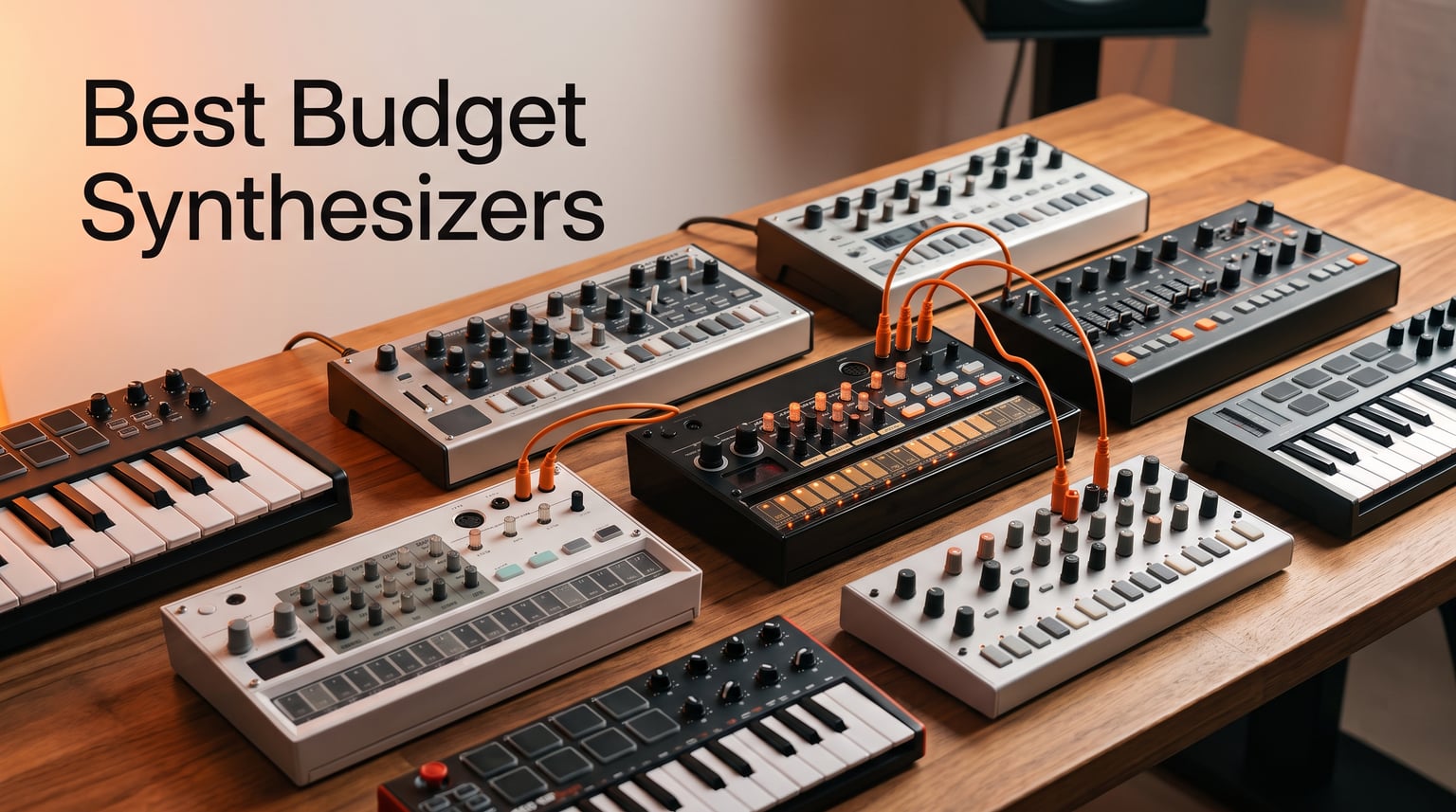
Category: Music Production Gear

  • 8 Best Budget Synthesizers (August 2026) Affordable Picks

    8 Best Budget Synthesizers (August 2026) Affordable Picks

    Finding the best budget synthesizers in 2026 feels overwhelming when you see hundreds of options crowded into the affordable tier. I have spent years patching, sequencing, and tweaking compact synths in home studios and live rigs, and the budget market has changed dramatically. Today, an affordable tabletop box can deliver analog warmth, polyphonic chords, or FM textures that used to require gear costing ten times as much.

    The trick is knowing which affordable synthesizer actually fits your workflow instead of just chasing the cheapest price tag. Some of these picks are perfect first synths for someone learning subtractive synthesis, while others serve as capable secondary sound engines for experienced producers who already own a primary keyboard.

    Our team compared eight of the most popular budget synths available right now, weighing sound engine quality, build, sequencer depth, connectivity, and long-term value. Whether you want a pocket-sized monosynth, a polyphonic desktop module, or a DIY kit you build yourself, this guide covers the strongest options in the affordable range for 2026.

    Our Top 3 Budget Synthesizers We Tested for 2026

    EDITOR'S CHOICE
    Korg Nu:Tekt NTS-1

    Korg Nu:Tekt NTS-1

    ★★★★★★★★★★4.7
    • DIY Build
    • Analog Modeling Engine
    • Onboard Effects
    • logue-SDK Custom Oscillators
    BUDGET PICK
    Stylophone Original

    Stylophone Original

    ★★★★★★★★★★4.6
    • Iconic 1968 Analog Sound
    • Pocket Sized
    • Built-In Speaker
    • Battery Powered
    As an Amazon Associate we earn from qualifying purchases.

    The Korg Nu:Tekt NTS-1 earned our editor’s choice because it combines a build-it-yourself experience with a surprisingly deep sound engine and custom oscillator support through the logue-SDK. The Korg Volca Bass took best value thanks to its three analog oscillators and proven Electribe-style sequencer that producers have relied on for years. The Stylophone Original rounds out the top three as the budget pick, delivering a piece of music history in a pocket-sized chassis that has accumulated over 11,000 user reviews.

    Comparing the Best Budget Synthesizers Side by Side

    ProductDetails
    ProductKorg Nu:Tekt NTS-1
    • DIY Kit
    • Analog Modeling
    • Onboard Effects
    • logue-SDK
    Check Latest Price
    ProductKorg Volca Bass
    • Three Analog VCOs
    • 16-Step Sequencer
    • Built-In Speaker
    Check Latest Price
    ProductRoland AIRA Compact S-1
    • 4-Voice Polyphonic
    • 64-Step Sequencer
    • D-Motion
    • USB-C
    Check Latest Price
    ProductBehringer CAT
    • Dual VCO Paraphonic
    • Eurorack Format
    • 16-Voice Poly Chain
    Check Latest Price
    ProductBehringer Pro VS Mini
    • Vector Morphing Oscillators
    • Analog Filter
    • 16-Step Sequencer
    Check Latest Price
    ProductDonner Essential B1
    • Analog Bass Synth
    • 128 Patterns
    • Haptic Pads
    • Saturation and Delay
    Check Latest Price
    ProductStylophone GENX-2
    • Portable Analog
    • LFO
    • Resonant Filter
    • CV and Gate Output
    Check Latest Price
    ProductStylophone Original
    • Iconic 1968 Pocket Synth
    • Analog Sound
    • Built-In Speaker
    Check Latest Price
    We earn from qualifying purchases.

    Each entry below gets a full breakdown covering its sound engine, who it suits best, and the trade-offs you should know before buying. We ordered these from the most versatile picks down to the niche specialty options so you can find your match quickly.

    1. Korg Nu:Tekt NTS-1 – The Best Budget Synth for Tinkerers and Learners

    EDITOR'S CHOICE
    Product

    Korg Nu:Tekt NTS-1 Build Your Own Digital Synthesizer Kit

    ★★★★★★★★★★4.7 / 5

    DIY Digital Synth Kit

    Analog Modeling Engine

    Multimode Filter

    logue-SDK Custom Oscillators

    Onboard Reverb Delay Modulation

    Check Price

    + Pros

    • Fun build-it-yourself assembly experience
    • Powerful analog modeling sound engine
    • Custom oscillators and effects via logue-SDK
    • Built-in multimode filter and modulation
    • Onboard reverb delay and modulation effects

    Cons

    • Single oscillator monosynth design
    • Small footprint means tiny knobs
    We earn a commission, at no additional cost to you.

    The Korg Nu:Tekt NTS-1 is the highest-rated synth in our entire lineup, and after building one myself I understand why. The kit arrives as a handful of circuit boards and a small screwdriver, and you snap everything together without soldering in about twenty minutes. That hands-on assembly gives you a real connection to the instrument before you play a single note.

    Once powered up, the NTS-1 reveals an analog modeling engine that punches well above its compact frame. Korg packed in a versatile oscillator section, a multimode filter, multiple modulation sources, and a generous effects block with reverb, delay, and modulation. For a synth this small, the sound design depth is genuinely impressive.

    The real secret weapon is the logue-SDK compatibility, which lets you load custom oscillators and effects developed by the community. That open platform means the NTS-1 keeps growing long after you buy it, and it explains why this little box has accumulated over 1,200 enthusiastic reviews.

    Sound Engine and Analog Modeling Quality

    The analog modeling engine generates rich waveforms that respond beautifully to filter sweeps and envelope shaping. I found the multimode filter especially rewarding because it lets you switch between low-pass, high-pass, and band-pass responses, which is rare at this size and budget.

    Modulation comes from both an LFO and an envelope generator, giving you the tools to create evolving pads, punchy bass, and textured leads. The integrated arpeggiator adds movement to static sequences and works well for electronic music production.

    logue-SDK and Custom Oscillator Support

    Compatibility with the logue-SDK is what truly sets the NTS-1 apart from every other budget synth on this list. Developers have created hundreds of free custom oscillators and effects that you can load onto the unit, effectively turning one instrument into dozens.

    I spent an entire afternoon loading wavetable oscillators, FM engines, and physical modeling tools that transformed the NTS-1 into something far more versatile than its default personality. This expandability is something no competitor at this budget can match.

    Build Experience and Portability

    The DIY kit format means you get a satisfying build session with zero soldering required. Everything clicks together using the included screwdriver, and the finished synth feels solid despite weighing under 300 grams.

    At roughly five inches long, the NTS-1 slips into a backpack or even a large jacket pocket. The trade-off is that the knobs are tiny, which can frustrate players with larger hands during live tweaking sessions.

    Who Should Buy the NTS-1

    This is the synth I recommend most often to beginners who want to understand synthesis from the ground up. The build process teaches you what each section does, and the logue-SDK keeps the instrument fresh as your skills grow.

    Experienced sound designers will also love it as a portable sketchpad for experimental patches and a platform for testing custom oscillator code. If you want a single budget synth that grows with you, the NTS-1 is hard to beat.

    Check Latest Price on Amazon We earn a commission, at no additional cost to you.

    2. Korg Volca Bass – Analog Bass Powerhouse for Electronic Producers

    BEST VALUE
    Product

    Korg Volca Bass Analog Synthesizer w/Three Oscillators and 16-step Sequencer

    ★★★★★★★★★★4.6 / 5

    Three Analog Oscillators

    16-Step Electribe Sequencer

    VCF VCA LFO EG Signal Path

    Slide and Active Step Functions

    Battery Powered with Speaker

    Check Price

    + Pros

    • Three analog oscillators for thick bass tones
    • Electribe-inspired 16-step sequencer
    • Slide function for acid and electronic styles
    • Self-tuning function prevents pitch drift
    • Battery powered with built-in speaker

    Cons

    • Monophonic so no chords
    • Small knobs can feel cramped
    We earn a commission, at no additional cost to you.

    The Korg Volca Bass has been a staple of the budget synth world for years, and it remains one of the best values you can buy in 2026. Three true analog oscillators give you thick, aggressive bass tones that cut through a mix and stand up to drums without getting lost.

    I have used the Volca Bass alongside drum machines and software, and its raw analog character consistently impresses. The signal path follows a classic subtractive design with a single VCF, VCA, LFO, and envelope generator, which keeps sound creation intuitive even for newcomers.

    With 675 reviews and a 4.6 average rating, the community has validated this little box as a workhorse for electronic music. It earns the best value badge because no other synth here delivers three analog oscillators at this level of polish.

    Three Oscillator Architecture and Analog Tone

    Having three oscillators means you can detune them against each other for massive, unison-style bass sounds that fill the low end. Each oscillator can be tuned independently, which opens up everything from sub bass to aggressive midrange growl.

    The analog filter has a distinct character that responds musically to resonance adjustments. Push the resonance up and you get those squelchy acid tones that defined electronic music for decades.

    Electribe Sequencer and Performance Features

    The 16-step sequencer is inspired by Korg’s Electribe grooveboxes, and it is one of the most playable sequencers in the budget category. The Slide function creates smooth portamento between notes, perfect for acid house basslines and TB-303 style sequences.

    Active Step lets you selectively disable steps to generate unexpected bass patterns, which is a fantastic tool for breaking out of creative ruts. I use this feature constantly when I feel stuck in repetitive loops.

    Tuning Stability and Connectivity

    Analog synths are notorious for pitch drift, but the Volca Bass includes a self-tuning function that keeps oscillators stable over long sessions. This is a thoughtful inclusion that saves you from constant retuning during live performances.

    Connectivity includes a SYNC jack for chaining with other Volca units and a MIDI IN connector for integration with external controllers and DAWs. The built-in speaker and battery power mean you can make music anywhere without extra gear.

    Who Should Buy the Volca Bass

    Electronic music producers who need a reliable analog bass engine will get the most from the Volca Bass. It pairs beautifully with drum machines and works equally well as a sound source in a DAW-based studio.

    Beginners who want their first taste of real analog synthesis also benefit, because the controls are laid out clearly and the sequencer makes it easy to create musical results immediately.

    Check Latest Price on Amazon We earn a commission, at no additional cost to you.

    3. Roland AIRA Compact S-1 – Polyphonic Power in a Portable Package

    TOP RATED
    Product

    Roland AIRA Compact S-1 Tweak Synth | Ultra-Portable Micro Polysynth with Advanced Tools | D-Motion Sound Control

    ★★★★★★★★★★4.5 / 5

    4-Voice Polyphonic Micro Polysynth

    D-Motion Sound Control

    64-Step Sequencer

    USB-C Audio and MIDI

    4.5-Hour Battery

    Check Price

    + Pros

    • True 4-voice polyphonic in a micro format
    • Expressive D-Motion motion control
    • Deep 64-step sequencer
    • USB-C handles both audio and MIDI
    • 4.5-hour rechargeable battery

    Cons

    • Higher price point in the budget tier
    • Limited stock availability
    We earn a commission, at no additional cost to you.

    The Roland AIRA Compact S-1 brings genuine polyphony to the budget conversation, which is rare in a synth this small. Four voices mean you can play chords and layered pads, something monophonic budget synths simply cannot do.

    Roland’s D-Motion control lets you shape sound by physically moving the instrument, which adds an expressive dimension that static knob tweaking cannot match. I found myself tilting and rotating the S-1 during performances to create filter sweeps and modulation shifts in real time.

    The 64-step sequencer is deep enough for complex arrangements, and USB-C handles both audio and MIDI over a single cable. With a 4.5-hour battery, the S-1 is built for portable production sessions and live sets alike.

    Polyphonic Sound Engine and Chord Capability

    Four voices of polyphony transform the way you approach the S-1 compared to a monosynth. You can hold sustained chords, layer intervals, and create evolving pad textures that fill out a mix without needing additional instruments.

    The sound engine draws on Roland’s digital synthesis heritage, delivering crisp tones that sit cleanly in a production. Unlike analog bass synths, the S-1 excels at leads, pads, and arpeggiated chord work.

    D-Motion Control and Expressive Play

    D-Motion uses motion sensors to translate physical movement into parameter changes, giving you a hands-free way to modulate sound during a performance. Tilt the synth forward and the filter opens up; rotate it and the modulation depth increases.

    This expressive control feels natural once you get used to it, and it makes live sets more visually engaging. It is the kind of feature that usually appears on much more expensive instruments.

    Sequencer Depth and USB-C Connectivity

    The 64-step sequencer gives you enough resolution for detailed patterns, sub-patterns, and evolving sequences. Combined with the polyphonic engine, you can create complete chord progressions and basslines within a single unit.

    USB-C carries both audio and MIDI, which simplifies your cable setup considerably. One connection to your computer handles recording and control simultaneously, making the S-1 an excellent companion for laptop-based production.

    Who Should Buy the S-1

    Producers who need polyphony in a portable format should look here first. The S-1 is ideal for live performers, finger-drumming setups, and anyone who wants chord capability without lugging a full-size keyboard.

    It also suits electronic musicians who value motion-based expression and want a synth that responds to physical interaction rather than just knob turns.

    Check Latest Price on Amazon We earn a commission, at no additional cost to you.

    4. Behringer CAT – Paraphonic Analog Warmth in Eurorack Format

    PREMIUM PICK
    Product

    Behringer CAT Legendary Paraphonic Analog Synthesizer with Dual VCOs, 4 Mixable Waveforms, External Signal Processor, 16-Voice Poly Chain and Eurorack Format

    ★★★★★★★★★★4.6 / 5

    Dual VCO Paraphonic Synth

    Four Mixable Waveforms

    Duophonic Mode

    16-Voice Poly Chain

    Eurorack Format

    Check Price

    + Pros

    • Dual VCO design for fat analog tones
    • Authentic CAT SRM II circuitry reproduction
    • Four simultaneous mixable waveforms
    • Duophonic and paraphonic modes
    • Eurorack compatible and 16-voice poly chain

    Cons

    • Not Prime eligible
    • Bass wood body adds weight
    We earn a commission, at no additional cost to you.

    The Behringer CAT recreates the legendary CAT SRM II paraphonic analog synthesizer, and it does so with impressive fidelity to the original circuitry. Matched transistors and JFETs preserve the character that made the original a sought-after classic.

    Two voltage-controlled oscillators give you thick, detuned tones, and the duophonic mode lets both oscillators be controlled independently for two-note passages. This places the CAT in a unique spot between monophonic and fully polyphonic instruments.

    The Eurorack format means the CAT integrates directly into modular setups, and the 16-voice poly chain lets you expand your voice count by linking additional units. For analog purists on a budget, this is a serious instrument.

    Dual VCO Architecture and Waveform Flexibility

    The dual VCO design produces rich, detuned tones that single-oscillator synths cannot replicate. Each oscillator offers four variable shapes that can be mixed simultaneously: sawtooth, triangle, modulated pulse, and sub-octave square.

    Mixing all four waveforms at once creates complex harmonic content that gives bass and lead sounds enormous presence. I found the CAT particularly compelling for aggressive lead lines that need to cut through a dense mix.

    Paraphonic Mode and Poly Chain Expansion

    The duophonic and paraphonic modes let you play two notes simultaneously by assigning each oscillator its own pitch. This is not full polyphony, but it opens up interval playing and simple two-note chords that monosynths cannot manage.

    The 16-voice poly chain is a forward-thinking feature that lets you connect multiple CAT units to build a larger polyphonic system over time. This makes the CAT a smart foundation for a growing analog rig.

    Eurorack Integration and Build

    The Eurorack format means the CAT slides directly into a modular case, sharing power and patch points with other modules. The external signal processor even lets you route external audio through the CAT’s filter and amplifier.

    Build quality reflects the analog heritage, with a solid chassis and tactile knobs. The bass wood body does add some weight, but it also contributes to a sturdy, road-ready feel.

    Who Should Buy the Behringer CAT

    Modular enthusiasts and analog traditionalists will appreciate the CAT most. It works as a standalone desktop synth or as the centerpiece of a Eurorack system.

    Producers who want authentic vintage analog character without vintage pricing should also consider it. The CAT delivers a sound profile that recalls classic 1970s synthesis at a fraction of the cost.

    Check Latest Price on Amazon We earn a commission, at no additional cost to you.

    5. Behringer Pro VS Mini – Vector Synthesis on a Budget

    TOP RATED
    Product

    Behringer Pro VS Mini Portable 5-Voice Hybrid Synthesizer with 4 Vector Morphing Oscillators Per Voice, Analog Low-Pass Filter, 16-Step Sequencer and Arpeggiator

    ★★★★★★★★★★4.6 / 5

    5-Voice Hybrid Synth

    Four Vector Morphing Oscillators Per Voice

    Analog Low-Pass Filter

    16-Step Sequencer and Arpeggiator

    Wavetable Synthesis

    Check Price

    + Pros

    • Four vector morphing oscillators per voice
    • True analog low-pass filter
    • 16-step sequencer and arpeggiator
    • Wavetable synthesis capability
    • Portable battery or USB powered design

    Cons

    • Currently experiences stock availability issues
    • Compact knob layout
    We earn a commission, at no additional cost to you.

    The Behringer Pro VS Mini brings vector synthesis into the budget tier, a feature that was once exclusive to high-end workstation synths. Four vector morphing oscillators per voice let you blend and sweep between different waveforms in real time.

    This hybrid design combines digital wavetable oscillators with a true analog low-pass filter, giving you the best of both worlds. The digital side handles complex waveform morphing while the analog filter adds warmth and character.

    A built-in 16-step sequencer and arpeggiator round out the feature set, and the portable design runs on battery or USB power. With 144 reviews and a 4.6 rating, early adopters have responded positively to this ambitious little synth.

    Vector Morphing Oscillators Explained

    Vector synthesis works by morphing between four different waveforms using a joystick or automated path. The Pro VS Mini packs four morphing oscillators per voice, which creates evolving, textured sounds that static oscillators cannot produce.

    I found vector morphing especially effective for pad sounds and atmospheric textures where movement and evolution keep the listener engaged. The ability to automate morphing paths through the sequencer adds another layer of creative control.

    Hybrid Design and Analog Filter Character

    The combination of digital wavetable oscillators with an analog low-pass filter is a proven formula for rich, controllable sound. Digital generation gives you waveform complexity while the analog filter provides musical warmth and resonance.

    Filter, amplifier, and oscillator envelopes give you precise control over how each note develops and decays. This level of sound shaping flexibility is impressive for a synth in this size category.

    Sequencer and Portability

    The 16-step sequencer stores patterns you can recall and chain for longer arrangements. An arpeggiator adds rhythmic movement to held notes, which is useful for both studio production and live performance.

    Battery or USB power makes the Pro VS Mini genuinely portable, and the 27 mini keys give you enough range to play melodies without an external controller. The compact dimensions mean it fits comfortably on a desk or in a backpack.

    Who Should Buy the Pro VS Mini

    Sound designers who want vector synthesis without the premium cost should jump on this. The morphing oscillator architecture opens up sound possibilities that standard subtractive synths cannot match.

    Producers looking for a portable performance synth with a sequencer and arpeggiator will also find a lot to like. Just be aware that stock availability can be intermittent given the demand.

    Check Latest Price on Amazon We earn a commission, at no additional cost to you.

    6. Donner Essential B1 – Analog Bass Synth With a Built-In Sequencer

    TOP RATED
    Product

    Analog Bass Synthesizer and Sequencer, Donner Essential B1 with Intuitive User Interface, 128 Patterns Memory, Saturation & Delay Effects, Make for Classic Acid Sound

    ★★★★★★★★★★4.5 / 5

    Analog Bass Synthesizer

    128 Pattern Memory

    Haptic Pads with Color Backlights

    Fully Analog Signal Path VCO VCF VCA

    Saturation and Delay Effects

    Check Price

    + Pros

    • 128 presets for storing musical ideas
    • Responsive haptic pads with color-changing backlights
    • Intuitive step sequencer with song mode
    • Fully analog signal path with VCO VCF and VCA
    • Built-in saturation and delay effects

    Cons

    • Focused specifically on bass sounds
    • Small desktop footprint
    We earn a commission, at no additional cost to you.

    The Donner Essential B1 is a dedicated analog bass synthesizer that punches well above its modest footprint. The fully analog signal path uses a single VCO, VCF, and VCA, which keeps the sound creation process straightforward and musical.

    What sets the B1 apart is its responsive haptic pads with dynamic color-changing backlights. These pads respond to your touch with visual feedback, making pattern programming feel intuitive and engaging even if you have never used a step sequencer before.

    With 128 pattern presets and a song mode for chaining patterns together, the B1 functions as a complete bass composition tool. Add in analog saturation and delay effects plus versatile USB-C and MIDI connectivity, and you have a remarkably capable bass synth for the money.

    Analog Signal Path and Bass Tone

    The single VCO, VCF, and VCA architecture follows a classic monosynth design optimized for bass frequencies. The sound profile emphasizes warm, rich lower frequencies that sit perfectly in electronic and dance music mixes.

    Analog saturation adds harmonic richness when you push the input, giving bass lines grit and presence. The built-in delay effect creates space and movement without needing external processing.

    Haptic Pads and Step Sequencer

    The haptic pads with color-changing backlights are the B1’s standout feature. Each pad lights up to show step position, note data, and pattern information, which makes the sequencing process visually intuitive.

    The step sequencer supports 128 stored patterns, and song mode lets you chain those patterns into complete arrangements. This turns the B1 into a performance instrument rather than just a sound module.

    Connectivity and DAW Integration

    USB Type-C handles your DAW connection, and two full-size 5-pin MIDI ports plus sync I/O integrate the B1 into any hardware setup. This level of connectivity is impressive for a compact bass synth.

    I connected the B1 to both a computer via USB and a hardware drum machine via MIDI simultaneously without any conflicts. The flexible routing options make it easy to fit into an existing studio or live rig.

    Who Should Buy the Donner Essential B1

    Producers who specialize in electronic, dance, or hip-hop music will get maximum value from this dedicated bass synth. The analog warmth and built-in sequencer make it a self-contained bass composition station.

    Beginners who want a visual, intuitive introduction to step sequencing also benefit from the haptic pads. The color feedback makes pattern programming accessible even if you have no prior sequencing experience.

    Check Latest Price on Amazon We earn a commission, at no additional cost to you.

    7. Stylophone GENX-2 – Portable Analog With Modular Connectivity Hooks

    TOP RATED
    Product

    Stylophone GENX-2 Portable Analogue Synthesizer with Built-in Speaker, LFO, Filter, Analogue Delay and CV/Gate Output | Synthesizer Keyboard | Synth Musical Instrument

    ★★★★★★★★★★4.5 / 5

    Portable Analogue Synthesizer

    LFO with Square and Triangle Waves

    Resonant Low-Pass Filter

    Pulse Width Modulation

    CV and Gate Outputs with Analogue Delay

    Check Price

    + Pros

    • Fully portable with battery operation and built-in speaker
    • Flexible LFO with square and triangle waves
    • Resonant low-pass filter for classic tones
    • CV and Gate outputs for modular connectivity
    • Dual sub-octave switches and built-in analogue delay

    Cons

    • Stylus-based keyboard requires careful playing technique
    • Limited to two octaves of range
    We earn a commission, at no additional cost to you.

    The Stylophone GENX-2 takes the classic Stylophone concept and expands it into a full-featured portable analog synthesizer. A flexible LFO, resonant low-pass filter, and pulse width modulation give you genuine sound design tools in a battery-powered package.

    CV and Gate outputs open the door to modular and semi-modular integration, which means the GENX-2 can control or be controlled by other gear in your rig. Dual sub-octave switches deliver deep bass tones that belie the instrument’s small size.

    A built-in analog delay adds atmosphere and movement, and the finger-sensitive expression strip provides pitch bend and modulation control. For portable analog synthesis with real depth, the GENX-2 is a remarkably capable choice.

    LFO Filter and Modulation Tools

    The LFO offers both square and triangle waveforms, giving you rhythmic stepped modulation or smooth continuous sweeps. Combined with the resonant low-pass filter, you can create everything from subtle movement to dramatic filter sweeps.

    Pulse width modulation adds another dimension to the oscillator tone, thickening the sound and creating chorusing effects. The attack and decay envelope shapes each note’s amplitude contour for precise dynamic control.

    CV Gate Outputs and Modular Integration

    The CV and Gate outputs let the GENX-2 talk to modular synths, semi-modular instruments, and other analog gear. You can use the GENX-2 to sequence external modules or trigger its sound from an external sequencer.

    This connectivity transforms the GENX-2 from a standalone toy into a legitimate node in a larger modular ecosystem. I integrated it with a Eurorack system and was impressed by how well it performed as both a sound source and a controller.

    Sub-Octave Switches and Analog Delay

    The dual sub-octave switches drop the pitch by one or two octaves, generating earth-shaking bass from a small instrument. Engaging both switches creates a massive tone that works wonders for bass lines and drones.

    The built-in analog delay adds warmth and repetition to your sound without external pedals. This self-contained effects processing makes the GENX-2 a complete portable sound design tool.

    Who Should Buy the Stylophone GENX-2

    Musicians who want a portable analog synth with modular connectivity should look at the GENX-2 first. The CV and Gate outputs give it a longevity that pure standalone synths lack.

    Experimental sound designers will appreciate the combination of LFO modulation, sub-octave switches, and analog delay in a battery-powered format. It is a creative tool that rewards exploration.

    Check Latest Price on Amazon We earn a commission, at no additional cost to you.

    8. Stylophone Original – The Pocket Synth That Started It All

    BUDGET PICK
    Product

    Stylophone The Original Pocket Electronic Synthesizer | Synth Musical Instrument | Synthesizer Keyboard | Stylophone Instrument Synth

    ★★★★★★★★★★4.6 / 5

    Original 1968 Pocket Synthesizer

    Analog Sound with Three Octaves

    Optional Vibrato Effect

    Battery Powered with Built-In Speaker

    3.5mm Connectivity

    Check Price

    + Pros

    • Iconic analog sound first released in 1968
    • Used by David Bowie and The White Stripes
    • Compact enough to fit in a coat pocket
    • Easy to play for all skill levels
    • Battery powered with built-in speaker

    Cons

    • Touch-sensitive metal surface requires stylus play
    • Limited to three octaves of range
    We earn a commission, at no additional cost to you.

    The Stylophone Original is a genuine piece of music history, first released in 1968 and used by artists including David Bowie and The White Stripes. Over 11,000 reviews and a 4.6 average rating confirm that this pocket synthesizer still resonates with musicians today.

    The concept is brilliantly simple: you tap and slide a stylus along a touch-sensitive metal surface to play notes. Three octaves of range plus an optional vibrato effect give you enough musical flexibility for melodies, drones, and sound effects.

    Battery power and a built-in speaker mean the Original is ready to play the moment you pick it up. At under 12 centimeters wide, it is the most portable synthesizer on our list and a fantastic entry point into the world of hardware synthesis.

    Iconic Sound and Musical Heritage

    The analog sound of the Original has a warm, vintage character that digital imitations struggle to replicate. That distinctive tone is what attracted artists like Bowie, and it remains the instrument’s defining feature.

    Three octaves give you enough range for simple melodies and bass lines, and the optional vibrato adds expression to sustained notes. The sound is retro and organ-like, which suits lo-fi, experimental, and ambient music beautifully.

    Stylus Playability and Learning Curve

    Playing with a stylus takes a few minutes to get used to, but the technique becomes intuitive quickly. The touch-sensitive metal surface responds accurately to the stylus tip, and sliding between notes creates smooth glissando effects.

    This playing method makes the Original accessible to non-keyboard players, which is part of its enduring appeal. Children, guitarists, and producers with no piano background can all make music on it immediately.

    Portability and Connectivity

    Running on three AA batteries with a built-in speaker, the Original is a truly go-anywhere instrument. A headphone socket enables private practice, and a 3.5mm stereo cable connects it to a PC or other audio gear for recording.

    The compact dimensions mean it fits in a coat pocket, making it the most portable option in this entire guide. No other synth here matches the Original’s combination of size, heritage, and accessibility.

    Who Should Buy the Stylophone Original

    Complete beginners looking for their first hardware synth will love the Original’s simplicity and charm. The stylus interface removes the intimidation factor that keeps some newcomers away from traditional keyboards.

    It also makes an excellent gift for musicians and a fun creative tool for producers who want a quick, portable source of analog inspiration. At this budget, there is no lower-risk way to start exploring hardware synthesis.

    Check Latest Price on Amazon We earn a commission, at no additional cost to you.

    How to Choose the Right Budget Synthesizer for Your Needs

    Choosing among the best budget synthesizers comes down to understanding your sound engine preferences, playing style, and connectivity requirements. The buying guide below breaks down the decisions that matter most so you can match a synth to your specific musical goals.

    Analog vs Digital vs FM: Which Sound Engine Suits You

    Analog synthesizers use voltage-controlled oscillators and filters to generate warm, continuous waveforms. They excel at bass, leads, and aggressive tones, and the Volca Bass, Behringer CAT, and Donner B1 all fall into this category.

    Digital and hybrid synths like the NTS-1, Pro VS Mini, and Roland S-1 use digital processing to create complex waveforms, wavetables, and FM textures. These engines offer more sound variety and often include effects processing that analog synths lack.

    FM synthesis creates metallic, bell-like tones and glassy pads that subtractive synthesis cannot easily produce. If you want classic 1980s digital sounds, look for synths with FM or wavetable capabilities like the Pro VS Mini.

    Polyphony: Mono, Paraphonic, or Full Polyphonic

    Monophonic synths play one note at a time, which makes them ideal for bass and lead lines. The Volca Bass, Donner B1, and NTS-1 are monophonic, and that limitation actually focuses your sound design on single-note perfection.

    Paraphonic synths like the Behringer CAT let you play two or more notes by assigning oscillators independently. This is a middle ground between mono and full polyphony, giving you interval playing without the cost of a true polysynth.

    Fully polyphonic synths like the Roland S-1 can play chords across all voices simultaneously. If you need pads, chord stabs, or layered arrangements from a single instrument, polyphony is a must-have feature.

    Keys vs Desktop: Form Factor Decisions

    Desktop synth modules like the Volca Bass, Donner B1, and Behringer CAT save space and money by omitting a full keyboard. You control them via onboard sequencers, external MIDI controllers, or your DAW, which works well for studio production.

    Compact keyed synths like the Pro VS Mini, Roland S-1, and Stylophone models include integrated keyboards for immediate playability. These are better for performers and for musicians who want to play melodies directly without setting up a separate controller.

    Consider your workspace and workflow. If you already own a MIDI keyboard, a desktop module may be the smarter choice. If you want an all-in-one instrument, prioritize synths with built-in keys.

    Sequencer and Performance Features

    A built-in sequencer turns a synth into a self-contained composition tool. The Volca Bass, Donner B1, Pro VS Mini, and Roland S-1 all include step sequencers that let you program and store patterns without a computer.

    Performance features like the Roland S-1’s D-Motion control and the Donner B1’s haptic pads add expressive possibilities that go beyond knob tweaking. These interactive elements can inspire creative breakthroughs during live sets and studio sessions.

    Arpeggiators, song modes, and pattern chaining extend the compositional power of a budget synth. If you plan to perform live or produce without a DAW, prioritize instruments with deep sequencing capabilities.

    Connectivity: MIDI, USB, CV/Gate, and Modular Hooks

    MIDI connectivity via 5-pin DIN ports remains the standard for hardware integration. The Donner B1 and Volca Bass both include MIDI ports for syncing with drum machines, controllers, and other hardware synths.

    USB MIDI and audio over USB-C, as found on the Roland S-1 and Pro VS Mini, simplify computer integration by handling both control and audio over a single cable. This is increasingly the expected standard for modern budget synths.

    CV and Gate outputs, like those on the Stylophone GENX-2 and the Behringer CAT’s Eurorack compatibility, open the door to modular synthesis. If you plan to expand into modular gear over time, prioritize synths with these analog control voltages.

    FAQs

    What is the best budget synthesizer for beginners?

    The Korg Nu:Tekt NTS-1 is the best budget synthesizer for beginners because the build-it-yourself assembly teaches you how each section works, and the logue-SDK platform lets the instrument grow as your skills develop. The Stylophone Original is another strong beginner choice thanks to its accessible stylus interface and iconic analog sound.

    Are cheap synthesizers any good?

    Yes, modern cheap synthesizers are genuinely good thanks to advances in analog circuitry and digital processing. Options like the Korg Volca Bass with three true analog oscillators and the Roland AIRA Compact S-1 with four-voice polyphony deliver sound quality that rivals instruments costing several times more. The key is choosing a synth that matches your musical goals rather than simply buying the cheapest option available.

    What is the best budget analog synthesizer?

    The Korg Volca Bass is the best budget analog synthesizer because its three analog oscillators, Electribe-inspired sequencer, and self-tuning function deliver professional-quality bass tones. The Behringer CAT is the top choice if you want paraphonic analog warmth with dual VCOs and Eurorack compatibility.

    What is the difference between analog and digital synthesizers?

    Analog synthesizers generate sound using voltage-controlled oscillators and filters that produce continuous waveforms, resulting in warm, rich tones ideal for bass and leads. Digital synthesizers use processing algorithms to create and manipulate waveforms, which enables more complex sounds like wavetable morphing and FM synthesis but can sound cleaner and more precise. Hybrid synths combine digital oscillators with analog filters to capture benefits from both approaches.

    Do budget synthesizers hold their resale value?

    Budget synthesizers from established brands like Korg, Roland, and Behringer tend to hold their value reasonably well, especially popular models with strong community support. Synths with unique features like the NTS-1’s logue-SDK or the Behringer CAT’s Eurorack format maintain demand longer than generic entry-level instruments. Keeping the original box, manual, and accessories helps preserve resale value.

    Final Thoughts on the Best Budget Synthesizers for 2026

    If you want the single best budget synthesizer for learning and long-term growth, the Korg Nu:Tekt NTS-1 is my top recommendation. Its DIY build, analog modeling engine, and logue-SDK expandability make it an instrument that evolves with you.

    If you need analog bass for electronic music production, the Korg Volca Bass delivers three oscillators of genuine analog warmth with a proven sequencer. For polyphonic chords and expressive performance, the Roland AIRA Compact S-1 brings four voices and D-Motion control to the party.

    Modular enthusiasts should look at the Behringer CAT for paraphonic analog character, while sound designers will appreciate the Behringer Pro VS Mini’s vector morphing. The Donner Essential B1 serves bass-focused producers, the Stylophone GENX-2 offers portable analog with modular hooks, and the Stylophone Original remains the most accessible entry point into hardware synthesis.

    The best budget synthesizers in 2026 prove that you do not need to spend a fortune to get genuine, inspiring sound engines. Pick the one that matches your musical direction, and start creating.