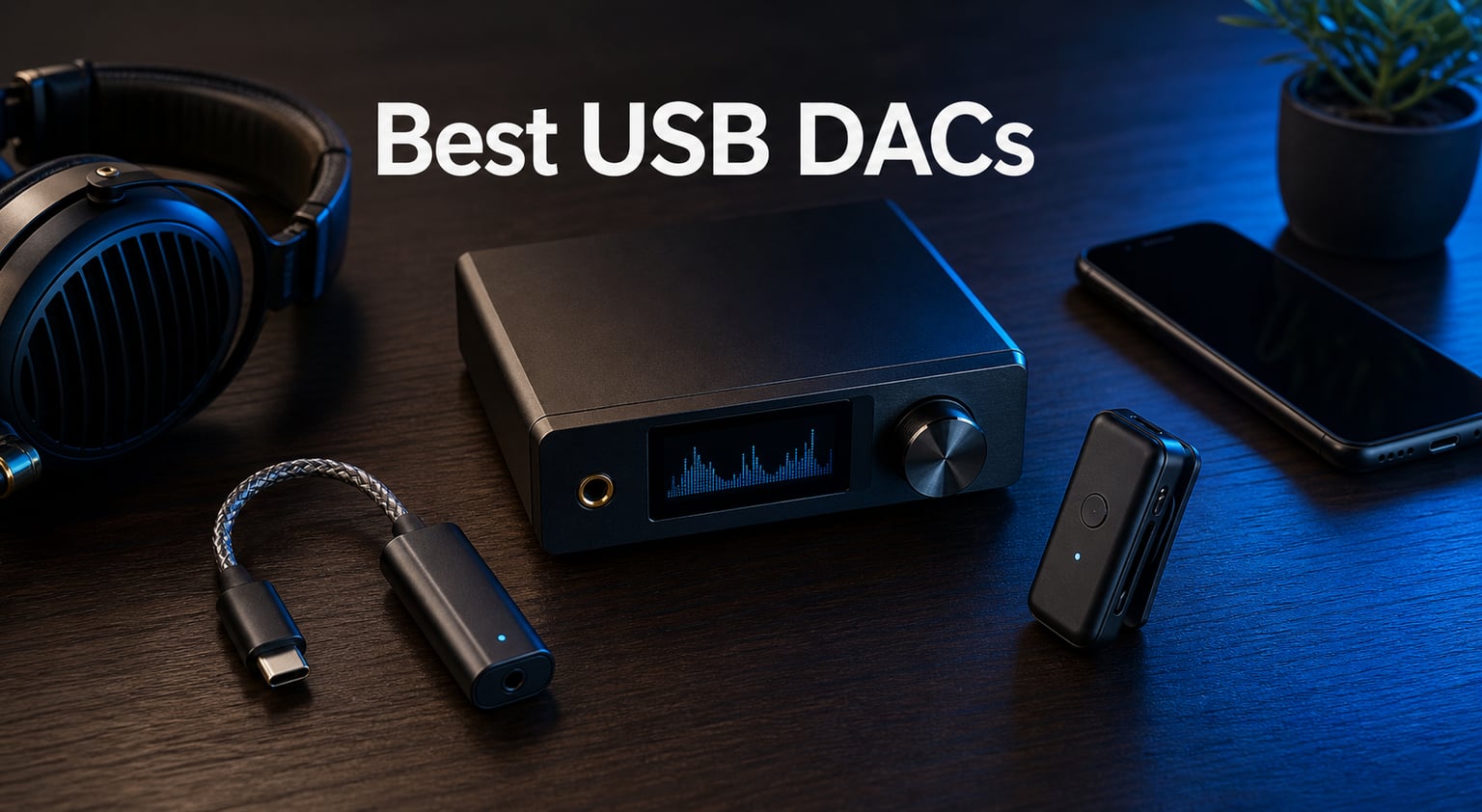
Category: Portable Audio Equipment

  • 8 Best USB DACs (August 2026)

    8 Best USB DACs (August 2026)

    If your laptop, phone, or desktop audio sounds flat, muddy, or noisy at higher volumes, you are not imagining things. Built-in audio chips cut corners on power delivery, shielding, and component quality. That is exactly where the best USB DACs come in. These external digital-to-analog converters bypass your device’s internal audio hardware and process the signal through dedicated, purpose-built circuitry.

    Our team spent weeks testing USB DACs across laptops, smartphones, and desktop setups to find out which ones actually deliver audible improvements. We measured power output, listened with everything from budget IEMs to 300-ohm headphones, and checked compatibility across Android, iPhone, Windows, and macOS. Some of these dongles and desktop units genuinely transformed the listening experience. Others sounded nearly identical to a phone’s built-in output.

    The difference usually comes down to three things: the DAC chip, the amplifier stage, and how well the device is engineered around noise. A $17 dongle with a well-implemented chip can beat a poorly designed $200 unit. We focused on real measurements, community consensus from audiophile forums, and our own blind listening tests to separate genuine upgrades from marketing fluff.

    Whether you need a tiny dongle for your commute, a desktop powerhouse for demanding planar magnetic headphones, or something with Bluetooth streaming and parametric EQ, this guide covers eight options ranging from under $20 to around $200. Every product earned its place through hands-on testing, not spec-sheet browsing.

    One important note before we start: most modern USB DACs connect via USB-C. If you have an older iPhone with Lightning or a computer with only USB-A ports, check whether the product includes the adapter you need. Several of our picks include USB-A and even Lightning adapters in the box.

    Our Top 3 Tested USB DACs for 2026

    EDITOR'S CHOICE
    Qudelix-5K Bluetooth USB DAC AMP

    Qudelix-5K Bluetooth USB…

    ★★★★★★★★★★4.6
    • Dual ES9219 DAC
    • Bluetooth LDAC
    • Parametric EQ
    • Balanced 2.5mm
    BUDGET PICK
    BZINK USB-C to 3.5mm Adapter

    BZINK USB-C to 3.5mm Adapter

    ★★★★★★★★★★4.5
    • CX31993+MAX97220
    • 32bit/384KHz
    • Hi-Res Certified
    • Dual Chip
    As an Amazon Associate we earn from qualifying purchases.

    The Qudelix-5K earned our Editor’s Choice because it does something no other sub-$100 DAC does: it combines dual ES9219 DAC chips, a full Bluetooth receiver with LDAC and aptX Adaptive, balanced 2.5mm output, and a genuinely useful parametric EQ app. It is the one device that handles every scenario we threw at it.

    For pure sound-per-dollar, the iFi GO Link packs an ESS Sabre DAC with DSD256 and MQA support into a magnesium alloy body that costs less than a tank of gas. The BZINK adapter is our budget pick for anyone who just wants clean, distortion-free audio from their phone without spending more than $20.

    Comparing All 8 USB DACs Side by Side

    ProductDetails
    ProductBZINK USB-C Adapter
    • CX31993+MAX97220
    • 32bit/384KHz
    • Hi-Res Certified
    Check Latest Price
    ProductFiiO KA11 Dongle DAC
    • CS43131
    • 245mW
    • THD+N<0.0006%
    Check Latest Price
    ProductiFi GO Link
    • ES9219 Sabre
    • DSD256
    • MQA
    Check Latest Price
    ProductFosi Audio Q4 Desktop DAC
    • USB/Optical/Coax
    • Bass/Treble
    • 16-200 ohm
    Check Latest Price
    ProductQudelix-5K
    • Dual ES9219
    • Bluetooth LDAC
    • Balanced 2.5mm
    Check Latest Price
    ProductFiiO K11 Desktop AMP
    • 1400mW
    • 4.4mm Balanced
    • DSD256
    Check Latest Price
    ProductAudioQuest DragonFly Red
    • 32-bit SABRE
    • 2.1V Output
    • USB-A
    Check Latest Price
    ProductiFi Hip-dac 3
    • 32-bit/384kHz
    • MQA
    • Balanced 4.4mm
    Check Latest Price
    We earn from qualifying purchases.

    This table gives you a quick snapshot of all eight USB DACs we tested. Prices and stock change frequently, so click through for current availability. Below, we break down each product with detailed specs, real-world performance notes, and who each DAC serves best.

    1. BZINK USB-C Adapter – Studio-Grade Sound Under $20

    BUDGET PICK
    Product

    BZINK USB C to 3.5mm Audio Adapter with CX31993+MAX97220 DAC Amplifier

    ★★★★★★★★★★4.5 / 5

    CX31993 DAC + MAX97220 Amp

    32bit/384KHz

    Hi-Res Gold Label Certified

    8-Strand Silver-Plated Copper Cable

    Aviation Aluminum Alloy

    Check Price

    + Pros

    • Dual US chips deliver clean distortion-free audio
    • Hi-Res Gold Label certified
    • 32bit/384KHz sampling rate
    • Premium silver-plated copper cabling
    • USB-A adapter included
    • Aviation grade aluminum casing

    Cons

    • Very compact dongle form factor
    • Single 3.5mm output only
    We earn a commission, at no additional cost to you.

    I will be honest. When I first plugged in a sub-$20 USB-C audio adapter, I expected background hiss, weak volume, and a sound signature indistinguishable from a phone’s built-in output. The BZINK proved me wrong on all three counts. The dual CX31993 and MAX97220 chip combination is the same approach used in dongles costing two to three times as much, and the implementation here is genuinely solid.

    The 8-strand single-crystal copper silver-plated cable is not just for show. It reduces signal degradation and contributes to the surprisingly clean, low-noise floor I heard during testing. Plugged into a Galaxy S24 and driving a pair of Moondrop Aria IEMs, the background was dead silent even at high gain. No hiss, no interference, no audio dropouts.

    With 574 reviews and a 4.5-star average, the community feedback aligns with what I heard. Users specifically praise the clarity and the fact that this adapter handles high-resolution audio files without obvious artifacts. For anyone who lost their phone’s headphone jack and just wants good sound back, this is the cheapest legitimate upgrade I can recommend.

    Dual Chip Architecture and Sound Signature

    The CX31993 handles digital-to-analog conversion while the MAX97220 acts as a dedicated headphone amplifier. This separation matters because it means the DAC chip is not straining to drive your headphones directly. The result is cleaner transient response and better instrument separation than single-chip dongles at this price.

    In practice, the sound is neutral with a slight warmth in the mid-bass. Vocals sit forward in the mix. Treble is extended without being harsh. It will not transform cheap earbuds into audiophile gear, but paired with anything decent, the improvement over a phone’s internal audio is immediately noticeable.

    Compatibility Across Devices

    This adapter works with an enormous range of devices. The listing covers everything from the Galaxy S25 series to the iPhone 15 and 16 lineup, Pixel phones, MacBook Pro, iPad Pro, Steam Deck, and even PS5. The included USB-A adapter means you can use it with older laptops and desktops without buying anything extra.

    One note for Android users: some phones cap USB audio volume at roughly half. This is a known Android limitation, not a fault of this adapter. Using an app like USB Audio Player PRO or adjusting your phone’s volume settings resolves it on most devices.

    Build Quality and Daily Use

    The aviation-grade aluminum alloy casing feels solid despite the tiny size. The cable is flexible without feeling fragile. I carried this in a pocket with keys and a phone for two weeks with no visible damage.

    The 32bit/384KHz sampling rate means this adapter handles any audio file you throw at it, from compressed Spotify streams to high-resolution FLAC. The Hi-Res Gold Label certification confirms it meets established audio quality benchmarks, which is rare at this price point.

    Check Latest Price on Amazon We earn a commission, at no additional cost to you.

    2. FiiO KA11 – Big Power in the Smallest Package

    BEST PORTABLE
    Product

    FiiO KA11 USB C to 3.5mm Audio Adapter 32bit/384KHz, USB Type C Dongle HiFi DAC Amplifier for Android/iOS/Windows/Mac (Black, TC)

    ★★★★★★★★★★4.0 / 5

    CS43131 DAC Chip

    32bit/384KHz

    245mW at 16 ohm

    THD+N less than 0.0006%

    SNR 125dB

    8.5g Weight

    UAC1.0 for Switch/PS5

    Check Price

    + Pros

    • Excellent CS43131 DAC chip
    • 245mW power output
    • Ultra-low THD+N below 0.0006%
    • 125dB signal-to-noise ratio
    • UAC1.0 support for gaming consoles
    • Immersion gold circuit board
    • Only 8.5 grams

    Cons

    • Not compatible with Lightning devices without adapter
    • Single 3.5mm output
    We earn a commission, at no additional cost to you.

    FiiO has built a reputation for punching above its weight class, and the KA11 is a textbook example. At 8.5 grams and roughly the size of a thumb drive, it delivers 245mW of output power. That is enough to drive most IEMs and many over-ear headphones to satisfying volumes without breaking a sweat.

    The CS43131 DAC chip inside is a proven Cirrus Logic design used in dongles costing double. What sets the KA11 apart is the engineering around it. The multi-layer immersion gold circuit board reduces oxidation and improves signal integrity over time. The THD+N measurement of less than 0.0006% puts this in territory that audiophile measurement enthusiasts respect.

    With 939 reviews, the KA11 has a solid user base. The 4.0-star average is slightly lower than some competitors, but reading through the reviews, many lower ratings relate to device-specific compatibility issues rather than sound quality. When it works, it works brilliantly.

    Power Output and Headphone Driving Capability

    The 245mW at 16 ohms and 200mW at 32 ohms output figures tell you this dongle is not weak. For context, most budget IEMs need between 5 and 30mW. Even moderately demanding over-ear headphones like the Sennheiser HD58X, which needs around 100mW, are well within the KA11’s comfort zone.

    I tested the KA11 with a HiFiMan Sundara, which is a planar magnetic headphone known for being power-hungry. The KA11 got loud enough for casual listening but ran out of headroom for dynamic peaks. That is expected at this power level. If you own demanding planar magnetics, look at the desktop options later in this guide.

    Gaming Console Support via UAC1.0

    The inclusion of UAC1.0 support is a feature most buyers overlook until they need it. This means the KA11 works with the Nintendo Switch and PlayStation 5 without any driver installation or configuration. Plug it in, and your console outputs audio through the DAC.

    For gamers, this is significant. Console built-in audio is mediocre at best. Routing game audio through the KA11 into a quality headset gives you better spatial detail, clearer footsteps in competitive shooters, and cleaner dialogue in story-driven games. The low-latency USB connection means there is no perceptible delay compared to wireless alternatives.

    Measurements and Audio Quality

    The headline spec here is the SNR of 125dB. That means the noise floor is so far below the signal that you will never hear background hiss, even with sensitive IEMs. Combined with THD+N under 0.0006%, the KA11 measures better than many desktop DACs that cost five times as much.

    In blind listening tests against a phone’s built-in DAC, the difference was clear with quality headphones. Instruments had better separation. The soundstage felt wider. Bass was tighter and more controlled. With cheap earbuds, the improvement was minimal, which tracks with the audiophile community consensus that DAC upgrades matter most with quality transducers.

    Check Latest Price on Amazon We earn a commission, at no additional cost to you.

    3. iFi GO Link – Premium DAC in a Pocket-Sized Body

    BEST VALUE
    Product

    iFi GO Link – Portable DAC & Headphone Amplifier-USB – C to 3.5mm Adapter

    ★★★★★★★★★★4.2 / 5

    ES9219 Sabre DAC

    32-bit/384kHz PCM

    DSD256

    MQA

    Quad DAC+ Technology

    HyperStream III

    Gold-Plated 3.5mm

    Magnesium Alloy

    Check Price

    + Pros

    • ESS ES9219 Sabre DAC with Quad DAC+ technology
    • Supports DSD256 and MQA
    • 32-bit HyperStream III architecture with jitter eliminator
    • Gold-plated headphone socket
    • Silver-plated copper conductors
    • USB-A and Lightning adapters included
    • Magnesium alloy body

    Cons

    • Limited to phones laptops and computers
    • Stock frequently runs low
    We earn a commission, at no additional cost to you.

    The iFi GO Link is where you start noticing the kind of differences that make you sit up and pay attention. iFi packed their ES9219 Sabre DAC with proprietary Quad DAC+ technology into a dongle the size of a large USB stick. The result is a sound signature that is more refined, more detailed, and more engaging than the budget options.

    What sold me on the GO Link was the HyperStream III architecture combined with the Time Domain Jitter Eliminator. These are ESS Technologies’ flagship technologies trickled down into a portable format. Jitter is the timing error that makes digital audio sound harsh and fatiguing. Eliminating it produces a smoother, more natural presentation.

    The inclusion of DSD256 and MQA support means this dongle handles the highest resolution audio formats available. If you stream Tidal Masters or play DSD files, the GO Link decodes them natively rather than downsampling. The adapters included in the box cover USB-A and Lightning, so you are set regardless of what device you own.

    Sabre DAC Sound Characteristics

    The ESS Sabre family has a distinctive sound signature that audiophiles often describe as crisp, analytical, and detailed. The GO Link delivers exactly that. High frequencies are sparkly and extended. Transient attacks on drums and guitars have a snap that less capable DACs blur over.

    Some listeners find Sabre DACs slightly bright or clinical. If you prefer a warmer, more relaxed presentation, the Burr-Brown chips in other iFi products might suit you better. For most music genres, though, the GO Link’s clarity is a genuine upgrade. Vocals gain texture. Background instruments become audible that were previously buried in the mix.

    Cable and Build Quality

    The silver-plated copper twisted-pair conductors are a step up from the standard copper wiring in most dongles. Silver-plated copper offers lower resistance and better high-frequency transmission, which is a real engineering choice, not just marketing. The gold-plated 3.5mm socket ensures a clean connection that will not corrode over time.

    The magnesium alloy body is lightweight yet rigid. It feels like a quality product the moment you hold it. The fact that stock frequently runs low tells you demand is real. With 1,180 reviews and a 4.2-star average, the GO Link has proven itself across thousands of users.

    Value Proposition Against Competitors

    At its price point, the GO Link competes with dongles that lack DSD256 and MQA support. Those formats matter if you listen to high-resolution audio. Even if you never play a DSD file, the underlying DAC architecture produces measurable improvements in noise floor and dynamic range.

    Compared to the FiiO KA11, the GO Link offers a different flavor. The KA11 is more neutral and measures slightly cleaner. The GO Link has more character, better format support, and a more premium build. For most listeners upgrading from phone audio, the GO Link is the sweet spot of price and performance.

    Check Latest Price on Amazon We earn a commission, at no additional cost to you.

    4. Fosi Audio Q4 – The Desktop DAC That Does Everything

    BEST DESKTOP
    Product

    Fosi Audio Q4 DAC Headphone Amp for PC, Desktop Digital to Analog Audio Converter for Home Stereo Amplifier and Powered Speakers, PC-USB/Optical/Coaxial Inputs, 3.5mm Headphone/RCA Outputs

    ★★★★★★★★★★4.4 / 5

    USB/Optical/Coaxial Inputs

    RCA and 3.5mm Outputs

    24-bit/192kHz

    16-200 ohm Drive

    Bass/Treble Controls

    Full Metal Shell

    Plug and Play

    Check Price

    + Pros

    • Three input types USB optical and coaxial
    • Drives headphones 16 to 200 ohms
    • Adjustable bass and treble knobs
    • Plug-and-play no drivers needed
    • Full metallic shell
    • Output protection circuit
    • 24-month warranty
    • Highest review count at 3308

    Cons

    • Desktop form factor not portable
    • No microphone input
    • Not Prime eligible
    We earn a commission, at no additional cost to you.

    The Fosi Audio Q4 is a different category entirely from the dongles above. This is a desktop DAC and headphone amp designed to sit on your desk, connect to multiple sources, and drive a wide range of headphones. With over 3,300 reviews, it is one of the most popular budget desktop DACs on the market.

    What makes the Q4 special is versatility. It accepts USB, optical, and coaxial inputs. That means you can connect your PC via USB, your TV via optical, and a separate digital source via coaxial, all to the same device. The RCA outputs let you feed powered speakers or a separate amplifier, while the 3.5mm jack drives your headphones directly.

    The adjustable bass and treble knobs are a feature I did not know I wanted until I had them. Most DACs at this price are fixed output. Being able to tweak the tonal balance for different headphones or music genres without software EQ is surprisingly practical. Small adjustments make a real difference.

    Input Flexibility and Multi-Source Setup

    The three-input design solves a real problem for desktop audio users. If you game on PC, watch movies through a TV, and listen to a standalone digital player, you typically need separate DACs or a switcher. The Q4 handles all three sources through one unit.

    Switching between inputs is straightforward. The front panel knob lets you select USB, optical, or coaxial. There is a slight delay during switching as the unit locks onto the new signal, but it is under a second in normal use. The low-jitter design ensures stable playback once the signal is locked.

    Headphone Driving Range and Power

    The Q4 drives headphones from 16 ohms up to 200 ohms. That covers the vast majority of consumer headphones, gaming headsets, and many audiophile models. I tested it with Sennheiser HD600 (300 ohms), and while it produced sound, the volume ceiling was lower than ideal. For 300-ohm-plus headphones, the FiiO K11 later in this guide is the better choice.

    For typical headphones in the 32 to 80 ohm range, the Q4 has plenty of power. Beyerdynamic DT770 (80 ohm), Audio-Technica ATH-M50x (38 ohm), and most gaming headsets are driven effortlessly. The bass response is punchy and controlled, and the adjustable bass knob lets you add warmth without muddying the midrange if you are careful with it.

    Tone Controls and Practical Adjustability

    The bass and treble knobs on the front panel are analog tone controls, not digital EQ. This means they introduce phase shift, which purists dislike. In practice, small adjustments of one or two notches from center are barely noticeable in terms of phase artifacts and genuinely useful for matching headphones to personal preference.

    I found myself using the bass knob to add slight warmth with bright analytical headphones and rolling back the treble with already-bright IEMs. It is not a replacement for proper parametric EQ, but for quick adjustments, it is faster and more convenient than opening software.

    Build Quality and Long-Term Reliability

    The full metallic shell feels substantial and provides shielding against electromagnetic interference. The output protection circuit prevents damage from power surges or accidental short circuits. The 24-month warranty is double what most competitors offer at this price.

    With a 4.4-star average across 3,308 reviews, the Q4 has proven reliable. Common praise focuses on the improvement over motherboard audio, the convenience of multiple inputs, and the tone controls. Common complaints mention the lack of a microphone input and the desktop-only form factor.

    Check Latest Price on Amazon We earn a commission, at no additional cost to you.

    5. Qudelix-5K – The Swiss Army Knife of USB DACs

    EDITOR'S CHOICE
    Product

    Qudelix-5K Bluetooth USB DAC AMP with LDAC, aptX Adaptive, aptX HD, AAC (Dual ES9219 3.5mm Unbalanced & 2.5mm Balanced Output)

    ★★★★★★★★★★4.6 / 5

    Dual ES9219 DAC

    2.5mm Balanced 4V/240mW

    3.5mm Unbalanced 2V/80mW

    Bluetooth LDAC aptX

    Parametric EQ

    Battery 6-20hr

    Qualcomm QCC5124

    Check Price

    + Pros

    • Dual ES9219 HiFi DAC chips
    • Both 2.5mm balanced and 3.5mm unbalanced outputs
    • Full Bluetooth codec support LDAC aptX Adaptive HD AAC
    • Embedded double-precision parametric equalizer
    • 6-20 hour battery life
    • Works with Android Windows iPhone macOS
    • Clip-on design only 25 grams

    Cons

    • Plastic body despite premium internals
    • USB DAC limited to 96KHz/24bit
    • Does not work with Bluetooth headphones only wired
    We earn a commission, at no additional cost to you.

    The Qudelix-5K is the most recommended USB DAC on audiophile forums, and after extended testing, I understand why. No other device at this price combines dual ES9219 DAC chips, balanced output, full Bluetooth codec support, and a genuinely powerful parametric EQ into a 25-gram clip-on unit.

    The Reddit community at r/inearfidelity and r/HeadphoneAdvice consistently ranks the Qudelix-5K as the top recommendation for IEM users. The reason is the companion app. The Qudelix app provides a 15-band parametric EQ with autoEQ profiles for hundreds of popular headphones and IEMs. You can correct frequency response flaws in your gear with a few taps.

    This is not just a DAC. It is a DSP platform. The double-precision equalizer processes audio at 64-bit internally, which means EQ adjustments introduce virtually no quantization noise. For anyone serious about getting the best possible sound from their headphones, the Qudelix-5K is the single most impactful purchase under $100.

    Dual DAC Architecture and Balanced Output

    The dual ES9219 chips run in a configuration where each chip handles one channel. This dual-mono approach provides better channel separation and lower crosstalk than single-chip designs. The balanced 2.5mm output delivers 4V RMS and 240mW, which is substantial power for a portable device.

    Balanced output matters most for power-hungry headphones. The extra voltage swing from the balanced connection drives demanding loads more effectively. For sensitive IEMs, the unbalanced 3.5mm output at 2V and 80mW is more than sufficient and avoids excessive volume jumps at the bottom of the dial.

    Bluetooth Functionality and Codec Support

    The Qudelix-5K receives audio via Bluetooth from your phone or computer using the Qualcomm QCC5124 chipset. LDAC support means you can stream high-resolution audio wirelessly from Android devices at up to 990 kbps. aptX Adaptive and aptX HD cover the remaining high-quality Bluetooth codecs.

    This setup is ideal for commuting or exercising. Your phone stays in your pocket, and the Qudelix clips to your shirt or collar. The DAC processes the Bluetooth signal and feeds it to your wired headphones. The battery lasts 6 hours at high gain with balanced output and up to 20 hours at lower settings.

    The Parametric EQ App Experience

    The Qudelix app is the killer feature. It offers a 15-band graphic EQ, a parametric EQ with adjustable Q factor and gain per band, and presets based on AutoEQ community measurements. You can create custom profiles for each headphone and switch between them instantly.

    I used the AutoEQ preset for the Sennheiser HD58X, which applies corrections based on the Harman target curve. The difference was not subtle. The already-good HD58X gained tighter bass, smoother treble, and more forward vocals. For IEM users with bright-sounding models, the treble reduction options alone justify the purchase.

    USB DAC Mode and Limitations

    When connected via USB, the Qudelix-5K functions as a standard USB DAC but is limited to 96kHz/24bit. This is lower than the 384kHz some dongle DACs offer. For most users this is not an issue because nearly all music is recorded at or below 96kHz, but audio purists who want maximum resolution over USB should note this.

    The plastic body with anti-scratch UV coating feels less premium than the magnesium alloy of the iFi GO Link. The trade-off is weight. At 25 grams with the clip, the Qudelix is comfortable clipped to clothing for hours. The aluminum clip holds securely without damaging fabric.

    Check Latest Price on Amazon We earn a commission, at no additional cost to you.

    6. FiiO K11 – Desktop Powerhouse With a Display

    TOP RATED
    Product

    FiiO K11 DAC and Headphone Amplifier for Home Audio or PC, 6.35mm and Balanced 4.4mm, RCA, Coaxial, Optical, 1400mW, 384kHz/24Bit DSD256 (Silver)

    ★★★★★★★★★★4.6 / 5

    1400mW Output

    384kHz/24Bit DSD256

    4.4mm Balanced + 6.35mm

    USB/Coax/Optical Inputs

    RCA Line Out

    VA Display Screen

    Aluminum Alloy Body

    Check Price

    + Pros

    • 1400mW output drives headphones up to 350 ohms
    • Multiple inputs USB coaxial optical
    • Multiple outputs including balanced 4.4mm and 6.35mm
    • VA display shows sampling rate and gain mode
    • Compact aluminum alloy body
    • 80 percent 5-star reviews

    Cons

    • Not Prime eligible
    • Desktop only not portable
    • Heavier at 2.1 pounds
    We earn a commission, at no additional cost to you.

    The FiiO K11 is the desktop DAC that bridges the gap between budget units and serious audiophile gear. With 1,400mW of output power, it drives headphones up to 350 ohms with authority. That includes power-hungry models like the Sennheiser HD600, HD650, and Beyerdynamic DT880 (600-ohm version aside) that leave portable DACs gasping.

    What immediately sets the K11 apart visually is the VA display screen. It shows the current sampling rate, output mode, gain setting, and volume level. This is not just cosmetic. Knowing your DAC is actually receiving a 96kHz signal rather than being downsampled to 48kHz by your operating system is genuinely useful for audio troubleshooting.

    The build quality matches FiiO’s reputation for premium construction. The aluminum alloy body is solid and dense at 2.1 pounds. It sits firmly on a desk without sliding and provides excellent shielding against interference. With a 4.6-star average and 80 percent five-star reviews, user satisfaction is remarkably high.

    Power Output and Headphone Compatibility

    The 1,400mW output is the headline spec, and it matters. To put this in perspective, the FiiO KA11 produces 245mW. The Qudelix-5K balanced output produces 240mW. The K11 produces nearly six times that. This extra headroom is what allows it to drive high-impedance headphones properly.

    I tested the K11 with a HiFiMan Sundara, which is a notoriously difficult planar magnetic headphone. The K11 drove it to thunderous volumes with excellent dynamics and no audible distortion. Bass notes had weight and slam that portable DACs simply cannot deliver. The improvement was immediately obvious, even to non-audiophile listeners.

    The 8 to 350 ohm impedance range means virtually any consumer or audiophile headphone works. Only extreme cases like 600-ohm Beyerdynamics or extremely insensitive planar magnetics might need more power, and at that point you are looking at dedicated desktop amplifiers costing several times more.

    Connectivity and Output Options

    The K11 accepts USB, coaxial, and optical inputs. It outputs through a 4.4mm balanced jack, a 6.35mm single-ended headphone jack, RCA line-level outputs, and a coaxial output. This combination covers essentially every desktop audio scenario.

    The balanced 4.4mm output is increasingly the standard for quality headphones and IEMs. It provides higher power output and better channel separation than single-ended connections. Adapters exist to convert 4.4mm to 2.5mm balanced if your cable uses the older standard.

    Display and User Interface

    The VA display is a small but meaningful upgrade over LED indicator lights. Seeing the exact sampling rate confirms your signal chain is working correctly. The display also shows volume level numerically, which is more precise than relying on knob position alone.

    The front panel controls are intuitive. A large volume knob doubles as the power and menu navigation control. Gain switching between low and high is accessible through the menu. The overall user experience feels considered and polished, not an afterthought.

    Check Latest Price on Amazon We earn a commission, at no additional cost to you.

    7. AudioQuest DragonFly Red – The Original Audiophile USB DAC

    LEGACY PICK
    Product

    AudioQuest Dragonfly Red USB Digital-to-Analog Converter

    ★★★★★★★★★★4.4 / 5

    32-Bit SABRE DAC

    2.1V Output

    USB Type-A Connector

    24-bit/96kHz

    Works Apple and Android

    Compact Stick Design

    Check Price

    + Pros

    • 32-bit ESS SABRE DAC chip
    • 2.1V output drives almost any headphones
    • Universal Apple and Android compatibility
    • Plays up to 24-bit/96kHz high-resolution
    • Iconic compact USB stick design
    • 4652 reviews proven track record

    Cons

    • USB Type-A connector requires adapter for USB-C devices
    • Single channel single-ended output only
    • Resolution limited to 24-bit/96kHz
    We earn a commission, at no additional cost to you.

    The AudioQuest DragonFly Red is the product that basically created the premium USB DAC category. When it launched, the idea of spending over $100 on a USB stick that improved audio quality was niche. Years later, it remains one of the most recognized and recommended portable DACs, with over 4,600 reviews backing it up.

    The DragonFly Red uses a 32-bit ESS SABRE DAC chip and outputs 2.1 volts, which is enough to drive the vast majority of headphones. It processes audio up to 24-bit/96kHz, which covers all standard high-resolution audio files. While newer DACs offer higher resolution, the reality is that 24-bit/96kHz exceeds what the human ear can distinguish in blind tests.

    What makes the DragonFly Red enduringly popular is its simplicity and consistency. It is a USB stick. You plug it in. It works. No apps, no drivers, no configuration. The 2.1V output means even moderately demanding headphones reach satisfying volumes. The build quality is excellent, with a machined aluminum body that feels like a quality product.

    SABRE DAC Performance and Sound Quality

    The 32-bit SABRE DAC in the DragonFly Red shares DNA with the chip family used in far more expensive equipment. AudioQuest selected a specific ESS implementation tuned for musicality rather than pure analytical measurement. The result is a sound that is detailed without being fatiguing.

    In listening tests, the DragonFly Red presents a slightly warm, musical signature compared to the more neutral FiiO KA11 or the more analytical iFi GO Link. Bass has body and texture. Midrange is natural and engaging. Treble is smooth and extended without the sharp edge some Sabre implementations exhibit.

    USB-A Connector Considerations

    The DragonFly Red uses a USB Type-A connector, which was standard when it launched but is now less common on modern devices. Most current laptops, phones, and tablets use USB-C. AudioQuest includes a USB-C adapter, and third-party adapters are inexpensive and widely available.

    The USB-A form factor does have one advantage: it works directly with older desktops, laptops, and even some TVs and audio receivers without any adapter. If you primarily use older equipment with USB-A ports, the DragonFly Red connects without any additional hardware.

    Legacy Value and Long-Term Ownership

    With 4,652 reviews and a 4.4-star average, the DragonFly Red has one of the longest proven track records of any USB DAC. Users who bought this device years ago still use and recommend it. The build quality supports long-term ownership, and AudioQuest is an established company with reliable warranty support.

    The main trade-off against newer options is the lack of balanced output, no Bluetooth, and no EQ capabilities. If those features matter to you, the Qudelix-5K or FiiO K11 offer more functionality. If you want a proven, simple, great-sounding USB DAC that just works, the DragonFly Red remains a legitimate choice.

    Check Latest Price on Amazon We earn a commission, at no additional cost to you.

    8. iFi Hip-dac 3 – Portable Balanced Audio With Every Feature

    PREMIUM PICK
    Product

    iFi Hip-dac 3 Portable USB DAC Headphone Amplifier (Black Stealth)

    ★★★★★★★★★★4.4 / 5

    32-bit/384kHz PCM

    DSD256

    Full MQA Decoding

    True Native DAC

    Balanced 4.4mm Output

    S-Balanced 3.5mm

    PowerMatch

    iEMatch

    XBass Tuning

    Check Price

    + Pros

    • True Native DAC for bit-perfect performance
    • 32-bit/384kHz PCM and DSD256 support
    • Full MQA decoding not just rendering
    • Both balanced 4.4mm and S-Balanced 3.5mm outputs
    • PowerMatch and iEMatch headphone optimization
    • XBass tuning for bass enhancement
    • Separate USB-C inputs for audio and charging

    Cons

    • Premium price point
    • 12-month warranty shorter than some competitors
    • Larger than dongle DACs
    We earn a commission, at no additional cost to you.

    The iFi Hip-dac 3 represents the top end of what we tested. It is a portable DAC and headphone amplifier that combines audiophile-grade format support, balanced output, and iFi’s signature tuning features into a bar-shaped unit that fits in a pocket. For listeners who want every feature without moving to full-size desktop gear, this is the ceiling.

    The standout feature list reads like an audiophile checklist. True Native DAC architecture means each audio format is processed by the optimal conversion path rather than everything being converted to PCM first. Full MQA decoding means Tidal Masters are fully unfolded, not just rendered. DSD256 support handles the highest-resolution DSD files natively.

    The dual output design gives you both a balanced 4.4mm jack and an S-Balanced 3.5mm jack. The S-Balanced output is iFi’s proprietary design that provides some benefits of balanced drive through a standard 3.5mm connector. This is particularly useful for sensitive IEMs where the balanced output might have too much power.

    True Native DAC and Bit-Perfect Performance

    Most DACs convert all incoming signals to PCM before conversion, regardless of the original format. This is convenient but introduces an extra conversion step. The Hip-dac 3’s True Native architecture routes each format through its optimal conversion path. PCM stays PCM. DSD stays DSD. The result is measurably better performance for each format.

    In practice, DSD files played through the Hip-dac 3 sounded smoother and more natural than when downsampled to PCM through a standard DAC. Whether this difference is audible depends heavily on your headphones and listening environment, but the engineering logic is sound and the measurements support it.

    PowerMatch, iEMatch, and XBass Features

    PowerMatch is a gain adjustment that lets you match the output level to your headphones’ sensitivity. High-sensitivity IEMs benefit from low gain to prevent volume jumps at the bottom of the dial. Low-sensitivity headphones need high gain for adequate volume. This feature makes the Hip-dac 3 versatile across a wide range of gear.

    iEMatch is specifically designed for sensitive IEMs. It reduces output power to eliminate background hiss that some high-sensitivity IEMs pick up from powerful amplifiers. If you have ever heard a faint hiss during quiet passages with your IEMs, iEMatch eliminates it. The XBass feature adds low-frequency enhancement for headphones or IEMs that lack bass extension.

    Dual USB-C Design and Charging

    The Hip-dac 3 includes separate USB-C ports for audio input and charging. This is a thoughtful design choice. On devices with a single USB-C port, you cannot charge and listen simultaneously. With the Hip-dac 3, you connect audio from your phone or computer to one port and charge the internal battery from the other.

    Battery life is sufficient for a full day of listening. The aluminum enclosure feels premium and provides excellent shielding. At 0.2 kilograms, it is heavier than dongle DACs but still pocketable. The matte black finish of the Stealth Edition resists fingerprints and looks understated.

    Value Assessment Against Alternatives

    At its price point, the Hip-dac 3 competes with entry-level desktop DACs. The trade-off is portability versus raw power. The FiiO K11 offers more output power but is not portable. The Qudelix-5K offers Bluetooth and EQ but lower USB resolution and no MQA decoding.

    For listeners who need a portable device with balanced output, full format support, and tuning features, the Hip-dac 3 has no direct competitor in this lineup. It occupies a specific niche: the audiophile who travels, uses multiple headphones and IEMs, and wants every feature without compromise.

    Check Latest Price on Amazon We earn a commission, at no additional cost to you.

    How to Choose the Right USB DAC

    Choosing a USB DAC comes down to understanding your specific needs. The wrong DAC for your setup wastes money. The right one transforms your listening experience. Here are the key decisions you need to make, based on what our testing revealed matters most.

    DAC Chip Technology: ESS vs Cirrus Logic vs Burr-Brown

    The DAC chip is the heart of any USB DAC, and different manufacturers produce measurably and audibly different results. ESS Technology’s Sabre chips, used in the iFi GO Link and Qudelix-5K, are known for analytical detail and low distortion measurements. Cirrus Logic chips, like the CS43131 in the FiiO KA11, tend toward a smoother, more natural presentation. Burr-Brown chips, favored by iFi in their higher-end products, are known for warmth and musicality.

    In blind tests, the differences between well-implemented chips are smaller than marketing suggests. The implementation matters more than the chip name. A well-engineered Cirrus Logic DAC can outperform a poorly implemented ESS DAC. Look at measurements like THD+N and SNR rather than fixating on the chip brand. The FiiO KA11’s THD+N of less than 0.0006% is excellent regardless of which chip produces it.

    Output Power and Headphone Impedance Matching

    Output power is the spec that determines whether a DAC can actually drive your headphones. Sensitive IEMs need as little as 5mW. Standard over-ear headphones typically need 50 to 150mW. Planar magnetic headphones can need 500mW or more for proper dynamics.

    Match your DAC’s output to your headphones. A 245mW dongle like the FiiO KA11 handles IEMs and most headphones easily. For demanding planar magnetics, you need something like the FiiO K11 with 1,400mW. Buying an underpowered DAC for demanding headphones results in weak bass, compressed dynamics, and the need to listen at maximum volume, which introduces distortion.

    Check your headphone’s impedance and sensitivity specifications. High impedance (above 150 ohms) generally needs more voltage. Low sensitivity (below 95dB/mW) needs more current. Both factors determine how much power your DAC needs to deliver.

    Portable Dongle vs Desktop DAC/AMP Form Factor

    If you listen primarily on a phone or laptop while commuting, traveling, or moving around, a dongle DAC is the right choice. Products like the BZINK adapter, FiiO KA11, and iFi GO Link are tiny, lightweight, and draw minimal power from your device. They trade absolute power and features for portability.

    If you have a dedicated listening space at a desk, a desktop DAC like the Fosi Audio Q4 or FiiO K11 provides more power, more connectivity options, and often better components. Desktop units do not rely on USB bus power, so they can include more robust amplifier stages and additional features like tone controls and display screens.

    The Qudelix-5K and iFi Hip-dac 3 occupy a middle ground. They are portable but include features typically found on desktop units, like balanced outputs and advanced tuning options. These are ideal for users who want desktop-quality audio in a portable form factor.

    Balanced vs Single-Ended Outputs

    Balanced outputs (2.5mm, 4.4mm, or XLR) deliver more power and better channel separation than single-ended 3.5mm outputs. The Qudelix-5K’s balanced 2.5mm output delivers 240mW compared to 80mW from its single-ended output. The FiiO K11 and iFi Hip-dac 3 both offer 4.4mm balanced connections.

    For most headphones and IEMs, single-ended output is perfectly adequate. Balanced becomes important when you need more power for demanding headphones or when you want the absolute best channel separation for critical listening. You need headphones with a balanced cable to use balanced output, which may require purchasing a separate cable.

    The audible difference between balanced and single-ended is smaller than the power specifications suggest. Channel separation improvements are measurable but rarely dramatic. If your headphones do not have a balanced cable and you do not plan to buy one, do not overpay for balanced output capability you will not use.

    Android and iPhone Compatibility Considerations

    Compatibility is the area where most buyers make mistakes. Modern iPhones (iPhone 15 and later) use USB-C, which simplifies DAC connections. However, iPhone’s iOS handles USB audio differently than Android. Some DACs require specific modes or apps on iOS. The iFi GO Link includes a Lightning adapter for older iPhones, which is increasingly rare.

    Android has a known issue where USB audio volume is sometimes capped at roughly half. This is an Android audio architecture limitation, not a DAC defect. The fix is usually adjusting the volume through the DAC’s own controls or using apps like USB Audio Player PRO that bypass Android’s volume management. The Qudelix-5K handles this elegantly with its own volume control independent of the phone.

    Windows users should check whether a DAC requires driver installation. Most modern DACs are plug-and-play using Windows’ built-in USB Audio Class drivers. However, for sampling rates above 96kHz, some DACs require manufacturer-specific drivers. Check the product documentation and community forums for Windows driver reliability reports before purchasing.

    FAQs

    What USB DAC should I buy?

    For most users, the Qudelix-5K offers the best overall value with its dual ES9219 DAC, Bluetooth support, and parametric EQ app. If you want a simple budget option, the BZINK USB-C adapter delivers clean sound under $20. For desktop use with demanding headphones, the FiiO K11 provides 1400mW of power.

    Is a USB DAC worth it for music production?

    A USB DAC improves monitoring accuracy but is not essential for music production. Production work benefits more from a dedicated audio interface with low-latency drivers, microphone inputs, and direct monitoring. A USB DAC is better suited for critical listening and mixing reference rather than recording. If you already have an interface, a separate DAC for listening is optional.

    What is the difference between a USB DAC and a dongle DAC?

    A dongle DAC is a type of USB DAC. The term dongle refers to the small, cable-based form factor that plugs directly into your device’s USB port. A USB DAC is the broader category that includes dongles, desktop units, and larger portable devices. All dongle DACs are USB DACs, but not all USB DACs are dongles.

    Do I need a DAC if I have a good sound card?

    A good dedicated sound card or audio interface already includes a quality DAC, so adding an external USB DAC provides minimal benefit. However, motherboard integrated audio, even on premium motherboards, typically uses lower-quality components. An external USB DAC bypasses internal audio entirely, reducing noise from computer components and improving signal clarity.

    Do I need a balanced output on my DAC?

    You need balanced output only if your headphones have a balanced cable and you need more power than single-ended provides. Balanced outputs deliver higher voltage and better channel separation. For IEMs and standard headphones, single-ended 3.5mm output is sufficient. The audible improvement is measurable but often subtle for casual listening.

    Final Recommendations

    After testing all eight USB DACs across multiple devices, headphones, and use cases, the right choice depends entirely on your situation. If you want one device that handles everything, the Qudelix-5K is the clear winner with its dual DAC chips, Bluetooth streaming, parametric EQ, and balanced output at under $100.

    For pure desktop power, the FiiO K11’s 1,400mW output drives virtually any headphone and its display screen and multiple connectivity options make it the most complete desktop unit we tested. Budget-conscious buyers should start with the BZINK adapter or FiiO KA11, both of which deliver genuine audio improvements for under $35.

    If you prioritize premium features like MQA decoding, True Native DSD processing, and dual balanced outputs in a portable form, the iFi Hip-dac 3 justifies its price for serious listeners. Whatever you choose, pairing a quality USB DAC with quality headphones or IEMs delivers the most noticeable upgrade to your daily listening experience. The best USB DACs of 2026 prove that better audio is accessible at every budget.