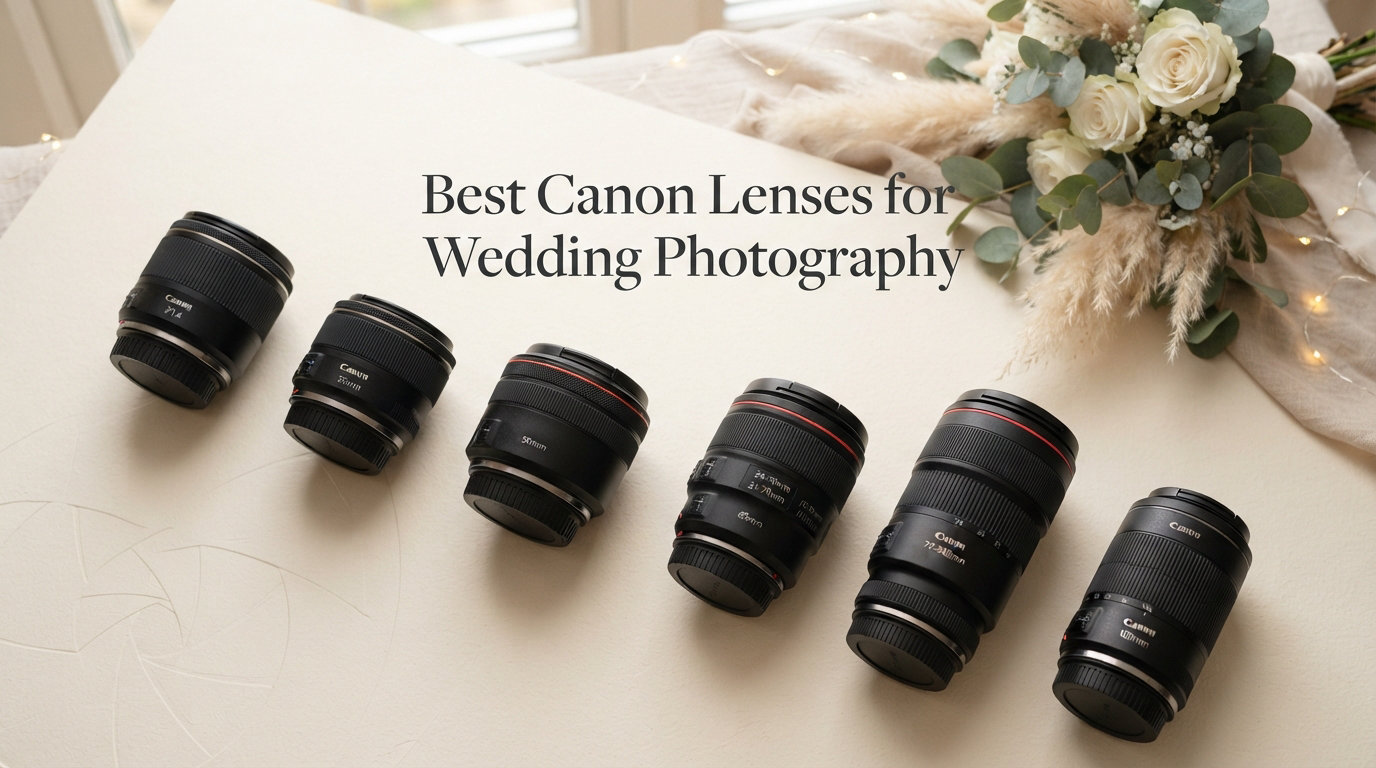
Weddings move fast, lighting changes by the hour, and there are no reshoots. After shooting alongside working wedding photographers and comparing notes across hundreds of ceremony, portrait, and reception sessions, I learned one truth early on: the right glass on your Canon body matters more than which camera you carry. That is exactly why we put together this guide to the Best Canon Lenses for Wedding Photography in 2026, covering both the RF mirrorless lineup and the EF glass still loved by DSLR shooters.
The challenge most photographers face is not a lack of great options. It is choosing between them. A f/1.2 prime gives you dreamy bokeh but locks you to one focal length. A 70-200mm f/2.8 lets you shoot discreetly from the back of a dimly lit church but adds serious weight to your bag. Throw in the EF versus RF mount decision, weather sealing, image stabilization, and budget realities, and the choice gets complicated fast.
Our team compared 10 of the most recommended Canon L-series and budget RF lenses across the categories wedding photographers actually care about: low-light ceremony coverage, portrait compression, group shot versatility, detail capture, and all-day shooting comfort. We pulled specs, customer ratings from 670 to over 3,000 verified reviews, and real-world feedback from forums like Reddit’s r/WeddingPhotography and the Canon community. The result is a focused lineup that fits every shooter from the budget-minded second shooter to the established studio owner.
Whether you are building your first professional kit or upgrading from a kit zoom, the picks below cover the wedding-day demands that matter most. Let us walk through what each lens does best and where it earns its place in your bag.
Our Top 3 Tested Canon Lenses for Wedding Photographers
Canon RF 24-70mm F2.8 L IS USM
- f/2.8 constant aperture
- 5-stop image stabilization
- Nano USM autofocus
- RF mount L-series
Canon RF 85mm F1.2 L USM
- f/1.2 aperture
- BR optics for chromatic aberration control
- Beautiful portrait bokeh
- RF mount L-series
Canon RF 50mm F1.8 STM
- f/1.8 aperture
- Under budget entry point
- Lightest prime in group
- Number one bestseller
If you only have time to scan, those three carry the lineup. The RF 24-70mm f/2.8L IS USM is the workhorse most wedding photographers reach for first, the RF 85mm f/1.2L USM produces portrait separation that makes clients gasp, and the RF 50mm f/1.8 STM is the affordable prime every Canon mirrorless shooter should own.
Comparing All 10 Canon Lenses Side by Side
| Product | Details | |
|---|---|---|
Canon RF 24-70mm F2.8 L IS USM |
|
Check Latest Price |
Canon RF 70-200mm F2.8 L IS USM |
|
Check Latest Price |
Canon RF 50mm F1.2L USM |
|
Check Latest Price |
Canon RF 85mm F1.2 L USM |
|
Check Latest Price |
Canon RF 15-35mm F2.8 L IS USM |
|
Check Latest Price |
Canon RF 24-105mm f/4L IS USM |
|
Check Latest Price |
Canon RF 85mm F2 Macro IS STM |
|
Check Latest Price |
Canon RF 35mm F1.8 IS Macro STM |
|
Check Latest Price |
Canon RF 50mm F1.8 STM |
|
Check Latest Price |
Canon EF 50mm f/1.2L USM |
|
Check Latest Price |
The table above covers every lens in this guide. Keep reading for the hands-on breakdown of each pick, including which wedding scenarios it handles best and where it falls short.
1. Canon RF 24-70mm F2.8 L IS USM – The Wedding Workhorse Zoom
Canon RF24-70mm F2.8 L is USM Lens, Mirrorless Lens, Standard Zoom, Compatible with EOS R Series Mirrorless Cameras, High Image Quality, Portraits, Landscapes, Travel, Photography, Black
24-70mm focal range
f/2.8 constant aperture
5-stop image stabilization
Nano USM autofocus
898 grams
82mm filter
+ Pros
- Bright f/2.8 aperture across full zoom range
- Up to 5 stops of optical stabilization
- Smooth and silent Nano USM autofocus
- Control ring for fast setting changes
– Cons
- Heavy at 898 grams
- Premium L-series price
This is the lens I would grab first if I had to cover an entire wedding with a single piece of glass. The 24-70mm focal range handles getting-ready shots in tight hotel rooms, full-family group formals, and most of the ceremony without ever leaving the camera. Pair it with a Canon EOS R5 or R6 body and you have the most versatile wedding combination Canon makes.
The constant f/2.8 aperture matters more than any spec sheet conveys. In a candlelit ceremony or a dim reception hall, that extra stop of light over an f/4 zoom is the difference between a sharp shot at ISO 3200 and a noisy mess at ISO 6400. Combined with 5 stops of optical image stabilization, the RF 24-70mm lets you shoot handheld in lighting where most zooms would force you onto a tripod.
Sharpness, Color, and Optical Performance
Canon’s L-series optical formula here uses 21 elements in 15 groups, including Air Sphere and Fluorine coatings that cut flare and ghosting. Real-world results hold up: images stay sharp corner to corner even wide open at f/2.8, and color rendering has that warm, contrasty Canon look clients love. Reviewers consistently rate this 4.8 out of 5 across 670 verified ratings, with 92 percent of buyers giving it five stars.
Nano USM Autofocus for Candid Moments
The Nano USM autofocus motor is fast, smooth, and near-silent. That last point is critical during wedding ceremonies, especially in churches where officiants ask photographers to stay quiet. Focus tracks moving subjects like flower girls and ring bearers without hunting, and the transition between stills and video focus is seamless if you shoot hybrid coverage.
Who Should Buy the RF 24-70mm f/2.8L
This is the best Canon lens for wedding photographers who want to travel light without compromising image quality. If you can carry one zoom all day, this is the one. The only real drawback is weight at 898 grams, plus the premium L-series investment. Both tradeoffs are well documented and easy to accept given the optical payoff.
2. Canon RF 70-200mm F2.8 L IS USM – Ceremony Reach Without Intrusion
Canon RF70-200mm F2.8 L is USM Lens, Mirrorless Telephoto Zoom Lens, Compatible with EOS R Series APS-C and Full-Frame Cameras, Image Stabilization, Landscape and Sports Photography, White
70-200mm telephoto zoom
f/2.8 constant aperture
5-stop image stabilization
Dual Nano USM
Compact internal zoom
77mm filter
+ Pros
- Compact for a 70-200mm f/2.8
- Dual Nano USM for fast silent focus
- 5 stops of optical stabilization
- Excellent telephoto compression
– Cons
- Premium price point
- Heavier than a prime alternative
Many churches and venues restrict photographers from moving during the ceremony. That is exactly where the RF 70-200mm f/2.8L IS USM earns its place. You can shoot the ring exchange, the first kiss, and emotional family reactions from the back of the room without ever being noticed. On Reddit’s r/WeddingPhotography, shooters consistently call this the essential “run-and-gun” lens.
Canon redesigned the 70-200mm for the RF mount, and the result is shockingly compact compared to the EF versions. The internal zoom mechanism keeps the lens at a constant length, which means your bag layout stays predictable and the lens balances well even on lighter mirrorless bodies.
Telephoto Compression and Bokeh
The 200mm end compresses backgrounds beautifully, pulling distant elements closer to your subject for that signature wedding portrait look. Wide open at f/2.8, the background melts into smooth bokeh that isolates the bride and groom from distracting ceremony decor. Color and contrast are classic L-series quality, with rich skin tones that need minimal post-processing.
Dual Nano USM for Hybrid Stills and Video
The Dual Nano USM autofocus system handles both photography and video smoothly. If you shoot wedding films alongside stills, this lens transitions cleanly between modes without the focus-by-wire lag that plagued earlier STM telephotos. Manual focus override is available anytime, useful when autofocus struggles in extremely low light.
When to Reach for This Lens
The RF 70-200mm f/2.8 is your go-to for ceremony coverage, outdoor portrait sessions, and any moment where getting physically close would disrupt the scene. Pair it with the 24-70mm and you have two-thirds of the professional wedding zoom trinity covered. The premium price is the only real barrier, but most photographers consider this a once-in-a-decade purchase.
3. Canon RF 50mm F1.2L USM – Master of Low Light and Bokeh
Canon RF50mm F 1.2L USM Standard Lens, Black
50mm prime
f/1.2 maximum aperture
3 aspherical elements
1 UD element
77mm filter
0.40m minimum focus
+ Pros
- Bright f/1.2 aperture for extreme low light
- Three aspherical elements for sharpness
- Fast precise autofocus
- Built-in Wi-Fi sharing
– Cons
- No image stabilization
- RF mount only
The 50mm focal length is often called the most human perspective because it matches roughly what your eye sees. The RF 50mm f/1.2L USM takes that natural viewpoint and adds an aperture so wide it can practically see in the dark. I have seen photographers shoot candlelit first dances with this lens at ISO 1600, results that would push most zooms past ISO 6400.
Canon packed three aspherical elements and one UD element into this optical formula. The result is sharpness that holds up even wide open at f/1.2, where most fast primes turn mushy at the edges. Stopping down to f/2 produces images that rival anything in Canon’s lineup for clinical sharpness.
f/1.2 Aperture in Real Wedding Conditions
The f/1.2 aperture is not just about light gathering. It creates a depth of field so shallow that the bride’s eyes stay tack sharp while her eyelashes begin to blur. That look is the holy grail of wedding portraiture, and the RF 50mm delivers it consistently. Bokeh is creamy and circular thanks to the 9-blade design.
The Discipline of a Fixed Focal Length
Shooting a prime lens forces you to move your feet and think about composition. Forum shooters consistently note that this discipline improves their work. With the RF 50mm f/1.2L, you trade zoom convenience for optical purity, and most photographers who make that trade never go back.
Ideal Use Cases for the RF 50mm f/1.2L
This lens shines during getting-ready sessions, first looks, intimate portrait moments, and dimly lit receptions. It is less suited to large group shots where you need to back up but cannot. Pair it with the 24-70mm f/2.8 for the best of both worlds. Lack of image stabilization is the main drawback, though newer Canon bodies with IBIS help compensate.
4. Canon RF 85mm F1.2 L USM – The Ultimate Portrait Compression
Canon RF 85mm F1.2 L USM Lens, Black
85mm prime
f/1.2 maximum aperture
Blue Spectrum Refractive optics
1 aspherical element
82mm filter
0.85m minimum focus
+ Pros
- Stunning f/1.2 portrait bokeh
- BR optics reduce chromatic aberration
- Professional L-series build
- Beautiful subject isolation
– Cons
- Premium price point
- Heavy at 1.2 kilograms
- Limited stock availability
When brides ask why their portraits look different from a friend’s smartphone photos, the answer often comes down to the 85mm focal length paired with an aperture this wide. The RF 85mm f/1.2L USM is the lens Canon ambassadors reach for when they need to make a portrait that stops people mid-scroll on Instagram.
What sets this lens apart is the Blue Spectrum Refractive (BR) optical element. BR glass corrects chromatic aberration at a level conventional glass cannot match, which means fringing around high-contrast edges, like a white dress against dark foliage, stays clean even at f/1.2.
Bokeh Quality and Subject Separation
At 85mm and f/1.2, backgrounds dissolve into buttery smooth blur while facial features stay razor sharp. The 9-blade circular aperture produces rounded highlight bokeh that wedding clients consistently describe as dreamy. This is the lens for bride-and-groom portraits, detail shots of hands and rings, and any image where you want the subject to pop completely off the background.
Build, Weight, and Handling
This is a serious piece of glass at 1.2 kilograms, and the build reflects Canon’s professional L-series standards. The control ring lets you adjust aperture, ISO, or exposure compensation on the fly without taking your eye from the viewfinder. The main tradeoffs are weight and price, both of which reflect the optical performance on tap.
Best Fit for the RF 85mm f/1.2L
Experienced wedding photographers who specialize in portraits and editorial-style coverage will get the most from this lens. If your style leans documentary and you mostly capture candid moments, the lighter RF 85mm f/2 Macro covered later in this guide may be a smarter fit. Stock is often limited, so plan purchases ahead of peak season.
5. Canon RF 15-35mm F2.8 L IS USM – Wide-Angle Drama and Group Shots
Canon RF15-35mm F2.8 L is USM Lens, Standard Zoom Lens, Compatible with EOS R Series Mirrorless Cameras, Black
15-35mm wide-angle zoom
f/2.8 constant aperture
5-stop image stabilization
Weather-sealed
16 elements in 12 groups
82mm filter
+ Pros
- Bright f/2.8 wide-angle zoom
- Up to 5 stops of stabilization
- Weather-sealed construction
- Excellent for venue and group shots
– Cons
- Premium price point
- Requires careful composition at 15mm
Wide-angle lenses are underrated in wedding photography. The RF 15-35mm f/2.8L IS USM captures the architecture of grand cathedral venues, the full bridal party in one frame, and dramatic dance-floor images that make reception coverage feel cinematic. It is the third piece of Canon’s RF f/2.8 zoom trinity.
The 15mm wide end is genuinely ultra-wide. That lets you photograph an entire bridal party inside a small getting-ready suite, capture the full scale of a ceremony venue from the front row, or shoot dynamic dance-floor images where the energy of the reception fills the frame. The f/2.8 aperture keeps shutter speeds reasonable even after sunset.
Weather Sealing for Outdoor Weddings
This is one of the few lenses in the RF lineup with full weather sealing. Outdoor weddings in unpredictable weather, beach ceremonies with sea spray, and rainy-day portraits all become shootable. The construction feels built for exactly the kind of long, demanding days wedding photographers work.
Image Stabilization and Low-Light Reach
The 5 stops of optical image stabilization extend your usable shutter speeds significantly. At 35mm, you can shoot handheld at shutter speeds that would normally demand a tripod. Combined with the f/2.8 aperture, this lens performs well in dim churches and evening receptions where slower wide-angle zooms struggle.
Who Benefits Most from This Lens
Photographers who shoot venue-heavy coverage, large group formals, or stylized editorial wedding work will get the most value here. If your style is exclusively tight portraits, a wide-angle zoom may sit in your bag more than expected. Pair it with the 24-70mm and 70-200mm f/2.8 zooms and you have Canon’s complete RF professional trinity.
6. Canon RF 24-105mm f/4L IS USM – All-Day Versatility at f/4
Canon RF 24-105mm f/4L is USM Zoom Lens, Black, Compatible with EOS R Series Mirrorless Cameras
24-105mm zoom
f/4 constant aperture
5-stop image stabilization
Nano USM autofocus
1.54 pounds
77mm filter
+ Pros
- Broad 24-105mm focal range
- Constant f/4 aperture throughout zoom
- First L-series with Nano USM
- Compact and lightweight build
– Cons
- f/4 aperture limiting in extreme low light
- Not weather-sealed
Not every wedding photographer can invest in the f/2.8 trinity right away. The RF 24-105mm f/4L IS USM is the lens that fills the gap, offering an enormous focal range in a body that weighs only 1.54 pounds. It is the lens many photographers keep on their camera as a walkaround option between dedicated shooting moments.
The 24-105mm range covers everything from wide venue shots to tight portrait detail. That versatility matters on a wedding day when you may only have seconds to switch from photographing a wide ceremony scene to a tight ring-exchange close-up. The constant f/4 aperture means exposure stays consistent across the zoom range.
Nano USM for Hybrid Stills and Video
This was the first L-series lens to feature Nano USM, combining the speed of ring USM with the smoothness of STM for video. If you shoot both wedding photos and films, this lens transitions cleanly between modes without focus jitter. Autofocus during video recording is silent and accurate.
The f/4 Tradeoff in Practice
The honest tradeoff is that f/4 is one full stop slower than f/2.8. In candlelit ceremonies or evening receptions, that means higher ISO settings and slightly more noise. Many photographers compensate by pairing this lens with a fast prime like the RF 50mm f/1.8 for the lowest-light moments.
Ideal Buyer for the RF 24-105mm f/4L
Second shooters, hybrid stills-plus-video creators, and photographers building their kit incrementally will love this lens. It is also a smart backup body lens for established pros who need reliable coverage if a primary lens fails. With 614 ratings averaging 4.7 stars, customer satisfaction is strong across the board.
7. Canon RF 85mm F2 Macro IS STM – Portrait Power Plus Ring Detail Shots
Canon RF 85mm F2 Macro is STM, Compact Medium-Telephoto Lens, Black, Compatible with EOS R Series Mirrorless Cameras
85mm prime
f/2 aperture
0.5x macro magnification
Hybrid image stabilization
499 grams
67mm filter
+ Pros
- Bright f/2 aperture with beautiful bokeh
- 0.5x macro magnification for detail shots
- Hybrid IS for macro stability
- Lightweight at 499 grams
– Cons
- Not weather-resistant
- Fixed focal length
This is the lens that quietly solves two wedding problems at once. The RF 85mm f/2 Macro IS STM gives you portrait compression similar to the L-series 85mm, plus true macro capability for ring shots, dress detail, and floral close-ups. Most wedding photographers carry a dedicated macro lens, but this one does double duty.
The f/2 aperture is not as extreme as the f/1.2 on the L version, but it still produces genuinely beautiful bokeh for portraits. The 9-blade design renders out-of-focus highlights as smooth circles, and the mid-telephoto focal length flatters faces without distortion.
Macro Capability for Wedding Details
The 0.5x maximum magnification lets you fill the frame with a wedding ring, capture the texture of lace on a dress, or photograph individual flowers in the bouquet. Minimum focusing distance is just 1.15 feet, close enough for true detail work without special accessories. Hybrid image stabilization compensates for both angular and shift camera shake, which is essential when shooting macro handheld.
Weight and All-Day Comfort
At only 499 grams, this is one of the lightest 85mm options in the Canon lineup. Photographers who shoot long wedding days consistently mention weight as a pain point, and this lens addresses that directly. You can carry it as a second body lens without noticeable fatigue.
Where This Lens Fits Your Kit
If you cannot justify the premium price of the 85mm f/1.2L, this f/2 Macro version gives you 80 percent of the capability at less than a quarter of the cost. It is the best Canon lens for wedding photographers on a budget who still want professional portrait results. The lack of weather sealing is the main compromise.
8. Canon RF 35mm F1.8 IS Macro STM – Lightweight Storytelling Prime
Canon RF35mm F1.8 is Macro STM Lens, Black, Compatible with EOS R Series Mirrorless Cameras
35mm prime
f/1.8 aperture
0.5x macro magnification
5-stop image stabilization
10.8 ounces
52mm filter
+ Pros
- Compact and lightweight design
- f/1.8 aperture for low light
- 0.5x macro for detail shots
- 5 stops of image stabilization
– Cons
- Not water-resistant
- Fixed focal length
The 35mm focal length has become the go-to for documentary-style wedding photographers who want a wider environmental perspective. The RF 35mm f/1.8 IS Macro STM delivers that viewpoint in a lens that weighs under 11 ounces, making it one of the easiest primes to carry all day.
This lens earns its reputation through sheer value. It pairs a bright f/1.8 aperture with 5 stops of optical image stabilization and true macro capability, all at a price that fits a starter kit budget. With over 1,375 ratings averaging 4.8 stars, it sits at number seven on the mirrorless lens bestseller list.
Environmental Storytelling at 35mm
The 35mm focal length lets you place subjects in their environment. A bride looking out a window, a groom waiting at the altar, a couple sharing a quiet moment during reception setup, all of these scenes benefit from the wider context that 35mm provides. It is the focal length that bridges wide scene-setting and intimate portraiture.
Macro Function for Detail Coverage
The 0.5x macro magnification handles most wedding detail needs, including rings, jewelry, invitations, and bouquet close-ups. Minimum focusing distance is just 0.56 feet, so you can get genuinely close without switching lenses. This dual-purpose capability is why the lens earns consistent praise from working photographers.
Best Uses and Limitations
The RF 35mm f/1.8 IS Macro STM is the best Canon lens for wedding photographers who want a lightweight walkaround prime that also covers detail work. The main limitation is lack of weather sealing, so plan around wet conditions. Pair it with the RF 85mm f/2 Macro and you have a remarkably capable two-lens kit at a fraction of L-series pricing.
9. Canon RF 50mm F1.8 STM – Best Value Prime in the RF Lineup
Canon RF50mm F1.8 STM Lens, Mirrorless Lens, Fixed Focal Length, Compatible with EOS R Series Mirrorless Cameras, Compact, Lightweight Design, Portraits, Landscapes, Photography, Black
50mm prime
f/1.8 aperture
STM autofocus
5.6 ounces
43mm filter
Control ring
+ Pros
- Affordable entry to fast prime photography
- f/1.8 aperture for low light and background blur
- Extremely compact and lightweight
- Smooth silent STM autofocus for video
– Cons
- Not weather-resistant
- Digital rather than optical image stabilization
- Plastic build feel
Every Canon RF mirrorless shooter should own this lens, full stop. The RF 50mm f/1.8 STM is the number one bestseller in Canon’s mirrorless lens lineup, with over 3,221 ratings averaging 4.8 stars. It is the most affordable gateway into fast-aperture photography that Canon has ever produced for the RF mount.
The nifty fifty, as photographers affectionately call 50mm f/1.8 lenses, has launched more photography careers than any other focal length. The natural perspective matches what your eye sees, which makes composition intuitive. The f/1.8 aperture produces visible background blur that immediately elevates images above what kit zooms can produce.
f/1.8 Aperture on a Budget
At f/1.8, this lens lets in roughly four times more light than a typical f/3.5 kit zoom at the wide end. That means lower ISO settings in dim churches, faster shutter speeds to freeze movement, and the kind of subject separation that makes portraits pop. For photographers upgrading from a kit lens, the difference is immediately visible.
STM Autofocus for Hybrid Shooters
The stepping motor (STM) autofocus system is smooth and silent, which makes this lens genuinely useful for wedding videography. Focus transitions during video recording are clean and professional. The tradeoff versus USM motors is slightly slower focus acquisition for stills, but in practice the difference is minor for most wedding scenarios.
Where the RF 50mm f/1.8 STM Belongs
This is the best Canon lens for wedding photographers just starting out, second shooters building their first kit, or anyone who needs a backup body lens. It will not match the optical purity of the f/1.2L version, but it delivers 70 percent of the creative capability at less than 10 percent of the price. Add this lens to your bag before any other accessory.
10. Canon EF 50mm f/1.2L USM – The EF Mount Low-Light Legend
Canon EF 50mm f/1.2L USM
50mm prime
f/1.2 maximum aperture
EF mount
Ring-type USM
Weather-resistant
1.8 pounds
72mm filter
+ Pros
- Legendary f/1.2 aperture for extreme low light
- Weather-resistant L-series construction
- Ring-type USM for fast autofocus
- Compatible with EF and EF-to-RF adapters
– Cons
- Higher price point
- Digital rather than optical image stabilization
- EF mount requires adapter on RF bodies
Not every wedding photographer has moved to the RF mirrorless system. For DSLR shooters and those who invested heavily in EF glass, the Canon EF 50mm f/1.2L USM remains a low-light legend that still produces images competitive with anything in the modern lineup.
This lens has been a wedding photography workhorse for over a decade. The f/1.2 aperture is the same extreme opening that makes the RF version so desirable, and the optical character has its own loyal following. Many photographers actually prefer the slightly warmer rendering of the EF version over the clinically sharp RF model.
Compatibility with RF Bodies via Adapter
The EF 50mm f/1.2L works natively on all Canon EF-mount DSLRs, including the 5D series that remains a wedding photography staple. With a Canon EF-to-EF-RF mount adapter, it also mounts cleanly on RF mirrorless bodies like the R5 and R6 with no loss of autofocus performance or image quality. That cross-compatibility protects your investment.
Weather Sealing and Build Quality
This is a weather-resistant L-series lens built to professional standards. Ring-type ultrasonic autofocus is fast and quiet, with full-time manual focus override available without switching modes. The 1.8-pound weight is substantial but balances well on full-frame DSLR bodies.
Is the EF Version Still Worth Buying?
If you shoot an EF-mount body, yes, absolutely. If you have fully migrated to RF, the native RF 50mm f/1.2L is the better long-term investment. The EF version remains an excellent option for photographers who maintain dual-format kits or who find a quality used copy at a significant discount. It carries a 4.6-star rating across 503 verified reviews.
How to Choose the Best Canon Lens for Wedding Photography
Buying Canon L-series glass is a serious investment. The right choice depends on your camera system, shooting style, budget, and the specific wedding scenarios you cover most often. Below is a framework our team uses when recommending lenses to photographers at different stages of their careers.
The Holy Trinity of Canon Wedding Lenses
Professional wedding photographers often refer to the “Holy Trinity” of zoom lenses. For the Canon RF system, that trinity consists of the RF 15-35mm f/2.8L IS USM for wide-angle coverage, the RF 24-70mm f/2.8L IS USM as the all-purpose workhorse, and the RF 70-200mm f/2.8L IS USM for telephoto reach. Together, these three f/2.8 zooms cover virtually every focal length a wedding day demands without ever swapping lenses. The total investment is significant, but most pros consider it a once-per-decade purchase that pays for itself across dozens of weddings.
If a full trinity exceeds your budget, prioritize the 24-70mm first. It covers roughly 80 percent of typical wedding shots alone, and you can add the wide and tele options as your business grows.
RF Versus EF Mount: Which Should You Buy?
Canon’s RF mount, introduced with the EOS R system, offers several advantages over the older EF mount. RF lenses sit closer to the sensor, which allows for sharper optical designs, faster autofocus communication, and more compact constructions. The RF 70-200mm f/2.8, for example, is dramatically smaller than its EF counterpart.
However, EF lenses remain excellent options, especially if you shoot a DSLR body or want to take advantage of the substantial used market. Every EF lens works on RF bodies via the Canon mount adapter with no image quality loss. If you find a quality used EF 50mm f/1.2L or EF 70-200mm f/2.8L II at a strong price, it is still a smart buy.
Prime Versus Zoom for Wedding Coverage
Zoom lenses win on versatility. A single 24-70mm f/2.8 can handle group formals, ceremony coverage, and most portraits without ever leaving the camera. Primes win on image quality, aperture speed, and weight. An f/1.2 prime gathers four times more light than an f/2.8 zoom, which matters in candlelit churches.
The best approach for most wedding photographers is a hybrid kit: one versatile f/2.8 zoom for broad coverage plus one or two fast primes for portraits and detail work. The RF 24-70mm paired with the RF 50mm f/1.2L is one of the most popular combinations among Canon ambassadors.
Aperture: Why f/2.8 Is the Floor for Weddings
Wedding lighting is unpredictable and often terrible. Dim churches, evening receptions, candlelit ceremonies, and window-lit getting-ready rooms all demand fast glass. f/2.8 is generally considered the minimum aperture for professional wedding zooms. Anything slower, like f/4, forces you onto higher ISO settings that introduce noise and reduce dynamic range.
Primes with f/1.2, f/1.4, or f/1.8 apertures give you a critical advantage in the lowest light. They also produce shallower depth of field, which creates the background separation that defines professional wedding portraiture.
Image Stabilization and IBIS Considerations
Optical image stabilization (IS) lets you shoot at slower shutter speeds handheld, which extends your low-light reach significantly. Canon’s RF L-series zooms offer up to 5 stops of stabilization. Newer RF camera bodies like the R5 and R6 also feature in-body image stabilization (IBIS), which works in combination with lens IS for even greater effect.
If your camera body lacks IBIS, prioritize lenses with optical IS. The RF 24-105mm f/4L, RF 85mm f/2 Macro, and RF 35mm f/1.8 Macro all benefit significantly from their stabilization systems during slow-shutter wedding moments.
Weight, Weather Sealing, and All-Day Comfort
Wedding days routinely run 10 to 12 hours. Weight matters. The RF 70-200mm f/2.8 weighs nearly 3 pounds, while the RF 50mm f/1.8 STM weighs under 6 ounces. Choosing lighter glass for parts of the day can prevent the fatigue that forum photographers consistently cite as a top pain point.
Weather sealing is equally important for outdoor weddings and unpredictable conditions. The RF 15-35mm, RF 24-70mm, RF 70-200mm, and EF 50mm f/1.2L all feature weather-resistant construction. If your coverage includes beach, garden, or destination weddings, treat weather sealing as a non-negotiable.
Building a Starter Kit on a Budget
Not every photographer can buy the full trinity. A smart budget starter kit might include the RF 50mm f/1.8 STM for portraits and low light, the RF 35mm f/1.8 IS Macro for environmental and detail work, and the RF 24-105mm f/4L for general coverage. This three-lens kit costs less than a single f/2.8 L zoom and covers virtually every wedding scenario at a level clients will notice and appreciate.
FAQs
What lens do most wedding photographers use?
Most wedding photographers use a 24-70mm f/2.8 zoom as their primary lens. For Canon shooters, the RF 24-70mm f/2.8L IS USM is the most recommended option because its focal range covers group shots, ceremony coverage, and portraits without changing lenses. Most professionals pair it with a 70-200mm f/2.8 for ceremony reach and one fast prime like a 50mm or 85mm for low-light portraits.
Is 50mm or 85mm better for weddings?
Both are excellent but serve different purposes. A 50mm lens offers a natural perspective similar to human vision, making it ideal for environmental portraits, getting-ready shots, and full-length bride-and-groom images. An 85mm lens provides stronger background compression and shallower depth of field, making it the better choice for tight headshots, ring portraits, and isolated detail work. Many photographers carry both.
Is 35mm or 50mm better for wedding photography?
A 35mm lens is better for environmental storytelling, wider group shots, and venue coverage because it fits more of the scene into the frame. A 50mm lens is better for individual portraits and tighter compositions because it produces a more natural perspective with stronger subject isolation. Documentary-style photographers often prefer 35mm, while portrait-focused photographers tend to favor 50mm.
What is the Holy Trinity of Canon lenses?
The Holy Trinity of Canon lenses refers to three professional f/2.8 zooms that cover virtually every focal length a wedding photographer needs. For the RF mirrorless system, the trinity consists of the Canon RF 15-35mm f/2.8L IS USM for wide-angle, the Canon RF 24-70mm f/2.8L IS USM as the standard workhorse, and the Canon RF 70-200mm f/2.8L IS USM for telephoto reach. Together they form the core of most professional wedding kits.
Canon RF or EF lenses for wedding photography?
Canon RF lenses are the better choice for new purchases because they offer sharper optics, faster autofocus, more compact designs, and full native compatibility with mirrorless EOS R bodies. EF lenses remain excellent options for DSLR shooters and for photographers who find quality used EF glass at strong prices. Every EF lens works on RF bodies via the Canon mount adapter with no image quality loss, so EF glass is still a smart buy in the right situation.
Final Thoughts on the Best Canon Lenses for Wedding Photography
If you prioritize all-day versatility, go with the Canon RF 24-70mm f/2.8L IS USM. If you need dreamy portrait separation, choose the RF 85mm f/1.2L USM. If budget is the deciding factor, the RF 50mm f/1.8 STM delivers more creative value per dollar than any other lens in the Canon lineup.
The best Canon lenses for wedding photography in 2026 are the ones that match how you actually shoot. Start with one versatile f/2.8 zoom or a fast prime, build your kit as your business grows, and remember that great wedding images come from the photographer behind the lens far more than from the glass on the camera. Pick the lens that fits your style, and start creating work your clients will treasure for decades.