
Do evaporative coolers work? The short answer is yes, but only when the conditions are right. I spent weeks researching this question after a friend in Phoenix swore by her swamp cooler while my cousin in Florida insisted the same unit just made his living room feel like a sauna.
The difference comes down to one factor that most people overlook until it is too late: humidity.
In this guide, I will explain exactly how evaporative coolers function, where they perform best, and how much cooling you can realistically expect. I have also pulled real experiences from homeowners across dry and humid climates so you can decide whether this technology makes sense for your home in 2026.
Our team looked at Department of Energy data, manufacturer specifications, and hundreds of user reports from forums like Reddit and Home Improvement communities. What we found is that evaporative coolers are not a gimmick, but they are also not a one-size-fits-all solution. The effectiveness depends almost entirely on your local climate and how you install the unit.
If you are considering a purchase, this article will give you the facts you need to make a smart decision.
How Evaporative Coolers Work
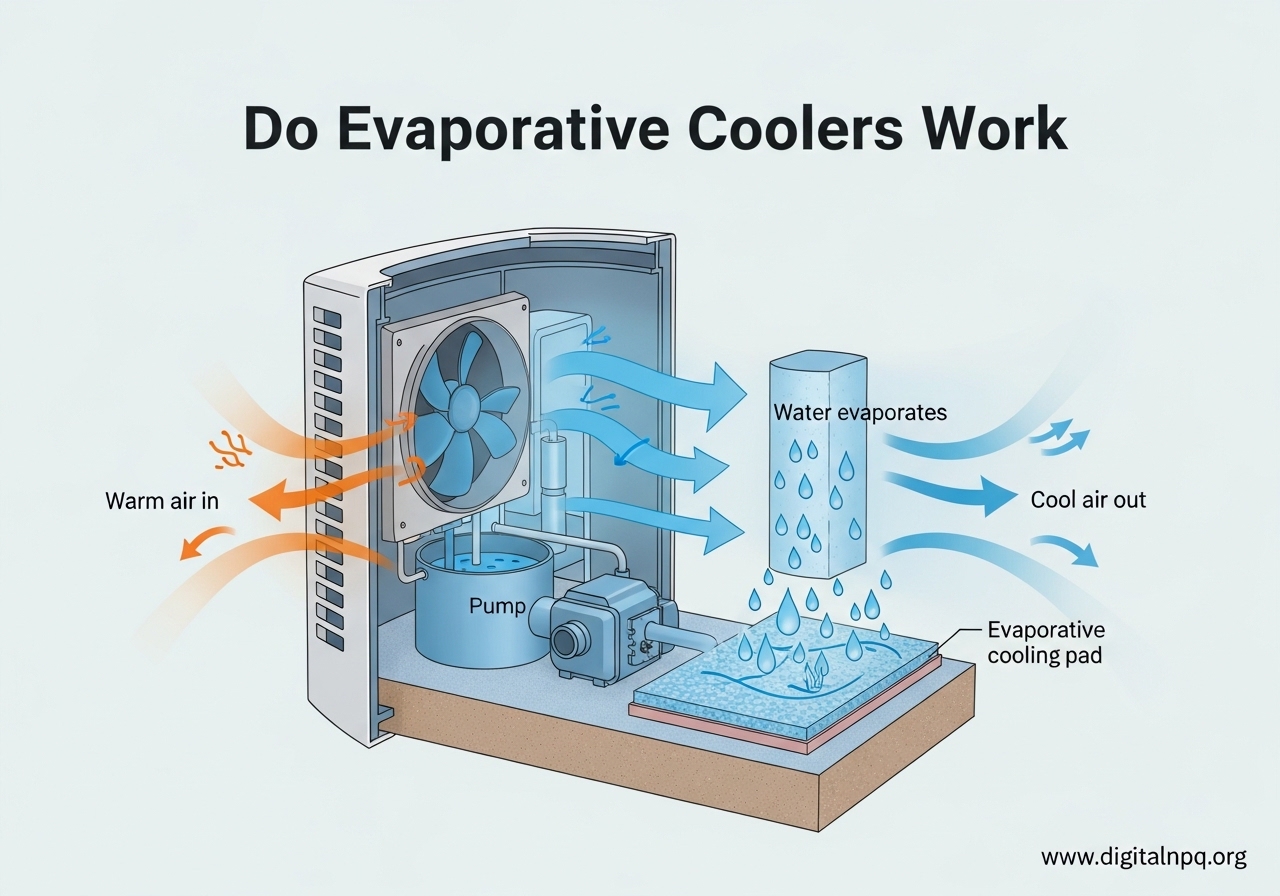
Evaporative coolers, often called swamp coolers, use a simple natural process to lower air temperature. A pump circulates water from a reservoir onto thick cooling pads, saturating them completely.
A powerful fan then pulls warm outside air through these wet pads, and as the water evaporates, it absorbs heat from the air stream. The result is a steady flow of cooler, slightly humid air pushed into your room or house.
This is the same cooling principle your body uses when you sweat. On a hot day, moisture on your skin evaporates and pulls heat away from your body.
An evaporative cooler does this on a larger scale, using water-soaked pads as the “skin” and a fan to force the air movement. The process requires no refrigerants, no compressor, and no complex mechanical parts beyond a water pump and a blower.
The science behind this is called the wet-bulb temperature. When water evaporates, it changes from a liquid to a gas, and that phase change requires energy.
The energy comes from the heat in the surrounding air, which drops the air temperature. The theoretical limit of cooling is the wet-bulb temperature, which is the lowest temperature air can reach through evaporation alone.
In dry air, the wet-bulb temperature can be 30 to 40 degrees below the actual air temperature. In humid air, the gap shrinks to just a few degrees because the air is already close to saturated with moisture.
The pads are typically made of cellulose, aspen wood fibers, or synthetic materials designed to hold water while allowing maximum airflow. Higher-quality pads with more surface area can saturate the air more effectively, which increases cooling performance.
The Department of Energy notes that two-stage evaporative coolers, which use a pre-cooler and more advanced media, can achieve even lower temperatures than single-stage units, though they cost more upfront. Aspen pads are the traditional choice and work well for basic units, but cellulose pads with a honeycomb structure last longer and provide more consistent cooling over the season.
Airflow is measured in cubic feet per minute, or CFM. The higher the CFM rating, the more air the unit can move, and the larger the space it can cool.
Most residential units range from 1,000 CFM for small portable models to 7,000 CFM or more for whole-house systems. For effective cooling, you generally want 20 to 40 air changes per hour inside the space, which means the unit should circulate the total room volume that many times every sixty minutes.
A unit with too low a CFM rating will leave hot spots and create uneven cooling throughout the room, especially in corners far from the vents.
The water reservoir is another critical component. Portable units hold anywhere from two to ten gallons, while whole-house systems connect directly to a water line for automatic refilling.
The pump continuously wets the pads during operation, and any water that does not evaporate drains back into the reservoir or out through a drain line. This constant water movement is what keeps the cooling process going, but it also means the unit needs a reliable water supply and occasional cleaning.
Hard water can accelerate mineral buildup, which is why some owners install simple inline filters on the fill line to reduce scaling.
Noise is another factor to consider when choosing a unit. The fan and pump both generate sound, and larger whole-house units can produce noticeable noise on high speed.
Portable units are generally quieter than a window air conditioner but louder than a standard box fan. If you plan to use the cooler in a bedroom or office, look for models with variable speed settings so you can run the fan at a lower, quieter speed during sleep or work hours.
Many users report that they get used to the white noise quickly, but light sleepers may want to test the noise level before committing to a permanent installation.
Do Evaporative Coolers Work in Your Climate?
Yes, evaporative coolers work exceptionally well in hot, dry climates where the air has low moisture content. The drier the air, the more water it can absorb, which means faster evaporation and greater heat removal.
In desert regions like Arizona, New Mexico, and parts of California, these units can drop indoor temperatures by 20 to 30 degrees below the outdoor reading. A user from Albuquerque told us they keep their house at a comfortable 73 degrees even when the sun pushes the mercury past 100 outside.
The challenge appears when relative humidity climbs above 50 percent. At that point, the air is already holding significant moisture, so it cannot absorb much more from the cooling pads.
The evaporation rate slows down, and the cooling effect drops dramatically. In areas with 60 percent humidity or higher, an evaporative cooler may only lower the temperature by 5 degrees, or in some cases, it may simply blow warm, damp air that makes the room feel worse.
A homeowner in Sydney reported that their evaporative cooler was “useless” during humid summer days, and they eventually switched to a portable air conditioner instead.
The 30 percent humidity threshold is where evaporative coolers really shine. At 30 percent relative humidity or lower, the Department of Energy confirms that these units can reduce ambient temperature by 15 to 40 degrees.
In the 30 to 50 percent range, you will still get noticeable cooling, typically 10 to 20 degrees, though the exact number depends on the unit size and airflow. Once humidity hits 60 percent, effectiveness falls off quickly.
Above 70 percent, the unit becomes a glorified fan that adds moisture to the air rather than removing heat.
We also found real reports from users in coastal and southern states who bought portable units expecting traditional air conditioning performance. One Reddit user in a humid climate wrote that their swamp cooler “actually made my room hotter” and left them waking up with a stuffy nose every morning.
Another user in New Mexico explained that when their local humidity spiked to 50 percent during monsoon season, the cooler stopped producing cold air and just moved warm air around. These experiences confirm that the climate question is not a minor detail.
It is the deciding factor.
Seasonal variation also matters. In desert areas, July and August can bring brief monsoon periods where humidity jumps from 15 percent to 50 percent for a few weeks.
During those windows, even loyal swamp cooler users notice a drop in performance. Some homeowners keep a small window air conditioner as a backup for those specific weeks.
If you live in an area with unpredictable humidity spikes, you should plan for that reality rather than expecting consistent cooling all summer long.
How Much Can an Evaporative Cooler Actually Cool?
The amount of cooling you get depends on the starting temperature, the humidity level, and the quality of the unit. Under ideal conditions, evaporative coolers can drop the air temperature by 15 to 30 degrees.
The Department of Energy cites a more conservative range of 5 to 15 degrees, but that figure includes performance across all humidity levels, including marginal conditions. Manufacturer Portacool reports that in extremely dry conditions, such as 125-degree air at 2 percent humidity, their industrial units can achieve reductions of up to 30 degrees.
Here is what you can realistically expect at different humidity levels when the outside air is 100 degrees. At 10 to 20 percent humidity, a well-sized unit can bring the air down to 70 to 80 degrees.
At 30 percent humidity, the output air typically measures 80 to 85 degrees. At 40 percent humidity, expect 85 to 90 degrees.
At 50 percent humidity, the output may only reach 90 to 95 degrees, which is barely perceptible. At 60 percent or higher, the cooling effect becomes minimal and the unit primarily adds moisture.
The question “do swamp coolers work in 100 degree weather?” gets asked constantly in online forums. The answer is yes, they can work in extreme heat, but only if the humidity stays low.
In a desert climate with 100-degree air and 15 percent humidity, a swamp cooler can deliver refreshingly cool air. In a humid climate with 100-degree air and 65 percent humidity, the same unit will struggle to produce any noticeable relief.
The temperature reading alone does not tell you enough. You need to know the relative humidity.
Air changes per hour also matter. A unit that is too small for the room will not move enough volume to create a comfortable environment.
The Department of Energy recommends dividing the cubic feet of your space by two to estimate the minimum CFM you need. For a 1,000 square foot room with eight-foot ceilings, that is 8,000 cubic feet, so you want a unit rated for at least 4,000 CFM.
If you undersize the unit, even perfect climate conditions will not produce the cooling you want.
Square footage ratings from manufacturers can be optimistic. A portable unit advertised for 500 square feet might only achieve that coverage in a perfectly dry climate with ideal ventilation.
In real-world conditions, you should size down by about 20 percent from the manufacturer claim. That means a unit rated for 500 square feet will likely cool 400 square feet effectively.
If you are on the borderline between two sizes, choose the larger one. The extra airflow will compensate for less-than-perfect humidity and help the unit work during those brief monsoon spikes.
Pros and Cons of Evaporative Coolers
Evaporative coolers offer several genuine advantages over traditional air conditioning, but they also come with limitations that you need to understand before buying. I have broken down the key points below so you can weigh them against your specific situation.
The biggest benefit is energy efficiency. Because there is no compressor or refrigerant cycle, evaporative coolers use roughly 75 percent less electricity than standard air conditioners.
Over a full summer, that can save hundreds of dollars on your utility bill. A whole-house evaporative cooler typically runs on a standard 120-volt outlet and draws a fraction of the amperage that a central AC compressor requires.
In areas where electricity rates are high, the savings can pay for the unit in just a few seasons.
Another major advantage is the constant supply of fresh air. Traditional air conditioners recirculate the same indoor air, which can trap odors, allergens, and carbon dioxide.
An evaporative cooler pulls outside air through the pads and pushes it into the room, creating a steady exchange of fresh air. This is why many people in dry climates say the air feels better with a swamp cooler than with refrigerated air.
The added moisture can also relieve dry skin and sinus irritation during scorching summers.
Environmental impact is another plus. Evaporative coolers do not use chemical refrigerants like R-410A or R-32, which contribute to greenhouse gas emissions if they leak.
They rely only on water and electricity, making them a more earth-friendly cooling option. The Wirecutter team noted this in their testing, and our research confirmed that the refrigerant-free design is a real selling point for environmentally conscious buyers.
When you factor in the lower electricity draw from power plants, the overall carbon footprint is significantly smaller than traditional air conditioning.
On the downside, evaporative coolers increase indoor humidity. In a dry climate, this is often welcome.
In a humid climate, it can create a sticky, uncomfortable environment and promote condensation on windows and surfaces. The humidity increase is the single most common complaint we found in forum discussions.
Users in moderate humidity reported that their homes felt “dank” after running the cooler for a few hours.
Water usage is another concern. Depending on the unit size and runtime, an evaporative cooler can use several gallons of water per hour.
A whole-house system running continuously might consume 10 to 25 gallons per day. In drought-prone areas, this water cost adds up, and some users expressed guilt about the environmental trade-off.
Portable units use less, typically 1 to 3 gallons per hour, but they also cool smaller spaces. One user in California noted that their water bill increased by about $15 per month during peak summer, which was still far less than their old AC electric bill.
The ventilation requirement is a practical limitation that catches many first-time buyers off guard. Evaporative coolers work by pushing air into the space, which means an equal volume of air must exit the room to prevent pressure buildup.
You must open windows or doors to allow exhaust airflow. This runs counter to the instinct of sealing up the house to keep hot air out.
In forums, users frequently asked whether they really needed to open windows, and the answer is always yes. Without an exit path, the unit cannot function properly.
Finally, maintenance demands are higher than with a traditional AC. The cooling pads need replacement every one to three years, and the water reservoir requires regular cleaning.
Mineral buildup from hard water can clog the pump and lines. Users who neglect these tasks often report reduced performance, musty odors, and eventually mold problems.
We will cover prevention strategies in the maintenance section below. The cost of pads and cleaning supplies is low, but the time commitment is real and should not be underestimated.
Installation and Ventilation Requirements
Installing an evaporative cooler is simpler than installing central air conditioning, but it still requires attention to airflow and placement. Whole-house units are typically mounted on the roof or an exterior wall, with a duct that connects to the existing HVAC system or a dedicated vent network.
Portable units just need a power outlet, water supply, and a venting strategy. The core principle is the same for both: air must be able to flow through the space and exit the building.
The reason you must open a window is simple physics. The cooler pumps a steady stream of air into the room, which increases the air pressure inside.
If the room is sealed, the pressure prevents new air from entering, and the fan simply recirculates the same volume without cooling it. By opening a window on the opposite side of the room from the cooler, you create a cross-draft that allows the incoming cool air to push the warmer, slightly humid air outside.
The Department of Energy recommends opening windows or installing up-ducts in the ceiling to vent the exhaust air into the attic, where it can escape through existing vents.
The amount of window opening matters. Too little, and the air cannot escape. Too much, and you lose the cooling effect because the air moves too quickly through the room.
A good rule of thumb is to open windows just enough to create a gentle airflow at the exit point. You should feel a slight breeze at the open window, but not a strong gust.
Some users install simple exhaust vents or trickle vents that allow a controlled airflow without creating a security risk. If you are worried about leaving windows open, consider installing window locks that limit the opening to a few inches, or use vent-only mode on the cooler if your model supports it.
Placement also affects performance. A rooftop unit should be positioned on the downwind side of the house so prevailing winds do not fight the exhaust airflow.
Ground-mounted units should sit in a shaded spot if possible, since feeding the unit already-hot air from direct sunlight reduces efficiency. Portable units work best when placed near an open window or door so the exhaust air has a direct path outside.
One garage owner told us they run four portable evaporative coolers from Hessaire and position each near a partially open garage door for maximum airflow, and the setup works well for their workshop.
Winterization is a step that many homeowners skip, leading to roof leaks and damaged ducts. Before the first freeze, shut off the water supply, drain all lines and the reservoir, and cover the unit with a weatherproof tarp.
Whole-house units mounted on the roof are especially vulnerable to ice damage if water remains in the pan. Some units have a winter damper that blocks the duct to prevent cold air from entering the house during the off-season.
Check your manual for the specific procedure, because a frozen water line can crack the housing and create expensive repairs.
Maintenance, Water Usage, and Mold Prevention
Keeping an evaporative cooler running well requires regular upkeep that goes beyond dusting the vents. The water system, pads, and housing all need attention to prevent performance loss and health issues.
I have talked to users who ran their units for years without problems, and I have also read reports from people who gave up after one season because of mold or mineral buildup. The difference is usually maintenance.
Water usage varies by unit size and runtime. Portable models typically consume 1 to 3 gallons per hour.
Whole-house systems can use 5 to 15 gallons per hour depending on the cooling pad area and fan speed. Over a 12-hour day, that adds up to 60 to 180 gallons for a large system.
If you live in an area with water restrictions, this is a real cost to factor in. Some users collect the drain water for gardening or lawn irrigation to reduce waste.
Newer units with automatic water feed systems can be more efficient than older models that run continuously.
Mineral buildup is the most common mechanical problem. As water evaporates, it leaves behind calcium, magnesium, and other dissolved solids on the pads and in the reservoir.
Over time, these minerals clog the pump, reduce pad saturation, and create white dust that can blow into the room. The fix is straightforward: drain and scrub the reservoir at least once per month during heavy use, and use a mild descaling solution if you have hard water.
Some users add a small amount of white vinegar to the reservoir periodically to dissolve buildup. Replacing the pads annually or biannually prevents the worst of this issue.
Mold and mildew prevention is the concern that keeps many potential buyers from pulling the trigger. Any device that constantly wets porous material and circulates air can become a mold factory if neglected.
The key is to never let the pads sit wet and stagnant when the unit is off. Always run the fan-only mode for 30 minutes after turning off the water pump to dry the pads completely.
At the end of the season, drain the reservoir, remove the pads, and let every component dry fully before storing. During the season, clean the reservoir with a mild disinfectant every two weeks to kill any spores before they spread.
Another tip from long-term users is to avoid letting the unit run continuously at low speed. Stagnant water in the reservoir warms up, which encourages bacterial growth.
Running the unit at higher speeds for shorter periods keeps the water circulating and cooler. If you smell a musty odor when the unit starts, that is a warning sign that mold or bacteria is already present.
Disassemble the unit, clean every surface with a diluted bleach solution, and replace the pads immediately. Do not ignore the smell, because the unit will blow those spores directly into your living space.
Water quality matters more than most people realize. If your tap water is very hard, consider using a water softener or filtered water for the reservoir.
Hard water not only creates mineral buildup faster, but the white dust it generates can coat furniture and electronics. Some whole-house systems have a bleed-off valve that continuously drains a small amount of water to reduce mineral concentration.
This increases water usage slightly but extends the life of the pads and pump significantly. Check whether your unit has this feature, and if not, manually drain and refill the reservoir every few days during peak use.
Portable vs Whole-House Evaporative Coolers
Not all evaporative coolers serve the same purpose. The two main categories are portable units and whole-house systems, and the right choice depends on your budget, space, and cooling goals.
I have used both in different settings, and each has clear strengths and weaknesses.
Portable evaporative coolers are the boxy units you see rolling on casters at hardware stores. They typically cool 200 to 1,000 square feet and plug into a standard wall outlet.
You fill the reservoir manually or connect a garden hose, and you position the unit near an open window. These work best for garages, workshops, patios, or single rooms in an apartment.
A Reddit user in a dry climate reported that their Hessaire portable unit works well for a small bedroom, but they would not expect it to cool an entire open-plan house. Portable units are affordable, usually costing between $100 and $500, and they require no installation.
Whole-house evaporative coolers are mounted on the roof or exterior wall and connect to your home’s ductwork. They cost more upfront, typically $1,500 to $4,000 installed, but they can cool 2,000 square feet or more.
They also connect directly to a water line, so you never have to refill a reservoir. The Department of Energy recommends these for dry climates where homeowners want an energy-efficient alternative to central air.
The downside is that you need existing ductwork or a willingness to install it, and the roof mounting requires professional installation to prevent leaks.
For garages, outdoor kitchens, and workshops, portable units are the practical choice. One user told us they run four portable units in a large auto shop and the combined effect keeps the workspace comfortable during afternoon heat.
For residential homes in arid regions, a whole-house system pays for itself over time through lower electricity bills. The break-even point depends on your local utility rates, but many users report saving $200 to $500 per summer compared to running central air conditioning.
Some homeowners use a hybrid approach. They run a whole-house evaporative cooler during the dry early summer months, then switch to refrigerated air conditioning during the monsoon season when humidity spikes.
This gives them the cost savings of evaporative cooling for most of the season without suffering through the humid weeks. If you already have central AC and are considering adding a swamp cooler, talk to an HVAC contractor about whether your ductwork can handle both systems.
In some cases, the transition is as simple as closing a few dampers.
Common Mistakes First-Time Buyers Make
After reading through hundreds of forum posts and user reviews, I noticed the same mistakes appearing over and over. The first and most expensive error is buying an evaporative cooler for a humid climate without checking local humidity averages.
Many buyers see the low price and energy efficiency claims, then assume it will work like an air conditioner. When it fails to cool, they blame the product rather than the environment.
Always check your summer humidity data before you spend a dollar.
The second mistake is buying a unit that is too small for the space. Manufacturers often list optimistic square footage ratings that assume perfect conditions.
In reality, you need more airflow than the box suggests. If you are cooling a 500 square foot garage in a dry climate, buy a unit rated for 700 square feet or more.
The extra capacity compensates for heat from the roof, door gaps, and equipment that generates warmth. Undersizing leads to disappointment, even when the humidity is perfect.
The third mistake is forgetting the ventilation requirement. I have seen users seal every window and door, then complain that the cooler is just blowing warm air around.
You need an exit path for the air. Open a window on the far side of the room, or install a vent.
Without this, the unit will simply pressurize the room and recirculate the same warm air. The physics is non-negotiable, and no amount of fan speed will fix a sealed room.
The fourth mistake is neglecting winterization. Water left in the lines and reservoir freezes in cold climates, cracking pipes and damaging the pump.
A whole-house unit left unprotected on a roof can develop leaks that rot the decking below. The fix takes 30 minutes at the end of the season: drain everything, remove the pads, and cover the unit.
Skipping this step is an expensive gamble that can cost hundreds in repairs.
Frequently Asked Questions
Do evaporative coolers actually cool the room?
Yes, evaporative coolers do cool the room in dry climates. They draw warm air through water-soaked pads, and the evaporation process removes heat from the air before circulating it into your space. In humid conditions, the effect is much weaker.
Do swamp coolers work in 100 degree weather?
Swamp coolers can work in 100 degree weather if the humidity is low. In dry climates with humidity below 30 percent, they can reduce the temperature by 15 to 30 degrees. If humidity is above 50 percent, the cooling effect drops significantly even at 100 degrees.
Do I need to open a window with an evaporative cooler?
Yes, you must open a window or door to allow air to exit the room. Evaporative coolers push air into the space, and without an exhaust path, pressure builds up and the cooling stops. Cross-ventilation is necessary for the unit to work properly.
What are the disadvantages of evaporative coolers?
The main disadvantages are increased indoor humidity, higher water usage, the need for open ventilation, and regular maintenance. They also lose effectiveness in humid climates above 50 percent relative humidity and require pad replacement and reservoir cleaning to prevent mold.
At what point do evaporative coolers become ineffective?
Evaporative coolers become ineffective when relative humidity reaches 60 percent or higher. At 50 percent humidity, performance drops noticeably. They work best at 30 percent humidity or below, where evaporation happens rapidly and removes the most heat.
Do evaporative coolers use a lot of water?
Portable units use 1 to 3 gallons per hour, while whole-house systems can use 5 to 15 gallons per hour. Daily consumption for a large system may reach 60 to 180 gallons during continuous operation. Water usage is an important factor if you live in a drought-prone region.
Do Evaporative Coolers Work?
Do evaporative coolers work? After reviewing government data, manufacturer claims, and hundreds of real user experiences, I can say with confidence that they do work, but only in the right environment.
If you live in a hot, dry climate with humidity consistently below 50 percent, an evaporative cooler can provide affordable, energy-efficient cooling that rivals traditional air conditioning at a fraction of the operating cost. The fresh air, low electricity draw, and simple mechanics make it a smart choice for desert regions and arid areas.
If your local humidity regularly climbs above 60 percent, a swamp cooler is not the right tool for your home. You will be disappointed by the weak cooling, frustrated by the humidity increase, and potentially dealing with mold issues down the line.
In those climates, a standard air conditioner or heat pump is the better investment. The key is to check your local humidity averages before you buy.
Look up your summer humidity data online, or ask a local HVAC contractor for an honest assessment. Armed with that information, you can make a choice that actually keeps your home comfortable through the hottest months of 2026.