
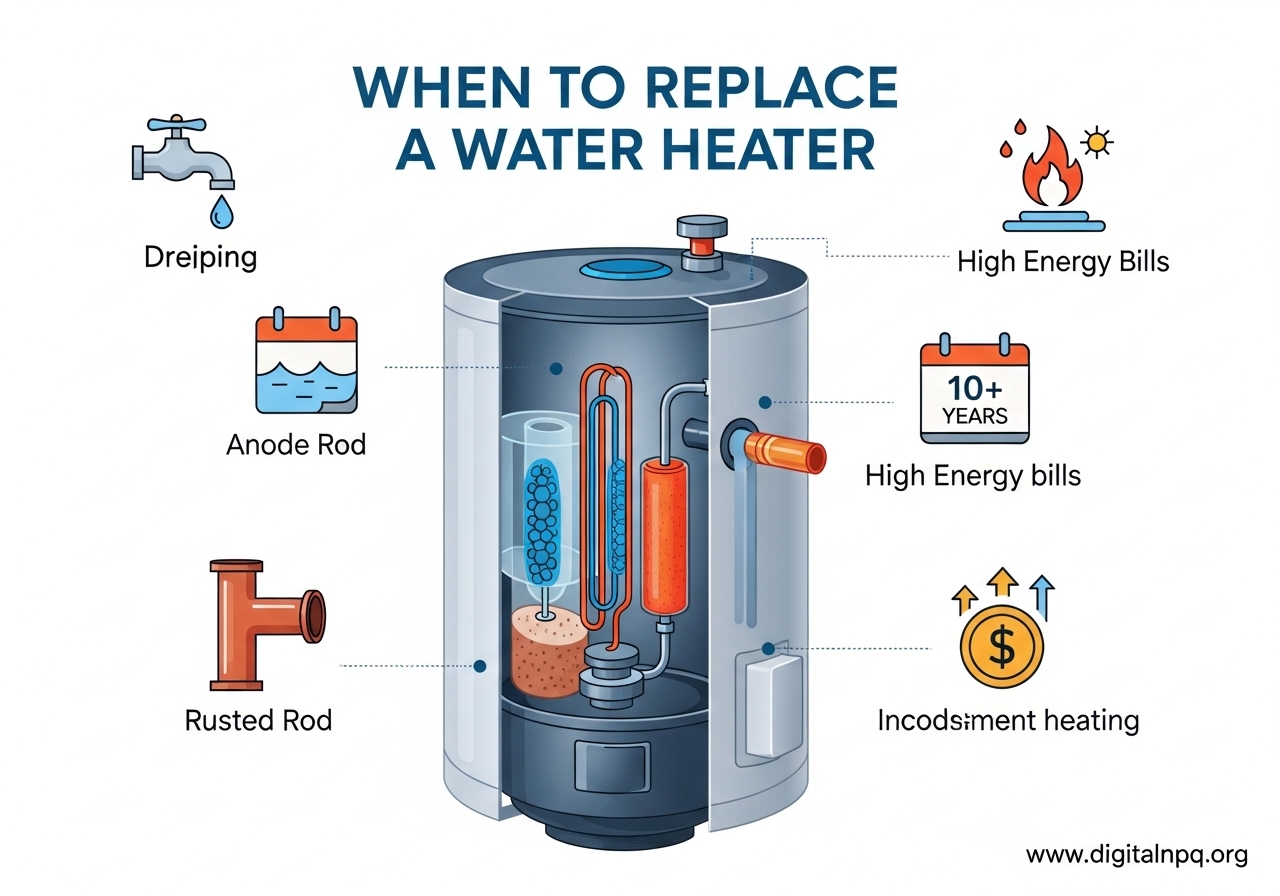
When to replace a water heater is a question nearly every homeowner faces at some point. Most people only think about their water heater when something goes wrong, but waiting for a complete failure can lead to expensive emergency repairs and water damage. I have seen too many homeowners caught off guard by a sudden burst tank or a complete loss of hot water on a cold morning.
The typical tank water heater lasts between 8 and 12 years. However, that range depends heavily on maintenance, water quality, and usage patterns. If your unit is approaching the 10-year mark, you should start paying close attention to warning signs.
In this guide, I will walk you through the exact lifespan expectations for tank and tankless systems, the red flags that signal replacement is needed, and how to decide between repair and replacement. You will also learn simple maintenance steps that can add years to your current unit. Whether you have a traditional tank or a modern tankless system, the information here applies to your situation.
Homeowners on plumbing forums consistently share one piece of advice: do not wait until your water heater fails catastrophically. Proactive replacement gives you time to research options, compare quotes, and choose the right unit for your home. Emergency replacements often lead to rushed decisions and higher costs.
How Long Do Water Heaters Last?
Water heater lifespan varies significantly depending on the type of system you own. Understanding these differences is the first step in deciding when to replace your unit.
Tank Water Heater Lifespan
Traditional tank water heaters typically last 8 to 12 years. Some well-maintained units in areas with soft water have been reported to reach 15 years, but that is the exception rather than the rule. Most manufacturers design these units with a 10-year service life in mind.
If your tank water heater is over 10 years old, you should treat it as a candidate for replacement. Even if it appears to function normally, internal corrosion and sediment accumulation are likely already weakening the tank. A unit that reaches 15 years is living on borrowed time.
The warranty length on your tank water heater is also a good indicator of expected lifespan. Units with 6-year warranties are built with thinner tanks and lighter components. Models with 10-year or 12-year warranties typically use thicker tanks and more robust anode rods, which can extend their useful life.
Tankless Water Heater Lifespan
Tankless water heaters generally last 15 to 20 years. Because they heat water on demand rather than storing it in a tank, they avoid the constant pressure and corrosion that tank models endure. This design difference is the main reason for their extended lifespan.
However, tankless units are not maintenance-free. Mineral scale buildup in the heat exchanger can reduce efficiency and cause premature failure. In areas with hard water, annual descaling is recommended to protect the unit and keep it running for its full expected life.
The installation quality also affects how long a tankless water heater lasts. Poor venting, incorrect gas line sizing, or hard water without treatment can all cut years off the expected lifespan. Professional installation by a certified technician is the best way to ensure your unit reaches its full 20-year potential.
How to Determine Your Water Heater’s Age
Many homeowners have no idea how old their water heater is. Fortunately, you can find this information quickly by checking the serial number on the manufacturer’s rating plate. This plate is usually located on the side of the tank near the top.
Serial number formats vary by manufacturer. Most major brands encode the manufacturing date within the first few digits. For example, a Rheem serial number starting with the letters A through M typically indicates the month of manufacture, while the next two digits represent the year. Bradford White and A.O. Smith use similar encoded systems.
If you cannot decode the serial number yourself, a quick call to the manufacturer with the number in hand will give you the exact production date. Knowing this date helps you plan replacement rather than gambling on an aging unit.
When to Replace a Water Heater: Warning Signs You Shouldn’t Ignore
Age is only one factor in the replacement decision. Performance problems and visible damage are often more urgent indicators that your water heater is failing. Ignoring these warning signs can result in flooding, property damage, or even safety hazards.
Water Leaks and Corrosion
Any water pooling around the base of your tank is a serious concern. Small leaks often start at seams or fittings before the tank itself begins to rust through. Once the tank metal corrodes, there is no reliable repair. The only safe solution is replacement.
Check the exterior of your tank for rust streaks or corrosion around the pressure relief valve and inlet connections. External rust is a sign that internal corrosion is also occurring. If the tank itself is rusting, it is only a matter of time before a leak develops.
Homeowners on home improvement forums frequently report discovering small leaks only after water damage had already spread to floors, drywall, or finished basements. The cost of repairing that damage often exceeds the cost of replacing the water heater itself. If your unit is located inside your living space rather than a garage, the risk is even higher.
Even a slow drip can indicate that the tank wall has thinned in a specific spot. High pressure and thermal expansion stress the tank every time it heats and cools. A pinhole leak today can become a burst seam tomorrow. Do not rely on temporary patch kits for tank leaks. They are a stopgap measure at best and a safety hazard at worst.
Strange Noises and Sediment Buildup
Popping, rumbling, or crackling sounds from your water heater are classic signs of sediment buildup. Over time, minerals from hard water settle at the bottom of the tank and harden into a crusty layer. This layer forces the heating element to work harder, overheating the tank and creating those disturbing noises.
Sediment buildup also reduces the available hot water capacity because the layer takes up space that should hold water. It insulates the heating element from the water, making heating slower and less efficient. If flushing the tank does not quiet the noises, the sediment may be too severe to remove.
Rumbling noises that sound like a boiling kettle are especially concerning. They mean water is overheating and flashing to steam under the sediment layer. This overheating weakens the tank steel and can damage the protective glass lining. Once the glass lining cracks, corrosion accelerates rapidly.
Insufficient or Inconsistent Hot Water
If your showers are getting shorter because the hot water runs out faster than it used to, your water heater may be losing capacity. Internal corrosion can reduce the effective tank size. A failing heating element or gas burner can also reduce recovery speed, meaning the tank takes longer to reheat between uses.
Inconsistent water temperature is another red flag. Water that fluctuates between hot and cold during a single shower usually indicates a failing dip tube, a worn thermostat, or sediment interfering with the heating process. If repairs do not resolve the issue, replacement is the logical next step.
If your household has grown or your hot water needs have increased, your old unit may simply be undersized. However, if demand has stayed the same and performance has dropped, the unit is declining. A new water heater will restore capacity and often lower your energy bills because newer models are more efficient.
Rusty or Discolored Water
Rusty or brown-tinted hot water coming from your taps is a strong sign of internal tank corrosion. To confirm the problem is the water heater and not your plumbing, run cold water separately. If the cold water is clear but the hot water is discolored, your tank is corroding from the inside.
This is one of the final warning signs before a tank fails. Once the interior lining is compromised, rust spreads quickly and the tank loses structural integrity. You should treat discolored hot water as an urgent signal to plan replacement immediately.
Repair vs Replace: Making the Right Decision
One of the most common questions homeowners ask is whether a repair will buy them enough time to delay replacement. The answer depends on the age of the unit, the cost of the repair, and the nature of the problem.
The 50% Rule for Repair Costs
A widely accepted guideline in the HVAC and plumbing industry is the 50% rule. If a repair costs more than 50% of what a new water heater would cost, replacement is the smarter financial choice. Spending hundreds of dollars to fix a 12-year-old tank is usually poor money management.
Even if the repair is cheap, consider the remaining expected life of the unit. A $200 repair on a 5-year-old unit makes sense. The same $200 repair on a 15-year-old unit is risky because another failure could happen within months. The money is better put toward a new unit.
Age-Based Replacement Guidelines
Use these age benchmarks to guide your decision. A tank water heater under 6 years old with a minor issue should almost always be repaired. Between 6 and 10 years, evaluate the repair cost and condition carefully. Over 10 years, replacement is usually the wiser long-term choice unless the repair is extremely minor.
For tankless water heaters, the same logic applies but with different age ranges. Under 10 years old, repair is typically the right call. Between 10 and 15 years, weigh the cost and the unit’s maintenance history. Over 15 years, consider replacement even if the unit is still running, because parts availability and efficiency decline.
Tank water heaters with 6-year warranties are typically built with thinner steel and less protective anode material. These models rarely justify expensive repairs after the 8-year mark. Conversely, premium 12-year-warranty tanks are built more robustly and may justify a repair at 10 years if the unit has been well maintained.
When Proactive Replacement Makes Sense
Proactive replacement means swapping out your water heater before it fails completely. This approach is especially smart if your unit is over 10 years old and located in an area where a leak would cause significant damage. Finished basements, utility closets inside the home, and upstairs installations are high-risk locations.
Homeowners who replace proactively report saving money and stress. You get to shop around for the best installer, choose the right model, and schedule the work at a convenient time. Emergency replacements often cost 30% to 50% more because you are paying for rush service and limited options.
Proactive replacement also lets you upgrade to a more efficient model. Energy efficiency standards have improved significantly over the past decade. A new unit can lower your utility bills and may qualify for local rebates or incentives. In 2026, many utility companies offer rebates for high-efficiency water heaters.
If you are planning a home renovation or expecting changes in household size, timing your water heater replacement with those plans is efficient. You can choose a larger or more efficient unit, relocate it if needed, and avoid disrupting your home twice.
Water Heater Maintenance to Extend Lifespan
Regular maintenance is the single most effective way to extend your water heater’s life. Homeowners who perform basic maintenance often report their units lasting 3 to 5 years longer than neglected units. A small investment of time each year can delay a major replacement expense.
Annual Flushing and Sediment Removal
Flushing your tank water heater once a year removes sediment that accumulates at the bottom. The process involves connecting a garden hose to the drain valve, turning off the cold water supply, and allowing the tank to empty until the water runs clear. This takes 30 to 60 minutes for most homeowners.
In areas with very hard water, you may need to flush twice a year. If you have never flushed your tank and it is more than 5 years old, be cautious. The drain valve may be clogged with sediment, and forcing it can cause leaks. A plumber can handle this safely if you are unsure.
Tankless water heaters also need periodic descaling. The process involves circulating a vinegar or commercial descaling solution through the heat exchanger using a small pump. This removes mineral deposits that restrict water flow and reduce heating efficiency. Manufacturers typically recommend descaling every 12 to 18 months depending on water hardness.
Anode Rod Replacement
The anode rod is a sacrificial metal rod that sits inside your tank and attracts corrosive minerals. By corroding instead of the tank wall, it protects the tank from rusting. Over 3 to 5 years, the anode rod depletes. Once it is fully consumed, the tank itself begins to corrode.
Replacing the anode rod every 3 to 5 years can double the effective life of your tank. The rod itself costs between $20 and $50 and can be installed with basic tools. If you are not comfortable working on your water heater, a plumber can do this during a routine service call.
Some modern water heaters use powered anode rods that do not deplete in the same way. These electronic rods can last the life of the tank and are worth considering if you are replacing a unit in an area with aggressive water chemistry. They are a higher upfront cost but reduce long-term maintenance.
Cost Considerations and Budget Planning
Understanding replacement costs helps you budget and avoid sticker shock. Prices vary based on the type of unit, capacity, installation complexity, and your geographic location. Tank water heaters generally cost less to purchase and install than tankless models.
For a standard 40-gallon tank water heater, replacement costs typically range from $900 to $1,500 including installation. A 50-gallon tank may run $1,000 to $1,800. Tankless units start around $2,000 and can reach $4,500 or more depending on venting requirements and gas line upgrades. Electric tankless models are often cheaper but may require electrical panel upgrades.
Emergency replacements often cost more because you are paying for immediate response, after-hours service, or weekend rates. Planning ahead and getting quotes during normal hours can save you several hundred dollars. Some plumbers offer seasonal discounts or package deals if you bundle the water heater replacement with other maintenance.
Do not forget to factor in energy savings. New water heaters are significantly more efficient than models from a decade ago. Over the life of the unit, lower utility bills can offset a portion of the replacement cost. Check with your local utility provider for rebates on high-efficiency models in 2026.
Homeowners on forums consistently recommend getting at least three quotes from licensed plumbers before committing. Prices can vary by 30% or more between contractors. Make sure each quote includes the unit, labor, permits, disposal of the old unit, and any necessary code upgrades.
Frequently Asked Questions
How do you know when a water heater needs to be replaced?
Replace your water heater when it shows signs of leaks, corrosion, rusty water, strange noises, or insufficient hot water. Age over 10 years for tank models is also a strong signal. If you notice any of these issues, schedule a professional inspection promptly.
Is a 10 year old water heater old?
A 10-year-old tank water heater is considered old and should be monitored closely. It is near the end of its expected lifespan and failure risk increases significantly. A 10-year-old tankless unit is still in its prime with many years of service remaining.
Should I replace a 20 year old hot water heater?
Yes, a 20-year-old tank water heater should be replaced immediately. It is well beyond its design life and poses a significant leak risk. Even if it still produces hot water, the tank metal has likely weakened. A 20-year-old tankless unit may still function but should be inspected annually.
What is the average price to replace a 40 gallon water heater?
The average price to replace a 40-gallon water heater ranges from $900 to $1,500 including installation. Costs vary by region, fuel type, and installation complexity. Tankless and heat pump alternatives cost more upfront but offer long-term savings.
Conclusion
Knowing when to replace a water heater comes down to age, warning signs, and your personal risk tolerance. If your tank unit is over 10 years old, or your tankless unit is over 15 years old, start planning for replacement. Do not wait for a catastrophic failure to force your hand.
Pay attention to leaks, noises, rusty water, and declining performance. These are your water heater’s way of telling you that the end is near. Use the 50% repair rule and age-based guidelines to make a smart financial decision. Proactive replacement almost always saves money and stress compared to emergency repairs.
Regular maintenance like annual flushing and anode rod replacement can extend your current unit’s life. When the time does come to replace, get multiple quotes and consider upgrading to a more efficient model. Your future self will thank you for the planning and the lower utility bills.