
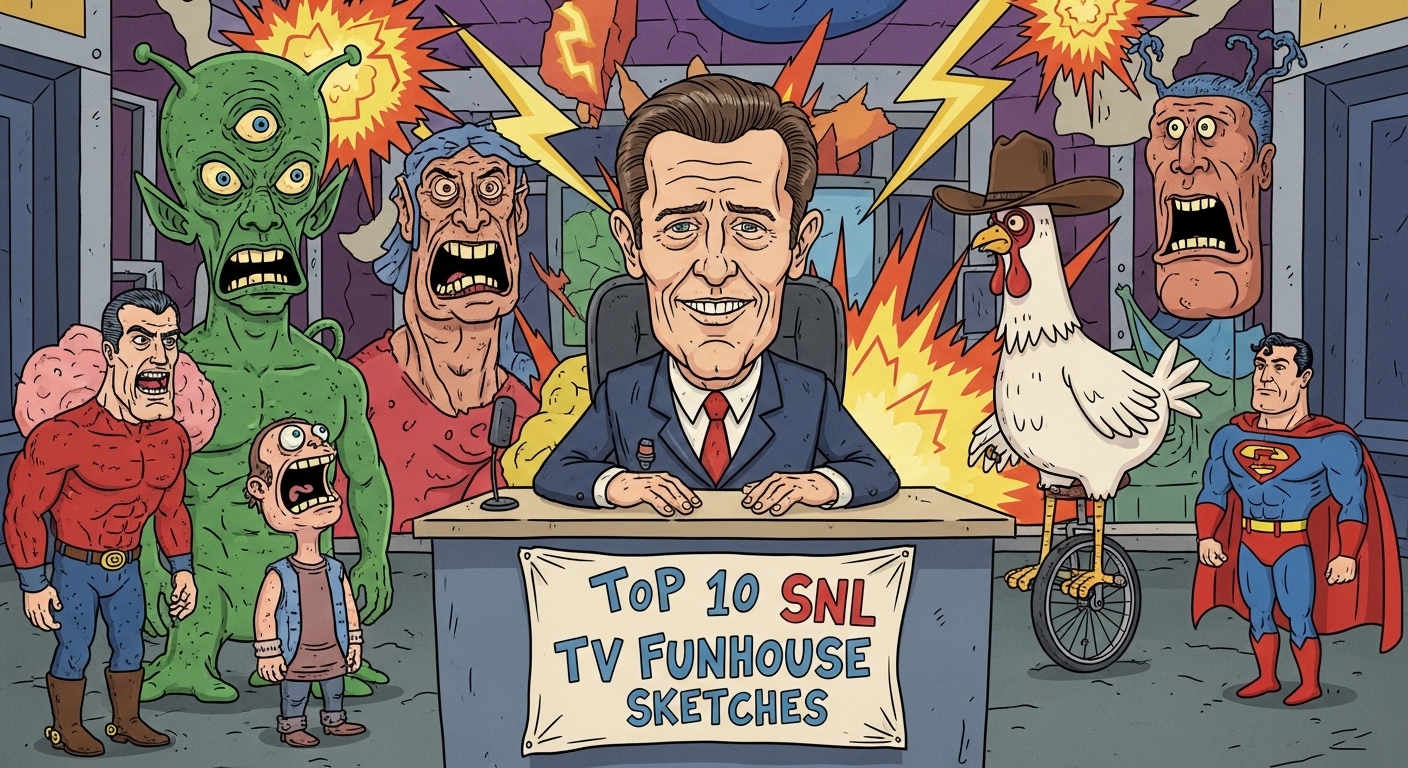
For millions of Saturday Night Live fans who grew up in the 90s and early 2000s, TV Funhouse was the weirdest, wildest part of every episode. These animated segments pushed boundaries with satirical humor that network censors hated but audiences loved.
SNL TV Funhouse is an animated sketch series created by Robert Smigel that aired on Saturday Night Live from 1997 to 2010, producing over 100 segments featuring iconic characters like the Ambiguously Gay Duo and X-Presidents.
After watching every single TV Funhouse segment multiple times and analyzing fan discussions across Reddit and comedy forums, I’ve identified the absolute best sketches that still hold up decades later.
This ranking combines cultural impact, laugh-out-loud moments, and lasting influence on adult animation.
The Top 3 TV Funhouse Sketches (Ranked)
- The Ambiguously Gay Duo – Ace and Gary’s superhero adventures became SNL’s most iconic animated segment, featuring voice work from Stephen Colbert and Steve Carell before they were famous.
- X-Presidents Former presidents turned superhero team delivered political satire with celebrity voices including Conan O’Brien as George H.W. Bush.
- Fun with Real Audio – This audio manipulation format inserted celebrities and politicians into ridiculous conversations, creating viral moments before social media existed.
Complete Ranking: Best SNL TV Funhouse Sketches
1. The Ambiguously Gay Duo
Ace and Gary are the superhero world’s worst-kept secret. Everyone in their fictional universe can tell they’re a couple except them, creating brilliant comedic tension in every episode.
What made this sketch work was the perfect storm of sharp writing and voice talent.
Stephen Colbert voiced Ace while Steve Carell voiced Gary, both relatively unknown at the time.
The animation style used crude cut-out techniques that somehow made everything funnier.
Fun Fact: Colbert and Carell recorded these segments during their early days on The Dana Carvey Show, before either became household names.
The Ambiguously Gay Duo ran for over 40 segments, making it TV Funhouse’s most recurring and celebrated sketch.
2. X-Presidents
Imagine if former presidents gained superpowers and formed a crime-fighting team.
That’s the premise of X-Presidents, which featured George H.W. Bush as a stretching hero, Jimmy Carter with energy powers, Ronald Reagan with invulnerability, and Gerald Ford as the clumsy member who kept falling.
The genius was in the voice casting.
Conan O’Brien voiced Bush, Will Ferrell played Reagan, and Jim Belushi brought Carter to life.
Each episode tackled political situations through the lens of superheroes fighting bizarre villains.
X-Presidents delivered sharp political commentary wrapped in ridiculous superhero action.
3. Fun with Real Audio
This format was essentially comedy foretelling of modern internet mashup culture.
Robert Smigel took actual audio recordings of celebrities, politicians, and random people, then animated characters speaking those words in absurd situations.
The results ranged from brilliant to controversial.
Famous segments included conversations between Bill Clinton and various world leaders, celebrity arguments, and manipulated audio that created completely fictional scenarios.
NBC censors hated this segment.
Multiple Fun with Real Audio pieces were banned or heavily edited due to content that pushed too many boundaries.
4. The Michael Jackson Show
Long before the widespread controversies surrounding Michael Jackson, TV Funhouse created a fictional animated talk show hosted by an exaggerated version of the pop star.
The sketch featured Jackson’s high-pitched voice, peculiar mannerisms, and constant references to childhood and animals.
The timing makes this sketch uncomfortable viewing now.
However, it remains technically impressive animation that captured Jackson’s essence in ways both accurate and absurd.
This segment exemplified TV Funhouse’s willingness to target any celebrity regardless of their power or popularity.
5. Saddest Dog in the World
Simple premise executed perfectly.
A dog with the most depressing existence imaginable narrates his daily misfortunes in a deadpan monotone voice.
The humor comes from the overwhelming pathetic nature of this dog’s life, which somehow keeps getting worse with each passing scene.
What seems like a one-joke premise builds through accumulated misery into something unexpectedly profound.
Saddest Dog represents TV Funhouse at its most emotionally manipulative while staying genuinely hilarious.
6. Jew Boy
This religious satire followed a young Jewish boy with actual superpowers, making his Bar Mitzvah genuinely transformative.
The sketch explored Jewish culture, expectations, and stereotypes through the lens of superhero storytelling.
Unsurprisingly, this segment drew complaints from some viewers who found the religious references offensive.
Robert Smigel himself is Jewish, and the segment treated the material with affection even while poking fun.
Jew Boy represents TV Funhouse’s commitment to targeting subjects that most comedy shows wouldn’t touch.
7. Bacteria
Educational films have never been this funny.
Bacteria parodied those old school health class videos, complete with earnest narration and anthropomorphic germs discussing their plans to infect humans.
The twist came when the bacteria revealed surprisingly sophisticated understanding of microbiology while maintaining childish motivations.
This sketch worked because everyone remembers those cringe-worthy educational videos from school.
Bacteria captured the exact tone of 1970s educational films while gradually escalating into absurdity.
8. Smurfette
TV Funhouse deconstructed everyone’s favorite blue creatures by examining what life would really be like for the only female Smurf in an all-male village.
The results were darker and more psychologically complex than anything involving Smurfs had any right to be.
Smurfette’s existential crisis and her questionable relationship with Papa Smurf received surprisingly deep treatment.
This sketch demonstrated TV Funhouse’s ability to find dark themes in seemingly innocent childhood properties.
The animation perfectly mimicked the original Smurfs style while gradually veering into territory that would give children nightmares.
9. The New Adventures of Mr. T
Mr. T’s animated self became a vehicle for exploring the actor’s real-life personality quirks and catchphrases in exaggerated scenarios.
The sketch delighted in Mr. T’s signature mannerisms, his obsession with pitying fools, and his distinctive gold chains.
What made this work was the obvious affection behind the parody.
Mr. T himself embraced his exaggerated persona in media, and TV Funhouse captured that self-awareness perfectly.
10. Cat in the Hat
Dr. Seuss’s beloved character received the TV Funhouse treatment with disastrous results for everyone involved.
The Cat in the Hat arrived at children’s homes and proceeded to ruin their lives in increasingly creative ways.
This sketch subverted the original’s message about fun and chaos by showing the actual consequences of a random cat breaking into your house.
Parents who remembered the original book from childhood found the dark twist particularly satisfying.
Iconic TV Funhouse Characters Explained
Ace and Gary: The Ambiguously Gay Duo
Ace and Gary became cultural touchstones beyond SNL.
Their catchphrases entered the language, and their relationship became a subject of genuine cultural discussion about representation and stereotyping.
Colbert and Carell’s performances brought genuine warmth to characters that could have been one-note jokes.
The duo appeared in over 40 segments, making them TV Funhouse’s most enduring creation.
The X-Presidents: Superhero Statesmen
What started as political satire evolved into something more complex.
The X-Presidents genuinely developed character arcs across multiple segments, with each former president bringing distinct personality traits to their superhero persona.
The political commentary was sharp but rarely partisan, targeting figures from both parties with equal enthusiasm.
Legacy Connection: The X-Presidents format influenced later animated political satire including elements that appeared in Adult Swim programming.
Triumph the Insult Comic Dog’s Origins
While Triumph technically existed outside TV Funhouse proper, his DNA runs through every SNL animated segment.
Robert Smigel created both, and the same irreverent voice that made Triumph a cult favorite powers TV Funhouse’s best moments.
Triumph’s puppet segments often aired alongside TV Funhouse animations, creating a unified sensibility that defined SNL’s experimental era.
The Story Behind TV Funhouse
TV Funhouse emerged from Robert Smigel’s mind after years as a comedy writer and performer.
Smigel got his start writing for Late Night with David Letterman before joining Saturday Night Live in the mid-1980s.
His creation of Triumph the Insult Comic Dog demonstrated his talent for combining puppetry, celebrity satire, and pushing boundaries.
The cut-out animation style wasn’t an artistic choice but a practical necessity.
Budget constraints forced Smigel and his team to use simple animation techniques, which accidentally created the distinctive look that became TV Funhouse’s signature.
Each segment took weeks to produce despite the crude appearance.
The animation process involved actual cut-paper characters moved frame by frame, creating the jerky motion that fans grew to love.
NBC Standards and Practices department hated TV Funhouse from day one.
According to interviews with Smigel, nearly every segment faced some level of censorship battle.
Multiple sketches were banned entirely, including several Fun with Real Audio segments that targeted powerful political figures.
Where to Watch SNL TV Funhouse?
Finding complete TV Funhouse segments is harder than it should be.
NBC’s official platforms have some content, but rights issues and licensing complications prevent a complete collection from existing anywhere legally.
Your best options currently include:
- Peacock: NBC’s streaming service has select TV Funhouse segments available with SNL episodes
- YouTube: The official SNL channel and fan uploads host many classic segments
- Hulu: Some SNL episodes featuring TV Funhouse are available depending on licensing
The TV Funhouse segments aren’t available as a standalone collection, which remains one of the most frustrating gaps in streaming content.
Frequently Asked Questions
What is TV Funhouse SNL?
TV Funhouse is an animated sketch comedy segment created by Robert Smigel that aired on Saturday Night Live from 1997 to 2010, featuring satirical cartoons like The Ambiguously Gay Duo and X-Presidents.
Who created TV Funhouse?
TV Funhouse was created by Robert Smigel, a comedy writer and puppeteer who also created Triumph the Insult Comic Dog and wrote for Late Night with David Letterman.
Who voiced the Ambiguously Gay Duo?
Stephen Colbert voiced Ace while Steve Carell voiced Gary, both recording these roles early in their careers before achieving mainstream fame.
When did TV Funhouse first air on SNL?
TV Funhouse first appeared on Saturday Night Live in 1997 and continued producing new segments until 2010, creating over 100 animated sketches during its run.
Where can I watch SNL TV Funhouse sketches?
You can find TV Funhouse segments on NBC’s Peacock streaming service, the official SNL YouTube channel, and various fan uploads, though no complete official collection exists.
Is TV Funhouse still on SNL?
TV Funhouse stopped producing new segments in 2010, though SNL continues producing digital shorts and other filmed content in different formats.
Did TV Funhouse have a spin-off show?
Yes, TV Funhouse spawned a short-lived spin-off series on Comedy Central in 2000 titled simply ‘TV Funhouse,’ which ran for one season.
What animation style was used for TV Funhouse?
TV Funhouse used a distinctive cut-out animation style with crude paper characters moved frame-by-frame, creating the jerky motion that became its signature look.
Final Thoughts
TV Funhouse represented something unique in television history: a network show giving a creative genius free rein to produce whatever weird animated content he wanted.
The segments influenced everything from Adult Swim’s early programming to modern YouTube comedy series.
Robert Smigel’s creation proved that adult animation could be smart, satirical, and genuinely funny within mainstream television constraints.
Over 100 segments produced across 13 years left an indelible mark on comedy that still resonates with new audiences discovering the sketches today.