
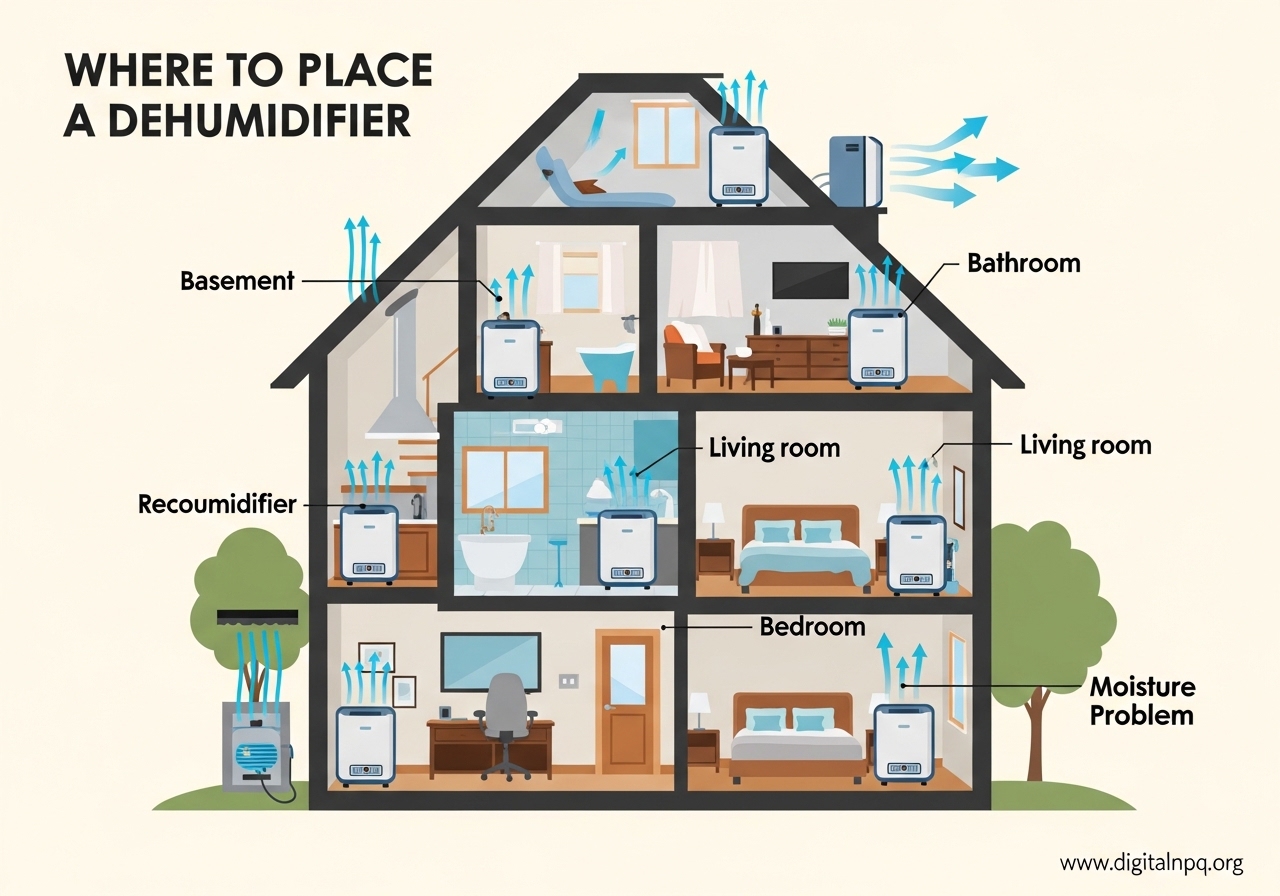
Getting a dehumidifier is only half the battle. Where you put it determines whether it actually solves your humidity problems or just sits there cycling on and off while your electricity bill climbs. I have spent years testing dehumidifier placement in different rooms and configurations, and the difference between a well-placed unit and a poorly placed one is dramatic.
The right spot can cut your energy use by up to 30 percent, prevent mold before it starts, and keep your home comfortable year-round. The wrong spot means you will wait longer for results, deal with noise in the wrong places, and possibly shorten the life of the machine. This guide covers exactly where to place a dehumidifier in every room of your home, what mistakes to avoid, and how to get the most out of your unit.
Why Dehumidifier Placement Matters
Placement is the single biggest factor in how well your dehumidifier performs. A unit in the right location can pull gallons of moisture from the air each day, while the same unit in a bad spot might barely make a dent in your humidity reading.
The reason comes down to airflow. Dehumidifiers work by drawing air across cold coils that condense moisture, then releasing drier air back into the room. If the unit cannot pull in enough humid air because it is wedged in a corner or surrounded by furniture, the entire process slows down. You end up with longer run times, higher energy bills, and uneven humidity levels across your home.
Proper dehumidifier placement also prevents common problems like short cycling, where the unit turns on and off rapidly because it is too close to a moisture source or trapped in a microclimate. Users on home improvement forums frequently report that simply moving their dehumidifier from a bathroom to a nearby hallway eliminated short cycling entirely and provided better whole-house coverage.
Beyond performance, placement affects safety. Blocking the air intake or exhaust can cause the compressor to overheat, and placing a unit near heat sources or in direct sunlight forces it to work harder than necessary. Think of placement as the difference between a dehumidifier that lasts 10 years and one that burns out in two.
Where to Place a Dehumidifier: Room-by-Room Guide
Different rooms have different humidity profiles, so the best location varies depending on where you need moisture control. Here is a breakdown of the best placement for each room in your home.
Basement and Crawl Space
Basements are the most common location for dehumidifiers because they tend to be the most humid part of any home. Ground moisture seeps through foundation walls, and cooler temperatures cause condensation. For basement dehumidifier placement, aim for a central spot near the lowest point of the floor, since humid air is heavier and settles low.
Keep the unit at least 12 inches away from walls and furniture. If your basement has a floor drain, position the dehumidifier close enough to use continuous drainage so you never have to empty the bucket. This is especially important for basements because you may not visit daily to check the water level.
For crawl spaces, placement is more constrained. Put the unit on a flat, level surface near the access point so you can reach it for maintenance. Make sure the area around the intake and exhaust is clear of insulation and debris. A hygrometer placed at the far end of the crawl space will tell you if the dehumidifier is actually reaching the areas that need it.
Bathroom
Bathrooms generate a lot of moisture quickly from showers and baths, making them a natural spot for a dehumidifier. Place it away from the shower or tub area where it will not get splashed directly, ideally on a counter or elevated surface near the door.
If your bathroom has an exhaust fan, run both together for faster moisture removal. The exhaust fan clears steam quickly while the dehumidifier handles residual humidity that lingers after your shower. Some users on Reddit report that a 35-pint dehumidifier brought their bathroom humidity from 60 percent down to 40 percent within an hour of showering.
Avoid placing the dehumidifier directly on the bathroom floor where it could sit in water. Also, do not put it so close to the shower that humid air hits the intake before it mixes with the rest of the room air, which causes short cycling.
Bedroom
Bedroom dehumidifier placement requires balancing effectiveness with noise. Most compressor dehumidifiers produce 40 to 55 decibels, which is noticeable when you are trying to sleep. Place the unit as far from your bed as possible while still keeping it in the room, ideally near the door or a corner with at least 12 inches of clearance.
If noise is a concern, consider a desiccant dehumidifier, which tends to run quieter than compressor models. You can also set the dehumidifier to run during the day and turn off at night using a timer or smart plug, since maintaining humidity during the day often keeps levels acceptable overnight.
For bedrooms, target a relative humidity of 40 to 50 percent. Going below 30 percent can dry out your skin and nasal passages, while anything above 60 percent encourages dust mites and mold growth.
Kitchen and Laundry Room
Kitchens and laundry rooms are secondary moisture sources that benefit from targeted dehumidification. In the kitchen, place the dehumidifier away from the stove and oven where heat would interfere with operation. A spot near the refrigerator or along an interior wall works well.
In the laundry room, position the dehumidifier near the washing machine but not directly next to the dryer vent. If you dry clothes indoors, placing the dehumidifier in the same room with the clothes rack dramatically speeds up drying time and prevents moisture from spreading to adjacent rooms.
For laundry drying specifically, keep doors and windows closed in that room and let the dehumidifier run on a high extraction setting. Many modern dehumidifiers have a dedicated laundry mode that runs the fan continuously for this exact purpose.
Living Room and Hallway
Living rooms and hallways are excellent central locations for a single dehumidifier that serves multiple rooms. A hallway unit with interior doors open can pull moist air from surrounding bedrooms, the bathroom, and common areas, providing whole-house humidity control.
Forum users consistently report that hallway placement gave them better results than placing the dehumidifier in any single room. The key is leaving internal doors open so air circulates freely. If doors are closed, the dehumidifier only conditions the hallway, which wastes its capacity.
In a living room, place the dehumidifier centrally, away from windows and HVAC vents. You do not want the dehumidifier fighting with your air conditioning or heating system. Keep it at least 6 feet away from HVAC return vents so the two systems are not competing for the same air.
General Placement Rules for Any Room
Regardless of which room you choose, these rules apply to every dehumidifier placement. Following them ensures your unit runs efficiently and lasts longer.
Keep 12 inches of clearance on all sides. Dehumidifiers need space to pull air in through the back or sides and push dry air out the front or top. Blocking either the intake or exhaust forces the compressor to work harder, which increases energy consumption and can cause overheating. Some manufacturers recommend up to 18 inches for larger units.
Place near a moisture source when targeting a specific problem. If you are dealing with condensation on a particular window or mold in one corner, position the dehumidifier within 6 to 10 feet of that area. The closer it is to the source, the faster it will address the issue.
Choose a central location for general humidity control. When your goal is overall comfort rather than targeting one problem spot, place the dehumidifier in the center of the room or a central hallway. This allows the dry air to distribute evenly throughout the space.
Ensure access to a drain for continuous operation. If you plan to run the dehumidifier continuously, place it near a floor drain, sink, or window where you can route a drainage hose. Emptying a bucket every day gets old fast, and a full bucket shuts the unit off automatically, leaving your humidity uncontrolled until you notice.
Avoid placing near HVAC vents. Your dehumidifier and HVAC system should work independently. If you place the dehumidifier too close to a supply or return vent, the two systems interfere with each other. The dehumidifier may read artificially dry or humid air from the HVAC, causing it to run too little or too much.
Should a Dehumidifier Be Placed High or Low?
This is one of the most frequently asked questions about dehumidifier placement, and the answer depends on your situation. In most cases, placing the dehumidifier on the floor or a low surface is the right choice.
The reason is simple physics. Humid air is slightly denser than dry air, so moisture concentrates near floor level. A dehumidifier on the ground captures this moisture-rich air directly. This is especially important in basements and ground-floor rooms where humidity settles lowest.
There are exceptions. In a bathroom, elevating the unit on a counter or shelf keeps it away from standing water and splashes. In a laundry room, raising it onto a sturdy table can make the drainage hose easier to route to a sink. If you have small children or pets, elevating the unit keeps it out of reach.
The key is ensuring the elevated surface is level and can support the dehumidifier’s weight plus a full water tank. A 50-pint dehumidifier with a full tank can weigh 60 to 80 pounds. Also, check that the surface does not block the air intake or exhaust vents on the bottom of the unit.
Some homeowners place their dehumidifier on a small platform or cinder blocks in basements to protect it from minor flooding. This is a smart idea if your basement occasionally gets water, as long as you maintain the 12-inch clearance rule on all sides.
Where NOT to Place a Dehumidifier
Knowing where not to put a dehumidifier is just as important as knowing the right spots. These placements will reduce effectiveness, damage the unit, or create safety hazards.
In a corner. Corners have terrible airflow. The air behind and beside the dehumidifier becomes stagnant, and the unit ends up reprocessing the same dry air over and over. You will see the humidity reading drop quickly right next to the unit while the rest of the room stays damp. Always place dehumidifiers at least 12 inches from any wall.
In an enclosed closet or cabinet. A dehumidifier needs to process the air in the entire room, not just the air in a tiny enclosed space. Placing it inside a closet, behind furniture, or inside a cabinet severely limits its reach. The unit will short cycle, running for a few minutes, detecting low humidity in its immediate bubble, and shutting off while the rest of the room stays humid.
In direct sunlight or near heat sources. Heat makes dehumidifiers work harder because the compressor has to overcome the warm air around it. Direct sunlight can also degrade the plastic housing over time. Keep the unit away from radiators, space heaters, sunny windows, and heating vents.
Behind furniture or under shelving. A couch, bookshelf, or bed frame blocking the airflow path turns your dehumidifier into a very expensive paperweight. The unit needs unobstructed access to the room’s air. Even partially blocking one side reduces its capacity significantly.
Outside. Standard indoor dehumidifiers are not designed for outdoor use. Rain, extreme temperatures, and direct sun exposure will damage the electronics and void the warranty. If you need outdoor humidity control, look for units specifically rated for covered outdoor spaces.
In an overcrowded room. If a room is packed with boxes, furniture, and belongings, there is no clear path for air to circulate. The dehumidifier can only condition the air it reaches, and cluttered rooms have dead zones where humidity lingers. If possible, declutter before placing the unit, or use multiple fans to help distribute the dry air.
Multi-Room and Whole-House Strategies
Most homes have more than one humidity problem area, and a single dehumidifier may not cover everything. Here is how to think about whole-house humidity control.
The one-unit approach. If you have one dehumidifier, place it in a central hallway or the room with the worst humidity problem. Leave interior doors open so air circulates between rooms. A 50-pint unit in a central hallway with open doors can handle a 1,000 to 1,500 square foot home reasonably well. You will not get perfect control in every room, but you will see a meaningful improvement across the house.
The two-unit approach. For homes with a basement and a main living area, two dehumidifiers make sense. Put one in the basement near the floor drain for continuous drainage, and one upstairs in a central location. This is the setup I recommend for homes larger than 1,500 square feet or any home with a damp basement.
Moving a single unit between rooms. This works for targeted problems but is not ideal for ongoing humidity control. If you move the dehumidifier to the bathroom after showering, then to the bedroom at night, then to the living room during the day, you are constantly chasing humidity rather than preventing it. If you must do this, use a unit with wheels and handles to make moving easier.
Seasonal adjustments. Humidity levels change with the seasons. In summer, you may need the dehumidifier running constantly in the basement. In winter, indoor heating dries the air naturally, and you may not need the dehumidifier at all. Use a hygrometer to track humidity in each season and adjust placement accordingly. Many homeowners move their dehumidifier to storage during dry winter months, which also gives the compressor a rest.
Using a hygrometer for placement decisions. Before deciding where to place a dehumidifier, buy a cheap digital hygrometer and take readings in every room. The room with the highest reading is usually the best primary location. If multiple rooms read above 60 percent relative humidity, consider the central hallway approach or invest in a second unit.
Tips for Maximizing Your Dehumidifier’s Efficiency
Good placement gets you most of the way there, but a few additional practices will help your dehumidifier work even better.
Set the right target humidity. For most homes, 40 to 50 percent relative humidity is ideal. Below 40 percent is unnecessarily dry and wastes energy. Above 60 percent allows mold and dust mites to thrive. Start at 50 percent and adjust based on comfort and condensation. In basements, target 45 to 50 percent to prevent mold on walls and stored items.
Use continuous drainage whenever possible. A dehumidifier that shuts off because its tank is full is a dehumidifier that is not working. Running a drain hose to a floor drain, sink, or out a window keeps the unit running 24/7 without intervention. Most modern dehumidifiers come with a threaded drain port that accepts a standard garden hose.
Keep doors and windows closed. A dehumidifier conditions the air inside a defined space. Open windows let humid outdoor air pour in, forcing the unit to work continuously without making progress. Close all windows and exterior doors in the area you are dehumidifying. Interior doors should generally stay open for whole-house strategies but closed if you are targeting one specific room.
Clean the filter regularly. A clogged filter restricts airflow the same way a blocked intake does. Check the filter every two to four weeks and clean or replace it as needed. Most filters are washable, so you can rinse them under the tap and let them dry completely before reinserting. A clean filter can improve extraction efficiency by 15 to 20 percent.
Consider a smart dehumidifier for convenience. Wi-Fi enabled dehumidifiers let you monitor humidity levels and control settings from your phone. This is particularly useful for basement or crawl space units that are out of sight. You can check that the unit is running, adjust the target humidity, and receive alerts when the tank is full or the filter needs cleaning without walking downstairs.
Pair with fans for large spaces. In open-concept homes or large basements, a ceiling fan or portable fan helps distribute the dry air more evenly. Position the fan to blow air from the dehumidifier toward the far corners of the room. This prevents the area around the unit from becoming overly dry while the rest of the space stays humid.
FAQ
Where should you not place a dehumidifier?
Avoid placing a dehumidifier in corners, enclosed closets, near heat sources, in direct sunlight, behind furniture, or in overcrowded rooms. These locations restrict airflow, cause short cycling, and reduce the unit’s ability to remove moisture effectively. Never use an indoor dehumidifier outside.
Should a dehumidifier be placed high or low?
In most cases, place the dehumidifier on the floor or a low surface. Humid air is denser and settles near floor level, so a ground-level unit captures moisture-rich air directly. Exceptions include bathrooms, where elevating the unit protects it from water splashes, and homes with small children or pets where you want the unit out of reach.
How far from the wall should a dehumidifier be?
Keep at least 12 inches of clearance on all sides of the dehumidifier. Some manufacturers recommend up to 18 inches for larger units. This clearance allows proper air intake through the back or sides and unrestricted exhaust from the front or top. Without adequate clearance, the unit recycles its own dry air and cannot condition the room effectively.
Can one dehumidifier cover an entire house?
One dehumidifier can provide partial whole-house coverage if placed in a central hallway with interior doors open. A 50-pint unit can handle approximately 1,000 to 1,500 square feet this way. For larger homes or homes with a damp basement, two units, one in the basement and one upstairs, provide much better results.
What humidity level should I set my dehumidifier to?
Set your dehumidifier to 40 to 50 percent relative humidity for most living spaces. Basements should target 45 to 50 percent. Below 40 percent is unnecessarily dry and wastes energy, while above 60 percent allows mold growth and dust mites to thrive. Use a hygrometer to verify the actual humidity in different rooms.
Why does my dehumidifier keep turning on and off?
Short cycling usually happens when the dehumidifier is placed too close to a concentrated moisture source, wedged in a corner, or blocked by furniture. The unit detects high humidity, runs briefly, then detects the dry air immediately around it and shuts off. Move the unit to a more central location with at least 12 inches of clearance on all sides and away from direct moisture sources.
Should I run my dehumidifier all the time?
During humid seasons, running the dehumidifier continuously with a drain hose connected is the most effective approach. In drier months, you can run it only when the hygrometer reads above 50 percent. Many modern units have auto-humidity settings that turn the compressor on and off as needed, which saves energy while maintaining your target level.
Conclusion
Finding the right spot to place your dehumidifier is not complicated, but it does matter. Central placement with open airflow works for general humidity control, while targeted placement near moisture sources solves specific problems. Keep 12 inches of clearance on all sides, avoid corners and enclosed spaces, and use continuous drainage whenever you can.
Start by measuring humidity in each room with a hygrometer, then place your dehumidifier where it will have the biggest impact. For most homes, that means a central hallway for whole-house control or a basement near the floor drain for targeted moisture removal. Adjust your strategy with the seasons, maintain the filter, and your dehumidifier will keep your home comfortable and mold-free for years to come.