
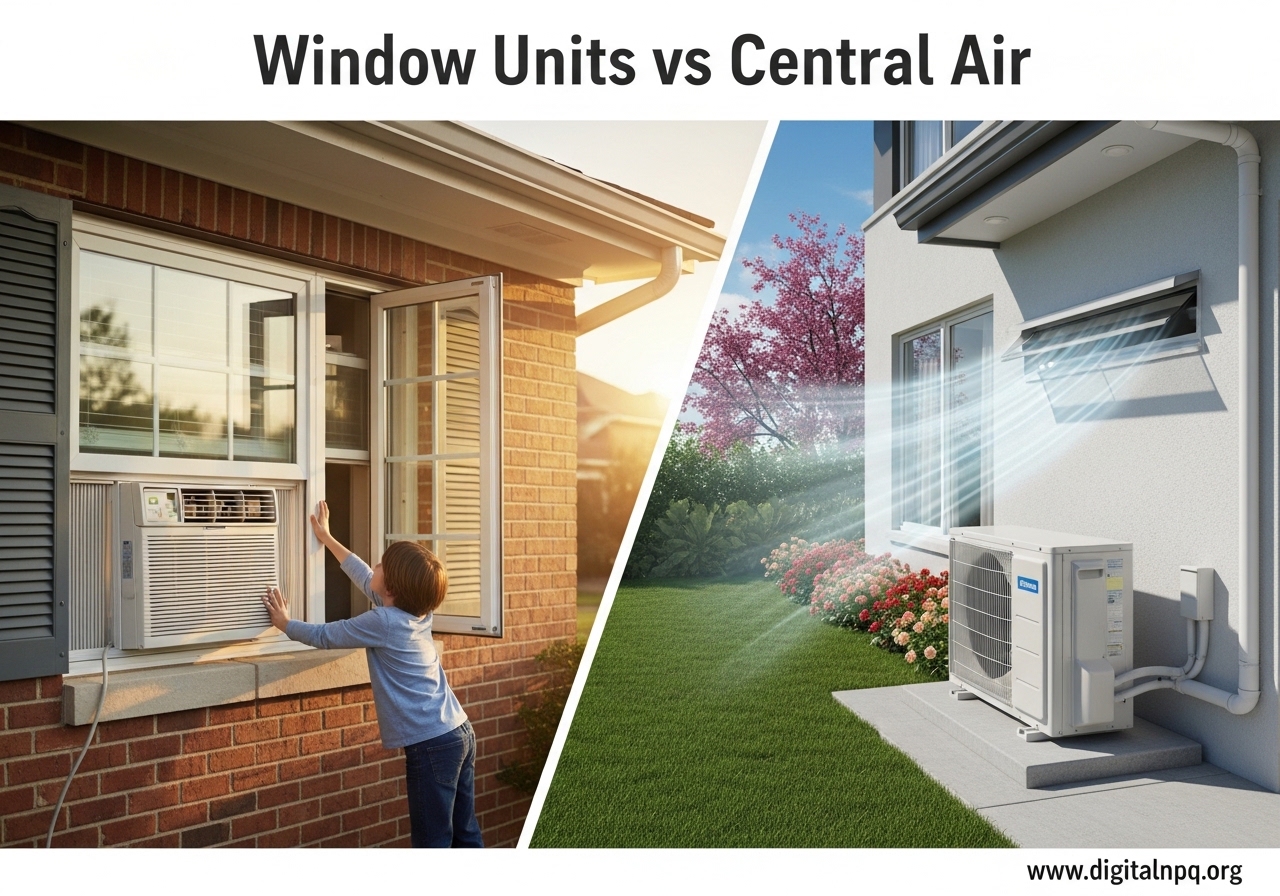
When summer temperatures climb, choosing between window units and central air becomes one of the most important decisions for your home comfort and budget. Window Units vs Central Air is not just about staying cool. It is about managing upfront costs, monthly energy bills, and installation complexity.
Our team has spent years analyzing home cooling systems, and the right choice depends on your specific situation. In this guide, you will learn exactly how each system works, what they cost to buy and run, and which option fits your home in 2026.
Choosing the wrong system can cost you hundreds of dollars per year in wasted energy. Some homeowners regret installing central air in small homes where window units would have sufficed. Others buy multiple window units only to realize they would have saved money with a single central system.
This guide breaks down every factor you need to compare. We cover upfront costs, operating expenses, energy efficiency ratings, noise levels, installation requirements, and expected lifespans. You will also find real-world scenarios to help you decide which cooling method makes sense for your space.
We also considered real-world pain points from actual homeowners. Reddit users consistently mention noise, safety, and seasonal storage as overlooked factors. Our guide addresses those concerns directly so you can make an informed decision.
Energy bills vary dramatically by climate zone. A homeowner in Arizona will spend far more on cooling than someone in Maine. We factored these regional differences into our analysis so you can estimate realistic costs for your location.
Window Units vs Central Air: Quick Comparison
Window units cool single rooms at lower upfront cost, while central air distributes conditioned air throughout an entire home using ductwork. The best choice depends on your square footage, budget, and cooling goals.
- Upfront Costs: Window units $150-$600 each; Central air $3,000-$7,500
- Energy Efficiency: Window units 8-12 EER; Central air 13-21 SEER
- Noise Levels: Window units 50-70 dB; Central air indoor unit 20-40 dB
- Lifespan: Window units 8-10 years; Central air 15-20 years
- Best For: Window units = 1-2 rooms; Central air = whole house
How Each Cooling System Works
Window AC Units Cool One Room at a Time
A window AC unit sits partially inside your window and draws warm air directly from the room. It passes that air over cold refrigerant coils, then blows the cooled air back into your space while exhausting heat outside through the rear of the unit.
Most window units plug into a standard 120V outlet. They require no ductwork. You simply install the side panels, lower the window sash, and plug it in.
Central Air Conditioning Uses Ductwork
Central air conditioning relies on a split system. An outdoor compressor unit cools refrigerant, and an indoor air handler pushes cooled air through ducts that run to every room in your home.
A thermostat controls the entire system. When the temperature rises above your set point, the compressor activates and distributes air through vents until the house reaches the desired temperature.
Room Size and BTU Sizing Guide
Matching Window Units to Your Space
Buying the wrong size window unit is a common mistake. An undersized unit runs non-stop and never cools the room. An oversized unit cycles too quickly, leaving humidity behind and creating a damp, clammy feeling.
A standard 150 square foot bedroom needs a 5,000 BTU unit. A 350 square foot living room needs at least 8,000 BTU.
If the room gets direct afternoon sun, add 10% to your BTU calculation. For kitchens with appliances generating heat, add 4,000 BTU to the base requirement.
Open floor plans complicate BTU math. A kitchen connected to a living room acts as one large space for cooling purposes.
You cannot use a small window unit for the kitchen and expect it to reach the living room effectively. Measure the total open area before choosing your equipment.
Sizing Central Air for Whole-Home Comfort
Central air sizing requires a Manual J load calculation performed by an HVAC contractor. This calculation accounts for square footage, ceiling height, insulation quality, window size, and local climate. A rough rule of thumb is one ton of cooling per 400-600 square feet of living space.
However, oversizing central air is extremely common. Contractors sometimes install larger systems to avoid callbacks, but an oversized unit short-cycles and fails to dehumidify properly. Always insist on a proper load calculation before signing a contract.
Ceiling height also matters. Standard 8-foot ceilings use the basic BTU chart. Vaulted ceilings or rooms with high ceilings need 20-30% more cooling capacity because there is more air volume to condition. Always adjust your calculations for anything above 8 feet.
Cost Comparison: Upfront and Operating
Upfront Costs
Window units cost between $150 and $600 per unit depending on cooling capacity. For a 1,500 square foot home, you might need three to four units, bringing the total to $600-$2,400. No professional installation is required for most standard units.
Central air installation costs $3,000 to $7,500 on average. Homes without existing ductwork face additional expenses of $2,000-$5,000 for duct installation. This makes central air significantly more expensive to set up.
Monthly Operating Costs
Running a single window unit costs roughly $30-$75 per month during peak summer. Running three or four units simultaneously can push your monthly cooling bill to $120-$300.
Central air costs $100-$250 per month to cool an entire home. However, central systems often use less total energy per square foot than multiple window units. The U.S. Department of Energy notes that central air with a high SEER rating can cool large spaces more efficiently than several smaller units running at once.
Regional Electricity Rate Impact
Electricity rates vary from $0.10 per kWh in some states to $0.30 per kWh in others. A central air system in a high-rate state can cost $300-$400 per month to run. The same system in a low-rate state might cost $120-$180.
Window units draw 500-1,500 watts depending on size. A 1,000-watt unit running 8 hours per day consumes 8 kWh. At $0.15 per kWh, that is $1.20 per day or $36 per month. Multiply by three units and you are at $108 monthly. This math helps you compare real costs before you buy.
Financing options differ significantly. Window units are paid in full at purchase. Central air installers often offer 0% financing for 12-24 months through partner lenders. This spreads the upfront cost but adds interest after the promotional period ends.
The $5,000 Rule for HVAC Decisions
The $5,000 rule is a simple guideline HVAC professionals use. Multiply your system’s age by the estimated repair cost. If the total exceeds $5,000, replacement is usually the smarter financial choice than repair.
For example, a 12-year-old central air system needing a $500 compressor repair scores 12 x 500 = 6,000. That exceeds $5,000, so you should consider replacing the unit rather than repairing it. This rule helps homeowners avoid throwing money at failing systems.
Energy Efficiency and Performance
Window units are rated by EER, or Energy Efficiency Ratio. Most modern units range from 8 to 12 EER. Higher numbers mean better efficiency. A 10 EER window unit costs less to run than an 8 EER unit with the same cooling capacity.
Central air systems use SEER ratings, which range from 13 to 21 for modern residential units. The minimum SEER rating allowed in the United States was raised to 14 in 2023 for northern states and 15 for southern states. Systems installed after 2026 should meet or exceed these standards.
For a single room, a window unit can be highly efficient. For whole-house cooling, central air wins because it moves more air with less total energy. The key is matching system size to your actual square footage.
BTU ratings determine how much cooling power a unit provides. A 5,000 BTU window unit handles rooms up to 150 square feet. A 12,000 BTU unit covers roughly 450-550 square feet. Central air is sized by tons, where one ton equals 12,000 BTU. A 2,000 square foot home typically needs a 3.5 to 4-ton central air system.
Oversizing either system wastes energy and shortens equipment life. Undersizing forces the unit to run constantly without reaching the target temperature. Our team recommends measuring your exact room or home dimensions before purchasing any cooling system.
Look for the Energy Star label when shopping. Energy Star certified window units use about 10% less energy than standard models. Energy Star central air systems must meet a minimum SEER of 15 for split systems. These units cost more upfront but save money over their lifetime through reduced electricity consumption.
Noise Levels and Comfort
Window units produce 50 to 70 decibels of noise depending on the fan speed and compressor quality. For comparison, normal conversation occurs at about 60 decibels. Many users report that cheaper window units disturb sleep and television viewing.
Central air systems keep the noisy compressor outside. The indoor air handler typically produces only 20 to 40 decibels. Most homeowners barely notice when the system cycles on. This quiet operation is a major reason families with young children or home offices prefer central air.
The location of your window unit also matters. A bedroom window unit will sound louder than one in a rarely used guest room. If you choose window units, look for models with a sleep mode or lower decibel ratings.
Vibration is another noise factor. Window units pressed against loose frames create rattling sounds that are louder than the compressor itself. Foam weatherstripping and tight installation reduce this problem. Some users place the unit on a piece of rubber matting to absorb vibration.
Sleep quality studies show that consistent low-level noise below 40 dB rarely disrupts sleep. Intermittent noise from a compressor cycling on and off, even at 50 dB, causes more sleep disturbances. Central air maintains a steady background hum, while window units cycle loudly.
Installation Requirements
Window Units Need Proper Support
Installing a window unit requires a compatible window frame, support brackets, and proper sealing. Most units fit double-hung windows. Sliding windows and casement windows require specialized models or modifications.
Safety matters. Improperly installed window units can fall from upper-story windows, causing injury or property damage. Support brackets that attach to the exterior wall are strongly recommended for units above the first floor. Reddit users frequently mention this concern as a major downside of window units.
Central Air Requires Professional Installation
Central air must be installed by a licensed HVAC technician. The process involves placing a compressor pad outside, connecting refrigerant lines, wiring the thermostat, and sealing duct connections. Installation typically takes one to three days depending on ductwork status.
If your home lacks ducts, installers must run them through walls, ceilings, or floors. This adds significant cost and construction time. Homes with existing forced-air heating systems have an advantage because they already have the ductwork in place.
Lifespan and Maintenance
Window AC units last 8 to 10 years with proper care. Annual maintenance includes cleaning the filter, straightening the fins, and checking the drain pan.
Filters should be washed or replaced every 30 days during heavy use. Neglecting maintenance leads to ice buildup and compressor failure.
Central air systems last 15 to 20 years when professionally maintained. Annual tune-ups cost $75-$200 and include refrigerant checks, coil cleaning, and electrical inspection. Ductwork should be inspected every few years for leaks, which can waste 20-30% of cooled air.
Seasonal storage is another consideration for window units. In climates with harsh winters, units must be removed, cleaned, and stored indoors to prevent damage. Central air stays in place year-round and requires only a winter cover for the outdoor compressor.
Most window units carry a 1-year full warranty and a 5-year sealed system warranty. Central air systems typically offer 5-10 year compressor warranties and 1-2 year parts coverage. Extended warranties are available for central air, but our team recommends focusing on installer quality rather than warranty length. A well-installed system outlasts a poorly installed system regardless of warranty terms.
Environmental Impact and Sustainability
Window units use refrigerants like R-410A or newer R-32. These chemicals have global warming potential if they leak. Older units may still contain R-22, which is being phased out due to ozone depletion. When disposing of a window unit, you must follow local regulations for refrigerant recovery.
Central air systems also use refrigerant, but they contain larger volumes. A leak in a central system can release more refrigerant into the atmosphere. On the positive side, central air with a high SEER rating uses less electricity, which reduces fossil fuel consumption at power plants if your grid relies on coal or natural gas.
For environmentally conscious buyers, mini-splits with R-32 refrigerant and inverter compressors offer the lowest carbon footprint. They use less energy and contain newer refrigerants with lower environmental impact. In 2026, several manufacturers have introduced central air systems that pair with solar panels for net-zero cooling.
Local utility rebates can offset upfront costs. Many power companies offer $200-$500 rebates for installing high-efficiency central air or heat pump systems. Some also provide free recycling for old window units. Check your utility’s website in 2026 for current incentive programs.
Pros and Cons of Each System
Window Unit Advantages and Drawbacks
Window units cost less upfront. They are portable between rooms and require no permanent installation.
Renters often prefer them because they leave no structural changes. Energy costs stay low when cooling just one occupied room.
On the downside, window units block natural light and emergency egress. They are noisy, and they only cool one area.
They can pose a security risk because the window remains partially open. They also create a visual obstruction from both inside and outside the home.
Central Air Advantages and Drawbacks
Central air provides uniform cooling throughout the entire home. It operates quietly, and it does not block windows.
It adds property value. A well-maintained system improves indoor air quality through filtration.
Central air also protects your home. Consistent temperature control prevents humidity damage to wood floors, furniture, and electronics. It allows you to keep windows closed, which improves security and reduces pollen and dust infiltration.
The drawbacks include high upfront cost. Ductwork requires space in walls and ceilings.
Energy bills rise even for unused rooms unless you have a zoned system. Repairs can be expensive, and a total system failure leaves the entire house without cooling.
When to Choose Window Units vs Central Air
Choose window units if you need to cool 1-2 rooms, rent your home, or face a tight budget. Choose central air if you own your home, need whole-house cooling, or already have ductwork installed.
Renters and Apartment Dwellers
Renters often cannot modify windows or walls permanently. Window units offer the best solution because they can be removed when you move. They also make sense for apartments where the building does not provide central air.
Homeowners with Existing Ductwork
If your home already has ducts from a furnace or heat pump, central air is the logical upgrade. The installation cost drops significantly because the distribution system is already in place. You will also enjoy higher resale value and better home comfort.
Small Homes and Single Rooms
For a studio apartment or a single bedroom, one window unit often provides enough cooling. Running a central air system to cool 400 square feet wastes energy. A $300 window unit pays for itself in saved installation costs within the first month.
Climate Zone Considerations
Climate should also guide your decision. In mild coastal areas where you only need cooling for a few weeks per year, window units are practical. In hot, humid climates where air conditioning runs six months annually, central air pays for itself faster through efficiency and durability.
Home resale value is another factor. Central air adds approximately 5-10% to home value in hot climates. Buyers often view it as essential. Window units signal temporary or budget-conscious cooling, which can reduce offers in competitive markets.
Consider Mini-Splits as a Middle Ground
Mini-split systems offer a third option worth considering. They consist of an outdoor compressor and one or more indoor wall-mounted units. They do not need ductwork. They offer higher efficiency than window units and quieter operation than central air.
A single-zone mini-split costs $1,500-$3,000 installed. Multi-zone systems run $3,000-$8,000. They are ideal for homes without ductwork where window units feel insufficient. They also allow you to cool specific rooms independently, which saves energy compared to cooling the whole house.
Cooling specific zones is a practical advantage. With a mini-split, you can cool the living room during the day and the bedroom at night without wasting energy on empty rooms. This flexibility is something central air struggles to match without expensive zoning dampers.
In 2026, mini-split technology has improved significantly. Many models now achieve SEER ratings above 20. Heat pump versions provide both heating and cooling, making them year-round investments. For older homes or additions where ductwork is impractical, mini-splits deserve serious consideration.
Frequently Asked Questions
Is it cheaper to run window units or central AC?
For a single room, a window unit is cheaper. For an entire home, central air usually costs less per square foot. Running three or more window units simultaneously often costs more than a single central air system.
What is the $5000 rule for HVAC?
Multiply the age of your HVAC system by the estimated repair cost. If the total exceeds $5,000, replacement is the better financial choice. For example, a 10-year-old system with a $600 repair scores 6,000, so you should replace it.
Do window units work as well as central air?
Window units cool individual rooms effectively. They do not match central air for whole-house comfort or consistent temperature control. For a single room, yes. For a full home, central air performs better.
How do Amish cool their homes without air conditioning?
Amish communities typically use natural ventilation, large windows, thermal mass, and strategic shading. Some use ceiling fans powered by compressed air or solar panels. They avoid mechanical refrigeration entirely.
Conclusion
Window Units vs Central Air comes down to your home size, budget, and living situation. Window units are affordable and effective for small spaces. Central air delivers superior comfort and efficiency for larger homes.
Before you decide, measure your space, calculate your energy costs, and consider whether you already have ductwork. If neither option feels perfect, explore mini-splits as a modern alternative. The right cooling system will keep you comfortable and save money for years to come.