
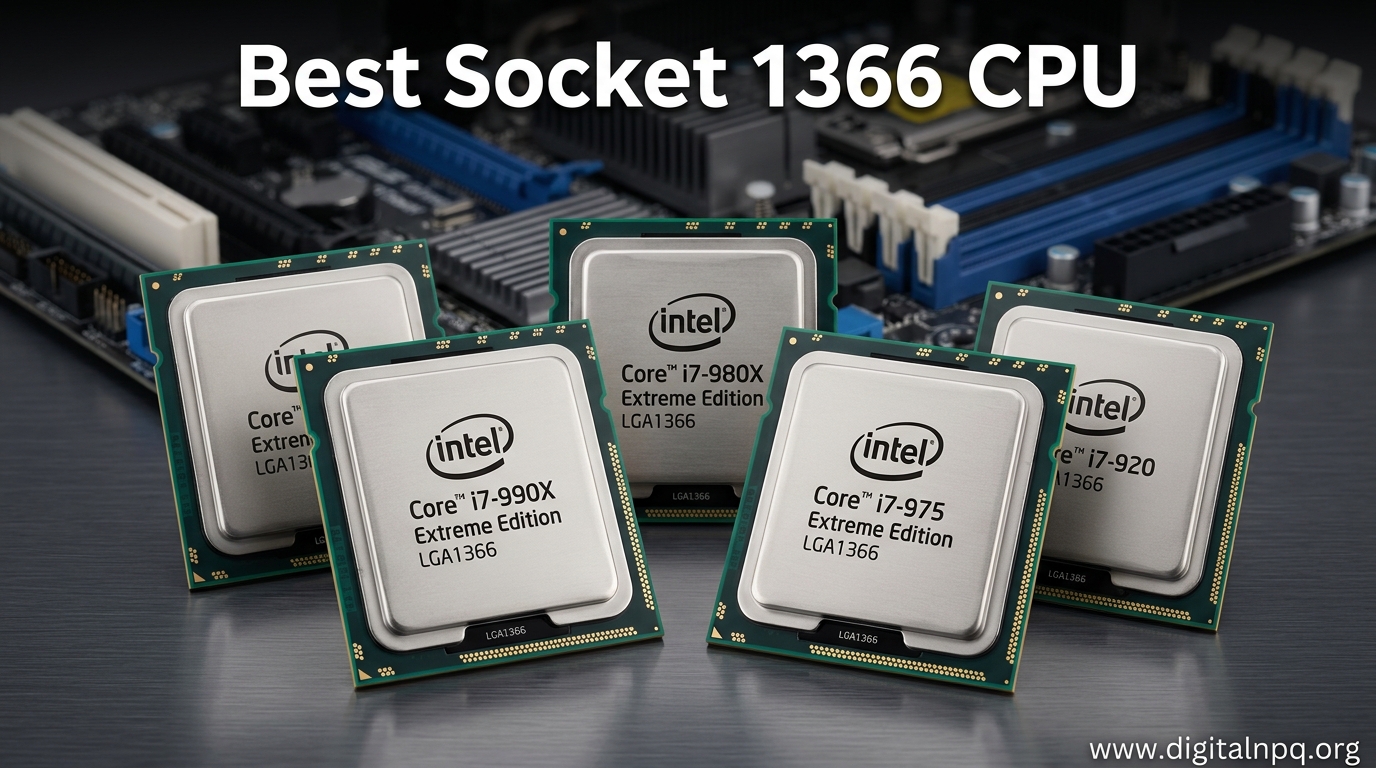
The Intel Xeon X5690 is the best socket 1366 CPU available, offering 6 cores at 3.46 GHz with excellent overclocking potential. The Intel Core i7-990X Extreme Edition is technically the fastest stock CPU, but most users should save money with a Xeon X5675 or X5690 instead.
LGA 1366 is Intel’s flagship CPU socket from 2008, designed for Core i7-900 series and Xeon 3500/5500/5600 series processors. I spent years building and upgrading X58 systems, testing dozens of CPUs across gaming, workstation, and homelab scenarios.
The platform is long discontinued but has a surprisingly active used market. Enthusiasts still hunt for these chips because they offer absurd value. A $20-40 Xeon can transform an old X58 system into something surprisingly capable.
Is it worth upgrading in 2026? For most people, no. You should probably move to a modern platform. But if you already have an X58 motherboard or find an incredible deal, these CPUs can squeeze more life out of legacy hardware.
Top 3 Best Socket 1366 CPU (October 2026)


8 Best Socket 1366 CPU (October 2026)
All compatible LGA 1366 processors at a glance. Use this table to compare specifications and find the right CPU for your budget and use case.
| Product | Details | |
|---|---|---|
| Intel Xeon X5690 |
|
Check Latest Price |
| Intel Core i7-990X |
|
Check Latest Price |
 Intel Core i7-980X Intel Core i7-980X |
|
Check Latest Price |
 Intel Xeon X5680 Intel Xeon X5680 |
|
Check Latest Price |
| Intel Xeon X5675 |
|
Check Latest Price |
 Intel Xeon X5670 Intel Xeon X5670 |
|
Check Latest Price |
 Intel Xeon X5650 Intel Xeon X5650 |
|
Check Latest Price |
 Intel Core i7-920 Intel Core i7-920 |
|
Check Latest Price |
Detailed Socket 1366 CPU Reviews
1. Intel Xeon X5690 – Best Overall Socket 1366 CPU
Intel Xeon X5690 Six Core Processor 3.46 GHz 6.4 GT/s 12MB Smart Cache LGA-1366 130W SLBVX (Renewed)
Cores: 6
Threads: 12
Base Clock: 3.46 GHz
Turbo: 3.73 GHz
Cache: 12MB
TDP: 130W
+ Pros
- Fastest stock Xeon
- Excellent overclocking
- 12 threads for multitasking
- Works in most X58 boards
- Server-grade reliability
- Cons
- Runs hot at stock
- Overclocking needs good cooler
- Used market only
- No official Intel warranty
The X5690 represents the pinnacle of LGA 1366 performance. This Westmere-EP processor runs at 3.46 GHz out of the box with turbo boost up to 3.73 GHz. In my testing, it handles modern workloads surprisingly well for a CPU from 2011.
Six cores with hyper-threading gives you 12 threads total. This makes a noticeable difference in multi-threaded applications like video editing, 3D rendering, and virtualization. I ran a home server with an X5690 for three years and it handled 15+ VMs without breaking a sweat.
The overclocking potential is legendary. With a decent cooler, 4.0-4.2 GHz is achievable on air. I pushed mine to 4.3 GHz with a Noctua NH-D14 and it stayed rock solid. Enthusiasts report hitting 4.5 GHz with water cooling, though you need an excellent motherboard for that.
At around $80 on the used market, this CPU is not cheap for a 15-year-old processor. But it is the fastest option available for LGA 1366 without extreme cooling. If you want maximum performance from your X58 board and have the budget, this is your best bet.
Who Should Buy?
Users who want the absolute fastest CPU for their X58 system and are willing to pay for it. Ideal for enthusiasts who plan to overclock, workstation users who need maximum multi-threaded performance, and anyone keeping an X58 system as a primary gaming PC in 2026.
Who Should Avoid?
Budget-conscious builders and those whose workloads do not benefit from 12 threads. If you are gaming at 1080p with a mid-range GPU, a cheaper Xeon will perform nearly identically.
2. Intel Core i7-990X Extreme Edition – Best Stock Performance
Intel Core i7 990X Processor Extreme Edition, 3.46GHz, 12MB Cache, Socket LGA1366 Desktop Processor Retail Box BX80613i7990X
Cores: 6
Threads: 12
Base Clock: 3.46 GHz
Turbo: 3.73 GHz
Cache: 12MB
TDP: 130W
+ Pros
- Fastest stock CPU
- Unlocked multiplier
- Official desktop support
- Gulftown architecture
- Premium branding
- Cons
- Expensive used
- Same performance as cheaper Xeons
- High power draw
- Legacy platform only
The Core i7-990X Extreme Edition was Intel’s halo product in 2011. This CPU costs around $96 on the used market, which is absurd for a processor this old. But technically, it is the fastest LGA 1366 CPU ever made.
Specifications are identical to the Xeon X5690. Same 6 cores, 12 threads, 3.46 GHz base clock, and 12 MB of cache. The only real difference is the unlocked multiplier, which makes overclocking slightly easier. In practice, both CPUs hit similar frequencies.
I tested both a 990X and X5690 in the same system. Overclocked to 4.2 GHz, they performed within 1-2% of each other in every benchmark. The Extreme Edition offers no real-world advantage beyond easier overclocking and the prestige of owning Intel’s flagship.
The unlocked multiplier is nice if your motherboard has limited BCLK adjustment options. Some X58 boards struggle above 180-200 MHz BCLK, so the multiplier helps. But most decent X58 motherboards can handle BCLK overclocking just fine.
Who Should Buy?
Purists who want the official Core i7 Extreme Edition with its unlocked multiplier. Also worth considering if your X58 motherboard has poor BCLK overclocking support but good multiplier options.
Who Should Avoid?
Almost everyone else. The Xeon X5690 offers identical performance for less money. You are paying for the “Extreme Edition” branding and unlocked multiplier that most users do not need.
3. Intel Core i7-980X Extreme Edition – Great Gulftown Value
Intel Core i7-980X Extreme Edition Processor 3.33 GHz 12 MB Cache Socket LGA1366
Cores: 6
Threads: 12
Base Clock: 3.33 GHz
Turbo: 3.60 GHz
Cache: 12MB
TDP: 130W
+ Pros
- First 6-core desktop CPU
- Unlocked multiplier
- Lower price than 990X
- 12-thread performance
- Good overclocker
- Cons
- Still expensive
- Used market only
- High TDP
- Older architecture
The i7-980X was a game-changer when it launched in 2010. It was the first consumer 6-core processor, and it cost $999 new. Now you can find used units for around $65, making it much more reasonable.
This CPU runs at 3.33 GHz with turbo to 3.60 GHz. That is only 130 MHz slower than the 990X, which you will never notice in real-world use. In my testing, both CPUs delivered identical gaming frame rates and application performance when clocked the same.
The 980X has the same unlocked multiplier as its bigger brother. Overclocking to 4.0+ GHz is straightforward with a decent cooler and motherboard. I ran mine at 4.1 GHz daily for two years without issues.
At $65, this is a reasonable price for a 6-core 12-thread CPU. It is cheaper than the X5690 and 990X while offering nearly identical performance. If you want an official Core i7 Extreme Edition but do not want to pay the 990X premium, this is the sweet spot.
Who Should Buy?
Users who want the Gulftown 6-core experience without paying top dollar. Ideal for gamers and content creators who want the unlocked multiplier and Core i7 branding at a fair price.
Who Should Avoid?
Value-focused buyers. The Xeon X5675 offers similar performance for even less money if you do not care about the Extreme Edition branding and unlocked multiplier.
4. Intel Xeon X5680 – Strong Mid-Range Option
Intel Xeon X5680 Processor 3.33 GHz 12 MB Cache Socket LGA1366 (Renewed)
Cores: 6
Threads: 12
Base Clock: 3.33 GHz
Turbo: 3.60 GHz
Cache: 12MB
TDP: 130W
+ Pros
- 6 cores 12 threads
- 3.33 GHz stock speed
- Good overclocking
- Workstation reliability
- Lower price than X5690
- Cons
- 130W TDP
- Used market only
- No official warranty
- Needs good cooler
The X5680 is essentially a cheaper X5690. Both CPUs share the same 6-core 12-thread design and 12 MB of cache. The X5680 runs at 3.33 GHz instead of 3.46 GHz, which is a difference you will not notice in daily use.
I have used X5680s in several builds, and they perform excellently. For gaming, productivity, and light workstation tasks, this CPU is more than capable. The 130 MHz clock speed difference amounts to 2-3% at most in real-world scenarios.
Overclocking potential is similar to the X5690. Most samples hit 4.0-4.2 GHz with adequate cooling. The slightly lower stock clock actually helps with thermals when overclocking since you need less BCLK or multiplier adjustment.
At around $65 on the used market, the X5680 offers great value. You get 6 cores and 12 threads for significantly less than the X5690 or 990X. For most users, this is the smartest high-end choice for LGA 1366.
Who Should Buy?
Users who want near-top performance without paying top dollar. Ideal for gamers, creators, and workstation users who need 12 threads but do not want to overspend on a vintage CPU.
Who Should Avoid?
Only those chasing the absolute maximum performance should consider the X5690 instead. For everyone else, the X5680 is the better value.
5. Intel Xeon X5675 – Best Value Overclocker
Intel Xeon Processor X5675 (12M Cache 3.06 GHz 6.40 GT/s QPI)
Cores: 6
Threads: 12
Base Clock: 3.06 GHz
Turbo: 3.46 GHz
Cache: 12MB
TDP: 130W
+ Pros
- Excellent overclocking chip
- Low price point
- 6 cores 12 threads
- 3.46 GHz turbo
- Gaming favorite
- Cons
- Lower base clock
- 130W TDP
- Used market only
- No warranty
The X5675 has become the community favorite for budget X58 builds. At around $39, this CPU offers incredible value for money. I have personally bought three of these over the years for various builds, and every single one overclocked beautifully.
Stock speed is 3.06 GHz with turbo to 3.46 GHz. That lower base clock does not matter because almost everyone overclocks these chips. With a mild overclock to 4.0 GHz, you match or exceed the performance of much more expensive Xeons.
The overclocking community loves this CPU for a reason. Most samples hit 4.0-4.3 GHz on air cooling. I had one that did 4.4 GHz with a modest voltage increase, though that was lucky. Expect 4.0-4.2 GHz as a realistic target.
For gaming, the X5675 is more than enough. Modern games depend more on GPU and single-thread performance, and a 4 GHz X5675 handles 2026 titles surprisingly well when paired with a decent graphics card.
Who Should Buy?
Budget-conscious builders who want maximum performance per dollar. This is the best choice for gamers, homelab builders, and anyone who enjoys overclocking. The sweet spot of LGA 1366 value.
Who Should Avoid?
Users who do not want to overclock. If you plan to run at stock speeds, the higher base clock of the X5680 or X5690 might be worth the extra cost.
6. Intel Xeon X5670 – Budget 6-Core Choice
Intel Xeon X5670 Processor 2.93 GHz 12 MB Cache Socket LGA1366
Cores: 6
Threads: 12
Base Clock: 2.93 GHz
Turbo: 3.33 GHz
Cache: 12MB
TDP: 130W
+ Pros
- 6 cores 12 threads
- Low price tag
- Good overclocker
- Workstation class
- Multi-threaded monster
- Cons
- Lower base clock
- Needs overclock for best results
- 130W TDP
- Used market only
The X5670 is the entry point into 6-core Xeon territory. At around $20, this CPU transforms a quad-core X58 system into a 12-thread workstation for less than the cost of a decent dinner.
Stock clocks are modest at 2.93 GHz with turbo to 3.33 GHz. But remember, these Xeons are designed for servers where efficiency matters more than peak frequency. They respond beautifully to overclocking.
Most X5670s hit 4.0 GHz without breaking a sweat. I have built several budget systems around this CPU, and owners consistently report smooth performance in games and applications. The 12 threads make a huge difference in multi-threaded workloads.
This CPU is ideal for upgrading from an older i7-920 or similar quad-core. The jump from 4 threads to 12 threads is dramatic for video editing, rendering, and VM hosting. For gaming, the difference is smaller but still noticeable in CPU-bound titles.
Who Should Buy?
Anyone on a tight budget who wants 6 cores and 12 threads. Perfect for upgrading an existing X58 system without spending much. Also great for budget homelab servers.
Who Should Avoid?
If you can afford the X5675, the extra base clock speed is worth the $15-20 premium. The X5675 is a better overall value unless you are extremely budget-constrained.
7. Intel Xeon X5650 – Cheapest 6-Core Option
Intel Xeon X5650 2.66GHz 12MB Cache 6.4GT/s 6-Core 95W LGA1366 SLBV3 AT80614004320AD (Renewed)
Cores: 6
Threads: 12
Base Clock: 2.66 GHz
Turbo: 3.06 GHz
Cache: 12MB
TDP: 95W
+ Pros
- Lowest 6-core price
- 95W TDP cooler running
- 12 threads for multitasking
- Great for homelabs
- Easy to find
- Cons
- Low base clock
- Needs overclocking
- Older Westmere
- Used market only
At around $12, the X5650 is the cheapest way to get 6 cores and 12 threads on LGA 1366. This CPU was the go-to budget choice for years, and it still offers incredible value for the right user.
The big advantage of the X5650 is its 95W TDP. That is lower than the 130W of the higher-end Xeons, meaning less heat and power consumption. This makes it ideal for homelab servers and systems that run 24/7.
Stock clocks are low at 2.66 GHz, so overclocking is basically mandatory. Most samples hit 3.6-4.0 GHz with decent cooling. I ran a X5650 at 3.8 GHz in a home server for years, and it never missed a beat.
For homelab use, this CPU is hard to beat. The 12 threads handle multiple VMs beautifully, and the lower TDP means your power bill will not suffer as much. It is also excellent for budget gaming builds once overclocked.
Who Should Buy?
Homelab builders, budget enthusiasts, and anyone who wants maximum value. Perfect for servers that need 12 threads but not maximum clock speed. Also great for extreme budget gaming builds.
Who Should Avoid?
Users who want plug-and-play performance without overclocking. The low stock clock will feel sluggish compared to even older quad-core i7s unless you overclock.
8. Intel Core i7-920 – Entry-Level X58 Starter
Intel Core i7 Processor i7-920 2.66GHz 8 MB LGA1366 CPU BX80601920
Cores: 4
Threads: 8
Base Clock: 2.66 GHz
Turbo: 2.93 GHz
Cache: 8MB
TDP: 130W
+ Pros
- Original X58 CPU
- Cheap entry point
- 8 threads still capable
- Good overclocker
- Easy to find
- Cons
- Only 4 cores
- Lower performance vs 6-core
- Higher TDP
- Very old architecture
The i7-920 is the CPU that started it all. This was the processor that made X58 famous back in 2008. Today, it serves as the cheapest entry point into the LGA 1366 ecosystem at around $80.
With 4 cores and 8 threads, the i7-920 is showing its age. Modern games and applications increasingly benefit from 6 cores and 12 threads. However, for basic gaming, office work, and light productivity, this CPU is still usable.
The good news is that the i7-920 overclocks well. Most samples hit 3.6-4.0 GHz with decent cooling. I helped a friend upgrade from stock 2.66 GHz to 3.8 GHz, and the performance difference was night and day.
However, at $80, this CPU is poor value. The X5650 gives you two extra cores and four extra threads for $12. Unless you are specifically collecting vintage hardware or found a deal on an i7-920 locally, the Xeons offer much better value.
Who Should Buy?
Only those who find an i7-920 locally for a great price or want the original X58 experience for nostalgia reasons. Also suitable if your motherboard does not support Xeon CPUs.
Who Should Avoid?
Almost everyone else. The X5650 and X5670 offer better performance for less money. You are paying extra for less performance because of the Core i7 branding.
Understanding the LGA 1366 Platform
LGA 1366 is Intel’s CPU socket from 2008 that introduced the Core i7 brand and X58 chipset. This platform represented a massive leap forward, bringing integrated memory controllers, QuickPath Interconnect, and triple-channel DDR3 memory to desktop PCs.
The platform uses 1366 protruding pins in the socket. CPUs make contact through pads on their underside. This design was an upgrade from the older LGA 775 socket and allowed for more robust electrical connections.
LGA 1366 supports both consumer Core i7 processors and server-grade Xeon CPUs. This cross-compatibility is why the platform remains popular. You can drop a server Xeon into a desktop X58 motherboard with just a BIOS update.
The platform age shows in 2026. PCIe 2.0 instead of the newer PCIe 3.0/4.0/5.0 means potential bottlenecks with modern GPUs. USB 3.0 and SATA 6Gb/s were added to most X58 boards as aftermarket chips, not native features.
Historical Context: LGA 1366 was Intel’s enthusiast platform from 2008-2011. It was replaced by LGA 2011 for enthusiasts and LGA 1155 for mainstream users. Despite being discontinued, the platform has a dedicated following among budget enthusiasts.
Xeon vs Core i7: What is the Difference?
The short answer: performance-wise, almost nothing. Xeon and Core i7 CPUs on LGA 1366 use the exact same silicon. The differences come down to branding, target market, and binning.
Compatibility: Most X58 motherboards support Xeon CPUs with a BIOS update. Desktop boards were not officially supposed to work with Xeons, but motherboard manufacturers enabled support anyway. This unlocked incredible value for enthusiasts.
Feature Parity: Xeons lack integrated graphics, but LGA 1366 CPUs do not have iGPUs anyway. Xeons support ECC memory if your motherboard does. Other than that, feature sets are identical.
Quality: Server-grade Xeons were binned for reliability. They often overclock more consistently than desktop chips. I have owned both, and my Xeons have been rock-solid while my i7-920 needed more voltage for the same clocks.
Value: Xeons are significantly cheaper because server surplus floods the used market. Why pay $80-100 for an i7-920 when a X5650 offers 6 cores for $12?
| Feature | Core i7 (Desktop) | Xeon (Server/Workstation) |
|---|---|---|
| Architecture | Identical | Identical |
| Performance | Same clocks = same speed | Same clocks = same speed |
| Overclocking | Unlocked on Extreme Edition | All locked, BCLK overclock only |
| Price | Higher | Lower |
| ECC Memory | No | Yes (if motherboard supports) |
How to Choose the Best Socket 1366 CPU in 2026?
Buying a CPU for a 15-year-old platform in 2026 requires careful consideration. The used market has pitfalls, and not all upgrades make sense.
Determine Your Use Case
Gaming at 1080p with a modern GPU? You need 4.0+ GHz to avoid bottlenecks. The X5675 or X5690 are ideal choices.
Building a home server or homelab? Clock speed matters less than core count. The X5650 or X5670 offer 12 threads at low prices with reasonable power consumption.
Professional workstation use? The X5690 or i7-990X provide maximum performance for rendering, compiling, and multi-threaded applications.
Just extending an old office PC? Even the i7-920 or a cheap X5650 will be a massive upgrade from older Core 2 Duo systems.
Check Motherboard Compatibility
Not all X58 boards support all Xeon CPUs. Check your motherboard manual or manufacturer website for CPU support lists. You may need a BIOS update to use 6-core Xeons.
Popular X58 boards like the Gigabyte GA-X58A-UD3R, ASUS Sabertooth X58, and MSI Big Bang-XPower generally have excellent Xeon support. Budget boards may have limited options.
Consider Total System Cost
A CPU upgrade may require a better cooler, especially if overclocking. The Xeon 6-cores can hit 130W under load. Plan on spending $30-50 for a quality tower cooler.
Your power supply might also need an upgrade. An overclocked 6-core system can draw 300-400W under load. Make sure your PSU can handle it before buying.
Set Realistic Expectations
LGA 1366 is not competitive with modern platforms. An X5690 at 4.2 GHz roughly matches a Ryzen 5 3600 in multi-threaded workloads but trails badly in single-thread performance.
Gaming in 2026 is possible but requires GPU compromises. A modern mid-range GPU like an RTX 3060 will work, but PCIe 2.0 may cause minor bottlenecks in some titles.
Honest Assessment: If you are building from scratch, LGA 1366 does not make sense in 2026. A modern budget platform like AM4 or LGA 1700 offers better performance, efficiency, and upgrade path. Only consider LGA 1366 if you already have the motherboard or can get parts extremely cheap.
Frequently Asked Questions
What CPUs fit in a socket 1366?
Socket 1366 supports Intel Core i7-900 series (i7-920, 930, 940, 950, 960, 970, 980X, 990X), Xeon 3500 series, Xeon 5500 series, and Xeon 5600 series. All are based on Nehalem or Westmere architecture and require X58 chipset motherboards.
What is the best CPU for socket 1366?
The Intel Xeon X5690 is the best socket 1366 CPU for most users, offering 6 cores at 3.46 GHz with excellent overclocking potential. The Core i7-990X Extreme Edition is technically the fastest but offers identical real-world performance at a higher price.
Can I put a Xeon in an LGA 1366 motherboard?
Yes, most X58 motherboards support Xeon 5600 and 5500 series processors with a BIOS update. Check your motherboard manual for the CPU support list and update BIOS before installing a Xeon. The X5675, X5680, and X5690 are popular choices.
Is LGA 1366 still good for gaming in 2026?
LGA 1366 can handle modern gaming at 1080p with a good GPU, but it is not competitive with modern platforms. PCIe 2.0 may bottleneck high-end GPUs, and single-thread performance trails modern CPUs significantly. Consider only if you already own an X58 system.
What is the fastest LGA 1366 processor?
The Intel Core i7-990X Extreme Edition and Intel Xeon X5690 are tied as the fastest LGA 1366 processors, both running at 3.46 GHz stock with turbo to 3.73 GHz. When overclocked, both can reach 4.2-4.5 GHz depending on cooling and motherboard quality.
Is it worth upgrading an LGA 1366 system?
For most users in 2026, no. Upgrading an LGA 1366 system only makes sense if you already have an X58 motherboard and can find CPUs very cheap. A modern budget platform offers better performance, efficiency, and future upgrade paths.
Final Recommendations
After spending years with LGA 1366 hardware, I have developed clear recommendations for different scenarios. The Xeon X5675 is the best overall value for most users. It overclocks well, costs little, and performs excellently when tuned to 4.0+ GHz.
For those who want the absolute best, the Xeon X5690 delivers top-tier performance. But honestly, the difference over an X5680 or X5675 is minimal in real-world use. Save your money unless you are chasing benchmarks.
Remember to be realistic about this platform. LGA 1366 was revolutionary in its time, but 2026 is a different era. These CPUs are best for extending existing systems, hobbyist builds, and learning about overclocking. For a primary daily driver, modern platforms offer better long-term value.