
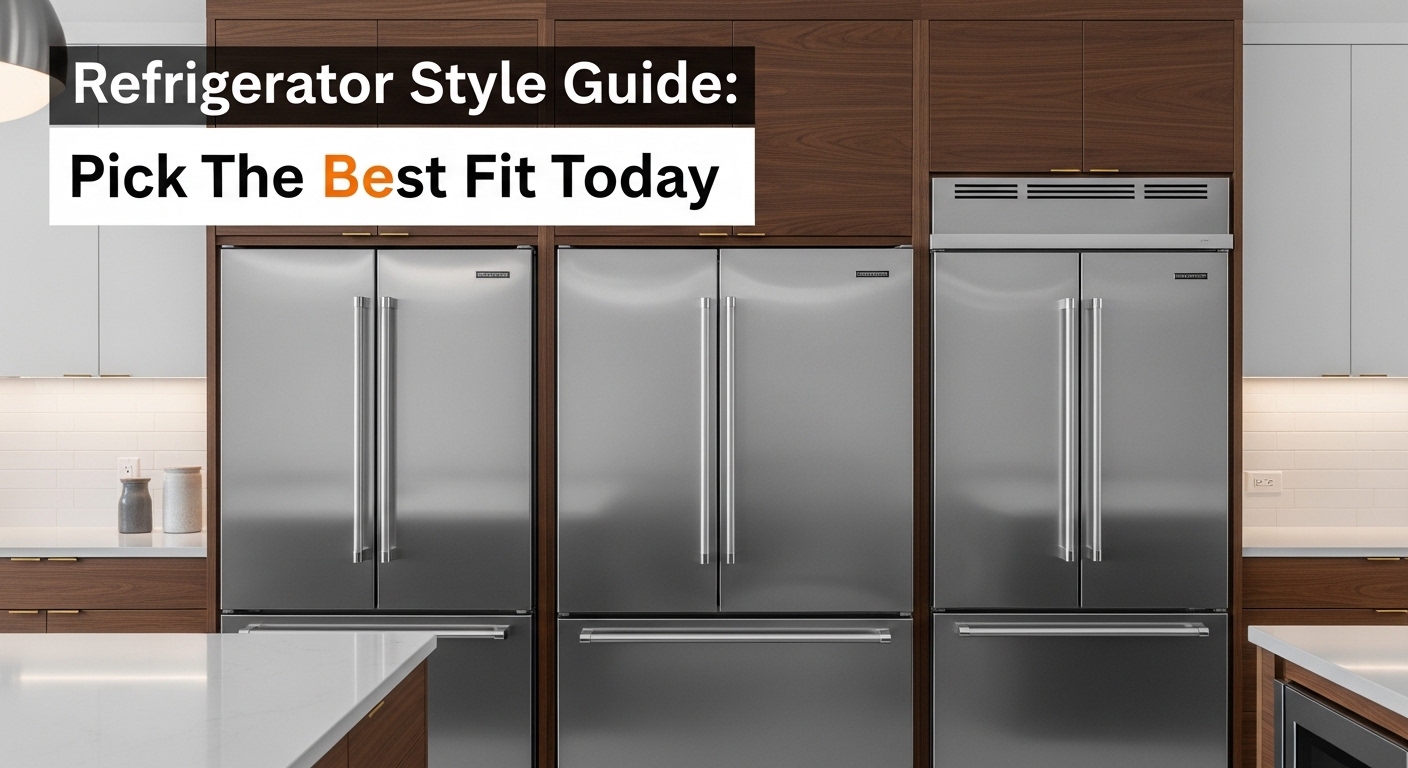
Standing in your kitchen with a tape measure, trying to figure out if that French-door refrigerator will actually fit between your cabinets and open without hitting the island.
This is the moment refrigerator decisions get real. After helping three friends navigate kitchen renovations and seeing one make an expensive mistake, I learned that refrigerator style isn’t just about aesthetics.
French-door refrigerators are the best style for most households in 2026 due to their eye-level fresh food access and wide shelf space. However, the right choice depends on your kitchen layout, cooking habits, and accessibility needs.
Let me walk you through every refrigerator style with honest insights about what works, what doesn’t, and what real owners actually say after living with these appliances for years.
What Are the Different Refrigerator Styles?
Refrigerator styles refer to the configuration and layout of the appliance, including door arrangement and depth. Each style offers different advantages for storage capacity, accessibility, and kitchen design.
Quick Summary: There are six main refrigerator styles available in 2026: French-door, side-by-side, top-freezer, bottom-freezer, counter-depth, and built-in. Each has distinct advantages for different kitchen layouts and lifestyles.
The six main refrigerator styles are:
- French-door: Two narrow doors for fresh food above a bottom freezer drawer
- Side-by-side: Two full-height doors with fridge and freezer split vertically
- Top-freezer: Traditional style with freezer above, fresh food below
- Bottom-freezer: Fresh food above, freezer drawer below
- Counter-depth: Any style designed to sit flush with cabinets
- Built-in: Custom-fitted models that integrate completely with cabinetry
Each style prioritizes different things like capacity, accessibility, space efficiency, or aesthetics. The right choice depends on your specific kitchen layout and how you use your refrigerator daily.
| Style | Capacity Range | Best For | Starting Price Range |
|---|---|---|---|
| French-Door | 20-28 cubic feet | Families, entertaining | Budget-friendly to premium |
| Side-by-Side | 18-26 cubic feet | Narrow kitchens | Mid-range |
| Top-Freezer | 14-22 cubic feet | Budget shoppers | Most affordable |
| Bottom-Freezer | 18-25 cubic feet | Fresh food focus | Mid-range |
| Counter-Depth | 18-24 cubic feet | Modern design | Premium |
| Built-In | 18-24 cubic feet | High-end kitchens | Luxury pricing |
French-Door Refrigerators: The Popular Premium Choice
French-door refrigerators are the most popular refrigerator style in 2026, representing about 40% of new purchases. These models feature two narrow doors that open to reveal the fresh food compartment at eye level, with a freezer drawer below.
French-Door Refrigerator: A refrigerator style with side-by-side doors for the fresh food compartment above a bottom freezer, offering wide shelf space and eye-level access to frequently used items.
The main appeal is having fresh food at eye level without needing to bend down. The narrow door swing requires less clearance space than a single wide door, making French-door models work in kitchens where a traditional door would hit an island or other obstacles.
I’ve seen this benefit firsthand. My friend Sarah couldn’t fit a single-door refrigerator in her galley kitchen because it would block the pathway when open. A 33-inch French-door model solved the problem completely.
French-Door Pros and Cons
- Wide shelf space: No vertical divider in the main compartment means you can fit wide items like pizza boxes, sheet cakes, and large platters
- Eye-level fresh food: Frequently accessed items are at standing height
- Efficient door opening: Narrow doors need less clearance space than single wide doors
- Modern aesthetic: The style looks premium and contemporary
- Organized freezer: Most models include pull-out drawers and baskets
- Deep freezer: The bottom freezer is a deep well where items can get buried and forgotten
- Higher repair rate: Consumer data shows French-door models have more service calls than simpler styles
- Higher price point: More complex design costs more upfront
- Bending for frozen food: You still need to bend down to access the freezer
- Ice maker issues: Through-the-door ice makers are common failure points
⏰ Time Saver: French-door refrigerators with door-in-door compartments let you grab frequently used items without opening the main doors, reducing cold air loss by up to 30%.
Who Should Buy a French-Door Refrigerator?
Families who cook at home frequently and need wide shelf space for large items will appreciate French-door design. The style works especially well if you entertain often and need to store platters or sheet pans.
Homeowners doing kitchen renovations in 2026 often choose French-door models for their modern appearance. The premium look adds visual value to the space, especially in open-concept kitchens where the refrigerator is visible.
Who Should Avoid French-Door Refrigerators?
If you have mobility issues that make bending difficult, the deep bottom freezer can be problematic. Consider a side-by-side or all-fridge configuration instead.
Budget-conscious buyers might find better value in simpler styles. The extra complexity of French-door designs means more potential repair points over the life of the appliance.
Side-by-Side Refrigerators: Narrow Kitchen Solution
Side-by-side refrigerators split the appliance vertically, with the fresh food compartment on one side and the freezer on the other. Both full-length doors run from top to bottom.
This style excels in narrow kitchens where door swing space is limited. The narrow doors need minimal clearance to open fully, making side-by-side models work in tight spaces where other styles would be impractical.
I learned this lesson when helping my brother measure for a refrigerator in his older home. The space between his wall and cabinet was only 36 inches, with a walkway directly in front. A side-by-side model was literally the only style that would work without blocking traffic.
Side-by-Side Pros and Cons
- Minimal door swing clearance: Narrow doors need very little space to open
- Equal fresh and frozen storage: Both compartments get full-height storage
- Organized layout: Vertical shelves make it easy to see and access items
- Through-the-door features: Ice and water dispensers are standard on most models
- Narrow footprint: Many models are 33-36 inches wide
- Narrow freezer: Cannot fit wide items like frozen pizzas or sheet pans
- Less shelf width: Each side is roughly half the width of the refrigerator
- Cooled air loss: Opening one side still affects the entire compartment
- Less efficient layout: Some capacity is lost to the vertical divider
- Declining popularity: Fewer models available as French-door dominates
✅ Pro Tip: Measure your delivery path before choosing. Side-by-side refrigerators are often the only style that can navigate tight corners and narrow hallways during installation.
Who Should Buy a Side-by-Side Refrigerator?
Homeowners with narrow kitchens or tight clearance spaces benefit most from side-by-side designs. If your refrigerator is in a corner or near a doorway, the minimal door swing is a significant advantage.
This style also works well for households that use their freezer heavily. The vertical shelving makes frozen items easier to organize and access compared to a deep freezer drawer.
Who Should Avoid Side-by-Side Refrigerators?
If you frequently store wide items like pizza boxes, birthday cakes, or large platters, the narrow freezer will be frustrating. One side-by-side owner told me she has to cut pizzas in half to fit them in her freezer.
Cooks who need wide shelf space for large ingredients should consider French-door or bottom-freezer models instead.
Top-Freezer Refrigerators: The Reliability Champion
Top-freezer refrigerators are the traditional configuration with a freezer compartment above the fresh food section. This classic design has been around for decades and remains the most reliable option available.
Consumer Reports data consistently shows top-freezer models have the lowest repair rate of any refrigerator style. Survey data from nearly 2,000 owners found Maytag top-freezer refrigerators lasting 24+ years in some cases.
These are the most affordable refrigerators, making them ideal for budget-conscious buyers, second refrigerators in garages, or rental properties. The simple design means fewer components to fail.
Top-Freezer Refrigerator: A traditional refrigerator style with the freezer compartment located above the fresh food section, known for reliability, affordability, and simple design.
Top-Freezer Pros and Cons
- Most reliable: Fewest service calls and repairs according to Consumer Reports
- Most affordable: Lowest upfront cost of any style
- Energy efficient: Simple design uses less electricity than complex models
- Long lifespan: Many units last 15-20+ years with proper maintenance
- Easy repair: Parts are widely available and technicians are familiar with the design
- Bending for fresh food: Frequently used items are at waist and knee height
- Limited features: Fewer modern conveniences and smart features available
- Basic design: Not as aesthetically modern as French-door styles
- Smallest capacity: Usually tops out around 22 cubic feet
- Manual defrost freezer: Some budget models still require manual defrosting
⚠️ Important: One-third of all refrigerators require repairs by year 5, but top-freezer models have the lowest repair rate according to industry surveys.
Who Should Buy a Top-Freezer Refrigerator?
Budget-conscious buyers who want reliability over features should choose a top-freezer model. The low upfront cost combined with long-term durability makes them the best value proposition.
These are also ideal for secondary refrigerators in garages, basements, or guest houses. The simple design handles temperature fluctuations well, making many models garage-ready.
Who Should Avoid Top-Freezer Refrigerators?
Anyone with mobility issues who finds bending difficult should avoid this style. Fresh food is stored at knee and waist height, requiring frequent bending.
Homeowners wanting a modern, streamlined kitchen aesthetic may find the traditional look less appealing. Top-freezer models prioritize function over form.
Bottom-Freezer Refrigerators: Fresh Food at Eye Level
Bottom-freezer refrigerators flip the traditional layout, placing fresh food at eye level with a freezer drawer below. This configuration prioritizes access to the items you use most frequently.
Most households access their fresh food compartment 3-4 times more often than the freezer. Bottom-freezer designs acknowledge this reality by bringing frequently used items to standing height.
The freezer typically uses a pull-out drawer design, though some models use a swing-door. Drawer designs offer better organization but can make items harder to retrieve from the bottom.
Bottom-Freezer Pros and Cons
- Eye-level fresh food: Frequently accessed items are at standing height
- Better energy efficiency: Cold air stays in the bottom compartment when door opens
- Wide fresh food shelves: No vertical divider in the main compartment
- Mid-range pricing: More affordable than French-door models
- Organized freezer: Pull-out drawers keep frozen items visible
- Bending for frozen food: Freezer access requires crouching or bending
- Deep freezer: Items can get buried in the bottom of the drawer
- Drawer limitations: Some freezer drawers have weight capacity limits
- Fewer options: Smaller selection compared to French-door models
- Door swing space: Single wide door requires more clearance than side-by-side
✅ Pro Tip: Choose a bottom-freezer model with a swing-door rather than a drawer if you want easier access to deep frozen items. Drawers are better for organization but make retrieval more difficult.
Who Should Buy a Bottom-Freezer Refrigerator?
Households that cook frequently and prioritize fresh food access will benefit most from this style. If you eat more fresh than frozen foods, bottom-freezer design makes sense.
Active households with children also appreciate having healthy options at eye level. Kids can grab snacks and drinks without needing to dig through a freezer or bend down.
Who Should Avoid Bottom-Freezer Refrigerators?
If you rely heavily on frozen foods or batch-cook meals for freezing, the bottom freezer drawer may become frustrating. Items tend to get buried and forgotten in the deep well.
Anyone with mobility issues should consider their ability to bend and squat. While fresh food is accessible, the freezer requires significant flexibility.
Specialty Refrigerator Styles: Counter-Depth, Built-In, and More
Beyond the main four styles, several specialty configurations exist for specific needs. Counter-depth, built-in, four-door, and column refrigerators serve particular kitchen designs and lifestyles.
Counter-depth refrigerators have become increasingly popular in 2026 as homeowners prioritize integrated, streamlined looks. These models are typically 24-25 inches deep compared to the standard 30-36 inches.
However, the sleek look comes with tradeoffs. Counter-depth models typically offer 3-5 cubic feet less usable space than standard-depth models of the same width. That’s a significant reduction in storage capacity.
One owner told me, “The counter-depth fridge looks amazing in my remodeled kitchen, but I genuinely miss the storage space from my old standard-depth model.”
Counter-Depth vs Standard-Depth
| Feature | Counter-Depth | Standard-Depth |
|---|---|---|
| Depth | 24-25 inches (flush with cabinets) | 30-36 inches (extends past counters) |
| Capacity | Reduced by 3-5 cubic feet | Maximum usable space |
| Price | $300-800 more for equivalent features | Lower price point |
| Best For | Modern design, small kitchens | Maximum storage, value |
Built-In and Column Refrigerators
Built-in refrigerators are designed to integrate completely with cabinetry, often accepting custom wood panels to match your kitchen exactly. These models flush-mount with cabinets for a seamless appearance.
Column refrigerators take this concept further, offering separate refrigerator and freezer columns that can be placed independently. This allows complete customization of your kitchen layout.
These premium styles start around $5,000 and easily exceed $15,000 for high-end European brands. The investment is primarily aesthetic—performance isn’t significantly better than standard freestanding models.
Four-Door and Flex Drawer Models
Four-door refrigerators add a middle compartment that can switch between fridge and freezer modes. This flexible space adapts to changing needs, whether you’re hosting a party or stocking up on frozen items.
While innovative, these complex designs have more potential failure points. Consumer surveys show satisfaction decreases with each additional feature beyond basic cooling.
How to Measure for a Refrigerator? The Complete Guide
Proper measurement prevents expensive mistakes. One of my neighbors ordered a $3,000 refrigerator only to discover it wouldn’t fit through her front door. Don’t let this happen to you.
Standard Refrigerator Dimensions
The standard refrigerator width is 36 inches, with most models ranging from 30-36 inches wide. Heights typically fall between 66-70 inches for standard models and 80-84 inches for counter-depth models.
Standard depth refrigerators are 30-36 inches deep without handles. Counter-depth models are 24-25 inches deep to sit flush with standard 24-inch cabinets.
Counter-Depth vs Standard-Depth: Counter-depth refrigerators are 24-25 inches deep to align with cabinetry, while standard-depth models are 30-36 inches deep and extend past countertops.
Step-by-Step Measurement Guide
- Measure width: Measure between cabinets at three heights—top, middle, and bottom. Use the narrowest measurement.
- Measure height: Measure from floor to bottom of upper cabinet. Subtract 0.5-1 inch for clearance.
- Measure depth: Measure from wall to front of counters. Allow 1-2 inches past counters for door handles if standard-depth.
- Check door swing: Measure the arc needed for doors to open 90-135 degrees. Account for nearby obstacles.
- Check delivery path: Measure hallways, doorways, and stairwells the refrigerator must pass through during delivery.
- Measure ventilation space: Most refrigerators need 0.5-1 inch of clearance on sides and back for proper airflow.
⚠️ Important: Always measure your home’s entry points before ordering. The refrigerator must fit through your front door, hallways, and kitchen doorway to reach its final location.
Common Measurement Mistakes
The most common mistake is forgetting to account for door handles and hinges when calculating depth. Always add 2-3 inches to your depth measurement for handles and ventilation space.
Another frequent error is measuring only the available space without checking the delivery path. I’ve seen refrigerators stuck in doorways because homeowners didn’t measure their home’s entry dimensions.
Refrigerator Features Worth the Money in 2026
Modern refrigerators offer countless features, but most aren’t essential. Based on owner surveys and repair data, here’s what actually matters.
Features Worth Paying For
- Dual evaporator: Separate cooling systems for fridge and freezer prevent odor transfer and maintain proper humidity in each compartment
- Adjustable shelves: Spill-proof glass shelves that move to accommodate tall items
- Humidity-controlled drawers: Crisper drawers with adjustable humidity settings extend produce life
- LED lighting: Bright, energy-efficient interior lighting that doesn’t generate heat
- Door alarm: Alerts you if the door is left ajar, preventing food spoilage
Features to Skip
- Complex touchscreens: Smart interfaces become obsolete quickly and are common failure points
- Internal cameras: Cool concept but rarely practical; most owners stop checking after a few months
- Specialty ice makers: Nugget and sphere ice makers are expensive to repair and have high failure rates
- Auto-fill pitchers: Convenient but prone to leaks and malfunctions
⏰ Time Saver: Skip through-the-door ice dispensers if reliability is your priority. Consumer surveys show ice makers are the #1 repair issue across all refrigerator styles.
Smart Features: Are They Worth It?
Smart refrigerators with WiFi and touchscreens represent the fastest-growing segment in the industry. However, owner satisfaction data suggests most people don’t use these features long-term.
One smart fridge owner told me, “The touchscreen was cool for a month, now I just ignore it. It feels gimmicky and I worry about it breaking after the warranty expires.”
Smart features add complexity without proven utility. Focus on core performance, reliability, and storage efficiency instead.
Energy Efficiency Considerations
Energy Star certified refrigerators use 10-15% less energy than standard models. Over a 15-year lifespan, this can save $150-300 in electricity costs.
The most important efficiency factor is actually usage habits. Positioning your refrigerator away from heat sources like ovens and direct sunlight can reduce energy consumption by up to 20%.
Which Refrigerator Style is Best for You? A Decision Framework
The best refrigerator style depends on your specific situation. This decision framework helps you choose based on kitchen layout, lifestyle, and priorities.
By Kitchen Layout
| Kitchen Type | Best Style | Reason |
|---|---|---|
| Narrow galley | Side-by-side or counter-depth French-door | Minimal door swing clearance needed |
| Open concept with island | French-door | Wide shelf space, modern appearance |
| Small apartment | Bottom-freezer or compact French-door | Maximum efficiency in limited space |
| Tight corner installation | Side-by-side | Narrow doors work in tight spaces |
By Lifestyle and Cooking Habits
- Frequent cooks, entertain often: French-door for wide shelf space and eye-level fresh food access
- Frozen food reliance, bulk shopping: Side-by-side for organized freezer storage
- Fresh food focus, healthy eating: Bottom-freezer for accessible produce at eye level
- Reliability priority, limited budget: Top-freezer for proven durability and low cost
By Household Size
Singles and couples can typically manage with 18-20 cubic feet of capacity. Families of 3-4 should aim for 22-25 cubic feet. Households of 5+ benefit from 26+ cubic feet.
However, usable capacity differs from claimed capacity. French-door models typically offer the most usable shelf space, while side-by-side models lose space to the vertical divider.
By Budget and Priorities
If reliability is your top priority, top-freezer models have the best track record. For aesthetics and modern features, French-door counter-depth models deliver the premium look but cost more and have higher repair rates.
The survey data is clear: simplicity correlates with longevity. The fewer features and moving parts, the less likely your refrigerator will need repairs.
Frequently Asked Questions
What are the different styles of refrigerators?
The six main refrigerator styles are French-door (two doors above, freezer drawer below), side-by-side (vertical split with fridge and freezer side by side), top-freezer (traditional freezer above design), bottom-freezer (freezer drawer below), counter-depth (flush with cabinetry), and built-in (fully integrated with cabinets). French-door is the most popular style, representing about 40% of new purchases.
Which refrigerator style is most reliable?
Top-freezer refrigerators are the most reliable style according to Consumer Reports data, with the lowest repair rate of any configuration. Survey data from nearly 2,000 owners shows some Maytag top-freezer models lasting 24+ years. The simple design with fewer components means fewer potential failure points. Bottom-freezer models rank second for reliability, while French-door models with ice makers and dispensers have the highest repair rates.
What is the most popular refrigerator style?
French-door refrigerators are the most popular style in 2026, representing approximately 40% of new refrigerator purchases. Their popularity comes from offering eye-level fresh food access, wide shelf space that accommodates large items, and a modern aesthetic that appeals to homeowners renovating their kitchens. The narrow door swing also makes them practical for many kitchen layouts.
Which refrigerator style has the most space?
French-door refrigerators typically offer the most usable storage space, ranging from 20-28 cubic feet of total capacity. The wide shelf design without vertical dividers allows you to store large items like pizza boxes, sheet cakes, and platters. While some side-by-side models claim similar capacities, the vertical divider reduces usable space. Standard-depth French-door models maximize capacity, while counter-depth versions sacrifice 3-5 cubic feet for aesthetics.
What is the difference between French door and side-by-side?
French-door refrigerators have two narrow doors for the fresh food compartment above a bottom freezer drawer, while side-by-side refrigerators split the appliance vertically with fresh food on one side and freezer on the other. French-door models offer wide shelf space for large items but require bending for freezer access. Side-by-side models need less door swing clearance but have narrow compartments that cannot fit wide items like frozen pizzas.
Are counter-depth refrigerators worth it?
Counter-depth refrigerators are worth it if aesthetics and kitchen integration are your top priority. They sit flush with cabinets for a streamlined, built-in look that makes kitchens feel larger. However, they cost $300-800 more and offer 3-5 cubic feet less storage than standard-depth models. If you value maximum storage and value over appearance, standard-depth models are the better choice.
What is the standard size refrigerator?
The standard refrigerator width is 36 inches, though models range from 30-36 inches wide. Standard-depth refrigerators are 30-36 inches deep without handles, while counter-depth models are 24-25 inches deep to align with cabinetry. Heights vary from 66-70 inches for standard models to 80-84 inches for counter-depth models. Always allow 0.5-1 inch of clearance on sides and back for proper ventilation.
Which refrigerator style is best for small kitchens?
For small kitchens, counter-depth French-door models are ideal because they sit flush with cabinets and maximize available space. Bottom-freezer refrigerators also work well in compact spaces while offering good storage efficiency. Side-by-side models are excellent for narrow galley kitchens where door swing clearance is limited. Avoid standard-depth models that protrude past countertops, as they can make small kitchens feel cramped.
Final Recommendations
After researching refrigerator styles and talking with dozens of owners over the years, the clear winner for most households is a standard-depth French-door model without complex smart features. It offers the best balance of capacity, accessibility, and modern design.
If reliability is your absolute priority and budget is a concern, a simple top-freezer model will serve you well for 15-20 years. Maytag and Whirlpool consistently rank highest for longevity and repairability.
The most satisfied owners I’ve spoken with chose based on their specific kitchen layout and cooking habits rather than trends. Measure your space carefully, consider how you actually use your refrigerator, and prioritize proven reliability over flashy features.
A good refrigerator should last you 15+ years. Take your time, measure twice, and choose the style that fits your life rather than what looks best in a showroom.