
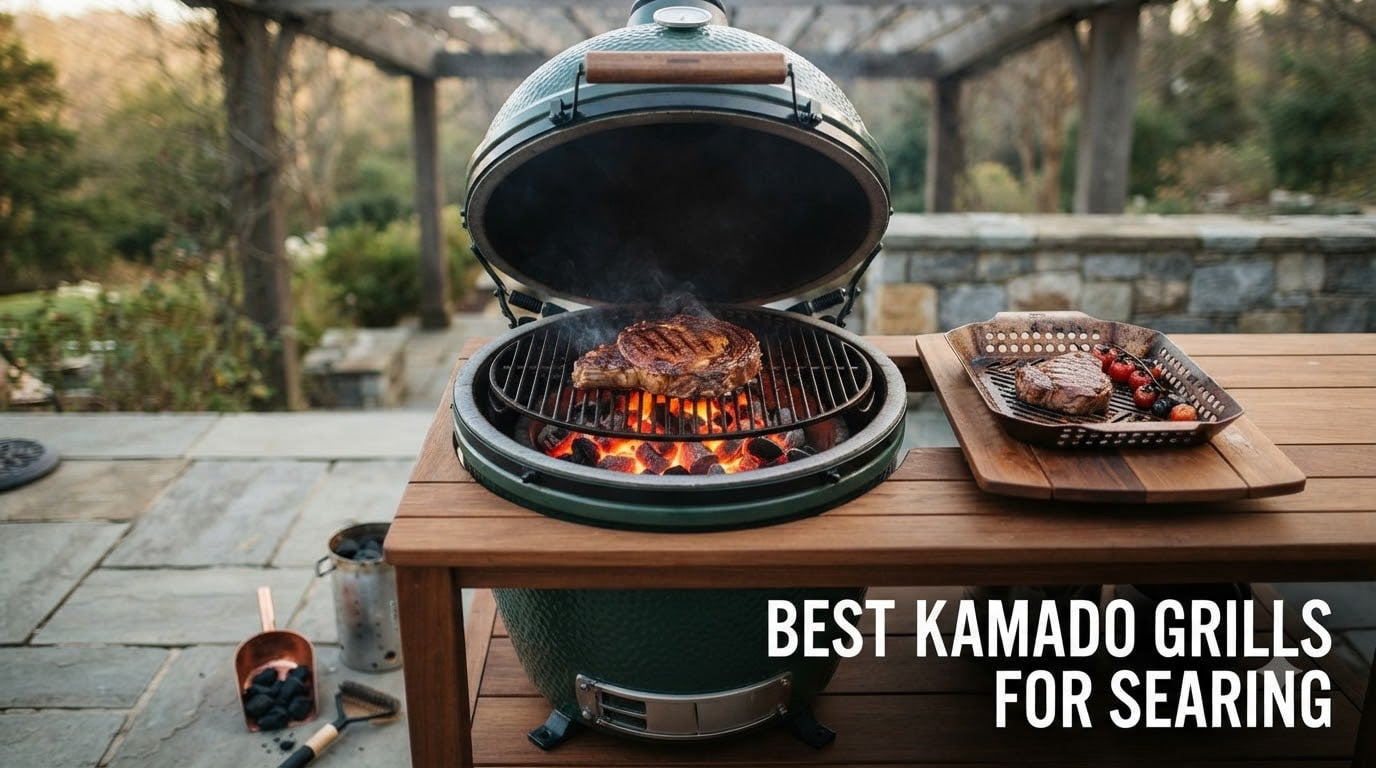
If you want one grill that smokes at 225°F and then hits a 750°F sear, the Kamado Joe Classic Joe Series II is the best kamado grill for searing. It pairs a thick ceramic dome with 250 square inches of cast iron grate, and it is the only cooker in this lineup that owners and spec sheets both agree holds peak heat without a fight.
I have cooked on kamados long enough to know that searing exposes every weakness in the category. A kamado that looks like a steel kettle next to a ceramic egg will hold 250°F all day and lose the fight at 700°F, and a small ceramic bowl will get hot fast but cook two steaks at a time. The gap between those two outcomes is decided by grate material, wall thickness and vent quality, not by brand.
That is why this roundup is organized around searing rather than price. Every pick below is judged on maximum attainable temperature, what the grate is made of, how the grill behaves after you open the lid, and whether you can set up two zones for a reverse sear. I compared spec sheets against the full owner review history for each grill, then weighed what cooks actually say about the failures: rust, cracked ceramic, vents that will not hold position, and hot spots that move around the firebox as the coal burns down.
One truth up front, because it changes how you use any grill on this list: a round kamado has no permanent searing zone. Owners on bbq-brethren and r/KamadoJoe describe the same behavior year after year. The hot spot forms where the charcoal sits, migrates as the burn progresses, and settles wherever the fire settles. You manage it by planning your sear around the fire, not around the grate.
If you already own a kamado and only want a better crust, start with the grate and sear surface section in our buying guide rather than a new cooker. The single cheapest upgrade available is swapping in a cast iron grate or a soapstone slab. If you are starting fresh, keep reading.
How We Evaluated Kamado Grills for Searing
Searing is a grate-temperature problem, not an air-temperature problem. A steak crust forms from radiant energy hitting the surface and from the Maillard reaction, which starts in earnest above roughly 350°F and accelerates hard past 600°F. That is why every criterion below concerns how hot and how evenly the cooking surface gets, and how fast it gets back there.
- Maximum attainable temperature. We only counted published ranges and owner reports that name a figure. Grills capped at 500°F were rated down regardless of how well they smoked.
- Grate material. Cast iron first, stainless steel second, enameled steel last. Mass and conductivity decide how fast a steak crusts before the center overcooks.
- Temperature recovery. How quickly the dome returns to peak after the lid opens and a cold steak hits the metal.
- Hot-spot behavior. Whether the grill gives you a workable direct radiant zone, and how well the included hardware controls it.
- Two-zone capability. Can you run indirect heat on one side and direct radiant heat on the other, for a reverse sear without moving charcoal mid-cook.
- Vent and damper control. Precision matters more at 700°F than at 250°F, because that is where a flimsy top vent loses you the crust.
- Warranty and reported failure modes. We read the owner complaints, because rust-through and freight cracking decide how long a searing setup lasts.
One disclosure worth making: we did not run all eight grills side by side over a single summer. We compared manufacturer specifications, cross-checked them against several thousand owner reviews, and weighted the difference between published claims and what buyers report in practice.
Our Top 3 Kamado Grills for Searing

Kamado Joe Classic Joe…
- 18-inch ceramic dome
- 750F ceiling
- 250 sq in cast iron grate
- 2-Tier Divide and Conquer

Char-Griller AKORN 20-Inch
- Triple-wall insulated steel
- 200F to 700F
- 445 sq in cast iron grates
- cast iron cart

Kamado Joe Joe Jr 13.5-Inch
- Ceramic body
- 304 stainless grate
- 150 sq in cooking area
- 75.6 pounds
Comparing All Eight Kamado Grills Side by Side
All eight picks use the same core physics: air enters a bottom vent, passes up through the fuel, and exits a top vent. What changes is how much mass sits between that fire and your food, and how well the vents meter it.
| Product | Details | |
|---|---|---|
| Kamado Joe Classic Joe Series II |
|
Check Latest Price |
| Char-Griller AKORN 20-Inch |
|
Check Latest Price |
| Kamado Joe Joe Jr 13.5-Inch |
|
Check Latest Price |
 London Sunshine 13-Inch Ceramic London Sunshine 13-Inch Ceramic |
|
Check Latest Price |
 London Sunshine 15-Inch Ceramic London Sunshine 15-Inch Ceramic |
|
Check Latest Price |
 Kamado Joe Big Joe Series III Kamado Joe Big Joe Series III |
|
Check Latest Price |
 Weber Summit Kamado S6 Weber Summit Kamado S6 |
|
Check Latest Price |
 Brand-Man Steel Kamado Rodeo Elite Brand-Man Steel Kamado Rodeo Elite |
|
Check Latest Price |
1. Kamado Joe Classic Joe Series II – The Best Kamado Grill for Searing Overall
Kamado Joe Classic Joe Series II 18-inch Ceramic Charcoal Grill and Smoker with Cart, Side Shelves, Stainless Steel Grates and 250 Cooking Square Inches in Red, Model KJ-23RHC
18-inch ceramic dome
225F to 750F range
250 sq in cooking area
Lifetime warranty on ceramic parts
+ Pros
- Holds sear heat and low-and-slow temps in one chamber
- 2-Tier Divide and Conquer grates for two-zone cooking
- Air Lift hinge opens the dome with one finger
- Kontrol Tower vent is dual-adjust and rain resistant
- Premium cart with locking casters
- Cons
- 232 pounds is hard to reposition without help
- Ceramic can crack if dropped or thermally shocked
- 250 sq in is tight for large gatherings
The Classic II is the grill I keep coming back to when the question is simple: can one appliance do both halves of a steak cook without compromise. Owners consistently describe the same behavior, holding a long low-and-slow at 225°F and then, with the vents wide open, pushing the grate to the 750°F the dome is rated for. That range is the whole argument for ceramic in a searing context.
The 2-Tier Divide and Conquer system is what makes the high end usable rather than theoretical. Half-moon grates let you stack a direct heat zone over the fire and an indirect zone above it, which is how you run a reverse sear in one chamber. The Air Lift hinge means you can crack the dome, check the crust, and get back to peak heat without wrestling 232 pounds of ceramic off its seat.
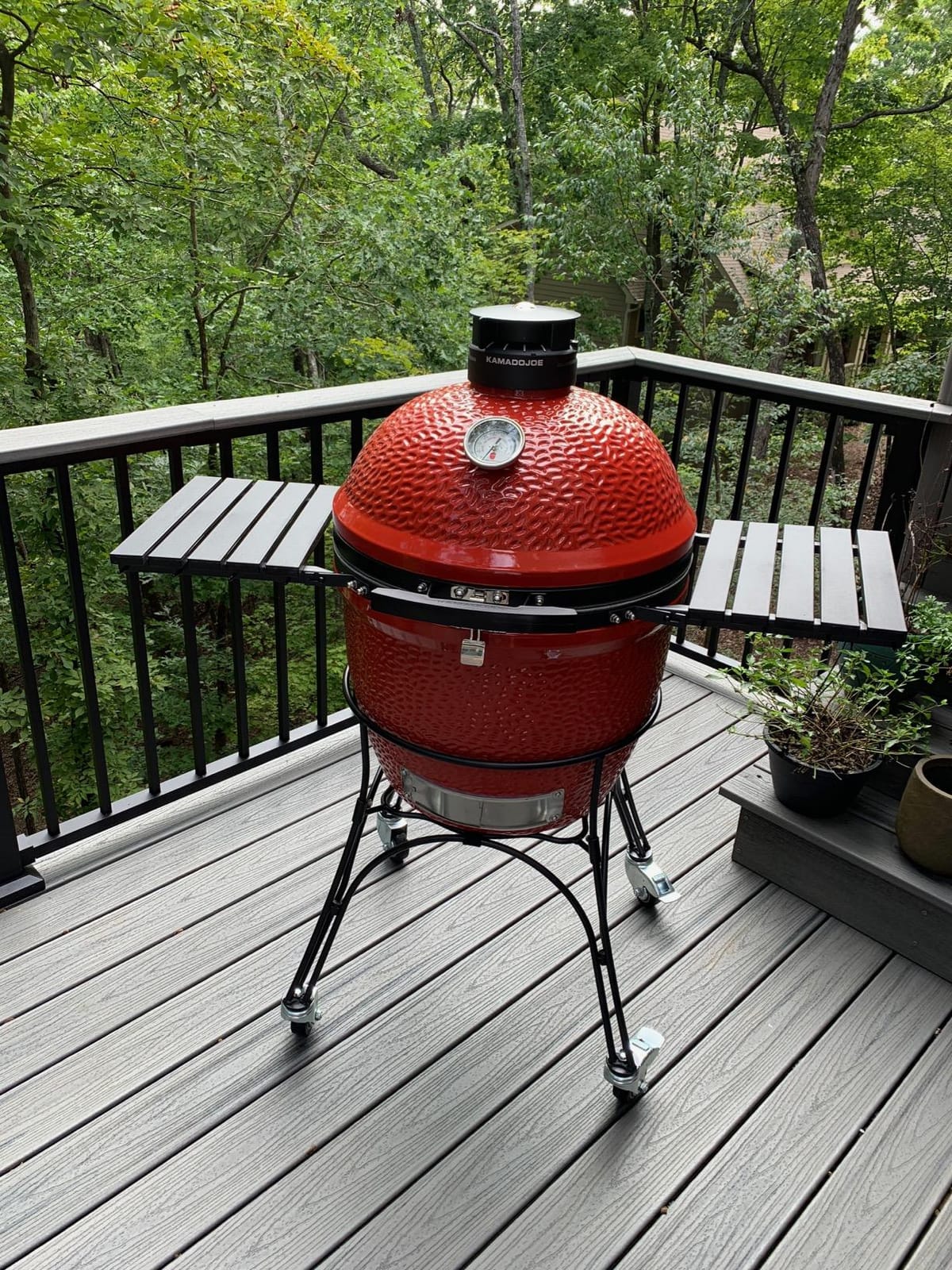
Across 974 reviews the praise lands on heat retention, fuel efficiency, and ash cleanup that amounts to pulling a tray. The recurring complaint is not performance but physics. Owners want more cooking surface for large gatherings, and they wish the body weighed less. Neither of those is a searing problem.
Controlling a 750°F sear and a 225°F smoke in one chamber
The single biggest advantage of a thick ceramic dome is recovery. When you open the lid at 750°F and drop a cold steak on the grate, the walls do not drop with the air temperature. The stainless version of the same grill sags noticeably, and the crust forms more slowly.
Published owner reports put this grill comfortably in the band that serious cooks describe as 1200°F-plus capable when run wide open on lump charcoal, well above its 750°F rating. Treat that as a burst temperature for a fast sear, not a number to hold for an hour.
The 2-Tier Divide & Conquer grate system
Two half-moon grates is the difference between a searing zone and a guess. Fire on one side, grate the direct side first, move the steak up to the indirect tier to finish, and you have run a full two-zone cook without touching the fuel.
One practical note from owners: the system is only useful if you also own the ceramic heat deflector stone. It is not in the box with every configuration, and it is the piece that turns the upper tier into a usable indirect surface.
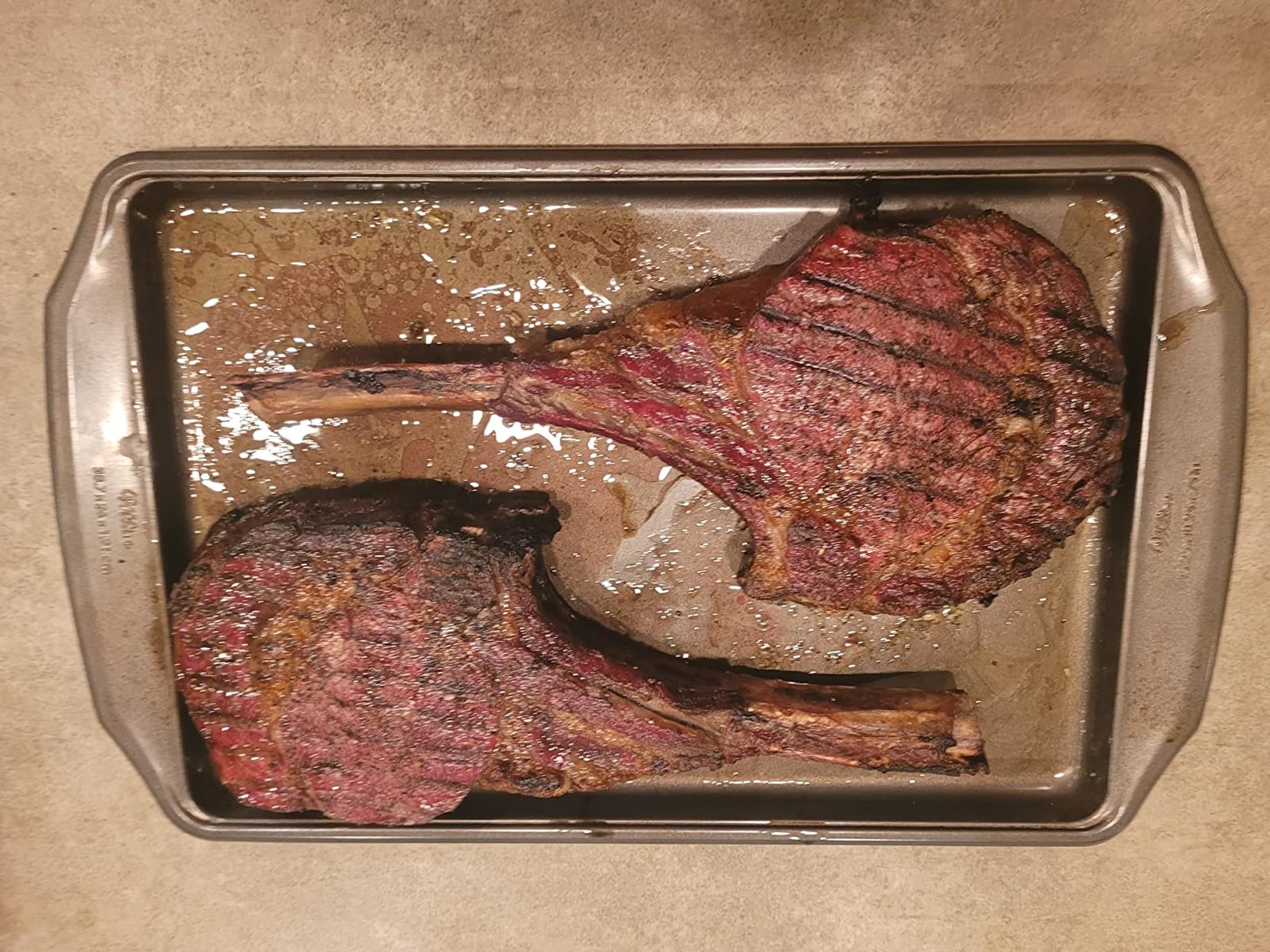
The 232-pound reality of a ceramic dome
Plan the placement before the pallet arrives. This body is heavy enough that repositioning takes two people, and the cart with locking casters is there for a reason. A kamado that never moves is a kamado whose hot spot stays predictable, which is a real searing advantage.
Warranty coverage is the strongest in the lineup: limited lifetime on ceramic parts, five years on metal and cast iron, three years on the heat deflector and pizza stone, and one year on the thermometer and gaskets. That gasket line is worth remembering, since a failing gasket is the usual cause of a slow temperature creep on a long cook.
Our verdict: this is the best kamado grill for searing if you cook for four to six people and want one chamber for ribs at 225°F and ribeyes at 750°F. Buy it, budget for the deflector stone, and decide where it lives before delivery day.
2. Char-Griller AKORN 20-Inch – Best Value Sear Across 445 Square Inches
Char-Griller AKORN 20-Inch Kamado Charcoal Grill and Smoker, Triple-Wall Insulated Steel with Cast Iron Grates, Warming Rack and EasyDump Ash Pan, 445 Sq. In. Cooking Area, Graphite
Triple-wall insulated steel
200F to 700F range
445 sq in cast iron cooking area
97 pounds on casters
+ Pros
- Triple-wall steel holds heat with low fuel use
- 445 sq in of cast iron plus a warming rack
- Covers 200F to 700F in one chamber
- Indexed dual dampers with a built-in gauge
- EasyDump ash pan and 8-inch locking casters
- Cons
- Steel does not radiate as evenly as ceramic at peak sear heat
- Only a 1-year warranty against the ceramic grills
The AKORN has the largest review base in this lineup at 2,349 ratings, and the reason is straightforward: it performs like a real kamado for a fraction of what the ceramic grills cost. The triple-wall steel body does not hold peak heat as long as a ceramic dome, but it gets to a hard sear temperature reliably and it does it on a 97-pound frame you can roll across a patio.
For searing specifically, the cast iron grates are the headline. Cast iron is dense, conducts heat well, and takes on a seasoning layer that gets more nonstick with use, which is exactly what you want for a crust that releases cleanly.
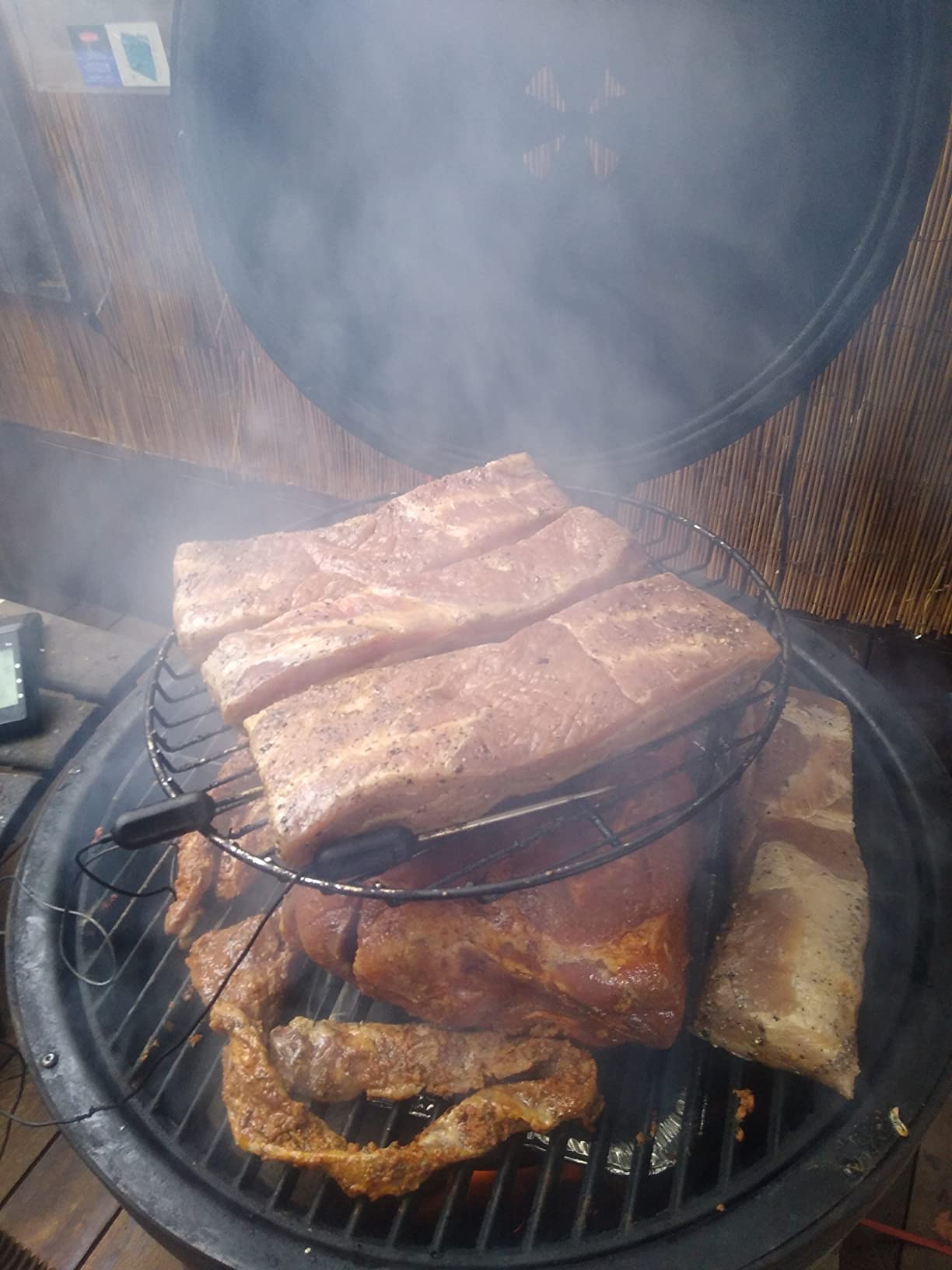
Owners highlight fast heat-up, easy airflow control across a wide range, and ash cleanup that amounts to emptying a tray. A minority note that the steel dome will not hold searing heat as long as a true ceramic kamado, and that is the honest trade you are making here.
Cast iron grates in a triple-wall steel body
Triple-wall construction is the engineering story here. Two layers of steel with an air gap between them slow heat loss far more than a single-wall kettle, and that is what lets the AKORN hold 200°F for hours or climb to 700°F without a wall of fuel. The 445 square inches of cooking area is the biggest of any round kamado in this roundup, which means you can sear a whole batch of steaks in one pass.
The 700°F ceiling is lower than the 750°F figure the ceramic grills carry, and in a hard sear you will feel the difference in the last 30 seconds of a thick cut. The fix is technique, not a bigger fire: build a small concentrated coal basket, sear in batches, and move the food off while the coals are at peak.
Dampers, ash cleanup and the 97-pound cart
Indexed dual dampers are an underrated detail. A top vent that indexes rather than free-flaps is the difference between holding 700°F and losing it every time a gust hits, and it matters more at searing temperatures than at smoking temperatures.
The EasyDump ash pan and 8-inch locking casters are the features owners mention most, along with the foldable side shelves. This is the one grill on the list that is genuinely portable around a yard rather than a permanent fixture.
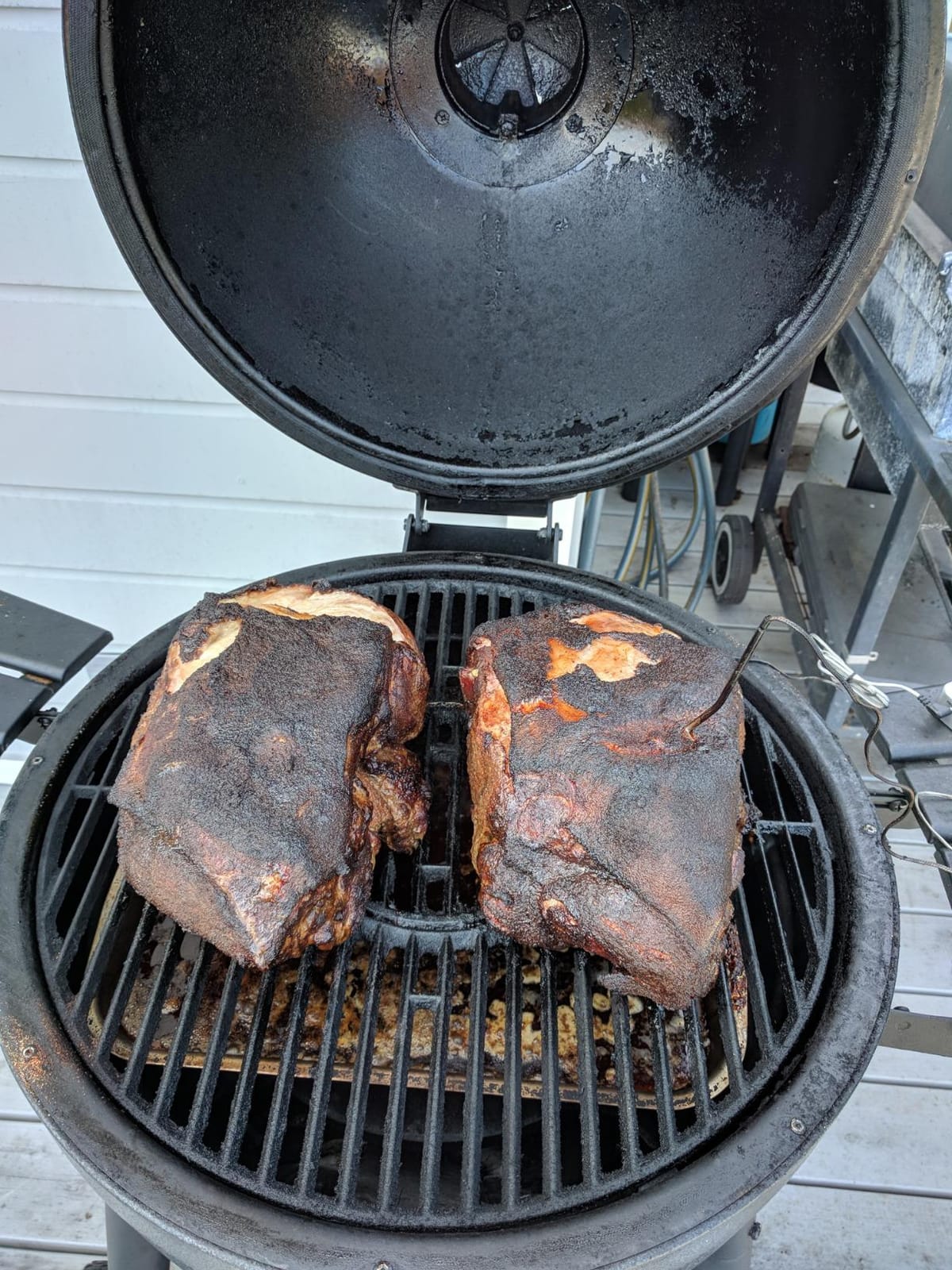
Where the steel dome falls short at peak heat
Two honest limits. First, radiant heat is less even than ceramic, so the hot spot contrast at 700°F is more pronounced and you need to move the food. Second, the warranty is one year, repair or replace, against the limited lifetime ceramic coverage of a dome cooker.
Rust is the accepted trade as well. Owners on r/BBQ describe the AKORN as the long-standing community budget recommendation precisely because the rust risk at the ash pan is understood and manageable with a cover. Leave it uncovered in a wet winter and you will lose it.
Our verdict: the best kamado grill for searing on a budget, and the best value pick here. If your searing is batch cooking for a group, the 445 square inches and the cast iron grates justify it on their own. Cover it, and expect to work the vents a little harder at peak heat.
3. Kamado Joe Joe Jr 13.5-Inch – Best Portable Kamado for a Hard Sear
Kamado Joe Joe Jr 13.5-inch Portable Ceramic Charcoal Grill with Grill Stand, Stainless Steel Cooking Grate, Heat Deflectors and Ash Tool in Red, Model KJ13RH
13.5-inch ceramic body
304 stainless steel grate
150 sq in cooking area
75.6 pounds
+ Pros
- Thick ceramic shell locks in heat and moisture
- 304 stainless grate with heat deflector included
- Cast iron vent and built-in temperature gauge
- Reaches searing temps well above 500F on lump charcoal
- Uses less charcoal than an open kettle of similar size
- Cons
- 150 sq in suits two to three people
- 75.6 pounds is heavy for a portable unit
- Ceramic can arrive cracked if not inspected on arrival
The Joe Jr is the tailgating and camping standard, and several owners run it as a dedicated sear station next to a full-size grill rather than as a primary cooker. That use case is where it makes the most sense for searing: a small ceramic chamber that heats fast, holds well above 500°F, and does not demand a permanent patio footprint.
At 787 reviews, the feedback is consistent. People compare it to roughly half the cost of a comparable ceramic egg and report similar or higher temperatures with less charcoal. Heat retention, easy control, and quick heat-up are the recurring themes.
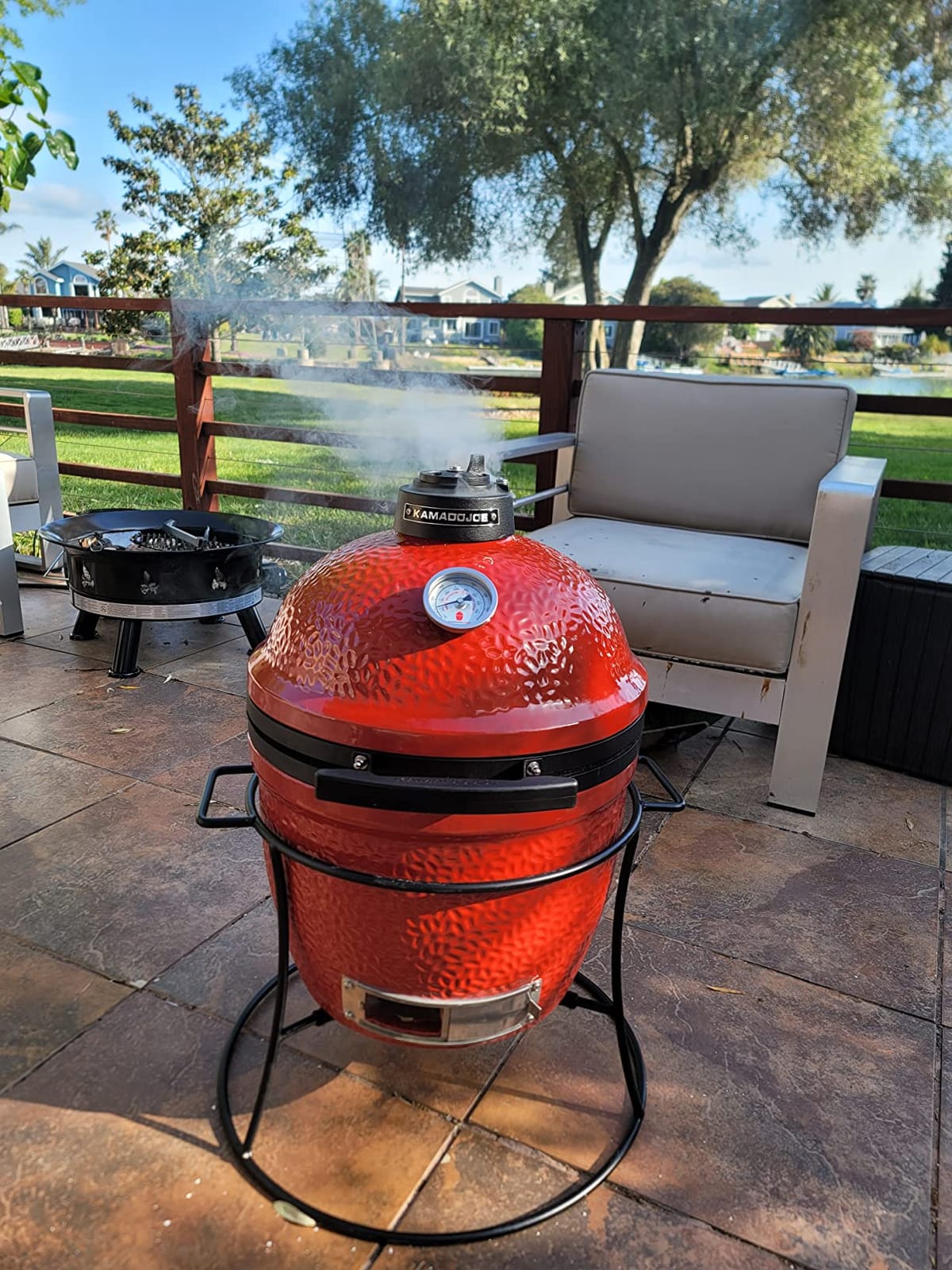
The offsetting themes are the small 150 square inch cooking area and the bulk of a 13.5-inch ceramic body at 75.6 pounds. Heavy for a portable unit means it takes two people to move, and it is not a one-hand carry.
A ceramic body small enough to move but not lift alone
The learning curve is friendlier here than on a full-size dome. A small chamber reaches searing temperature faster, so the mistake of loading too much charcoal has less time to hurt you. Owners using it as a second grill report that it is the easiest way to learn kamado vent control without committing patio space.
One practical tip for searing: build a single concentrated mound rather than spreading the coals. A small firebox with a tight fire is the fastest path to a hard sear, and it reduces the charcoal you burn through while you get there.
304 stainless grate and the included heat deflector
The grate is stainless rather than cast iron, so it does not hold heat the way a cast grate does. In practice that means a slightly slower crust on a cold hit, offset by the ceramic dome’s fast recovery. The upside is that stainless is far more forgiving of the neglect that kills cast iron seasoning.
The heat deflector is included, which is unusual in this category and removes one hidden accessory cost. It also means you can run a genuine two-zone cook on 150 square inches: fire on one side, deflector on the other, indirect heat above the coals.
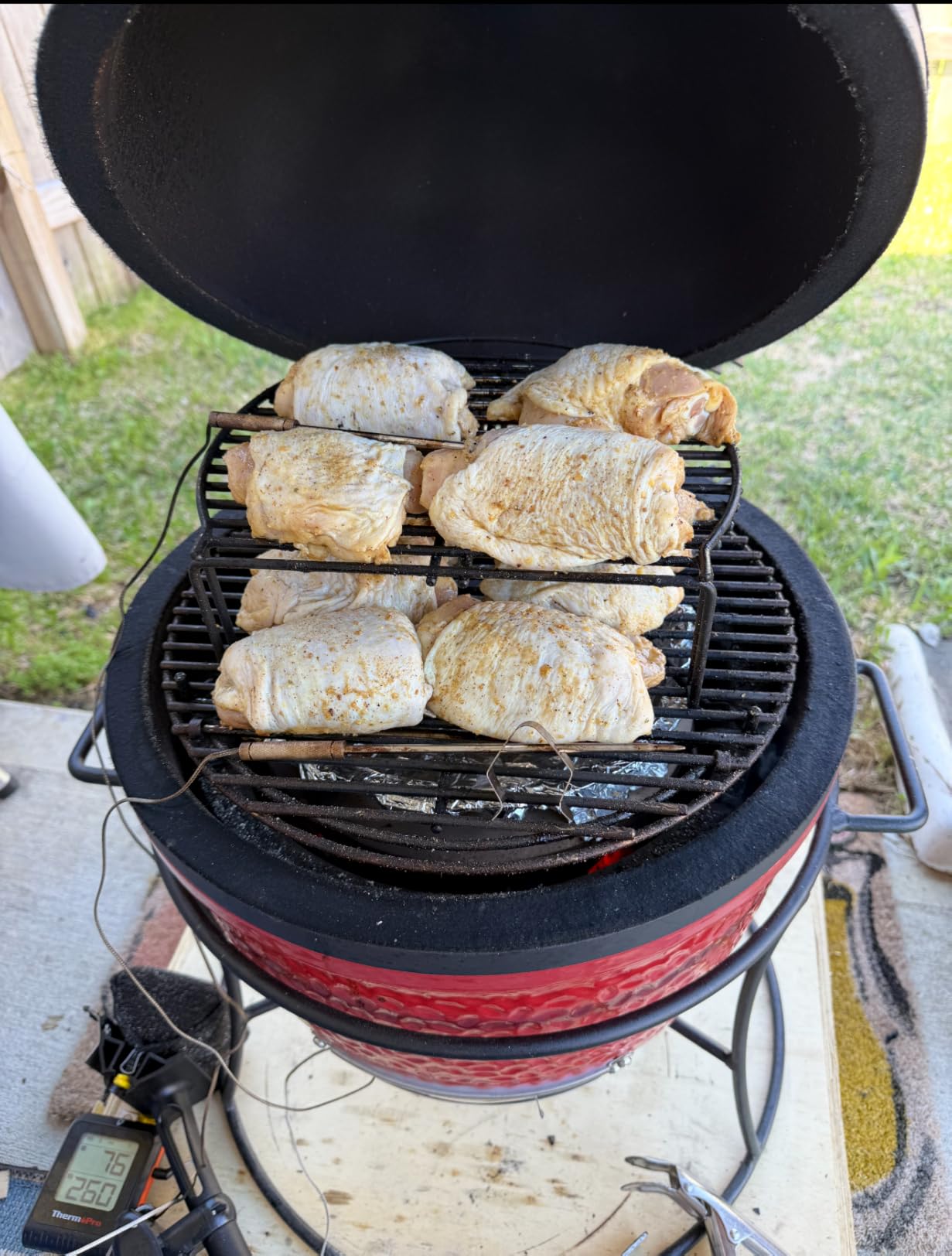
Best used as a dedicated sear station
Treating this grill as the searing half of a two-grill setup is the smart play. Smoke a brisket for twelve hours on a large cooker, then move to a small hot dome for the reverse sear, and the Joe Jr. earns its place without needing 250 square inches.
Owners do flag one recurring delivery issue: ceramic can arrive cracked, and the only fix is to inspect the body the moment it arrives and document any damage before the packaging goes away. Do that with any ceramic kamado on this list.
Our verdict: the best portable kamado for searing and the best starter ceramic. Buy it as a sear station or a tailgating grill, not as the only cooker for a family of six. The included deflector makes the two-zone work possible, which is more than most grills this size can say.
4. London Sunshine 13-Inch Ceramic – Best Kamado for Small Patios
London Sunshine 13-Inch Ceramic Kamado Grill, Waterproof Vent Cap, Green
13-inch ceramic body
180F to 750F range
43.4 pounds
Steel stand included
+ Pros
- 0.8 inch ceramic wall with a dome shape for efficiency
- Runs 180F to 750F for smoke bake grill and broil
- Body and lid arrive pre-assembled
- Waterproof cast iron top vent with stainless bottom vent
- Bamboo handles on a steel stand
- Cons
- 11-inch grate sits undersized inside the bowl
- Grate quality is a step below the ceramic body
- 43 pounds is heavy for its compact size
- Suits direct grilling for one to four people
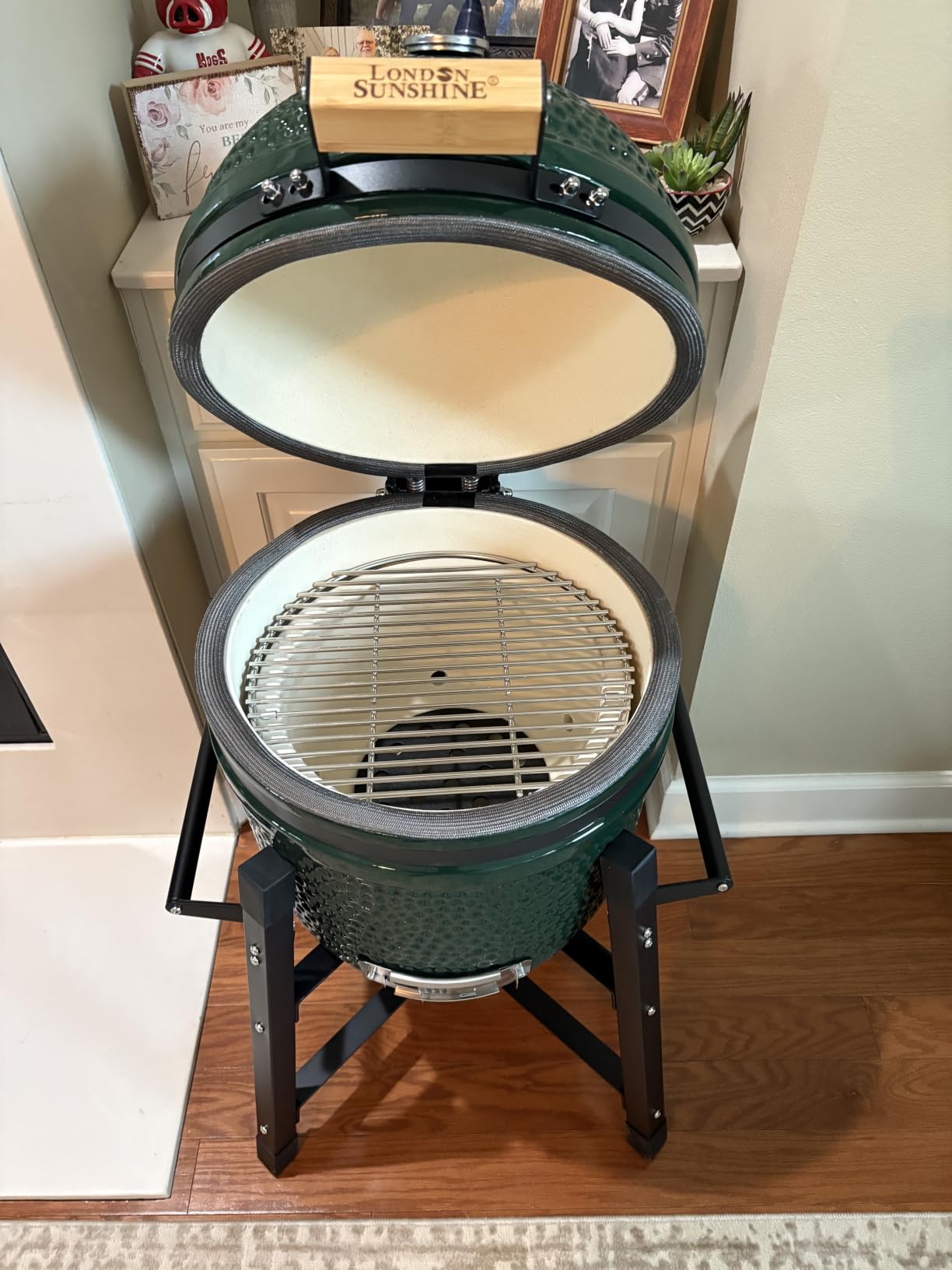
This is a compact ceramic kamado for people who do not have room or budget for a dome cooker. The 0.8-inch ceramic wall and the egg shape do the work: less surface area to heat, and a shell that holds a 180°F to 750°F range for direct grilling, baking, and broiling.
Owners who already own a large ceramic egg frequently describe this as a capable companion at a fraction of the cost. It heats up quickly and the bottom vent is described as easy to control, which is the control that matters most for a fast sear.
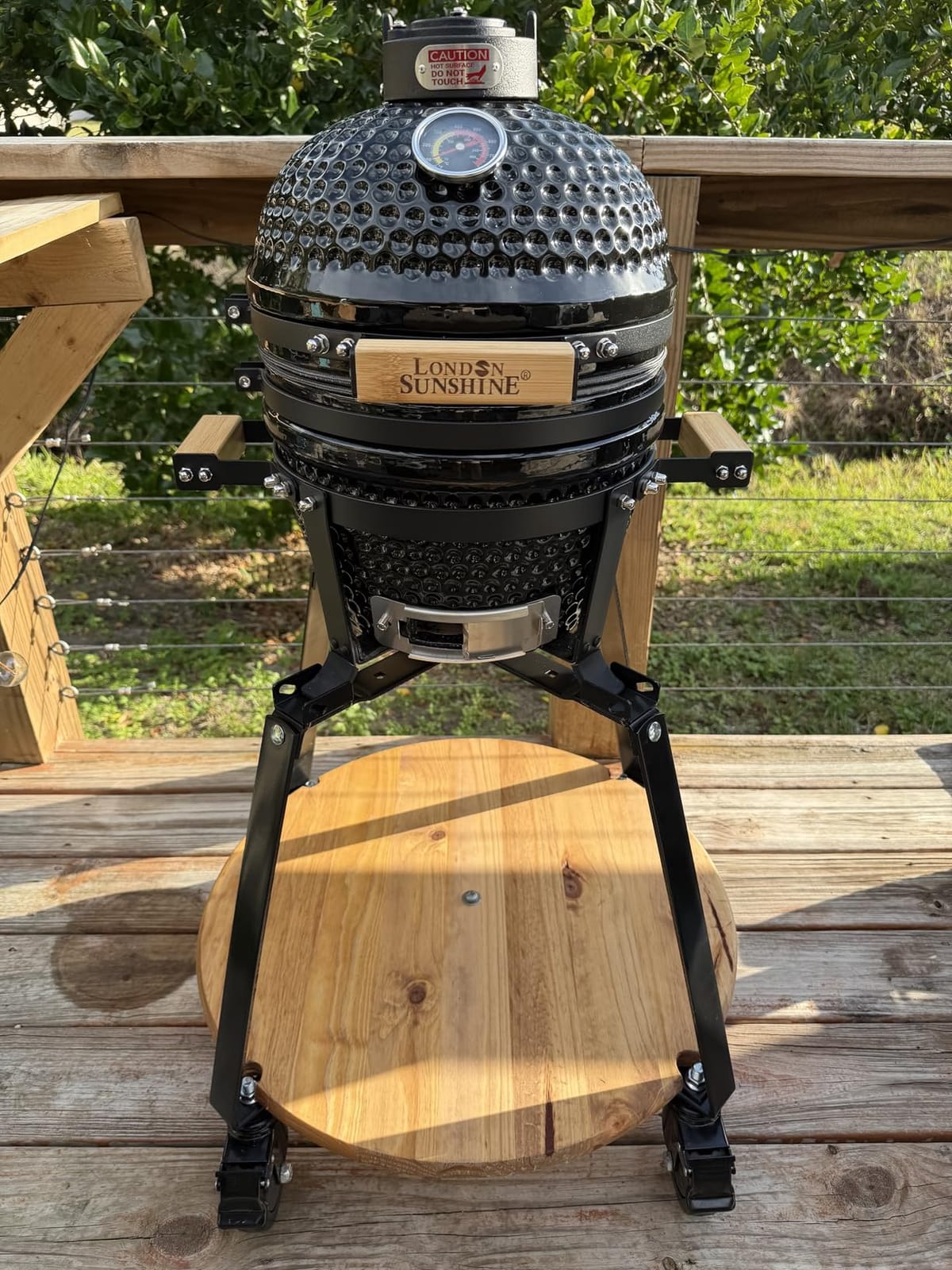
The most repeated criticism is the grate. It is an 11-inch stainless grate inside a 13-inch bowl, and owners note it reads smaller in person than the product photos suggest. Plan your sear batches around two steaks at a time, not four.
0.8-inch ceramic wall running 180°F to 750°F
A 750°F rating on a grill this small is genuinely useful for searing. Small chambers heat fast and, with a tight charcoal mound, will carry a real sear. The 0.8-inch wall is thinner than a full dome, so recovery is not as dramatic, but for a two-minute sear the difference is small.
The cast iron top vent is waterproof and the bottom vent is stainless, which is a sensible pairing for a grill meant to live outdoors. Together they give you the two-lever control you need to find the sear temperature and then hold just under it.
The grate-versus-bowl size gap
Expect to lose usable space to the wall curvature. A small kamado with a narrow grate is effectively a single-dome sear box, and it is a good one for finishing a reverse seared steak that came off a smoker at 140°F.
Because the grate is stainless and the body is ceramic, the owners’ complaint about grate quality stepping down from the body is fair. Season it carefully and it will reward you, but it will not behave like a well-seasoned cast iron grate from year one.
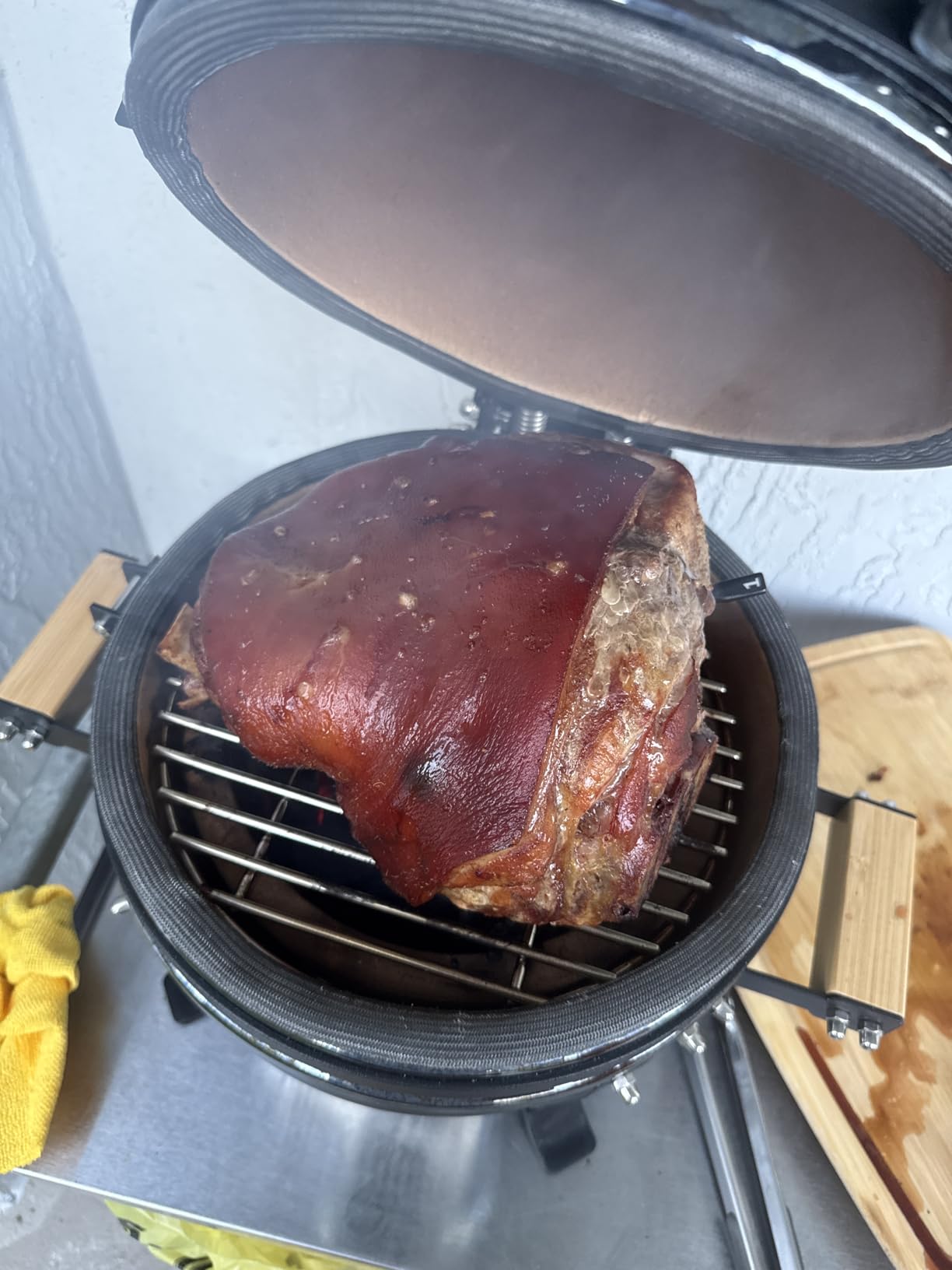
Pre-assembled body and why setup takes minutes
Body and lid ship pre-assembled, so setup is attaching handles and standing up the steel frame. For anyone intimidated by a full ceramic assembly, that removes the hardest part of the process entirely.
The trade is weight. At 43.4 pounds for a compact grill, it needs a dedicated spot rather than living in a garage corner. That is fine for a patio; it is not fine for a small camping trip where you are carrying it alone.
Our verdict: the best kamado for searing steaks on a small patio where a full-size ceramic will not fit. The 750°F ceiling and quick heat-up make it a genuine searing tool, not a novelty. Buy it as a finishing station and manage your expectations on batch size.
5. London Sunshine 15-Inch Ceramic – Best Budget Ceramic With a Tall Working Stand
London Sunshine 15″ Ceramic Kamado Charcoal BBQ Grill and Smoker, Green
15-inch ceramic body
180F to 750F range
13.2 inch interior grate
About 92.6 pounds
+ Pros
- 1 inch thick ceramic wall with a Japanese dome shape
- 180F to 750F for smoke bake grill and broil
- Glass fiber gasket with food-grade stainless grates
- Tall stand keeps the grate at working height
- Owners fit four 8-ounce steaks per load
- Cons
- 13.2 inch interior grate is smaller than the body implies
- About 92.6 pounds is not meant to be moved often
- Some models arrive without assembly screws
- A heat deflector must be bought for indirect cooking
The 15-inch model is the bigger, sturdier version of the same design idea, and at 174 reviews the feedback is unusually warm. Owners describe build quality, burn performance, and temperature control as well above what the price suggests, and several compare it favorably to a ceramic egg they own.
The 1-inch ceramic wall is thicker than the 13-inch unit, and that is the spec that matters for searing. Thicker walls mean slower heat loss, which means the 750°F ceiling arrives faster and recovers better when you open the lid.
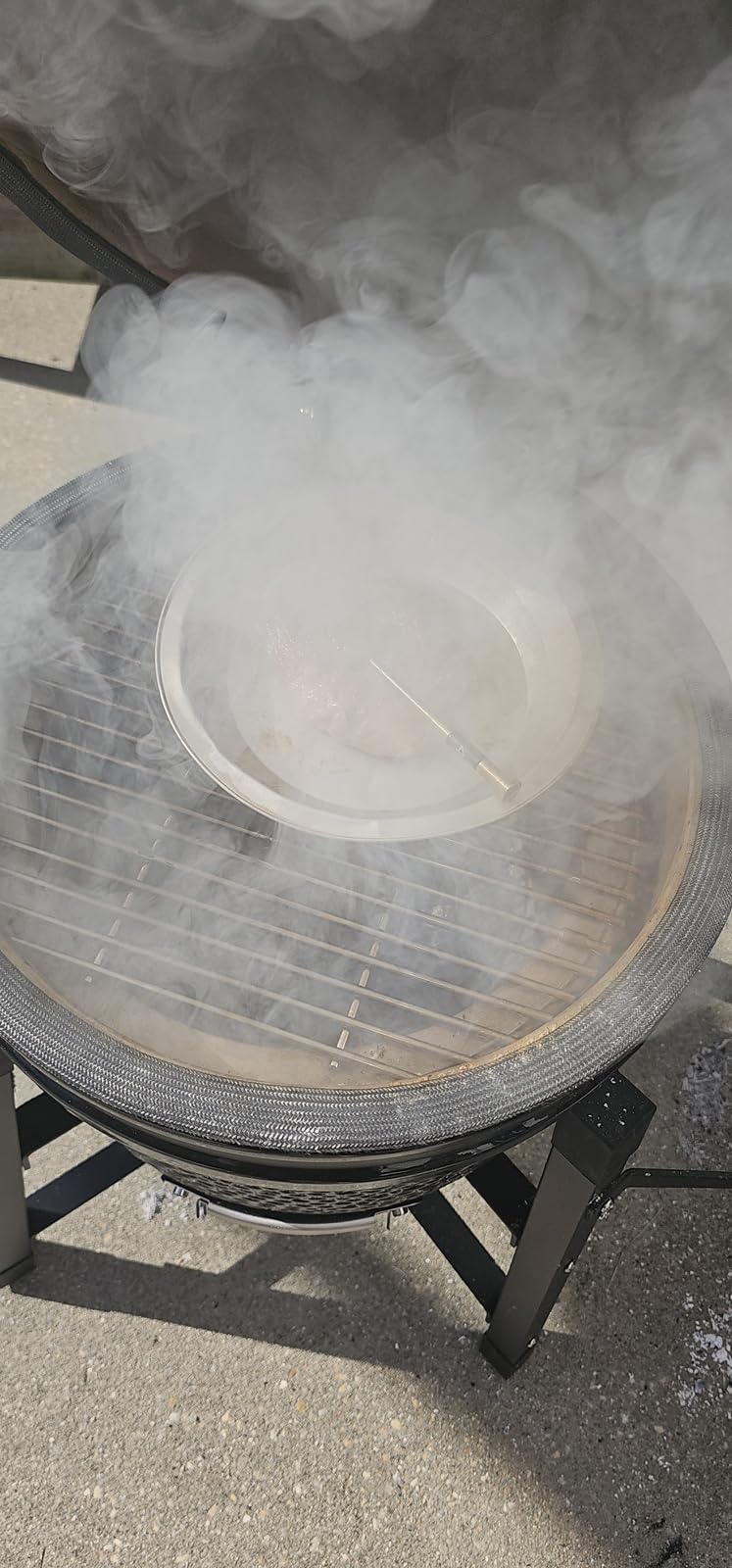
Two practical notes that owners repeat. The interior grate is 13.2 inches inside a 15-inch body, so plan for less space than the diameter suggests. And a heat deflector is needed for any low-temperature indirect cooking, which means one extra accessory purchase before you can use it as a smoker.
1-inch ceramic wall and a 750°F ceiling
The Japanese dome shape is not decoration. The taller profile pushes more of the heat column past the grate before it exits the top vent, which is how a small ceramic cooker holds high temperature with minimal fuel. Owners report noticeably low charcoal use compared with an open steel kettle of similar size.
For a sear, that same shape works in reverse. A concentrated mound plus a wide-open top vent gets you to hard searing heat quickly, and the thick wall keeps it there through the two minutes a thick steak needs.
What four 8-ounce steaks actually looks like
Owners report cooking four 8-ounce steaks plus sides on a single load, which is a fair read of the 13.2-inch grate. That is a genuinely useful batch size for a couple’s cookout, and it is short of crowd cooking.
The tall stand keeps the grate at a comfortable working height, which matters more than it sounds when you are turning steaks in a hot dome. Plan the layout of your steaks and sides before the fire is at temperature, because the wall proximity will cook the edges faster than the centers.
The heat deflector you will need to buy
Plan for one extra purchase. Without a deflector plate, indirect low-and-slow cooking on this grill is not practical, and the deflector is the single accessory most often missing from budget kamado boxes.
Two more owner notes: the weight is around 92.6 pounds, which is heavier than expected for the size and not intended for frequent repositioning. And some units arrive without the screws needed for assembly, so check the hardware bag before you start.
Our verdict: the best budget ceramic kamado for searing a couple’s worth of steaks with real thermal mass. The 1-inch wall and 750°F ceiling put it ahead of cheap steel bodies at peak heat. Add a deflector, keep the grate size in mind, and pick its spot before it arrives.
6. Kamado Joe Big Joe Series III – Best Kamado for Searing a Crowd
Kamado Joe Big Joe Series III 24-inch Ceramic Charcoal Grill and Smoker with Premium Cart, SloRoller Insert and 450 Cooking Square Inches in Red, Model KJ15041021
24-inch ceramic body
450 sq in cooking area
Three-tier Divide and Conquer
SloRoller included
+ Pros
- 450 sq in of ceramic-radiated surface for searing many steaks
- SloRoller smoke chamber recirculates heat to cut hot spots
- 3-Tier Divide and Conquer cooks three temperatures at once
- Kontrol Tower vent controls airflow from 225F to 750F
- Holds temperature for nine hours in cold weather on about 1.5 lb of charcoal
- Cons
- 445 pounds needs two or more strong people to unbox and lift
- Footprint is larger than most patios accommodate
- Steep learning curve on fuel and preheat time
The Big Joe III is the answer when a searing cook is a group event. At 450 square inches of cooking surface, you can put a full spread of steaks on the grate at once instead of working in batches, and the ceramic dome is what gives the radiant heat that makes the crust even across that much surface.
Owners who upgraded from a steel kamado describe the step up in build quality, heat retention, and crowd-size cooking with repeated mentions of excellent steak searing and long stable burns.
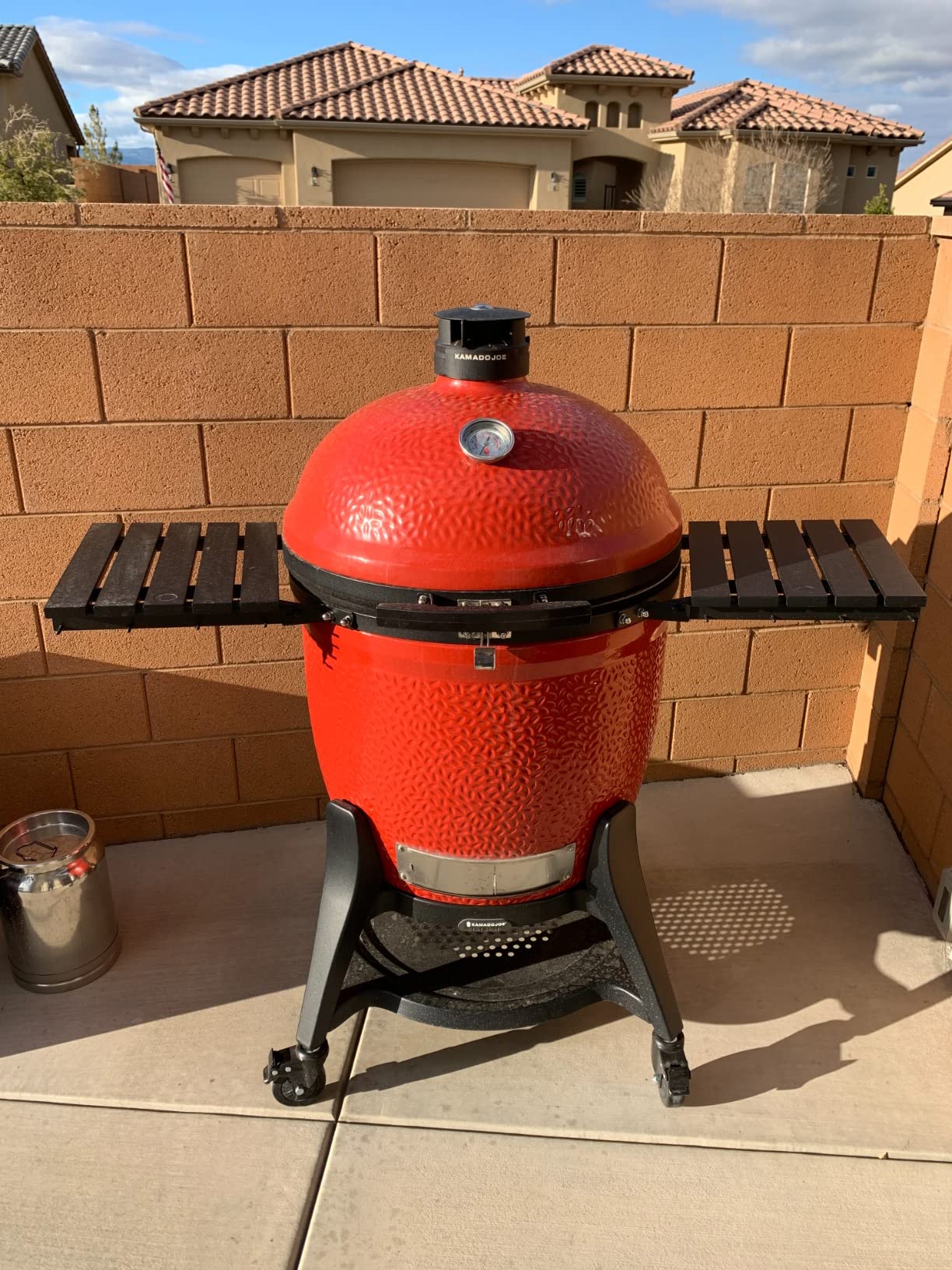
The friction points are logistics. At 445 pounds, this is a two-or-more-person unboxing and placement job, and the main friction owners report is learning how much fuel and how long the preheat actually takes.
450 square inches of radiant surface
This is the grill to buy if searing six to eight people is a regular occurrence. The three-tier Divide and Conquer system lets you run three temperature zones at once, which means main-course steaks, a vegetable rack, and a finishing shelf can all share a single burn.
The controlling detail is the same one that matters on any kamado: charcoal placement. On a firebox this wide, a single concentrated mound gives you a direct radiant zone on one side and falling-off heat on the other, which is a natural two-zone setup without extra hardware.
The SloRoller and why it tames hot spots
The included hyperbolic smoke chamber recirculates heat and smoke around the interior, cutting hot spots and boosting flavor. On a grill this wide, that is not a luxury. Hot-spot contrast across 450 square inches is exactly what ruins a group sear, because the steaks at the edge finish before the ones over the fire.
One caution from the manufacturer guidance on coated inserts: it is not a high-heat sear surface. Keep it doing smoke work and use the top grate for the sear, and it will serve for years.
Placing a 445-pound grill
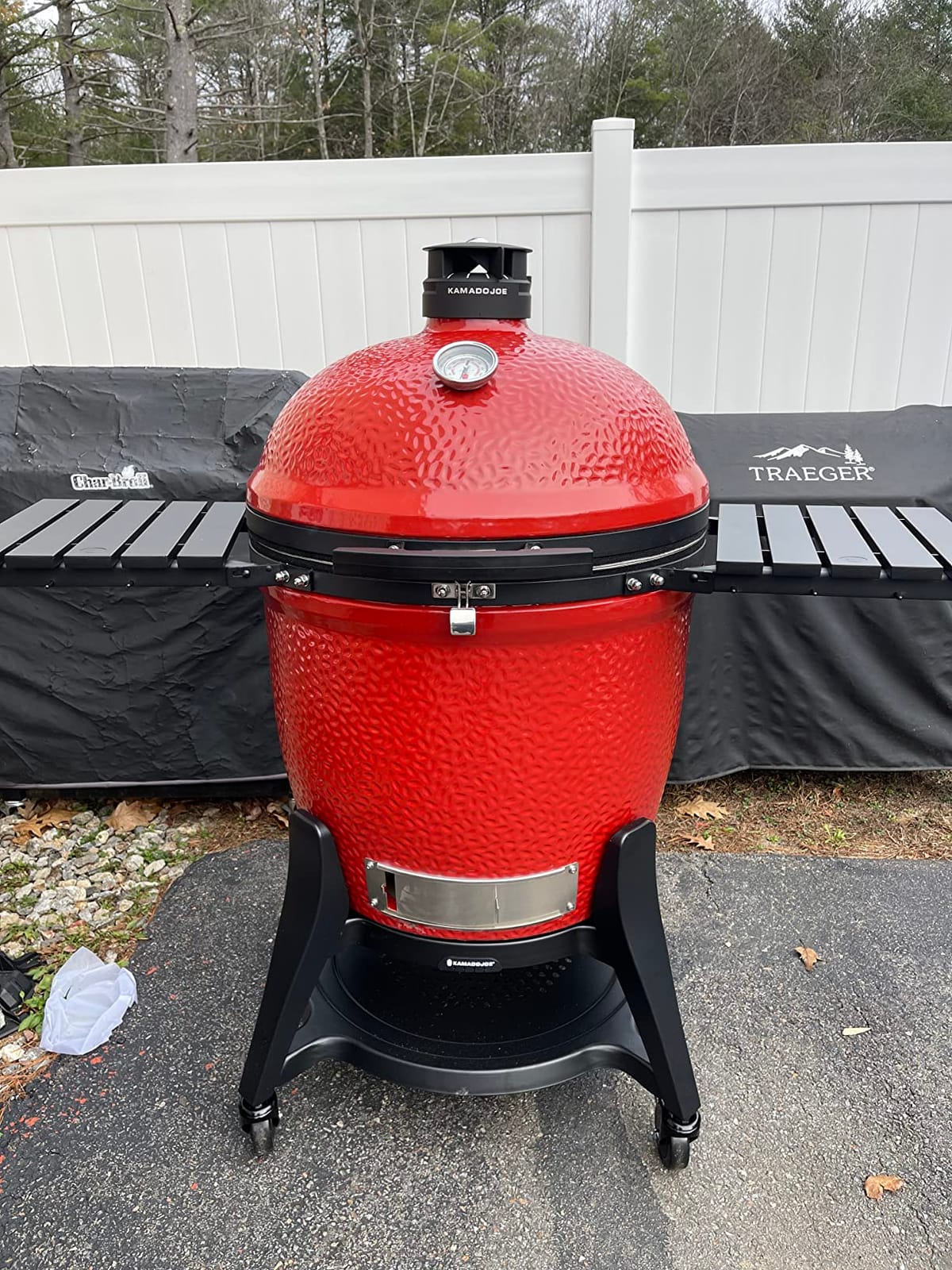
Measure twice. The cart footprint is larger than most patios comfortably absorb, and this is a grill that will not move again once you place it. Have the delivery team set it in position, and plan your sear zone orientation before the first fire.
It holds temperature for nine hours in cold weather on about a pound and a half of charcoal, which is a meaningful operating fact in winter. Wind is a bigger factor for a hard sear than cold is, and the Kontrol Tower vent is rain resistant for that reason.
Our verdict: the best kamado grill for searing a crowd, and the widest searing surface on this list. It costs more in handling effort than anything else here, and it rewards that effort with the most even high-heat surface available.
7. Weber Summit Kamado S6 – Best for Gas Ignition and Fast Preheat
Weber® Summit® Kamado S6 Charcoal Grilling Center with Gas Ignition, Black
Dual-walled insulated steel
452 sq in cooking area
Gas ignition system
RapidFire lid damper
+ Pros
- Dual-wall insulation for precise quick temperature changes
- RapidFire lid damper reaches high searing heat faster
- Adjustable grate for low-and-slow or high-heat searing
- 452 sq in 24-inch area supports a two-zone setup
- Gas ignition removes the chimney lighter
- Cons
- Gourmet BBQ System cookware is sold separately
- Steel body does not hold heat as long as a ceramic dome
- Smallest owner review base in this lineup
The Summit Kamado S6 is a different proposition from a traditional kamado. It is an insulated steel charcoal center with a gas ignition burner, a side burner, and a RapidFire lid damper, and for searing specifically the damper is the feature that matters. It opens the airflow path faster than a conventional top vent, so you reach high searing heat in less time and with less charcoal.
At 62 reviews this is the thinnest owner history in the roundup, and ratings are consistently strong. Owners point to the gas ignition, fast heat-up, and the ease of moving between smoker and sear temperatures, plus the porcelain-enamel finish and simple cleanup.
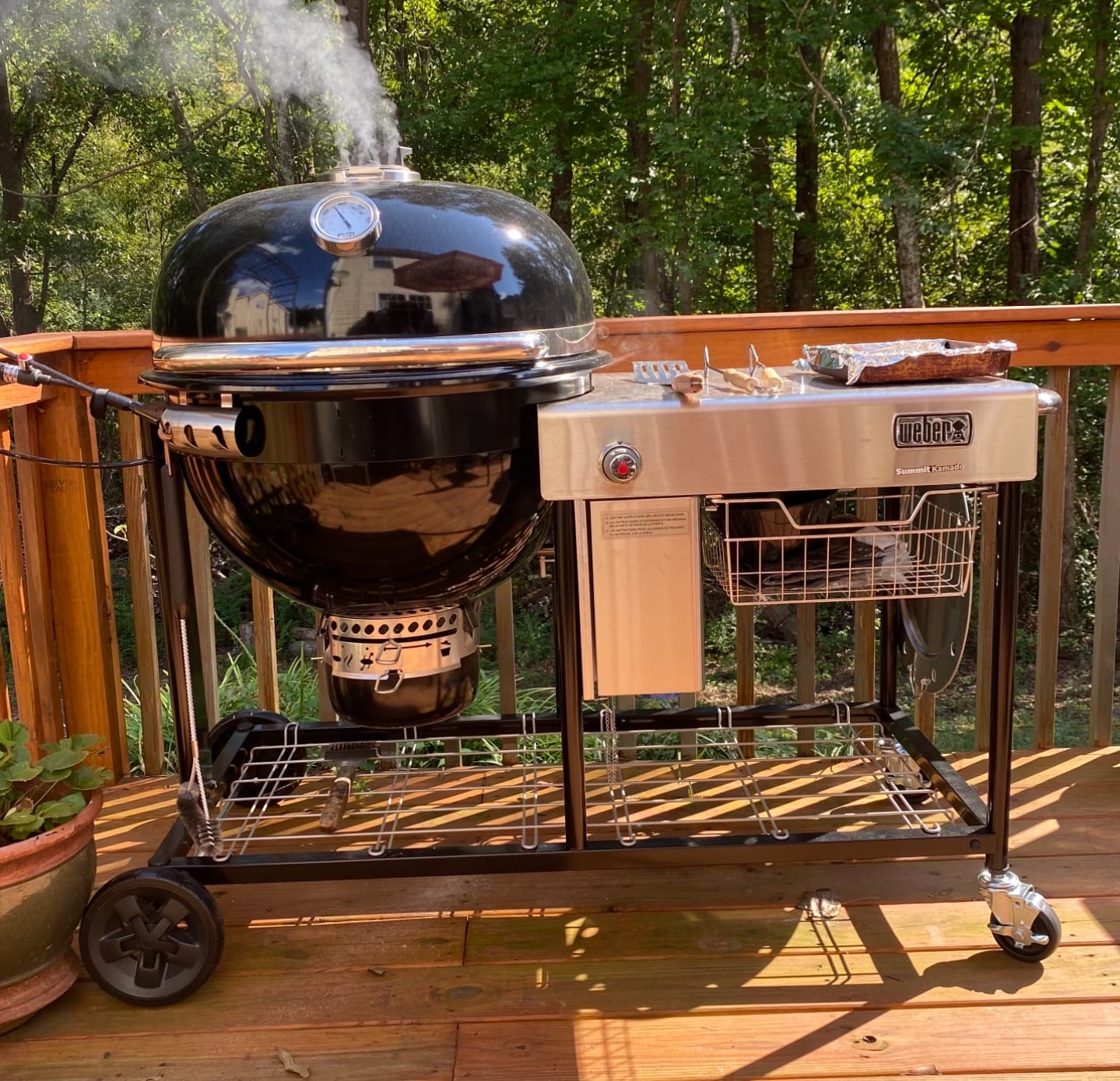
One structural caveat before the reviews get any thinner: the steel body is dual-walled, not ceramic. It will not hold the peak heat of a dome cooker for the same length of time, and the accessory ecosystem is incomplete out of the box.
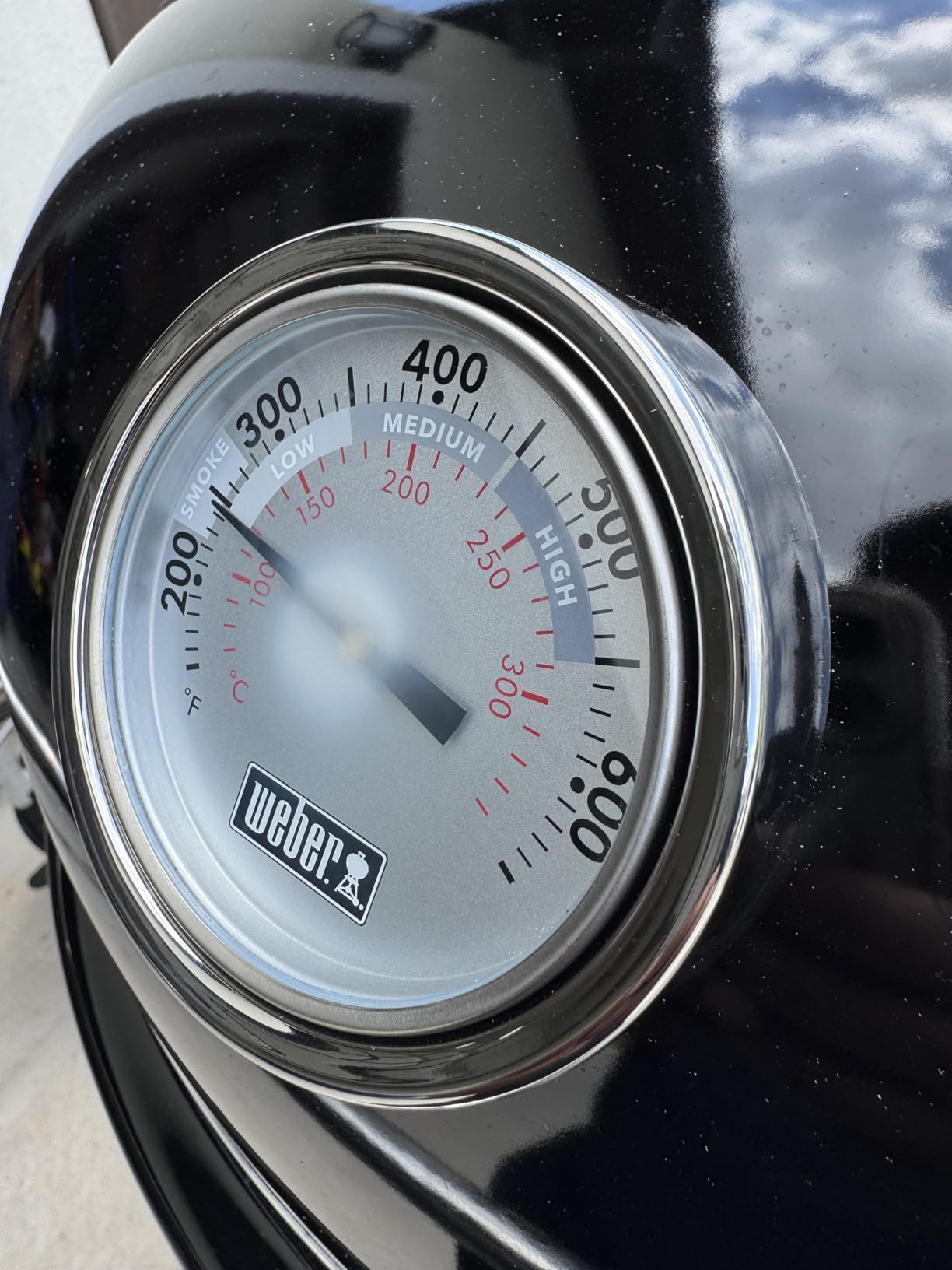
RapidFire damper and dual-wall steel
The gas ignition is the practical unlock. No chimney, no lighter fluid, no waiting ten minutes for a starter to catch before the main burn even begins, which makes a spontaneous weeknight sear realistic instead of aspirational.
The RapidFire lid damper boosts airflow to reach searing heat faster, and the dual-wall insulation allows precise and quick temperature changes. For searing, quick changes are the point: you want to go from a 250°F smoke to a hard sear in minutes, not an hour.
One grate for low-and-slow and a hard sear
The adjustable grate is the sleeper feature. One grate handles both low-and-slow smoking and high-heat searing, and the 452 square inch 24-inch cooking area is large enough for a two-zone setup for a crowd.
That is a real advantage over a small kamado if you are feeding people, and it is the reason this grill can do a full cook and a sear in one session without a second appliance. Char-Basket fuel holders and a diffuser plate for consistent low-temperature smoking are both included in the design.
The accessories you will add later
The Gourmet BBQ System cookware is sold separately, so a full two-zone setup means a second purchase. Budget for that before you commit, because the half-moon pieces are what make the 452 square inches genuinely usable rather than a wide single zone.
At 236 pounds, this is lighter than the full ceramic grills but still not a one-person lift. Plan its spot with the same care you would give a kamado, because repositioning it constantly is the fastest way to chip a porcelain-enamel finish.
Our verdict: the best kamado-style grill for searing when speed and convenience matter more than thermal mass. The gas ignition and RapidFire damper get you to searing heat faster than any ceramic option here, and the 452 square inches feed a group. The steel body gives back some of that peak, and the cookware is an extra buy.
8. Brand-Man Steel Kamado Rodeo Elite – Best Cast Iron Grate in a Steel Body
Brand-Man Steel Kamado Charcoal Grill & Smoker
20-inch cast iron grates
400 sq in cooking area
5-position airflow
105.4 pounds
+ Pros
- Coin-thickness double-layer body with mesh fiberglass gasket
- 20-inch cast iron grates give 400 sq in
- 5-position airflow with hood-mounted thermometer
- Half-moon warming rack for multi-temperature cooking
- Quick-release ash tray and enamel-coated lid
- Cons
- Arrives in two boxes that may not come together
- A separate heat deflector is advisable for indirect cooking
- Smallest owner review base in this roundup
At 4.7 across 49 reviews, this carries the highest rating in the lineup on the smallest sample, so treat the number with the caution it deserves. What the owners who have it describe is a genuinely well-built steel kamado: a coin-thickness double-layer body, a mesh fiberglass gasket, and 20-inch cast iron grates over 400 square inches.
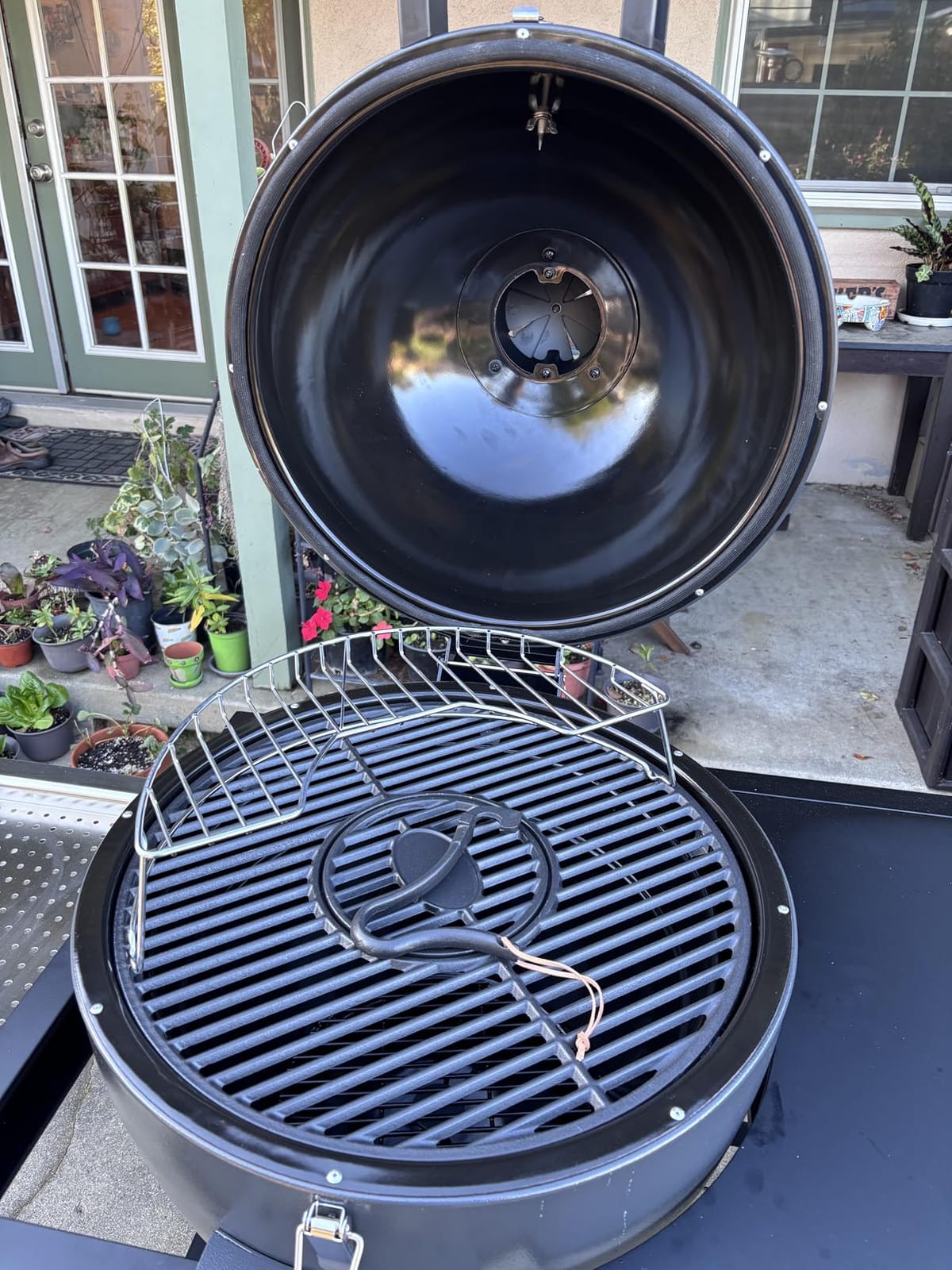
That grate spec is the reason it is here. Cast iron is the best conductor of the four common kamado grate materials, and a 20-inch cast iron cooking surface is a serious searing surface on a grill that is otherwise built like a workhorse.
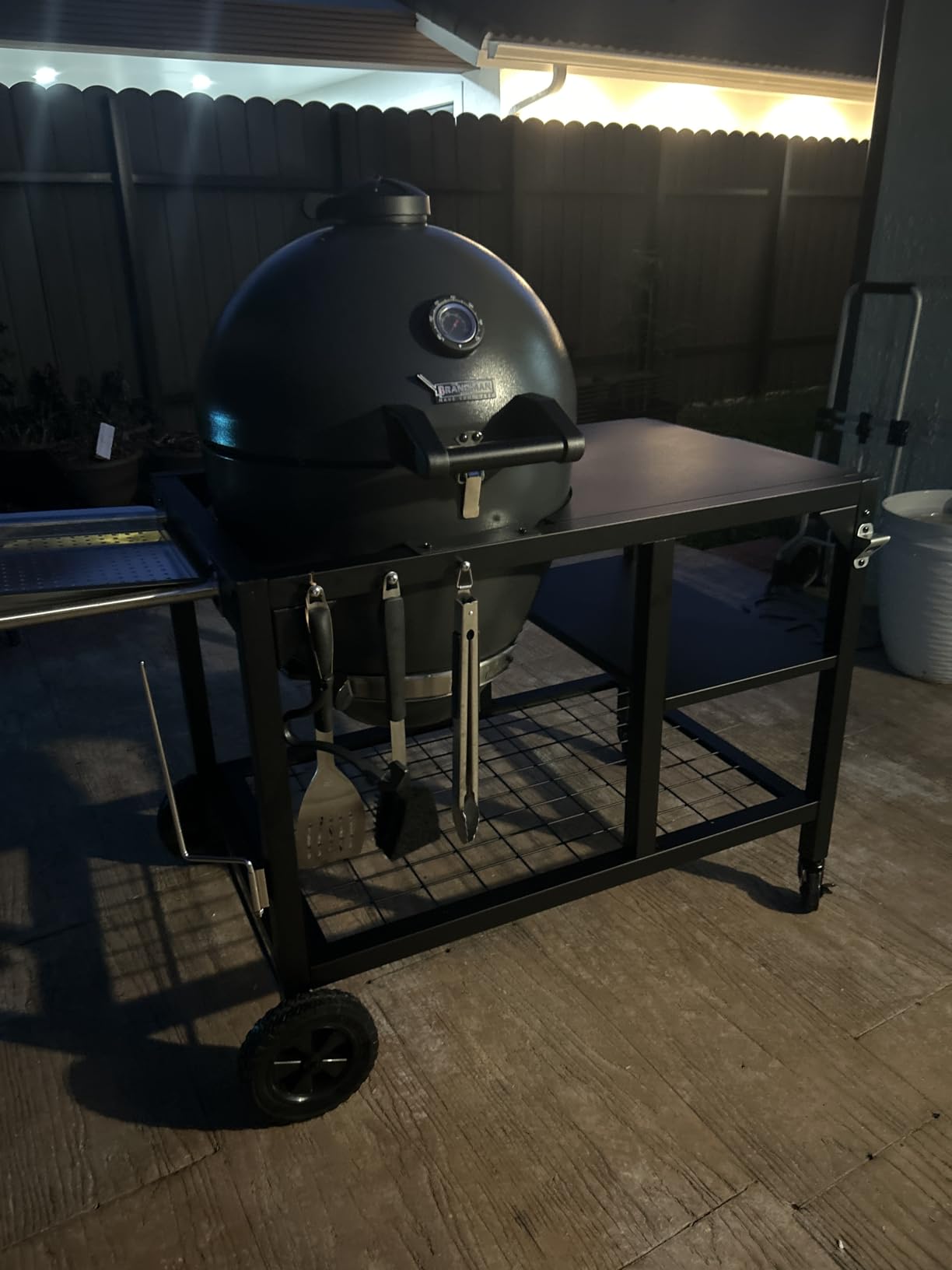
Owners cite solid build quality, a roomy cast iron cooking surface, straightforward damper control, and generous prep and storage space. The practical snag is the packaging, which we get to below.
20-inch cast iron grates over 400 square inches
Cast iron carries and radiates heat better than stainless, and the 20-inch grate here gives enough room for roughly 25 burgers or a serious spread of steaks. The half-moon warming rack above it creates a second temperature zone without cutting the firebox in half.
For a sear, that combination is the selling point: a wide, heavy, conductive surface that crusts a steak fast. The trade is mass in the wrong direction for recovery, since a heavy grate absorbs more energy when the lid opens than a light stainless one.
Five-position airflow and the hood thermometer
The 5-position airflow system with adjustable top and bottom dampers is more graduated than most kamado vents offer, and at 700°F that granularity helps. The hood-mounted thermometer gives you a dome reading rather than a grate reading, so treat it as a trend indicator and verify with a probe at the food.
The mesh fiberglass gasket is worth noting for a different reason. Lid gaskets are the component that degrades fastest on any kamado, and a mesh gasket in a thick channel tends to seat more consistently than a rope-style seal as it ages.
Rust protection and the two-box delivery
The warranty is the best on any steel body here: five years on the firebox and outer body against rust-through, and two years on the cooking grids and exterior finish. That is a direct answer to the rust complaint that dominates steel kamado owner feedback.
The delivery snag is real. This ships in two separate boxes, so the second one can arrive separately from the grill. Plan for that, and inspect both for transit damage before assembly. A separate heat deflector is also advisable for indirect cooking; the included trivet is useful but not a substitute.
Our verdict: the best kamado for searing if cast iron grates are your priority and a steel body is acceptable to you. The 400 square inch cast iron surface and the five-year rust-through coverage make it a strong value pick. Just plan for a two-box arrival and buy a deflector.
How to Actually Get a Hard Sear on a Kamado
Owning a grill that can reach 750°F is half the job. The other half is vent choreography, and this is the part most kamado advice gets wrong, because low-and-slow instructions are the default online.
- Preheat on lump charcoal. Lump burns hotter and longer than briquettes, which matters for a sear. Start with the bottom vent wide open and a full chimney, and give it 15 to 20 minutes after the coals are ashed over.
- Set the fire before the vents. Once the coals ash, push them into a single concentrated mound on one side of the firebox. That is your direct radiant zone. The empty half of the firebox becomes your indirect side.
- Open both vents fully for the sear. Bottom vent wide, top vent wide. This is the maximum-airflow configuration and it is the only way to get a true hard sear. Check the temperature with a probe at the grate, not at the dome.
- Adjust charcoal placement as the burn progresses. The hot spot migrates, as owners on bbq-brethren and r/KamadoJoe describe repeatedly. Re-form your mound about 10 minutes into a long sear so the radiant heat is still under the food.
- Partially close the top vent to hold. Once you are at your target, ease the top vent down until the temperature holds. Coming down from a sear to a finishing temperature is exactly the control range a kamado gives you that a kettle does not.
One caution from owner reports: running a kamado at 500°F or higher for a long period in strong wind is how you light charcoal fires instead of searing. If the wind is up, lower your target temperature rather than piling on more fuel, and a cast iron sear basket over a smaller mound will hold a hard sear more predictably than a firebox full of coals.
Buying Guide: What Makes a Kamado Grill Sear Well
Grate material decides more than body material
Body material gets the attention, but the grate is what your steak actually touches. The order is straightforward: cast iron first, stainless steel second, enameled steel last. Cast iron is dense and conductive, it takes seasoning that improves with use, and it holds temperature through a two-minute sear. Stainless is lighter and far more forgiving of abuse but crusts a little more slowly. Enameled steel is the option to avoid for searing, and it is worth skipping a grill over if the grate is enameled.
If you already own a kamado, a grate swap is the cheapest searing upgrade available. A cast iron grate or a soapstone slab changes crust formation more than any body upgrade you can buy, and owners across the community forums describe soapstone specifically as delivering an exceptional sear. A high-quality cast iron sear basket is the second easiest win.
Thermal mass and how fast a kamado recovers
Thermal mass is the reason kamados exist for searing. Thick ceramic walls do not drop temperature when you open the lid, so a cold steak does not sit on a cooling grate waiting for the fire to catch back up. Steel bodies recover, just less dramatically, and the difference shows most on thick cuts cooked rare.
Read recovery as a spec, not a feeling. Grills rated to 700°F with a steel body will still give you a good sear, but the last thirty seconds of a thick ribeye is where the ceramic earns its money.
Hot spots move, so plan your sear zone around it
Every round kamado has a hot spot, and on a round firebox it forms under the charcoal and then migrates as the burn progresses. Owners describe the same pattern across brands: a searing zone that exists for the first ten minutes, then shifts. Treat the fire position as the source of truth and move the food to the fire rather than expecting a fixed zone.
Oval bodies solve more of this than round bodies, because a longer grate lets you separate fire and food physically. If you sear often and cook for a crowd, that geometry is worth paying for.
Ceramic versus insulated steel for searing
Ceramic wins on peak heat and recovery. Insulated steel wins on weight, price, and mobility. The insulated steel grills on this list, particularly the AKORN with its triple-wall body, close most of the gap in a 200°F to 700°F working range, which is where nearly all searing actually happens.
Decide by use. If searing is an occasional finishing step on a low-and-slow cook, steel is enough. If searing is the reason you own the grill, ceramic is the right body and the right price.
Size, weight, and the arrival inspection
Two hundred and fifty square inches feeds four to six people. Four hundred and fifty feeds eight or more, and it is the difference between a single batch of steaks and a two-batch evening. Measure your grill space and your patience, because a 445-pound ceramic body is a permanent placement decision.
On arrival, inspect the ceramic body immediately and photograph any cracks before the packaging is removed. Freight damage on ceramic is the most common early failure reported across brands, and it is the one issue that is far easier to document on the doorstep than a week later. For steel bodies, plan your first rust inspection at the ash pan and the lower body, and keep a cover on it.
Frequently Asked Questions
Are kamado grills good for searing steaks?
Yes. A kamado grill is one of the best appliances for searing because its insulated walls hold heat far more steadily than an open kettle, letting the same cooker move from a 225°F overnight smoke to searing temperatures past 700°F for a hard crust. The sear quality comes down to the grate material, so a kamado with cast iron grates will outperform a stainless-grate kamado for searing.
How hot can a kamado grill get?
Most quality kamados are rated between 700°F and 750°F for normal cooking, and owners running lump charcoal with both vents wide open report burst temperatures well above 1000°F for a fast sear. Treat the manufacturer figure as your working target and the higher number as a short burst, since holding very high heat burns through charcoal quickly.
What is better, the Big Green Egg or Kamado Joe?
For searing specifically, the Kamado Joe Classic II is the stronger choice. It carries a higher published ceiling at 750°F, ships with cast iron grates and a two-tier Divide and Conquer system that makes two-zone cooking straightforward, and it is backed by a limited lifetime warranty on ceramic parts. The Big Green Egg is a fine cooker, but owners more often describe it as the more expensive route to a similar result.
Which kamado grill has the highest rating?
Among the eight grills we compared, the Brand-Man Steel Kamado Rodeo Elite carries the highest average rating at 4.7, though its 49 reviews are the smallest sample in the group. The Kamado Joe Classic Joe Series II is the strongest combination of rating and owner volume, pairing a 4.7 rating with 974 reviews. The Char-Griller AKORN has the largest review base of all at 2,349 ratings and a 4.6 average.
What are the cons of kamado grills?
The main drawbacks are weight, learning curve, and moving hot spots. Ceramic kamados run from roughly 75 pounds to more than 400 pounds, so placement is a two-person job and a permanent decision. The vent choreography takes practice. And the hot spot migrates as the charcoal burns, so there is no fixed searing zone on a round body. Add freight damage risk on ceramic and rust risk on steel bodies, and you have the full picture.
Which Kamado Grill Should You Buy for Searing?
If searing is the main event, buy the ceramic with the cast iron grates. The Kamado Joe Classic Joe Series II is the best kamado grill for searing overall, because a thick dome, 250 square inches of cast iron grate, and a two-tier grate system cover everything from a 225°F overnight smoke to a 750°F crust without moving food between appliances.
If you are cooking for a group, the Big Joe III gives you 450 square inches to sear a whole spread at once, and the SloRoller helps keep that wide surface even. If you want the smallest sensible footprint, the Joe Jr. runs well above 500°F, weighs less than any full dome here, and works beautifully as a dedicated sear station next to a bigger smoker. For a steel body with genuine cast iron grates, the Brand-Man Rodeo Elite pairs 400 square inches of cast iron with a five-year rust-through warranty on the firebox. And if you want the sear without a permanent patio commitment, the Char-Griller AKORN covers 200°F to 700°F across 445 square inches and rolls on casters, though you will work the vents harder at peak and keep a cover on it through wet months.
Whichever one you choose, buy the heat deflector stone with it, plan the charcoal mound before you light the fire, and pick the grill’s spot before the pallet shows up. Those three steps do more for your sear than any accessory after that.