
Most wheelbarrows sold today are built for leaves and dry topsoil, not for the loads that break them. If you are moving wet clay, river rock, gravel, sod pallets or bags of concrete, the best wheelbarrows for heavy loads are the ones rated at 500 pounds or more, and in practice almost all of them are four-wheel dump carts rather than classic single-wheel barrows. I compared 12 of them on capacity, tub volume, wheel layout, tire type and owner-reported failures, and the honest answer is that capacity alone tells you very little.
The trap is the headline number. A cart rated for 1200 pounds tells you nothing about what a cubic yard of wet material actually weighs when it is sitting in the bed, and it says nothing at all about whether the frame racks on a slope. So the first thing I did was build a load reference: dry mulch runs about 35 to 40 pounds per cubic foot, wet soil runs closer to 80 to 100, and crushed gravel is around 100. That spread means a 7 cubic foot bed can hold roughly 250 pounds of mulch or about 700 pounds of gravel, with the cart overloaded in the second case and underloaded in the first.
That single calculation changed how I read the category. A 900 pound cart is not half of a 1800 pound cart, it is a different tool. Below roughly 600 pounds of realistic load, a two-wheel design is faster and cheaper. Between 600 and 1200 pounds, you want four wheels, a pneumatic or properly rated flat-free tire, and a dump mechanism. Above 1200 pounds of real material, the answer stops being a wheelbarrow and becomes a small utility trailer.
I also read the owner reports, not just the spec sheets, because that is where this category earns its reputation. Punctured tubes are the most repeated complaint in the owner discussions I read, followed by poly tubs cracking at the bolt points and handles working loose after a season of heavy trips. The picks below are the ones whose failure complaints stayed cosmetic.
Our Top 3 Picks for Heavy-Load Hauling in 2026

Gorilla Carts 600 lb Poly Yard Cart
- 600 lb capacity
- 36 x 20 in poly bed
- 10 in pneumatic tires
- Patented quick-release dumping

Gorilla Carts 1200 lb Poly Dump Cart
- 1200 lb capacity
- 7 cu ft poly bed
- 13 in flat-free tires
- Quick-release dumping

VEVOR 900 lb Steel Garden Wagon
- 900 lb capacity
- 3.45 cu ft bed
- Fenced or flatbed conversion
- Powder-coated steel
Comparing 12 Heavy-Duty Carts and Wheelbarrows in 2026
Every cart in this roundup is listed with its rated capacity and, where the manufacturer publishes one, its bed volume in cubic feet. Read those two numbers together, because the gap between them is where most disappointed buyers end up.
| Product | Details | |
|---|---|---|
| Gorilla Carts 600 lb Poly Yard Cart |
|
Check Latest Price |
 VIVOHOME 880 lb Steel Mesh Garden Cart VIVOHOME 880 lb Steel Mesh Garden Cart |
|
Check Latest Price |
 WORX WG050 8-in-1 Aerocart WORX WG050 8-in-1 Aerocart |
|
Check Latest Price |
| VEVOR 900 lb Steel Garden Wagon |
|
Check Latest Price |
| Gorilla Carts 1200 lb Poly Dump Cart |
|
Check Latest Price |
 BILT HARD 900 lb Poly Dump Cart BILT HARD 900 lb Poly Dump Cart |
|
Check Latest Price |
 VEVOR 1200 lb Poly Dump Cart VEVOR 1200 lb Poly Dump Cart |
|
Check Latest Price |
 Sekey 1600 lb Steel Garden Cart Sekey 1600 lb Steel Garden Cart |
|
Check Latest Price |
 BILT HARD 880 lb Steel Garden Cart BILT HARD 880 lb Steel Garden Cart |
|
Check Latest Price |
 BILT HARD 1200 lb Poly Dump Cart BILT HARD 1200 lb Poly Dump Cart |
|
Check Latest Price |
 CAMMOO 900 lb No-Flat Dump Cart CAMMOO 900 lb No-Flat Dump Cart |
|
Check Latest Price |
 Best Choice Dual-Wheel Yard Cart Best Choice Dual-Wheel Yard Cart |
|
Check Latest Price |
1. Gorilla Carts 600 lb Poly Yard Cart – Best Overall Heavy-Load Hauler
Gorilla Carts 600-Pound Capacity Heavy Duty Poly Yard Garden Steel Quick Dump Utility Wheelbarrow Wagon Cart with Straight Pull Handle, Green, Model GOR4G-COM
600 lb capacity
36 x 20 in poly bed
10 in pneumatic tires
Four wheels, 32 lb empty
+ Pros
- Patented quick-release dumping system
- 10 in pneumatic tires roll well over mixed terrain
- Quick assembly out of the box
- 36 x 20 in bed holds bulky yard waste
- Steel frame with rust-resistant poly tub
- Cons
- Tires need periodic inflation
- Poly bed flexes at the very top of its rating
- Only a 1-year warranty
This is the cart I keep coming back to, and the reason is the review count rather than the spec sheet. More than 30,000 owners have rated it, and the complaints that survive that volume are about tire pressure and bed flex, not about structural failure. In my own yard work it is the one I reach for first when the job is mixed: leaf bags, a half load of wet soil, a stack of sod.
The patented quick-release dumping system is the feature that changes daily use. You lift the handle and the bed tilts without wrestling a loaded tray over an edge, which is where most two-wheel barrows lose their advantage. For 600 pounds of realistic payload, nothing here has broken in a way that matters.
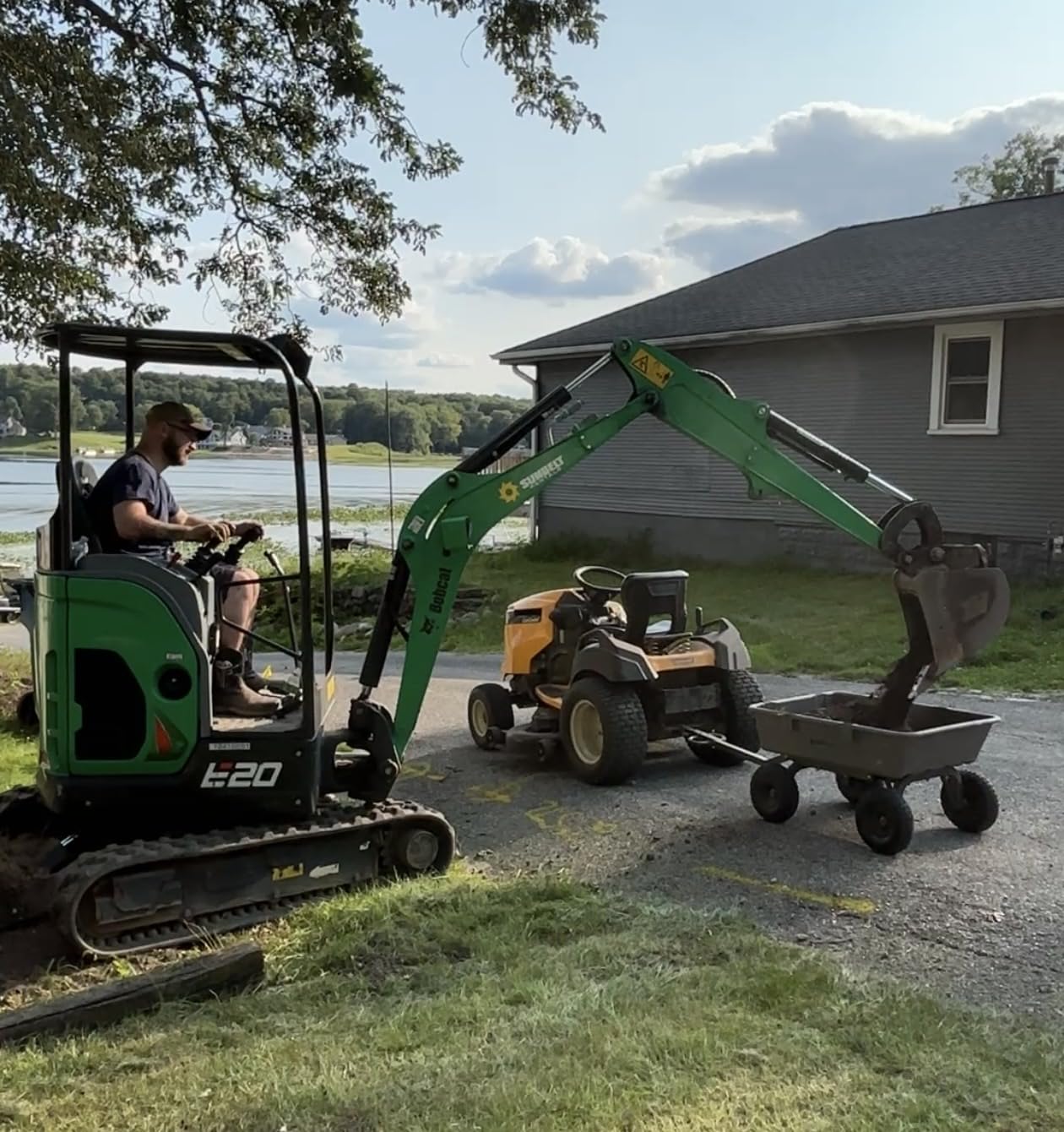
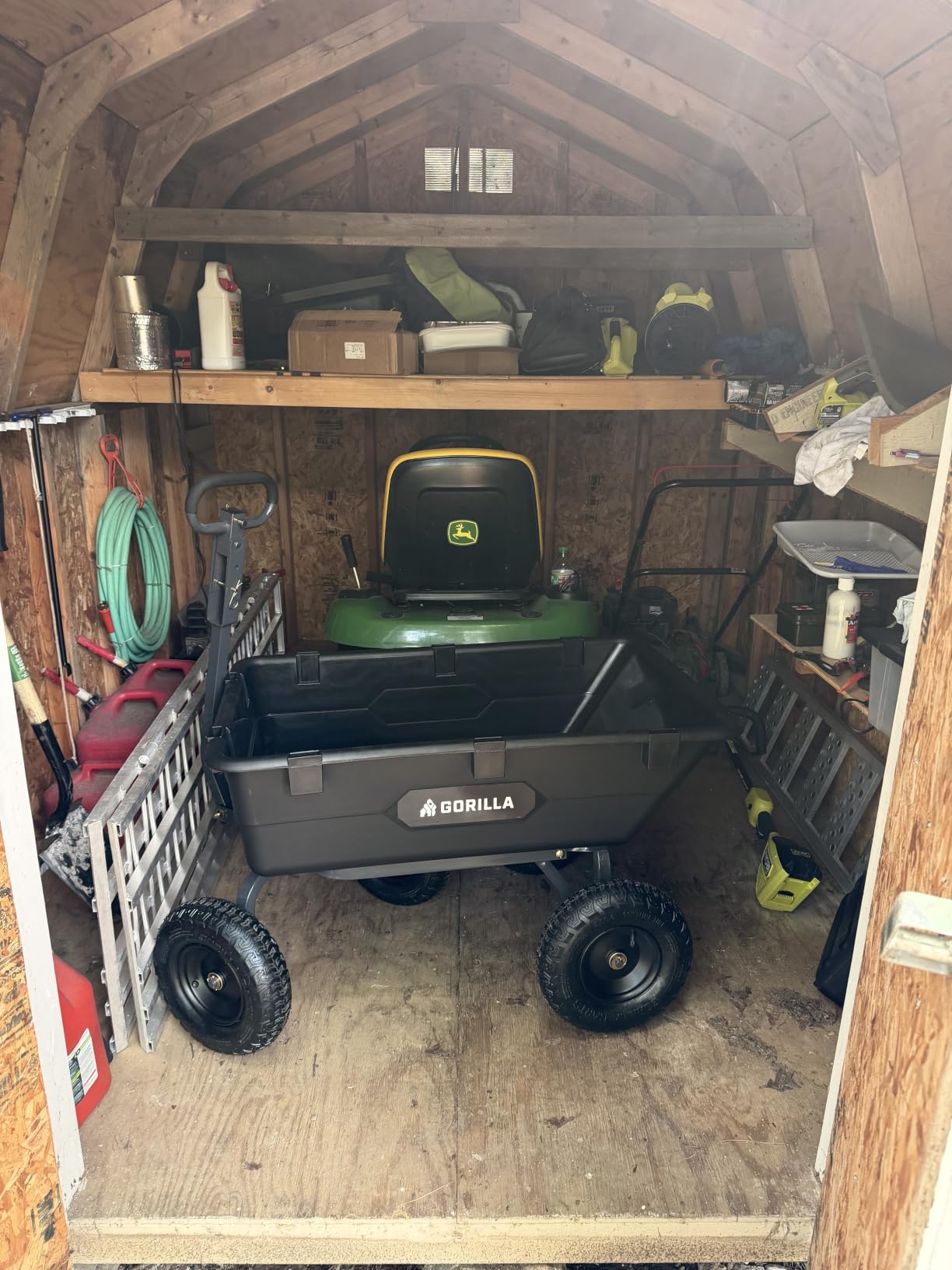
The 36 by 20 inch poly bed is wider than most traditional tubs, which is why bulky material sits inside it rather than on the handles. At 32 pounds empty, it is also light enough to reposition without asking for help, something the 1200 pound carts in this list are not.
Where the 600 pound rating actually lands
Dry mulch in this bed comes to roughly 250 pounds, well inside the rating. Wet soil or gravel in the same bed pushes toward 500 pounds and starts pushing on the limit. Owners do report the poly bed flexing at its maximum, which is the mechanism behind a few of the cracked-corner complaints I saw. For dense material, keep trips lighter and more frequent.
The straight pull handle is described as comfortable for heavy hauling, and that checks out for short to medium distances. It is a pull cart, not a lift, so a 500 pound load up a truck ramp is a two-person job. Ten-inch pneumatic tires soften every rut and absorb impact, but they are the part you will be pumping up.
Where it falls short
Six hundred pounds is the ceiling here, and once you start moving fieldstone or river rock by the half load, you are outgrowing it. The tub is rust-resistant poly, so wet material sits in it without the corrosion penalty a steel tray pays, but poly loses stiffness in cold weather and can look worse after a hard winter than a steel equivalent.
Beyond that, the fit and finish are workmanlike rather than refined. It does not fold, it does not convert, and the straight pull handle gives you no steering finesse in a tight side yard. For anything longer than a straight run across level ground, one of the four-wheel carts with a rotating handle will feel more precise.
2. VIVOHOME 880 lb Steel Mesh Garden Cart – Welded Steel for Oversized Loads
VIVOHOME Heavy Duty 880 Lbs 4.5 Cu Ft Mesh Steel Garden Cart Utility Wagon
880 lb capacity
4.5 cu ft mesh steel bed
Four 10 in pneumatic tires
180 degree rotating handle
+ Pros
- Fully-welded iron construction with anti-rust finish
- 180 degree rotating handle makes tight turns predictable
- Removable mesh sides convert it to a flatbed
- Pneumatic tires reduce noise and bounce on uneven ground
- Cons
- Mesh bed will not contain small loose material
- Tires may arrive underinflated
- No published empty weight
This is the cart for loads that are awkward rather than simply heavy. A fully welded iron mesh bed takes sheet goods, fence panels, long boards and awkward brush that will not sit in a molded poly tub, and the removable sides let you drop those same sides and load something longer than the bed is wide.
The 180 degree rotating handle is what separates it from a fixed-handle wagon. You can pivot the handle to walk alongside the load rather than behind it, which changes how you handle the cart on a driveway with a wall on one side.
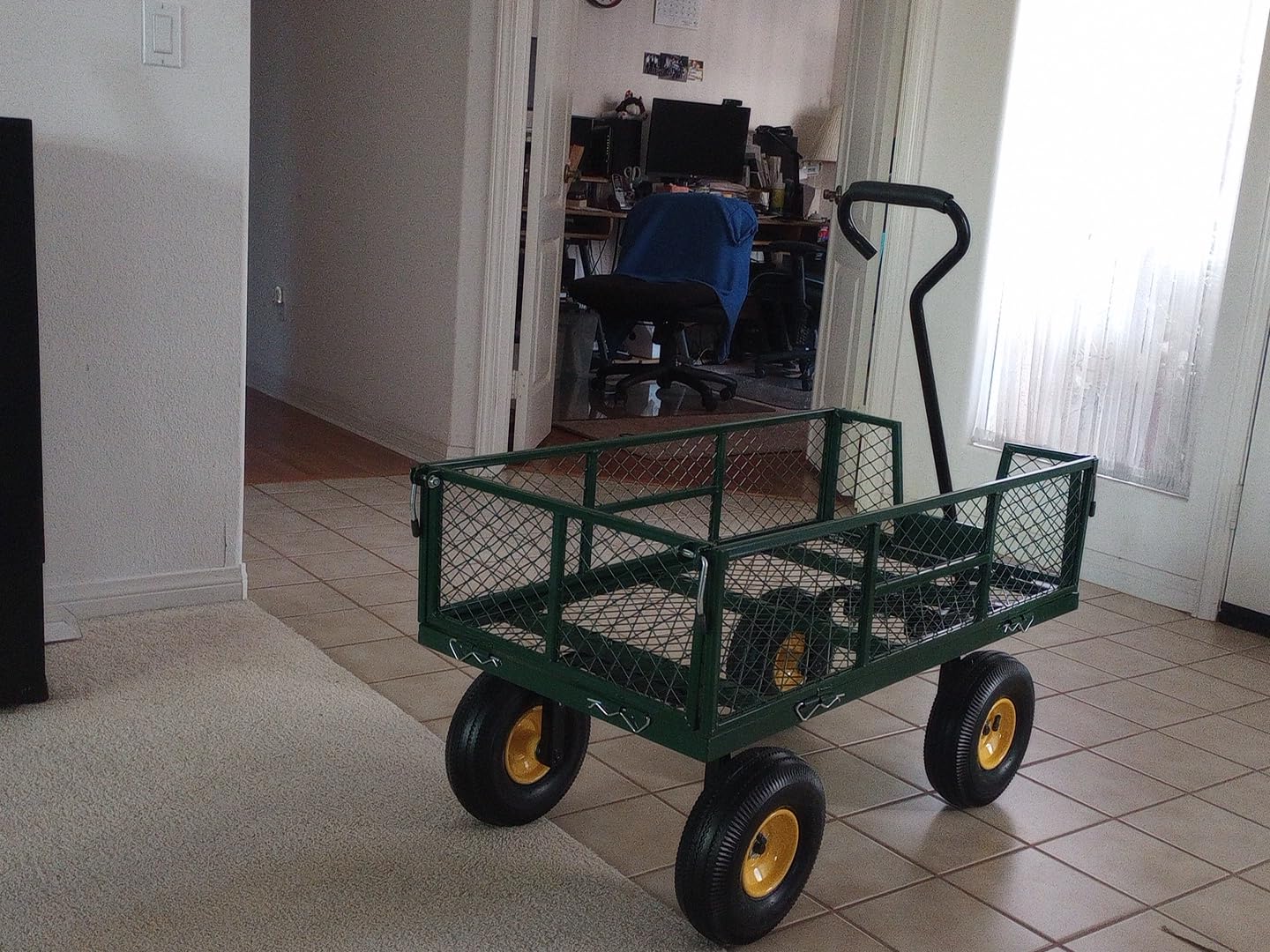
Rated at 880 pounds with a 4.5 cubic foot bed, it sits in an awkward middle. The volume suits brush, firewood, fence posts and bagged material. The rating suits dense material in smaller loads. Owners report good performance on uneven and hilly terrain, which matches the four-wheel stance and the pneumatic tires.
Steel construction and the mesh floor
A welded steel bed will take a beating that would split poly, and it will not crack at a bolt point after a few seasons. The trade is weight and rust. Steel holds heat in summer and is the right choice when you are hauling metal, stone or lumber rather than soil.
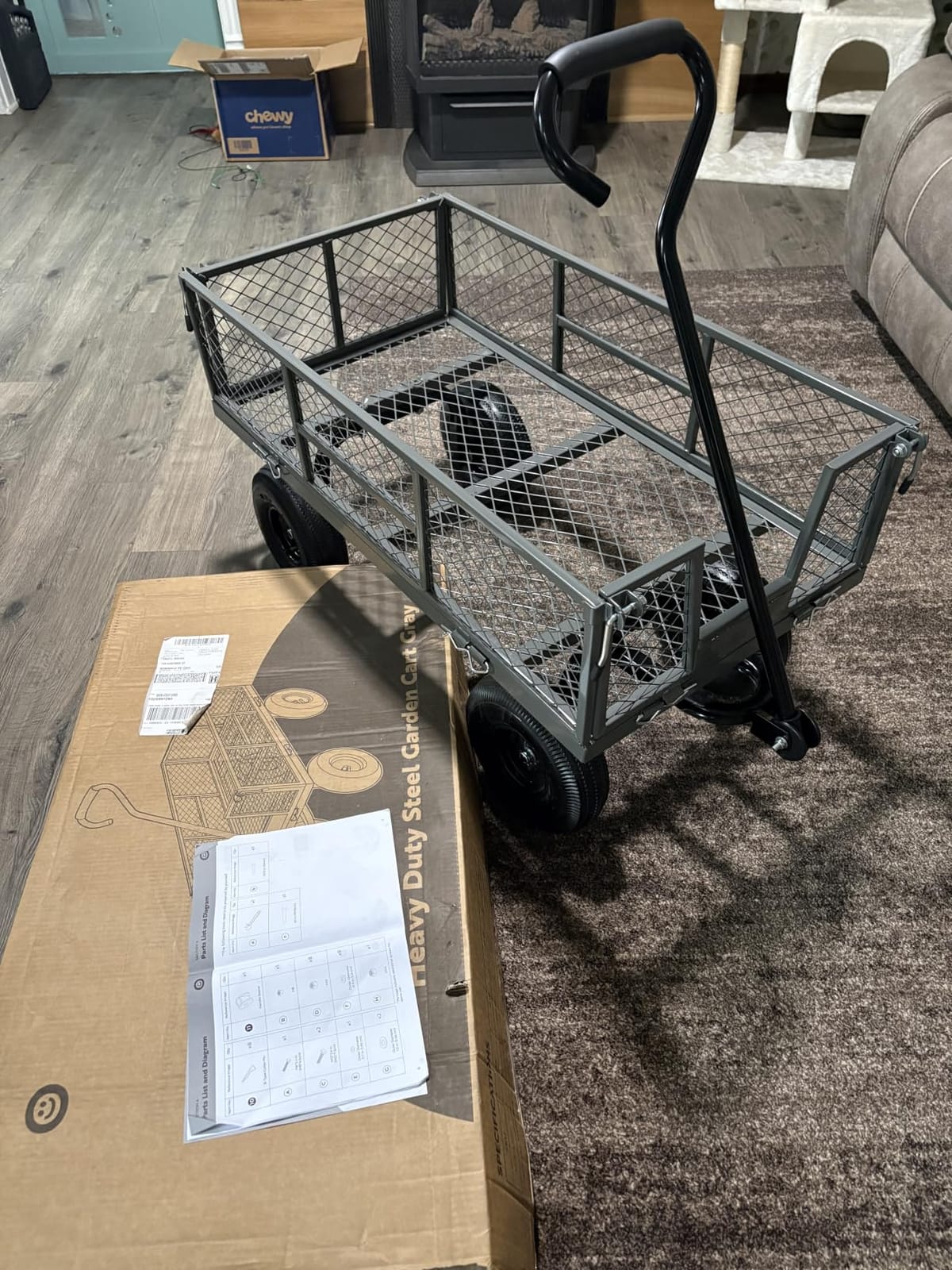
The mesh floor is the one genuine limitation. Soil, gravel fines, sand and anything smaller than a golf ball will find the gaps and end up on the ground, so this is not the cart for spreading a screed of sand or moving a bucket of concrete mix. Owners mention this directly, and it is a fair criticism.
Where it falls short
There is no published empty weight, which makes it hard to plan a two-person lift into a truck bed, and there is no stated warranty length in the product data. Owners note that the tires may not arrive fully inflated, which is a shipping precaution rather than a defect, but it means a pump and a few minutes before the first trip.
For landscaping volume work, the 4.5 cubic foot bed is modest. Professionals posting on lawnsite forums repeatedly describe 8 cubic foot poly models as their standard for mulch and soil, and none of the mesh carts here reach that volume. If you are moving bulk material by the cubic yard, this cart makes you take more trips.
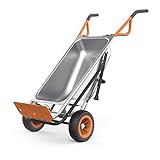
3. WORX WG050 8-in-1 Aerocart – Converts Into Eight Different Tools
WORX Wheelbarrow Heavy Duty Dolly, 8-in-1 Aerocart Garden Cart, WG050
300 lb capacity
Turbo Lift handle geometry
Flat-free tires
Two wheels, 40.8 lb empty
+ Pros
- Eight configurations from one frame
- Turbo Lift design cuts perceived lifting effort
- Flat-free tires mean zero maintenance
- All-metal corrosion-resistant structure
- 3-year warranty and it hangs on a wall
- Cons
- 300 lb rating is low for heavy material
- Hard flat-free tires do not absorb shock
- Wheels sink in soft mud
- Not built for construction loads
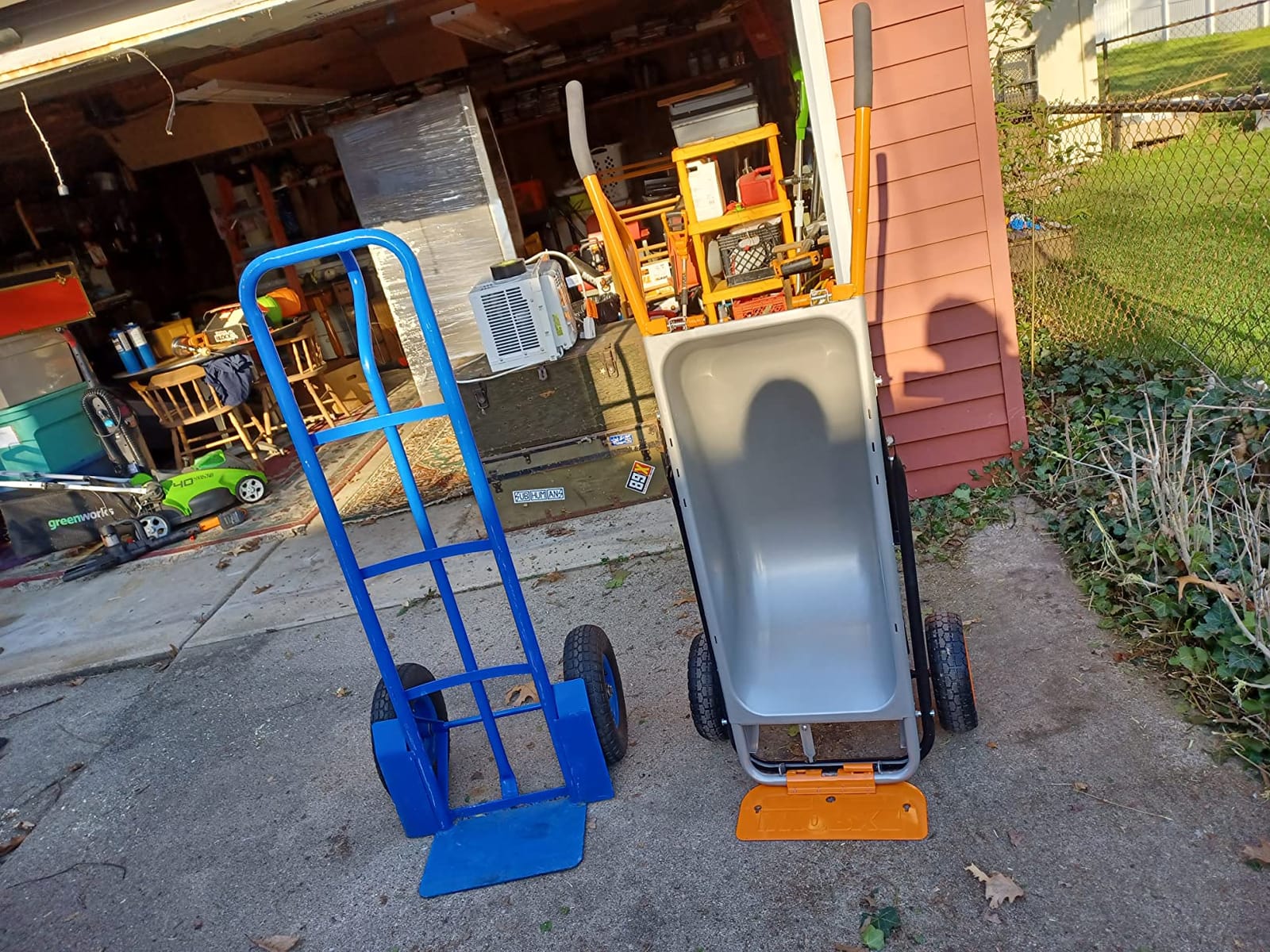
The other carts here are single-purpose haulers. The Aerocart reconfigures into a wheelbarrow, a hand cart, a dolly, a bag holder, a plant mover, a rock mover, a cylinder holder and a wagon kit, and the accessories are in the box. For a property owner who needs to move a propane tank one day and a bag of soil the next, that versatility is the argument.
The Turbo Lift geometry is the part I would call out. The design places the load closer to the axle, so a 200 pound lift is described by the manufacturer as feeling closer to 17 pounds. Whether or not you buy that number, the short wheelbase does make the Aerocart easier to balance than a full-length two-wheel barrow.
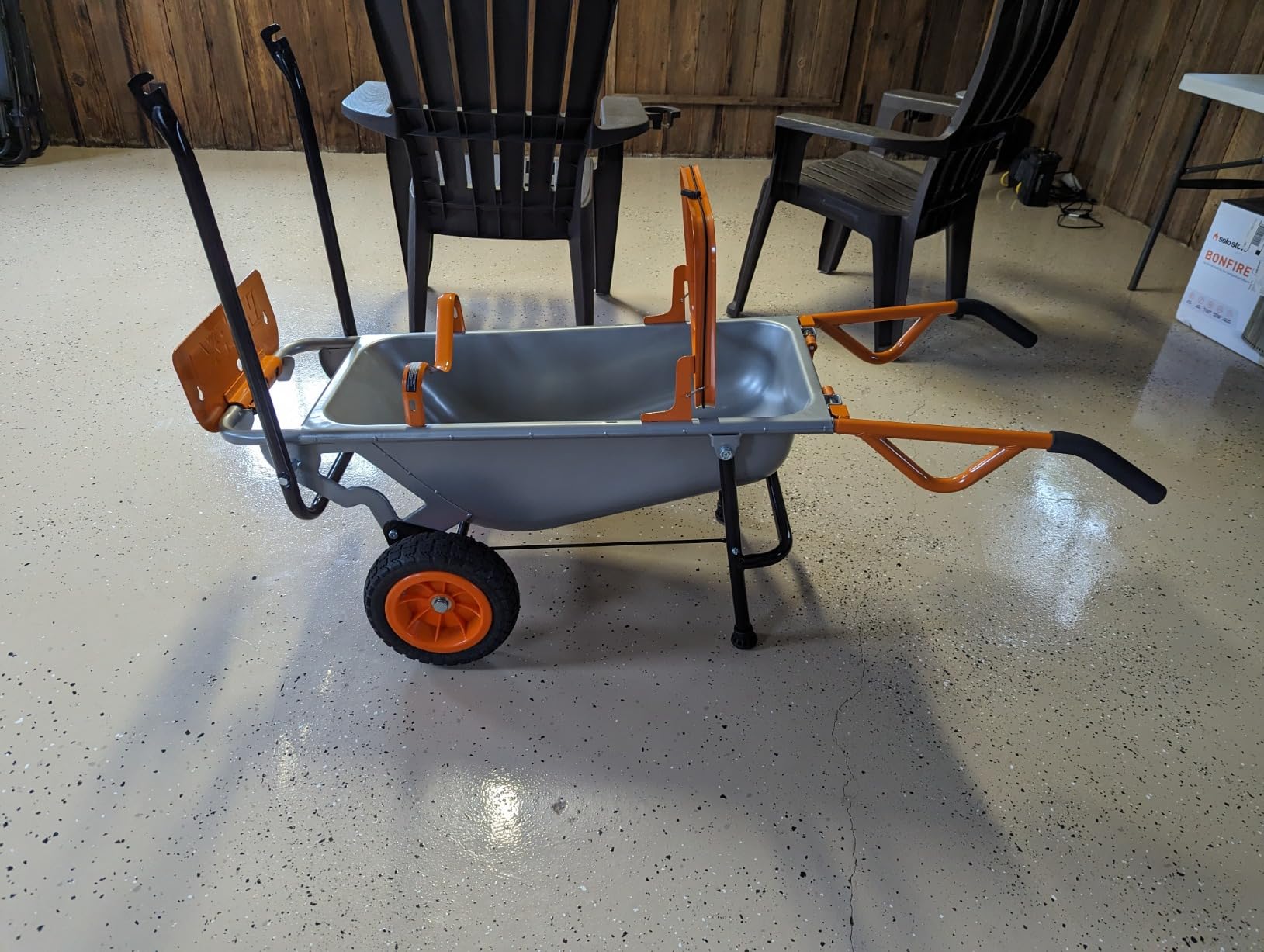
Two wheels with dual support legs means it stands on its own when parked, which matters more than it sounds when you are working alone. At 40.8 pounds empty it is one of the heavier two-wheel designs here, but the 3-year warranty is the longest in the roundup and the only one backed by a stated multi-year term.
When 300 pounds is plenty
A 5 to 6 cubic foot bag of mulch, a few potted plants, a bagged load of gravel, a stack of firewood, a cylinder of propane. Those are the jobs this cart does comfortably, and it does them in a side yard or over a lawn where a four-wheel cart would tear the turf.
What it will not do is move a cubic yard of anything. Once you are into wet clay, fieldstone or bags of concrete, 300 pounds means many trips and a wheel that sinks into soft ground. Owners are candid about this: the rating is a residential number, not a heavy-load number.
Where it falls short
The flat-free tires are the trade for zero maintenance. They roll forever and never need a pump, but they transmit every stone and rut straight into your arms, and a few owners report rust appearing on welds over time. It is a household and yard tool that happens to be very well built, not a jobsite tool.
At 40.8 pounds empty you are not lifting this one into a truck bed by yourself at the end of a long day, and it carries more frame weight per pound of rated capacity than the lighter two-wheel cart at the end of this list. If your real load is 300 pounds or less, none of that matters.
4. VEVOR 900 lb Steel Garden Wagon – Budget Pick for 900 Pounds
VEVOR Heavy Duty Steel Garden Cart 900 lbs Garden Wagon Cart on Wheels
900 lb capacity
3.45 cu ft steel bed
Q235 steel, 3 support beams
Four 10 in rubber tires
+ Pros
- 900 lb rating without stepping up to the 1200 lb class
- Q235 high-strength steel with three support beams resists frame racking
- Powder-coated finish resists corrosion
- 2-in-1 conversion from fenced cart to flatbed
- 180 degree adjustable T-handle with rubber grip
- Cons
- Assembly required
- Mesh sides will not hold very small material
- 72 in bed is hard to store in a small shed
When a buyer asks me where the value is in the heavy-load category, this is the cart I point at. A 900 pound rating on Q235 high-strength steel with three support beams is a genuinely strong frame, and three cross beams is the detail most budget carts leave out.
The 2-in-1 conversion is more useful than it sounds. Leave the mesh sides on and it contains mulch, soil and yard waste. Take them off and it becomes a flatbed for lumber, sheet goods and a load longer than the bed is wide.
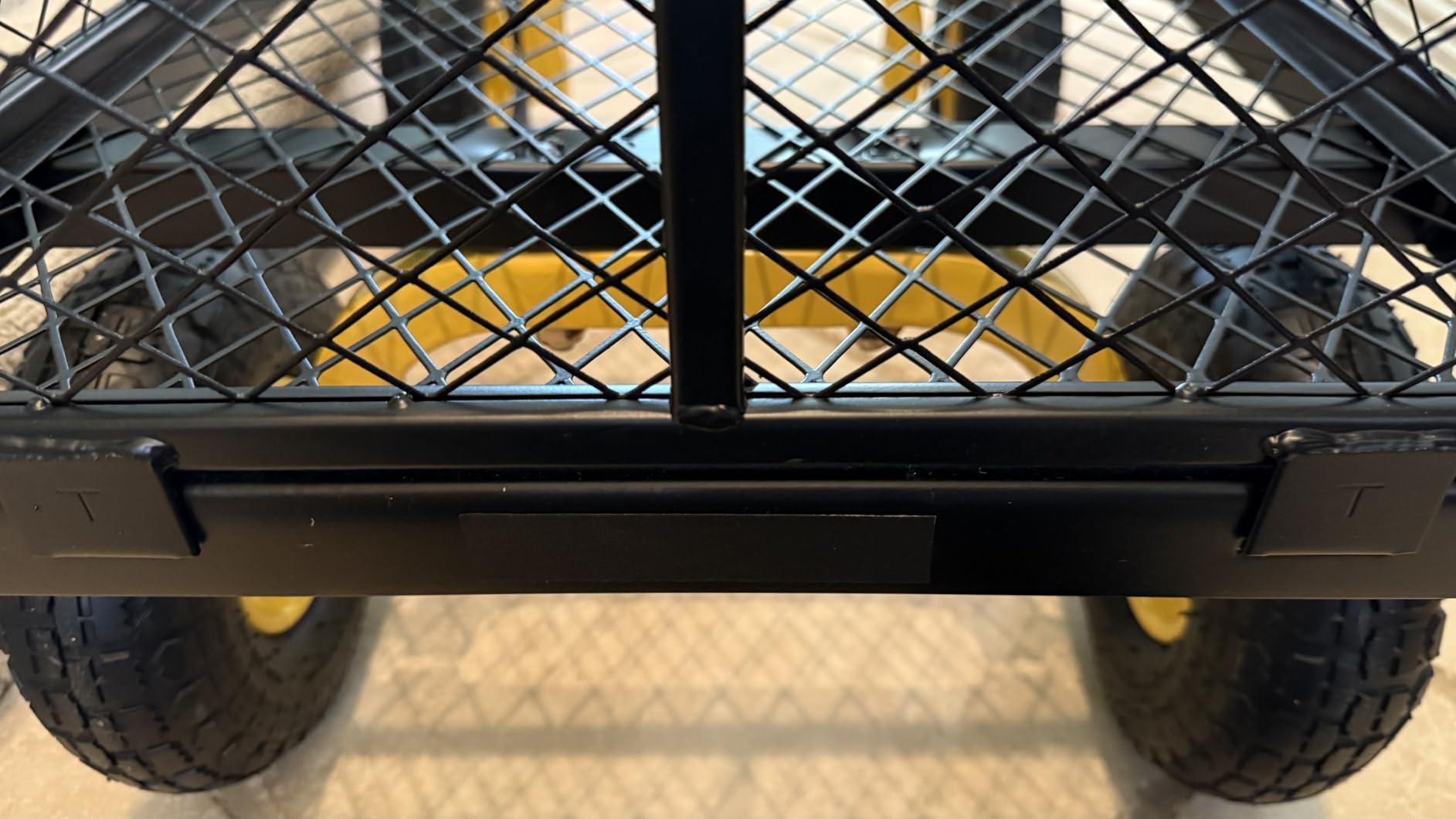
Ten-inch rubber tires with metal hubs and 360 degree rotating wheels keep it moving over gravel and packed dirt, and the T-shaped handle adjusts through 180 degrees with a rubber grip so you can pull it on either side of the load.
Frame stiffness is the real story
Racking is the failure mode owners describe on four-wheel carts, and it happens when a frame twists under a load that is not centered. Three support beams across a Q235 frame resist that twist far better than a single-beam budget frame, which is why this cart holds its shape with unevenly stacked material where lighter carts do not.
The powder-coated surface is what keeps bare steel from going orange in a wet climate. It is not a marine coating, but it is more protection than an unpainted frame, and it is one of the reasons the corrosion complaints on cheaper carts show up as rust streaks after a year or two outdoors.
Where it falls short
The 3.45 cubic foot bed is small for the 900 pound rating. That rating wants dense material, and dense material is heavy, so you will be making short loads rather than full ones. If you are moving mulch by the cubic yard, this is the wrong shape of cart.
Assembly is required, and the 72 inch bed length is a real storage problem in a standard shed. Measure your storage space before you commit, because this cart does not fold and the long bed is the dimension that will not fit through a narrow door.
5. Gorilla Carts 1200 lb Poly Dump Cart – Top Rated for Bulk Material
Gorilla Carts Dump Garden Cart, 7 Cu Ft,1200 lb Capacity, No-Flat Tires
1200 lb capacity
7 cu ft poly bed
13 in flat-free tires
Powder-coated steel frame
+ Pros
- Top owner rating among the carts listed
- 7 cubic foot bed cuts trips for bulk material
- 13 in flat-free tires never need inflation
- Patented quick-release dumping
- Tight-turning steering
- Rust-resistant poly tub on a powder-coated frame
- Cons
- Heavy at 54.3 lb empty
- Flat-free tires transmit more shock than pneumatic
- Priced well above the 600 and 900 lb carts here
- 1-year limited warranty
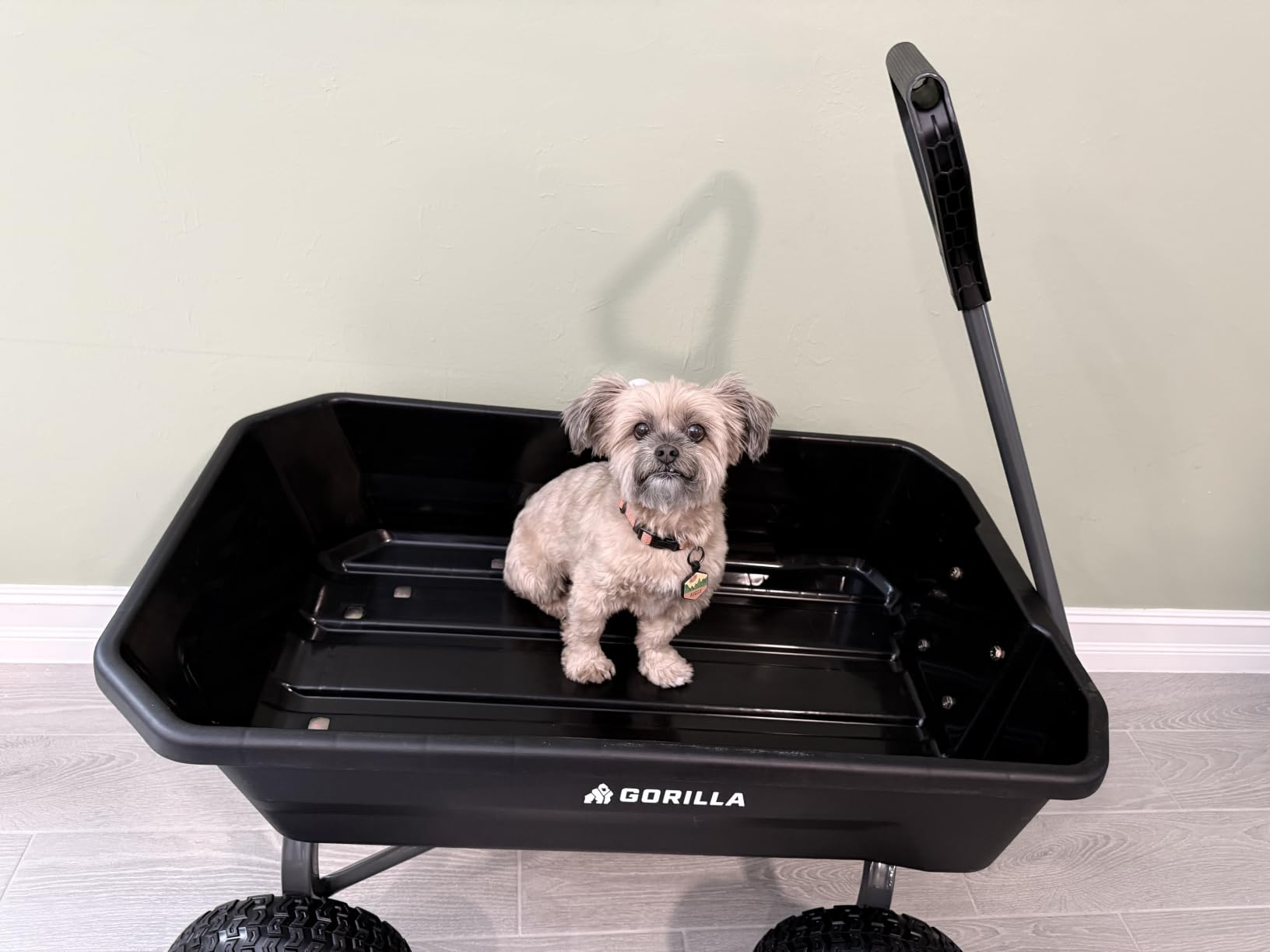
This is the cart that answered the most owner questions in the roundup, at 4.8 stars across more than 3,000 reviews. The headline is 1200 pounds, but the number that changes how you work is 7 cubic feet. That volume moves bulk material in fewer trips, and fewer trips is how you finish a mulch job before dark.
The bed measures 39.5 by 27 inches, which is wide enough to pile material rather than spread it thinly. The patented quick-release dump is the same mechanism as the smaller Gorilla, which means one hand and a lift of the handle dumps a full bed.
At 54.3 pounds empty it is a two-person lift into a truck bed, and that is worth knowing before you plan a project. Once it is on the ground it rolls on 13 inch flat-free tires that never need inflation, and the tight-turning steering is what lets you work it in a confined yard.
Flat-free tires on a 1200 pound cart
The 13 inch flat-free tires are the most deliberate part of this design. On a cart that heavy, a puncture is not an inconvenience, it is a tow, so eliminating air pressure removes a whole category of downtime. Owners consistently describe it as the reason they stopped worrying about the cart.
The cost is ride harshness. A solid or foam-filled tire does not absorb a pothole the way a pneumatic does, and on rough ground you feel more of it through the frame. For a yard that is mostly lawn and driveway, that is a good trade. For a site that is broken concrete and rebar ends, less so.
Where it falls short
It sits well above the 600 and 900 pound carts in cost, and the warranty is one year limited, which is shorter than the three years on the WORX Aerocart. At 1200 pounds with a poly tub, you are carrying the full rated load on a molded body, and owners do report flex in the bed at the very top of the range.
Flat-free tires also mean you cannot fine-tune pressure for the load. That matters on soft ground where a lower psi would float a pneumatic tire over the surface. On a lawn, use this one. On a rutted jobsite, a pneumatic 1200 pound cart holds more traction.
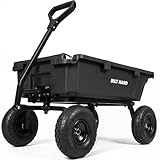
6. BILT HARD 900 lb Poly Dump Cart – All-Terrain Traction on Mud and Gravel
BILT HARD 900 lbs Poly Garden Dump Cart, 5 Cu.Ft Wheelbarrow Cart with 10″ All Terrain Wheels & Quick-Release System, Heavy Duty Utility Wagon for Yard, Farm & Garden
900 lb capacity
Over 5 cu ft expandable bed
10 in all-terrain pneumatic tires
Four wheels
+ Pros
- All-terrain 10 in pneumatic tires with deep tread for grip on mud and loose gravel
- Quick-release dumping
- 180 degree adjustable handle
- Side expansion slots let you widen the bed
- Rust-resistant materials that wash out easily
- Cons
- Poly bed flexes near the 900 lb ceiling
- Expansion panels are sold separately
- Empty weight not published
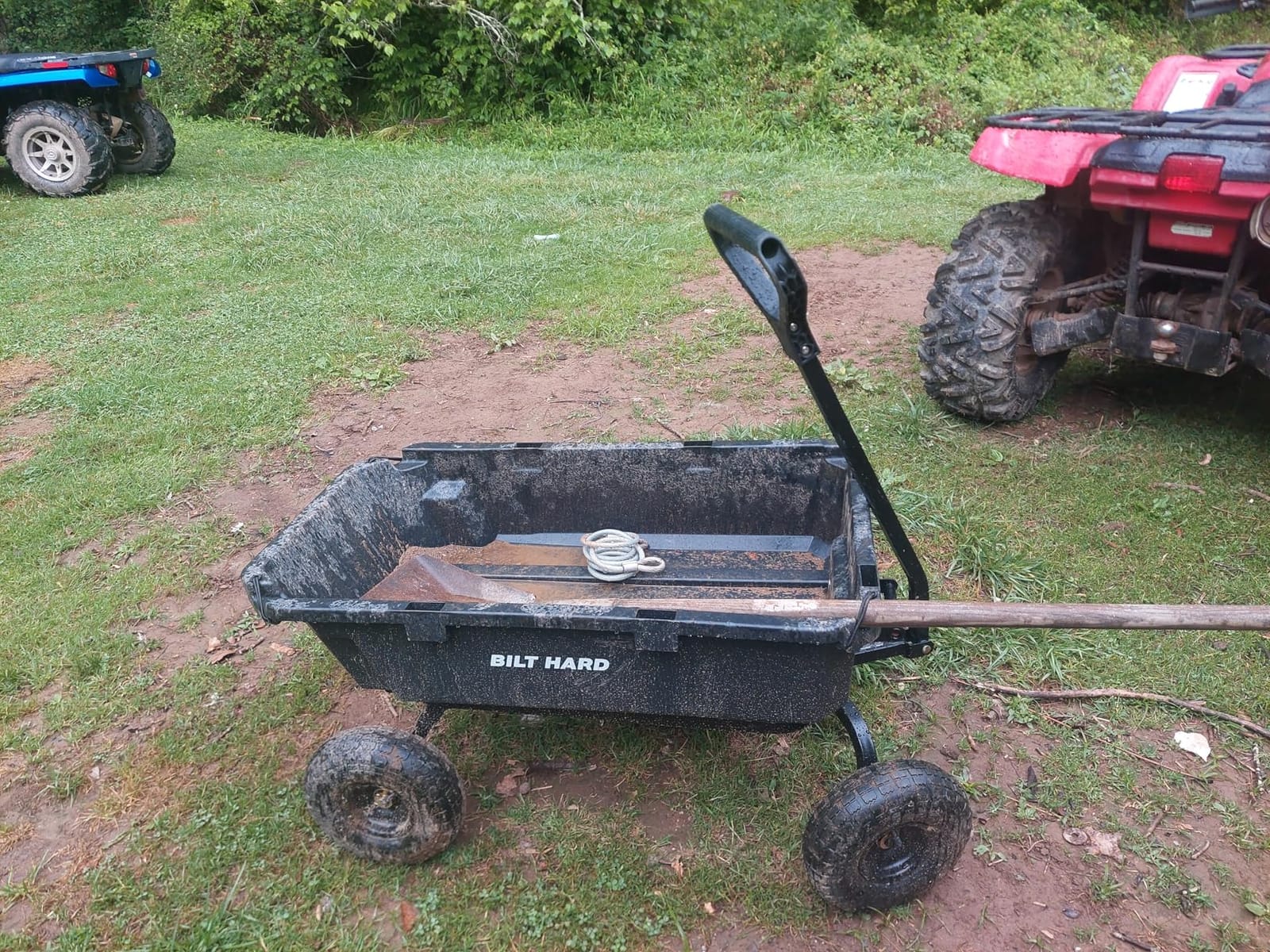
The distinguishing feature here is tire choice. All-terrain 10 inch pneumatic tires with deep tread are built for traction, and traction is what actually stops a loaded cart from sliding sideways on a slope. On wet clay and loose gravel they hold their line where a flat-free tire of the same diameter would skate.
The expansion slots are a clever second feature. The bed is over 5 cubic feet out of the box, and slots in the sides let you add boards to widen it when you are moving leaves or brush and need volume rather than density.
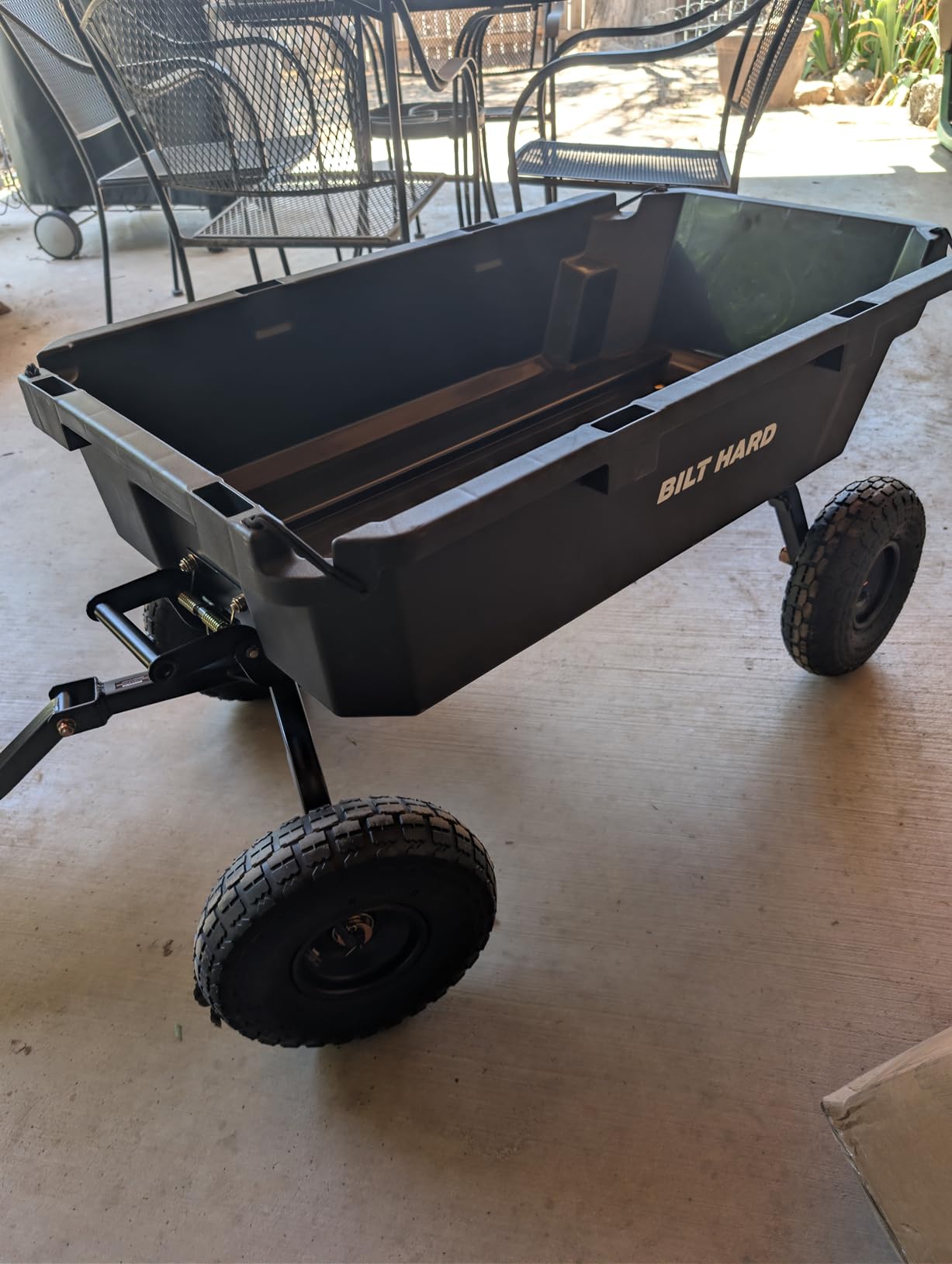
The four-wheel stance means you push rather than balance, which removes the single-wheel tipping problem that forum users complain about most on sloped driveways. The 180 degree adjustable handle lets you pull from either side when a wall or fence is in the way.
When traction beats convenience
Pneumatic tires at 10 inches give you a softer, wider contact patch than a flat-free tire of the same size. On a slope with wet clay, on a gravel drive, on a lawn that is soft after rain, that is the difference between pushing the load and chasing it.
The trade is maintenance. Pneumatic tires need pressure checks and they can take a puncture from a sharp rock or a piece of rebar, which is exactly the complaint that dominates owner reports across this category. If you are hauling on a surface with broken concrete in it, these are not the tires you want.
Where it falls short
At 900 pounds, the poly bed is carrying a lot of expectation, and owners note flex at the top of the range. The side expansion panels are an extra purchase, so the 5-plus cubic feet figure only holds if you buy them.
Empty weight is not published, which makes planning a two-person lift harder, and there is no stated warranty length in the product data. For a farm or a large property with rough ground, this is the traction answer. For a paved driveway, you are paying for grip you will not use.
7. VEVOR 1200 lb Poly Dump Cart – Pull It or Tow It Behind a Tractor
VEVOR Heavy Duty 1200lbs 7 Cu.Ft Wheelbarrow Garden Dump Cart Wagon
1200 lb capacity
6.48 cu ft poly bed
Convertible pull or tow handle
13 in pneumatic tires
+ Pros
- 2-in-1 convertible handle lets you pull it by hand or tow it behind an ATV
- 1200 lb rating with 13 in pneumatic tires for shock absorption
- Quick-release dumping from the front handle frame
- 180 degree adjustable handle
- Mesh cover and cushion included
- Cons
- 79.5 in length is long for storage
- Pneumatic tires need inflation maintenance
- Poly bed flexes under heavy loads
On a property with a tractor, an ATV or a UTV, the convertible handle is the feature that changes the economics. In pull mode you wheel it to the edge of the driveway, hook it up in tow mode, and move a full bed without a single trip up the lane.
This is the only pick here that pairs a 1200 pound rating with 13 inch pneumatic tires rather than flat-free ones. That combination is unusual at this capacity and it is the right call for rough ground.

The quick-release dump is operated from the front handle frame, which keeps the release lever under your hand while you are walking alongside a loaded cart. Included mesh cover and cushion protect loose items such as firewood, mulch bags or a stack of sod on uneven ground.
Towing changes what capacity means
When the cart is towed, the 1200 pound rating is no longer a lifting problem, it is a braking and rolling problem. The long wheelbase keeps it straight, and the 13 inch pneumatic tires roll over ruts that would bounce a rigid wheel. If you already own a tractor, pairing it with a 1200 pound cart moves more per trip than hauling the same load in a truck bed by hand.
Pulled by hand, the same 1200 pound rating is theoretical. Owners are candid that a fully loaded 7 cubic foot bed of wet soil is a two-person job, and realistic hand-pulled loads are well under the rating. Treat the number as a tow rating unless you are loading with a machine.
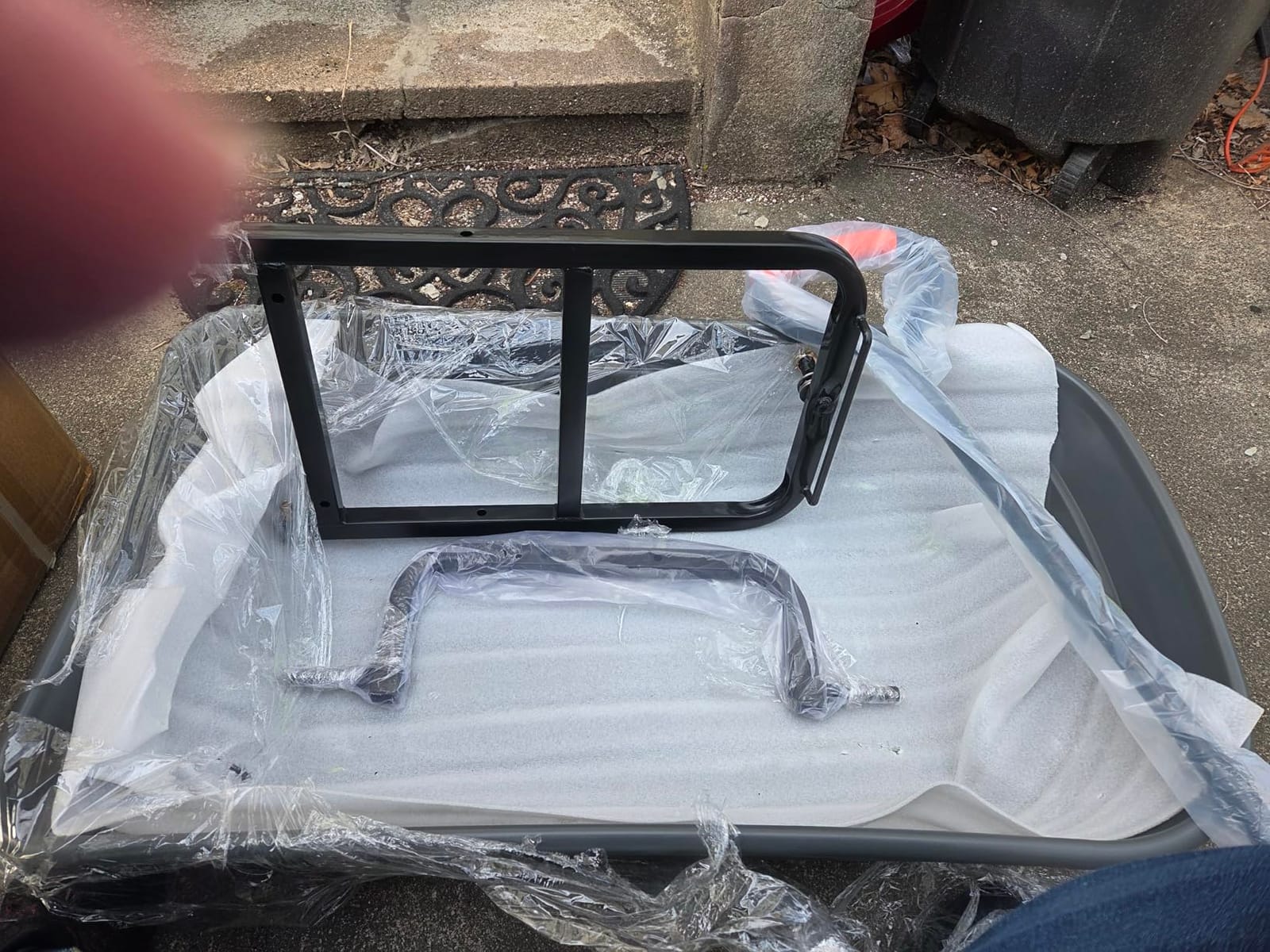
Where it falls short
At 79.5 inches long it is the longest cart here, and that dimension is a genuine problem. It will not turn in a side yard, it will not fit through a standard gate, and it needs real floor space in a garage.
Owners also report poly bed flex under heavy loads and note the tire upkeep that comes with a pneumatic design. The 4.4 rating reflects that balance, and it is the reason this cart sits behind the flat-free 1200 pound option for pure hand hauling.
8. Sekey 1600 lb Steel Garden Cart – Maximum Capacity for Farm and Ranch Work
Sekey 12 Cu Ft Steel Garden Cart, 1600 lb Capacity, Towable Handle
1600 lb capacity
12 cu ft carbon steel bed
Towable handle
13 in pneumatic tires
+ Pros
- Highest capacity and largest bed volume of the carts listed here
- 12 cu ft steel bed cuts trips dramatically
- Reinforced heavy-gauge frame with oversized axles
- Removable sides fold down to a flatbed platform
- Towable handle for ATV or lawn tractor
- Cons
- Newer model with 652 reviews
- Very large and needs serious storage space
- Steel bed is heavy to move by hand
- Pneumatic tires need maintenance
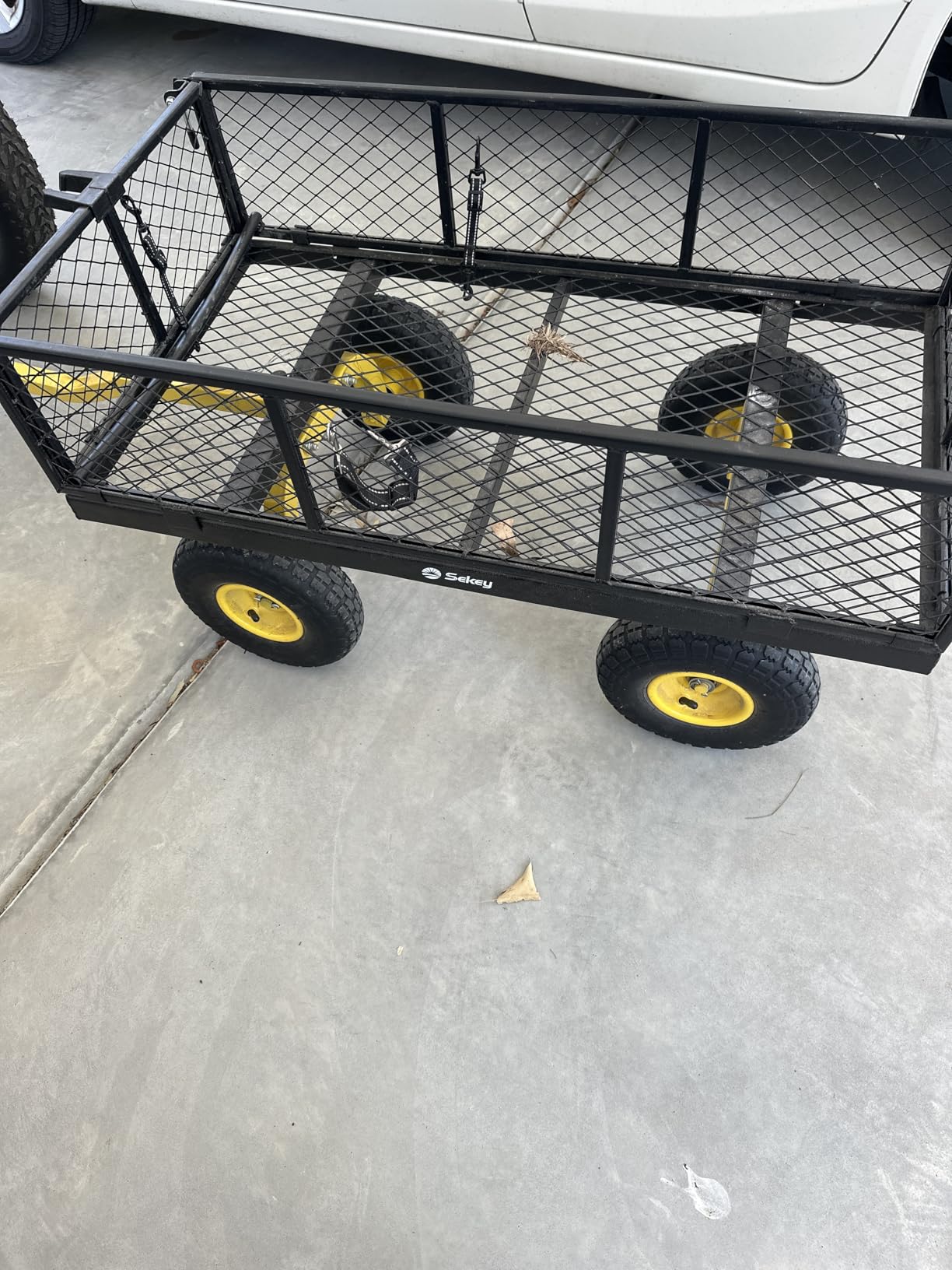
This is the only cart here rated at 1600 pounds with a 12 cubic foot steel bed, and the pairing matters. Twelve cubic feet is roughly double the bed volume of most picks on this list, which is the difference between three trips and six for a yard of mulch.
The carbon steel construction with oversized axles is aimed at farm, ranch and small construction work, where a lighter frame would be the weak link. Removable sides fold down to convert it to a flatbed platform for logs, fencing and long material.
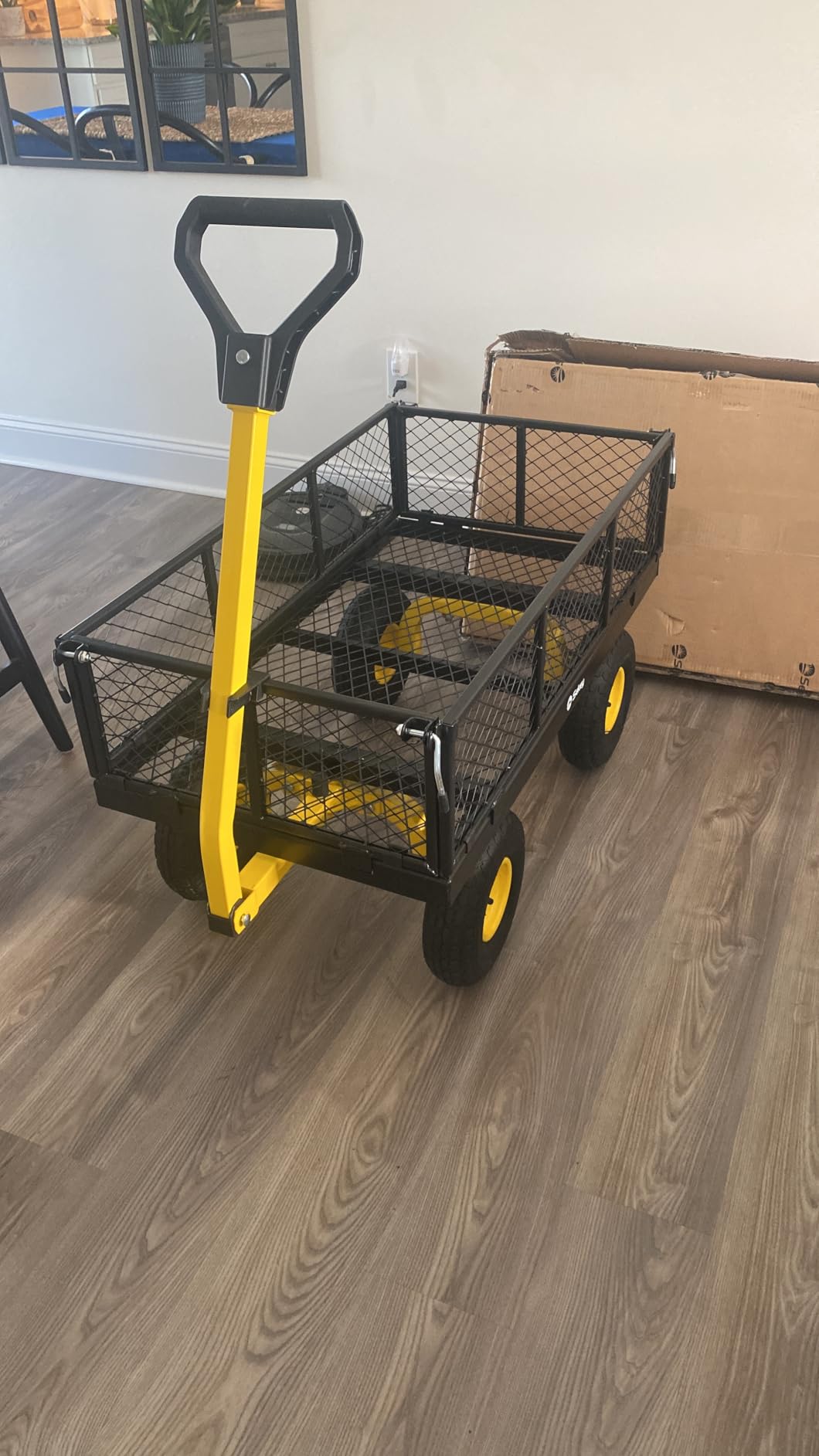
The professional two-in-one towing handle pulls by hand or hooks to an ATV or lawn tractor, and 13 inch oversized pneumatic tires give the traction to move that weight over soft ground. If you have towing capability, this is the only pick here where the full rating is realistically usable.
Volume is the real advantage
Almost every other cart in this roundup clusters between 3.45 and 7 cubic feet. At 12 cubic feet this one moves bulk material in a fraction of the trips, and trip count is the single biggest factor in how long a day takes. For a farm moving feed, firewood or manure, that is worth the size.
A steel bed also will not crack at a bolt point after a few seasons, which is the most common structural complaint in the category. If you are loading rocks, scrap metal or fencing, steel is simply the right material.
Where it falls short
It is large, and large carts do not fit through gates, down stairs or into small sheds. A steel bed on a frame this size is heavy, and the empty weight is not published, so plan on a two-person lift and a wide path to wherever it lives.
The 652 review count is on the low side for a cart this size, so there is less long-term history behind the design than behind the carts in this list with tens of thousands of reviews. Owners rate the build at 4.5 stars, and the complaints that do appear are about size and tire maintenance rather than failure.
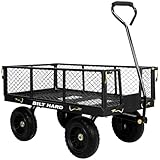
9. BILT HARD 880 lb Steel Garden Cart – Budget Cart with Flat-Free Tires
BILT HARD 880 lbs 10″ Tires Steel Garden Cart with 180° Rotating Handle and Removable Sides, Heavy Duty 4 Cu.Ft Capacity Utility Garden Carts and Wagons, Black
880 lb capacity
4 cu ft steel bed
10 in flat-free rubber tires
44 lb empty
+ Pros
- 880 lb rating paired with flat-free tires
- an unusual combination at this weight class
- Flat-free 10 in rubber tires need no inflation
- 180 degree rotating handle makes maneuvering predictable
- Removable sides
- Rust and corrosion resistant construction
- Easy assembly
- Cons
- A 4 cu ft bed is a small volume
- Can feel tippy on tight turns with heavy loads
- Reports of bent panels on arrival
- Paint durability questioned over time
Flat-free tires at a 880 pound rating is a combination that is normally expensive, and that is the reason this cart earns its place. No tubes, no pump, no pressure checks, and the rubber tire still gives you more give than a rigid solid wheel.
At 44 pounds empty it is heavy for a flat-free design, but the four-wheel footprint keeps it stable and the 180 degree rotating handle lets you walk beside the load rather than behind it.
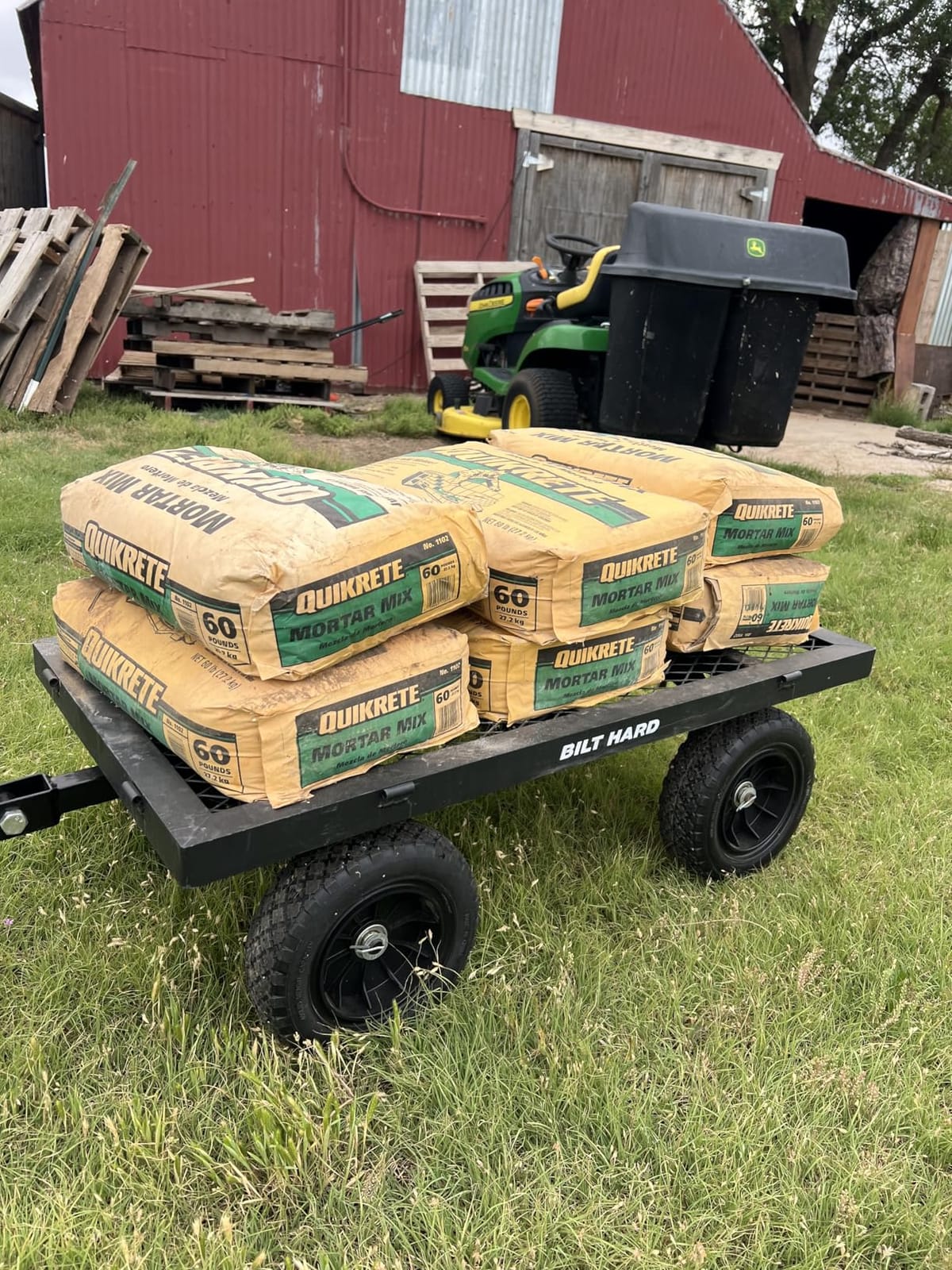
The removable sides let you switch between a contained bed for soil and an open bed for long material. Owners also cite straightforward assembly, which matters for a cart arriving flat-packed in a large box.
Flat-free tires on a yard cart
The case for flat-free tires is strongest on carts that live outside and get used intermittently. A pneumatic tire on a cart that sits for a month loses pressure, and every owner forum I read has the same story about finding a flat weeks later with no visible cause.
These tires are 10 inch solid rubber, so they still roll and steer normally, but they do not absorb a sharp impact the way a pneumatic does. Over a lawn or a paved drive that is invisible. Over broken concrete and gravel edges you will feel every edge in your arms.
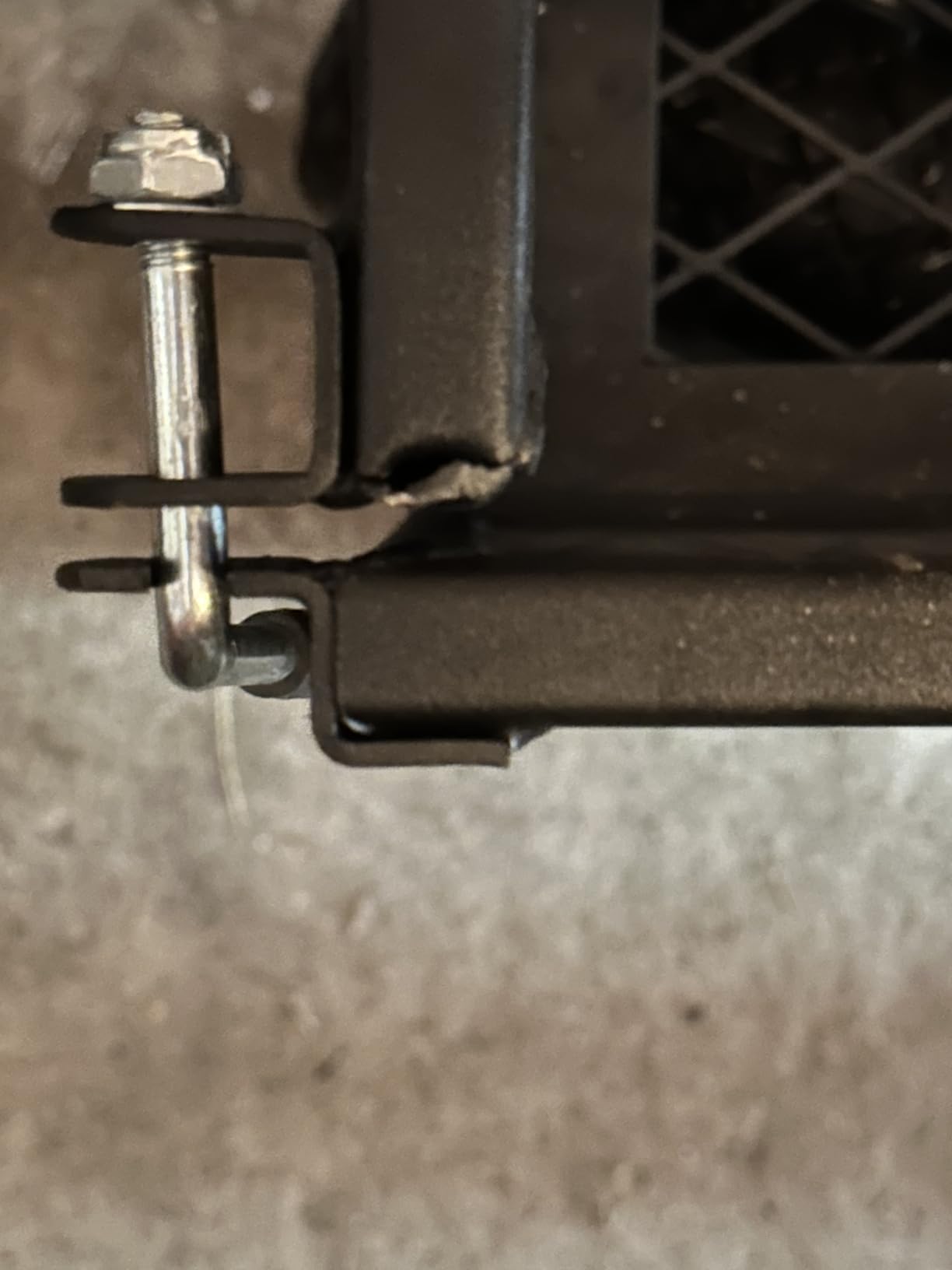
Where it falls short
The 4 cubic foot bed is one of the smaller volumes here, so a full bed of gravel is close to its rating and a full bed of mulch is far under it. Expect to make several trips for any yard of material.
Owners report bent panels on arrival and question how well the paint holds up over time, which is the classic complaint pattern for a low-cost steel cart in an outdoor setting. Add a 100 percent satisfaction guarantee to the list, but the structural ceiling is lower than the carts with three support beams.
10. BILT HARD 1200 lb Poly Dump Cart – Fits Through 30 Inch Garden Gates
BILT HARD Poly Garden Dump Cart 1200 lbs with No Flat Tires, Quick Release, 2-in-1 Convertible Handle, 7 Cu Ft Dump Wagon Heavy Duty for Yard, Outdoor
1200 lb capacity
7 cu ft poly bed
13 in no-flat tires
Convertible pull or tow handle
+ Pros
- 1200 lb rating in a 7 cu ft poly bed
- Fits through standard 30 in garden gates
- 13 in no-flat tires remove all maintenance
- 2-in-1 convertible handle for pulling or towing
- Quick-release dumping from the front handle frame
- Mesh cover and cushion included
- Cons
- Heavy at 76 lb empty
- Poly bed flexes and does not dump fully without tipping
- Loose wheel washers reported after assembly
- Younger design with a shorter review history
Gate clearance is the unglamorous reason to buy this cart, and it is the reason it works where a 79.5 inch towable cart cannot. At 30 inches wide it fits through a standard garden gate, which on a property with a fenced side yard is the difference between using a cart and walking mulch around the house.
It pairs that compact footprint with a 1200 pound rating and a 7 cubic foot poly bed, plus 13 inch no-flat tires and the same convertible pull-or-tow handle as the larger towable options.
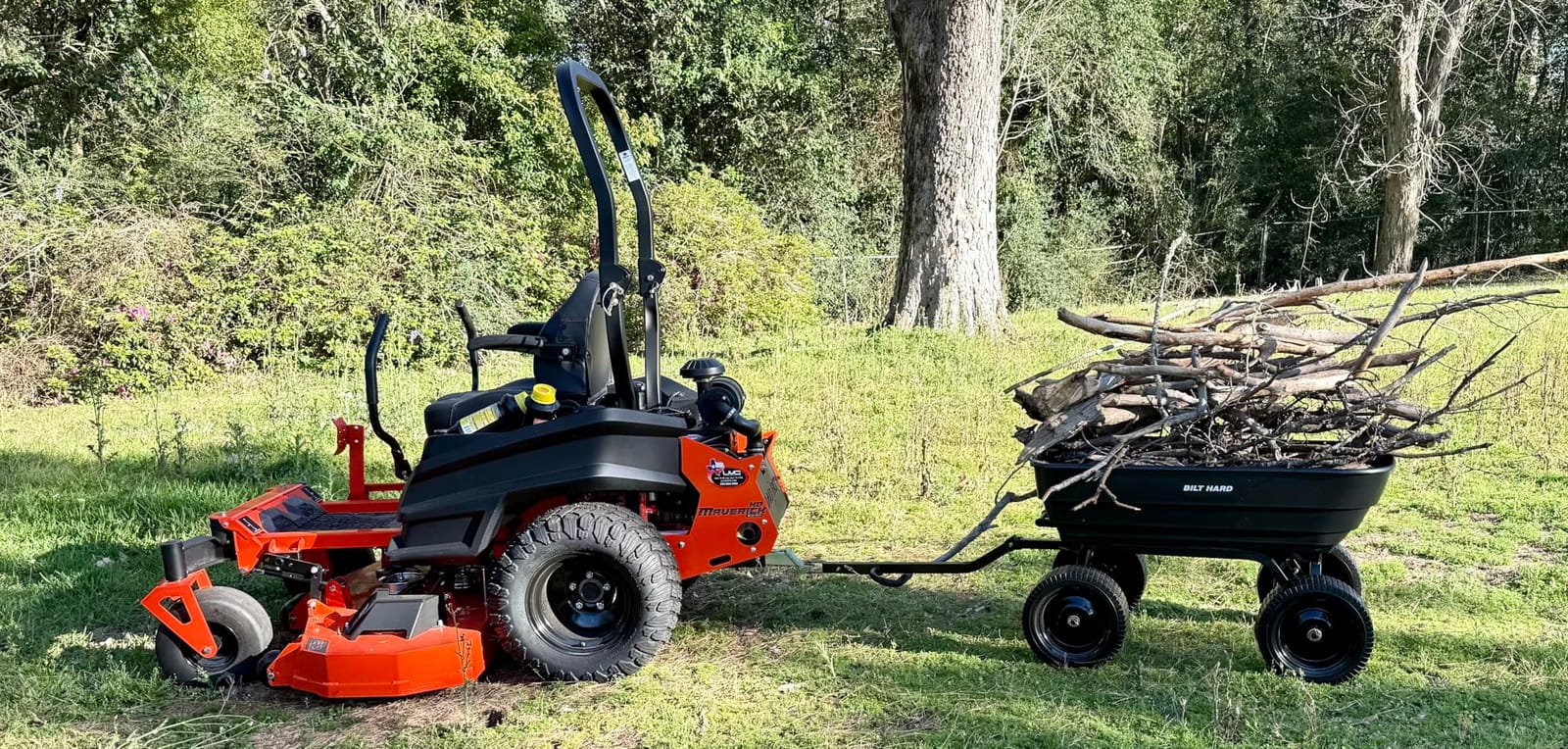
Owners single out the assembly as unusually well organized, with step-by-step hardware packaging, and the included mesh cover and cushion keep bagged material from sliding on uneven ground. The quick-release dump is operated from the front handle frame.
Heavy rating, small footprint
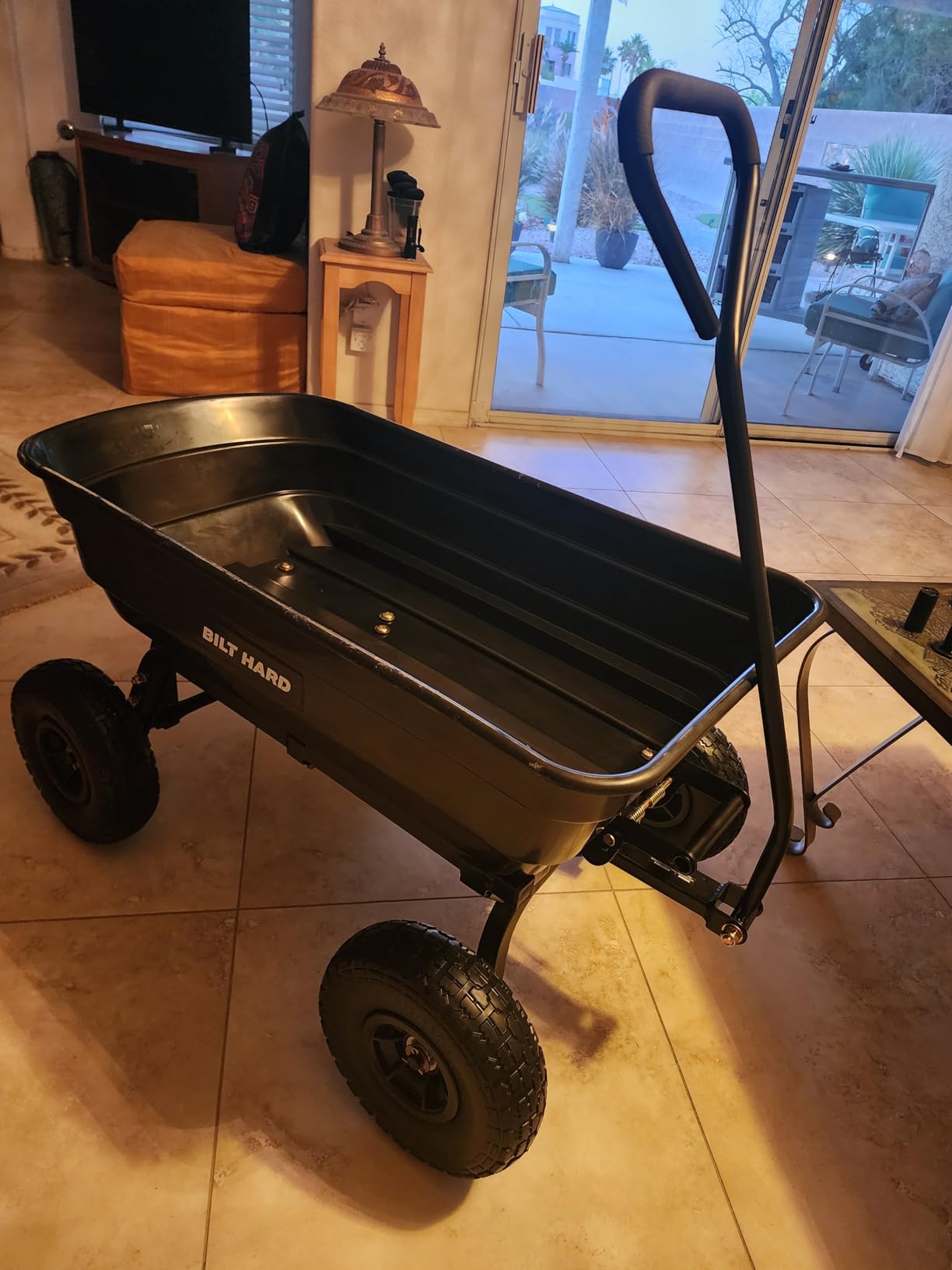
The engineering question with a 30 inch wide cart is stability under a high center of gravity. Four wheels spread across a narrower track than a full-length cart means more weight transfer when you turn, so owners report it wants a slower pace and a wider arc in tight spaces than the longer carts.
That is manageable if you slow down. What is not manageable is the 76 pound empty weight, the heaviest in this roundup. Getting it into a truck bed is a two-person job at minimum, and owners with small storage sheds report the same constraint here as with the larger carts.
Where it falls short
Owners note the poly bed flexes under heavy loads and that the dump does not empty completely without tipping the cart, which means a residue of wet material stays in the corners. That is a normal trade for poly, and it matters more with mortar or concrete mix than with mulch.
Loose wheel washers after assembly are a straightforward fix with a wrench and a five-minute job, but it is a known issue. At 687 reviews, the long-term record here is one of the thinner ones in the roundup, so treat it as a newer design rather than a proven one.
11. CAMMOO 900 lb No-Flat Dump Cart – Deep Tread and a 90 Degree Tilt Dump
CAMMOO 10-in NO-Flat Tires 900lb Garden Dump Cart Wheelbarrow Garden Wagon
900 lb capacity
10 in no-flat tires
90 degree tilt dump
43.2 lb empty weight
+ Pros
- Deep tread 10 in no-flat tires rated for grass
- gravel
- mud
- sand
- turf
- snow and cement
- Triangular rear bracing keeps the frame stable on uneven ground
- Front handle tilts the cart to 90 degrees for a full dump
- 100 percent virgin polypropylene body with reinforced interior ridges
- Dual steel bearings roll smoother and last longer
- Cons
- Ridged bed floor means flat items do not sit level
- 43.2 lb weight makes it heavier to shift by hand than a lighter cart
- No dump release while the cart is loaded
Most no-flat tires are shallow because a solid tire has to be molded. These are 10 inch with deep tread, and the manufacturer lists the surfaces they are intended for: grass, gravel, mud, sand, turf, snow and cement. That is a much more useful claim than the standard never-flat marketing line.
The 270 degree rotating handle and the triangular rear bracing on the thickened carbon steel frame are the two details that address the frame racking owners report on four-wheel carts carrying unevenly stacked loads.
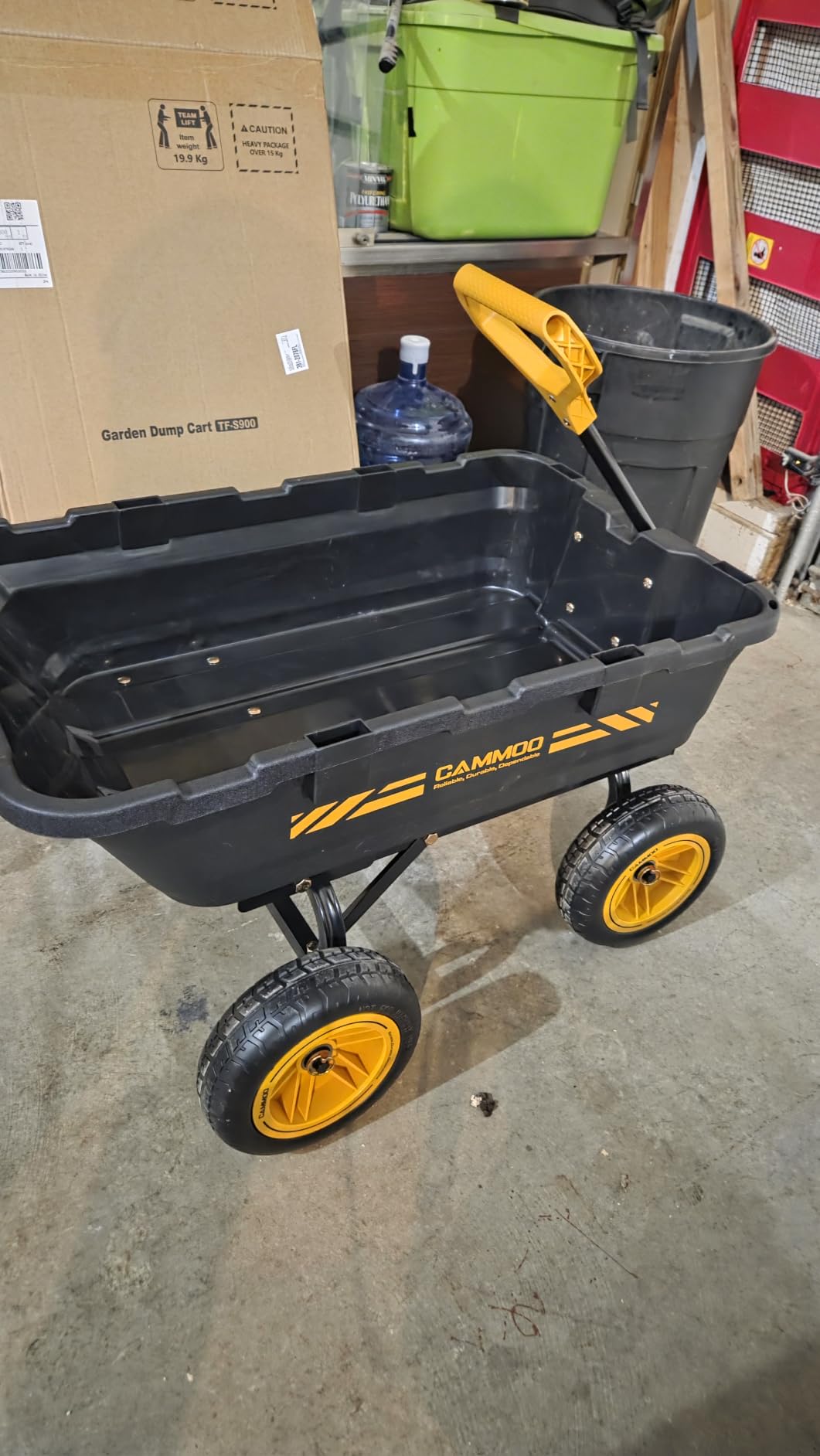
Bed dimensions are 27.95 by 17.32 by 8.27 inches, which holds over 4 cubic feet with structural interior ridges for strength. Side expansion slots let you add boards and widen the bed when you are moving leaves, branches or firewood rather than dense material.
The tilt dump and what it costs
Locking the front handle tilts the cart to 90 degrees and dumps the load without you wrestling a full tray over an edge. On a 900 pound cart that is a meaningful ergonomic gain, and it is the reason this cart keeps appearing on cleanup lists.
The catch is the sequence. There is no dump release while the cart is loaded, so the tilt is a deliberate two-step move rather than a one-handed lift like a quick-release lever. In exchange you get a dump that clears the bed almost completely, which matters for wet material that would otherwise stick to a flat poly floor.
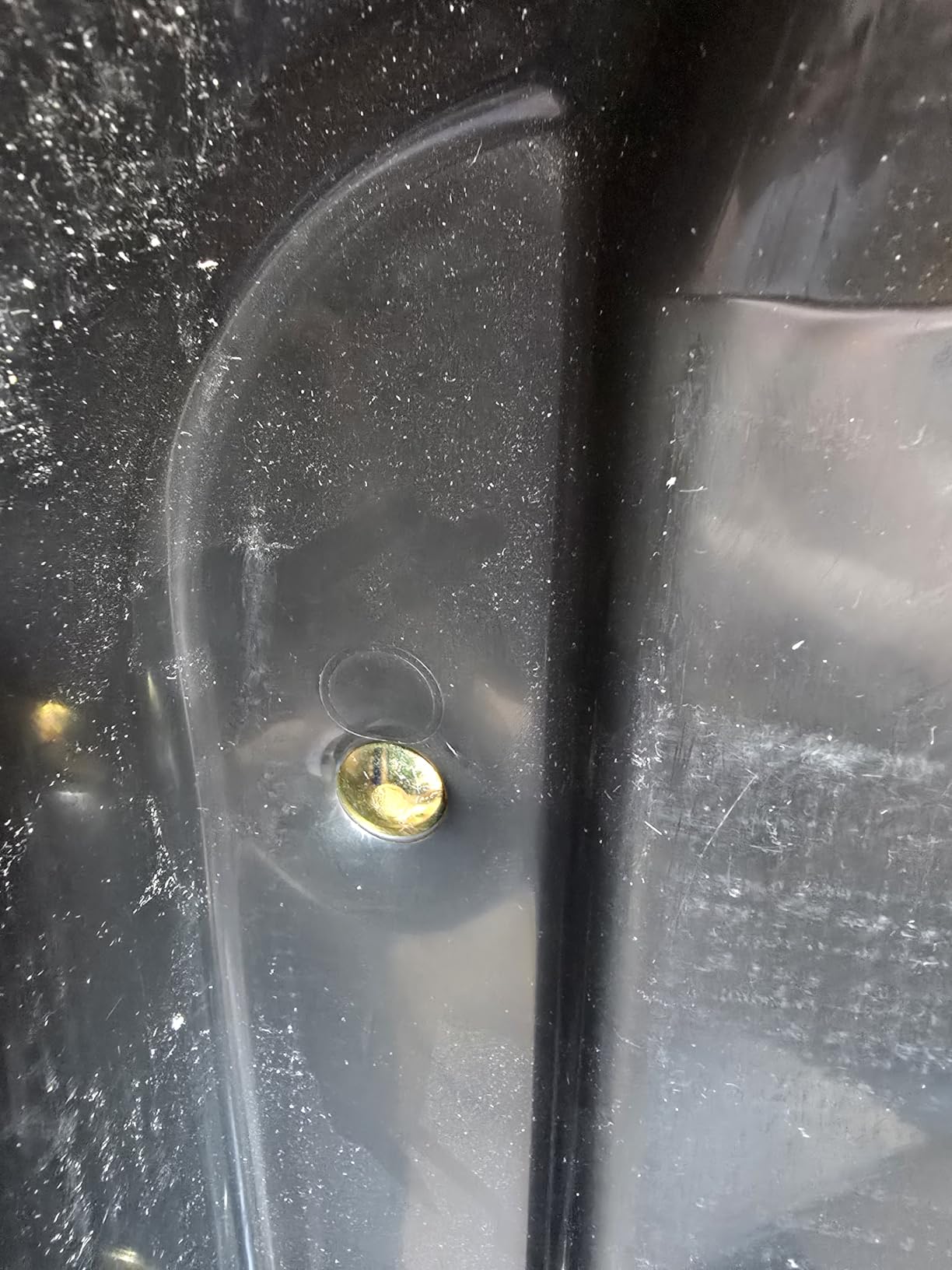
Where it falls short
The reinforced interior ridges are a strength feature and a usability compromise. Flat items such as plywood offcuts, stacked sod or a bucket do not sit perfectly level on the ridged floor, and that is the drawback owners raise most often.
The 584 review count is on the lighter side for a cart built this way. It is a strongly braced design, but the long-term durability record is younger than the carts with tens of thousands of reviews.
12. Best Choice Products Dual-Wheel Yard Cart – Lightest Two-Wheel Hauler
Best Choice Products Dual-Wheel Home Utility Yard Wheelbarrow Garden Cart w/Built-in Stand for Lawn, Gardening, Construction – Green
330 lb capacity
5 cu ft deep bin
14 in inflatable rubber wheels
21 lb empty
+ Pros
- Lightest listed empty weight at 21 lb so one person can lift and reposition it
- 5 cu ft deep bin holds soil
- bricks
- mulch and gravel
- Padded handlebar doubles as a built-in stand
- 14 in inflatable wheels roll over varied terrain
- Tipping design stores upright in a garage or shed
- Cons
- 330 lb rating is far below the heavy-duty carts
- Two wheels mean you balance the entire load
- Pneumatic wheels lose pressure and need upkeep
- Padded handle is the only built-in support
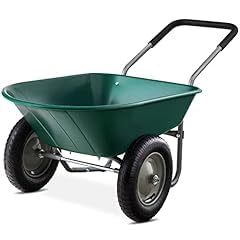
This is the only traditional barrow-style cart in the roundup, and it is here as a boundary marker rather than a heavy-load recommendation. At 21 pounds empty and 330 pounds rated, it is half the payload of the four-wheel carts and it requires you to balance every pound of it.
What it does well is storage and lightness. The thick padded handlebar doubles as a built-in stand when the cart is parked, and the tipping design lets it stand upright against a wall in a garage or shed, which none of the four-wheel carts here can do.
The deep bin holds 5 cubic feet of soil, bricks, mulch and gravel, and the 14 inch inflatable rubber wheels roll over varied ground well for a barrow of this size.
When a wheelbarrow beats a cart
A wheelbarrow is more efficient in a raised bed, a side yard or a mulched path where a four-wheel cart cannot follow. Two wheels and a thin footprint let you get close to a bed edge and tip material exactly where you want it, and the 21 pound weight means one person can move it between jobs.
It is also the right tool for leaf collection, because leaves are light and bulky, which is the opposite profile from gravel. The failure mode is not structural, it is ergonomic: owners regularly describe wrist and back strain from fighting a full 330 pound barrow over gravel or soft turf.
Where it falls short
It is not a heavy-load tool, and no amount of careful loading changes that. Bricks and full bags of concrete are not realistic here, and the shallow two-wheel stance tips sideways on a sloped driveway, which is the most common complaint on owner forums about this style of cart.
The warranty is 60 days with return shipping at the buyer’s expense, the shortest in the roundup by a wide margin. For a lightweight yard tool that is defensible. For anything you intend to load with stone, it is the wrong purchase.
How I Picked These Heavy-Load Carts
I evaluated all 12 carts in this roundup against seven criteria, in this order of weight. Capacity came first because it is the only number that eliminates a candidate outright, and everything else broke ties between carts that survived the capacity filter.
- Realistic load, not the printed rating. I converted each cart’s bed volume into pounds for dry mulch, wet soil and gravel, then asked whether the printed rating matched a realistic full load.
- Bed volume in cubic feet. Trip count is driven by volume, not by the pound rating, and most buyers in owner forums make their decision on trips.
- Tub material. Steel, molded poly and virgin polypropylene each fail differently, so I noted which failure mode applies to the material you actually plan to move.
- Wheel count and track width. Two wheels for a lightweight load and a narrow path, four wheels for anything dense, because tipping is the complaint that shows up most often on sloped ground.
- Tire type. Pneumatic, flat-free or solid rubber, judged on the surface you will be on rather than on the tire label.
- Dump mechanism and steering. A dump that empties completely and a handle that rotates save more time than a small capacity increase.
- Review volume and reported failure modes. I read the complaints, not the five-star summaries, and weighted the carts whose failures stayed cosmetic above the ones with structural reports.
One result surprised me. The carts with the highest ratings and the most reviews are not the ones with the highest capacity numbers. The 600 pound four-wheel cart leads this roundup, and the 1600 pound steel cart sits at the other end with one of the thinner review histories behind it.
Buying Guide: Capacity, Material, Wheels and Tires
Capacity rating versus usable capacity
A printed rating is a limit, not a promise, and a shallow tray rated at 400 pounds can move less material than a deep tray rated at 300. What matters is pounds per trip at your material’s density, and the honest way to compare two carts is to multiply bed volume by the weight per cubic foot of whatever you are moving.
For heavy-load work, set your target at 60 to 70 percent of the printed rating for hand-pulled carts and at the full rating if you are towing. Overloading is what bends axles, racks frames and cracks poly tubs at the bolt points, which is exactly the pattern owners report.
Steel, poly or polypropylene: which tub survives your load
Steel is heavier and will rust if the finish fails, but it does not crack at a bolt point after three seasons and it takes impact from rocks and scrap without complaint. Choose it for stone, lumber, metal and fencing.
Polyethylene is lighter, will not rust and wipes clean after a mortar spill, but it flexes near its rating and becomes brittle after years of ultraviolet exposure, particularly if it is stored outside through a winter. Virgin polypropylene with reinforced interior ridges, as on the CAMMOO, is a step up from recycled blends.
None of the carts in this roundup is a seamless steel tray wheelbarrow, and that is worth stating plainly. Steel tray barrows remain the choice for wet concrete and mortar work because nothing sticks to a bare steel tray, and a poly tub will hold a residue in its corners.
One wheel, two wheels or four
Single-wheel barrows pivot and turn in places nothing else can, but they tip sideways when the load is not centered, which is the most repeated complaint in owner discussions about sloped driveways and rutted ground. Two wheels with support legs, as on the Aerocart and the Best Choice cart, are more stable and still fit down a side path.
Four wheels is the answer for dense material. The width spreads the load, so a full bed of gravel does not put all its weight on one narrow line of contact, and nothing here needs you to hold a heavy load balanced while walking.
Pneumatic, flat-free or solid tires
Pneumatic tires give the best ride and the best traction on soft or uneven ground, and they are the only option that lets you lower pressure to float over mud. They also need air, they lose it while sitting, and puncturing one on a 1200 pound cart means a real recovery job.
Flat-free and solid rubber tires remove that entire failure category, which is why several of the highest-rated carts in this roundup use them. The trade is a harsher ride over sharp edges and no ability to tune pressure. On a lawn or a paved drive, that is the right trade. On broken concrete, it is not.
Loading to the rated maximum without tipping
Load the axle first, from the back and the bottom, then build the pile forward. A cart loaded from the front is heavy over the wheel and light behind it, which is exactly the condition that lifts a single-wheel barrow’s handles or tips a four-wheel cart on a slope.
Center the mass over the axle rather than distributing it evenly, and stop before the load reaches the top of the bed sides. A heaped bed has a higher center of gravity, and the extra material above the rim adds weight without adding much usable volume. For a two-wheel cart, keep the load below the handle line and lift with your legs.
Warranty, review volume and parts
A warranty length is the clearest signal of manufacturer confidence in this category. The Aerocart’s three years is the strongest statement here; most of the four-wheel carts carry one-year terms and one carries 60 days, with return shipping at the buyer’s expense.
Parts matter as much as the warranty, and it is worth confirming before you buy that a replacement wheel, tire, handle or dump latch is sold separately for your model. A cart that can be repaired keeps working for a decade, which is the benchmark owners on landscaping forums talk about when they describe a barrow they have replaced with the same brand rather than switching.
Wheelbarrow Load Math: What Your Load Really Weighs
Here is the conversion that turns a trip count into a number you can shop with. Take the bed volume of the cart, then multiply by the density of your material.
- Dry mulch: about 35 to 40 pounds per cubic foot. A 7 cu ft bed holds roughly 250 to 280 pounds, so a cubic yard of mulch takes about 4 trips in a 7 cu ft bed and about 7 in a 4 cu ft bed.
- Compost and dry topsoil: about 60 to 80 pounds per cubic foot. A 7 cu ft bed comes to roughly 420 to 560 pounds, so a cubic yard takes three to five trips in the larger bed.
- Wet soil and clay: about 80 to 100 pounds per cubic foot. A 7 cu ft bed is 560 to 700 pounds, which is at or past the rating of a 600 pound cart and comfortably inside a 1200 pound one.
- Crushed gravel and road base: around 100 pounds per cubic foot. A 7 cu ft bed is about 700 pounds and a 12 cu ft bed is about 1200 pounds, so gravel is the material that makes big carts worth their size.
- River rock and fieldstone: roughly 90 to 110 pounds per cubic foot depending on size, and because stone does not compact the way soil does, weight is the limiting factor rather than volume.
- Concrete mix and mortar: about 140 pounds per cubic foot. A 7 cu ft bed is nearly 1000 pounds, so wet concrete is the load that most often pushes a residential cart past its rating in a single trip.
- Bagged material: a 2 cubic foot bag weighs roughly 40 to 50 pounds, so 50 bags is about 2000 to 2500 pounds. That is four to five full trips on a 1200 pound cart and is the number that ends most “one trip” claims.
Read the list twice for the two materials people argue about. Mulch is light and bulky, so volume is your limit and a big bed pays off. Concrete is heavy for its volume, so weight is your limit and a smaller bed with a high rating is the safer tool.
Frequently Asked Questions
What size wheelbarrow do I need for heavy loads?
For dense material such as gravel, wet soil or concrete mix, look for a cart rated at 600 pounds or higher with a bed of at least 5 cubic feet. Below 300 pounds you are in wheelbarrow territory, and you will balance the whole load on two wheels. Between 600 and 1200 pounds, choose four wheels, a dump mechanism and a tire type matched to your surface.
Is steel or poly better for heavy loads?
Steel wins on impact and lifespan, and it will not crack at a bolt point after a few seasons, which is the most common structural complaint about poly. Polyethylene wins on weight, rust resistance and clean-up after mortar or concrete, but it flexes near its rating and becomes brittle with ultraviolet exposure. Choose steel for rock and lumber, poly for soil and wet material.
How much gravel fits in one wheelbarrow load?
Crushed gravel runs about 100 pounds per cubic foot, so a 5 cubic foot bed holds roughly 500 pounds and a 7 cubic foot bed roughly 700 pounds. Because gravel does not compact, weight is the limit rather than volume. That means a 7 cubic foot bed of gravel fills a 600 pound cart to its limit and fits comfortably in a 1200 pound cart.
How many loads does it take to move two cubic yards of mulch?
Two cubic yards is 54 cubic feet. At about 5 cubic feet per load that is 11 trips, at 7 cubic feet per load about 8 trips, and at 12 cubic feet per load only 5 trips. Dry mulch weighs roughly 35 to 40 pounds per cubic foot, so 54 cubic feet is between 1900 and 2160 pounds, which is well within a single 1200 pound cart over two or three fills.
Are flat-free tires worth it for heavy loads?
Flat-free tires remove the single most repeated complaint in this category, which is punctures and lost pressure on carts that sit between uses. They need no pump and no tubes, and they keep working on a heavy load where a puncture would be a recovery job. The trade is a harsher ride over sharp edges and no ability to lower pressure for soft ground, so pneumatic tires still suit rough and muddy sites.
Best Wheelbarrows for Heavy Loads: The Verdict by Job Type
If you want one cart for general heavy work around a yard, the Gorilla 600 pound four-wheel poly cart is the pick. It carries the largest number of owner reviews of anything in this roundup, a 36 by 20 inch bed that will not tip when you hit a slope, and a quick-release dump that empties in one motion. It is the default answer to the best wheelbarrows for heavy loads question because it is the one most owners come back to after a few seasons.
If your load is genuinely dense, step up. The 1200 pound Gorilla with 7 cubic feet and 13 inch flat-free tires is the volume and maintenance answer for mulch, soil and cleanup work. The VEVOR 900 pound steel wagon is the value pick when you want steel stiffness and a fenced-or-flatbed bed without moving up a tier. The Sekey 1600 pound 12 cubic foot steel cart is the farm and ranch answer, and it only makes sense if you can tow it.
Pick your tire to match your ground, not your budget. Pneumatic tires on soft or broken ground, flat-free tires on lawn and pavement. And if you are moving concrete or mortar, buy the dedicated tray rather than a poly tub, because wet material sticks and the residue is what cracks at the bolt points.
Work out your real load in pounds before you buy, using the reference above, then match the bed volume to your trip count. That one calculation will save you more trips than any feature on the spec sheet.