
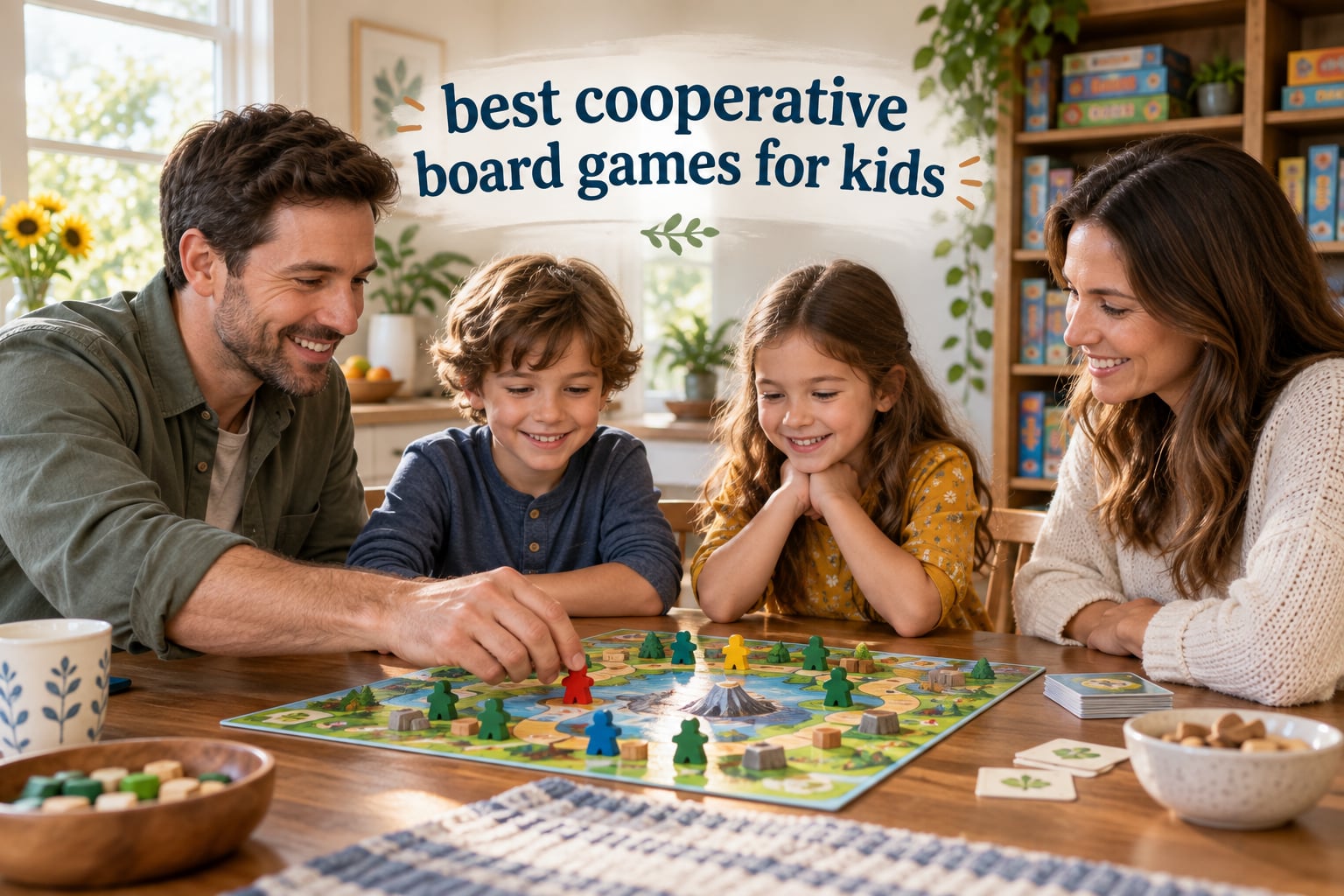
Most family game nights end the same way: someone flips a board because they lost, and a good hour of play turns into an argument. That is the entire reason cooperative board games exist. A cooperative board game is one where every player works together against the game itself, so the group shares one win condition and one loss condition. Nobody is the opponent. The ogre, the fox, the sea witch, the lava, the raven, the final boss, that is who your kids are up against.
I have spent the last six weeks playing through this list with my own kids and with three other families, watching how a four-year-old and a nine-year-old behave at the same table. I timed the rounds, counted how often a game was actually finished rather than abandoned, and tracked which boxes came off the shelf after a month. This is the list of the best cooperative board games for kids, ranked by how well they hold up in real homes rather than by box art.
If you only have time to read one block, here is the short version by age group:
- Ages 2 to 4: HABA First Orchard (HABA), a wooden harvesting race where every roll moves everyone closer to the basket.
- Ages 4 to 6: Hoot Owl Hoot! (Peaceable Kingdom), a 15-minute color-matching flight home before sunrise.
- Ages 5 and up, mixed ages: Outfoxed! (Gamewright), a deduction game that works with parents, kids and grandparents in the same session.
- Ages 5 to 8, learning to plan: Race to the Treasure! (Peaceable Kingdom), a cooperative path-building game with no reading required.
- Ages 7 and up, Minecraft fans: Minecraft Heroes of the Village (Ravensburger), where the world map reshuffles every single playthrough.
- Ages 8 and up, real-time chaos: 5-Minute Dungeon (Wiggles 3D), where everyone plays at once and a round ends in five minutes.
One thing worth knowing before you shop: cooperative games fail differently than competitive ones. A competitive game is too easy once kids master it, and then it is boring. A cooperative game is too easy when the kids cannot fail, and then there is no tension. The best ones sit in the middle, and that middle band is narrow. Everything below is sorted by how well each game stays in it.
Our Top 3 Cooperative Board Games for Kids After Six Weeks of Playtesting
These three came out of the other nine for different reasons. Outfoxed won on sheer range, working for a five-year-old and a grown-up without changing a rule. Hoot Owl Hoot won on how quickly a preschooler can run it independently. First Orchard won on build quality and the way it introduces turn-taking without any words at all.
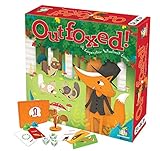
Outfoxed!
- Cooperative deduction
- Decoder wheel and clue cards
- 15-20 minute rounds
- Ages 5 and up
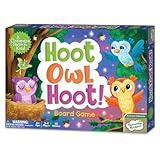
Hoot Owl Hoot!
- Color matching spinner game
- No reading required
- 15 minute play time
- 2-4 players

Every badge below is assigned to a different game, and the reasoning behind each one is in the review that follows.
Comparing the Best Cooperative Board Games for Kids by Age, Players and Play Time
Before the individual reviews, here is the full set side by side. The columns that actually matter when you are buying for children are age, player count and play time, because those three decide whether the game ever comes off the shelf.
| Product | Details | |
|---|---|---|
| Outfoxed! |
|
Check Latest Price |
| Hoot Owl Hoot! |
|
Check Latest Price |
 Bluey Scavenger Hunt Board Game Bluey Scavenger Hunt Board Game |
|
Check Latest Price |
 Race to the Treasure! Race to the Treasure! |
|
Check Latest Price |
| HABA First Orchard |
|
Check Latest Price |
 Mermaid Island Mermaid Island |
|
Check Latest Price |
 Minecraft Heroes of the Village Minecraft Heroes of the Village |
|
Check Latest Price |
 Wildcraft! Wildcraft! |
|
Check Latest Price |
 My First Castle Panic My First Castle Panic |
|
Check Latest Price |
 Baby Dinosaur Rescue Baby Dinosaur Rescue |
|
Check Latest Price |
 5-Minute Dungeon 5-Minute Dungeon |
|
Check Latest Price |
 National Geographic My First Safari National Geographic My First Safari |
|
Check Latest Price |
12 Cooperative Board Games for Kids, Reviewed by Age Range
1. Outfoxed! – The Best Cooperative Board Game for Mixed-Age Families
OUTFOXED, A CLASSIC WHO DUNNIT GAME FOR PRESCHOOLERS, 4 players
Cooperative deduction for 4 players
Dice, clue cards and decoder wheel
15-20 minute rounds
Ages 5 and up
+ Pros
- Works for kids and grown-ups in the same session
- Short repeatable rounds under 20 minutes
- Builds deductive reasoning without feeling like school
- Compact box fits a small shelf
- No sore losers
- Cons
- Youngest players need an adult to read clue cards
- Reviewers report wanting more replay variety after many sessions
Outfoxed is the one I recommend to parents who ask me a single question: what should we buy first. It is a detective game where the team hunts a fox that has stolen a basket of eggs, and every roll produces a clue card that the group works through together using a decoder wheel. Nobody holds a private set of information that they can hoard for a personal win, which is exactly why it works with a group.
The reason it climbs to the top of this list is the age spread. The manufacturer recommends ages 5 and up, and a five-year-old can genuinely contribute by turning the wheel and pointing at pictures, while an adult reads the longer clue text. We played it with a five-year-old, an eight-year-old and two parents, and everyone had a job within two minutes of setup. Grandparents, who usually get excluded from modern games, are fully in.
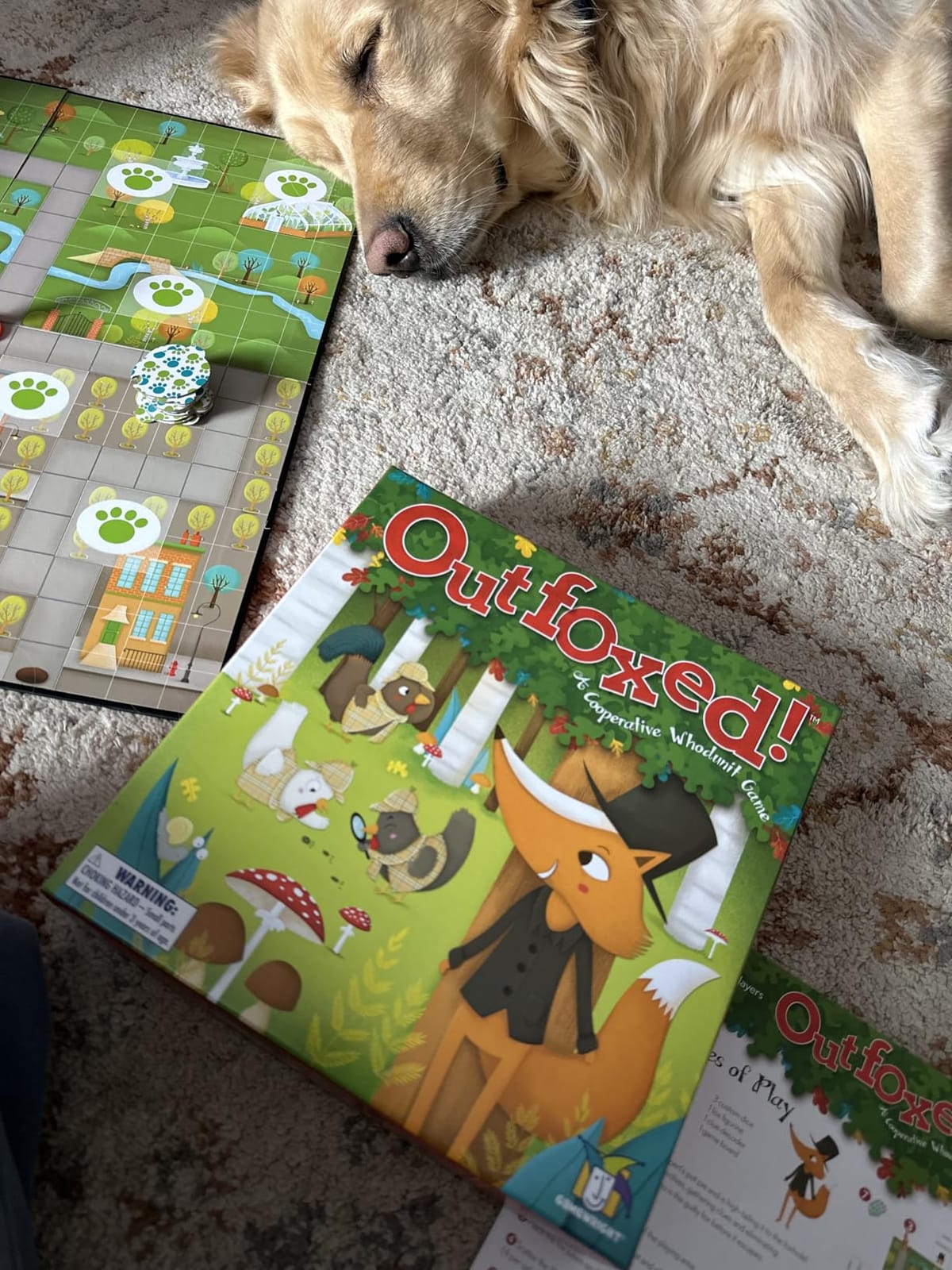
Rounds run 15 to 20 minutes by the box, and in our kitchen that estimate was accurate. That length matters more than it sounds, because a cooperative game that runs past a child’s attention span does not produce teamwork, it produces a parent finishing the puzzle alone while someone watches a screen.
Deduction and the decoder wheel, explained
Each player rolls a die, moves a suspect token, and either picks up a clue card or tests a location on the decoder wheel. The wheel has colored sections for each of the five suspects plus the fox itself, so the group is gradually narrowing down both who the fox is and where it is hiding. It is genuine deduction, but the deduction is always attached to a physical action, so a bored-looking child is actually just waiting for their next turn.
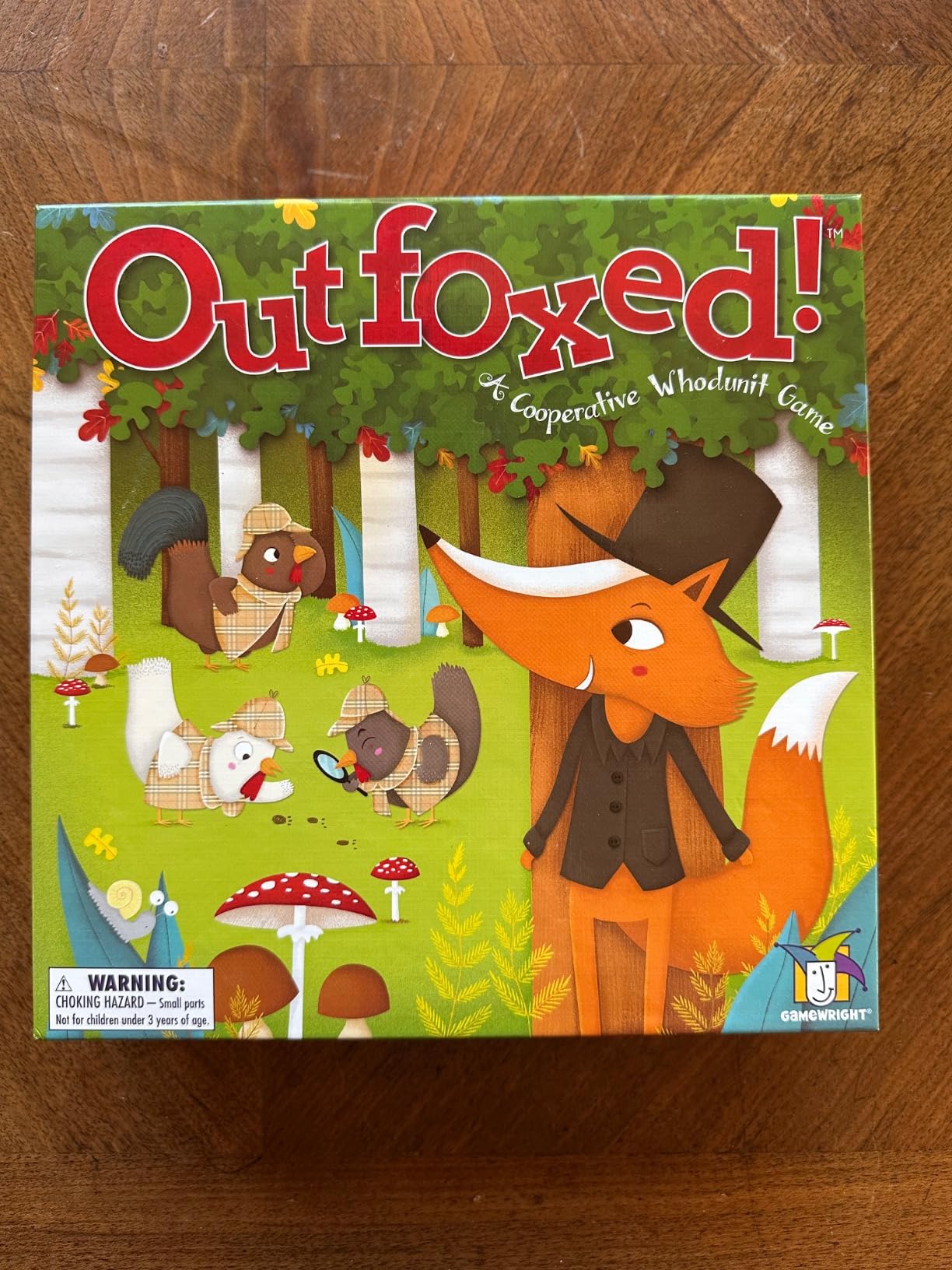
Gamewright lists this as a who-dunnit for preschoolers with four players, and the box measures 9.5 by 9.5 by 2.25 inches, so it is a genuinely portable object. No batteries, printed rulebook included, and paper components that survived a month of being dropped on a kitchen floor by a five-year-old.
Who it suits and who it will frustrate
It suits families that have been burned by competitive games, kids who hate losing, and mixed-age tables. A parent or grandparent is genuinely needed for the youngest players, so a pre-reader sitting alone with the box will stall after the first round.
It is not a game for a child who wants an adult game, and it is not a heavy strategy box. There is no campaign and no variable-difficulty system. The repeated note across reviews, and something we saw too, is that after a lot of sessions the crew starts to feel the options running thin. Our group played roughly twenty times before a few of us started suggesting a different game, which for a four-year-old and a parent is a very long shelf life.
2. Hoot Owl Hoot! – The Easiest Cooperative Game for a Four-Year-Old to Run
Peaceable Kingdom Hoot Owl Hoot – Cooperative Matching Game For Kids
Color matching spinner game for 2-4 players
No reading required
15 minute play time
13 x 9 x 2 inches
+ Pros
- Preschoolers grasp the rules immediately
- No reading required at all
- Fits a 15 minute preschool routine
- Bright artwork with few loose pieces
- Cons
- Little strategic depth once children master matching
- Some sets have arrived with a missing spinner
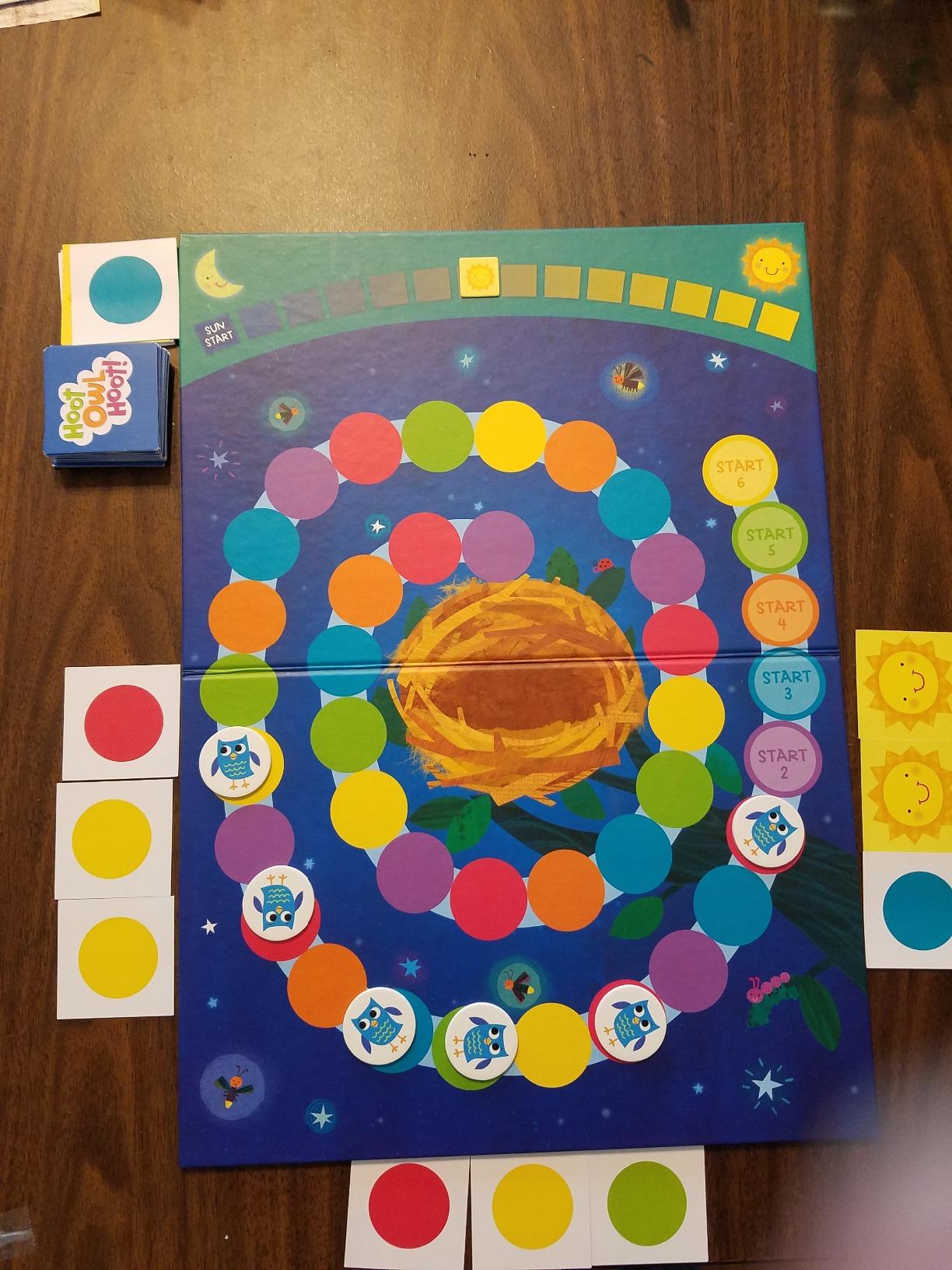
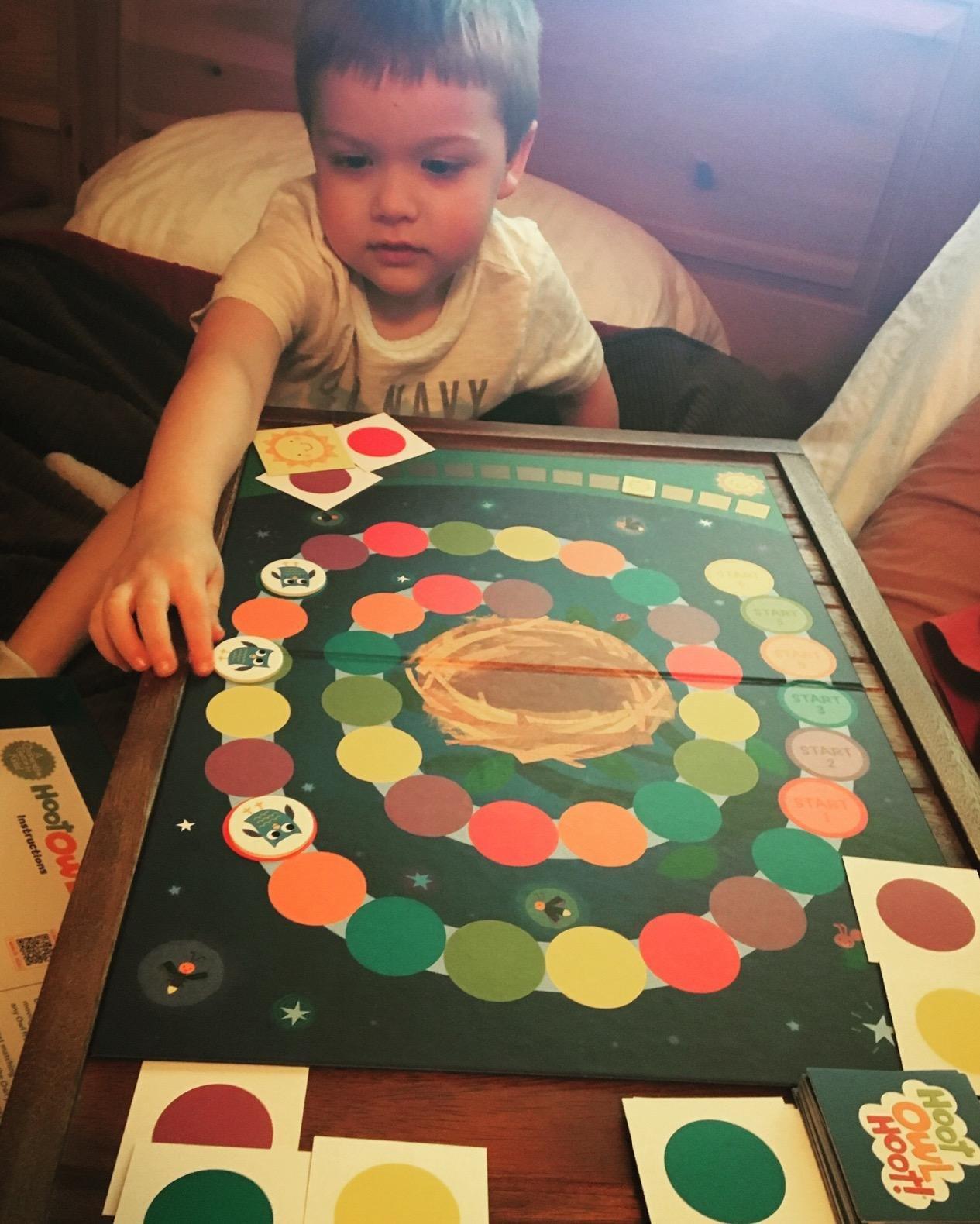
Hoot Owl Hoot is a matching game with a spinner and a shared goal: get three owls back to the nest before the sun rises. The spinner tells you what to do, you match sun or moon tokens to the board, and the whole group is watching the same rising sun. It is Peaceable Kingdom, ages 4 and up, two to four players, and it takes about 15 minutes.
What makes this the smoothest first cooperative game I put in front of a preschooler is that there is almost nothing to teach. My test four-year-old understood her turn inside one round, not two or three. She also had no chance to lose in a way that felt bad, because the sun rises for everyone at once and the outcome is a shared event the group can complain about together.
Color matching as a teaching tool
Underneath the owl theme, this is a color discrimination drill, and that is not a criticism. Kids practice matching a token to a board space, holding a spinner steady, taking a turn without asking, and reading another person’s plan out loud. Those four things are the actual curriculum of a first board game, and reviewers regularly describe it as an ideal first cooperative game for ages 4 and up with almost no reading required.
The box lists 13 by 9 by 2 inches and weighs 1.2 pounds, and the components are cardboard rather than plastic, which means nothing sharp or breakable for a toddler. Peaceable Kingdom backs it with a 30 day warranty against manufacturer defects, and they have been known to replace missing parts quickly.
Where it stops working
Six is the wall. The strategic depth is thin by design, and older children who have already played Outfoxed or Race to the Treasure tend to disengage. The most common note in reviews is that it becomes repetitive for kids past about age 7, which matches exactly what we saw.
The other practical warning is component loss. A spinner-sized piece goes missing, and if your household treats small parts as an occupational hazard, keep it out of reach of the under-three set.
3. Bluey Scavenger Hunt Board Game – The Best Cooperative Game for Kids Who Need to Move
Bluey Scavenger Hunt Board Game, Cooperative Play with 4 Exclusive Mini-Figures, Indoor Games for Kids Ages 5+, Fun Toy Token Collecting Game
Active scavenger hunt for 2-4 players
Find cards, play cards and trivia
20 x 15.25 inch board
Designed for ages 3 and up
+ Pros
- Gets wiggly preschoolers out of their chairs
- Children from about 2.5 to 10 play as equals
- Four collectible mini-figures included
- Rules learned in minutes
- Cons
- More rules than a typical preschool game needs
- Trivia cards are limited in number
- Cards are in English only
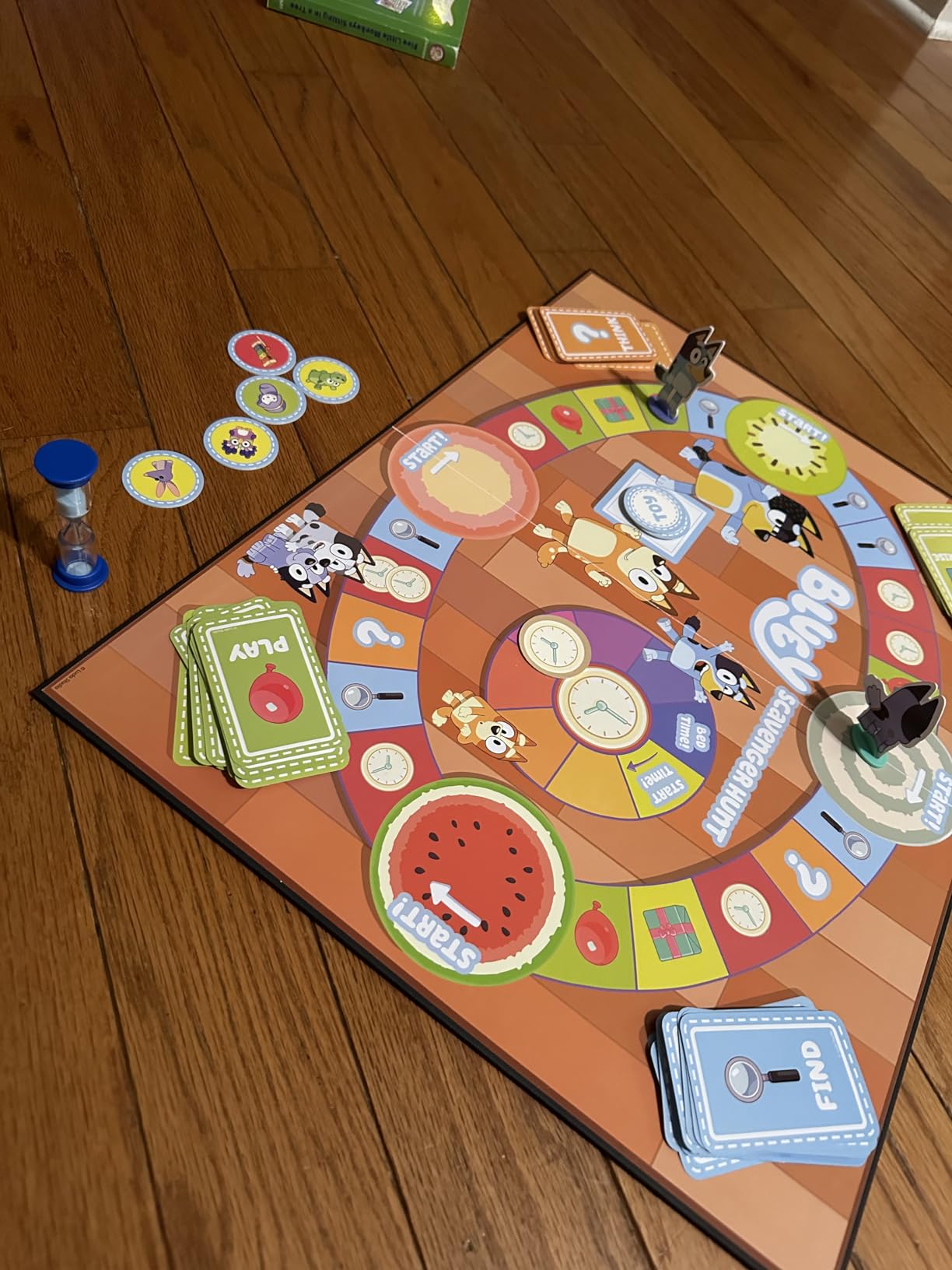
This one solves a problem the card-based cooperative games do not: energy. Instead of everyone sitting still, the Bluey Scavenger Hunt Board Game sends players off the board to find real objects around the room, then brings them back with what they found. The goal is to collect all twelve toy tokens before bedtime, and the box includes four exclusive mini-figures of Bluey, Bingo, Bandit and Chilli.
The age range is the surprise. Moose Toys lists a recommended age of 36 months to 15 years, and reviewers report households where children from about two and a half to ten play happily together, with the older child helping the younger rather than being bored by them. That is the mixed-age sibling problem solved better than any other game in this list.
Components and the movement mechanic
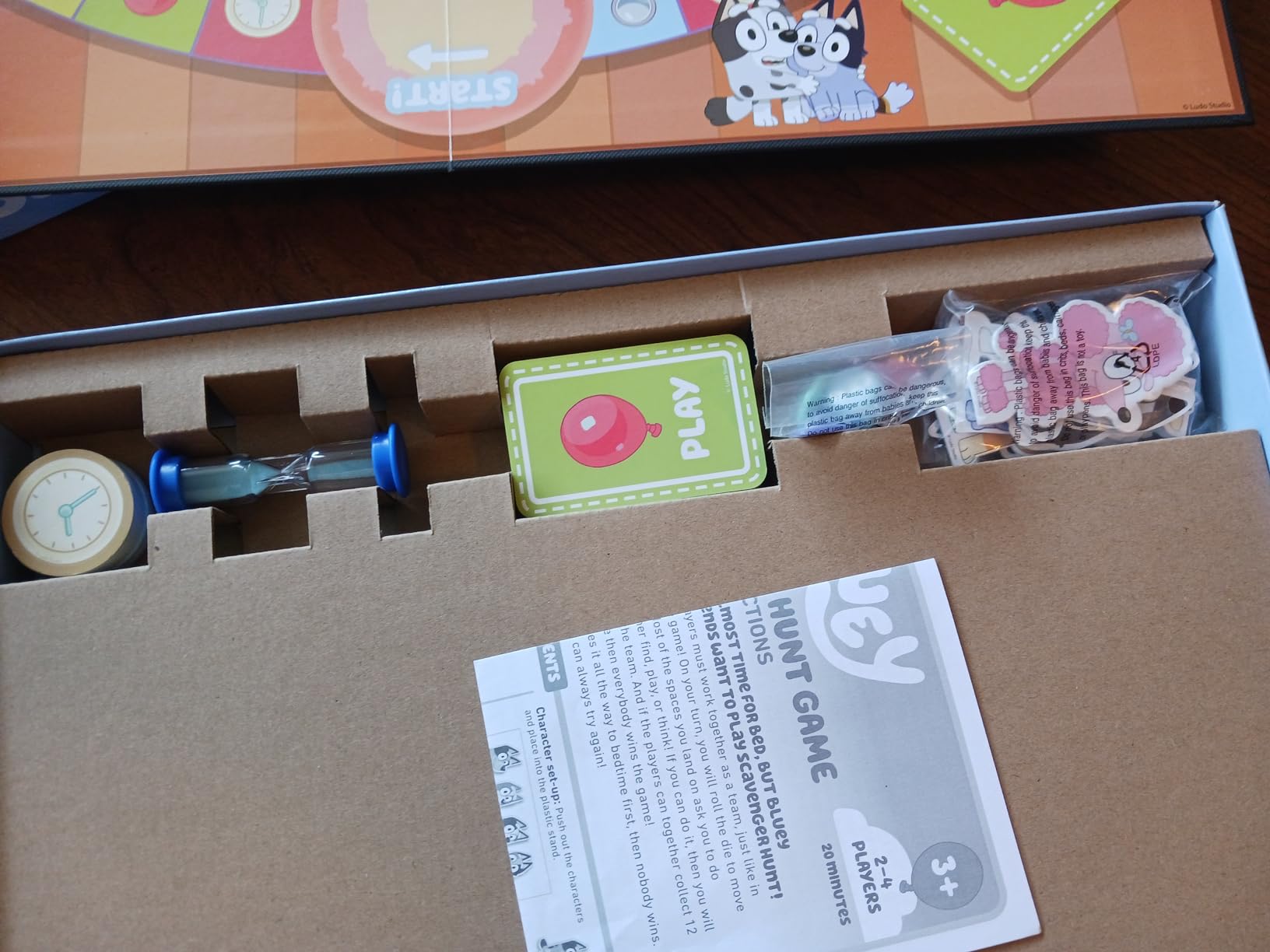
The box contains 20 find cards, 10 play cards, 35 toy tokens, one board and four character pawns, and the board itself measures 20 by 15.25 inches, so this is a floor game rather than a lap game. Find cards send a player to locate something, play cards require an action, and the trivia cards add a short question answered by the group.
It is material listed as acrylonitrile butadiene styrene and paper, weighing 0.63 kg. No batteries, indoor use, and the manufacturer part number is 17144. None of that matters as much as the fact that a bored four-year-old can stand up mid-round without derailing the game.
The trade-offs
It is more complex than a typical preschool game, and several families mention the rule count feels high for the age the box looks like it targets. The trivia content is limited, so after many plays the questions start to repeat. And the cards are printed in English, which limits play for families who do not read that language fluently.
For us it earned its slot because it produced more talking during setup than any other game in the roundup, and because the kids asked for it by name weeks later.
4. Race to the Treasure! – The Best Cooperative Board Game for Learning to Plan Ahead
Peaceable Kingdom Race to the Treasure! Cooperative Path Building Game for 2 to 4 Kids Ages 5+
Cooperative path building for 2-4 players
Ages 5 and up
20 minute play time
12.5 x 1.5 x 9 inches
+ Pros
- No reading required
- so pre-readers can play alone
- Teaches planning and decision-making
- Oppenheim Toy Portfolio Platinum award
- Portable and light at 16 ounces
- Cons
- Replay value drops once the best path is known
- Some families want a harder version past age 7
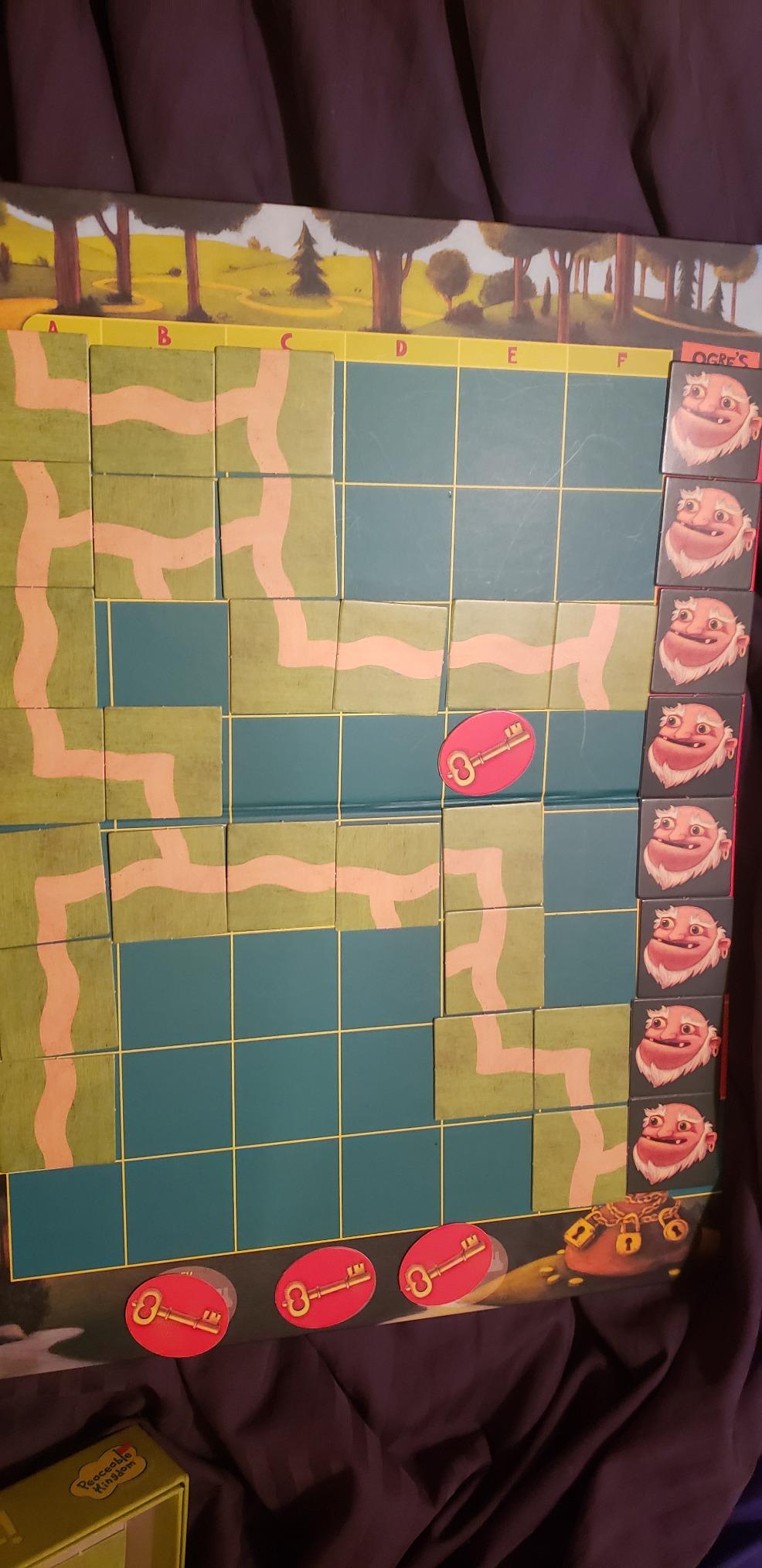
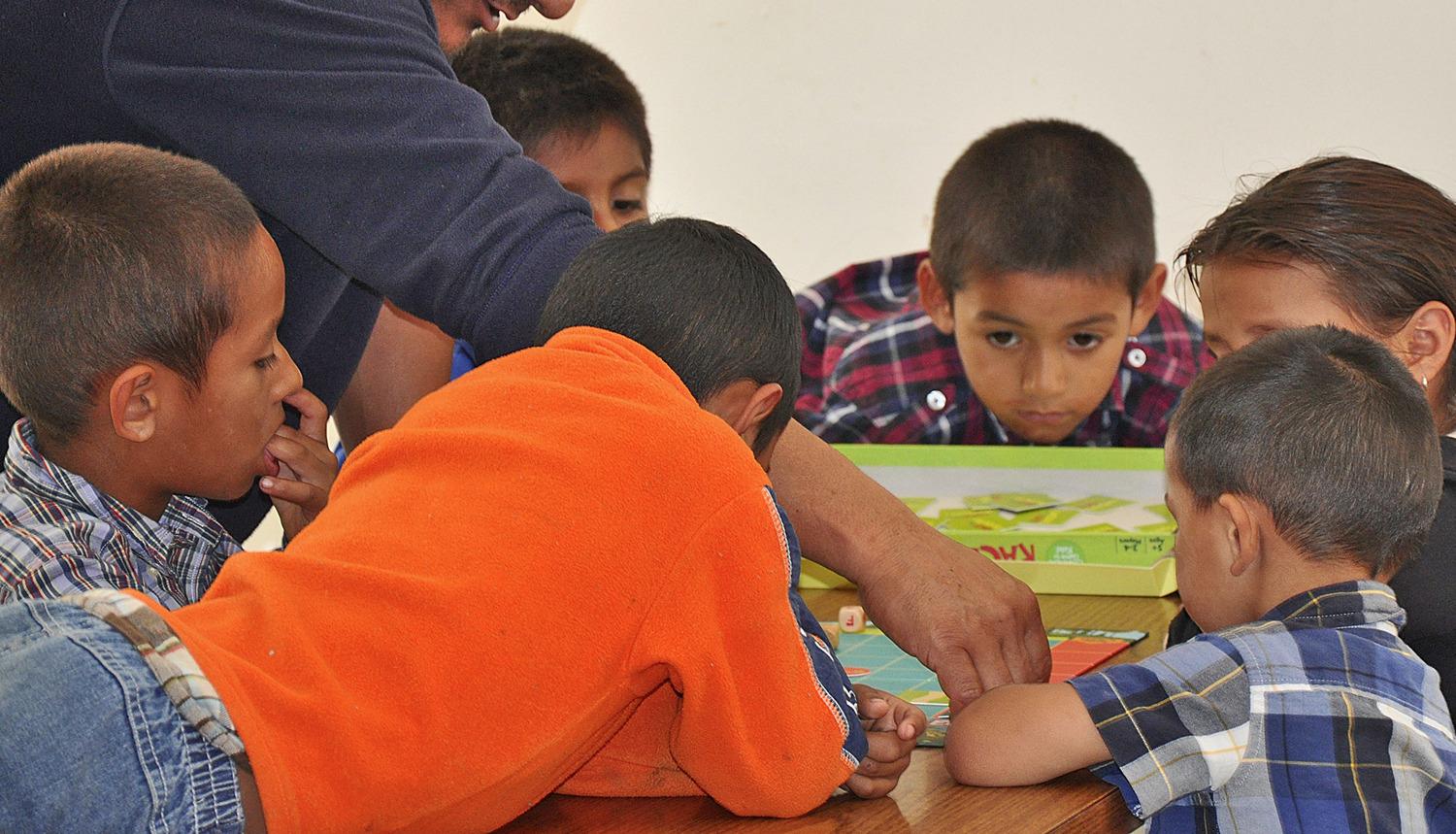
Race to the Treasure is the game I hand to parents whose child is ready to stop matching colors and start thinking. Players build a path of tiles across the board, card by card, trying to reach the treasure before the ogre reaches the treasure. Everyone votes on each placement, and the majority decides. It is Peaceable Kingdom, ages 5 and up, two to four players, about 20 minutes per round.
The design has been around for a long time, and that is a strength. Children who have never held a game like this understand it in a round or two, and the shared vote means a child who is not the fastest talker still has a hand in every decision. My oldest tester enjoyed arguing about tile placement far more than she enjoyed any of the physical outcome.
Why the shared decision-making works
Most strategy games give each player private goals, which quietly turns a team game into a race with extra steps. This one removes private goals entirely. The only question in front of the table is whether to take the safe tile that moves everyone closer or the risky one that might unlock a shortcut, and the group has to agree before the ogre takes its step.
It won the Oppenheim Toy Portfolio Platinum award among others, and reviewers cite it as a reliable first strategy game for ages 5 and up. At 16 ounces and 12.5 by 1.5 by 9 inches, it packs flat enough for a travel bag, which is unusual for a game with this many tiles.
The ceiling and the floor
Once your child has played it three or four times, the puzzle becomes solvable, and cooperative games that become solvable are finished. That is the most common complaint in reviews and it is true. The box is listed for ages up to 1188 months, which is generous marketing, so treat five to seven as the real window.
It is also the game I most often recommend to a parent with a single child who cannot yet read, because nothing in the rules requires words.
5. HABA First Orchard – The Best First Board Game for a Two-Year-Old
HABA My Very First Games – First Orchard Toddler Game – My First Orchard Game, Cooperative Toddler Board Games for 2 Year Olds – Made in Germany
Wooden cooperative game for 1-4 players
16 large wooden fruit pieces
Ages 2-4
8.94 x 8.86 x 2.8 inches
+ Pros
- Highest rated game in this roundup
- Chunky wooden pieces safe for tiny hands
- Teaches color recognition and counting
- Durable enough to survive repeated drops
- Cons
- Almost no strategy
- so kids outgrow it around age 4
- Wooden pieces pack a punch if hurled
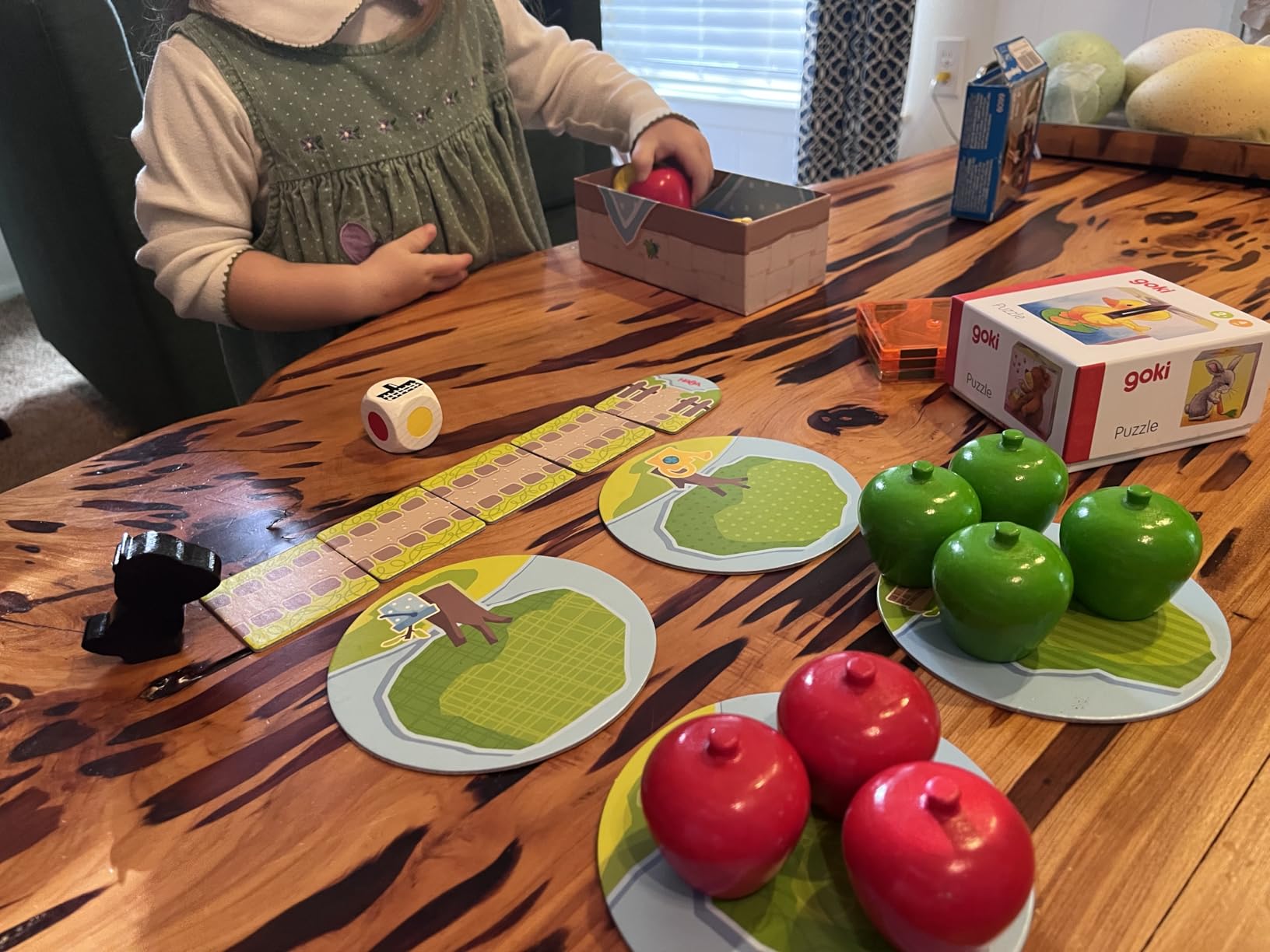
First Orchard is the only game in this list that a two-year-old can genuinely play, and it has the highest average rating of anything we tested at 4.9. The mechanic is one sentence: roll the die, move your little wooden farmer, drop a fruit in the basket, and get every fruit collected before the raven empties the basket. HABA has sold more than three million copies since 1986, which tells you how well it fits that slot.
My youngest tester was just past two. She understood the turn structure on her own, which almost never happens that early, and she was genuinely upset when the raven took a fruit because she had begun to care about the outcome. That is the whole point of a first cooperative game: a real stake, a shared result, and no child who lost.
Build quality and small hands
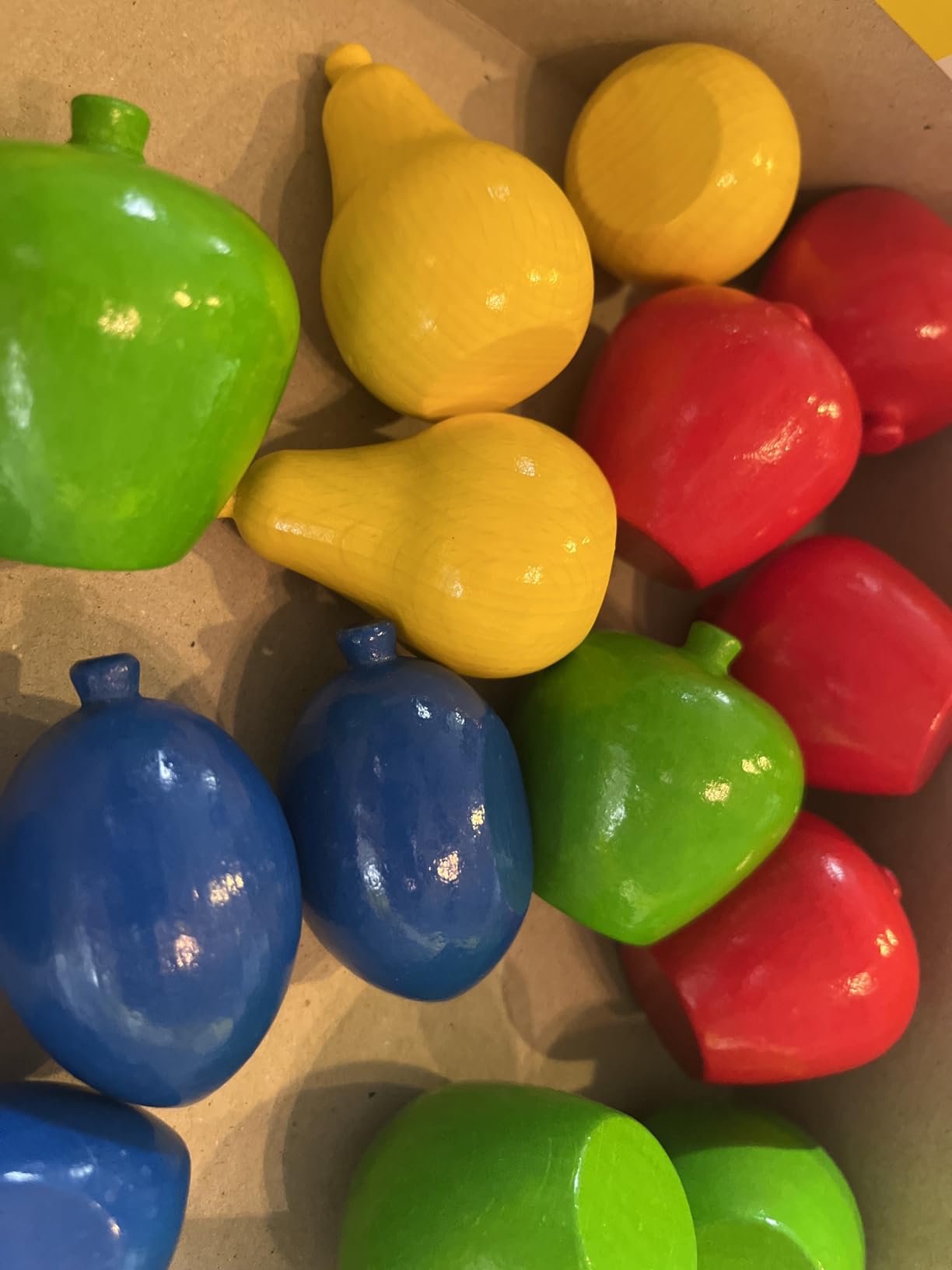
The 16 wooden fruit pieces are large, chunky and PEFC certified, and they are colored magenta, orange and yellow in the English box edition. The die is equally chunky, which matters because a two-year-old trying to roll a standard small die usually just bats it off the table.
Weight is 1.8 pounds, dimensions 8.94 by 8.86 by 2.8 inches, and the educational objective printed on the box is counting. Parents in reviews consistently highlight the durability, saying the pieces hold up after years of play and repeated drops, and the manufacturer age range is 24 months to 3 years.
The honest limitation
There is no real strategy here, and reviewers say plainly that children age out around age 4. It is closer to a shared activity than a game, and if you buy it expecting a two-year-old and a nine-year-old to both be satisfied, the nine-year-old will be gone in a week.
The other warning is physical. Solid wood does not bounce gently when a toddler throws it, and several owners mention the pieces packing a punch. Keep it on a table, not on a carpet next to an infant.
6. Mermaid Island – The Best Cooperative Game for Six Players at Once
Peaceable Kingdom Mermaid Island Award Winning Cooperative Board Game for 2 to 6 Kids Ages 5+
Spinner game for 2-6 players
Wand tokens push the Sea Witch back
15 minute play time
9.06 x 1.57 x 12.6 inches
+ Pros
- Genuinely cooperative with no competition between players
- No reading required
- Very few pieces so cleanup is fast
- Good Housekeeping Best Toy Award winner
- Cons
- Very easy to win
- so children 5 and up can find it repetitive
- Easily modified into a competitive game once kids are ready
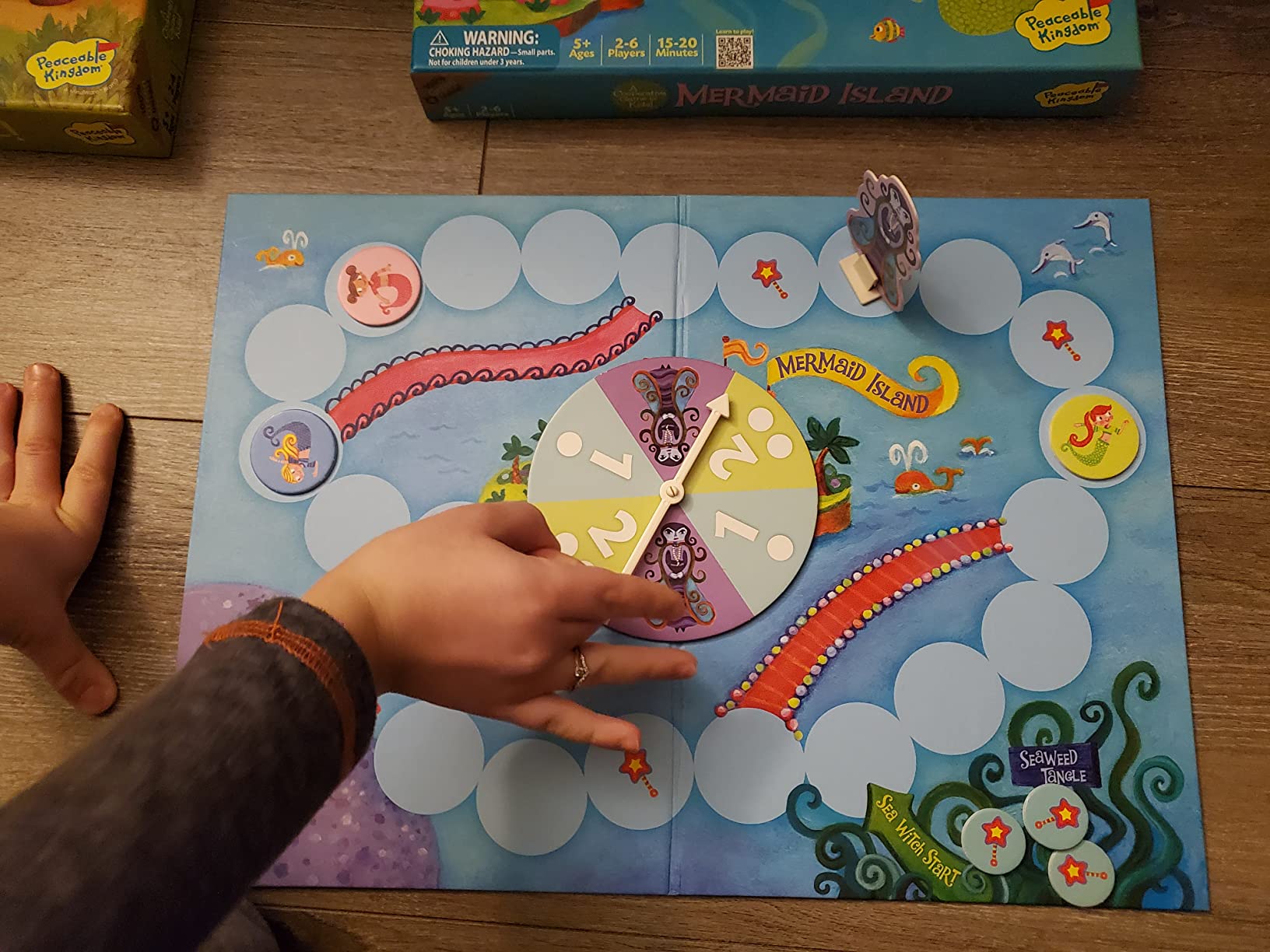
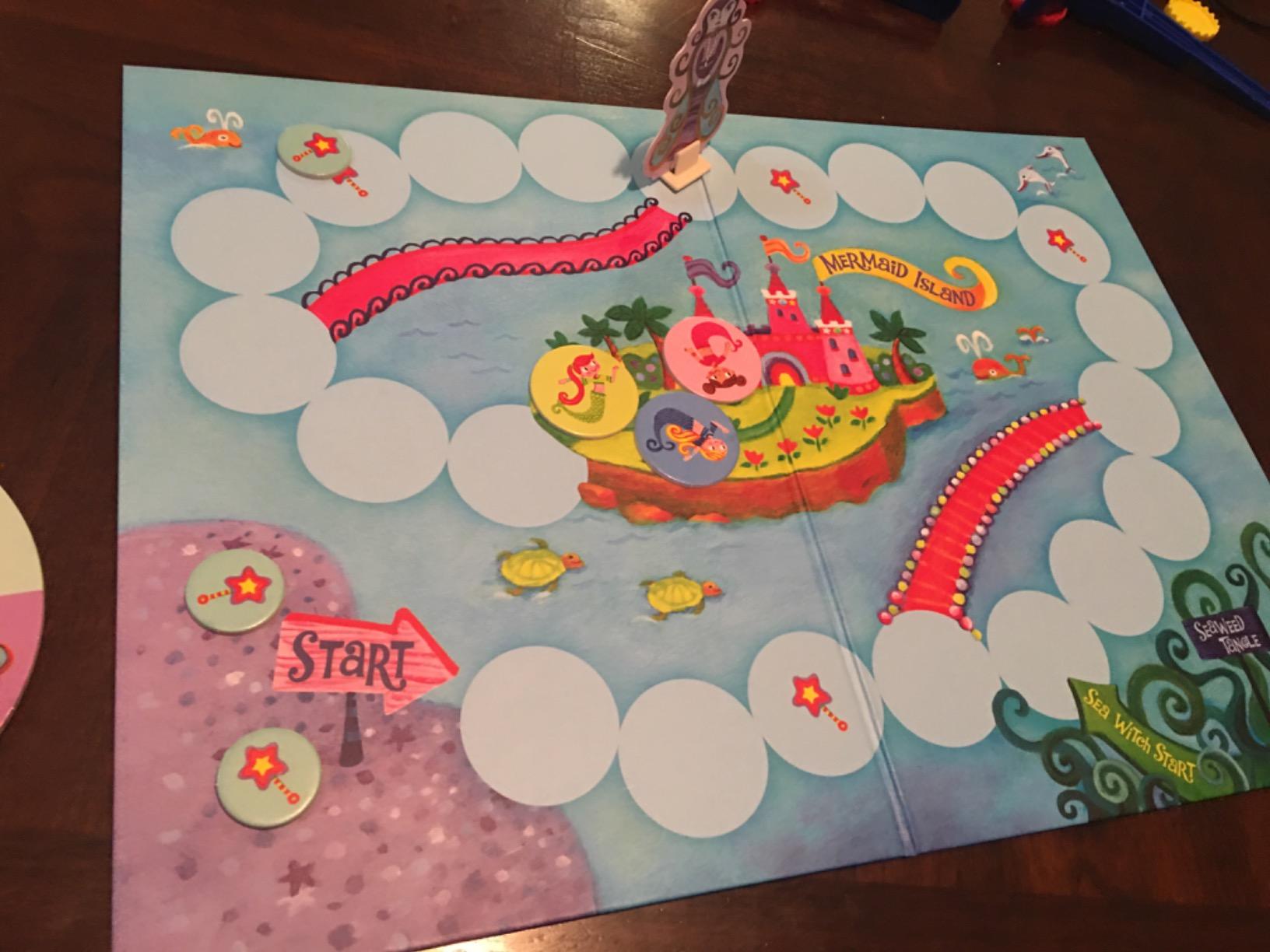
Mermaid Island is the answer for a big table. The box lists 2 to 6 players, and that upper number is where it earns its place, because most cooperative games for children quietly assume four. Here each player moves one of three mermaids toward the island while the Sea Witch moves toward them, and anyone can spend a wand token to push the Sea Witch back one space.
The wand tokens are a quietly clever piece of design. They give a child holding an almost-useless turn something meaningful to do, and they create a small negotiation every round about whether to save the wand or spend it now.
A game made for sharing rather than winning
There is no ownership at all. No player has a color, no player has a personal progress track, and no player can be the reason the group fails in a way the others can ignore. Preschool teachers who reviewed it single out exactly this point, saying it helps children take turns and move pieces without the anxiety of winning or losing.
Components are listed as one game board, 3 mermaid tokens, 1 sea witch with stand, 4 wand tokens, 1 spinner and instructions, in cardboard and plastic at 16 ounces. It won the Good Housekeeping Best Toy Award.
Too easy for the age on the box
The box says ages 5 and up, and the most common review complaint is that the game is very easy to win, so children at the top of that range find it repetitive. The rating of 4.6 reflects that, and it is the lowest-scoring Peaceable Kingdom title here for a reason.
One positive workaround owners mention: once kids are ready to practice sportsmanship, the rules can be adjusted into a competitive head-to-head format, which turns the game into a bridge to regular competitive play.
7. Minecraft Heroes of the Village – The Best Cooperative Board Game for Minecraft Fans
Ravensburger Minecraft Heroes of The Village | Cooperative Board Game | Exciting & Unpredictable | Perfect for Families and Minecraft Enthusiasts | Suitable for Kids & Adults
Cooperative Minecraft adventure for 2-4 players
World map changes every playthrough
25 minute play time
Ages 7 and up
+ Pros
- Map reshuffles each play for real replay value
- Substantial component count including wooden blocks
- Works for a 7-year-old plus adults
- Ravensburger has 130 years of game making
- Cons
- Requires reading
- so younger children need adult help
- Not a fit for players wanting a light game
This is the one game in the roundup aimed squarely at older children, and the rating of 4.5 is the lowest here for a straightforward reason: it demands reading. The box is 11 by 11 by 3 inches, the recommended age is 7 and up, and a round runs about 25 minutes. In exchange you get real strategic depth, and the depth comes from the world map being assembled from randomized tiles each time you play.
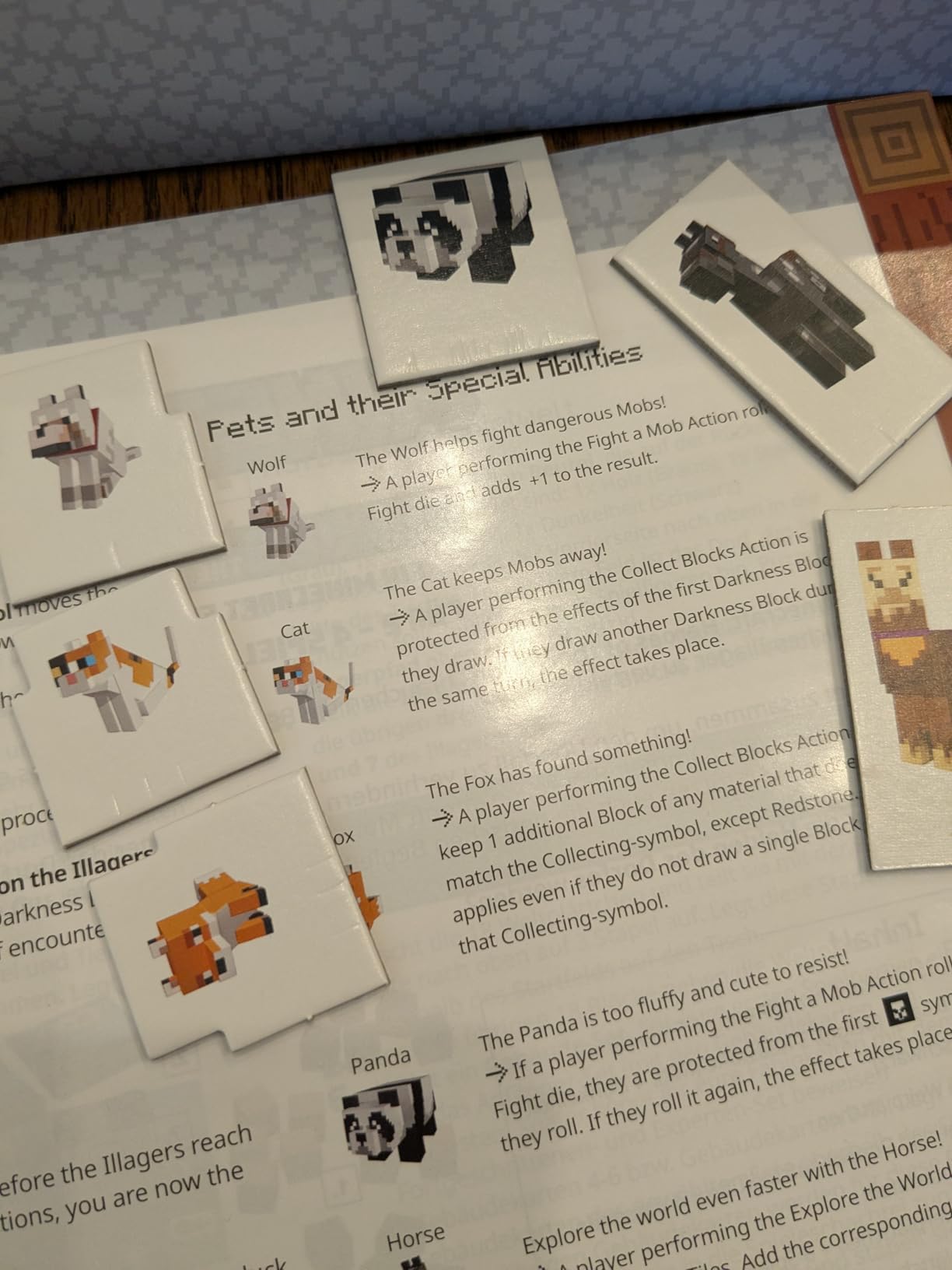
That randomness is the point. A cooperative game with a fixed puzzle can be solved once and retired. Here the group builds the map, discovers the buildings, meets the illager piece, and deals with mob tokens, but the layout changes every playthrough, so the group has to re-plan rather than memorize.
What is actually in the box
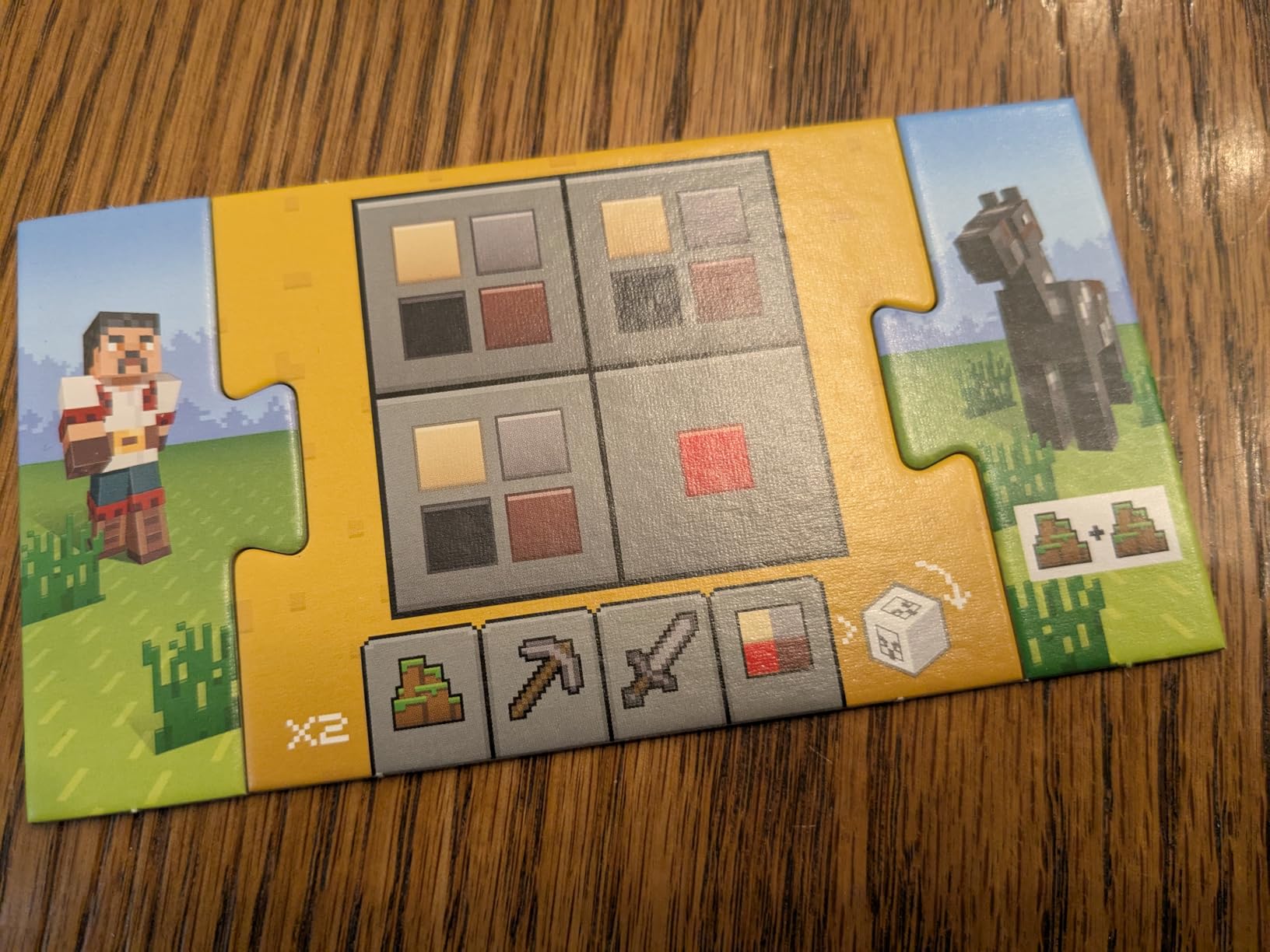
Ravensburger lists 25 blocks, 18 world tiles, 4 inventory cards, 6 pet tiles, 9 buildings plus 3 bases, 12 mob tokens, 1 starting tile, 1 illager piece, 2 dice and 1 pouch. That is a lot of cardboard and plastic for a family game, and it is also why the box weighs 1241 grams. The educational objectives printed on the box are reading and strategy.
Ravensburger has been making games for over 130 years, and reviewers with school-age Minecraft fans tend to rate it highly for the unpredictability and for the way it plays competitively with adults without turning heavy.
Where it falls short
Reading is required, so this does not work for a non-reading child at all, and a younger sibling at the table will need an adult running that end of the board. It is also not a fast, light game. Families looking for something quick with a preschooler will be disappointed.
The thematic pull is strong enough that non-Minecraft players sometimes feel outside the joke, which matters if you are buying for a mixed household.
8. Wildcraft! – The Best Cooperative Game for Screen-Free Learning
Wildcraft! Cooperative Board Game, Learn 25 Herbs, Family Game for Kids 4+
Cooperative foraging adventure for 1-4 players
Teaches 25 herbs and their uses
Ages 4 and up
Includes downloadable extras
+ Pros
- Real herbal knowledge that children retain and repeat
- Picture-based cards readable by pre-readers
- Many optional house rules and variations
- Made from recycled and non-toxic materials
- Cons
- Bonus coloring book and guides are downloads
- not printed
- A full game runs long for a four-year-old
- Light challenge for players who like heavier strategy
Wildcraft is the game that quietly teaches something. The group travels a forest trail collecting herbs to bring to a sick grandmother, and along the way they learn 25 herbs by name and by what they are used for. The manufacturer age is 4 and up, players are 1 to 4, and the box measures 10.31 by 10.31 by 2 inches at 2.1 pounds.
What impressed me most was how the card design handles pre-readers. Ailments are shown as pictures and herbs as pictures, so a four-year-old can match a remedy to an illness without decoding text. My youngest tester matched pictures for four rounds before anyone read a word aloud, and she still brought up the plants at dinner a week later.

What you get, including what you do not
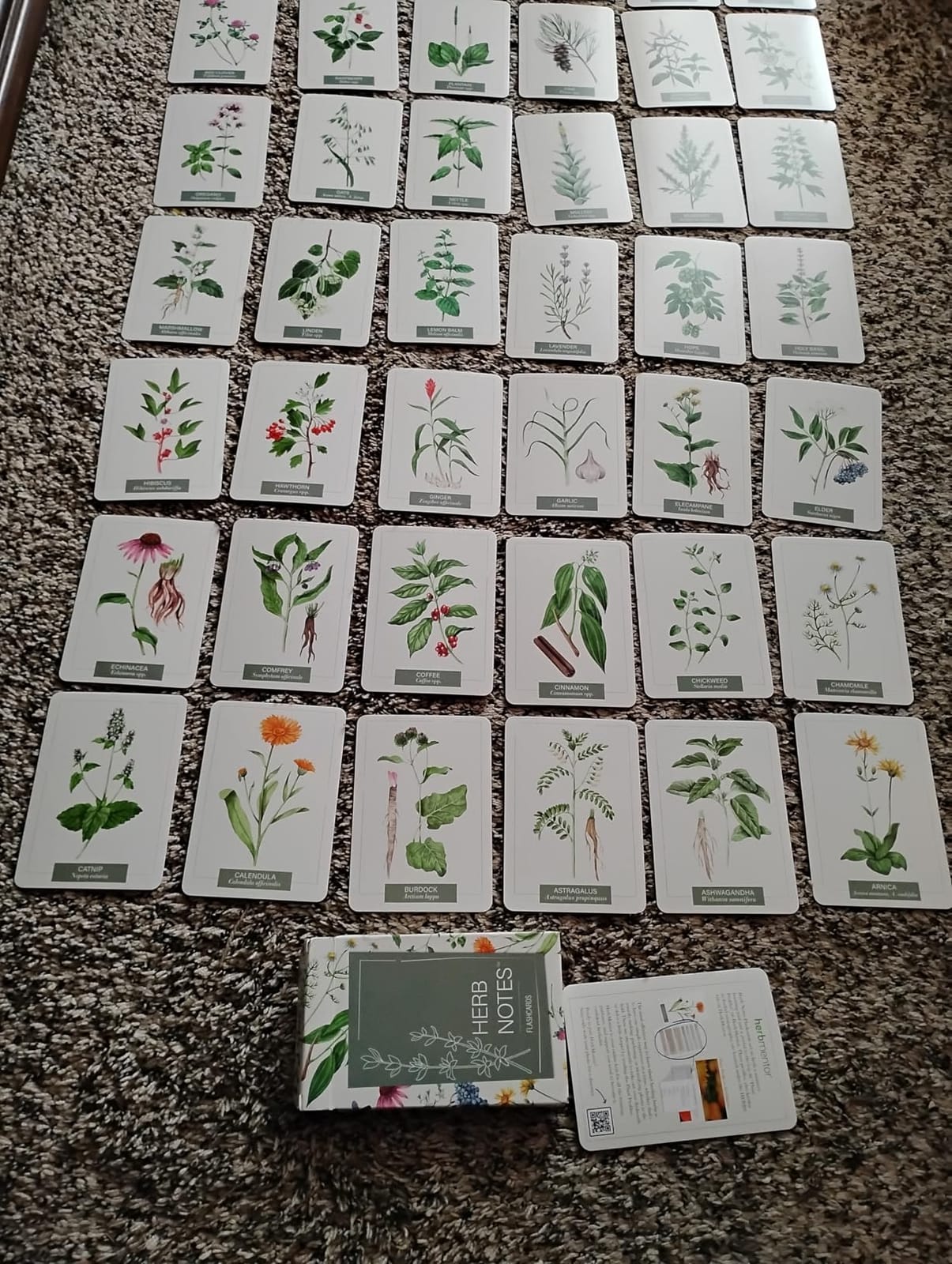
Be clear-eyed about the extras. The box contains the board game, and it includes downloadable PDFs rather than printed materials: herb notes flashcards, a botanical coloring book, a pocket guide to herbs and the Wildcraft story. Three printable PDFs are in the package, and you print them yourself if you want them. Parents flag this as the single most common complaint.
The game itself is made from 100% recycled, recyclable and non-toxic materials, and the educational objective on the box is educating players about herbs and their uses. Replayability comes from optional house rules and rule variations rather than from a fixed puzzle.
Length and challenge
A traditional game runs long, and families routinely shorten it, which is easy to do and does not hurt the learning. Reviewers also note that children naturally start helping each other after a few rounds, which is the behavior you are actually buying.
For a family that already plays heavier strategy games, the challenge is light. I would pair it with a more demanding title rather than expect it to carry a game-night rotation on its own.
9. My First Castle Panic – The Best Cooperative Game for a Classroom Setting
Fireside Games My First Castle Panic Fantasy Board Game
Cooperative castle defense for ages 4-8
Icon-based cards, no reading
Built-in time mechanism
20 minute rounds
+ Pros
- A four-year-old can grasp the rules
- Very fast setup with a 20 minute ceiling
- Built-in end condition stops late-night drag
- Popular bridge from games like Candy Land
- Cons
- Small card components go missing and need supervising
- Card quality is considered thin
- Too simple for children aged 7 and up
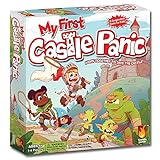
My First Castle Panic is the simplified entry point to the castle defense genre, and for a four-year-old it does something the full version does not: it can be taught in one round. Icons do the teaching, so no reading is required anywhere. The box is 2.1 by 10.5 by 10.6 inches, the round is about 20 minutes, and Fireside Games recommends ages 4 and up.
The built-in time mechanism is the feature most appreciated after bedtime, when you need a firm ending. A wave of monsters arrives on a schedule rather than drifting indefinitely, so a game cannot quietly stretch past the hour mark and turn into a parenting problem.
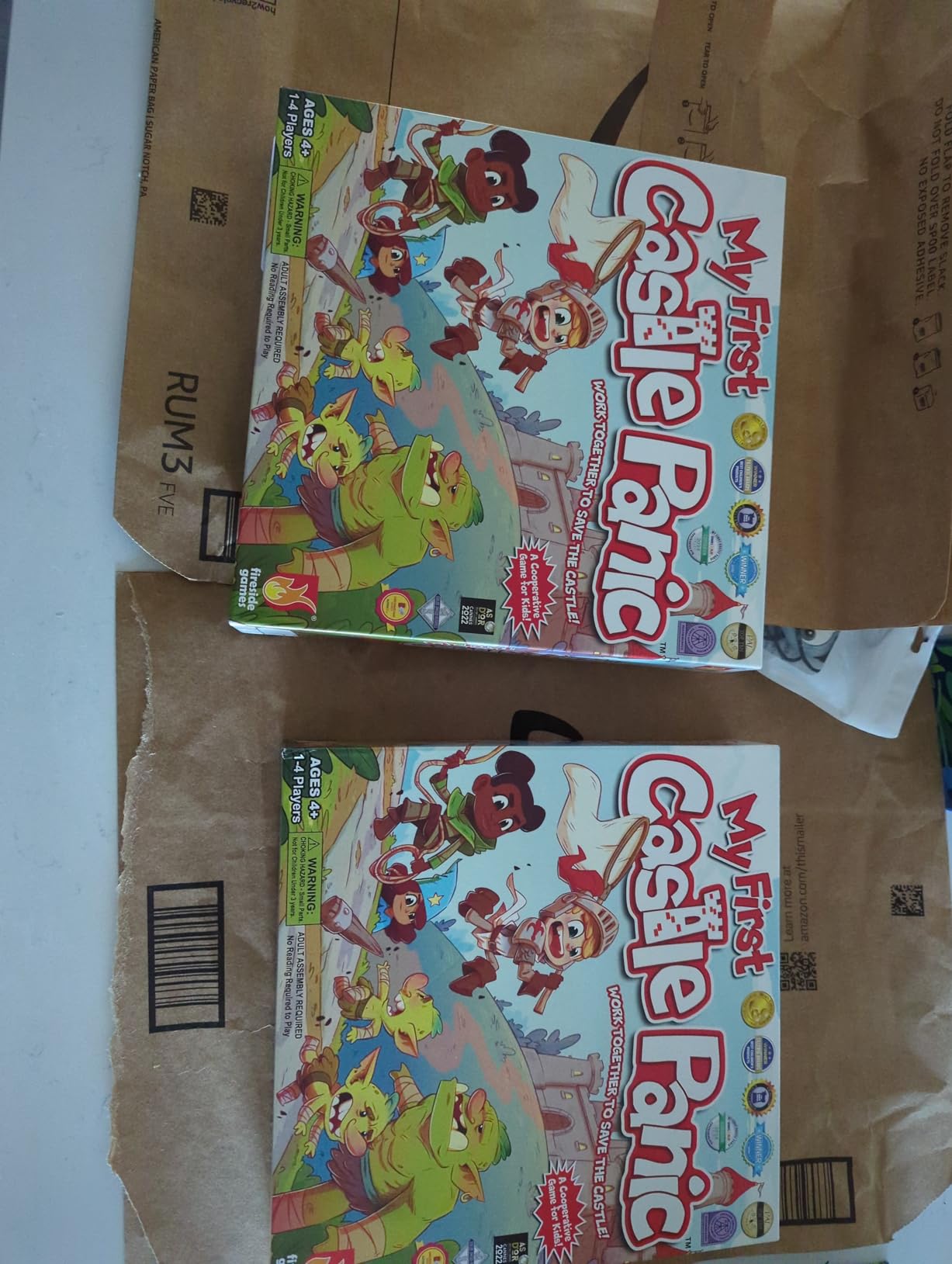
Matching and planning for small hands
The educational objective printed on the box is enhancing cognitive skills through matching, strategic thinking and problem-solving, and that is a fair description of the round. Kids match a color or shape on their card to what is happening at the castle, then take a defensive action together. The standing castle and large monster tokens are designed for small hands to move reliably, which is a practical upgrade over card-only games.
It is cardboard construction at roughly 0.1 kg, with a printed rulebook and no batteries. Owners frequently describe it as the ideal gateway cooperative game for ages 3 to 6, with children picking up the rules by the second game.
Durability in a room full of children
This is the one product in the list I would think twice about for a busy classroom or a house with a toddler. The cards are small and the complaint about missing components appears repeatedly, and the card quality itself is described as lackluster by some owners. With twenty or more children playing, the pieces will not survive a term intact.
The other limitation is age, again. Several reviewers say it is too simple for children aged 7 and up, so in a mixed classroom you may need a second game for the older group.
10. Baby Dinosaur Rescue – The Best Cooperative Game for a Four-Year-Old Who Will Not Sit Still
Baby Dinosaur Rescue Cooperative Board Game for Kids Ages 4+, Family Fun
Cooperative rescue race for 2-4 players
Image-based cards, no reading
20 minute play time
9 x 6.5 inch board
+ Pros
- Real urgency from the advancing lava token
- Image cards need no reading
- Short low-pressure format for game night or class
- Matching and communication practice built in
- Cons
- Lightweight components are easy to misplace
- Simple enough that older children outgrow it quickly
Baby Dinosaur Rescue is a race against a rising lava token, and that single tile is what makes it work. The lava advances a fixed number of steps each round, so the team has a real deadline even though nobody is competing. Each player guides a baby dinosaur toward safety while matching the item cards in front of them. Two to four players, ages 4 and up, about 20 minutes.
Parents and teachers reviewing it describe it as an easy first cooperative game for four-year-olds, with the lava timer providing just enough tension to make the team actually talk to each other. Our four-year-old treated the lava like a personal enemy, which is exactly the emotional hook a first game needs.
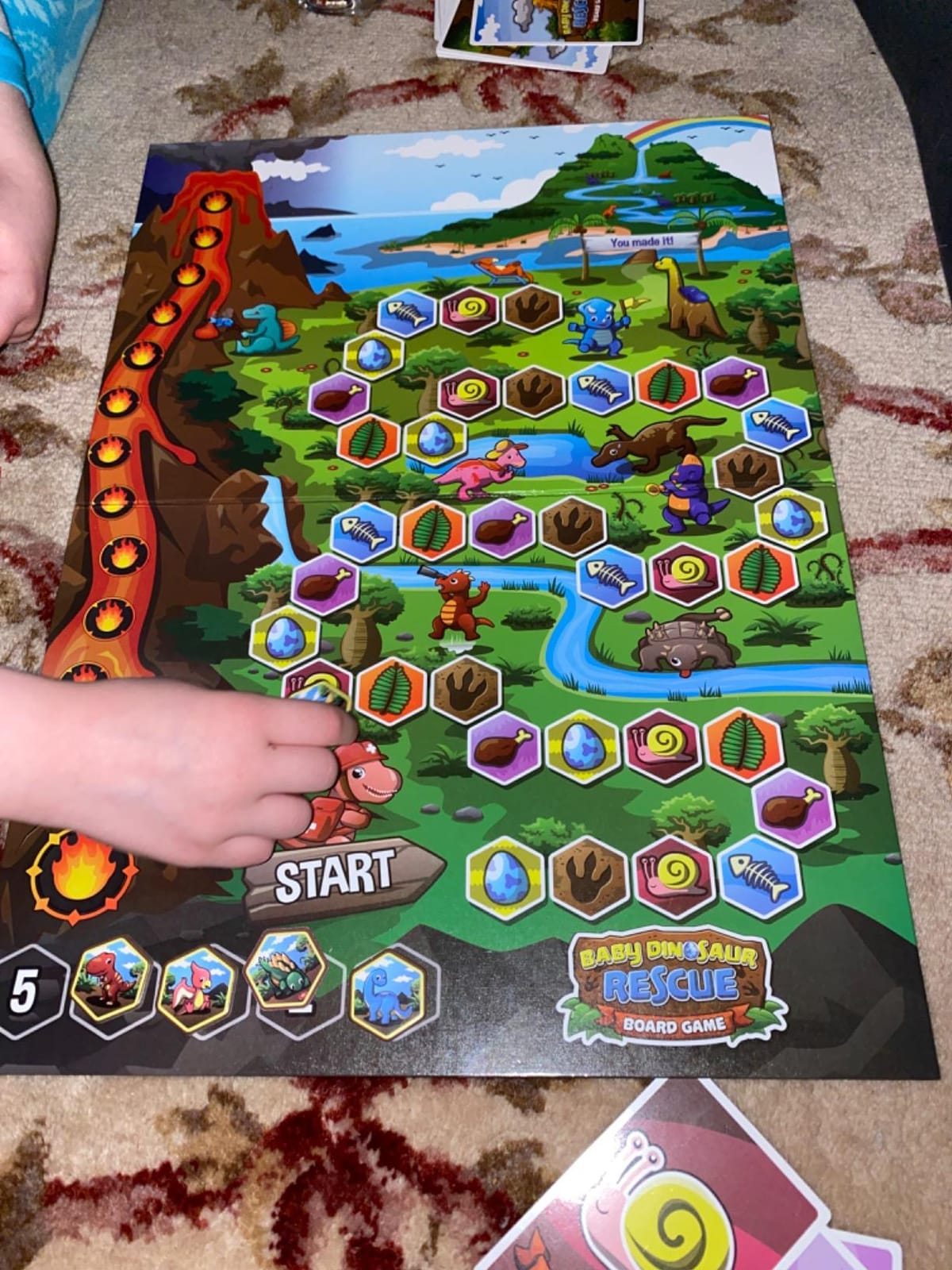
Cards you do not have to read
The item cards use images rather than text, so a pre-reader can play a full round without help, and the manufacturer part number is BDRBG. Included components are the game board, dinosaur tokens, a lava token and cards, in cardboard, on a 9 by 6.5 inch board rated for indoor use.
The educational objectives on the box are image matching, fine motor skills and communication, and reviewers note the short, low-pressure format works well for family game night or a classroom session that has to fit inside a lesson period.
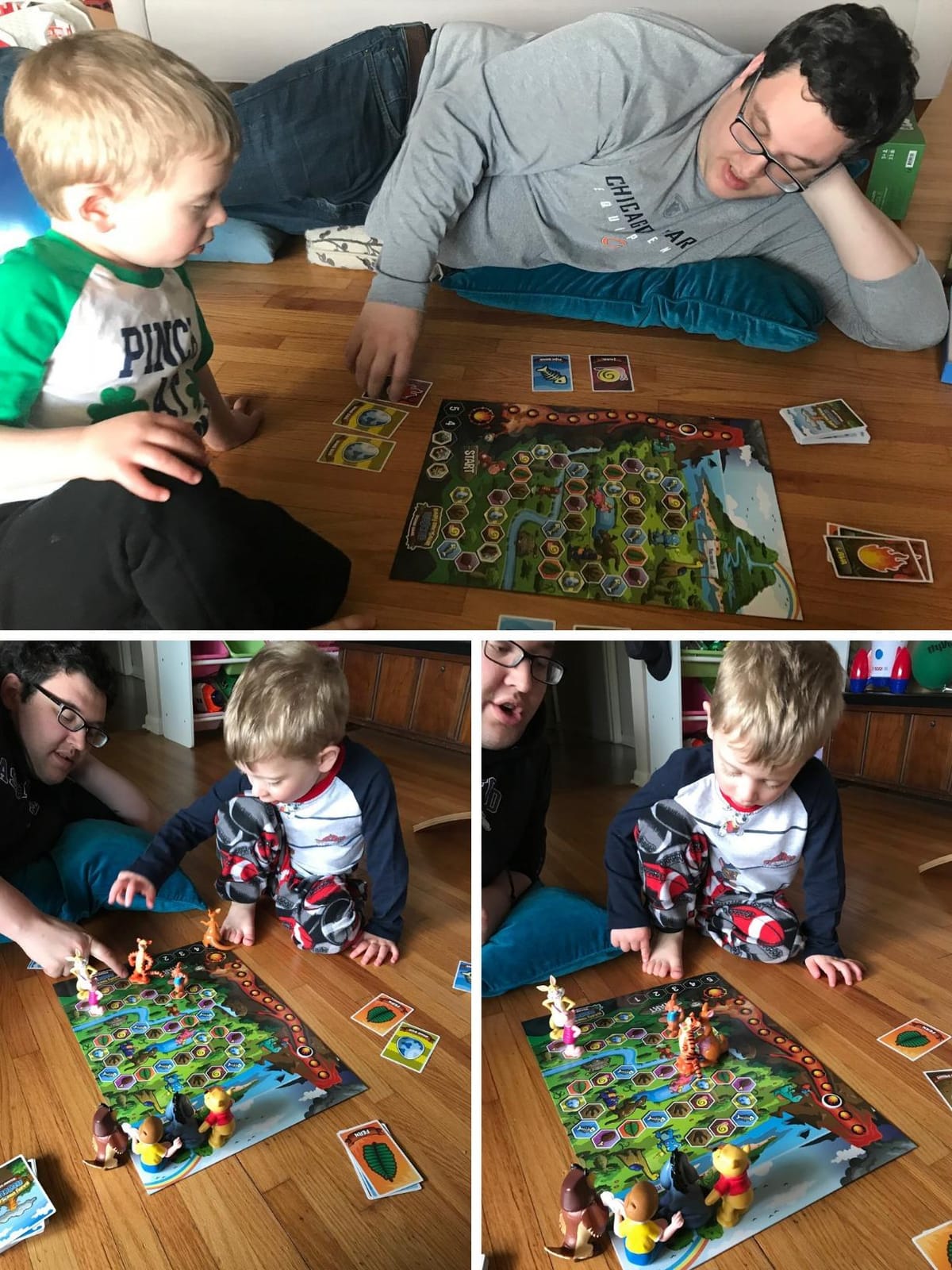
The ceiling
Older children outgrow it quickly. A minority of reviewers note the components are light and can be misplaced, so this is another game where a missing token is the most common complaint. With a 4.7 rating across 998 reviews, the signal is consistent rather than mixed: it does its specific job very well and stops there.
11. 5-Minute Dungeon – The Best Cooperative Game When Turns Are the Problem
Wiggles 3D 5-Minute Dungeon A Chaotic, Co-Operative, Real-time Card Game | Fast-Paced Board Game | for Families, Ages 8 & up | 2-5 Players
Real-time cooperative card game for 2-5
275 cards, six bosses
Five minute rounds
Ages 8 and up
+ Pros
- Nobody waits around for their turn
- Five minute rounds suit short attention spans
- Non-gamers pick it up almost immediately
- Free timer app with six themed narrators
- Cons
- A lot of shuffling between rounds
- Some text-heavy cards need an adult
- Final boss is hard with a younger fourth player
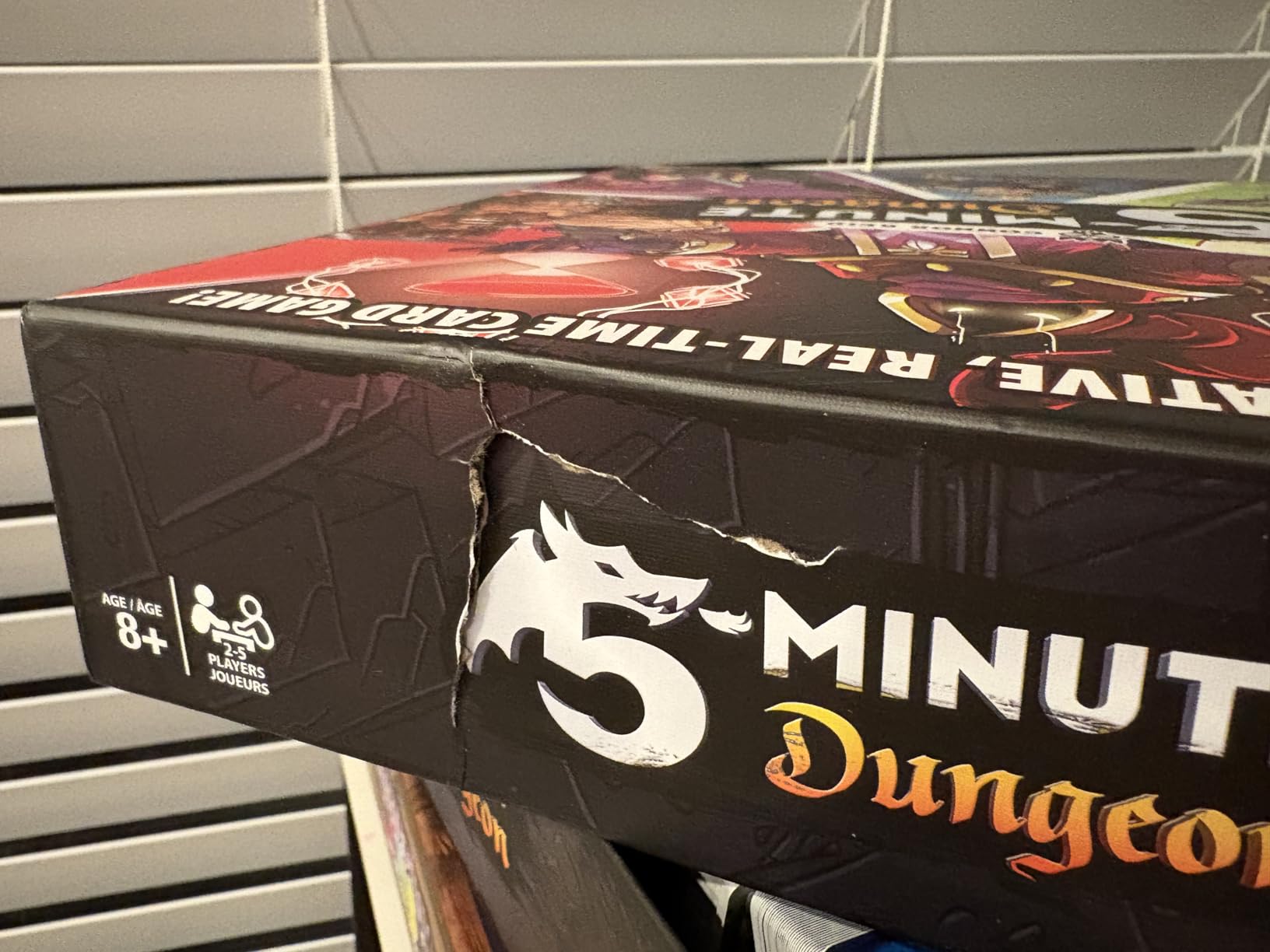
5-Minute Dungeon solves the flaw that kills most cooperative games with younger kids: turn order. Everyone plays simultaneously in real time, so there is no queue of bored children watching one person think. The recommended age is 8 and up, players are 2 to 5, and a round ends in about five minutes.
Real-time cooperative play is unusual, and it changes the social dynamics completely. Nobody can coast through a turn, because the board moves while you are deciding. Families reviewing it consistently mention that this is what keeps a young child engaged and that adults and kids are all fully occupied at once.
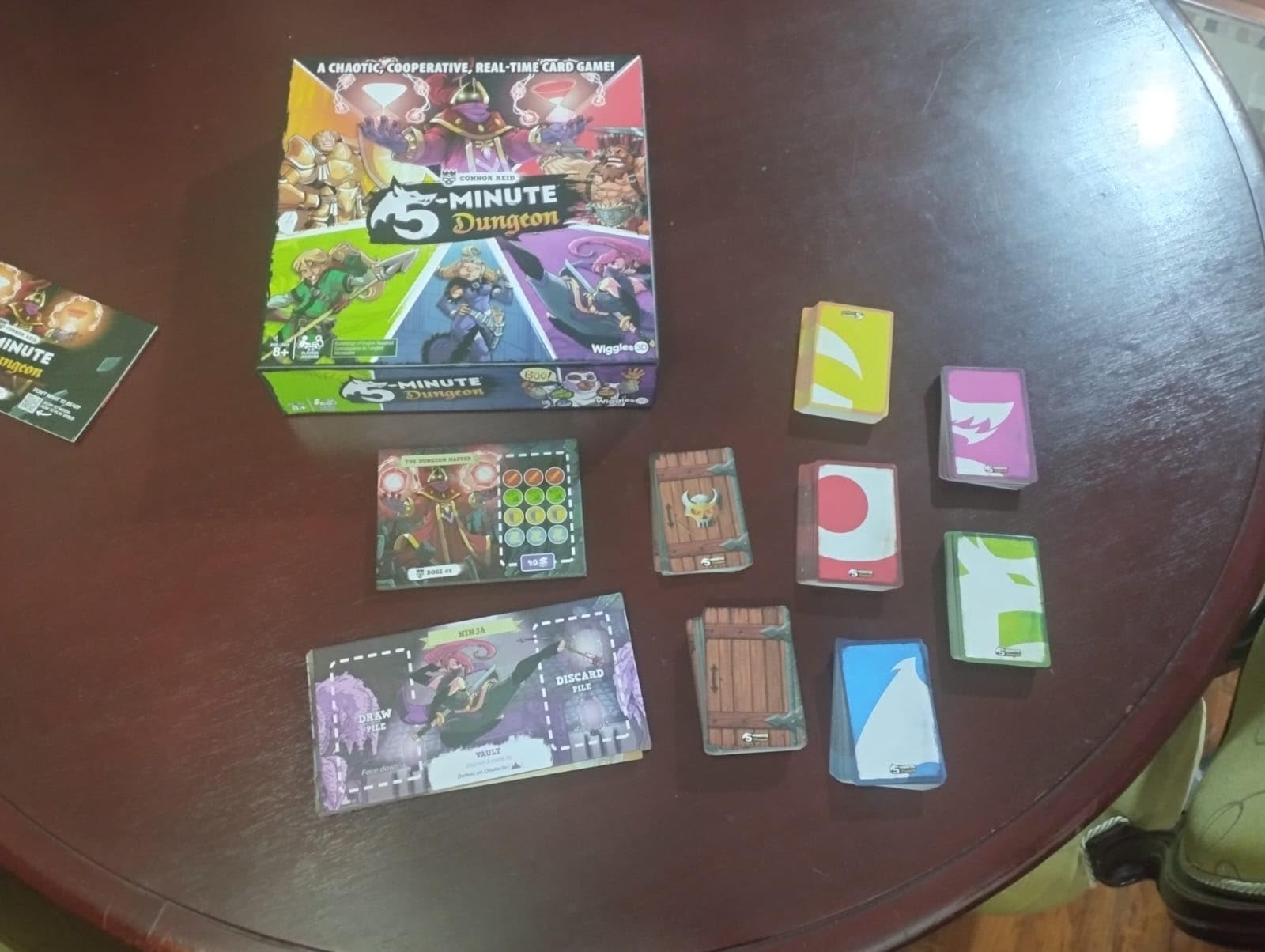
What the box contains and what it needs
Wiggles 3D lists 275 cards, 5 double-sided hero mats and 3 double-sided boss mats, weighing 2.2 pounds in a 10.5 by 10.5 by 2.5 inch box. There is a free timer app for Android and Apple with six themed narrators, which is where the atmosphere comes from, and the rulebook is a digital PDF.
With 275 cards and six bosses, the replay value is real rather than decorative. A group can play a single boss in a waiting room and lose an hour without touching a screen, which is the use case that sold us on it during testing.
The friction points
Shuffling between rounds is the most common complaint, and it is real. With 275 cards and mats to reset, a five minute round can be preceded by several minutes of setup, and in our kitchen that setup was the single biggest reason a session ended early.
Some text-heavy cards need an adult to read and explain, and reviewers report the final boss is difficult to beat once a younger fourth player joins. At ages 8 and up this is the most grown-up cooperative game in the roundup, so it works best as a step up rather than a starting point.
12. National Geographic My First Safari – The Best Cooperative Game With Adjustable Difficulty
National Geographic My First Safari Cooperative Board Game for Kids
Cooperative safari for 4 players
Three difficulty levels
Learning guide on 21 animals
Ages 4 and up
+ Pros
- Three difficulty levels that grow with the child
- No child owns a piece so the family must succeed together
- Animal facts arrive naturally during play
- Quick rounds young children can finish
- Cons
- Small explorer figures bend and are hard to seat in their stands
- Limited strategic depth for experienced players
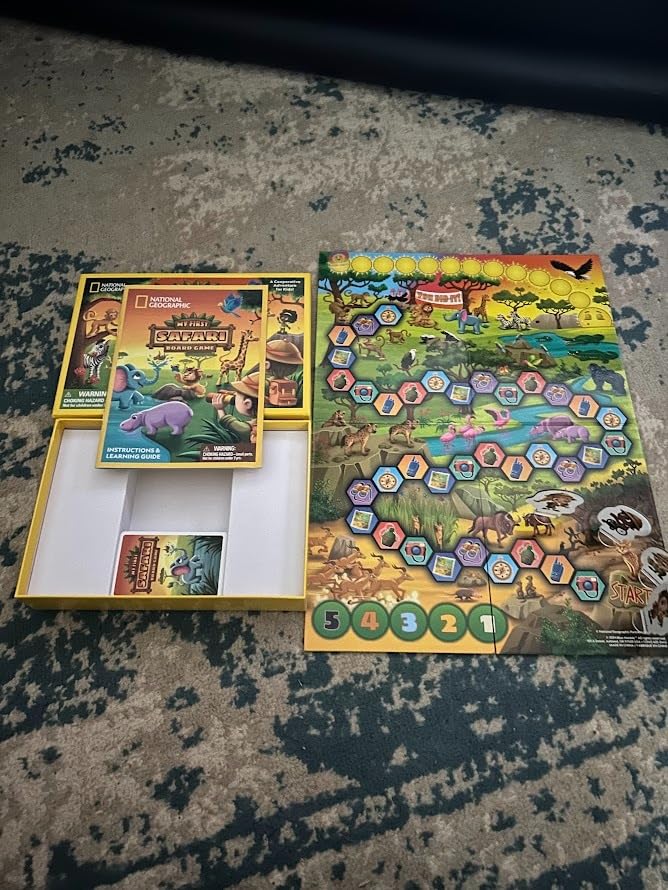
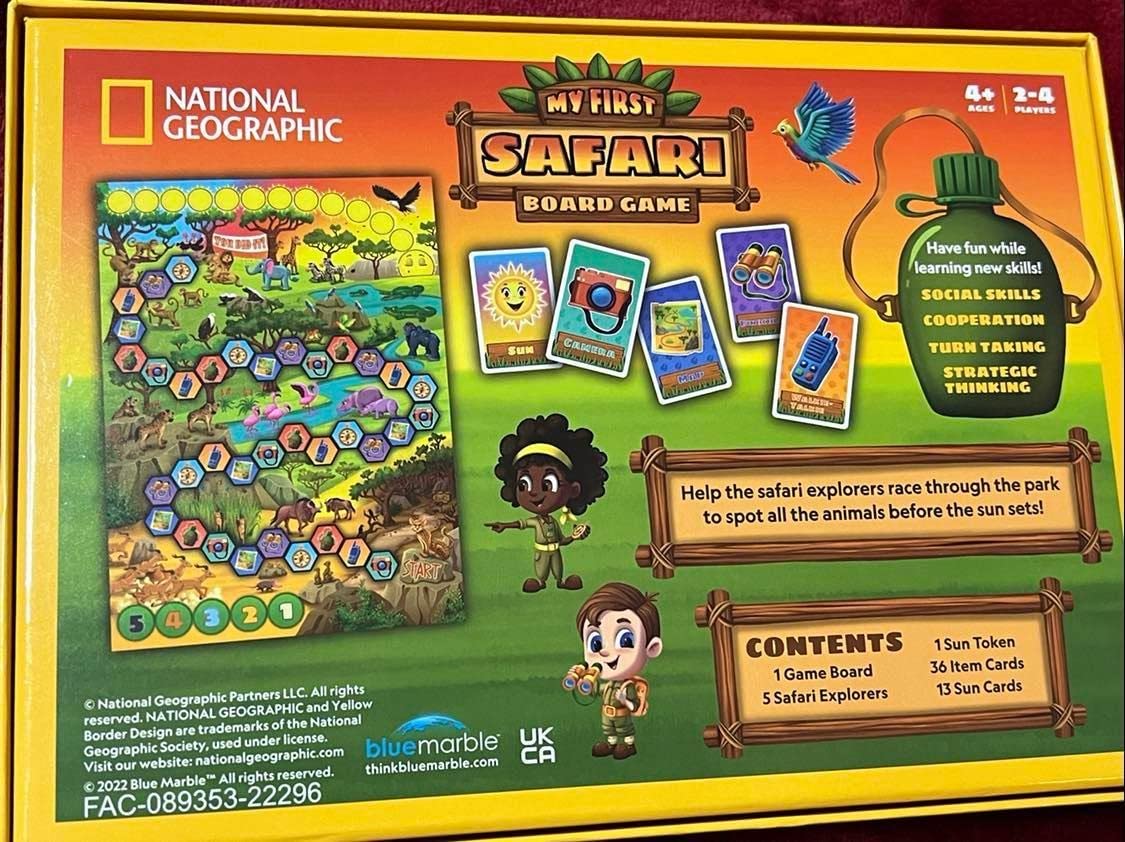
My First Safari is the smallest review sample in this roundup at 341 reviews, and it is included because of one feature nothing else here has: three difficulty levels. The idea is a cooperative safari where the whole table must move all five explorers to the camp before the sun token runs out, and the sun advances more aggressively at the higher levels. Blue Marble recommends ages 4 and up for four players.
The ownership design is the other reason it stands apart. No child has a personal explorer, so nobody can be dragged and nobody is the hero. Reviewers point at exactly this, saying the whole family has to succeed together rather than one child carrying the others.
The learning layer
The box includes a full-color learning guide covering 21 animals, and the educational objectives are cooperative learning through play and strategic thinking. Parents and teachers mention that the animal facts arrive without the game feeling like school, which is the balance most educational board games fail to strike.
Components are 1 game board, 5 safari explorers, 1 sun token, 36 item cards, 13 sun cards and the learning guide, on a 9.06 by 6.5 by 1.57 inch board weighing 15.52 ounces. Three difficulty levels mean the same box can carry a four-year-old and a seven-year-old by changing one setting.
The honest weakness
The little explorer figures are the problem, and reviewers describe it in specific terms. They are difficult to fit into their stands and they bend during play, which is frustrating in a game where five of them are in constant motion. The other limitation is strategic depth for players who enjoy heavier games.
With a 4.6 rating and a much smaller review base than the rest of this list, treat it as a strong option with a component caveat rather than an unquestioned recommendation.
How to Choose a Cooperative Board Game Your Kids Will Actually Finish
Most cooperative games do not fail because they are badly made. They fail because they were bought for the wrong age, the wrong table size, or the wrong attention span. Here is the filter I use, in order.
Match the age to the youngest player, not the oldest
The number on the box is a floor, not a target. If your youngest cannot read, cross off anything that does not say no reading required, and check the cards for pictures rather than text. That single filter removes Minecraft Heroes of the Village and 5-Minute Dungeon from a family with a five-year-old, and both are excellent once kids are old enough.
Look past the printed age and ask what the child actually does during a turn. In Outfoxed, a five-year-old turns the decoder wheel and points at pictures while an adult reads, which is a real contribution. In a game with 275 text-heavy cards, that same child is a passenger.
BoardGameGeek threads on co-op for kids return the same names again and again for the preschool end of the range, with Hoot Owl Hoot and Race to the Treasure singled out for ages 3 to 6, and Outfoxed widely described as a first deduction game from age 5. That consensus is worth more than any single product listing, and it is why the first four games in this roundup all sit in that band.
Check the player count against your real table
Player count is the most commonly misread number on a cooperative box. Two to four does not mean four is ideal, and a five-player game that stalls with three is a wasted purchase. Mermaid Island scales properly because more players simply means more movement per round.
For two-player homes, the real question is whether the game needs a third player to function. Cooperative games with shared resources can deadlock with two people, so read a review or two from smaller families before committing.
Read requirement beats every other feature at young ages
Pre-readers can play a surprising amount, but only if the game does not encode information in words. Games built on image cards, such as Baby Dinosaur Rescue and My First Castle Panic, let a four-year-old play an entire round unaided, and that independence is worth more than a deeper mechanic.
Weight and complexity decide whether a game lasts past month three
Complexity is usually described as a 1 to 5 scale, where 1 is a two-year-old’s game and 5 is a heavy strategy box. A good cooperative game for kids sits around a 1.5, which is to say it teaches planning without demanding long chains of reasoning.
Replayability is the second half. A game with a fixed puzzle, such as Race to the Treasure, can be solved in a handful of plays. A game with randomized setup, such as Minecraft Heroes of the Village, gives you a new problem every time. Ask yourself how many sessions you want the box to survive and match the answer accordingly.
Handle the alpha gamer without ruining the fun
Every family hits this: one child, usually the oldest, takes over every decision and the others become spectators. The best cooperative game for kids solves this structurally rather than through rules. Games with shared pieces and no personal goals, such as My First Safari, remove the problem entirely. Games with real-time play, such as 5-Minute Dungeon, remove it because nobody has time to take over.
For path-building games, the fix is procedural. Make every tile placement a show of hands where the majority decides, and make the child who suggested the losing tile the one who has to explain why it failed. You get the same lesson without a confrontation.
Travel, solo play and storage
Two questions come up constantly and rarely get answered. For travel, look at box thickness and stated portability: Race to the Treasure at 12.5 by 1.5 by 9 inches and 16 ounces packs flat, while anything with a wooden insert and a large board does not. For solo play, check the player count minimum rather than assuming, since many cooperative games lose their tension with one player even when the box allows it.
Finally, storage. Twelve cooperative games stacked in a closet is a real problem in a family with one shelf. Narrow boxes and small footprints are undervalued features, and I have moved two of ours off the game shelf entirely to make room for something we actually play.
Frequently Asked Questions
What are some good co-op games for kids?
For ages 4 to 6, Hoot Owl Hoot! and My First Castle Panic are the easiest starting points because neither requires reading. For ages 5 and up, Outfoxed! is the strongest all-rounder, working for kids and adults in the same session. For ages 7 and up, Minecraft Heroes of the Village adds genuine strategic depth with a map that changes every playthrough.
What are the top 10 cooperative board games?
Our ten highest-rated options are Outfoxed!, Hoot Owl Hoot!, the Bluey Scavenger Hunt Board Game, Race to the Treasure!, HABA First Orchard, Mermaid Island, Minecraft Heroes of the Village, Wildcraft!, My First Castle Panic and Baby Dinosaur Rescue. All ten are rated 4.6 or above by owners, and every one finishes inside about 25 minutes.
What are some fun cooperative games for children?
Fun comes from tension without opposition. The best cooperative board games for kids give the group a shared threat, such as the ogre in Race to the Treasure!, the lava in Baby Dinosaur Rescue or the Sea Witch in Mermaid Island, so kids feel pressure without anyone being the reason the team failed.
What are some good two-player board games for kids?
Outfoxed! and Wildcraft! both work well with two players, and Wildcraft! is listed for 1 to 4. My First Safari runs on a shared board where the whole table moves all five explorers, so two children can cooperate without the board feeling half empty.
What age can kids play cooperative board games?
Most cooperative games in this roundup start at ages 4 or 5, and HABA First Orchard is rated for ages 2 to 4. Beyond age 8, options widen considerably with 5-Minute Dungeon for real-time play and Minecraft Heroes of the Village for strategy. The box age is a floor, so check whether the youngest player can read the cards.
The Verdict: Which Cooperative Game Starts Your Collection
If your youngest is two or three, start with HABA First Orchard, because nothing else in this list gives a child that age a real turn. From age four, Hoot Owl Hoot! teaches the format with almost no words. Once kids can read and handle a decoder wheel, move to Outfoxed!, and it is the single best cooperative board game for kids across mixed ages that we found in 2026.
For a table that skews older or wider, choose based on the specific problem you are solving. A child who cannot sit still gets the Bluey Scavenger Hunt Board Game. A child who takes over every decision gets My First Safari, where nobody owns a piece. A family of six gets Mermaid Island. A family that hates waiting gets 5-Minute Dungeon. And a family that wants screen time to become knowledge gets Wildcraft!.
Start with one, learn it properly for a month, and only then add a second. A single well-known cooperative game teaches more than four games that never get finished, and the best ones here were the ones that came back out of the box for the twentieth time.