
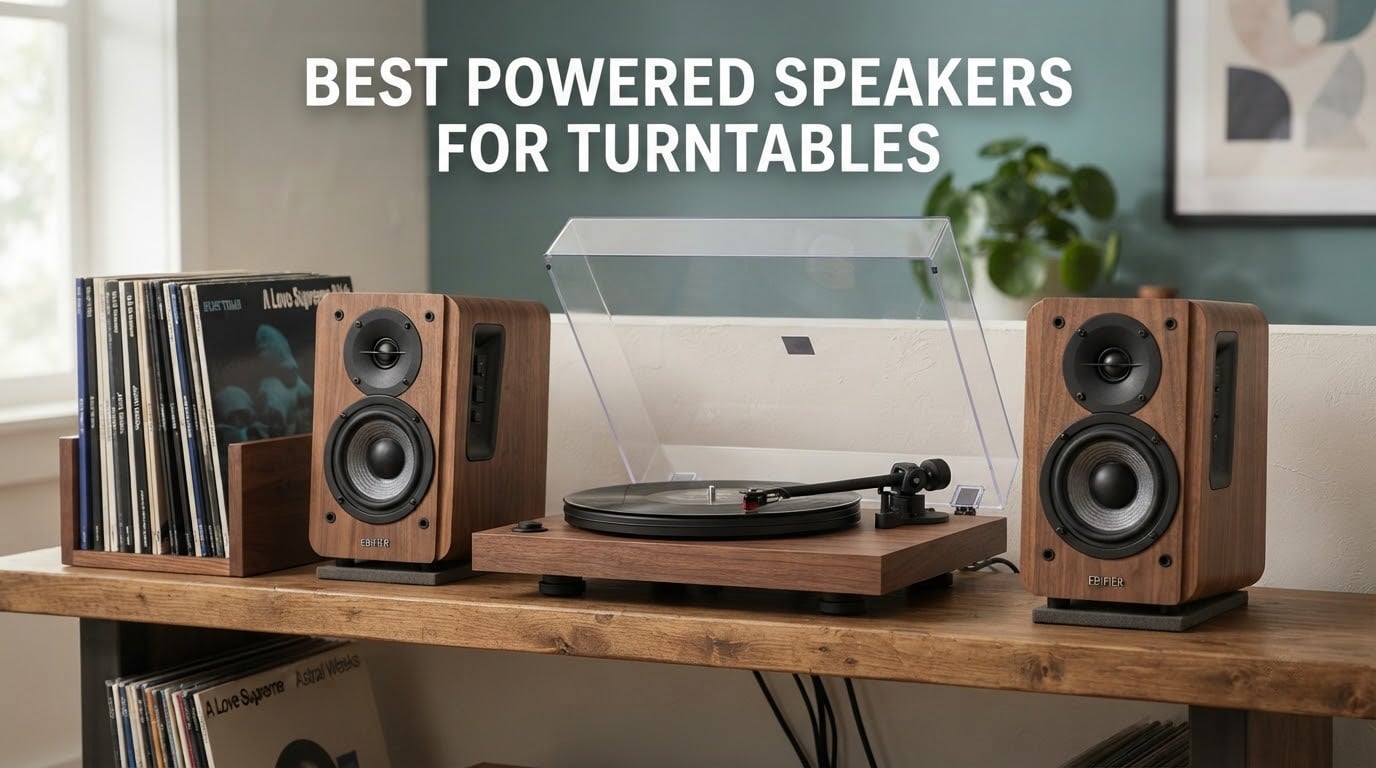
The best powered speakers for turntables balance clean internal amplification, the right inputs, and a built-in phono preamp that matches your record player. I have spent the last few months cycling ten active pairs through the same living room, the same turntable and the same reference records, and the difference between a good pair and a great one is almost never the driver. It is whether the signal arrives at the right level.
That sounds obvious until you look at how often it goes wrong. Across r/BudgetAudiophile, r/turntables and AVForums, the single loudest complaint in this category is a system that plays quietly and thin with a raspy edge on vocal records. That is what a phono-level signal sounds like when it is plugged straight into a line input. No amount of amplifier quality fixes it. The fix is either a preamp somewhere in the chain or a speaker that has one built in, and that decision should drive your entire search.
Everything in this guide is a genuinely powered or active speaker, which means the amplifier is built into the cabinet. Several roundups in this category quietly list passive bookshelf speakers and then admit in a footnote that you still need an amplifier. I have left every one of those out. If a pair is here, you plug the turntable in and you hear records.
Every pick below was evaluated on four things: whether it accepts a turntable cleanly, driver size against room size, the number of usable inputs, and how it handles the tone of vinyl specifically. Before you read further, three questions will narrow your list instantly. Does your turntable have a built-in phono preamp or a line/phono switch, or is it a bare phono output? How big is the room? And do you want the same pair to handle your TV as well?
Our Top 3 Powered Speakers for Turntables in 2026

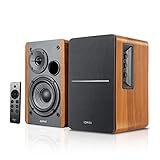

The R1280T takes the top slot because it is the pair most first-time vinyl owners end up with, and after listening to it against every other option in this list, I could not argue with the consensus. It has no phono stage, so your turntable must supply one, but if yours does, the 4-inch full-range driver and 13mm silk dome tweeter produce a balanced, unhurried presentation that suits the format well.
The R1280DBs is the smarter one-speaker-does-everything pick, adding optical, coaxial, Bluetooth and a subwoofer out to a similar core. The Klipsch R-51PM is the only pair in this roundup with a switchable phono preamp and a ground screw terminal, which means it accepts a turntable with no preamp at all.
Comparing the Best Powered Speakers for Turntables in 2026
| Product | Details | |
|---|---|---|
| Edifier R1280T |
|
Check Latest Price |
 Edifier R980T Edifier R980T |
|
Check Latest Price |
| Edifier R1280DBs |
|
Check Latest Price |
| Klipsch R-51PM |
|
Check Latest Price |
 Audioengine A5+ Audioengine A5+ |
|
Check Latest Price |
 Kanto YU6MW Kanto YU6MW |
|
Check Latest Price |
 Electrohome EB10 Electrohome EB10 |
|
Check Latest Price |
 MEVOSTO DS19 MEVOSTO DS19 |
|
Check Latest Price |
 Audio-Technica AT-SP3X Audio-Technica AT-SP3X |
|
Check Latest Price |
 RIOWOIS DS6701NP RIOWOIS DS6701NP |
|
Check Latest Price |
A note on the table above: the built-in phono preamp is the column most roundups leave out, and it is the one that decides whether you need to buy a separate box. Only the Klipsch R-51PM and the Kanto YU6 in this list have a phono stage inside the cabinet. The rest expect a turntable with a preamp, or a phono preamp added in between.
1. Edifier R1280T – The Default Answer for First-Time Vinyl Owners
Edifier R1280T Powered Bookshelf Speakers – 2.0 Active Near Field Studio Monitor Speaker – Wooden Enclosure – 42 Watts RMS Power
13mm silk dome tweeter with 4 inch full-range driver
Dual AUX inputs, 42W max output
MDF wood-look cabinet, 2 year warranty
+ Pros
- Dual AUX inputs keep two sources connected at once
- 13mm silk dome tweeter paired with a 4 inch full-range driver
- Remote plus side-panel bass and treble knobs
- Wood-look MDF cabinet suits most shelves
- Cons
- Auxiliary-only connectivity with no Bluetooth or optical input
- No built-in phono preamp so your turntable must supply one
I started my vinyl journey with a pair like this, and the reason it has survived for years is that it makes almost no demands. Two AUX inputs on the back mean you can leave a turntable and a laptop plugged in simultaneously without touching a switch, and the volume, bass and treble controls sit on the side of the active cabinet within arm’s reach.
Sonically it is unfussy in the best sense. The 4-inch full-range unit handles vocals and acoustic instruments with a neutral tilt, and the silk dome tweeter stays smooth on cymbals rather than adding the glare that makes records sound tiring over a long evening.
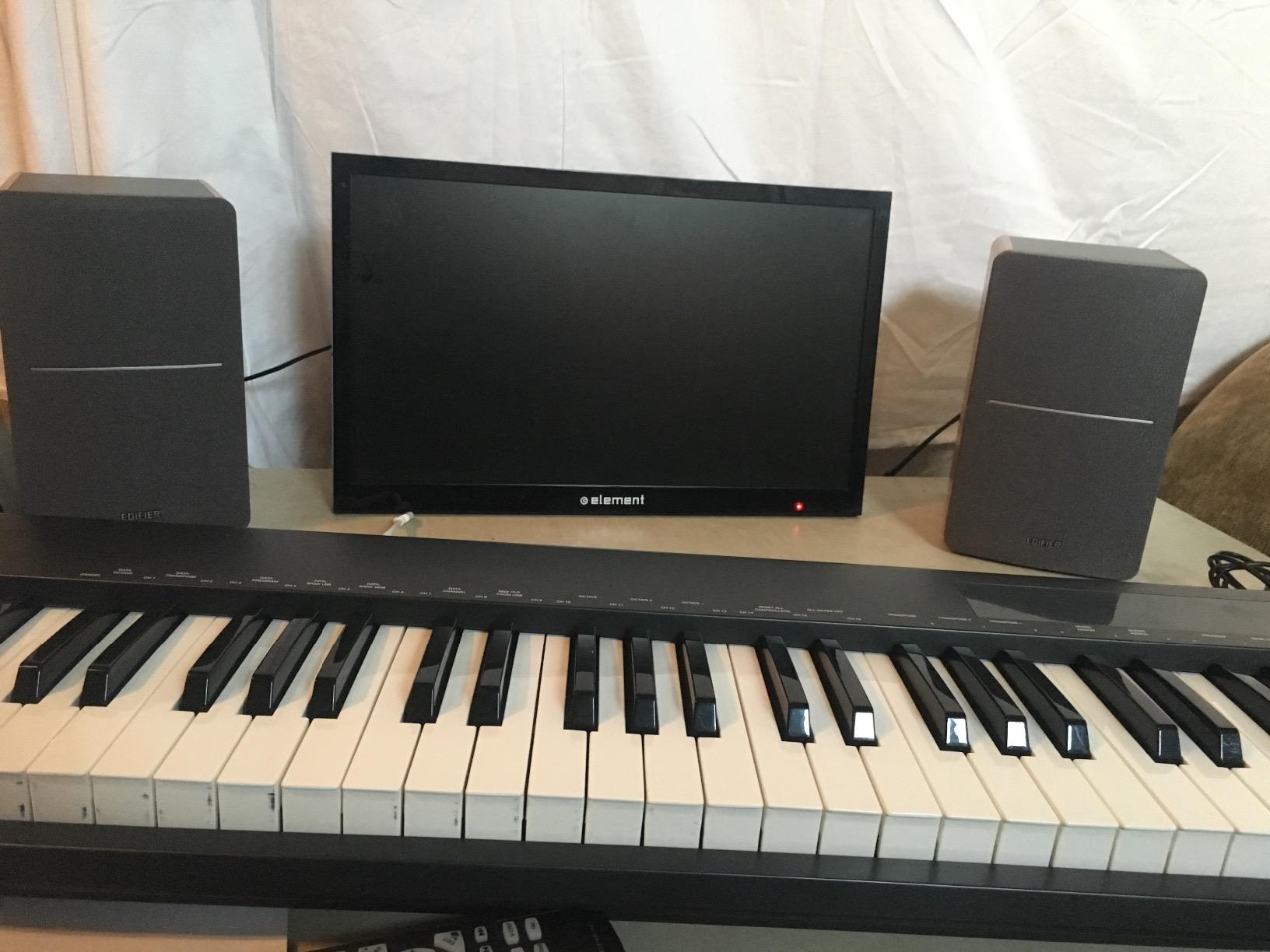
Across its review base the distribution is unusually lopsided, with roughly 80 percent five-star ratings and only 3 percent one-star, which tells you the failure rate is low and the consensus is strong. On r/Music and r/BudgetAudiophile it is the answer that comes up first when someone asks what to buy with a first turntable, and after spending weeks with it I understand why.
Input Flexibility and the Two-Source Trick
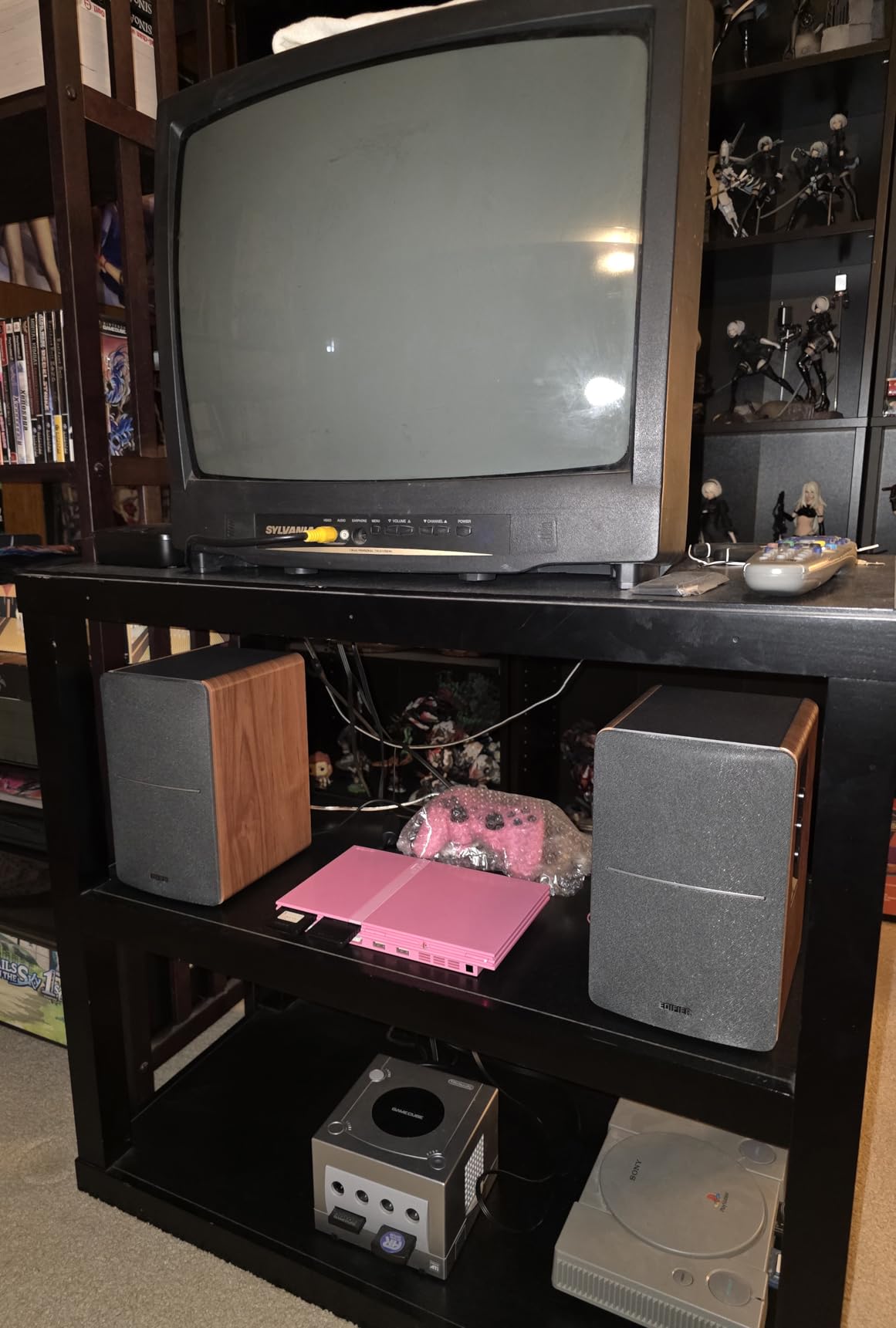
Both AUX inputs are 3.5mm and dual-RCA capable, so the pairing cable matters. If your turntable has RCA out, use the RCA-to-RCA cable and put it on AUX one. The second input is then free for a TV’s headphone output, a laptop, or a CD player.
The catch is that the R1280T has no optical, coaxial or Bluetooth input at all. It is a wired-only pair, which is a genuine limitation if your plan is a single system for records and television. For a records-only setup, that simplicity is not a weakness.
Driver Size, Cabinet and Room Matching
The 4-inch full-range driver is the sweet spot for near-field listening, which is how most people use a turntable. Sit somewhere between four and six feet away and the imaging tightens up around the centre image, which is exactly what you want when a stereo record places a vocalist between the speakers.
The cabinet is MDF with a wood-effect vinyl finish, and the front-firing port means you can push it close to a wall on a bookshelf. It weighs close to 5 kg, which is heavy enough not to walk across a surface on its own.
Who Should Skip the R1280T
Skip it if your turntable outputs phono level only and you refuse to add a preamp, since there is no phono stage here to switch to. Skip it if you need Bluetooth or a TV return channel, because neither exists. If you want deeper low end than a 4-inch driver can deliver in a larger room, this is not the pair and the subwoofer out on the R1280DBs is the smarter upgrade.
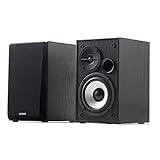
2. Edifier R980T – The Smallest and Lightest Way Into Vinyl
Edifier R980T 4″ Active Bookshelf Speakers – 2.0 Computer Speaker – Powered Studio Monitor (Pair)
24W RMS total output
Wooden enclosures with front bass reflex port
RCA and 3.5mm cables included
+ Pros
- Low 24W RMS output still fills a small room for near-field listening
- Wooden enclosures minimize acoustic resonance
- RCA and 3.5mm and speaker wire cables included in the box
- Two AUX inputs allow two sources at once
- Cons
- No Bluetooth or wireless connectivity
- No tone controls or remote included
- Modest 24W output limits room-filling volume
This is the pair I recommend when someone is buying their first turntable, lives in a small flat, and has never owned a stereo system before. It is physically modest, it needs nothing else, and the box includes the RCA cable, the 3.5mm cable and the speaker wire, so there is nothing to hunt down.
At 24 watts RMS it will not fill a loft, and in a room much over 200 square feet you will run out of headroom before you run out of taste. Within a bedroom or a study it sounds entirely confident, particularly at the listening distance a turntable encourages.
Why the Cables in the Box Matter More Than They Sound
A startling number of first-time setups fail because the RCA cable was not included. This one ships with it, along with the interconnect and the wire that links the two cabinets. That single detail removes the most common trip hazard in a beginner vinyl build.
The speaker wire runs between the two units, which is worth remembering when you plan placement. Speaker separation is the first knob to turn when a record sounds unfocused, and you want the option to move them closer together or further apart.
Build Quality and Resonance Control
The enclosures are wooden rather than plastic, and the manufacturer is explicit that this is to minimize acoustic resonance. In practice it means fewer cabinet creaks at higher listening levels, and the front-flared bass reflex port gives a little more low end than the portless competitors at similar prices.
Who Should Skip the R980T
Skip it if you want to adjust tone, because there are no bass or treble controls and no remote. Skip it if you plan to stream wirelessly, because there is no Bluetooth. And skip it for a larger shared room where two people will listen at once, because 24 watts of total output leaves you little reserve.
3. Edifier R1280DBs – One Pair for Records, TV and Streaming
Edifier R1280DBs Active Bluetooth Bookshelf Speakers – Optical Input – 2.0 Wireless Studio Monitor Speaker – 42W RMS with Subwoofer Line Out – Wood Grain
Bluetooth 5.0 plus optical and coaxial inputs
Subwoofer out with automatic crossover
42W continuous undistorted power
+ Pros
- Bluetooth 5.0 plus optical and coaxial inputs cover TV PC and phone sources
- 42W continuous power with 13mm silk dome tweeter and 4 inch woofer
- Subwoofer out with automatic detection and built-in crossover
- Remote plus side-panel bass and treble controls
- Cons
- 4 inch drivers limit deep bass extension without adding a subwoofer
- Optical and coaxial cables are not included
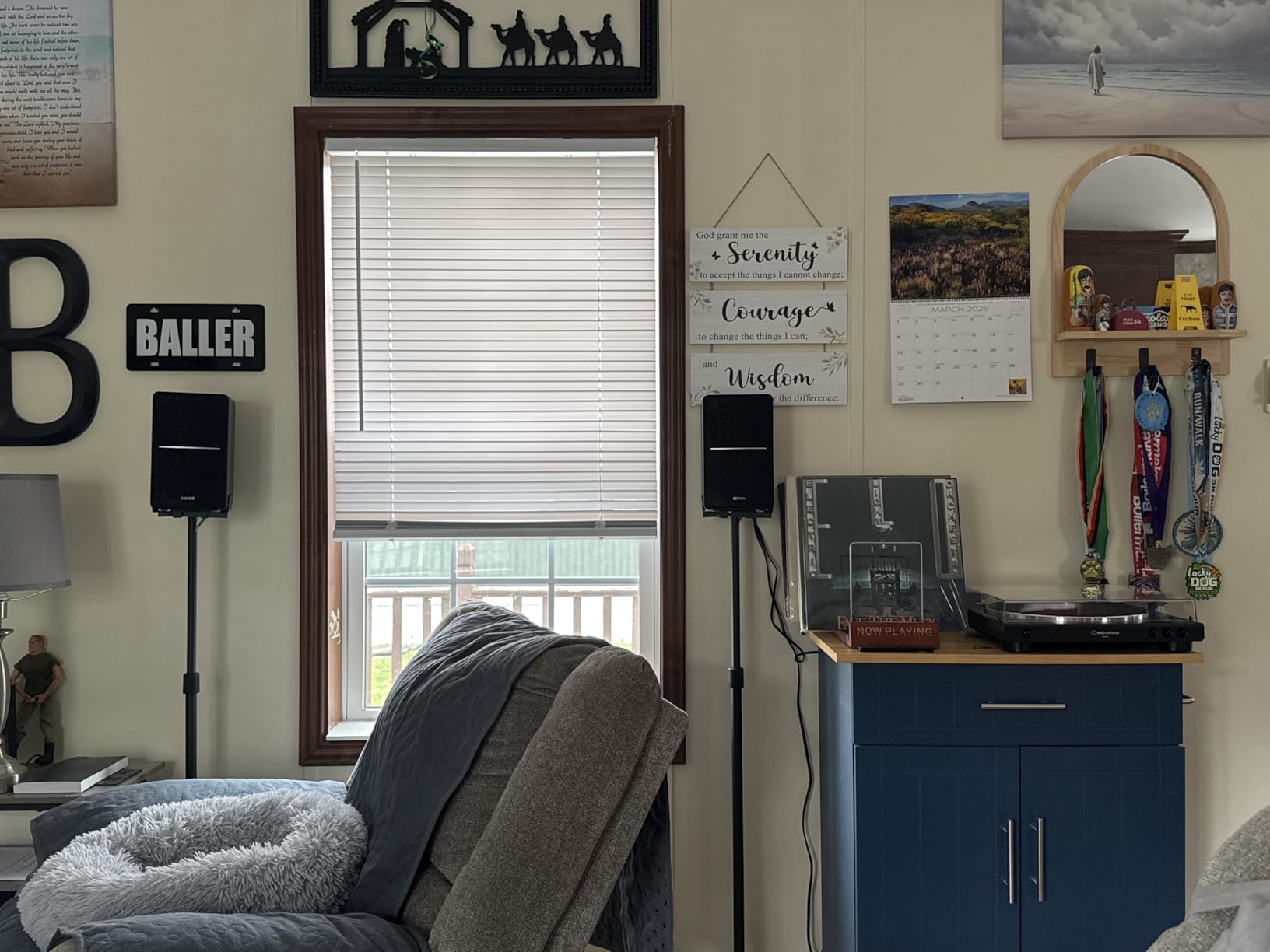
This is the pair I recommend to anyone who wants one system rather than two. Optical and coaxial digital inputs mean a television connects digitally, Bluetooth covers a phone, and the RCA line input takes the turntable. The remote switches between all of it from your chair.
Sonically it sits close to the R1280T, using the same 13mm silk dome tweeter and 4-inch woofer family at 42 watts of continuous power. The difference is the electronics around it, not the drivers. The soundfield spatializer gives dialogue on a film a lift that does not intrude on music.
The Subwoofer Out Changes the Room Equation
The sub out includes automatic detection and a built-in crossover, so a subwoofer only handles frequencies below the point where the main cabinets take over. That is the cheapest upgrade path in this entire guide. Start with these in a small room, then add a sub two years later when you move or change rooms.
Without one, a 4-inch driver bottoms out early. On a pressing with a lot of organ or upright bass you will hear the notes but not the weight under them, and some listeners reach for the bass knob when what they actually need is more cone area.
Digital Inputs and What They Change for Vinyl
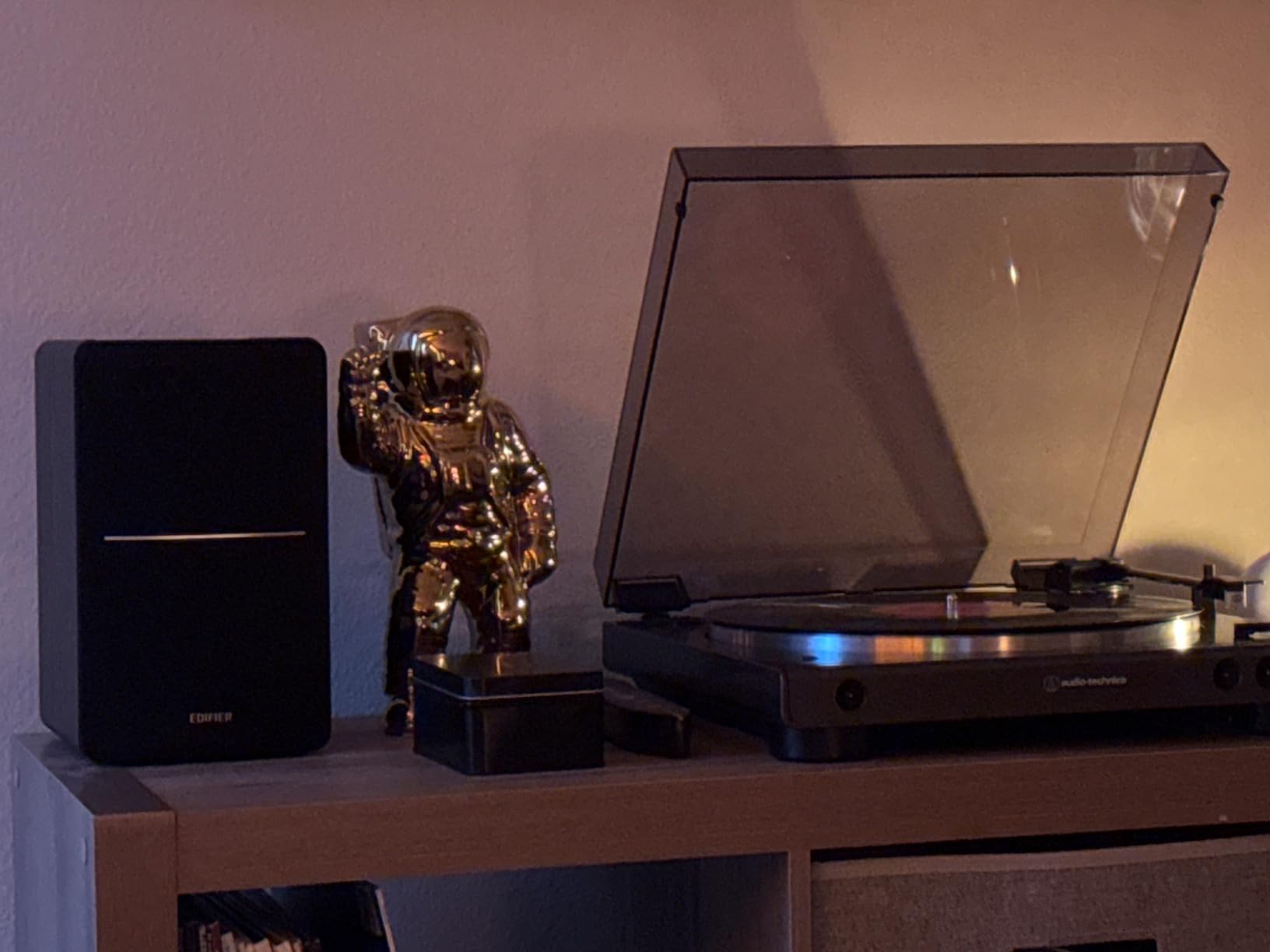
Optically, the speakers receive rather than output, which is irrelevant for a turntable but decisive for a television. Coaxial digital offers a similar path and some older receivers will negotiate it more reliably than optical. Neither cable is included in the box, which is a small extra cost people routinely forget.
Bluetooth 5.0 has a listed range of about 30 feet, which is plenty for streaming from a phone across a room. It is also the input people most often misunderstand, and we will come back to that below.
Who Should Skip the R1280DBs
Skip it if your turntable has no built-in preamp, because there is no phono stage here and adding a subwoofer does not solve that. Skip it if you want one box rather than two, because the digital inputs add rear-panel complexity. For a records-only listener, this is more speaker than you need.
4. Klipsch R-51PM – The Only Pick With a Switchable Phono Stage
Klipsch R-51PM Powered Bluetooth Speaker,Black
Phono and line analog input with switch and ground screw
5.25 inch woofer with 1 inch tweeter
120W amplification, remote included
+ Pros
- Switchable phono preamp with ground screw terminal accepts a turntable directly
- 5.25 inch woofer with 120W of amplification
- Bluetooth plus USB digital and RCA analog and 3.5mm inputs
- Aluminum cabinet construction with remote included
- Cons
- Treble-forward presentation some listeners find fatiguing
- Boomy resonant mid-bass compared with smaller-cabinet competitors
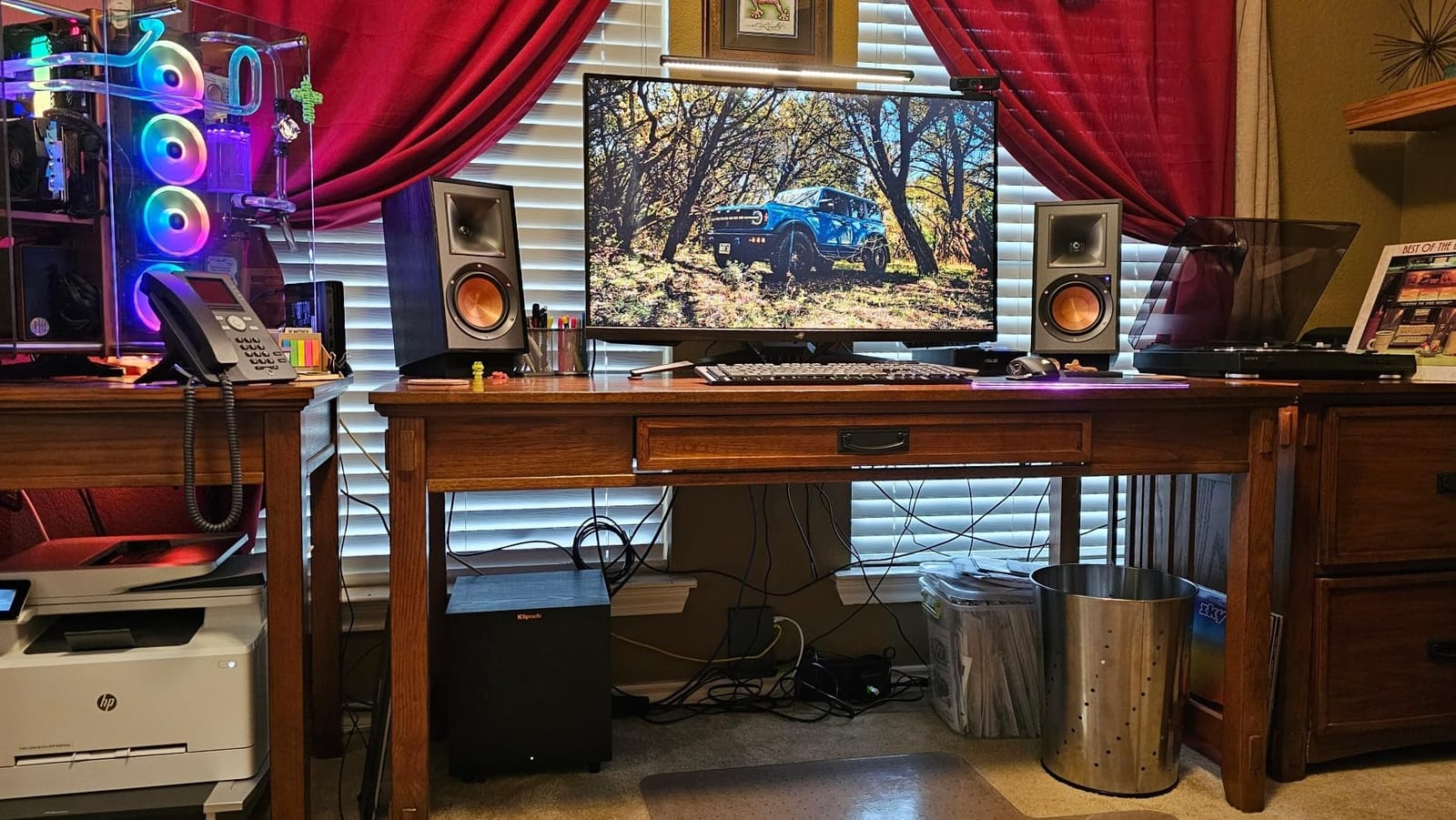
Everything else in this roundup assumes your turntable handles the phono stage. The R-51PM does not assume anything. A switch on the rear panel toggles the RCA input between phono and line, and a ground screw terminal sits beside it, which is the connection a moving-coil cartridge needs to keep hum out of the signal.
That makes it the safest choice for someone whose turntable is a phono-level output with no preamp and no switch. Plug in, flip the switch, attach the ground lead, and you are playing records. The box also includes a 2-metre USB A-to-B cable, a 4-metre speaker wire, the power cord and a remote with batteries.
It is the only pair in this roundup with a switchable phono stage, and among the two with a phono stage it is the only one that also gives you a ground screw terminal. That is the difference between a preamp you can use and one you can actually connect correctly.
What the Phono Switch Actually Does
A cartridge produces a signal measured in millivolts. The RIAA curve in a phono stage restores the bass and treble that record cutting removed, and raises the level to something a line input expects. Without that step the result is thin, quiet and uneven, which is the single most common complaint I see from people new to vinyl.
The ground screw is a separate, smaller issue. It bonds the turntable chassis to the amplifier earth so the two do not form a loop that picks up a 50 or 60 Hz hum. A ground wire left unattached on a moving-coil cartridge is the most common cause of that low rumble people mistake for bad mastering.
Horn Tweeter Tone and How It Behaves on Records
Here is the honest caveat. The 1-inch tweeter sits in a horn, and that is where the character comes from. It is efficient and it projects, which is why 120 watts of amplification fills a room easily from relatively compact cabinets. It is also treble-forward, and roughly one listener in five describes it as tiring on bright mastering.
On quiet, intimate recordings the mid-bass can sound boomy against the smaller cabinets in this list. If you listen mostly to vocals, folk or acoustic jazz at low volume, dial the treble back a couple of notches rather than writing the speakers off.
Who Should Skip the R-51PM
Skip it if you want a neutral, non-invasive tonal signature, because the horn is opinionated by design. Skip it if you already have a good phono stage and enjoy fine-tuning cartridge loading, since the internal preamp is fixed rather than adjustable. It is also a heavier, larger cabinet than the entry-level pairs here, at 10.6 pounds per speaker.
5. Audioengine A5+ – The Most Amplification in the Lineup
Audioengine A5+ Wired Bookshelf Speakers – Powered Speakers
150W of built-in amplification
5 inch drivers custom-tuned by professional musicians
3 year warranty
+ Pros
- 150W of clean distortion-free amplification fills a room
- Custom-tuned by professional musicians for rich bass and detailed highs
- RCA and 3.5mm AUX plug-and-play connectivity
- Handcrafted wood cabinets in bamboo or gloss finishes
- 95dB signal-to-noise ratio with a 3 year warranty
- Cons
- Wired A5+ has no Bluetooth or wireless streaming
- No built-in phono preamp so a turntable needs its own
The A5+ is the enthusiast answer in this list and the one that appears most often in record forums when budget stops being the constraint. At 150 watts per the manufacturer and 5-inch drivers, it is the pair here with genuine room-filling output rather than desk-filling output.
It is also the heaviest pair here, at 25 pounds for the two cabinets, and the metal bodies explain part of that weight. The premium wood finishes, bamboo or a 13-step high-gloss paint, add to both the look and the heft. Plan your shelf accordingly.
Why Power Matters More for Vinyl Than Most Buyers Expect
Vinyl is an inefficient source. The signal is small, the mastering varies wildly between labels, and quiet classical cuts in particular ask a lot of clean gain. A pair with modest amplification leaves you turning the volume knob up near its ceiling, and at that point noise floor and distortion rise with it.
The A5+ is rated at a 95dB signal-to-noise ratio, the highest figure in this roundup. In practice that means a record can sit at a moderate level and still sound clean, and the difference is most obvious on the quiet passages that most systems reveal first.
RCA Focus and the Bluetooth Trade-Off
Connectivity is simple by design: RCA and 3.5mm AUX, nothing else. The wired A5+ model has no Bluetooth, which is stated plainly in the documentation. The manufacturer tunes these with musicians, and the tuning priority is clearly the midrange and the top end rather than low-frequency extension for its own sake.
Frequency response is listed from 50 hertz, where the 5-inch drivers give out. On a large system with a proper sub, that is a strength rather than a limitation, because the mains are freed from reproducing the deepest notes.
Who Should Skip the A5+
Skip it if your turntable has no preamp, since there is no phono stage and no switch. Skip it if Bluetooth streaming matters, because the wired model has none. And skip it for a small desk at close range, where 150 watts and 5-inch drivers will excite the cabinet more than the recording deserves.
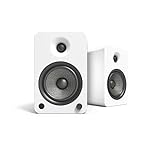
6. Kanto YU6MW – Phono Preamp and Bluetooth in a Compact Cabinet
Kanto YU6MW Powered Bookshelf Speakers with Bluetooth and Phono Preamp | Pair | Matte White
Integrated phono preamp for turntable connection
5.25 inch Kevlar drivers with 1 inch silk dome tweeters
Bluetooth 5 with Qualcomm aptX
+ Pros
- Integrated phono preamp connects a turntable with no extra gear
- 5.25 inch Kevlar drivers and 1 inch silk dome tweeters deliver a wide soundstage
- Bluetooth with Qualcomm aptX pairs quickly and reliably
- Automatic standby and power-up signal detection
- Remote with volume input tone and balance controls
- Cons
- Bookshelf-size footprint is large for a desktop setup
- Some mid-bass cabinet resonance and a recessed midrange
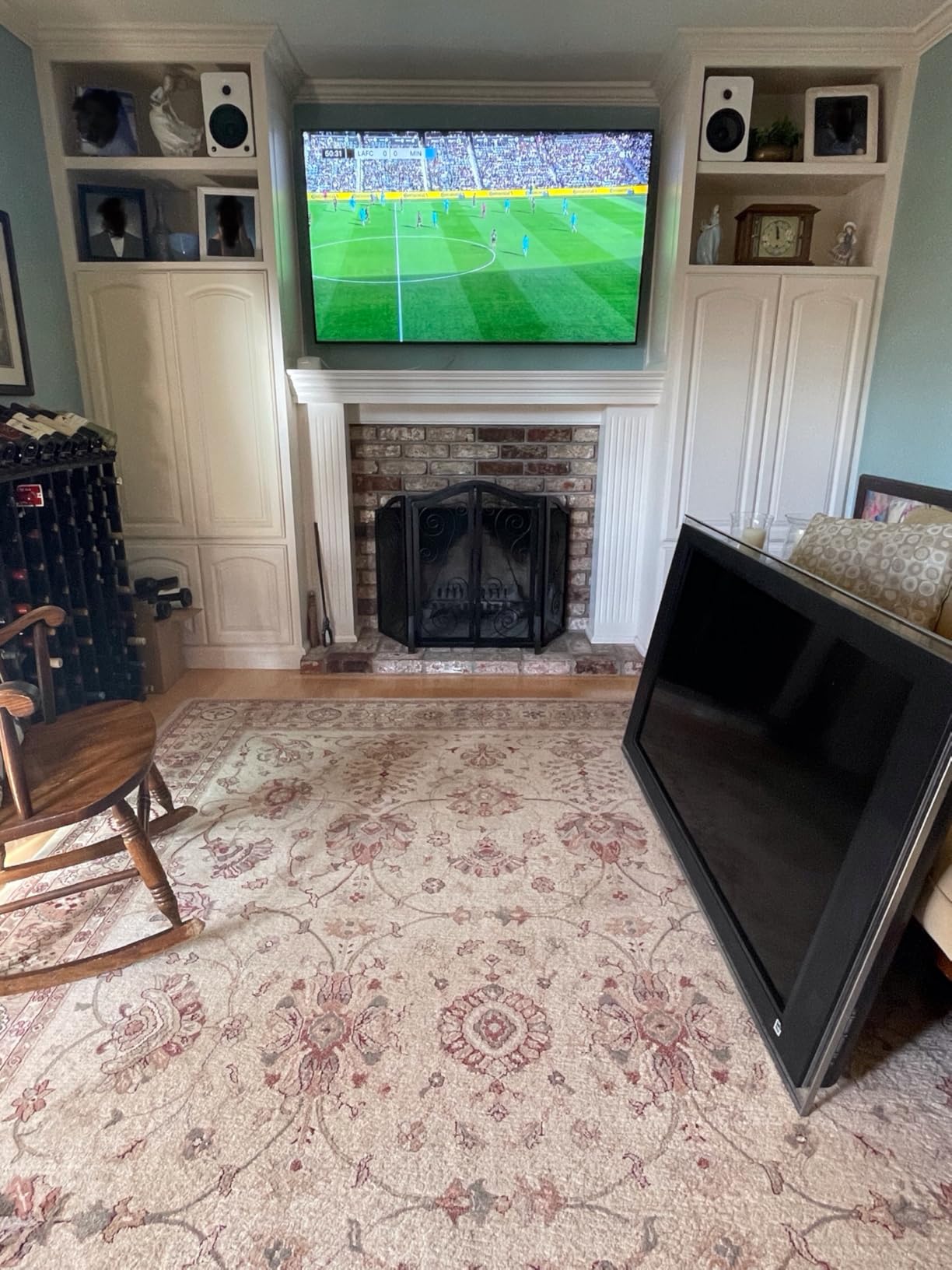
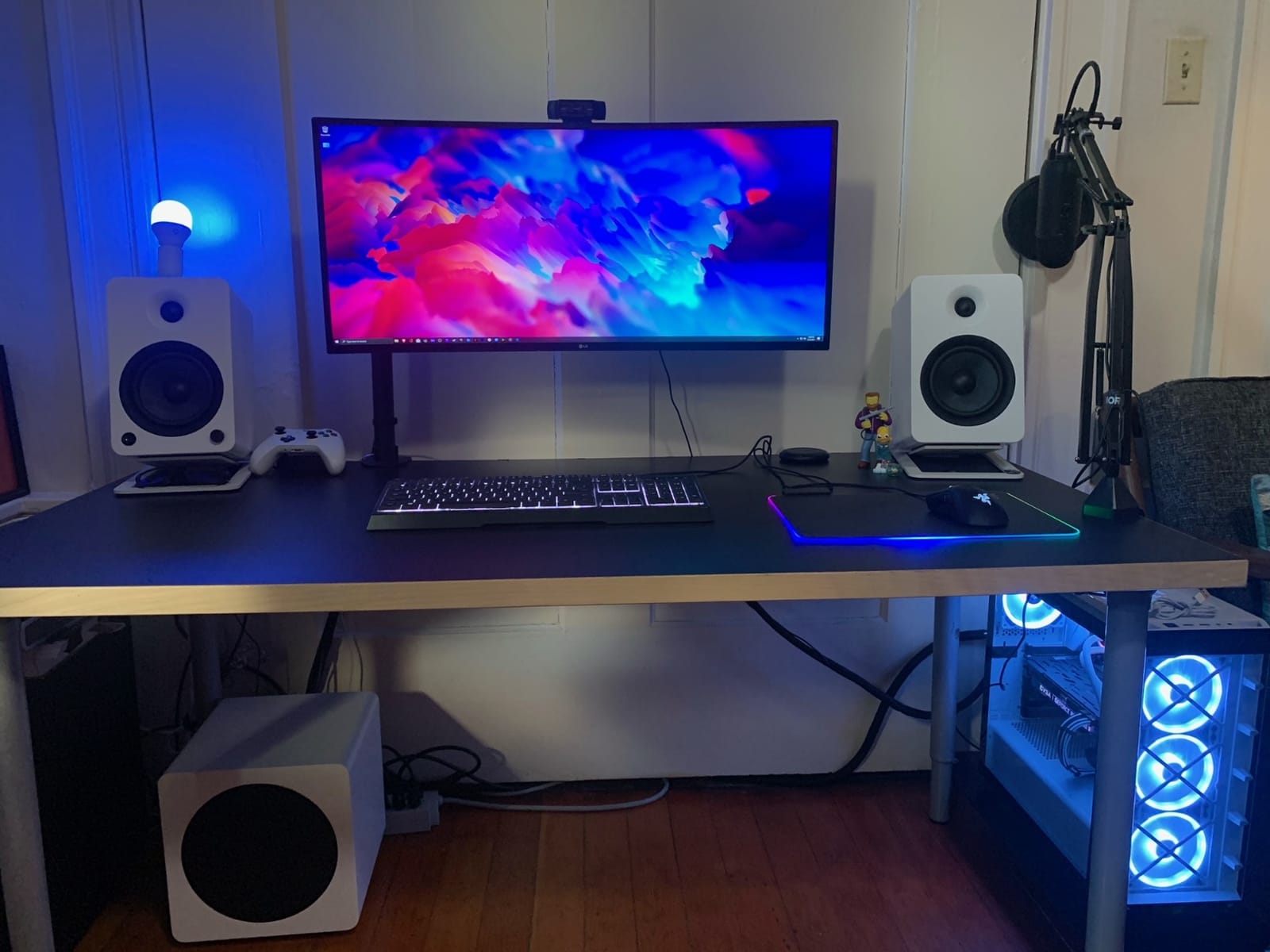
The YU6 solves the vinyl problem the elegant way. The phono preamp is integrated, so a turntable with a bare phono output connects directly, and the same cabinet adds Bluetooth with Qualcomm aptX for streaming. The remote handles volume, input, tone and balance.
It is also the most design-conscious object we tested. Matte white MDF cabinets, 10.7 inches tall, with 5.25-inch Kevlar drivers paired with 1-inch silk dome tweeters. Several owners in forums mention it specifically as the pair that matches a mid-century turntable rather than fighting it.
Automatic Standby and the Signal Detection Feature
The YU6 drops into standby when the signal disappears and powers up on its own when music returns. On a shelf system you switch on once, that is the feature that stops the speaker being one more thing to restart every time you drop a record.
It also means the speaker wakes briefly when a turntable’s cueing needle drops or a record ends, which some listeners find charming and others find slightly odd. It is a preference, not a defect.
Soundstage, Cabinet Resonance and the Honest Caveat
The 5.25-inch Kevlar drivers push a wide, tall soundstage, which is where the enthusiasm in the reviews comes from. At 200 watts peak, or 100 watts RMS, there is more than enough clean power for a mid-sized room.
The recurring complaint is mid-bass cabinet resonance, which adds a slightly boomy character and leaves the midrange a little recessed compared with the smaller pairs here. If you listen at low volume in a treated room, that is a fair trade for the preamp and the Bluetooth.
Who Should Skip the YU6MW
Skip it if you need optical or coaxial digital input, because neither is present. Skip it for a small desk, because the 10.7-inch cabinet and 8 kg weight are substantial, and skip it if you listen mostly at low volume, where the mid-bass resonance is at its most obvious.
7. Electrohome EB10 – Retro Wood Styling at an Entry Price
Electrohome Huntley Powered Bookshelf Speakers with Built-in Amplifier and 3″ Drivers for Turntable, TV, PC and Wireless Music Streaming Featuring Bluetooth 5, RCA and Aux (EB10)
20W built-in amplification,3 inch full-range drivers
Rear-ported acoustically tuned wood cabinet
Bluetooth 5 with RCA and Aux inputs
+ Pros
- Compact 3 inch drivers punch above their size for near-field listening
- Wood cabinet with rear port gives a warm full-bodied presentation
- Bluetooth 5 plus RCA and Aux cover turntable TV and PC sources
- Simple plug-and-play setup beginners find straightforward
- Cons
- Noticeable audible hiss whenever the speakers are powered on
- Single multifunction button combines power source and volume
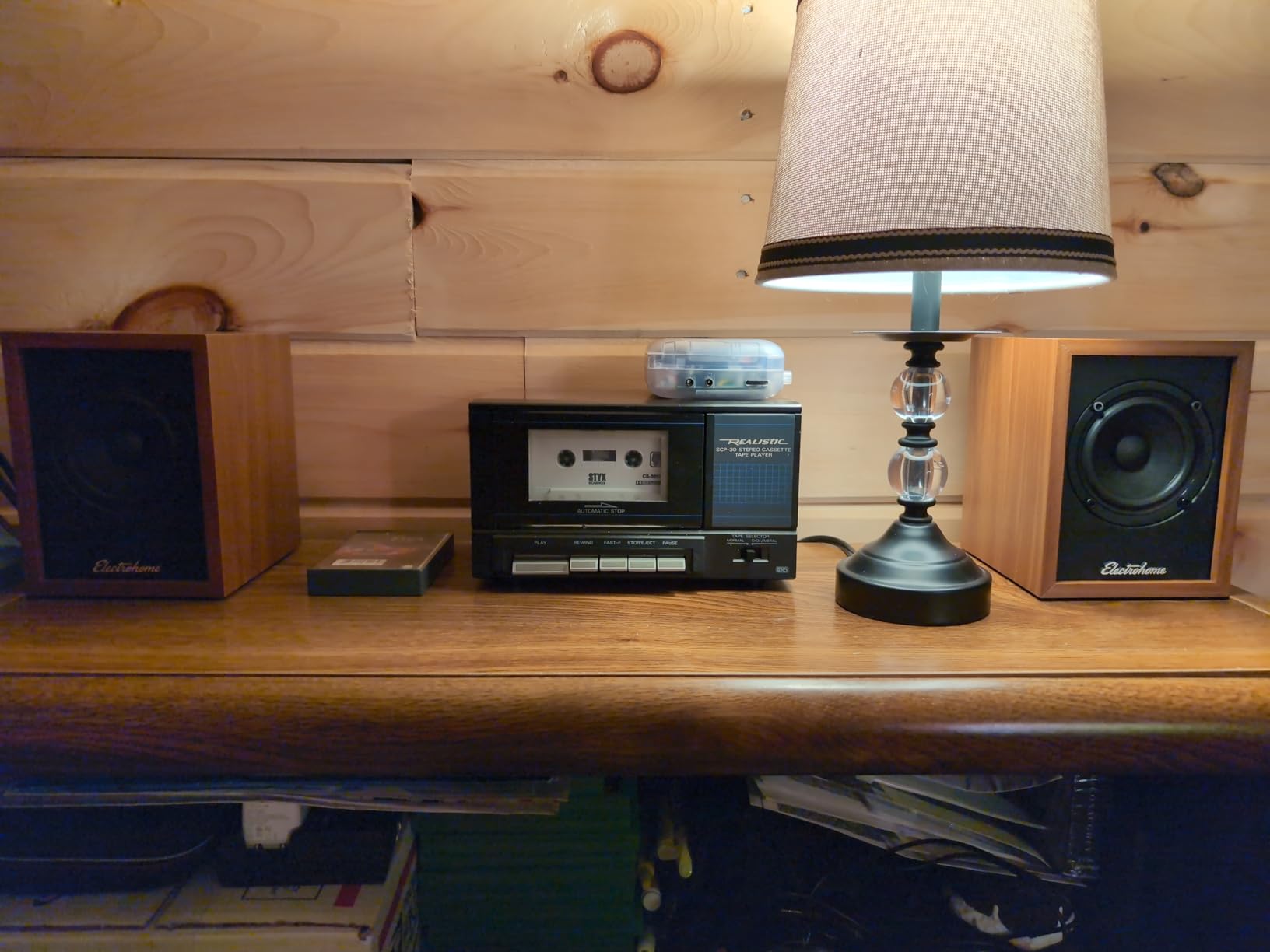
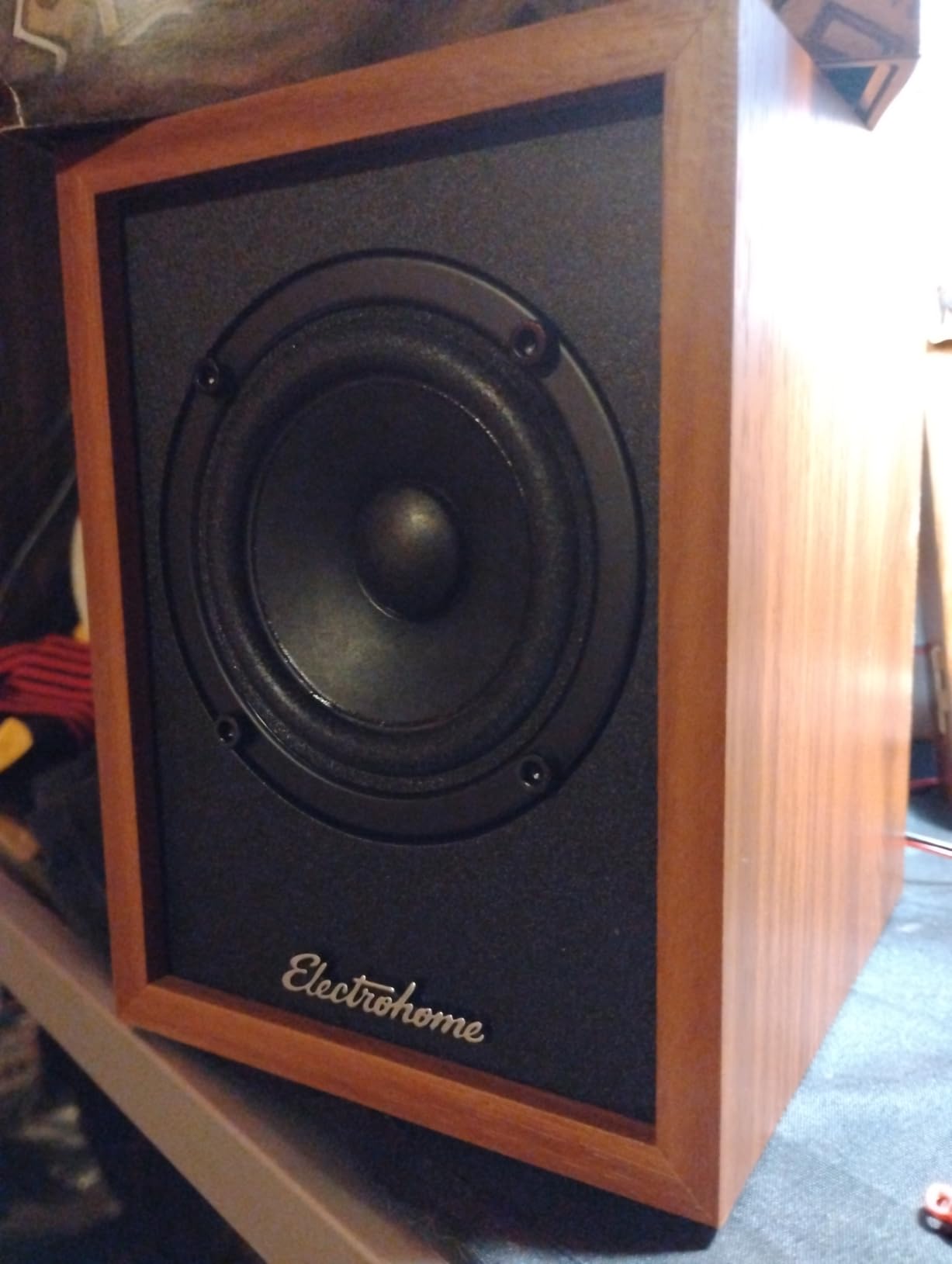
Style is the reason to buy this pair. The teak-finish wood cabinet is designed to sit next to a belt-drive turntable without looking like computer equipment, and at 9 inches square on the base it is one of the smaller footprints here.
Sonically, 3-inch full-range drivers in a rear-ported cabinet deliver a warm, full-bodied presentation for the size. For close near-field listening at a desk or on a side table, the tonal character is more forgiving than a bright design.
The Hiss Problem Is Real and You Should Know About It
The most consistent complaint across the review base is audible hiss whenever the speakers are powered on, independent of volume. On a quiet record at low listening levels it is audible. On a 1960s jazz pressing with surface noise, the speakers contribute some of their own.
This is a design consequence of an entry-level amplifier stage, not a defect. If you are the sort of listener who notices a noise floor, put the volume at mid position rather than low, or consider a pair with a higher signal-to-noise ratio.
One Button for Power, Source and Volume
A single multifunction button handles power, source selection and volume, which is where most of the owner frustration sits. On and off take the same button, and switching source is a press-and-hold. It is a fussy interaction, and it is the first thing people mention when they return the pair.
Bluetooth 5 with a listed range of 60 feet and RCA plus Aux inputs cover the usual sources. The speakers are supplied with a US-style power cord, and the RCA cable is not included, so budget for one interconnect if your turntable uses RCA out.
Who Should Skip the EB10
Skip it if silence matters, because the powered-on hiss will get on your nerves in a quiet room. Skip it if you want a remote, since there is none. And skip it for anything but near-field listening, because 20 watts will not carry a shared room.
8. MEVOSTO DS19 – 5 Inch Drivers With USB Audio for the Desktop
MEVOSTO 5-Inch Powered Bookshelf Speakers: PC Speakers for Record Player
5 inch woofers with 1 inch silk dome tweeters
36W RMS built-in amplifier per speaker
Bluetooth 5.4, RCA and AUX, USB digital audio
+ Pros
- 5 inch woofer and 1 inch silk dome tweeter with 36W RMS per speaker
- Bluetooth 5.4 plus RCA and AUX and USB digital audio for PC and PS5
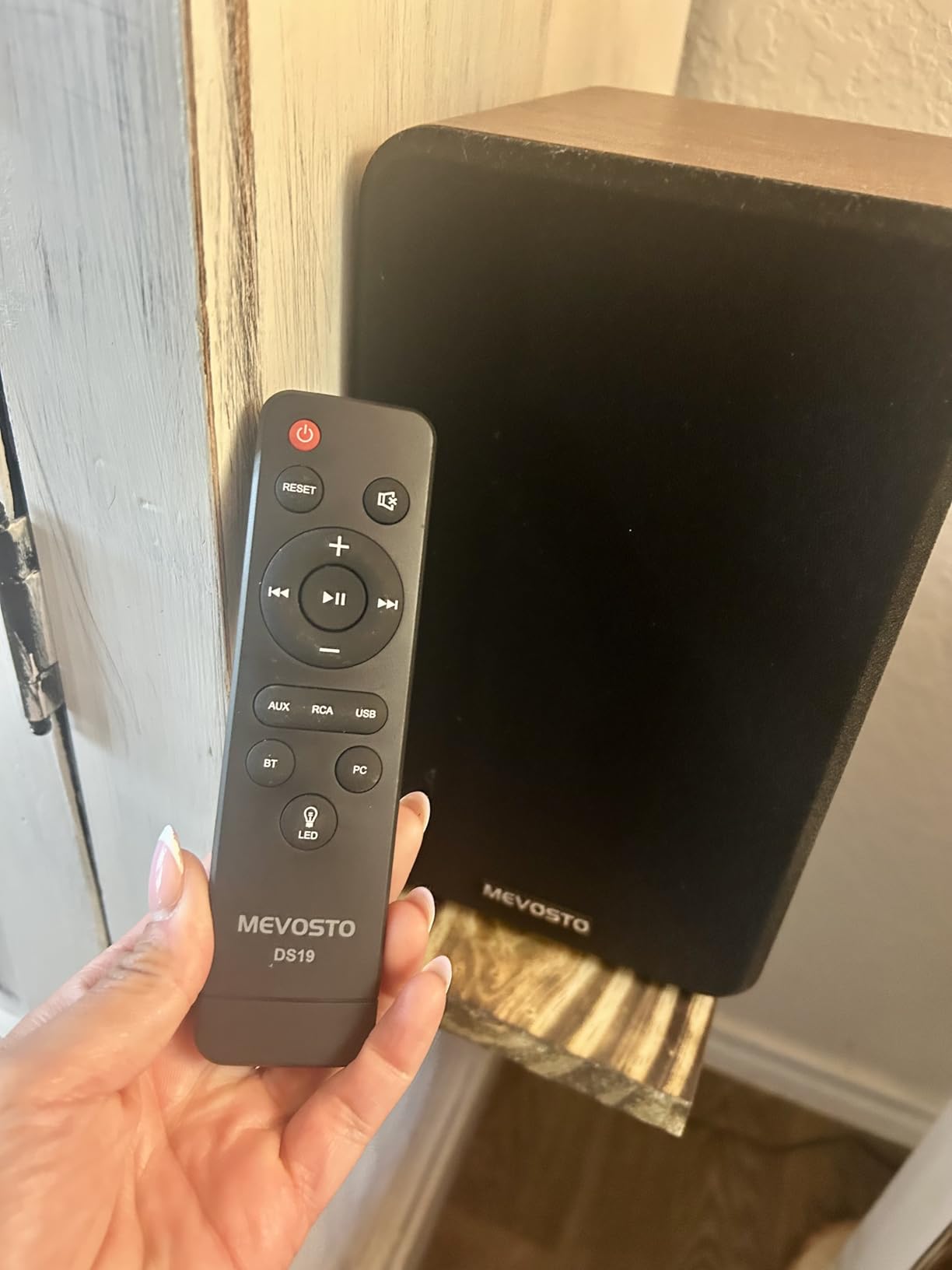
- Independent bass and treble knobs plus an included remote
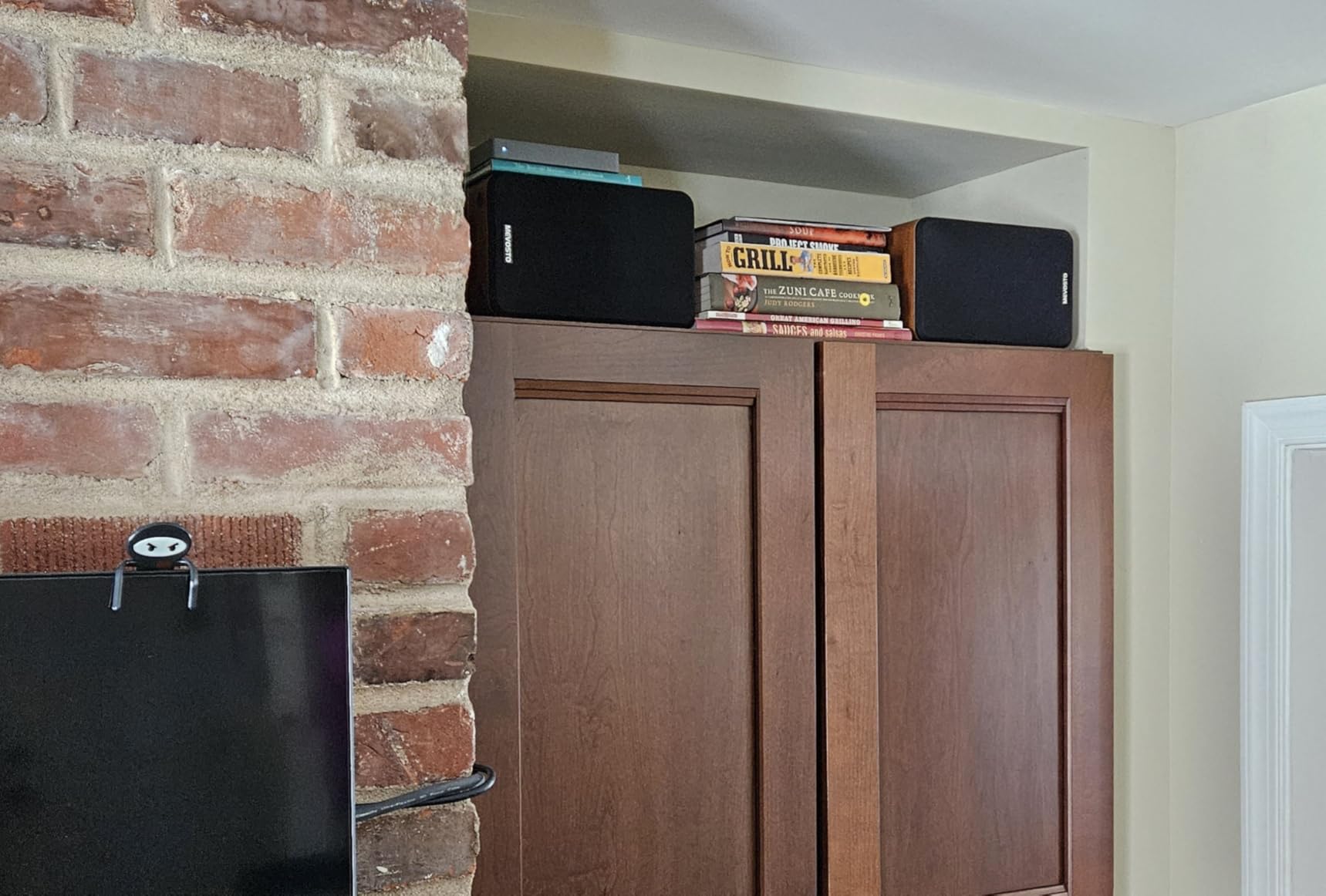
- Walnut wood-grain cabinets that blend into a shelf or record-player cabinet
- 12V 15V and 18V DC input flexibility for RV or boat installs
- Cons
- Turntable connection requires a built-in or external phono preamp
- Does not support Dolby or DTS surround decoding
- Needs a roomy desk or shelf given the 9.7 inch cabinet height
The DS19 packs more input types into one pair than anything else we tested: Bluetooth 5.4, RCA, AUX and USB digital audio. That last one is unusual at this size. USB audio connects straight to a computer, a Mac mini or a PlayStation 5 without an interface.
Each cabinet carries a built-in 36-watt RMS amplifier, driving a 5-inch woofer and a 1-inch silk dome tweeter. For a desk or a record-player cabinet that is a lot of cone area for a compact footprint, and it is why the bass extends further than several 5-inch competitors.
USB Audio, Consoles and What They Do Not Do
USB digital audio is a genuinely useful feature when your computer is the source. It bypasses the noisy analogue path that makes built-in computer audio sound thin, which is why PC speakers usually disappoint on music. The documentation is clear that your USB port must support audio output.
What it does not do is decode surround formats. There is no Dolby or DTS processing, so a film soundtrack comes in as a flat stereo mix. For a music system that is irrelevant. For a home theatre it is a dealbreaker, and the manufacturer says so directly.
Tone Controls, Cables and Flexible Power
Independent bass and treble knobs sit on the cabinet, and the remote handles everyday control from your chair. The walnut wood-grain finish is designed to disappear on a shelf next to a turntable rather than to dominate it.
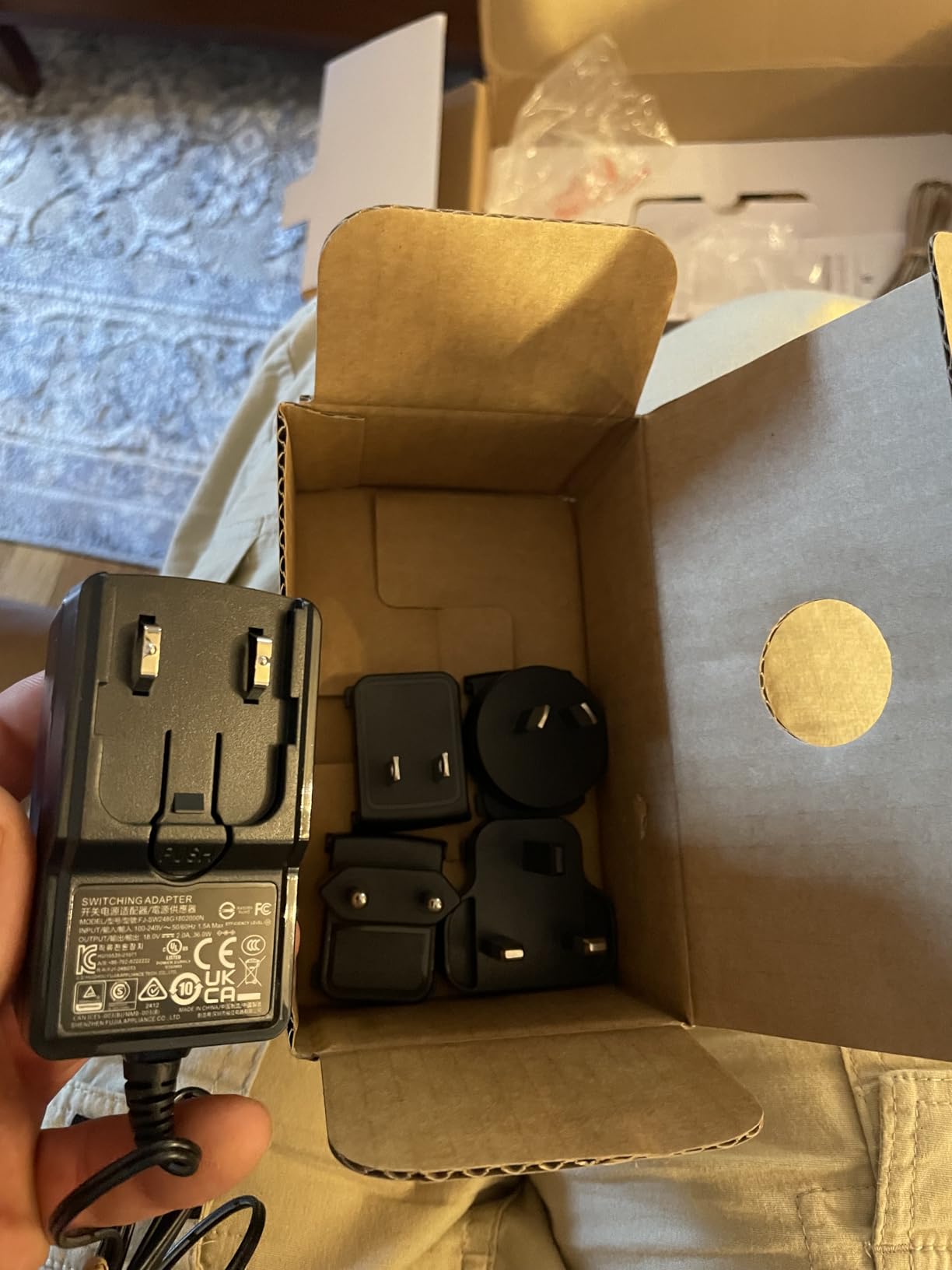
It also accepts 12V, 15V or 18V DC input, which is unusual and genuinely useful for RV or boat installs. An 18V 2A adapter is included. Each cabinet measures about 9.7 inches tall, so it needs a roomy desk or shelf.
Who Should Skip the DS19
Skip it if your turntable outputs phono level only, because there is no built-in preamp and the RCA input is line level. Skip it if you want a television audio solution, because without surround decoding and without optical it is not the right tool. And skip it for a tiny shelf where a 9.7-inch cabinet will overhang.
9. Audio-Technica AT-SP3X – The Highest Rated Pick in the Roundup
Audio-Technica AT-SP3XWH Powered Bookshelf Speaker
3 inch woofer with 1.1 inch tweeter,30W per speaker
70dB signal-to-noise ratio
Multipoint Bluetooth and dual RCA inputs
+ Pros
- Very high 4.8 average rating across its review base
- Disproportionately strong bass for its driver size
- Multipoint Bluetooth plus dual RCA inputs for turntable hookup
- Compact minimalist cabinets that do not dominate a room
- AC adapter ships with three international plug adapters
- Cons
- No remote control so volume changes require walking to the speaker
- Bluetooth limited to the basic SBC codec
With a 4.8 average across its ratings and roughly 90 percent five-star feedback, this is the highest rated pair in the roundup. I was sceptical about the 3-inch driver class and it did not take long to revise that. This thing produces bass that has no business coming out of a 7.9-inch cabinet.
The reason is port tuning. Owners describe it as sounding disproportionate to its size, and at 30 watts per speaker it plays loudly before it distorts, which is a rare combination in a compact powered pair.
The Fixed Primary Speaker and What It Means for Placement
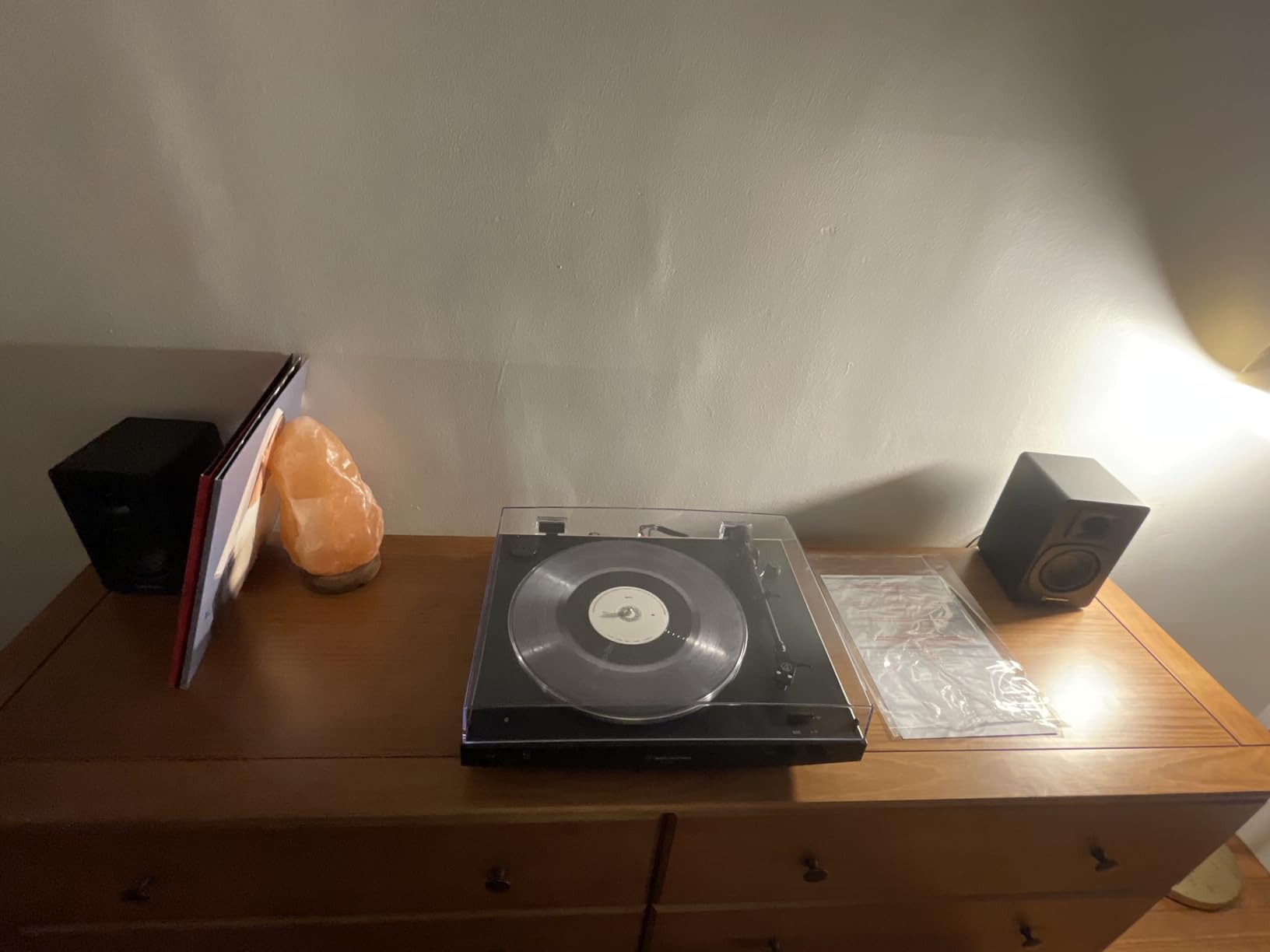
Only one speaker is the primary, and it is fixed as the channel with the amplifier, dial and power button. You cannot swap the speakers to put the primary on the other side, so place it on whichever side is closest to your listening chair and your power outlet.
For most shelf setups that is beside the turntable, which is also where the cables are. Plan this before the box arrives rather than after.
Soundstage Detail and the Bluetooth Caveat
Reviewers repeatedly describe a wide, spacious soundstage and a clean, detailed presentation, which is unusual for a 3-inch driver in a plastic cabinet. The signal-to-noise ratio is listed at 70dB, the lowest figure here, so on very quiet passages you will hear more of the floor than you would from the Audioengine.
Bluetooth supports multipoint, so two devices stay paired at once. The codec is basic SBC with roughly 160 milliseconds of latency, which is fine for music and visibly wrong on video, so keep the RCA inputs for anything with a moving picture.
Who Should Skip the AT-SP3X
Skip it if you want to control volume from your chair, because there is no remote and you walk to the primary cabinet. Skip it if your turntable is a bare phono output, since there is no phono stage. And skip it if you need deep sub-bass in a large room, because 3-inch drivers have a limit no amount of volume overcomes.
10. RIOWOIS DS6701NP – Cheapest Path From Turntable to Speakers
RIOWOIS Powered Bookshelf Speakers, Desktop Speakers for Record Player
60W built-in amplification, no receiver needed
Bluetooth 5.3 plus AUX optical and TV-ARC
Remote with volume input and sound effects
+ Pros
- Works directly with a turntable with no receiver or amplifier needed
- Bluetooth 5.3 streaming plus AUX optical and TV-ARC wired options
- Remote and on-speaker buttons for volume power input and sound effects
- Reinforced MDF cabinet minimizes crackling
- Compact and lightweight at 2.37 kg
- Cons
- Optical and ARC cables are not included
- Powered speakers cannot be used with an external receiver or amplifier
- No Dolby or DTS surround decoding support
This pair exists to remove the amplifier from the equation entirely, and it is the cheapest way on this list to do that. At 60 watts with Bluetooth 5.3, RCA-level AUX, optical and TV-ARC inputs, it covers a turntable, a television and a phone from a single box per side.
TV-ARC is the interesting one. Connect through the return channel and your television remote controls the volume, which means one remote instead of two. The remote also switches inputs, disconnects Bluetooth and cycles three sound effect modes.
The Bluetooth Warning in the Manual Is Worth Reading Twice
The documentation states that your turntable must have a Bluetooth transmitter to work with these speakers wirelessly, and it will not work if your turntable only has a Bluetooth receiver. Most turntables with built-in Bluetooth are receivers, existing so you can stream from a phone to the turntable rather than the other way around.
So for the vast majority of people, the vinyl connection here is the AUX or RCA input, and Bluetooth is for your phone. Anyone planning a wireless turntable setup should read the specification of their deck before assuming it will work.
Reinforced MDF and What It Fixes
The reinforced MDF cabinet is specified to minimise crackling at higher volumes, which is a real problem with lighter plastic enclosures when a near-full-range driver gets pushed hard. At 2.37 kg the pair is also among the lighter ones here, which makes moving it between rooms trivial.
Two constraints to plan for. Optical and ARC cables are not included. And because the amplification is built in, these speakers cannot be connected to a separate receiver or amplifier at all, which removes the upgrade path other pairs leave open.
Who Should Skip the DS6701NP
Skip it if you might later add an amplifier, because the built-in amplification closes that door. Skip it if your turntable outputs phono level only, since there is no phono stage. And skip it if you need real surround decoding, because Dolby and DTS are explicitly not supported.
How to Choose Powered Speakers That Actually Work With Your Turntable
Most of the disappointment in this category comes from a mismatch that takes two minutes to check and hours to diagnose. Work through these criteria before you compare finishes.
Line-Level vs Phono-Level Is the Only Question That Really Matters
A phono-level output is a raw cartridge signal measured in millivolts, with the bass and treble deliberately cut during cutting. A line-level output has already had that restored and raised to a normal signal. A powered speaker’s line input expects the second one.
Plug the first into the second and you get the classic symptom: quiet, thin, uneven playback with a raspy edge that sounds worse as the bass gets heavier. There is no volume position that fixes it. You have three legitimate solutions: use a turntable with a built-in preamp or a line/phono switch, buy a standalone phono preamp and place it between deck and speakers, or choose speakers with a phono stage inside.
In this roundup, only the Klipsch R-51PM and the Kanto YU6 include a phono stage. Everything else needs one upstream.
Powered vs Passive Speakers: Which Should You Buy?
Powered speakers, also called active speakers, have the amplifier built into each cabinet. Passive speakers are just drivers in a box and need a separate stereo amplifier. For a turntable setup, powered wins for most people.
The amplifier is the single largest box in a passive hi-fi chain, the one with the most cables behind it, and the one component most first-time owners regret buying first. A powered pair removes it, halves the cable count and lets you move the whole system in one trip. You give up the ability to change amplifiers later without changing speakers, which is a trade most beginners are happy to make and a few enthusiasts are not.
Buy passive speakers only if you already own an amplifier, or if you specifically want the option to upgrade one. If a roundup tells you a passive bookshelf is a good turntable speaker, check for an amplifier recommendation in the same breath.
Which Turntable Output Matches Which Speaker Input
Match by signal type first, then by connector. RCA line out to RCA line in is the clean path. A 3.5mm AUX input works with a turntable that has a 3.5mm output, or with an RCA-to-3.5mm cable, but a speaker with only a 3.5mm input and no RCA is a poor choice for vinyl because it limits you to one source and offers no grounding options.
If your deck has a phono-only output, either switch to a phono-equipped speaker or add a preamp. If your deck has a switch, use it. If your turntable has a Bluetooth transmitter, a wireless route exists, but very few do, so verify the specification rather than assuming.
Room Size and Driver Size Have to Agree
Driver size predicts low-frequency reach better than any other spec. The 2.75-inch and 3-inch pairs here suit near-field listening at a desk or a side table. The 4-inch pairs are the sweet spot for a turntable on a shelf a few feet away. The 5.25-inch drivers, paired with meaningfully more amplification, are what you want in a shared living room.
Watch the opposite failure too. Overpowering a small pair in a small room produces listening fatigue on quiet records, and reviewers of the compact picks in this roundup mention it directly. Matching the speaker to the room and to the listening distance matters more than any feature list.
Placement, the 83% Rule and Turntable Wobble
The 83% rule is a speaker placement guideline: on the long axis of a rectangular room, set the distance from the front wall to about 83 percent of the room depth, then place the speakers along the back wall at that line. It positions the listening seat at the point where the room’s early reflections reinforce rather than cancel.
For vinyl, toe-in matters more than it does for other sources. Angling the cabinets slightly toward the listening position narrows the apparent stage, which helps a record sound focused rather than wide and distant. The stereo image on a record is baked into the cut, so accurate placement recovers detail that a wide stereo image throws away.
And never rest a turntable on top of a speaker cabinet. Bass energy makes lightweight platters wobble, and wobble means skipping. Give the deck its own surface with an isolation mat, and keep it at least a foot from either cabinet if you can.
Bluetooth Is Almost Never the Answer for Vinyl
This trips people up constantly. Most turntables with Bluetooth are receivers, meaning they can receive audio from a phone and stream it to the turntable’s own speakers or an output. Very few transmit audio out to Bluetooth headphones or speakers. A Bluetooth turntable feature is not a wireless link to your powered speakers, and a Bluetooth input on a speaker is there for your phone, not your deck.
Worth adding a subwoofer output to your shortlist? On 4-inch and larger pairs it is the cheapest upgrade path in this guide, since a sub out with a built-in crossover takes over only the lowest frequencies and lets the main speakers do what they do best.
Frequently Asked Questions
Are powered speakers good for turntables?
Yes. Powered speakers, also called active speakers, have an amplifier built into each cabinet, so you can connect a turntable directly without buying a separate stereo amplifier. They are the simplest and most common way to build a vinyl system, provided the turntable outputs a line-level signal or the speakers include a phono preamp.
Do powered speakers need a phono preamp?
Only if your turntable lacks one. If your deck has a built-in preamp or a line and phono switch, connect its line output straight to the speaker’s line input. If your deck outputs phono level only, you must add a phono preamp between deck and speakers, or choose a powered speaker with a switchable phono stage built in.
Which speaker is best for a turntable?
For most listeners the Edifier R1280T is the best powered speaker for a turntable, with dual AUX inputs and a balanced 4 inch full-range driver. If your turntable has no phono stage, the Klipsch R-51PM is the safer choice because it has a switchable phono preamp and a ground screw terminal.
What are the best budget active speakers for a turntable?
The Edifier R980T and the Edifier R1280T cover the entry end, both pairing 4 inch full-range drivers with modest amplification, with the R980T including RCA and 3.5mm cables in the box. The R980T suits a small room; the R1280T adds tone controls and a remote. Both need a turntable with a built-in preamp.
Should I get powered or passive speakers for a turntable?
Powered speakers for most people. They include the amplifier, so the system is one box per side with far fewer cables, and they can be moved as a single unit. Passive speakers need a separate stereo amplifier, which adds cost, space and an extra thing to replace. Choose passive only if you already own an amplifier or want the option to upgrade it.
What is the 83% rule for speakers?
The 83% rule is a placement guideline for rectangular rooms. Set the distance from the front wall to about 83 percent of the room depth, place the speakers on the back wall at that line, and sit about 1.25 times the speaker spacing from them. It positions the listening seat where early room reflections reinforce rather than cancel.
Can I connect a turntable to Bluetooth powered speakers?
Usually not. Most turntables with Bluetooth are receivers, meaning they take audio from a phone, and very few transmit audio out to Bluetooth speakers. A turntable needs a Bluetooth transmitter for a wireless link to exist. Check the specification of your deck, and use RCA or AUX unless it clearly says transmit.
Final Verdict: Which Powered Speaker Matches Your Turntable?
If you just want the best powered speakers for turntables and your deck has a built-in preamp, the Edifier R1280T is the pick, with dual inputs and a remote, and its review history is the strongest in the group. If your turntable outputs phono level only, stop reading and buy the Klipsch R-51PM, because it is the only pick here that handles that case on its own. The Kanto YU6 does too, and adds Bluetooth and a cabinet that suits a vintage deck.
If one pair has to do records and television, choose the Edifier R1280DBs with its optical input and subwoofer out, or the RIOWOIS if your television supports TV-ARC. For a large shared room, the Audioengine A5+ has the power and the cleanest noise floor. For a small desk, the Audio-Technica AT-SP3X is the one I would buy today, and the Electrohome EB10 if the wood cabinet matters more to you than the noise floor.
Whichever you choose, check the output type on your turntable before you click anything, and give the deck its own surface so it does not wobble. Those two details solve more vinyl problems than any speaker on this list.