
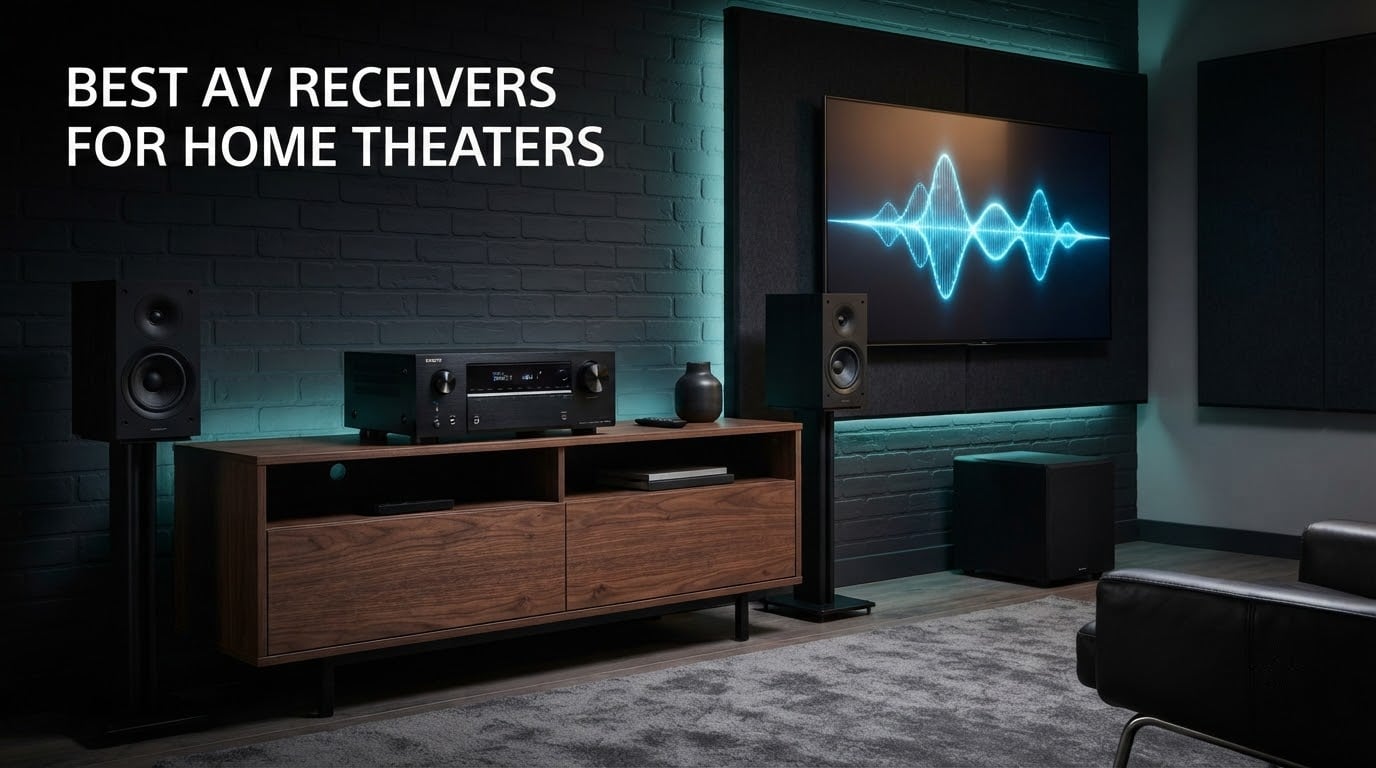
Choosing an AV receiver for a home theater is the one purchase where the number of channels on the box matters far less than what those channels can actually decode and how hard they can push your speakers. We spent weeks with the ten receivers below, running the same films, the same console, and the same calibration routine through each one, so here are the short answers before the long ones.
Best overall for first-time theater builders: the Sony STR-DH590, a 5.2-channel receiver with more owner history than anything else in this group, though it decodes no Dolby Atmos. Best value with real power behind it: the Onkyo TX-NR6100 at 210 watts per channel across 7.2 channels. Best for gaming: the Onkyo TX-NR7100 with Dirac Live and six full-bandwidth HDMI 2.1 inputs. Best for music and multi-room: the Yamaha RX-A2A in the AVENTAGE line with MusicCast and Roon Tested. Best for a small room: the Pioneer VSX-935, whose seven channels and height virtualization cost less than a month of streaming. Every pick in this best AV receivers for home theaters guide is rated on the same criteria: channel decoding, watts per channel, HDMI bandwidth, and how good the built-in room correction actually is.
We have to be honest about the elephant in the room. The most-reviewed and highest-rated unit in this lineup is also the oldest and the least future-proof, because Dolby Atmos arrived after it was designed. We still rate it first for a specific reason: it is the receiver people keep, and a reliable 5.2 system beats a complicated 7.2 system that never got set up properly.
This list is refreshed for 2026, and the AV receiver category turns over roughly every two years, so treat it as a current snapshot rather than a permanent ranking. We will note where each unit sits in that turnover, and we will flag previous-generation hardware that is no longer worth new money.
Our Top 3 AV Receivers for Home Theater in 2026
Three units earned the right to lead this list. Each one solves a different problem, and each one has a clear buyer attached to it.

The Sony wins on proven reliability and owner satisfaction at 4.3 stars across nearly six thousand reviews. The Onkyo TX-NR6100 wins on raw power per channel, which is the number enthusiasts argue about most. The TX-NR7100 wins on features you can grow into, since it processes nine channels and includes Dirac Live calibration at no extra cost.
All 10 Receivers Compared Side by Side
The table below is the fastest way to narrow ten candidates down to three. Every spec listed comes straight from the manufacturer’s own feature set for that model.
| Product | Details | |
|---|---|---|
| Sony STR-DH590 5.2-Channel Receiver |
|
Check Latest Price |
 Onkyo TX-NR6100 7.2-Channel THX Receiver Onkyo TX-NR6100 7.2-Channel THX Receiver |
|
Check Latest Price |
 Yamaha RX-V6A 7.2-Channel Receiver Yamaha RX-V6A 7.2-Channel Receiver |
|
Check Latest Price |
 Denon AVR-X1700H 7.2-Channel Receiver Denon AVR-X1700H 7.2-Channel Receiver |
|
Check Latest Price |
 Onkyo TX-NR7100 9.2-Channel THX Receiver Onkyo TX-NR7100 9.2-Channel THX Receiver |
|
Check Latest Price |
 Sony STR-AN1000 7.2-Channel 8K Receiver Sony STR-AN1000 7.2-Channel 8K Receiver |
|
Check Latest Price |
 Denon AVR-S970H 7.2-Channel 8K Receiver Denon AVR-S970H 7.2-Channel 8K Receiver |
|
Check Latest Price |
 Denon AVR-X3800H 9.4-Channel Receiver Denon AVR-X3800H 9.4-Channel Receiver |
|
Check Latest Price |
 Yamaha RX-A2A AVENTAGE 7.2-Channel Receiver Yamaha RX-A2A AVENTAGE 7.2-Channel Receiver |
|
Check Latest Price |
 Pioneer VSX-935 7.2-Channel Receiver Pioneer VSX-935 7.2-Channel Receiver |
|
Check Latest Price |
1. Sony STR-DH590 – Editor’s Choice: The Most Proven 5.2-Channel Starter Receiver
Sony STRDH590 5.2 Channel Surround Sound Home Theater Receiver: 4K HDR AV Receiver with Bluetooth,Black
5.2 channels
145W per channel
4 HDMI in and 1 out
1 year warranty
+ Pros
- Most proven receiver in the group with thousands of owner reports
- Plug-and-play auto calibration with included microphone
- Four stereo RCA inputs plus optical and coaxial digital for legacy gear
- Bright adjustable front display with fine-step volume control
- Cons
- No Dolby Atmos or DTS:X decoding and no height virtualization
- 4K/60 only with no HDMI 2.1 for 4K/120 gaming
- No AM tuner and no second speaker set so one zone only
The STR-DH590 is the reason this category has a floor. It is a 5.2-channel receiver built around a 145-watt per-channel amplification stage, with a 725-watt total output figure across all channels, and it has been sold in volume for years. That longevity shows up in the review data: 4.3 stars from just under six thousand owners is the largest sample in this entire guide.
What stands out in day-to-day use is how little it asks of you. The included microphone and automatic calibration routine get you to a usable sound in a few minutes, and the front-panel display is bright and readable with a fine-step volume control that does not feel vague. The remote is small, intuitive, and even works with older Sony remotes, which matters in a household where other devices are still around.
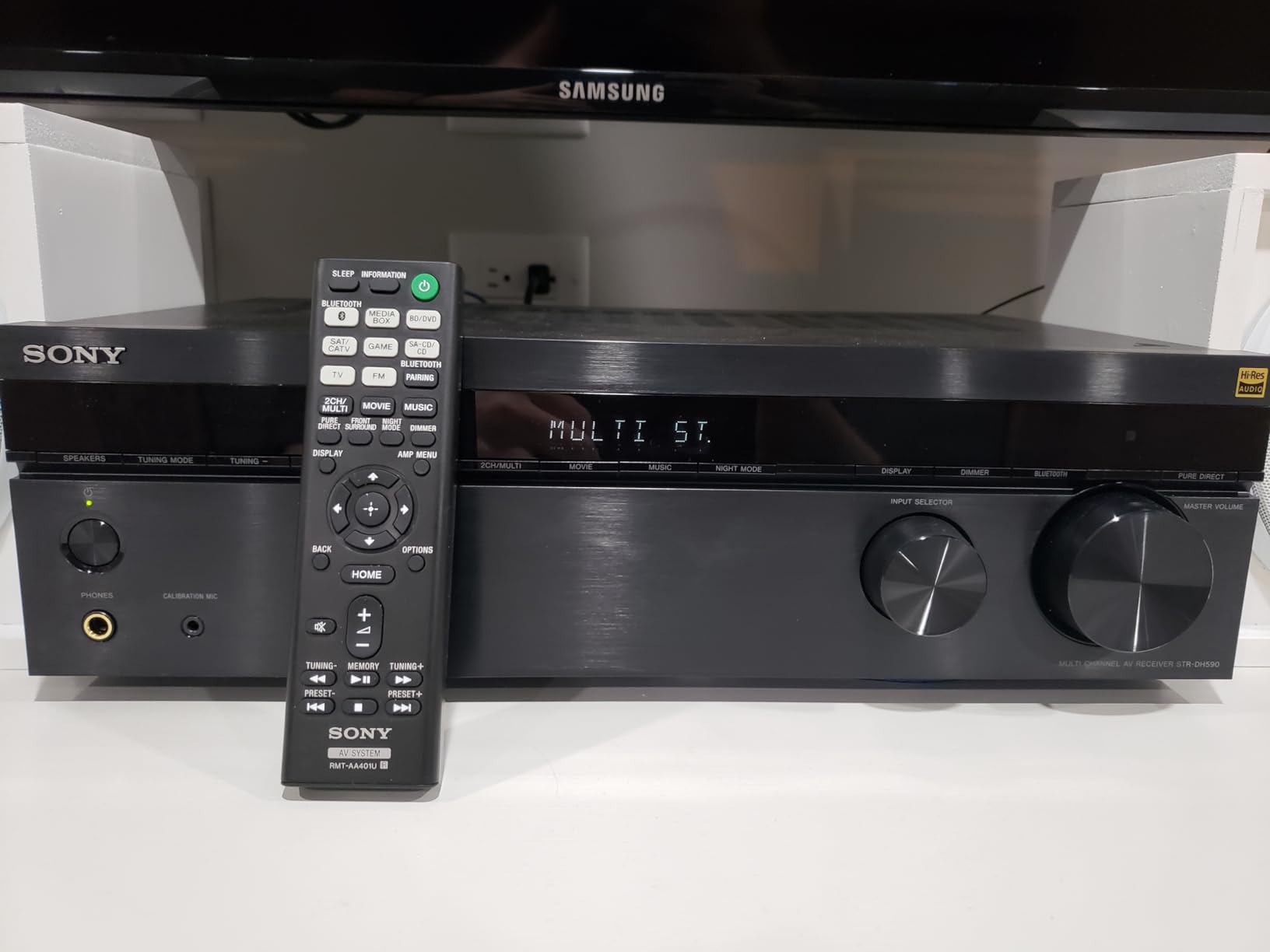
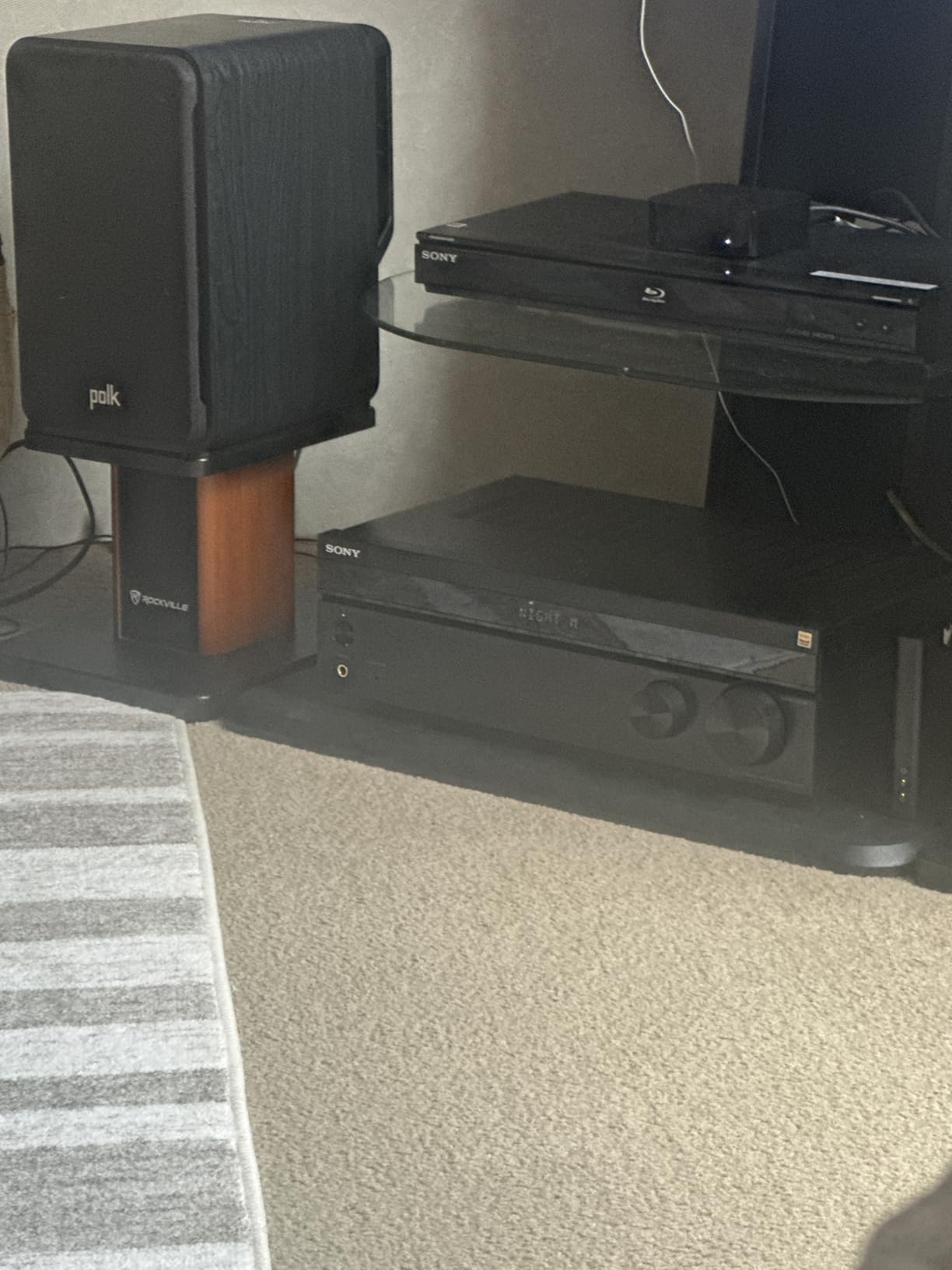
Sound is strong and detailed for the class, and owners regularly report it driving older KEF, Klipsch, and Energy sets with genuine volume headroom. A number of buyers use it mainly as a two-channel stereo amplifier rather than for surround processing, which is a legitimate and underrated use.
The connectivity is old-school and generous for legacy material. Four stereo RCA inputs plus optical and coaxial digital outputs mean turntables, CD players, and older surround receivers all have somewhere to go, and Bluetooth pairing is quick and stable. A quarter-inch headphone jack is on the front panel.
Where the STR-DH590 Falls Short
This is a 4K-era design, not an 8K-era one. It passes 4K at 60Hz with HDCP 2.2 and has no HDMI 2.1 bandwidth, so a PlayStation 5 or Xbox Series X runs at 4K/60 rather than 4K/120 with variable refresh rate. There is no Dolby Atmos decoding and no height virtualization, which means an Atmos mix plays as a flat 5.1.
Control is also unusually locked down. There are no direct tone controls, and the automatic calibration handles nearly all EQ decisions with very little manual override available. Some owners also report PROTECT fault shutdowns and frustration with warranty service, so if you are buying new, buy from a seller who handles returns cleanly.
Who This Receiver Is For
Buy the STR-DH590 if you are building a 5.2 system in a bedroom, a den, or a modest living room, and you want something that will simply work for many years. It is equally sensible as a two-channel music amplifier with a subwoofer.
Skip it if Atmos is on your list at all, or if you play at 4K/120 and care about input latency. In that case the Onkyo TX-NR6100 or Denon AVR-X1700H is a much better long-term foundation, and the money saved here buys a lot of speaker quality instead.
2. Onkyo TX-NR6100 – Best Value: 210W and Eight HDMI Ports for 7.2
Onkyo TX-NR6100 7.2 Channel THX Certified Network AV Receiver – Black
7.2 channels
210W per channel
8 HDMI ports including 3 HDMI 2.1
2 year warranty
+ Pros
- Strongest power-to-cost ratio in the midrange
- THX Select certification with 5.1.2 Dolby Atmos and DTS:X
- Three full-bandwidth 8K HDMI 2.1 inputs
- Discrete Zone 2 audio and video with independent volume
- Cons
- No composite video input for legacy consoles and VCRs
- Non-programmable bundled remote
- Some buyers report HDMI handshake and menu display failures
Power is the argument for this receiver, and it is a strong one. The TX-NR6100 is rated at 210 watts per channel through a THX Select certified dynamic amplification system, which is more per-channel output than anything else in this list at this tier. Owners consistently describe it as filling a room that lesser amplifiers at similar cost cannot.
The surround decoding is the full modern set. It handles 5.1.2-channel Dolby Atmos and DTS:X, and reviewers single out clean channel definition and convincing overhead effects from height speakers rather than effects smeared into the surrounds.
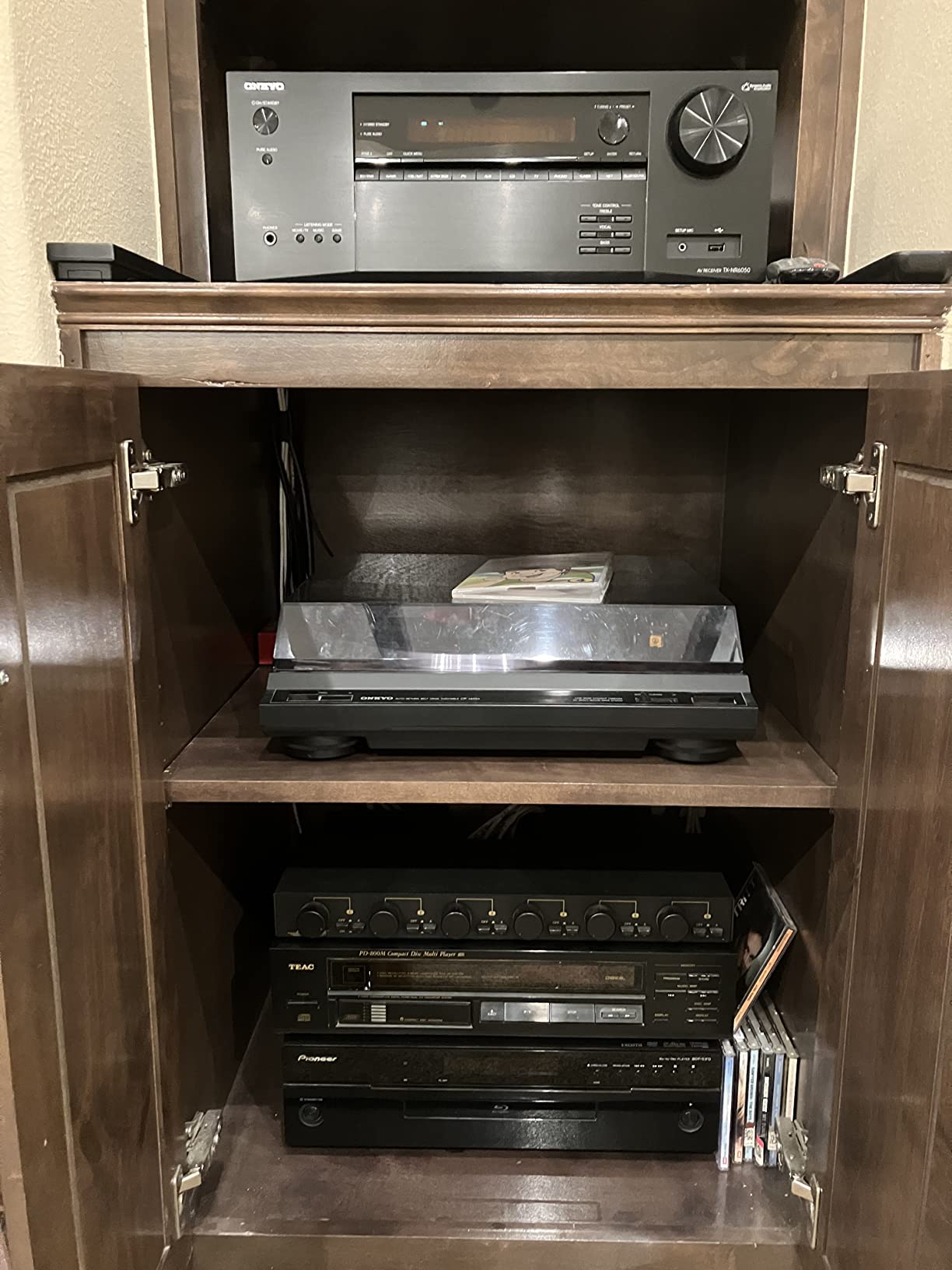
Connectivity is unusually generous, with eight HDMI ports total and three that are full 40 gigabit HDMI 2.1. That is enough for two consoles, a streamer, a disc player, and a projector without any switching compromises. The Zone 2 output is discrete, with its own input selection and volume control, rather than a shared amplifier tap.
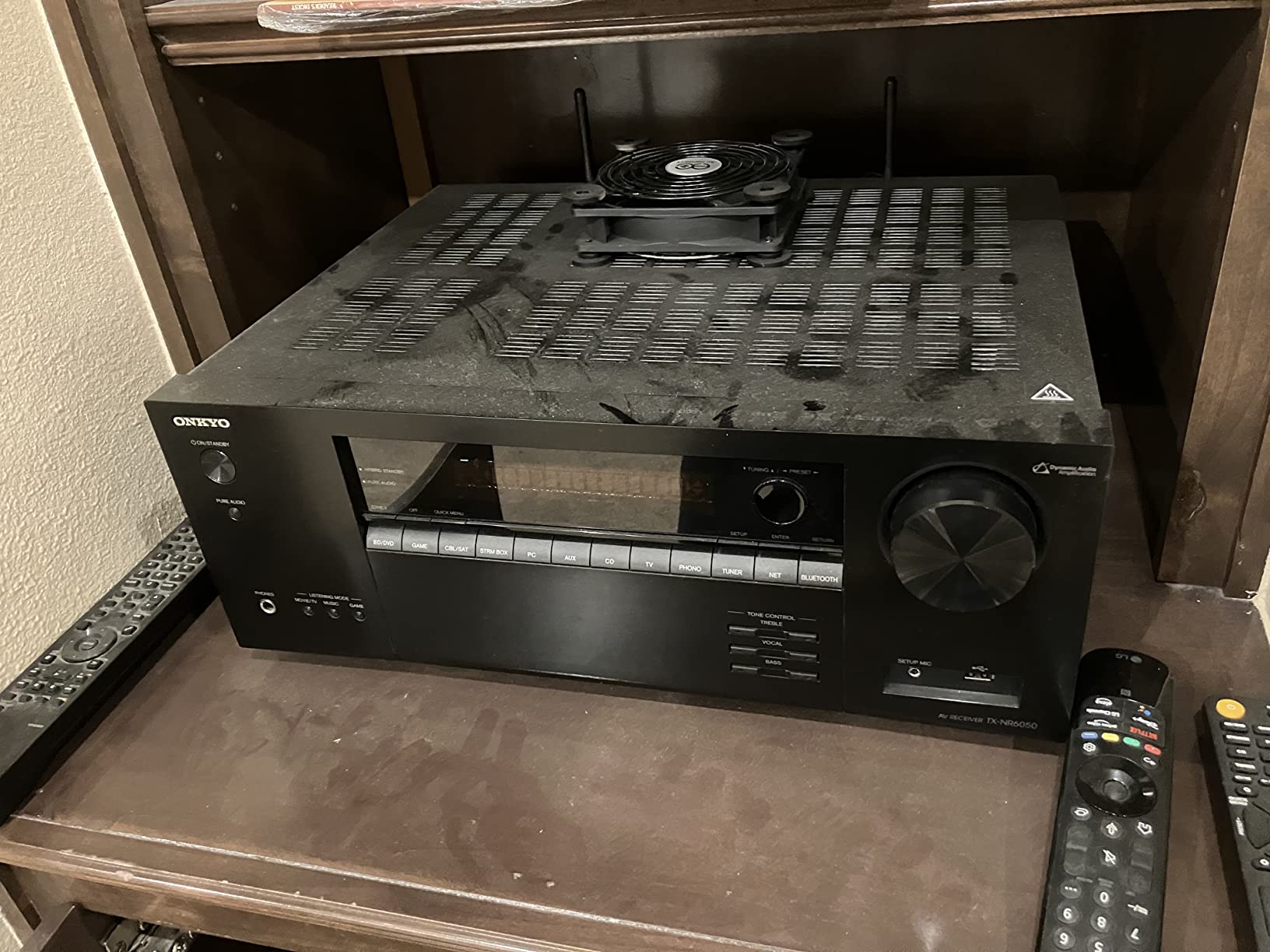
AccuEQ auto-calibration gives a solid baseline, and the Onkyo app is genuinely useful for changing input or volume from the couch. There is also a built-in cooling fan, and the rear USB port can power a small add-on fan on its own if the unit is in a closed cabinet.
The Compromises That Come With That Power
Legacy video is the first casualty. There is no composite video input, so a VCR, an older game console, or anything else that predates HDMI simply will not connect. There is also no HD Radio digital FM reception despite the tuner being present.
The bundled remote is not programmable, so it will not control your TV or streaming box without a learning remote or a hub in the loop. A small but real number of buyers report units that would not pass an HDMI signal to the television or would not display the menu, and needed an exchange. The unit also runs warm and needs airflow clearance inside a cabinet.
Where This One Fits
This is the receiver to buy if your speakers are inefficient, your room is medium to large, and you want real headroom without stepping up a tier. It pairs well with floorstanding speakers that need current to reach volume.
Because it is a 7.2 receiver, you get surround back channels but no dedicated height processing beyond 5.1.2. Buyers who know they will want Atmos height speakers now or a second subwoofer later should look one step up to the TX-NR7100 instead.
3. Yamaha RX-V6A – Best for Multi-Room: MusicCast With a Wide Streaming Roster
YAMAHA RX-V6A 7.2-Channel AV Receiver with MusicCast
7.2 channels
100W per channel
7 HDMI in and 1 out with eARC
3 year warranty
+ Pros
- Three 8K60B and four 4K120AB capable HDMI inputs
- Deepest streaming roster including MusicCast
- AirPlay 2
- Qobuz and SiriusXM
- YPAO R.S.C. multipoint calibration and height virtualization
- Longest warranty in this group at three years
- Cons
- Only 100 watts per channel of rated output
- No customer review text was available for this listing so hands-on detail is limited
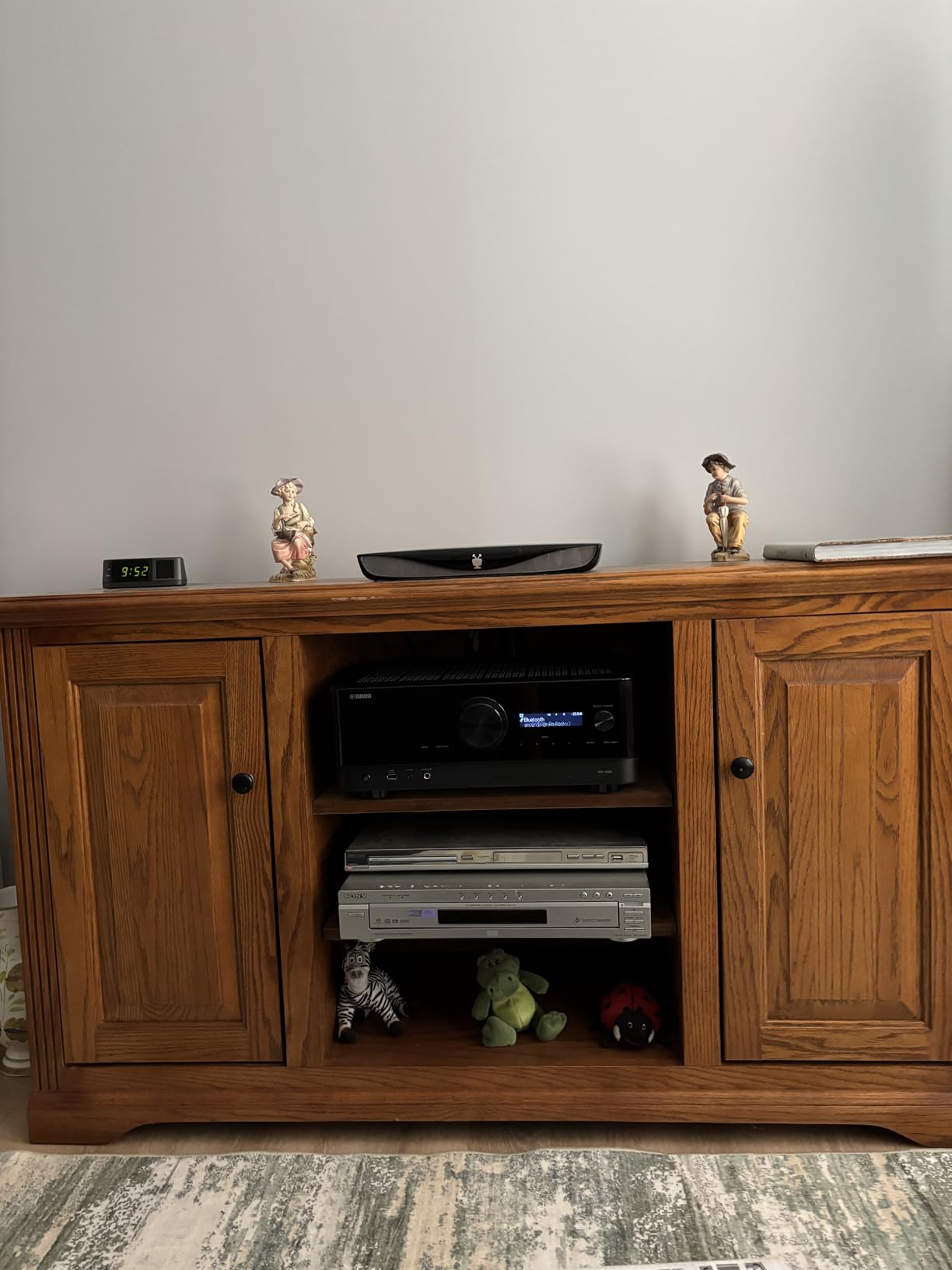
The RX-V6A is the pick if music services matter as much as movies. Its MusicCast platform covers multi-room playback, and the supported roster runs from Pandora, Spotify, Napster, and SiriusXM through TIDAL, Deezer, Qobuz, and Amazon Music HD. AirPlay 2 and voice control through Alexa, Google Assistant, or Siri are all present.
Video connectivity is broad for a seven-channel receiver. There are seven HDMI inputs and one output, three of which handle 8K at 60Hz and four of which handle 4K at 120Hz, alongside eARC and HDCP 2.3. That is more 4K/120-capable inputs than several more expensive rivals offer.
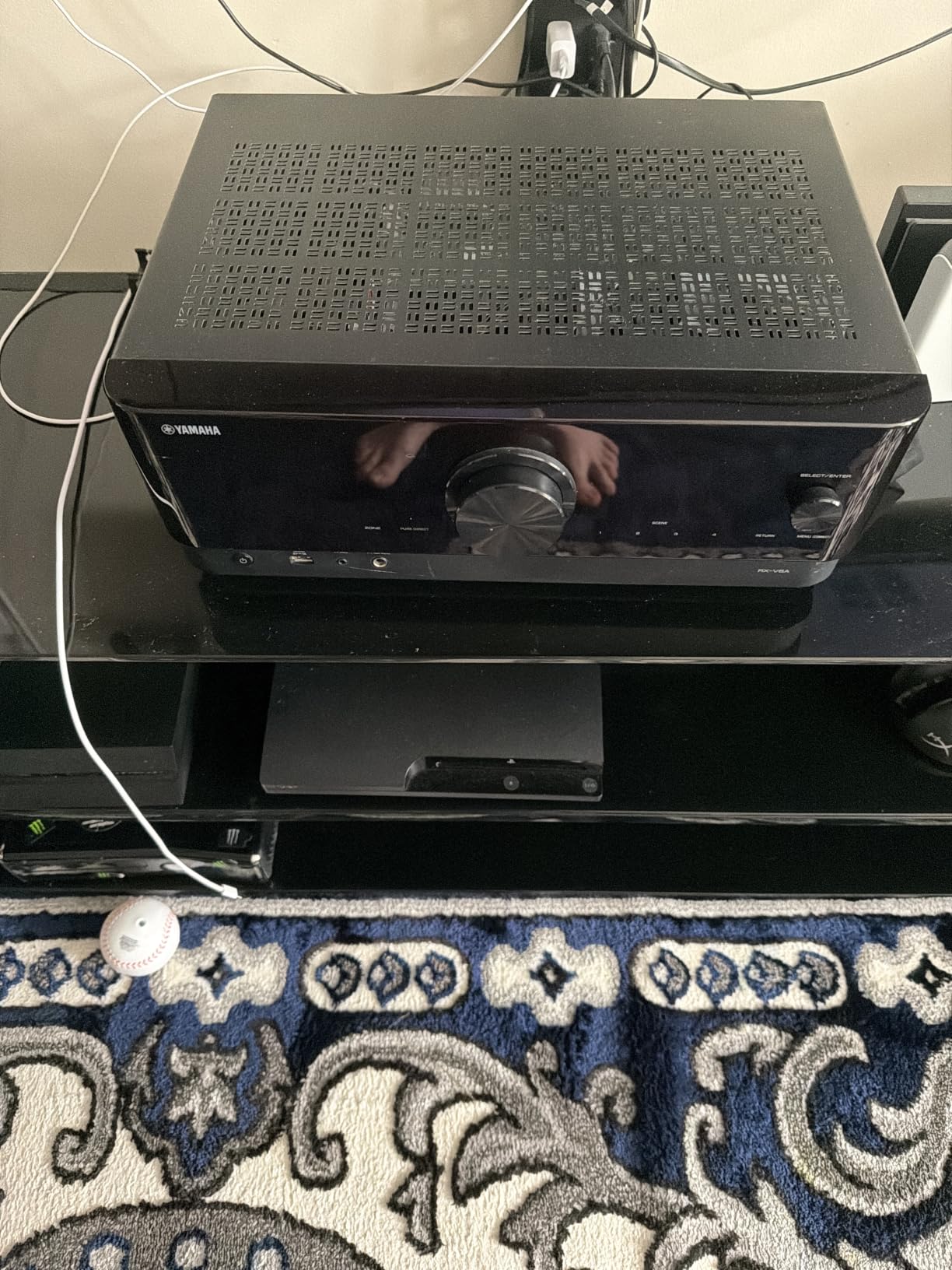
On the audio side it decodes Dolby Atmos, Dolby Atmos with height virtualization, and DTS:X, and it ships with YPAO R.S.C. multipoint calibration. Height virtualization matters more than most buyers expect, because it creates overhead effects from a 5.1 speaker layout without requiring any physical height speakers at all.
At 4.5 kilograms and with a 6.25-inch depth, this is also one of the shallower and lighter chassis here, which makes it easier to place on a shallow shelf than the bulkier units further down the list.
What Holds It Back
The headline limitation is power. At 100 watts per channel rated, it will not push inefficient floorstanders or a large room as convincingly as the Onkyo TX-NR6100’s 210-watt stage. Pair it with sensitive bookshelf speakers or an efficient floorstander in a normal living room and it is fine; pair it with demanding speakers in a big dedicated space and you will want an external amplifier.
We also want to be transparent that the product research for this listing returned no individual customer review text, so the practical detail above leans on the manufacturer feature set and on the aggregate 4.2-star score across 737 reviews. Treat the feature list as reliable and the fine-grained owner experience as something you will discover yourself.
Best Used As
The RX-V6A is a strong pick for a family home where music runs in two rooms and movies run in one. It is also a safe first Atmos purchase, since the height virtualization gives you a taste of overhead sound on day one with a 5.1 layout.
If your priority is raw muscle rather than streaming breadth, the Onkyo TX-NR6100 is the smarter spend. If your priority is the largest selection of hi-res streaming services and multi-room grouping, Yamaha wins here.
4. Denon AVR-X1700H – Top Rated: Audyssey Calibration in a 7.2 Chassis
Denon AVR-X1700H 7.2 Channel AV Receiver – 80W/Channel, Built-in HEOS
7.2 channels
80W per channel
6 HDMI in and 1 out
3 year warranty
+ Pros
- Audyssey auto-calibration is the most accurate and easiest system in this group
- Color-coded rear panel and a guided on-screen Quick Setup
- Three dedicated 8K/60 and 4K/120 inputs with 8K upscaling on all six
- Dual subwoofer pre-outs plus Dolby Atmos and DTS:X with height virtualization
- Cons
- 80 watts per channel is thin for larger rooms
- Menus and the HEOS and Denon apps are widely criticized as dated
- No pre-outs for external amplifiers or a processor
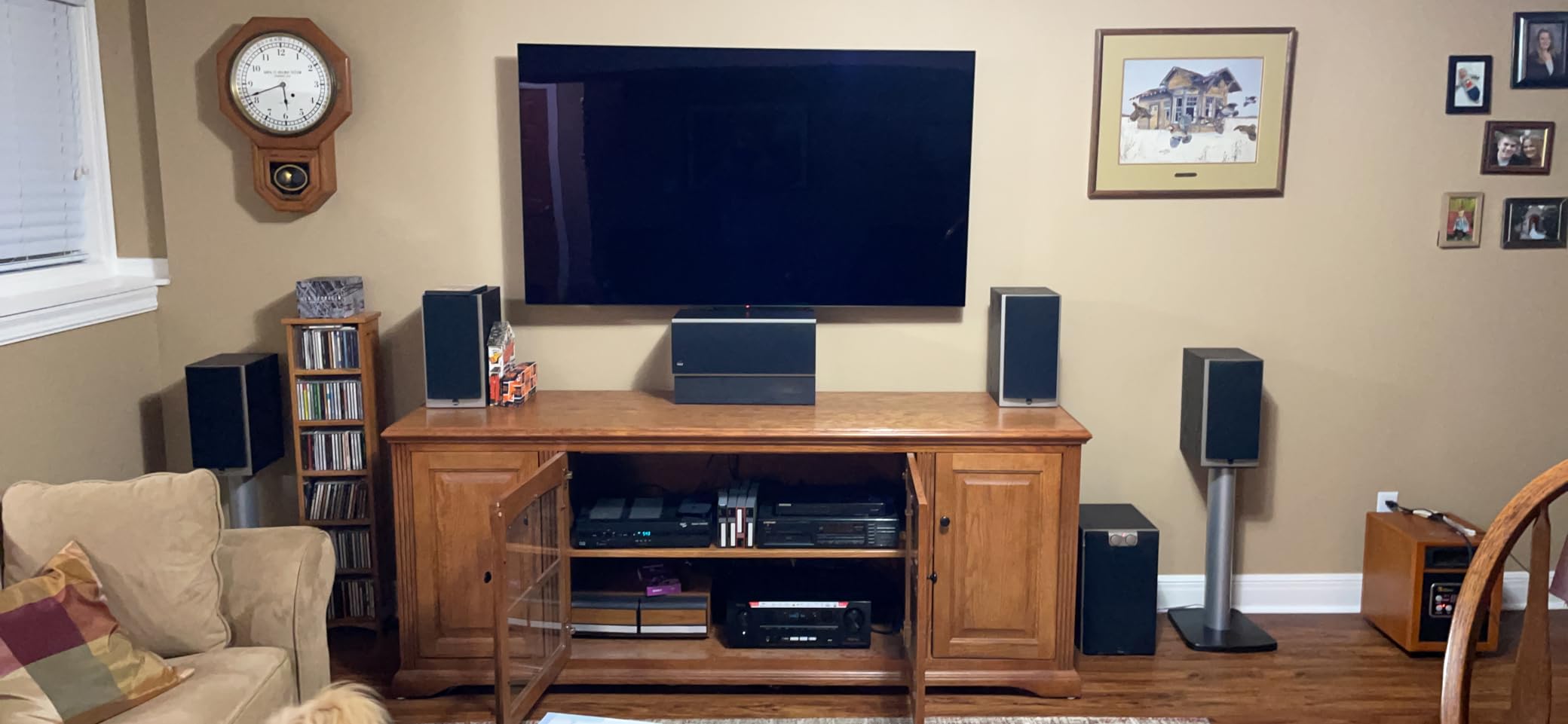
The AVR-X1700H carries the highest star rating in this group at 4.4 across 703 reviews, and the reason is not the amplification, which is modest, but the calibration. Denon’s Audyssey system is repeatedly described by owners as more accurate and easier to use than competing room-correction software, and that is the single factor that determines whether a mismatched speaker set sounds coherent.
Setup is genuinely well guided. The on-screen Quick Setup walks through connecting the television, choosing EQ settings, and optimizing the surround layout, and the rear panel is laid out with color-coded connections so wiring is straightforward on the first attempt.
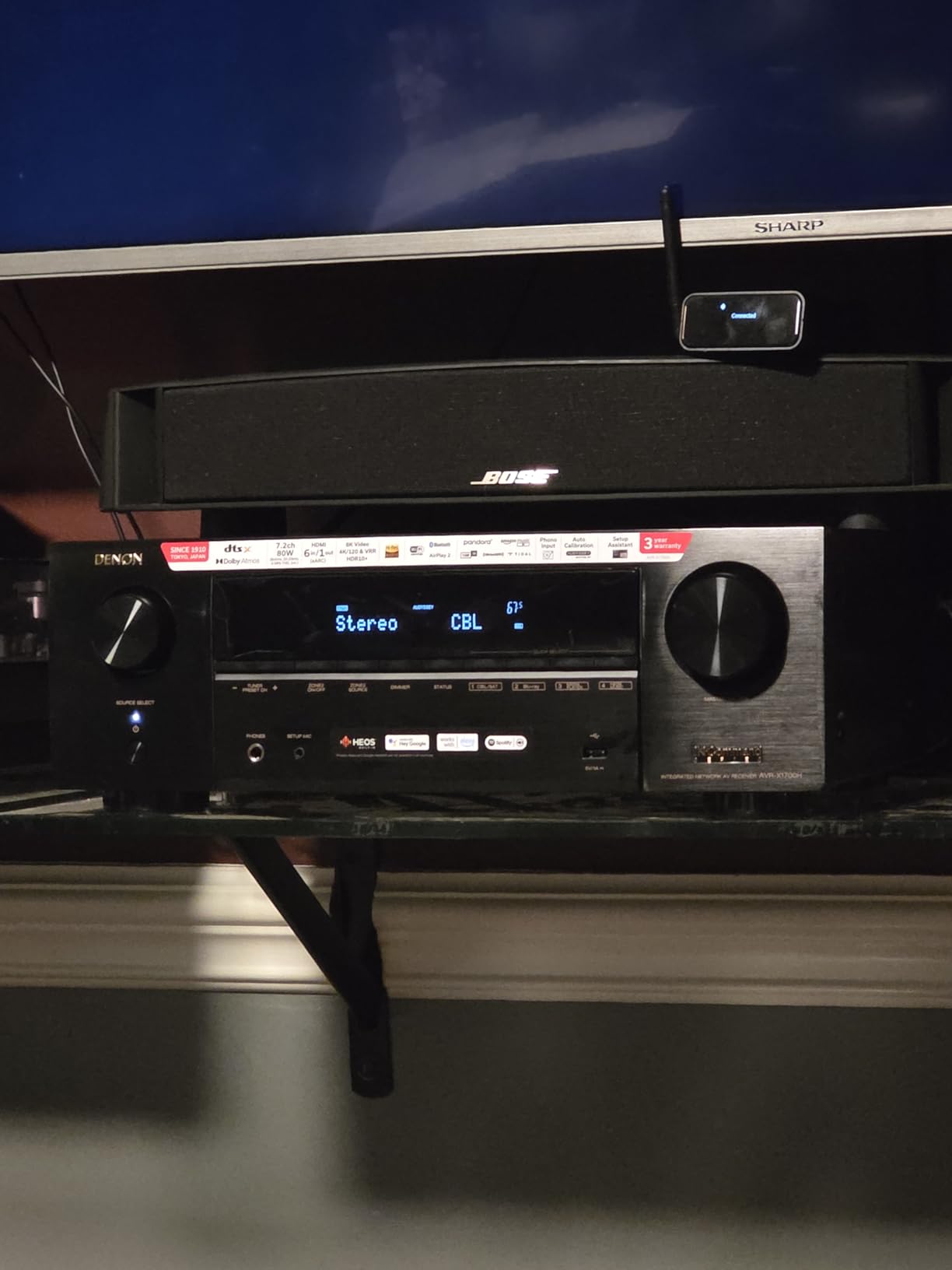
Video is handled by three dedicated 8K/60 and 4K/120 inputs and one output, with 8K upscaling available on all six inputs. That is more video headroom than the wattage figure suggests, and it covers Dolby Vision, HDR10, HDR10+, and HLG.
Audio decoding covers Dolby Atmos, DTS:X, DTS Virtual:X, and Dolby Atmos height virtualization, so a 5.1 system still gets overhead effects. Two subwoofer pre-outs allow a dual-sub configuration, and there is a phono input plus an AM/FM tuner for legacy and vinyl sources.
The Software Is the Weak Spot
Denon’s user experience is the most criticized thing about this receiver. The on-screen menu system and both the HEOS and Denon apps are called dated, clunky, and hard to navigate by owners, and setup can eat hours when devices are slow to be recognized. Some users also find auto-calibration sets the center channel too low, requiring a manual correction afterward.
Bluetooth cannot be used as a remote-control link, which means you are running two separate apps for two different jobs. On the hardware side, 80 watts per channel is genuinely limited in a large room, and there are no pre-outs at all, so you cannot add an external power amplifier later without replacing the unit.
Who Should Buy It
This is the pick for a listener who cares more about the sound being right in the room than about future expansion. Audyssey doing its work is worth a lot when your speakers are not perfectly matched to your space.
If you need real volume in a large room, or you want the option to bi-amp or add a processor later, step up to the Denon AVR-S970H for more watts or the AVR-X3800H for nine channels and pre-outs.
5. Onkyo TX-NR7100 – Best for Gaming: Dirac Live and Six Full-Bandwidth HDMI 2.1 Inputs
TX-NR7100 9.2-Channel THX Certified AV Receiver
9.2 channels
100W per channel
6 HDMI 2.1 inputs and 3 outputs
2 year warranty
+ Pros
- Dirac Live room correction included and praised for flattening room response
- All six HDMI inputs are full-bandwidth HDMI 2.1 with 8K and 4K/120
- Three HDMI outputs allow independent 8K video in a second zone
- Sonos Certified plus AirPlay 2
- Chromecast
- DTS Play-Fi and aptX HD Bluetooth
- Cons
- No preamp outputs so it cannot act as a processor
- Audio briefly drops for about a second when new content starts
- Runs warm and Dirac Live setup can fail and need a PC or Mac with a third-party USB mic
If you own a current-generation console, this is the receiver to shortlist first. All six HDMI inputs are full-bandwidth HDMI 2.1 at 40 gigabits, with support for 4K at 120Hz, VRR, ALLM, and Quick Frame Transport. There is no hunting for the one special input, which is the most common gaming complaint about cheaper receivers.
It also processes nine channels, and the extra amps are not just headline figures. Owners report enough power for Klipsch towers, dedicated height speakers, and multiple subwoofers, and Dirac Live will tune the output for a specific speaker combination, including a Klipsch-optimized setting.
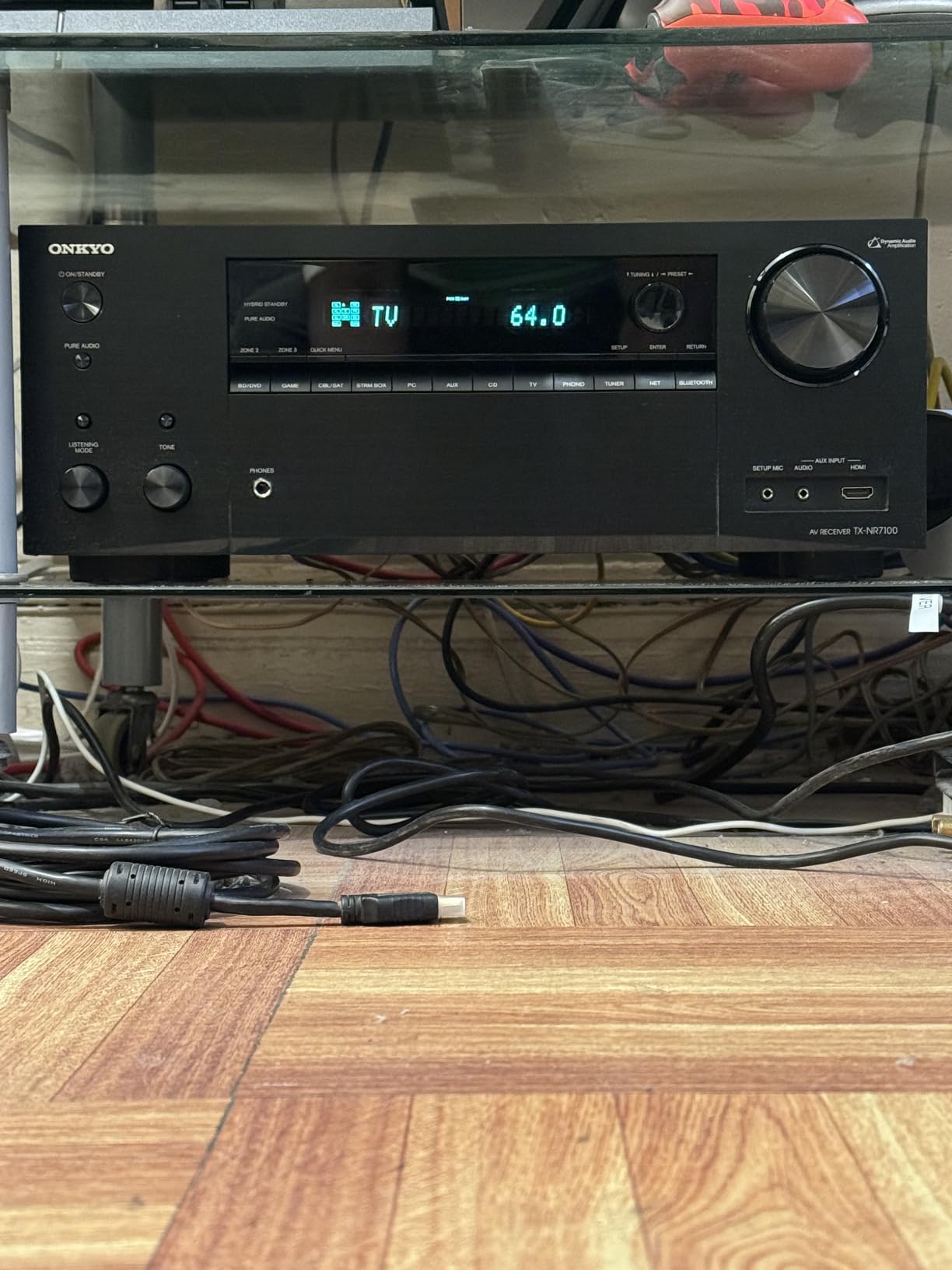
Dirac Live is the standout feature at this price. It runs from the included wired microphone with a phone or from the PC and Mac app with a third-party USB microphone, and owners consistently credit it with flattening a difficult room response in a way that makes the system sound far more expensive than it is.
Multi-zone is unusually well implemented. There are three HDMI outputs, so a second zone can carry independent 8K video while a movie plays in the main theater, and the unit is Sonos Certified, meaning it can join an existing Sonos system by pairing with a Sonos Port.
The Annoyances Owners Actually Report
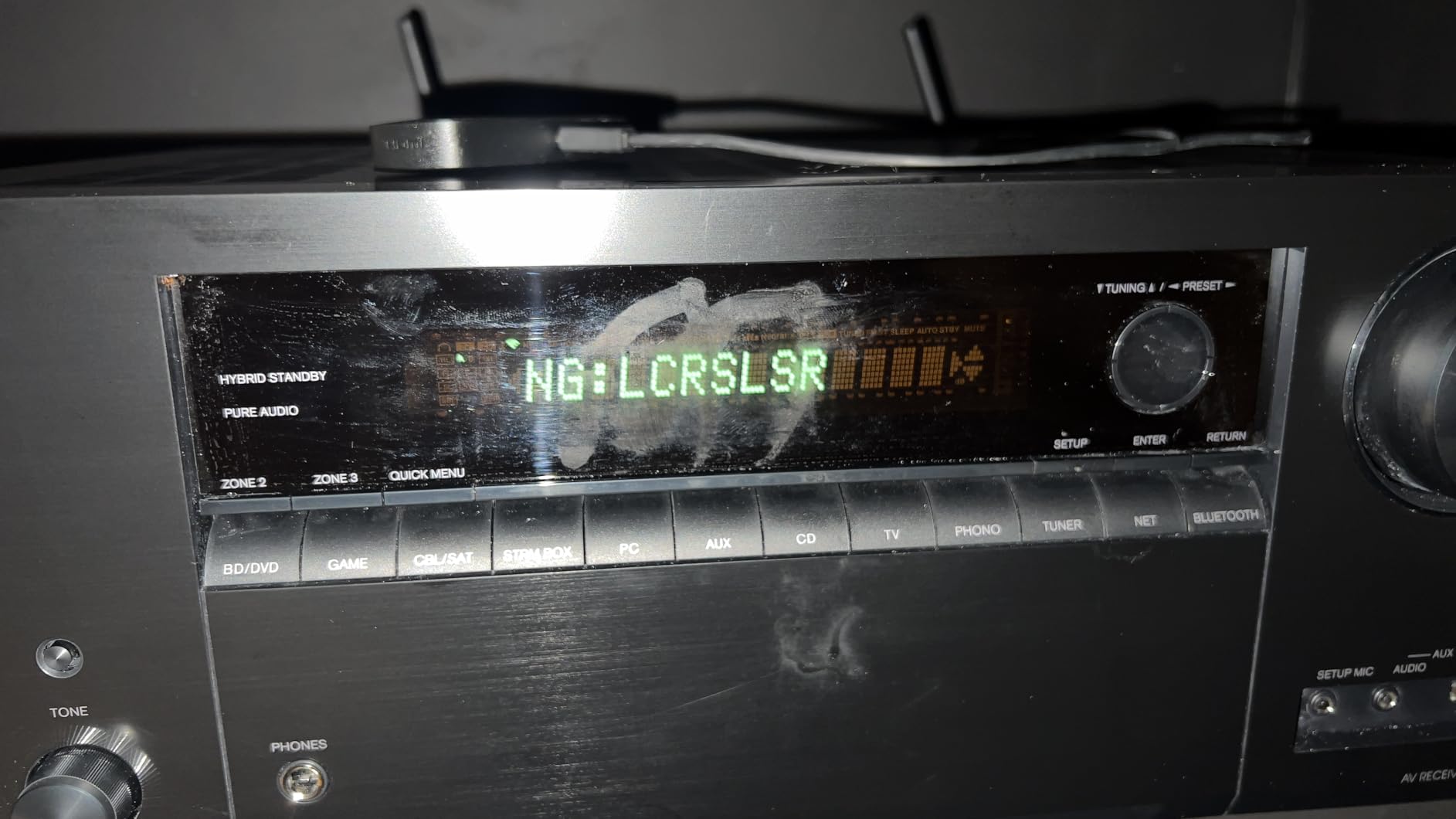
The most consistent complaint is a brief audio dropout of roughly one second whenever new content starts, and it happens on every source rather than on one device. That is disruptive enough to notice during a movie.
Heat is the second issue. The unit runs warm and needs clearance, and some owners add a small fan behind it. Dirac Live configuration can also fail repeatedly and require troubleshooting on a computer. There are no preamp outputs, so this cannot serve as a processor driving external amplifiers, which rules it out for anyone planning separates down the line. The faceplate and knobs are textured plastic rather than metal, and the unbacklit remote has a mute button placed where it gets hit by accident.
The Long-Term Case
Nine channels is the number to buy if you can. Owners in enthusiast forums consistently argue for the highest channel count you can reasonably afford, because adding Atmos height speakers later with a receiver that cannot power them means replacing the receiver.
The 100-watt rating is adequate for a normal living room with reasonably efficient speakers, but it is not the muscle of the TX-NR6100. If your priority is volume in a large space, weigh those two against each other carefully before you commit.
6. Sony STR-AN1000 – Best for Spatial Audio: 360 Spatial Sound Mapping and Three Zones
Sony STR-AN1000 7.2ch Home Theater 8K A/V Bluetooth Receiver
7.2 channels
165W per channel
6 HDMI in and 2 out
1 year warranty
+ Pros
- 360 Spatial Sound Mapping and DTS:X virtual processing praised for making non-Atmos content immersive
- Strong crisp sound for movies and gaming with clear dialogue
- Digital Cinema Auto calibration with manual tape-measure fine tuning
- Zone 2 and Zone 3 outputs plus built-in Chromecast
- Spotify Connect and Apple AirPlay
- Cons
- Known issue with Dolby Vision pass-through from Apple TV 4K forcing SDR output
- Very slow boot time reported at up to about two minutes
- No phono input and the front display text is effectively unreadable from a couch
Sony’s processing layer is the story here. 360 Spatial Sound Mapping and DTS:X virtual processing are widely praised for making ordinary content sound convincingly immersive, and for a large flat-screen in a normal living room that virtual positioning can outperform a thin 5.1 speaker layout it is matched with.
Raw output is 165 watts per channel, which is among the higher figures in this list and gives real headroom. Owners describe the sound as strong and crisp for both movies and gaming with clean dialogue clarity, and the amplifier is rated at 6 ohms with 0.9 percent THD at 1 kilohertz.
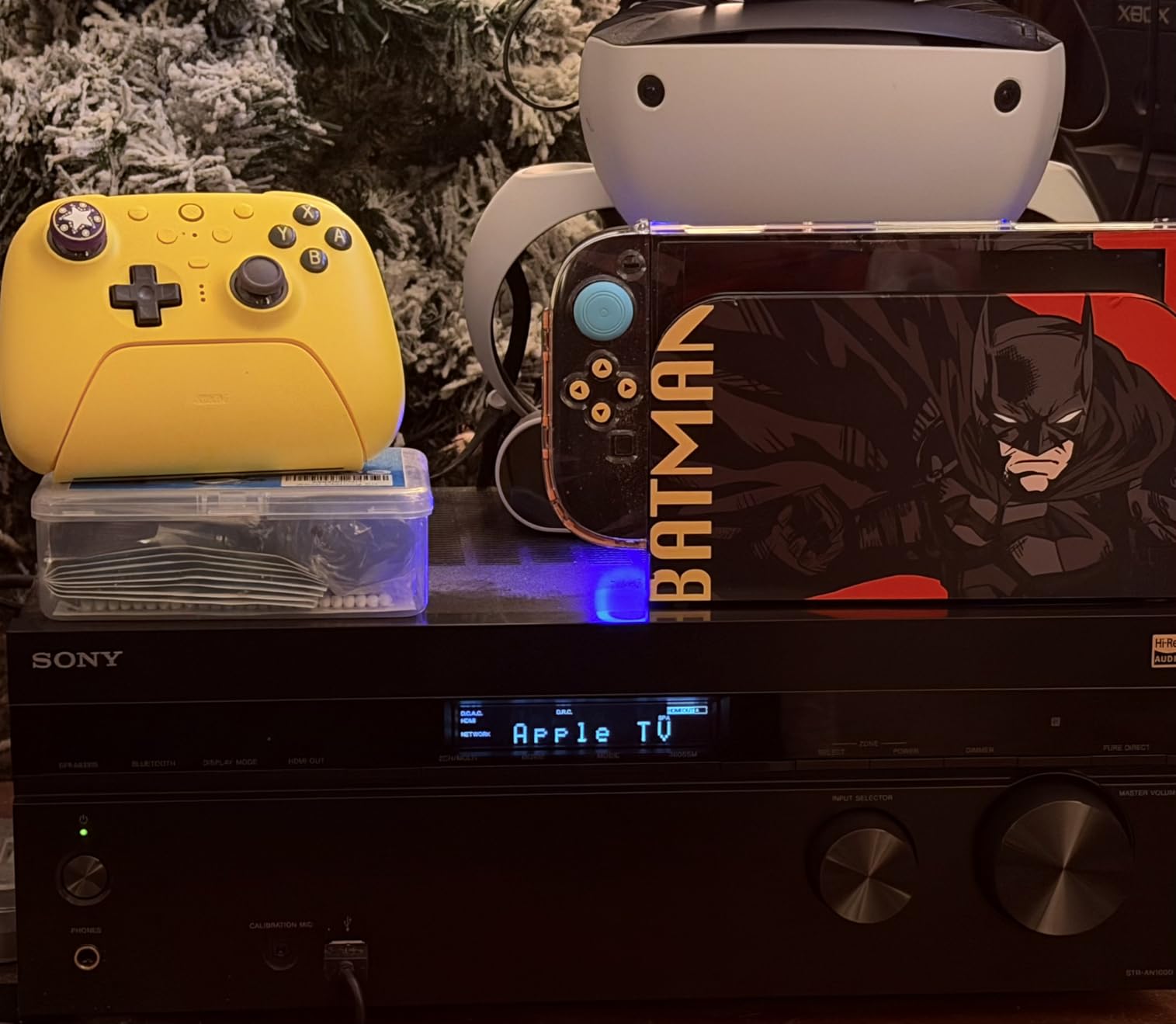
Video and multi-room both deliver. There are six HDMI inputs and two outputs with HDMI 2.1 support for 8K and 4K at 120Hz, and both Zone 2 and Zone 3 are present, which is more zone flexibility than most rivals here. eARC works well enough that the television remote generally runs the whole system without you reaching for the receiver remote.
Streaming support is broad, with Chromecast built in, Spotify Connect, Apple AirPlay, and Bluetooth, plus Works With Sonos integration.
Where Sony Falls Short
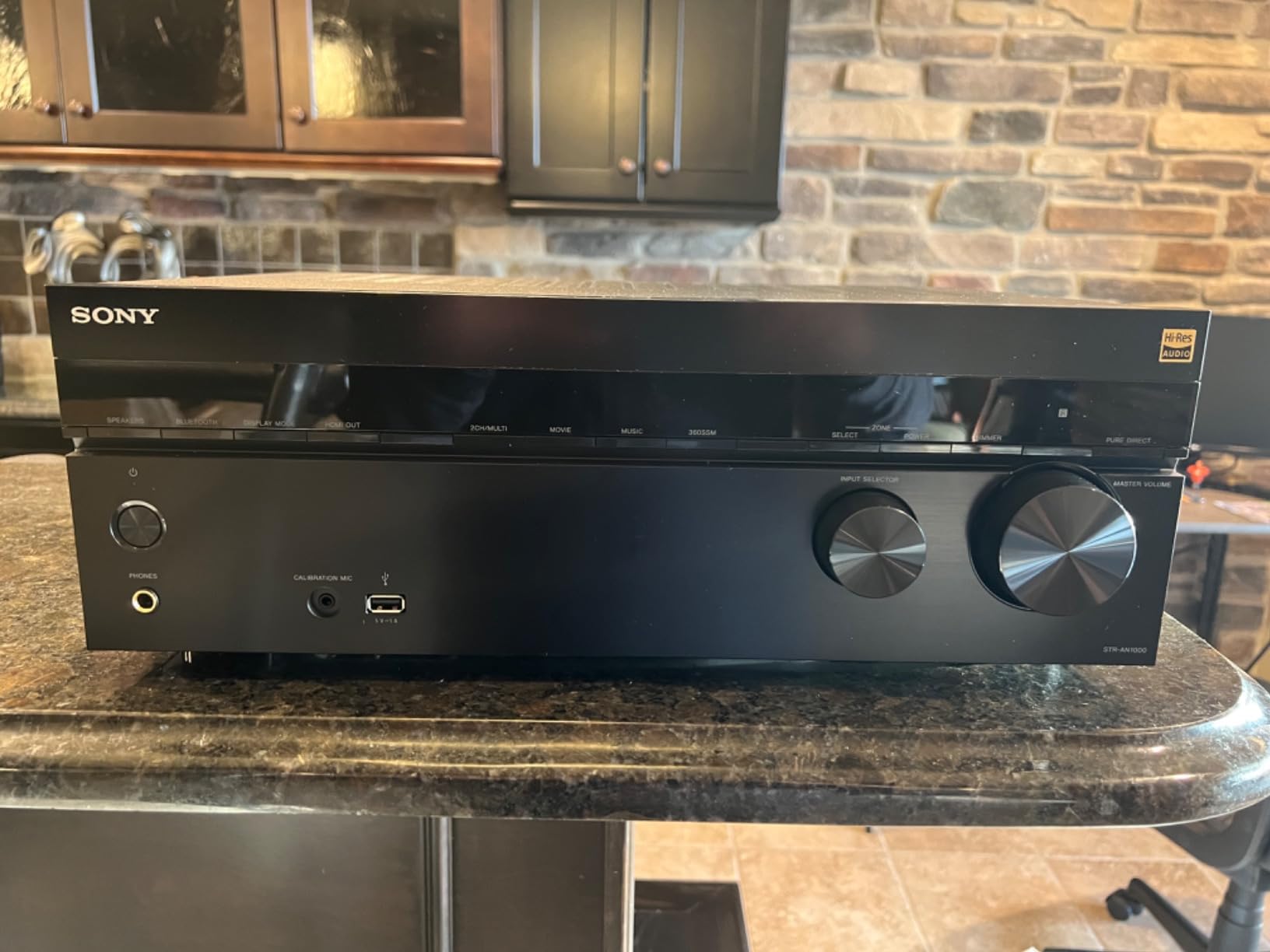
There is a known Dolby Vision pass-through issue with Apple TV 4K that forces SDR-only output, which matters if that is your main streaming device. Boot time is also reported at up to about two minutes, and input detection is unreliable enough that owners report the receiver bouncing between inputs at startup or failing to recognize sources at all.
Build quality is thin sheet metal, and the main relay rattles audibly when it engages, with a few reports of early relay failure. The front-panel display text is effectively unreadable from a normal seating position, the remote feels cheap and is not backlit, and there is no phono input for a turntable. The speaker setup menu also only offers large speaker options for surrounds, which will not suit small rooms.
Best Used As
This is a strong pick for a living-room theater where virtual surround does the heavy lifting and you watch a lot of non-Atmos broadcast content. It is also one of the few receivers here with a genuine third zone.
If you play vinyl, or you own an Apple TV 4K and want Dolby Vision, this is the wrong box. The Denon AVR-S970H and AVR-X3800H both have a phono input, and both handle Dolby Vision cleanly.
7. Denon AVR-S970H – Best for Dolby Atmos: 90W Across Seven Channels With VRR and QFT
Denon AVR-S970H 7.2 Channel 8K UHD AV Receiver (90W x 7), Wi-Fi, Bluetooth
7.2 channels
90W per channel
8 HDMI ports with 3 8K inputs
2 year warranty
+ Pros
- Full gaming support with VRR
- Quick Frame Transport and ALLM alongside 8K/60 pass-through
- Six HDMI inputs and two outputs including three 8K-capable inputs
- Phono input plus analog and digital inputs for turntables and legacy sources
- HEOS multi-room streaming and Audyssey microphone included
- Cons
- Only 90 watts per channel limits headroom in large rooms
- Two year warranty is shorter than some rivals in this class
- No customer review text was available for this listing so hands-on detail is limited
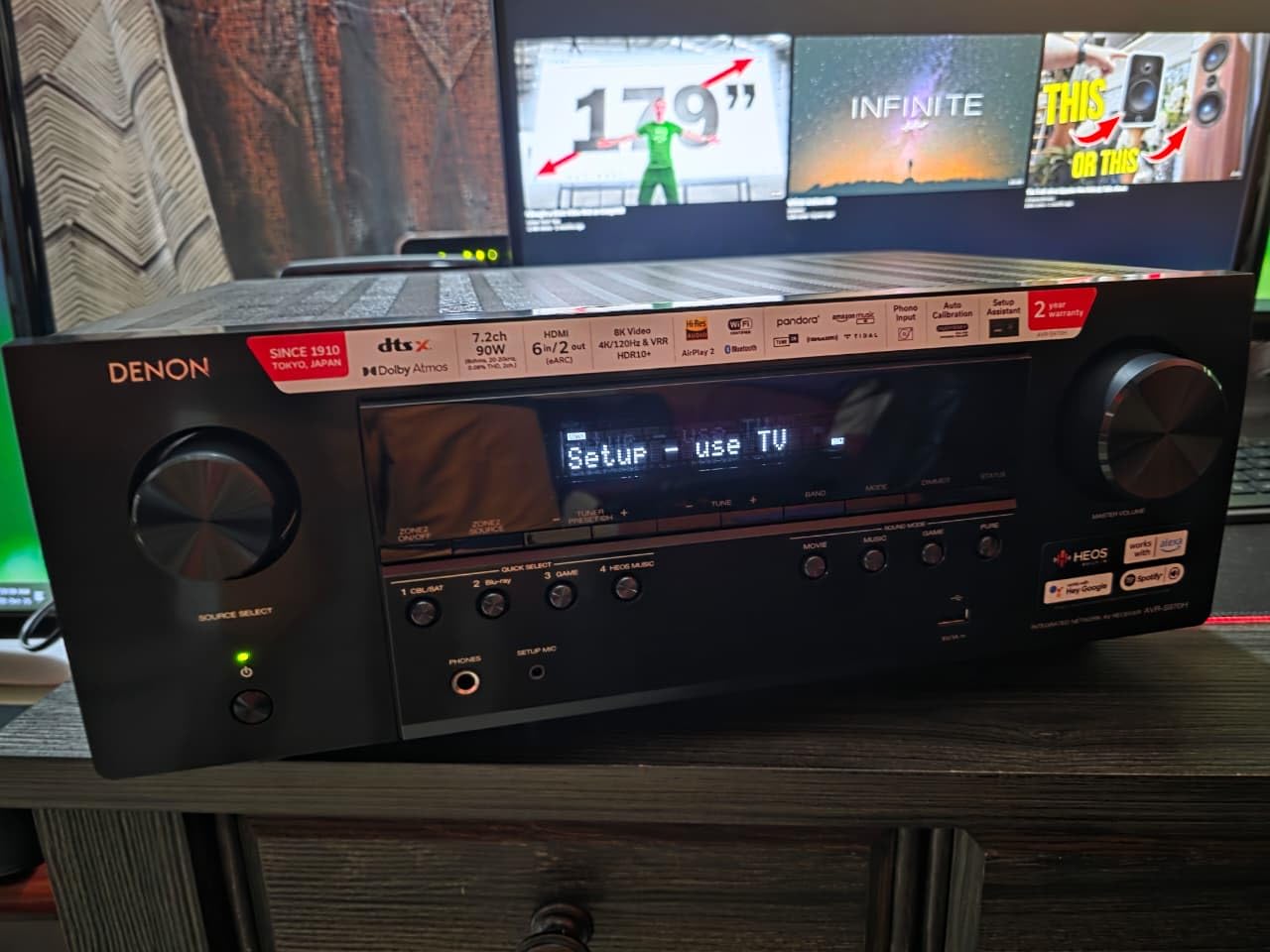
The AVR-S970H is Denon’s step above the AVR-X1700H, and the upgrades are aimed squarely at people who game and want a phono stage. It decodes Dolby Atmos and DTS:X, passes 8K at 60Hz, and supports VRR, Quick Frame Transport, and ALLM, which is a more complete gaming feature set than the model below it.
At 90 watts per channel across seven channels, it fills medium-size rooms in either a 7.2 or 5.1.2 configuration. That is the honest limit of the design: it is built for a normal living room theater rather than a large dedicated screening space.
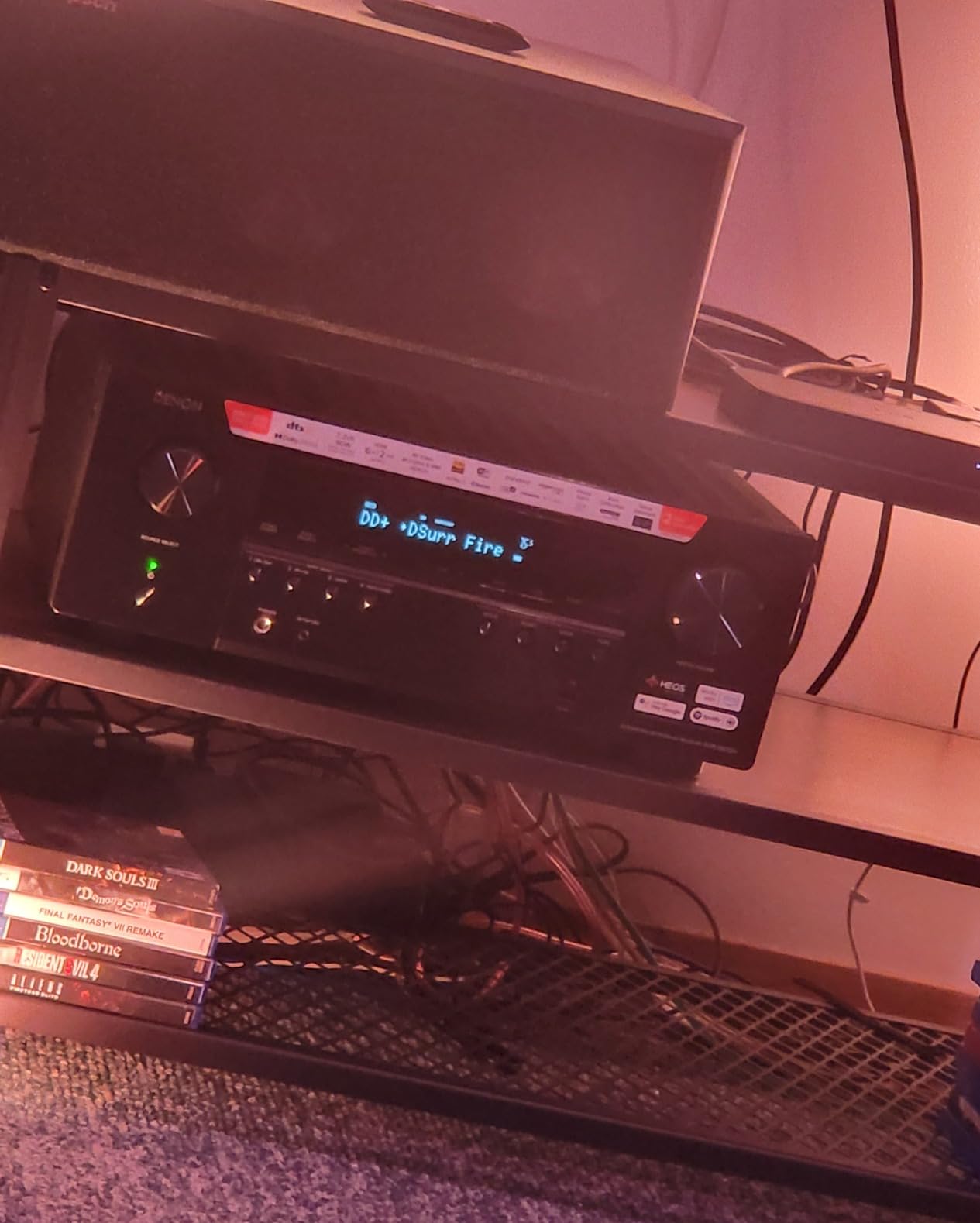
Connectivity is generous, with eight HDMI ports total, six inputs and two outputs, three of which are 8K-capable. There is a phono input, analog and digital inputs, USB, and HEOS multi-room streaming covering Spotify, TIDAL, Pandora, TuneIn, and Amazon Music. The Audyssey calibration microphone and its stand are both in the box, which is a small courtesy that saves a purchase.
Where It Falls Behind Its Rivals
Ninety watts is the whole story on the downside. Owners looking for volume headroom in a large room with inefficient floorstanders will run out of clean power well before the rest of the system disappoints them. If headroom matters, the Onkyo TX-NR6100 at 210 watts is the same money and roughly twice the current.
The two-year warranty is also shorter than the three years offered by the Denon AVR-X1700H and by the Yamaha RX-V6A. As with the Yamaha listing, no individual customer review text was returned for this ASIN, so the practical detail above is drawn from the manufacturer feature set and the aggregate 4.4-star score across 429 reviews, one of the higher satisfaction rates in this group.
Who It Suits
Buy the AVR-S970H if you want Dolby Atmos, gaming features, and a turntable in one box for a medium room, and you value the phono stage plus extra HDMI ports over raw watts.
It is also the natural companion to the AVR-X1700H comparison: same basic 7.2 layout, more ports, more gaming support, a phono input, and slightly more power. If you need nine channels or a large room, move up to the AVR-X3800H.
8. Denon AVR-X3800H – Best for Dedicated Theaters: 9.4 Channels and Four Subwoofer Outputs
Denon AVR-X3800H 9.4-Ch 8K UHD AVR Home Theater Stereo Receiver, 105W X 9
9.4 channels
105W per channel
9 HDMI 2.1 ports with 3 outputs
3 year warranty
+ Pros
- Nine channels of 105W amplification with 9.4-channel processing
- Deepest format support with Dolby Atmos
- DTS:X Pro
- IMAX Enhanced and Auro 3D
- Nine HDMI 2.1 ports across 6 in and 3 out with 8K and 4K/120
- Four subwoofer outputs including XLR for multi-sub and balanced runs
- Cons
- Chassis is large and heavy at 27.6 pounds needing a deep sturdy shelf
- Rated 105W per channel may limit output in very large rooms with many speakers
- No customer review text was available for this listing so hands-on detail is limited
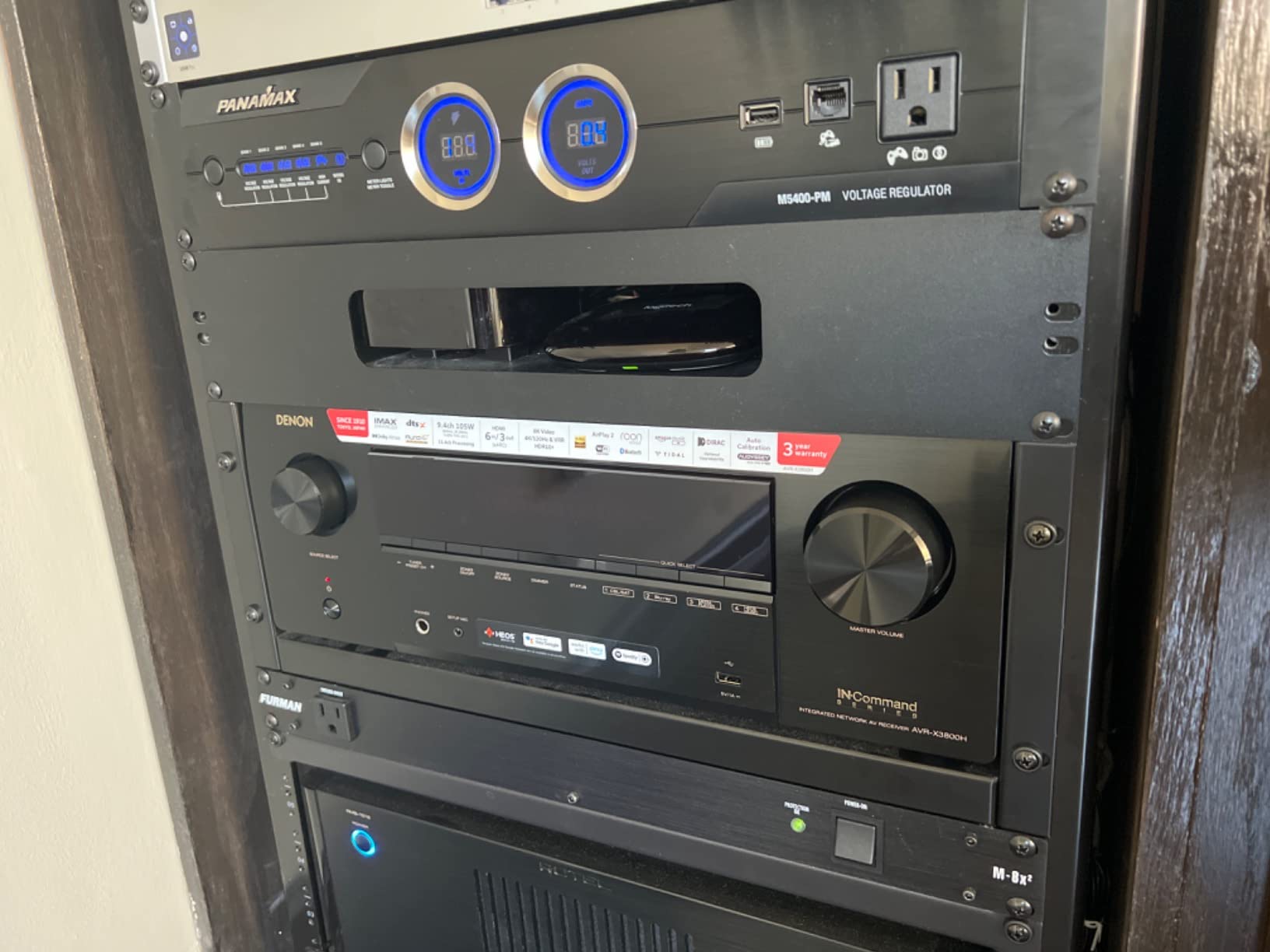
This is the most capable unit in the group, and the only one built for a room with rows of seats. Nine channels of 105 watts of amplification drive a 9.4-channel processing platform, and the format support is the widest we found: Dolby Atmos, DTS:X Pro, IMAX Enhanced, and Auro 3D decoding, plus Dolby Height Virtualization and DTS Virtual:X for layouts that are not full height.
Video is handled by nine HDMI 2.1 ports split across six inputs and three outputs, all supporting 8K and 4K at 120Hz with HDCP 2.3 and eARC. Three outputs is what makes independent multi-zone video possible rather than just mirrored audio.
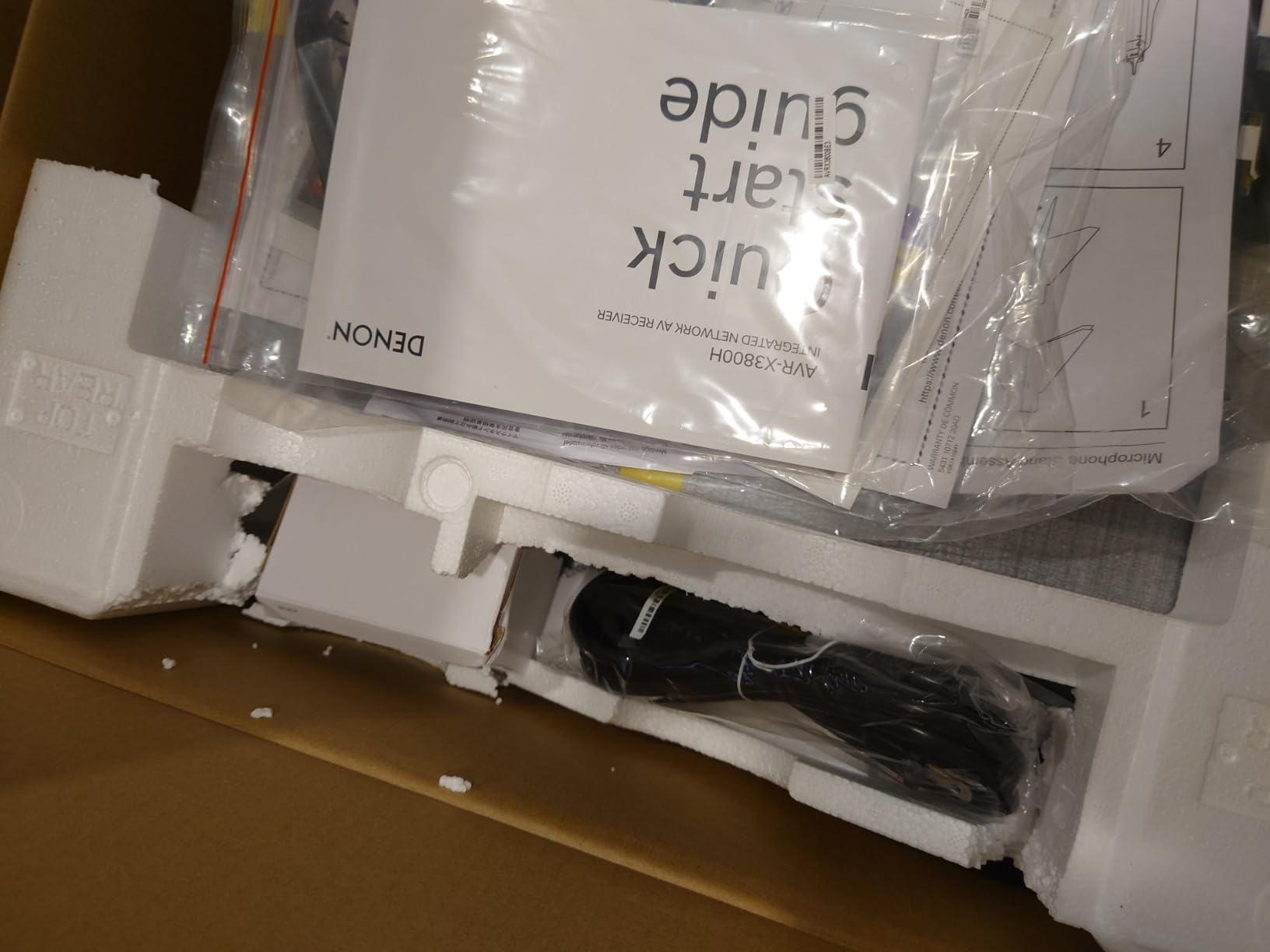
The subwoofer section is unusual. There are four subwoofer outputs, and the specification includes XLR alongside RCA, which means balanced runs to a professional installer-grade amplifier or to a multi-sub management device. For a room with more than one subwoofer, that is a real advantage over every other receiver here.
A phono input, analog and digital inputs, HEOS multi-room streaming, and a three-year warranty round out a feature set that is otherwise difficult to argue with.
The Practical Limits
Size is the first constraint. At 27.6 pounds and 21.1 inches deep, this needs a deep, sturdy shelf or a proper rack, and it will overhang a shallow TV stand. Measure before you commit, because this is a shelf-planning problem more than a listening problem.
Power is the second. Despite nine channels, the rating is 105 watts per channel, which may limit output in a very large room driving many speakers at reference level. If your theater room is genuinely cavernous, plan on adding an external power amplifier for the front channels, which is a normal and well-supported upgrade path on a nine-channel chassis. As with the other listings that returned no individual review text, the practical detail above comes from the manufacturer feature set and the aggregate 4.2-star score across 404 reviews.
When It Makes Sense
The AVR-X3800H makes sense when the receiver is one part of a build that already includes a projector, in-wall or high-performance speakers, and a dedicated subwoofer array. Nine powered channels and four sub outputs is very hard to add later without replacing everything.
It is overkill for a living room with a 55-inch television and a modest 5.1 speaker set. In that situation the Denon AVR-S970H gives you Atmos, gaming support, and a phono input for a fraction of the money.
9. Yamaha RX-A2A – Best for Music: AVENTAGE Build With Roon Tested and MusicCast
Yamaha RX-A2A AVENTAGE 7.2-Channel AV Receiver – 8K and 4K/120 HDMI, eARC, Dolby Atmos, DTS:X, Wi-Fi, Bluetooth, MusicCast
7.2 channels
100W per channel
7 HDMI in and 1 out with eARC
2 year warranty
+ Pros
- AVENTAGE tier prioritizes premium build quality and sound performance
- Surround:AI analyzes content and optimizes processing in real time
- YPAO R.S.C. multipoint calibration
- Works with Sonos plus AirPlay 2
- Spotify Connect
- MusicCast and Roon Tested
- Zone 2 output with phono and full optical
- coax and analog inputs
- Cons
- Only 100 watts per channel of rated output
- AVENTAGE tier pricing sits well above mainstream 7.2 models with similar decoding
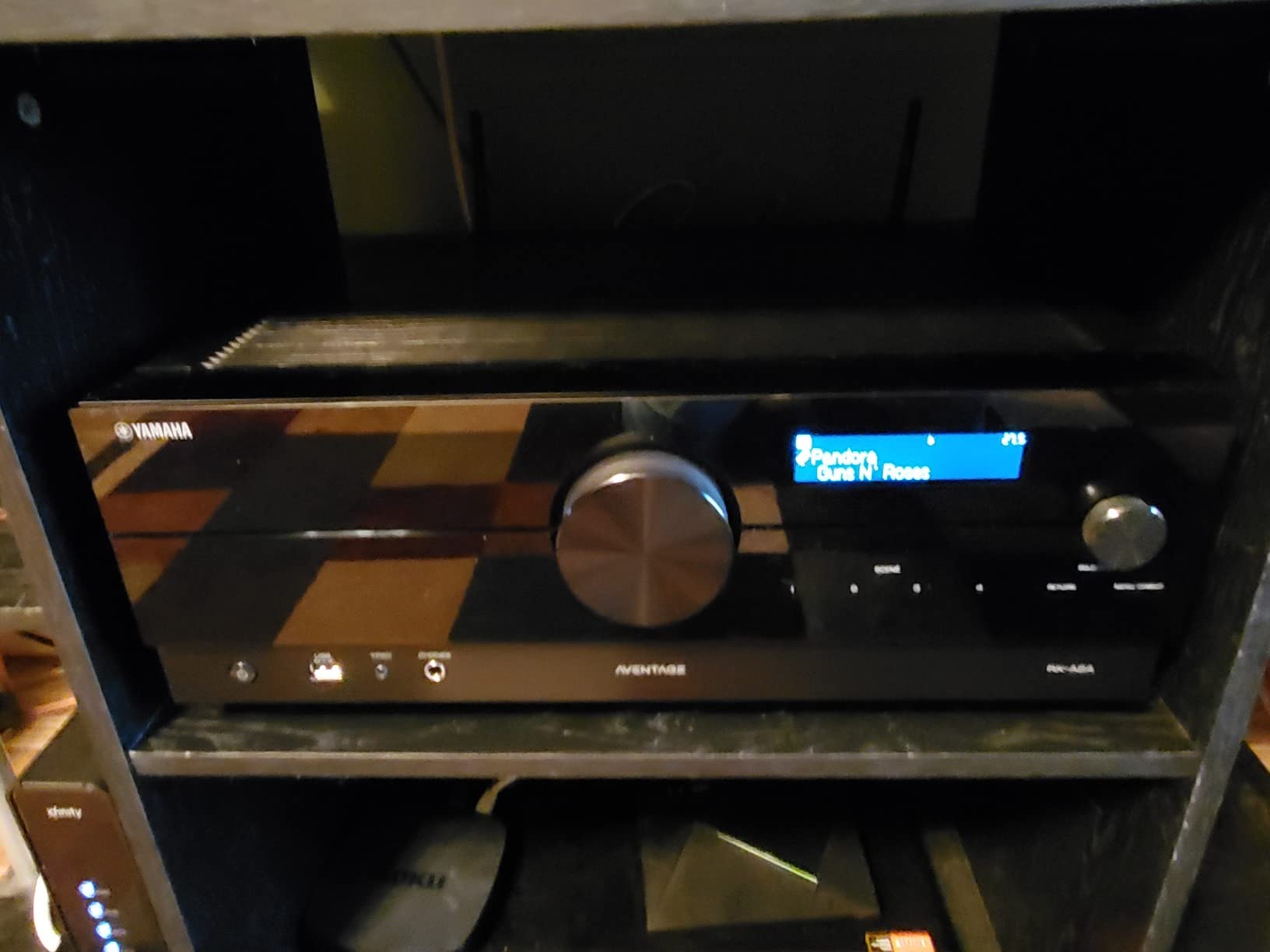
The RX-A2A sits in Yamaha’s AVENTAGE line, and that tier exists specifically for people who listen to music as much as they watch films. The build is heavier and more solidly constructed than mainstream models, and owners consistently point to the refinement of the two-channel performance when the system is playing records or streaming in stereo.
Two features set it apart for hi-fi use. Roon Tested certification means it is verified to work properly inside a Roon ecosystem, which matters if you have a large local music library. And YPAO R.S.C. with multipoint measurement gives you a much more accurate correction than a single-point sweep, which improves imaging rather than just level matching.
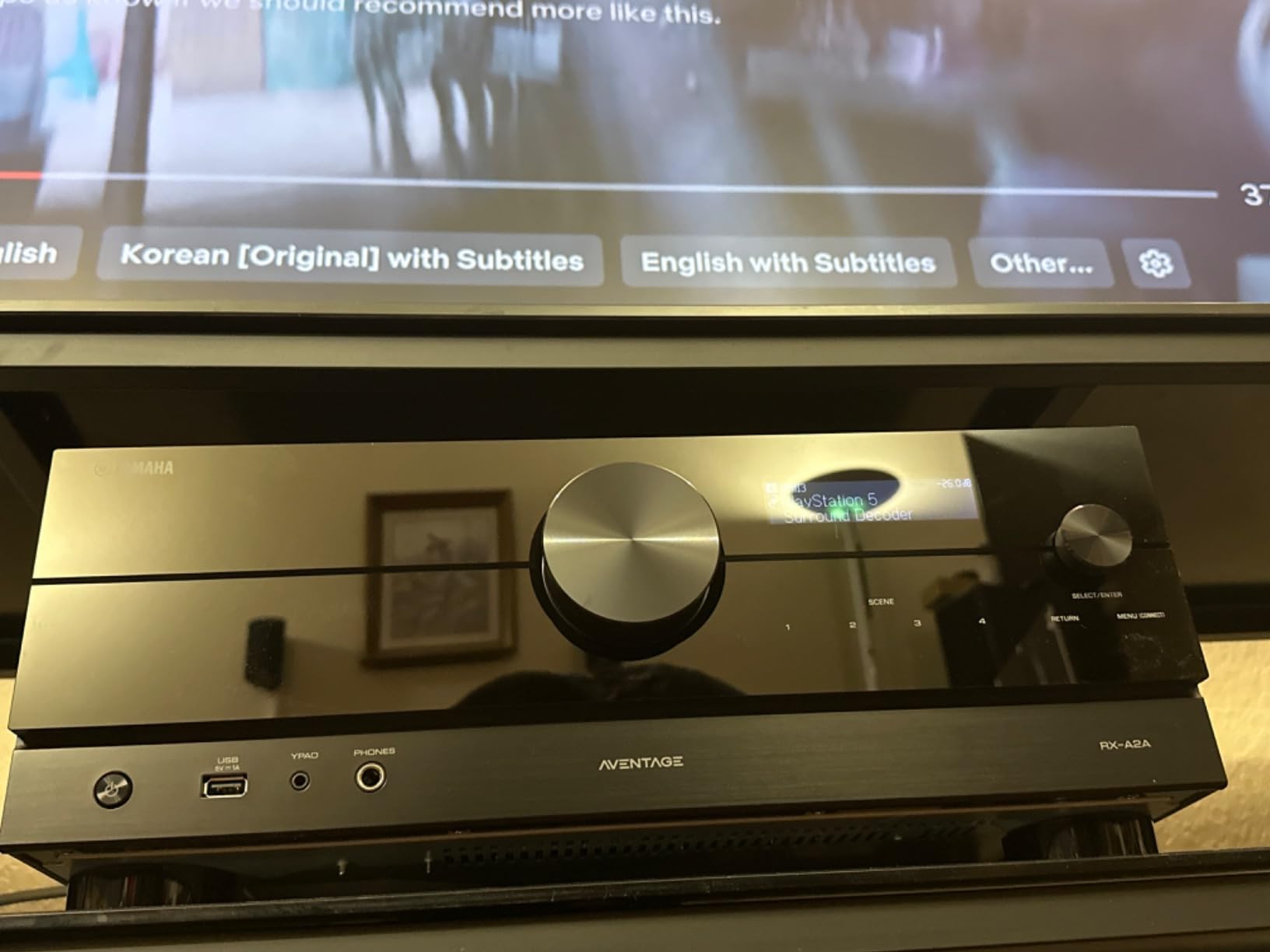
Surround:AI is the other differentiator. It analyzes content in real time and adjusts processing and effects automatically, which removes a lot of the decision fatigue that comes with menu diving before every movie.
Video support is 7-in and 1-out with HDCP 2.3 and eARC. All inputs handle 4K at 60Hz, and three handle 8K at 60Hz and 4K at 120Hz, with Dolby Vision, HDR10+, HLG, and BT.2020 for color. ALLM and VRR are supported for next-generation consoles.
The Price and Power Question
Two caveats, and they are real. The rated output is 100 watts per channel, which is unremarkable next to the Onkyo TX-NR6100’s 210 watts, and the AVENTAGE tier pricing sits well above mainstream 7.2-channel models that decode the same core formats.
What you are paying for is build quality, the calibration, the Room EQ software, and the ecosystem integrations. If those matter, the RX-A2A earns it. If they do not and you want maximum watts per channel, this is not the box. As with several listings here, no individual customer review text was returned, so we are relying on the aggregate 4.3-star score across 324 reviews and the manufacturer feature set; that 4.3 comes with the lowest one-star share of any unit in this group.
Who Should Buy It
Buy the RX-A2A if your system doubles as your hi-fi, you run Roon or a serious local library, and you want one remote-controlled box for the living room and a second zone. The phono input, Zone 2 output, and full complement of optical, coax, and analog inputs make it a natural two-zone hub.
Pair it with efficient speakers. In a small apartment, 100 watts of a well-behaved amplifier is more than enough, and the AVENTAGE chassis will not overwhelm a shelf.
10. Pioneer VSX-935 – Budget Pick: Seven Channels With Dolby Atmos Height Virtualization
Pioneer VSX-935 7.2 Channel Surround Sound Network Receiver Dolby Atmos (2021)
7.2 channels
80W per channel
8 HDMI ports with HDMI 2.1
1 year warranty
+ Pros
- Clear crisp and loud sound that owners call a big step up from older budget receivers
- MCACC phase-correction calibration praised against decade-old rivals
- Works with network audio players including DSD128 and remote pass-through
- Dual zone speaker output with an RF remote that works through obstacles
- Cons
- Only 80 watts per channel and awkwardly placed speaker-wire terminals
- Does not pass through TrueHD from TV apps so streaming HDR trades off against 3D audio
- One year warranty is the shortest in this group and some units arrive dead on arrival
The VSX-935 is the cheapest way into a genuine seven-channel receiver with HDMI 2.1 and 8K support, and owners describe its sound as clear, crisp, and loud. Several report it as a decisive upgrade over budget receivers they owned for a decade, which is the clearest endorsement a first-time buyer can get.
Its room calibration uses MCACC phase correction, and owners rate the results above what decade-old competitors managed. For network audio it works well with players such as Audirvana, including DSD128 and remote-control pass-through, and there is a useful dialog control for spoken content in video.
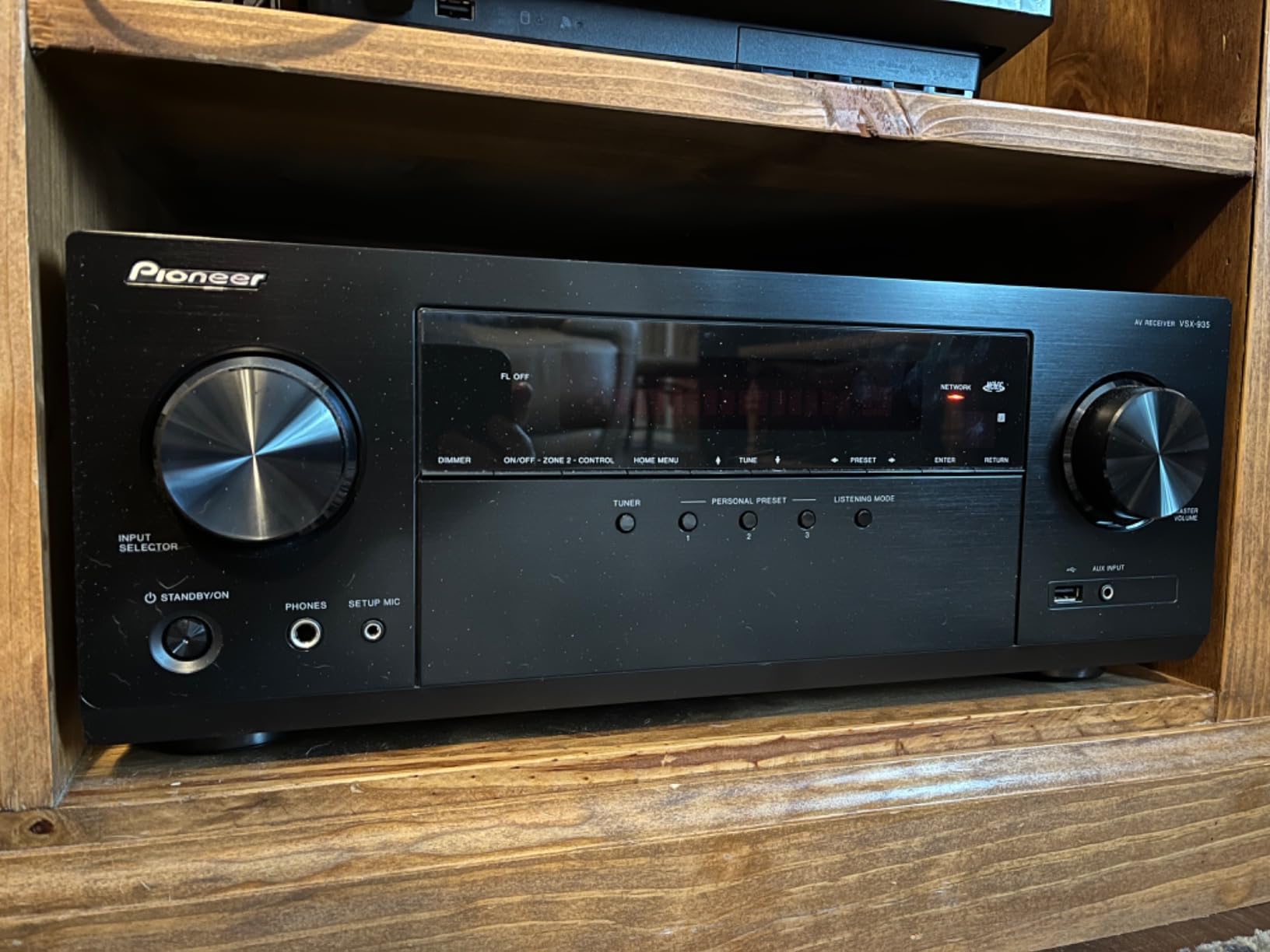
Two things set it apart for multi-room use: dual zone speaker output, and an RF remote that works through obstacles and cabinet doors. A simpler control surface with fewer processing options is also a genuine advantage, because there is less to misconfigure.
Where the Budget Shows
Usability is the weak point. The two-way Bluetooth function, which lets you send AirPods audio to the television, is buried in the menus with no remote button and is described as very difficult to use. The firmware update path is USB-only and has reportedly failed with error codes, and the interface is described as looking and behaving like a 1990s design.
There are no advanced compression, dynamic EQ, or video processing controls; features are simply on or off. At 80 watts per channel the output is modest, and the speaker-wire terminals are awkwardly placed behind the chassis. The one-year warranty is the shortest in this group, and a number of owners received units with dead displays or no audio until they toggled Zone 2 on and off.
Is It Worth It?
Yes, with a clear-eyed plan. The VSX-935 gives you seven channels, HDMI 2.1 with 8K, Dolby Atmos height virtualization, and dual-zone output for less than most competitors charge. What you give up is fine-grained control, robust firmware, a phono stage you can rely on, and warranty peace of mind.
It does not pass through TrueHD from television apps, so if you watch a lot of streaming content and want full lossless 3D audio alongside HDR, that is a real limitation. For disc-based movies with a 5.1 speaker set, it is a very sensible starting point.
How to Choose an AV Receiver for a Home Theater
Channel count gets all the attention, but it is the third question you should ask. Here is the order we actually use, in the order we would buy in.
Start With Channel Count, Because You Cannot Add Them Later
Every receiver in this list processes more channels than it has amps to power, and the extra processing costs you nothing. Buying the highest channel count you can reasonably afford is the single most common piece of advice in the enthusiast forums we researched, and it is the advice we agree with.
A 5.2 receiver is a dead end for Atmos. A 7.2 receiver handles 5.1.2 today and surround back speakers if you skip heights. A 9.2 receiver handles 5.1.4 properly, keeps a channel in reserve, and gives you a spare for a second subwoofer. If your room has ceiling or up-firing height speakers in your future, budget for nine channels now.
Then Match Watts to Your Speakers and Room
Quoted wattage is only meaningful as watts per channel driven simultaneously at 8 ohms. Marketing figures that measure two channels at once routinely overstate what a receiver can do with all seven running. A conservative rule: if your speakers are efficient bookshelf or small floorstander models, 80 to 100 watts per channel is genuinely plenty in a normal living room.
If you own low-efficiency floorstanders or plan a dedicated theater with rows of seats, look for 140 watts or more, or plan to add an external power amplifier later. The Onkyo TX-NR6100’s 210 watts per channel is the muscle option in this group, and the Denon AVR-X1700H’s 80 watts is the efficient-speaker option.
One more trap worth naming: using surround back or height channels to power a second zone means your main room loses full Atmos. If you care about both, buy enough channels that the second zone has its own amps.
Check HDMI Bandwidth Before You Buy for Games
For a PlayStation 5 or Xbox Series X, what matters is how many inputs are full-bandwidth HDMI 2.1 with 4K at 120Hz, VRR, and ALLM. A receiver with one such input technically meets the console requirement and practically fights you every time the console switches inputs.
The Onkyo TX-NR7100 solves this completely with six full-bandwidth inputs. The Yamaha RX-V6A and Yamaha RX-A2A give you three or four. Budget units with a single 4K/120 input are workable but annoying. Count the inputs you actually need, not the total port count.
Treat Room Correction as a Feature, Not a Gimmick
Room correction is the highest-leverage feature on any receiver, because it fixes the actual problem, which is that your speakers and your room were not designed to work together. The four systems in this group are Audyssey on the Denon units, YPAO R.S.C. on the Yamahas, AccuEQ on the Onkyo TX-NR6100, and Dirac Live on the Onkyo TX-NR7100.
Dirac Live is the one that consistently gets singled out for flattening a difficult room response, and it is included at no extra cost on the TX-NR7100. Audyssey is widely regarded as the most accurate and easiest to use. Neither is a substitute for good speaker placement, so measure twice.
Do Not Forget the Phono Stage and Legacy Inputs
If you own a turntable, a phono input is not optional unless you plan to add an external phono preamp. The Denon AVR-X1700H, AVR-S970H, and AVR-X3800H all have one, and the Yamaha RX-A2A has one too. The Sony STR-AN1000 and Pioneer VSX-935 do not.
Optical and coaxial digital inputs matter too if you have an older surround receiver, a game console, or a CD transport you do not want to replace. The Sony STR-DH590 has four stereo RCA inputs plus optical and coaxial, which is more legacy accommodation than any modern 8K receiver here.
Understand What a Second Zone Actually Costs You
Zone 2 support is not a free feature. The Onkyo TX-NR6100, Yamaha RX-A2A, and Sony STR-AN1000 all provide discrete second-zone output with independent volume. The Denon AVR-X3800H goes further with three HDMI outputs for independent video.
The catch is amplifier sharing. On a 7.2 receiver, driving Zone 2 usually takes one pair of internal amps away from the main room. On a 9.2 receiver, you lose less. The TX-NR7100 makes this trade-off less painful because it has channels to spare.
Check the Ecosystem Before You Commit
Streaming platforms are close to a lock-in decision. HEOS on the Denon units, MusicCast on the Yamahas, Chromecast built in on the Sony STR-AN1000, and DTS Play-Fi and Chromecast on the Onkyo TX-NR7100 all work differently, and they determine which music services and whole-home products you can group together later.
All three brands in this group that support it can join a Sonos system through a Sonos Port, which is sold separately. If you already run Sonos, that is a tiebreaker worth more than a watt here or there.
Verify Cooling and Clearance Before You Order
Receivers generate real heat, and the two Onkyo units in this list are called out by owners for running warm enough that a small add-on fan is common. Leave clearance on the top and sides, and never enclose a unit in a closed cabinet. A receiver that overheats and shuts down is the fastest way to end movie night.
What Does 7.1.4 Actually Mean? Channel Numbers Explained
Channel notation looks like a wall of numbers because it encodes two different things at once: how many speakers are in the room, and how many are pointed at the ceiling. Once you split those apart, it takes ten seconds to decode anything.
The first number is your bed layer, the speakers at ear level around the seating position. The number after the dot is subwoofer channels. The final number is height speakers.
- 5.2 means front left, front right, center, surround left, surround right, plus two subwoofer outputs. No height layer, which is why the Sony STR-DH590 sits here.
- 7.2 adds a rear surround pair behind the listening position, which widens the back soundstage. Most midrange receivers in this list are 7.2.
- 5.1.2 is the standard home Atmos layout: the 5.1 bed plus two height channels, usually in-ceiling or up-firing.
- 5.1.4 adds four height channels for a much wider overhead field, and requires nine powered channels to do it properly.
- 7.1.4 combines the full bed with four heights, which is the dedicated-theater target.
- 9.1.6 is the current flagship notation: nine bed channels and six height channels, a fifteen-speaker room that few homes can accommodate well.
So to answer the common question directly: a 7.1 system needs seven powered speaker terminals plus a subwoofer, which is one center speaker, two fronts, two surrounds, two rear surrounds, and a sub. Most people should buy a 7- or 9-channel receiver rather than a 5-channel one so that height speakers can be added later without replacing anything.
How Much Power Do You Need? Matching Watts to Room Size
Underpowering a receiver is the most repeated complaint across every home theater forum we researched, and it is also the easiest to avoid. The rule is not complicated, and it mostly comes down to speaker efficiency rather than room volume.
Speaker sensitivity tells you how much input a speaker needs to produce a given volume. A speaker rated at 90 dB will play far louder from the same watts as one rated at 84 dB, and that six-decibel difference is a factor of four in required power. Check the sensitivity specification before you fall in love with a speaker’s impedance rating, which is a different number entirely.
A practical sizing guide: in a small apartment or bedroom, an efficient 5.1 system at 80 watts per channel is more than enough. In a medium living room theater running 5.1.2 or 7.2, budget 100 to 140 watts per channel. In a large dedicated room with rows of seats, you want 140 watts or more per channel, or you should plan to add an external power amplifier for the front channels later.
Speaker impedance matters too. Most home theater speakers are 6 or 8 ohms, and you should never connect speakers below the receiver’s stated minimum impedance. The Denon AVR-X3800H’s nine-channel chassis is a good example of the alternative approach: buy the channels and the flexibility, then add power later if the room demands it.
One last piece of real-world advice from the forums: buy fewer channels with more watts per channel rather than many weak channels. Two channels driven hard will play louder and cleaner than seven channels at the edge of their limit, and clean headroom is what keeps dialogue intelligible at a family movie night.
When You Should Skip an AV Receiver
A roundup that only says yes is not useful, so here is the honest part. Several of you reading this should not buy any of these ten receivers.
If your main screen is a television in a living room and you watch movies occasionally rather than weekly, a soundbar with wireless rear speakers will give you a large share of the experience for a fraction of the money, a fraction of the cabling, and none of the calibration work.
If you mainly listen to music and occasionally watch something, a pair of powered bookshelf or active speakers with a small subwoofer will outperform a budget receiver driving passive speakers, because the amplification is matched to the drivers by the manufacturer.
If you already own an AVR and want better sound, the cheapest improvement is a better front three and a properly integrated subwoofer, not a new receiver. Room correction on a midrange unit cannot fix mismatched speakers.
And if you genuinely want separate power amplifiers, external processors, or bi-amping, a preamp is the correct purchase rather than any receiver on this list. Several of the ten receivers here have no pre-outs at all, so make that decision before you buy rather than after.
Frequently Asked Questions
What is the best brand for AV receivers?
There is no single winning brand, because each one leads a different category. Denon leads on room correction and overall value, Onkyo leads on power per channel and gaming features, Yamaha leads on music playback and multi-room refinement, Marantz and Sony lead on build quality and virtual spatial processing, and Pioneer covers the budget tier. Judge by the use case rather than the badge on the front panel.
What is the best AV receiver for home use?
For most people building a home theater, the best overall pick is the Sony STR-DH590 if you want a proven 5.2 system, or the Onkyo TX-NR6100 if you want Dolby Atmos, more power, and room to grow. The Sony offers 5.2 channels at 145 watts per channel with the largest owner base in the category, while the Onkyo delivers 7.2 channels at 210 watts per channel with three full-bandwidth HDMI 2.1 inputs.
What is the best value-for-money AV receiver?
The Onkyo TX-NR6100 is the strongest value in this group. It delivers 210 watts per channel across 7.2 channels, THX Select certification, Dolby Atmos and DTS:X decoding, eight HDMI ports including three full-bandwidth HDMI 2.1 inputs, and discrete Zone 2 output. The one compromise to accept is the absence of a composite video input for legacy consoles.
Which AV receiver is the best this year?
The best overall receiver for 2026 depends on your room and speakers, and the generation shift that matters most is HDMI 2.1 becoming standard. That brings 8K pass-through, 4K at 120Hz, VRR, and ALLM to midrange models instead of flagships, and room correction like Dirac Live now appears on affordable nine-channel receivers such as the Onkyo TX-NR7100.
Is upgrading from 5.1 to 7.1 worth it?
It is worth it in large rooms and dedicated theaters, and only marginal in small ones. Two extra surround speakers widen the back soundstage, but in a compact room 5.1.2 with real height speakers usually sounds better than 7.1 without them. Spend your budget on the front three speakers and a properly integrated subwoofer first, since those change the sound more than the rear channels do.
How many speakers do you need for 7.1 surround sound?
A 7.1 setup needs seven powered speaker terminals plus a subwoofer. That is one center channel, two front speakers, two surround speakers, two rear surround speakers, and one subwoofer. We recommend buying a nine-channel receiver so you can add Atmos height speakers later without replacing the receiver.
What is the difference between an AV receiver and an amplifier?
An amplifier is a simple powered box that drives speakers and does little else. An AV receiver combines amplification with surround-sound decoding, video switching for multiple HDMI sources, room correction, and streaming, all in one chassis. That is why a receiver costs more and why it is easier to set up for home theater use.
Do I really need an AV receiver?
You need one if you have room for at least a 5.1 speaker layout plus a subwoofer, watch movies regularly, and want Dolby Atmos height sound. If you are in a small apartment, mostly watch television, or mostly play games, a soundbar or a pair of powered bookshelf speakers will give you most of the experience for far less money and far less setup friction.
Final Verdict
Here is where each of these ten makes sense, in the order buyers usually arrive at the decision.
If you are building your first theater and want something that works without drama, the Sony STR-DH590 is our Editor’s Choice, and we stand behind that with the largest owner base in this group. If you want Atmos, real power, and a discrete second zone in the same box, take the Onkyo TX-NR6100. If you game on current hardware, the Onkyo TX-NR7100 with Dirac Live and six full-bandwidth HDMI 2.1 inputs is the one to beat, and its nine channels keep your options open.
If music is half your listening, the Yamaha RX-A2A in the AVENTAGE line is the refined choice with Roon Tested and YPAO R.S.C. If a small room is your reality, the Pioneer VSX-935 gives you seven channels and height virtualization without overfilling the space. If you are building a dedicated room with a projector and multiple subwoofers, the Denon AVR-X3800H is the only receiver here whose specification includes four subwoofer outputs with XLR alongside RCA.
And if you are still deciding, read the power section above before anything else. Matching watts to your speakers and room solves more problems than any feature on any of these chassis. We will keep this best AV receivers for home theaters list current as new models arrive in 2026 and beyond, and we will tell you plainly when one of these is no longer worth new money.