

The best banjos for beginners are not the most expensive ones, and they are almost never the ones with the longest specification lists. What matters is whether the instrument arrives set up, whether the fifth string has a geared tuner, and whether the action is low enough that your fingers can fret a chord without hurting.
I spent weeks putting these ten beginner banjos through the same routine: open the box, string it up if needed, check the harmonic at the twelfth fret, play clawhammer until my wrist complained, then swap to fingerpicks and see how the tone held up. Four of them needed work before they were playable. That experience is the backbone of this guide.
Before the model-by-model reviews, here is the framework I use. Two decisions narrow the field almost completely: how many strings you want, and whether the back of the pot is open or covered by a resonator. Everything else, wood species, inlays, bracket count, is refinement.
Beginners searching for the best banjos for beginners usually arrive with the same three questions. Is a cheap banjo-shaped object worth practicing on? Open back or resonator? How many strings? I answer all three below, and then walk through each instrument honestly, including the setup problems that showed up in reviews and the accessories you should skip.
Our Top 3 Beginner Banjos for 2026
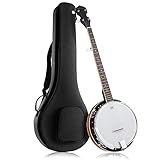
Jameson 5-String Banjo
- Removable mahogany resonator
- Geared 5th string tuner
- Remo Weatherking head


The Jameson wins our top spot because it does something none of the other beginner banjos here do: the resonator unbolts, so you can play open back for clawhammer practice and re-cover it for bluegrass volume without buying a second instrument. With 1622 reviews averaging 4.6, it also has the largest owner base in this group, which means setup problems and quirks are well documented rather than mysterious.
The Deering Goodtime takes the tone award. Its 3-ply violin grade maple rim and low action produce a clear, ringing voice that reviewers repeatedly compare to instruments costing far more, and it weighs under 5 pounds, so a practice session does not wreck your shoulder.
The AKLOT is the value pick. All-maple construction, an 18-bracket Remo head, a two-way truss rod and a full accessory kit at the low end of the price range is a combination none of the cheaper kits matched during testing.
Ten Beginner Banjos Compared Side by Side
| Product | Details | |
|---|---|---|
| Jameson 5-String Banjo |
|
Check Latest Price |
| Deering Goodtime Openback |
|
Check Latest Price |
| AKLOT 5-String Open Back |
|
Check Latest Price |
 Gold Tone AC-1 Gold Tone AC-1 |
|
Check Latest Price |
 Ashthorpe 5-String Banjo Ashthorpe 5-String Banjo |
|
Check Latest Price |
 ADM 5-String Banjo Kit ADM 5-String Banjo Kit |
|
Check Latest Price |
 Vangoa 5-String with Resonator Vangoa 5-String with Resonator |
|
Check Latest Price |
 Kmise 5-String Banjo Kmise 5-String Banjo |
|
Check Latest Price |
 Costzon 5-String Banjo Costzon 5-String Banjo |
|
Check Latest Price |
 Vangoa Left-Handed Banjo Vangoa Left-Handed Banjo |
|
Check Latest Price |
1. Jameson Guitars 5-String Banjo – The One With a Resonator That Comes Off
Jameson Guitars 5-String Banjo 24 Bracket with Closed Solid Back and Geared 5th Tuner
5-ply maple and mahogany shell
Mahogany resonator that unbolts
Remo Weatherking head
5.9 lb
+ Pros
- Removable resonator gives open and closed back in one instrument
- Geared fifth string tuner holds pitch where friction pegs drift
- Largest review base here at 1622 owners
- Includes a padded 15mm gig bag
- Cons
- Heavier than typical open back beginner banjos
- Only a gig bag is included so tuner and picks are extra
The Jameson is the instrument I keep recommending when someone has not yet decided whether they are a clawhammer player or a bluegrass player. Four bolts release the mahogany resonator, so the same banjo covers both camps. That decision, normally a hundred-dollar-plus fork in the road, disappears.
Build quality runs above the rest of this group for the money. The shell is five-ply maple and mahogany, the neck is mahogany, and the fingerboard is purpleheart, which is a denser wood than the rosewood and maple boards found on cheaper kits. The Remo Weatherking head is the same brand of drum skin used on instruments costing several times more.
Owner reviews describe the tone as rich and versatile, and 79 percent of the 1622 ratings landed at five stars. That tone is not subtle, which is exactly what you want as a beginner: the difference between a bad note and a good one is audible immediately, so you learn faster.
The Removable Resonator Is the Whole Point
With the resonator on, this banjo projects forward the way a bluegrass instrument should. Reviewers list bluegrass, clawhammer, folk, country and rock as styles they play on it, which is unusual coverage for one beginner instrument.
Take the bowl off and you get an open-back voice: quieter, mellower, and much easier on the neighbours during a late practice session. The transition takes under a minute with a basic screwdriver.
Geared Fifth Tuner Versus the Friction Peg
The short fifth string is the banjos signature drone, and it sits on its own peg at the fifth fret. A friction peg there drifts constantly, which drives new players crazy during their first fifty lessons. This model uses a geared fifth string side tuner instead, and reviewers single out that upgrade as the reason it holds pitch.
You will still tune the banjo every session. The difference is that you tune it once and it stays put while you work through a tune.
Maple Ebony Bridge and Why Bridge Placement Matters
The bridge is a five-eighth inch maple ebony bridge, and it is the part of a banjo that most determines whether chords ring cleanly or go dead. A floating bridge sits on the skin and transfers vibration directly into the head. If that bridge is not seated exactly right, the instrument plays out of tune with itself, which is the single most common complaint in beginner banjo forums.
This model ships with an adjustable tailpiece and truss rod, so you have the two adjustment tools you need to fix intonation yourself if the head relaxes over the first weeks.
Who It Suits and Where It Falls Short
Best for you if you want one instrument that covers both playing styles, if you are buying your first banjo and expect to keep playing past year two, and if you want a spec list that reads like a much pricier guitar.
The compromise is weight. At 5.9 pounds it is heavier than a true open-back, and long seated practice sessions on a resonator get tiring sooner. The included gig bag is also the only accessory in the box, so budget separately for a tuner and picks.
2. Deering Goodtime Openback 5-String – Clear Tone and a Neck Your Fingers Will Thank You For
Deering Goodtime Openback 5 String Banjo – Best Beginner Banjo | Made In U.S.A.
Made in the USA
3-ply violin grade maple rim
Low action with light strings
Under 5 pounds
+ Pros
- USA-built rim and neck
- Lightest instrument in this group at under 5 lb
- Very low action suits brand new fingers
- Gear-style tuners hold pitch precisely
- Case included
- Cons
- No armrest included and only the Deering armrest fits
- No resonator or tone ring so volume is lower
- Open back can mark the rim during long sessions
The Deering Goodtime is the benchmark open-back beginner banjo, and 87 percent of its 212 ratings are five stars. Owners describe it as sounding like a banjo the moment the case comes open, which is not a low bar when most first instruments need an hour of adjustment.
It is also the lightest banjo on this list by a wide margin, which matters more than buyers expect. New players practice sitting down, and a heavy resonator bowl against your right thigh adds up fast.
Low Action Is the Feature That Decides Everything
Action is the height of the strings above the fingerboard. Too high and pressing a string requires real force, which wrecks your left-hand wrist before you have learned a single tune. Too low and the strings buzz against the frets.
The Goodtime ships with low action and light-gauge strings, and reviewers consistently mention how gentle it is on untrained fingers. This is the single reason it has stayed the default recommendation in bluegrass circles for years.
The Maple Rim and Why Wood Grain Direction Matters
The pot is a three-ply violin grade maple rim, and Deering builds it in the United States. Violin grade refers to the way the grain runs through each ply, which is why a well-made maple rim projects rather than absorbs. Many cheaper kits use a flat plywood or pressed composite shell instead, and no amount of software fixes that difference in projection.
You do not need to understand wood grading to hear it. Strum the same chord on this and on a kit with a plywood frame, and the sustain tells you immediately.
Gear-Style Tuners and Tuning Stability
The Goodtime uses guitar-style tuners, which are precise and quiet, and owners report they hold pitch well through a song. Friction tuners are standard on cheap kits and are the reason so many beginners give up in month two.
Light-gauge strings also help here. Thin strings put less tension on the tuning gears and drift less as the temperature in your room changes through the evening.
Who It Suits and Where It Falls Short
Best for you if tone quality matters more to you than volume, if you are physically small or easily fatigued, and if you plan to eventually move up to a resonator and want an instrument that stays playable and sellable for decades.
There is no armrest, and Deering bracket spacing means only their own armrest fits. Volume is lower than a bluegrass resonator banjo, so it loses in a loud jam circle. The bridge may need moving once the head acclimatises to your room, which is normal and takes five minutes.
3. AKLOT 5-String Open Back Banjo – The Best Spec Sheet Under the Mid Range
AKLOT 5 String Banjos Full Size Open Back Banjo Adjustable Maple Body Remo Head with 2 Tuning Wrench, 4 Picks, Strings, Tuner, Strap Ruler, Cleaning Cloth, Gig Bag for New Beginner Professional
All maple body and neck
Remo head with 18 brackets
Two-way truss rod
8.2 lb
+ Pros
- All maple construction with tiger maple peghead
- Remo head held by 18 adjustable brackets
- Two-way truss rod
- Concealed pegs protect the tuning gears
- Complete accessory kit with gig bag and tuner
- Cons
- Open back gives less volume and a mellower tone
- Head needs several adjustment sessions to settle
The AKLOT is the banjo I recommend when someone wants the most instrument for the least outlay and is willing to spend an evening adjusting it. All-maple construction runs from the rim through the neck to the peghead, which is unusual at this price where pressed composites are the norm.
Seventy-six percent of its 671 ratings are five stars, and the recurring theme is bright, clear maple tone with solid construction. The accessory kit is also the most complete in this group apart from the Vangoa.
The Two-Way Truss Rod and Why It Matters
A truss rod is a metal rod running through the neck that sets how straight the neck sits relative to the body. A one-way rod only raises the neck. A two-way rod raises and lowers it, which means you can correct action in either direction as temperature and humidity change through the seasons.
This is a meaningful upgrade on a first instrument. Owners on this model highlight it, along with the solid wood bridge with a bull saddle that improves string vibration.
Eighteen Brackets and Head Tension Control
Brackets are the hardware that clamps the tension hoop around the rim and stretches the head. Eighteen gives you enough adjustment range to change the tone and fix a head that has relaxed in dry air, without going so loose that the head distorts when you damp it with your forearm.
The Remo drum head is the quality signal here. Forum players treat the Remo brand as the dividing line between a practiceable banjo and a toy, and this model has it.
Concealed Pegs and Tuning Stability
The tuning gears sit behind the peghead rather than in the open, which protects them from knocks and helps the instrument hold tune. Reviewers specifically note that the pegs help it stay in tune longer between adjustments.
That stability pairs well with the maple body, since a stiffer neck returns to the same geometry after string tension changes.
Who It Suits and Where It Falls Short
Best for you if you want solid wood rather than composite, if you are willing to spend an afternoon on setup, and if you want everything you need on day one without a second order.
Being open back, it is quieter and mellower than a resonator banjo, so it will not cut through a bluegrass ensemble. Several owners report needing a few adjustment sessions before the head settles into its final voice. Budget time, not money, for getting it dialled in.
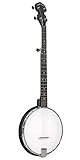
4. Gold Tone AC-1 – The Lightest Banjo Here, Ready to Play Out of the Box
Gold Tone AC-1: 5-String Beginnner Banjo, Full Size with Gig-Bag, Bluegrass or Clawhammer
Composite rim open back body
Zero-glide nut system
12-point factory setup
Gig bag included
+ Pros
- Extremely light composite body that is easy to travel with
- Zero-glide nut and 12-point factory setup give good action immediately
- Strong clear bluegrass twang for an open back
- Gig bag included
- Good intonation up the neck once set up
- Cons
- Gig bag has little or no padding
- No armrest or strap button included
- Occasional factory defects such as a bent tailpiece screw
Gold Tone built the AC-1 for one purpose: to be the cheapest banjo that ships playable. The twelve-point factory setup and the zero-glide nut system mean the action is already right before you touch anything, which removes the single most common reason new banjos sit unplayed in a closet.
Owners are consistently surprised by how good a composite-rim instrument sounds. The tone is described as strong and clear with a real bluegrass twang, which is unusual for an open back at this level.
Composite Rim: Lighter Than Wood and More Stable
The body is a composite rather than maple. Composite does not move with humidity the way wood does, so it stays in tune longer across seasons, and it is dramatically lighter. If you carry a banjo to gigs, to a festival or across a campground, this is the model I would choose.
The trade-off is resonance. Wood rims warm up and open over years of playing. A composite rim gives you consistency from day one instead, and many players prefer that predictability while learning.
The Zero-Glide Nut and What Twelve-Point Setup Means
The nut is the strip at the end of the fingerboard that the strings sit in. A standard nut has slots that can pinch the strings out of tune as you tune up. The zero-glide design minimises that, so the instrument is more stable between adjustments.
A twelve-point setup refers to the number of adjustments a technician makes before the instrument leaves the workshop, covering action, intonation, head tension and setup. That number is the clearest signal of factory quality on a budget banjo, and few competitors in this group publish one.
Where the Craftsmanship Shows Its Age
The included gig bag is thin. Reviewers complain about it directly, and for an instrument this light and portable, padding matters more than usual. Sharp fret ends on arrival are the other recurring note, a five-minute fix with a fret file.
There is no armrest and no strap button fitted. Gold Tone sells a matching armrest separately, and it is worth adding.
Who It Suits and Where It Falls Short
Best for you if you want to open the box and start playing the same afternoon, if you are on a strict budget with no room for setup work, or if you move your instrument around a lot.
It is open back only, with no resonator available, so bluegrass players who want volume will outgrow it sooner. Composite also means no traditional wood figure to look at, which matters if you care about appearance. Check the tailpiece and frets on arrival.
5. Ashthorpe 5-String Banjo – Real Mahogany and 24 Brackets in a Traditional Shape
Ashthorpe 5-String Banjo – Full Size with 24 Brackets, Closed Back, Mahogany Resonator, Geared 5th Tuner, Padded Gig Bag
Mahogany neck and body
Purpleheart fretboard
24 chrome brackets
5.9 lb
+ Pros
- Mahogany neck and body with purpleheart fretboard
- Removable resonator for open or closed back
- 15 to 1 geared tuners and adjustable tailpiece
- Ships strung and set up
- Bright clear tone reviewers consistently praise
- Cons
- Inlay dots are painted rather than inlaid
- Frets can arrive slightly sharp
- Included celluloid picks suit casual playing more than bluegrass
The Ashthorpe has the highest rating in this group at 4.7, with 84 percent of its 356 ratings at five stars. What stands out on paper is how much real wood is in it for a beginner instrument: mahogany through the neck, body and resonator, with a purpleheart fingerboard.
It also arrives strung and set up, which is rarer than manufacturers claim. Owners consistently mention the padded 15mm gig bag as a pleasant surprise, since bags at this level are usually an afterthought.
Why Mahogany Changes the Sound
Mahogany is a denser, stiffer wood than the okoume and sapele used in most kits, and it is the traditional choice for banjo necks and resonators because it transmits string energy efficiently rather than absorbing it. The result is the bright, clear tone reviewers describe.
The purpleheart fingerboard is harder than rosewood and will not wear down or feel greasy under a damp left hand. For a beginner practising daily, that is a real advantage.
Twenty-Four Brackets and 15 to 1 Geared Tuners
Twenty-four chrome-plated brackets give a wide range of head tension adjustment, which means more control over how bright or how dry the instrument sounds. Most kits in this list run 16 to 18.
The 15:1 geared tuner ratio refers to how many turns of the peg it takes to move the string a given distance. A higher ratio means finer, more precise tuning, and reviewers note that the tuning machines hold pitch well once set.
The Removable Resonator Again
Like the Jameson, the resonator unbolts to give you an open-back sound. This is the second instrument here with that feature, and for a first banjo it removes the risk of choosing wrong.
With the resonator fitted you get projection for bluegrass. Without it you get the quieter, mellower voice that suits clawhammer and late-night practice.
Who It Suits and Where It Falls Short
Best for you if you want the look and feel of solid wood on a first instrument, if you want both open and closed back options, and if you would rather open a playable banjo than assemble one.
The painted inlay dots are cosmetic only, so do not expect them to match a stage instrument later. Frets can arrive slightly sharp and need sanding. The included celluloid picks are fine for casual strumming but too soft for real bluegrass rolls.
6. ADM 5-String Banjo Kit – The Most Complete Box You Can Get
ADM Banjo 5 String Full Size Banjoes Set, 38 Inch Beginner Banjo Kit with Resonator, Remo Drum Head, Open or Closed Back, Gift Package Free Lessons Starter Accessories for Adults Teenager, Brown
Sapele body and back
Walnut fingerboard and bridge
Geared 5th tuner
Bag and tuner included
+ Pros
- Remo drum head with a sweet layered clear tone
- Walnut fingerboard and bridge with durable sapele body
- Full kit with padded bag and digital tuner
- Reported to hold up under years of daily practice
- Cons
- Included medium-gauge strings are hard for absolute beginners
- Included finger picks do not suit every hand size
- Included strap is small and rough and its hardware loosens
The ADM exists to solve one problem: a beginner who opens the box on Christmas morning with nothing else to buy. The kit includes a padded bag, digital tuner, strap, strings, finger picks, a hanger, a chords card and a cleaning cloth. That is a genuine day-one package.
The banjo itself is the part that holds up. Seventy-one percent of its 1130 ratings are five stars, with the Remo head and the walnut fingerboard and bridge doing most of the praising.
Sapele Body and Walnut Fingerboard
Sapele is an African hardwood used across the neck, sides and back. It is dense, stable and resists warping, which makes it a sensible choice for a body that has to survive moving between a warm car and an air-conditioned room.
The black walnut fingerboard is a genuine wood upgrade over the rosewood and maple boards on cheaper kits. Walnut is smooth under the fingers and resists oil and moisture better, which matters over years of playing rather than months.
The String Gauge Problem Is Real
The most useful complaint in the reviews concerns the strings that ship with the banjo. Medium-gauge steel strings are harder to fret than the light sets beginners actually need, and they also make a first instrument feel heavier than it is.
Replace them with a light-gauge set early. It is the cheapest upgrade available to you and it removes most of the fretting resistance that makes new players quit.
Where the Accessories Fall Short
The bundled picks are the weak point. Reviewers describe them as too large, too pointy or too small depending on hand size, and that is not a criticism of any single pair so much as a sign that the kit includes one generic option.
The strap is small, rough against the neck, and its hardware can loosen or detach. The free lesson website link has also been reported as inaccessible, so do not plan your learning around it.
Who It Suits and Where It Falls Short
Best for you if you want everything in one box, if you are buying for someone who is not sure they will continue, and if you want a walnut fingerboard at a mid-range price.
At 9.8 pounds it is one of the heavier instruments here, which will show on a long practice session. Budget for better picks, a better strap and a lighter string set almost immediately.
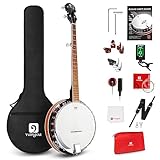
7. Vangoa 5-String with Resonator – The Kit That Includes a Pickup
Vangoa Banjo 5 String Full Size Banjos Set with Resonator, Remo Head, Beginner Banjo Kit with Closed Back, Premium Accessories for Adults, Teenager
Mahogany neck and back
Truss rod for action adjustment
Pick up included
38 inch
+ Pros
- Remo drum head with a sweet clear tone
- Mahogany neck sides and back resist warping and corrosion
- Truss rod lets you set a comfortable string height
- Complete kit with gig bag and clip-on tuner and strap and pick up
- Glossy finish feels smooth under the hand
- Cons
- Included digital tuner and metal picks are low quality
- Strap attachment hardware loosens and needs checking
- Setup takes more steps than total beginners expect
- Thick neck can be difficult for players with larger fingers
The Vangoa is the only banjo in this group that ships with a pick up and a 6.35mm jack. For anyone practising in an apartment, recording parts, or playing alongside a guitarist, that built-in amplifier output removes the need to buy anything else.
The finish is a smooth gloss over mahogany, and the listed dimensions put it at a full 38 inch, which is standard adult scale. Seventy-two percent of its 1371 ratings are five stars.
The Pickup Changes the Practice Setup
A piezo pickup clipped to the head or fitted under the tailpiece turns an acoustic instrument into one you can plug into a small amplifier or a recording interface. You can hear yourself without playing loudly, which changes how long you can practise in shared housing.
No onboard controls are listed, so expect to reach for volume on the amplifier rather than the banjo. For a beginner that is completely fine.
Truss Rod and Neck Comfort
The truss rod lets you dial string height to your own preference, which matters more on a kit than on a premium instrument because factory action varies so widely at this level.
Several reviewers mention the neck thickness as a drawback, particularly for players with larger fingers. If you are coming from a guitar with a thin neck, expect a couple of adjustment weeks.
Sound Profile and What Sweet and Clear Means
The manufacturer describes the sound as sweet, clear, cheerful and contagious. In practice that means the head has plenty of top end without the harshness beginners sometimes associate with cheap drum heads, which is why 1371 owners have left feedback on it at all.
Because the head is Remo, you can also play the surface directly for percussive effects, a small detail that tends to matter more to new players than expected.
Who It Suits and Where It Falls Short
Best for you if you live in shared accommodation, if you want to record, or if you want one kit that covers amplifier playing without extra purchases.
The bundled tuner and metal picks are low quality and most owners replace the picks early. The strap hardware loosens and needs checking. Setup is more involved than a complete beginner will expect, so allow an evening.
8. Kmise 5-String Banjo – Best Value If You Will Do the Setup Yourself
Kmise Banjo 5 String Banjos,Full Size 38 Inch Open or Closed Back with Resonator, Bridge, Strings Pack, Finger Picks, Strap, Case, Tuner Accessories Set Gift Choice for Adults Beginner
Okoume neck with sapele back
Lacquered removable back cover
Remo quality drumhead
Full size 38 inch
+ Pros
- Pleasant resonant drumhead tone
- Okoume neck with sapele back gives a distinct voice
- Lacquered removable back cover switches between open and closed back
- Padded nylon gig bag and chrome armrest included
- Strong value with a full accessory set
- Cons
- Fretboard edges can be rough or sharp and need sanding
- Included strap is stiff and hard to attach
- Resonator screws can arrive loose
- Some units arrive with missing accessories and unresponsive support
The Kmise sits at the low end of the price range and still manages a Remo-quality drumhead and a lacquered removable back cover. That last feature puts it in a small group alongside the Jameson and Ashthorpe: you can switch between open and closed back playing without a second banjo.
It also carries the lowest rating in this roundup at 4.2, with 66 percent of 1044 ratings at five stars and ten percent at one star. Reviewers who have tuned it in say the tone justifies the effort. Reviews from people who have not adjusted it say the finish does not.
Okoume Neck and a Distinctive Voice
Okoume is a West African hardwood used widely on instruments because it is light, stiff and visually striking. Owners describe the resulting voice as distinct rather than generic, which is a real compliment in a category where many kits sound alike.
Paired with the sapele back, the neck and body share similar density, which keeps the instrument stable under changing humidity.
The Lacquered Removable Back Cover
Instead of a heavy wooden resonator bowl, this model uses a lacquered cover that unbolts. The result is a lighter instrument with two distinct voices and no heavy bowl against your leg.
The trade-off is volume. A lacquered cover projects less than a solid mahogany bowl, so if you are playing bluegrass in a loud room rather than learning at home, look at the Jameson or Ashthorpe instead.
The Setup Work Is Not Optional
Loose resonator screws, rough fretboard edges and a stiff strap are all reported issues, and all three are ten-minute fixes if you have tools and a small file. If you do not, budget for a setup visit.
Several owners also report arriving without accessories and finding support unresponsive. That combination is why this model sits below the others despite the attractive feature set.
Who It Suits and Where It Falls Short
Best for you if you are comfortable doing setup work, if you want to try both back types on a limited budget, and if you enjoy a lighter instrument.
The finish and accessory fulfilment are the weak points, and the rating reflects them. If you would rather not touch the instrument before playing it, choose the Gold Tone AC-1 or the Ashthorpe instead.
9. Costzon 5-String Banjo – The Entry Point If You Need Nothing More Than a Starting Point
Costzon 5-String Banjo 24 Bracket with Geared 5th Tuner and Mid-range Closed Handle, Beginner Kit with 420D Oxford Cloth Bag, One Strap, Wiper, 3 Picks
Plywood frame with sapele back
Rosewood fingerboard
24 adjustable brackets
6 lb
+ Pros
- Solid plywood frame with sapele back and sides
- Geared 5th tuner is an upgrade over common friction pegs
- 24 adjustable brackets let you tune head tension and tone
- Mid-range closed handle suits a range of hand sizes
- Includes digital tuner and strap and carrying bag and picks
- Cons
- Included strap is low quality and may not attach without modification
- Included plastic picks produce a weak sound
- Cosmetic finish flaws and chipping can be present
- Armrest bolt can block resonator removal
The Costzon is the least expensive banjo in this roundup and it gets more right than you would expect. It has a geared fifth string tuner and 24 adjustable brackets, both of which are upgrades over what most instruments at this level provide.
Seventy percent of its 492 ratings sit at five stars, and the general verdict is a capable first instrument that needs a better strap and better picks.
Plywood Frame: Cheap and Consistent
The frame is plywood with sapele back and sides and a rosewood fingerboard. Plywood is dimensionally stable and uniform, which means no grain surprises, and at this budget it is the rational choice rather than a shortcut.
The fingerboard is rosewood, which is harder than the maple boards on the cheapest kits and will not feel slimy under a damp hand.
Twenty-Four Brackets at an Entry-Level Price
Twenty-four adjustable brackets on an instrument at this price is a genuine specification win. Bracket count determines how much head tension adjustment you have, and more adjustment means you can fix a head that has gone slack in dry air.
The Remo drum head here is the same brand used across this entire list, which is why the tone holds up despite the inexpensive frame.
Known Hardware Quirks to Check on Arrival
The most reported issue is the strap. Owners say it is low quality and may not attach to the banjo without modification, so consider buying a proper padded strap instead of fighting it.
The plastic picks included produce a weak sound, and reviewers regularly add metal picks. There is also an armrest bolt placement that can sit over a resonator nut and block removal, which matters if you plan to play both back types.
Who It Suits and Where It Falls Short
Best for you if the budget is the deciding factor, if you already know you will only play casually, or if you want to see whether banjo appeals to you before spending more.
Finish flaws and chipping are reported, and the strap needs replacing. If you commit to the instrument, plan a move up to a set-up model within a year rather than fighting this one.
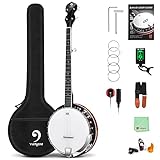
10. Vangoa Left-Handed 5-String Banjo – A Full Size Left-Handed Kit That Is Rarely Offered
Vangoa LEFT-HANDED Banjo 5 String Mahogany Open Back Banjo with Resonator, Remo Drum Head, Geared 5th String Beginner Kit with Manual, Full Size
Full size left-handed build
Removable arched mahogany resonator
Remo head with 24 brackets
8 lb
+ Pros
- Full size left-handed option that is rare at this level
- African mahogany body with arched resonator that removes for open back
- Remo Weatherking head with 24 chrome-plated brackets
- Adjustable truss rod and geared 5th string peg
- Complete kit with guide and tuner and spare strings and pick up
- Cons
- Body is laminated rather than solid wood
- Review base is much smaller than the right-handed models
- Setup takes more steps than total beginners expect
- Thick neck can be difficult for players with larger fingers
Finding a full size left-handed banjo at a beginner price is genuinely hard, and this is the clearest example in this roundup. Most left-handed listings are fractional-size travel instruments or a right-handed instrument flipped over, neither of which works well for a serious beginner.
This is a real left-handed build with the strings, bridge and action set correctly, rated 4.5 across 153 reviews with 74 percent at five stars. The review base is small, so treat the consensus with care, but the feature set is right.
What a True Left-Handed Banjo Requires
A left-handed banjo needs the bridge angled the opposite way, the tailpiece and pickup reversed, and the neck joint mirrored. Flipping a right-handed instrument leaves you with an awkward setup and a reversed string relationship that complicates chord shapes.
Reviewers of this model note the arched resonator is removable, which gives the same open or closed back choice as the other convertibles in this list.
Mahogany Body and Removable Resonator
The body is African mahogany with a polished finish that shows the grain, and the fretboard is described as comfortable with a smooth, safe neck. The Remo Weatherking frosted head sits under 24 chrome-plated brackets, which matches the bracket count on the more expensive instruments here.
The arch on the resonator is decorative rather than structural, but it gives the instrument a traditional silhouette that a flat kit does not.
Why the Small Review Base Matters
With 153 reviews this is the least-verified instrument in the roundup, and that is worth weighing. Large review counts tell you what a consistent run of production looks like. Small ones tell you almost nothing either way.
What you can check before committing is the specification. Adjustable truss rod, geared fifth string peg, 24 brackets, Remo head. Those are the parts that determine whether an instrument is playable.
Who It Suits and Where It Falls Short
Best for you if you play left-handed and want a full size instrument rather than a travel model, and if you want both open and closed back options in one banjo.
The body is laminated rather than solid, so the tone will not develop the way a solid wood instrument does. Verify the setup on arrival and expect an evening of adjustment.
How to Choose a Beginner Banjo: Six Decisions That Matter
Every comparison on the web leads with wood species and inlay work. Those are the last decisions you should make. Work through these six in order and you will have eliminated most of the market before you start reading specification sheets.
Five Strings, Not Four: the Drone String Defines the Instrument
Almost certainly buy a five-string. The short fifth string, tuned to a drone above the top of the neck, is what produces the sound people recognise as a banjo. It is also the part that makes a banjo a banjo.
Four-string tenor banjos exist for Irish and Dixieland jazz and use a different tuning. Six-string banjos are tuned like a guitar and are easy to pick up, but they teach guitar technique and put a much longer learning curve between you and the genre.
Open Back or Resonator: Pick the Back Before the Tone
An open-back banjo has no bowl on the back. It is lighter, quieter, mellower, and it is the traditional choice for clawhammer and old-time playing. A resonator banjo has a wooden bowl that projects sound forward. It is louder, brighter and built for bluegrass.
Choosing wrong is the most common beginner mistake in this category, and it is also the easiest to avoid. If you are undecided, buy a model with a removable resonator. Three instruments in this roundup offer one.
Geared Fifth Tuner Over Friction, Every Time
The fifth string sits on a separate peg because it is much shorter than the others. Entry-level instruments give you a friction peg there, which drifts under string tension and cannot be tuned accurately.
A geared fifth string tuner is the single most important hardware feature on this list. Six of the ten instruments here have one. Do not compromise on it.
Action and Setup Beat Fancy Wood
Action, the height of the strings above the fingerboard, determines whether playing is comfortable or painful. Factory action varies enormously between budget instruments. Look for a published setup specification, an adjustable truss rod, and an adjustable tailpiece.
Forum discussion consistently identifies bridge placement as the number one early frustration. It is covered in detail below.
Neck Profile and Nut Width for Your Hands
A thicker neck feels substantial but can be hard for players with larger fingers, and several instruments in this roundup draw exactly that complaint. Nut width affects chord spacing. Too narrow and stretching to reach the low strings is miserable.
If you already play guitar, note that banjo necks often feel wider than you expect because of the fifth string tuner and the different string spacing. Give it a week.
Weight, Gig Bags and Playing for Hours
Weight matters more than buyers expect. These instruments range from under 5 pounds to nearly 10. A heavy resonator against your thigh adds up over an hour of practice, and beginner practice sessions are long.
Check the gig bag too. Two instruments here ship with unpadded bags, and a banjo that spends its life in a car is a banjo that arrives out of tune.
The Bridge Setup Trap Every New Banjo Owner Hits
Here is the problem that shows up in almost every beginner banjo discussion: the instrument plays out of tune with itself. The open G chord rings dull and muted, chords sound sour, and the instrument gets blamed for a fault that takes five minutes to fix.
The cause is almost always the bridge. A banjo bridge is not glued down. It floats on the head and is held in position by string tension, so when the head relaxes or a string is replaced, the bridge shifts and intonation goes with it.
How to Check It in Four Steps
First, tune every string to pitch and leave the instrument alone for a while. A banjo that has moved from one room to another needs time for the head to settle before any measurement means anything.
Second, fret the twelfth fret and compare it to the open string. The two should match. If the fretted note is sharp, the bridge needs to move toward the tailpiece. If it is flat, the bridge moves toward the head.
Third, move the bridge in very small increments and retune after each one. Small movements are easier to hear; large ones send you back to the start.
Fourth, check the same harmonic again after the instrument has warmed up and after several string changes. Bridge position is a starting point that you refine as the head settles, not a permanent fix.
What Makes the Difference on Factory Work
An instrument that ships set up saves you this entire process. In this roundup, the Gold Tone AC-1 publishes a twelve-point factory setup and the Ashthorpe ships strung and set up. Those are the two models where a beginner can start playing immediately.
Several kits in this group list a bridge that needs correct setup to avoid muted chords. That is not a fault in the instrument. It is a fact about inexpensive manufacturing, and it is solvable.
Adjustments You Can Make Yourself
Two adjustments cover most banjo problems. The truss rod changes neck angle, which sets action height overall. The tailpiece changes string length at the break, which sets intonation at the twelfth fret and above.
Every instrument in this roundup except the Deering Goodtime includes at least one of the two, and most include both with a supplied wrench. The Goodtime uses a bridge that moves instead of an adjustable tailpiece, which is the traditional solution.
The Five Accessories Worth Buying With Your Banjo
Most kits include a bag, a tuner, some strings, picks and a strap. Four of those five are usually disappointing. Here is what actually changes your experience.
1. A Clip-On Chromatic Tuner
A banjo has an unusual tuning with the short fifth string, and a chromatic tuner that clips to the headstock is the fastest way to learn it. Replace the generic tuner that ships with a kit rather than adding to it.
2. Real Finger Picks or a Good Thumbpick
If you are learning bluegrass rolls, you need metal finger picks. The plastic picks that ship with most kits produce a weak, papery sound that will not teach you what a bluegrass banjo sounds like. Fit is personal, so buy a few sizes.
3. A Lighter String Set
Factory strings are almost always too heavy for a beginner. A light-gauge set lowers the action, makes fretting easier, and reduces the tuning strain on your fifth string gear. This is the cheapest improvement available to you.
4. A Padded Strap With Solid Hardware
Straps are the most common accessory complaint across the kits reviewed here. Cheap webbing straps dig in, rub the neck, and their attachments loosen within weeks. Buy one with wide padding and metal hardware.
5. A Properly Padded Gig Bag
If your banjo travels at all, padding matters. Two instruments in this roundup ship with thin bags, and a banjo that lives in a car boot will not stay in tune. A padded bag is where the difference shows over months rather than days.
Frequently Asked Questions
Which banjo is the easiest for beginners?
The easiest beginner banjos combine low action, a geared fifth string tuner and a body that arrives already set up. On that basis the Gold Tone AC-1 is the most immediately playable because of its twelve-point factory setup and zero-glide nut, the Deering Goodtime is the easiest on new fingers because of its low action and light strings, and the Jameson 5-String is the most flexible because its resonator removes for open-back playing.
Should a beginner buy an open back or a resonator banjo?
An open back banjo is lighter, quieter and mellower, and it is the traditional choice for clawhammer and old-time playing. A resonator banjo has a wooden bowl that projects sound forward, making it louder and brighter for bluegrass. If you cannot decide between the two, buy a banjo with a removable resonator so you can play both without owning two instruments.
Should a beginner get a 4 or 5 string banjo?
Almost certainly a 5-string. The short fifth string is the drone that produces the characteristic banjo sound, and five strings also opens directly into a standard tuning. A 4-string tenor is tuned differently and is used mainly for Irish and Dixieland jazz, while a 6-string is tuned like a guitar and teaches guitar technique rather than banjo technique.
Is banjo harder to learn than guitar?
In some ways it is easier, because open G tuning lets you play a chord immediately rather than spending weeks on chord shapes. It is harder in that the picking technique takes longer to coordinate than strumming, and a poorly set-up instrument will fight you while you learn. A banjo that ships set up with a geared fifth tuner removes most of that difficulty.
What accessories do I need to start playing banjo?
You need a clip-on chromatic tuner, a light-gauge string set, finger picks if you plan to play bluegrass, a padded strap and a padded gig bag if the instrument travels. Most kits include all of these, but the tuner, picks and strap are usually the weakest items, and heavier factory strings make fretting harder than it needs to be for a beginner.
Why does my new banjo play out of tune with itself?
The bridge has moved or the head has relaxed. A banjo bridge floats on the head rather than being glued down, so it shifts as string tension changes. Tune the instrument, then compare the twelfth fret with the open string. If the fretted note runs sharp, move the bridge toward the tailpiece; if it runs flat, move it toward the head, in small increments, and retune after each change.
Can I learn banjo on a cheaper banjo?
You can, provided the instrument has a geared fifth string tuner and a proper head. The cheapest instruments in this roundup already include 24 adjustable brackets and Remo drum heads, which is enough to learn on. What you lose is a factory setup, so expect to spend an evening adjusting the bridge and action before serious practice begins.
Which Beginner Banjo Should You Buy?
If you want one banjo that covers both clawhammer and bluegrass, choose the Jameson 5-String. The removable mahogany resonator lets you change back type in under a minute, and with 1622 owner reviews at a 4.6 average, its long-term consistency is better documented than anything else in this roundup.
If you want the best sound and the easiest neck on new fingers, choose the Deering Goodtime. Its 3-ply maple rim and low action produce the clearest tone here, and under 5 pounds makes it the least tiring instrument to practise on.
If you want solid wood and a full accessory kit at the low end of the range, choose the AKLOT. If you want to open the box and play the same afternoon, choose the Gold Tone AC-1 with its twelve-point factory setup. If you want real mahogany with a traditional silhouette, choose the Ashthorpe. If you play left-handed, the Vangoa left-handed model is one of the few full size options anywhere.
And do not skip the bridge check. Ten minutes confirming that the twelfth fret matches the open string will save you weeks of blaming the instrument for your mistakes.
Whichever one you pick, buy a clip-on tuner, a light string set and a decent strap on the same day. Those three items change more about your first month of practice than any difference between two similar models.