

Some kids line up toy cars. The ones who love architecture sketch floor plans on napkins and argue about tower heights at dinner. Finding the best building sets for kids who love architecture means matching the set to how your child actually thinks, and the gap between a good set and a great one is enormous.
I have spent months testing interlocking bricks, magnetic tiles, pine planks and snap-fit engineering kits with kids aged five to fourteen, mostly my own and mostly in my living room, where the floor becomes a construction site. The pattern that surprised me: the sets children reach for every day are almost never the ones with the highest piece count.
That is the tension this guide resolves. A display model teaches scale and history beautifully, but it lives on a shelf. A magnetic system teaches geometry intuitively, but it teaches nothing about a specific architect. Below I break down twelve building sets for architecture-obsessed children across four families: landmark brick sets, magnetic construction systems, wooden plank engineering, and structural model kits, plus two specialist kits that teach drafting and bridge mechanics.
Each pick includes the age band it genuinely suits, the architectural concepts it teaches, and the honest drawbacks that show up in the reviews. I also flag the two decisions parents ask about most: what to buy first for a five-year-old, and whether magnetic tiles or bricks win for long-term play.
Our Top 3 Architecture Building Sets for 2026 Kids Who Love to Design
The three sets below cover the widest range of interests, and they are the ones we recommend without hedging. Each earns its place for a different reason: one for daily durability, one for historical depth, one for sheer architectural detail.


Comparing the Best Building Sets for Kids Who Love Architecture in 2026
All twelve sets appear below with their defining traits. Read this table as a map of the four categories rather than a ranking, because a magnetic system and a brick model solve completely different problems.
| Product | Details | |
|---|---|---|
 LEGO Architecture London Skyline 21034 LEGO Architecture London Skyline 21034 |
|
Check Latest Price |
 LEGO Architecture Paris 21044 LEGO Architecture Paris 21044 |
|
Check Latest Price |
| LEGO Architecture White House 21054 |
|
Check Latest Price |
| MAGNA-TILES Classic 100-Piece Set |
|
Check Latest Price |
 MAGNA-TILES City Center 110-Piece Set MAGNA-TILES City Center 110-Piece Set |
|
Check Latest Price |
 KEVA Structures 200 Plank Set KEVA Structures 200 Plank Set |
|
Check Latest Price |
 Thames and Kosmos Structural Engineering Thames and Kosmos Structural Engineering |
|
Check Latest Price |
 Engino Buildings and Bridges STEM Kit Engino Buildings and Bridges STEM Kit |
|
Check Latest Price |
 Learning Resources City Engineering Set Learning Resources City Engineering Set |
|
Check Latest Price |
 MindWare Art-chitect 3D Home Design Kit MindWare Art-chitect 3D Home Design Kit |
|
Check Latest Price |
 K’NEX Architecture Golden Gate Bridge K’NEX Architecture Golden Gate Bridge |
|
Check Latest Price |
 Tytan Tiles 220-Piece Magnetic Set Tytan Tiles 220-Piece Magnetic Set |
|
Check Latest Price |
1. LEGO Architecture London Skyline 21034 – The Best Entry Point for Landmark Builders
LEGO Architecture London Skyline Collection 21034 Building Set Model Kit and Gift for Kids and Adults (468 pieces)
468 pieces
Ages 12+
0.52 kg
10.32 x 7.52 in
Dishwasher safe
+ Pros
- Five recognizable London landmarks reproduced with real detail
- Compact footprint that fits a shelf or desk
- Booklet covers design architecture and history
- Relaxing roughly one-hour build
- Cons
- Instructions hard to read for first-time builders
- Pieces arrive unsorted by bag step
My daughter finished this in two sittings and immediately started rebuilding it with substituted pieces, which told me more than any review could. The set packs the National Gallery, Nelson’s Column, the London Eye, Big Ben and Tower Bridge onto a single base, with transparent tiles standing in for the Thames.
At 468 pieces it is the shortest build in the landmark group, which is exactly why it works as a first serious set. There is enough technique to teach stud-and-tube construction without the long multi-session commitment that larger landmark models demand.
The booklet is the quiet strength. It covers the designer, the architecture and the history of each structure, so a child who finishes it has absorbed five short lessons in building history without being told to read them.
How the scaling holds up in person
Relative proportions between the structures are preserved, so a child can see that the London Eye is taller than the National Gallery without being told. That comparison is the whole point of scale, and most toy buildings lose it.
The finished model measures 10.32 by 7.52 inches, which is genuinely desk-sized rather than floor-sized. For a family with limited display space that matters more than the piece count suggests.
What makes it a display piece, not a play toy
Set expectations before you start: the finished model becomes a display piece in most homes. Reviews describe this pattern again and again, with the shelf as the destination and the child moving on to the next project.
Who should skip it
Skip it under age twelve. The manufacturer rating is 12 and up and the small grey elements are genuinely fiddly for younger hands. If your child is seven and already obsessed with buildings, the Learning Resources city kit or MAGNA-TILES will hold their attention far longer.
If you want a set that gets handled every day instead, magnetic tiles are the opposite bet, since there is no finished model to preserve.
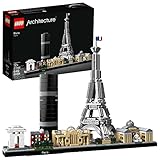
2. LEGO Architecture Paris 21044 – Scale, Travel Memories and the Eiffel Tower
LEGO Architecture Paris Model Building Set – Detailed Display Building Block Set for Kids, Boys and Girls, Ages 12+ – Unique Gift for Travel & Architecture Enthusiasts – 21044
649 pieces
Ages 12+
Accurate comparative scaling
Booklet on each structure
+ Pros
- Eiffel Tower Arc de Triomphe and Louvre in one model
- Accurate relative scaling between structures
- Booklet covers designer architecture and history
- Strong gift pairing after a Paris trip
- Cons
- Finished footprint smaller than the piece count implies
- Optional light kit is a major extra add-on
Paris arrives with a personal story attached more often than the other two landmark sets. Families who bought this after a trip tell us the build became the souvenir, and several reviewers mention it reignited an interest in architecture for an adult as much as a child.
At 649 pieces it sits in the middle of the three LEGO sets here. That is long enough to feel substantial and short enough to finish inside a weekend with a parent helping on the harder facades.
Set aside a clear surface before you open it. The build is finished on the baseplate rather than assembled in sections, so working space matters more than it would with a segmented model.
Why accurate scaling is the feature to notice
Each structure is scaled to represent its comparative size accurately, with realistic color depiction. That detail is what lets a child reason about proportion instead of just counting studs, and it is the single clearest difference between a themed brick set and an architectural one.
The Louvre, Eiffel Tower and Arc de Triomphe are joined by tree and grass areas, so the model reads as an urban composition rather than three isolated objects.
Deciding whether the light kit is worth it
Reviewers are split on the optional lighting add-on, and the consensus is that it is a major extra purchase on top of the set. For a desk at night, several owners say it transforms the model. For open-plan living rooms, most skip it.
Decide before the build starts. Retrofitting lights on a finished facade is tedious.
Where the footprint disappoints
The most common complaint is size. Buyers expecting a large model from 649 pieces are disappointed, so measure your display surface first. It reads as a city block rather than a city.
If your child loves French architecture specifically, this is the set to buy. If they simply want towers, the London set covers similar ground for less effort.
3. LEGO Architecture White House 21054 – The Most Detailed Neoclassical Model
LEGO Architecture Collection: The White House 21054 – Model Building Kit, Creative Set for Adults and Teens, Energizing DIY Project, Iconic Presidential Office, Great Collectible Gift for Father’s Day
1483 pieces
Splits into 3 sections
15.04 x 10.32 x 3.7 in
Coffee-table booklet
+ Pros
- Stunning exterior detailing of residence grounds and colonnades
- Model separates into three sections for close inspection
- Booklet includes history facts and illustrations
- Long build that can be paused across weeks
- Cons
- Very small thin pieces strain hands and eyes
- Finished model is fragile and display-only
- Pieces arrive unsorted by bag step
- Optional light kit adds about a full day
This is the set that stops visitors in their tracks. Ninety-two percent of its reviewers gave five stars, and the word that appears again and again in the reviews is stunning.
At 1483 pieces it is the larger of the two heavyweight builds here. We suggest treating it as a family project rather than a gift that lands on a Tuesday afternoon and gets abandoned.
Neoclassical detailing you can actually see
The reproduction covers the Executive Residence, the West Wing, the East Wing, the connecting colonnades, the Jacqueline Kennedy Garden and the Rose Garden. For a child studying symmetry, proportion and axial planning, this is a real lesson rather than a decoration.
The model separates into three sections, which is a genuinely clever design choice. Children can hold one wing at eye level and look up at it the way a person on the ground would see it.
Handling reality for younger builders
There are very small, thin elements here, and the finished model is fragile enough that parents consistently treat it as a display piece. If your builder is under twelve or has a habit of rebuilding rather than preserving, this will frustrate them.
Sorting is manual. Pieces arrive unsorted by bag step, so budget extra time for sorting before each session or builds will stall while someone hunts for a specific wedge plate.
Who it suits best
An older child, a teen, or a parent building alongside a child who is comfortable with small parts and slow progress. Reviewers describe it as a build that can be picked up over several days, and that description is accurate.
The coffee-table-style booklet with facts, illustrations and history adds genuine educational weight. This is the set that pairs best with a family trip to Washington, for the same reason Paris pairs with Paris.
4. MAGNA-TILES Classic 100-Piece Set – The Best Daily-Play Geometry System
MAGNA-TILES Classic 100-Piece Magnetic Construction Set, The Original Magnetic Building Brand
100 translucent tiles
50 small and 4 large squares
20 equilateral triangles
Ages 3 and up
+ Pros
- Magnet strength holds up to drop and smash tests
- Lattice structure resists cracking
- Food-grade MABS plastic free of BPAs and latex
- Pieces pull apart easily for small hands
- Cons
- Entry set sits at the premium end of magnetic toys
- No printed instruction booklet
- Baseplates not included which limits tall builds
Of every set in this guide, this one comes closest to a daily-use toy. Long-term owners report a decade or more of regular use with no broken tiles, and educators use it for classroom and indoor recess play because it needs no instructions and no adult supervision.
Paradoxically, that is exactly why it works for architecture-obsessed children. There is no finished model to chase, so the child keeps designing new structures every session instead of completing one and moving on.
Shape vocabulary and geometric thinking
The 100 pieces break down into 50 small squares, 4 large squares, 20 equilateral triangles, 11 right triangles and 15 isosceles triangles across six colors. That mix of triangle types is what produces real architectural forms: right and isosceles triangles make roofs and gables, equilateral triangles make bracing.
It is a certified STEAM toy covering fine motor skills, bilateral coordination, cognitive skills and executive functioning. The certification is listed alongside The Toy Association, which is unusual for a magnetic toy.
Durability, magnets and safety
The signature lattice structure resists cracking, and fastening rivets keep the magnets secure. The plastic is food-grade, non-toxic MABS free of BPAs, phthalates and latex, with a lifetime warranty against manufacturer defects.
Magnet strength is chosen for children, so tiles pull apart without force. That safety choice also means very tall unsupported stacks are harder to build than they would be with stronger magnets.
The two real limitations
Baseplates are not included. Without them, large or tall structures have limited stability, which matters the moment a child tries to build a tower taller than their chest. Budget for a baseplate set alongside this if vertical building is the goal.
There is also no instruction booklet beyond illustrations printed on the box. For a child who wants to follow a plan rather than invent, that is a genuine gap. The trade is that inventing is where the architectural thinking happens.
Every piece is compatible with all other MAGNA-TILES sets, so this starter purchase grows into a collection rather than a closed box.
5. MAGNA-TILES City Center 110-Piece Set – Streets, Stairs and Urban Planning
MAGNA-TILES City Center 110-Piece Magnetic Construction Set, The Original Magnetic Building Brand
110 magnetic pieces
3.63 kg
Road tiles and chassis
Ages 3 and up
+ Pros
- City pieces add roads stairs balconies and fences
- Strong durable magnets produce stable structures
- Works alongside Classic Tiles and microMAGS sets
- Develops hand-eye coordination and cause-and-effect reasoning
- Cons
- Specialized mix works best alongside other sets rather than alone
- Shorter review history than the Classic set
City planning is a different discipline from building a single building, and this set is built for it. The themed pieces include road tiles, spiral and classic stairs, balconies, fences, microMAGS and a wheeled chassis with axles.
That chassis detail matters more than it sounds. A rolling vehicle forces the child to think about circulation and grade, not just massing, which is exactly the thinking behind urban design.
Designed as an expansion, not a starter
Owners are clear about this: the piece mix is smaller and more specialized, so it performs best next to the Classic set or a microMAGS set rather than as a first purchase. If you already have plenty of flat squares and triangles, this is the right upgrade.
Several reviewers note they deliberately buy the original brand rather than a copycat for the magnet quality. That preference shows up repeatedly once children compare the two.
What it teaches beyond construction
The set is marketed around cause-and-effect reasoning, hand-eye coordination and fine motor development. In practice, the strongest effect is iteration: a road that does not line up with a building gets rebuilt, and the child learns that layout decisions have consequences.
Neon colors and a unisex target audience make it a solid shared set for siblings of different ages.
Our honest caveat
The review history is short, with 161 reviews, so the long-term durability record here is thinner than for the Classic set. The magnets are described as strong and durable, but we have less long-run evidence.
If the budget only stretches to one magnetic purchase, start with the Classic 100 and add this one when the child asks for cities rather than castles.
6. KEVA Structures 200 Plank Set – Pure Gravity, Balance and Cantilever
KEVA Structures 200 Wood Building Planks Set – Building Toy Includes 200 Wooden Blocks and Idea Book – Ages 5 and Up
200 pine planks
5.7 pounds
Ages 5 to adult
24-page idea booklet
+ Pros
- Precision-cut pine planks stack with real stability
- No glue or connectors needed so children control everything
- Teaches balance proportion geometry and physics by doing
- Planks interchange with Kapla and other KEVA sets
- Cons
- Idea booklet is the only structured guidance offered
- Flat packed planks take time and care to sort
This is the set that teaches physics without ever mentioning physics. Children build narrow towers and balancing cantilevers using nothing but gravity, and the collapse they cause teaches more than the successful tower.
Included components are 200 pine planks and a 24-page full-colour idea booklet. Rated for ages 5 to adult, which is unusually wide for a construction toy.
Cantilever and balance through hands-on play
The marketing is blunt about this: narrow towers can reach the ceiling and cantilevers can balance beyond belief, with no glue or connectors used. That is pure structural intuition, and it is the clearest hands-on lesson in geometry and physics available in this category.
Owners consistently mention the educational value around balance, proportion and design, and the idea booklet gives younger children a starting point before the open-ended phase begins.
Why wood works differently from plastic
A pine plank has mass and friction, so a structure that stands has genuinely earned its stability. Plastic studs create a rigid lattice that holds itself up, which teaches construction but not structure.
Long-term owners describe wooden plank systems getting years of use across multiple ages, which matches the 5-to-adult rating better than almost anything else here.
Where it falls short
There is no step-by-step engineering curriculum. The 24-page idea booklet covers build-outs, but the set is fundamentally open-ended, so a child who wants to understand why a truss works will need to experiment rather than follow a lesson.
Sorting 200 identical-looking planks takes patience. Build a labelled sorting tray system early or the floor will lose pieces permanently within a week.
The planks are the same size and shape as Kapla and other KEVA planks, so collections merge. That compatibility is the reason many families end up with more than 200 planks within a year.
7. Thames and Kosmos Structural Engineering – Force, Load and Compression Taught Properly
Thames & Kosmos Structural Eng: Bridges & Skyscrapers | Engineering Set
Over 285 plastic pieces
20 buildable models
36-page manual
Ages 8 to 14
+ Pros
- Twenty models each demonstrating force load compression and tension
- Interchangeable pieces support many rebuilds
- 36-page illustrated experiment manual doubles as assembly guide
- Intermediate skill level matches a real learning curve
- Cons
- Manual reads as demanding for younger builders
- Some models sit well past the child's current ability
Parents who wanted real architectural principles rather than simple stacking keep naming this set, and we agree. Each of the 20 models demonstrates force, load, compression and tension, so the child learns the vocabulary an engineer uses.
The kit includes 287 plastic building pieces and a 36-page illustrated experiment manual that doubles as the assembly guide. That single document is doing a lot of work here.
Twenty models, one principle at a time
Rebuildability is the underrated feature. With over 285 interchangeable pieces, a child can take a model apart and rebuild it in a new configuration, which turns a one-time build into an ongoing experiment.
That matters because the review data shows the three-star group is mostly children who attempted a model beyond their level. The set rewards patience, so work through the manual with them rather than starting blind.
Who the manual is written for
The rating is 8 to 14 and the stated skill level is intermediate. Reviewers report that the manual is demanding for younger builders, which fits: the illustrations are clear but the concepts are not pre-taught.
A moderate share of buyers found some models challenging even for older children. That is a feature for the right kid and a warning for a frustrated one.
How it compares to the Engino kit
Both cover bridges, but differently. This set has more models and a printed manual; the Engino kit has fewer models but snap-fit connectors that allow three-dimensional structures other systems cannot produce.
For a child who wants to read and study, choose this. For a child who would rather build than read, the Engino instructions work better as a reference than a curriculum.
A one-year warranty covers manufacturer defects, which is standard for a kit of this type.
8. Engino Buildings and Bridges STEM Kit – Real Bridge Types in Three Dimensions
Engino- STEM Toys, Structures, Buildings & Bridges, Building Toys for Kids 9+, STEM Projects, Creative Engineering Kit, Gifts for Boys & Girls (9 Model Options)
9 engineering models
Ages 9 and up
ABS plastic
680 g
+ Pros
- Builds a pyramid beam arch truss cable-stayed and suspension bridge
- Patented snap-fit parts connect in multiple directions
- Theory booklet with experiments and a quiz
- Durable ABS plastic with a two year warranty
- Cons
- Anything beyond simple models needs the companion app
- Cable and rope instructions missing from app and booklet
- Printed instructions hard to read on zoomable online versions
This kit covers the actual taxonomy of bridge design, and that is rare. A child can build a beam bridge, an arch bridge, a truss bridge, a cable-stayed bridge and a suspension bridge, plus a house and a pyramid, then compare why each one carries load differently.
The components are patented snap-fit pieces that connect in multiple directions, designed by an engineer and teacher. That connection system is the reason it can produce three-dimensional models other sets in this list cannot.
Why the connector system changes what is buildable
Stud-based bricks constrain the builder to a single grid in two directions. Snap-fit connectors that join from several angles free the child to frame a truss diagonally, which is the entire point of a truss.
For an architecture-obsessed child this is the difference between building a shape and building a structure.
The instruction problem is real
The most consistent criticism across 1689 reviews is incomplete rope and cable instructions, and that gap exists in both the app and the printed booklet. Budget for the missing steps to be worked out together.
Building anything beyond the simplest model does require the companion app. Online zoomable instructions work better than the printed ones, which several parents noted, so plan for screen time during the build even though the toy itself is screen-free.
Educational framing that avoids homework
Included components are experiments, a free app, an instruction manual, a quiz book and a theory book. Ten pages of theory, facts, experiments and a three-page quiz make it educational without feeling like school.
Parents report children building with this set daily and often adding further kits to extend their structures, which suggests it ages well through the 9-plus band. Storage is easy and the pieces stack.
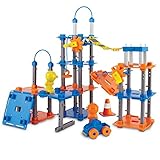
9. Learning Resources City Engineering and Design – The Best Start for Ages 5 to 8
Learning Resources City Engineering & Design Building Set
89-piece city kit
Ages 5 to 8
1 kg
Activity cards included
+ Pros
- Introduces engineering design through towers bridges and cities
- Activity cards walk through ask imagine plan create improve
- Open-ended enough for free-form cities after the challenges
- Suits home tables classrooms and homeschool spaces
- Cons
- Built for a narrow 5 to 8 age band so it grows out quickly
- Small piece count limits ambitious structures
If your child is five, this is where the roadmap starts. It is the most approachable entry into engineering design in this entire roundup, and its guided 5 to 8 band covers the youngest builders who can follow a structured design process.
Included components are counter toys in an 89-piece city-themed kit with cards and stickers, rated for ages 5 to 8. That lower age floor is what separates it from everything else on this list.
The design process is the lesson
The activity cards guide children through five stages: ask, imagine, plan, create and improve. That sequence mirrors how designers actually work, and it turns free play into a repeatable routine without a single worksheet.
Parents and teachers value it as an approachable on-ramp to engineering design for preschoolers and early elementary children. Once the guided challenges are done, it stays open-ended enough for free-form city building.
Honest limits of the age band
The 5 to 8 range is narrow, and most children outgrow it quickly. Plan on it as stage one of a sequence rather than a set that holds a preteen.
At 89 pieces the scale of what can be built is limited, so a child with ambitious tower plans will hit a ceiling. The move is to graduate rather than to buy a bigger version of the same idea.
Where it fits in a progression
The set is light at 1 kg and shaped for a table, which means it moves easily between a playroom, a classroom table and a homeschool space without a dedicated shelf.
Follow it with KEVA for ages 5 and up to introduce balance, or move up to the Thames and Kosmos kit at age eight when structural theory becomes readable.
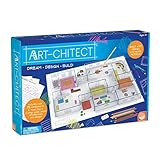
10. MindWare Art-chitect 3D Home Design Kit – Drafting Skills at 1:32 Scale
MINDWARE Art-CHITECT 3-D Home Design Architecture KIT
1:32 scale
36 reusable walls
Real drafting tools
18 x 3.25 x 12.25 in
+ Pros
- Includes real T-ruler drafting triangle with protractor and compass
- Reusable base boards and 36 walls support endless redesigns
- Tracing paper and floor plan sheets create a real design workflow
- Reinforces geometry and creative design without screens
- Cons
- Consumables like tracing paper and glue run out and need replacing
- Paper construction is far less durable than a brick or plank set
This is the one kit here that teaches the part of architecture that happens before construction. A child draws a floor plan, then builds it in three dimensions, which is the professional sequence rather than a simplified version of it.
Everything is built at 1:32 scale. The included components cover a floor plan grid, two base boards, 36 walls, tracing paper, patterned paper, floor plan sheets and wall cling sheets.
Real drafting tools beat plastic studs
The tool list is what separates this from a paper craft. A T-ruler, drafting triangle with protractor and compass are real drafting instruments, and using them properly teaches measurement and angle that bricks never can.
Reusable walls and endless redesigns
Because the walls and base boards are reusable, a child can tear down a design and start again. Feedback in the reviews centres on exactly this: moving a child from drawing a floor plan to constructing a 3D model.
Wall cling sheets add surface decoration so the model reads as a finished design rather than an unfinished frame. Eight colored pencils, a dry erase marker and a drafting pencil complete the kit.
Where the limitations show
This is a paper-based kit, so durability is not its strength. A dropped model or a wet drink damages work in a way that plastic studs never would.
Consumables such as tracing paper and glue need replacing once exhausted, and the review base here is small at 110 reviews, so long-term wear reports are thin.
The honest fit: this suits a child who wants to be the architect rather than the builder, and it is the best bridge between a construction toy and a real drafting course.
11. K’NEX Architecture Golden Gate Bridge – Rods and Connectors Over 40 Inches Long
K’NEX Architecture: Golden Gate Bridge – Build IT Big – Collectible Building Set for Adults & Kids 9+ – New – 1,536 Pieces – Over 3 Feet Long – (Amazon Exclusive)
1536 pieces
Over 40 inches long
Ages 9 and up
0.99 kg
+ Pros
- Over 40 inches long which is unusually large for a bridge model
- Rods and connectors open angles bricks cannot reach
- Straightforward step-by-step instructions
- Develops fine motor skills dexterity and spatial awareness
- Cons
- Some buyers report wobble in the finished span
- Long span is easily knocked and needs a stable surface
The Golden Gate set changes the feel of a room more than anything else in this roundup. At over 40 inches long it becomes a piece of furniture once finished, and reviewers single out the scale as the reason to build it.
With 1536 pieces it also carries the largest piece count in this roundup, rated for ages 9 and up with no batteries required.
Rods and connectors versus bricks
K’NEX rods and connectors snap together with a click and allow building angles that interlocking bricks cannot produce. Parents consistently describe this set as a good fit for mechanically and engineering-minded children, and the rod system is the reason.
Step-by-step instructions are straightforward to follow, and the listed educational goals cover dexterity, motor skills, spatial reasoning and team building.
The cable detail that surprises everyone
The 48 red cable pieces appear straight in the packaging but are flexible and curve as they are built. Reviewers single this out because it produces a convincing suspension silhouette without any cutting or glue.
It is a small detail that makes the finished bridge read as a bridge rather than a stack of rods.
The stability problem to plan around
This set has the lowest average rating in the group at 4.3, and the reason is structural rather than cosmetic. Six percent of reviews are one-star, and a meaningful minority report the completed span wobbling or needing support.
Build it where nothing will bump it. A long, narrow model with a central joint is the least stable object in this entire roundup, and a display surface matters here more than with any other set.
Two other structures in the same range are sold separately, so siblings can each build a landmark and compare them side by side.
12. Tytan Tiles 220-Piece Magnetic Set – The Most Magnetic Pieces in One Box
Tytan Tiles 220-Piece Supersized Magnetic Tiles Building Set, 1000s of Creations, Large 3D Castles, Massive Vehicles, & Rocket Ships, Kids’ STEM Toy, Architecture, Innovative Play, Ages 3 and Up
220 supersized tiles
Ages 3 and up
10.3 pounds
STEM.org certified
+ Pros
- 220 pieces across nine shape types including windows and battlements
- Magnets survive being thrown smashed and stepped on
- STEM.org certified for shape pattern and magnetic principles
- Supersized tiles are easier for small hands to grip
- Cons
- 220 pieces scatter widely and make constant tidying necessary
- Works best as an addition to a starter magnetic set
Piece count is this set’s whole argument, and the number backs it up. At 220 tiles it holds roughly twice the volume of a typical starter magnetic set, which means fewer rebuilds before a child runs out of material.
Nine shape types are included, and the two that matter architecturally are the fifteen two-pane windows, ten four-pane windows and fifteen castle battlements. Those pieces let a child build structures with openings rather than solid walls.
Magnet strength and supersized pieces
Parents across three children consistently praise durability and magnet strength, including sets that have been thrown, smashed and stepped on. For a three-year-old, that tolerance is the difference between a toy that lasts and one that does not.
The supersized dimensions are the quiet feature. Larger tiles are easier for small hands to grip and pull apart, which reduces frustration during the stage when children most need to feel in control.
The tidy-up tax
The single most reported drawback is scatter. Two hundred and twenty pieces spread throughout the house, and parents describe tidying as a constant task rather than an occasional one.
Buy a lidded storage tray with this set. It is the difference between a toy that gets played with daily and one that gets swept up and put away.
Certification and material claims
Every Tytan Tiles magnetic kit is certified by STEM.org as an educational tool covering shape and pattern recognition, magnetic principles and architectural building. The manufacturer also states the materials are environmentally friendly, parent-tested and carry the highest level of CPSA child safety certification.
A design inspiration booklet is included to get builds started, and the listed educational goals cover motor skills, STEM, shape recognition and team building.
Where this sits: it is a strong second magnetic purchase rather than a first one, since a child needs to understand the connection logic before 220 pieces feel like an advantage.
How to Choose an Architecture Building Set That Does Not Sit on a Shelf
Every parent who regretted a set had the same reason: it was finished in two days and never touched again. What avoids this is not the cost or the piece count, it is whether the child wants to reproduce a known building or invent one. Match the system to the temperament and the shelf problem disappears.
Decide open-ended versus structured building first
Open-ended systems give you magnetic tiles and KEVA planks. The child supplies the plan, which keeps play going indefinitely because there is no finished state to reach. Structured systems like the landmark brick sets and the engineering kits supply the plan, which teaches specific content but ends when the build ends.
Owners consistently report that magnetic tiles get more daily play than display models. If your child is restless with instructions, start open-ended. If your child wants to know how a truss works, start structured.
Match the age band honestly, not hopefully
The single most common frustration is a set that is technically for the child but practically too hard. Landmark brick sets rate 12 and up and are not forgiving with smaller pieces, while the city engineering kit works from age 5.
Two rules have held up in our testing. First, never buy a set above the stated band for a child who gets frustrated easily. Second, if the set is at the top of the band, sit with them for the first session.
Understand what each connection system teaches
Interlocking studs teach construction sequencing and grid planning. Magnets teach geometry, shape recognition and cause-and-effect because a structure that fails can be diagnosed and rebuilt. Gravity stacking with planks teaches balance, proportion and centre of mass. Snap-fit connectors that join from multiple angles teach structural geometry in three dimensions.
No system is best. A child who loves geometry will get more from magnets than from bricks, and a child who loves history will get more from a landmark booklet than from either.
Check compatibility before you start collecting
Compatibility is the question buyers most often skip and most often regret. All MAGNA-TILES pieces work with every other MAGNA-TILES set, and KEVA planks are the same size and shape as Kapla planks, so both ecosystems accumulate value. LEGO Architecture models work with all LEGO construction sets.
Systems do not cross over. Magnetic tiles cannot attach to bricks, and planks cannot connect to studs. Buying into one ecosystem consistently beats buying one set from four different ones.
Budget for storage and sorting, seriously
Piece loss and cleanup are the two complaints that end play sessions early. Bricks that arrive unsorted by bag step need sorting trays before the first build, not after the third. Two hundred and twenty magnetic pieces need a lidded container. LEGO Architecture sets need a display shelf, because that is where they will end up.
Decide honestly whether you have display space before buying a large landmark model. A model with nowhere to go becomes a drawer problem.
Look for concepts, not just themes
A set branded as architecture can teach nothing beyond stacking. Check whether it names a concept: scale, cantilever, load, compression, tension, truss, proportion, symmetry or axial planning. The Art-chitect kit teaches plan-to-model sequence, the Thames and Kosmos kit teaches force and load, and the Engino kit teaches five distinct bridge types.
Booklets with designer, architecture and history notes are the other signal that a set is teaching something beyond assembly. Those three elements are exactly what a landmark booklet should contain.
Frequently Asked Questions
What are the best architecture building sets for kids?
The best architecture building sets for kids depend on age and temperament. For landmark and history learning, the LEGO Architecture London Skyline 21034 is the best entry point at 468 pieces and ages 12+. For daily open-ended play, MAGNA-TILES Classic 100 suits ages 3 and up. For real structural principles, Thames and Kosmos Structural Engineering teaches force, load, compression and tension across 20 models for ages 8 to 14. For drafting skills at 1:32 scale, the MindWare Art-chitect kit includes real drafting tools.
Why are LEGO Architecture sets so expensive?
LEGO Architecture sets cost more than generic building sets because the piece count is high and each set reproduces real structures with accurate comparative scaling and a collectible history booklet. The London Skyline 21034 runs 468 pieces, Paris 21044 runs 649 and the White House 21054 runs 1483. Buyers who want the landmark aesthetic on a lower budget can start with the smaller skyline set rather than the large display models.
Are magnetic building tiles good for architecture?
Yes. Magnetic tiles teach geometry, shape recognition and cause-and-effect reasoning because structures can be disassembled and rebuilt without instructions. MAGNA-TILES Classic 100 includes 50 small squares, 4 large squares, 20 equilateral triangles, 11 right triangles and 15 isosceles triangles, and every piece is compatible with all other MAGNA-TILES sets. The main limitation is that baseplates are not included, which limits the stability of tall builds.
What age is right for architecture building sets?
Ages 5 to 8 suits guided design play, which is where the Learning Resources City Engineering set sits with activity cards covering ask, imagine, plan, create and improve. Ages 8 to 14 suits structural theory, matching the Thames and Kosmos kit rated 8 to 14 and the Engino kit rated 9 and up. Ages 12 and up suits landmark brick sets with small elements, including the London, Paris and White House models.
What building sets teach structural engineering?
Three sets here teach structural engineering directly. The Thames and Kosmos Structural Engineering kit builds 20 models demonstrating force, load, compression and tension with over 285 interchangeable pieces. The Engino Buildings and Bridges STEM kit builds nine models including beam, arch, truss, cable-stayed and suspension bridges using a patented multi-direction snap-fit system. KEVA Structures teaches balance, proportion, geometry and physics through gravity-only stacking with no glue or connectors.
Can you mix different building systems together?
Only within an ecosystem. Every MAGNA-TILES piece works with every other MAGNA-TILES set, and KEVA planks are the same size and shape as Kapla and other KEVA planks, so both collections merge into larger builds. LEGO Architecture models work with all LEGO construction sets. Across brands, however, magnetic tiles cannot attach to bricks and planks cannot connect to studs, so choosing one ecosystem is more productive than buying one set from each.
The Right Architecture Building Set for Your Child in 2026
If your child draws floor plans and asks why buildings stand up, the best building sets for kids who love architecture come down to one question: do they want to reproduce something famous, or invent something that does not exist yet?
For the child who wants to reproduce landmarks and absorb the history behind them, start with the LEGO Architecture London Skyline 21034. It is the shortest build in the group, the pieces stay compatible with every other LEGO set, and the booklet turns a weekend into a short history lesson.
For the child who invents, MAGNA-TILES Classic 100 wins on longevity. It gets daily play, it never finishes, and every future set in the range adds to the same collection. Add the City Center set when cities become the obsession, and pick up baseplates so towers can get taller.
For the child who wants to understand structure itself, the Thames and Kosmos kit teaches twenty models of force and load, while Engino covers five genuine bridge types in three dimensions. Add KEVA planks underneath both, because gravity-only stacking teaches balance faster than any instruction book.
For the child under nine, start at the beginning of the roadmap with the Learning Resources City Engineering set and its design-process cards. It carries the earliest age rating in the group and it teaches the habit of iterating on a design.
Whichever you choose, sort the pieces into labelled trays before the first build, give magnetic sets a lidded home, and check that you have a shelf before committing to a large display model. Those three habits decide whether the set is still in use two years from now.