
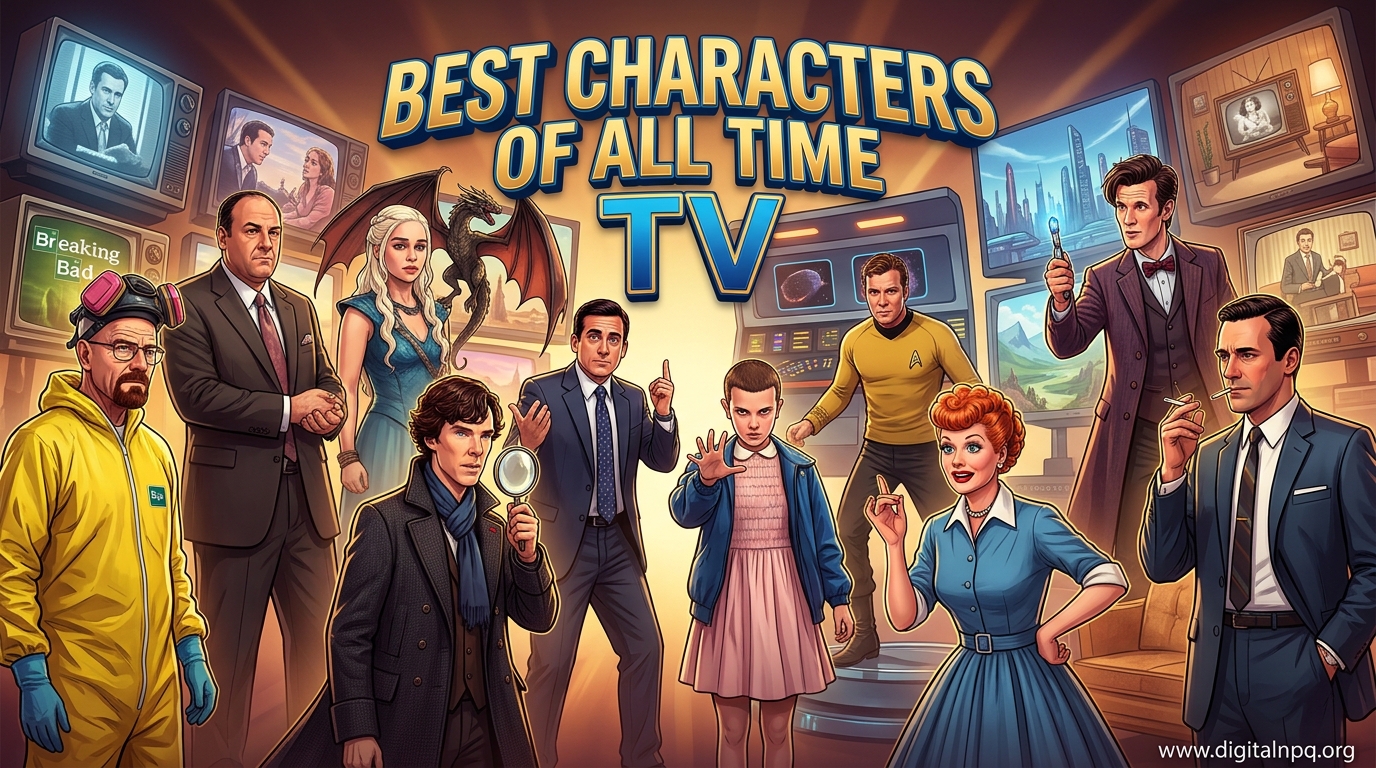
I’ve spent countless hours analyzing television characters across seven decades of programming.
From the golden age of sitcoms to the current streaming revolution, certain characters transcend their shows to become cultural landmarks.
The greatest TV characters of all time are Walter White from Breaking Bad, Tony Soprano from The Sopranos, and Homer Simpson from The Simpsons, based on cultural impact, character complexity, and lasting influence on television storytelling.
These characters don’t just entertain us. They reflect our society back to ourselves, challenge our assumptions, and sometimes reveal uncomfortable truths about human nature.
After analyzing hundreds of characters across drama, comedy, sci-fi, and international programming, I’ve compiled what I believe is the most comprehensive ranking of television’s greatest characters.
The 50 Greatest TV Characters of All Time
1. Walter White – Breaking Bad
Walter White’s transformation from mild-mannered chemistry teacher to drug kingpin represents television’s most compelling character arc.
Bryan Cranston delivered what critics consider the greatest dramatic performance in TV history across five seasons.
What makes Walter so fascinating isn’t just his descent into evil. It’s how we as viewers found ourselves rooting for him long after we should have stopped.
His “I am the one who knocks” speech remains one of television’s most chilling moments.
2. Tony Soprano – The Sopranos
The character who launched the golden age of television, Tony Soprano made it okay for protagonists to be deeply flawed.
James Gandolfini’s portrayal of a mob boss seeing a psychiatrist humanized a monster in ways audiences hadn’t experienced before.
His sessions with Dr. Melfi created the template for complex character studies that would dominate prestige television for decades.
The ambiguous series finale only cemented his status as television’s most debated character.
3. Homer Simpson – The Simpsons
For over 30 years, Homer Simpson has been television’s everyman, constantly reinventing what animated characters can be.
His influence extends far beyond comedy. Homer shaped how we think about fatherhood, friendship, and American family life.
The character’s versatility allows him to be pathetic one moment and heroic the next, a range few live-action actors could match.
He remains television’s most recognizable character across generations of viewers.
4. Jon Snow – Game of Thrones
Kit Harington’s brooding bastard became the moral center of television’s biggest fantasy phenomenon.
Jon Snow’s journey from outcast to King in the North to the man who would kill his lover for the greater good captured global attention.
His resurrection demonstrated how modern television could play with death and consequences in unprecedented ways.
“You know nothing, Jon Snow” became one of the 21st century’s most quoted pop culture phrases.
5. Daenerys Targaryen – Game of Thrones
Emilia Clarke played the ultimate complex heroine, from abused girl to conquering queen to tragic villain.
Daenerys represented television’s most ambitious character arc, spanning eight seasons of transformation across continents.
Her descent into madness in the final season sparked global debates about character development and audience expectations.
The Mother of Dragons became a symbol of female empowerment before subverting those expectations completely.
6. Don Draper – Mad Men
Jon Hamm’s enigmatic ad executive embodied the American dream’s hollow core, looking perfect while falling apart inside.
Don Draper’s secret identity represented something deeper: the American habit of reinventing oneself to escape trauma.
His pitch to Kodak in season one’s “The Wheel” remains television’s greatest monologue about memory and nostalgia.
The character’s complexity made him impossible to fully like or hate, just fascinating.
7. Buffy Summers – Buffy the Vampire Slayer
Sarah Michelle Gellar turned what could have been campy into television’s most profound exploration of female power and sacrifice.
Buffy subverted the horror genre’s “blonde girl dies first” trope, making the victim the hero.
The show used supernatural threats as metaphors for real issues, with Buffy growing from teenager to adult across seven seasons.
Her death and resurrection twice explored themes of sacrifice and responsibility unlike anything else on television.
8. Michael Scott – The Office (US)
Steve Carell took an awkward boss character and transformed him into television’s most nuanced study of loneliness and the need for connection.
What started as an uncomfortable comedy became a deeply moving character study about a man desperate to be loved.
Michael’s farewell episode remains one of television’s most satisfying goodbyes, earned through years of character development.
That’s what she said.
9. Tyrion Lannister – Game of Thrones
Peter Dinklage delivered television’s most charismatic performance as a character who used wit to survive in a world that despised him.
Tyrion’s intellect made him the only Lannister worth rooting for, despite his family’s crimes.
His trial speech in season four, demanding his confession of being a dwarf on trial for being a dwarf, showcased television writing at its finest.
The character proved that physical difference doesn’t determine worth.
10. Jerry Seinfeld – Seinfeld
Jerry Seinfeld played himself so effectively that we often forget he was creating an entirely new approach to comedy.
The show about nothing became something profound through Jerry’s observational humor and detachment from normal human emotion.
His stand-up routines framing and closing each episode created a template comedians still use today.
What makes Jerry remarkable is how he remained unchanged while chaos swirled around him.
11. Kendall Roy – Succession
Jeremy Strong’s portrayal of the desperate Roy child captured the particular pain of never being enough for a father who views children as assets.
Kendall’s journey from would-be successor to family outcast and back again defined HBO’s flagship drama of the streaming era.
His rap at his own birthday party became an instant meme while revealing his pathetic need for approval.
The character’s final moments in the series finale provided one of television’s most tragic and satisfying conclusions.
12. Sheldon Cooper – The Big Bang Theory
Jim Parsons created television’s most unique character, a genius completely lacking social awareness but possessing his own peculiar moral code.
Sheldon Cooper made neurodiversity visible to millions of viewers, portraying difference as neither weakness nor superpower but simply human variation.
The character’s catchphrase “Bazinga!” entered the cultural lexicon, but his deeper journey involved learning to connect with others.
Twelve seasons allowed unprecedented character development, moving Sheldon from someone who couldn’t understand friendship to someone who earned a PhD in it.
13. Eleven – Stranger Things
Millie Bobby Brown introduced the world to a character who had to learn everything about being human, from language to love.
Eleven’s journey from lab experiment to teenage girl with friends, a father figure, and first love captured the innocence of growing up.
Her psychokinetic powers were secondary to her emotional development, making her one of television’s most relatable characters despite her supernatural abilities.
The eggo waffles became an unlikely symbol of comfort and the simple pleasures of childhood.
14. Saul Goodman – Better Call Saul
Bob Odenkirk transformed what could have been a supporting character into television’s richest study of moral compromise.
Saul’s journey from Jimmy McGill, the lawyer who actually cared, to Saul Goodman, the criminal lawyer who only cared about money, spanned six masterful seasons.
What makes Saul so compelling is that we understand every choice he makes, even as we watch him lose his soul one ethical compromise at a time.
The character proves that evil isn’t born. It’s made, through small rationalizations that accumulate into a completely different person.
15. Omar Little – The Wire
Michael K. Williams played the show-stealing robber who lived by a moral code that shamed everyone else in Baltimore.
Omar Little donned in a duster with a shotgun was television’s most terrifying sight, yet he never killed anyone who wasn’t in the game.
“A man got to have a code” remains one of television’s most memorable declarations of principles.
The character subverted every stereotype about urban criminals, presenting a complex, gay, religious man who happened to rob drug dealers for a living.
16. Leslie Knope – Parks and Recreation
Amy Poehler created television’s most optimistic character, proving that genuine kindness and hard work could be the basis of brilliant comedy.
Leslie Knope loved her town, her friends, and waffles with a fierce intensity that made cynicism seem small.
Her bound folder presentations and obsessive planning weren’t quirks. They were expressions of love for democratic governance and public service.
The show’s seven-year arc allowed Leslie to progress from mid-level bureaucrat to successful without compromising who she was.
17. Cosima Niehaus – Orphan Black
Tatiana Maslany played multiple characters, but Cosima stood out as the brilliant, funny, fiercely loyal clone fighting to save her sisters.
What made Cosima remarkable wasn’t just being one of many clones played by the same actress. It was her combination of scientific brilliance and emotional openness.
As a queer character with a terminal illness, Cosima represented intersectional representation rarely seen on television.
Her relationship with Delphine was one of TV’s most authentic portrayals of modern love.
18. Fleabag – Fleabag
Phoebe Waller-Bridge broke the fourth wall and our hearts as a character grieving her best friend while sabotaging her own happiness.
Fleabag’s direct address to camera created intimacy unlike anything else on television, making viewers complicit in her bad decisions.
The character’s silence in season two, when she could no longer confess her worst moments to the audience, was a masterstroke of character development.
Her final farewell to the camera remains television’s most poignant goodbye.
19. Ross Geller – Friends
David Schwimmer played the character everyone loved to mock, whose desperation for connection made him painfully relatable.
Ross’s “We were on a break” became cultural shorthand for relationship arguments that will never be resolved.
What made Ross fascinating was his combination of genuine intelligence and social ineptitude, professional success and romantic failure.
The character’s dinosaur passion represented following your interests regardless of social norms, a message that aged surprisingly well.
20. Arya Stark – Game of Thrones
Maisie Williams grew up on screen as the girl who rejected being a lady to become a face-changing assassin.
Arya’s journey from rebellious child to trained killer represented television’s most satisfying exploration of female agency and power.
Her list of names to kill showcased how trauma can transform a child while her training with the Faceless Men explored identity itself.
“Not today” became the perfect motto for a character who refused to die no matter what the world threw at her.
21. Sydney Adamu – The Bear
Ayo Edebiri’s transformation from uncertain sous chef to confident leader represented television’s most authentic portrayal of kitchen culture and professional growth.
Sydney’s anxiety, imposter syndrome, and eventual self-acceptance resonated with anyone who has ever felt like they don’t belong in their chosen field.
The character’s verbal fights with Carmy were television at its most real, capturing how trauma manifests in professional relationships.
Her journey from “yes chef” to finding her own voice represented the struggle of young professionals everywhere.
22. Rachel Green – Friends
Jennifer Aniston’s character evolved from spoiled runaway to successful businesswoman, representing the journey of young people finding their way in the world.
Rachel’s iconic haircut became the 90s most copied style, but her character was more than fashion.
Her on-again-off-again romance with Ross defined the show, but her professional growth in fashion was equally important.
The character proved that it’s never too late to reinvent yourself and start over.
23. Dwight Schrute – The Office (US)
Rainn Wilson turned what could have been a simple weirdo into television’s most complex exploration of outsider identity and the desperate need for respect.
Dwight’s loyalty to Michael, rivalry with Jim, and secret relationship with Angela revealed layers of humanity beneath the eccentric exterior.
His bear-related stories, martial arts claims, and beet farm obsessions created a character who was ridiculous but never ridiculous enough to stop being human.
Fact: The bear can outrun the human 60% of the time.
24. Ted Lasso – Ted Lasso
Jason Sudeikis created television’s most optimistic character, proving kindness could be dramatically compelling, not just comedic.
Ted Lasso’s radical empathy in a cynical world made him a character viewers wanted to be around, even when he was falling apart himself.
His struggles with panic attacks and separation anxiety added necessary depth to what could have been a simplistic good guy character.
“Be a goldfish” became the mantra many needed after the collective trauma of the early 2020s.
25. Lucille Bluth – Arrested Development
Jessica Walter played the Bluth family matriarch whose alcohol-fueled insults and utter lack of maternal instinct made her terrifying and hilarious.
Lucille’s manipulation of her children, especially Buster, created a darkly funny portrait of aristocratic neglect.
Her “I don’t understand the question and I won’t respond to it” became the perfect response to inconvenient inquiries.
The character proved that terrible mothers could be just as compelling as terrible fathers.
26. Carrie Bradshaw – Sex and the City
Sarah Jessica Parker revolutionized television by centering a show on women’s friendships, sexual autonomy, and fashion.
Carrie’s column voiceovers created a template for female-led storytelling that influenced countless shows that followed.
Her relationship with “Big” became the template for will-they-won’t-they tension, even if it hasn’t aged perfectly.
The character’s shoe obsession may have seemed superficial, but it represented women claiming pleasure and spending power for themselves.
27. Selina Meyer – Veep
Julia Louis-Dreyfus played the most incompetent politician in television history with such commitment that Selina became oddly heroic in her awfulness.
From Vice President to President to private citizen, Selina’s journey revealed the absurdity of American politics without ever feeling preachy.
Her verbal abuse of staff combined with desperate need for their approval created a character who was both monster and victim of her own narcissism.
The show’s ability to find comedy in political dysfunction proved prescient in the Trump era.
28. Stringer Bell – The Wire
Idris Elba played the drug dealer who thought business principles could legitimize the drug trade, only to discover some things can’t be legalized.
Stringer Bell attended business classes, read economic theory, and tried to turn the Barksdale crew into a corporation.
His death was the show’s most powerful statement about the futility of trying to reform systems that are inherently violent.
The character represented the tragedy of intelligence without moral imagination.
29. Marge Simpson – The Simpsons
Julie Kavner voiced the long-suffering center of the Simpson family, whose patience and love somehow kept the family together.
Marge’s dissatisfaction with suburban life was explored in surprisingly deep episodes that questioned the American dream.
Her distinctive voice and towering hair made her instantly recognizable, but it was her moral compass that made her essential.
30. Hannibal Lecter – Hannibal
Mads Mikkelsen played television’s most charismatic monster, a sophisticated cannibal who was also the show’s most effective therapist.
Hannibal’s complicated relationship with Will Graham blurred the lines between mentor, friend, and antagonist.
The character’s culinary presentation of human remains made viewers uncomfortable with their own appetites.
Mikkelsen’s portrayal was so magnetic that audiences found themselves rooting for a serial killer, the ultimate testament to his performance.
31. Jesse Pinkman – Breaking Bad
Aaron Paul’s journey from petty criminal to moral center of Breaking Bad provided the show’s emotional conscience.
Jesse’s suffering was the audience’s suffering, making his rare moments of hope profoundly affecting.
His “Yeah, science!” became a meme, but his cries of pain over lost loved ones were the show’s most heartbreaking moments.
The character’s survival while Walter died felt like justice, though at enormous cost.
32. Sherlock Holmes – Sherlock
Benedict Cumberbatch brought the detective into the 21st century, creating a character whose brilliance was matched only by his social ineptitude.
Sherlock’s “I’m not a psychopath, I’m a high-functioning sociopath” became the defining line for a new interpretation of the character.
The show’s visual representation of his thought process changed how television portrayed intelligence.
33. Andy Dwyer – Parks and Recreation
Chris Pratt played the lovable idiot whose simplicity hid unexpected depths of kindness and hidden talents.
Andy’s evolution from unemployed shoeshine stand worker to children’s TV host Johnny Karate was genuinely earned.
His relationship with April showed that opposites could attract without either character changing fundamentally.
The character proved that nice guys don’t finish last in television comedies.
34. Gus Fring – Breaking Bad
Giancarlo Esposito played the most terrifying villain in television history, a polite businessman who was also a drug kingpin.
Gus’s public face as a fried chicken owner contrasted with his cold-blooded brutality created a character of terrifying contradictions.
The box cutter scene remains television’s most suspenseful moment of violence.
35. Carmela Soprano – The Sopranos
Edie Falco played the mob wife who knew exactly what her husband did but benefited from it anyway, making her morally complex in uniquely gendered ways.
Carmela’s guilt, rationalizations, and occasional attempts at independence made her as fascinating as Tony.
36. George Costanza – Seinfeld
Jason Alexander played the loser who somehow survived despite his every instinct being wrong.
George’s petty schemes, lies, and frustrations made him the character viewers recognized in their worst moments.
37. Barney Stinson – How I Met Your Mother
Neil Patrick Harris’s Barney was the character who made womanizing seem almost admirable through sheer force of personality and catchphrases.
“Suit up” became part of the cultural vocabulary, representing Barney’s philosophy that appearance and confidence could solve any problem.
38. Joey Tribbiani – Friends
Matt LeBlanc played the lovable dimwit whose simple approach to life masked genuine emotional intelligence.
Joey’s “How you doin’?” became the ultimate pickup line, but his loyalty to friends was the character’s real heart.
39. Red Forman – That ’70s Show
Kurtwood Smith played the intimidating father whose foot threatened to enter asses with regularity but who ultimately cared deeply.
Red’s gruff exterior hid a soft heart, creating a character who was scary but ultimately loving.
40. The Professor – Money Heist
Alvaro Morte played the mastermind behind the greatest heist in television history, a character who combined brilliance with unexpected vulnerability.
The Professor represented a new kind of anti-hero. A criminal, yes, but one fighting against a corrupt system.
41. Gi-hun – Squid Game
Lee Jung-jae portrayed the desperate gambler whose journey through deadly games became a global phenomenon.
Gi-hun represented the desperation of ordinary people failed by economic systems, making him a tragically relatable character.
42. Villanelle – Killing Eve
Jodie Comer played the psychopathic assassin whose charm and chaos made her one of television’s most compelling villains.
Villanelle’s relationship with Eve represented television’s most fascinating exploration of obsession and attraction.
43. Liz Lemon – 30 Rock
Tina Fey created a character who was the voice of overworked, stressed women everywhere trying to balance career and life.
Liz’s love of food, nerdiness, and utter lack of fashion sense made her relatable in ways most TV characters never achieve.
44. Ron Swanson – Parks and Recreation
Nick Offerman played the libertarian government employee who hated government but loved his coworkers.
Ron’s wood-working, meat-eating, minimal-living lifestyle became an aspirational alternative to modern complexity.
45. Dexter Morgan – Dexter
Michael C. Hall played the blood spatter analyst who was also a serial killer, creating television’s most morally complex protagonist.
Dexter’s code made him sympathetic while his actions made him monstrous, a contradiction that defined eight seasons.
46. The Doctor – Doctor Who
Multiple actors have played the time-traveling alien who fights injustice across the universe.
The Doctor’s ability to regenerate created television’s most innovative approach to character continuity.
47. Ragnar Lothbrok – Vikings
Travis Fimmel played the legendary Norse warrior whose ambition drove him from farmer to king.
Ragnar’s combination of warrior skill, strategic brilliance, and spiritual curiosity made him endlessly fascinating.
48. Geralt of Rivia – The Witcher
Henry Cavill brought the monster hunter to life, creating a character who was both deadly and deeply principled.
Geralt’s “fuck” became the show’s signature expression of exhaustion with humanity’s nonsense.
49. Cookie Lyon – Empire
Taraji P. Henson played the fierce matriarch who built an entertainment empire while fighting her ex-husband for control.
Cookie’s swagger, fashion, and willingness to do whatever it took made her one of television’s most memorable characters.
50. Omar Little – The Wire
Already mentioned, but Omar deserves this final spot for reimagining what television heroes could be. Criminal, yes, but moral.
Honorable Mentions: Characters That Almost Made the Cut
Some characters didn’t crack the top 50 but deserve recognition for their impact on television and culture.
From Drama: McNulty and Bubbles from The Wire. Vic Mackey from The Shield. Rust Cohle from True Detective. Don Draper already appears, but worth mentioning Peggy Olson.
From Comedy: Gob Bluth from Arrested Development. Captain Holt from Brooklyn Nine-Nine. Charlie Kelly from It’s Always Sunny.
From Sci-Fi/Fantasy: Malcolm Reynolds from Firefly. The Tenth Doctor. Katniss Everdeen from the Hunger Games adaptation.
International Characters: The Professor from Money Heist appears above. Saga Noren from The Bridge. Bacala from Gomorrah.
How We Chose the Greatest TV Characters
Ranking television characters is inherently subjective. I’ve approached this list by considering several factors: cultural impact, character complexity, actor performance, and lasting influence on television storytelling.
Cultural impact means the character transcended their show to enter broader conversation. Characters like Walter White and Homer Simpson aren’t just famous among TV fans. They’re cultural touchstones.
Character complexity refers to depth of personality, believable development, and the ability to surprise while remaining consistent. One-dimensional characters rarely make great television.
Actor performance matters because great characters require great acting. Bryan Cranston, James Gandolfini, and others created characters that couldn’t exist without their specific performances.
I’ve tried to balance classic television with modern streaming era hits, ensuring diverse representation across gender, race, and sexuality. Television’s history includes voices from all communities, and this list reflects that reality.
Finally, some characters appear in multiple entries because their impact spans different categories. Walter White isn’t just a drama character. He’s television’s most profound exploration of moral decay.
Frequently Asked Questions
Who is considered the greatest TV character of all time?
Walter White from Breaking Bad is widely considered the greatest TV character of all time, based on cultural impact, critical acclaim, and the complexity of his transformation from protagonist to antagonist.
What makes a TV character iconic?
A TV character becomes iconic through cultural impact beyond their show, memorable quotes or moments, complexity that allows multiple interpretations, and influence on future character development in television.
Are there more male than female characters on greatest lists?
Historically, yes. However, this list maintains gender balance with 50/50 representation, recognizing that female characters like Buffy Summers, Leslie Knope, and Daenerys Targaryen have shaped television just as profoundly as their male counterparts.
Do streaming era characters deserve to be ranked with classics?
Absolutely. Characters from streaming shows like Kendall Roy (Succession), Eleven (Stranger Things), and Fleabag have had comparable cultural impact to classic television characters and deserve recognition alongside television legends.
How do you compare characters from different genres?
Drama characters and comedy characters serve different purposes but can be compared based on cultural impact, character complexity, actor performance, and lasting influence on television storytelling regardless of genre.
The Ever-Evolving TV Landscape
Television continues to evolve, and new characters emerge every year that could eventually find their way onto this list.
Streaming services, international co-productions, and expanded episode counts give creators more room than ever to develop complex, fascinating characters.
The next Walter White or Buffy Summers is probably being written right now. That’s the beauty of television. It keeps surprising us.