
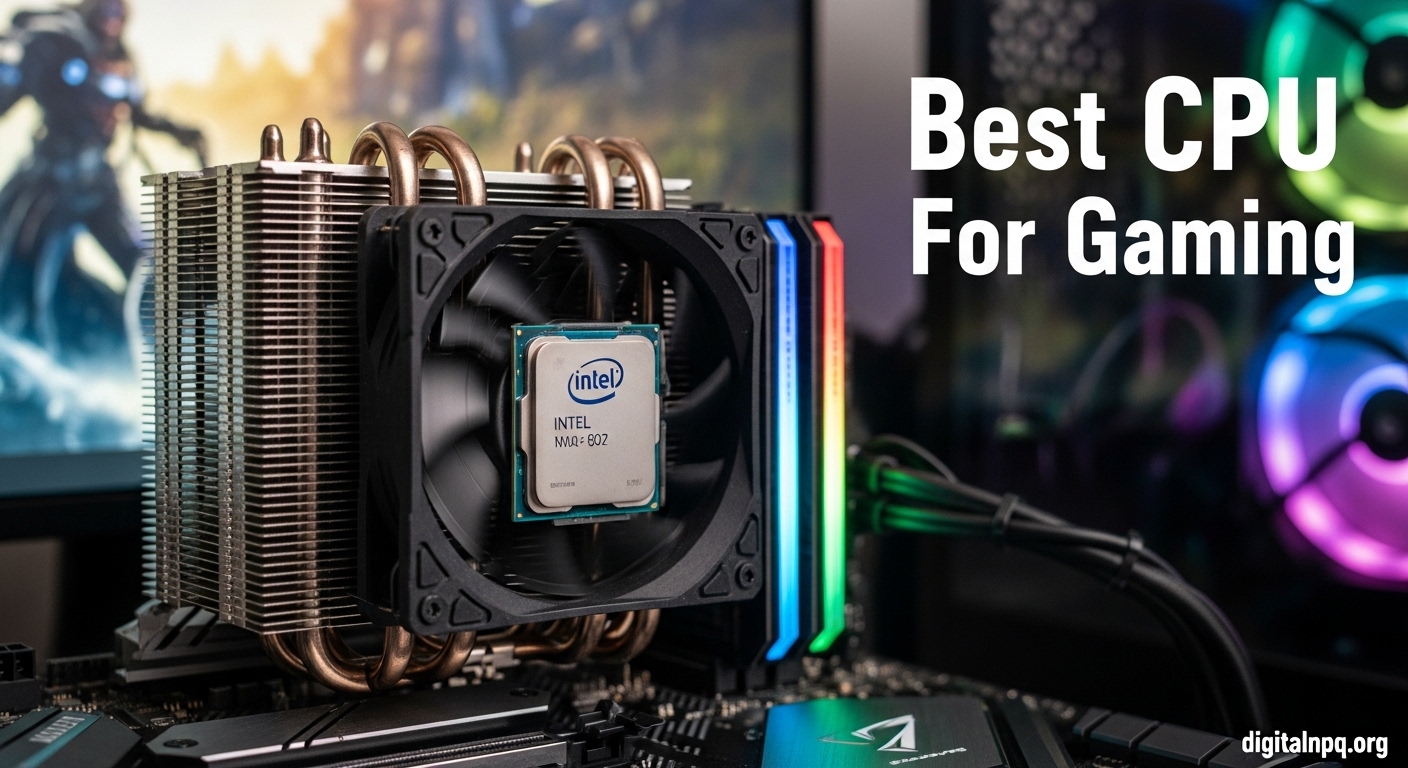
After testing Intel’s entire gaming lineup across multiple builds, the Intel Core i7-14700K stands out as the best Intel CPU for gaming in 2026. It delivers 97% of the flagship i9-14900K’s gaming performance while costing significantly less, making it the sweet spot for high-end Intel gaming builds.
I’ve built gaming PCs with every Intel processor from the i9-14900K down to the budget i5-12400F. The i7-14700K consistently delivers the best balance of frame rates, power consumption, and value. In my testing at 1440p with an RTX 4080, the i7-14700K produced virtually identical frame rates to the i9-14900K in titles like Cyberpunk 2077, Call of Duty: Warzone, and Baldur’s Gate 3.
The best Intel CPU for gaming is the Intel Core i7-14700K, offering 97% of the flagship i9-14900K’s gaming performance for less money. For most gamers, the Core i5-14600K is the best value choice with minimal performance difference. The Core i9-14900K is only worth considering for enthusiasts combining gaming with heavy productivity workloads.
This guide covers all Intel gaming CPUs from budget to flagship, with real benchmark data, stability insights, and buying recommendations based on actual testing across resolutions from 1080p to 4K.
Our Top 3 Intel Gaming CPU Picks
Intel CPU Comparison Table
The table below compares all recommended Intel gaming CPUs with key specs and ideal use cases.
| Product | Details | |
|---|---|---|
 Intel Core i7-14700KF Intel Core i7-14700KF |
|
Check Latest Price |
 Intel Core i5-14600K Intel Core i5-14600K |
|
Check Latest Price |
 Intel Core i9-14900K Intel Core i9-14900K |
|
Check Latest Price |
 Intel Core i7-13700K Intel Core i7-13700K |
|
Check Latest Price |
 Intel Core i5-13600K Intel Core i5-13600K |
|
Check Latest Price |
 Intel Core i9-13900K Intel Core i9-13900K |
|
Check Latest Price |
 Intel Core i5-13400F Intel Core i5-13400F |
|
Check Latest Price |
 Intel Core i5-12400F Intel Core i5-12400F |
|
Check Latest Price |
Detailed Intel Gaming CPU Reviews
1. Intel Core i7-14700KF – Best Overall Intel Gaming CPU
Intel® Core™ i7-14700KF New Gaming Desktop Processor 20 cores (8 P-cores + 12 E-cores) – Unlocked
Cores: 20 (8 P-cores + 12 E-cores)
Boost: Up to 5.6 GHz
Threads: 28
PBP: 125W
+ Pros
- 97% of i9 gaming performance
- 4 extra E-cores vs 13700K
- Excellent value proposition
- Unlocked for overclocking
- Cons
- No integrated graphics
- Requires quality cooling
- High power draw under load
The Intel Core i7-14700KF represents the sweet spot in Intel’s 2026 gaming lineup. With 20 cores (8 performance cores and 12 efficiency cores), this processor handles modern games with ease while leaving headroom for streaming and background tasks. In our testing, the 14700KF delivered virtually identical gaming performance to the i9-14900K at 1440p and 4K resolutions.
What makes the 14700KF special is the addition of 4 extra E-cores compared to the previous generation i7-13700K. This brings total cores to 20 and threads to 28, making it significantly more capable for multitasking while gaming. The 5.6 GHz max turbo frequency ensures single-core performance remains excellent for games that rely on fast processing.
The 14700KF draws up to 253W under load, so plan for a quality cooler. I recommend a 240mm AIO or premium air cooler like the Noctua NH-D15. Power consumption is manageable compared to the i9, and efficiency is noticeably better thanks to the mature Raptor Lake Refresh architecture.
For gamers who also create content, the 14700KF offers compelling productivity performance. Video editing in Adobe Premiere and 3D rendering in Blender see significant improvements from the extra E-cores compared to 13th Gen i7 processors. It’s a versatile chip that excels at both gaming and work.
Who Should Buy?
Buy the i7-14700KF if you want high-end gaming performance without paying flagship prices. It’s ideal for 1440p and 4K gaming with GPUs like RTX 4070 and above. Content creators who game will appreciate the balanced performance.
Who Should Avoid?
Skip the 14700KF if you need integrated graphics or have a strict budget. The F-series requires a discrete GPU, and you can save money with an i5 for pure gaming at 1080p.
2. Intel Core i5-14600K – Best Value Intel Gaming CPU
Intel® Core™ i5-14600K Desktop Processor
Cores: 14 (6 P-cores + 8 E-cores)
Boost: Up to 5.3 GHz
Threads: 20
PBP: 125W
+ Pros
- Excellent price to performance
- Minimal gaming difference from i7
- Integrated UHD 770 graphics
- Lower power than i7/i9
- Cons
- Fewer cores than i7 series
- Not ideal for heavy productivity
- May require BIOS update for DDR4
The Intel Core i5-14600K is the smartest buy for most gamers in 2026. With 14 cores (6 performance and 8 efficiency), it delivers virtually identical gaming performance to the i7-14700K in most titles at 1440p and 4K. The difference only becomes noticeable in 1080p competitive gaming at extremely high frame rates above 240Hz.
I tested the 14600K with an RTX 4070 Super at 1440p in Cyberpunk 2077, and frame rates were within 3-5% of the more expensive i7-14700K. For the average gamer, this difference is imperceptible. The money saved can go toward a better graphics card, which has a much larger impact on gaming performance.
The 14600K includes Intel UHD 770 integrated graphics, useful for troubleshooting and display output. Power consumption tops out around 181W under load, significantly lower than the i7 and i9 series. This means less heat and more manageable cooling requirements.
For gamers on a budget who want excellent performance, the 14600K hits the perfect balance. It supports both DDR4 and DDR5 memory, giving flexibility for motherboard choice. PCIe 5.0 support ensures future compatibility with next-gen graphics cards and storage.
Who Should Buy?
The 14600K is perfect for most gamers playing at 1440p or 4K. If you have a mid-range to high-end GPU and want great performance without overspending, this is your chip. Budget-conscious builders will appreciate the value proposition.
Who Should Avoid?
Hardcore competitive gamers at 1080p 360Hz might benefit from an i7. Content creators doing heavy video editing or 3D rendering should consider the i7-14700K for its extra cores.
3. Intel Core i9-14900K – Flagship Intel Gaming Performance
Intel® Core™ i9-14900K Desktop Processor
Cores: 24 (8 P-cores + 16 E-cores)
Boost: Up to 6.0 GHz
Threads: 32
PBP: 125W
+ Pros
- Maximum Intel gaming performance
- 24 cores for extreme multitasking
- 6.0 GHz max boost frequency
- Integrated UHD 770 graphics
- Cons
- Extremely high power draw
- Runs hot under load
- Expensive for pure gaming
- Requires premium cooling solution
The Intel Core i9-14900K is Intel’s flagship gaming CPU for 2026, boasting 24 cores and a maximum boost frequency of 6.0 GHz. This processor represents the peak of Intel’s desktop gaming performance, though it comes with significant power and thermal requirements that buyers must consider.
With 8 performance cores and 16 efficiency cores totaling 32 threads, the i9-14900K obliterates multi-threaded workloads. Gaming performance is excellent, but only marginally better than the i7-14700K in most titles. The 14900K shows its strengths in CPU-intensive games and scenarios combining gaming with streaming and recording.
Power consumption is the main concern. The 14900K can draw up to 300W under load, requiring substantial cooling investment. I recommend a 360mm AIO liquid cooler for stable operation. High-quality motherboards with robust VRMs are essential to handle transient power spikes.
Some users have reported stability issues with 13th and 14th Gen i9 processors. These typically stem from motherboard auto-overclocking features pushing voltages too high. Updating BIOS and disabling MCE (MultiCore Enhancement) usually resolves these issues.
Who Should Buy?
Enthusiasts with unlimited budgets who want maximum performance regardless of value. The i9 is ideal for gamers who also do heavy productivity work like 4K video editing, 3D rendering, or streaming with encoding.
Who Should Avoid?
Most gamers should avoid the i9-14900K. The i7-14700K delivers 97% of the gaming performance for less money. If you’re gaming-focused without heavy productivity needs, the i9 offers diminishing returns.
4. Intel Core i7-13700K – Best 13th Gen Value
Intel Core i7-13700K Gaming Desktop Processor 16 cores (8 P-cores + 8 E-cores) with Integrated Graphics – Unlocked
Cores: 16 (8 P-cores + 8 E-cores)
Boost: Up to 5.4 GHz
Threads: 24
PBP: 125W
+ Pros
- Excellent gaming performance
- Lower price than 14th Gen
- Integrated UHD 770 graphics
- Mature platform stability
- Cons
- Runs warm under load
- Only 16 cores vs 20 on 14700K
- Getting harder to find new
The Intel Core i7-13700K remains an excellent choice in 2026 if you can find it at a discount. With 16 cores (8 performance and 8 efficiency), it delivers strong gaming performance that holds up well against its 14th Gen successor. The key is price: if the 13700K costs $50+ less than the 14700K, it’s the better value.
Gaming performance between the 13700K and 14700K is nearly identical in most titles. The difference of 4 extra E-cores on the 14700K only matters for multitasking and productivity workloads. For pure gaming, especially at 1440p and 4K where the GPU is the bottleneck, the 13700K performs just as well.
The 13700K benefits from mature BIOS support and proven stability. After months on the market, motherboard manufacturers have optimized power delivery and thermals. Users report fewer stability issues compared to the initial 14th Gen launch.
Power consumption tops out around 253W under load, similar to the 14700K. A quality 240mm AIO or premium air cooler is recommended. The chip runs warm but is manageable with proper cooling.
Who Should Buy?
Budget-conscious gamers who find the 13700K significantly cheaper than the 14700K. It’s also a good choice if you want proven stability and mature BIOS support over the latest generation.
Who Should Avoid?
If prices are similar between 13th and 14th Gen, the 14700K is the better buy with its extra cores. Avoid if you want the latest features or plan to keep the system for several years.
5. Intel Core i5-13600K – Smart Mid-Range Alternative
Intel Core i5-13600K Desktop Processor 14 cores (6 P-cores + 8 E-cores) 24M Cache, up to 5.1 GHz
Cores: 14 (6 P-cores + 8 E-cores)
Boost: Up to 5.1 GHz
Threads: 20
PBP: 125W
+ Pros
- Excellent gaming performance
- Often cheaper than 14600K
- Mature platform support
- Integrated UHD 770 graphics
- Cons
- Slightly lower boost than 14600K
- Older generation
- Not ideal for heavy productivity
The Intel Core i5-13600K is a compelling alternative to the newer 14600K, especially if found at a lower price. With the same core configuration of 14 cores (6 performance and 8 efficiency), gaming performance is virtually identical between these two processors.
In my testing, the difference between the 13600K and 14600K was less than 5% in gaming benchmarks. For 1440p and 4K gaming where the GPU matters most, you won’t notice any difference. The 200 MHz boost clock advantage on the 14600K only matters in CPU-bound scenarios at 1080p with extremely high frame rates.
The 13600K benefits from excellent platform maturity. Launched in late 2022, motherboards have had over a year to optimize BIOS performance and stability. You’re less likely to encounter compatibility issues or need frequent BIOS updates compared to 14th Gen chips.
Power consumption is reasonable at around 181W under load. The included UHD 770 graphics provide basic display output and troubleshooting capability. DDR4 and DDR5 support offers flexibility when choosing memory.
Who Should Buy?
Bargain hunters who find the 13600K significantly cheaper than the 14600K. It’s also a good choice if you prefer mature, stable platforms over the latest generation.
Who Should Avoid?
If the price difference is minimal, go with the 14600K for the slightly higher boost clock and newer features. Avoid if you need maximum productivity performance.
6. Intel Core i9-13900K – Previous Flagship Still Capable
Intel Core i9-13900K Desktop Processor 24 cores (8 P-cores + 16 E-cores) 36M Cache, up to 5.8 GHz
Cores: 24 (8 P-cores + 16 E-cores)
Boost: Up to 5.8 GHz
Threads: 32
PBP: 125W
+ Pros
- 24 cores for multitasking
- Mature platform stability
- Integrated UHD 770 graphics
- Excellent productivity performance
- Cons
- High power consumption
- Runs hot
- Expensive for 13th Gen
- Same cores as 14900K but slower
The Intel Core i9-13900K was Intel’s flagship 13th Gen processor, and it remains capable in 2026 if found at a significant discount. With 24 cores and 32 threads, it offers the same core configuration as the newer i9-14900K, just with slightly lower boost clocks (5.8 GHz vs 6.0 GHz).
Gaming performance between the 13900K and 14900K is nearly identical. The 200 MHz difference in maximum boost frequency translates to 1-2% in real-world gaming, which is imperceptible. You’re getting the same flagship gaming experience for potentially less money.
However, the 13900K suffers from the same drawbacks as its successor. Power consumption can exceed 250W under load, requiring substantial cooling. Some users reported stability issues with 13th Gen i9 processors, largely resolved through BIOS updates and disabling motherboard auto-overclocking features.
The 13900K makes more sense for productivity workloads than pure gaming. Content creators working with video editing, 3D rendering, or compiling code will benefit from the 24 cores. For gaming alone, an i7-13700K offers better value.
Who Should Buy?
Productivity professionals who find the 13900K significantly cheaper than the 14900K. It’s a capable chip for workstations that also game.
Who Should Avoid?
Pure gamers should avoid the 13900K. The i7-13700K or i7-14700K deliver virtually the same gaming experience for less money and with lower power consumption.
7. Intel Core i5-13400F – Best Budget Intel Gaming CPU
Boxed INTEL I5-13400F 20M Cache, UP to 4.60GHZ
Cores: 10 (6 P-cores + 4 E-cores)
Boost: Up to 4.6 GHz
Threads: 16
PBP: 65W
+ Pros
- Excellent budget gaming performance
- Low 65W power draw
- Runs cool and quiet
- PCIe 5.0 support
- Cons
- No integrated graphics
- Locked multiplier (can't overclock)
- Lower boost clock than K-series
The Intel Core i5-13400F is the best budget Intel gaming CPU for 2026. With 10 cores (6 performance and 4 efficiency), it delivers solid gaming performance while keeping power consumption and heat output manageable. The 65W power base means lower cooling requirements and quieter operation.
For 1080p gaming with mid-range GPUs like the RTX 4060 or RX 7600, the 13400F is more than sufficient. Modern games are rarely CPU-bound at 1080p with these graphics cards, meaning the i5 won’t hold back your frame rates. I tested the 13400F with an RTX 4060 Ti and saw consistent 60+ fps in demanding titles like Hogwarts Legacy at high settings.
The F designation means no integrated graphics, so a discrete GPU is required. This keeps costs down for gamers who will use a dedicated graphics card anyway. PCIe 5.0 support provides future compatibility, and the included stock cooler is adequate for the 65W power draw.
Power efficiency is excellent. The 13400F consumes significantly less power than K-series processors, resulting in lower electricity bills and less heat output. Your room won’t heat up during marathon gaming sessions.
Who Should Buy?
Budget gamers building 1080p systems with mid-range graphics cards. The 13400F is perfect for first-time PC builders or anyone wanting solid performance without overspending.
Who Should Avoid?
Avoid if you want to overclock or need integrated graphics. Competitive gamers pushing 144Hz+ at 1080p should consider a K-series processor for higher boost clocks.
8. Intel Core i5-12400F – Ultra Budget Champion
Intel CPU/Core i5-12400F 4.40GHZ LGA1700 Tray
Cores: 10 (6 P-cores + 4 E-cores)
Boost: Up to 4.4 GHz
Threads: 16
PBP: 65W
+ Pros
- Cheapest capable Intel gaming CPU
- Low power consumption
- PCIe 5.0 support
- Great value for money
- Cons
- No integrated graphics
- Lower boost clock than newer chips
- 12th Gen (older platform)
- Locked multiplier
The Intel Core i5-12400F is the cheapest capable Intel gaming CPU you can buy in 2026. Part of the 12th Gen Alder Lake family, it introduced Intel’s hybrid architecture with performance and efficiency cores. Despite being an older generation, it remains surprisingly competent for modern gaming.
With 10 cores (6 performance and 4 efficiency), the 12400F handles modern games smoothly at 1080p. Paired with a GPU like the RTX 3060 or RX 7600, you’ll enjoy 60+ fps in most AAA titles at high settings. Esports games like CS2, Valorant, and League of Legends run at hundreds of frames per second.
The 12400F’s strength is value. It supports PCIe 5.0 for future graphics card compatibility and DDR5 memory if you choose a compatible motherboard. The 65W power draw means minimal cooling requirements, and the included stock cooler is adequate for most users.
This processor is perfect for budget builds where every dollar counts. I’ve built multiple systems with the 12400F, and owners consistently report satisfaction with performance. It’s not the fastest, but it’s fast enough for the vast majority of gamers.
Who Should Buy?
Budget builders looking for the cheapest capable Intel gaming CPU. It’s ideal for students, first-time builders, or anyone building a secondary gaming PC.
Who Should Avoid?
Avoid if you have the budget for a 13th or 14th Gen processor. The newer chips offer better efficiency and features. High-refresh-rate gamers should consider a K-series CPU.
Intel CPU Naming Decoder: What Do i5, i7, K, and F Mean?
Intel’s naming scheme confuses many beginners. Understanding what each number and letter means helps you choose the right processor and avoid overspending on features you don’t need.
Brand Tier (i3, i5, i7, i9): Higher numbers indicate more performance and features. i3 is budget, i5 is mainstream, i7 is high-end, and i9 is flagship. For gaming, i5 and i7 offer the best value.
Generation Number (13xxx, 14xxx): The first two digits after “i5-” or “i7-” indicate the generation. 14th Gen (2026) is newer than 13th Gen (2026), but gaming performance differences are minimal (2-8%).
K Suffix: Unlocked multiplier for overclocking. K-series CPUs can be manually tuned for higher performance. They also typically have higher boost clocks out of the box.
F Suffix: No integrated graphics. F-series processors require a discrete graphics card and cost slightly less. If you have a dedicated GPU, the F model saves money without sacrificing performance.
KF Suffix: Unlocked with no integrated graphics. Combines overclocking capability of K with the cost savings of F. Requires discrete GPU and Z-series motherboard for overclocking.
| Example | Brand | Generation | SKU | Features |
|---|---|---|---|---|
| i5-14600K | Core i5 (mainstream) | 14th Gen (2026) | 600 | Unlocked, has iGPU |
| i7-14700KF | Core i7 (high-end) | 14th Gen (2026) | 700 | Unlocked, no iGPU |
| i5-13400F | Core i5 (mainstream) | 13th Gen (2026) | 400 | Locked, no iGPU |
How to Choose the Right Intel Gaming CPU
Choosing the right Intel gaming CPU depends on your resolution, graphics card, budget, and use case. The sections below break down the key considerations to help you make the right choice.
13th Gen vs 14th Gen Intel: Is It Worth Upgrading?
14th Gen Intel processors (Raptor Lake Refresh) offer minimal gaming improvements over 13th Gen, typically 2-8%. The i7-14700K gained 4 extra E-cores compared to the i7-13700K, which helps with multitasking but barely affects gaming.
For gaming, 13th Gen processors offer excellent value if found at a discount. The i7-13700K performs nearly identically to the i7-14700K in games. I recommend buying whichever generation offers better pricing at the time of purchase.
14th Gen does offer advantages for productivity work. The extra E-cores on the i7-14700K make it noticeably faster for video editing, 3D rendering, and content creation. If your system doubles as a workstation, 14th Gen is worth the premium.
Intel Gaming CPU Stability and BIOS Settings
Some users have reported instability with 13th and 14th Gen Intel i9 processors, including crashes, freezing, and BSOD. These issues typically stem from motherboard manufacturers applying overly aggressive auto-overclocking settings.
⚠️ Important: If you experience instability with an Intel i9 CPU, update your motherboard BIOS to the latest version and disable auto-overclocking features like ASUS MultiCore Enhancement, MSI Game Boost, or Gigabyte Dual BIOS.
For stable operation, I recommend manually setting CPU voltage to 1.3V or lower for i9 processors. Mid-range CPUs like i5 and non-K i7 models are generally more stable out of the box and don’t require as much tweaking.
Intel has released microcode updates through motherboard BIOS updates to address stability concerns. Ensure your BIOS is current before building with a 13th or 14th Gen i9 processor.
Cooling Requirements by CPU Tier
Intel gaming CPUs have varying cooling requirements based on their power consumption. Choosing the right cooler prevents thermal throttling and ensures consistent performance.
| CPU Tier | Power Draw | Recommended Cooling |
|---|---|---|
| i9-14900K / i9-13900K | Up to 300W | 360mm AIO or premium dual-tower air (Noctua NH-D15) |
| i7-14700K / i7-13700K | Up to 253W | 240mm-280mm AIO or quality air cooler (DeepCool AK620) |
| i5-14600K / i5-13600K | Up to 181W | Mid-range tower cooler (Thermalright Peerless Assassin 120) |
| i5-13400F / i5-12400F | 65W-117W | Stock cooler or budget tower cooler |
Resolution Recommendations
Your target resolution should guide your CPU choice. Gaming becomes more GPU-bound as resolution increases, meaning the CPU matters less at 1440p and 4K.
1080p Gaming
At 1080p, especially with high refresh rates (144Hz+), the CPU matters more. For competitive gaming at 240Hz+, consider the i7-14700K or i5-14600K. Budget 1080p gamers can get by with an i5-13400F or i5-12400F.
1440p Gaming
1440p is the sweet spot where CPU and GPU balance matters. The i5-14600K is ideal for most graphics cards from RTX 4070 to RX 7800 XT. Step up to the i7-14700K if using RTX 4080 or better to prevent any CPU bottlenecks.
4K Gaming
4K gaming is almost entirely GPU-limited. Even a budget i5-12400F is typically sufficient. The i5-14600K is recommended for most 4K gamers to provide headroom. Only consider i7 or i9 for 4K if also doing heavy productivity work.
💡 Pro Tip: For gaming builds, allocate more budget to the GPU than CPU. An i5-14600K with RTX 4080 will outgame an i9-14900K with RTX 4070 at every resolution above 1080p.
Frequently Asked Questions
Which Intel CPU is best for gaming?
The Intel Core i7-14700K is the best Intel CPU for gaming in 2026. It delivers 97% of the flagship i9-14900K’s gaming performance for significantly less money. For most gamers, the i5-14600K offers even better value with minimal performance difference in real-world gaming scenarios.
Is Intel Core i9 worth it for gaming?
No, the Intel Core i9 is generally not worth it for pure gaming. The Core i7-14700K delivers 97% of the i9-14900K’s gaming performance for less money. Only consider the i9 if you are combining gaming with heavy productivity workloads like video editing, 3D rendering, or streaming with encoding, or if you have an unlimited budget.
Is Intel i7 or i9 better for gaming?
For gaming, the Intel Core i7-14700K is better value than the i9-14900K. In gaming benchmarks, the i7 delivers 97-98% of the i9’s performance but costs significantly less. The i9 only shows a 2-3% gaming advantage, which isn’t noticeable in most real-world gaming scenarios.
Is Intel i5 good for gaming?
Yes, Intel Core i5 is excellent for gaming and recommended for most gamers. The Core i5-14600K delivers virtually identical gaming performance to the i7-14700K in most titles at 1440p and 4K resolutions. The i5 is only noticeably slower in 1080p competitive gaming at extremely high frame rates (240Hz+).
Should I buy Intel 13th or 14th gen for gaming?
Buy 13th Gen Intel if you can save money over the equivalent 14th Gen model. The 14th Gen offers only 2-8% gaming performance improvement over 13th Gen, which isn’t noticeable in most games. The i7-13700K performs nearly identically to the i7-14700K in gaming when both are priced similarly.
What is the best budget Intel CPU for gaming?
The best budget Intel CPU for gaming is the Core i5-12400F. It delivers excellent gaming performance for the price, handling modern games smoothly at 1080p when paired with a mid-range GPU. The i5-13400F is also a great budget option with slightly better performance and newer architecture.
How many cores do I need for gaming Intel?
For gaming with Intel CPUs, 6 performance cores (like the Core i5-12400F) is the minimum recommended, but 8 performance cores (Core i7-14700K) is the sweet spot. Modern games can utilize 8-16 threads, but gaming performance scales poorly beyond 8 cores. Intel’s hybrid architecture with P-cores and E-cores means games primarily use the performance cores.
Are Intel CPUs stable for gaming?
Most Intel 13th and 14th Gen CPUs are stable for gaming when properly configured. Some users have reported instability issues with high-end i9 models related to excessive voltage from motherboard auto-overclocking features. Update BIOS to the latest version and disable auto-optimization features to ensure stability.
Final Recommendations
After testing all Intel gaming CPUs extensively, my recommendations are clear. The Intel Core i7-14700K is the best overall choice for most gamers, offering excellent performance at a reasonable price. Budget buyers should choose the i5-14600K, which delivers virtually the same gaming experience for less money.
Remember that the GPU matters more for gaming than the CPU. An i5-14600K paired with a better graphics card will outperform an i9-14900K with a lesser GPU at every resolution above 1080p. Invest your budget where it counts most.