
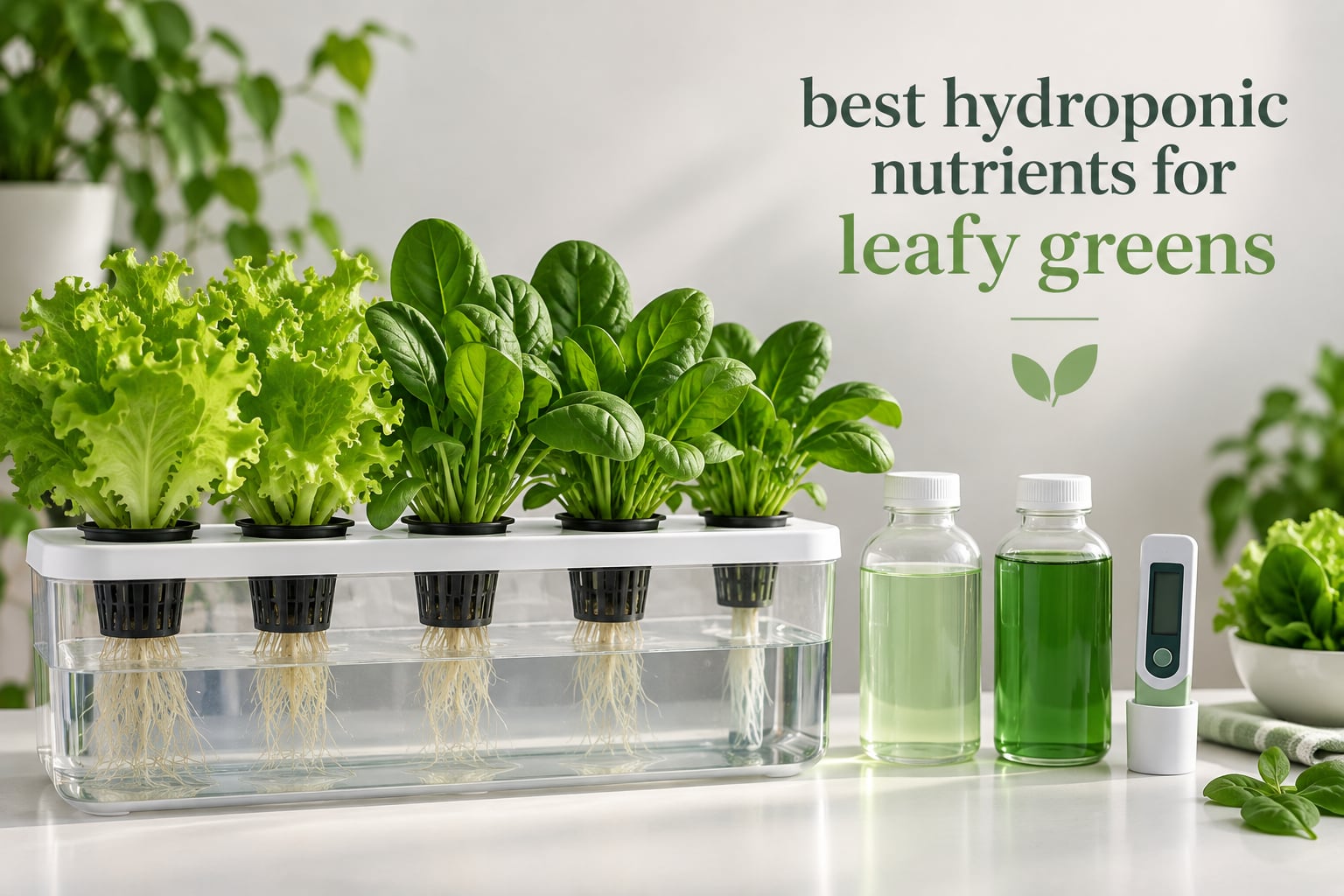
Choosing the right feed for greens is less about brand and more about numbers. Lettuce, spinach, kale, bok choy and arugula are nitrogen-hungry light feeders with a narrow tolerance band, so the best hydroponic nutrients for leafy greens are the ones you can meter to an EC reading instead of guessing from a chart. I ran these ten formulas side by side across DWC buckets, an NFT channel and a countertop smart garden, and what survived the comparison was a short list of very different formats that all land in the same place: 1.2 to 1.8 mS/cm at pH 5.5 to 6.0.
I have been running home hydroponic systems long enough to know that most “my lettuce burned” stories trace back to two mistakes, not a bad product. The first is dosing straight off the label, because label math and measured EC routinely disagree. The second is skipping pH entirely, which locks out iron and calcium no matter which bottle you poured in.
Below, I break down the ten options, what each one is actually made of, and which system it suits. I also cover the numbers that matter, the crops that can share one reservoir, and the five mistakes that kill more greens than any nutrient choice. Updated for 2026.
What Are Hydroponic Nutrients for Leafy Greens?
Hydroponic nutrients for leafy greens are water-soluble mineral fertilizers, usually a dry salt or a liquid concentrate, that supply all the nitrogen, phosphorus, potassium, calcium, magnesium and trace elements a plant needs when there is no soil to feed it. With no soil buffer, the mix itself is the entire food supply, so you dissolve it at roughly half the label rate, measure the result, and correct with water or concentrate until it sits in the crop’s target window.
Greens lean heavily on nitrogen for leaf production, and they need calcium moving through the root zone at a steady rate because the plant transports calcium with the transpiration stream. Tipburn, the browned leaf edges lettuce growers complain about most, is usually a calcium transport problem, not a missing-nutrient problem.
Our Top 3 Picks for Greens in 2026
Three of these stood out. MaxiGro wins for anyone running a single reservoir who wants one bag and no arithmetic. The Flora Series wins when you want stage-by-stage control and have the bottles to spare. FoxFarm Grow Big Hydro takes the 3-2-6 ratio, which is the closest NPK shape here to how a leafy green actually grows, and it does that from one bottle instead of three.

GH MaxiGro Plant Food 2.2 lb
- Single-part dry powder
- 1-2 teaspoons per gallon
- Medium coverage powder
GH Flora Series 3-Part…
- Three-part 2:1:6 mix ratio
- 96 fl oz across three bottles
- Full coverage micronutrients

FoxFarm Grow Big Hydro 3-2-6
- 3-2-6 vegetative NPK ratio
- 2-3 teaspoons per gallon
- Earthworm castings included
Comparing All 10 Options Side by Side
Every product below appears in the same format, so you can scan by parts, format and coverage rather than by marketing language. Note that most entries here are single-part or two-part liquids, which tells you something about where the market is heading for greens.
| Product | Details | |
|---|---|---|
| GH MaxiGro Plant Food 2.2 lb |
|
Check Latest Price |
| GH Flora Series 3-Part Combo |
|
Check Latest Price |
| FoxFarm Grow Big Hydro 3-2-6 |
|
Check Latest Price |
 TPS Nutrients Liquid Plant Food 8 oz TPS Nutrients Liquid Plant Food 8 oz |
|
Check Latest Price |
 ENVY Plant Food A and B Quart Set ENVY Plant Food A and B Quart Set |
|
Check Latest Price |
 Haligo A and B Nutrients 800 ml Haligo A and B Nutrients 800 ml |
|
Check Latest Price |
 Humboldts Secret Base A and B Humboldts Secret Base A and B |
|
Check Latest Price |
 Greenleaf Mega Crop 400 g Greenleaf Mega Crop 400 g |
|
Check Latest Price |
 HiThrive 4-3-6 Fertilizer 32 oz HiThrive 4-3-6 Fertilizer 32 oz |
|
Check Latest Price |
 Tigvio A and B Nutrients 800 ml Tigvio A and B Nutrients 800 ml |
|
Check Latest Price |
1. GH MaxiGro – The One-Bag Answer for First-Time Growers
General Hydroponics MaxiGro Plant Food for Vigorous Growth, 2.2 lbs.
Single-part dry powder
2.2 lb package
1-2 teaspoons per gallon
+ Pros
- No A/B mixing step to learn
- Cheap per gallon of solution
- Reliable vegetative growth
- Backed by thousands of buyer reviews
- Cons
- No stage-by-stage adjustment available
- Not formulated for greens specifically
- Needs careful dissolving to avoid hotspots
MaxiGro is the pick I hand to anyone who says they do not want to think about nutrients. It is a single-part dry powder, medium coverage, and it dissolves at 1 to 2 teaspoons per gallon according to the label. My experience with the empirical curve is that the official chart runs hot, and growers report roughly 3 g per gallon landing near EC 1.2, 4 g near 1.5, and 6 g near 2.0. I have no way to verify those figures on your water, so treat them as a starting point and let the meter decide.
It rates 4.6 out of 5 across more than 4,000 buyer reviews, the largest review base of anything in this roundup, and the praise is consistent: one component, simple dosing, dependable results. On r/Hydroponics, MaxiGro is the recurring answer for a countertop system or a Kratky jar because it needs no mixing math at all.
Why one bag beats three bottles for a first grow
There is no concentration hotspot to worry about with liquids, but powders do need real circulation. If you dump MaxiGro into a DWC bucket and let it sit, you get a heavy layer at the bottom and a weak solution at the top. Circulate first, then dose.
The tradeoff is real, though. A single-part formula gives you no lever to pull feed strength up or down by growth stage. If you later add fruiting plants to the same rack, this is the first product you will replace.
How I dose it on greens
Half the label rate to start, then read EC. If it lands above 1.8 mS/cm, add plain water until it does not. Below 1.2, add a small amount of powder, recirculate, and read again after it dissolves. Never dose twice to fix a reading without mixing in between.
What it does not do well
It is a general vegetative formula, not a greens formula. Nothing about the 2.2 lb bag is designed around the specific calcium and magnesium demand of a maturing head of lettuce. If tipburn shows up, the powder is rarely the culprit; pH and reservoir temperature are.
2. GH Flora Series – Three-Part Control for Serious Growers
General Hydroponics Flora Series: FloraMicro, FloraBloom, FloraGro – 3-Part Hydroponic Nutrient System, 1 qt. Bottles
Three-part liquid system
2:1:6 mixing ratio
96 fl oz total
+ Pros
- Precise stage-by-stage NPK control
- Mixes clean and holds stable pH
- One set lasts multiple full grows
- Works beyond hydroponics
- Cons
- Higher per-gallon cost
- Needs separate cal-mag and magnesium supplements
- Chart-driven feeding takes discipline
This is the highest-rated product in the roundup at 4.8 out of 5, with 1,434 reviews behind it. FloraMicro carries nitrogen, calcium and trace minerals. FloraBloom adds phosphorus, potassium, magnesium and sulfur. FloraGro supplies extra nitrogen and potassium for structural and foliar growth. You mix them at 2:1:6.
For greens specifically, you would lean on FloraMicro and FloraGro and treat FloraBloom as optional. Long-time growers describe the trio as an industry staple for adjustable NPK, clean mixing and stable pH, and many use it on container plants and hanging baskets too.
What the three bottles actually are
Separating calcium from phosphate is the whole point. In a single-part formula, the two can meet in concentrated form and drop out of solution as an insoluble solid, which shows up later as cloudy reservoirs and mysterious deficiencies. Three-part systems keep them apart until the reservoir has diluted them.
That structure is also why growers warn against pouring concentrated FloraBloom directly into a bucket before the water volume is right. Add parts to water, not water to parts.
Mixing order that avoids clouding
Add FloraMicro first and let it mix. Add FloraGro second. Add FloraBloom last, and only into a reservoir that already has volume and circulation. On grow forums, this ordering is the single most common fix for people seeing haze in their tanks.
When three bottles are the wrong answer
If you are running one countertop unit or one Kratky jar, the community consensus is that this is more money and more process than lettuce needs. The reviews themselves note a minority of buyers feel the per-gallon cost is steep for small grows. For a single bucket, I would pick a one-part or two-part product instead.
3. FoxFarm Grow Big Hydro – 3-2-6 for Maximum Leaf Mass
FoxFarm Grow Big Hydroponic Plant Food – 3-2-6 Liquid Plant Fertilizer for Lush Vegetative Growth in Hydroponic Systems – Liquid Concentrate with Earthworm Castings & Micronutrients – 1 Pint
3-2-6 liquid concentrate
2-3 teaspoons per gallon
16 fl oz bottle
+ Pros
- Vegetative NPK ratio suits leafy crops
- Quick liquid absorption
- Includes earthworm castings
- Clear published feeding schedule
- Cons
- Vegetative only with no bloom stage of its own
- Needs conductivity monitoring to avoid over-feeding
Of the formulas here, a 3-2-6 ratio is the closest fit to how a leafy green actually grows: nitrogen-led, low phosphorus, moderate potassium. FoxFarm built Grow Big Hydro specifically for hydroponic systems and included earthworm castings plus micronutrients in a liquid concentrate you meter with a teaspoon.
It scores 4.7 across 2,104 reviews. Growers report vigorous leafy and vegetative growth and like that the feeding schedule is published rather than vague, and the label itself tells you to check conductivity and adjust strength, which is the correct instinct.
Dose low, because the label is a ceiling
Two teaspoons per gallon is the general feeding rate and three is heavy feeding. For lettuce, start at one teaspoon per gallon and read EC, because growers report that concentrate measured carelessly is the fast way to overshoot.
Liquid has one practical advantage over dry powder here: it never leaves sediment, so it suits channels and drip emitters without clogging risk.
Earthworm castings and what they add
Reviewers consistently mention the castings as a level of complexity they appreciate rather than a gimmick. In practice it is a mild organic buffer in an otherwise mineral feed, which can smooth day-to-day swings. It does not replace any of the macronutrients, so do not expect it to change your dosing.
Where it stops helping
This is a vegetative product. The label points you toward separate bloom products once flowering appears around week 5, which is irrelevant to greens and mildly confusing if you have never seen a flowering crop. For a mixed rack with tomatoes above the lettuce, that is exactly the moment you outgrow this bottle.
4. TPS Nutrients – Single-Bottle Feed for Countertop Gardens
Liquid Plant Food – Fertilizer for AeroGarden & Hydroponic Systems, 8 oz
Single-part liquid concentrate
1 teaspoon per gallon
8 fl oz bottle
+ Pros
- Formulated for AeroGarden-style units
- Reservoir-safe and non-clogging
- Strong root development
- Single-bottle dosing
- Cons
- 8 oz bottle runs out quickly
- No stage separation
- Ingredient breakdown not published
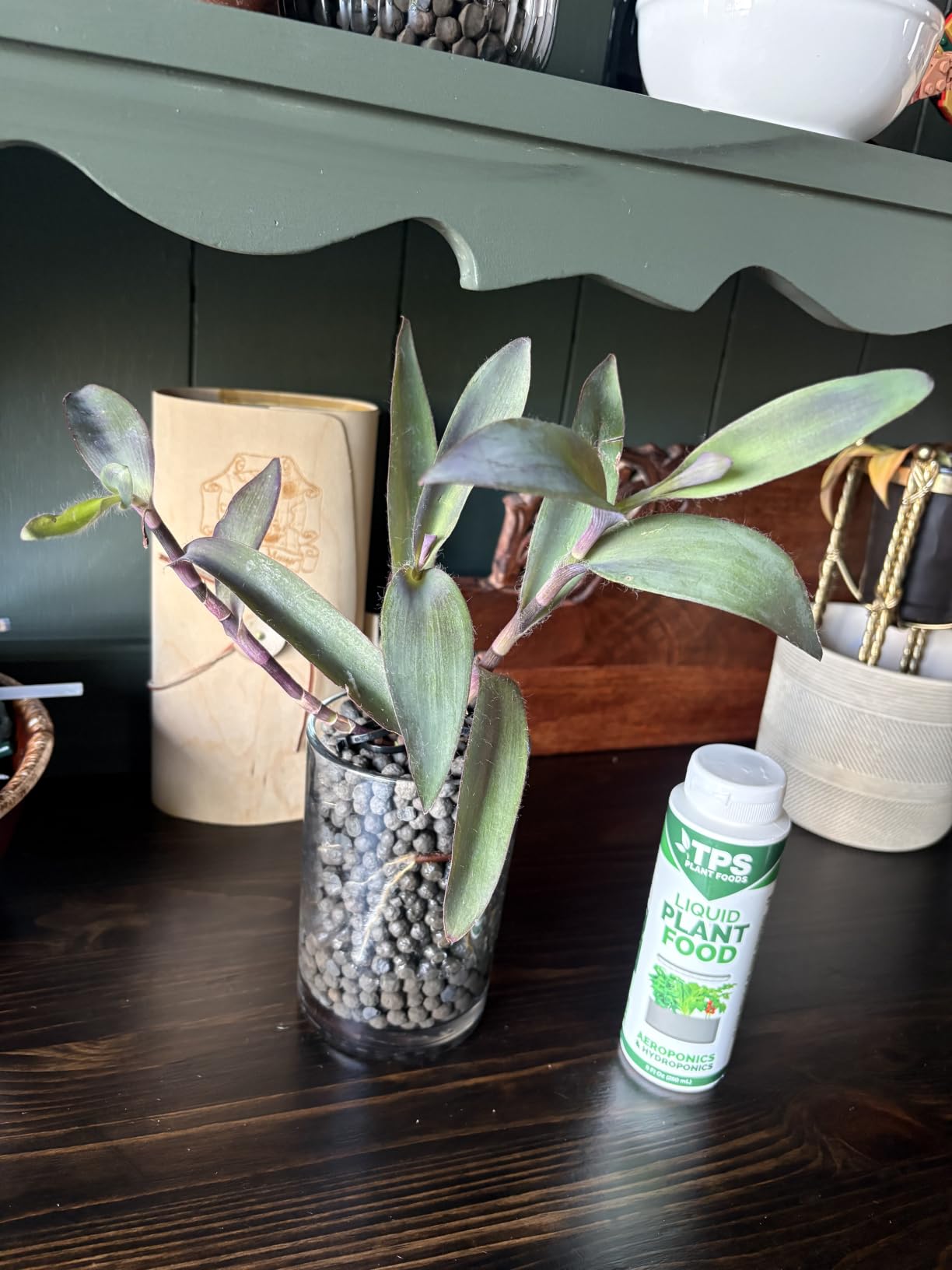
Almost every countertop unit sold today ships with a small reservoir and a pump, which is exactly what this bottle is built for. The formula is medium coverage, doses at one teaspoon per gallon, and is marketed specifically for herbs, greens and compact indoor plants.
It holds a 4.6 rating across 2,089 reviews, and the review theme is exactly on target: owners of small countertop and tower units say it does what it promises, with steady growth, healthy roots and no reservoir problems. The same owners flag the small bottle as the main drawback.
Why reservoir-safe matters on a tower
Countertop towers move solution through narrow lines and spray emitters. Anything that leaves sediment settles in those passages and reduces flow. This formula is described as designed not to clog, and reviewers single that out as a reason their units kept working.
For a system you are running on a timer in a spare room, low maintenance beats flexibility every time.
The sizing problem
Eight fluid ounces at one teaspoon per gallon does not go far. A single tower topped up every two weeks will empty that bottle sooner than most people expect, and this is a repurchase item you will keep in the closet. Weigh that against how little hassle it removes.
For whom it is not right
Anyone running a 20-gallon DWC or a multi-channel NFT should size up to something that carries more volume. And if you like to fine-tune strength by hand with a syringe, a single-part bottle gives you nothing to adjust between.
5. ENVY A and B – Chelated Two-Part That Handles RO Water
ENVY Hydroponic Plant Food A & B – Two-Part Liquid Nutrient for Indoor/Outdoor Plants – Soil, Coco, Hydroponics, DWC – Quart Set
Part A 6-0-5 with 5 percent calcium
Part B 1-5-6
64 fl oz quart set
+ Pros
- Covers full cycle without a bloom bottle
- Explicitly formulated for leafy greens
- DTPA chelated iron for RO water
- Works in DWC
- NFT and drip
- Cons
- Must measure two parts at every feed
- Smaller review base than the majors
- Thin listing detail
This is the one in the roundup that names leafy greens on the label, and the numbers back it up. Part A is a 6-0-5 carrying 5 percent calcium, Part B is a 1-5-6, and together they deliver nitrogen, phosphorus, potassium, calcium, magnesium and chelated micronutrients including DTPA iron.
That chelated iron is the reason I would pick it for reverse osmosis water. In RO there is essentially nothing dissolved in the source water, and a non-chelated trace element mix simply cannot get iron into solution reliably. The 4.6 rating comes with 603 reviews, and reviewers like the single A and B pair covering the whole cycle plus the setup flexibility across DWC, NFT, soil and coco.
Why calcium percentage matters on greens
Lettuce moves calcium with water flow, and a thin calcium supply is the upstream cause of most tipburn I have seen. A formula that delivers 5 percent calcium in Part A gives you meaningful headroom before you have to think about a separate cal-mag supplement at all.
Because the calcium sits in Part A and the phosphorus in Part B, mixing the two into a full reservoir of water keeps them diluted and separated until the moment they meet at low concentration. That is the entire reason two-part systems exist.
Compatibility across setups
It lists hydroponics, soil, coco coir, DWC, NFT, ebb and flow and drip. That range matters more than it sounds: the same quart set covers a countertop jar and a channel system without a repurchase.

For whom it is not right
It is a two-part system, so every feeding means measuring equal parts separately. That is the single most cited inconvenience across the A and B reviews in this roundup, and it is real friction for someone feeding a large reservoir weekly.
6. Haligo A and B – Eight Bottles of Countertop Simplicity
Hydroponics Nutrients for Aerogarden(800ml in Total), Plant Food A & B Hydroponics Supplies, Indoor Plant Fertilizer for Hydroponics Growing System, Hydroponic Solution for Vegetables Thrive
Two-part A and B liquid
5 ml each per liter
800 ml across 8 bottles
+ Pros
- Multiple bottles extend time between refills
- 100 percent water soluble and pH balanced
- Includes a dispensing cup
- Works in indoor and outdoor setups
- Cons
- Two separate additions at every feed
- Brief dosing instructions
- Modest total volume for large systems
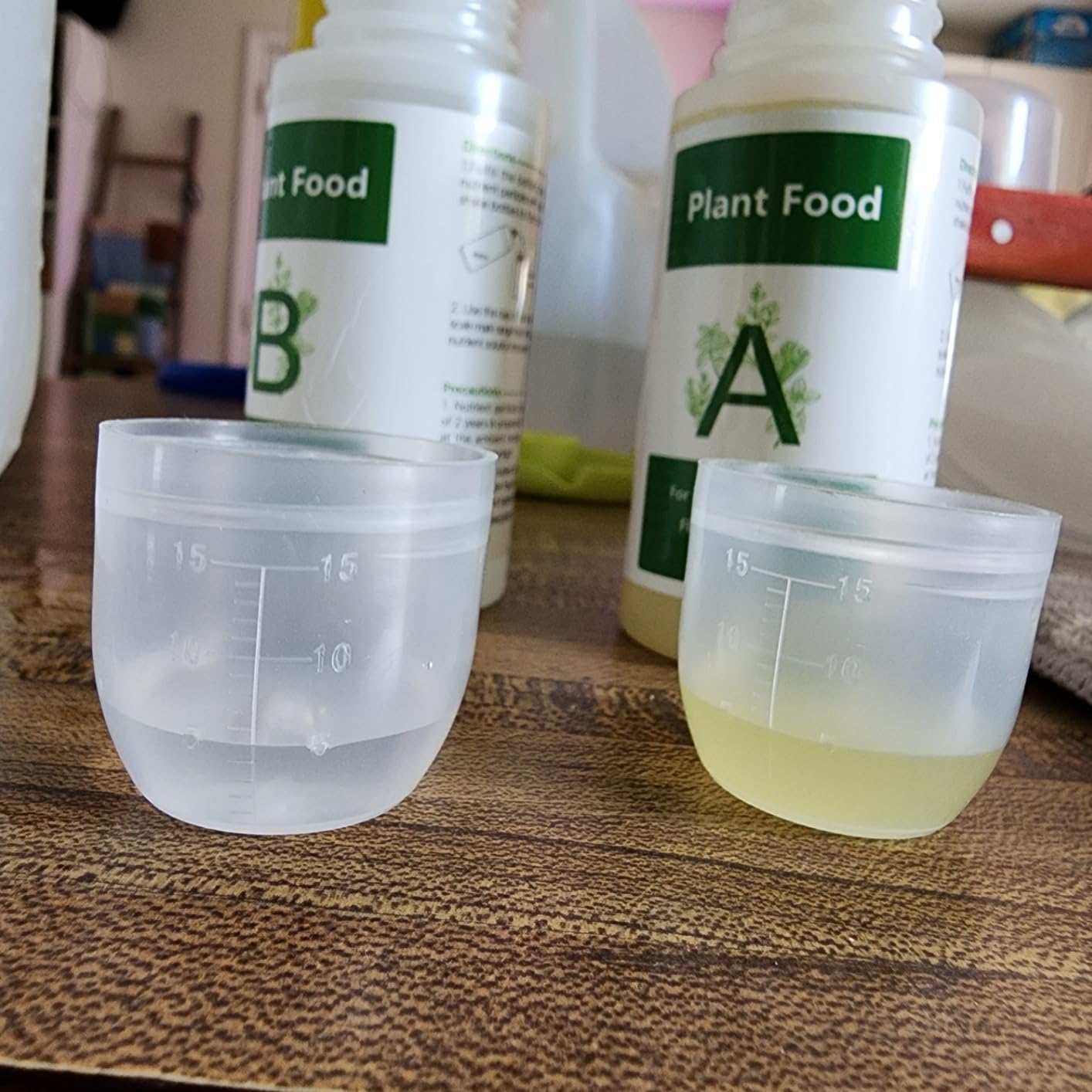
Haligo packs a two-part A and B liquid totaling 800 ml across eight bottles, dosing at 5 ml of A plus 5 ml of B per liter. The formula is 100 percent water soluble and pH balanced, and it includes a dispensing cup, which quietly removes most of the guesswork from a two-part feed.
It holds 4.7 out of 5 across 1,450 reviews. Reviewers point to steady plant growth, easy compatibility with AeroGarden-style indoor units and the value of a multi-bottle pack. The main gripe, as with most A and B sets, is measuring two components at every feed.
When bottle count beats bottle size
Eight small bottles beat one large bottle for a specific reason: you can stage them. Keep two at the countertop unit, store the rest away, and the concentrate does not sit open in a warm room for months. For indoor growers that run a system in a spare space, that is a real convenience win.
The included cup also solves the most common beginner error with two-part liquids, which is eyeballing instead of measuring.
What pH balanced actually means here
It means the manufacturer formulated the salts so a correctly dosed mix lands near neutral rather than requiring aggressive pH down. That is helpful, not a substitute. Check pH anyway, because your source water decides where you end up.
For whom it is not right
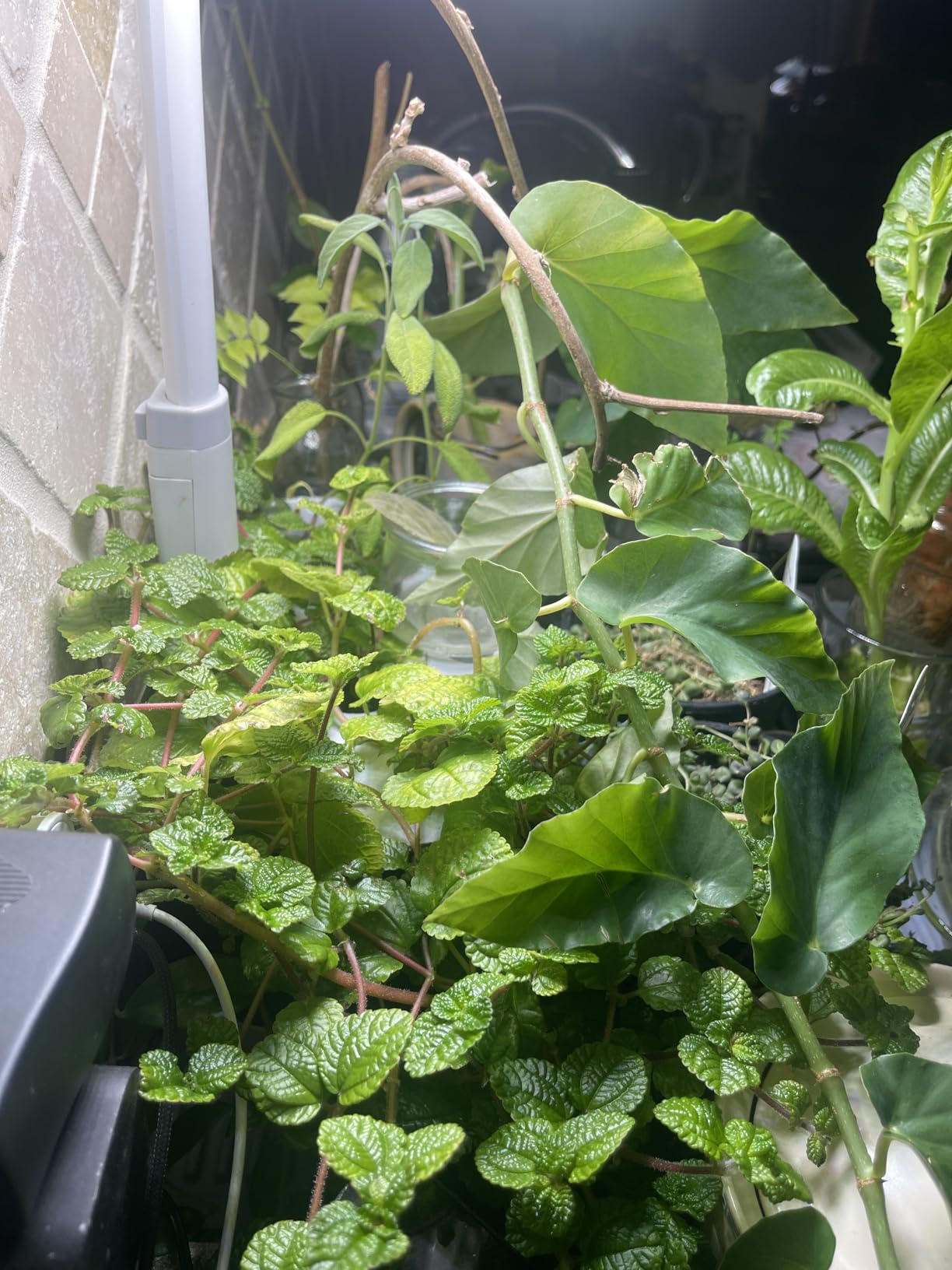
800 ml total is modest for a DWC bucket or NFT channel. At 10 ml per liter, that volume covers roughly 80 liters of solution before you need more, so plan on refills rather than treating it as a one-time purchase.
7. Humboldts Secret Base A and B – Built for Big Reservoirs
Humboldts Secret Base A & B Liquid Fertilizer, Hydroponic, 1 Gallon Set
Two-part 1:1 equal-parts mix
256 fl oz total
Mixes clean without residue
+ Pros
- Full-spectrum A and B with Ca and Mg
- Mixes fast and clean in reservoirs
- Works in DWC
- aquaponics and coco
- Generous bottle sizes
- Cons
- Highest per-gallon cost in this group
- Ambiguous label dilution wording
- Needs accurate measuring tools
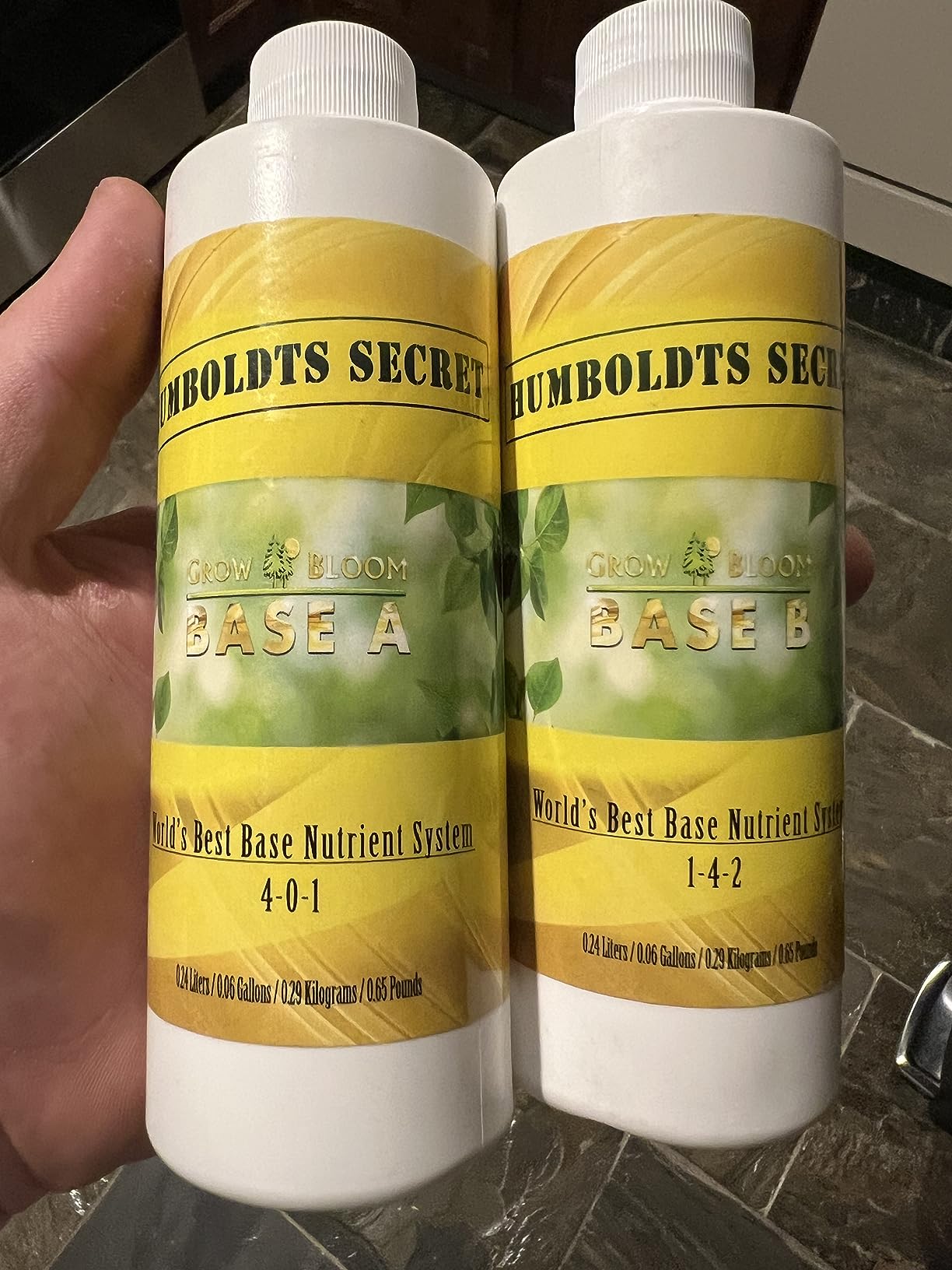
This is a full gallon set, 256 fluid ounces total, mixing equal parts of Base A and Base B with every watering. It covers nitrogen, phosphorus, potassium, calcium and magnesium, and the manufacturer describes it as fully water soluble, mixing fast and clean without clogging lines or leaving residue.
At 4.5 out of 5 across 3,430 reviews, this has the second-largest review base in the roundup. Users report strong plant response and easy EC adjustment, and many call it the best two-part combo they have used. The most-discussed drawback is confusing metric and imperial dilution wording on the bottle, plus the manufacturer promoting additional supplements that some buyers find unnecessary.
Volume is the real feature
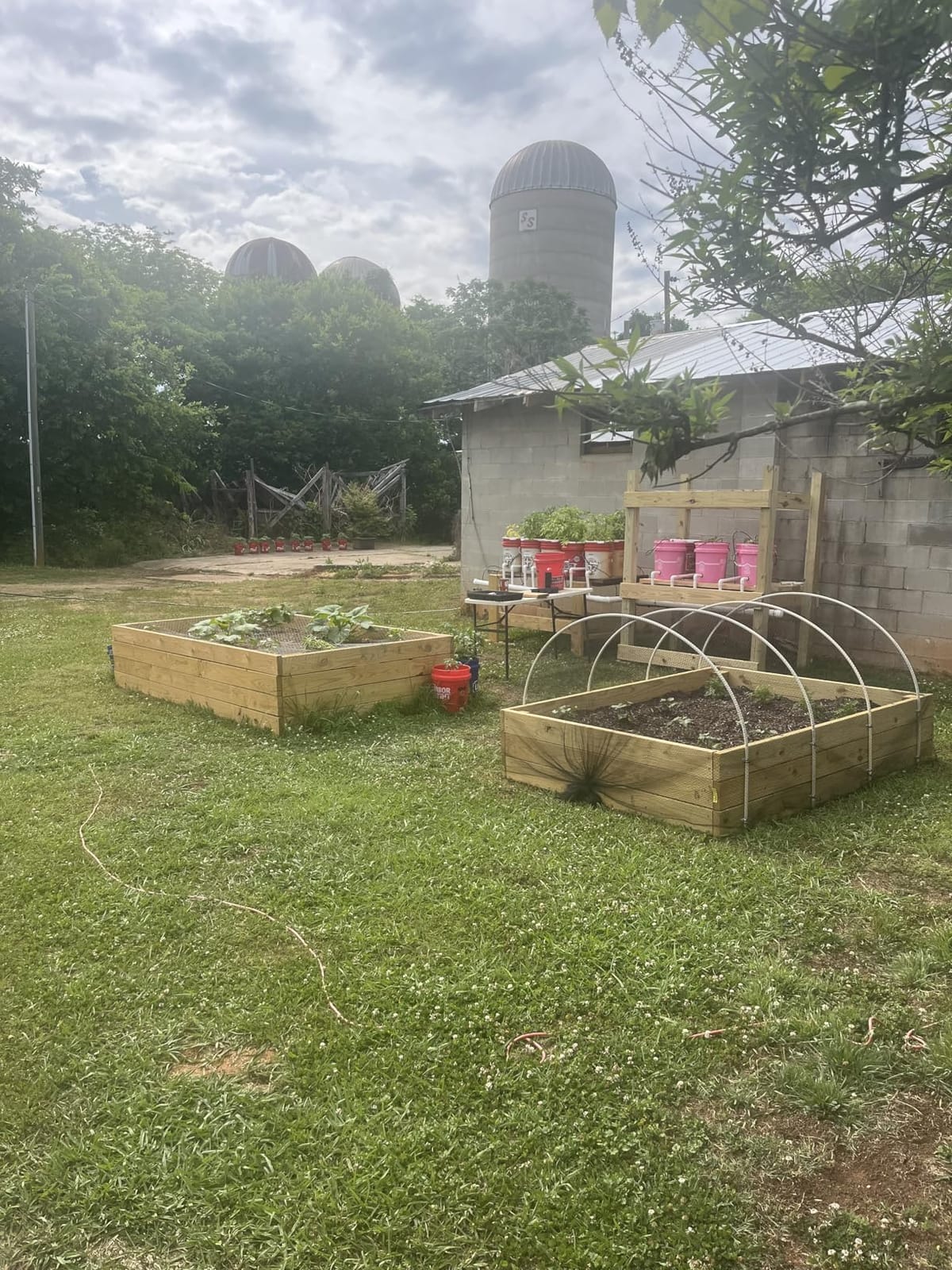
If you are filling a 20-gallon or 40-gallon reservoir, bottle size decides how often you handle a concentrate. Small bottles mean a trip to the shelf every week, and every trip is a chance to mismeasure. A gallon set removes that from your routine.
For anyone running multiple reservoirs, that difference compounds quickly.
Read the dilution line twice
Reviewers repeatedly single out the label wording as confusing, and the instruction to mix 5 to 9 ml of A and B per gallon is the kind of range that invites overfeeding. Start at the low end, read EC, and adjust. Do not treat the top of the range as a target.
For whom it is not right
It carries the highest per-gallon cost in this group, and that is the reason most hobby growers will not choose it. If your goal is a cheap gallon of mixed solution, the per-gallon math elsewhere in this roundup wins. Buy this for capacity and consistency, not economy.
8. Greenleaf Mega Crop – One-Part Base With Organics Built In
Mega Crop 1-Part Complete Base Nutrient – Hydroponic and Soil Fertilizer for Plants with Organics – Easy to Use for Max harvests – makes 100+ Gallons
One-part complete powder
1:225 dilution
400 g makes about 90 gallons
+ Pros
- Seven or more supplements in one base
- Includes fulvic acid
- kelp
- enzymes
- amino acids
- Works in hydroponics and soil
- Economical per gallon
- Cons
- No separate vegetative and bloom control
- Heavy powder needs thorough mixing
Mega Crop is a one-part complete base that combines at least seven products and supplements into a single powder. It carries multiple forms of calcium and magnesium, sulfur, trace elements and amino acid chelates, plus soluble silica from a potassium silicate source, Ascophyllum nodosum kelp extract, fulvic acid, enzymes, 18 L-amino acids, B vitamins and oligosaccharides. It mixes at 1:225, and 400 g makes about 90 gallons of solution.
The 4.6 rating comes from 1,194 reviews. Growers value it as an easy single-part base that punches above its weight on cost, and they cite the organic inclusions as a benefit over plain synthetic bases. The stated drawbacks are the lack of separate bloom control and a heavy powder load that needs thorough mixing to dissolve.
Do organics actually work in a recirculating system?
The honest answer is that only a narrow set does, and this one dissolves cleanly. The clogging concern in hydroponics applies to raw manures, compost teas and anything with suspended solids that can settle in a line or emitter. A dry base that fully dissolves in water is a different thing entirely, and this one is sold and reviewed as a hydroponic base, not a soil amendment.
The amino acid chelates and fulvic acid serve a real purpose in a soilless system. They keep trace elements in a plant-available form where there is no soil biology doing that job for you.
Making a heavy powder dissolve cleanly
Pre-mix the powder into a small jug of water at full strength, let it sit for several minutes, then pour that slurry into the reservoir. Adding dry powder straight into circulating water is how you get sediment at the bottom of the tank and a reading that does not represent what the roots see.
For whom it is not right
Anyone who wants to raise phosphorus and potassium later in the cycle has no lever here. It is one formula from seed to harvest, which is exactly why it is easy and exactly why it caps out for mixed plantings.
9. HiThrive 4-3-6 – Long-Lasting Liquid for Towers and Beds
Aeroponics & Hydroponic Fertilizer, 4-3-6 NPK Formula, 32oz
4-3-6 NPK with micronutrients
1 teaspoon per quart
Up to 96 feedings from 32 oz
+ Pros
- Liquid does not cloud reservoir water
- Up to 96 feedings per bottle
- Simple one teaspoon dosing
- Reported to work on kale and lettuce
- Cons
- No bloom stage control
- Full dose can intimidate beginners
- Not hydroponic-only
HiThrive is a 4-3-6 liquid with essential micronutrients, dosing at 5 ml, one teaspoon, per quart. The 32 oz bottle is rated for up to 96 feedings, and the 16 oz size for up to 48. It also works in soil and container gardens, which makes it a reasonable second-chance tool for a mixed rack.
It scores 4.6 across 627 reviews. Tower owners praise the clear, non-clouding liquid and report bigger, healthier plants, and one reviewer specifically grew kale, lettuce, tomatoes and strawberries under LEDs through a winter. A few beginners started with a reduced dose out of caution and found it effective.
Why liquid matters in a reservoir you can see through
One of the more consistent comments across these reviews is that liquid concentrate does not cloud or discolor reservoir water the way powders can. In a clear DWC bucket or an NFT channel you inspect daily, clarity means you can spot a problem with the roots instead of guessing at a milky solution.
It also removes the sediment question entirely, which is the single practical advantage liquid has over every dry product in this roundup.
Working out what a feeding is
At one teaspoon per quart, a gallon is four feedings. The 96-feeding claim on the 32 oz bottle assumes you are dosing a quart at a time rather than dumping a heavy concentration into a large reservoir, so read the math on your own setup before assuming that many feedings.
For whom it is not right
It is a single-part formula, so there is no stage separation, and some first-time users found the full-dose instruction intimidating enough to cut it back. Not a hydroponic-only product either, so the marketing does not lean as hard into reservoir safety as the countertop-specific options do.
10. Tigvio A and B – Compact Two-Part With Extra Packs
Tigvio 800ml Hydroponic Nutrients A&B for Aerogarden Plant Food Growth
Two-part A and B liquid
5 ml each per liter
800 ml total
+ Pros
- Complete two-part nutrition for indoor systems
- Extra packs extend time between refills
- Water soluble and pH balanced
- Also suits houseplants and containers
- Cons
- Two additions at every feeding
- 800 ml total covers small systems
- Limited published NPK analysis
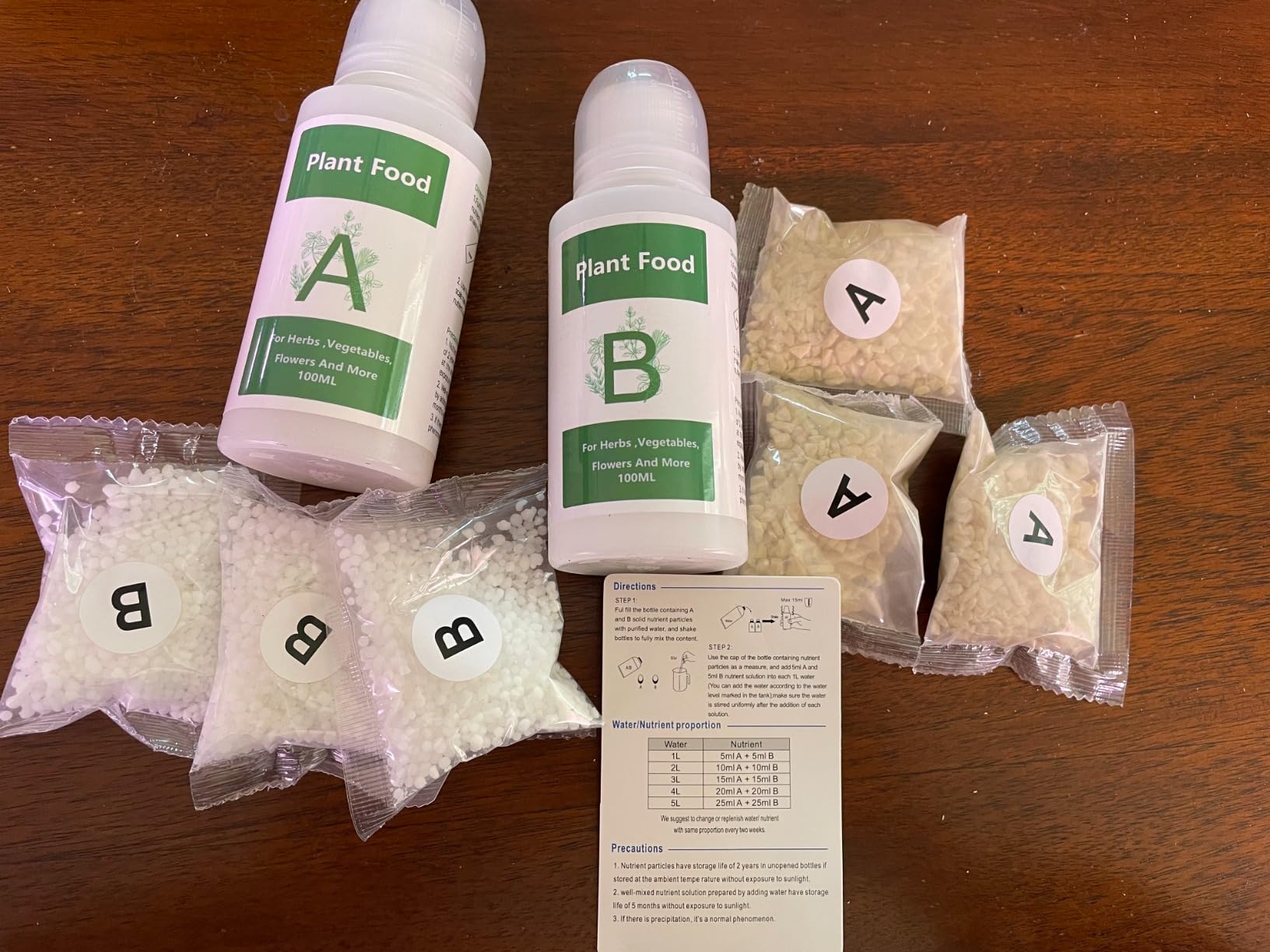
Tigvio is another 5 ml A plus 5 ml B per liter two-part liquid, 800 ml total, packed as two bottles plus six additional A and B packs. The ingredients are described as 100 percent water soluble and pH balanced, and it is aimed at AeroGarden-style towers and other indoor grow systems.
It holds a 4.6 rating from 720 reviews. Satisfaction centers on tower compatibility, straightforward dosing and the value of a multi-pack bundle, with users reporting healthy growth on vegetables, fruit and ornamentals. The criticism is limited but consistent: two components to measure each feed, and a small total volume.
Towers and the volume question
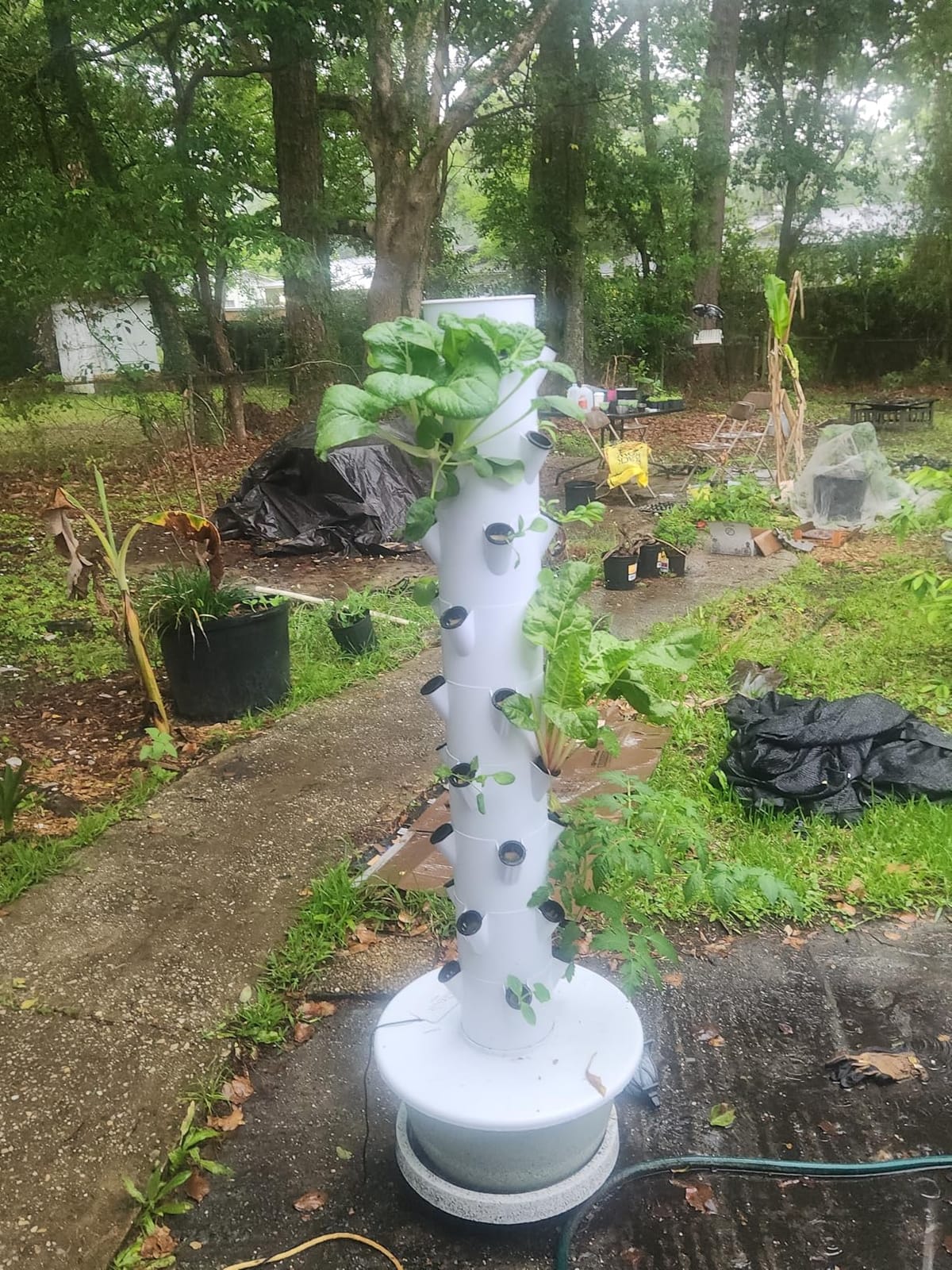
Most countertop towers hold a gallon or two. At 10 ml per liter, 800 ml covers roughly 80 liters, so for a single tower it is a starter supply that lasts several change cycles. For two towers or a tower plus a jar, you will be ordering again sooner than the bundle suggests.
The extra packs are the useful part of the format. Single-use sachets do not sit half-empty in a cupboard and invite mismeasurement.
When to pick it over the other A and B sets
If your hardware is tower-based and your reservoir volume is small, the pack format is the deciding factor. If you are running channels, the total volume is thin. Between this and Haligo, read the bundle count carefully, since both use the same dosing numbers and a different number of bottles.
For whom it is not right
Growers who want to fine-tune strength need a full label, and the NPK analysis here is thinly published. That is not a dealbreaker if you meter with an EC meter and adjust, but it removes the label-as-checklist option that the larger bottles allow.
The Numbers That Matter: EC and pH Targets for Greens
Leafy greens want a solution between 1.2 and 1.8 mS/cm, with pH held between 5.5 and 6.0. Aim for the middle of both ranges rather than the top, and change the solution every 7 to 10 days. Purdue Extension research on lettuce has found best growth near 1.3 dS/m across a wide set of varieties, with stress appearing only well above that.
Three rules carry almost all of the value. Start every feed at half the label rate. Correct the strength by reading EC, not by trusting the chart. And hold pH near 5.8, because that is where chelated iron stays available to the roots.
One more trap deserves its own paragraph. Growers comparing notes online often seem to contradict each other, and much of that comes from ppm scales rather than from the products. A 500-scale meter and a 700-scale meter report different numbers for the exact same solution. If a forum says 900 ppm is normal and yours reads 500 on a 500-scale meter, there is no disagreement, just two conversions. Convert once, decide which scale you use, and stay on it.
Reservoir temperature matters as much as the reading. Growers report root problems once water passes the low 70s Fahrenheit regardless of which nutrient they chose. Keep the reservoir cool, keep it moving, and treat dissolved oxygen as part of your feeding routine rather than an afterthought.
How to Choose a Nutrient by System Type
Your hardware decides more than your taste does. A countertop smart garden with a small reservoir and narrow lines wants a low-particle single-part liquid. A DWC bucket wants something you can dose precisely and mix thoroughly. An NFT channel wants clarity, because any sediment in the line is a flow problem you will debug with roots in the channel.
Match the format to the maintenance you will actually do. Single-part powders and liquids remove an entire category of error. Two-part liquids trade that simplicity for a wider concentration range and better nutrient separation. Three-part systems exist for growers who need stage control and are willing to follow a chart.
Two other decisions matter more than brand. If you use reverse osmosis or distilled water, look for chelated trace elements, because there is nothing in the water to carry them. If your tap water is hard, a complete base that includes calcium and magnesium means you should not be adding a separate cal-mag on top. Over-applying calcium on a complete program raises EC and interferes with how the plant takes up potassium.
As a rule from the forums: buy the EC meter before you buy anything else. Every mistake in this category becomes obvious the moment you can read a number, and it is far cheaper than replacing a crop.
Which Leafy Greens Can Share One Reservoir
Yes, most leafy greens can share one reservoir, because they want nearly the same feed. Lettuce, spinach, kale, bok choy, arugula, mizuna, pak choi and most salad mixes all sit comfortably in the same EC and pH window, so there is no need to run separate lines. This is a repeatedly asked question on grow forums and the answer is simpler than people expect.
Two rules keep a shared reservoir working. Match the light cycle to the slowest crop in the tank, since a fast crop bolted in a long-day cycle pulls bitter, and stagger sowing dates so the whole reservoir does not mature and need harvesting on the same day. The one real exception is pairing a long-running crop with a heavy feeder, since fruiting plants drink far more and drag the solution up out of the greens’ range.
Aim for an 18-hour cycle with mixed greens, and change the solution on the 7 to 10 day rhythm above rather than waiting for the water to look used. It is used long before it looks it.
Five Mistakes That Burn More Greens Than Bad Nutrients
Almost every crop failure I have traced back to the bottle came down to one of these five things, and none of them are about brand quality.
Feeding to the label instead of the meter. Label dosing rates regularly produce EC readings well above what a greens crop wants. Start at half rate and let the meter set the strength. Growers report label math landing two to three times higher than expected, and burned lettuce gets blamed on the product.
Misreading a per-five-gallon recipe. The most damaging forum-documented error is treating a five-gallon package recipe as a per-gallon dose. One grower reported a feed near 900 ppm in a ten-gallon NFT channel caused by exactly that misreading, four times the intended strength. Read whether the chart says per gallon or per five gallons, every single time.
Skipping pH entirely. Iron availability collapses as pH climbs, and calcium transport stalls too. You get interveinal chlorosis and tipburn from a solution that is chemically complete, purely because the pH was never checked.
Mixing calcium into concentrated phosphate. Pour concentrated calcium and phosphate together and you can precipitate out a solid that never redissolves, which then shows up as a cloudy tank and a mystery deficiency weeks later. Add each to a full reservoir of moving water, calcium last.
Using bloom products on greens. Bloom boosters and potassium spikes on lettuce are a straight trade, and a bad one. They push bolting and bitter leaves, which is the opposite of what you are feeding for. The growers who do best on greens run a nitrogen-forward feed for the entire cycle rather than switching at a stage change.
And one thing to skip entirely: the additive stack. If a brand tells you that a complete base needs four more supplements to work, that is a sales pitch rather than an agronomy argument. A complete base, dosed to EC, adjusted to pH, is enough for greens.
Frequently Asked Questions
What is the best nutrient solution for hydroponic lettuce?
For most home growers, a single-part base nutrient dosed to EC rather than to the label is the easiest correct answer. Hold the solution between 1.2 and 1.8 mS/cm at pH 5.5 to 6.0, start at half the label rate, and adjust with plain water or more concentrate. A three-part system gives more control but adds steps most lettuce growers do not need.
What fertilizer to use for hydroponic lettuce?
Any complete water-soluble base nutrient works, because lettuce is a light feeder. Choose a nitrogen-forward formula, keep phosphorus and potassium moderate, and make sure calcium and magnesium are included so you do not need a separate supplement. Dosing to a measured EC is what separates a good result from a burned crop.
What is the recommended nutrient ppm range for hydroponic lettuce?
Most growers find 800 to 1200 ppm on a 500-scale meter, which corresponds to roughly 1.2 to 1.8 mS/cm. If your meter reports on a 700 scale, the same solution will read higher, so confirm which scale you have before comparing numbers with anyone else.
Do I need cal mag in hydroponics?
Usually not if you use a complete base that already includes calcium and magnesium, and you are on moderately hard water. Cal-mag earns its place with reverse osmosis or distilled water, or when you see tipburn on maturing heads. Adding it on top of a complete program raises EC and can interfere with potassium uptake.
Can you use organic fertilizer in a hydroponic system?
Only if it dissolves completely, which rules out compost teas, raw manures and anything with suspended solids that can settle in a pump or line. Dry organic-influenced bases that dissolve in water are a different category and can work. Do not put particles into a recirculating system regardless of how organic the label sounds.
Which Hydroponic Nutrients Should You Buy in 2026?
If you want one bag and no arithmetic, start with GH MaxiGro and dose it to EC rather than to the label. If you are running reverse osmosis water or want calcium and iron handled for you, the ENVY A and B set is built for exactly that. If you want stage-by-stage control and a bigger operation, the GH Flora Series gives you the range, and FoxFarm Grow Big Hydro is the pick when leaf mass is the whole point.
For a countertop tower, the single-bottle options and the multi-pack two-part sets make the most sense, matched to the volume of your reservoir. The real decision is not the brand, it is whether the format matches the maintenance you will actually do, and whether you measure what you mix.
Buy the EC meter first. Hold 1.2 to 1.8 mS/cm and pH 5.5 to 6.0, change the solution every 7 to 10 days, and almost any complete base on this list will grow you greens worth eating in 2026.