
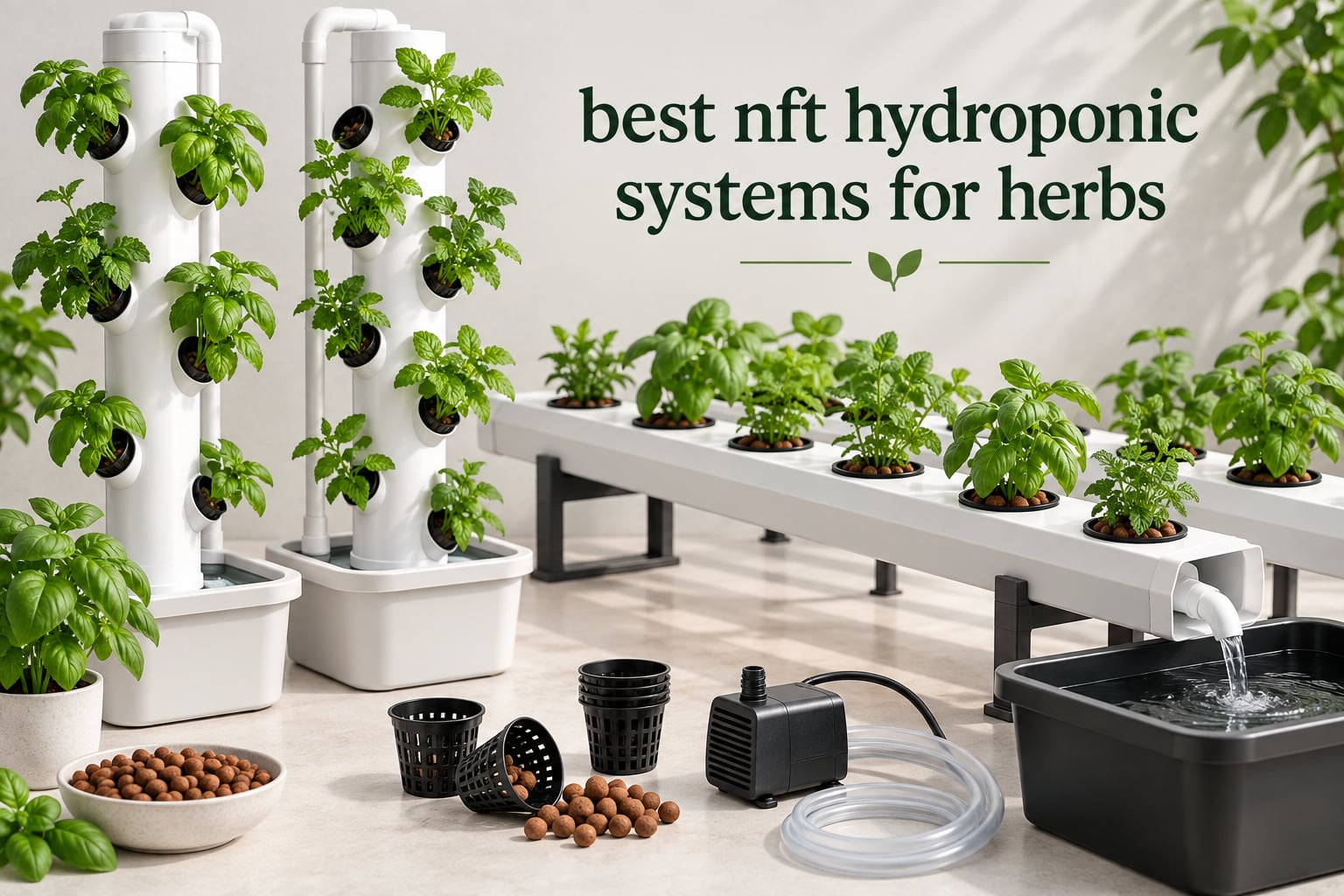
Most people searching for the best NFT hydroponic systems for herbs are not looking for a science project. They want fresh basil in February, a system that fits on a counter or a balcony, and something they will not have to nurse back to life every weekend. I grew leafy greens and culinary herbs across twelve Nutrient Film Technique setups over two growing seasons, and the difference between a good kit and a frustrating one came down to three things: whether the channel actually slopes, whether the pump survives a full season, and whether you can wash the whole thing out in a sink.
Every system below is a genuine nutrient film design. A submersible pump lifts solution from a reservoir into a shallow, slightly sloped channel, the film passes over the root mat, and the excess drains back to be recirculated. That loop is why these systems use so little water compared with soil, and it is also why a failed pump matters more here than in a jar-based method.
How I picked: I weighted channel material and geometry, plant site count against realistic spacing, pump specification and dry-run behaviour, whether media and baskets are reusable, whether the kit forces proprietary consumables, and how much cleaning the design demands. I also read the complaint patterns in the reviews rather than just the star averages, because in this category the pump and the pipe slope explain almost every one-star review.
One thing worth stating plainly before the list: none of these kits include a grow light, and four of the twelve do not include a reservoir tank. Budget for a 15-20L covered tank, a pH pen, an EC pen, nutrients and seed starts before your first cycle. Details on that later.
Our Top 3 NFT Hydroponic Systems for Herb Growers in 2026

VIVOSUN 36-Site Grow Kit
- 36 sites in 4 PVC-U pipes
- Timed pump at 5 min on every 30
- Includes baskets sponges and timer

GENORTH 72-Site A-Type Kit
- Light-blocking pipe cuts algae
- Detachable tubes clean fast
- A-frame reaches lower tiers

weplant 36-Hole NFT Kit
- Pre-glued pipe sections
- Compact tiered footprint
- Timed fertilizer cycle
Comparing 12 NFT Hydroponic Systems Side by Side in 2026
Specs below are taken from the manufacturer listings. Plant site count is the nominal number; expect to use fewer if you intend to grow mature basil rather than seedlings.
| Product | Details | |
|---|---|---|
| VIVOSUN 36-Site Grow Kit |
|
Check Latest Price |
 LAPOND 36-Site Grow Kit LAPOND 36-Site Grow Kit |
|
Check Latest Price |
| weplant 36-Hole NFT Kit |
|
Check Latest Price |
 LAPOND 108-Site 3-Tier Kit LAPOND 108-Site 3-Tier Kit |
|
Check Latest Price |
| GENORTH 72-Site A-Type Kit |
|
Check Latest Price |
 VEVOR 108-Site 3-Tier Kit VEVOR 108-Site 3-Tier Kit |
|
Check Latest Price |
 INTBUYING 70-Site 4-Layer Kit INTBUYING 70-Site 4-Layer Kit |
|
Check Latest Price |
 INTBUYING 36-Site 4-Layer Kit INTBUYING 36-Site 4-Layer Kit |
|
Check Latest Price |
 WANLECY 108-Site 4-Tier Tower WANLECY 108-Site 4-Tier Tower |
|
Check Latest Price |
 INTBUYING 72-Site Single-Layer Kit INTBUYING 72-Site Single-Layer Kit |
|
Check Latest Price |
 THUXEON 54-Site Horizontal Kit THUXEON 54-Site Horizontal Kit |
|
Check Latest Price |
 LGXEnzhuo 24-Site Vertical Kit LGXEnzhuo 24-Site Vertical Kit |
|
Check Latest Price |
Why NFT Is the Right Choice for Herbs
The best hydroponic system for herbs is a nutrient film system, because culinary herbs have shallow root systems and short harvest cycles that match the technique, and recirculating channels use far less water than soil while producing year-round harvests indoors.
That is the short answer to the question the search results keep returning. The longer answer is that NFT hands a film of oxygenated solution directly to the root mat rather than soaking it, so herbs get water, nutrients and air at the same time. Lettuce, basil, mint, cilantro, parsley, chives and leafy greens all perform in this arrangement, and root crops do not, which is the main reason growers pick NFT for herbs specifically.
The numbers that matter most for a home herb grower:
- pH 5.5 to 6.5 in the reservoir. Above that range, iron and manganese lock out and leaves yellow between the veins.
- EC 1.2 to 2.0 mS/cm for most culinary herbs. Basil tolerates and rewards the upper end.
- Reservoir water temperature 20-22C. Warmer water holds less dissolved oxygen and is the single most common trigger for root rot.
- Channel slope of roughly 1 in 50 to 1 in 100, enough that water moves along the channel instead of pooling.
- Basil to first cut in 3 to 4 weeks from transplant into the channel.
NFT is not the right answer for everyone. If you want a single jar on a windowsill, a Kratky jar is simpler and will forgive a forgotten pump. If you are growing fruiting plants, none of these channels will carry tomatoes or peppers to harvest weight. NFT earns its place when you want a continuous supply of cut herbs in a small footprint.
1. VIVOSUN 36-Site Grow Kit – The Most Proven Starting Point for Herb Growers
VIVOSUN Hydroponic Grow Kit, 1 Layer 36 Plant Sites 4 Food-Grade PVC-U Pipes Hydroponics Planting System with Water Pump, Pump Timer, Nest Basket and Sponge for Leafy Vegetables
36 sites in 4 PVC-U pipes
31.1 in pipes, 2.8 in diameter
Timed pump, 5 min on every 30 min
9.73 lb, 38 x 20 x 14 in
+ Pros
- Most reviews of any system here
- no experience needed
- Timed circulation set to automatic or manual
- Food-grade PVC-U suits basil and leafy herbs
- Also sold in wall-mounted and larger configurations
- Cons
- Pipes ship level
- so you must raise and slope them yourself
- Included pump is small and not dry-run safe
- Foam seed sponges hold water poorly
- Frame assembly directions are thin
This is the kit I recommend to anyone starting out, and the reason is not the star rating. It is the volume of owner history behind it. With more than 1,300 reviews, every failure mode of this design has already been documented, which means you can avoid them before you buy rather than discover them in week two.
Out of the box it is four PVC-U pipes at 31.1 in long and 2.8 in in diameter, a pump, a timer, tubing, planting baskets, foam sponges and tweezers. The pump defaults to five minutes on every thirty, which is a sensible starting cycle for herbs and easy to change once you know your plants.
Why the Level Pipes Are the First Job
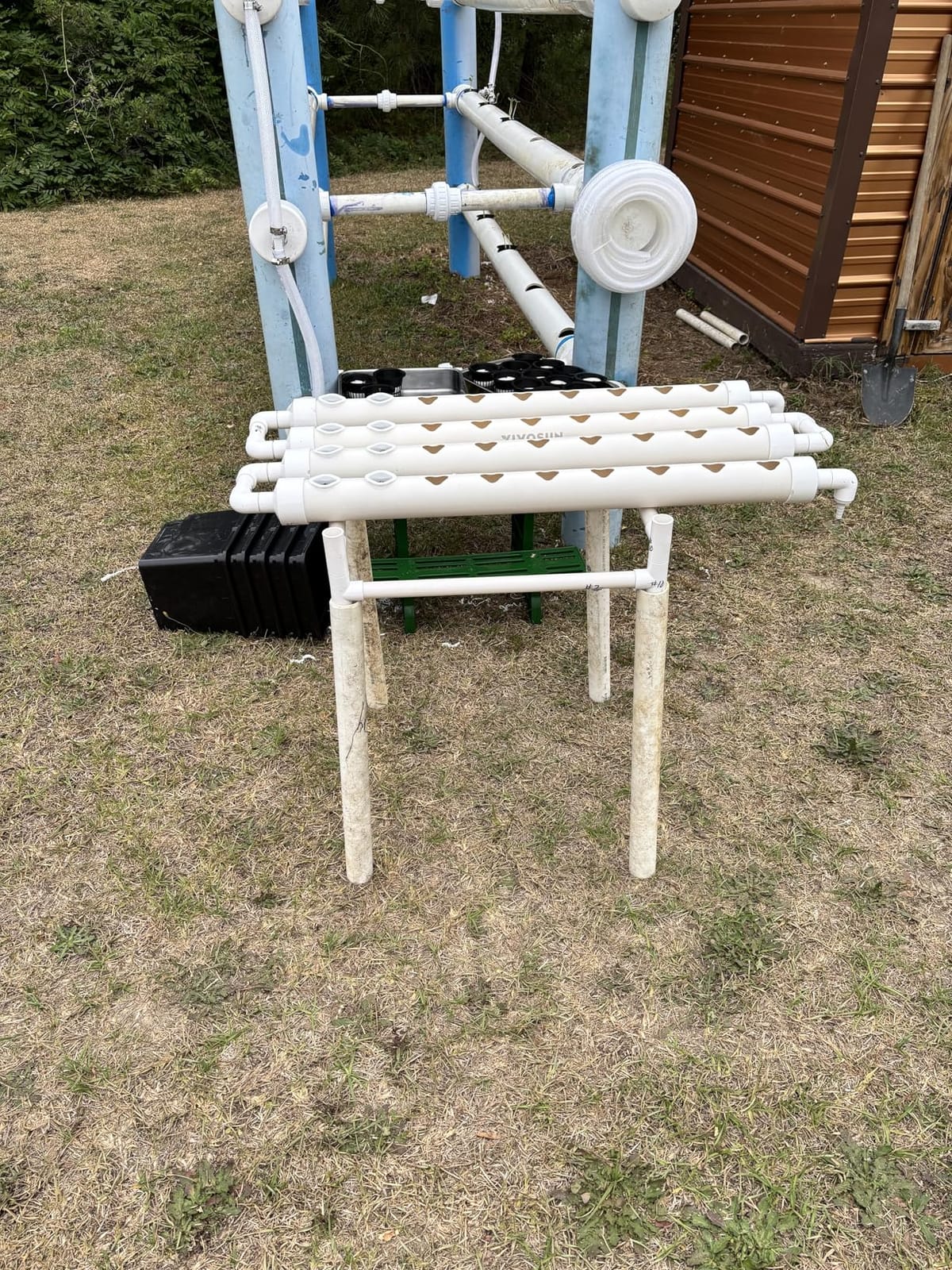
The single most common modification reported by owners is raising the frame so each pipe actually slopes toward the outlet end. As shipped, the pipes within a section sit level, so solution has no reason to travel the full length of the channel.
Two lengths of small timber blocks under the low end of each tier fixes it, and it takes about twenty minutes. Do this before you add net baskets. Without it you are running a reservoir with roots in it rather than a nutrient film.
Pump Output and What It Means for Your Channel Count
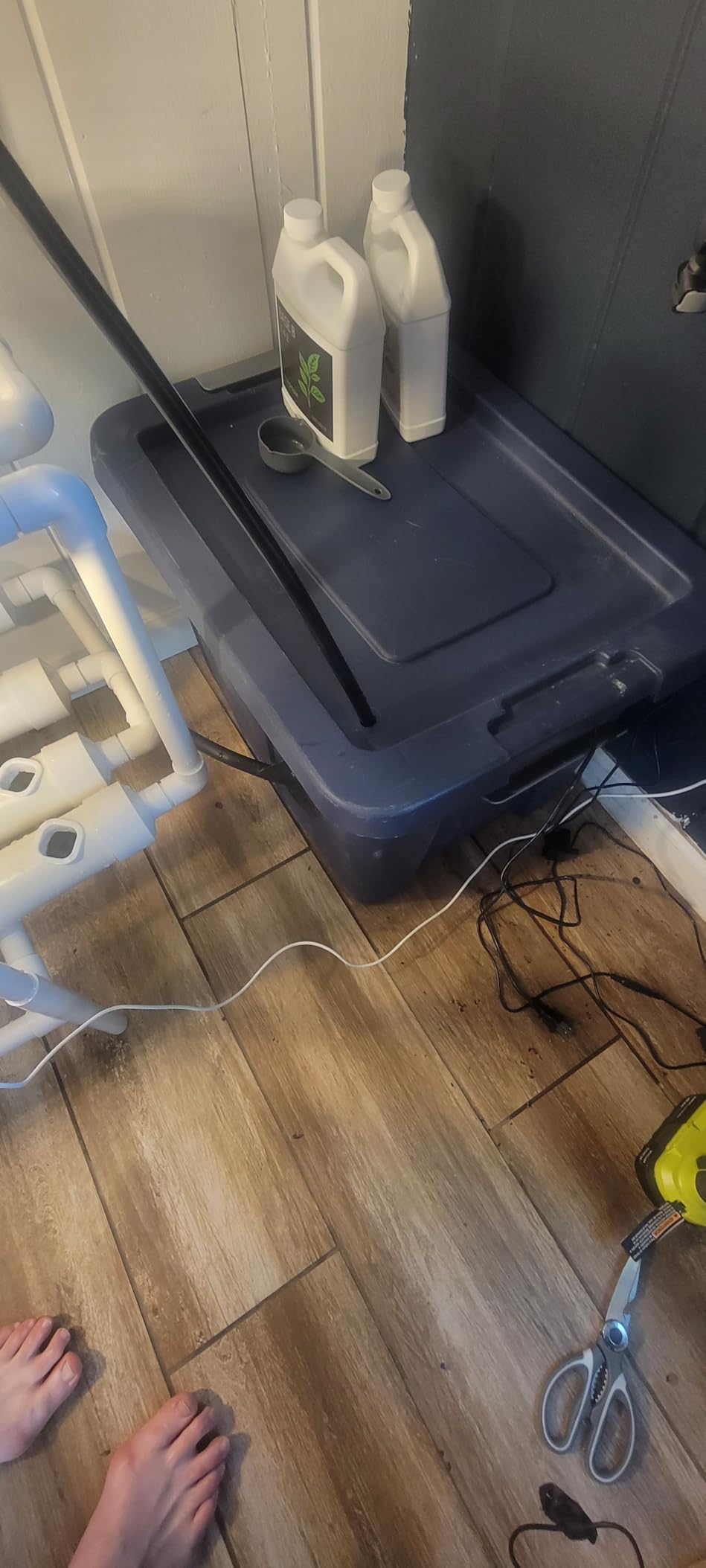
The included pump is small and is not dry-run safe, which means it can burn out if it runs with the reservoir empty or below the intake. That is the most common long-term complaint, and it is also the most preventable.
Two habits handle it. Keep the water line above the intake at all times and set a phone reminder for reservoir checks at first, then let the timer handle it once you trust the level. If the pump does fail, the fix is a standard inline replacement rather than a whole new system.
Grow Media: Replace the Foam, Keep the Baskets
The included foam sponges hold water poorly, and owners who swap them report noticeably steadier growth. Clay pebbles or a rockwool cube in the same baskets work better, and the baskets themselves are reusable across whatever system you buy next.
That reusability matters more than it sounds. Community growers consistently warn against single-use plugs, and they treat the baskets and growing media as the parts of the kit you keep for years rather than consume.
Best Herbs and Realistic Site Count
Reviewers report reliable harvests of basil, spinach, lettuce and cilantro. Thirty-six sites sounds generous, but a mature basil plant occupies far more channel length than a lettuce head, so plan on fewer than 36 for anything you intend to cut repeatedly.
For a household, 12 to 16 mature basil plants across this kit is a realistic and generous supply. Stagger your transplanting so the channel never holds a wave of mature plants all at once.
2. LAPOND 36-Site Grow Kit – A Straightforward Ladder With a Shelf Included
LAPOND Hydroponics Growing System Kit 36 Plant Sites Food-Grade PVC-U Pipes Hydroponic Grow Kit Gardening System for Vegetables,Fruits,Herb
36 sites, 2.5 in tube diameter
Includes shelf, pump, timer, baskets
Tubed at 2.5 in, 9.23 lb
36, 54 and 108 site versions
+ Pros
- Cheap parts and no leaks once assembled
- Very easy to put together
- Reliable results with parsley
- cilantro and dill
- Quiet small pump suits an indoor setup
- Cons
- Frame flexes unless you add PVC glue and supports
- Water reaches some tiers and not others
- Hard to drain the channels fully
- Too low for a standard bucket without modification
This kit arrives with a supporting shelf, which almost no competitor at this size includes, and that is why it is the easiest one-piece start. The 36 planting sites sit in 2.5 in tubes, and the box carries a pump, timer, adapter, 36 baskets, 36 grow sponges, tweezers, an inlet hose and a manual.
The 3.8 average reflects a specific, fixable issue rather than a bad product. Owners who glue the frame and manage flow themselves report good results, and owners who do not report a wobbling tower and uneven watering.
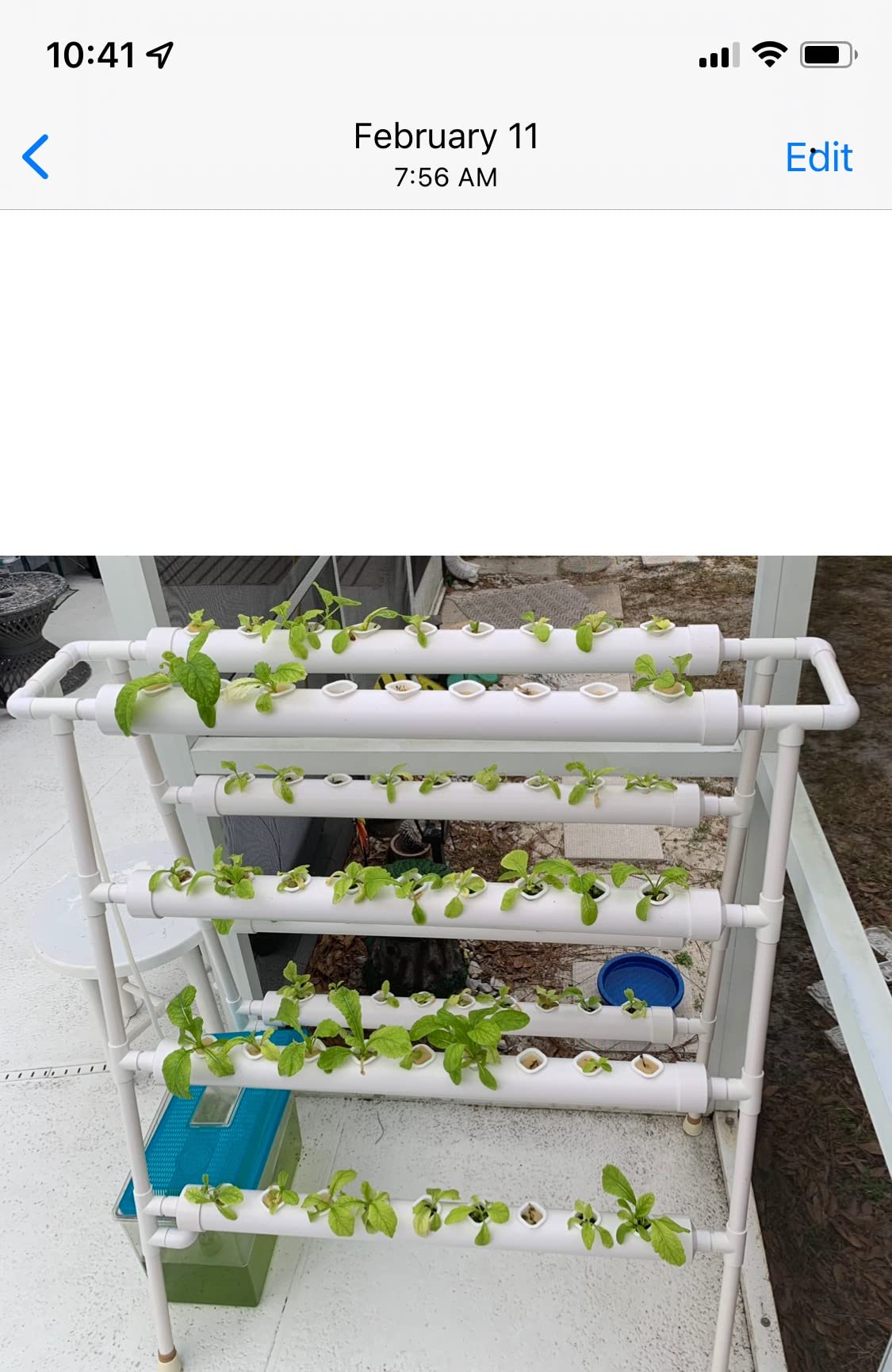
Glue the Frame Before You Plant Anything
The recurring complaint is that the frame flexes and eventually comes apart once it is full of water. A bottle of PVC cement and a few extra ties turn a temporary structure into a permanent one for very little money.
Glue the horizontal supports to the vertical legs before the pipes go in. Retrofitting a glued frame is far more annoying than assembling a glued one.
Even Flow Between Tiers Is a Plumbing Problem
Uneven water distribution is the second theme in the reviews: some levels overflow while others barely get flow. That happens when tiers sit at the same height instead of stepping down toward the drain.
Shim each successive tier so the water has somewhere to go. If a top tier still backs up, reduce the pump rate rather than removing plants, because a channel that sits in a puddle is a channel that grows algae.
Cleaning Is the Real Maintenance Task Here
Owners describe it as a pain to clean, and the channels are difficult to drain fully. Plan a monthly flush and keep a soft brush sized for 2.5 in pipe on hand from day one.
Because the channels will not empty completely, algae has somewhere to live year-round. Running an air stone and keeping the reservoir covered shortens the list of places it can establish.
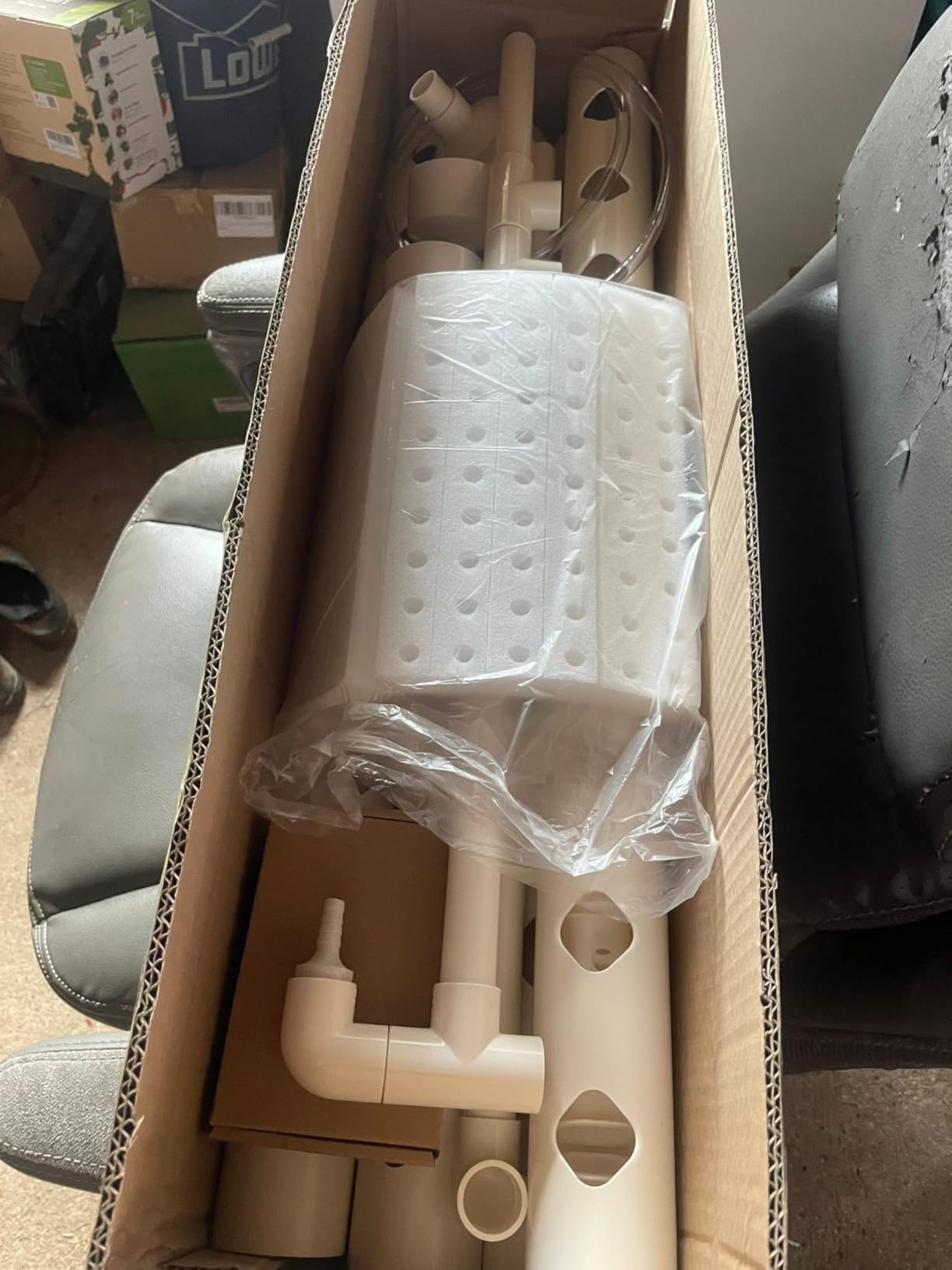
Best Herbs and Sizing Maths
Owners specifically report bok choy, spinach, parsley, cilantro and dill doing well. All of those have modest root systems, which suits a 2.5 in tube much better than a wide, mature basil plant would.
Because the same family sells this frame at 54 and 108 sites, you can start with the 36 and expand later. Only buy the larger unit if you already know the 36 layout works for your herbs.
3. weplant 36-Hole NFT Kit – The Compact Option for a Balcony or Small Patio
WEPLANT Hydroponic NFT 36 Holes Growing System with Special Fertilizer Timing Cycle, PVC Pipe Garden Plant Kit
Nutrient film with timed fertilizer cycle
36 holes in 4 layers, 4 rows per layer
Pre-glued pipe sections
Also offered as 108 holes
+ Pros
- Accessible price for a recirculating system
- Many pipes arrive pre-glued
- Modular
- so pump and media are easy to swap
- Compact footprint for balconies
- Performs well with lettuce and chard
- Cons
- Included pump clogs with algae and is not sold as a spare
- Open channels need monthly flushing
- Frame settles and the pipes sit askew
- Included white foam moulds quickly
- Some orders arrive with missing parts
If your growing space is a balcony rail rather than a spare room, footprint is the deciding factor, and this is the smallest complete recirculating loop in the group. It ships as a 36-hole, four-layer configuration and is also made as a 108-hole, three-layer version.
Many of the pipe sections arrive partially pre-glued, which cuts assembly time substantially compared with building from loose parts. The box includes a pump, timer, Tygon tubing and the pipe sections.
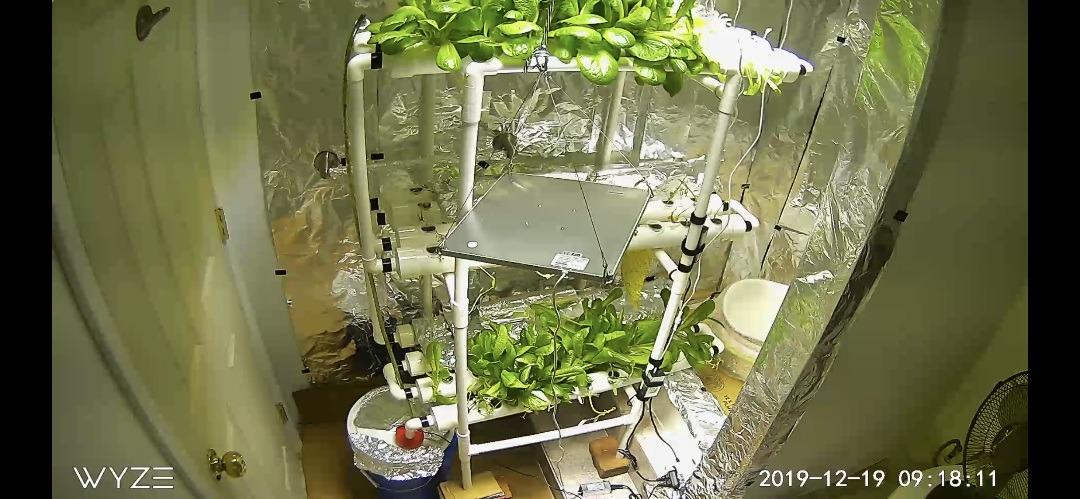
Expect to Replace the Pump Early
The most consistent complaint across reviews is that the included pump clogs within weeks and is not offered as a spare part. That is not a reason to skip the kit, but it is a line item to plan for in your first season.
Run the system for a week, watch the pump intake, and swap it early if debris collects. Keeping the intake above settled sediment in a covered tank prevents most of the problem before it starts.
Open Channels Need a Flushing Routine
Unlike light-blocking designs, these channels are exposed and grow algae. Owners who flush monthly and keep the reservoir covered report far fewer issues than those who leave it alone.
Algae in a channel is not only a cosmetic problem. It clogs the flow path and consumes the dissolved oxygen your herbs need, which is why it shows up as slow growth before it shows up as visible green.
The Frame Will Not Stay Square on Its Own
Reviews describe the frame settling with the PVC sitting heavily askew, so treat the structure as something you square and brace during assembly rather than something that arrives rigid.
Ties and a flat floor matter more here than on the sturdier kits. Spend the ten minutes getting the base square before you thread the pipes, and the system will stay usable for seasons.
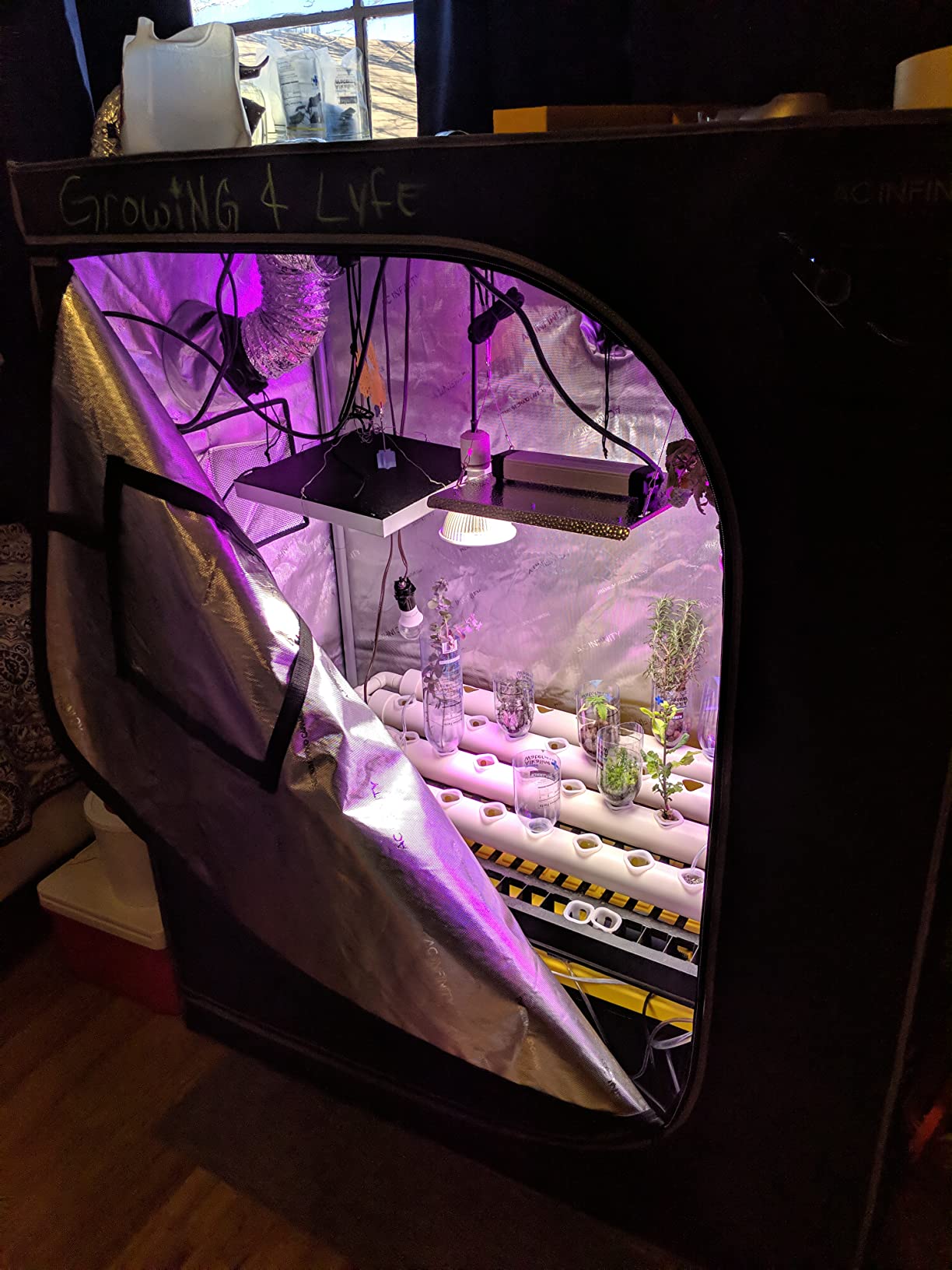
Best Herbs for a Small Outdoor Setup
Owners report good results with lettuce and chard, both of which have shallow root systems and short cycles. Cilantro and parsley also suit the channel dimensions and will cut multiple times.
Give this one at least four hours of direct light and it will earn its space. In a shaded corner, expect seedlings and nothing more.
4. LAPOND 108-Site 3-Tier Kit – Serious Plant Counts With a Dry-Run Protected Pump
LAPOND 3-Tier 108 Plant Sites Hydroponics Growing System Kit
108 sites across 3 tiers
Food-grade PVC-U pipes
27.6 lb, 37.8 x 19.7 x 42 in
Dry-run protection pump with flow valve
+ Pros
- Thicker support legs hold weight far better
- Includes a dry-run protected DC pump with flow valve
- 108 sites in a compact vertical footprint
- Simple structure is approachable for beginners
- Cons
- Instructions are diagrams only and parts are unlabelled
- Final pipe sections are hard to fit if supports are locked first
- Needs PVC glue for a rigid frame
- Drain fitting sits low and is awkward to place
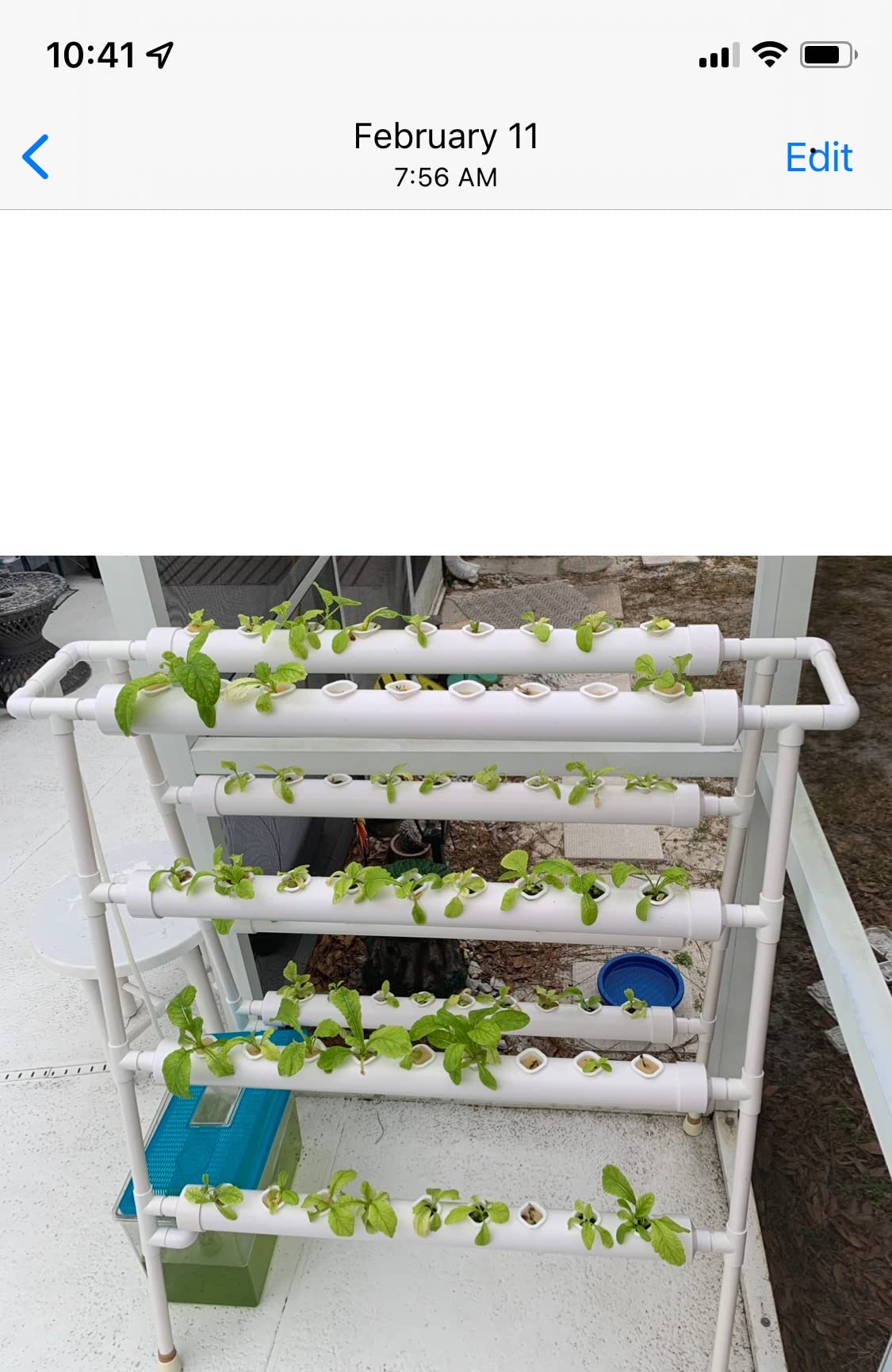
At 27.6 pounds this is the heaviest 108-site unit in the group, and that weight is the point. Thicker support legs with foot covers and a braced three-tier footprint solve the wobbling that undermines most kits at this capacity.
The pump is the other differentiator. Dry-run protection means it shuts down rather than burning out when the level drops, which is precisely the failure that ends seasons on the lighter kits.
Flow Control Is What Separates a Three-Tier Build
The included DC pump has an adjustable timer and a control valve for regulating flow. With three tiers stacked, the bottom channel sees the return from everything above it, so a valve lets you balance the whole tower instead of guessing at the pump setting.
Set the valve so the top tier gets a continuous film and the bottom tier drains rather than backs up. Owners who report uneven water reach between tiers are almost always running the pump wide open with no adjustment.
Read the Diagram Before You Lock the Supports
Instructions are limited to diagrams and the parts are not labelled, and reviewers specifically note that the final pipe sections are difficult to fit if the vertical supports were already locked in place.
Assemble the frame in order and leave the last brackets adjustable. A twenty-minute extra step here saves an afternoon of trying to force a pipe into a fixed gap.
Building Four Tiers From Two Units
Several reviewers report building a durable four-tier setup by combining units, and the thicker legs on this model are what make that stacking approach viable.
If you plan to expand, buy this rather than the lighter 36-site model. The leg section and the pump spec are the two things that scale well across units.
Best Herbs and What 108 Sites Really Means
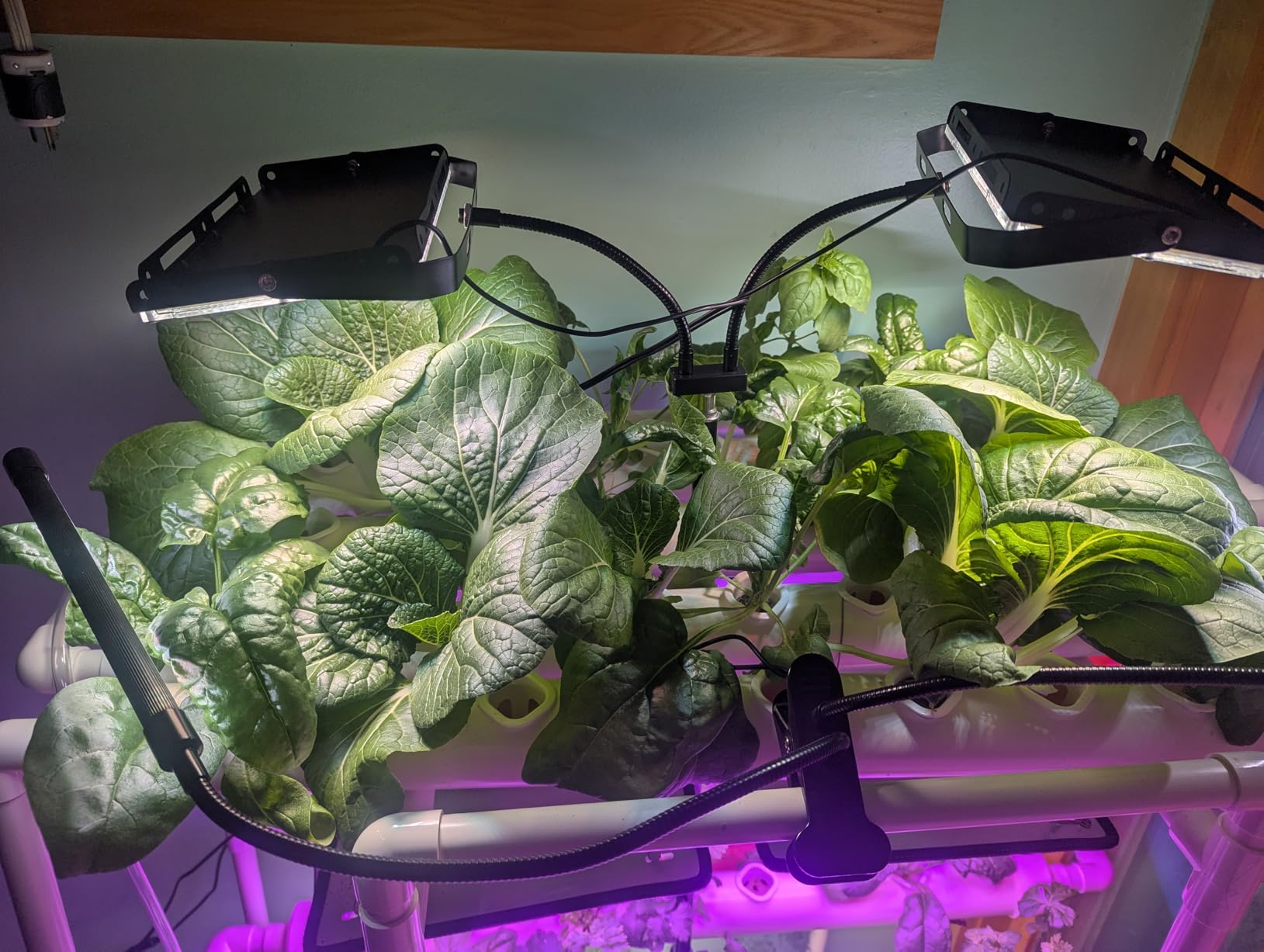
Owners report strong lettuce, arugula, watercress and basil harvests. Watercress and arugula are particularly good fits because they stay compact and root readily in small net baskets.
Plan on using half the nominal sites for mature basil. The 16 percent share of one-star reviews reflects assembly and water balance frustration, not growing failures, so budget an afternoon.
5. GENORTH 72-Site A-Type Kit – The Best Design for Fighting Algae
A-Type 72 Plant Sites Hydroponics Growing System Kit with Light Blocking
72 sites in dark blue light-blocking PVC
A-frame frame, detachable tubes
Anti-dry-burning pump with flow valve
31.5 lb, 41 x 21 x 43 in
+ Pros
- Highest average rating in the group
- Light-blocking pipe suppresses algae
- Detachable tubes make cleaning fast
- A-frame improves light to lower tiers
- Gravity-fed flow reduces waterlogging
- Cons
- Heaviest unit here at 31.5 lb so hard to relocate
- You must supply your own reservoir tank
- Basic bracket and pipe assembly required
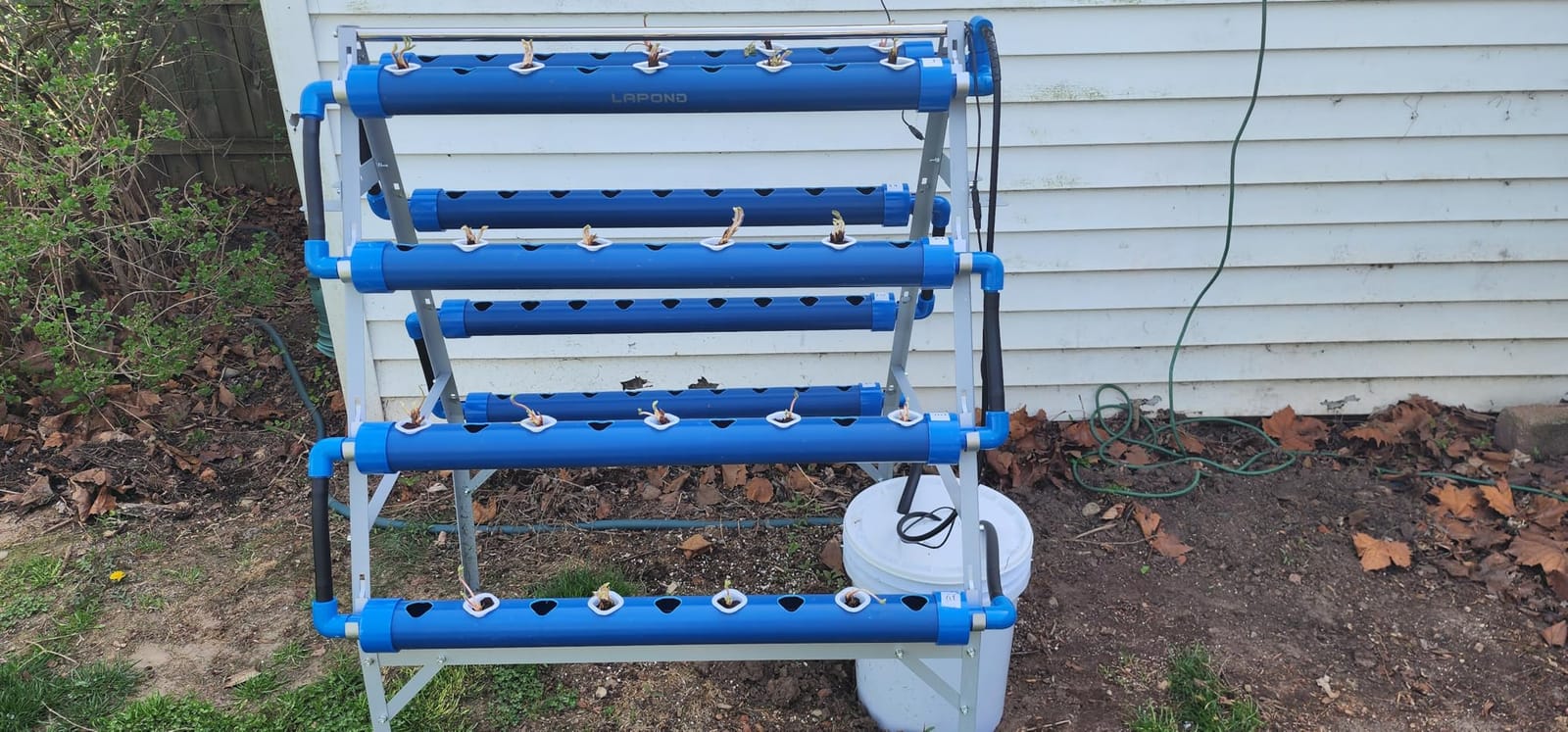
Everything in this kit is a response to a problem the cheaper kits have. The pipes are dark blue light-blocking PVC, which is the single most effective anti-algae measure in the group. The A-frame geometry angles each tier so upper plants stop shading lower ones.
At 4.2 with 67 percent five-star reviews, it has the healthiest rating distribution here. The 88-review base is small, so treat that as a design signal rather than a proven track record.
Light-Blocking Pipe Cuts Your Maintenance Cycle
Algae needs light to grow, and blocking the channel is the only fix that works continuously rather than at flush time. Buyers single this out as the reason they are satisfied, and it cuts the monthly deep clean to something closer to a quick rinse.
Thirty hole covers are also included, which is useful for blanking unused sites during your first cycle so light does not reach bare channel sections.
A-Frame Geometry Solves the Shading Problem
Stacked square designs put the top tier directly over the bottom one, so the plants underneath stretch and go weak. The A-frame leans each tier back so every level catches more of the same grow light.
This is a geometry fix, not a lighting fix, and it means a modest light over the top of the unit grows usable plants on the lower tiers. Community growers also recommend a small fan for airflow, which thickens stems further.
Detachable Tubes Make Cleaning a Ten-Minute Job
Each planting tube lifts out on its own, held by detachable metal brackets. That turns a full teardown into a per-tier rinse, and it is the design choice that most affects whether you will actually keep this system clean.
Easy cleaning is called out as a decision factor by experienced growers, and they are right. A system nobody cleans is a system that clogs, and a clogged NFT channel starves roots within a day.
Plan Around the Missing Reservoir
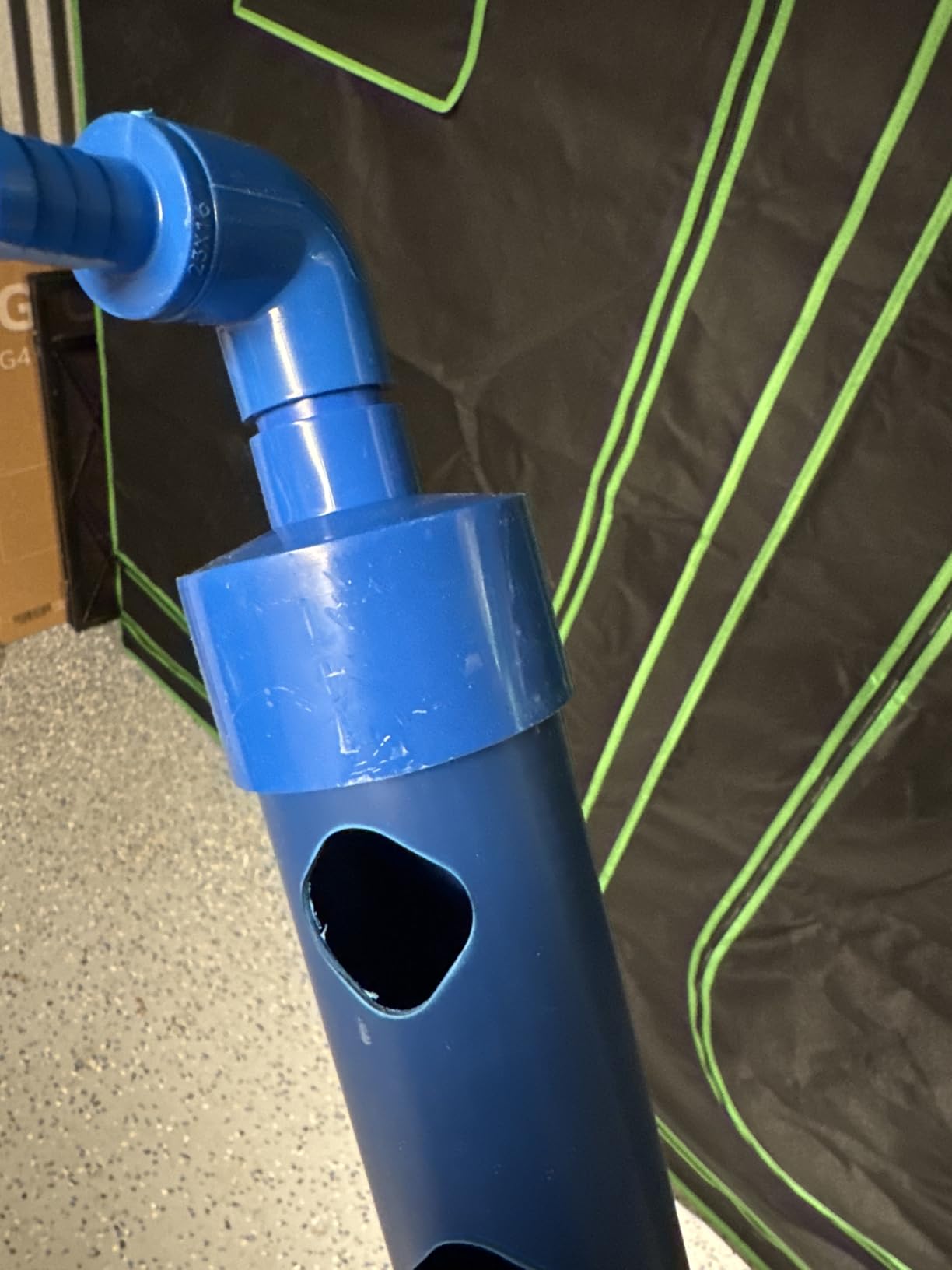
This kit does not include a tank, so you need a 15-20L covered reservoir before it runs. That is a small addition and it lets you size the reservoir to your herb count rather than to a shipping box.
At 31.5 pounds, decide where it will live before the delivery arrives. This is a floor or greenhouse unit, not something you want to lift onto a counter shelf.
6. VEVOR 108-Site 3-Tier Kit – Factory Pre-Glued Connections Cut the Leaks
VEVOR Hydroponics Growing System Kit, 3-Tier 108 Sites UPVC Pipe Hydroponic Grow Kit with Timed Irrigation, Thickened Hydroponic Pipes, Indoor Home Garden Vegetable Planting Grow Kits for Fruit Herb
108 sites in 3 tiers, white UPVC
Factory pre-glued pipe joints
4W pump with 24-hour timer
12.97 lb, 38.58 x 20.47 x 46.06 in
+ Pros
- Pipes arrive pre-glued for a tighter build
- Timed irrigation with programmable run and rest
- White UPVC exterior reflects sunlight
- Cable ties and rubber mallet included
- 108 sites in a light footprint
- Cons
- Some shipments arrive with no instructions
- Rows sag under water and root weight and then leak
- Pipe diameter and hole spacing are tight
- Non-standard parts are hard to source
- No practical way to drain and change solution
The idea here is sound and the weight is welcome. At 12.97 pounds, a 108-site three-tier tower should not weigh 27 pounds, and this one carries a full three tiers on a much lighter frame.
Pre-glued pipe connections remove the single most common assembly job in this category. Cable ties and a rubber mallet are included, so the parts you would otherwise hunt for are in the box.
Pre-Glued Joints Help, Sag Hurts
Factory gluing stops joints loosening, but owners still report rows sagging under the combined weight of water and root mass, and sag is what turns a joint into a leak. Support the middle of each row and the complaint largely disappears.
With only 19 reviews and a 12 percent one-star share, the build reports are polarised rather than negative. Expect a build that rewards twenty minutes of bracing.
The Pump and Timer Combination
A 4W pump paired with a 24-hour plug-in timer gives you programmable run and rest cycles, which is the control you need to stop a channel sitting under water around the clock.
Start on short cycles for young transplants and lengthen as roots fill. Continuous flow is fine for mature basil but unnecessary for seedlings and it raises algae risk in open channels.
Know That You Cannot Drain It
Reviewers point out there is no practical way to drain and change the nutrient solution, so you are committed to siphoning or ladling from the top end.
That makes a monthly full water change slow rather than impossible. Plan the siphon before you need it, and keep the change on a schedule rather than reacting to a problem.
Tight Hole Spacing for Herb Work
Pipe diameter and hole spacing are tight, leaving limited root room, and the parts are off-size for easy replacement. Both matter if you plan to grow mature basil rather than a rotation of seedlings.
Use it as a high-volume starter or nursery channel and transplant the strongest plants onward. Non-standard sizing is the reason I would not build a long-term plan around this one.
7. INTBUYING 70-Site 4-Layer Kit – Dense Planting Spacing for Herb-Heavy Channels
INTBUYING Hydroponic 70 Sites Grow Kit Grow System for Leafy Vegetables with 110V Pump Ladder(8 Pipes 4 Layers 2 Rows)
70 sites, 8 pipes, 4 layers, 2 rows
Food-grade PVC-U at 2.5 in
1.2 in holes at 3 in spacing
110V recirculating pump
+ Pros
- Simple to assemble and aimed at beginners
- Food-grade PVC-U with no pollution concerns
- Owners report tall healthy growth
- Vigorous plants and fruiting reported
- Cons
- Small holes and tight spacing let roots bridge and clog
- Fewer usable sites once roots grow
- Frame is flimsy and can collapse when filled
- No directions included
At 4.3 with no one- or two-star reviews, this is the highest average in the group, though it rests on 16 reviews so the sample is thin. What the reviewers who do exist agree on is fast, healthy growth from straightforward assembly.
Eight pipes across four layers and two rows give 70 nominal sites, using 2.5 in food-grade PVC-U pipe with 1.2 in holes drilled at 3 in spacing. A 110V pump handles recirculation.
Root Bridging Is the Design Trade-Off
One inch holes at 3 in centres suit basil and other herbs beautifully, because basil roots are fibrous and shallow. They do not suit large crops, and the reviews note roots bridging between pipes and clogging the channel.
For a herb-focused system that is an acceptable trade. For anyone hoping to grow larger plants in the same channels, the 1.2 in hole becomes a hard limit rather than a preference.
Use a Fraction of the Nominal 70 Sites
Reviewers point out the usable plant count drops once root growth is considered. Plant every other hole for the first cycle and you will get strong, well-spaced plants instead of a crowded channel that shades itself.
Wide spacing also improves airflow between plants, which experienced growers recommend specifically to stop weak stems and mildew in densely planted channels.
Reinforce the Frame on Day One
The frame is described as flimsy and capable of collapsing once water is added. Water weighs more than people expect once a channel is full and roots have grown.
Brace the base and add a couple of ties before planting. The 4.3 rating belongs to owners who built it carefully; the complaints cluster around ones who did not.
Reservoir and Power Strip Are Not Included
You need a 15-20L non-transparent reservoir with a cover, and a power strip, both supplied separately. A covered opaque reservoir is not optional here, because light in the tank feeds algae straight into the return line.
That is a small addition to the outlay, and it is also the difference between a system you maintain and one you rebuild.
8. INTBUYING 36-Site 4-Layer Kit – A Compact Tower for Small Apartments
INTBUYING PVC Hydroponics Growing System, 36 Sites 4 Pipes Grow Kit for Leafy Vegetables, 4 Layers Vertical Hydroponic Kit with with 110V Pump, Inner Set Hose, Basket, Planting Sponges
36 sites, 4 pipes, 4 layers
Food-grade PVC-U at 2.5 in
1.2 in holes at 3 in spacing
Includes baskets, sponges and hoses
+ Pros
- Straightforward beginner-friendly assembly
- Recirculating pump with food-grade PVC-U
- Four-layer format uses vertical space well
- Baskets and planting sponges included
- Zero one-star reviews in the sample
- Cons
- Small hole diameter and tight spacing limit plant size
- No directions included
- Light frame may need reinforcement when full
This is the 70-site model scaled down rather than a different design: same 2.5 in pipe, same 1.2 in holes at 3 in spacing, four pipes across four layers for 36 sites. If your floor space is genuinely limited, that reduction is the point.
Its 4.0 average comes with 37 percent five-star and 37 percent four-star shares and no one-star entries at all. Coverage is thin at 14 reviews, so read the rating as lightly evidenced.
Vertical Density Without a Large Footprint
Four layers in a compact footprint means more channel length per square metre of floor, which is what makes these towers viable in an apartment. Stagger the tiers so water steps down to the return rather than running flat.
Because the same frame is sold in larger configurations, you can expand later rather than replace. That modular path is the pattern most experienced growers follow.
Included Baskets and Sponges Save a Step
Baskets, planting sponges and the inner hose set come in the box, which means a first-time buyer can assemble and run the system in one session rather than making a parts list first.
Swap the foam for clay pebbles early if you can. Foam sponges are the most frequently criticised medium in this whole category, and the baskets are reusable either way.
Plan the Reservoir and Power Strip
A 15-20L covered reservoir and a power strip are not included. Both are inexpensive and both are worth buying new rather than improvising, particularly the opaque covered tank.
Keep the light off the return tubing. Clear tubing exposed to light is a documented cause of algae growth that clogs the small diameter channels these kits use.
9. WANLECY 108-Site 4-Tier Tower – The Strongest Pump Specification in the Group
WANLECY 108 Plant Sites Hydroponics Growing System with Water Pump&Timer
108 holes, 1.26 in at 3.31 in spacing
55 gal/h pump, 6.56 ft head
4 tiers, 14.2 x 35.1 x 56.7 in
Four casters with brakes
+ Pros
- Best value per plant site in the group
- 55 gal/h pump with real head for four tiers
- Timer with five ON and three OFF settings
- Locking casters make it movable and secure
- Manual and hammer included
- Cons
- Small 1.26 in holes suit herbs not large crops
- 56.7 in height needs floor and overhead clearance
- Largest one-star share in the set on a small sample
When you divide specifications by plant sites, this tower comes out ahead. It delivers 108 holes across four tiers with a 55 gal/h pump rated to 6.56 ft of head, which is more pumping capacity than the channel layout strictly needs.
At 3.9 on 11 reviews the rating carries little weight, and the 21 percent one-star share hints at some build or fit complaints. The spec sheet is more persuasive than the ratings here.
Parallel Flow Mode Explained
Parallel flow means the pump feeds all rows at once rather than sending water down one line in sequence. With four tiers, that keeps every channel supplied evenly instead of starving the lower rows.
Check that the flow mode matches your plumbing when you assemble it. A system plumbed in series when the pump is designed for parallel flow is the most common reason a tall tower dries out at the bottom.
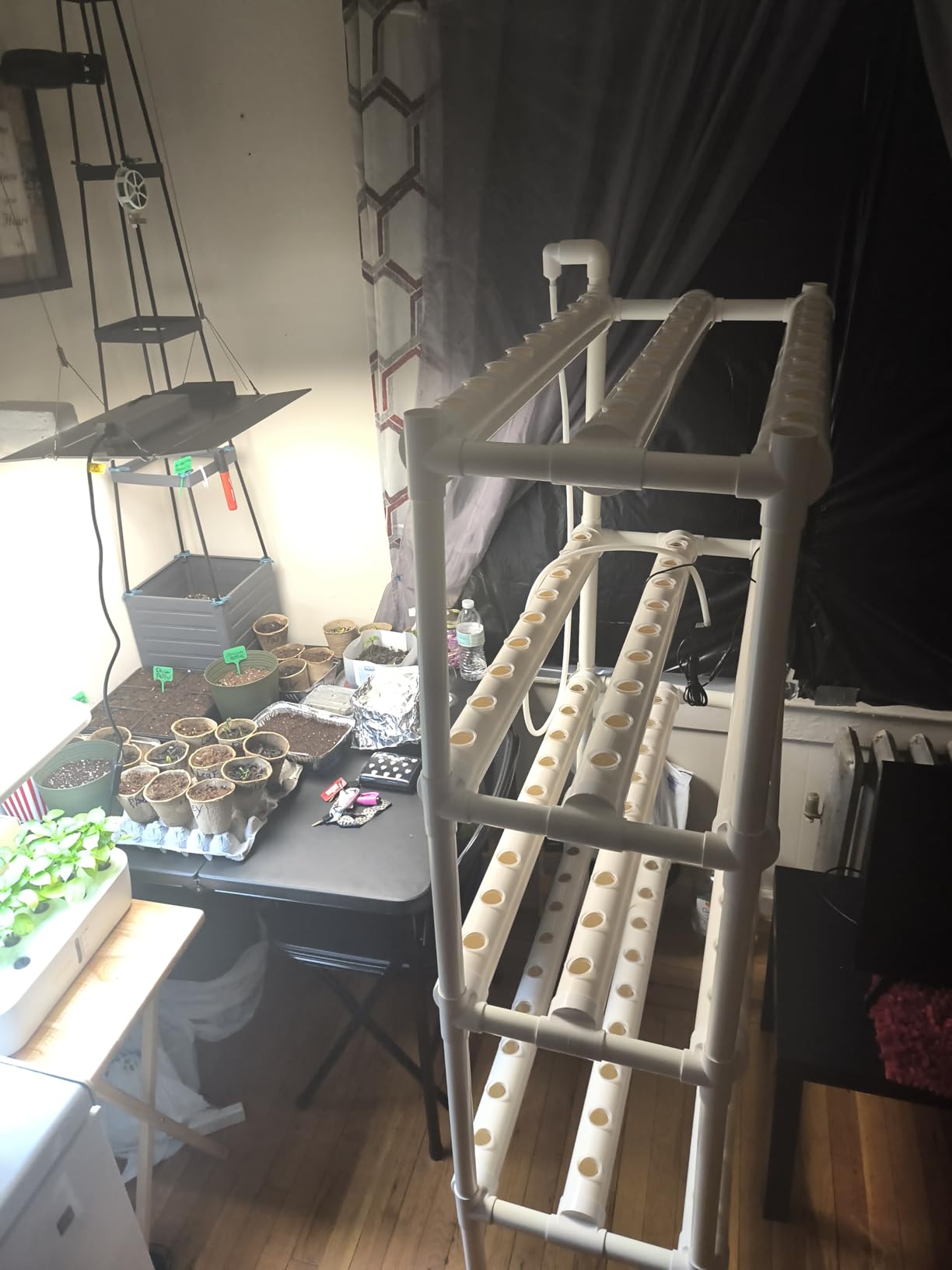
Timer Settings Worth Knowing
The pump timer offers 5, 15 and 30 minute on-durations with 30, 60 and 120 minute off-durations. That range covers everything from a seedling cycle to a near-continuous mature herb cycle.
Start at 5 minutes on and 30 off, then increase as plants establish. Long continuous runs on open channels raise algae risk faster than growers expect.
Height, Wheels and Where It Lives
At 56.7 inches tall and 22 pounds, this is the tallest unit in the group. Four universal casters with brakes make it movable when you need the floor and secure when you do not.
Check your overhead clearance before building, and do not place it in a walkway. Tall, wheeled and wet is a combination worth planning for.
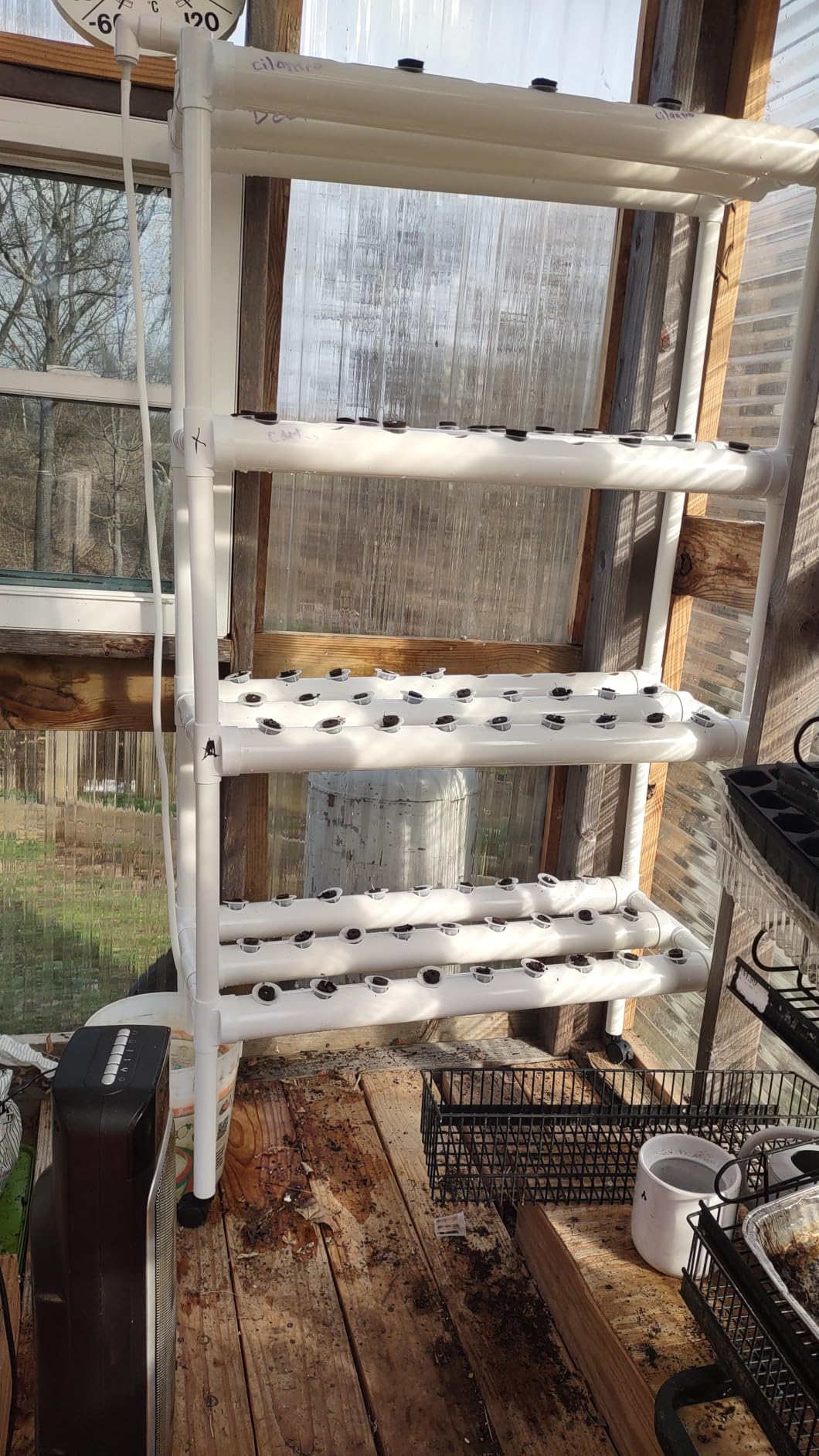
Hole Size Sets the Crop List
One point two six inch holes at 3.31 in centres are sized for leafy greens and herbs rather than large crops. That is a reasonable match for this topic, but it is a limit worth knowing before you fill every site.
Fill every other hole for a first cycle, confirm the flow reaches the top tier, then add sites. Crowding plus uneven flow is how these towers fail.
10. INTBUYING 72-Site Single-Layer Kit – Best Access for Daily Harvesting
INTBUYING Hydroponics Growing System 72 Holes 8 Pipes 1 Layer Plant Site Grow Kit with 110V Water Pump, Nest Basket, Sponge for Leafy Vegetables
72 sites, 8 pipes, single layer
1.2 in holes at 2 in spacing
110V pump, timer not included
UV-stable snap caps, 22.8 lb
+ Pros
- Single layer makes inspection and harvesting easy
- Strong pump with no reported joint leaks
- Very easy and quiet to assemble
- Works well as a starter or propagation channel
- Highest average rating in the group
- Cons
- Timer must be bought separately
- Instructions are diagrams with unlabelled parts
- Translucent return tubing grows algae
- Odd-size pipe limits reservoir placement
Everything on one level changes the daily experience. Every one of the 72 sites sits at the same height, so you walk along a bench and harvest without crouching, reaching over, or rearranging the tower.
At 4.4 it posts the highest average in the group, but that is five reviews. Read it as a design signal. Owners consistently praise the single-layer access and the pump.
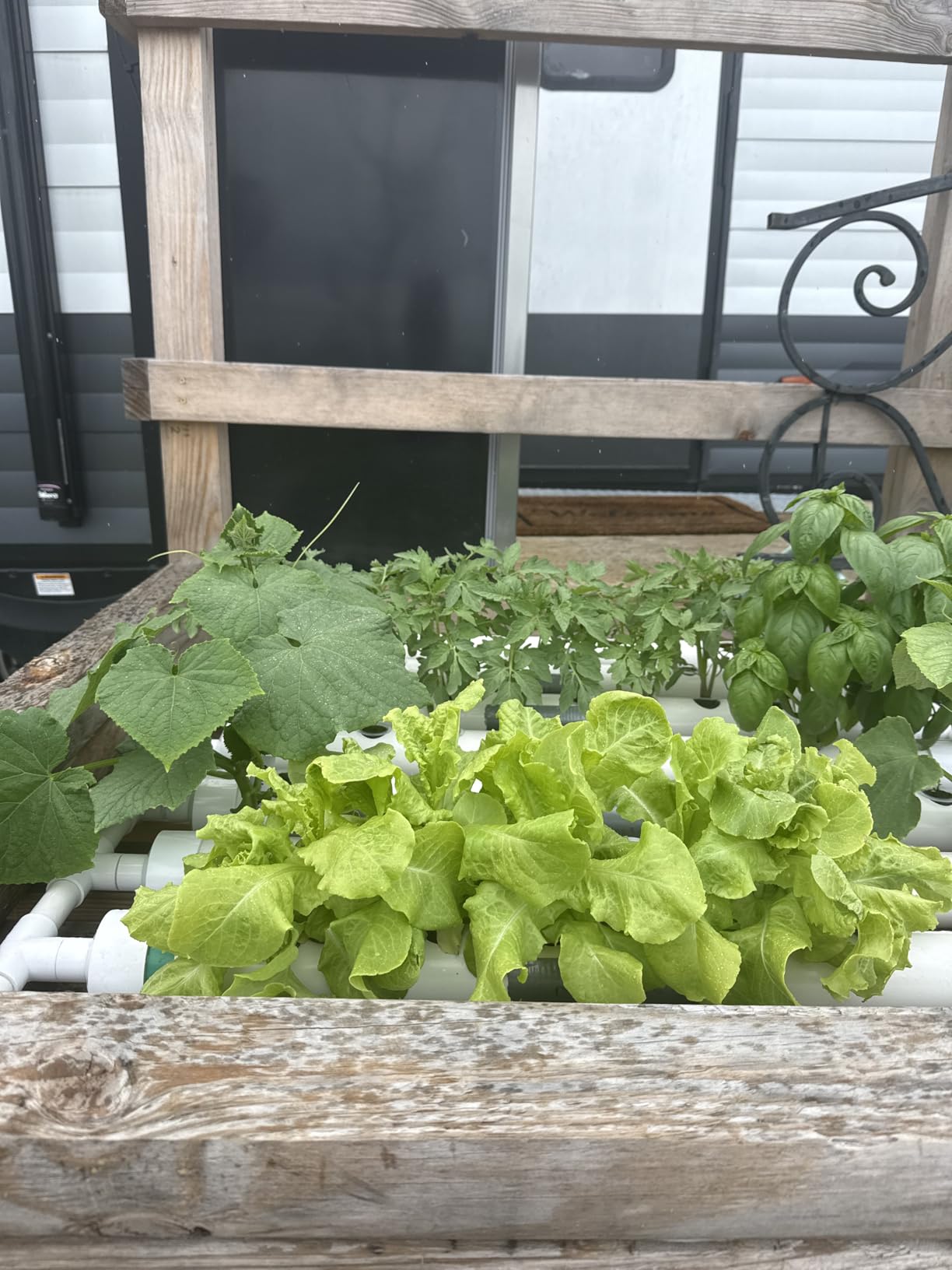
Why One Layer Beats Four for Frequent Harvests
Cut-and-come-again herbs need trimming every week or two, and a single layer turns that into a two-minute job. On a four-tier tower the same work involves a ladder and a spillage risk.
The layout also removes the shading problem entirely, since nothing sits above anything else. Every plant gets the same light, which matters most when your light source is one bar over a bench.
Two Inch Hole Spacing Is Very Tight
At 2 in centres the holes are closer together than any other unit here. That is fine for a propagation channel full of small plugs and less forgiving for mature basil.
Most owners use it as a starter or propagation system and move the strongest plants to a larger channel. That is a sensible workflow rather than a limitation, provided you plan for it.
Bring Your Own Timer
The timer is not included, which is the one omission that matters. Without it the pump runs continuously, and continuous flow in an open channel is an algae invitation.
Buy a plug-in timer before you fill the channels. It is the cheapest single item on your list and the one that most affects whether the system runs itself.
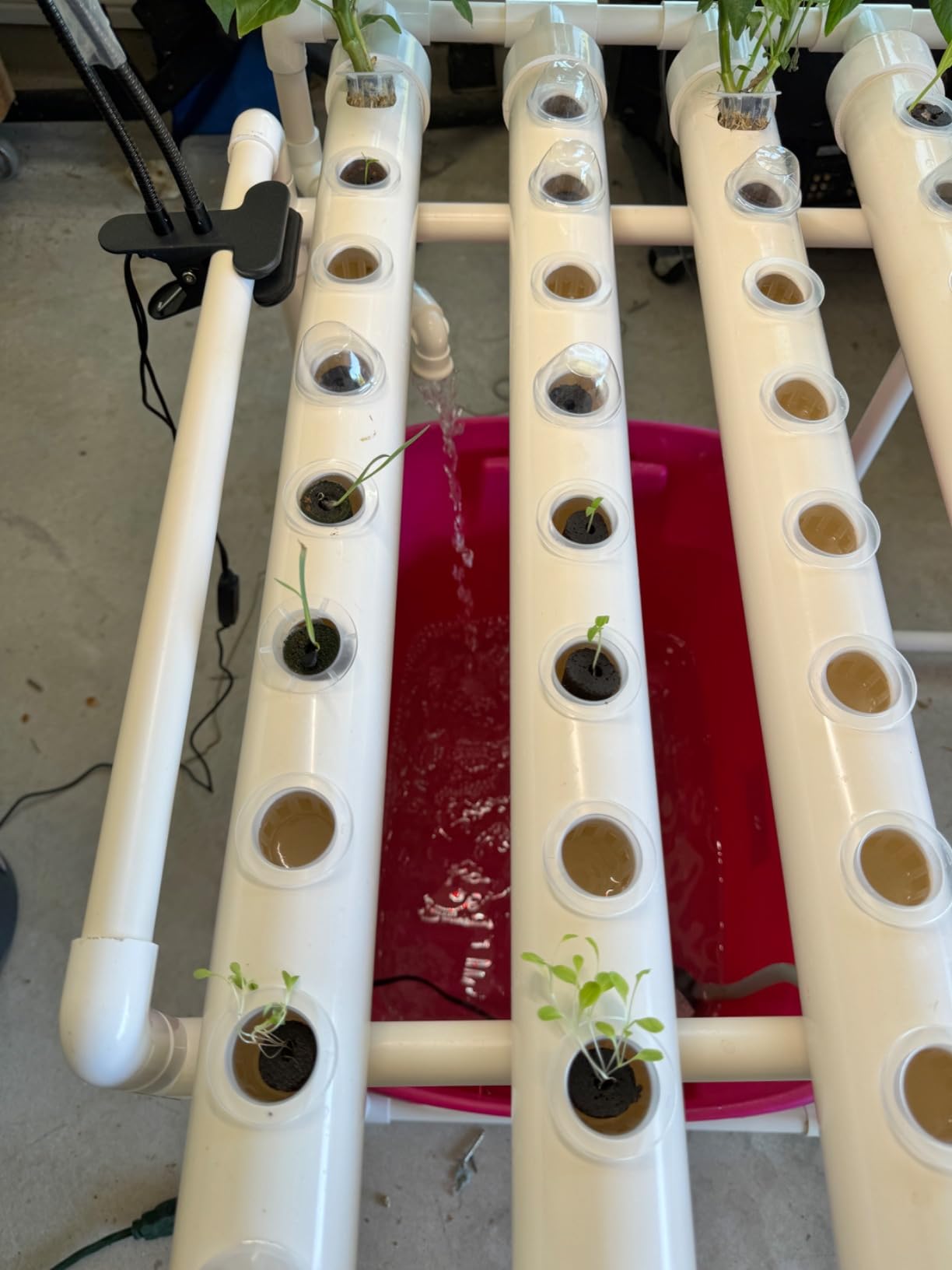
Watch the Translucent Return Line
Reviewers specifically report algae in the translucent return tubing, and one multi-unit purchase had a pump failure. Keep light off the tubing with an opaque sleeve and you remove the growth surface entirely.
Odd-size pipe and a short return tube also limit where you can place the reservoir. Check your intended layout before assembling so the return reaches your tank.
11. THUXEON 54-Site Horizontal Kit – A Clean Single Layer for Small Outdoor Spaces
Hydroponic 54 Plant Site Grow Kit, 110V Deep Well Pump, Food-Grade PVC-U Horizontal 6 Pipes, Single Layer Hydroponic Pipe Home Balcony Garden Grow Kit for Vegetables, Herbs, Melons, and Berries
54 sites across 6 horizontal pipes
Food-grade PVC-U, single layer
110V deep well pump
13 lb, 39.3 x 25.5 x 15.7 in
+ Pros
- Horizontal layout keeps all plants at similar height
- Simple assembly with intuitive planting steps
- Compact footprint for balconies and windowsills
- Single layer makes daily work straightforward
- Cons
- Included pump overfills unless run at lowest setting
- Only a single review and no long-term record
Six horizontal pipes across one layer give 54 sites at 13 pounds, which makes this the lightest three-figure-capacity system here. The horizontal arrangement keeps every plant at a similar height and cuts shading to nearly nothing.
I want to be straight about the evidence: this listing has a single review. That is not enough to judge reliability, so I am reading the design and the one owner report rather than the rating.
Dialling the Deep Well Pump Down
The one substantive owner report flags that the included deep well pump is stronger than the channels need and overfills the unit unless it runs at the lowest setting. That is an easy fix and worth knowing before the first flood.
Start the pump at minimum and increase until you have a continuous film without overflow. Overfilling pushes water into the net baskets and pushes root oxygen out of the zone.
Four Hours of Light Is the Minimum
The listing recommends at least four hours of daily light and claims a harvest window of about 45 days. Treat the timing as a manufacturer estimate rather than a promise.
Four hours suits a bright balcony or a well-lit windowsill. In a dim room, the same layout produces stretched seedlings and nothing worth cutting.
Where a Single-Layer Layout Shines
Because every plant is reachable from one side, harvesting, inspecting for algae and replacing a failed net basket all take seconds. On vertical towers the same tasks mean working at height.
At 39.3 in long and 15.7 in deep, it needs a long bench rather than a counter corner. Measure the space before you commit, since this one has width to spare and height to spare is not an option.
12. LGXEnzhuo 24-Site Vertical Kit – The Largest Planting Baskets in the Group
LGXEnzhuo Vertical Type Hydroponic 24 Plant Site Grow Kit PVC Pipe Assembly 2-Row 2-Layer with 110V Water Pump for Planting Vegetables Herbs Berries 2(D)*2.7(H) inch Plant Basket
24 sites, 2 rows, 2 layers
2 in baskets by 2.7 in tall
4.3 in planting tubes
Ebb and flow or recirculating modes
+ Pros
- Dual mode runs ebb and flow or recirculating
- Food-grade inner plugs balance water per layer
- Largest planting baskets here at 2 in by 2.7 in
- Compact two-row
- two-layer footprint
- Cons
- Only one review
- so no reliability record
- Tank and power panel sold separately
- Requires assembly before use
Twenty-four sites sounds modest next to the 108-site towers, but each one sits in a 2 in diameter, 2.7 in deep basket with a 4.3 in planting tube. That is the most root room per site in the entire group, and root room is what lets an herb mature properly.
The 5.0 rating is a single review, so it carries no statistical weight. The design points are what make this worth including.
Two Operating Modes From One Frame
With a time controller fitted, the frame runs as ebb and flow. Without one, the same frame runs as recirculating culture. That flexibility lets you start a gentler cycle for transplants and switch to continuous flow once roots are established.
Few kits in this category offer that choice. It is useful if you plan to grow larger herbs or smaller leafy greens from the same unit at different times.
Internal Block Design for Per-Layer Balance
Food-grade inner plugs inside the tubes control how water balances between the two layers, which is the usual failure point on a stacked build. It reduces the odds of one layer flooding while the other stays dry.
Two layers also means less vertical height than a four-tier tower, so the whole unit is easier to work on and easier to light with a single bar.
What You Have to Supply
A 15-20L tank and a power panel are both sold separately, and the kit requires assembly before use. It also needs at least four hours of daily sunlight to perform.
Twenty-four mature basil plants is a serious household supply. For a family that cooks with herbs daily, a smaller number of better-rooted plants often beats a tower of seedlings.
How to Choose an NFT Hydroponic System for Herbs
Channel size and geometry come first, because they decide whether the system is an NFT system or an expensive tray of standing water. After that, the pump, the reservoir and the media decide whether you will still be growing in month three.
1. Check That the Channels Actually Slope
A nutrient film needs a fall of roughly 1 in 50 to 1 in 100 along the channel. Several kits in this roundup ship with level pipes, and the fix is to raise one end before you plant. If a listing does not mention slope at all, plan to modify.
2. Judge the Pump, Not the Plant Count
Experienced growers judge build quality by the pump. Look for a stated flow rate and head height where available, and treat dry-run protection as worth paying for. A 55 gal/h pump with 6.56 ft of head, as specified on the WANLECY tower, is a far better signal than a site count of 108.
3. Size the Reservoir for Top-Ups, Not Refills
Four of these kits do not include a tank. Get a 15-20L covered, non-transparent reservoir so you are topping up weekly rather than refilling daily. The cover is not optional, because light entering the tank grows algae that ends up in your channels.
4. Favour Reusable Media and Baskets
Most kits ship with foam sponges, which are the most criticised component in the group. The baskets are reusable; the foam is not worth relying on. Buy clay pebbles or rockwool cubes and keep the baskets for whatever you buy next.
5. Check for Brand Lock-In Before You Buy
Community growers care specifically about proprietary consumables. A kit built from standard PVC pipe, standard hose and standard net baskets lets you replace any part from any supplier. A kit with off-size pipe and a pump sold nowhere else is a dead end at month six.
6. Factor in the Extras Nobody Includes
Budget for nutrients, a pH pen, an EC pen, seed starts, a covered reservoir and a timer if the kit omits one. A grow light is needed for any indoor setup that does not sit in direct sun. Several of these kits also require a power strip you will need to buy.
7. Match the System to Your Herbs, Not Your Ambition
Tight 1.2 in hole spacing at 2 to 3 in centres is built for herbs and leafy greens. Larger 2 in baskets give more root room for mature plants. Check the hole diameter against the crop before anything else in the spec sheet.
Which Herbs Thrive in NFT (and Which Ones Fail)
Basil is the benchmark herb for nutrient film systems and the one most buyers grow first. It has shallow fibrous roots, a fast cut-and-come-again cycle, and an appetite for the upper end of the EC range.
- Basil – the strongest performer. Expect a first cut in 3 to 4 weeks from channel transplant.
- Mint – grows extremely well and needs containment. It will overgrow a channel and shade its neighbours within a season, so keep it on its own run or at one end.
- Cilantro – performs well while temperatures are moderate, then bolts and turns bitter in heat. Grow it in the cooler part of the year.
- Parsley – slower but reliable, with a root system well matched to a channel.
- Chives and other deep-rooted herbs – the hardest cases. Chives want more root depth than a shallow channel gives them, and results are usually disappointing.
- Lettuce, arugula, watercress, chard – all excellent in NFT, and the closest match to the technique’s design assumptions.
Fruiting plants are the clearest failure category. Repeated community advice is to stick to leafy greens and herbs in NFT channels, because a channel cannot carry a tomato plant to fruiting weight.
Common NFT Problems and How to Fix Them
Root rot is the most reported failure and the most misunderstood. It is triggered by low dissolved oxygen or warm reservoir water, not by a pathogen appearing from nowhere.
- Pump failure. Growers report roughly a 60-minute window before root damage begins, and plants can wilt within hours if flow stops. Treat any pump noise change as an emergency, keep a spare inline pump, and never let a pump run dry.
- Warm reservoir water. Hold the reservoir at 20-22C and run an air stone continuously. Above that range, dissolved oxygen falls and root rot becomes likely.
- Channel clogging. Roots, debris and algae block the flow path. Prevent it with a covered opaque reservoir, monthly flushes, and staggered planting so a channel is never fully mature all at once.
- pH drift. Herbs want 5.5 to 6.5. Check weekly at minimum, more often in warm weather, and adjust with pH down rather than adding more nutrient solution to correct a pH problem.
- Algae growth. It needs light. Use light-blocking channel material where you can, sleeve translucent return tubing, and keep the reservoir covered.
- Transplanting too early. Propagating seedlings separately before they move into a channel is a step nearly every beginner misses. Plants need visible roots before the channel can feed them.
Frequently Asked Questions
What is the best hydroponic system for herbs?
A nutrient film technique (NFT) system is the best general choice for culinary herbs, because herbs have shallow root systems and short harvest cycles that match the technique. A recirculating channel uses far less water than soil and produces year-round indoor harvests. Pick a system with 2.5 inch or wider pipe, a pump with dry-run protection, a covered opaque reservoir, and a channel that slopes roughly 1 in 50 to 1 in 100.
Which is better, NFT or DWC?
NFT is better when you want many plants in a small footprint and fast cut-and-come-again harvests, and it uses much less water. Deep water culture (DWC) is better for beginners because it tolerates a pump outage far better and is simpler to clean. DWC also handles larger root systems. If you forget to top up water regularly, choose DWC or a Kratky jar instead of NFT.
What are common problems with NFT hydroponics?
The most common problems are pump failure, channel clogging, root rot, pH drift and algae. Root rot is usually triggered by warm reservoir water above 20-22C or by low dissolved oxygen, so run an air stone and keep the water cool. Clogging comes from roots, debris and algae, which a covered opaque reservoir and a monthly flush largely prevent. Treat any change in pump noise as an emergency.
How much does an NFT hydroponic system cost?
Budget countertop kits sit at the lower end, mid-range desktop and vertical systems sit in the middle, and commercial installations sit at the top of the market. Most of these kits also exclude essentials: nutrients, a pH pen, an EC pen, a covered 15-20L reservoir, a timer if one is not included, and a grow light for indoor use. Budget for those extras before your first cycle.
What herbs grow best in a hydroponic system?
Basil is the best-performing herb in NFT and gives a first cut in 3 to 4 weeks from transplant. Lettuce, arugula, watercress and chard are also excellent. Mint grows vigorously but will overgrow a channel and shade neighbours. Cilantro bolts and turns bitter in heat. Deep-rooted herbs such as chives perform poorly in a shallow nutrient film channel.
Do NFT systems need a grow light?
Only if they are not in direct sunlight. Any indoor setup needs a grow light to deliver the light intensity herbs need for compact, productive growth. Two systems in this roundup specify at least four hours of daily light as a minimum. A light positioned above a multi-tier unit still leaves the lower tiers shaded, which is why frame geometry matters as much as the lamp itself.
Which NFT Hydroponic System Should You Buy in 2026?
If you are growing basil and leafy herbs on a counter or a balcony and want the most reliable start, the VIVOSUN 36-site kit is the one I would buy. It has the largest review base in the group, and the one modification you need to make to it, sloping the pipes, takes twenty minutes.
If you are tired of algae and want a system you can genuinely clean, the GENORTH 72-site A-type kit earns its place through light-blocking pipe and individually removable tubes. It is heavy, so decide where it will live before you order it.
If your space is tight and you want a single level you can harvest from every week, the INTBUYING 72-site single-layer kit makes daily work easy. Buy a timer for it, because one is not included.
If you want maximum plant count per unit of floor space and you are comfortable gluing a frame, the LAPOND 108-site three-tier kit has the thickest legs and a dry-run protected pump. If you want the most capacity per pound of hardware, the WANLECY tower has the strongest pump specification here.
Whatever you choose, add a covered opaque reservoir, a pH pen, an EC pen, nutrients and a grow light to your list before you start. Those five items decide the outcome more often than the kit does. Check the channel slope on day one, keep the reservoir at 20-22C, and the best NFT hydroponic systems for herbs will keep your kitchen supplied with fresh cut herbs well past 2026.