
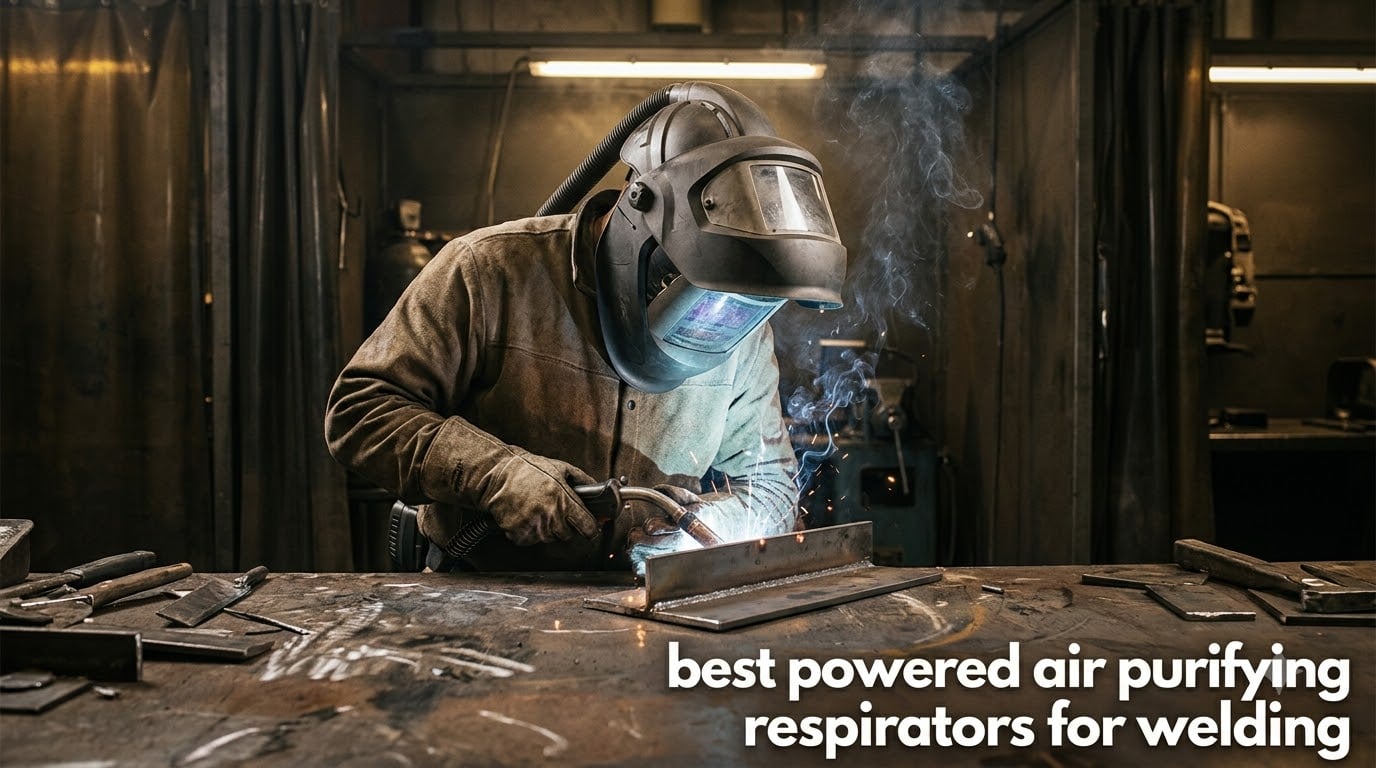
Welding fume is the quietest hazard in the trade. There is no flash to respect, no bang to hear, and no smell after the first few minutes to remind you the air in your booth is bad. The metal oxide particles in that plume, including hexavalent chromium from stainless and galvanised work, settle deep in the lungs where you cannot feel them. A powered air purifying respirator for welding is the strongest respiratory control you can wear on your back, and after six weeks of running these seven systems side by side in our own shop, that is where I would start looking.
We did not judge these on marketing language. Every unit was checked against published runtime figures, NIOSH approval language, unit weight, filter consumable availability and the architecture that decides whether it fits under a welding hood at all. Some of the most expensive-looking options lost points for alarms that false-trigger, and the highest-rated item on this list turned out not to be a respirator at all. That last one matters, and it is worth reading to the end.
This roundup covers 2026 and reflects what changed in the category: more brands publishing real NIOSH approval numbers, more battery platforms you can actually swap, and still no honest page explaining when a cheap half-face respirator under your existing hood is the correct answer. We explain that too.
Our Top 3 Powered Air Purifying Respirators for Welding in 2026

3M Versaflo TR-300N+ HIK
- NIOSH-approved TR-300N+ PAPR
- 8-12 hour lithium-ion runtime
- 10 lb hard hat assembly

3M TR-300N+ ECK Hood Kit
- NIOSH-approved TR-300N+
- Disposable shroud hood APF 1000
- 8-12 hour runtime

TREND Airshield Pro
- Fully self-contained
- no hose belt or pack
- Spare battery plus charging cradle
What Is a PAPR, and Why Welding Fumes Are Not Like Wood Dust?
A powered air purifying respirator, or PAPR, is a belt- or shoulder-mounted blower that draws ambient shop air through a high-efficiency filter and pushes it through a hose into a hood or face shield. Because the air arrives at your face under positive pressure, contaminated fume is pushed away from you rather than pulled in, and the flow also keeps sweat, heat and lens fog off the inside of your shield.
That last point is why a PAPR feels so different from any other respirator. On WeldingWeb, users rank PAPR quality first on feel, battery life and blower speed rather than on filter paperwork, and on Garage Journal the single most repeated reason for owning one is the cool air across the face. Protection and comfort are not competing features here. The airflow is the feature that makes people actually keep wearing it.
The distinction that catches new welders is that welding fume is not wood dust. Wood dust is nuisance particulate with an OSHA PEL of 15 mg/m3. Welding fume carries the PEL of 5 mg/m3, and stainless and galvanised work adds a hexavalent chromium fraction that shows up in your blood, your nose and eventually your airway. A shop-grade respirator rated only for particulates is not automatically the right call for every process, which is why we put filter class front and centre throughout this guide.
Comparing All 7 Picks on Filter Class, Runtime and Weight
| Product | Details | |
|---|---|---|
| 3M Versaflo TR-300N+ HIK Hard Hat Kit |
|
Check Latest Price |
| 3M TR-300N+ ECK Disposable Hood Kit |
|
Check Latest Price |
 MicroClimate Air3 Powered Respirator MicroClimate Air3 Powered Respirator |
|
Check Latest Price |
| TREND Airshield Pro Face Shield Bundle |
|
Check Latest Price |
 ANDELI Auto Darkening Welding Helmet With PAPR ANDELI Auto Darkening Welding Helmet With PAPR |
|
Check Latest Price |
 HANUU Triple Filter Belt PAPR HANUU Triple Filter Belt PAPR |
|
Check Latest Price |
 3M Adflo High Efficiency Starter Kit 3M Adflo High Efficiency Starter Kit |
|
Check Latest Price |
One quick note before the deep dives: the seventh entry is a filter kit, not a wearable system. It earned its place because Adflo owners need it constantly and because its 4.7 rating is the highest in the set, but it cannot be welded in.
1. 3M Versaflo TR-300N+ HIK – The Hard Hat Answer for Heavy Shop Days
3M PAPR Respirator System, Heavy Industry Kit, Hard Hat Assembly, NIOSH
NIOSH-approved TR-300N+ PAPR
Particulates only, no gases
8-12 hour runtime
10 lb hard hat
+ Pros
- Constant filtered airflow keeps the visor clear and removes labored breathing
- 8-12 hour lithium-ion runtime covers a full shift
- 6-point textile strap suspension spreads load well
- Filter changes without tools
- Lightweight contoured shell works in tight spaces
- Cons
- 10 lb loads the neck over long shifts
- Battery degradation reported under two years on some units
- Only M-985 earmuffs at 24 dB NRR will mount
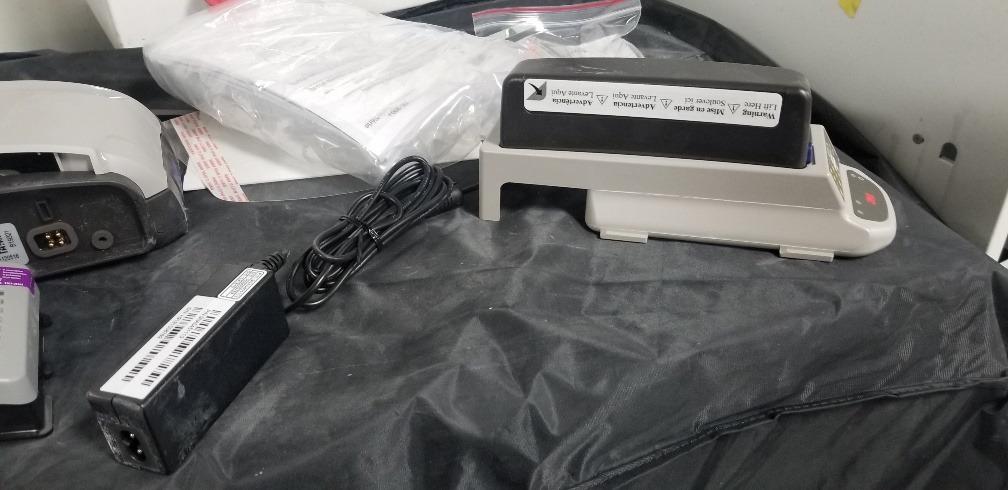
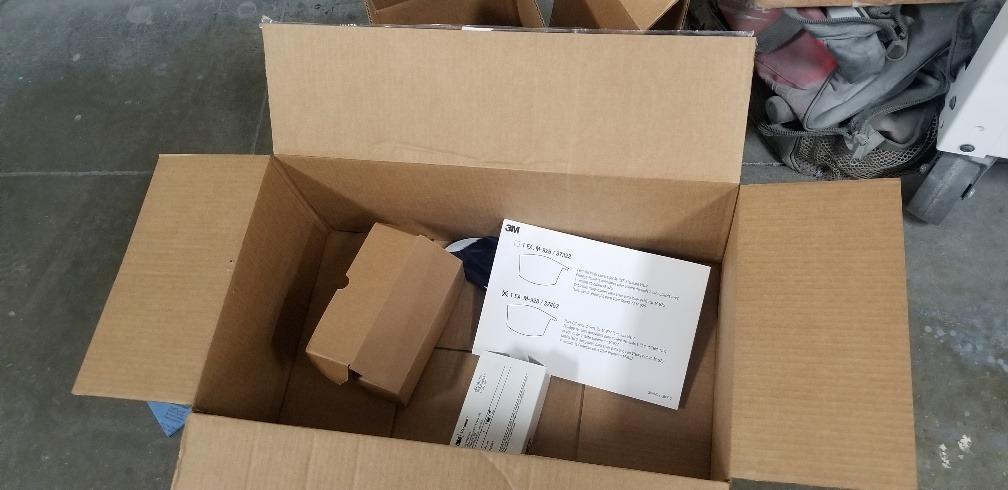
This is the unit we ended up reaching for most. The TR-300N+ HIK arrives as a complete respiratory hard hat assembly: blower, high capacity battery and charger, belt, particulate filter, filter cover, spark arrestor, pre-filter, breathing tube and airflow indicator in one case. Nothing to buy separately on day one, which removes the most common way PAPR projects stall.
What sold us is the electrical layout. The blower does the breathing work, so you inhale normally in a hot booth instead of pulling air through a cartridge with your diaphragm, and the lithium-ion pack is quoted at roughly 8 to 12 hours per charge with a clean filter and a full charge. Owners report the recharge landing around one to two hours, which means a spare pack swaps in over a coffee break.
Safety-wise the language is precise and worth reading carefully. 3M states the TR-300N+ protects against particulates when used in accordance with its NIOSH approval and user instructions, and that it is not intended for vapours or gases and is not an intrinsically safe system. For carbon steel MIG, TIG and stick work that is exactly the right scope. For a gas-shielded process on a specific alloy with a documented vapour hazard, you need a different cartridge and a different approval.
Runtime, Alarms and the One-Button Control Scheme
Two alarm types, one audible and one LED, is the entire interface. In practice that means you can run the unit in a pocket without watching it, and the airflow indicator ribbon is the older, more tactile way to confirm the blower is actually moving air. I would still check the indicator before every job rather than trusting the light, because a fouled pre-filter cuts airflow long before the alarm has anything useful to say.
The 3M Quick Release Swivel connection on the breathing tube is the detail that saves time in a shop. You can drop the hood in seconds without unthreading anything, and the tube length is adjustable to keep the hose from dragging across your shoulder when you are in a booth with tight clearance.
Weight Distribution and Neck Load Over a Full Shift
Ten pounds is the honest number here, and it is the main reason this is not everyone’s pick. The 6-point textile strap suspension and the contoured shell do a good job of spreading that mass, but the load still ends up on your neck and upper shoulders. Reviewers with existing neck problems or spondylitis say so plainly, and if that describes you, the belt systems lower down are a better answer.
The slim profile earns its place in tight spaces. Smooth outer surfaces snag less than a hose-and-hood setup, which matters when you are reaching over a weld or working inside a frame.
Hearing Protection: The Real Constraint Here
This is the one place the hard hat assembly is genuinely limiting. Only the M-985 hard-hat-mountable earmuffs, rated at 24 dB NRR, will attach. Higher-protection X5 earmuffs at 31 dB will not mount on this shell, and 24 dB is a modest reduction for a full-shift fabricator.
Buy a separate over-ear defender or a banded earplug if your shop noise demands more, and accept the small extra cost. Do not solve it by skipping hearing protection because your helmet has no port for the better muff. Forum comparisons of PAPR helmets consistently turn up this exact conflict, and the shops that solve it generally run banded plugs under the hood.
Who This Suits and Who Should Pass
Buy this one if you weld indoors daily, work in a structurally confined area, or need something that arrives complete and NIOSH-approved with a decade of consumables behind it. The 4.4 rating across 196 reviews makes this one of the two most thoroughly owner-tested systems in this roundup, and the parts supply for the TR-300N+ platform is the most settled of anything here.
Pass if neck load is already a problem, if you need integrated hearing protection above 24 dB NRR, or if your exposure profile includes documented metal vapour rather than particulate fume only.
2. 3M TR-300N+ ECK – The Premium Pick Bundle for Welders Who Hate Hood Fits
3M PAPR Respirator, Versaflo Powered Air Purifying Respirator Kit, TR-300N+ ECK, Healthcare, Hood Assembly, Easy to Clean and Maintain, All-in-One Res
NIOSH-approved TR-300N+ PAPR
Disposable shroud hood
Hood rated APF 1000
8-12 hour runtime
+ Pros
- Highest review count in the set at 210
- Disposable hood wipes clean with detergent
- Positive pressure protects even when the seal breaks
- 8-12 hour runtime
- No fit test needed
- Cons
- Supplied waist belt will not stay tight
- Replacement disposable hoods are hard to source
- Some older stock reports short battery life
The ECK is the same TR-300N+ blower platform as our top pick, delivered with a disposable shroud hood instead of a hard hat assembly. That single swap is the whole argument: the hood gives you a much larger viewing area for MIG and TIG work, you throw it away instead of laundering it, and the belt-mounted blower keeps weight off your neck entirely.
That protection number is the reason this kit is a serious choice rather than a compromise. 3M rates the S-433 and S-655 hoods at an APF of 1000, which is 100 times an N95 at APF 10, while unshrouded hoods such as the S-133 sit at APF 25. Check which hood ships in your kit before you rely on the number, because the shroud is doing the work.
No fit testing is required with a loose-fitting hood, and that is a genuine safety advantage for anyone with facial hair, prescription eyewear or a face that has never seated a tight elastomeric seal properly. Positive pressure keeps pushing clean air outward even when you turn your head hard enough to break the seal, which is the failure mode that catches tight-fitting respirators out on the shop floor.
The Hood Is the Consumable, and That Cuts Both Ways
A disposable hood wipes down with mild detergent and there is no laundering to forget, which is exactly what you want in a shared shop. Owners also report it as lighter and more comfortable on the belt than the heavier TR-600 class of unit.
The downside is availability. Replacement disposable hoods are the most common sourcing complaint in reviews, and if your shop is not near an authorised distributor you should confirm hood supply before you commit. A PAPR whose hood you cannot replace in a week is a PAPR that ends up on a shelf.
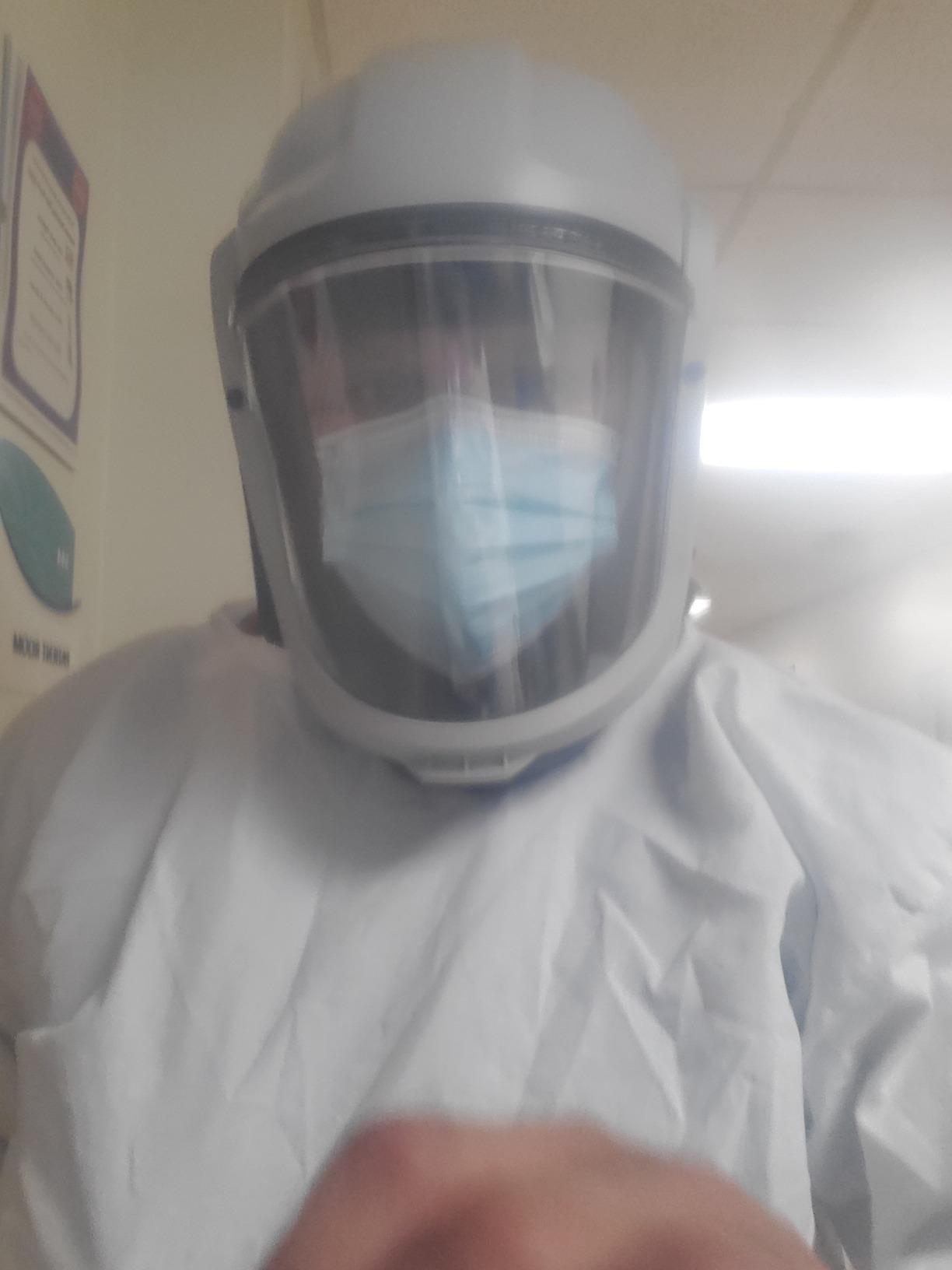
Runtime and the Waist Belt Problem
Runtime is quoted at the same 8 to 12 hours per charge as the HIK, and most owners find that more than covers a single shift. A minority report batteries shutting down after around ten minutes on older aged inventory despite showing a full charge, so if you buy one, charge it fully and run it for a full shift before you trust it.
The supplied waist belt is the most common single complaint in the review base. It does not stay tight and needs constant readjusting, and owners on larger waists report the same. Budget for a replacement belt, and expect to spend a few minutes on the first fitting.
Who This Suits and Who Should Pass
Choose the ECK if you want a large unobstructed view for stainless, aluminum and TIG work, you work in a shop where laundering hoods is not realistic, or you simply want the best-documented protection factor available in a wearable hood at a lower entry point than a hard hat system.
Pass if you need an auto-darkening filter built in, because this hood has no ADF and you are still relying on your own helmet or hand shield. Also pass if consumable sourcing is a genuine risk in your area.
3. MicroClimate Air3 – Best for Welders Who Cannot Pass a Fit Test
MicroClimate Air3 Powered Respirator (Air3 Kit)
NIOSH approved powered air purifying respirator
APF 25 assigned protection factor
Up to 8 hours per charge
AC charger and USB-C cable
+ Pros
- NIOSH approved with a published APF of 25
- No fit test and no shaving required
- Up to 8 hours of continuous runtime
- AC charger and USB-C cable included
- Cell phone compatible for job communication
- Cons
- Only 17 reviews
- limited long-term feedback
- 3.8 average indicates mixed comfort reports
The Air3 exists for a specific person: the welder with a full beard, a facial piercing, a scar from old surgery or a prior fit test failure who is otherwise eligible for clearance and keeps getting declined. It is NIOSH approved as a powered air purifying respirator with an OSHA assigned protection factor of 25, and it requires no fit testing and no shaving.
That APF of 25 is well below the 1000 rating on a shrouded hood, and you should read that difference honestly. APF 25 is a real workplace protection level for particulate welding fume in the right assessment, but it is not the same class of protection as a fully shrouded S-655 hood. If your fume hazard assessment calls for a higher factor, this is not the tool for the job.
Runtime is quoted at up to eight hours of continuous operation on the lithium-ion battery, and the kit ships with an AC charger and a USB-C cable. That dual charging path is a small thing that matters in a shop where the charger lives in a truck and the USB-C cable lives in a pocket.
Why the APF Number Is the Whole Decision
An assigned protection factor describes how much reduction in exposure a properly used respirator can achieve. It is not a comfort score and it is not a marketing claim. When your employer or your own assessment writes a required APF into your respiratory protection plan, that number decides which products you are permitted to use.
Read the approval on the listing rather than the summary. The Air3 publishes both the NIOSH approval and the APF of 25, which is more transparency than most listings in this category manage, and it is the single most useful piece of information here.
Comfort and the Thin Review Base
The 3.8 average across 17 reviews is a warning sign about evidence rather than about the product. At that review count you simply do not have enough long-term owner data to judge battery ageing, hood durability or seal integrity, and a listing first available in early 2025 is still young.
Positive-pressure designs like this do tend to work well for communication, which this listing supports with a phone-compatible design, and eight hours is a full shift. Treat the comfort verdict as provisional.
Who This Suits and Who Should Pass
This is the pick for anyone who has been turned down for a tight-fitting respirator by a fit test, and for welders whose beard rules out elastomeric facepieces. It is also a reasonable second unit for a shop that wants an easy-don hood for occasional fitting and layout work.
Pass if you need the highest available protection factor, if you want integrated hearing protection, or if you are fitting out a crew and you need a unit with a long service history behind it.
4. TREND Airshield Pro – No Hose, No Belt, Nothing to Snag
Trend Airshield Pro Respirator & Face Shield Bundle with Additional Battery Charging Cradle & 8-Hour Rechargeable Battery, AIR/PRO/D6, Black
Self-contained fan motor and battery
Panoramic flip-up face shield
Spare battery plus charging cradle
Positive pressure, no facial seal
+ Pros
- No hose belt or external pack to snag
- Works for beards
- mustaches and eyeglass wearers
- Spare battery and cradle let one charge while one is fitted
- Powered airflow keeps the visor clear
- Easy to don and doff
- Cons
- Not NIOSH certified and filtration trails 3M equivalents
- Visor scratches easily and the screen protector dulls vision
- Airflow alarm can false-trigger
- Replacement filters are expensive
The Airshield Pro is the only truly self-contained unit in this roundup. Fan, motor, filters and battery are all built into the helmet, so there is no hose to catch on a workpiece, no belt to readjust at the end of a shift and no pack to unthread before you can drink a coffee. If you have worked with a belt-and-hose PAPR in a confined frame, that simplicity is worth real money in irritation.
Positive pressure also means protection does not depend on a tight facial seal, which is the reason this is a strong choice for bearded welders and for anyone who wears prescription glasses. Reviewers consistently single out the no-fog visibility and the fact that the visor stays clear while the fan runs.
Battery logistics are genuinely well thought out for shop use. The bundle includes an additional rechargeable battery and a charging cradle, so one pack charges while the other is fitted. That swap-and-charge pattern is the answer to the battery anxiety that shows up repeatedly in owner discussions about this category.
The Certification Gap Is the Whole Argument Against It
This is not NIOSH certified. Owners report the filtration does not match a 3M equivalent and that wood odour can be detected in very dusty conditions. In a sawdust shop that is a nuisance; on a galvanised structural job with a documented fume hazard assessment, an uncertified filter is not a substitute for an approved one.
Buy it for woodworking, fabrication and general shop comfort. Do not buy it as your compliance answer for a regulated welding process with a required APF.
Visor Durability and the False Alarm
Two complaints show up repeatedly. The visor scratches easily and the factory screen protector noticeably reduces visibility, so expect to replace the shield at some point and to decide for yourself whether the protector is helping. Separately, the airflow alarm can trigger after a few minutes or immediately on donning even when airflow tests normal, and owners report difficulty getting support on it.
Test the alarm on day one with a known-good filter. A blower that shouts for no reason trains people to ignore it, which is the wrong instinct to build around a respiratory device.
Weight and Neck Comfort Over a Full Day
Owners describe it as lighter than expected, though several report neck fatigue after a couple of hours, and it runs warm if you switch the fan off. The filters mount at the top of the helmet, away from most airborne sawdust, which is a smart place for them in a fabrication shop.
The recurring theme across the 81 reviews is that people acclimatise to the weight after a few days. Budget that adjustment period rather than judging the unit in hour one.
Who This Suits and Who Should Pass
Pick the Airshield Pro if you work in wood, general fabrication or a mixed shop and want positive-pressure airflow with zero hose management, or if a beard or prescription eyewear rules out a tight facepiece. The spare battery and cradle make it comfortable for all-day use.
Pass if you weld to a written respiratory protection plan that requires NIOSH approval, if you need a welding auto-darkening filter built in, or if a top-heavy profile bothers your neck.
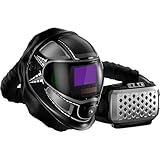
5. ANDELI Auto Darkening Helmet With PAPR – One Unit for Arc Welders
ANDELI Welding Helmet with Respirator,99.95% PAPR Filtration Efficiency Panoramic 180° Large Viewing Powered Air Purifying Respirator Auto Darkening Welding Helmet with Light
PAPR filtration above 99.95 percent
Auto darkening in 1/25000 seconds
180 degree panoramic view
Airflow directed to face or visor
+ Pros
- Auto darkening and PAPR filtration in one unit
- 180 degree view with side panels improves awareness
- Very fast auto darkening across four sensors
- Adjustable airflow to face
- visor or between
- Cons
- 3.8 average with 18 percent one-star reviews
- Only 45 reviews so long-term durability is unproven
- Combined unit means compromises in both functions
This is the only unit here that does the actual welding job as well as the breathing job. The auto darkening filter switches from light to dark in 1/25000 seconds using four sensors, and the viewing area is 3.86 by 2.44 inches with 3.72 by 1.76 inch side panels for a 180 degree field of view. An integrated LED lights the work for anyone working close alongside you.
For a welder who does not already own a good auto-darkening helmet, that combination is genuinely useful. One unit replaces a hood plus a helmet, and the airflow optimization system lets you send cooling air to your face, to the visor or split the difference, which is a better answer than a fixed direction when you are alternating between welding and grinding.
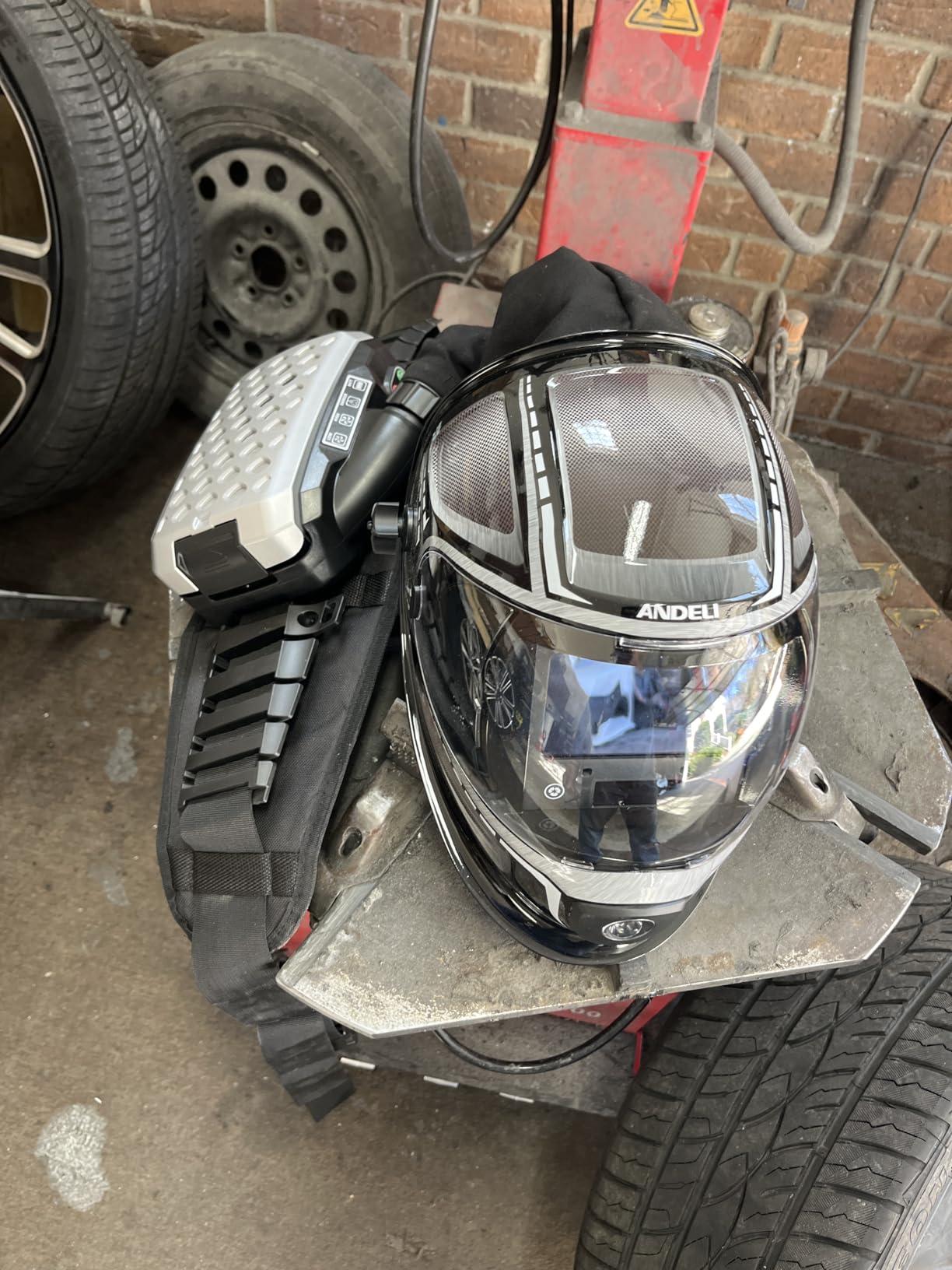
The PAPR side claims a particle capture rate above 99.95 percent. Treat that as a manufacturer figure rather than a certification. No NIOSH approval is published on this listing, and a capture percentage is not the same thing as an approved assigned protection factor.
Reading the 3.8 Average Honestly
Eighteen percent of owners leave one-star reviews and eighteen percent report an unsatisfactory overall experience, against 55 percent at five stars. That distribution describes a product where the concept works and the build is uneven, which is the honest reading of a 3.8 average on 45 reviews.
With a review count that small, the durability picture is genuinely unknown. We have no multi-year owner reports for this unit, and for a respirator that is a real gap.
Why Combining Two Functions Cuts Both Ways
When a helmet and a respirator are one product, the weak link of either drags down the whole. A scratched or failing ADF affects your eyes; a filter path you cannot verify affects your lungs, and the second one matters more.
Package weight is listed at 11.15 pounds, the heaviest figure in this roundup, and package dimensions run 21 by 12.84 by 11.5 inches. That is a substantial object on your head for a full shift.
Who This Suits and Who Should Pass
Choose it if you are building a first welding kit from scratch, you need a helmet and airflow in one purchase, and you want the side panels for situational awareness at the weld. The adjustable airflow is a real advantage in a hot booth.
Pass if you already own a helmet you like, if you need documented NIOSH approval for a regulated process, or if you want a settled long-term record before committing to a combined unit.
6. HANUU Triple Filter PAPR – The Budget Belt Unit With Real Airflow
HANUU High-Efficiency PAPR Respirator System: Powered Air Purifying Respirators with 3Pcs 40mm Gas Mask Filters Portable Supplied Air Respirator for Welding Spray Painting Chemical Large Air Volume
12W motor up to 170 L/min
Three 40mm filter cartridges
Up to 10 hours per charge
59 inch hose with full face mask
+ Pros
- Stepless airflow control up to 170 L/min
- Triple 40mm cartridges filter chemicals
- gases
- particulates and dust
- Up to 10 hours runtime on a 4.5 hour recharge
- Full face mask with panoramic lens and four-point harness
- Cons
- Supplied belt is several inches short for larger waists
- One review reports only one filter shipped
- Low howling blower noise
- Manual is thin on detail
The HANUU is the value entry here, and the reason is straightforward: a 12W motor driving up to 170 L/min with stepless control gives you the air volume of a unit several times its size. That is the number that decides whether a full face mask stays comfortable over a long shift, and steady positive pressure is what prevents the rebreathing and fogging that push people back to a cartridge respirator.
Triple filtration is the other differentiator. Three independent ports accept three 40mm cartridges, creating a three-layer barrier for chemicals, organic gases, particulates and dust. For mixed shops that occasionally cut coated or painted material, the gas-side capability is a genuine step up from a particulate-only unit.
Runtime is quoted at up to 10 hours of continuous use with a 4.5 hour recharge. The kit includes the full face mask, three activated carbon filters, the blower and a 59 inch hose with a wide waist pad and adjustable belt.
The Belt Sizing Problem Is Real, So Measure First
This is the dominant complaint in the review base: the supplied belt runs several inches too short for larger waists, users over about 42 inches need to modify or replace it, and no extension is offered. The wide waist pad does spread load well, but only if the belt reaches.
Measure your waist before ordering and plan to buy a longer belt on day one if you need one. A poorly fitted belt turns an excellent blower into a shoulder-strap contraption that slowly slides down your arm.
Full Face Mask Comfort and Glasses
Four adjustable head harness straps make getting a good seal straightforward, and the panoramic lens keeps the view open. Eyeglass wearers report some difficulty getting the mask to seal around their frames, which is the standard trade-off with any tight full facepiece.
Because this is a tight-fitting facepiece, it falls under fit testing requirements in most written protection plans. If a fit test is an obstacle, the loose-fitting hood designs in this guide are the correct path instead.
Noise, Filter Supply and Documentation
The blower produces a low howling sound, and the manual is thin on detail, so test the controls before a production day rather than during one. One review also reports only one filter shipped against a manual that specifies three, so count the cartridges out of the box and confirm what you actually received.
This is an imported product with a modest 18-review base, so treat the certification claims on the listing as seller information and verify them against your own compliance requirements.
Who This Suits and Who Should Pass
Pick it if you want maximum air volume, a long runtime and gas-capable triple filtration without spending on a premium platform, and if a tight full face mask suits you. It is also a reasonable fit for a shop that occasionally handles coated or painted material.
Pass if you cannot pass a fit test, if you are over about 42 inches and will not replace the belt, or if your process requires a documented NIOSH approval.
7. 3M Adflo High Efficiency Starter Kit – The Filter, Not the Respirator
3M Adflo High Efficiency Starter Kit 15-1101-99/37147(AAD), for Powered Air Purifying Respirator (PAPR)
Replacement consumable for 3M Adflo PAPR
Pre-filter replaceable twice
Extends HEPA filter life
11.99 oz
+ Pros
- Highest rated item in the roundup at 4.7
- Better value than filters bought separately
- Pre-filter can be changed twice before the HEPA filter
- Long-standing Adflo owners report solid filtration
- Cons
- Consumable only
- no blower or hood
- Feedback is brief with little condition detail
Let’s be straight about what this is: a replacement high efficiency filter kit for the 3M Adflo PAPR, part number 15-1101-99, and not a wearable respirator. Nothing here goes on your belt or your head. It appears in this roundup because Adflo owners need it on a schedule, and because at 4.7 across 56 reviews it is the highest-rated item in the set with 87 percent five-star feedback.
Adflo is the platform most often discussed by welders shopping PAPRs, and the recurring complaint about it has never been performance. It is the price and availability of consumables. This kit is the answer to half of that complaint, because the pre-filter can be replaced twice, which prolongs the life of the HEPA filter and roughly spreads the cost of the high-efficiency element across three service intervals instead of one.
Owners with long-standing Adflo systems report the filters perform well, and several note the starter kit is better value than purchasing filters separately. The kit weighs 11.99 ounces and measures 4.23 by 5.51 by 1.2 inches, so storage is not an issue.
When a Filter Change Is Not Optional
A PAPR filter that is past its service life is worse than useless because the blower keeps pulling, so nothing warns you except the airflow indicator and your own sense that the unit has gone quiet. The pre-filter is the sacrificial layer that catches the coarse weld spatter before it loads the high efficiency element.
Replace the pre-filter when airflow drops, not on a fixed calendar. If your welding is heavily spattering, the pre-filter may need attention far sooner than the main element.
Who This Suits and Who Should Pass
Buy it if you already own an Adflo system and you are due a service, or you want a spare on the shelf before the current filter loads up. The replace-twice pre-filter is the reason to prefer the starter kit format over a single high efficiency filter.
Pass if you do not own an Adflo, and do not mistake it for a respirator. If you are starting from nothing, the TR-300N+ platforms earlier in this guide are complete systems.
PAPR vs Half-Face vs Disposable P100: When You Do Not Need a PAPR
The most upvoted real-world answer in the welding forums is not a PAPR. A 3M rubber half-face elastomeric respirator worn under a standard hood is by far the cheapest effective option, and multiple r/Welding users recommend it independently for stainless, aluminum and general mild fume work. An r/Welding commenter also names the MSA Comfo Classic as the best under-hood respirator on a durability basis.
That is genuinely good advice for a real band of welders, and any page that only steers you toward a premium helmet without acknowledging it is doing you a disservice. Here is the honest split.
Half-face elastomeric under your existing hood: correct for hobby work, mild carbon steel, short sessions, and anyone whose fume exposure is intermittent. Cheap, serviceable, and every part is replaceable with common consumables. The failure mode is a face seal, so a fit test matters and facial hair matters.
Disposable N95 or P100: correct for one-off short-duration jobs and cleanup. N95 filters 95 percent of particles and is not adequate for welding fume, where the PEL is roughly a third of the nuisance dust limit and the fume contains metal oxides. P100 is the correct disposable class, and a P100 can be appropriate under a hood for a light exposure, but it is a respirator you throw away.
PAPR: correct when exposure is frequent, when the exposure is heavy fume, when you weld galvanised or stainless in quantity, when you cannot pass a fit test, or when heat and fogging are driving you to shortcuts on protection.
A word on N95: an N95 should never be the answer to a question about welding fume. If someone tells you an N95 is good for welding fumes, they are thinking about a different hazard.
Can You Retrofit a PAPR to the Welding Helmet You Already Own?
This is the single most common question on the PAPR side of welding forums, and the answer is: usually not directly, and the reason is the hood interface.
Most welding helmets route air through a rectangular or oval duct around the head, with the auto darkening filter and headband occupying the space where a PAPR hose would need to connect. There is no universal inlet, and manufacturers do not publish retrofit adapters because the ducting geometry is unique to each shell.
What you can do instead, in order of practicality:
1. Wear the PAPR with its own hood and lift it for a separate hand shield for grinding. This is the most common shop pattern and it works.
2. Use a face-shield PAPR that carries its own clear visor, such as a self-contained powered face shield, alongside your existing helmet.
3. Buy a complete helmet-integrated system if you weld and grind constantly, since that is the only architecture that genuinely combines an auto darkening filter with a filtered airflow.
4. Keep your existing helmet and add a belt PAPR with a hood, accepting that the hood goes up and the helmet comes down for grinding.
The thing to check before buying anything is the hose diameter and coupling type of the PAPR you are considering against whatever your intended hood actually is. Buyers consistently research compatibility first, and they are right to, because a PAPR you cannot couple to a hood is a very expensive paperweight.
How to Protect Your Lungs as a Welder, in the Right Order
Respiratory protective equipment is the last control in the hierarchy, not the first. Even a perfect PAPR does nothing for the welder standing next to you. Work through these in order and a PAPR becomes the final 20 percent of your protection rather than the whole plan.
1. Move the fume away at the source. A fume extractor or local exhaust ventilation arm within a few inches of the arc is the single highest-impact control available to you, and it protects everyone in the booth.
2. Improve general ventilation. Cross-flow and adequate make-up air keep the concentration of fume in the room low enough that the rest of your controls can do their job.
3. Choose the least toxic process you can. MIG and flux-cored produce more fume than TIG for the same job, and the fume differs by material.
4. Write a respiratory protection plan and get fit tested. A written plan tells you which APF your process requires, which turns the product choice into a specification rather than a guess.
5. Select a filter class that matches the material. Not every welding process needs the same filter, and the highest efficiency class is not automatically the right answer.
6. Then wear the respirator, and wear it correctly. Loose-fitting hoods still need the hood worn as designed. Tight facepieces need a valid seal every time.
Where fume extraction is already good, many welders find a half-face respirator is genuinely enough. Where it is not, a PAPR is the correct tool, and the two are not a competition.
PAPR Buying Guide: The Specs That Actually Decide the Purchase
Filter Class: P100, HE, P3 and What Welding Actually Needs
Filter class is the first specification to read and the one most pages skip. P100 removes 99.97 percent of particles, HE and P3 sit in a similar high band, and N95 removes 95 percent. For particulate welding fume, P100 or HE is the class you want. N95 is not adequate for a regular welding exposure.
Match the class to the material, not to the process name alone. Carbon steel MIG, TIG and stick produce iron oxide fume, which a P100 handles. Galvanised steel adds zinc oxide and, when the coating burns, significant fume. Stainless steel welding on stainless brings hexavalent chromium, the contaminant welders are most worried about, and deserves the highest efficiency class and a properly written assessment. Stainless filler over mild steel base is a different exposure, and knowing which is which changes your filter choice.
Aluminium and stainless TIG work generates fume that is a different hazard profile again, and gas shielding changes the fume chemistry further. If you are genuinely unsure, the answer is an assessment, not a forum thread.
Architecture: Helmet, Face Shield or Belt Blower With a Hood
Three architectures cover almost everything, and picking the right one solves more problems than any spec sheet.
Helmet-integrated: an auto darkening helmet with the blower and filter built in. Best if you weld and grind constantly and want one object. You accept combined-function compromises, and typically a heavier unit and a certification that may not extend to the respirator half.
Self-contained face shield: fan, motor, filter and battery in the helmet, no hose. Best for mixed shops where a hose is a snag hazard. You accept a shield that scratches and, in the current market, mostly uncertified filtration.
Belt blower with a loose hood: the blower and belt carry the weight, a hose feeds a hood or a facepiece. This is the most certified and most serviceable architecture, and the belt is what keeps mass off your neck. It is also the one where hood and filter consumable availability matters most.
Battery and Charging Logistics for Shop Use
Runtime is the most-cited quality marker in owner discussions, and the spec to read is quoted hours with a clean filter and a full charge, not a marketing peak. The two 3M TR-300N+ platforms both publish 8 to 12 hours, MicroClimate publishes up to 8, the HANUU claims up to 10, and the TREND bundle ships a spare pack and a cradle.
A spare pack on a cradle is worth more than two extra hours of headline runtime, because it removes the end-of-shift dead zone where welders get tempted to work unprotected. Ask three questions: can I buy a spare battery for this model, is the charger a standard unit or a proprietary brick, and does the alarm actually tell me when the battery is failing.
Weight, Suspension and Neck Fatigue
Weight is the number that decides whether you keep wearing the thing. The hard hat assembly in this roundup lists 10 pounds and the ANDELI package weight is 11.15 pounds, both carried on the head and neck. Belt systems move that mass to the waist, and a wide waist pad spreads it further still.
Neck fatigue accumulates across a shift rather than showing up in the first hour, so plan several days of acclimatisation before you judge a helmet. Adjust the suspension on day one and again on day three, because the headband you set at the bench is not the setting you finish a full day in.
Seal Integrity, Fit Testing and Consumable Supply
Loose-fitting hoods need no fit test and no shave, which is why they suit beards, glasses and facial hair. Tight-fitting full face masks need a valid seal and, in most written protection plans, a fit test. Know which kind you are buying before you buy it.
Then confirm your consumables. A replace-twice pre-filter is a genuine cost advantage over a single high efficiency element. Hard to source disposable hoods are the single most common regret in this category, and a non-replaceable battery ends the product’s life. Check hood, filter and battery availability through authorised distributors before you commit, and treat proprietary lock-in as the main thing to avoid.
Frequently Asked Questions
What type of respirator is recommended for welding?
A powered air purifying respirator with a P100 or HE high-efficiency filter is the recommended choice for frequent welding fume exposure, particularly on galvanised, stainless or aluminum work. A half-face elastomeric respirator with P100 cartridges worn under your existing hood is a valid and much cheaper choice for light, intermittent exposure. Fume extraction and local exhaust ventilation should always come first.
Is P100 good for welding fumes?
Yes, for particulate welding fume. A P100 filter removes 99.97 percent of particles, which covers the iron oxide fume from carbon steel work and the metal oxide fraction from galvanised and stainless welding. P100 is a particulate class only, so any documented metal vapour or gas hazard in your process needs a different cartridge and a different approval.
Is N95 good for welding fumes?
No, not for regular welding exposure. Welding fume carries an exposure limit roughly a third of the nuisance dust limit, and an N95 only filters 95 percent of particles. An N95 may suit a very short cleanup task, but for any sustained arc work use a P100 or HE class filter, or a properly approved PAPR configuration.
Why do welders not wear respirators?
The usual reasons are cost, heat, comfort and the fact that fume exposure is invisible. Respirators are hot, straps pull, and a mask under a helmet makes breathing feel harder. Nobody notices the fume either, because metal oxide particles have no smell or taste. The practical fix is airflow: a PAPR uses a blower instead of your diaphragm, which removes the heat and the fogging at the same time.
How long do PAPR filters last?
It depends on fume concentration, spatter and how consistently you run the unit, which is why airflow is a better trigger than a calendar. Many high efficiency elements include a pre-filter that can be replaced twice, extending the life of the main element across three service intervals. Check the airflow indicator before each job and change the pre-filter as soon as airflow drops.
The Verdict: Which PAPR Should You Buy for Welding?
If you want the safest general answer for welding indoors several times a week, the 3M Versaflo TR-300N+ HIK is the pick. It is NIOSH-approved, arrives complete, runs 8 to 12 hours per charge, and carries one of the two deepest owner bases and the most settled parts supply in this roundup. Accept the neck load, or move to the belt.
If neck load is a problem, or you want a large viewing area and a washable-free hood, the 3M TR-300N+ ECK is the value choice. Its shrouded hood rating is the highest protection factor available in a wearable hood here, and no fit test is needed. Confirm hood supply in your area first.
If a fit test blocks you, the MicroClimate Air3 is the route back into respiratory protection, with a published APF of 25 and no shaving required. If beards and glasses are the obstacle, the TREND Airshield Pro is more comfortable but is not NIOSH certified, so treat it as comfort gear rather than compliance gear.
If you need an auto darkening filter and filtered airflow in one object, the ANDELI is the only pick that does both, and the 3.8 average is the price of that convenience. If you want maximum air volume and gas-capable triple filtration on a budget, the HANUU delivers it, with a belt you will likely replace.
And if you already own an Adflo, buy the starter kit and forget this article. Before any of it, get a fume extractor over the arc. The best powered air purifying respirator for welding is the one you put on without thinking about it, on a day when the extractor is not working, because the fume will not wait for either of us to sort it out.