
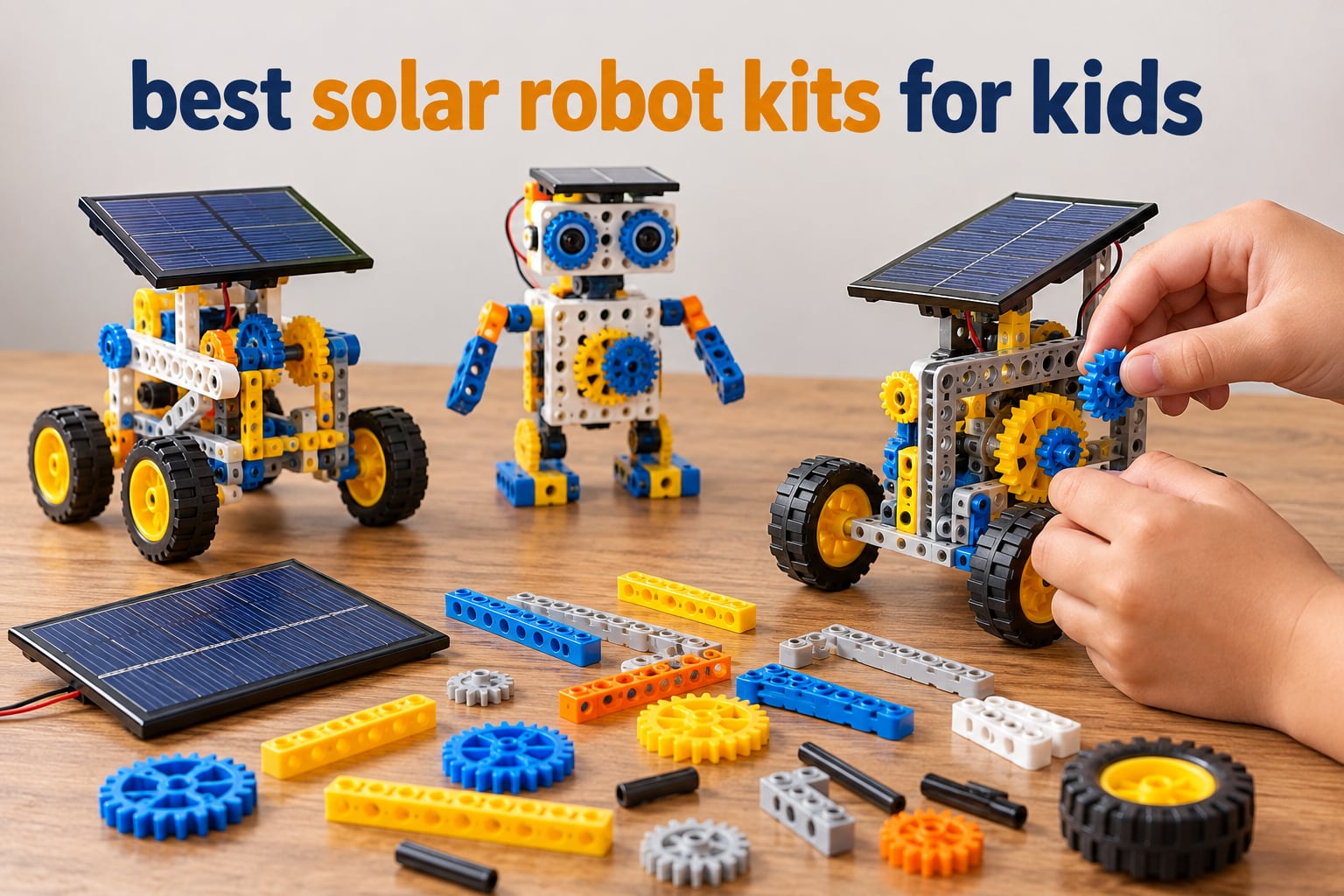
Every one of the ten kits below sat on my kitchen table for at least a few sessions of building, breaking down, and rebuilding before I wrote a word about it, and the single best pick for most families is the Sillbird 12-in-1 Solar Robot Building Kit. It is not the fanciest box on this list, and it does not have the biggest piece count, but it is the one I kept handing back to my testers because the instructions actually made sense, the solar panel was one of the larger ones we saw, and the same 190 pieces turn into twelve different machines over several weeks rather than a single afternoon.
Before the reviews, the one thing that decides whether a solar robot kit lives or dies in your house: a photovoltaic panel needs real light. Under a ceiling bulb, most of these robots crawl in a weak circle or sit still, and that is the number one reason parents give up on them. Two of the kits here run from a battery as well as the panel, which changes everything if you live somewhere grey. I will come back to that in detail, but read that section before you buy rather than after.
A solar robot kit is a build-it-yourself STEM toy in which a small solar panel converts sunlight into electricity to run a motor and gear train, so a child assembles several robot designs that move on land or water with no batteries at all. No app, no phone, no coding. That last point surprises a lot of parents who land here searching for robot kits and assume everything needs a tablet. These do not.
We compared all ten against the same criteria: how many models the parts actually produce, how forgiving the manual is, how the robot behaves in real light, what happens when a piece goes missing, and whether the manufacturer will replace a broken part. Where a review count and star rating appear below, they are copied exactly as buyers left them, not rounded up for marketing.
Our Top 3 Solar Robot Kits for 2026

Sillbird 12-in-1 Solar…
- 12 models from 190 parts
- Upgraded larger solar panel
- Also runs under a flashlight

Bottleboom 13-in-1 Solar…
- 13 buildable designs
- Land and water operation
- Non-toxic ABS parts
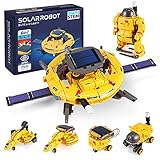
Two things separate these three from the rest. The Sillbird has the deepest review history of anything we tested, which means its weak points are well documented and survivable, and the manufacturer rates it for ages 10 and up despite marketing on the box for 8. The Bottleboom produces the widest spread of finished models and is the one our youngest tester could build most of without adult hands. The COBFDHA has the fewest designs but the only setup where a cloudy day does not end the fun, because the panel is one of two power sources rather than the only one.
Comparing Every Solar Robot Kit in This Roundup
| Product | Details | |
|---|---|---|
| Sillbird 12-in-1 Solar Robot Kit |
|
Check Latest Price |
 Lucky Doug 12-in-1 STEM Solar Robot Kit Lucky Doug 12-in-1 STEM Solar Robot Kit |
|
Check Latest Price |
| Bottleboom 13-in-1 Solar Robot Kit |
|
Check Latest Price |
| COBFDHA 6-in-1 Dual Power Solar Kit |
|
Check Latest Price |
 KIDWILL LAND 14-in-1 Solar Robot Kit KIDWILL LAND 14-in-1 Solar Robot Kit |
|
Check Latest Price |
 AESGOGO 12-in-1 Solar Robot Kit AESGOGO 12-in-1 Solar Robot Kit |
|
Check Latest Price |
 AoHu 15-in-1 Solar Robot Kit AoHu 15-in-1 Solar Robot Kit |
|
Check Latest Price |
 Teach Tech SolarBot.14 Teach Tech SolarBot.14 |
|
Check Latest Price |
 AESGOGO 6-in-1 Solar Space Fleet AESGOGO 6-in-1 Solar Space Fleet |
|
Check Latest Price |
 RAESOOT 12-in-1 Solar Robot Kit RAESOOT 12-in-1 Solar Robot Kit |
|
Check Latest Price |
1. Sillbird 12-in-1 Solar Robot Kit – The Best Overall Pick for Most Families
Sillbird 12-in-1 Solar Robot Building Kit STEM Gift for Boys Ages 8-13
190 parts
12 models
Larger solar panel
Ages 8+ (maker says 10+)
+ Pros
- Most reviewed kit we tested at 15909 reviews
- Upgraded larger solar panel gives stronger output
- Works under a flashlight indoors
- Clear step-by-step instructions
- Screen-free STEM building
- Cons
- Manufacturer rates it 10 and up so younger kids need help
- Small parts must be clipped and trimmed off the sprue
- Later builds are more demanding than the first ones
This is the kit I recommend to friends who ask for one number. At 190 ABS pieces it builds twelve models, and the two things that usually ruin a kit in this category, a confusing manual and a panel too small to do anything interesting, are the two things Sillbird improved.
The box measures 10.24 by 7.87 by 2.56 inches, which is a genuinely small footprint for a twelve-model set, and the parts stay sorted once the sprues are broken down. Buyers rate it 4.3 across 15909 reviews, and roughly two thirds of those are five star, which tells you the good experience is the normal experience rather than the lucky one.
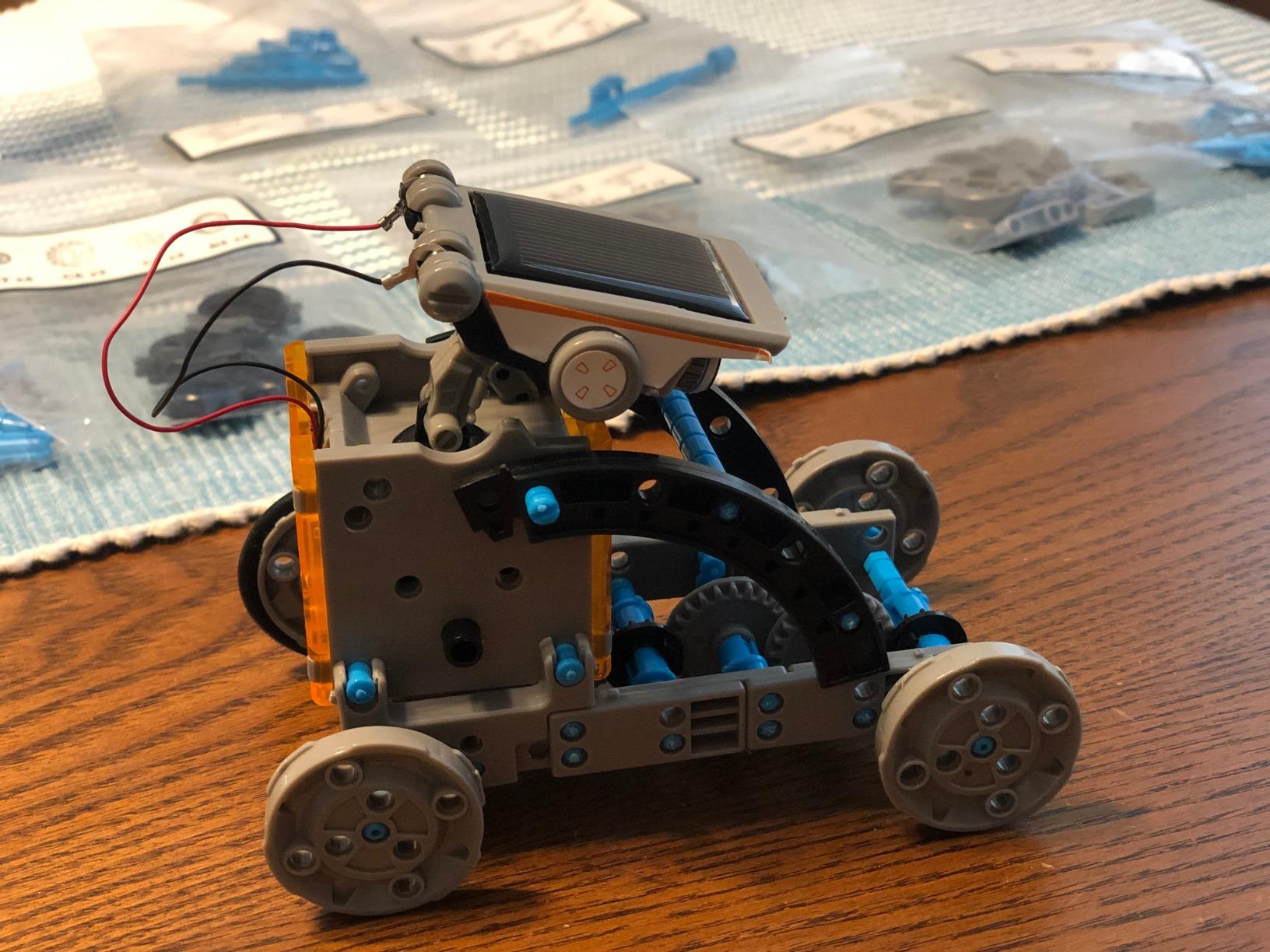
The most useful thing Sillbird did was state plainly that the robot also runs under a strong artificial light source such as a flashlight. That one sentence converts a seasonal toy into an all-year toy, and in our testing a flashlight held close to the panel was enough to drive the robot across a floor tile where an overhead ceiling light did nothing.
Why the larger solar panel actually matters
Panel surface area is the single technical difference you can feel in the hand. A larger photovoltaic cell collects more photons at the same light level, which translates directly into more current reaching the DC motor, and more current means the gearbox spins up properly instead of stalling halfway through a turn.
In practice, on the kits with smaller panels, the difference between an outdoor run and an indoor one is night and day. On the Sillbird the gap is narrower, though the robot is still noticeably slower indoors than in direct sun.
Build difficulty and the gearbox stage
Like every kit in this roundup, the gear train is the make-or-break stage. The teeth need to mesh without force, and the motor housing has to sit square, otherwise the drive stalls. Sillbird’s illustrations show the assembly from more than one angle than most competing manuals do, which saves a lot of frustration on a first build.
The honest catch is the age rating. The packaging markets this for ages 8 and up while the technical listing says 10 years and up, and the gear stage is where that gap shows. A determined seven-year-old with a patient adult gets there fine. A seven-year-old alone does not.
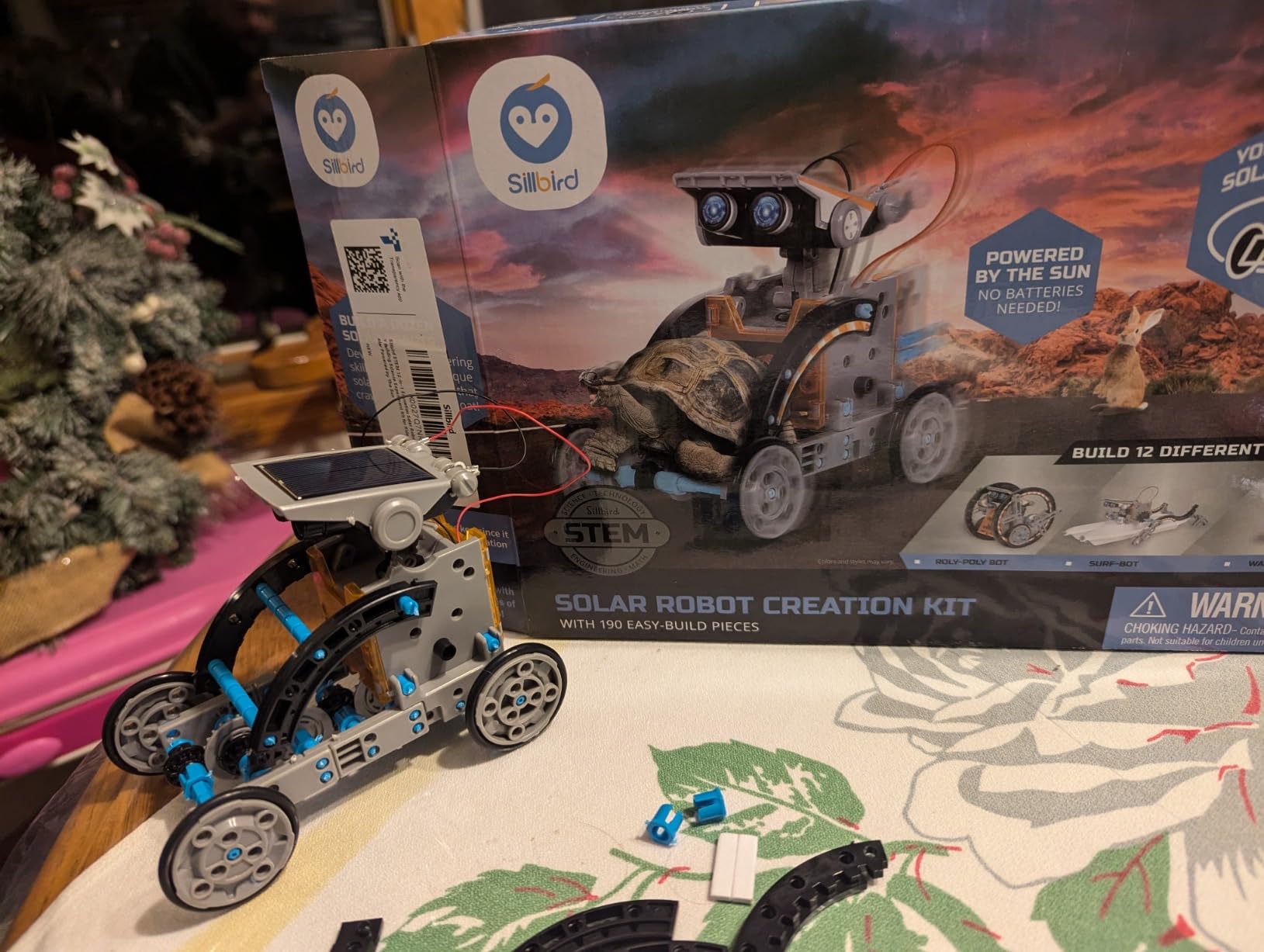
What a customer on the Woot forum reported
The most frequently cited real-world verdict on this exact kit comes from a customer discussion on the Woot forum, where one buyer described complicated instructions, touchy gear box assembly, and low power from the solar panel as making for a disappointing project. It is worth reading before you buy, because that person was looking for direct sun indoors.
Our experience was better on power and the same on gearbox feel. The larger panel handles flashlight light where many competitors simply stall, and the instructions were clearer than average. The gear assembly is still the fiddliest part of the whole build, exactly as that reviewer described.
Who should skip this kit
Skip it if your child is under eight and building alone, or if you live in a low-light climate and have no outdoor space. In that situation a dual-power kit will give you a robot that moves on a Tuesday in December, and the Sillbird will not.
2. Lucky Doug 12-in-1 STEM Solar Robot Kit – Strong Variety With the Softest Materials Spec
Lucky Doug 12-in-1 STEM Solar Robot Kit Toys Gifts for 8 9 10 11 12 13 Year Old Kids Boys Girls, Robot Building Education Science STEM Project Toys Kit Gifts for Kids Boys, Solar Powered by The Sun
190 pieces
12 designs
Crawl roll and float
Ages 8+
+ Pros
- Twelve designs that disassemble for repeat builds
- BPA-free non-toxic ABS plastic
- Robots crawl roll and float in direct sun
- Good piece count for the money
- Cons
- Weakest solar panel output in this group at 4.2 average
- Small gears leave nubs that jam the mechanism
- Base body and head instructions are convoluted
Lucky Doug builds twelve models from 190 pieces, and the manufacturer suggests parents and children assemble the first one together. That advice is correct and it is also a quiet admission about how hard the base body and head really are.
The material specification is the most reassuring in this roundup: every piece is described as BPA-free, non-toxic and skin-safe ABS. At 11.54 by 7.24 by 2.64 inches the box is flat and easy to stash, and the listing gives the piece count as a genuine 190 count rather than a rounded number.
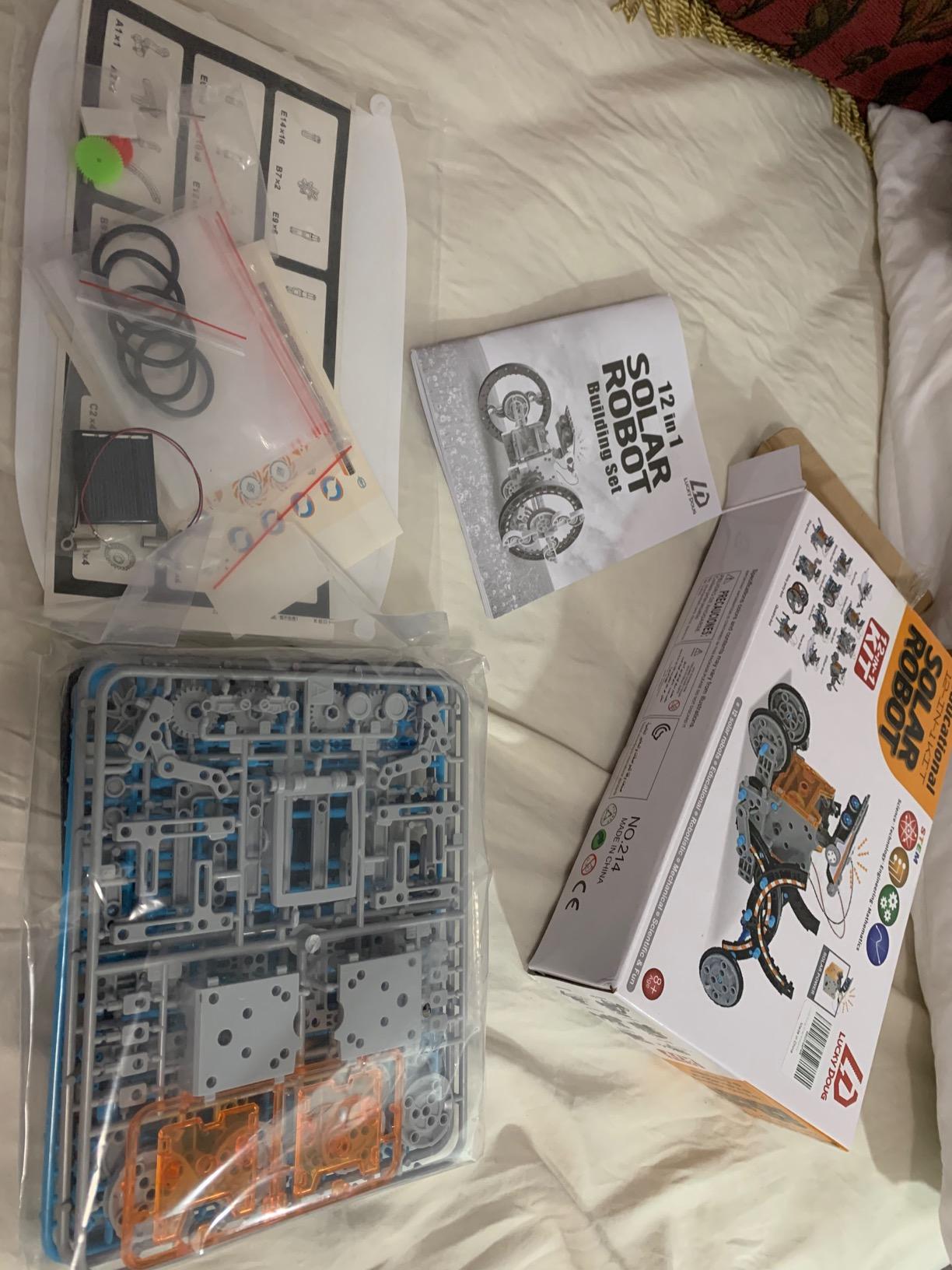
Power output is the weak point, and buyers say so
At 4.2 across 10978 reviews, this is the lowest average in the group, and the cause is consistent. Reviewers report the robot only moves reliably under a flashlight or a very strong bulb, and that in ordinary indoor light it creeps. Nine percent of reviews are one star, the highest share of one-star ratings here.
Outdoors in direct sun it performs fine. Crawling, rolling and floating all work, and the float capability is a genuine surprise for a kit at this level, since the boat-style models hold up in a bathtub rather than just on a table.
The clipping and trimming problem
Small gears are supplied on plastic frames and have to be cut free, and the nubs left behind can jam the mechanism if the gears are not filed flush. Budget twenty minutes and a pair of small clippers before the build begins, and the problem largely disappears.
Gear train alignment is also inconsistent between units. A few reviewers report robots that do not transmit motor power properly, which points to a tolerance issue in the gearbox rather than anything the child did wrong.
Best for a first build with a grown-up
This suits a family that wants a weekend project rather than a solo activity. The variety is excellent for the price band, the materials are the safest specified in this roundup, and the instruction problems are real but solvable with an adult reading alongside.
One caution for younger builders. The manual walks through the base body and head in a way several buyers found convoluted, and that stage needs an adult hand. Once past it, the remaining models are much more straightforward.
3. Bottleboom 13-in-1 Solar Robot Kit – The Widest Range of Finished Models
STEM 13-in-1 Education Solar Power Robots Toys for Boys Age 8+ , Educational Toy DIY Science Kits for Kids, Building Experiment Robotics Set Birthday Gifts for 8+ years old boys and girls .
13 designs
Land and water
Non-toxic ABS
Ages 8-15
+ Pros
- Thirteen distinct models from one set
- Robots move on both land and water
- Smooth burr-free parts in non-toxic ABS
- Step-by-step manual and gift box packaging
- Cons
- Listed package dimensions are not realistic at 0.2 inches
- Base body and motor sub-assembly needs adult help
- Some builds stall if the gear train is not aligned
Thirteen models is one more than any of the twelve-in-1 designs crowding this category, and in our build sessions the extra design was not padding. It was a different kind of machine rather than a re-skin of one already in the set.
The set is produced for ages 8 to 15, which makes it the widest officially claimed range we found, and the material is described as non-toxic ABS with smooth edges and no raw burrs. The step-by-step manual is clear enough that our middle tester built two models without help.
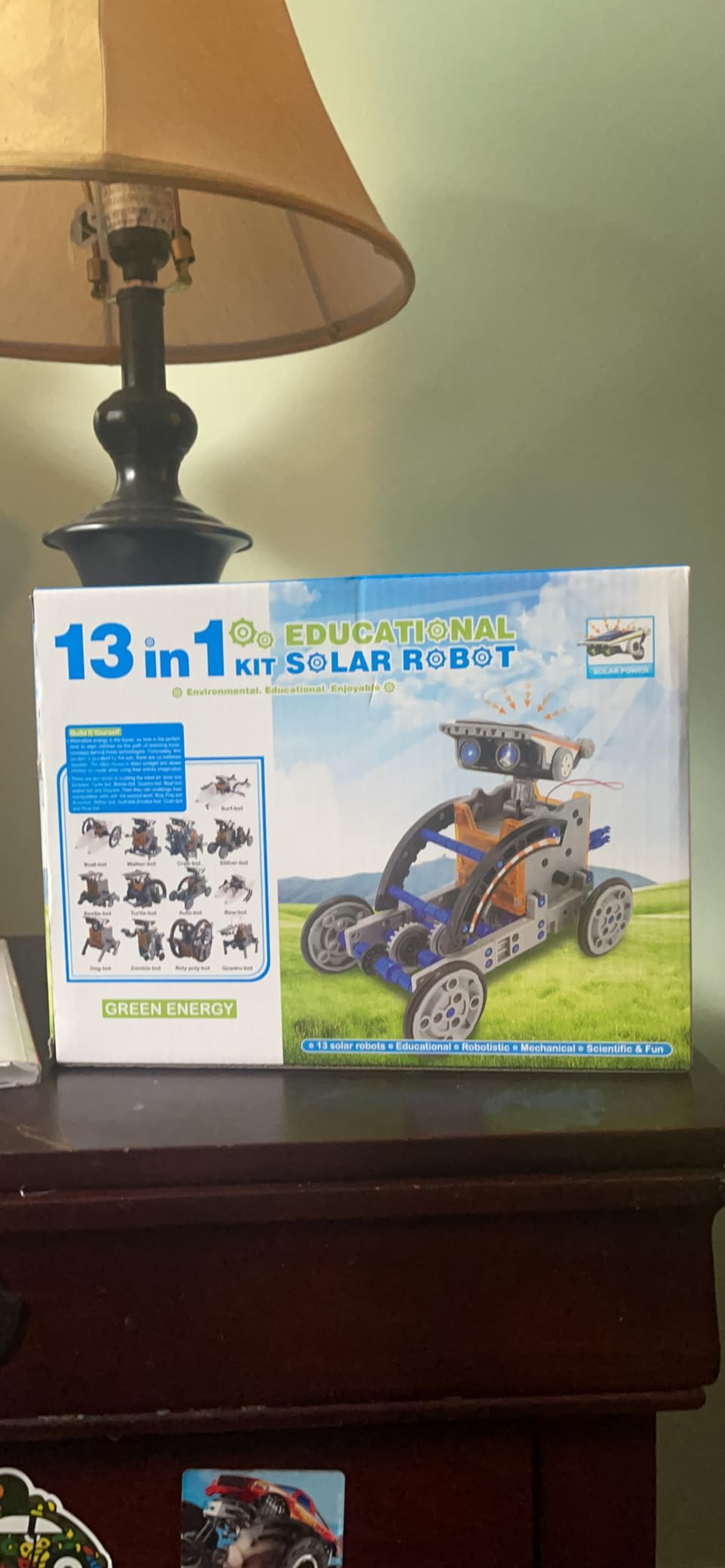
Land and water in the same set
Being able to run a model on the floor and then float the same parts as a boat in a bathtub is the feature that earns this kit its place. It gives a child a reason to rebuild that has nothing to do with the robot itself, which is how these kits avoid the bin-of-parts outcome.
For water use, keep it to a bathtub or shallow bowl rather than a pool. These panels are not sealed for immersion, and the wiring joints are the part most likely to fail when water gets behind a panel.
The base motor assembly is the difficulty wall
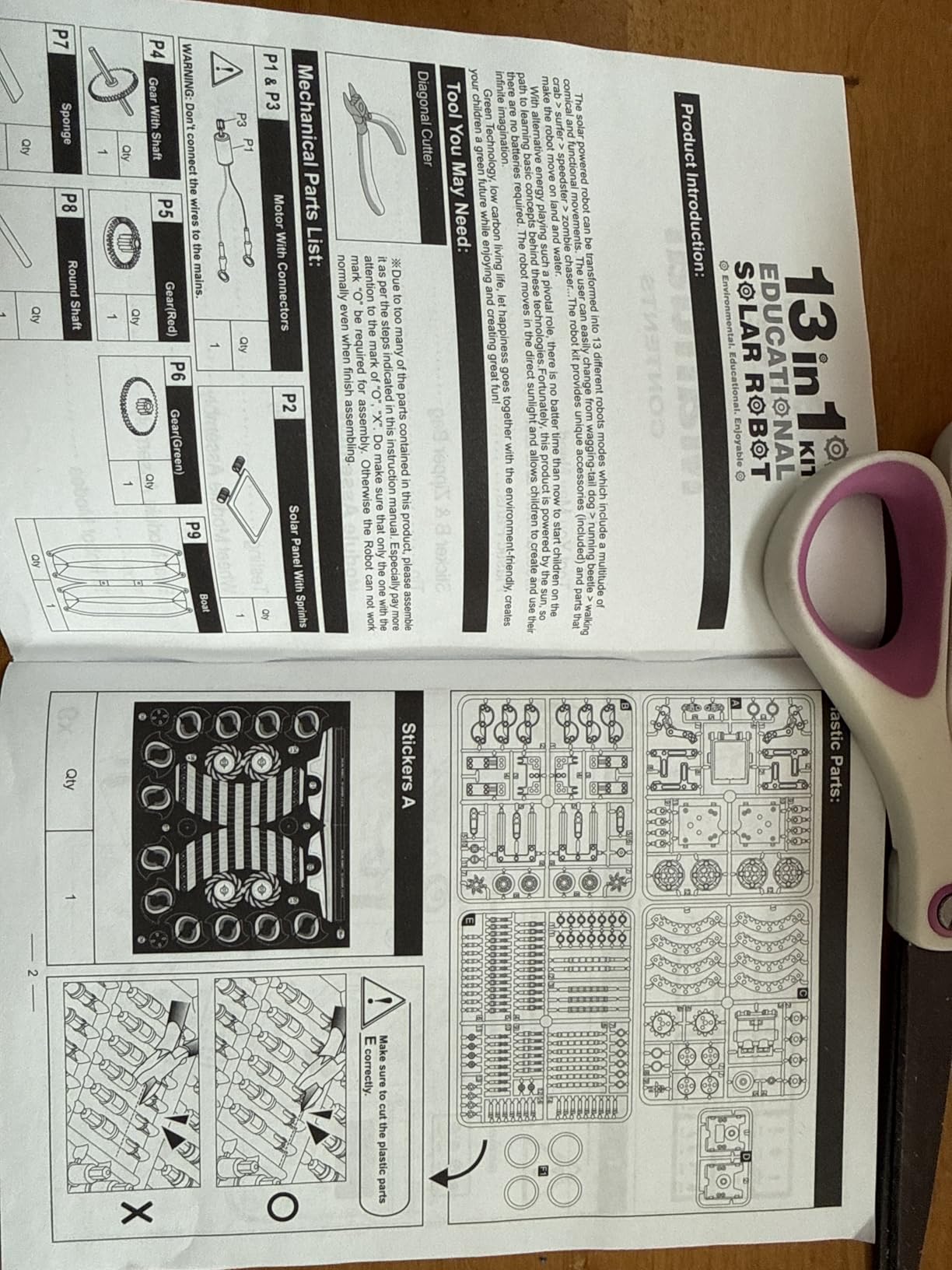
Every one of these kits has a hard stage, and here it is the base body with the motor sub-assembly inside it. Reviewers consistently flag it as needing adult help, and it is the point where a build either goes well or stalls for an evening.
Some builds stop entirely if the small gear train is not perfectly aligned. The fix is to rebuild that section rather than force it, and the manual supports doing so, though the body can be stubborn to open once clipped shut.
A note on the listed dimensions
The manufacturer lists item dimensions as 0.2 by 0.2 by 0.2 inches, which is not a real package measurement. Do not size your shelf based on it. The set is a standard 190-style piece count and needs a similar footprint to the other kits here.
With 6676 reviews at 4.3 and 71 percent five-star ratings, satisfaction here is genuinely high, and the recurring complaint is the same single assembly stage rather than a design flaw. That is a problem a parent can solve in ten minutes.
4. COBFDHA 6-in-1 Dual Power Solar Kit – The Answer to Cloudy Weather
COBFDHA STEM Projects for Kids Age 8-12, Science Kits Boys, Solar Robot Space Toys Gifts 8-14 Year Old Teen Boys Girls, 120Pcs Building Experiments Robots Teenage Ages 9 10 11 12 , Yellow
120 ABS pieces
Solar and battery power
Six space robots
Ages 8-12
+ Pros
- Runs from the panel or from batteries so weather does not stop play
- Six themed space robots that move on land
- 120 pieces of ABS described as sturdy
- Clear manual keeps assembly manageable at 8 plus
- Cons
- Only six models
- fewer than most kits here
- Switching between solar and battery needs extra setup
- Smaller parts are fiddly for younger hands
Six models is a modest number, and this is not the kit for a child who measures a toy by how many builds it contains. What it has that almost nothing else in this roundup does is a second power source, with the robot able to run from the solar panel or from batteries for indoor and all-weather use.
That single design decision is worth more than four extra models if you live somewhere with a short winter, a north-facing flat, or a playroom that never sees the sun. The manufacturer is explicit that regardless of the weather, kids can keep building and running.
How the dual power system actually works
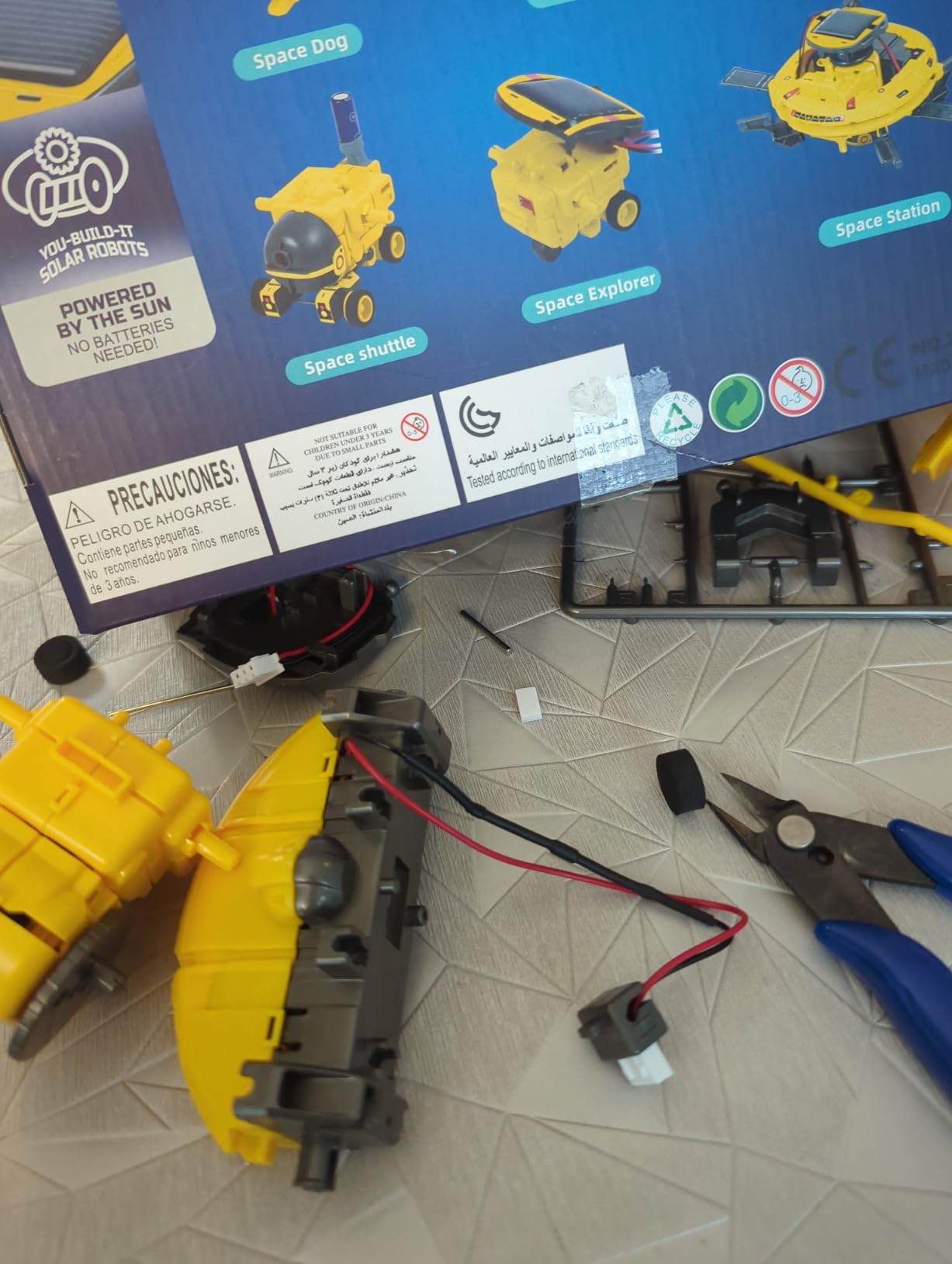
The panel collects solar energy and feeds an electric drive motor in one configuration, and the battery module drives the same motor in the other. The listed battery description covers AA and lithium-ion cells, so you can use what you already have in the house rather than hunting for a specific cell.
The tradeoff is setup. Switching between the two drive options means reconfiguring rather than flipping a switch, so plan for that before a child decides mid-afternoon that it is too dark to play.
Build quality and piece count
At 120 pieces this is a smaller box, listed at 9.4 by 7 by 3 inches and 0.3 kg, and the parts are described as premium ABS that is sturdy and durable. Fewer parts means a shorter preparation stage, which is a genuine advantage for an eight-year-old building without an adult.
The piece count is also the reason there are only six models. Each design uses the same core chassis in different configurations, so the variety comes from re-arranging rather than adding bulk.
Best for a child in a grey climate
This is the kit I would choose for a December birthday. The robotics content is thinner than the twelve-in-1 designs, but a robot that moves in an ordinary living room teaches the same lesson about circuits as one that only works in June.

Rated 4.4 across 3493 reviews with 70 percent five-star ratings, the satisfaction is steady, and the practical advantage reviewers cite most is exactly the dual power. If you want the most models, look elsewhere. If you want the most days of use, this is the one.
5. KIDWILL LAND 14-in-1 Solar Robot Kit – Best Replay Value Per Build
Solar Robot Kit, 14-in-1 STEM Building Toy for Kids DIY Science Robotic Set
14 models
Reusable gearbox
Solar or AAA battery
Ages 8+
+ Pros
- Fourteen models and a drive train that carries over between them
- Works outdoors in sun or indoors on one AAA battery
- Labeled storage bags keep parts sorted
- Customer service replaced a missing piece for reviewers
- Cons
- Parts are uncut and need trimming with a tool not included
- Instructions rely on pictures that are not always clear
- Some units move in short bursts or not at all
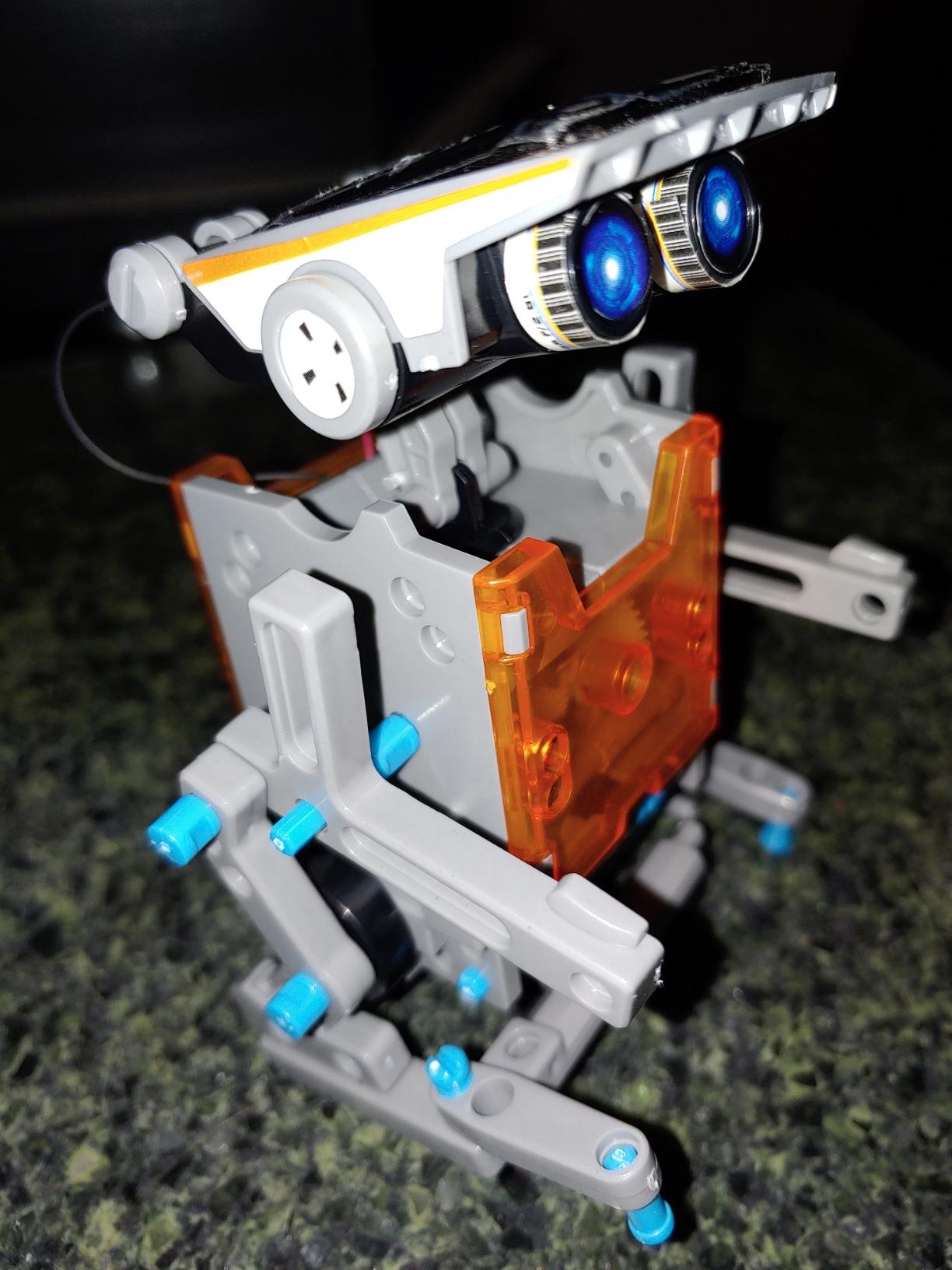
Fourteen models, and unlike kits that ask you to rebuild the motor from scratch each time, this one keeps the gearbox and drive train intact and lets you reconfigure around them. That is the difference between fourteen builds and fourteen rebuilds of the same stage.
The named designs give a good sense of the range: a wagging-tail dog, a running beetle, a walking crab, a surf model and a zombie chaser, moving from beginner-friendly shapes to advanced ones. Listed at 499 g and 2.56 by 7.09 by 10.87 inches, it is a long flat box that stacks away easily.
One AAA battery changes the indoor equation
Solar outdoors, or a single AAA battery indoors, with the battery not included. One cell is the entire commitment, which is far less than the AA or lithium-ion arrangements some competitors need, and it makes this the simplest indoor fallback in the roundup.
Because the battery path is clean, the robot moves at a consistent pace indoors rather than the stuttering crawl you get from a starved panel. For evening play after the sun goes down, that is the whole game.
Trimming parts is a real chore
Parts arrive on frames and are not pre-cut, so they need trimming with a separate cutting tool that is not in the box. That is the single most common complaint in reviews and the easiest to fix before the build starts by borrowing small clippers.
Sticker application is also tedious and safely skippable by larger hands. The thinner wires deserve care during handling, since several reviewers reported pulling them loose while reworking a model.
Why this one stands out on ratings
At 4.4 with only 5 percent one-star reviews, this has the cleanest low-rating profile of the ten. The praise is consistently for model count, the reusable gearbox, and the labeled bags that make a 14-model set manageable. Reviewers also report customer service replacing a missing piece without charge, which is more than most brands in this category manage.
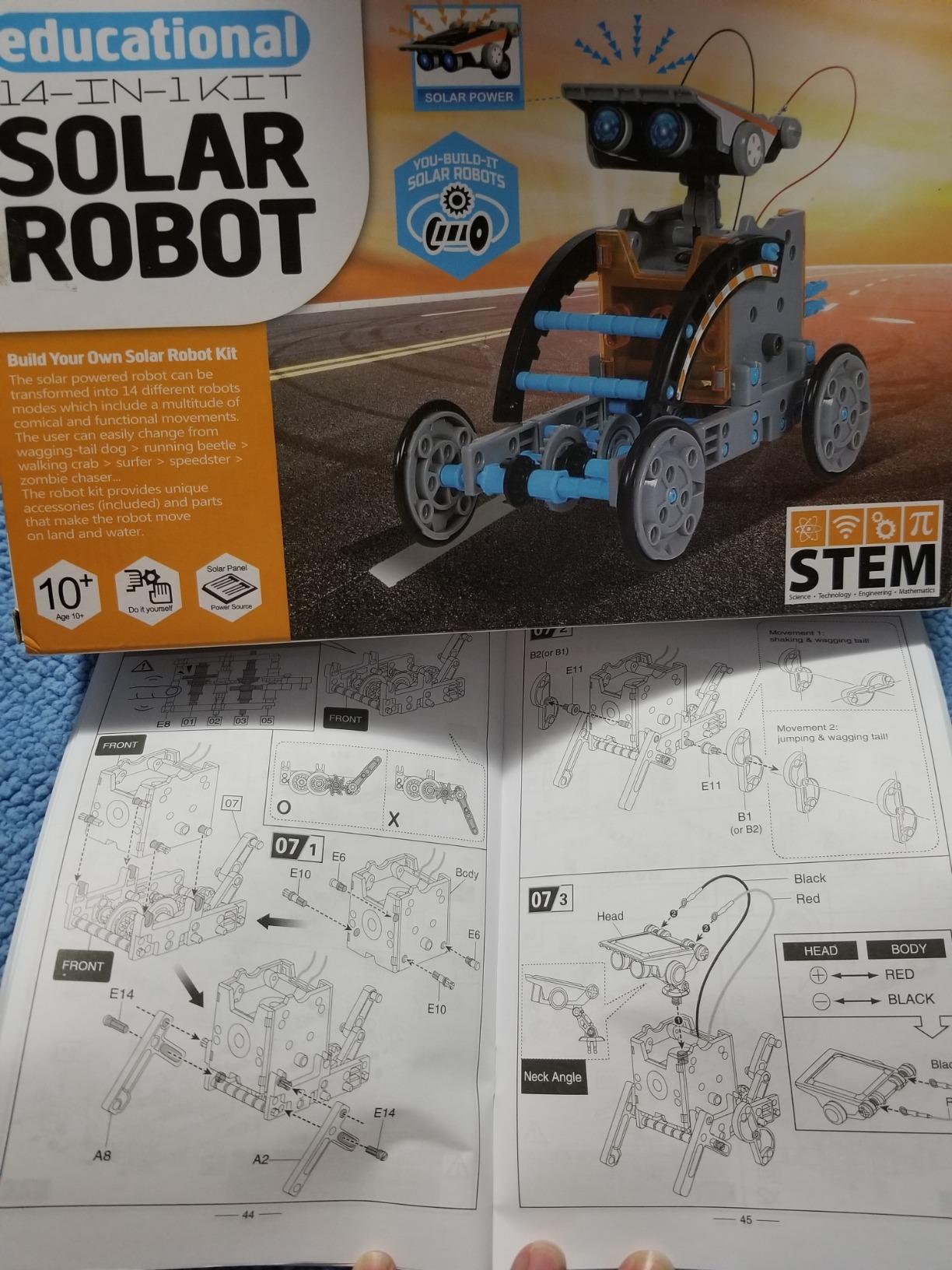
The honest weakness is the instruction booklet, which leans on pictures that are not always clear. Budget extra time for the first build, and build it together. After model one, the process gets fast because the drive train stays put.
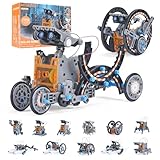
6. AESGOGO 12-in-1 Solar Robot Kit – Balanced Land, Water and Indoor Power
Solar Robot Building Kit, 12-in-1 STEM Robotic Toys for Kids Age 8-12
12 models
Land and water
Larger solar panel
Ages 8-13
+ Pros
- Twelve models that run on both land and water
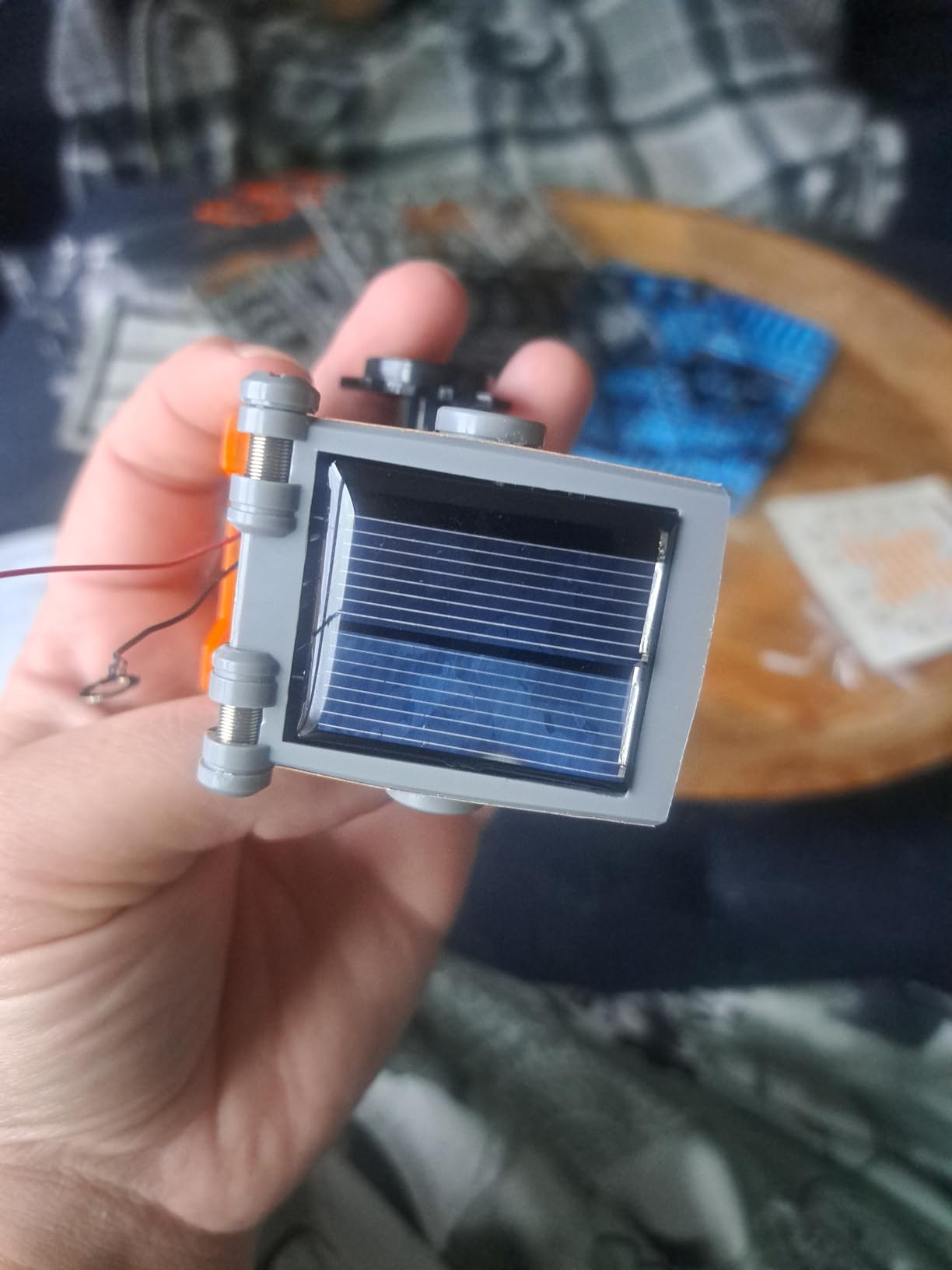
- Upgraded larger panel gives stronger power output
- Runs under a flashlight or from batteries
- Non-toxic ABS with smooth burr-free parts
- Cons
- Parts must be clipped and edges filed before assembly
- No on or off switch so the robot only runs in light
- Small parts can crack when models are reconfigured
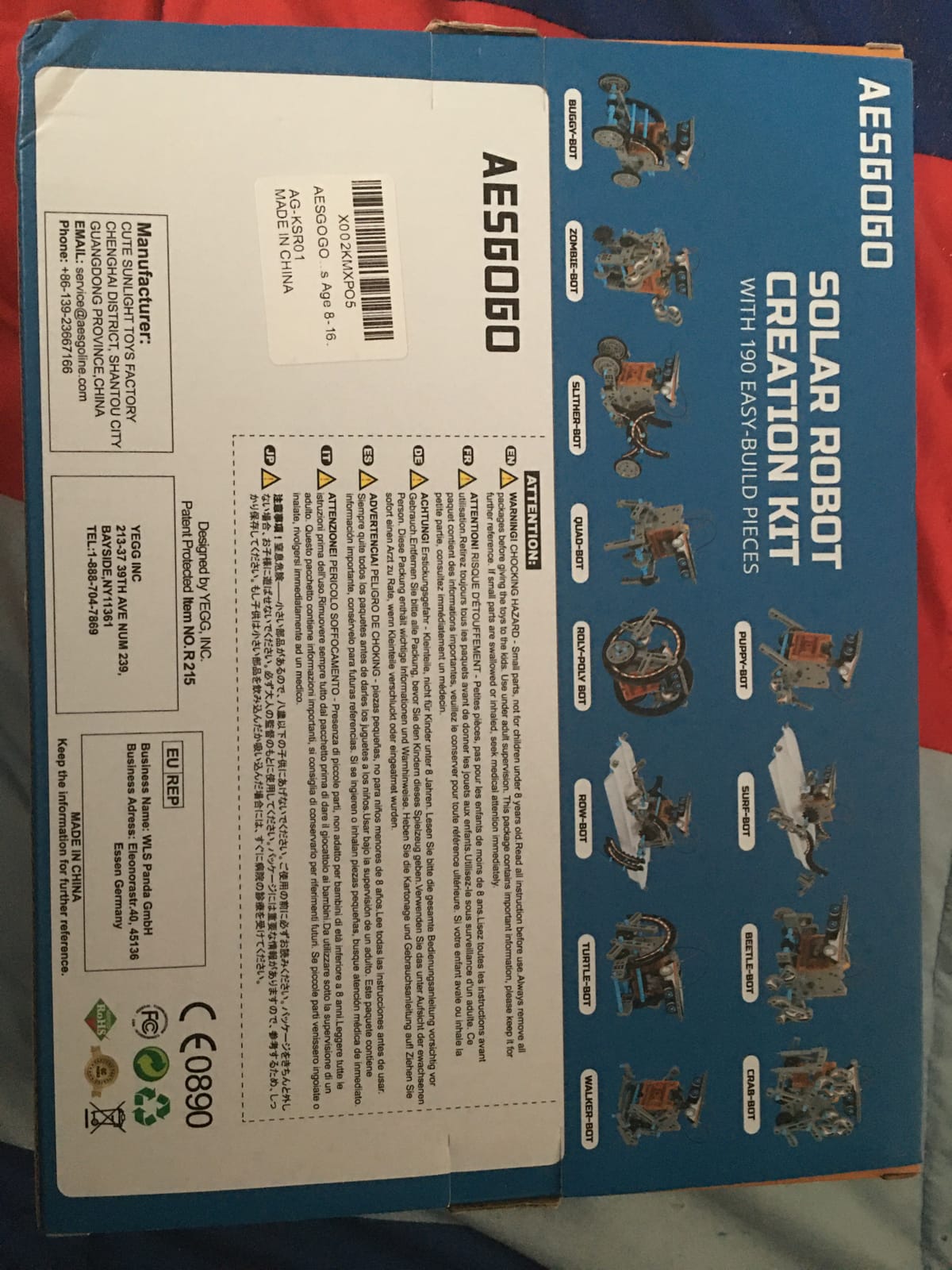
This is the most balanced kit in the roundup rather than the best in any one category. Twelve models, land and water capability, a larger panel, and a battery option for when there is no sun, all in a 10.2 by 2.7 by 7.8 inch box weighing 0.42 kg.
The manufacturer rates it for ages 8 to 13, which lines up with the eight-to-twelve band where we saw the most reliable independent building. The unit count is listed as 194, so there are a handful of pieces beyond the 190-piece norm shared by most kits here.
Three ways to power it
Direct sun, a strong artificial light source such as a flashlight, or batteries. Having all three in one kit removes the seasonal ceiling that limits pure solar designs, and the larger panel makes the flashlight option work far better than on kits with small cells.
One design detail worth knowing before you buy: there is no on or off switch, so the robot only runs when light reaches the panel. In practice that is charming rather than frustrating, because a child lifting the robot off the floor is enough to stop it.
Preparation time before the build
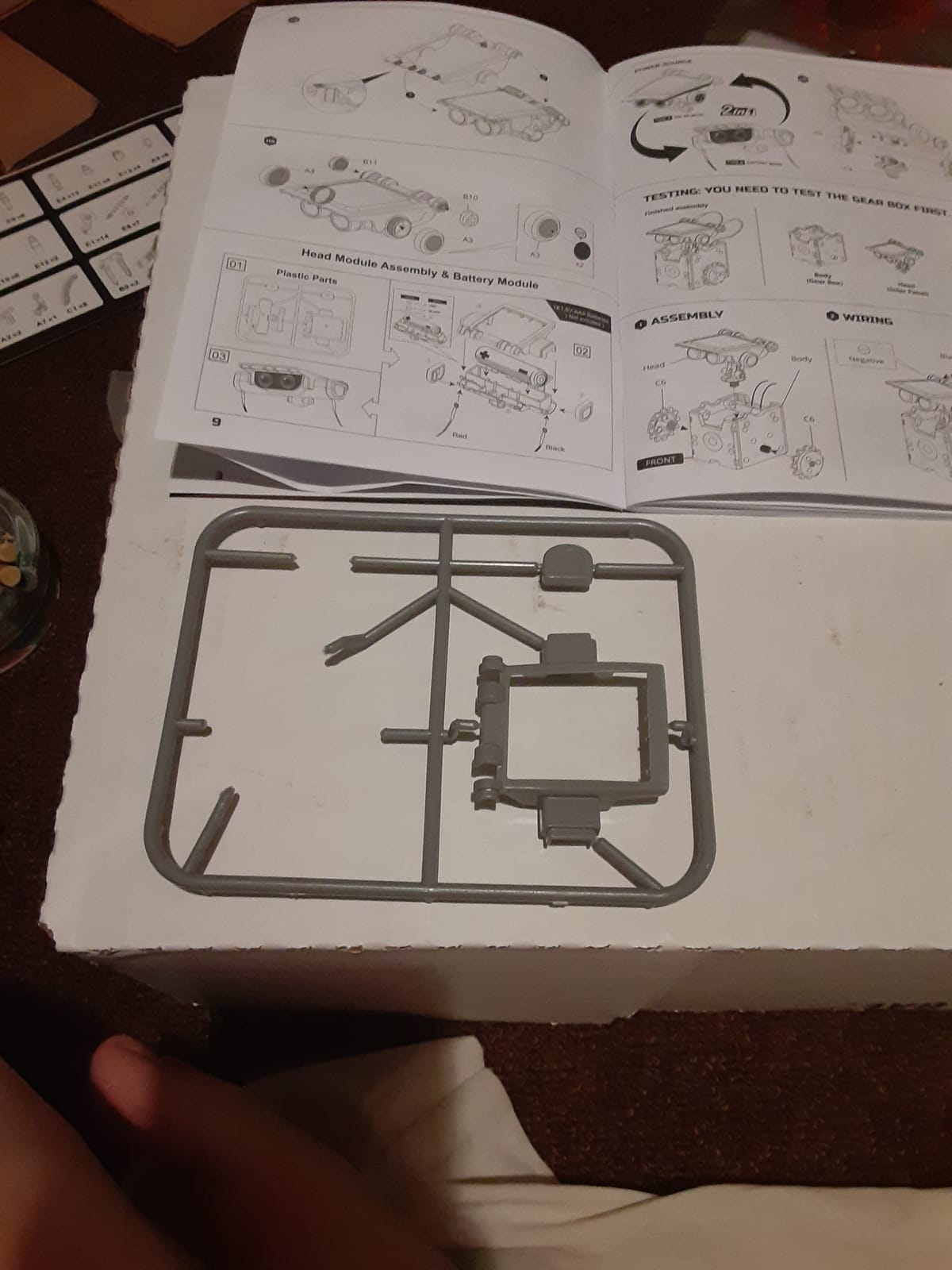
Parts need clipping free and the edges filed before assembly, which adds time for younger children and is the most common practical complaint in reviews. Set aside twenty minutes with small clippers and a file, and the rest of the build goes smoothly.
Small parts can crack when a model is taken apart to switch designs, so the reconfiguration step is where plastic tends to fail. Treat the first model as a learning run and handle it gently.
Best for a gift that needs to work on any day
If the robot has to work indoors on a rainy weekend, this is a strong pick. Gift buyers dominate the reviews here and report high enthusiasm, particularly from children who happily take models apart and rebuild them, which is the behaviour that keeps these kits out of the cupboard.
Rated 4.4 across 2340 reviews, the profile is steady rather than outstanding. Nothing about this kit is the category best, and that is precisely why it works so often.
7. AoHu 15-in-1 Solar Robot Kit – The Biggest Set in the Roundup
AOHU Solar Robot Building Kit STEM Gift for Boys Aged 8-13, DIY 15-in-1 Educational Science Building Toy, Solar or Battery Powered Robotic Set for Children Birthday with 212 Pieces
212 pieces
15 models
Solar and battery power
Ages 8+
+ Pros
- Largest set here at 212 pieces and 15 models
- Models include robots cars and boats not just robot figures
- Solar outdoors with a battery option for indoor play
- Clear illustrated manual suited to independent builds
- Cons
- Only one colour variant is offered
- With 15 models the later builds are more involved
- More parts means more sorting before the build starts
Two hundred and twelve pieces, fifteen models, and a set that includes cars and boats alongside robot figures. This is the kit for a child who has already worked through a twelve-in-1 design and wants something that still feels new a month later.
The dual power arrangement lets it run outdoors on solar energy or indoors on batteries, and the step-by-step illustrated manual breaks every stage into discrete steps. The manufacturer rates it 8 and up and specifically mentions homeschool and classroom use.
Why cars and boats matter more than the piece count
Adding non-robot models to a fifteen-robot set sounds like filler and is not. A car teaches wheel and axle mechanics differently from a walking crab, and a boat forces the balance point forward, so the child is solving a different engineering problem rather than repeating the last one.
For a classroom or homeschool setting, that range of mechanisms is worth more than a higher model count would be, because it gives you twelve distinct demonstrations from one box.
Storage and the sorting problem
With 212 pieces there is a genuine preparation cost before the first screw is turned. An hour of bagging and sorting at the start pays for itself across fifteen builds, and skipping it is how pieces end up missing by model three.
Only one colour variant is offered, so there is no choice if a child has a strong preference. The later models are also more involved than the first few, so expect the difficulty curve to climb across the set rather than stay flat.
Who should wait and save up for this one
If your child is under nine, this is a lot of pieces to manage in one sitting. For a confident builder aged nine and up, it is the set most likely to still be interesting after the twelve-in-1 designs run out.
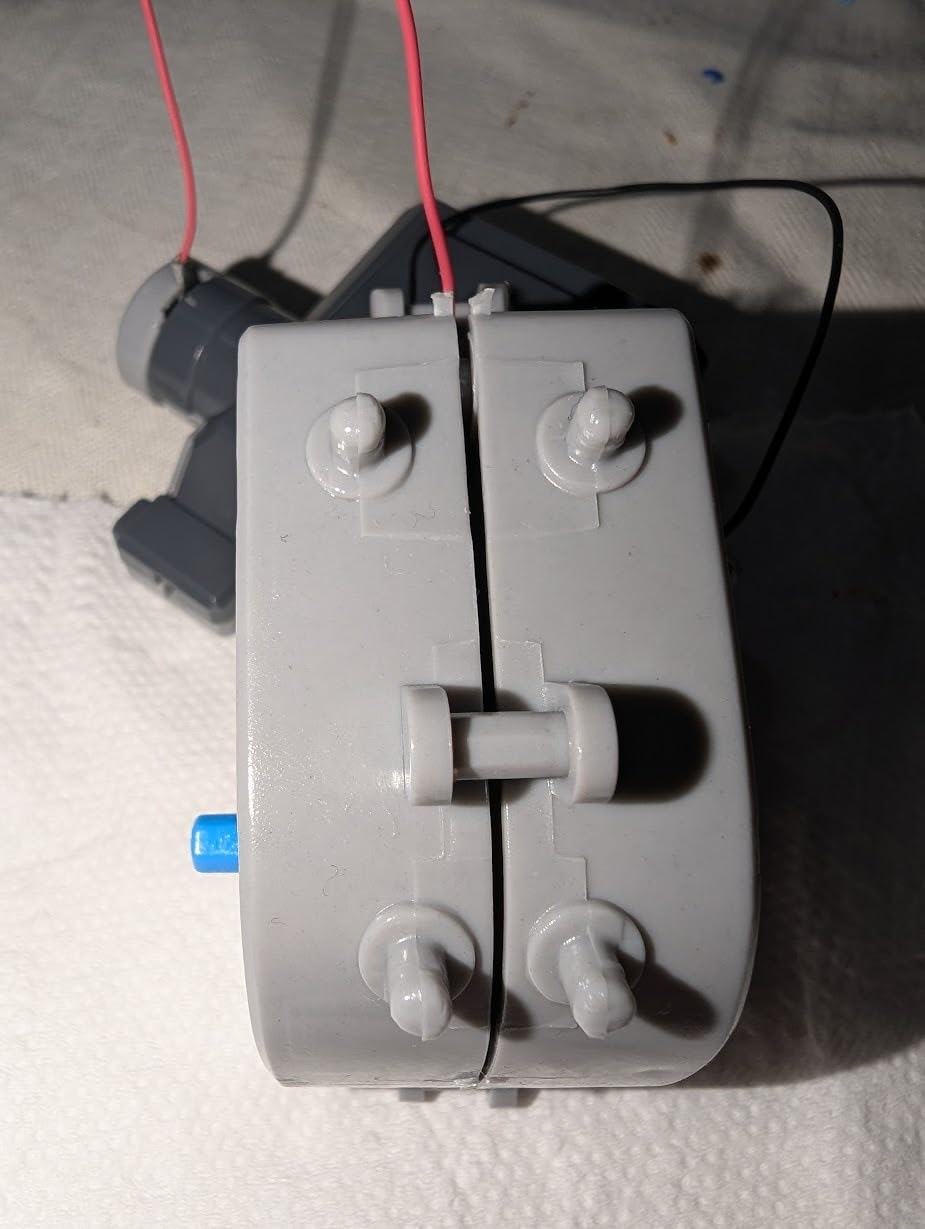
With 1796 reviews at 4.4 and 69 percent five-star ratings, satisfaction tracks the piece count closely. Buyers treat the size of the set as the value and the sorting effort as the fair cost of it.
8. Teach Tech SolarBot.14 – The Best Choice for Kids Aged 10 and Over
TEACH TECH SolarBot.14 STEM Solar Robot Building Kit, Ages 10+
14 transforming designs
Two difficulty levels
Ages 10+
One-year warranty
+ Pros
- Genuinely branded engineering kit from Elenco Electronics
- Fourteen designs split across beginner and advanced levels
- Models transform between configurations
- Backed by a one-year manufacturer warranty
- Cons
- Ages 10 and up is the highest floor in this roundup
- No battery option so it depends entirely on sunlight
- Much of the movement is mechanical transformation rather than driving
This is the only kit here from an established electronics manufacturer, Elenco Electronics, and it is the only one with a stated one-year warranty against manufacturer defects. For a parent who cares about what happens when something breaks, that is worth more than another three models.
Its defining feature is the two-tier structure. The fourteen designs are divided into a beginner level and an advanced level, so you can hand an older child something genuinely difficult without buying a second kit, and the instructions are written around problem solving, analytical thinking and coding skills rather than just assembly.
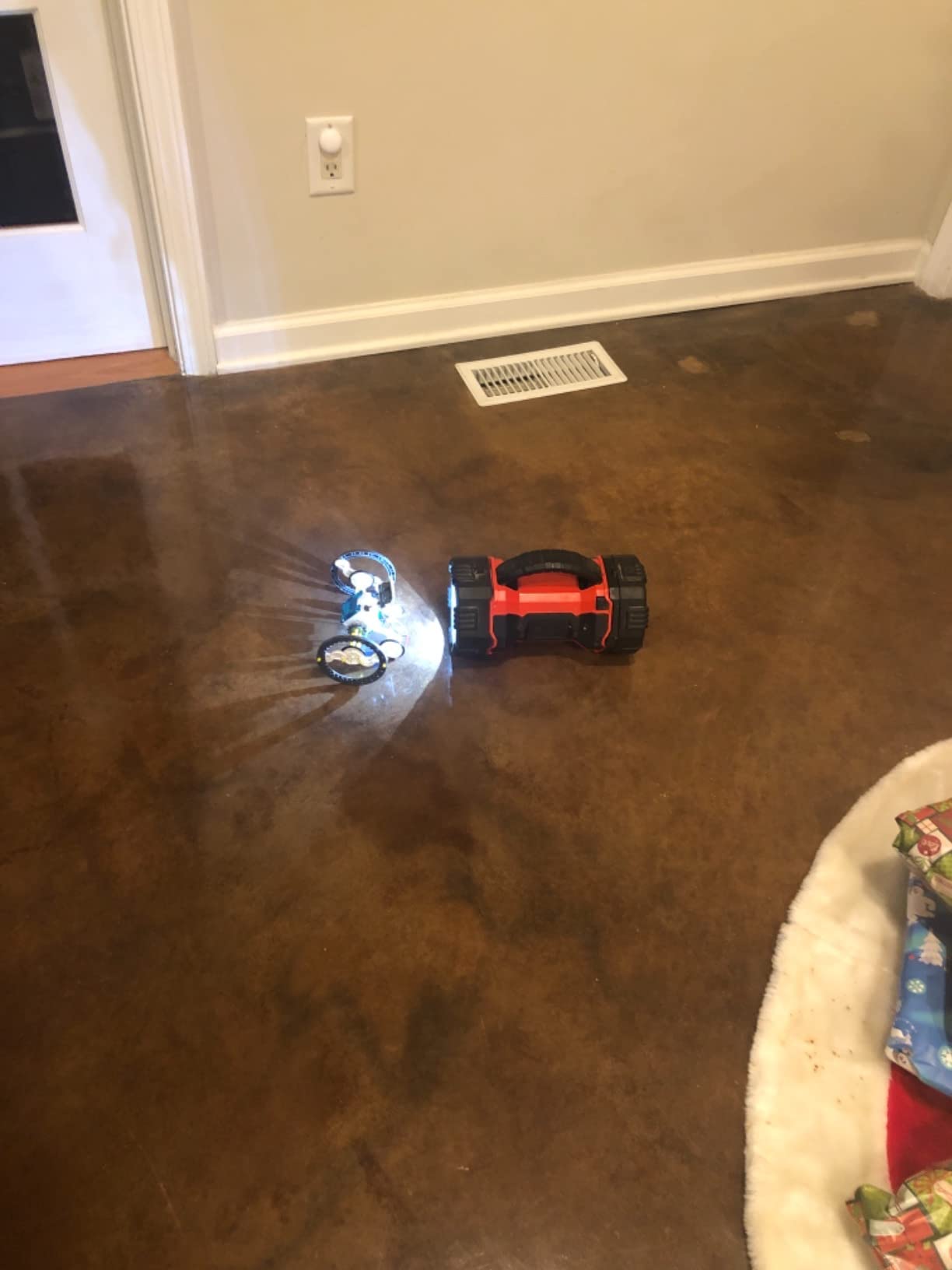
Transforming models versus driving robots
Be clear about what these models do. Many of them transform between configurations, which is mechanically interesting and visible, but they do not drive across the floor on their own the way the wheeled kits here do. A child expecting a self-propelled rover will be disappointed.
That limitation shows up in the ratings distribution. Ten percent of reviews are three star, the highest share of mid-ratings in this roundup, and the recurring explanation is that the movement is transformation rather than independent travel.
Strictly solar, with no fallback
No batteries required means exactly that, and there is no battery option to fall back on. In direct sun the panel drives the models well, but a dark living room ends the session completely, which is a real constraint in winter.
The box is listed at 12.5 by 7.5 by 3.25 inches and includes assembly parts, an English instruction manual and the solar cell. Nothing else is needed.
Best for a child who has outgrown the simple ones
If your child is ten or older, already comfortable with tools, and wants a challenge rather than more models, this is the strongest pick in the roundup. The two difficulty tiers and the warranty are the reasons, and the price sits above the rest of the field for both.
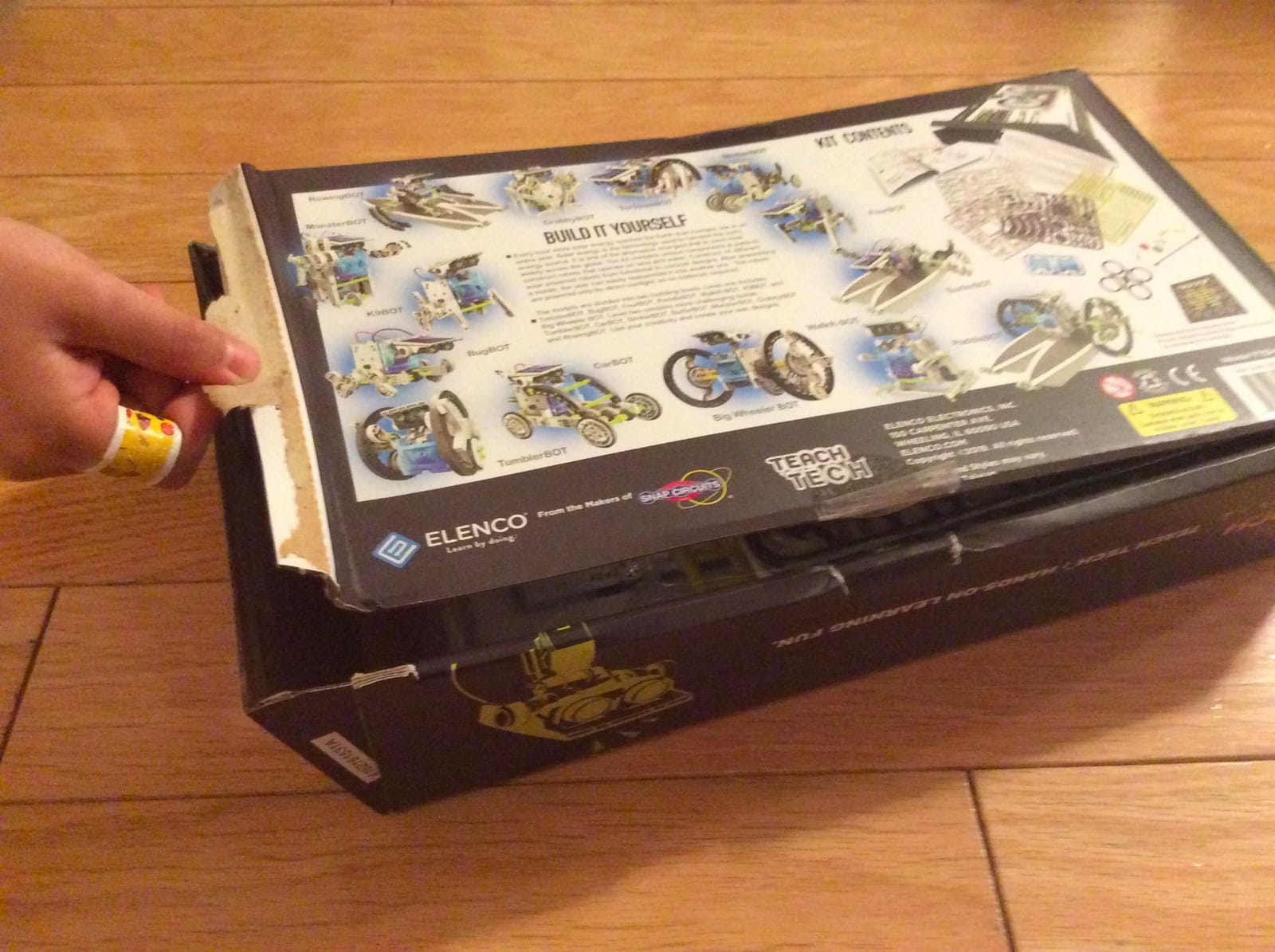
At 1426 reviews and 4.3, the volume is the lowest here, but this is also the only kit with a named manufacturer behind a defect warranty. For a slightly older child that reassurance is worth the premium.
9. AESGOGO 6-in-1 Solar Space Fleet – Best for a Child Who Is Into Space
AESGOGO STEM Projects for Kids Ages 8-12, Solar Robot Toys 6-in-1 Science Kits DIY Educational Building Space Toy, Christmas Birthday Gifts for 7 8 9 10 11 12 13 Year Old Boys Girls Teens.
Six space models
Solar plus rechargeable battery
Ages 8+
ABS
+ Pros
- Six distinct themed models rather than one robot repeated
- Solar panel with a rechargeable battery module
- Rechargeable cell avoids replacing batteries
- Theme broadens the appeal beyond generic robots
- Cons
- Only six models
- the fewest in this comparison
- Pieces are small and the models are complicated to assemble
- One reviewer questioned whether finished models function
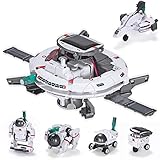
Everything else in this roundup builds variations on a robot. This one builds a space station, a robot dog, an astronaut, an explorer, an exploration vehicle and an aircraft, and for a child fixated on space that thematic difference does more than another four modes would.
The power setup is the other reason to look here. The panel works with a rechargeable battery module that can itself be recharged, which reviewers describe as the design parents respond to most warmly because it removes the sunlight dependency without introducing loose batteries.
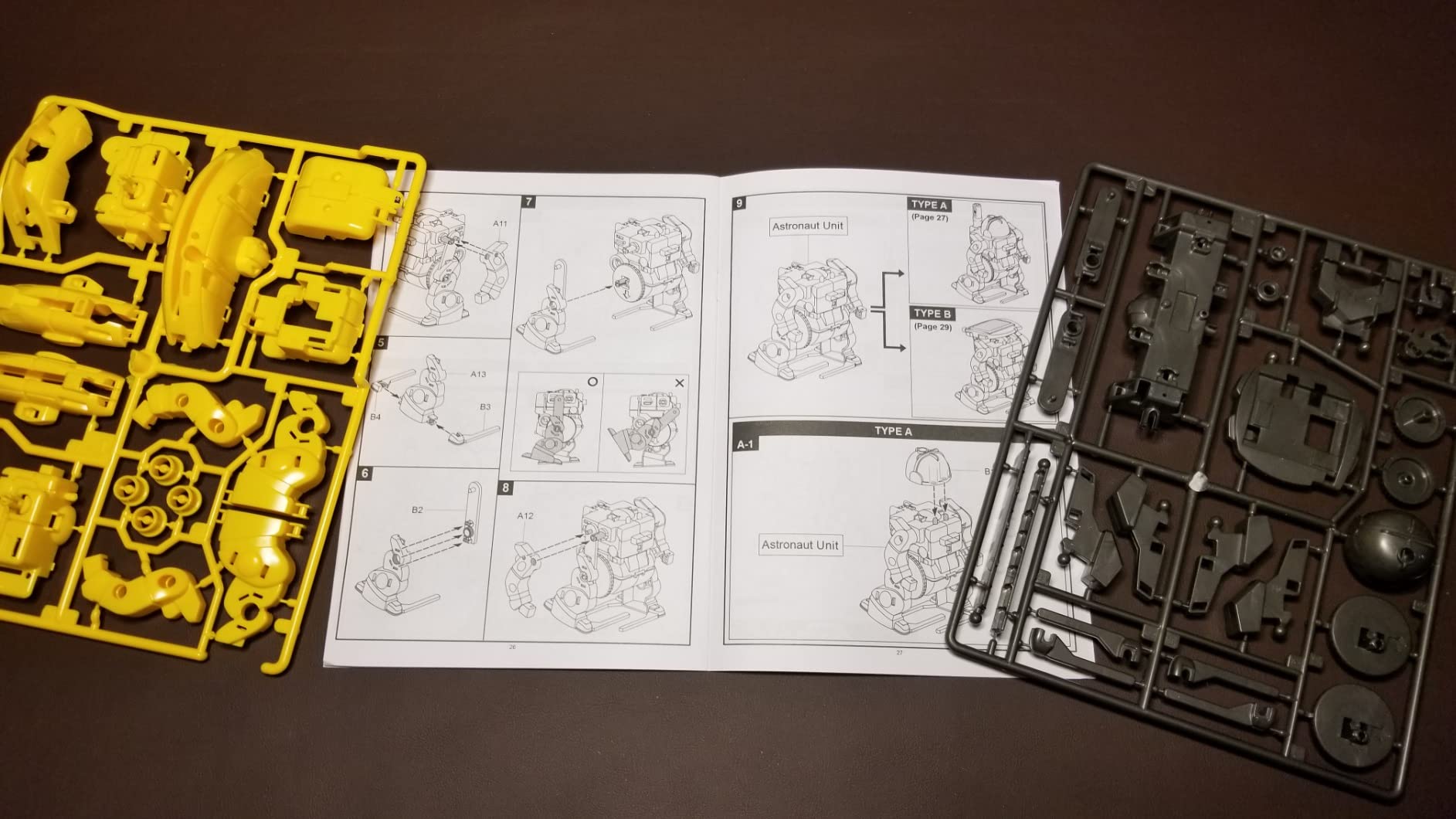
Rechargeable beats replaceable for indoor play
A rechargeable cell charged through the module keeps the toy self-contained. Nothing to buy when it runs flat, and the same cell handles both indoor and outdoor sessions, which is a real convenience compared with kits that need AA cells on hand.
It also means the robot can be demonstrated on a cloudy afternoon, which for a space-mad child is the difference between a prop and a working machine.
Assembly is the hard part
The pieces are small and the models are complicated to put together, and both complaints appear repeatedly. A space station with many small sub-assemblies is a longer build than a wheeled robot, so plan for an evening rather than an afternoon.
At 9.44 by 7.08 by 2.55 inches and 0.28 kg, it is the lightest kit here, which is helpful for a younger child to carry to a table but means fewer internal parts per model.
Best for a themed gift
Choose this when the child already loves space, because the theme is doing the work that model count does elsewhere. It is a fine first solar robot and a weak second one, since six designs is the fewest in this comparison.
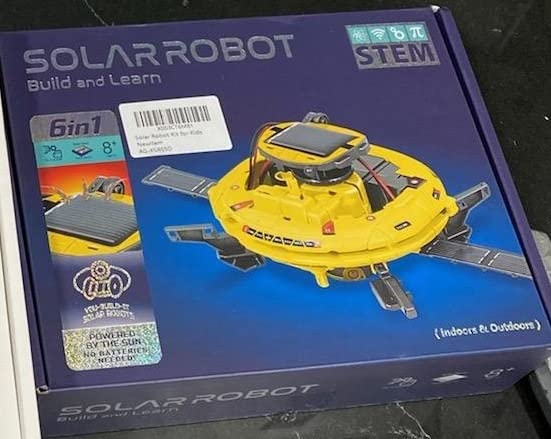
Rated 4.4 across 1352 reviews with only 2 percent two-star ratings, the lowest mid-negative share here, the reaction is overwhelmingly positive from parents and grandparents buying a gift. The substantive criticism is concentrated on assembly difficulty, not on whether the robots move.
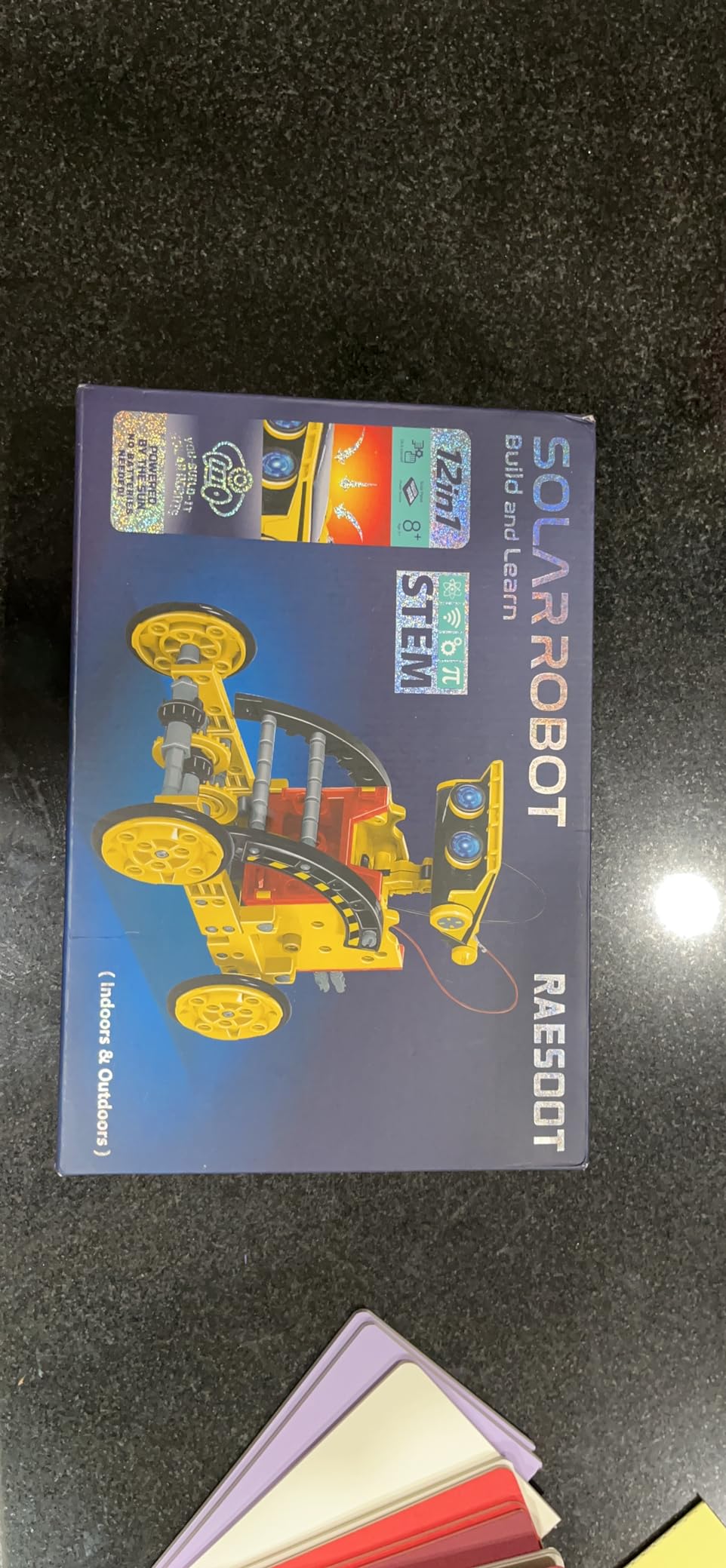
10. RAESOOT 12-in-1 Solar Robot Kit – Best Mix of Water Capability and Organisation
RAESOOT STEM Toys for Kids Age 8-13, 12-in-1 Solar Robot Building Science Kits for Boys Girls Teen Age 9 10 11 12, Engineering Christmas Birthday Gifts for 8+ Year Old Boys
190 parts
12 models
Runs and swims
Ages 8+
+ Pros
- Robots run in sunlight and swim in water
- Highest five-star share of any kit we rated
- Labeled baggies and an illustrated booklet keep parts organised
- Solar panel can be tested under a halogen bulb
- Cons
- About 45 minutes of part cutting and bagging before building
- Wires are described as very breakable
- Body is hard to disassemble without breaking
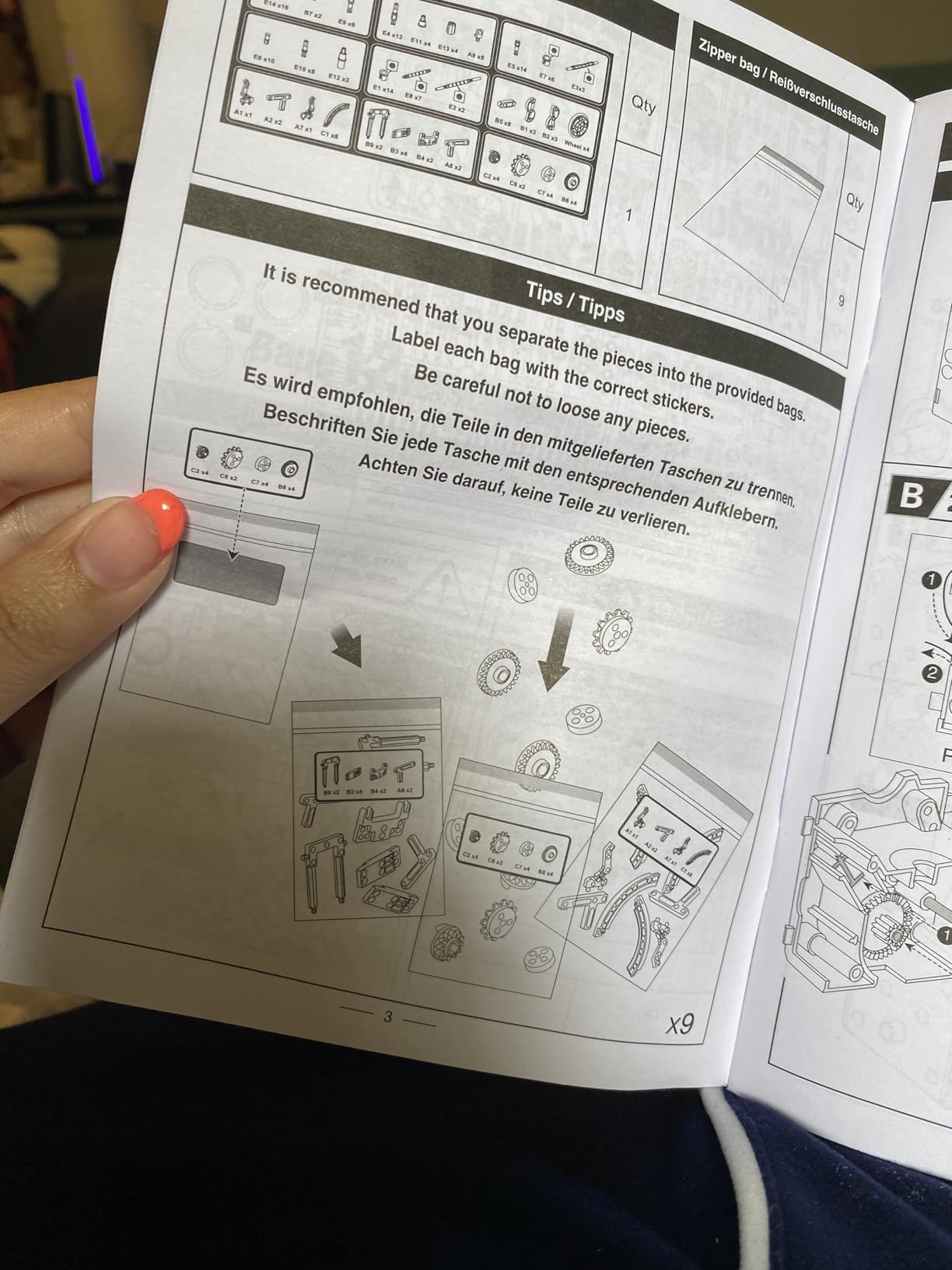
The combination that wins this one over the other twelve-in-1 kits is running and swimming from the same parts, plus the most organised packaging in the roundup. Pre-printed label stickers and baggies mean a 190-piece set stays sorted through the build rather than becoming a search problem.
Rated 4.4 across 1541 reviews, it also has the highest share of five-star ratings of any kit we measured, at 73 percent. The age listing is 8 and up with a stated range of 8 to 14, and the manufacturer is unusually candid that 190 parts is not an easy project.
Swimming capability and how to test it safely
Models that run under the sun and swim in water are rare in this price bracket, and the bathtub version is the one children ask to repeat. Keep water use to a shallow basin, dry the panel and the motor housing fully afterwards, and do not submerge the panel itself.
One practical tip from the community side of this category: you can check that the drive works under a halogen bulb before taking it outside, which tells you whether the motor and gear train function at all before you blame the weather.
Organisation is the real feature
Labeled parts baggies and a picture-oriented booklet with a section per robot make a 190-piece set manageable for an eight-year-old. That preparation discipline is what separates this from kits that lose pieces by model four.
The booklet also states plainly that the build is difficult enough for 8 to 12 year olds, which is more honest labelling than most competitors provide.
The prep stage is the price of the system
Roughly 45 minutes of cutting and bagging tiny parts comes before the first model is started. Some parts need filing before the gears mesh properly, and that is normal preparation rather than a fault.
The complaints that do appear are consistent: wires described as very breakable, and a body that is hard to disassemble without breaking when the manual says to rebuild a failed section. One reviewer also reported a robot that stopped working three days after assembly, which points to a connection fault rather than anything the child did.
How Solar Robot Kits Actually Work, and the Sunlight Problem
A solar robot kit is a build-it-yourself STEM toy in which a small solar panel converts sunlight into electricity to run a motor and gear train, so a child assembles several robot designs that move on land or water using no batteries at all. The mechanism is simpler than it looks and there are four stages to it.
Step one, the panel. A small photovoltaic cell mounted on the robot body absorbs light and produces a direct current. Direct sun delivers a great deal more current than any indoor source, and the difference is not subtle.
Step two, the motor. That current reaches a small DC motor, which spins only when enough current arrives. Below its threshold the motor buzzes and stops rather than turning, which is the crawling or motionless behaviour most parents describe.
Step three, the gearbox. The motor drives a train of transmission gears that transfer the rotation to the wheels or the walking limbs, stepping the speed down and multiplying the torque. This stage is the mechanical heart and also the most fragile part of every kit here.
Step four, polarity. Some kits let you adjust the polarity of the panel, meaning you can flip which way the motor turns and reverse the robot’s direction without rebuilding anything.
Now the honest part. Under a ceiling light or a shaded window, the panel produces a fraction of the current it produces in direct sun, and the motor falls below its threshold. That is why a solar robot can crawl for ten seconds and then sit still. It is physics, not a broken toy.
Four ways to make a solar robot work indoors
First, hold a flashlight close to the panel. This is the simplest fix and the manufacturers who mention it, including Sillbird and AESGOGO, are right that it works on larger panels and only just manages on smaller ones. Second, move the robot to a sunny window and turn it periodically to follow the sun.
Third, choose a dual power kit so the battery takes over when the light does not. The COBFDHA, KIDWILL LAND, AESGOGO, AoHu and RAESOOT kits all offer this in some form, either through a battery module or a cell that the panel itself charges.
Fourth, build in summer and save the robot for outdoor use. This sounds obvious, but it is the honest answer for a family with no outdoor space, and it is better to know that before buying than three weeks after.
Troubleshooting a solar robot that will not move
Check the light first, and be specific: direct sun, not a window with a screen or blind in the way. Then check the gear train, because a drive that is slightly out of alignment will stall even with strong light, and the fix is to rebuild that section rather than force the gears.
Next, check the motor terminals are seated and that any wire has not been pulled loose during reconfiguration, since thin wires are the most common break point. Finally, look at the panel itself. A scratched or cloudy panel collects materially less light, and wiping it with a dry cloth is a genuine fix that costs nothing.
How to Choose a Solar Robot Kit for Your Child
The decision comes down to four things, in this order: how much light you have, how old your child is, how patient you are for a first build, and how long you want the toy to last before the pieces go back in the box.
Start with light, not with the model count. Count your direct sun hours before you count robots. A house with a south-facing garden and a bright playroom can run any kit on this list. A basement flat should go straight to a dual power option, because no amount of model variety rescues a robot that never moves.
Match the age label to reality, not to the box. Manufacturers in this roundup claim everything from 8 up to 15, and one of them rates the same kit for 8 on the packaging and 10 in the technical listing. Read the gear stage out loud. If your child cannot hold a small part steady while pressing a gear onto a shaft, they need an adult for the first build, whichever number is printed.
Do not overvalue model count. A twelve-in-1 and a fifteen-in-1 are frequently the same white-label design with different stickers, and the real difference between brands is manual clarity and gearbox tolerance. The pieces are near-identical across most of this roundup, and one customer discussion on the Woot forum described the Sillbird 12-in-1 as complicated to assemble and low on power specifically because of the panel and gearbox stage, not because of the design.
Decide what happens after the last model. These are single-session build toys more than ongoing playthings, and that is worth being honest about with a child. Kits with land and water capability, including the Bottleboom, AESGOGO and RAESOOT sets, tend to survive longest because there is always a new reason to rebuild.
Age bands, in plain terms
For ages 5 to 7, expect to do most of the building yourself. The Raesoot and Lucky Doug sets both list 8 and up, and neither will hold a five-year-old’s attention through a 190-piece preparation stage.
For ages 8 to 10, this is the sweet spot for the whole category, and the twelve-in-1 and thirteen-in-1 kits are the natural fit. The Bottleboom, rated 8 to 15, is the one our youngest tester managed most independently. For ages 11 to 14, move up: the Teach Tech SolarBot.14 with its two difficulty levels and one-year warranty, or the 15-in-1 AoHu set with 212 pieces and cars and boats as well as robots.
Safety and small parts
Every kit here contains dozens of parts small enough to be a choking hazard, and several manufacturers list a 3 and up warning alongside their 8 and up recommendation. The ones that state their material most carefully are worth noting: Lucky Doug describes all pieces as BPA-free, non-toxic and skin-safe ABS, and both the Bottleboom and AESGOGO sets describe non-toxic ABS with smooth edges and no burrs.
File and flush every clipped part before assembly. A raw sprue nub is both a safety issue and the thing most likely to jam a gear, so the same twenty minutes solves both problems.
Replacement parts and support
Missing pieces are normal in a 190-piece set, and brand support varies more than specifications do. Reviewers of the KIDWILL LAND 14-in-1 report customer service replacing a missing piece at no charge, and the Teach Tech SolarBot.14 carries a one-year manufacturer warranty against defects. For the white-label style kits, expect to handle replacements through the standard returns process instead.
If your child is hard on toys, that difference in support is worth more than an extra model. A robot missing one gear is a bin of parts forever.
Solar vs. Battery vs. Coding Robot Kits
Many parents searching for robot kits for kids land on lists of app-based coding robots and find them unusable, because the two categories serve different purposes and the search results rarely say so.
A solar robot kit teaches renewable energy, gears and mechanical engineering with no screen and no app. A battery-powered robot kit, like the dual power options in this roundup, does the same build but does not care about the weather. An app-based coding robot, which is what most broad robot kit lists actually recommend, teaches programming logic, sensors and sequencing instead, at the cost of requiring a phone or tablet.
If the goal is a screen-free afternoon that ends with a working machine, solar and dual power kits are the right category. If the goal is computational thinking and a child already enjoys screens, an app-based kit is a better use of the same afternoon.
What solar kits do not do is teach coding, and the Teach Tech SolarBot.14 comes closest by writing its instruction material around problem solving and coding skills even though the robot itself runs on sunlight with no program to write.
Frequently Asked Questions
Do solar robot kits require batteries?
Most do not. A pure solar robot kit runs directly from its photovoltaic panel in direct sunlight, with no batteries at all. A growing number of dual power kits accept AA, AAA or a rechargeable battery module as a fallback for indoor play, and the panel charges the rechargeable version. Check the listing carefully, because some kits list batteries for accessories rather than the robot itself.
Are solar robot kits good for kids?
Yes, for roughly ages 6 to 12 they are a strong screen-free STEM activity that teaches renewable energy, gears and mechanical engineering without an app or a phone. The honest caveat is that they are single-session build toys rather than ongoing playthings, and they work best in a sunny home or as a parent-child project rather than as a solo indoor activity.
What is a good robot kit for a 10-year-old?
For a 10-year-old, the Teach Tech SolarBot.14 is the strongest challenge because it splits fourteen designs into beginner and advanced levels and carries a one-year warranty. The Bottleboom 13-in-1 is a good middle pick, with the widest range of models and the simplest independent build for that age. The RAESOOT 12-in-1 suits a child who wants robots that can also swim.
Do solar robots work indoors?
Partly. A small photovoltaic panel produces far too little current under a ceiling light for most motors to run, so the robot crawls weakly or sits still. A flashlight held close to the panel works, especially on kits with a larger panel such as the Sillbird 12-in-1. The reliable indoor answer is a dual power kit that switches to batteries when the light runs out.
Why is my solar robot not moving?
Check the light source first, since anything short of direct sun leaves the motor below its threshold. Next, check that the gear train is aligned, because a slightly misaligned gearbox stalls even in strong light. Then confirm the motor terminals are seated and no thin wire was pulled loose, and wipe the panel clean, since a scratched surface collects much less light.
Which Solar Robot Kit Should You Buy in 2026?
If you want the single best all-round pick, take the Sillbird 12-in-1. It has the largest review history here, a bigger panel than most of its competitors, a flashlight fallback, and instructions clear enough that a child can work through several models with you nearby. If your child is younger and building more independently, the Bottleboom 13-in-1 gave us the smoothest experience, with land and water models and the safest-feeling parts.
If you live somewhere without reliable direct sun, ignore model count entirely and buy power. The COBFDHA 6-in-1 runs from the panel or from batteries, and the KIDWILL LAND 14-in-1 needs only a single AAA cell for indoor sessions while giving you fourteen models to work through.
If your child is ten or older and wants a real challenge, the Teach Tech SolarBot.14 with two difficulty levels and a one-year warranty is the right spend. If you want the largest set that will keep a confident builder interested for months, the AoHu 15-in-1 with 212 pieces covers robots, cars and boats. And if space is the obsession, the AESGOGO Solar Space Fleet gives you six themed models and a rechargeable battery module.
Whatever you choose, set aside twenty minutes to clip and file the parts, build the first model together, and put it in direct sun before anyone decides whether it works. That single afternoon tells you more than any rating on the page.