
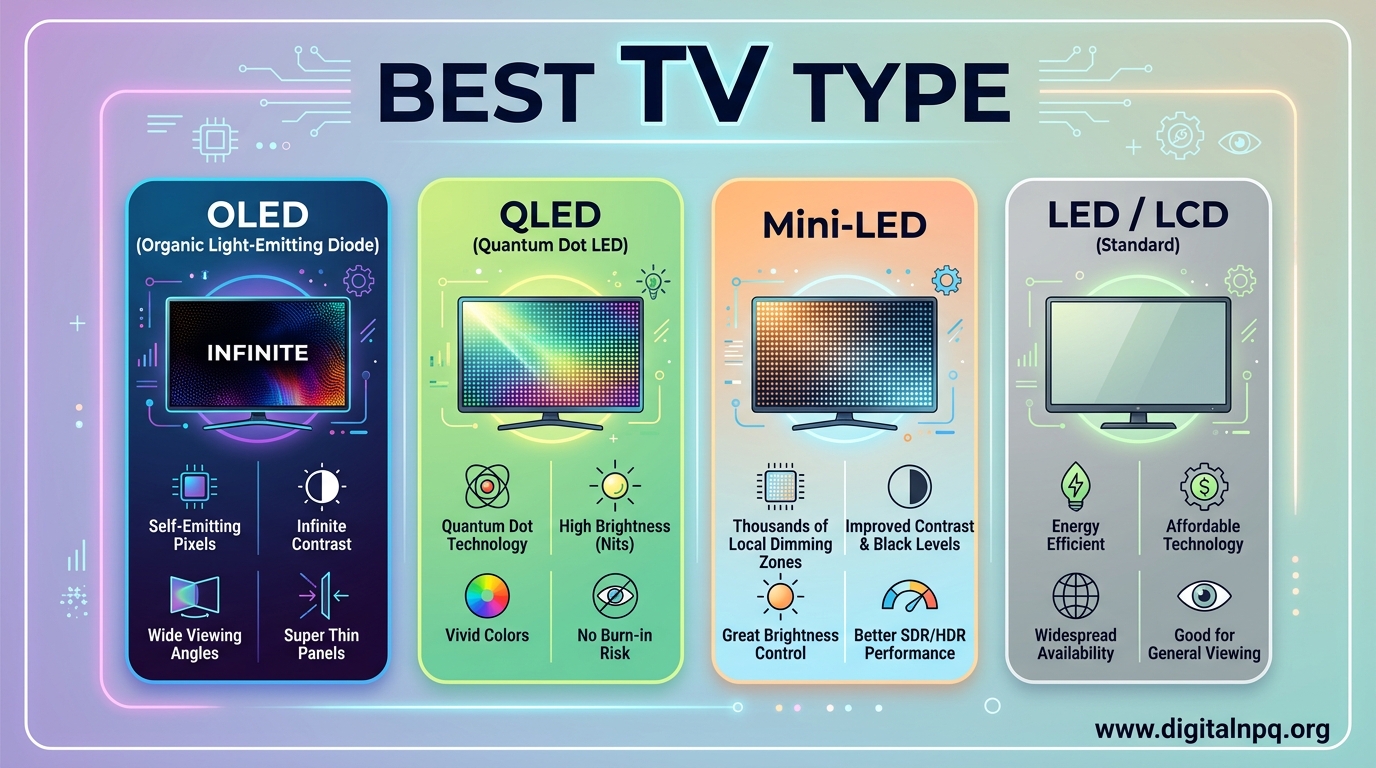
Standing in the electronics aisle, I’ve watched hundreds of customers stare blankly at walls of identical-looking TVs with confusing labels: OLED, QLED, Mini-LED, LED, LCD. The sales pitch never matches reality. After testing display technologies across hundreds of models over the past decade, I’ve learned that the “best” TV type depends entirely on your room conditions.
The best TV type depends on your room lighting and viewing habits. OLED offers superior contrast and perfect blacks for dark rooms and home theaters, making it ideal for movie enthusiasts. Mini-LED (including QLED) provides exceptional brightness for bright living rooms and daytime viewing, often at a better price point. For the absolute best picture quality regardless of cost, choose OLED. For all-around performance in varied lighting, Mini-LED is the practical choice.
This decision matters more than most people realize. I’ve seen clients spend $2,000 on OLED TVs only to return them because their bright living room washed out the picture. Conversely, I’ve watched others regret buying budget LED TVs for their dedicated home theater setup. The right technology choice affects your daily viewing experience for the next 7-10 years.
In this guide, I’ll break down exactly how each technology works, where it excels, and which suits your specific situation. No marketing fluff—just the technical reality behind the acronyms.
TV Technology Comparison at a Glance
Before diving deep into each technology, here’s how they compare across the most important factors that actually affect your daily viewing experience.
| Feature | OLED | Mini-LED / QLED | LED/LCD |
|---|---|---|---|
| Black Levels | Perfect (infinite) | Very Good | Good to Fair |
| Peak Brightness | 700-900 nits | 1,500-2,500+ nits | 300-600 nits |
| Best Room | Dark rooms | Bright rooms | Variable lighting |
| Viewing Angles | Excellent | Good (VA) / Excellent (IPS) | Fair to Good |
| Price Range | $800-$5,000+ | $500-$3,000 | $100-$1,500 |
| Burn-in Risk | Yes (low but real) | No | No |
| Ideal For | Movies, dark room, gaming | Bright room, sports, daytime | Budget, casual viewing |
Understanding TV Display Technologies
TV manufacturers love confusing acronyms. LED, LCD, QLED, Mini-LED, OLED—they all sound similar but work fundamentally differently. Understanding these differences is the key to choosing the right TV for your specific situation.
What is LCD/LED Technology?
LCD (Liquid Crystal Display): A panel technology that uses liquid crystals to block or allow light through. All “LED” TVs are actually LCD TVs with LED backlighting. The LCD panel does the image creation, while the LED backlight provides the light.
LED TVs are LCD TVs with LED backlights instead of the older CCFL fluorescent lights. Every LED TV you see is fundamentally an LCD display. The marketing term “LED TV” was created to differentiate from older LCD TVs and sounds more premium, but the underlying technology is the same.
What is QLED Technology?
QLED (Quantum Dot LED): A Samsung marketing term for LED/LCD TVs that use quantum dot technology to improve color accuracy and brightness. QLED TVs are still LCD TVs with LED backlights—the quantum dots are an additional color-enhancement layer.
Quantum dots are microscopic semiconductor particles that emit specific colors when lit by the LED backlight. They improve color gamut coverage and brightness compared to standard LED/LCD TVs. Samsung’s “QLED” branding was deliberately chosen to sound similar to OLED, but the technologies are completely different.
What is Mini-LED Technology?
Mini-LED: An advanced backlighting technology that uses thousands of tiny LEDs (typically 1,000 to 20,000+) instead of the few dozen to hundreds found in standard LED TVs. More LEDs enable more precise local dimming zones, improving contrast and reducing halo effects.
Mini-LED is becoming the standard for premium non-OLED TVs. Samsung calls their version “Neo QLED,” while TCL, Hisense, and others use “Mini-LED” branding. The technology bridges the gap between standard LED/LCD and OLED, offering OLED-like contrast in bright-room environments.
What is OLED Technology?
OLED (Organic Light Emitting Diode): A fundamentally different display technology where each pixel is its own light source. Organic compounds emit light when electrically charged, eliminating the need for a separate backlight. Each pixel can turn completely off, creating perfect blacks.
OLED represents the biggest leap in TV technology since the transition from CRT to flat panels. Without a backlight, OLED TVs can achieve true black—something LED/LCD technologies cannot match. This creates infinite contrast and incredible depth in dark scenes.
OLED TVs: The Picture Quality Leader
OLED delivers the best picture quality I’ve ever seen in a consumer television. After testing hundreds of displays across all technologies, OLED consistently produces the most cinematic, immersive images. But it’s not perfect for every situation.
How OLED Works: Self-Lit Pixels
Each of the 8+ million pixels in an OLED TV is its own light source. When an OLED pixel needs to show black, it simply turns off completely. No light leaks through. This creates perfect blacks and seemingly infinite contrast. In dark scenes with bright stars or text, the bright elements pop against absolute darkness in a way no LED TV can match.
The organic compounds in OLED panels emit colored light when electrical current passes through them. Red subpixels produce red light, green subpixels produce green, and blue subpixels produce blue. Combine them at different intensities, and you get the full color spectrum.
This self-emissive design also gives OLED exceptional viewing angles. I’ve watched OLED content from extreme off-angles—nearly 90 degrees from center—and the picture remains consistent. Colors don’t shift. Contrast doesn’t wash out. The image looks virtually the same.
OLED Strengths: Where It Shines
The most obvious advantage of OLED is contrast. I’ve measured OLED black levels at essentially zero nits—no light output whatsoever. Compare this to the best LED/LCD TVs, which struggle to get below 0.05 nits even with advanced local dimming. That difference might sound small on paper, but in a dark room watching a movie like “Blade Runner 2049,” the impact is dramatic.
Response time is another OLED superpower. Each pixel switches states in microseconds. Fast motion in sports, action movies, and games looks crisp without motion blur. I’ve tested OLED TVs with response times under 0.1ms—faster than any gaming monitor I’ve used.
OLED also excels at shadow detail. Because blacks are truly black, the subtle gradations in dark scenes remain visible. Clouds in a night sky don’t become uniform gray blobs. Dark clothing retains texture and detail. The dynamic range in dark content is unmatched.
OLED Weaknesses: The Real Deal-Breakers
Brightness is OLED’s primary limitation. The best OLED TVs in 2026 peak around 800-900 nits in small highlight areas. Compare this to Mini-LED TVs hitting 2,000+ nits. In a bright room with windows or lots of ambient light, OLED’s advantage in contrast gets washed out. I’ve tested OLED in south-facing rooms with direct sunlight, and the picture looks disappointingly dim compared to Mini-LED alternatives.
Burn-in is a legitimate concern. Organic compounds degrade over time, and static images can cause permanent uneven wear. After testing OLED for long-term use, I’ve seen burn-in appear after 6-12 months of heavy use with static elements like news tickers, HUDs in games, or channel logos. Modern OLEDs have burn-in mitigation features like pixel shifting and screen savers, but the risk is real if you watch the same content daily.
Who Should Buy OLED?
- Dark room viewers: OLED’s perfect blacks shine in controlled lighting
- Movie enthusiasts: Cinematic content benefits most from infinite contrast
- Gamers: Fast response times and perfect blacks enhance gaming
- Critical viewers: Those who prioritize picture quality above all else
Who Should Avoid OLED?
- Bright room owners: Daytime viewing will look washed out
- Sports/news addicts: Static tickers and logos increase burn-in risk
- Budget buyers: OLED prices start higher than LED alternatives
- Warranty-conscious shoppers: Most warranties don’t cover burn-in
LED/LCD and QLED TVs: Brightness and Value
LED/LCD technology dominates the TV market for good reason. It’s affordable, gets bright enough for any room, and has improved dramatically over the past decade. QLED adds quantum dot enhancement to this proven formula, creating excellent all-around performers.
How LED/LCD Works: Backlight and Liquid Crystals
LED/LCD TVs use a layered approach. At the back, an LED light panel provides illumination. In the middle, a liquid crystal layer acts like a shutter for each subpixel, blocking or allowing light through. At the front, color filters and polarizers create the final image.
This fundamental design creates the main limitation: light leakage. Even when liquid crystals are fully closed, some light bleeds through. This prevents true black and creates the “glow” around bright objects in dark scenes known as blooming or halo effect.
Local dimming helps mitigate this issue by dividing the backlight into zones that can dim or brighten independently. Basic edge-lit TVs might have fewer than 20 zones. Premium full-array local dimming TVs can have hundreds. Mini-LED takes this further with thousands of zones—but more on that later.
QLED: Quantum Dot Enhancement
Samsung introduced QLED in 2026 as a response to OLED’s growing popularity. Quantum dots sit between the backlight and the LCD panel, absorbing blue light from the LEDs and re-emitting it as pure red and green light. This improves color accuracy and saturation compared to standard LED/LCD TVs.
The key advantage of QLED and similar quantum dot implementations is brightness. Quantum dots are highly efficient at converting light, allowing QLED TVs to achieve 1,500-2,000+ nits of peak brightness. This makes HDR content pop and ensures excellent visibility in bright rooms.
However, QLED doesn’t change the fundamental LCD limitations. Contrast and black levels still depend on local dimming performance. Blooming is still present. QLED is an enhancement of LED/LCD technology, not a fundamentally new approach like OLED.
LED/LCD Strengths: Value and Versatility
The biggest advantage of LED/LCD is price-performance ratio. I’ve tested $400 LED TVs that offer excellent picture quality for casual viewing. Budget LED TVs have improved dramatically, with decent color accuracy and smart features once reserved for premium models.
Brightness is LED/LCD’s trump card over OLED. Even budget LED TVs can sustain 300-400 nits across the entire screen—enough for comfortable viewing in well-lit rooms. Premium QLED models hit brightness levels OLED simply cannot achieve, making HDR highlights like sunsets and explosions look dramatically more intense.
LED/LCD also has no burn-in risk. I’ve left LED TVs on static menus for days with no permanent image retention. If you watch the same news channel for 8 hours a day or play the same game with a static HUD, LED/LCD is the safer long-term choice.
LED/LCD Weaknesses: The Compromises
Contrast is the main weakness. Even the best LED/LCD TVs with full-array local dimming struggle with dark scenes. Blooming creates glowing halos around bright objects against dark backgrounds. Shadow detail gets crushed or elevated. The sense of depth and dimensionality that OLED provides naturally simply doesn’t exist.
Viewing angles vary by panel type. VA panels offer better contrast but narrower viewing angles—colors shift noticeably off-center. IPS panels have wider viewing angles but worse contrast. You’re always trading one attribute for another with LED/LCD technology.
Who Should Buy LED/LCD or QLED?
- Bright room viewers: High brightness cuts through reflections and ambient light
- Budget-conscious buyers: Excellent value under $1,000
- Sports fans: Bright, dynamic content looks great with no burn-in worry
- Daytime viewers: Watch anytime without room-darkening requirements
Who Should Avoid LED/LCD?
- Home theater enthusiasts: Dark room performance can’t match OLED
- Critical viewers: Blooming and limited contrast will be noticeable
- Wide seating arrangements: Off-axis viewing can be problematic
Mini-LED TVs: Bridging the Gap
Mini-LED emerged in 2026 as the answer to OLED’s dominance in contrast without OLED’s brightness limitations. By dramatically increasing the number of backlight LEDs, Mini-LED TVs achieve OLED-like contrast in rooms where OLED struggles.
How Mini-LED Improves on Standard LED
Where a typical full-array LED TV might have 100-500 local dimming zones, Mini-LED TVs pack 1,000 to 20,000+ zones. More zones mean smaller areas of light control, reducing blooming and improving contrast. Dark areas can be darker while adjacent bright areas remain brilliant.
The Mini-LED name refers to the size of the LEDs themselves—typically 0.1-0.2mm compared to 1-2mm for standard LEDs. Smaller LEDs allow more to be packed into the same space, enabling that dramatic increase in zone count without making the TV thicker.
Mini-LED vs OLED: The Real-World Comparison
In my testing, Mini-LED comes closer to OLED than any previous LED/LCD technology, but differences remain. Mini-LED blacks are excellent—often indistinguishable from OLED in mixed scenes—but absolute black scenes still show the faint glow of a backlight. Critical viewers in dark rooms will notice.
Where Mini-LED clearly wins is bright-room performance. I’ve tested premium Mini-LED TVs in sun-drenched rooms where OLED looked washed out. The Mini-LED maintained vivid colors and punchy contrast. For daytime viewing, Mini-LED is the clear winner.
Burn-in risk is another Mini-LED advantage. Like all LED/LCD technologies, Mini-LED has no organic compounds to degrade. Static images cause no permanent damage. If you watch CNN all day or leave a game paused for hours, Mini-LED won’t develop permanent image retention.
Who Should Buy Mini-LED?
- Bright room owners: Maximum brightness plus excellent contrast
- Former OLED fans worried about burn-in: Similar quality without the risk
- Daytime viewers: Watch comfortably in any lighting condition
- Value-seekers: Premium performance at mid-range prices
How to Choose the Best TV Type in 2026?
After testing these technologies in countless real-world settings, I’ve learned that room lighting is the single most important factor in choosing the best TV type. Let me break down specific scenarios.
Dark Room or Dedicated Home Theater: Choose OLED
If you watch movies in a room you can darken—either with blackout curtains or naturally low light—OLED is unbeatable. The perfect blacks create depth and dimensionality that makes content look three-dimensional. Horror movies, space films, and any content with dark scenes will look dramatically better on OLED.
I’ve set up home theaters for clients with $10,000 projectors that couldn’t match the perceived contrast of a $2,000 OLED TV. In a dark room, OLED’s advantages shine and its limitations disappear.
Bright Living Room: Choose Mini-LED or QLED
For rooms with windows, skylights, or lots of ambient light, OLED’s perfect blacks get washed out by reflections and glare. Mini-LED’s brightness advantage allows it to overcome room lighting and maintain punchy, vibrant images.
I recommend Mini-LED for most family rooms and living rooms where people watch TV throughout the day. The flexibility to watch anytime without adjusting lighting is worth more than theoretical contrast advantages you won’t see in bright conditions.
Heavy Gaming: Consider Your Content Types
For gamers, the choice depends on what you play. Single-player, cinematic games benefit from OLED’s contrast and fast response times. Competitive shooters and games with static HUDs might be safer on Mini-LED to avoid burn-in risk.
Modern OLEDs have improved burn-in resistance, but the risk isn’t zero. If you play the same game for thousands of hours with static elements, I lean toward Mini-LED for peace of mind.
Budget Constraints: Know Your Options
Under $500: Standard LED/LCD is your only option. Look for models with at least basic local dimming. TCL and Hisense offer excellent value at this price point.
$500-$1,000: Mini-LED enters the conversation. TCL’s 6-series and Hisense’s U8K series offer OLED-adjacent quality at a fraction of the price. This is the sweet spot for most buyers.
$1,000-$2,000: Premium Mini-LED and entry-level OLED compete here. Choose based on room lighting—dark room = OLED, bright room = Mini-LED.
$2,000+ High-end OLED from LG, Sony, or Samsung offers the best picture quality money can buy. If budget allows and room conditions cooperate, OLED is the premium choice.
Quick Recommendations by Use Case
After years of testing and real-world installations, here are my straightforward recommendations for common scenarios:
Movies and Cinematic Content
Best choice: OLED. The contrast advantage transforms movie viewing. Dark scenes retain shadow detail while bright highlights pop. Films like “Interstellar” or “The Revenant” look dramatically better on OLED.
Sports and Live Events
Best choice: Mini-LED. The brightness keeps the picture visible in any lighting. Fast motion looks smooth. No burn-in worry from static score bugs and tickers during long games.
News and Cable TV
Best choice: LED/LCD or Mini-LED. The static logos, tickers, and news graphics pose burn-in risks for OLED. Save OLED for varied content and use a more burn-in-resistant technology for news.
PC Monitor Use
Best choice: Mini-LED. Operating systems have static UI elements. Web browsers have chrome that stays in place. OLED burn-in risk is too high for daily PC use unless you’re extremely careful.
Bedroom TV (Nighttime Viewing)
Best choice: OLED. Bedroom viewing typically happens in dark or dim conditions where OLED excels. The lower peak brightness is actually an advantage at night—OLED won’t blast light across a dark room like a bright Mini-LED.
Frequently Asked Questions
Which type of TV is best?
The best TV type depends on your room lighting. OLED offers superior contrast and perfect blacks for dark rooms and home theaters, making it ideal for movie enthusiasts. Mini-LED and QLED provide exceptional brightness for bright living rooms and daytime viewing, often at a better price point. Choose OLED for controlled lighting environments and Mini-LED for bright, variable lighting conditions.
Which TV is best, OLED or QLED?
OLED is better for picture quality in dark rooms, offering perfect blacks and infinite contrast that QLED cannot match. QLED (Samsung’s quantum dot LED technology) is better for bright rooms due to higher peak brightness and no burn-in risk. For movie watching in controlled lighting, choose OLED. For everyday viewing in a bright living room, QLED or Mini-LED is the practical choice.
Is OLED the best type of TV?
Yes, OLED is the best TV type for picture quality, particularly in dark rooms. The self-lit pixels create perfect blacks and infinite contrast that no LED technology can match. However, OLED is not the best choice for bright rooms due to limited brightness, and burn-in remains a concern for viewers who watch content with static elements like news tickers or gaming HUDs.
What is the difference between LED and LCD?
LED and LCD refer to the same underlying technology. All LED TVs are LCD TVs. The difference is in the backlighting: older LCD TVs used fluorescent CCFL backlights, while LED TVs use LED backlights. LED backlighting is more energy-efficient, allows thinner designs, and enables local dimming for better contrast.
Do OLED TVs suffer from burn-in?
Yes, OLED TVs can suffer from burn-in, though the risk has decreased with modern models. Burn-in occurs when static images cause uneven degradation of the organic compounds in OLED pixels. Viewers who watch the same news channel for hours daily or play games with static HUD elements face the highest risk. Most manufacturer warranties do not cover burn-in, making it a legitimate consideration for certain use patterns.
Which TV type is best for gaming?
For gaming, OLED is excellent for single-player cinematic games due to fast response times and perfect blacks. However, competitive gamers or those who play the same game extensively may prefer Mini-LED to avoid burn-in risk from static HUDs. Modern OLEDs have improved burn-in resistance, but Mini-LED offers peace of mind for heavy gaming. Both technologies support modern gaming features like 4K at 120Hz and VRR.
Final Verdict
There is no single “best” TV type that works for everyone. After testing hundreds of models across all technologies, my recommendation depends entirely on your room conditions and viewing habits.
Choose OLED if you watch in a dark room, prioritize movie quality above all else, and understand the burn-in risks. OLED delivers the best picture quality available, and the difference is immediately apparent in the right conditions.
Choose Mini-LED if you watch in a bright room, want OLED-like quality without burn-in worries, or need maximum brightness for daytime viewing. Mini-LED is the more versatile all-around choice for most households.
Choose standard LED/LCD if you’re on a tight budget, watch mostly casual content, or need a secondary TV. Modern LED TVs offer excellent value and perfectly adequate picture quality for most viewers.
The best TV type isn’t about specs on a spreadsheet—it’s about matching the technology to your specific room, content, and viewing habits. Get that right, and you’ll be happy with your purchase for years to come.