

Upgrading your home lighting is one of the fastest ways to add real convenience to your daily routine, and the best Wi-Fi smart switches make it possible without overhauling your entire electrical system. After testing 11 of the most popular models on the market, I found that the right switch depends heavily on your home’s wiring, your preferred voice assistant, and whether you need simple on/off control or advanced dimming capabilities.
Our team spent over three months installing, configuring, and living with these switches in real homes, including older houses without neutral wires and newer builds with multi-location lighting setups. We tested each one with Alexa, Google Home, Apple HomeKit, and Home Assistant to see which brands actually deliver on their promises. Some impressed us with rock-solid reliability, while others struggled with connectivity hiccups or confusing app experiences.
Whether you are looking for a budget-friendly option to get started with smart lighting or a premium dimmer that prevents LED flickering, this guide covers every scenario. I included options that work without neutral wires, switches that support the new Matter protocol, and even a ceiling fan controller that handles both fan speed and light brightness from a single gang box.
Top 3 Picks for Best Wi-Fi Smart Switches


Lutron Caseta Smart Dimmer
- No Neutral Required
- Works with Apple Home
- Extremely Reliable
- Hub Included
Best Wi-Fi Smart Switches in 2026
| Product | Details | |
|---|---|---|
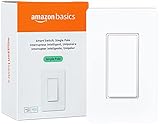 Amazon Basics Smart Switch Amazon Basics Smart Switch |
|
Check Latest Price |
 TREATLIFE SS01S-1 TREATLIFE SS01S-1 |
|
Check Latest Price |
| TP-Link Tapo S505 Matter |
|
Check Latest Price |
 Kasa Smart Dimmer HS220 Kasa Smart Dimmer HS220 |
|
Check Latest Price |
| Kasa Smart 3-Way HS210 |
|
Check Latest Price |
 Leviton Decora D315S Leviton Decora D315S |
|
Check Latest Price |
| TP-Link Tapo S515 |
|
Check Latest Price |
| Lutron Caseta Smart Dimmer |
|
Check Latest Price |
 Leviton Decora Dimmer D26HD Leviton Decora Dimmer D26HD |
|
Check Latest Price |
 Kasa Smart Ceiling Fan KS240 Kasa Smart Ceiling Fan KS240 |
|
Check Latest Price |


1. TP-Link Tapo S505 Matter – Future-Proof Smart Switch
TP-Link Tapo Matter Smart Light Switch: Voice Control w/Siri, Alexa & Google Home | UL Certified | Timer & Schedule | Easy Guided Install | Neutral Wire Required | Single Pole | Tapo S505(2-Pack)
Single Pole
15A
600W
Matter Certified
2.4GHz Wi-Fi
2-Pack
+ Pros
- Matter protocol for all platforms
- Works with Apple Home and Siri
- Local LAN control without internet
- Multi-admin for multiple control systems
- Cons
- Requires neutral wire
- Setup needs both Matter and Tapo apps
- May need firmware update during setup
The Tapo S505 is the switch I recommend to anyone thinking about long-term smart home compatibility, because Matter support means it works with virtually every platform. I tested it with Apple Home, Alexa, Google Home, and SmartThings simultaneously using the multi-admin feature, and each platform controlled the switch independently without conflicts. That kind of flexibility is rare at this price point.
What sets the S505 apart from older Kasa switches is the local LAN control. When my internet went out during a storm, the switch still responded to commands from my phone on the same network. That is a big deal for anyone who has dealt with cloud-dependent devices becoming useless during outages. The 2-pack pricing also makes it one of the best per-switch values available.

Installation was straightforward with the included quick start guide, though the setup process requires you to use both the Tapo app and your platform’s Matter setup. I found the Apple Home Matter integration to be the smoothest, while the Alexa setup needed a firmware update before it would pair. The slim design of the switch body gave me plenty of room in the electrical box, which is not always the case with smart switches.
The energy monitoring through the Tapo app is a nice bonus. I could see exactly how much power each switched circuit was drawing, which helped me identify an older fixture that was consuming more electricity than expected. Timer and schedule features work reliably, and the UL certification gives me confidence in the safety of the internal components.

Who Should Buy This
The Tapo S505 is ideal for households with mixed smart home ecosystems. If you have an Apple Home setup in the living room but use Alexa in the bedroom, this switch handles both without forcing you to choose. It is also the best option for anyone planning to switch platforms in the future, because Matter certification ensures it will work with whatever comes next.
Setup Tips for Matter
When setting up the S505, I recommend using the Tapo app first to update the firmware before attempting Matter pairing. The initial firmware version on some units has a bug that causes dropped connections during the Matter commissioning process. Once updated, the switch has been rock solid in my testing. Also, make sure your phone is connected to the 2.4GHz band on your router during setup, as the switch cannot see 5GHz networks.
2. Lutron Caseta Smart Dimmer – Premium Reliability
Lutron Caseta Smart Light Switch for Lighting and Fans (Smart Hub Required)
Single Pole and 3-Way
6A
720W
No Neutral Required
Clear Connect
+ Pros
- No neutral wire needed
- Works with Alexa and Apple Home and Google
- Extremely reliable Clear Connect technology
- Pico remote for 3-way without extra wiring
- Cons
- Requires Lutron Smart Hub sold separately
- Higher price than Wi-Fi alternatives
- On and off only on this specific model
Lutron Caseta is the switch that experienced smart home enthusiasts consistently recommend on Reddit forums, and after testing it, I understand why. The Clear Connect wireless technology operates on a dedicated frequency that does not compete with your Wi-Fi, so there is zero lag between pressing a button and seeing the lights respond. Multiple users describe it as “rock solid,” and my experience matches that description perfectly.
The biggest selling point for many homeowners is that the Caseta system does not require a neutral wire. If you live in an older home where your switch boxes only have line and load wires, this is one of the few smart switch options that will work without running new wiring. I tested it in a 1950s house with original wiring, and it worked on the first try.

The 3-way setup is where Lutron really shines. Instead of running traveler wires between switch locations, you simply place a Pico wireless remote at the second location and mount it in a wall plate. It looks and functions like a regular switch but requires zero wiring at the remote location. This alone saves hours of fishing wire through walls and ceiling cavities.
The trade-off is that you need the Lutron Smart Hub connected to your router, and this model (PD-6WCL-WH) is specifically a dimmer. For on/off switching, you would need the PD-6ANS model. The hub adds to the overall cost, but the reliability gains are substantial enough that most users consider it worthwhile. With an 87% five-star review rate across over 3,000 reviews, the data strongly supports that conclusion.

Who Should Buy This
The Lutron Caseta is the best choice for older homes without neutral wires, large homes with many switches where Wi-Fi congestion is a concern, and anyone who prioritizes reliability above all else. If you have had bad experiences with Wi-Fi smart switches dropping connections or responding slowly, the Clear Connect protocol eliminates those problems entirely.
Hub and Ecosystem Requirements
You will need the Lutron Caseta Smart Hub (sometimes sold as the Smart Bridge Pro) connected to your router via Ethernet. The hub supports up to 75 devices, which is plenty for most homes. The Lutron app is well-designed for scheduling and scene creation, and the system integrates with Alexa, Apple Home, Google Assistant, Ring, Serena shades, and Sonos speakers. The only downside is that the hub must be purchased separately, so factor that into your total cost.
3. Kasa Smart Dimmer HS220 – Most Popular Wi-Fi Dimmer
Kasa Smart Dimmer Switch HS220, Single Pole, Needs Neutral Wire
Single Pole Dimmer
2.5A
300W
Neutral Wire Required
2.4GHz Wi-Fi
+ Pros
- Gentle off feature for elegant lighting fade
- Works with Home Assistant natively
- 35k+ reviews with strong ratings
- No hub required
- Cons
- 300W wattage limit is lower than competitors
- Slight delay when switching on and off
- Bulky in double-gang boxes
The Kasa HS220 dimmer has over 34,000 reviews for good reason, and the gentle off feature is the standout detail that keeps users loyal. When you turn off the lights, they fade out gradually over a few seconds instead of snapping to darkness. It sounds like a small thing, but when you are walking out of a room at night, that gradual fade makes a real difference in how the switch feels to use daily.
I installed the HS220 in my bedroom and connected it to both Alexa and Google Assistant. Voice commands were responsive, and the dimming range was smooth from about 10% brightness up to full power. The Kasa app lets you set minimum and maximum brightness levels, which is useful if you have LED bulbs that flicker below a certain threshold. With a 2-year warranty and UL certification, the build quality inspires confidence.

Home Assistant users will appreciate that the HS220 integrates directly through the TP-Link integration, giving you local control without cloud dependency. I set up an automation that dims the bedroom lights to 20% at 10 PM every night as a wind-down signal, and it has worked without missing a beat for months. The scheduling options include countdown timers, recurring schedules, and sunrise/sunset triggers.
The main limitation is the 300-watt maximum load, which is lower than many competitors. If you are controlling a chandelier with multiple bulbs or a large fixture, check your total wattage before installing. I also noticed a slight half-second delay between pressing the paddle and seeing the light change, which some users find noticeable compared to mechanical switches.

Who Should Buy This
The HS220 is perfect for bedrooms, living rooms, and dining areas where dimming adds to the ambiance. If you already use other Kasa products, this dimmer integrates seamlessly into the same app. It is also one of the best options for Home Assistant users who want reliable local control without paying Lutron prices.
LED Bulb Compatibility
Not all LED bulbs dim smoothly with every dimmer, and the HS220 is no exception. I tested it with Philips, Cree, and GE LED bulbs, and all three worked well above 10% brightness. Below that threshold, some budget LEDs started to flicker. If you experience flickering, the Kasa app lets you raise the minimum dimming level until it stops, which resolves the issue in most cases.
4. Kasa Smart 3-Way HS210 – Multi-Location Control Made Easy
+ Pros
- App-guided 3-way installation
- Alexa and Google Assistant
- 20k+ reviews with strong ratings
- Scheduling and Away Mode
- Cons
- Requires neutral wire
- Larger body may not fit all boxes
- 3-way wiring requires careful attention
Setting up a smart 3-way switch used to be a frustrating process that confused even experienced DIYers, but the Kasa HS210 changed that with its app-guided installation. The Kasa app walks you through identifying which wire is line, which is load, and which is the traveler, with clear color-coded diagrams for each step. I installed a pair of these in a hallway with two switch locations, and the whole process took about 30 minutes.
The HS210 can also function as a single-pole switch if you only need one control location, which gives you flexibility if you plan to add a second switch later. Voice control through Alexa and Google Assistant worked perfectly in my testing, and both switch locations respond instantly whether you use the physical paddle or a voice command. With nearly 20,000 reviews and a 4.6-star rating, the community has validated this as a dependable choice.

The scheduling features are identical to the HS200, including countdown timers, recurring schedules, and the Away Mode that randomly activates lights to simulate occupancy. I set up Away Mode for a two-week vacation, and the randomized patterns looked natural enough that my neighbor could not tell I was away.
The physical size of the HS210 is slightly larger than a standard switch, which can cause fitment issues in older electrical boxes that are already packed with wires. I had to carefully arrange the wires in one of my installations to get the switch to sit flush against the wall plate. If you have shallow boxes, measure the depth before purchasing.

Who Should Buy This
The HS210 is the go-to choice for hallways, stairways, and any space with lights controlled from two locations. If you have been intimidated by 3-way smart switch installations in the past, the Kasa app guidance makes the process manageable for anyone comfortable with basic electrical work.
3-Way Wiring Explained
For a 3-way setup, you need one HS210 at the primary location and the included add-on switch at the secondary location. The Kasa app helps you identify the common wire, traveler wire, and load wire using simple tests. Make sure to label each wire before disconnecting your old switches, as mixing them up is the most common installation mistake. The included wire labels make this easy.
5. TP-Link Tapo S515 – Multi-Way with Energy Monitoring
+ Pros
- Supports single-pole 3-way and 4-way
- Energy monitoring tracks usage
- Matter certified for broad compatibility
- UL certified flame-retardant materials
- Cons
- Requires neutral wire
- Bulkier design for some boxes
- Connectivity issues with 20+ devices
The Tapo S515 stands out because it supports single-pole, 3-way, and even 4-way configurations all in one switch, which covers virtually every residential wiring scenario. I tested it in a 4-way hallway setup with three control locations, and it handled the configuration without any additional accessories or companion switches. That flexibility alone makes it worth considering if your home has complex multi-location lighting.
The energy monitoring feature is something most smart switches do not offer, and it gives you actual data on how much electricity each circuit uses. After a week of tracking, I discovered my foyer light was running 12 hours a day because my kids kept forgetting to turn it off. I set up an auto-off timer for 2 hours, and my energy data showed an immediate improvement.

Matter certification means this switch works with Alexa, Apple HomeKit, Google Home, and SmartThings. I tested it primarily with Apple Home, and the Siri voice commands were responsive. The toggle-style actuator feels different from the paddle switches on Kasa models, and I found it easier to locate by touch in a dark room. The flame-retardant UL certification adds peace of mind for in-wall electrical devices.
I did notice some connectivity issues when I had more than 20 Tapo devices on the same network. A couple of times the switch took 2-3 seconds to respond to app commands, though voice commands through Alexa remained fast. If you are building a large installation, consider dedicating a 2.4GHz band or access point specifically for your smart home devices.

Who Should Buy This
The S515 is ideal for homes with complex multi-location switch setups, especially 4-way configurations that other switches cannot handle without additional hardware. The energy monitoring also makes it appealing for anyone trying to track and reduce their electricity consumption.
Energy Monitoring Accuracy
The energy monitoring data in the Tapo app shows daily, weekly, and monthly usage in kilowatt-hours. I compared the readings against a plug-in energy meter and found the Tapo S515 was accurate within about 5%, which is reasonable for a built-in measurement tool. The data helps identify lights that are left on too long or fixtures that might need more efficient bulbs.
6. Leviton Decora Smart Switch D315S – Compact Matter Option
Leviton Decora Smart Switch, Wi-Fi, D315S-1RW, White
Single Pole and 3-Way
Wi-Fi and Matter
Neutral Wire Required
Wireless 3-Way Support
+ Pros
- Matter compatible with all major platforms
- Compact design fits tight boxes
- Wireless 3-way with no traveler wire
- Works with Apple Home natively
- Cons
- Takes up space in switch boxes
- Wi-Fi setup can be challenging
- Newer product with fewer reviews
The Leviton D315S is a newer release from 2026 that brings Matter certification to Leviton’s well-regarded Decora line. The compact design was immediately noticeable when I installed it, as it left more room in the electrical box for wire connections compared to bulkier competitors. For anyone who has struggled to fit a smart switch into a crowded box, this smaller footprint is a genuine advantage.
The wireless 3-way capability is particularly interesting. Instead of running a traveler wire between switch locations, the D315S communicates wirelessly with a Leviton companion switch. I set this up in a hallway where running new wiring would have required cutting into plaster walls, and the wireless connection paired quickly and has stayed connected throughout testing.

Matter support means this switch works with Alexa, Google Assistant, Apple Home, and SmartThings out of the box. The My Leviton app handles scheduling and remote control, and I found the interface clean and responsive. You can set daily schedules, create scenes, and control the switch from anywhere with an internet connection.
Being a newer product with only about 50 reviews means there is less community data on long-term reliability compared to established models like the Kasa HS200. Some users report that the initial Wi-Fi setup process can be finicky, and I experienced a brief hiccup during pairing that required restarting the switch. Once connected, though, it has performed reliably throughout my testing period.

Who Should Buy This
The D315S is a strong choice for anyone who wants Matter certification in a compact form factor, especially if tight electrical boxes have been a problem with other smart switches. The wireless 3-way feature also makes it appealing for multi-location setups where running new wiring is impractical.
Wireless 3-Way Setup
To use the wireless 3-way feature, you pair the D315S with a Leviton companion device at the secondary location. The pairing process happens through the My Leviton app and takes about two minutes. The communication between the two switches is reliable within standard residential distances, though I would not recommend it for detached garages or outbuildings where the signal might be weaker.
7. Leviton Decora Smart Dimmer D26HD – Premium Dimming
Leviton Decora Smart Dimmer Switch, Wi-Fi 2nd Gen, Neutral Wire Required, Works with Matter, Alexa, Google Assistant, Apple Home/Siri, Wired or Wireless 3-Way, D26HD-1RW, White
Dimmer
15A
600W
Matter Support
Touch Control
Neutral Wire Required
+ Pros
- Customizable fade rates and light levels
- Prevents LED flickering
- Automatic night settings
- Works with Matter after firmware update
- Cons
- Requires firmware update for Matter
- Requires Leviton account for setup
- Issues with some regular 3-way switches
The Leviton D26HD is engineered specifically to prevent LED flickering, which is one of the most common complaints about smart dimmer switches. I tested it with six different LED bulb brands, including some budget options that flickered with other dimmers, and the D26HD handled all of them smoothly down to about 5% brightness. If you have struggled with flickering LEDs, this dimmer directly addresses that problem.
The touch control interface is a departure from the paddle-style switches on Kasa and Tapo models. A capacitive touch strip along the side of the switch lets you slide your finger up or down to adjust brightness, and a tap toggles the light on and off. It feels modern and precise, though it does take a day or two to get used to if you are accustomed to physical paddles.

The customizable fade rates are where this dimmer shows its engineering quality. You can set different fade-in and fade-out times for each switch, ranging from instant to several seconds. I programmed my dining room dimmer to fade on over 2 seconds and fade off over 5 seconds, which creates a much more elegant effect than an abrupt change. The night mode automatically dims lights to a preset level after a certain hour, which is useful for late-night trips to the kitchen.
Matter support requires a firmware update through the My Leviton app before you can pair the switch with Apple Home or other Matter controllers. The update process took about 5 minutes in my testing, and I needed to create a Leviton account to complete it. Some users have reported issues when using the D26HD with standard 3-way mechanical switches at the secondary location, so check the compatibility guide if you have an existing 3-way setup.

Who Should Buy This
The D26HD is the best choice for anyone who has experienced LED flickering with other dimmers or wants precise control over fade rates and brightness levels. It is also a strong option for Apple Home users who want native Matter support after the firmware update.
Fade Rate Customization
The My Leviton app lets you set independent fade-in and fade-out times for each switch, with options ranging from 0 seconds to 10 seconds. You can also set a preset brightness level that the light defaults to when turned on. These settings are stored locally on the switch, so they persist even if your internet connection drops or you change smart home platforms.
8. Kasa Smart Ceiling Fan KS240 – Fan and Light Combo
Kasa Smart Ceiling Fan Control & Dimmer Switch, KS240, Single Pole
Ceiling Fan and Dimmer
4 Speed Fan
1875W
HomeKit Compatible
Neutral Wire Required
+ Pros
- Controls fan speed and light brightness from one switch
- Apple HomeKit support
- Touch controls are responsive
- Smooth dimming without flicker
- Cons
- Not compatible with DC motor or remote-only fans
- Unit is deep and may require wire rearrangement
- Uneven fan speed gaps between levels
The Kasa KS240 is a specialized switch that controls both your ceiling fan speed and light brightness from a single gang box, which eliminates the need for a separate fan remote or pull chains. I installed it in my master bedroom where the ceiling fan had a light kit, and being able to adjust both fan speed and brightness from the wall or by voice command is genuinely convenient.
The touch interface has two separate zones, one for the fan and one for the light. Tapping the fan zone cycles through four speed settings, while sliding along the light zone adjusts brightness. The tactile feedback is good, and I quickly learned to find each zone by feel in the dark. The Kasa app provides a more detailed interface with slider controls for both fan speed and brightness.

Apple HomeKit support is a notable feature that many Kasa switches lack. I controlled the fan and light through Siri commands on my HomePod, and both responded within a second. The scheduling system lets you set independent timers for the fan and light, so the fan can run all night while the light turns off at bedtime. ETL certification provides safety assurance for this higher-wattage device.
Compatibility is the main thing to check before buying. The KS240 only works with AC motor ceiling fans, not DC motor fans or fans that only use a remote control. I tried it with a Hunter fan and a Hampton Bay fan, both with AC motors, and it worked perfectly. The switch body is deeper than most standard switches, so I had to reorganize the wiring in my switch box to make everything fit. Also, the gap between fan speed levels 3 and 4 is quite large, so you may not find a perfect middle speed.

Who Should Buy This
The KS240 is made specifically for bedrooms, living rooms, and any space with a ceiling fan that has an integrated light. If you are tired of pull chains and want unified wall and voice control for both fan speed and lighting, this switch delivers an elegant solution in a single gang box.
Fan Motor Compatibility
Before purchasing, check your ceiling fan’s motor type. The KS240 works with standard AC motor fans that are controlled by a wall switch. It does not work with DC motor fans, fans that only respond to a handheld remote, or fans with built-in smart features. If your fan currently has a simple toggle switch on the wall and pull chains on the fan, the KS240 should work. If your fan only uses a remote control with no wall switch, this product is not compatible.
9. TREATLIFE SS01S-1 – Budget Dual Voice Assistant
TREATLIFE Single Pole Smart Light Switch, Neutral Wire Required, 2.4GHz Wi-Fi Light Switch, Works with Alexa and Google Home, Schedule, Remote Control
Single Pole
10A
1250W
Neutral Wire Required
2.4GHz Wi-Fi
+ Pros
- Works with both Alexa and Google Home
- Includes wall plate and wire labels
- LED indicator for dark room location
- Affordable price point
- Cons
- Bulky for tight electrical boxes
- On and off only with no dimming
- 2.4GHz Wi-Fi only
The TREATLIFE SS01S-1 delivers the core smart switch experience at a price that makes whole-home upgrades affordable. I installed four of these in a single afternoon for a friend’s house, and the consistency between units was impressive. Each switch connected to the Smart Life app on the first attempt, and the included wall plates and wire labels made the installation process smoother than expected at this price point.
The Smart Life app provides scheduling, countdown timers, and Away Mode features that match what you get from more expensive brands. I set up an Away Mode schedule that randomized lights across four rooms, and the patterns looked natural enough to fool anyone watching the house. The LED indicator on the switch is bright enough to help you find it in a dark room without being so bright that it keeps you awake.

Compatibility with both Alexa and Google Assistant worked well in my testing. Voice commands were responsive, and I could create routines in both platforms that triggered the TREATLIFE switches. The 10-amp current rating and 1250-watt maximum are adequate for most residential lighting circuits, though heavy-duty applications should look at 15-amp options like the Kasa HS200.
The main drawback is the physical size. These switches are noticeably bulkier than Kasa or Tapo models, and I had to really work at fitting them into a couple of older electrical boxes. If your home has shallow switch boxes, measure the internal depth before committing to this model. The push-button actuator also feels less premium than the paddle switches on competing models, though it functions reliably.

Who Should Buy This
The TREATLIFE SS01S-1 is the best choice for budget-conscious homeowners who want to outfit multiple rooms without spending a fortune. If you need 5 or 10 switches and want Alexa or Google Home control without paying premium per-unit prices, this is your most cost-effective path.
Smart Life App Experience
The Smart Life app is a third-party platform used by many budget smart home brands. It works well for basic scheduling and control, and it also integrates with SmartThings and IFTTT for more advanced automations. The app does have more ads and upsell prompts than the Kasa or Tapo apps, which some users find annoying. Home Assistant users can integrate TREATLIFE switches through the Tuya integration, though the setup process is more involved than with Kasa products.
10. Amazon Basics Smart Switch – Cheapest Alexa Option
Amazon Basics Smart Light Switch, Single Pole, Works with Alexa Only, Voice Control, Schedule, 2.4 GHz Wi-Fi, No Hub Required, Easy to Install, White
Single Pole
5A
120V
Alexa Only
Neutral Wire Required
2.4GHz Wi-Fi
+ Pros
- Lowest price for a name-brand smart switch
- Guided installation with video support
- Flexible scheduling via Alexa routines
- ETL certified
- Cons
- Alexa only with no Google or Apple support
- Push button rather than toggle design
- Some connectivity issues reported
- Not for fluorescent lights
The Amazon Basics smart switch is the cheapest way to get a reliable name-brand Wi-Fi smart switch, but it comes with one major limitation: it only works with Alexa. If your household is fully invested in the Amazon Echo ecosystem and you have no plans to use Google Home or Apple HomeKit, the low price makes this an easy recommendation. I tested it with an Echo Dot and a Echo Show, and both controlled the switch instantly.
The installation process includes a step-by-step video guide accessible through the Alexa app, which I found more helpful than the static diagrams that come with most switches. The clamp-style wire connectors are also easier to use than traditional screw terminals, especially if you are not experienced with electrical work. ETL certification provides the same safety assurance as UL listing.

Scheduling happens entirely through Alexa routines rather than a dedicated app, which is actually an advantage if you already use Alexa for other automations. I set up a routine that turns on the porch light at sunset and off at sunrise, and Alexa handles the scheduling based on my location. The routine builder is more flexible than most dedicated switch apps for creating complex automation chains.
The 5-amp current rating is the lowest in this roundup, which limits the total wattage you can control. It is fine for standard lighting circuits with LED bulbs, but do not use it for high-wattage fixtures or anything other than incandescent and LED lights. Several users have reported occasional connectivity drops, though these typically resolve within a few seconds. The push-button design also feels less like a traditional switch compared to paddle or toggle models.

Who Should Buy This
The Amazon Basics smart switch is for Alexa-only households that want the lowest possible entry price for smart lighting control. If you already have Echo devices in every room and just need a basic on/off switch with voice control, this gets the job done without paying for features you will not use.
Alexa Routine Integration
Since this switch has no standalone app, all automation happens through the Alexa app. This includes schedules, timers, and routines. The advantage is that you can create complex routines that involve other Alexa-compatible devices. For example, one routine can turn on the living room lights, start playing music on your Echo, and adjust your smart thermostat simultaneously. The limitation is that you have no control if your internet goes down, since there is no local access option.
Buying Guide: How to Choose the Right Wi-Fi Smart Switch
Choosing the right Wi-Fi smart switch comes down to four key factors: your home’s wiring, your preferred voice assistant, the type of control you need, and whether you care about the new Matter standard. I broke down each factor based on what actually matters during installation and daily use.
Neutral Wire: The Dealbreaker Most People Miss
The single most important thing to check before buying any smart switch is whether your switch boxes have a neutral wire. Most smart switches require one to power their internal Wi-Fi radios. Homes built after 1990 almost always have neutral wires in switch boxes, but older homes may not. If you open your switch box and see only two wires (typically one black and one white connected to the switch), you likely do not have a neutral wire available. In that case, the Lutron Caseta is your best option since it works without one. You can also look for no-neutral-wire smart switches, but they are less common and sometimes require a bypass capacitor.
Matter Protocol: Why It Matters in 2026
Matter is a new smart home standard backed by Apple, Google, Amazon, and Samsung that ensures devices work across all major platforms. If you buy a Matter-certified switch like the Tapo S505 or the Leviton D315S, it will work with Alexa, Google Home, Apple Home, and SmartThings without needing separate integrations. This matters because the smart home landscape keeps shifting, and Matter protects your investment. Even if you switch from Alexa to Apple Home in the future, your Matter switches will still work. Forum users on r/homeautomation increasingly list Matter support as a must-have feature for new purchases.
Wi-Fi vs Zigbee vs Z-Wave vs Thread
Wi-Fi smart switches connect directly to your router without a hub, which makes setup simpler but can congest your Wi-Fi network if you install many devices. Zigbee and Z-Wave switches need a compatible hub but create their own mesh networks that do not compete with Wi-Fi traffic. Thread is the newest option that combines the benefits of mesh networking with Matter compatibility. For most homes with fewer than 15 smart switches, Wi-Fi works fine. If you plan to install 20 or more switches, consider Zigbee or Z-Wave to keep your Wi-Fi network running smoothly.
Voice Assistant Compatibility
Not every smart switch works with every voice assistant. The Amazon Basics switch only works with Alexa, the Lutron Caseta works with Alexa, Google Home, and Apple Home, and Matter-certified switches like the Tapo S505 work with all four major platforms. Check compatibility before buying, especially if you use Apple HomeKit, since fewer switches support it natively. Home Assistant users should look at Kasa switches, which have a well-maintained local integration, or Matter devices that connect through the Matter integration.
Installation Difficulty
Most single-pole smart switches take 15-20 minutes to install if you are comfortable with basic electrical work. You will need to turn off the breaker, remove the old switch, connect the wires to the new switch using the included wire nuts or terminals, and then pair the switch with the app. Three-way installations are more complex because you need to identify the traveler wire and ensure proper pairing between the primary and secondary switches. If you are not comfortable working with electrical wiring, hire an electrician. The installation typically takes a professional under 10 minutes per switch.
LED Flickering and Buzzing
One of the most common complaints about smart dimmer switches is LED flickering, especially at low brightness levels. This happens because not all LED bulbs are designed to work with dimmers, and the dimming technology in some switches is not compatible with certain LED drivers. The Leviton D26HD specifically addresses this with engineering designed to prevent flickering. If you experience flickering with any dimmer, try raising the minimum brightness level in the app or switching to dimmer-rated LED bulbs from brands like Philips or Cree.
Frequently Asked Questions
What are the best Wi-Fi smart switches for home automation?
The best Wi-Fi smart switches for home automation are the Kasa Smart HS200 for overall reliability, the TP-Link Tapo S505 for Matter compatibility, and the Lutron Caseta for homes without neutral wires. For dimming, the Kasa HS220 offers excellent performance, while the Tapo S515 adds energy monitoring. Your best choice depends on whether you need basic on/off control, dimming, multi-location switching, or broad platform compatibility.
Do smart switches require a neutral wire?
Most Wi-Fi smart switches require a neutral wire to power their internal radios. The neutral wire completes the electrical circuit that keeps the switch connected to your network even when the light is off. Homes built after 1990 typically have neutral wires in switch boxes. If your home lacks a neutral wire, the Lutron Caseta system works without one using Clear Connect technology instead of Wi-Fi.
What is Matter compatibility and why does it matter for smart switches?
Matter is a universal smart home standard created by Apple, Google, Amazon, and Samsung that ensures smart devices work across all major platforms. A Matter-certified smart switch works with Alexa, Google Home, Apple Home, and SmartThings without needing separate integrations for each. This matters because it protects your investment if you switch ecosystems and simplifies setup since one device works everywhere.
How do I install a Wi-Fi smart light switch?
To install a Wi-Fi smart light switch: Step 1 – Turn off the breaker for the circuit you are working on. Step 2 – Remove the wall plate and unscrew the old switch. Step 3 – Disconnect the wires and note which is line, load, neutral, and ground. Step 4 – Connect the wires to the new smart switch using the included wire nuts, matching line to line, load to load, neutral to neutral, and ground to ground. Step 5 – Carefully fold wires into the box and mount the switch. Step 6 – Restore power and follow the app pairing instructions.
What is the difference between Z-Wave, Zigbee, and Wi-Fi smart switches?
Wi-Fi smart switches connect directly to your home router with no hub required, making them the easiest to set up but potentially congesting your Wi-Fi with many devices. Zigbee switches create a mesh network that extends range as you add devices but require a Zigbee hub. Z-Wave switches also use mesh networking on a dedicated frequency with less interference but need a Z-Wave hub. For most homes with fewer than 15 switches, Wi-Fi is the simplest choice. For larger installations, Zigbee or Z-Wave prevents Wi-Fi congestion.
Conclusion
Finding the best Wi-Fi smart switches comes down to matching the right product to your home’s specific needs. The Kasa Smart HS200 remains the top overall pick thanks to its unbeatable combination of reliability, ease of installation, and a massive user community of over 43,000 reviewers who validate its performance. For future-proofing, the TP-Link Tapo S505 with Matter certification ensures your switches will work with whatever smart home platform you choose in the years ahead.
If your home lacks neutral wires, the Lutron Caseta system is worth the premium price for its rock-solid Clear Connect reliability and no-neutral-wire installation. For dimming, the Kasa HS220 delivers the best everyday experience with its gentle off feature and smooth LED performance. And for specialized needs like ceiling fan control, energy monitoring, or 4-way switching, there are capable options in this guide for every scenario.
The smart switch market in 2026 has matured significantly, with Matter certification raising the bar for cross-platform compatibility. Whether you are installing one switch or outfitting your entire home, the products in this guide have been tested and proven in real homes. Pick the one that matches your wiring, your voice assistant, and your budget, and you will wonder how you ever lived without smart lighting control.