
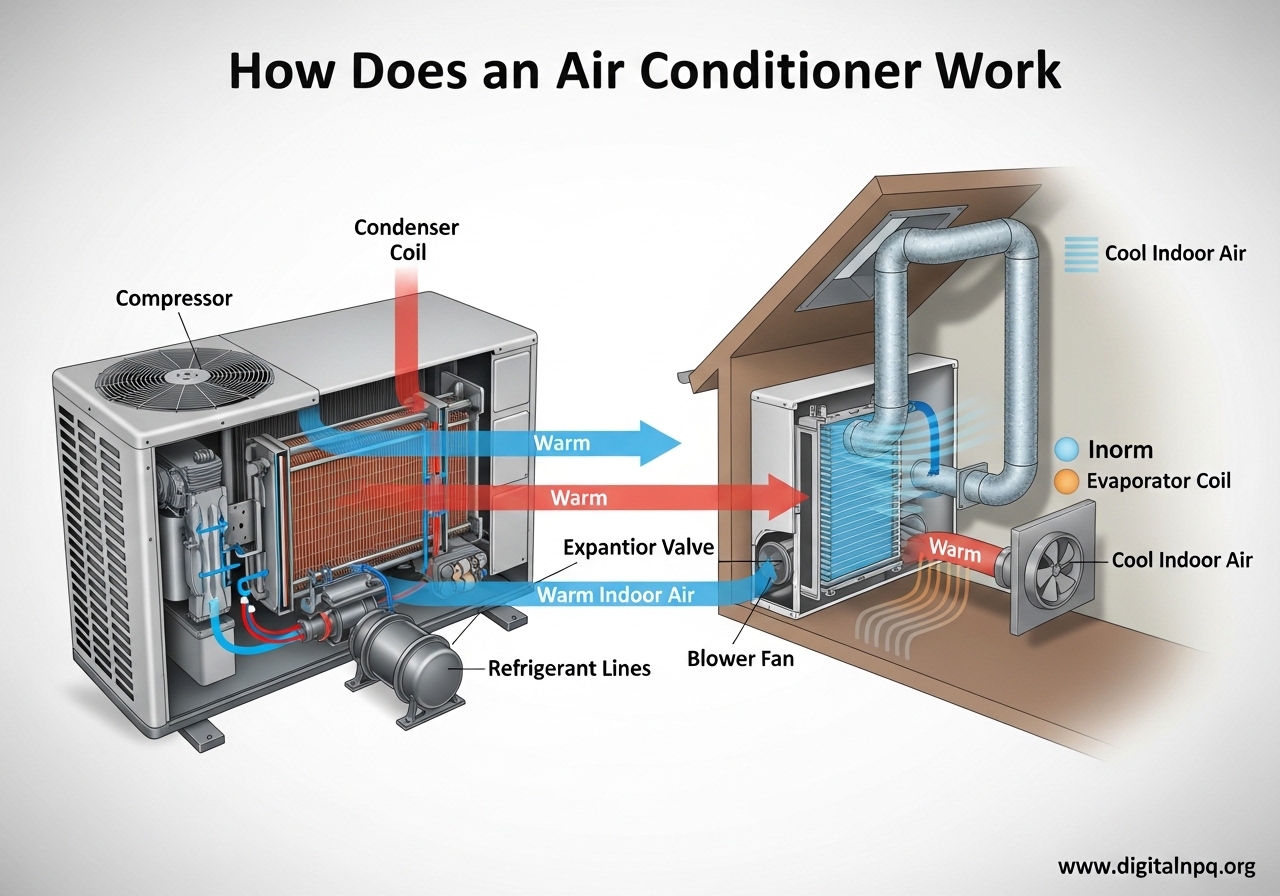
An air conditioner works by pulling warm air from inside your home, absorbing the heat using refrigerant-filled coils, and releasing that heat outside. It does not create cold air — it removes heat from the air that is already there. Think of it like a sponge that soaks up heat instead of water, then wrings that heat out outdoors. This continuous cycle of heat removal is what keeps your rooms cool and comfortable all summer long.
If you have ever wondered exactly what happens inside that humming box on your wall or outside your house, you are in the right place. I have spent years working with and writing about home comfort systems, and I will walk you through how air conditioners work using plain language and simple analogies. No engineering degree required.
One of the biggest misconceptions people have is that an AC unit “produces” cold air the way a heater produces warmth. That is not how it works at all. An air conditioner is really just a machine that moves heat from one place to another. Once you understand this core idea, everything else about how an air conditioner works clicks into place.
The Basic Principle: Moving Heat, Not Making Cold
Here is the single most important thing to understand about air conditioning: it is a heat transfer system. Your air conditioner does not generate cold. Instead, it grabs heat energy from your indoor air and dumps it outside. The air that remains inside is cooler because heat has been taken away from it.
A good way to picture this is to think about your refrigerator. Your fridge works on the exact same principle as a central air conditioning system, just on a smaller scale. It pulls heat out of the food compartment and releases it from the coils on the back or underneath. Your home AC does the same thing but for an entire room or house.
Another analogy that helps is a bicycle pump. When you compress air in a pump, the nozzle gets warm because compressing a gas raises its temperature. The reverse is also true — when a gas expands, it cools down. Air conditioners use this basic physics principle over and over in a sealed loop. The refrigerant gets compressed to make it hot, then that heat is released outside. Then the refrigerant is allowed to expand, making it cold again so it can absorb more heat from your indoor air.
This cycle runs continuously while your AC is on. Warm indoor air gets pulled in, passes over cold coils that soak up the heat, and the now-cooled air gets blown back into your room. Meanwhile, the absorbed heat travels outside through the refrigerant loop and gets released. That is why you feel hot air blowing from the outdoor unit — that is the heat being removed from your home.
How Does an Air Conditioner Work: The 4-Step Refrigeration Cycle
The heart of every air conditioning system is a process called the refrigeration cycle. No matter what type of AC you have — central air, window unit, ductless mini-split, or even your car — they all use these same four steps. Here is how the cycle works.
Step 1: Evaporation (Absorbing Heat)
The cycle starts inside your home at the evaporator coil. This is a set of cold, thin tubes usually located inside your air handler or attached to your furnace. A fan pulls warm indoor air across these coils. Inside the coils, a cold liquid refrigerant flows at low pressure.
When the warm air touches the cold coils, the refrigerant absorbs the heat energy from that air. As it absorbs heat, the refrigerant evaporates — it changes from a cold liquid into a warm gas. The air that just had its heat removed is now cool and gets blown back into your room through the ductwork or vents.
At the same time, moisture from the warm indoor air condenses on the cold surface of the evaporator coils. This is how your AC dehumidifies the air — it pulls water out along with the heat. That condensation drips into a drain pan and flows outside through a condensate drain line.
Step 2: Compression (Pressurizing the Gas)
The warm refrigerant gas now travels through a pipe to the outdoor unit, where it enters the compressor. The compressor is essentially a pump that squeezes the warm gas into a much smaller space, raising both its pressure and its temperature significantly.
This step is important because the refrigerant needs to be hotter than the outside air for the next step to work. By compressing the gas, the compressor turns moderately warm refrigerant into a very hot, high-pressure gas. The compressor is usually the most energy-hungry component in your AC system, and it is often called the heart of the air conditioner because it keeps the refrigerant circulating through the entire loop.
Step 3: Condensation (Releasing Heat Outside)
The now very hot, high-pressure refrigerant gas flows into the condenser coil, which is the large set of coils you see on the outside unit of your air conditioning system. A large fan blows outdoor air across these coils.
Because the refrigerant inside the coils is hotter than the outside air, heat transfers from the refrigerant to the outdoor air. As it loses heat, the refrigerant condenses — it changes from a hot gas back into a warm liquid, still at high pressure. This is why you feel warm air coming off the outdoor unit when your AC is running. That warmth is literally the heat that was removed from inside your home.
Think of it like a steaming cup of coffee cooling down on your kitchen counter. The hot coffee transfers its heat to the surrounding air until both reach the same temperature. The condenser coil works the same way, except a fan speeds up the process by constantly pushing fresh outside air over the coils.
Step 4: Expansion (Cooling the Refrigerant)
The warm, high-pressure liquid refrigerant now passes through the expansion valve (also called a metering device). This valve is a tiny restriction in the line that suddenly drops the pressure of the refrigerant.
When pressure drops quickly, the temperature drops with it — just like how a spray can gets cold as you use it. The refrigerant cools down dramatically and turns into a cold, low-pressure liquid (or a mix of liquid and gas). This cold refrigerant now flows back to the indoor evaporator coil, ready to absorb more heat from your indoor air.
And the cycle begins again. The refrigeration cycle repeats continuously as long as your thermostat is calling for cooling. On a hot summer day, this loop might cycle thousands of times per hour, steadily removing heat from your home and keeping you comfortable.
The Main Components of an Air Conditioning System
Now that you understand the cycle, let me walk through each major component and what it does. Every air conditioning system has these key parts working together.
Compressor
The compressor sits in the outdoor unit and acts as the pump that keeps refrigerant circulating through the system. It takes in low-pressure gas from the evaporator and compresses it into a high-pressure, high-temperature gas. Without the compressor, the refrigerant would not get hot enough to release its heat to the outside air. Most residential compressors run on 220-240 volts and are powered by your home electrical panel.
Evaporator Coil
Located inside your home (usually in the air handler or attached to the furnace), the evaporator coil is where the actual cooling happens. Cold refrigerant flows through these finned copper or aluminum tubes while warm indoor air is blown across them. The refrigerant absorbs heat and evaporates, and the cooled air is distributed through your ducts. These coils need to stay clean for efficient operation — dirty coils reduce cooling performance significantly.
Condenser Coil
The condenser coil is in the outdoor unit and does the opposite of the evaporator. Hot, high-pressure refrigerant gas flows through these coils, and an outdoor fan blows air across them to carry the heat away. The refrigerant condenses back into a liquid as it cools. Keeping the outdoor unit clear of leaves, dirt, and debris helps this coil release heat efficiently.
Expansion Valve
This small but critical component sits between the condenser and the evaporator. It regulates how much refrigerant enters the evaporator coil and creates the pressure drop that cools the refrigerant down. There are different types — fixed orifice, thermostatic expansion valves (TXV), and electronic expansion valves — but they all serve the same purpose of metering refrigerant flow and dropping the pressure.
Refrigerant
Refrigerant is the working fluid that carries heat from inside to outside. It has a very low boiling point, which means it can change between liquid and gas at temperatures that make the cooling cycle work. Common refrigerants include R-410A (used in most modern systems) and R-32 (a newer, more environmentally friendly option). Older systems used R-22 (Freon), which has been phased out due to environmental concerns. The refrigerant never gets “used up” — it simply circulates in the sealed loop, absorbing and releasing heat over and over.
Air Handler and Blower
The air handler contains the blower fan that circulates air through your home. It pulls warm air from your rooms through return ducts, pushes that air across the evaporator coil to be cooled, and then sends the cooled air back through supply ducts to your rooms. The blower motor can run at single speed, multi-speed, or variable speed, with variable-speed motors being the most energy efficient and quietest option.
Thermostat
The thermostat is the control center for your air conditioning system. It monitors the indoor temperature and tells the AC to turn on when the temperature rises above your set point, and to turn off once the target temperature is reached. Modern smart thermostats can learn your schedule, adjust temperatures automatically, and even be controlled from your phone. A well-programmed thermostat can reduce your cooling costs by 10-15 percent.
How Does an Air Conditioner Work in Different Types of Systems
While the refrigeration cycle stays the same, different AC systems arrange the components in different ways. Here is how the most common types work.
Central Air Conditioning (Split-System)
This is the most common type in US homes. It is called a “split-system” because it splits the components between indoor and outdoor units. The evaporator coil and air handler sit inside (usually in a basement, attic, or closet), while the compressor, condenser coil, and condenser fan sit in the outdoor metal cabinet. Refrigerant lines connect the two halves. A central system uses ductwork to distribute cooled air throughout the house and is controlled by a central thermostat.
Packaged AC System
In a packaged system, all components — compressor, condenser, evaporator, and blower — are housed in a single outdoor unit, usually placed on the roof or a concrete slab next to the house. Ductwork runs from the packaged unit into the home to deliver cooled air. These systems are more common in commercial buildings and in homes without basements or attic space for an indoor unit.
Ductless Mini-Split System
A ductless mini-split works like a small central system but without ductwork. An outdoor unit containing the compressor and condenser connects to one or more indoor air handlers mounted on walls or ceilings. Each indoor unit has its own evaporator coil and blower, and each can be controlled independently. This makes mini-splits great for room-by-room temperature control, home additions, or older homes without existing ductwork.
Window Air Conditioner
A window unit is a self-contained system with all components housed in a single box that sits in a window or through a wall opening. The evaporator side faces the room and blows cool air in, while the condenser side faces outside and exhausts heat. These units are affordable and easy to install but typically only cool a single room. They work on the exact same refrigeration cycle as larger systems, just on a smaller scale.
Portable Air Conditioner
Portable AC units are freestanding on wheels and exhaust hot air through a hose that connects to a window kit. Like window units, they contain all components in one package. They are convenient because you can move them from room to room, but they are generally less efficient than window or split systems. Most single-hose portable units also create negative pressure in the room, which can pull warm air from other parts of the house.
How Car Air Conditioning Works
Car AC uses the same refrigeration cycle but is powered by the engine rather than an electric compressor. The compressor is driven by a belt connected to the engine crankshaft, which is why your car uses more fuel when the AC is running. The condenser sits at the front of the car near the radiator, and the evaporator is behind the dashboard. Instead of ductwork, a small blower pushes cooled air through vents in the cabin.
What About Dehumidification and Air Quality
Cooling the air is only part of what an air conditioner does. The other major function is dehumidification. When warm, humid indoor air passes over the cold evaporator coils, water vapor in the air condenses on the coil surface, just like water droplets form on a cold glass on a summer day.
This condensation drips into a drain pan and flows outside through a drain line. On a humid day, your AC might remove several gallons of water from the air. Lower humidity makes the air feel cooler at the same temperature, which is part of why air conditioning feels so comfortable. This is also why running your AC can help prevent mold growth in humid climates.
Some people find that air conditioning dries out their sinuses, skin, or eyes, especially when running the AC for long periods. This happens because the air in your home can drop below the ideal 30-50 percent relative humidity range. Using a separate humidifier or adjusting your AC settings can help maintain comfortable moisture levels.
Most air conditioning systems also include an air filter that captures dust, pollen, pet dander, and other particles as air circulates through the system. A clean filter improves both air quality and system efficiency. Higher-efficiency filters (MERV 11 or higher) can capture smaller particles, but they also create more resistance to airflow, so it is important to choose a filter that your system can handle.
Energy Efficiency: Understanding SEER and EER Ratings
When shopping for or comparing air conditioners, you will see efficiency ratings. Understanding these numbers helps you estimate how much your AC costs to run and compare different models.
SEER (Seasonal Energy Efficiency Ratio) measures cooling output divided by energy used over an entire cooling season. Higher SEER means better efficiency. The minimum SEER for new central AC units in most of the US is 14, while high-efficiency models reach 20 or higher. A jump from SEER 14 to SEER 18 can reduce cooling costs by roughly 22 percent.
EER (Energy Energy Efficiency Ratio) is similar but measured at a single outdoor temperature (95 degrees Fahrenheit), making it a snapshot of peak-performance efficiency. EER is more useful if you live in a consistently hot climate.
To estimate running costs, a typical 3-ton (36,000 BTU) central AC unit running 8 hours per day in summer might add $60 to $120 per month to your electric bill, depending on your local electricity rate and the efficiency of your unit. The Department of Energy recommends looking for the ENERGY STAR label, which means the unit meets strict efficiency guidelines that can save you 10-30 percent on cooling costs compared to standard models.
Simple habits can also lower your AC costs. Raising your thermostat setting by just 2 degrees, using ceiling fans to supplement cooling, and keeping blinds closed during the hottest part of the day all reduce the workload on your air conditioner.
Common AC Problems and Quick Troubleshooting
Even a well-maintained air conditioning system can run into issues. Here are the most common problems people encounter and what you can check before calling a technician.
AC Blowing Warm Air
If your air conditioner is running but blowing warm air, the most common cause is a dirty or clogged air filter restricting airflow over the evaporator coil. Check and replace your filter first. Other causes include low refrigerant (indicating a leak), a dirty outdoor condenser coil, or a faulty compressor. If a new filter does not fix the problem, you likely need a professional to check refrigerant levels and inspect for leaks.
AC Not Turning On
Start with the basics: check that the thermostat is set to “cool” and the temperature is set below the current room temperature. Check your circuit breaker panel for a tripped breaker. Make sure the outdoor unit is receiving power (there is usually a disconnect switch near it). If everything checks out but the unit still will not start, the issue could be a faulty capacitor, a broken thermostat, or a more serious electrical problem that needs a professional.
Strange Noises
Different sounds point to different problems. A squealing noise often means a worn fan belt or motor bearing. A grinding sound can indicate a failing compressor or motor. Rattling usually means a loose component or debris in the unit. A clicking sound when the unit tries to start may point to a failing capacitor or relay. Most of these issues require a technician, but you can check for obvious loose panels or debris around the outdoor unit first.
Water Leaking
If you see water pooling around your indoor unit, the condensate drain line is likely clogged. Algae and mold can grow in the drain line and block water flow, causing the drain pan to overflow. You can often clear a minor clog with a wet/dry vacuum attached to the drain line outlet outside. A frozen evaporator coil can also cause water leaks when it thaws — this is usually caused by dirty filters or low refrigerant.
When to Call a Professional
Some issues are safe and easy to handle yourself: replacing filters, clearing debris from the outdoor unit, checking thermostat settings, and unclogging drain lines. But refrigerant work, electrical repairs, compressor issues, and anything involving the internal sealed system should always be handled by a licensed HVAC technician. Refrigerant handling requires EPA certification, and improper repairs can cause further damage or safety hazards.
Simple Maintenance Tips to Keep Your AC Running Well
Regular maintenance keeps your air conditioner running efficiently and extends its lifespan. Most of these tasks take just a few minutes and can prevent the common problems described above.
Replace or clean your air filter every 1 to 3 months. A dirty filter forces your system to work harder, reduces cooling performance, and can even cause the evaporator coil to freeze. Check your filter monthly during heavy-use months and replace it when it looks dirty.
Keep the outdoor unit clear. Trim back bushes, grass, and debris at least 2 feet around the condenser unit. Hose down the exterior fins gently to remove dirt and dust buildup. Make sure nothing is blocking airflow into or out of the unit.
Schedule an annual professional tune-up. A qualified HVAC technician will check refrigerant levels, clean the coils, inspect electrical connections, lubricate moving parts, and verify that everything is running at peak efficiency. This small investment each spring can prevent costly breakdowns during the hottest months of the year.
Check your thermostat settings. Make sure your thermostat is working properly and consider upgrading to a programmable or smart thermostat if you have not already. Setting the temperature a few degrees higher when you are away from home and lowering it when you return can save a noticeable amount on your cooling bills.
Frequently Asked Questions
How does an air conditioner work in simple terms?
An air conditioner works by pulling warm air from your room, passing it over cold coils filled with refrigerant that absorb the heat, then pumping that heat outside. The cooled air is blown back inside. It runs this cycle continuously until your room reaches the temperature you set on the thermostat.
Does an air conditioner bring in fresh air from outside?
Most home air conditioners do not bring in fresh outdoor air. They recirculate the air that is already inside your home, cooling it each time it passes through the system. If you want fresh air, you need to open windows (when the AC is off) or use a ventilation system like an ERV or HRV that works alongside your HVAC setup.
How is an air conditioner different from a fan?
A fan moves air around but does not change its temperature. It creates a wind-chill effect on your skin that makes you feel cooler, but the actual room temperature stays the same. An air conditioner actively removes heat from the air and lowers the room temperature. Fans use significantly less electricity than AC units but cannot cool a room below the ambient temperature.
How long does it take for an AC to cool a room?
A properly sized air conditioner typically takes 15 to 30 minutes to lower a room by 5 to 10 degrees Fahrenheit. Factors that affect cooling time include room size, ceiling height, insulation quality, number of windows, outdoor temperature, and whether the AC unit is properly sized for the space. An undersized unit will struggle to reach the target temperature on very hot days.
Can an air conditioner make you sick?
An air conditioner itself does not make you sick. However, if the system is not maintained properly, it can circulate dust, mold spores, and bacteria through your home. Very dry air from extended AC use can also irritate sinuses and dry out skin. Changing filters regularly, cleaning coils, and maintaining humidity between 30 and 50 percent keeps the air healthy.
How often should I change my AC filter?
Most AC filters should be checked monthly and replaced every 1 to 3 months. If you have pets, allergies, or live in a dusty area, you may need to replace the filter more often, roughly every 30 to 60 days. A clean filter improves airflow, reduces energy consumption, and helps prevent frozen coils and system breakdowns.
Conclusion
Understanding how an air conditioner works comes down to one core idea: it moves heat from inside your home to outside through a continuous refrigeration cycle. The refrigerant absorbs heat at the evaporator coil, gets compressed to a hot gas, releases that heat at the condenser coil outside, and then expands back to a cold liquid to start the cycle over again.
Every component — the compressor, evaporator coil, condenser coil, expansion valve, blower, and thermostat — plays a specific role in this loop. Whether you have a central split-system, a window unit, or a ductless mini-split, the underlying process is the same. The system also dehumidifies your air and filters particles, contributing to overall indoor comfort.
If you take one thing away from this guide, let it be this: your air conditioner is a heat mover, not a cold-air maker. Knowing this helps you understand why maintenance matters, why airflow is so important, and why keeping those coils clean makes a real difference in performance and energy costs. If your system is not cooling properly, start with the basics — check your filter, clear the outdoor unit, and if the problem persists, call a licensed HVAC professional to take a closer look.