
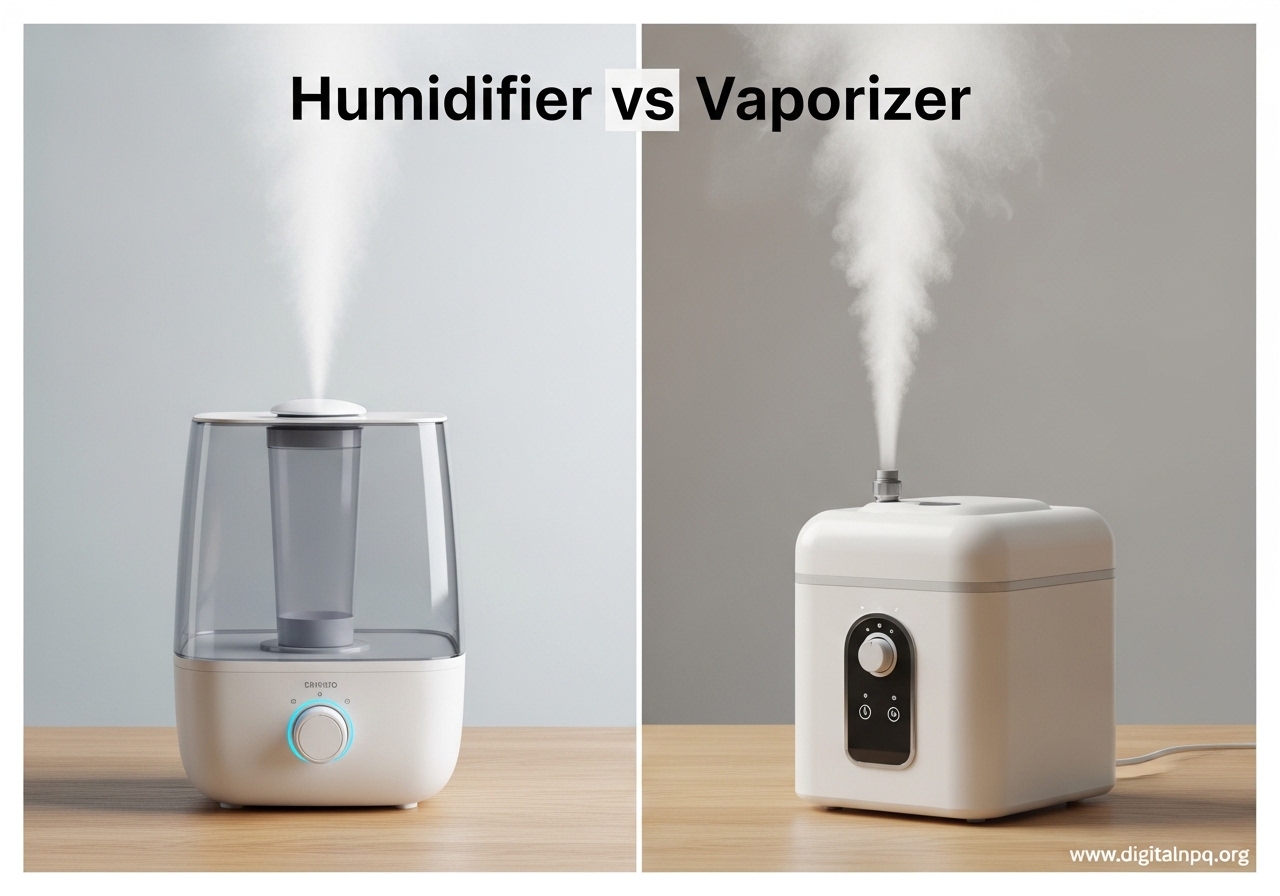
Dry air does a number on your body. It dries out your nasal passages, irritates your throat, cracks your lips, and can even make congestion feel worse. If you have ever woken up with a scratchy throat or watched your child struggle to sleep through a stuffy nose, you know exactly how miserable dry indoor air can get.
That is where adding moisture to the air comes in. Two devices do this job: humidifiers and vaporizers. They both increase humidity levels in a room, but they go about it in completely different ways. Understanding the humidifier vs vaporizer distinction matters because the wrong choice can affect your comfort, safety, and even your health.
I have spent countless hours researching both devices, digging through medical guidelines from the American Academy of Pediatrics and EPA recommendations, and reading thousands of real user experiences. In this guide, our team breaks down exactly how each device works, when to use which one, and which option makes sense for your specific situation.
What Is a Humidifier and How Does It Work?
A humidifier is a device that adds moisture to the air by releasing a cool (or sometimes warm) mist into your room. It does not heat water. Instead, it uses other methods to break water down into tiny droplets and disperse them into the surrounding air.
Types of Humidifiers
Not all humidifiers work the same way. There are three main types you will encounter, and each has its own strengths.
Ultrasonic humidifiers use high-frequency vibrations to turn water into an ultra-fine mist. These are the quietest option available and tend to be popular for bedrooms and nurseries. They do not use a fan, so the only sound you hear is a faint hum. One thing to keep in mind: if you use tap water, ultrasonic models can produce a fine white dust from minerals in the water. Using distilled water eliminates this issue entirely.
Evaporative humidifiers pull air through a moistened wick filter using a small fan. The air absorbs moisture as it passes through and releases it into the room. These are self-regulating to some degree, meaning when humidity is already high, less water evaporates from the wick. The tradeoff is that the fan creates a noticeable hum, which some people find distracting at night.
Impeller humidifiers use a rotating disk to fling water at a diffuser, breaking it into droplets that float into the air. These are less common but work well for smaller spaces and tend to be very affordable.
Pros of Humidifiers
Cool mist humidifiers are widely recommended by pediatricians because they carry zero burn risk. The American Academy of Pediatrics specifically recommends cool mist humidifiers for babies and young children. There is no boiling water, no hot steam, and no scalding hazard even if the device gets knocked over.
They also tend to cover larger room sizes effectively and use less electricity than vaporizers since there is no heating element running continuously. Modern models come with useful features like automatic shut-off when the water tank empties, built-in hygrometers that measure humidity levels, and adjustable mist output settings.
Cons of Humidifiers
The biggest drawback is maintenance. Because the water never gets heated, bacteria and mold can grow inside the tank and get dispersed into the air. You need to clean humidifiers regularly, ideally every one to three days, to prevent microbial growth. The EPA recommends using distilled water and following the manufacturer cleaning instructions closely.
Mineral buildup is another headache, especially with ultrasonic models using tap water. That white dust settles on furniture and electronics near the device. Filters on evaporative models also need regular replacement, which adds to the ongoing cost and effort.
What Is a Vaporizer and How Does It Work?
A vaporizer, sometimes called a warm mist humidifier or steam vaporizer, heats water to its boiling point and releases the resulting steam into the air. The heating element brings the water to a rolling boil, killing most bacteria and mold spores in the process. The steam cools slightly before it leaves the device, but it is still warm when it reaches you.
How Steam Generation Works
Inside a vaporizer, an electrical heating element sits in a water reservoir. When you turn the device on, that element heats the water until it boils. The steam rises through a vent or medicine cup (if the model has one) and into your room. Some models have a medicine cup where you can add inhalants like Vicks VapoSteam for medicated steam. This is one of the key features that sets vaporizers apart from standard humidifiers.
The boiling process acts as a natural disinfectant. Because the water reaches 212 degrees Fahrenheit, most common bacteria, mold spores, and other microorganisms are killed before the steam ever reaches the air. This means you do not have to worry as much about the device spreading germs, which is a real concern with poorly maintained cool mist humidifiers.
Pros of Vaporizers
Steam kills germs in the water before releasing moisture, so there is less risk of spreading bacteria or mold. Many users report that warm steam feels more soothing on irritated sinuses and sore throats compared to cool mist. The ability to add medicated inhalants like Vicks makes vaporizers a popular choice during cold and flu season when adults want extra congestion relief.
Vaporizers also do not produce white mineral dust because the minerals stay behind in the boiling chamber. They do not require replacement filters in most cases, which reduces ongoing maintenance costs.
Cons of Vaporizers
The burn risk is the single biggest concern with vaporizers. The water inside is literally boiling, and the steam that escapes is hot enough to cause serious burns, especially to curious toddlers who might grab or tip the device. This is exactly why the AAP recommends against using vaporizers in children’s rooms.
Vaporizers also use significantly more electricity than cool mist humidifiers because they run a heating element continuously. They tend to be noisier than ultrasonic humidifiers, producing a bubbling or gurgling sound as water boils. And the warm output can actually raise the temperature in a small room slightly, which may be uncomfortable during summer months.
Humidifier vs Vaporizer: Head-to-Head Comparison
Now that you understand how each device works, let us put them side by side. The humidifier vs vaporizer debate comes down to several key factors that affect your daily experience.
Moisture Output and Effectiveness
Both devices effectively increase humidity levels in a room. The main difference is temperature. Humidifiers produce cool mist at room temperature, while vaporizers produce warm steam. Both can raise humidity to the EPA-recommended indoor level of 30 to 50 percent. Neither device is inherently better at adding moisture. The amount of moisture added depends more on the specific model’s tank size and output rate than on whether it uses heat or cool mist technology.
Safety Comparison
This is where the two devices diverge sharply. Humidifiers win on safety, especially in homes with children or pets. A cool mist humidifier can be knocked over, touched, or grabbed without causing injury. A vaporizer contains boiling water and releases hot steam that can scald. If you have a toddler who touches everything, or a pet that likes to investigate, the vaporizer poses a real hazard.
The American Academy of Pediatrics recommends cool mist humidifiers for nurseries and children’s rooms for this exact reason. Children’s Hospital of Philadelphia echoes this guidance, noting that the burn risk from vaporizers outweighs any potential benefit for young children.
Noise Level
This is an area most competitors overlook, but it matters a lot if you plan to run one of these devices while you sleep. Ultrasonic humidifiers are the quietest option, producing barely a whisper. Evaporative humidifiers with fans are moderately noisy, similar to a small desk fan on low. Vaporizers make a distinct bubbling and gurgling sound as water boils, which some people find soothing and others find annoying. If silence is your priority, go with an ultrasonic humidifier.
Energy Consumption
Vaporizers use noticeably more electricity than humidifiers because they need to continuously heat water to boiling. A typical vaporizer draws between 300 and 500 watts, while an ultrasonic humidifier uses only 25 to 50 watts. Over weeks of nightly use during winter, that difference adds up on your electric bill. If energy efficiency matters to you, humidifiers are the clear winner.
Maintenance and Cleaning
Vaporizers require less frequent deep cleaning because the boiling process kills bacteria and mold. However, mineral deposits build up in the heating chamber over time and need to be removed with vinegar soaks. Humidifiers need more attention because standing water in the tank can harbor bacteria and mold growth. You should empty and dry the tank daily, and do a thorough cleaning with white vinegar every one to three days. Both types benefit greatly from using distilled water instead of tap water.
Key Differences at a Glance
Here is a quick summary of how humidifiers and vaporizers compare across the factors that matter most:
- Mechanism: Humidifiers use ultrasonic vibrations, fans, or rotating disks. Vaporizers boil water with a heating element.
- Output temperature: Humidifiers produce cool or room-temperature mist. Vaporizers produce warm steam.
- Burn risk: Humidifiers have zero burn risk. Vaporizers pose a scalding hazard from hot water and steam.
- Germ control: Vaporizers kill germs during boiling. Humidifiers require regular cleaning to prevent bacterial growth.
- Noise: Ultrasonic humidifiers are nearly silent. Vaporizers produce bubbling sounds from boiling water.
- Energy use: Humidifiers use 25 to 50 watts. Vaporizers use 300 to 500 watts.
- Inhalants: Many vaporizers have medicine cups for Vicks or similar products. Most humidifiers do not support inhalants.
- Best for children: Humidifiers are recommended by the AAP for all ages.
When to Use a Humidifier vs Vaporizer
Choosing between a humidifier and vaporizer depends almost entirely on your specific situation. Here is straightforward guidance organized by the most common use cases people ask about.
For Babies and Young Children
Cool mist humidifiers are the clear and non-negotiable recommendation for babies, toddlers, and young children. The American Academy of Pediatrics specifically advises against vaporizers in nurseries and children’s rooms because of the burn risk. A curious toddler who reaches for a vaporizer can suffer serious scalds from the hot water or steam. This safety concern alone makes humidifiers the right choice for any household with kids.
Cool mist works just as effectively as warm steam for relieving baby congestion. The moisture soothes dry nasal passages whether it arrives cool or warm. Place the humidifier at least three feet from the crib, and run it during naps and overnight to help your baby breathe easier. Keep the nursery door slightly open so humidity does not build up excessively.
For Congestion and Sinus Relief
Both devices help with congestion by adding moisture to dry nasal passages and thinning mucus. Vaporizers may feel more soothing because warm steam helps open swollen nasal passages faster. Many adults prefer the warm sensation when dealing with a severe cold or sinus infection. The steam can also be combined with medicated inhalants like Vicks VapoSteam for added relief.
That said, cool mist humidifiers work well for congestion too. If you have children in the home, a humidifier provides the same congestion-relieving benefits without the safety trade-offs. If you are an adult living alone or with other adults, a vaporizer might give you that extra comfort factor during a rough cold.
For Allergies and Asthma
Humidifiers are generally the safer bet for allergy and asthma sufferers, but there is a catch. If the humidifier is not cleaned properly, it can actually make allergies and asthma worse by dispersing mold spores and bacteria into the air. This is why cleaning discipline is so important.
The EPA recommends maintaining indoor humidity between 30 and 50 percent. Going above 50 percent encourages dust mite and mold growth, which triggers allergies. Use a hygrometer to monitor your room’s humidity level, and choose a humidifier with a built-in humidistat that automatically adjusts output. If you have asthma or COPD, talk to your doctor about the right humidity approach for your specific condition.
For Dry Skin and Chapped Lips
Both devices help with dry skin by increasing the moisture content in the air around you. When humidity drops below 30 percent, your skin loses moisture to the dry air faster than your body can replace it. Running either a humidifier or vaporizer in your bedroom overnight can make a noticeable difference in how your skin and lips feel in the morning.
For this use case, pick whichever device fits your safety and noise preferences. If you want near-silent operation and low energy use, go with an ultrasonic humidifier. If you prefer the warmth and do not have safety concerns, a vaporizer works fine too.
For Snoring and Sleep Quality
Dry air irritates the tissues in your throat and nasal passages, which can worsen snoring. Adding moisture to the bedroom air can reduce this irritation and help you (and your partner) sleep better. Many users in sleep forums report that running a humidifier overnight noticeably reduced their snoring.
For snoring, humidifiers are generally better for long-term nightly use because they are quieter, use less energy, and are safer to leave running all night. Vaporizers can work too, but the noise from boiling water and higher energy draw make them less ideal as a nightly sleep companion.
For Cold and Flu Season
During cold and flu season, both devices help by keeping your respiratory passages moist, which supports your body’s natural defenses. Vaporizers have an edge here because the boiling process kills germs in the water, and you can add medicated inhalants to the steam. This is why many adults reach for a vaporizer when they are actively sick.
The key is to think about who else is in the home. If kids are around, stick with a humidifier even during sickness. If it is just adults, a vaporizer with Vicks in the medicine cup can provide extra comfort during a rough cold.
How Long Should You Run Your Device?
Most humidifiers and vaporizers are designed to run for 8 to 12 hours on a full tank, which covers overnight use comfortably. Run the device while you sleep and turn it off during the day unless the air is exceptionally dry. Use a hygrometer to check humidity levels, and turn the device off when you reach 50 percent humidity. Going above 50 percent invites mold growth on walls, windows, and furniture, which creates a whole new set of problems.
Safety and Maintenance Tips
Whichever device you choose, proper maintenance is non-negotiable. A poorly maintained humidifier or vaporizer can actually make you sick by spreading bacteria, mold, or mineral particles into the air you breathe.
Cleaning Your Humidifier
Follow this cleaning routine to keep your humidifier safe and effective:
Daily: Empty the water tank completely. Rinse it with clean water. Dry it with a clean cloth or let it air dry. Refill with fresh water before each use. This simple step prevents most bacterial growth.
Every 1 to 3 days: Do a deeper clean using white vinegar. Unplug the device. Fill the tank with a mixture of one part white vinegar to nine parts water. Let it sit for 20 to 30 minutes to dissolve mineral deposits. Scrub the tank with a soft brush, paying attention to corners and crevices where biofilm builds up. Rinse thoroughly before refilling.
Weekly: Disinfect the tank using a mild bleach solution. Mix one teaspoon of bleach per gallon of water, fill the tank, and let it sit for 20 minutes. Rinse multiple times until you cannot smell any bleach. The Children’s Hospital of Philadelphia recommends this 10 percent bleach solution approach as an effective disinfection method.
Cleaning Your Vaporizer
Vaporizers need less frequent cleaning because boiling kills most germs. However, mineral deposits build up on the heating element over time, which reduces efficiency and can cause the device to stop working.
Weekly: Unplug the vaporizer and let it cool completely. Fill the heating chamber with undiluted white vinegar and let it soak for 30 to 60 minutes to dissolve mineral scale. Scrub gently with a soft brush. Rinse thoroughly. Some models come with a mineral absorption pad that you can replace to reduce buildup.
Safety Precautions
Regardless of which device you use, follow these safety rules:
- Always use distilled or demineralized water. Tap water contains minerals that get dispersed into the air or build up inside the device.
- Place the device on a flat, waterproof surface at least three feet from beds, furniture, and walls to prevent moisture damage.
- Keep vaporizers well out of reach of children and pets. Never use a vaporizer in a child’s room.
- Do not let humidity exceed 50 percent. Use a hygrometer to monitor levels.
- Unplug and empty the device when not in use for extended periods.
- Replace filters on evaporative humidifiers according to the manufacturer schedule.
- Look for models with automatic shut-off that turns the device off when the tank runs dry.
Room Placement Tips
Where you put the device matters more than most people realize. Place it on a raised surface like a table or nightstand (not the floor) so the mist distributes evenly throughout the room. Keep it at least three feet away from your bed, walls, and wooden furniture to prevent moisture damage. Aim the mist output away from electronics and anything that could be damaged by water. If you notice condensation forming on windows or walls near the device, move it further away or reduce the output setting.
FAQ
Which is better a vaporizer or humidifier?
Neither device is universally better. Humidifiers are safer for homes with children and use less energy, while vaporizers kill germs during boiling and allow medicated inhalants. Choose based on your household: humidifiers for families with kids, vaporizers for adults who want warm steam relief during illness.
Do you use a vaporizer or humidifier for congestion?
Both devices help with congestion by adding moisture to dry nasal passages. Vaporizers may feel more soothing because warm steam helps open swollen nasal passages faster, and you can add medicated inhalants like Vicks. However, humidifiers provide the same congestion relief and are safer if children are in the home.
Is a vaporizer good for a cough?
Yes, a vaporizer can help soothe a cough by adding warm moisture to the air, which loosens mucus and calms irritated throat tissues. The warm steam is particularly comforting for dry, hacking coughs. Adding a medicated inhalant like Vicks VapoSteam to the medicine cup can provide additional cough relief for adults.
Is a Vicks vaporizer the same thing as a humidifier?
No, a Vicks vaporizer is a steam vaporizer that heats water to create warm steam, not a cool mist humidifier. Vicks makes both types of devices. The Vicks Warm Steam Vaporizer boils water and has a medicine cup for VapoSteam inhalants. A Vicks Cool Mist Humidifier uses ultrasonic or evaporative technology without heating. They serve different needs and have different safety profiles.
Which is healthier, a vaporizer or a humidifier?
Both are equally healthy when properly maintained. Vaporizers have a hygiene advantage because boiling kills bacteria and mold in the water. However, a well-maintained humidifier cleaned every one to three days with white vinegar is perfectly safe. The bigger health concern is improper maintenance, not the device type itself. A dirty humidifier can disperse more harmful particles than a clean vaporizer.
Is a humidifier or vaporizer better for babies?
Cool mist humidifiers are recommended for babies by the American Academy of Pediatrics. Vaporizers pose a serious burn risk because they contain boiling water and release hot steam. Babies and toddlers can be scalded if they touch or tip a vaporizer. Cool mist provides the same congestion relief without any safety hazard, making it the clear choice for nurseries and children’s rooms.
Conclusion
The humidifier vs vaporizer decision comes down to one question: are there children in your home? If yes, a cool mist humidifier is the right and safe choice, full stop. If you are an adult looking for warm steam relief during a cold, a vaporizer with a medicine cup can be a comforting option. Both devices do an excellent job of adding moisture to dry air when maintained properly. Clean regularly, use distilled water, keep humidity between 30 and 50 percent, and you will feel the difference in how you breathe, sleep, and feel.