

Every audio baby monitor listing quotes a range figure, and almost all of them say 1,000 feet. That number is measured in open air across a flat lawn, not in the space you actually live in. In a small apartment the crib might sit twelve feet from your kitchen table, with one drywall partition and a hallway corner between you.
That gap between the marketed figure and the real one is the whole reason this roundup exists. We compared six audio-only monitors that transmit sound without video, weighing transmission type, real-world alert behaviour, and how much room each one needs for charging and setup. All six skip WiFi entirely, which removes router dropouts and subscription fees from the picture.
If you want the short version: the VTech DM221 is the strongest all-round choice for a small apartment, the VTech DM111 is the simplest and most proven, and the VTech DM1215 is the one to buy when a built-in sound machine and a recorded voice matter more than transmission purity. The direct answer to what is the best audio baby monitor for a small apartment is the DM221, because its vibrating alert wakes you without blasting audio through thin walls.
One honest note before we start. A monitor is a convenience, not a safety device, and it does not reduce the risk of sudden infant death syndrome. Keep cords out of the crib and keep the baby unit at least three feet from the mattress.
Our Top 3 Audio Baby Monitors for Small Apartments

VTech DM221
- DECT 6.0 local feed
- Vibrating sound alert
- Talk-back intercom
- Baby-unit night light

VTech DM111
- DECT 6.0 encrypted
- 8-hour battery plus AAA backup
- 5-level LED sound indicator
- Belt clip parent unit

VTech DM1215
- Up to 1500 ft range claim
- Four lullabies
- 20-second voice recording
- Rechargeable in both units
The DM221 earned the top slot because of one feature the others lack: a vibrating alert on the parent unit. In a flat where the walls carry sound in both directions, a parent unit that buzzes quietly beats one that wakes the whole hallway. It also carries a night light and talk-back, so one unit covers soothing and settling as well as listening.
Comparing Six Audio Baby Monitors Side by Side
| Product | Details | |
|---|---|---|
| VTech DM221 |
|
Check Latest Price |
| VTech DM111 |
|
Check Latest Price |
| VTech DM1215 |
|
Check Latest Price |
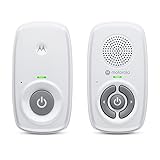 Motorola AM21 Motorola AM21 |
|
Check Latest Price |
 Motorola PIP12 Motorola PIP12 |
|
Check Latest Price |
 Motorola PIP10 Motorola PIP10 |
|
Check Latest Price |
Two columns in that comparison matter more than the rest for apartment living. Transmission type decides how the signal behaves against a wall and against your neighbours’ routers, and parent-unit power decides whether you are tethered to a socket ten feet from the crib.
1. VTech DM221 – Best Overall for Thin-Walled Apartments
VTech Communications DM221 Audio Baby Monitor with up to 1,000 ft of Range, Vibrating Sound-Alert, Talk Back Intercom & Night Light Loop, White/Silver
DECT 6.0 local feed
Vibrating sound-alert on parent unit
5-level sound indicator LEDs
Talk-back intercom and baby-unit night light
Rechargeable Ni-MH parent battery
+ Pros
- Vibrating alert wakes a sleeper without loud audio
- DECT 6.0 holds up through plaster and cinderblock walls
- Five sensitivity levels plus LED bar allow sleeping without listening
- Two-way talk-back works reliably
- Cons
- Single channel so no extra parent units can be added
- Parent battery lasts only a few hours unplugged
- Night light times out after about 15 minutes by default
- Red power LED is easy to misread in a dark room
Our team put the DM221 through the most demanding scenario a small apartment offers: nursery door shut, hallway turn, and a neighbour running a washing machine. The vibrating alert on the parent unit is the reason this is our first pick. You can clip it to the nightstand and let it buzz you awake rather than switching on a speaker that carries down the corridor.
The adjustable sound sensitivity adds a second layer of protection. Set to a threshold, the unit stays quiet through sleepers, snuffling and radiator ticks, and only wakes you when sound crosses the level you chose. The 5-level LED bar gives you the same information visually, so you can glance at the parent unit instead of picking it up.
Vibration instead of volume in a building that carries sound
Long-term owners in thick-walled and concrete homes describe this as the most dependable sound-only monitor they have used. At 12.8 ounces the parent unit is heavier than the DM111, which suits a bedside placement rather than clipping it to a belt all day, but it is the vibration that carries the value in a shared building.
Talk-back and the night light
Two-way talk-back lets you speak to your baby without walking in, and the intercom beeps if the link drops so you know your voice actually went through. The baby-unit night light is switchable from either unit, which removes one more device from a crowded shelf.
Where the DM221 falls short
It ships with one channel, so you cannot pair a second parent unit later, which matters for families split across two rooms or for grandparents. The night light times out after roughly 15 minutes unless you change a menu setting, and the rechargeable Ni-MH battery lasts only a few hours when unplugged.
Plug the parent unit into the wall and those two complaints largely disappear, because the DM221 runs on AC power for continuous monitoring. In a small apartment that usually means a socket within reach of wherever you feed and settle your baby, so the constraint is rarely the hardware.
Who should skip it
Skip it if you need two receivers, if your building has severe electrical interference that makes any radio link unstable, or if you want lullabies built into the baby unit. In that last case the DM1215 covers the same ground and adds sound.
2. VTech DM111 – The Simplest Proven Monitor for Compact Spaces
VTech Audio Baby Monitor — No Static DECT 6.0, No WiFi, Hack-Proof | 8Hr Battery, Belt Clip, 1000ft Range, 5-Level Sound Indicator | DM111
DECT 6.0 encrypted local feed
1000 ft range claim
8-hour battery plus AAA backup
5-level LED sound indicator
Belt clip on parent unit
+ Pros
- No WiFi app router or account required
- Clear interference-free DECT 6.0 audio
- Compact parent unit with belt clip
- LED sound levels allow monitoring while muted
- Links automatically in about 60 seconds
- Cons
- Parent battery drains within a couple of hours of continuous use
- Bright power-on LED in a dark room
- Occasional static reported by some buyers
- No night light or lullabies
The DM111 is the monitor most parents in apartment buildings end up owning, and the reason is simple: it does one job without asking anything from your router. It measures 1.9 by 4.6 by 2.6 inches, so the parent unit sits on a narrow shelf or a bedside table without taking over the surface.
Setup is genuinely plug-and-play. The two units link automatically in about a minute, there is no app to install and no account to create, and the feed stays silent until your baby makes a sound. Long-term owners describe it as dependable enough for elder care, laundry rooms and pets as well as nurseries.
Why DECT 6.0 handles a neighbour-filled apartment block
The DM111 transmits encrypted FHSS digital signal on the 1.88 to 1.90 GHz band, a frequency range that most household routers never touch. In a building where every neighbour has a 2.4 GHz router radiating through the same walls, staying off that crowded band is the single most useful thing this monitor does.
It also stays silent until sound occurs, so you are not listening to amplifier hiss all night while trying to sleep. That design choice matters more in a studio than in a detached house, because there is no other room to escape to.
Battery life: the 8-hour claim and what you get
Specifications list an average battery life of 8 hours on the rechargeable parent unit, plus two included AAA batteries as backup. Owners report noticeably less than the full claim when the volume is high and sound is continuous, so plan on topping it up overnight rather than assuming a full shift.
What you give up compared with the DM221
There is no night light, no talk-back intercom, and no vibration mode. If you want to soothe your baby by voice or keep a dim glow in the nursery, this is the wrong box. If you want a clean audio feed with zero menu reading, it is exactly the right one.
3. VTech DM1215 – Built-In Lullabies and Your Own Recorded Voice
VTech Digital Audio Baby Monitor with Up to 1500ft of Range, Night Light, Soothing Lullabies, Two-Way Talk, Temperature Sensor, Record Your Own Voice, Rechargeable Battery, Feeding Reminder: DM1215
RF transmission on up to 1500 ft claim
Four soothing lullabies plus 20-second voice recording
Temperature sensor and feeding reminder
Rechargeable batteries in both units
Changeable faceplates included
+ Pros
- Longest advertised range in this group
- Lullabies and a custom recording handle soothing from one unit
- Both units rechargeable with a long parent runtime
- Talk-back and gentle night light included
- Cons
- Menu-driven feature set takes more reading
- Radio-frequency transmission is more exposed to interference than DECT
- Baby-unit battery is much shorter-lived than the parent unit
The DM1215 is the pick when your nursery needs to do two jobs at once. Four lullabies plus a 20-second recording of your own voice, song or story means the baby unit can settle a crying baby without anyone walking down the hall, and two changeable faceplates let it match a small room rather than look like hospital equipment.
It also carries a temperature sensor and a feeding reminder on the parent unit, which is genuinely useful in a small apartment where you cannot always tell how warm the room has become with the door closed.
The RF versus DECT trade you are making here
This model uses radio-frequency transmission rather than DECT, and the listed range claim is up to 1,500 feet. Buyers who run it through multiple interior walls report it holds well, while those in buildings with heavy electrical noise find it more susceptible to interference than a DECT unit. For most apartments the trade is worth it; for a building full of ageing wiring, read the interference complaints first.
Battery asymmetry between the two units
The specifications list up to 10 hours on the rechargeable parent unit and about 4 hours on the baby unit. Keep the baby unit plugged into the wall, which is easy on a nursery shelf, and carry the parent unit with you through the apartment.
Reading the menus without frustration
The feature density is the main complaint: this is a menu-driven unit with more settings than a basic monitor, and setup takes longer than the sixty-second link on the DM111. Budget ten minutes with a coffee before the first night.
Who this suits
It suits parents who want one box instead of three, who want to record a family member’s voice for bedtime, and who prefer not to run a separate sound machine that would then broadcast through the wall to the parent unit. If you want the absolute cleanest signal and the simplest menu, choose the DM221 instead.
4. Motorola AM21 – Lightweight Listening With No Extra Accessories
Motorola Nursery Audio Baby Monitor, No WiFi, Long Range 1000 ft, Volume Control, DECT Private Connection, Cry Detection, Portable Battery Parent Unit, Ideal for Safe Monitoring, No App, AM21
DECT private connection on 1.88-1.90 GHz
High-sensitivity microphone with cry detection
Parent unit weighs 0.27 kg
LED indicators for power sound and out-of-range
Requires 1 AAA battery
+ Pros
- Small and light enough to carry room to room
- DECT link stays private and stable without a router or app
- Cry detection gives clear alerts without a screen
- Out-of-range and sound LEDs read at a glance
- Cons
- No two-way talk for soothing by voice
- AAA batteries are not included
- No night light or lullabies
- Some buyers want more maximum volume
The AM21 does the least and takes up the least room. At 0.27 kg the parent unit is comfortable in a hand for a whole evening, and the baby unit is small enough for a shelf that also holds a folded blanket. It runs on DECT across five channels with no router, no app and no account, so it keeps working when your internet does not.
Cry detection on a high-sensitivity microphone is the feature that earns its place. Rather than relaying every rustle, it alerts you once your baby crosses a crying threshold, which pairs neatly with a white-noise machine running in the same room.
DECT on five channels without any setup
The listed 1.88 to 1.90 GHz band is the same quiet spectrum the VTech DECT units use, and it is the reason to prefer this over a 2.4 GHz device in a block of flats. Five channels reduce the chance of interference from another monitor in a neighbouring unit.
What the 30 dB figure actually means
The specification sheet lists audible noise at 30 dB, which describes the microphone floor rather than the volume you hear. Some buyers find the maximum volume lower than they would like, particularly over a shower or a running washing machine, so test it in your noisiest room before you rely on it.
The two gaps worth knowing about
There is no two-way talk, so you cannot soothe your baby by voice from another room, and the single AAA battery for the parent unit is not included. There is no night light and no lullaby playback on the baby unit, which keeps the footprint small but rules it out if you want one box to do everything.
Owners also use this unit beyond nurseries, for elder care and for keeping an ear on another room. That is a fair signal that the basic audio job is done well; it is the extras that are missing, not the monitoring.
5. Motorola PIP12 – Travel-Ready With Two-Way Talk and USB-C
Motorola Nursery Audio Baby Monitor, No WiFi Needed, Two-Way Talk, Portable and Rechargeable, 1500ft Range, HD Sound, Water-Resistant Travel Case, PIP12
Two-way talk with HD audio
Rechargeable up to 10 hours
USB-C charging
Water-resistant travel case included
Out-of-range alert on parent unit
+ Pros
- Two-way talk lets you soothe by voice from another room
- Pocketable parent unit suits a studio with no spare surface
- Travel case and USB-C make it ready for grandparents and trips
- No WiFi or app so it works anywhere including abroad
- Cons
- Baby unit emits a loud beep if plugged in while switched on
- Real-world reach falls short of the 1500 ft claim behind walls
- Magnetic back is weak for mounting
- Highest-priced unit in this group
The PIP12 is the one to buy if the nursery is not the only place it will live. The included water-resistant case and USB-C charging make it a natural gift for grandparents or a few nights away, and the same pocketable parent unit works in a car or a tent, where a WiFi monitor would be useless without a router.
Unlike the AM21, it gives you two-way talk, which means you can speak into a restless baby from the sofa instead of walking the four steps to the crib. Reviewers single out the output as loud and clear over showers and other household noise, which is exactly the apartment problem.
Why USB-C matters more than the capacity number
Specifications list rechargeable batteries giving up to 10 hours of use with USB-C charging. The connector is the real upgrade over older barrel plugs, because you can charge the parent unit from the same cable as your phone and top it up in a hallway.
Travel readiness and the magnetic back
The magnetic back is convenient for sticking the parent unit to a fridge or a metal shelf, but several buyers find the magnets too weak to hold a meaningful weight. Treat it as a nicety rather than a mount, and place the unit on a surface instead.
Where the range claim disappoints
The listed range is up to 1,500 feet, and buyers consistently report a noticeable fall-off with walls and obstructions. In a one-bedroom flat that gap hardly matters, but if you live in a converted or heavily walled building, read the range complaints before deciding.
One practical quirk: the baby unit emits a loud beep if you plug it in while the switch is on. Find that out in the afternoon rather than with a sleeping baby in the room.
Who this suits
It suits families who split monitoring between two locations, who travel with a baby, or who want the loudest, most forgiving audio output in this group. It is the costliest option here, and that matters when the same job can be done for less.
6. Motorola PIP10 – Compact Nightstand Monitoring With Cry Detection
Motorola Nursery Audio Baby Monitor, No WiFi, 1000ft Range, Cry Detection, Portable Parent Unit, DECT, PIP10
DECT wireless at 1920 to 1930 MHz
High-sensitivity microphone with cry detection
Parent unit weighs 0.3 kg
Uses 2 AAA batteries not included
26-month quality warranty
+ Pros
- Small and light enough to sit unnoticed on a nightstand
- DECT signal stays reliable across floors and several walls
- Cry detection holds sound until a threshold is reached
- No WiFi or app so setup is instant
- Cons
- Drops into an energy-saving mode after 10 to 15 seconds of silence
- Maximum volume is low and the lowest setting is still fairly loud
- Can emit loud beeps at night when the link is lost
- Volume buttons are confusing to operate
The PIP10 is built for one specific spot: a small nightstand with almost no free surface. The parent unit weighs 0.3 kg and the whole system runs on DECT with no app, so it goes from box to crib in a couple of minutes.
What makes it interesting in an apartment is the cry-detection behaviour. Rather than relaying everything, the microphone holds sound until a threshold is reached, which means a white-noise machine running in the nursery is not broadcast constantly into your bedroom.
Energy-saving mode: helpful or irritating
The most consistent complaint is that the unit drops out of continuous monitoring or enters a power-saving mode after roughly 10 to 15 seconds of silence. If you want a live feed you can lean on at any moment, that is a real drawback. If you only need to be woken by crying, it is a feature.
Volume judgement and night-time beeps
The volume range is poorly judged in both directions: the maximum is low, and the minimum setting is still fairly loud, which is awkward for a partner sleeping nearby. Several owners also report random loud beeps at night when the link drops, a specific nuisance in a quiet studio.
Warranty and power
The warranty runs 26 months for quality-related issues, which is longer than the one-year cover on the VTech units. The parent unit runs on two AAA batteries that are not included, so keep a spare pack in the drawer for the nights you forget to charge.
Owners describe the DECT link as dependable across two floors and several walls, which suggests it copes well with the vertical stacking common in apartment blocks. Two reviewers also mention using it while travelling because it needs nothing but power.
Who should pick it
Pick it if you want the smallest nightstand footprint in this group and you value cry-triggered alerts over continuous audio. Look elsewhere if you need two-way talk, a night light, or a feed that never goes quiet.
What Small Apartments Change About Monitor Choice
DECT on 1.9 GHz beats crowded 2.4 GHz WiFi
Most home routers broadcast on 2.4 GHz, and in an apartment block that band is shared with every neighbour in the building plus microwaves and Bluetooth gear. DECT 6.0 monitors, including the DM111, DM221, AM21 and PIP10, operate on a dedicated band near 1.9 GHz that few household devices touch. The practical result is a feed that stays clear without you touching a router, an app or a subscription.
Marketed range versus the distance you actually have
A 1,000 or 1,500 foot figure describes an open path. Through drywall the useful distance drops to a fraction of that, and through concrete or brick it drops further still. Apartment parents rarely have a range problem at all, because the nursery is close. What matters is that the signal does not break up when a door swings or a washing machine starts, and digital DECT handles that far better than cheap analog units.
Household noise masking the nursery
Running water, a washing machine on spin cycle and a neighbour’s television can bury a quiet cry. Two habits help. Position the baby unit away from the bathroom door and the wall shared with the noisy neighbour, and set the parent-unit sensitivity to a threshold so the LED bar rises with the real signal rather than with ambient rumble.
Portability, twins and travel
None of these six supports a second parent unit after purchase, and the DM221 ships as a single channel, so twins in two rooms need either two complete systems or a model sold in a dual-receiver pack. For grandparents and travel, the PIP12 with its water-resistant case and USB-C charging is the most self-contained option, and every unit here works without WiFi, which is exactly what you want abroad.
Three checks before you commit
Walk the signal before you rely on it: carry the parent unit to the far corner of the flat with the nursery door shut and confirm the out-of-range light stays off. Check the battery situation honestly, because several units here last a few hours unplugged. And keep cords, straps and the charging lead well beyond the crib, since loose cables near a sleeping baby are the real hazard, not the radio.
Frequently Asked Questions
What is the best audio only baby monitor?
For most small apartments the VTech DM221 is the best audio only baby monitor, because its vibrating sound alert wakes a sleeper without pushing loud audio through thin walls, and it adds a talk-back intercom and a baby-unit night light. The VTech DM111 is the simpler, cheaper alternative, and the VTech DM1215 wins if you want lullabies and a recording of your own voice built into the baby unit.
Are audio only baby monitors still good?
Yes. A sound-only monitor is a two-unit device with no camera, so it costs a fraction of a video system, runs for years on standard batteries, and needs no WiFi, app or subscription. In a small apartment it is arguably better, because there is no screen light washing over the room and no router to depend on when the connection drops. Its one limitation is that it cannot show you breathing or positioning.
What frequency do baby monitors run on?
DECT 6.0 audio monitors transmit encrypted digital audio on a dedicated band near 1.9 GHz, commonly listed as 1.88 to 1.90 GHz or 1920 to 1930 MHz. Some feature-heavy models use general radio-frequency transmission instead. Both stay clear of the congested 2.4 GHz band used by most home routers, which is why local-feed monitors outperform WiFi cameras in a crowded apartment building.
Do I need a baby monitor in a small apartment?
If the crib is in the same room you sleep and the door stays open, you may not need one at all. Add a monitor the moment there is a closed door, a hallway turn, or enough household noise from water, appliances or neighbours that a soft cry gets masked. Where a monitor helps, keep the baby unit at least three feet from the mattress and route every cord out of reach.
Can one audio baby monitor cover two babies?
Generally no. Every audio-only model here ships with a single receiver, and the VTech DM221 in particular has one channel, so a second parent unit cannot be paired to it after purchase. Parents of twins in separate rooms should plan on two complete two-piece systems rather than one system with two receivers, and keep the receivers in separate rooms so each alarm stays meaningful.
The Bottom Line for Apartment Parents
If you want one recommendation for a small apartment in 2026, take the VTech DM221. Its vibrating alert, talk-back intercom and night light cover the three things apartment parents ask for, and the DECT 6.0 link ignores your neighbours’ routers entirely.
If simplicity and a proven track record matter more than features, the VTech DM111 does the job with no menu reading at all. If the nursery needs to soothe as well as report, the VTech DM1215 covers lullabies, a recorded voice and temperature in one box. For travel, grandparents or the loudest possible output, the Motorola PIP12 is the pick, and the Motorola AM21 and PIP10 keep the smallest footprints on the market.
Whichever you choose, walk the signal to the far corner of your flat before the first night, keep cords away from the crib, and remember that a monitor adds convenience rather than safety. Pick your unit, test it once properly, and then leave it alone.