
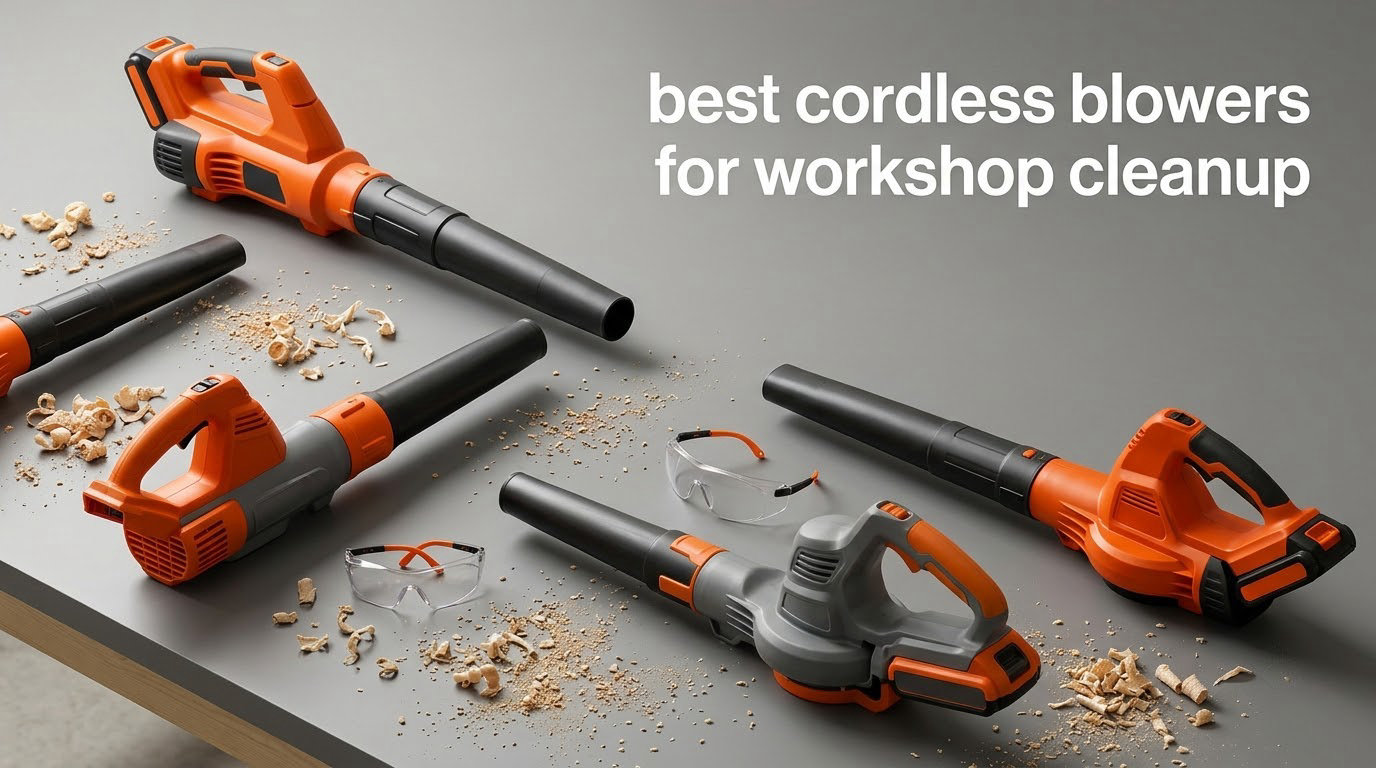
Most cordless blowers get bought for leaves, then dragged into the shop where they immediately fail at the one job that matters. A yard blower is tuned for wet leaves and gravel; a workshop needs to lift fine sawdust off a bench without blasting it into the air, and push planer shavings across concrete without scattering them into your rafters. Those are different jobs, and the spec that separates them is rarely the one printed on the box.
I’ve spent years cleaning up after miter saws, planers and sanders, and my rule is simple: blow first, vacuum second, and never use a blower as a substitute for dust collection. In this guide to the best cordless blowers for workshop cleanup, I break down eight machines by the jobs they actually do well, from a 2.5-pound handheld that fits behind machinery to a 615 CFM machine that clears a shop floor in one pass.
The other thing nobody tells you at the counter is that the battery platform decides your purchase more than the airflow number does. If you already own M18, 20V MAX or PowerShare packs, buying into a new ecosystem for a blower is the most expensive mistake in this category. We’ll get into that below.
Our Top 3 Cordless Blowers After Bench, Floor and Garage Duty
The three picks below cover the most ground for a typical shop: a controlled bench-and-floor unit, a complete quiet kit, and a high-volume pack for people who want batteries in the box. Each one earned its place by clearing real debris, not by topping a spec chart.
DEWALT DCE100B 20V MAX
- 100 CFM airflow
- 135 MPH air speed
- 2.5 lb body
- 3-speed switch and trigger lock

Greenworks 40V 24252
- 135 CFM airflow
- 150 MPH air speed
- 53 dB rated
- 2.0 Ah battery and charger included
MZK ET1613 20V
- 450 CFM claimed
- 130 MPH air speed
- Two 4.0 Ah batteries included
- Up to 75 minutes per charge
Comparing Every Cordless Blower in This Roundup
Every machine below sits on the same spectrum, but they occupy very different points on it. The two columns that decide workshop usefulness are CFM (how much air moves) and MPH (how fast it leaves the nozzle), and the row order here roughly follows that trade-off from high-velocity bench tools to high-volume floor tools.
| Product | Details | |
|---|---|---|
| DEWALT DCE100B 20V MAX Blower |
|
Check Latest Price |
| Greenworks 40V Cordless Leaf Blower 24252 |
|
Check Latest Price |
| MZK ET1613 20V Cordless Blower |
|
Check Latest Price |
 WOLFMEN LB-8197 Cordless Leaf Blower WOLFMEN LB-8197 Cordless Leaf Blower |
|
Check Latest Price |
 WORX WG543 Cordless Leaf Blower WORX WG543 Cordless Leaf Blower |
|
Check Latest Price |
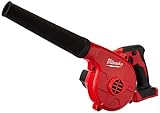 Milwaukee 0884-20 M18 Compact Blower Milwaukee 0884-20 M18 Compact Blower |
|
Check Latest Price |
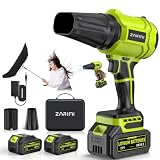 YUQUESEN RL-009 Cordless Leaf Blower YUQUESEN RL-009 Cordless Leaf Blower |
|
Check Latest Price |
 EGO POWER+ LB6151 Cordless Leaf Blower EGO POWER+ LB6151 Cordless Leaf Blower |
|
Check Latest Price |
1. DEWALT DCE100B 20V MAX – Best Balanced Blower for Bench and Floor Cleanup
DEWALT 20V MAX Blower, 100 CFM Airflow, Variable Speed Switch, Includes Trigger Lock, Bare Tool Only (DCE100B)
100 CFM airflow
135 MPH air speed
2.5 lb
3 nozzles included
3-year limited warranty
+ Pros
- Lightest body in the group at 2.5 pounds
- Three-speed switch plus variable trigger for fine control
- Trigger lock-on reduces finger fatigue
- Three nozzle attachments in the box
- Shares 20V MAX batteries with the rest of your DeWalt tools
- Cons
- Bare tool only
- battery and charger sold separately
- Modest 100 CFM output for heavy chip piles
- Single-battery runtime limits long sessions
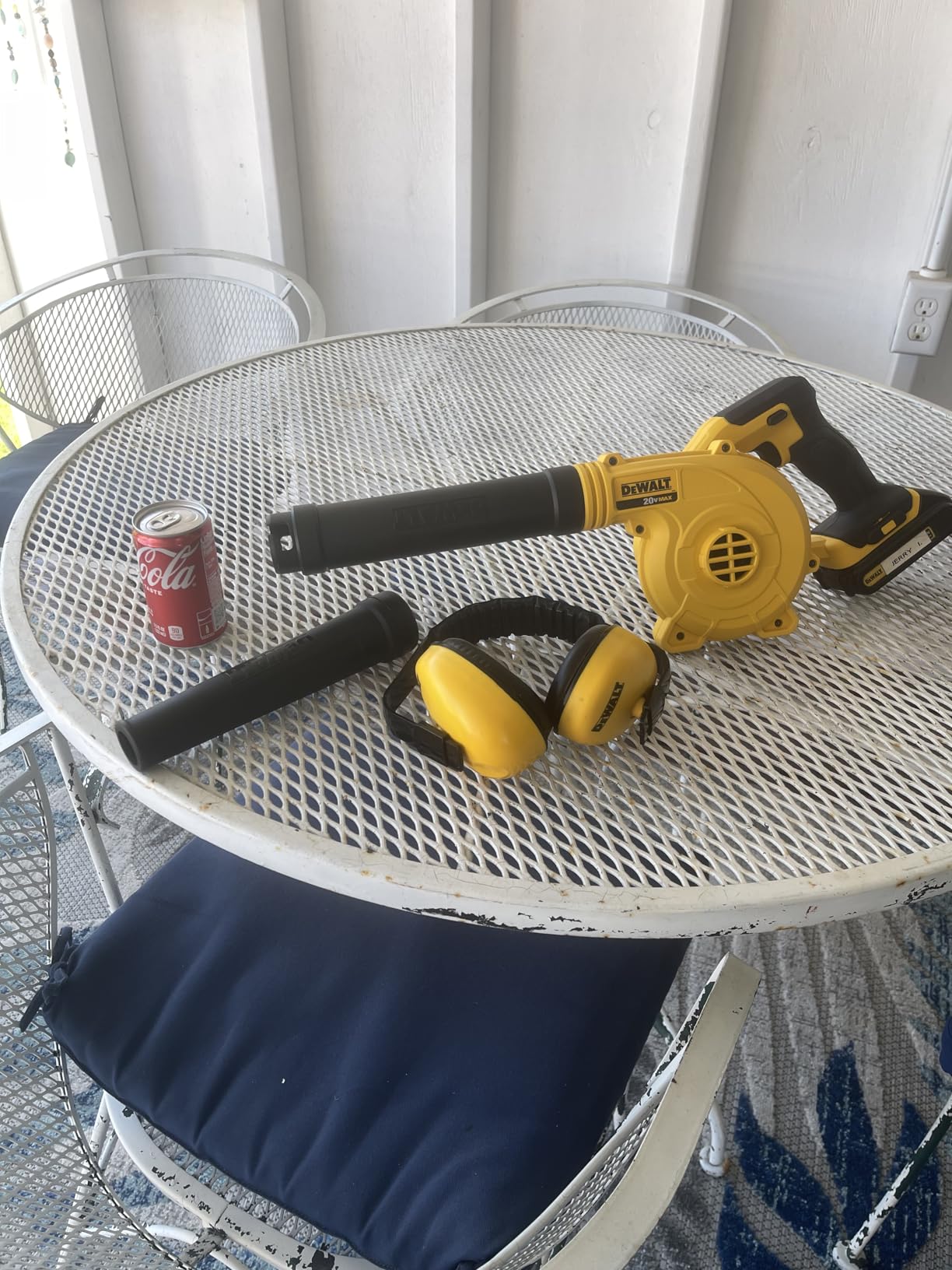
This is the one I reach for first, and the reason is boring but important: at 2.5 pounds it is the lightest body in this group, so I can hold it one-handed behind a table saw blade guard and still move the nozzle accurately. Most of my cleanup time is spent in awkward positions rather than open floor, and weight matters more there than peak output.
The DEWALT DCE100B pairs 100 CFM of volume with 135 MPH of exit speed. That combination sits closer to the precision end of the spectrum than the big-volume machines, which is exactly what a bench job wants: enough velocity to lift dust off a surface and carry it into a bag, without the turbulent cloud a 600 CFM machine produces.
Airflow balance for fine dust and chips
CFM is the number most people fixate on and the least useful number for bench work. Air volume tells you how much air moves; air speed tells you how forcefully it moves that air at the nozzle. Fine sawdust needs force to lift off a surface and move into a collection point, so the MPH figure does more of the actual work than the CFM figure.
What 100 CFM does give you is a narrow, controlled stream. That makes this machine well suited to tuck pointing along joints, clearing debris out of narrow spaces and cleaning a work area without scattering material across the shop. The three included nozzle attachments let you shape that stream for a soft bench pass or a focused crevice blast.
Weight, control and the trigger lock
The 2.5-pound figure is the headline, but the three-speed switch is what makes the weight workable. I run low speed for anything near a finished surface and high speed only when I’m pushing chips off the floor. The variable speed trigger gives finer control than a two-position switch, and the trigger lock-on holds the setting so I’m not squeezing the trigger through an entire cleanup pass.
Where the bare-tool version costs you
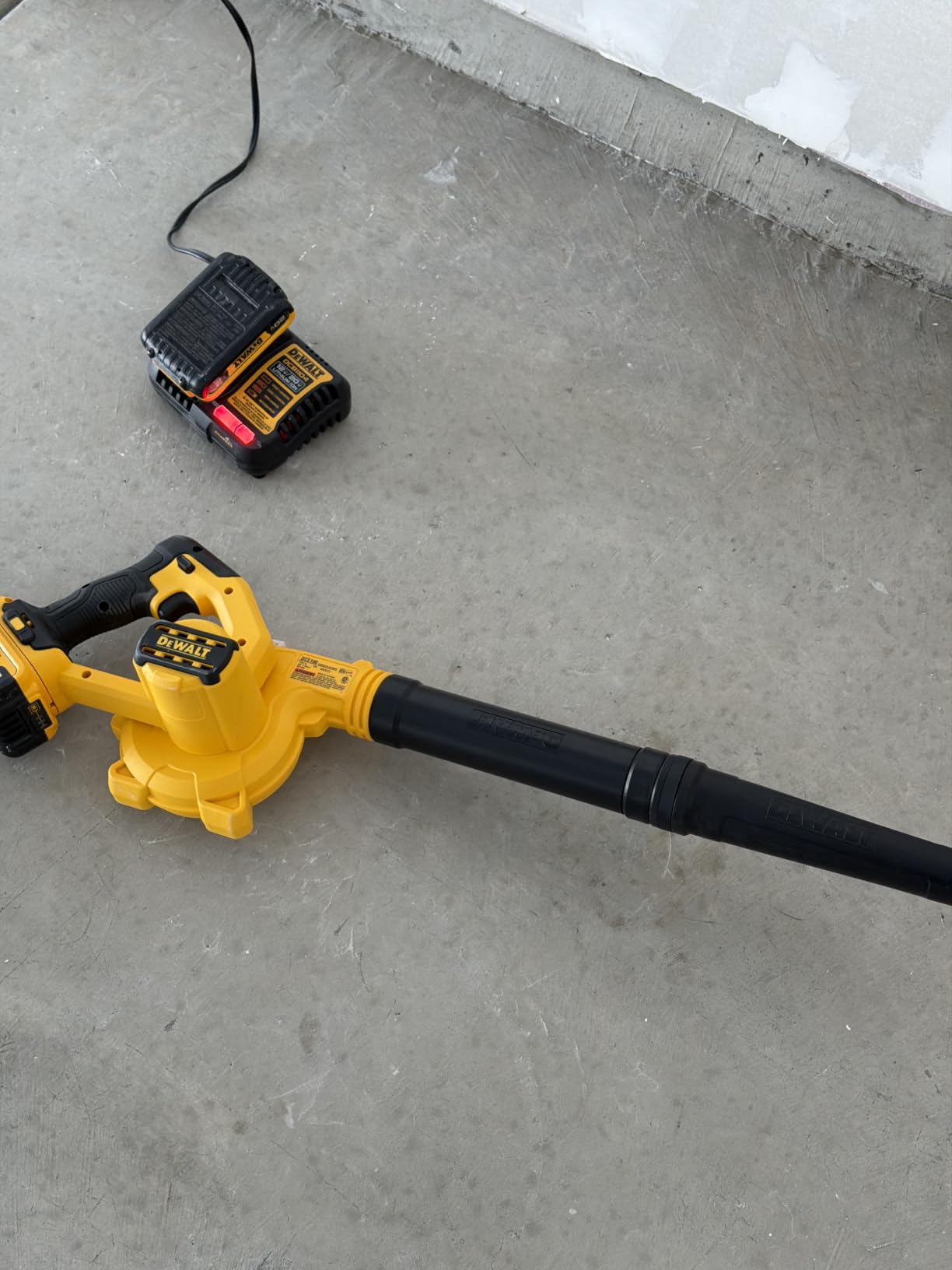
The DCE100B is a bare tool. That is the right call if you already have 20V MAX packs, and a poor one if you don’t, because you’ll be adding a battery and a charger before the blower does anything. Owners also note that a single pack sets the ceiling on a cleanup session, so anyone doing a full shop floor on one charge should plan a second battery.
Across more than 15,000 reviews the complaint pattern is consistent: people love the weight and the control, and they want more air volume for larger areas. It remains the safest general-purpose pick here for a reason: it is light, it is well controlled, and it does not tie you to a new battery ecosystem.
2. Greenworks 40V 24252 – Best Value Kit with the Quietest Rated Noise Level
Greenworks 40V Cordless Leaf Blower, 135 CFM, 2.0 Ah Battery and Charger
135 CFM airflow
150 MPH air speed
53 dB noise level
3.3 lb
3-year tool and battery warranty
+ Pros
- Battery and charger included as a complete kit
- 53 dB rated noise is the lowest figure here
- 150 MPH clears light snow and wet debris
- Variable speed dial plus concentrator nozzle
- Comfort grip at 3.3 pounds
- Cons
- Included 2.0 Ah battery is the smallest pack here
- Runtime per charge is limited at that capacity
- Lowest average rating in the group at 4.2
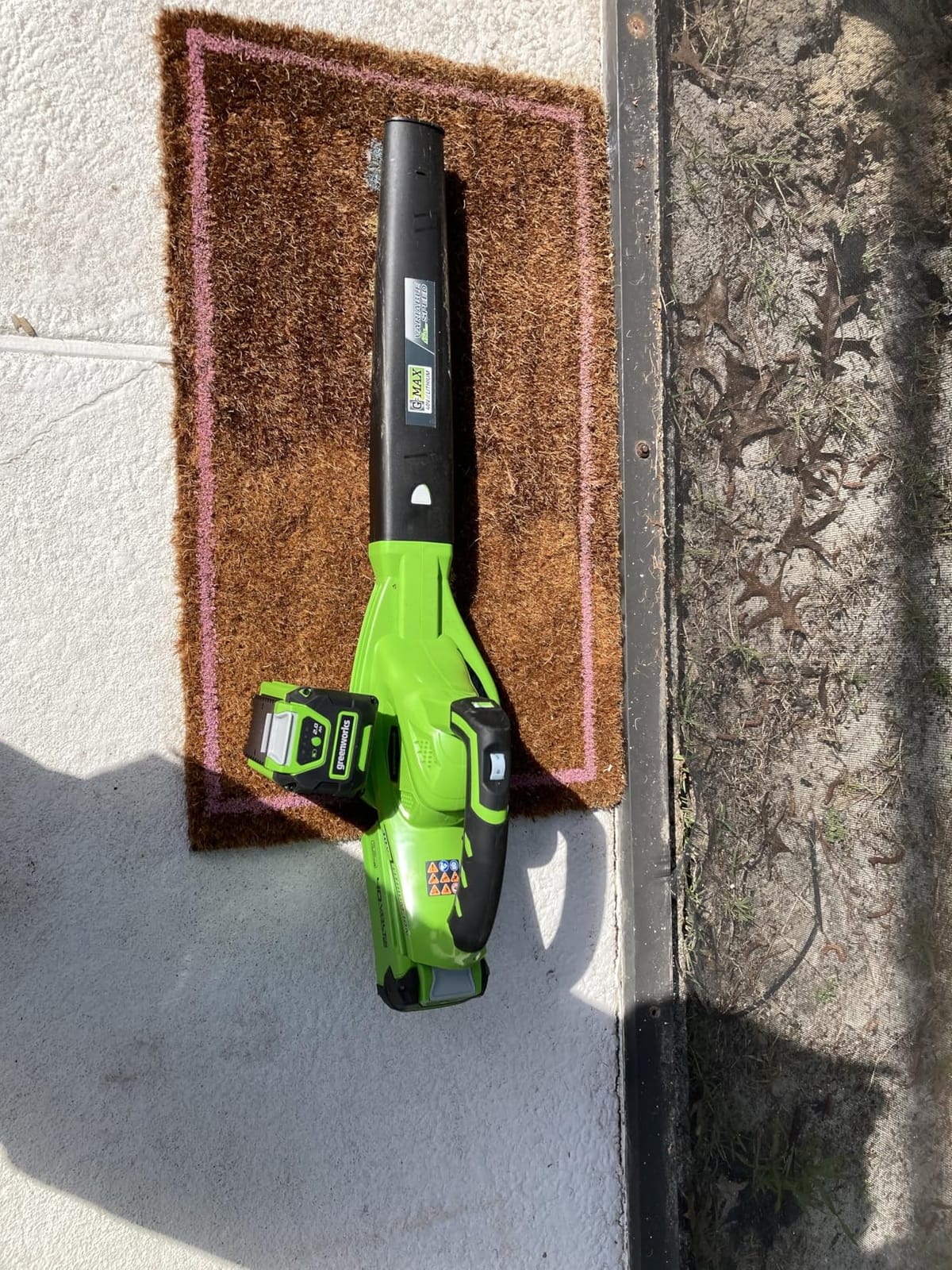
The Greenworks 40V 24252 is the pick for anyone starting from nothing. It arrives with a battery and a charger in the box, which removes the single most common complaint in this category: buying a bare tool and then discovering you need a second purchase before it runs at all.
Its rated noise level of 53 dB is the lowest published figure in this roundup by a wide margin. In a closed garage that difference is not academic. A blower rated a full 10 dB higher sounds dramatically louder, and noise is where a lot of shop owners give up on cordless tools and go back to a corded unit near an outlet.
135 CFM and 150 MPH on a 40V pack
The output numbers put this machine in the middle of the spectrum. 135 CFM of airflow with 150 MPH at the nozzle is more than enough for sawdust, offcuts of paper and packaging, and light debris off a shop floor. It is not enough to move a heavy pile of chips in a single pass, and the spec sheet itself is candid that it targets patios, decks, porches and garage floors.
The variable speed dial lets you back the airflow down when you’re cleaning a finished bench or a machine housing, and the concentrator nozzle narrows the stream for corner work. That is a genuinely useful combination for workshop dust rather than just lawn debris.
The 53 dB number in a closed garage
Noise rating is the least trustworthy spec on any blower listing, but when a manufacturer does publish a figure this low it usually reflects a genuinely quieter motor and inlet design. Treat 53 dB as the floor of the range rather than a promise at your ear, and check it against your own garage acoustics.
Even so, it makes this the quietest option in the group, which matters in an enclosed space. The ergonomic comfort grip and 3.3-pound weight are aimed at the same goal: getting through a garage sweep without fatigue.
Battery and charger: complete kit, small pack
The included 2.0 Ah battery is the weak point, and owners say so repeatedly. It is enough for a quick bench pass or a garage floor sweep, but it is the smallest capacity pack here, and anyone planning an end-of-day cleanup will want a higher-capacity pack sooner rather than later.
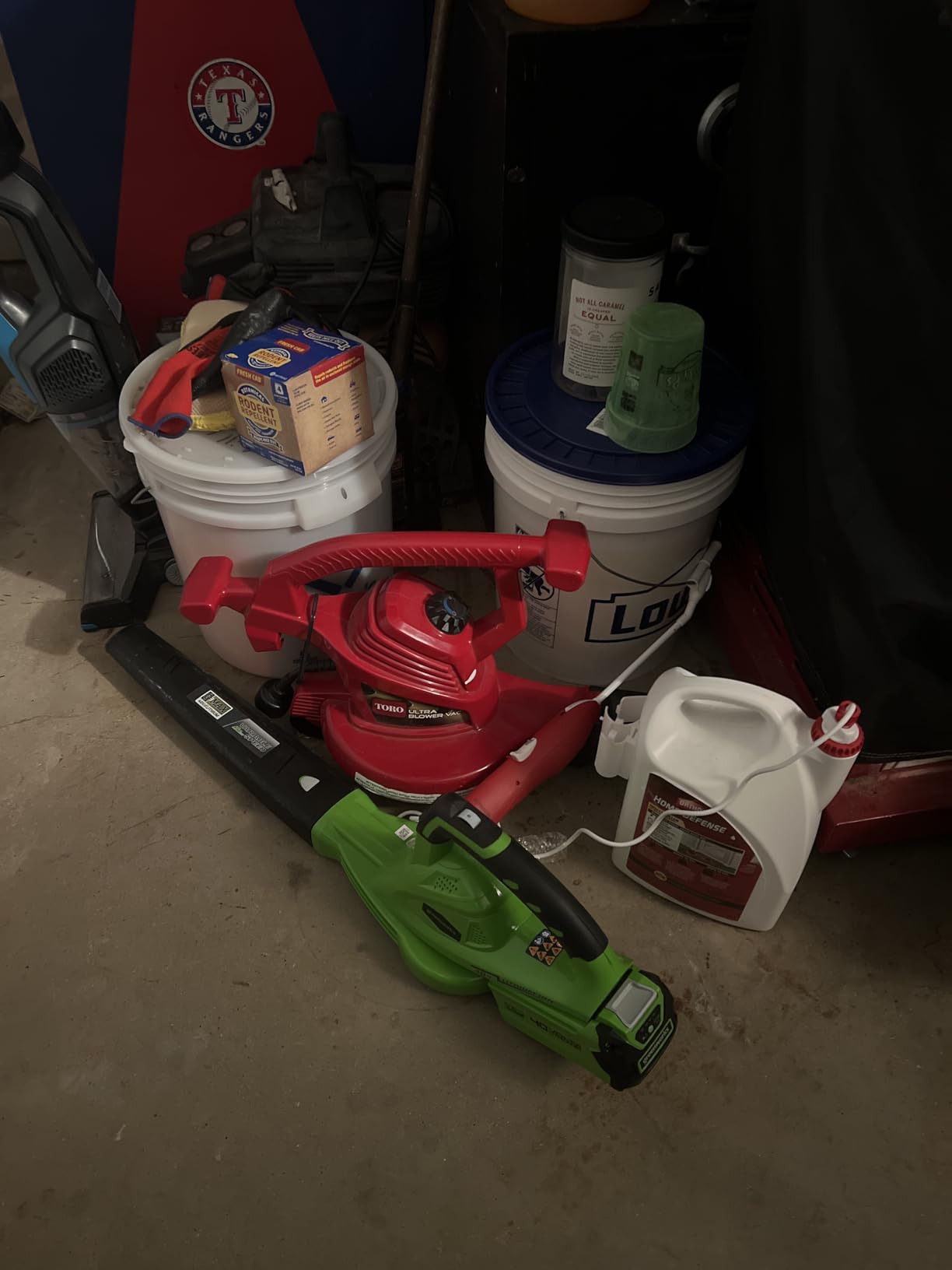
That is the trade: a complete, quiet, ready-to-use kit for the price-conscious buyer, with a battery you’ll probably upgrade. Given the 4.2 average across nearly 13,000 reviews, this is the most-honest-rated option in the roundup, and the reviews reflect it: quiet, easy, complete, and short on endurance.
3. MZK ET1613 20V – Budget Pick with Two Batteries in the Box
MZK 20V Cordless Leaf Blower, Lightweight Electric Blower
450 CFM claimed airflow
130 MPH air speed
3.9 lb one-hand body
Two 4.0 Ah batteries
65 dB noise level
+ Pros
- Two 4.0 Ah batteries and a fast charger included
- Light 3.9 lb one-hand body
- Up to 75 minutes runtime per charge
- Adjustable handle angle reduces wrist strain
- Good for garages
- shops
- patios and van interiors
- Cons
- Some owners report airflow feels weak on large piles
- This revision dropped the earlier low-speed setting
- 65 dB is louder than the quieter units
- Battery must be removed to charge
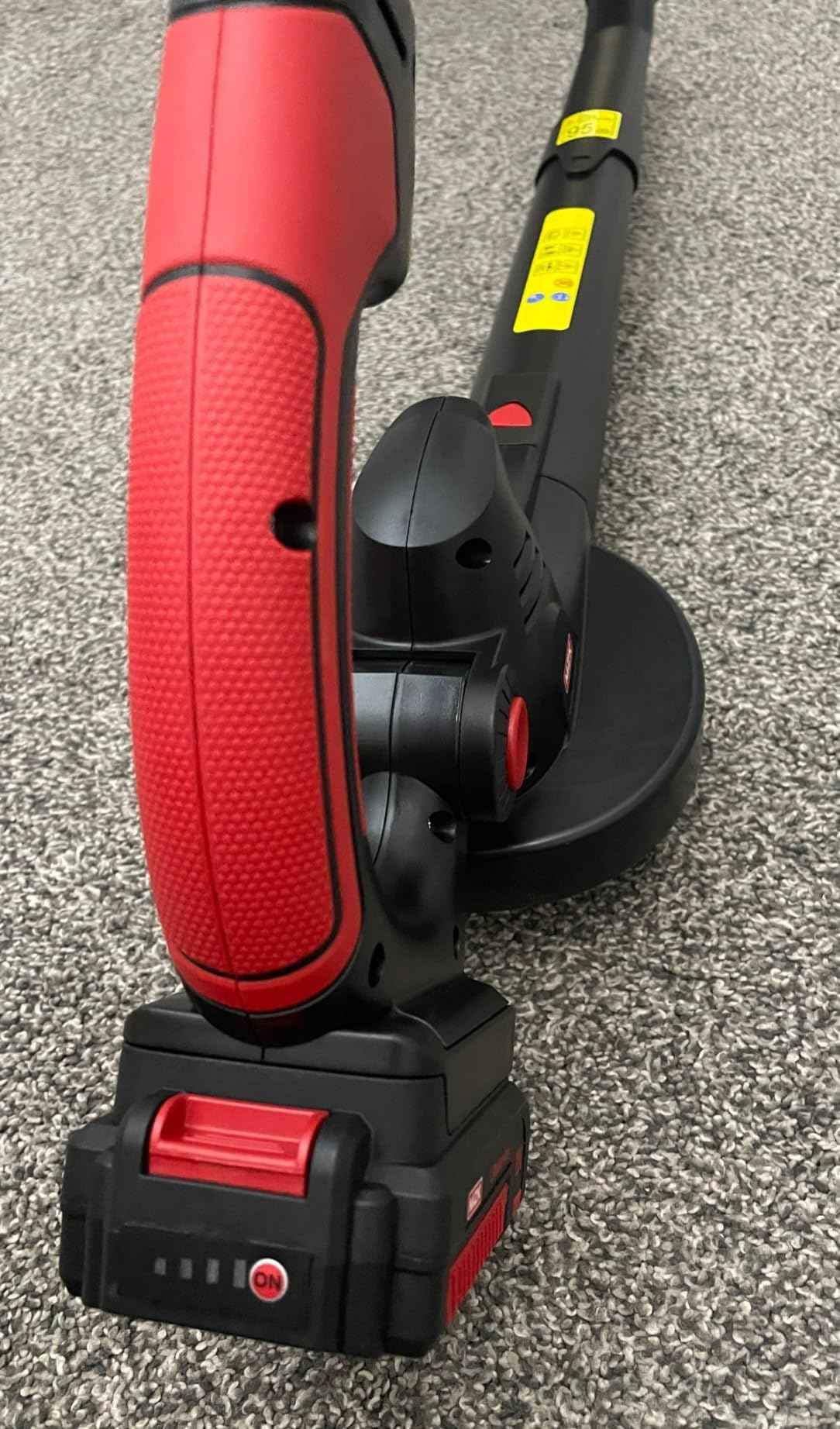
The MZK ET1613 is the most interesting value story here, and it isn’t close. Two 4.0 Ah batteries and a fast charger ship in the box. For most shop owners, that dual-pack setup alone changes how you work, because you can swap to the second pack while the first one charges and never stop mid-cleanup.
It also covers an unusually broad range of workshop-adjacent jobs: garages, shops, driveways, spider webs, dust and drying car surfaces. Reviewers describe it as a light, easy-to-handle blower for quick cleanups rather than heavy yard work, and that framing is accurate.
450 CFM claimed, 130 MPH delivered
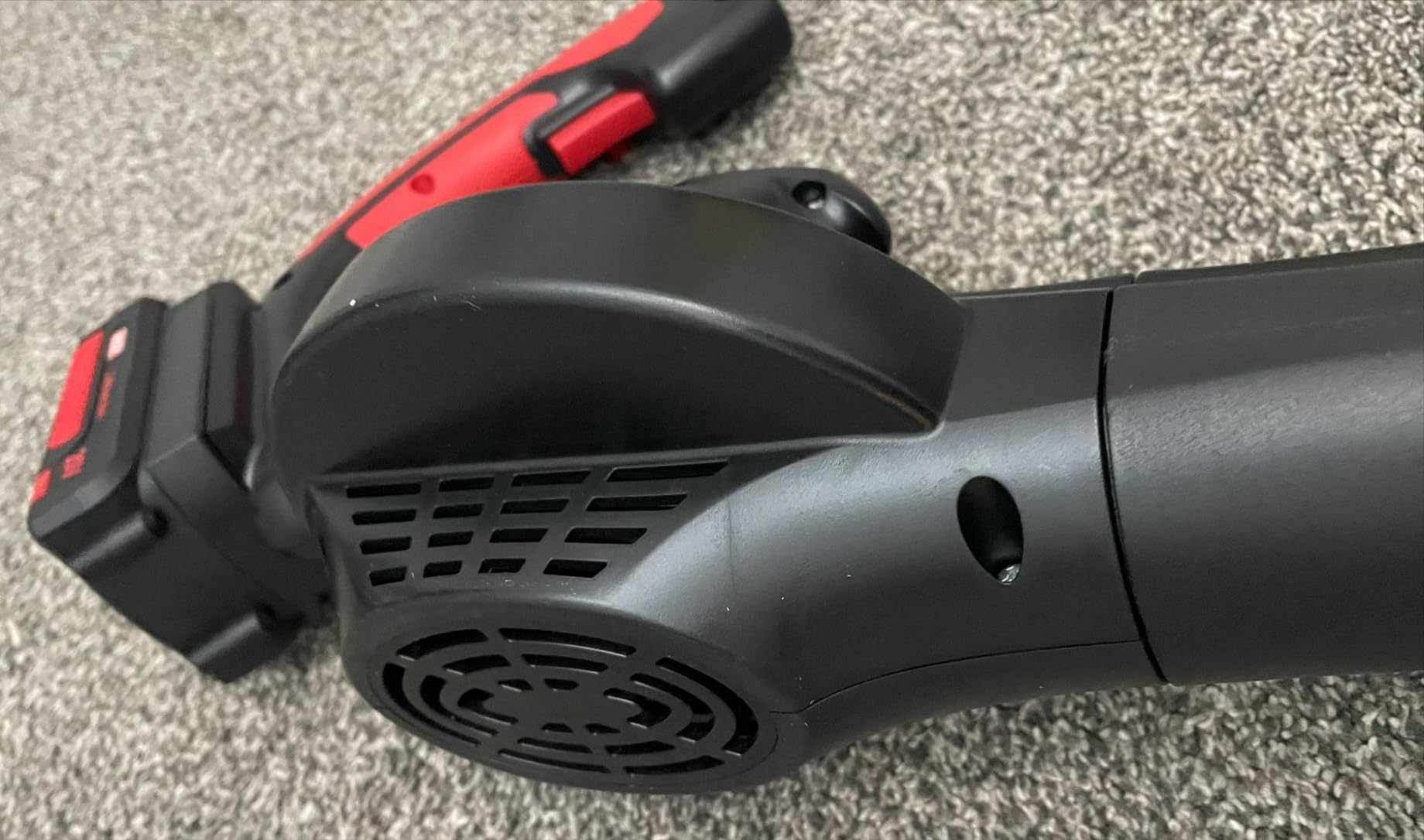
The 450 CFM headline figure is at the high-volume end of this list, which on paper makes it look like a floor machine. The 130 MPH exit speed tells a different story. High CFM with moderate speed produces a broad, rolling wave that lifts volume but not individual particles with much force, which is why owners report the airflow feeling soft even when the number is large.
For workshop dust specifically, that is a compromise rather than a contradiction. It moves loose material across a floor well and handles patio and deck debris fine. If your cleanup is mostly bench dust and fine particles, a higher-velocity machine like the DEWALT or Milwaukee will serve you better. If it’s chips, offcuts and shop-floor grit, this is closer to right.
Two 4.0 Ah batteries and the swap habit
Up to 75 minutes of runtime at maximum output per charge is the figure that makes this kit interesting. In practice you’ll get less than that on the high setting, but the dual-pack setup means the realistic session length is bounded by your patience, not by the battery.
The 3.9-pound body and adjustable handle angle are aimed at long, awkward sessions. Owners mention using it on gravel and driveways where wrist position matters, and the same applies indoors when you’re working low under a bench.
The version change that cost it a low-speed setting
This revision dropped the low-speed mode that the earlier version had, which several owners miss. That matters more in a workshop than in a yard, because the low setting is exactly what you want for a soft pass near a finished surface or a machine housing. You now have two speeds instead of a graduated range.
At 65 dB it is also louder than the compact units here, and it is the loudest item in the roundup short of the EGO. If your garage is enclosed, budget for hearing protection. Buyers who accept the trade report it as a capable, light blower at a genuinely low entry point, with two batteries included that would cost more than the tool on some competitors.
4. WOLFMEN LB-8197 – Best for Patio, Deck and Driveway Sweeps
Leaf Blower, Electric Leaf Blower Cordless with 2 Batteries and Charger, 2 Speed Mode, Lightweight Cordless Leaf Blowers for Lawn Care, Blowing Leaves, Patio Cleaning and Dust, Green
450 CFM airflow
150 MPH air speed
3.8 lb body
2 speed modes
Two batteries and charger
+ Pros
- Two batteries and charger included
- Very light at 3.8 pounds
- Two speed modes give useful control
- Quick tool-free assembly
- Practical for garage and patio cleanup
- Cons
- Not strong enough for large piles
- Reviewers report batteries lose charge capacity over about a year
- Limited brand support on a generic listing
The WOLFMEN LB-8197 is the machine I’d point someone toward if their cleanup routine starts on the driveway and ends in the garage. It uses an axial flow turbofan rated to 450 CFM and 150 MPH, which gives it a stronger velocity figure than the MZK at the same volume class, and that combination suits both hard surfaces and shop-floor debris.
At 3.8 pounds it’s light enough for one-handed work over extended sessions, and the two speed modes give you a real low setting rather than a single on-off control. The quick assembly detail is worth noting too: two nozzles and a battery go on in a couple of minutes, so you’re not fiddling with fittings at the start of a cleanup.
Axial turbofan output at 450 CFM
An axial fan pulls air straight through the housing and out the nozzle, which produces a wide, fast stream. The practical effect in a workshop is good coverage across a bench or a section of floor in a single sweep, at the cost of the tight pencil stream you’d want for a crevice or a machine housing.
The 150 MPH figure is the more useful half of the spec pair for fine material. Owners consistently describe it as pushing more air than expected, which tracks with the velocity number rather than the volume number.
Two-speed control and quick assembly
Two modes give enough separation to handle light sweeping and heavier piles in the same session without over-blowing delicate surfaces. Batteries recharge quickly, and reviewers note that they hold their charge well over a week to ten days of intermittent use, which matters if the blower lives on a shelf between cleanups.
Runtime is listed at up to 30 minutes per battery on the low setting, so the two-battery package gives roughly an hour of light work and less at high output. For garage-floor sweeps and patio work that’s a workable cycle.
Battery longevity and support are the weak points
The consistent long-term complaint is battery degradation. Across reviews, owners report that the packs gradually lose charge-holding capacity over roughly a year of regular use. If you’re buying this as a five-year shop tool rather than a seasonal patio tool, factor replacement packs into your thinking.
The other limitation is support. This is a generic listing with minimal brand backing, so troubleshooting and parts are less predictable than with an established platform brand. Owners also note it’s not strong enough for large piles, which is the honest ceiling on this one.
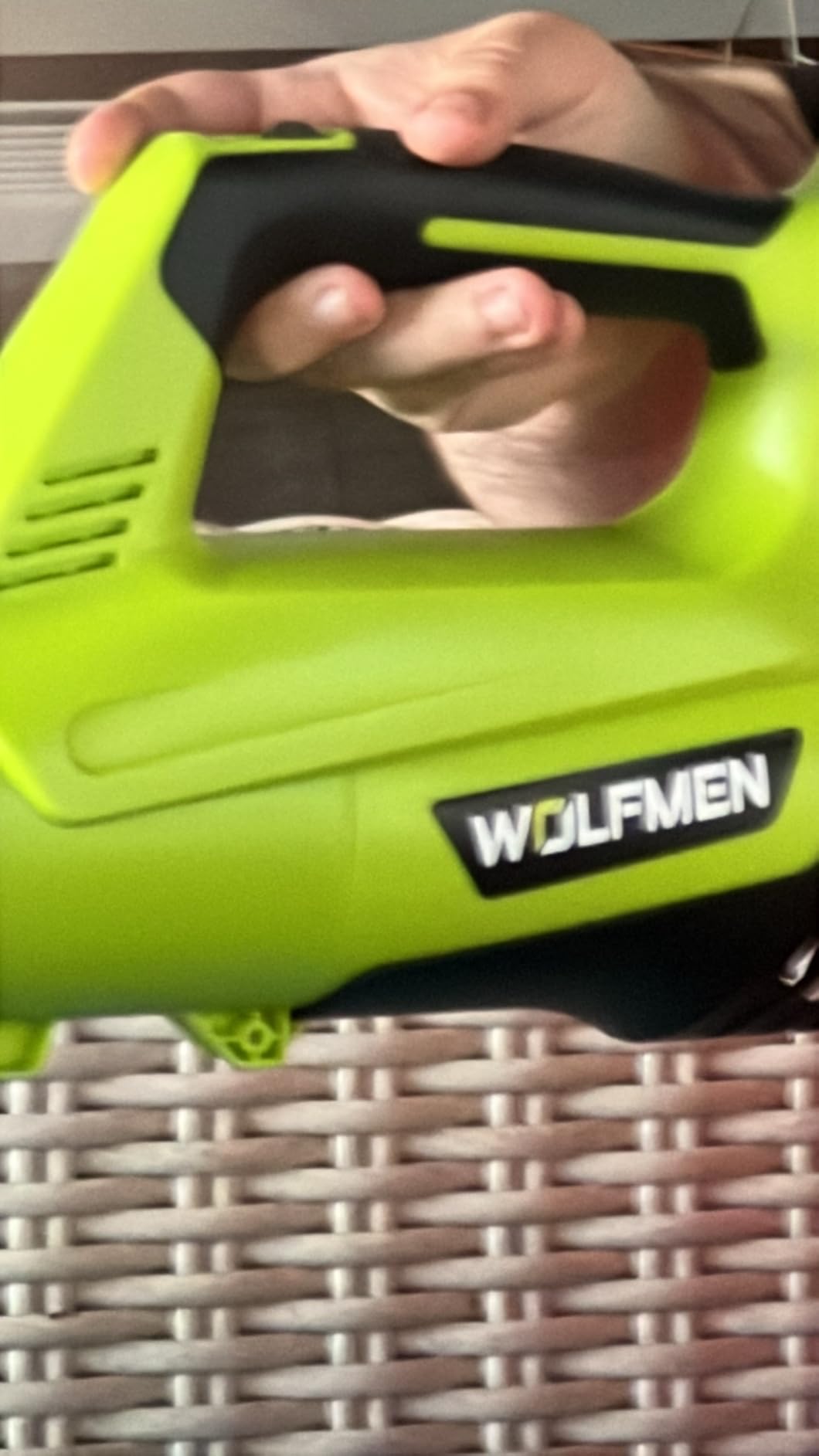
Within that ceiling, it’s a capable machine for light debris. Think patio, walkway and garage-floor cleanup rather than wet leaves or heavy chip piles, and it’ll serve you well for a fraction of what the branded high-volume machines ask.
5. WORX WG543 – Best for Electronics-Safe Dusting with Two-Mode Control
WORX Cordless Leaf Blower, 20V Electric Blower for Leaf Removal, WG543
410 CFM volume mode
130 MPH speed mode
7.3 newton jet stream
3.8 lb body
4.0Ah battery and charger included
+ Pros
- Two-mode nozzle for volume or speed
- Brushless motor 2.0 with 7.3 newtons of thrust
- 3.8 lb one-hand body
- 4.5 average rating with strong review volume
- Battery shares across 140+ PowerShare tools
- Cons
- 65 dB noise level
- Only one 4.0 Ah battery included
- Higher cost than generic 20V blowers
The WG543 solves a problem most people don’t realize they have: a blower that’s strong enough for the yard but controllable enough for a workbench. Its two-mode nozzle is the feature that matters. Volume mode runs up to 410 CFM for broad floor work; speed mode reaches 130 MPH for focused, high-velocity cleaning where you want to move a specific bit of dust and nothing else.
That switch is exactly what you want around a PC case, a bench with soldered components, or a machine with a cooling fan. Volume mode on electronics is what pushes dust into corners; speed mode at a distance moves it out without the turbulence.
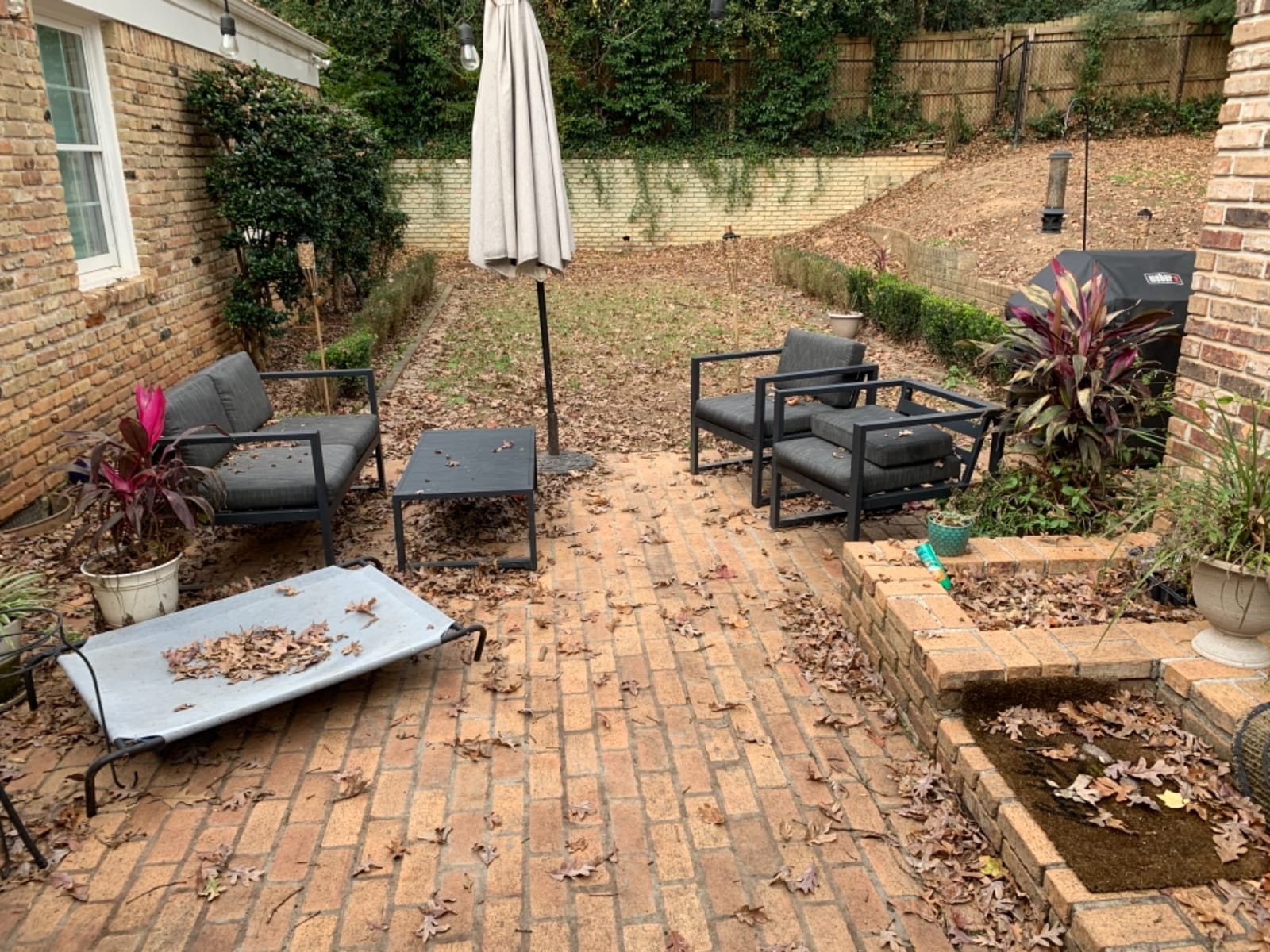
Volume mode vs speed mode and why the switch matters
Most blowers give you a dial that trades volume against speed continuously. This one gives you a deliberate, labeled choice between the two extremes, and that predictability is why it’s my pick for detail work. I set the mode first, then use the trigger for fine adjustment inside that range.
The sonic turbine fan delivers a 7.3 newton jet stream, which is a meaningfully more useful spec than raw CFM when the job is lifting dust off a surface. Force, not volume, separates debris from a surface. Volume just moves what’s already loose.
Brushless 2.0 motor and 7.3 newtons of thrust
The brushless motor 2.0 is rated at 40 percent more power and 10 percent longer runtime than a standard brushless motor. In practice, brushless means a sealed motor with no carbon brushes to wear, which is the right call for a tool that lives near a dusty bench and gets stored in a damp garage.
At 3.8 pounds it is one-hand operable without fatigue, which again favors the awkward positions that dominate shop cleanup: behind a machine, under a bench, inside a cabinet.
PowerShare ecosystem and the single-battery box
The real argument for this blower is the platform. The same PowerShare battery works across more than 140 tools and outdoor products, so if you’re already in that ecosystem this becomes a cheap add-on rather than a new system. If you’re not, the ecosystem advantage is much smaller.
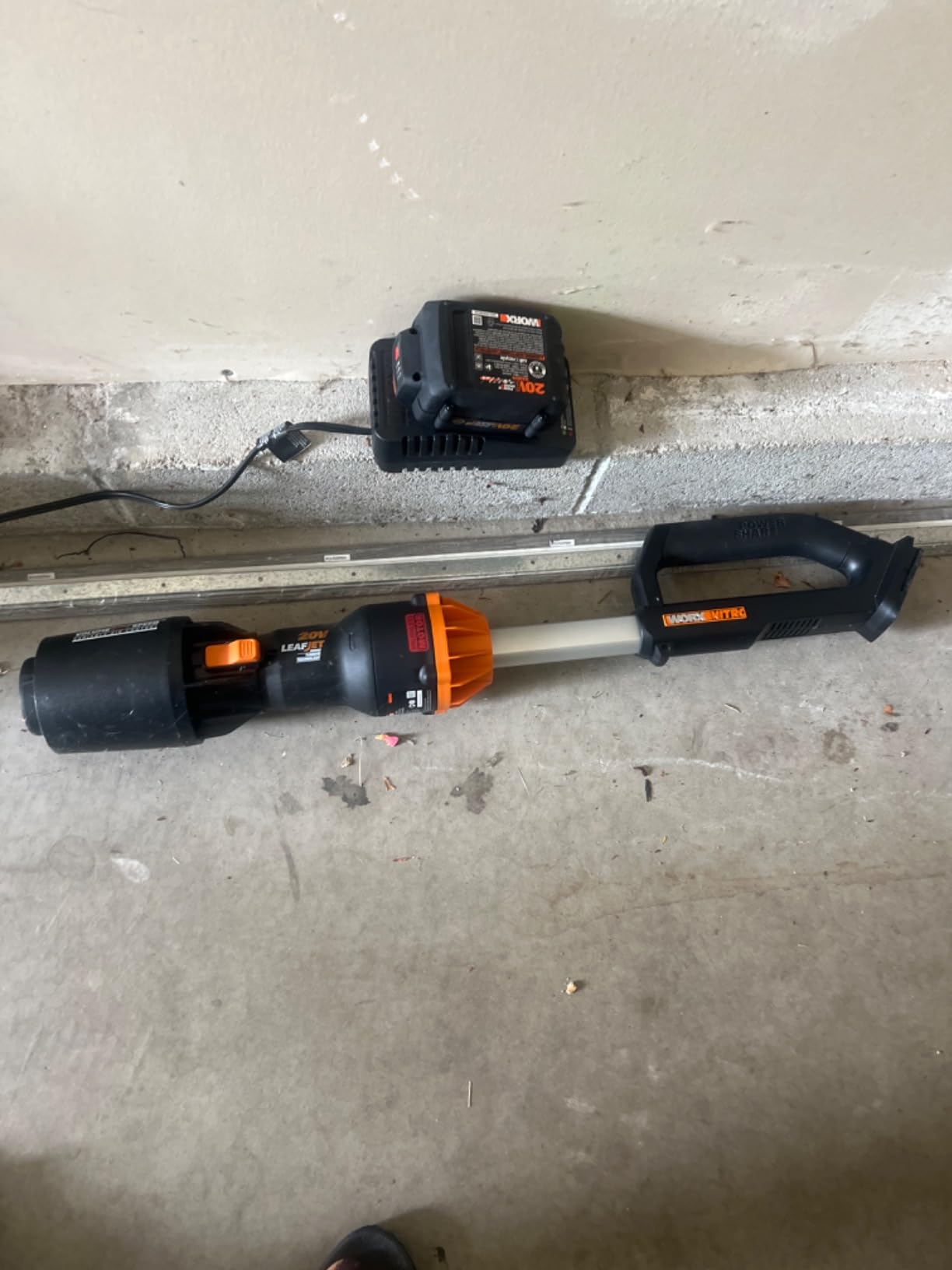
It arrives with a single 4.0 Ah PowerShare Pro battery and a 2.0A charger, so there’s no swap-and-charge rotation out of the box. The 65 dB rating is louder than the Greenworks by a noticeable margin, and the cost sits above the generic-brand 20V units. Within its class, though, the review profile here is the strongest in the roundup.
6. Milwaukee 0884-20 M18 – Best for M18 Platform Owners and Machine Cleaning
Milwaukee 0884-20 M18 18 V Litio Ion 100 CFM 160 MPH Inalámbrico Compacto Multipropósito Utility Blower
100 CFM airflow
160 MPH air speed
3.6 lb compact body
3-speed electronic switch
Lock-on switch
+ Pros
- Lightest branded body at 3.6 pounds
- 3-speed electronic control with a gentle low setting
- Lock-on switch frees both hands
- Flexible nozzle protects delicate surfaces
- Batteries interchange with the whole M18 range
- Cons
- Bare tool
- battery and charger sold separately
- Drains M18 packs in roughly 20 minutes of hard blowing
- Short nozzle tube for ground-level work
- Intake on one side pulls in loose clothing
If you already own Milwaukee M18 batteries, this is the blower to add. It shares packs with your entire M18 range, which removes the ecosystem cost entirely and turns a blower into a marginal addition to a tool collection you have already invested in.
Milwaukee owners describe the 0884-20 as one of their most-used platform tools. The combination that earns that reputation is 160 MPH at the nozzle with 100 CFM of volume: the highest air speed of any machine in this roundup, which makes it the best of these eight at moving dust off a surface rather than rolling it around.
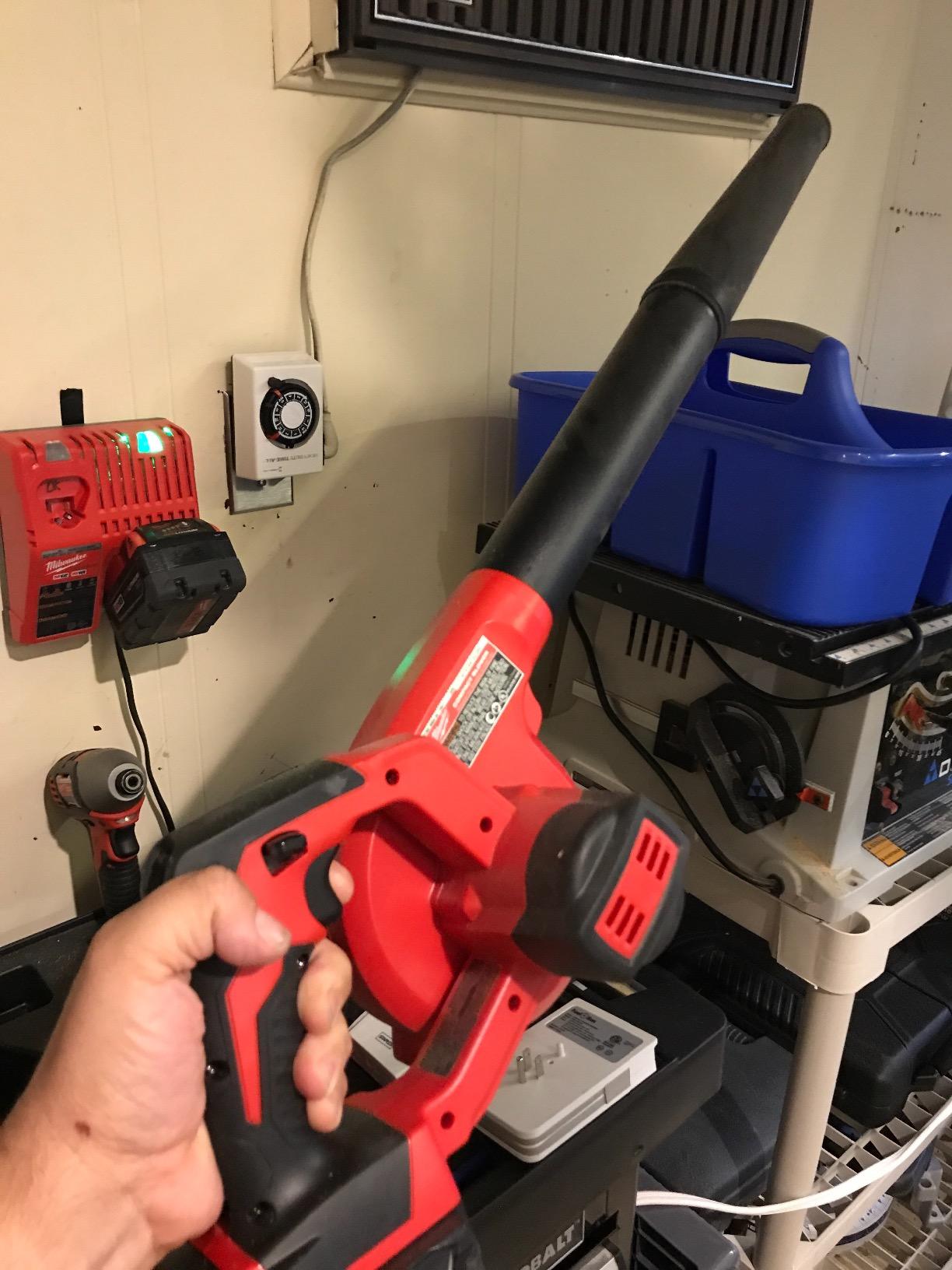
100 CFM at 160 MPH and the flexible nozzle
At 160 MPH this is a high-velocity machine with modest volume, and for fine dust that ratio is correct. Force lifts particles off the bench; volume only distributes what is already airborne. The flexible nozzle is a small detail that matters more in a workshop than it does outside, because it lets you put airflow close to a painted surface or a machine housing without worrying about abrasion.
The 3-speed electronic switch gives you a low setting gentle enough for a finished bench and a high setting for shop-floor cleanup. That range is the reason this tool works across more of a shop day than a single-speed blower.
Three-speed electronic switch and lock-on
The lock-on switch is the ergonomic feature I’d prioritize on any workshop blower. It holds the throttle so both hands are free, which matters when you’re steadying a hose, holding a nozzle against a machine housing or managing the pack at the same time. Combined with 3.6 pounds, it’s comfortable for long sessions.
The shock-absorbing ABS polymer housing is also worth mentioning, because blowers live on concrete floors and plastic housings crack when dropped. It’s a durability argument rather than a performance one.
Bare tool, short tube and pack drain
This is a bare tool, so a battery and charger are separate purchases. Owners also report that it consumes M18 packs quickly, roughly 20 minutes of hard blowing per pack, which means a second battery is close to mandatory for a full shop floor.
The nozzle tube is short, and some users add a longer one for ground-level work. The side-mounted intake pulling in loose clothing is a recurring complaint and a genuine safety consideration: keep long sleeves and drawstrings secured.
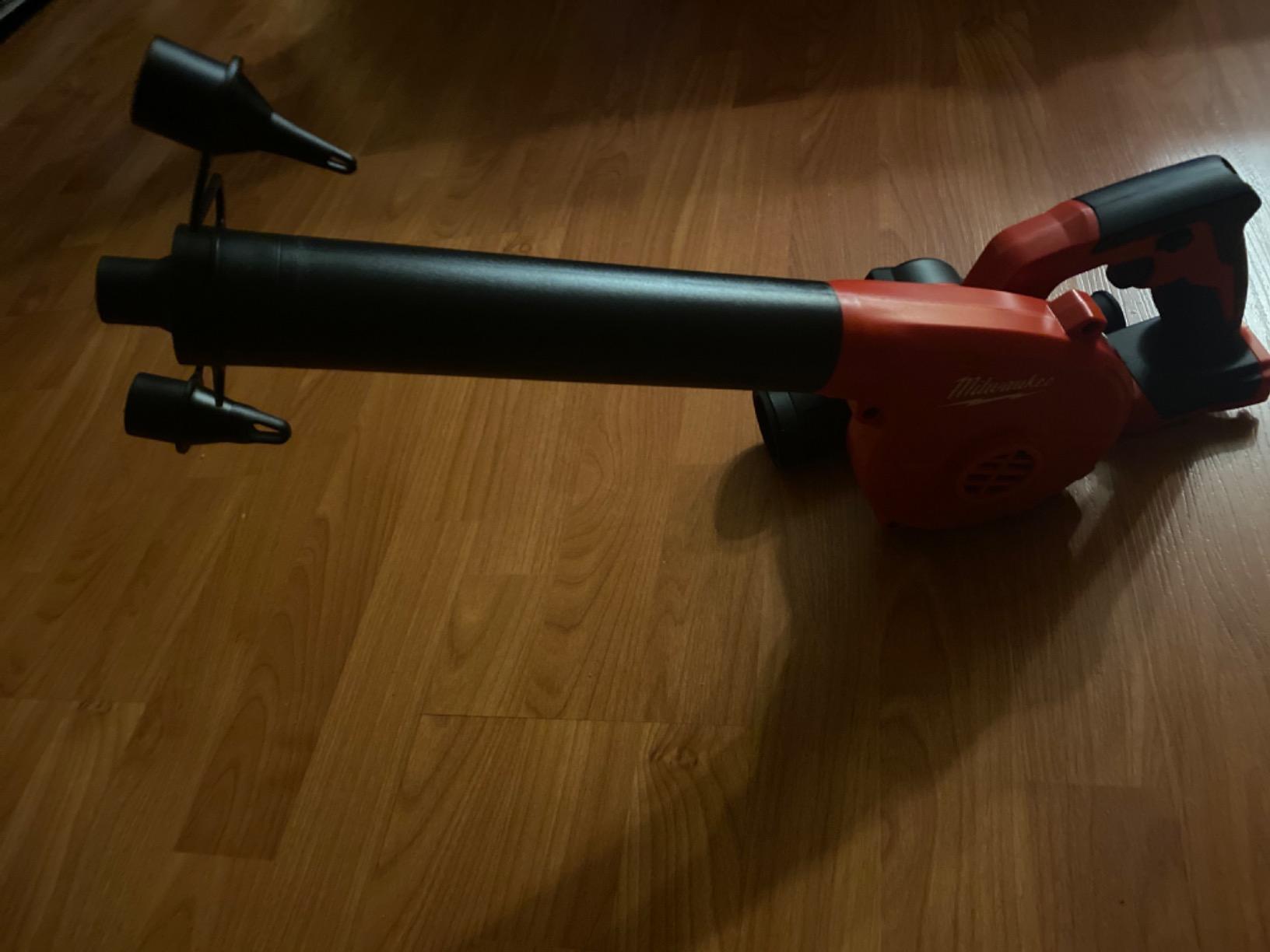
There is also an inflation and deflation add-on that attaches directly to the blower, which turns a dust tool into a multi-function shop device. Owners note the tool runs cool and lasts many hours on shared batteries, which is the strongest durability signal in this group.
7. YUQUESEN RL-009 – Best Lightweight Pick for Quick One-Hand Cleanups
YUQUESEN Cordless Leaf Blower, 980,000 RPM Handheld Leaf Blower with 2 Batteries & Charger, Lightweight Leaf Blowers for Patio, Lawn, Leaves, Dust – Bright Green
980000 RPM turbine
Wind over 50 m/s
2.8 lb body
Two batteries and storage box
Charge indicator
+ Pros
- Lightest body in the group at 2.8 pounds
- High-RPM turbine gives real airflow from a small frame
- Two batteries
- charger and a storage box included
- Owners report moving wet leaves
- pebbles and car water
- Vibration-suppressed grip reduces hand fatigue
- Cons
- Louder than the quiet units
- 13 to 20 minutes per battery splits work into bursts
- Not suited to large acreage or heavy whole-yard jobs
The RL-009 is the one I recommend when the cleanup is thirty seconds long and you don’t want to unclip a blower from a wall mount. At 2.8 pounds it’s the second-lightest body here and easily the most compact, which makes it the tool you actually reach for between cuts rather than the one you plan a session around.
It ships with two lithium batteries, a charger and a storage box. That box matters more than it sounds: it’s the difference between a blower that lives on a shop shelf and one that ends up in the back of a truck because there was nowhere to put it.
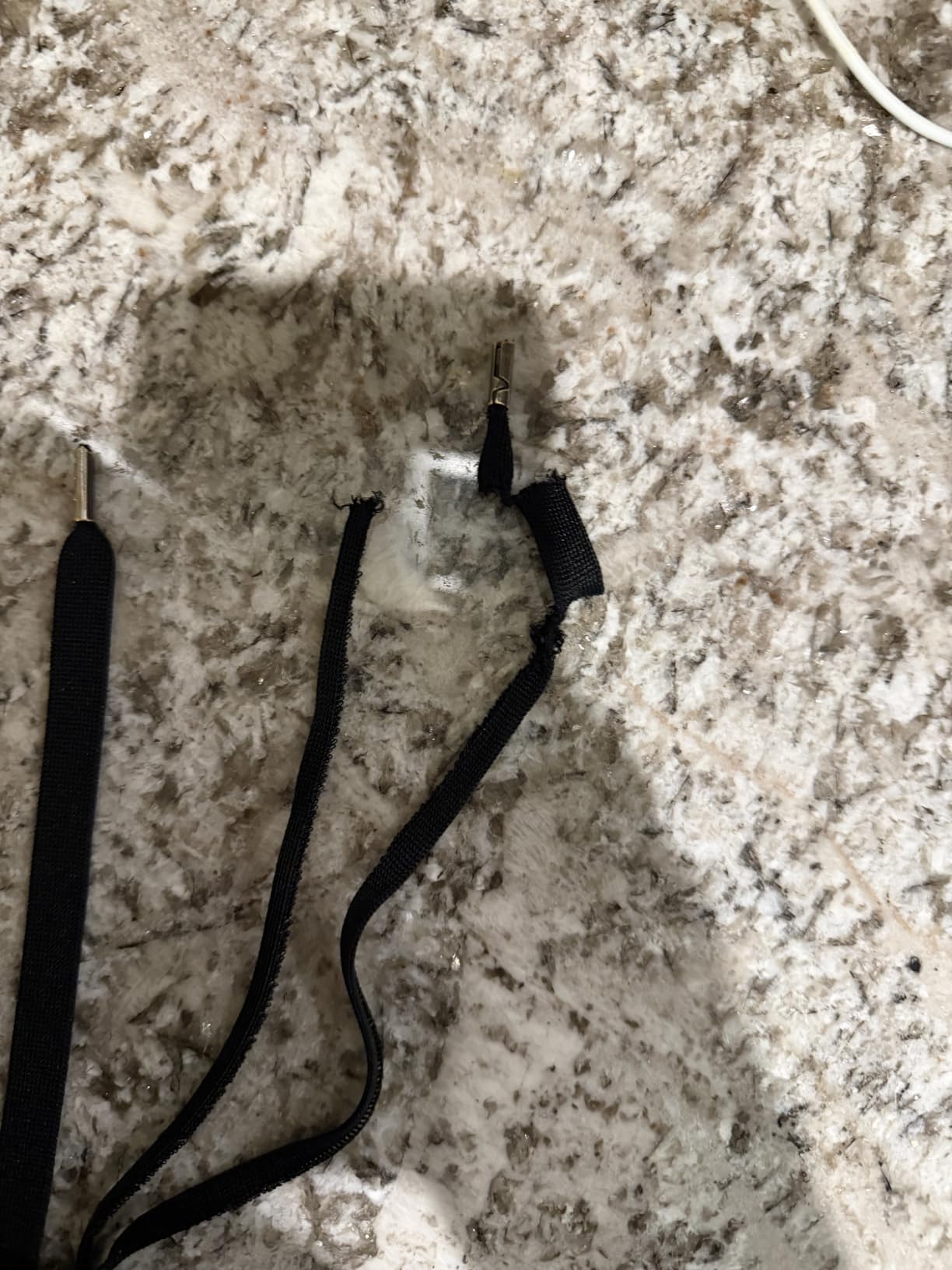
980,000 RPM turbine in a 2.8 lb body
The high-RPM turbine produces wind over 50 m/s, which is roughly 110 MPH at the nozzle. Owners frequently describe it as more powerful than its size suggests, and that tracks: the rotational speed is high enough to move surface water and small pebbles, not just paper and dust.
For workshop use that means it’s genuinely capable on a bench, in a cabinet, and around a car door after a wash. The concentrated narrow nozzle included tightens the stream for crevice work, where a wide general nozzle just bounces air off the edges.
Two batteries, 13+ minutes each
Each battery delivers 13 or more minutes of continuous strong airflow, so the pair gives roughly 26 minutes of total work. That is a short cycle compared to the EGO’s claims, and it shapes how you use the tool: this is a grab-and-go machine for quick passes, not a whole-floor machine.
The intelligent battery management system uses protective chips and a charge indicator with red for charging and green for full. The vibration-suppressed ergonomic grip is what actually keeps the high turbine speed from turning into hand fatigue over repeated short sessions.
Noise and short bursts of runtime
Two complaints dominate: noise and runtime. Owners rate it as louder than the compact units here, and anyone in an enclosed garage with sustained exposure should use hearing protection. The 13 to 20 minute per-battery window also means you’re planning around swaps rather than running long.
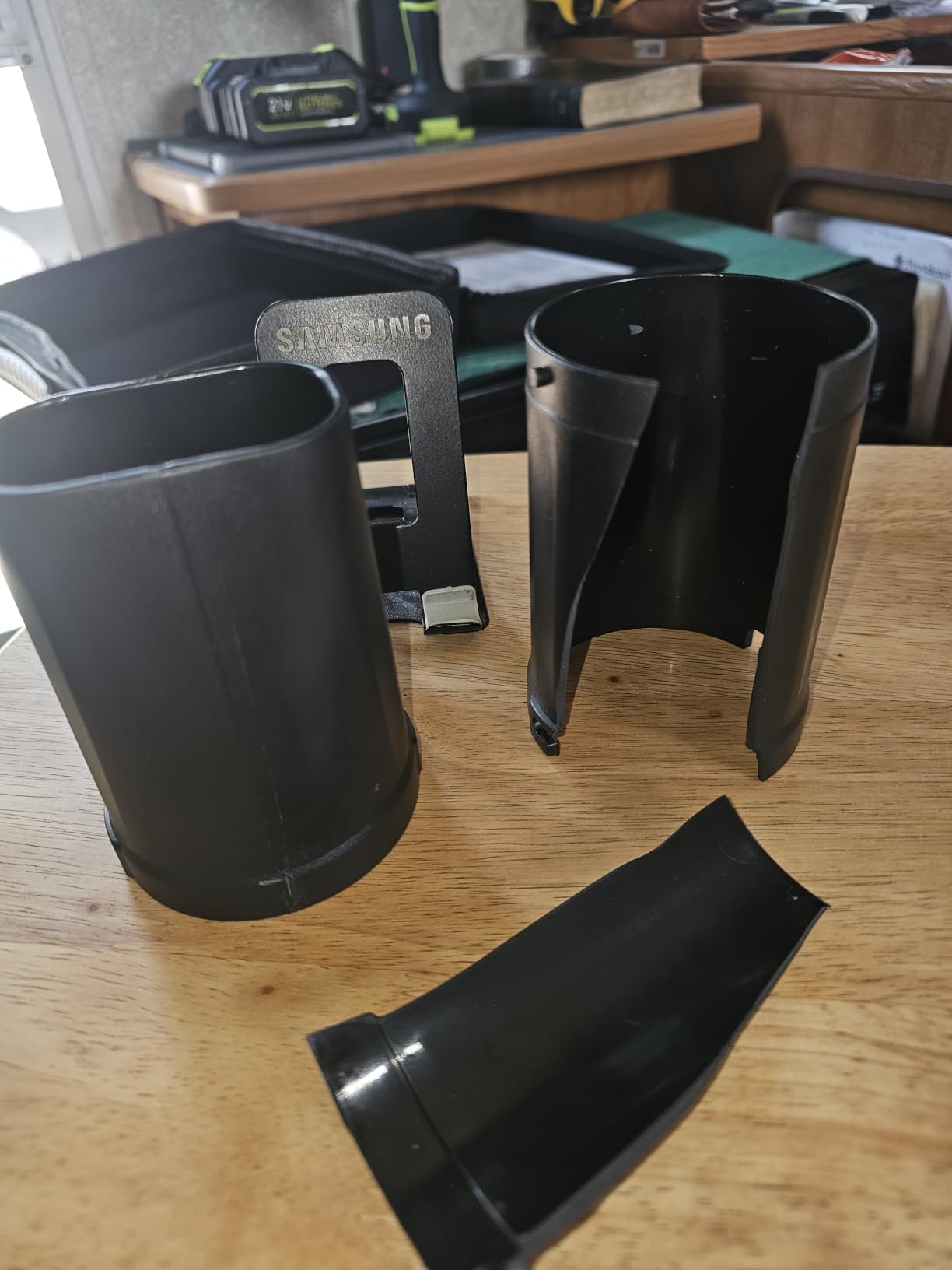
The support setup is unusually good for a generic brand: the team replies within 12 business hours and digital manuals are included, which removes the usual weak point on lesser-known brands. The clear limitation is scale: this is not the machine for a large yard or heavy whole-yard job.
8. EGO POWER+ LB6151 – Best High-CFM Machine for Clearing a Shop Floor Fast
EGO POWER+ Cordless Electric Leaf Blower, 615 CFM, With Battery – LB6151
615 CFM turbo mode
170 MPH air speed
7.5 lb with battery
200 to 480 CFM dial with lock
5-year tool warranty
+ Pros
- Highest airflow here at 615 CFM
- Handles heavy wet debris and packed piles
- Variable dial plus lock-on plus turbo mode
- 56V ARC batteries work across the EGO platform
- 5-year tool warranty and 3-year battery warranty
- Brushless motor with low vibration
- Cons
- Heaviest unit here at 7.5 lb with the battery about half of it
- Loudest at 71 dB and ear protection is advisable
- Turbo drains the 2.5 Ah pack in roughly 15 to 20 minutes
- Reports of a nose-heavy feel
- Highest cost in the group
The LB6151 is the machine you buy when clearing a shop floor is the whole job and you want it done in one pass. At 615 CFM in turbo mode it moves more air than anything else here by a wide margin, and owners routinely compare its output to gas blowers while noting it is far quieter.
It is also the machine most often described as overkill for bench work. I agree with that framing. Pointing 615 CFM at a workbench creates a dust cloud rather than removing dust, and the variable speed dial exists precisely so you can dial that down to 200 CFM when you move from the floor to the bench.
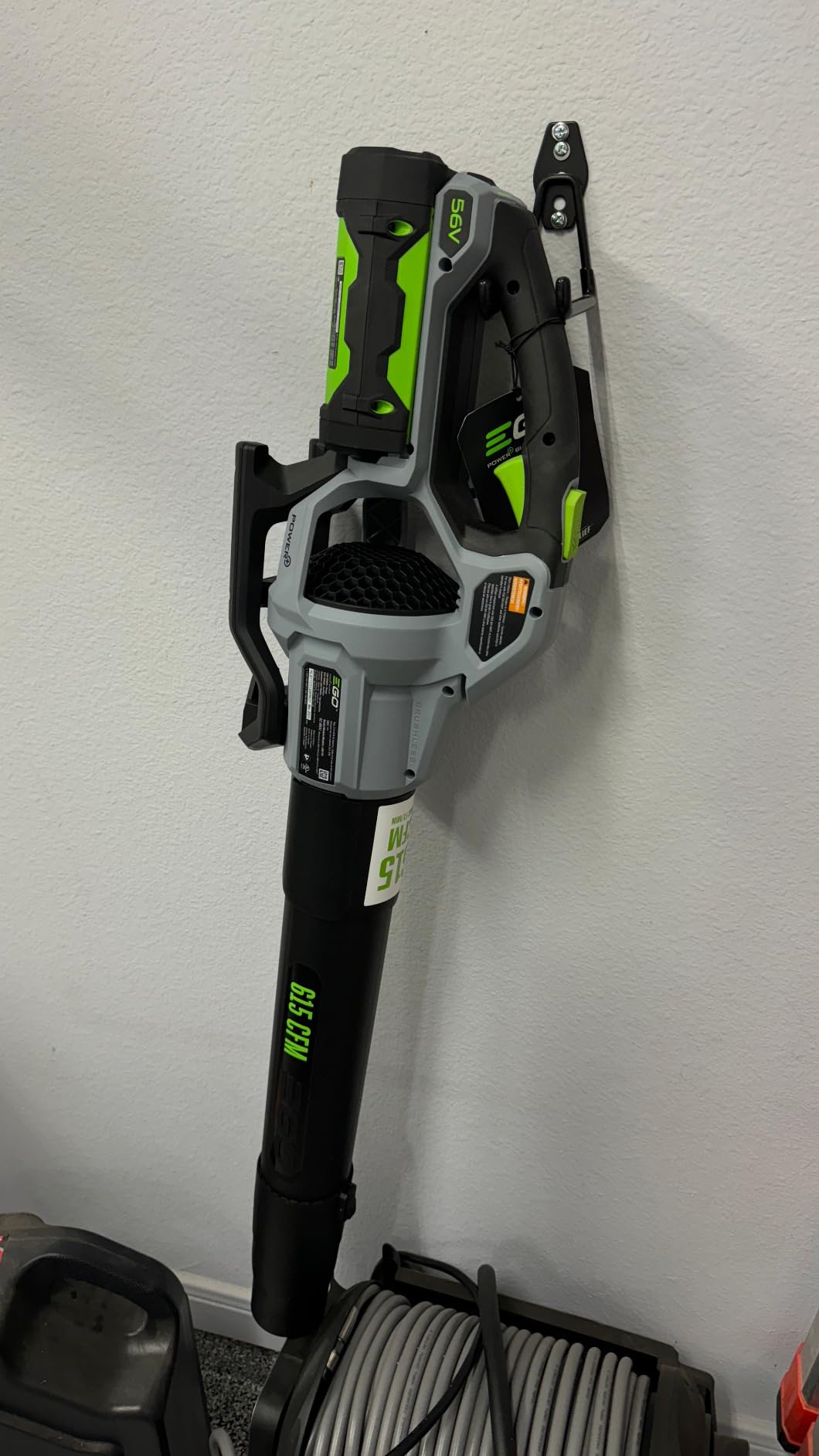
615 CFM turbo mode and the variable dial
The 200 to 480 CFM range on the variable dial is the most useful control on this machine, because it turns a yard blower into something workshop-appropriate. Locked on high for planer shavings and chip piles, the turbo button handles wet debris and caked material. Turned down to the low end, it becomes a controlled bench tool.
At 170 MPH it also has the highest exit speed here, so it moves fine material as well as volume. Turbine fan engineering is doing real work here rather than being a marketing line: it delivers high power at high volume without the heat and noise signature of a gas engine.
7.5 lb weight and 71 dB noise
The 7.5-pound figure includes the battery, which accounts for roughly half the mass. That is a genuine ergonomic cost in a workshop, because you’re carrying that weight overhead to clear rafters and undersides of shelves. Several owners describe a nose-heavy balance when the pack is fitted.
At 71 dB this is the loudest machine here, and reviewers specifically recommend ear protection. In an enclosed garage with concrete walls, that is a real consideration rather than a spec-sheet footnote.
56V ARC batteries, runtime and warranty
The included 2.5 Ah battery is rated for up to 75 minutes of runtime, though turbo mode cuts that dramatically to roughly 15 to 20 minutes by owner reports. The CH2100 charger refills it in 50 minutes. 56V ARC packs interchange across the EGO platform, including weed eaters and lights.
The 5-year tool warranty and 3-year battery warranty are the longest in this roundup, and the brushless motor runs with low vibration for long service life. If you buy this machine and expect to keep it a decade, that warranty is a meaningful part of the value calculation.
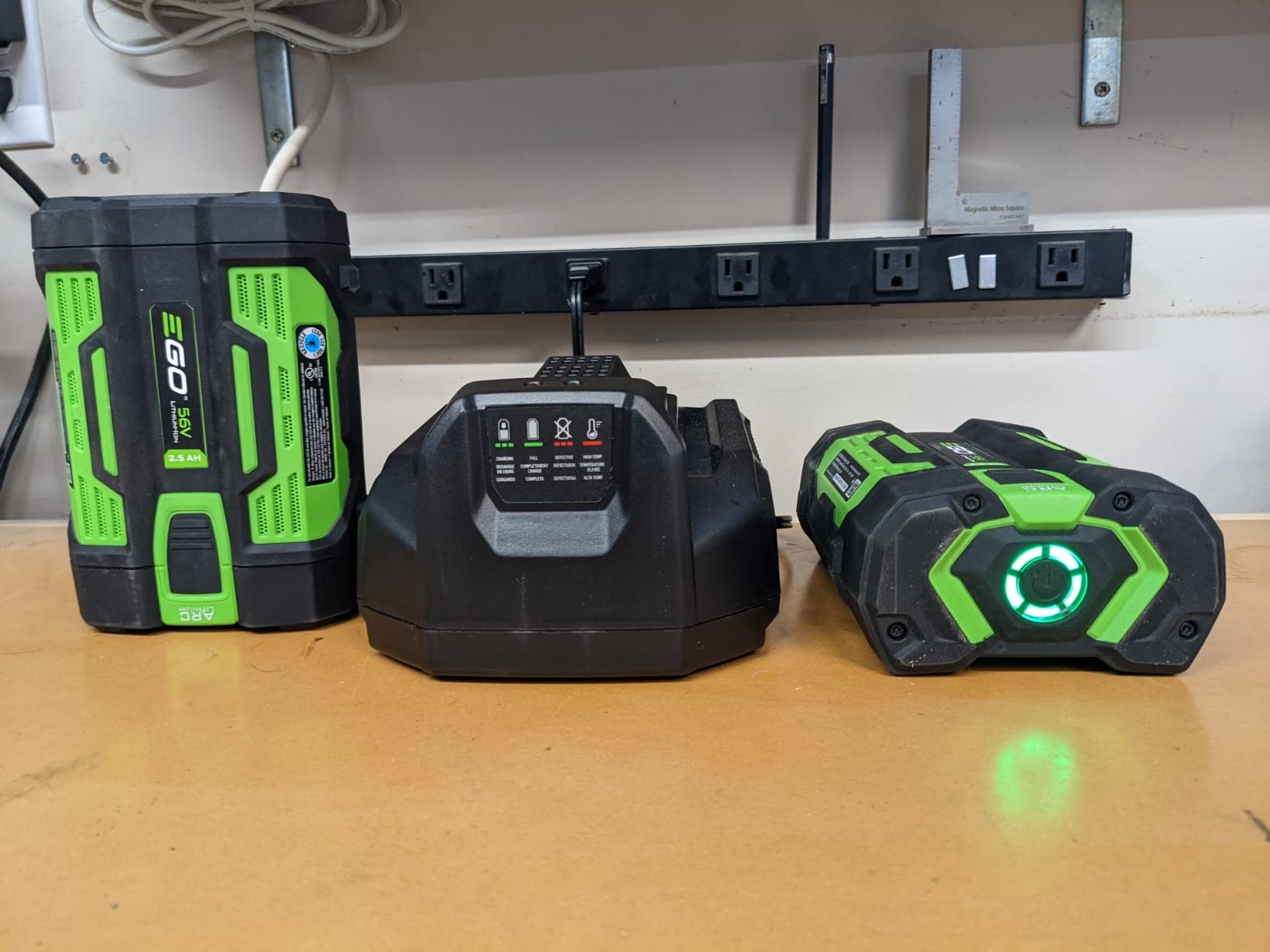
One long-term review in the data recommends the 615 over larger models for most buyers and suggests a higher-capacity 5 Ah pack for anyone starting out. That matches how I use it: this is the floor machine, and the pack you pair with it determines whether you clean once or twice per session.
How to Choose a Cordless Blower for a Working Shop
Eight machines, four battery platforms and a dozen marketing claims all resolve into a handful of decisions. Here is the sequence I use when someone asks me what to buy.
CFM versus MPH: the rule for wood dust
CFM is air volume, measured in cubic feet per minute. MPH is air speed at the nozzle exit. They trade off against each other: a machine that moves a lot of air slowly is a volume machine, and one that moves less air fast is a velocity machine. Workshop dust needs MPH, because force is what lifts particles off a surface. Chips and floor debris need CFM, because volume is what carries bulk material across a room.
That is why the two 100 CFM machines here, the DEWALT and the Milwaukee, outperform the 450 CFM units for bench dust. Their 135 and 160 MPH figures move dust that a broad rolling wave would leave sitting there. If your cleanup is fine material, ignore the CFM headline. If it’s chips and shavings by the bucket, look at volume.
Match the blower to the battery platform you already own
This is the decision that costs people real money, so make it first. Buying a bare-tool blower on a platform you already run turns a new tool into a marginal expense. Buying into a new ecosystem for one blower turns it into a multi-tool investment. Count your existing packs before you look at any spec.
Worth noting in this roundup: DEWALT uses 20V MAX, WORX uses PowerShare, Milwaukee uses M18, and EGO uses 56V ARC. Greenworks runs a 40V platform here, while the MZK, WOLFMEN and YUQUESEN units ship with their own generic packs that do not cross over. Generic packs are fine for a first blower; they are expensive to expand later, as the WOLFMEN battery-degradation reports show.
Nozzle choice: flat, round, extended and rubber tips
Most blowers ship with a general nozzle, and the swap matters more than people expect. A flat nozzle spreads a wide, even sheet for bench work. A round or concentrator nozzle focuses the stream into a tight jet for crevices and for drying a car panel without disturbing adjacent surfaces. An extended tube gets airflow behind machinery where you cannot fit your hand. A rubber-tipped nozzle protects a finished surface at close range.
For electronics, use the narrowest stream you can and keep distance. Airflow itself is fine; static discharge from handling is the actual risk, so ground yourself and hold the tool by its body rather than its nozzle when working around a bare power supply or an open case.
Blower, shop vac or dust extractor: which does which job
These three get confused constantly, so here is the split. A blower moves bulk material off a surface and across the shop. A shop vac collects what has already been lifted. A dust extractor captures dust at the machine while you’re cutting, which is the only one of the three that reduces airborne exposure at the source.
No blower replaces dust collection, and forum consensus on this point is absolute. A blower with a vacuum attachment is better than nothing, but it does not capture what you never lift. The correct order is: blow the bulk material out first, vacuum the fine residue second, and run extraction during the cut itself.
Noise, dust exposure and the blow-then-vacuum order
Rated noise levels here range from 53 to 71 dB. Treat those as a relative ranking rather than an exact reading at your ear, and use hearing protection in an enclosed garage regardless. Above 80 dB, extended exposure causes damage, and a concrete-floored shop with hard walls reflects sound back at you.
The dust warning matters more. Blowing in a closed garage redistributes fine particulates onto clean surfaces and keeps them airborne for hours. If you work with MDF or any silica-containing material, open the door first, wear a respirator, and never blow a closed room. And remember the honest framing: blowing moves dust, it does not remove it from your lungs.
Maintenance that keeps the motor alive
Intake screens clog with shavings faster than most people expect, and a clogged intake makes the motor run hot and shortens its life. Check it every few cleanup sessions and clear it by hand. Keep the nozzle off when the tool is stored so shavings don’t pack into the tube.
For battery care, store packs around half charge rather than full or empty, and keep them out of a hot unheated garage if you can. Lithium-ion cells degrade fastest at full charge in heat, which is exactly the condition a workshop bench creates in summer.
Frequently Asked Questions
What’s a good CFM for a cordless workshop blower?
For fine sawdust and bench work, CFM matters less than MPH. Aim for at least 135 MPH to lift particles off a surface, and treat anything above 300 CFM as useful for chips and floor debris rather than bench dust. A machine around 100 CFM and 135 to 160 MPH handles dust well; a machine at 400 CFM or more clears bulk material faster.
Is CFM or MPH more important for workshop dust control?
MPH matters more for workshop dust. Air speed is the force that lifts a particle off a bench or machine housing, while CFM is the volume that carries bulk material across a floor. Fine dust needs velocity; chips and shavings need volume. A good shop blower does both, which is why a two-mode design is valuable.
Can I use a regular leaf blower in my workshop?
You can, but a high-volume yard blower is usually wrong indoors. It creates a dust cloud instead of removing dust, and it can spin cooling fan bearings on machinery. Use a lower-volume, higher-velocity unit, open the door, and vacuum immediately after blowing. A blower also does not replace dust collection at the machine.
Do I need a variable speed trigger on a workshop blower?
Yes. A variable speed trigger or dial lets you drop to a low setting for finished surfaces, machine housings and electronics, and hold high speed only for bulk debris. It also reduces noise and extends runtime, because you are not running full power on light jobs. Every machine in this roundup offers at least two speed settings.
How long do workshop blower batteries last on a charge?
Expect roughly 13 to 20 minutes per battery on the compact high-RPM units at full output, and up to 75 minutes on the larger packs at lower settings. Turbo or maximum settings drain a pack fast. Most shop owners keep two packs and swap while one charges, which is why several picks here include dual batteries.
Which Cordless Blower Fits Your Shop
If your cleanup is fine dust on benches, machinery and tool housings, go with velocity. The DEWALT DCE100B is our overall pick: 2.5 pounds, 135 MPH, three-speed control and a trigger lock, and it won’t cost you a new battery ecosystem if you already run 20V MAX.
If you already own M18 packs, the Milwaukee 0884-20 is the same idea with more air speed at 160 MPH and a flexible nozzle, plus an inflation add-on. If you want two-mode control for electronics and bench work, the WORX WG543 switches between 410 CFM volume and 130 MPH speed and shares batteries across a large PowerShare range.
If you clear chips and floor debris in volume, the EGO POWER+ LB6151 at 615 CFM is the fastest and carries the longest warranty, though the 7.5-pound weight and 71 dB rating are real costs indoors. If you’re starting from zero batteries and want a complete quiet kit, the Greenworks 40V 24252 at 53 dB is the sensible entry, with a small pack you’ll likely upgrade. For the lowest entry point with two batteries in the box, the MZK ET1613 and WOLFMEN LB-8197 cover light debris, with the WOLFMEN the faster of the two.
Whatever you pick, blow first and vacuum second, keep the intake clean, and start with the blower platform you already own. Those three habits will outlast any spec sheet in this roundup.