
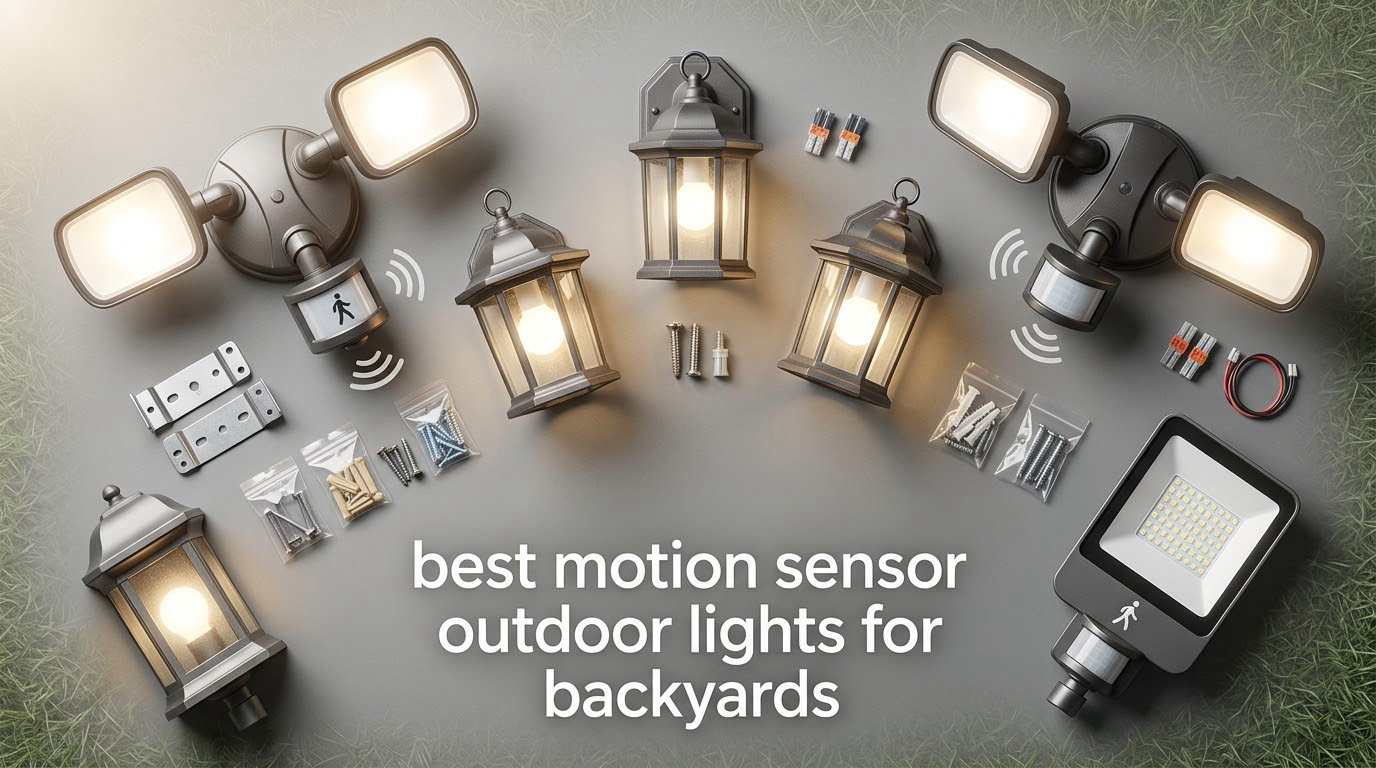
The best motion sensor outdoor light for most backyards is the HMCITY 6-Pack Solar Wall Light, a no-wiring 960-lumen fixture that covers several yard zones at once, while the LEPOWER 58W 7000-lumen flood light takes the crown for anyone who already has a junction box. Three criteria decide this category: how the light is powered, how much ground the sensor actually watches, and how many lumens that ground needs.
Backyards break flood lights in ways front porches never do. A light that reads as generous over a driveway looks like a flashlight in the middle of a lawn, and a single fixture bolted to the house rarely reaches the far corner of the fence line. I compared 12 fixtures on exactly those terms, then mapped each one to the yard zone it suits best.
My selection criteria were output in lumens rather than watts, detection range and angle from the manufacturer specs, the IP weatherproofing rating, how the unit is powered, and the volume of buyer feedback behind it. I read through thousands of owner reviews across the group, focusing on install friction, false triggers and how the light performed through bad weather.
What follows is a roundup of the best motion sensor outdoor lights for backyards, split by power source because that choice narrows everything else. It also includes a zone-by-zone placement map, a buying guide built on the specs that actually change outcomes, and a troubleshooting section for the flickering-light problem almost every owner eventually hits.
Two notes before we start. I have not mounted any of these on a live electrical circuit, so installation advice comes from documented product requirements and the consensus of owner reports rather than my own wiring. And none of the lights here are decorative wall packs; every fixture is built for functional coverage, which is what a backyard needs after dark.
Our Top 3 Backyard Motion Sensor Lights

These three cover the three real use cases. The HMCITY pack solves a yard with no power and no budget for an electrician. The Tuffenough pair solves coverage, with three adjustable heads sweeping 270 degrees from a single bracket. The LEPOWER solves raw output, throwing 7000 lumens across a driveway or back lawn from a hardwired box.
Owners of the HMCITY pack consistently point at the same thing: one purchase lights several zones, and the third lighting mode keeps a path visible all night without going full brightness. Its weakness is honest and simple, 960 lumens is an accent output, not a flood.
The Tuffenough remote is the feature competitors with button-only controls cannot match. Changing mode from a deck chair beats climbing a ladder in the dark, and the 210-bead array delivers 2500 lumens at 6500K. Weather remains its weak point, since an overcast week can stretch charging across several days.
The LEPOWER is the fixture owners describe replacing a thirty-year-old halogen with. Seventy-two feet of sensing range and three independently aimed heads mean one box can cover a driveway and a side path. It requires wiring, so it is the wrong pick for a shed or a rental.
Comparing All 12 Picks at a Glance
| Product | Details | |
|---|---|---|
 HMCITY 6-Pack Solar Wall Lights HMCITY 6-Pack Solar Wall Lights |
|
Check Latest Price |
 Tuffenough Solar 3-Head Flood Tuffenough Solar 3-Head Flood |
|
Check Latest Price |
| LEPOWER 58W 7000 Lumen Flood |
|
Check Latest Price |
 LEPOWER 40W 4000 Lumen Flood LEPOWER 40W 4000 Lumen Flood |
|
Check Latest Price |
 daphino Solar 3-Head Flood daphino Solar 3-Head Flood |
|
Check Latest Price |
 LUTEC 32W Dusk to Dawn Flood LUTEC 32W Dusk to Dawn Flood |
|
Check Latest Price |
 intelamp Dual-Sensor Solar Flood intelamp Dual-Sensor Solar Flood |
|
Check Latest Price |
 Onforu 75W Low-Profile Flood Onforu 75W Low-Profile Flood |
|
Check Latest Price |
 UME 19W 2000 Lumen Flood UME 19W 2000 Lumen Flood |
|
Check Latest Price |
 LEPOWER Battery Powered Flood LEPOWER Battery Powered Flood |
|
Check Latest Price |
 LUTEC 72W 7500 Lumen Flood LUTEC 72W 7500 Lumen Flood |
|
Check Latest Price |
 Peasur 6-Pack Solar Path Lights Peasur 6-Pack Solar Path Lights |
|
Check Latest Price |
Reading the table across rather than down tells you most of what you need. Solar fixtures cluster between 960 and 2500 lumens. Hardwired fixtures span 2000 to 7500 lumens, and that output gap is the single biggest reason to run cable if you can.
Where to Mount Each Light in a Typical Backyard
No competitor on the search page maps fixtures to yard zones, yet that is where most buying decisions actually go wrong. A backyard is not a rectangle with one entry point; it is a set of disconnected pockets of darkness, and each pocket wants a different kind of light.
- Driveway and parking apron. This zone needs raw output and long range because the person arriving is in a vehicle and may be looking for a step. Aim a 4000 to 7500 lumen hardwired flood from a soffit or garage gable, mounted high enough that the arc covers the apron without pointing into an upstairs neighbour’s window.
- Side yard passage. Narrow and blind, this is where single-head 1200 to 2000 lumen fixtures earn their place. A dual-sensor or 220-degree unit catches someone walking the passage from either direction, which a straight-ahead sensor misses.
- Fence line. A long run of fencing needs coverage from a single point, so a three-head 270-degree solar light is the efficient answer. Mount it on a post at 6.5 to 8 feet so the detection arc crosses the walkway rather than pointing along it.
- Deck post and patio corner. Here output matters less than timing. Two-level or dim-then-bright modes keep the space readable after the initial burst, and a lower lumen count stops the light from blinding anyone sitting at the table.
- Back door and garage side entry. The best coverage comes from a fixture on the wall above the door with a two-head wall pack or a compact flood. Keep the detection zone tight to the stoop so passing foot traffic on the sidewalk does not set it off all night.
- Shed and outbuilding. No mains power usually means solar or battery. These are the zones where small 200-lumen path lights and battery flood lights make more sense than a security flood, because the goal is seeing the padlock, not flooding a lawn.
One yard rarely needs only one fixture. The awkward layouts that frustrate owners are the ones where a single wide arc cannot reach past a tree, a shed or an angled fence, and the fix is two or three cheaper units with overlapping coverage rather than one expensive fixture with a wider claim.
If you already run a smart home, a standalone outdoor-rated motion sensor paired with smart bulbs is a legitimate alternative to a fixture-integrated sensor. Homeowners on Home Assistant report using outdoor sensors screwed to a tree with no battery changes, which sidesteps the heat and moisture problems that defeat some built-in sensors.
1. HMCITY 120 LED Solar Wall Lights – The Best Overall Backyard Starter Pack
HMCITY 120 LED Outdoor Solar Lights with Motion Sensor and 3 Lighting Modes, IP65 Waterproof Wide Solar Wall Lights Ideal for Garden Patio Yard (Front Button 6Packs, Black Shell-Daylight White)
960 lumens
6500K
6-pack
Solar powered
IP65
Wall mount
+ Pros
- Three lighting modes including motion-only full brightness
- Monocrystalline solar panel with up to 30% conversion efficiency
- IP65 waterproof ABS body rated for rain and heat
- Six-pack covers several yard zones in one purchase
- Mounts with included screws and no wiring
- Cons
- 960 lumens reads as accent and path lighting
- Small housing gives a limited detection footprint
- One mode bypasses the motion sensor entirely
- Brightness drops in deep shade or after cloudy spells
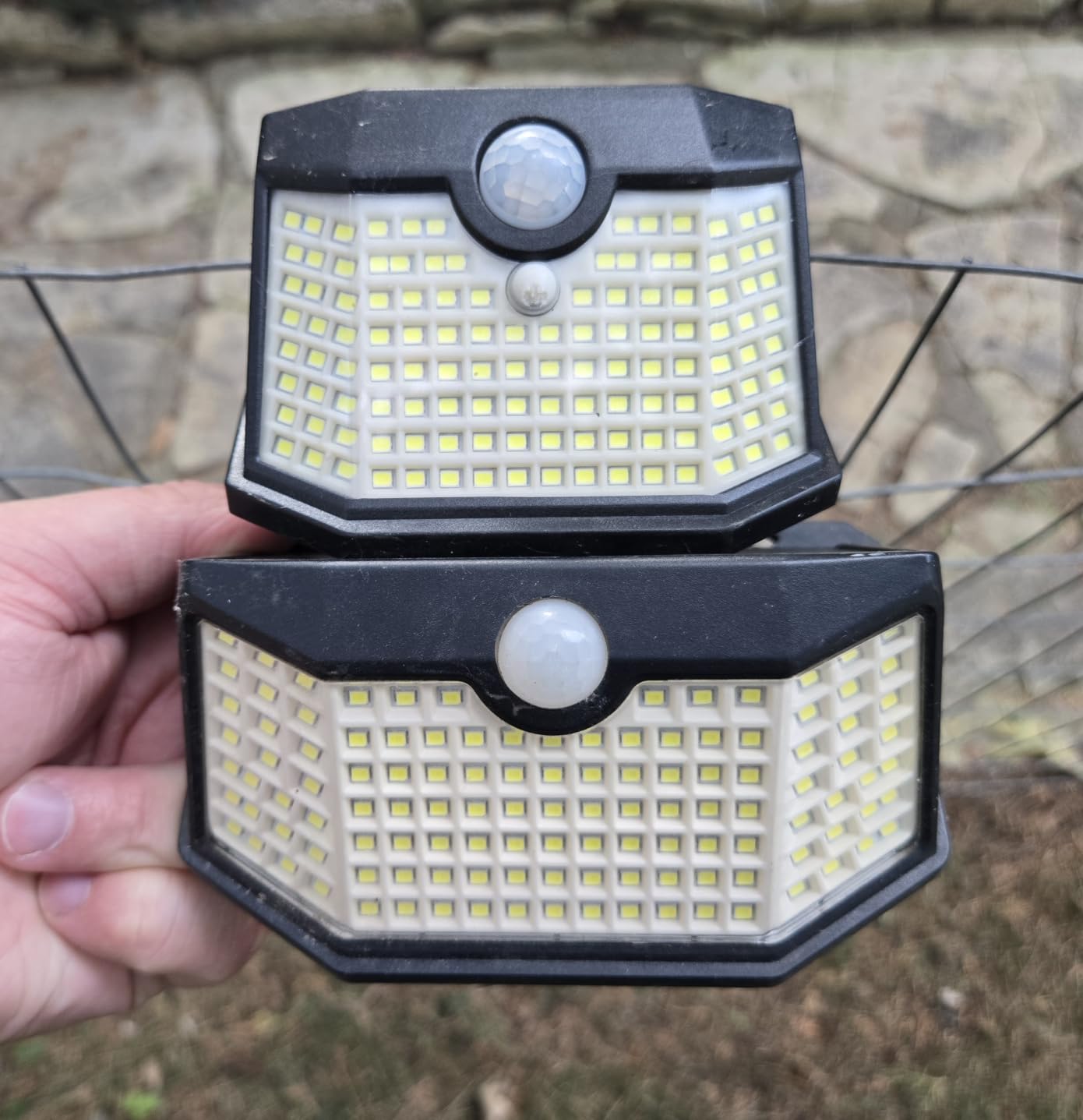
The HMCITY pack is the pick I keep coming back to for anyone starting from an empty yard. Six small fixtures, 4.12 by 3.65 by 2.08 inches each, no wiring, and a monocrystalline silicon panel that converts up to 30% of available sunlight. For a fence line, a path and a couple of steps, one purchase covers the whole path.
With 69,632 reviews behind it, this is the most widely owned light in the group, and the feedback is consistent about what matters: install speed, mode choice and how the pack lets you spread light across a property instead of over-concentrating it in one corner.
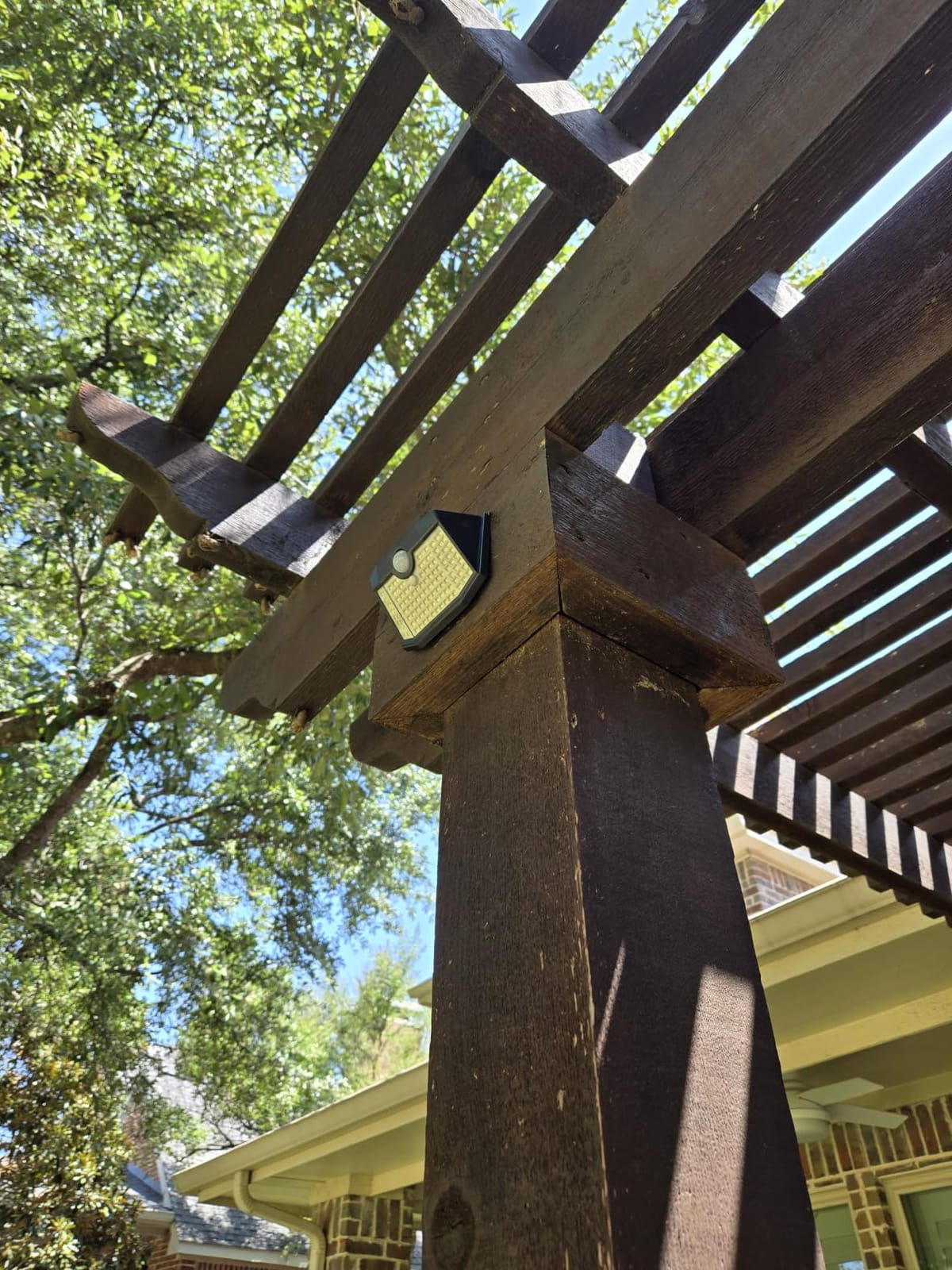
Owners rate it at 4.4 stars with 70% of buyers giving five stars. The most repeated caveat is brightness, because 960 lumens in a wide-open lawn looks modest, and motion activation can behave oddly until the panel has taken a full charge.
Three Lighting Modes and What Each One Is For
The mode selector is the reason this light is flexible. One mode keeps a dim constant glow through the night, another goes to full output only on motion, and the third gives a dim standby that jumps to full brightness when something approaches.
That middle option matters more than it sounds. A permanently dark path is a trip hazard, and a permanently full-brightness path wastes the battery before midnight, so a dim standby with a motion boost is the sensible middle path for most yards.
Solar Panel Placement Decides Whether It Works
The panel is the whole ballgame for output. Mount the fixture where it gets the full day of sun, because a wall in afternoon shade can cut overnight runtime badly even in fair weather. Owners also report that a new fixture sometimes needs a couple of clear days before the sensor behaves consistently.
There is no remote on this pack, so mode changes mean walking to the fixture. That is a real inconvenience on a wall at head height but a non-issue on a fence post six feet up.
Where It Works in a Backyard
These read as path and step lights rather than flood lights. In practice that means fence runs, deck stairs, shed corners and the strip between a house and a fence, where you want a human figure to be seen rather than a lawn to be illuminated.
If your goal is lighting the whole back lawn, a 960-lumen fixture is the wrong tool regardless of how cheap the pack is. Pair it with a higher-output flood on the house wall and the two together cover far more ground than either alone.
Who Should Skip It
Skip it if you want a single dramatic beam across a driveway, because the detection footprint and output will both fall short. It is also the wrong fixture for anyone who cannot position the panel in direct sun, which rules out deep north-facing walls and heavily shaded yards.
2. Tuffenough 2500 Lumen Solar 3-Head Flood Light – Best Value Wide-Angle Coverage
Tuffenough Solar Outdoor Lights 2500LM 210 LED Security Lights with Remote Control,3 Heads Motion Sensor Lights, IP65 Waterproof,270° Wide Angle Flood Wall Lights with 3 Modes(2 Packs)
2500 lumens
210 LEDs
270-degree
26-foot range
Remote
IP65
+ Pros
- Wireless remote changes modes without climbing a ladder
- 210 LED beads deliver 2500 lumens at 6500K
- Three adjustable heads sweep a 270-degree coverage zone
- 1800mAh battery recharges in low-light conditions
- IP65 waterproof two-pack with no wiring
- Cons
- Works best mounted at 6.5 to 8 feet
- Overcast stretches may require switching the panel off
- Some fixtures need several nights of initial charging
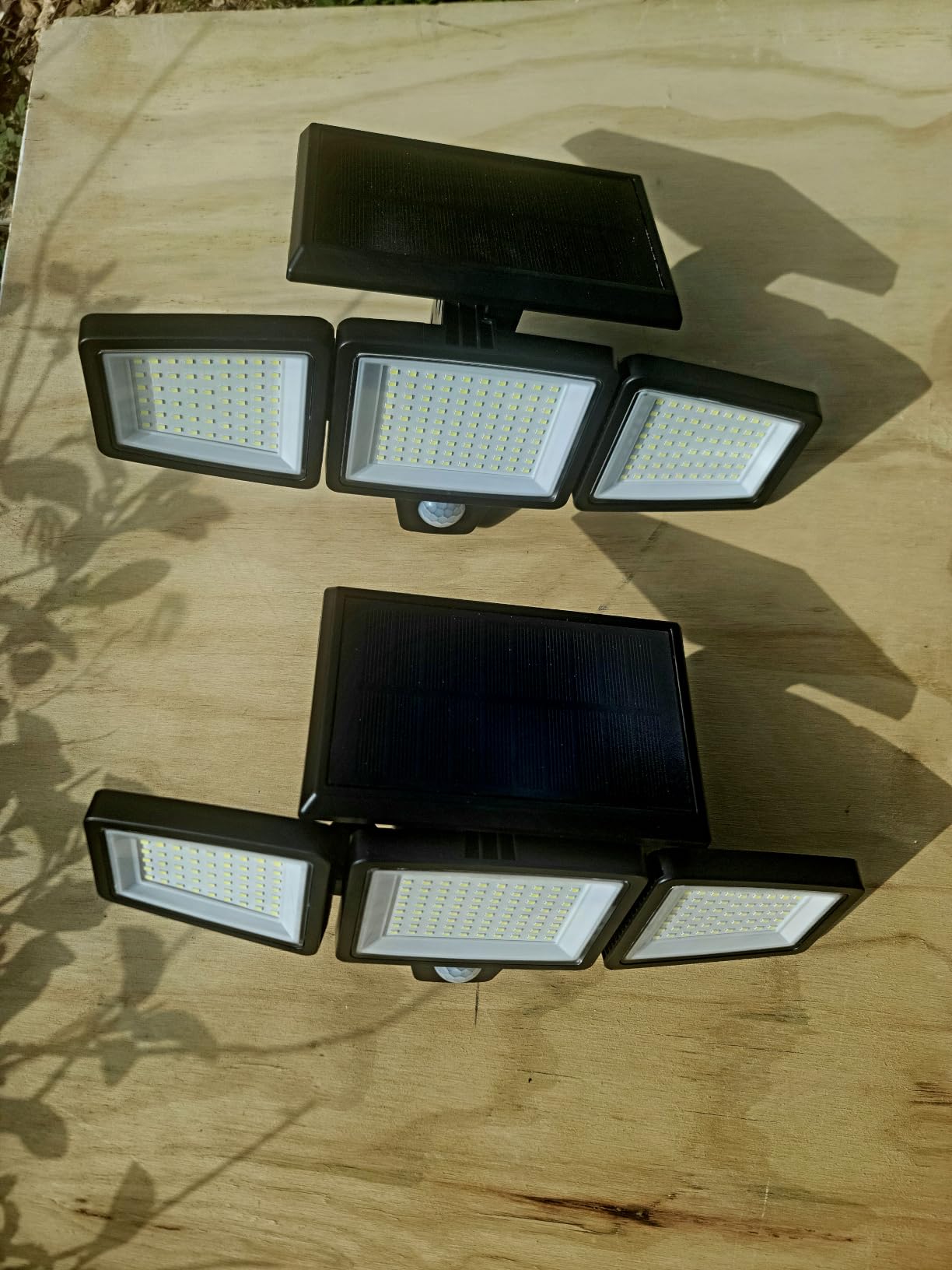
The Tuffenough pair is the most capable solar light here for a simple reason: three independently adjustable heads and a 26-foot sensing distance from a single bracket. At 2500 lumens it doubles the output of typical solar path lights while staying entirely off the electrical grid.
At 41,332 reviews and 72% five stars, this is the second most proven product in the roundup. Owners single out the remote control as the deciding feature against button-only competitors, because a 2500-lumen solar fixture is heavy and awkward to reach.
Why Three Heads Change the Geometry
A single-head solar flood throws one cone. Three heads let you spread a wider, lower arc across a driveway apron or a fence corner, which means fewer fixtures for the same area. For a yard with an angled fence line, that flexibility is often the difference between one light and three.
The 210 beads spread across three heads at 6500K give a cool daylight tone. That reads well for security purposes because it maximises apparent brightness and visibility, though it is not the warmest light for a patio table.
Remote Control and Three Lighting Modes
The remote cycles the modes without a ladder, which matters on a fixture this size mounted at eight feet. The modes cover a dim all-night glow, a motion-only full burst, and a combined dim-then-bright mode, giving you the same range of behaviours as the HMCITY pack with far more reach.
Owners appreciate the 1800mAh rechargeable battery paired with a high-efficiency panel, particularly in shoulder seasons when light is weaker. The caveat they report most often is runtime, not brightness, when the weather turns wet for days.
The Charging Rule That Matters Most
Owners are clear on two points. Mount between 6.5 and 8 feet or the motion detection degrades, and during a long overcast stretch the panel may need to be switched off for two or three days to recover a usable charge.
That second behaviour catches people out. A solar light left switched on through a wet week can drain the battery faster than the poor-weather panel can refill it, so the light goes dark precisely when you need it.
Best Yard Zones for This Pair
These work best on a wide wall: a two-storey side of the house, a garage gable, or a long fence run where you can mount one fixture and cover two approaches. Two fixtures from the pack can then handle opposite ends of the same yard with overlapping arcs.
Skip them if your mounting point is shaded for most of the day, or if you need true flood output across an entire lawn. At 2500 lumens they are strong security lights rather than area lights.
3. LEPOWER 58W 7000 Lumen 3-Head Flood Light – Premium Pick for Wired Yards
LEPOWER LED Security Light Motion Sensor Outdoor Lights, Easy to Install
7000 lumens
58W
72-foot range
180-degree
3 heads
ETL listed
+ Pros
- 7000 lumens from 58W for full-yard output
- Filter lens spreads light more evenly than bare LED arrays
- 72-foot sensing range at a 180-degree angle
- Three light heads plus a swiveling sensor head
- Selectable 1
- 5 or 10 minute on-time
- Cons
- Hardwired
- so wiring and a junction box are required
- Stepless dials need a couple of nights to calibrate
- Bulkiest fixture here at over 14 inches wide
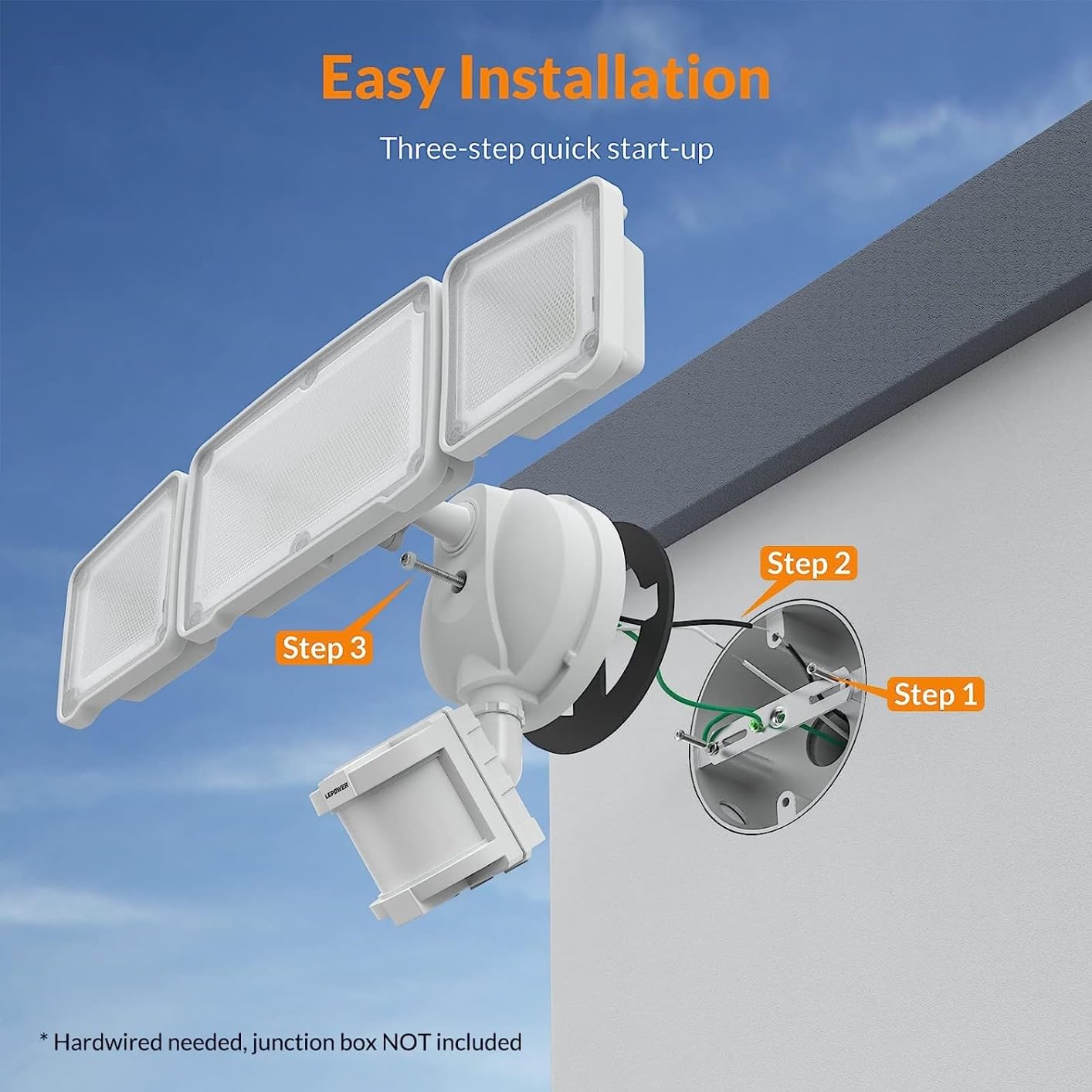
This is the wired workhorse. Fifty-eight watts producing 7000 lumens, in an aluminum housing, with 72 feet of sensing at 180 degrees and three heads you can aim independently. For a driveway, a back lawn or an uneven plot where someone walks from a parked car to the door, that combination is hard to argue with.
Owners describe a familiar upgrade story: pull down a thirty-year-old halogen fixture, mount this in its place, and immediately see the difference across a two-and-a-half-car drive. At 23,244 reviews and 75% five stars, the pattern is well established.
7000 Lumens Without the Glare You Would Expect
The output figure is only half the story. The filter lens optical design spreads the beam more evenly than a bare LED array, which is what keeps a 7000-lumen fixture from reading as a hard hotspot with dark edges.
At 14.05 inches long and 8.24 inches tall, it is the largest fixture in this group. That bulk is a real consideration on a finished wall, but on a garage gable or under a deep eave it disappears completely.
72 Feet of Range and Three Aimable Heads
The detection specification is 72 feet at 180 degrees, which covers a deep yard from a house wall. Because the sensor head itself swivels, you can pull the detection zone away from a neighbour’s side of the property while keeping the light itself aimed where you want it.
Three light heads give you independent control of the beam pattern. Owners routinely use them to cover a driveway and a side path from the single junction box, which saves both a second fixture and a second run of cable.
Calibration Takes More Than One Evening
This is the most repeated friction in reviews, and it is not a defect. The dials are stepless rather than stepped, so a small turn produces a large change, and several nights of walking the yard are normal before the sensitivity and duration settings feel right.
The 1, 5 or 10 minute on-time selection is a step control, unlike the sensitivity dials, so the timeout is easy to set once. The aluminum body also runs cooler than plastic housings, which supports the rated LED lifespan.
What It Takes to Install
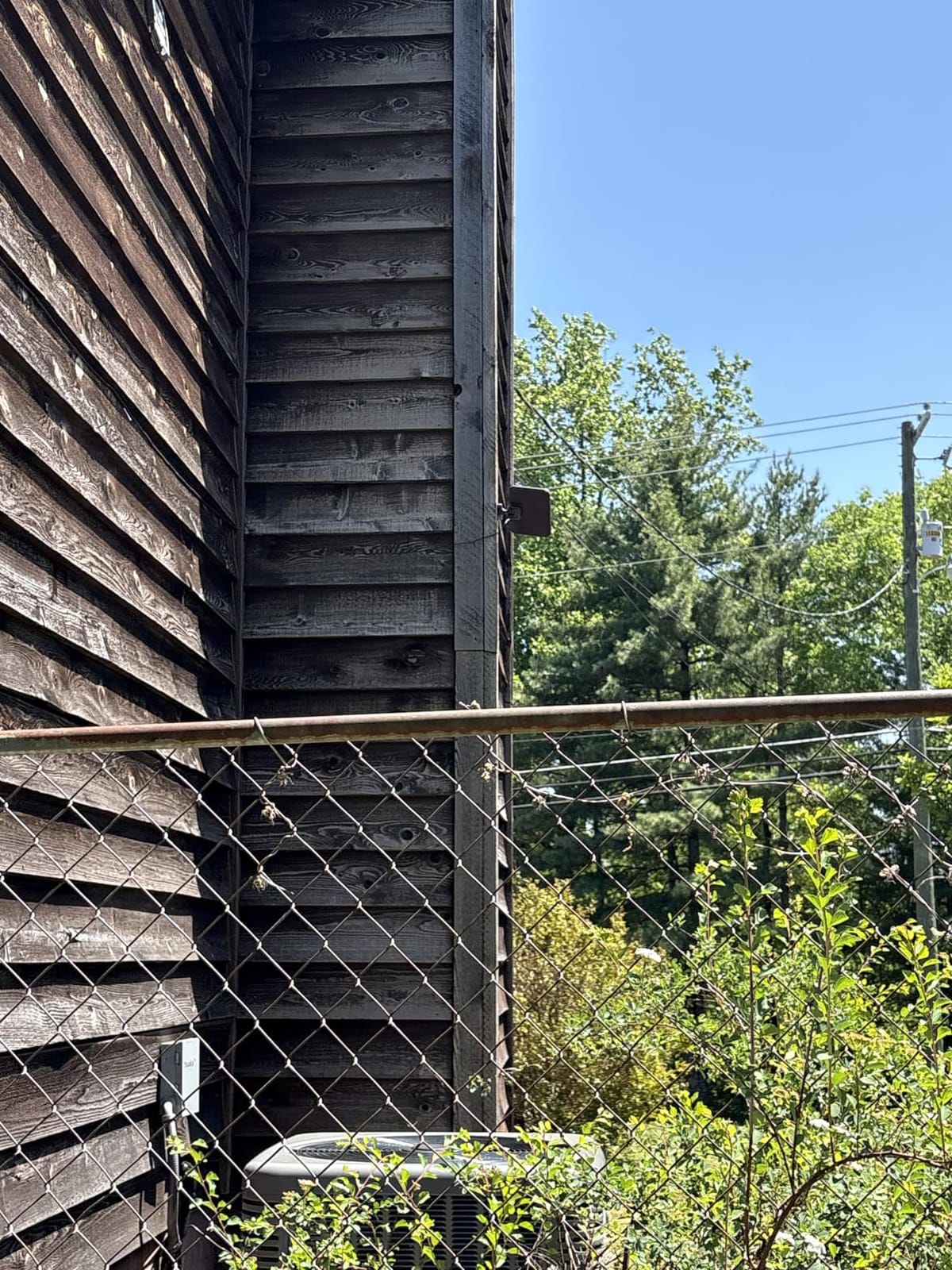
This is a hardwired fixture that works best with a 4-inch junction box, so it suits a replacement install and any new run where you can put in cable. It is ETL and FCC listed, which matters if your municipality or insurer asks about certified gear.
Skip it for a shed, a rental or any spot with no mains power. There is no battery or solar fallback, and the three-wire connection is not a beginner project without an existing box to land on.
4. LEPOWER 40W 4000 Lumen 2-Head Flood Light – Tunable Detection for Medium Yards
LEPOWER Hardwired LED Security Lights Motion Sensor Outdoor, 40W 4000LM
4000 lumens
40W
4 detection ranges
2 heads
50000 hours
ETL listed
+ Pros
- 4000 lumens at 40W with a filter lens for even spread
- Four selectable detection distances from 10 to 72 feet
- Compact 10-inch aluminum body that stays out of the way
- Aluminum housing rated for a 50000-hour lifespan
- ETL certified with selectable on-time
- Cons
- Hardwired install needs wiring competence and a box
- Only two heads
- so a large yard needs careful aiming
- Sensor can need a few nights of fine-tuning
The 40W LEPOWER is the more considered version of the three-head argument. At 10.12 by 4.51 by 7.55 inches it is visibly smaller than a multi-head flood, and 4000 lumens is more than enough for most residential yards without flooding a neighbour’s hedge.
What genuinely distinguishes it is the sensitivity selector with four detection distances at 10, 20, 50 and 72 feet. That is a real feature, not a marketing line, because a fixed 70-foot sensor on a narrow side passage will fire constantly until you can physically block the zone.
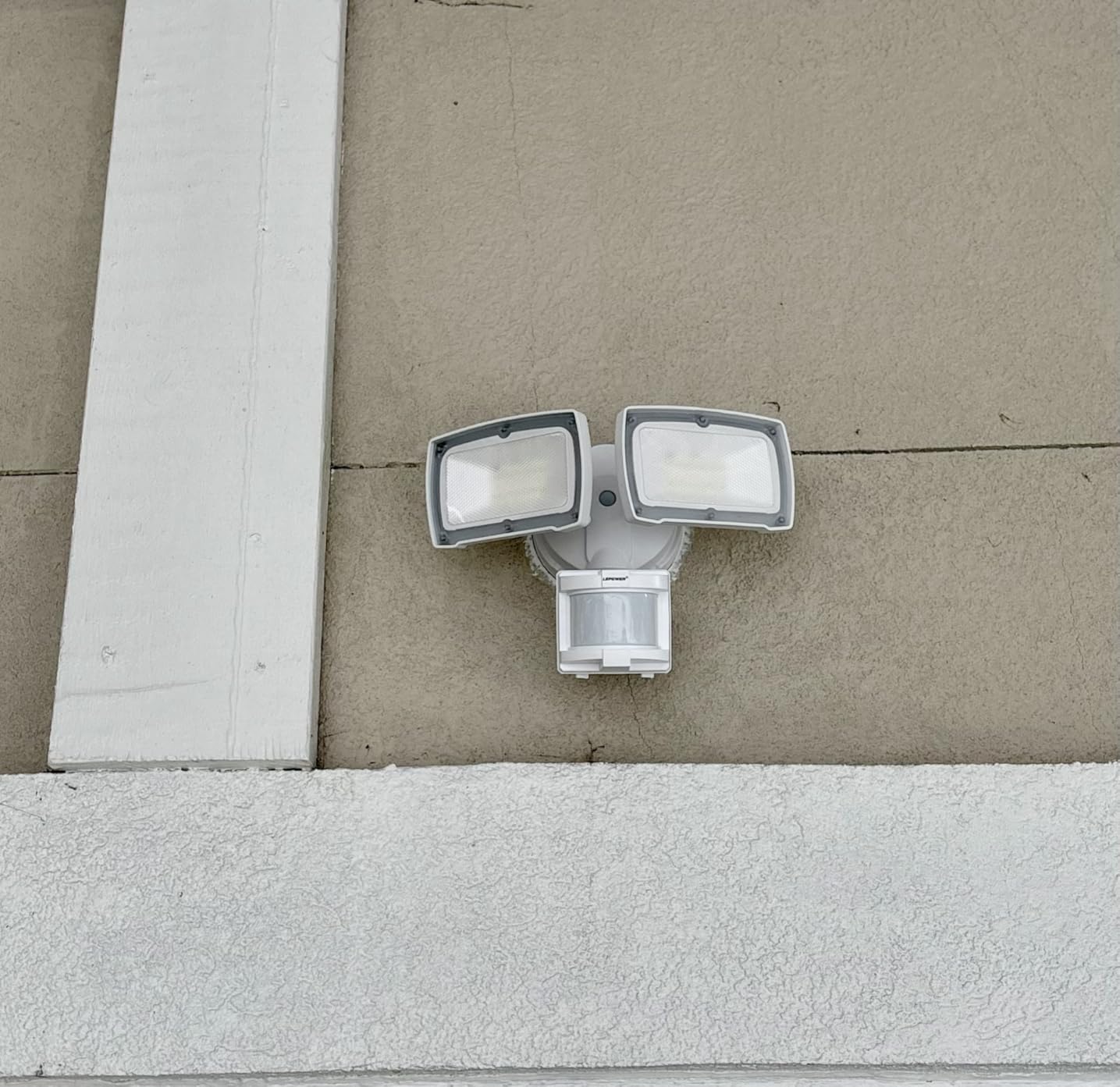
Across 9,242 reviews at a 4.6 average, the compact aluminum body is repeatedly described as less obtrusive than bigger flood fixtures. The 50,000-hour lifespan rating supports the long-service claim owners make when they say they plan to keep it mounted for a decade.
Four Detection Distances Change the Fit
Every other fixture here offers either a fixed range or a smooth dial. This one gives you four fixed steps, and that predictability is worth something when you are tuning a fixture that a neighbour’s tree keeps triggering at the far end of the property.
For a mid-size backyard, setting the sensor to 20 or 50 feet is usually the right call. Reserve the full 72 feet for a long driveway or an open plot where you genuinely want the reach.
4000 Lumens at 40 Watts
The efficiency figure is the useful part. Forty watts drawing 4000 lumens means the fixture runs cooler than a high-wattage halogen replacement, and the filter lens keeps the distribution even across a patio or a side path rather than concentrating it in one spot.
Color temperature is 5500K, a neutral-cool white that reads clearly underfoot and keeps colours natural. That sits in the middle of the range and works well for both security and ordinary outdoor use.
Two Heads, Not Three
Two adjustable heads plus an adjustable sensor head give you less total beam than the three-head models. In exchange you get a smaller footprint, which matters on a finished wall where a 14-inch fixture would look out of place.
For a yard up to about a quarter acre, aiming one head at the house wall and one at the path is enough. Beyond that, you are better served with a three-head fixture and a second mounting point.
Who Should Look Elsewhere
Skip it if you have no wiring and no plan to add it, since there is no wireless version. It is also the wrong pick if your yard is genuinely open and large, because two heads will leave dark corners you would then need a second fixture to fill.
5. daphino 2500 Lumen Solar 3-Head Flood Light – Longest Solar Detection Range
daphino 2500LM Solar Lights, Motion Sensor Outdoor Lights, 3-Head, 2 Pack
2500 lumens
40-foot range
130-degree
3 heads
12-hour dim mode
+ Pros
- Longest solar sensing range here at 40 feet within a 130-degree arc
- 2500 lumens from 156 LEDs at 6500K
- Three adjustable heads plus a 90-degree adjustable solar panel
- Up to 12 hours in dim mode from a 7-8 hour charge
- ABS and polycarbonate body rated IP65
- Cons
- Mounting height strongly affects detection quality
- Non-remote version
- so mode changes mean walking over
- Solar runtime still drops after several overcast days
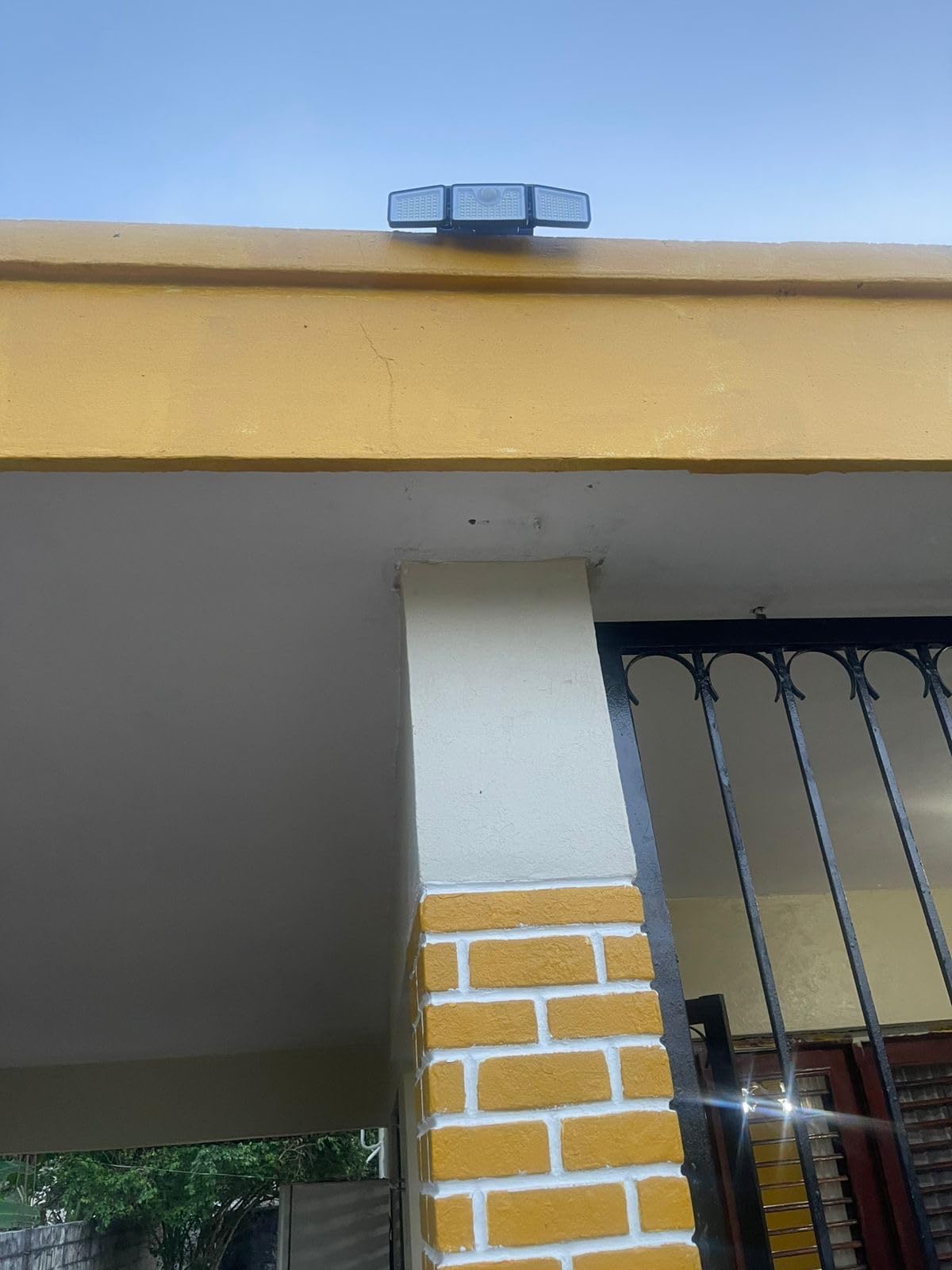
The daphino is the solar fixture to buy when detection matters more than brightness. Forty feet of sensing inside a 130-degree arc is the longest reach of any solar light in this roundup, and the 130-degree arc is wider than the roughly 120 degrees a typical single PIR gives you.
Its 4.5 rating comes with the strongest five-star share among the solar picks at 76%, across 4,532 reviews. Buyers describe it as a light that simply keeps working dusk to dawn without being switched off to recharge.
Why the 90-Degree Panel Adjustment Matters
Most solar lights fix the panel above the sensor, which is fine on a south wall and poor anywhere else. This one lets the panel tilt through 90 degrees independently, so you can capture the best available sun while still aiming the heads and the detection zone where you want them.
That single adjustment resolves the most common solar complaint. A fixture shaded at the wrong hour can be repositioned for the panel without moving the whole light or re-aiming the coverage.
Runtime and the Dusk-to-Dawn Habit
Up to 12 hours in dim mode from a 7 to 8 hour charge on the 3.7V lithium-ion battery is the useful figure. Owners report that running it automatically through a wet week works better than manually switching it off, which is the opposite of the advice that applies to some competing solar lights.
Three modes are cycled with a single button under a waterproof silicone cover. There is no remote, so the button is also the most durable part of the control system, with nothing to lose.
Coverage Shape for Odd Yards
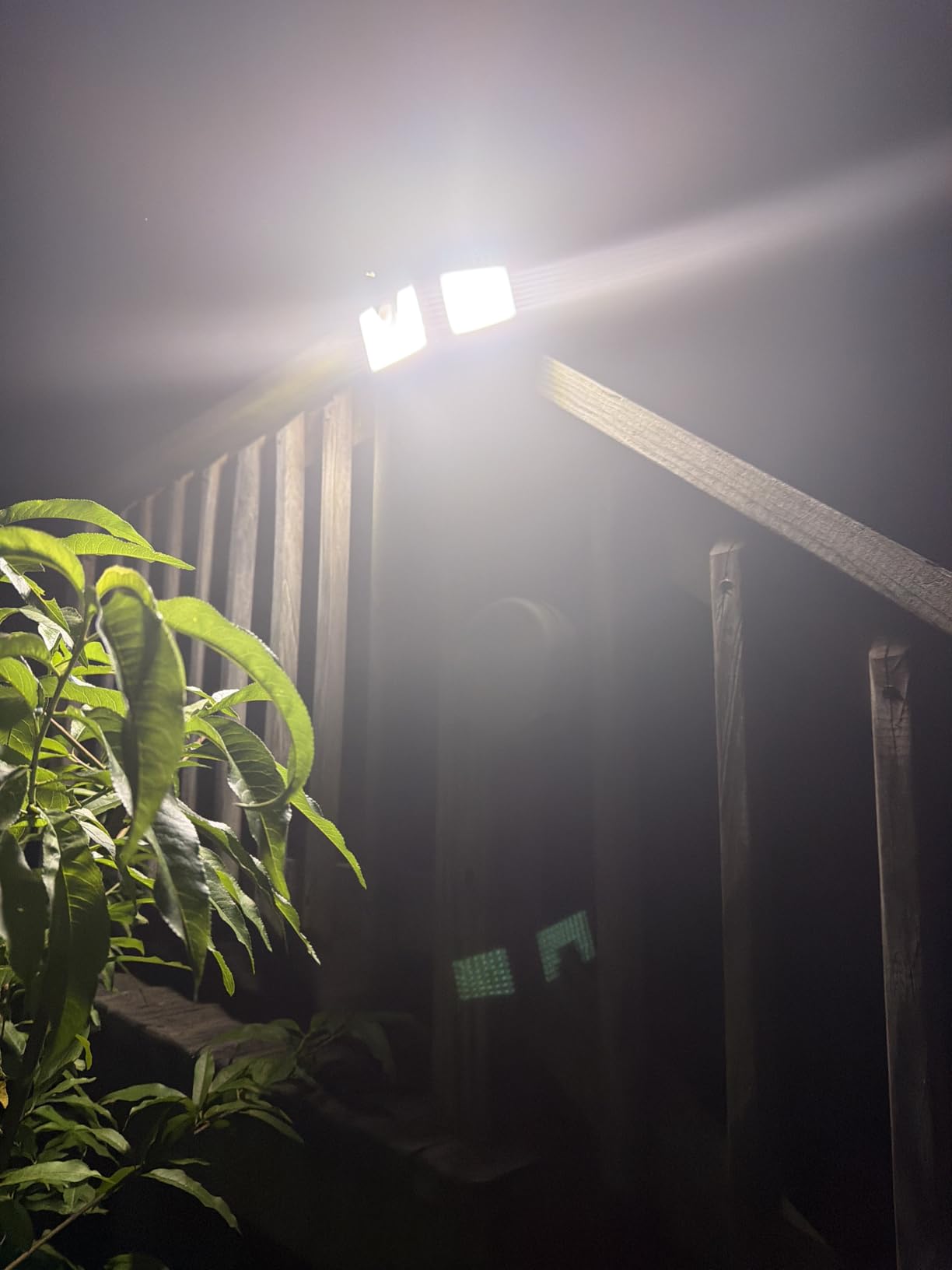
Three independently adjustable heads plus a 130-degree detection arc makes this a good fence-line and side-yard fixture. You can throw one head down a passage, one across a gate and one at a gatepost, all from a single wall or post mount.
Owners caution that 6.5 to 8 feet is the recommended mounting height and that going too high or too low degrades detection noticeably. On a low fence this needs a separate post.
Best Zones and One Real Limitation
This is a strong fit for a side yard, a long fence and a gate area in a yard that gets reliable sun. It is also a solid two-pack complement to a wired flood, covering ground the house-wall fixture physically cannot reach.
Skip it in heavily shaded yards, since the 2500-lumen output depends on a good charge, and expect reduced runtime after several overcast days even with a large panel.
6. LUTEC 32W 3500 Lumen Dusk to Dawn Flood Light – Best Multi-Mode Behaviour
LUTEC 32W 3500 Lumen LED Security Lights Motion Sensor Light Outdoor, 5000K Daylight, IP65 Waterproof, Dusk to Dawn, Motion Detector Flood Light for Garage, Yard, Porch-Black
3500 lumens
32W
5000K
4 modes
69-foot range
3-year warranty
+ Pros
- 3500 lumens at 32W in a 5000K daylight tone
- Four modes including test
- security
- dusk to dawn and manual override
- Switch-flip override runs the light constantly for a set period
- 180-degree motion sensing up to 69 feet
- 3-year warranty with responsive after-sales service
- Cons
- Shallow body can clash with a deep electrical box
- Dusk-to-dawn dim level is not adjustable
- Hardwired
- so mains power is required
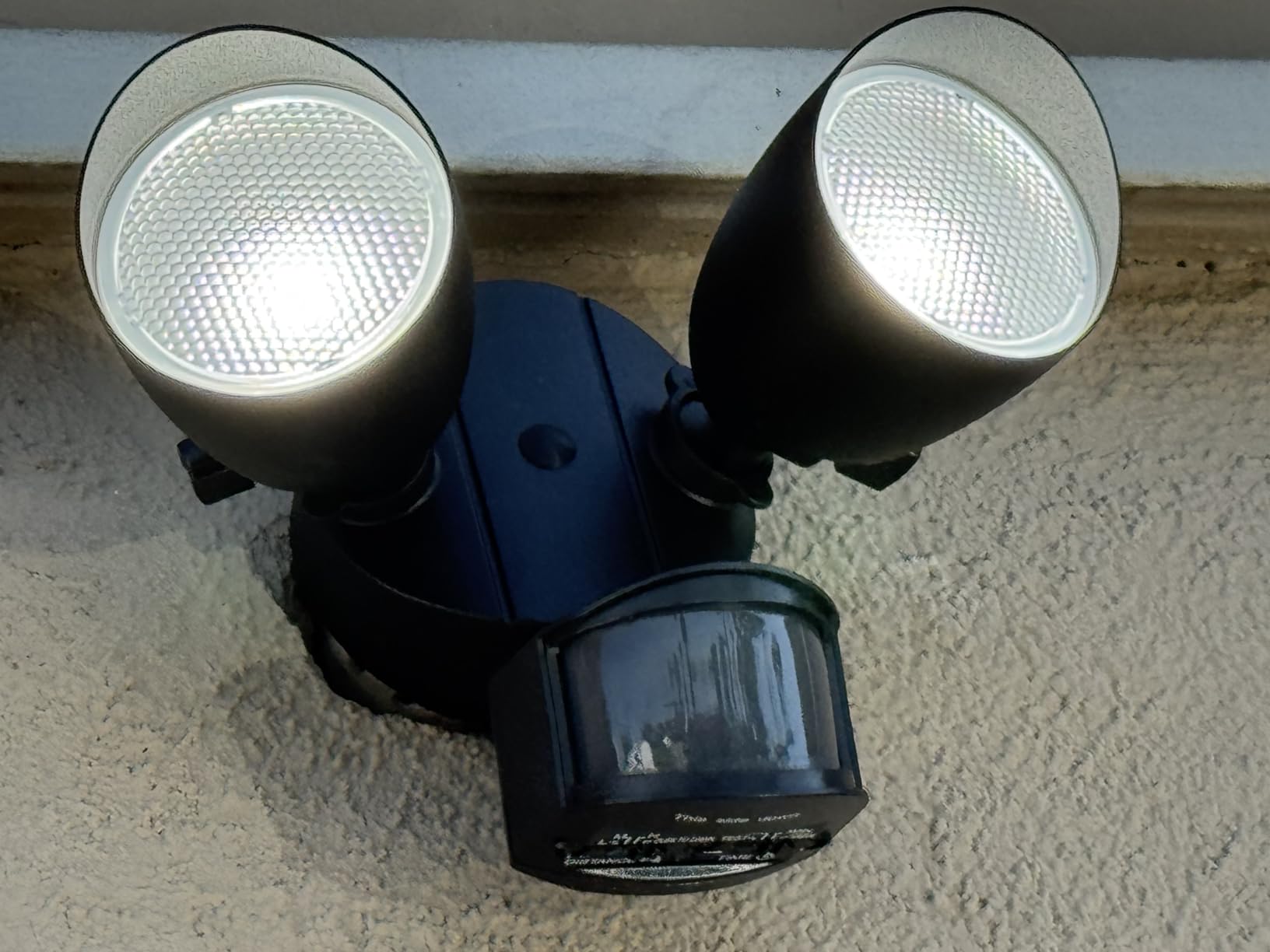
The LUTEC is the pick for a yard that is used at more than one intensity. Four modes cover test, security, dusk to dawn and manual override, and the override is the feature that separates it from basic single-mode fixtures in this category.
At 3,457 reviews and 75% five stars, long-term owners report first units still running after a year of daily use. The 3-year warranty is genuinely longer than most of the wired lights here, and one owner whose sensor failed at 14 months documents a replacement arriving within five days.
How the Manual Override Actually Works
Flipping the wall switch off, on, off, on within about three seconds puts the light into constant operation for a set period. In practice owners use it to light the yard while carrying groceries, working on a project or walking a dog before bed.
Once the period ends, the light returns to sensor control. That is a small feature with an outsized effect on how much people like a fixture, because it removes the need for a separate always-on light.
3500 Lumens at 32 Watts
The efficiency story is strong: 32W producing 3500 lumens, equivalent to a 150W halogen while cutting electricity use by as much as 88%. For most suburban backyards, that is more than enough to light a patio and the path to the shed from a single fixture.
At 5000K the output is a neutral daylight white, and the 180-degree sensing reaches 69 feet with a timer adjustable across test, 1, 3 or 10 minutes.
The Installation Snag Worth Knowing
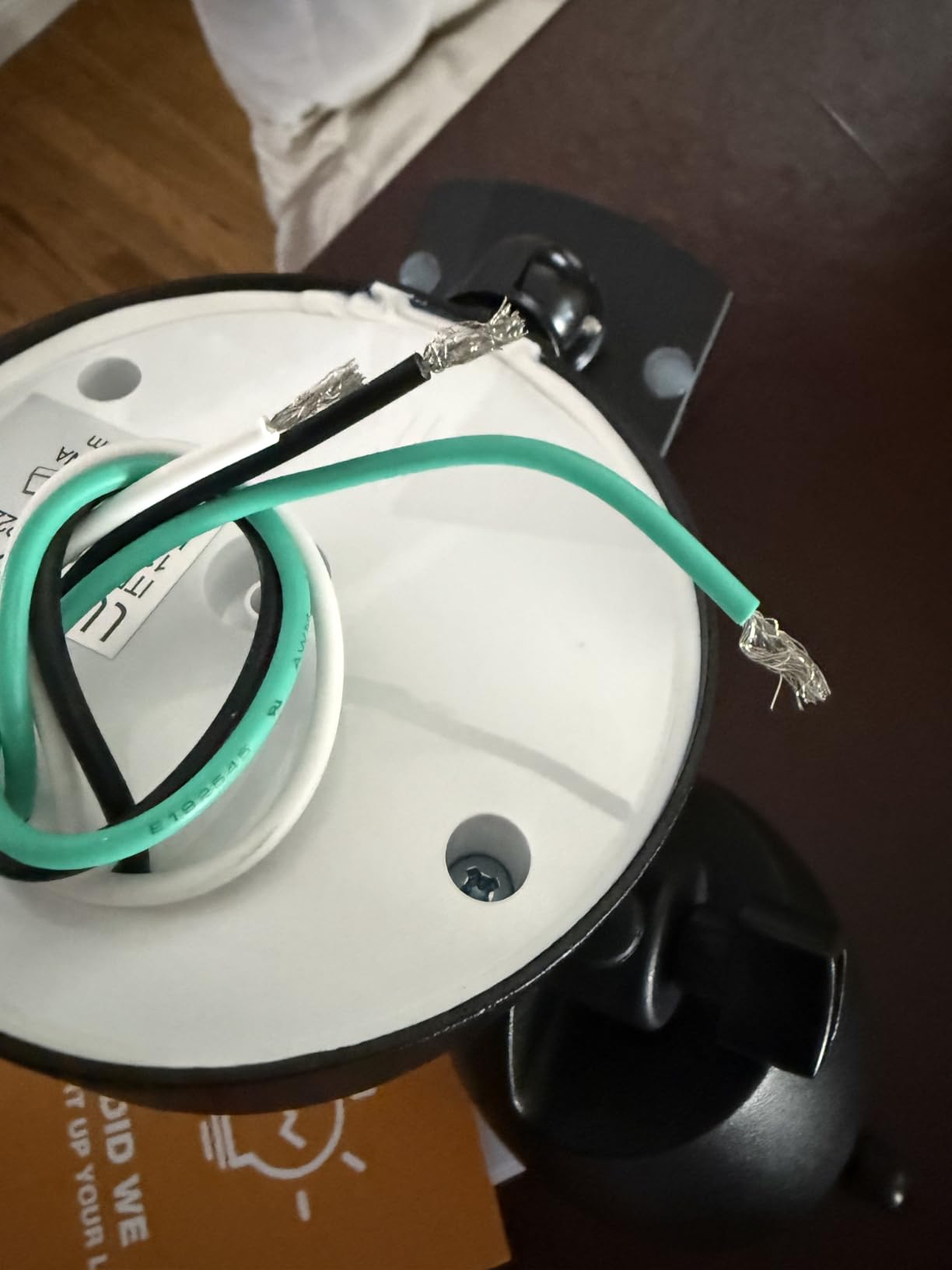
The body sits nearly flush to the wall, which looks clean but can conflict with a deep existing electrical box. If your current box is deep, you may need a shallow mounting base or a short box extender before the fixture sits properly.
It is designed around a 4.13-inch junction box, which is worth checking before you start. This is also the fixture that best suits an eave or soffit, where the rotatable heads can be angled down without a wall behind them.
Who Should Pick Something Else
Skip it where there is no mains power available, since this is a corded fixture with no wireless option. Buyers who want to dim the dusk-to-dawn level below its fixed setting should also look at a model with two-level lighting instead.
7. intelamp Dual-Sensor Solar Flood Light – Best for Trees and Posts
intelamp Solar Outdoor Lights, Motion Sensor with Dual Sensors Waterproof
1200 lumens
108 LEDs
Dual sensors
270-degree
3-night battery
+ Pros
- Dual sensors detect from the front and both sides across over 180 degrees
- Three adjustable heads cast a 270-degree illumination arc
- High-capacity battery runs up to three consecutive sensing nights after one full charge
- Includes screws and tie straps for walls
- fences
- trees and posts
- 2-year warranty
- Cons
- 1200 lumens is modest for large open areas
- 8W draw caps the maximum brightness
- Tie-strap mounting is less tamper-resistant than screwed wall mounting
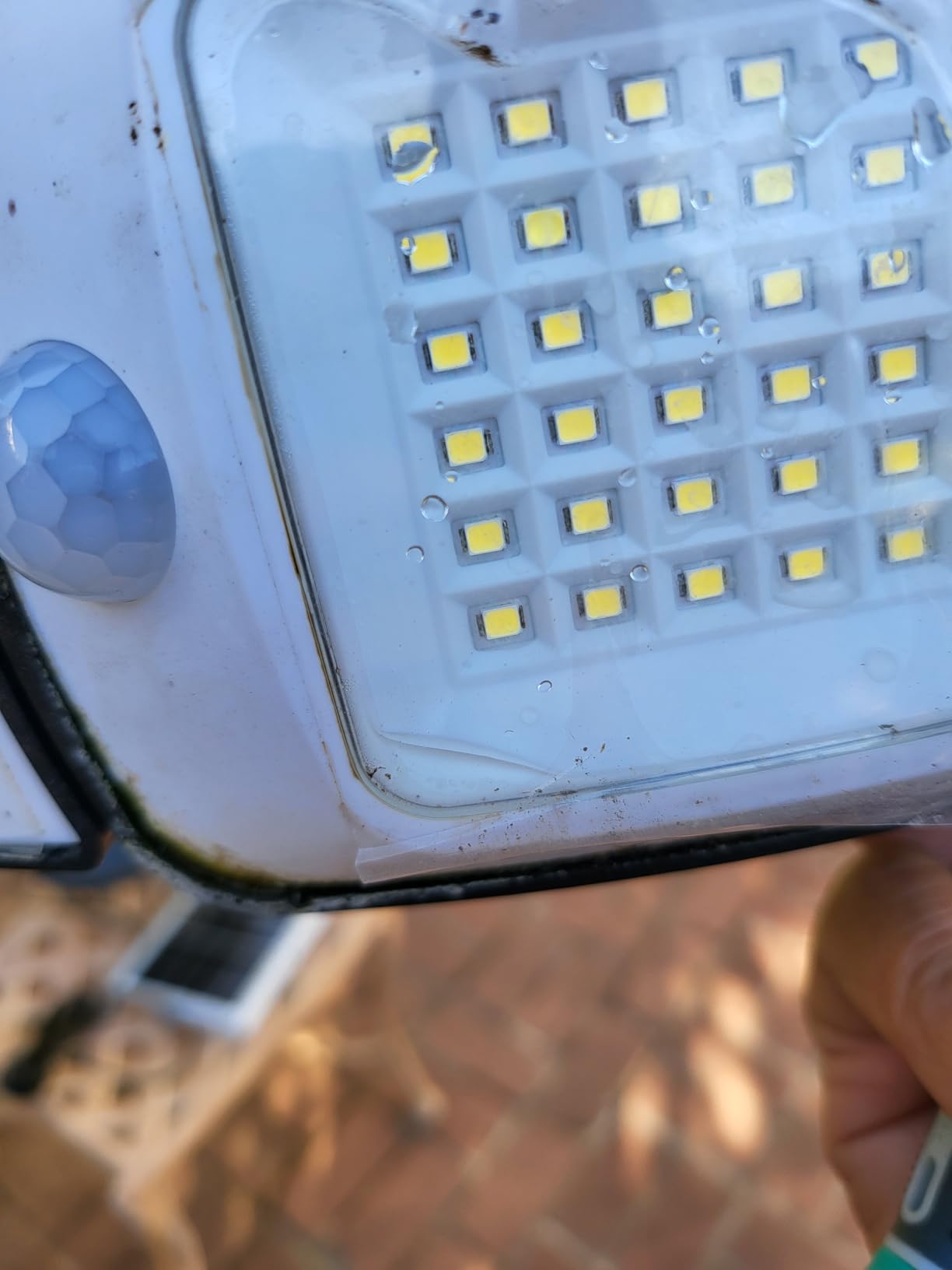
The intelamp is built around a genuinely different sensor arrangement. Two motion sensors watch the front and both sides, covering more than 180 degrees, so someone walking across the detection zone rather than toward the light still triggers it. On a wide backyard, that side-on coverage is the whole point.
At 3,356 reviews and 75% five stars, the dual-sensor design is what buyers write about. The three-night battery endurance is the other frequently praised trait.
Tree Mounting Changes What Is Possible
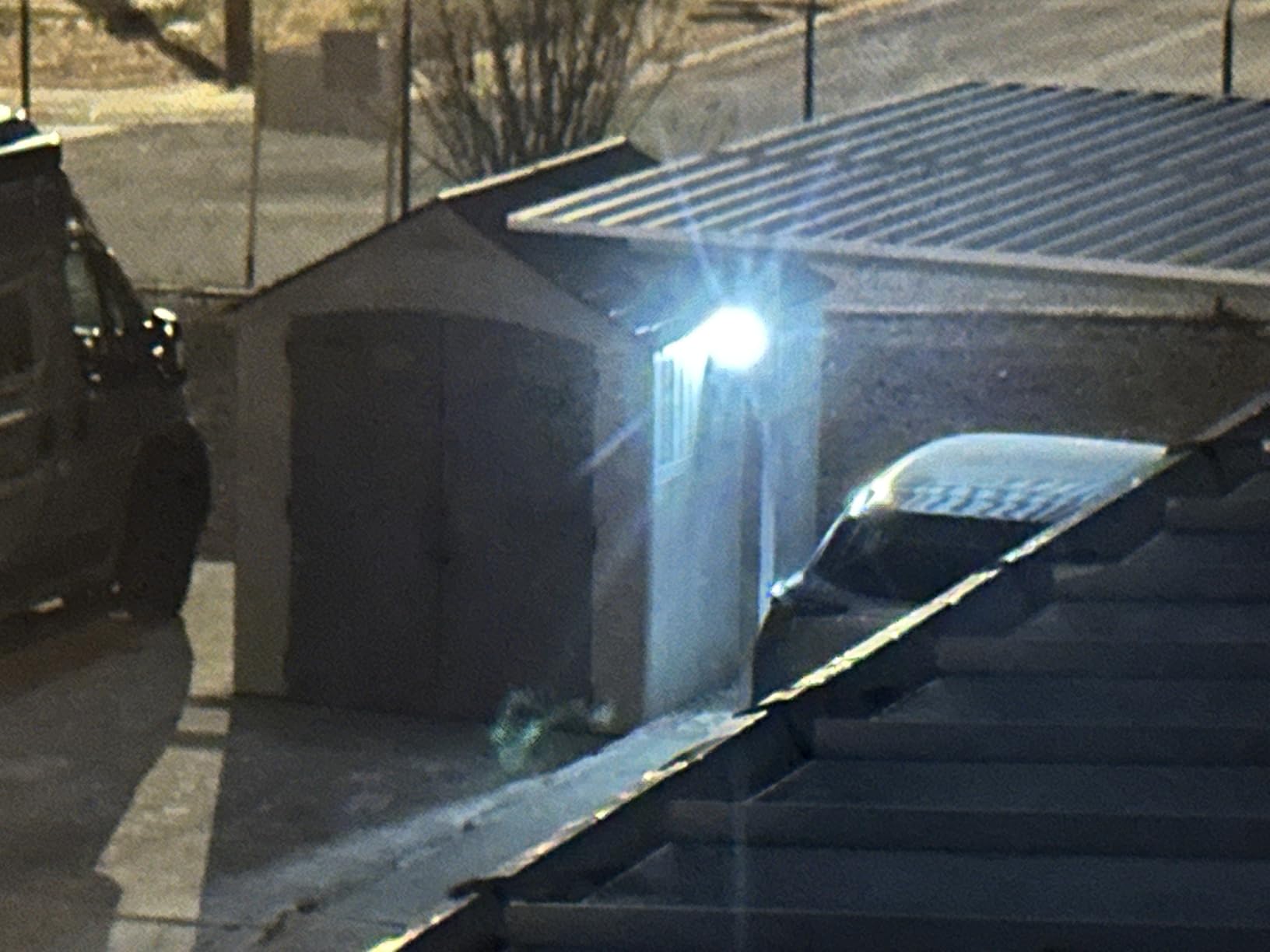
The included screws and tie straps mean this can go on a tree, a fence post or a garage frame where no wall exists. A homeowner on a smart home forum described running an outdoor sensor fixed to a tree in a backyard with no battery changes, and this light offers the same installation freedom at a fraction of the coordination.
Tree mounting also changes the detection geometry for the better. A light two metres up in a canopy sees across a lawn rather than along it, which solves the blind-spot problem that a wall-mounted single-sensor flood always has at the far corner.
Battery Endurance and Charging Behaviour
The high-capacity battery runs up to three consecutive nights in motion-sensing mode after one full day of charge, and owners report consistent 1200-lumen output even in low-sunlight conditions. That consistency is what separates a solar light that works in autumn from one that flickers out.
Three lighting modes cover dim-then-bright on motion, off-then-bright on motion, and a steady low output all night with the sensor switched off. The third is the one to use when a path needs to stay visible.
Where 1200 Lumens Is and Is Not Enough
This is adequate rather than impressive, and owners say so plainly. It reads as enough for a side yard, a gate, a deck corner or the strip between house and fence, and not enough to light an open lawn or a long driveway approach.
Because the 8W draw is lower than competing solar floods, the ceiling on brightness is fixed by design. If your zone is a large open area, budget for a second fixture rather than expecting this one to stretch.
Strap Mounting Trade-Offs
Tie straps are quick and work anywhere, but they are less tamper-resistant than a screwed wall mount. In a yard where a fixture is reachable from the street or a shared side passage, that is a real security consideration.
The 2-year warranty is a reasonable term for a solar light and matches what most of the solar picks in this roundup offer.
8. Onforu 75W 7000 Lumen Low-Profile Flood Light – Best Discreet High Output
Onforu 75W LED Flood Light Motion Sensor Outdoor, 7000lm Dusk to Dawn Flood Light, Security Light with Three Head, IP65 Waterproof Exterior Floodlight, 6500k Wall Light for Entryway Stairs Yard Garage
7000 lumens
75W
112 LEDs
270-degree
6500K
IP65
+ Pros
- 7000 lumens from 112 LED beads at 75W
- Three adjustable heads covering a 270-degree detection zone
- Low-profile housing blends into siding better than bulky industrial floods
- 180-degree sensing up to 72 feet with a 1-10 minute timer
- Aluminum fin-type heat sink design runs cool
- Cons
- Instruction text describes the dial order incorrectly
- The three rotary dials are extremely sensitive
- A small share of buyers received faulty LED panels
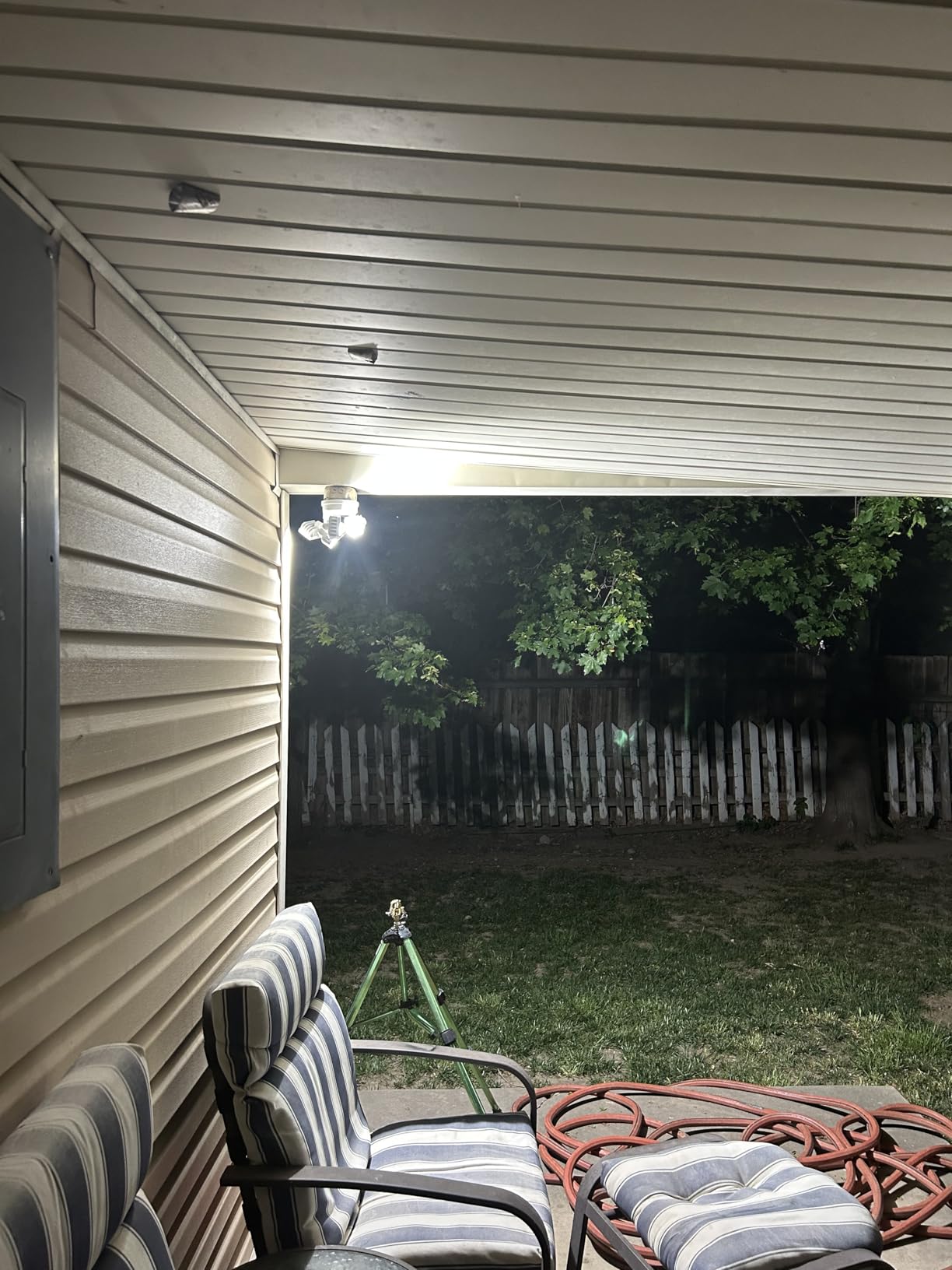
The Onforu matches the LEPOWER for output but keeps the profile down, which changes how it looks on a finished wall. At 9.3 by 6.6 by 4.4 inches it is roughly a third shorter than a 14-inch industrial flood, and buyers with a decorated backyard specifically praise how it blends into siding or trim.
Brightness dominates the reviews. Multiple owners report installing it over an aging halogen and reading at 25 to 30 feet, or lighting a two-and-a-half-car driveway, at 3,631 reviews and 71% five stars.
Hidden Dusk-to-Dawn Mode
A dial setting bypasses the motion sensor and runs the fixture continuously from dusk to dawn. It is a discreet design choice, which matters for a backyard where a security flood that clicks on and off all night becomes a habituation problem for both you and your neighbours.
For a permanently lit back lawn, this mode is genuinely useful. It is also the neighbourly option, because a steady low flood reads as ambient rather than as someone standing in your garden with a torch.
Ignore the Manual, Read the Symbols
This is the most repeated piece of advice in the reviews, and it is worth heeding. The instruction text describes the left-to-right order of the three dials incorrectly, and following it sets the unit up wrong on the first try.
The raised symbols moulded on the sensor housing are reliable. Buyers who follow the casing instead of the paper report the settings work as intended on the first night.
Sensitive Dials and Heat Management
The three rotary dials controlling range, ambient light level and timer are extremely sensitive, so a small turn produces a large change. Expect to spend more than one evening walking the yard to settle them.
The die-cast aluminum fin design dissipates heat well, which supports LED lifespan in a fixture that runs at 75W. Colour temperature is 6500K, a cool daylight white that maximises visibility across a driveway.
Warranty and the Small Failure Group
The 2-year warranty is standard for the category. A small share of buyers report receiving faulty or dim LED panels, and a small share of one-star ratings reflect units that failed shortly after installation, so a retailer with straightforward returns is worth considering.
Skip it if you need a small fixture. At 7000 lumens this is output by design, and there is no way to dim it below its full setting except by aiming the heads away.
9. UME 19W 2000 Lumen 2-Head Flood Light – Most Versatile for Porches and Paths
UME 19W LED Flood Light Motion Sensor Outdoor, 2 Adjustable Head, 2000LM, 5000K, IP65 Waterproof, Dusk to Dawn Security Light with Photocell for Exterior,Outside,Garage,House(Black)
2000 lumens
19W
5000K
50-foot range
Photocell
IP65
+ Pros
- Lowest wattage wired option here at 19W for 2000 lumens
- Two adjustable heads plus an adjustable motion sensor head
- 50-foot PIR range with 1
- 3 or 10 minute on-time
- Lightest fixture here at 1.1 pounds
- easy to handle on a ladder
- 3-year warranty with an included weather gasket
- Cons
- No sensitivity or brightness adjustment
- Quick switch-flip manual override does not work
- Polycarbonate body is less rigid for long-term exposure
- 2000 lumens suits porches more than large yards
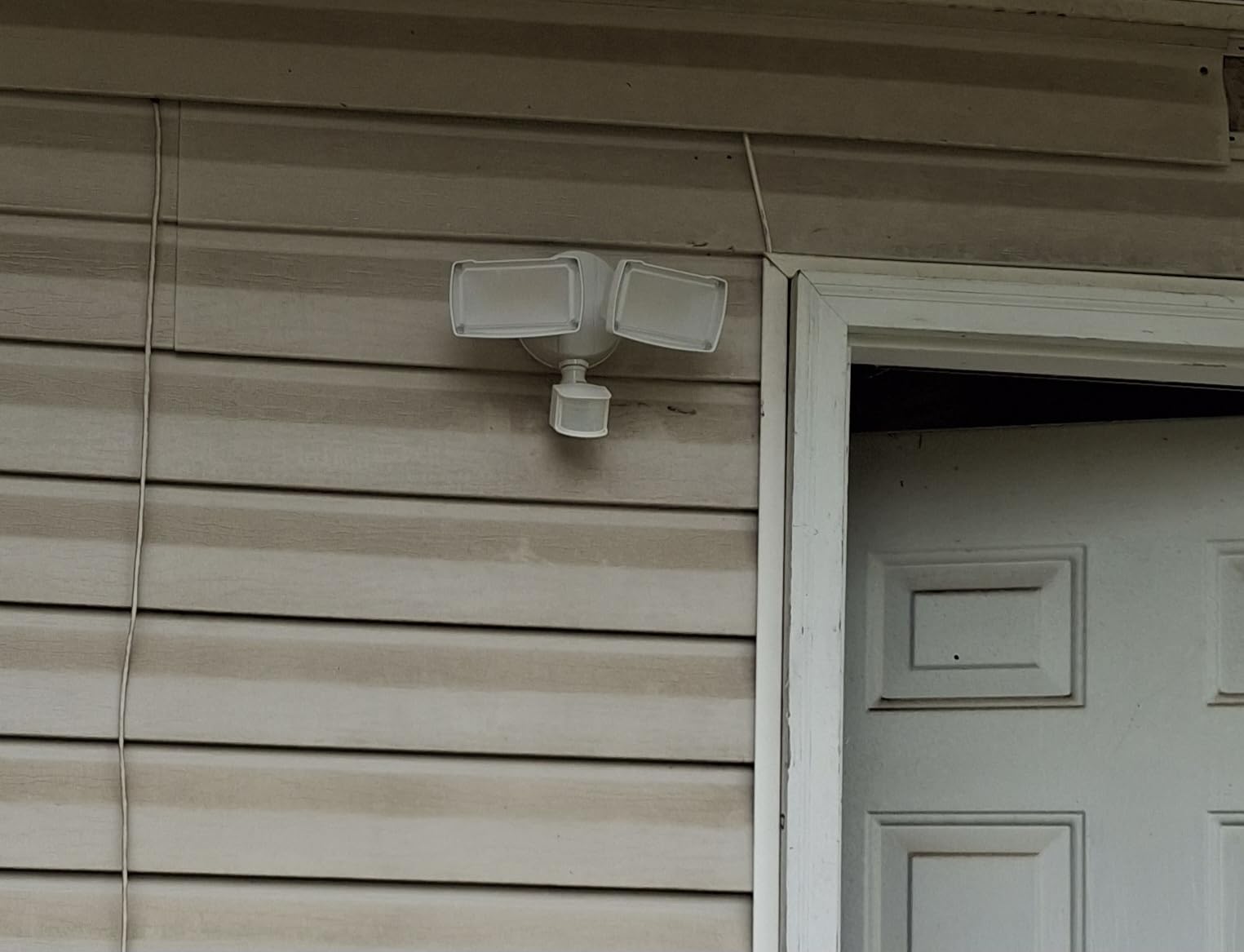
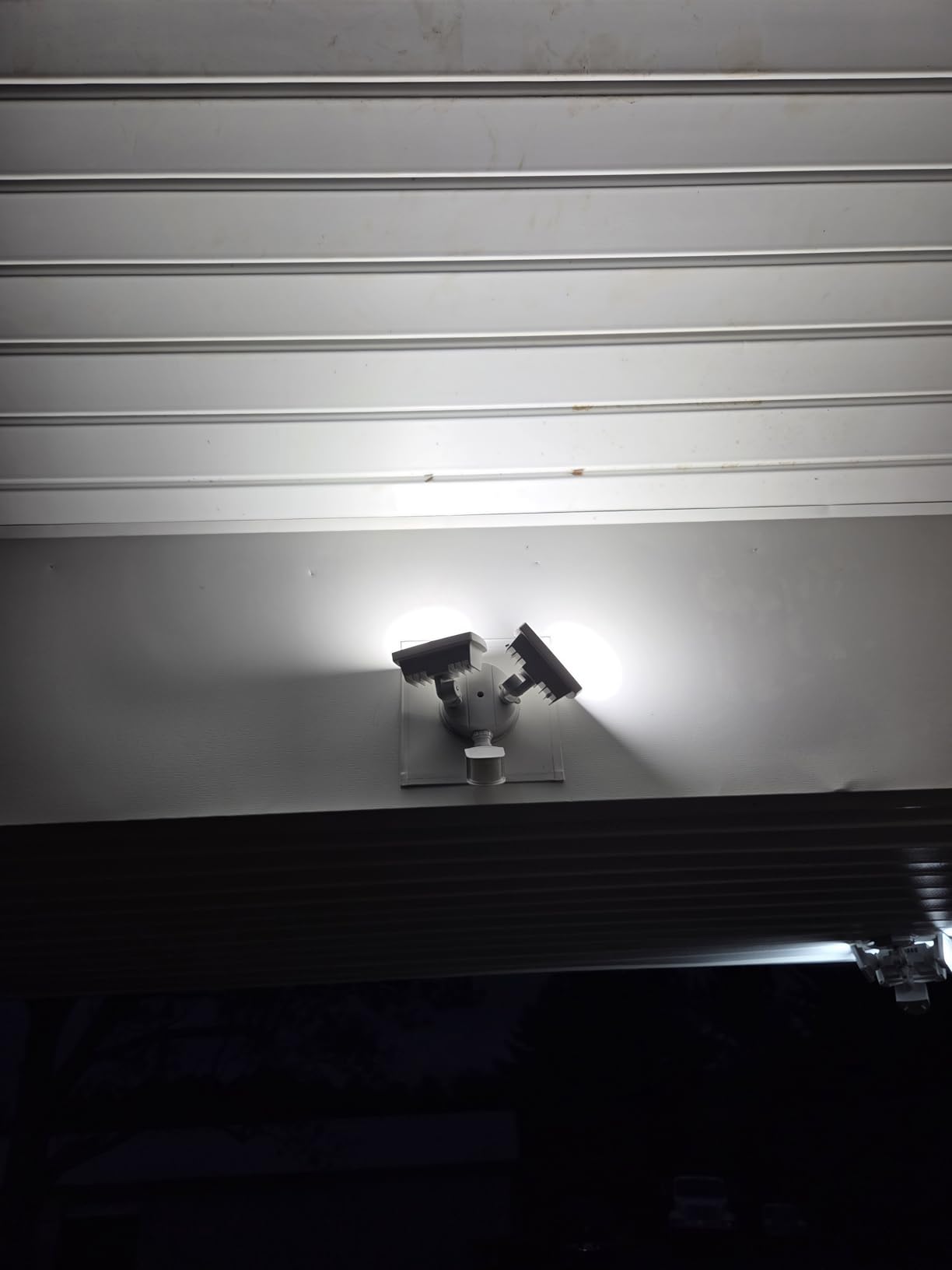
The UME is the efficient one. Nineteen watts producing 2000 lumens is the lowest power draw of any hardwired fixture in this roundup, over 90% below a comparable 120W halogen, and at 1.1 pounds it is the lightest fixture here to handle on a ladder.
Owners mostly use it as a direct halogen replacement on an existing box and report a roughly ten-minute install with the included gasket doing the weather sealing. At 3,044 reviews and 73% five stars, the sensor reliably picks up small movement including animals in the yard.
Efficiency Is the Whole Argument
Nineteen watts drawing 2000 lumens works out to more than 100 lumens per watt, which is why it delivers usable output from a small fixture with a polycarbonate body. For a back door or a short path, that is more than enough light for the money spent.
Two adjustable heads plus an adjustable sensor head let you aim one at a stoop and one at a path, and the photocell handles dusk-to-dawn switching automatically without any mode setting.
No Dial, No Override, No Problem
This fixture has no sensitivity adjustment and no brightness adjustment, and the quick switch-flip manual override does not work on this model. The light is set once and left alone, which is either a feature or a frustration depending on your yard.
For a straightforward stoop with no adjacent foot traffic, fixed settings are fine. For a side passage next to a footpath, a model you can tune will serve you better.
Where 2000 Lumens Works
This is porch and path output. A back door, a patio corner, the strip along a shed, and a short driveway apron are all within reach. An open lawn or a long drive is not, and adding a second fixture is cheaper than expecting more from this one.
The 3-year warranty is among the longer in this group, and the polycarbonate body is the practical trade-off for a light that gets handled on a ladder and left in the rain.
Honest Downsides
A small number of owners report the motion sensor failing to trigger outside test mode, so factor that into any purchase where detection reliability is the whole point. The lack of tuning means you cannot narrow the zone after installation.
10. LEPOWER 1500 Lumen Battery Powered Flood Light – Best for Renters and Off-Grid Spots
LEPOWER 1500LM Battery Powered Outdoor LED Flood Light with Motion Sensor
1500 lumens
4 D cells
72-foot range
220-degree
Eco mode
Wireless
+ Pros
- Battery powered
- so no wiring and no electrician
- 1500 lumens at 5000K from 92 LED beads
- 72-foot PIR detection adjustable from 10 to 72 feet
- Three adjustable panels give a 220-degree beam angle
- Eco mode drops to 300 lumens after 40 seconds
- Folded surface design and separate mounting plate for quick fitting
- Cons
- Four D batteries are not included
- 1500 lumens reads dimmer than expected for a flood
- Plastic body is lighter and less rigid than aluminum
- Battery changes are awkward on a high tree mount
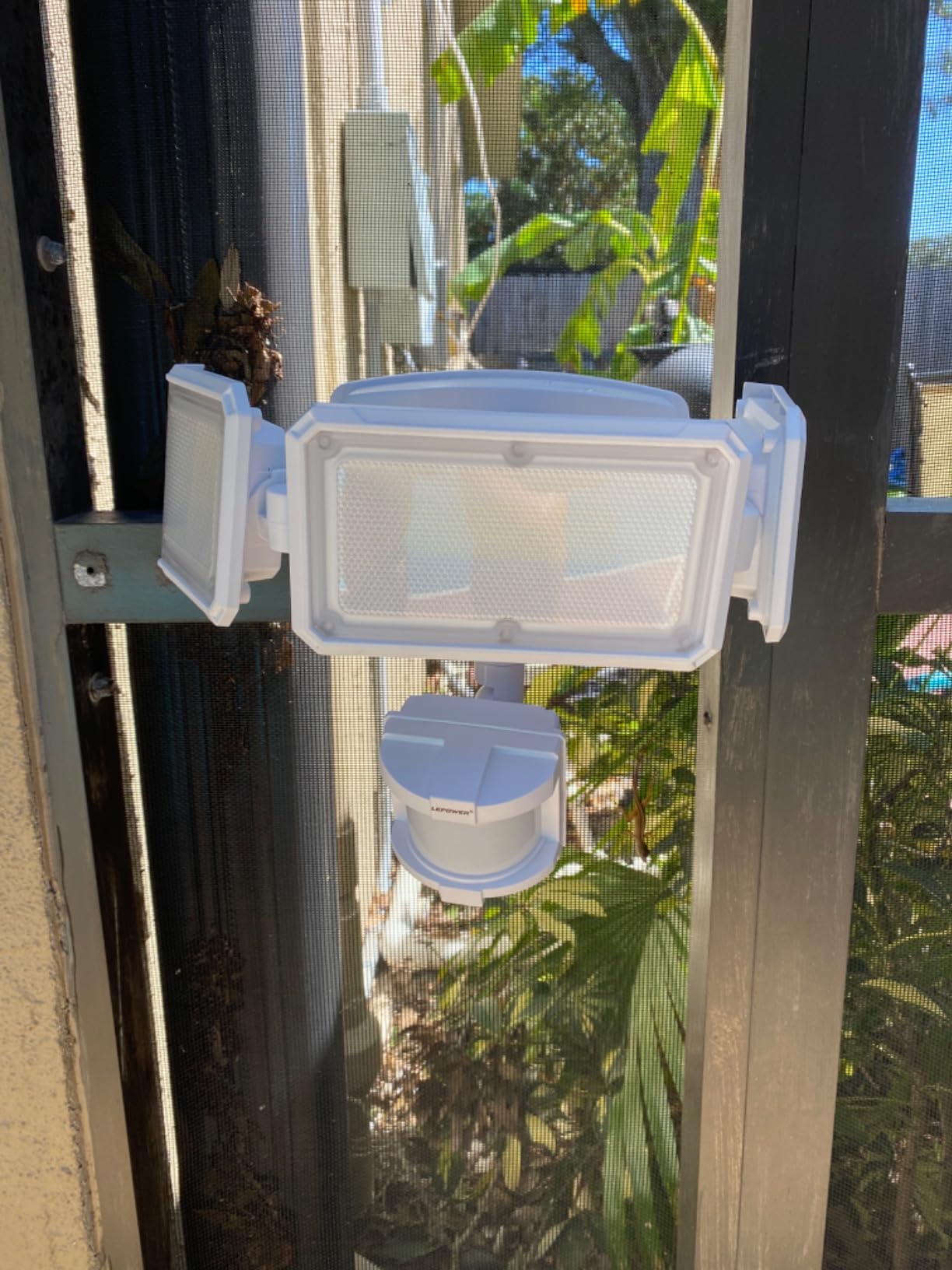
This is the light for a place you cannot wire. Four D cells power a 1500-lumen, 5000K fixture with a 72-foot PIR sensor and three adjustable panels covering a 220-degree beam, and it installs in about five minutes with no electrician and no cable.
Owners choose it over hardwired models specifically for installation freedom, mounting on trees, fences and unlit side passages where mains power is not an option. At 2,524 reviews and 72% five stars, the 72-foot range is confirmed to work in a fully dark yard.
Three Modes That Manage Battery Life
Auto mode runs full 1500 lumens for 20 seconds after motion. Eco mode steps down to 1050 lumens and then to 300 lumens after 40 seconds, which is the mode owners specifically praise for keeping a dark deck or a shared stairway visible without draining the cells.
That two-stage dimming is what makes a battery light workable. Without it you either burn the cells in a short bright burst or sit in the dark, and most battery fixtures offer only the first option.
The Separate Mounting Plate Is the Detail That Helps
The light and sensor assembly click onto a mounting plate after the plate is secured, so you can position the bracket precisely and then attach the light without wrestling with wires or a heavy body over a ladder.
At 14.5 by 9.5 by 5.1 inches the folded surface design is wide but flat, which lets the three panels aim independently across a 220-degree arc from a single point.
What 1500 Lumens Really Looks Like
Several reviewers find it dimmer than the specification suggests, one comparing it to a 40W bulb rather than a flood light. That is a fair description for open areas, and it is why this sits in the path and side-yard category rather than the driveway category.
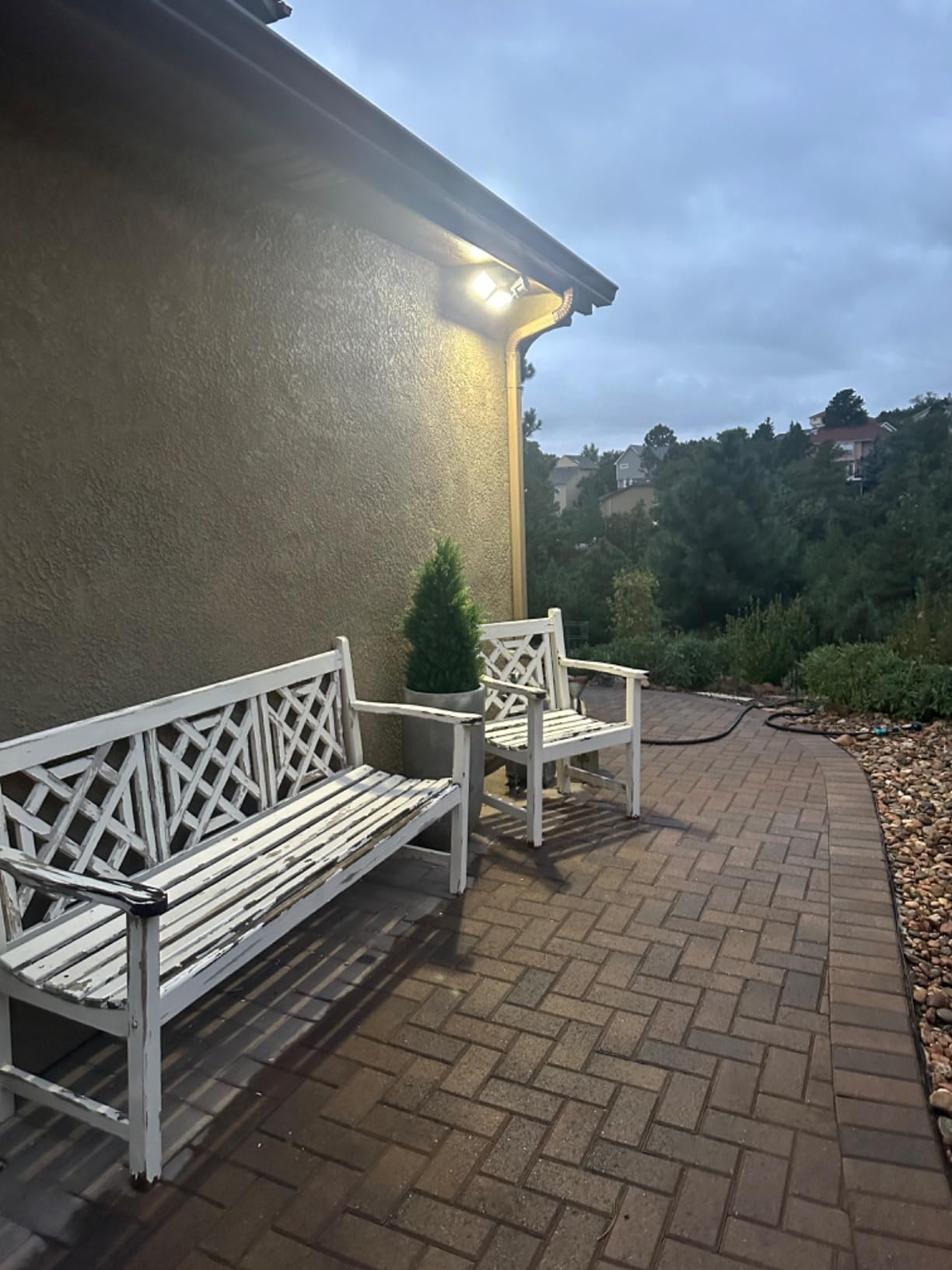
It is rated IP65 for wind, rain, snow and freezing weather, so cold climates are fine on the housing. The four D cells are not included, and replacements on a high tree mount are an awkward errand.
Who This Suits Best
Renters, anyone without a suitable junction box, and anyone lighting a spot the cable would never reach. It also suits seasonal and temporary lighting where you do not want to run a circuit.
Skip it for a driveway or a back lawn. For those zones, a solar fixture gives you more output with no battery cost, or a wired flood gives you the output you actually need.
11. LUTEC 72W 7500 Lumen 3-Head Flood Light – Best for Raw Brightness
LUTEC 72W 7500LM LED Security Lights Motion Sensor Light Outdoor, 5000K Daylight, IP65 Waterproof, Dusk to Dawn, 3-Head Motion Detected Flood Light for Garage, Yard, Porch(Black)
7500 lumens
72W
3 heads
5000K
69-foot range
3-year warranty
+ Pros
- 7500 lumens from 72W
- the highest output in this roundup
- Three adjustable heads plus an adjustable motion sensor head
- 180-degree motion sensing up to 69 feet with a 1
- 3 or 10 minute timer
- Four lighting modes including dusk to dawn and manual override
- Aluminum housing rated 50000 hours with a 3-year warranty
- All mounting hardware included in the box
- Cons
- Dusk-to-dawn low setting is fixed and too bright for some
- Plastic wall-mount base raises long-term durability questions
- Awkward wire routing at the outlet box
- Heaviest and hardestwired option in this group
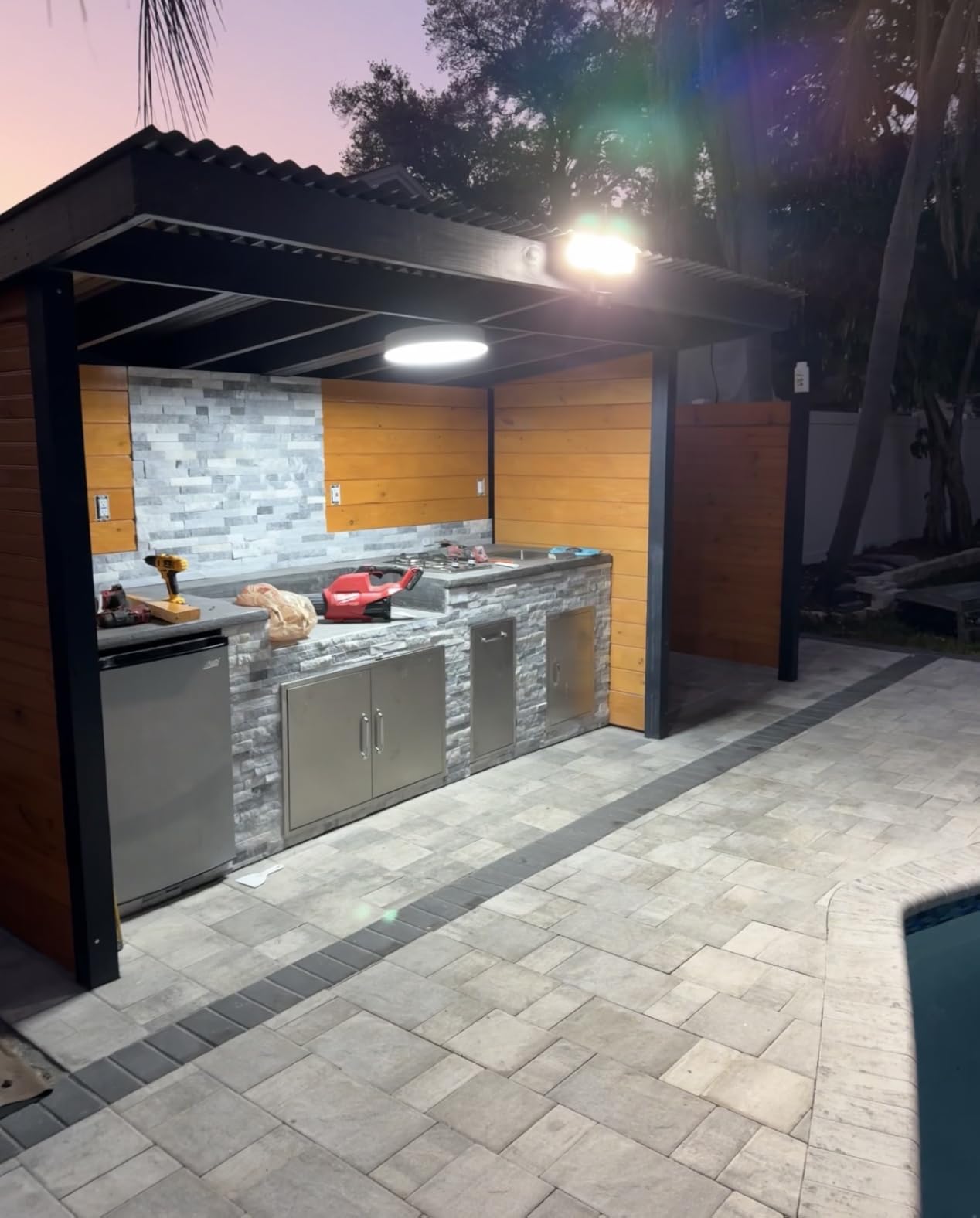
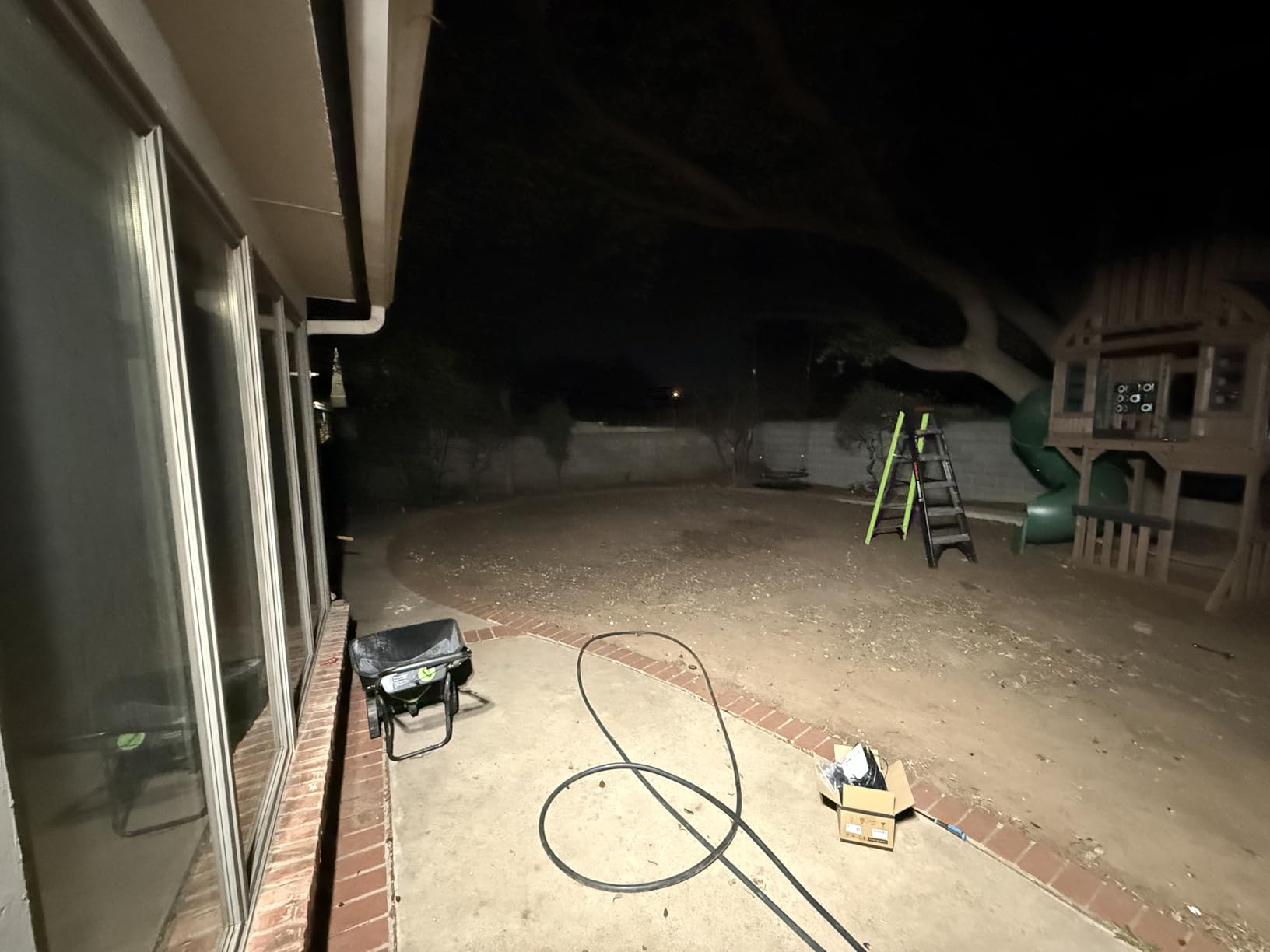
When a yard genuinely needs daylight at night, this is the fixture. Seventy-two watts producing 7500 lumens, with three independently aimable heads and a sensor that reaches 69 feet, means a single box can cover a driveway, a side path and an entrance.
Owners describe it as turning night into daylight and cite a real safety upgrade for uneven rural driveways, where the light stays on long enough to walk from a vehicle to the door. Across 2,027 reviews it holds a 4.5 rating with the highest five-star share in the group at 78%.
Where the Output Actually Earns Its Keep
Large open yards, long driveways, gravel paths and plots with a shed set well back from the house. In those spaces, a 4000-lumen fixture leaves dark ground between the beams, and this one does not.
It also suits a house with a side gate that opens onto an unlit alley or an outbuilding set more than 40 feet from the main wall, because the 69-foot sensing range covers approach from a distance most fixtures never reach.
Four Modes and a 5000K Output
Test, security, dusk to dawn and manual override give the same behaviour range as the 32W LUTEC. The timer adjusts across 1, 3 or 10 minutes, and 5000K daylight white keeps the space neutral rather than tinted.
Owners praise that all mounting hardware is included, which removes the excuse to delay. The 50,000-hour aluminum housing rating supports a genuinely long service life in a fixture this powerful.
The Three Practical Complaints
The dusk-to-dawn low setting is fixed and some buyers find it too bright for ambient use, which is the main tension in a fixture this powerful. The wall-mount base is plastic rather than aluminum, and the three wires are routed in a way that makes the outlet box connection fiddly.
At 2.4 pounds this is also the heaviest fixture here, and it is the hardestwired, so plan the run and the box before you buy rather than after.
Who Should Skip It
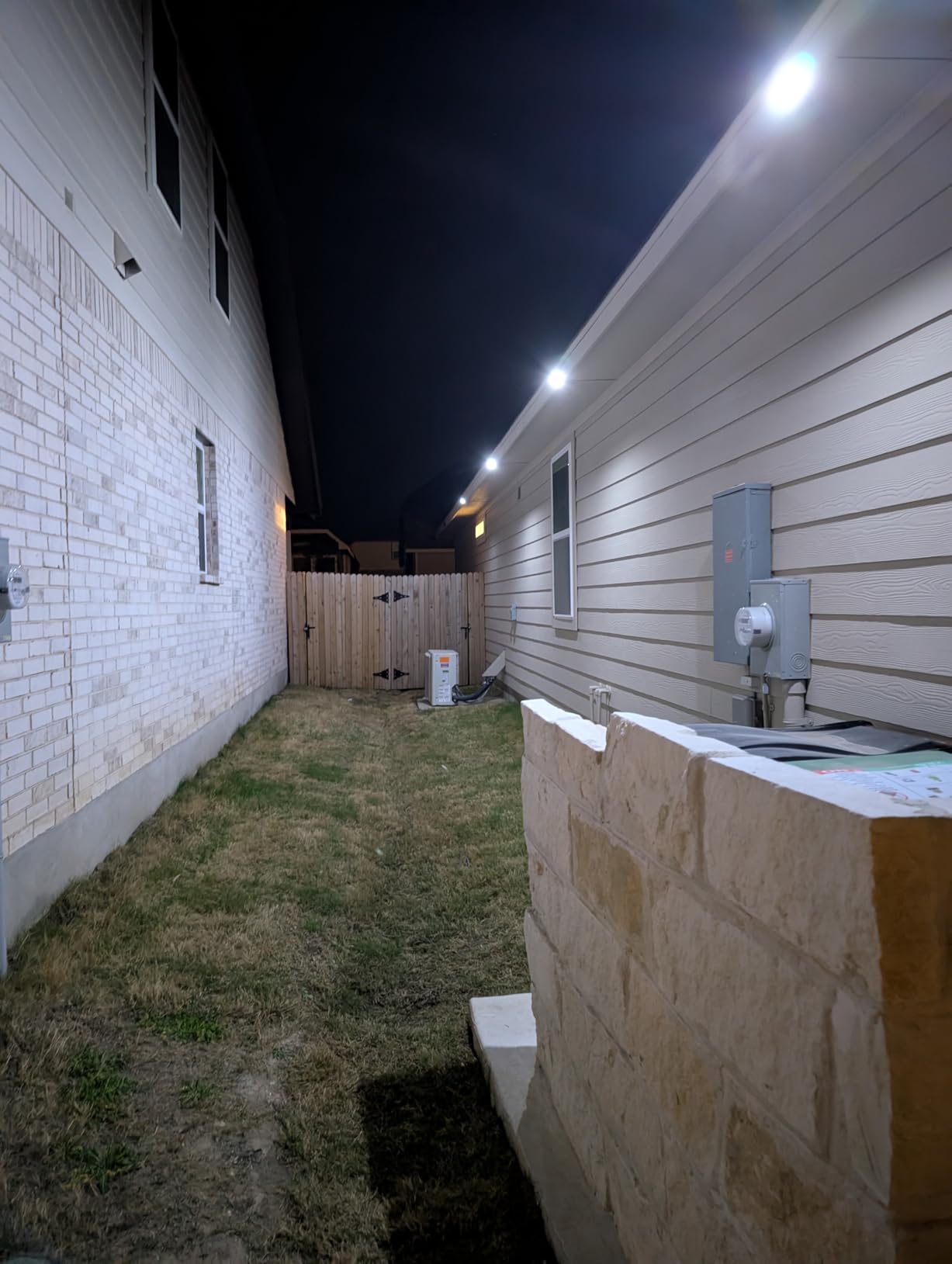
Skip it for a suburban yard under about a quarter acre, where 7500 lumens is more light than you need and more than your neighbours want to receive. A 3500 or 4000-lumen fixture covers those spaces at a fraction of the output and usually a smaller physical footprint.
12. Peasur 6-Pack Solar Path and Step Lights – Best for Paths and Fence Posts
Peasur 6 Pack Solar Motion Sensor Lights Outdoor Waterproof with 3 Modes
200 lumens
138 LEDs
6-pack
3 modes
4.1 by 3.3 inch body
+ Pros
- Small low-profile body fits fence posts and decks without overhang
- 138 LEDs deliver 200 lumens for the size
- Three modes including a dim-then-bright path mode
- Installs with included screws
- tape or zip ties
- 6-pack with a 2-year warranty
- Cons
- 200 lumens is path lighting
- not flood coverage
- Some lights in a pack can stop working within about six months
- Brightest mode is short-lived after motion
- Cool white output reads blue to some buyers
The Peasur pack solves a problem nothing else here does: making a fence line or a deck edge look intentional. At 4.1 by 3.3 by 1.7 inches, these sit almost flush on a 4×4 post, where a 10-inch flood would jut out over the yard.
Buyers routinely underestimate how bright 200 lumens looks in the dark, and the satisfaction profile is strong for a low-cost path set, with a 4.6 average across 5,459 reviews, 77% five stars and only 3% one-star.
Three Modes and the One to Use
The three modes run from constant illumination to motion-sensor activation, including a dim-then-bright mode that keeps a path visible all night. The most useful practical tip in the reviews is to use the steady-on mode rather than motion-only, because the bright burst is short-lived.
For a path that people actually walk on after dark, a short burst is not a safety feature. A steady low output is, and on a solar panel this small it remains achievable through a night.
Installation Flexibility
Screws, tape or zip ties are all included as mounting options, so these work on wood, vinyl and metal surfaces without a drill in the right spot. Several owners have zip-tied them on in severe weather and had them survive.
One owner has had a set running for four years in full sun, which is a reasonable indicator of panel and battery longevity for a fixture this size.
Durability and Shade
The main quality risk is consistency across a pack. One owner reported two of six lights dead after six months, and brightness varies between pieces. Buying from a seller with straightforward returns matters more here than on a wired fixture.
In shaded locations the lights need to be moved into direct sun periodically to hold a charge, and the cool white output reads blue to buyers who prefer a warmer tone.
Best Placement
Fence posts, deck edges, step risers, a shed doorway and a path from the patio to the fence. Six lights from one pack can trace a route across a yard in a way a single flood never could.
Skip it if you need to see a face from 30 feet away or light a driveway. This is guidance lighting, and it works because it is everywhere rather than bright in one place.
How to Choose a Backyard Motion Sensor Light
How We Selected These 12
We ranked every fixture on output in lumens rather than watts, manufacturer-stated detection range and angle, IP rating, power source, warranty length and the volume of owner feedback. We then read the reviews for install friction, false triggers and weather performance rather than just star averages.
Specs alone did not decide placements. A fixture with a 40-foot range and a fixed sensor is useless on a yard where somebody walks across the zone, which is why the dual-sensor and multi-head models rank where they do.
Hardwired vs. Solar vs. Battery: What Each Can Actually Do
Hardwired fixtures are the only category that reliably lights a large yard, and the gap in output is stark. Wired models here run from 2000 to 7500 lumens. Solar models run from 200 to 2500 lumens, and the battery model sits at 1500.
Solar wins when you have good sun and no electrical access. Its real cost is placement discipline, because the panel has to see sky, and its real failure mode is weather, since a wet week can leave a fixture dark for a couple of nights.
Battery wins for temporary or off-grid spots and costs nothing to install. Over time it is the most expensive to run per fixture, because cells need replacing, and a light mounted high in a tree is the hardest to service.
Over five years, the honest comparison is simple. A hardwired LED fixture plus a cable run costs more up front and far less to run, with no consumables. A solar fixture costs nothing to run and needs no wiring, but output is capped by panel area and degrades if placed badly.
Detection Angle vs. Detection Range
These two numbers are confused constantly. Range is how far the sensor sees, measured in feet. Angle is how wide the sensing zone is, measured in degrees, and it is what determines whether a corner of the yard is covered or blind.
A 72-foot sensor with a 120-degree arc is a spotlight, ideal for a straight driveway. A 40-foot sensor with a 130-degree arc plus three heads covers a much larger footprint from a fence post, which is usually what a backyard actually needs.
PIR means passive infrared, detecting heat movement, and it is the standard in almost all consumer outdoor lights. Microwave sensing detects movement across a wider area and can sometimes see through light cover, but it is less common in fixtures at this level. Dual-sensor units combine both approaches to catch side-on approaches.
How Many Lumens Each Yard Zone Needs
Think in zones rather than wattage. A back door and stoop need 1200 to 2000 lumens. A side passage needs 1500 to 2500. A fence line or patio corner needs 2000 to 3500. A driveway, back lawn or long path needs 4000 and up.
Watts are not brightness anymore. The old halogen equivalence in the listings tells you the light you are replacing, not the light you are getting, so ignore it and read the lumen figure only.
Two or three lower-output fixtures placed to overlap usually outperform one expensive fixture aimed at the middle of a yard. That is the single most useful rule in this article.
What IP65 and IP66 Actually Mean
The first digit after IP is dust protection and the second is water ingress. IP65 means dust-tight and protected against water jets from any direction, which covers rain, sprinkler spray and hose splash. IP66 adds protection against powerful water jets, which matters if a fixture sits in a permanently damp spot.
Every fixture in this roundup is rated IP65 or listed as waterproof, which is adequate for a normal backyard. Full submersion ratings are irrelevant outside and are not what you are looking at here.
Colour Temperature and CRI
Colour temperature in Kelvin describes how warm or cool the light reads. Around 5000K to 6500K is a cool daylight white that maximises visibility and shows colours accurately, which is what you want for security. Around 2700K to 3000K is a warm white that flatters a patio but softens edge detection.
Most of these lights are fixed in colour temperature with no adjustment. If you want warm light on a deck and cool light at the door, that means two fixtures rather than one adjustable one.
Camera Floodlights and Standalone Sensors
Camera-integrated floodlights sit in a different category from everything in this roundup, because none of the twelve include one. If your requirement extends beyond a light to a view of whoever triggered it, a camera floodlight is a different purchase entirely.
Homeowners running smart homes report dimming camera floodlights well below full output because the default brightness blinds at close range. The same advice applies to the lights here, and every fixture with a mode selector lets you run a dim standby instead of full power.
For a yard too large for a doorbell camera to see, a standalone outdoor-rated motion sensor paired with smart bulbs gives you remote control of the sensing zone separately from the light, which no integrated fixture can offer.
Neighbour-Friendly and Wildlife-Friendly Aiming
Aim light down, not across. A fixture aimed at a neighbour’s window is the fastest way to turn a security upgrade into a dispute, and multiple independent homeowner forums describe exactly that conflict. Hooded or shielded fixtures reduce this, and lower sensitivity settings reduce false triggers.
Lowering sensitivity also reduces animal triggers, which owners report as a genuine nuisance with raccoons and possums. If your light flips on all night with nothing visible, the fix is almost always the sensitivity dial rather than a different fixture.
Seasonal and Climate Notes
Cold is less of a problem than people expect. IP65 housings handle freezing weather, and LED output does not collapse in the cold the way some halogen fixtures did. Heat is the more realistic concern for a dark-coloured metal housing in direct summer sun.
Winter is the real problem for solar. Lower sun angles mean shorter charging windows, and a fixture that worked all autumn can become marginal in December. Coastal yards face a separate issue, where salt-laden air degrades cheaper steel fittings faster than the housing rating suggests.
Pre-Purchase Checklist
Before you buy, check six things. Does an existing junction box sit where you need coverage, or will this be a new run requiring an electrician. Is there a GFCI-protected circuit available if the fixture is wired. How many hours of direct sun does the chosen wall get if the fixture is solar. How high is the mounting point, since solar motion detection degrades badly outside 6.5 to 8 feet. What is the size of your existing electrical box, because shallow fixtures conflict with deep ones. And how close is the nearest neighbouring window to the beam path.
Fixing a Motion Light That Keeps Flickering or Sticking On
A light that keeps flipping on and off, or one that never turns off, is almost always a settings problem or a wall-switch state problem rather than a defective sensor. Work through these in order.
- Turn the wall switch off and wait. Leave it off for a full minute or two so any stored charge in the sensor drains, then turn it on. This resets most fixture electronics and fixes a surprising share of stuck-on lights.
- Turn the sensitivity dial down. Step it down gradually and walk the yard between each change. The most common cause of a light cycling endlessly is a hot surface, a moving branch or an animal inside the zone, all of which a lower sensitivity setting stops registering.
- Re-aim the sensor head, not just the lights. On multi-head fixtures the sensor swivels independently. Aim it at the walkway rather than at the neighbour’s hedge, and keep the detection zone off the road if the light sits near a footpath.
- Use the override correctly. Most fixtures put the light into constant-on mode by flipping the switch off, on, off, on within about three seconds. If you have been doing that by accident while testing, the light is working as designed.
- Check the photocell. A covered or dirty photocell keeps the light on through daylight. Wipe the sensor lens, clear spider webs and make sure no exterior light or porch lamp is shining onto it, because a fixture that never goes fully dark will never trigger properly.
- Check the supply and the battery. For a wired fixture, reset the GFCI and confirm the breaker. For a solar or battery fixture, check charge and cells, since a depleted battery often presents as a sensor that appears to work but stops responding within seconds.
Frequently Asked Questions
What is the best motion detector light for outdoor use?
For most backyards the best motion sensor outdoor light is the HMCITY 6-Pack Solar Wall Light, because it needs no wiring and covers several zones at once. Where a junction box already exists, the LEPOWER 58W 7000-lumen 3-head flood covers the most ground from a single mount. The deciding factors are power source, detection angle and required lumens rather than brand.
Why does my flood light keep going on and off?
The usual causes are a heat source, moving foliage or an animal inside the detection zone, and occasionally a light or porch lamp keeping the photocell from going fully dark. Turn the wall switch off for a minute to reset, then step the sensitivity dial down and re-aim the sensor head rather than the light heads. Clean the photocell lens and clear spider webs.
Is a hardwired motion sensor light better than solar?
Hardwired is better when you want brightness and reliability, since wired fixtures in this roundup reach 7000 lumens while solar units top out near 2500. Solar is better when there is no outlet, no permission to run cable, or no appetite for an electrician. Solar output depends entirely on panel placement and daily sunlight, so a shaded wall rules it out.
How bright should a backyard security light be?
A back door or stoop needs roughly 1200 to 2000 lumens, a side passage 1500 to 2500, and a driveway or open lawn 4000 or more. Read lumens rather than watts, because halogen equivalence figures describe the old fixture rather than the new one. Two well-placed medium-output fixtures usually cover a yard better than one very bright fixture.
Can I install a motion sensor light without wiring?
Yes, if you choose a solar or battery fixture. Solar lights need no wiring and no batteries are user-replaceable, but the panel needs several hours of direct sun and mounting between 6.5 and 8 feet for reliable detection. Battery lights install in minutes and work anywhere, including trees and fences, but the cells need replacing periodically.
How do I stop my motion sensor light from triggering on animals?
Lower the sensitivity setting first, then re-aim the sensor head so its detection zone excludes the fence line or ground level where animals move. Shielded or hooded fixtures narrow the zone further. Raising the mounting height also helps, and on solar units the 6.5 to 8 foot range keeps detection focused on human-height movement.
Which Light Should You Buy?
If you are starting from nothing and want the whole yard handled without an electrician, the HMCITY 6-Pack Solar Wall Lights are the pick. Spread them across a fence run, a deck and a path, and you have lighting everywhere for one purchase and no cable.
If you have a junction box and want a single fixture to cover a lot of ground, choose the LEPOWER 58W 7000 Lumen 3-Head Flood Light. For a large driveway or open back lawn, its 72-foot range and three aimable heads do the work of three cheaper lights.
If you want wide solar coverage and dislike climbing a ladder, the Tuffenough remote-controlled pair is the better buy than any button-only solar light. If you need the longest solar detection reach, the daphino 40-foot model wins, and if the mounting point is a tree rather than a wall, the intelamp dual-sensor fixture with tie straps is the one.
For a smaller or tighter yard, the LEPOWER 40W 4000-lumen two-head model gives you four selectable detection distances, which is the single most useful tuning feature in the roundup. For a porch or short path, the UME 19W fixture covers it at the lowest power draw here, and for path and step lighting the Peasur 6-pack fits a 4×4 post without overhang.
Whatever you choose, aim it down, keep the sensitivity as low as the zone allows, and check the sun on the mounting wall before committing to solar. Those three habits solve more backyard lighting problems than any specification on the box, and they will keep your choice among the best motion sensor outdoor lights for backyards working for you long after the novelty fades.