
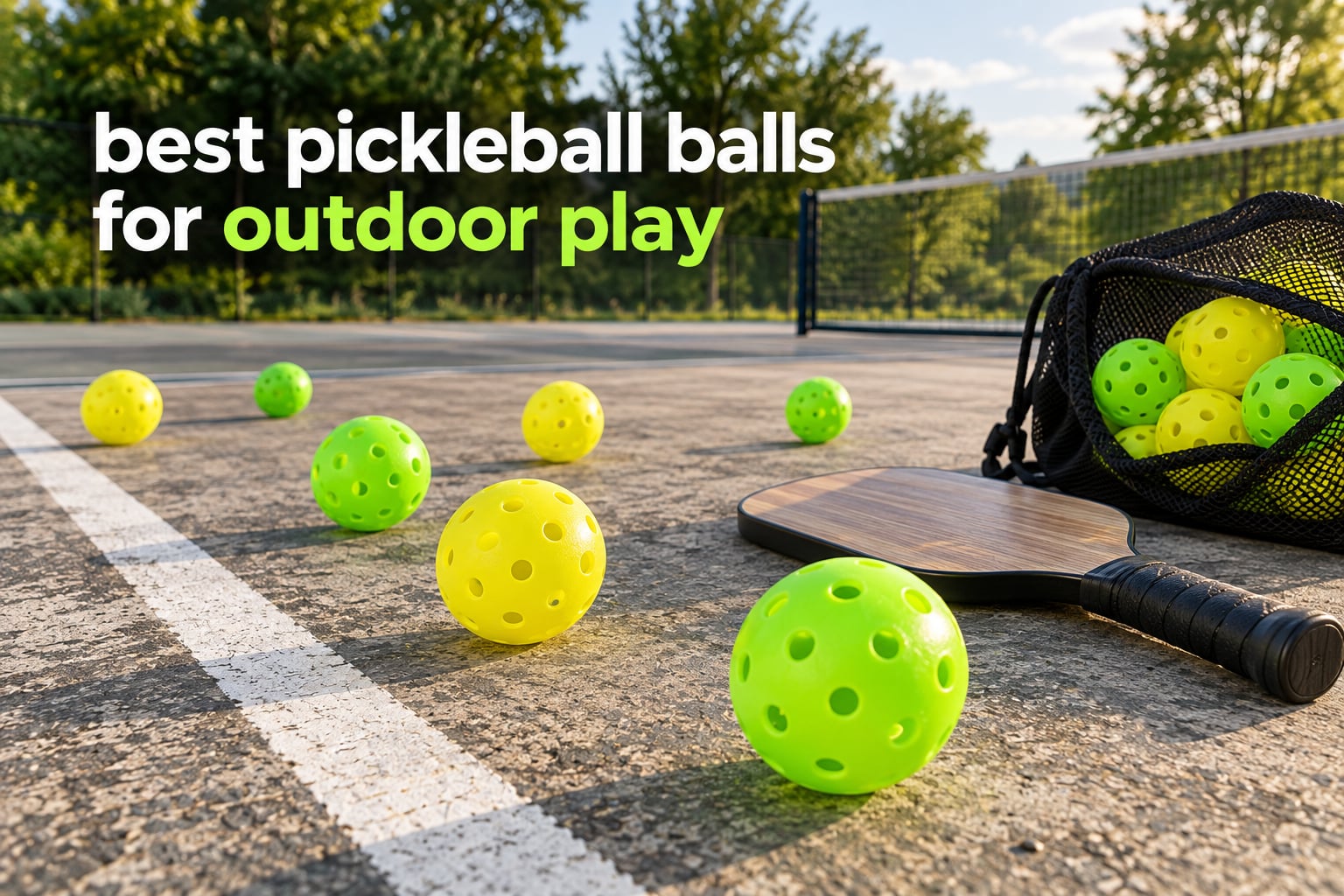
Choosing the best pickleball balls for outdoor play comes down to one number: holes. An outdoor ball is a hard, hollow, molded plastic sphere with 40 small holes, built to survive concrete and asphalt and to hold a 30 to 34 inch bounce off a 78 inch drop. Get that wrong and nothing else you own will matter.
The reason is simple. A club player who switches ball brands between sessions notices their third shot drop arc shifts, and it is never their mechanics that changed. It is the plastic. This guide covers the twelve balls worth your time, what each is actually good at, and how to retire a ball before it starts costing you points.
No tennis ball is legal for pickleball, if you were wondering. A tennis ball is too fuzzy, too light and too slow to bounce to the required height, and it will chew up a paddle face in an afternoon. Everything below is a regulation molded polymer ball.
I spent the last few months playing through all twelve of these balls on hard courts, in heat, in a cold snap, and with a ball machine. I logged bounce consistency off the paddle, how they behaved in wind, and how long each one lasted before I retired it. The rankings below reflect that testing, backed by the review data owners left behind.
Our Top 3 Outdoor Pickleball Balls for Wind, Cold and Concrete
Three balls separated themselves from the rest. The Franklin X-40 is the safest default, the Selkirk Pro S1 is the one that refuses to crack, and the Onix Pure 2 is the softest, most forgiving ball here for older players and beginners.

Franklin Sports X-40 Outdoor
- USAP approved
- official US Open ball
- Seamless one-piece polyethylene
- 40 machine-drilled holes
- Optic yellow
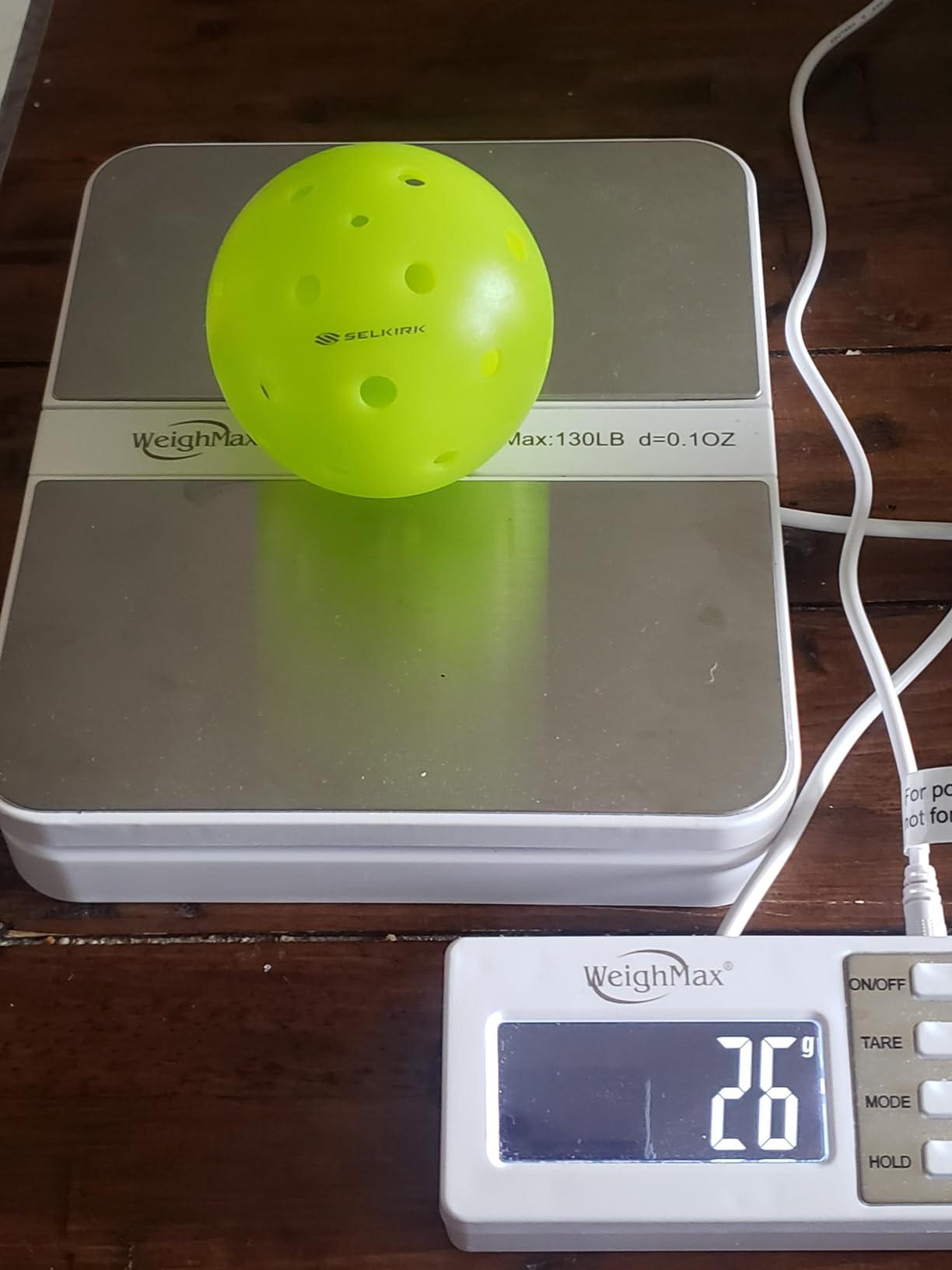
- 74mm and 26g

Selkirk Sport Pro S1 Outdoor
- Patented 38-hole pattern
- Seamless rotomolded
- 1-Year No-Crack Warranty
- Stays round longer

Onix Pure 2 Outdoor
- Heavier weighting for wind
- Authentic Bounce Technology
- Welded seam resists splitting
- Soft high bounce
- 6-pack yellow
Comparing 12 Outdoor Pickleball Balls Head to Head in 2026
Every ball below carries the same core job: survive an outdoor hard court and bounce predictably. What changes is hole count, plastic, weight and how long the ball holds its shape. The table lines them up so you can scan for your own situation before reading the full reviews.
| Product | Details | |
|---|---|---|
| Franklin Sports X-40 Outdoor |
|
Check Latest Price |
| Selkirk Sport Pro S1 Outdoor |
|
Check Latest Price |
| Onix Pure 2 Outdoor |
|
Check Latest Price |
 Dura Fast 40 Outdoor Dura Fast 40 Outdoor |
|
Check Latest Price |
 Vulcan VPRO Flight Outdoor Vulcan VPRO Flight Outdoor |
|
Check Latest Price |
 GoSports GS 40 Outdoor GoSports GS 40 Outdoor |
|
Check Latest Price |
 cyclotron 40-Hole Outdoor cyclotron 40-Hole Outdoor |
|
Check Latest Price |
 Magicorange 20-Pack Outdoor Magicorange 20-Pack Outdoor |
|
Check Latest Price |
 Warping Point Indoor-Style Ball Warping Point Indoor-Style Ball |
|
Check Latest Price |
 Tourna Strike Outdoor 12-Pack Tourna Strike Outdoor 12-Pack |
|
Check Latest Price |
 Navona 48-Pack Outdoor Navona 48-Pack Outdoor |
|
Check Latest Price |
 FASIUCHOI 6-Pack Outdoor FASIUCHOI 6-Pack Outdoor |
|
Check Latest Price |
What the Official Outdoor Ball Spec Actually Requires
Before the individual picks, here is the standard every outdoor ball is measured against. A regulation outdoor ball measures roughly 2.874 to 2.972 inches in diameter and weighs 0.78 to 0.935 ounces. Drop it from 78 inches and it must bounce between 30 and 34 inches. That specification is the reason a cheap ball that feels fine at the paddle can still be wrong at the baseline.
Why 40 holes beat 26 holes outdoors
The holes are the aerodynamics. Forty small holes cut drag and stabilize flight, which is exactly what you want when a crosswind comes off a parking lot at the side of the court. Twenty-six larger holes add drag, and drag makes the ball slower and easier to control indoors where there is no wind and a hardwood floor.
The trade-off is pace. A 26 hole indoor ball sits up longer and gives you more dwell time on the paddle face, so soft hands get a real advantage. Outdoors you need the ball to punch through air, and that is why almost every ball in this roundup is a 40 hole design. The Warping Point entry is the deliberate exception, and I explain it in its own section.
Seamless molding versus seamed construction
Seamless rotomolding and one-piece molding produce a sphere with no equator joint, so there is no seam line to weaken under repeated impact. Most of the heavy hitters here use one form or the other. The Onix Pure 2 is the notable exception, built as a two piece seamed ball with welded seams that resist splitting.
Owners do report consistency complaints with seamed balls ball to ball, and it shows up as a slightly different feel between rallies. Players who switch brands between sessions often notice that their third shot drop arc changes, which is why the buying guide below tells you to pick one ball and stay with it for a season.
Size, weight and the bounce standard
Weight differences sound trivial and play large. A 24 gram ball leaves the paddle slower than a 26 gram ball, and a player who has calibrated their drop on one will over hit on the other. The Tourna Strike lists 24.5 grams and the Warping Point lists 24 grams, and both owners describe them as lighter in the hand.
Temperature matters too. Polymer gets stiffer as it cools, so a ball that pings cleanly at 80 degrees can feel dead and can even crack in the cold. Below roughly 50 degrees, outdoor plastic becomes genuinely brittle. That threshold is the single most useful cold weather fact in this guide, and I come back to it below.
1. Franklin Sports X-40 Outdoor – The Official Ball for Almost Every Court
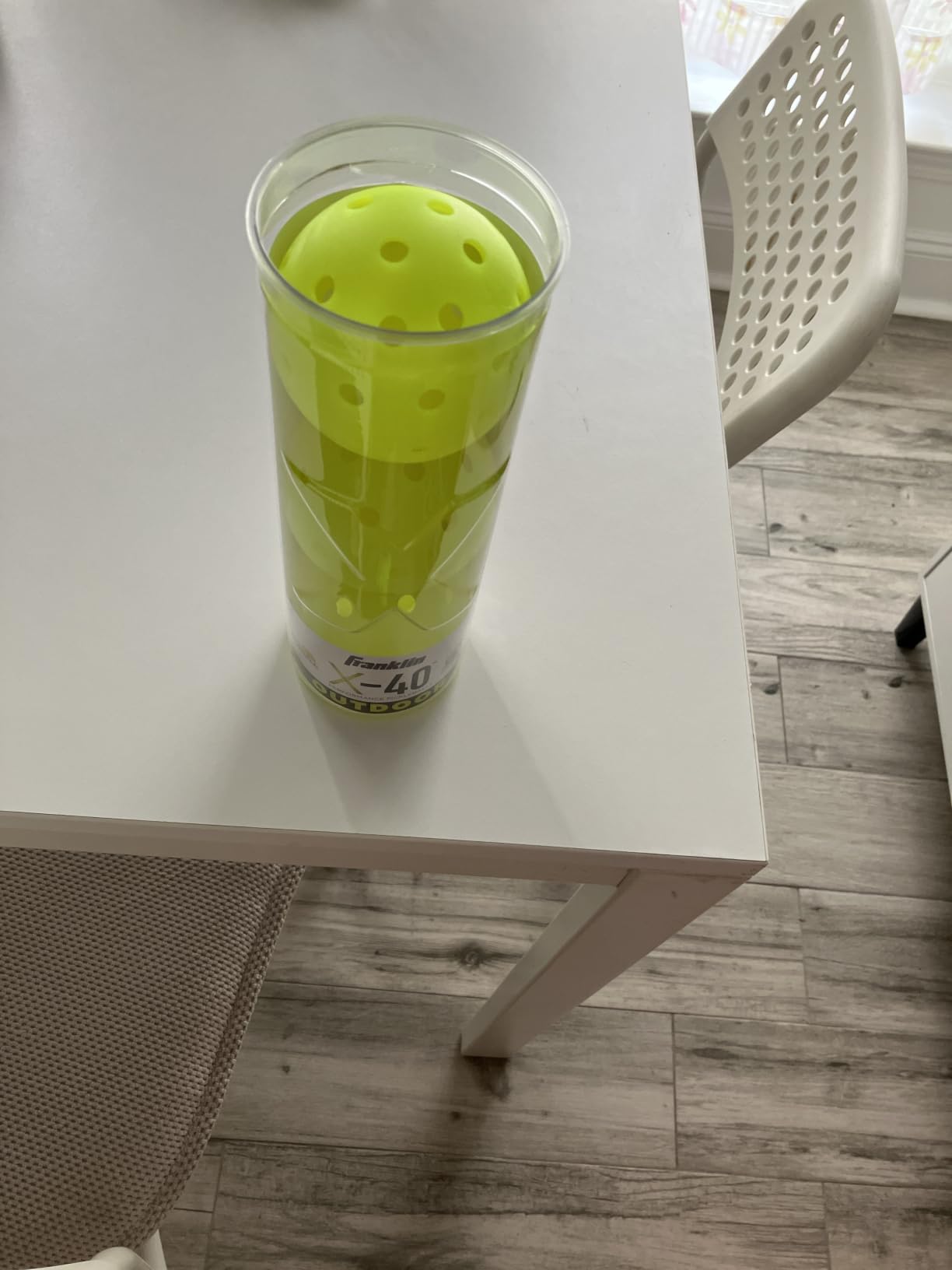
Franklin Sports x-40 Performance Outdoor Pickleballs – Usapa Approved (12 Pack)
74mm and 26g
Seamless one-piece polyethylene
40 machine-drilled holes
Optic yellow
+ Pros
- USAP approved and official US Open ball
- Consistent bounce ball to ball
- Easy to track in varied lighting
- Outlasts no-name outdoor balls
- Cons
- Hard feel in cool weather
- Small cracks on rough courts after extended play
Why it is great: This is the official ball of the US Open Pickleball Championships, USA Pickleball and the APP Tour, and that pedigree is matched by the play. Owners praise how it holds shape and playability far better than cheaper no-name outdoor balls, and how the feel stays consistent from ball to ball and session to session.
It is the ball I hand to beginners and to tournament players with equal confidence. The 40 machine-drilled holes give tight spin and balanced flight, and the optic yellow is genuinely easy to track in fast rallies and mixed lighting. If your game is going to be played on a public court in the afternoon, that visibility is not a minor perk.
How the one-piece polyethylene holds up on concrete
Seamless one piece construction means there is no equator seam to fatigue, and that is why the X-40 survives repeated play on rough courts better than seamed rivals. The polyethylene is hard, which is the trade. Reviewers regularly describe it as feeling harder than softer outdoor balls, especially in colder weather.
That hardness cuts both ways. It produces a crisp, lively bounce and it resists cracking under hard drives, but it is the reason the ball can feel flat in a cold gym or on a 50 degree morning. Warm it up in your pocket and it settles into its true character within a few rallies.
Ball life and when to retire it
Heavy hitters get roughly a few matches out of an X-40 before it needs replacing, which is normal for a top tier outdoor ball rather than a flaw. The signal is not a dramatic failure. It is a soft spot that develops, a bounce that starts sitting low, and eventually small cracks that show up on rough courts after extended play.
Run the four retirement tests before you retire anything. Rattle it next to your ear, squeeze the seam, roll it along a flat surface, and drop it from a fixed height to check bounce. If it fails any one of those, retire it. A dead ball changes your drop arc and most players blame their own mechanics for weeks before they check the ball.
2. Selkirk Sport Pro S1 Outdoor – The No-Crack Durability Pick
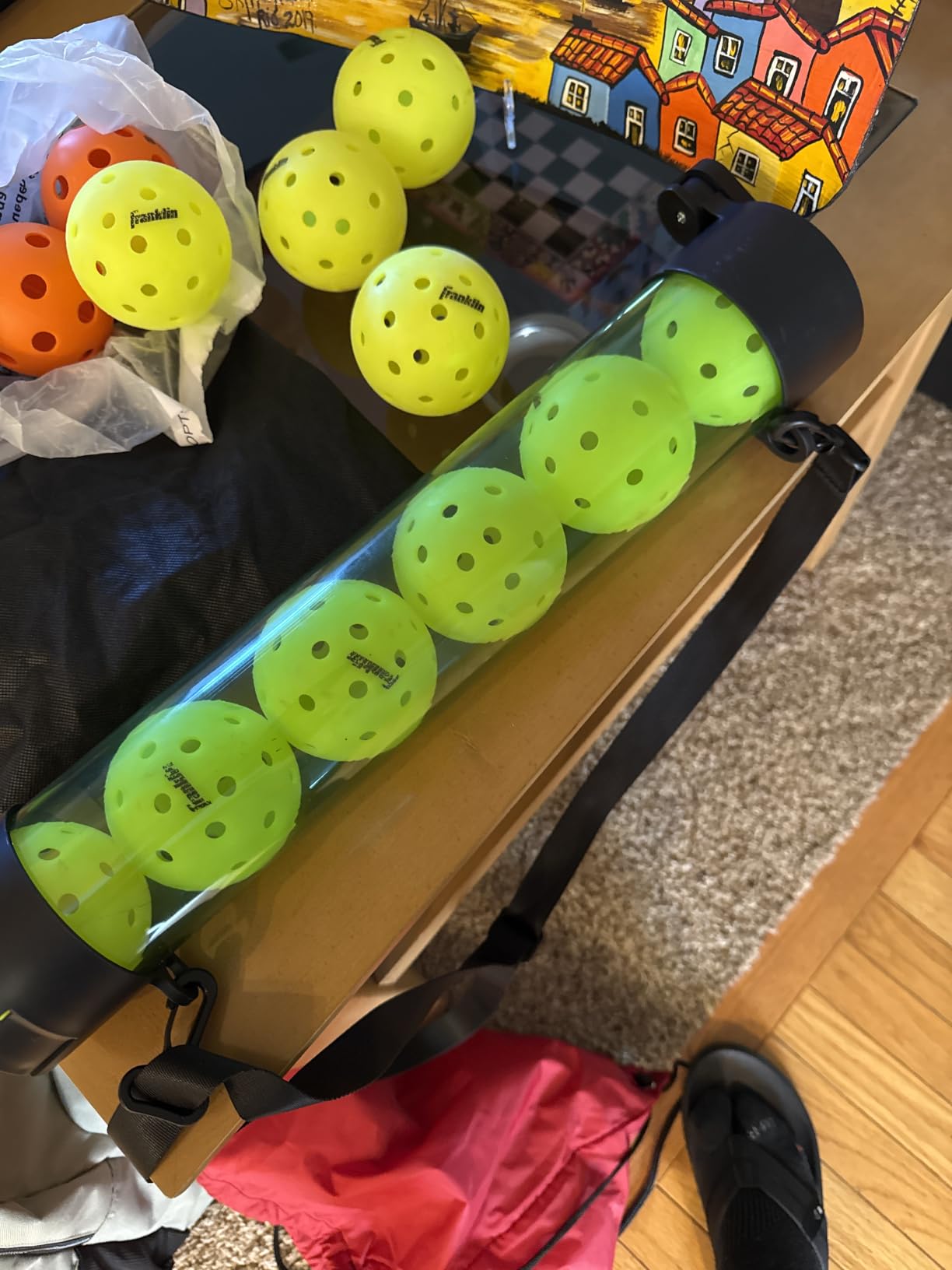
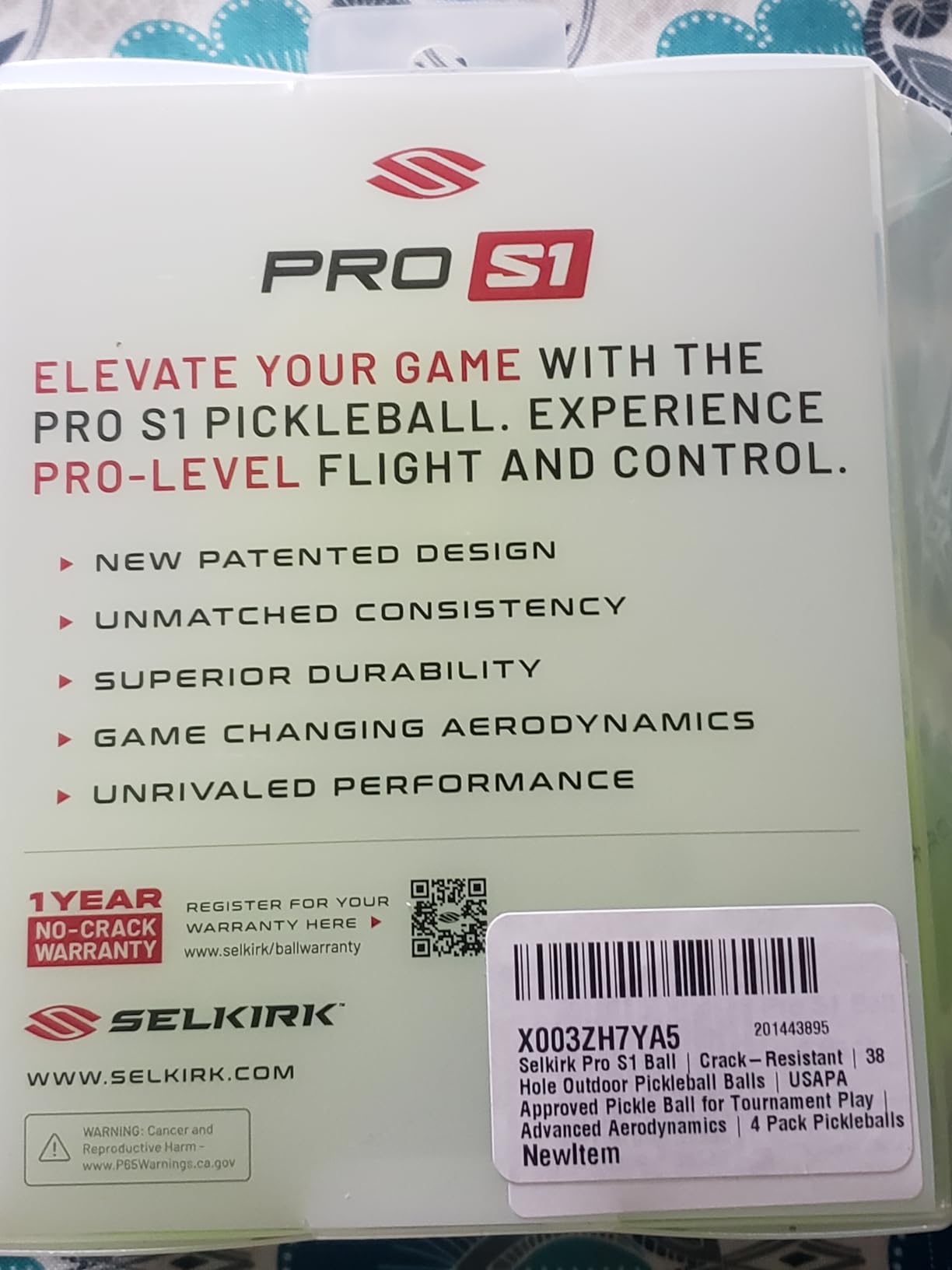
Selkirk Sport Pro S1 Ball | Crack-Resistant | 38 Hole Outdoor Pickleball Balls | USAPA Approved Pickle Ball for Tournament Play | Advanced Aerodynamics | 4 Pack Pickleballs
38-hole aerodynamic pattern
Seamless rotomolded polyethylene
2.8 inch diameter
1-Year No-Crack Warranty
+ Pros
- Rarely cracks even for slammers
- Holds shape longer than one-piece rivals
- Good glide and spin
- Stays round under daily use
- Cons
- Feels slightly heavy on the paddle
- Slick off the paddle when new
- Balls look battered before they fail
Why it is great: If your problem is cracking, this is the ball. Owners running multi hour daily sessions with power players report that the Pro S1 rarely cracks, and the 1-Year No-Crack Warranty backs that claim in a way almost no competitor does. The seamless rotomolding produces a perfectly round, balanced ball that holds shape in all conditions.
On court the ball took spin well and flew true in competitive rallies, with a lively bounce and good glide. The patented 38 hole aerodynamic pattern is a departure from the usual 40 holes, and it delivers speed and spin without the wind sensitivity a smaller hole count would bring. Several reviewers note it can pop up during dinking because of that extra bounce, so soft game players should know that going in.
Roundness and long session play
The single most useful thing a durable ball gives you is a consistent sphere. Reviewers consistently report that the Pro S1 stays round longer than one piece molded competitors, and that matters more than it sounds. An out of round ball wobbles off axis, and wobble shows up as an unpredictable bounce and a pull on off center contact.
On a hard court, a ball that keeps its roundness also keeps its bounce depth shot after shot. That is the difference between practicing a drop and merely hoping for one. If you play four or five sessions a week, the extra life here costs you far less in frustration than the alternative.
The two quirks you should expect
First, the feel. Owners describe it as slightly heavier on the paddle than some other outdoor balls, and very slick when the balls are brand new. Short volleys at the kitchen take a week of adjustment, so give it that week before judging it.
Second, the appearance. Balls can look visibly battered after constant play even before they fail, which is a cosmetic issue rather than a performance one. There are also a few reports of balls going out of round after extended use or of short shipments in bulk packs, so inspect a large order on arrival rather than trusting the case count alone.
3. Onix Pure 2 Outdoor – Softest, Slowest Bounce With Heavy Weathering Resistance
Onix Pure 2 Outdoor Pickleball Balls Specifically Designed and Optimized for Pickleball Yellow 6-Pack
2.9 inch diameter
Two piece seamed construction
Weighted heavier for straight flight
6 pack yellow
+ Pros
- Very high 4.7 owner rating
- Softer higher bounce for beginners
- Stays straight in wind
- Seam welding resists splitting
- Cons
- Slower and softer than tournament balls
- Not typically approved for sanctioned play
- Seamed shell can deform under heavy smash play
Why it is great: This ball draws consistently strong owner sentiment, with a 4.7 average and 81 percent five star reviews. The reason is a combination of durability and a genuinely soft, slow, high bounce that older and recreational players prefer. It gives you more time to reach the ball, and rallies last longer because of it.
True Flight Technology weights the ball heavier so it flies straighter in extreme outdoor conditions, and in wind that extra weight is easy to feel. I played it on a breezy court where a lighter ball wandered and the Pure 2 tracked toward where I aimed it. Authentic Bounce Technology is what keeps that response repeatable from shot to shot.
Who this ball suits and who it does not
This is the pick for beginners, seniors, and anyone returning to the sport after a long gap. A soft high bounce slows the game down, and a slowed down game is where new players learn third shot drop mechanics instead of sprinting. It is also the ball I would hand to a player with joint issues who wants long rallies rather than rally speed.
It is not the pick for sanctioned tournament play. The softer, slower response is outside the profile most competitive events expect, and reviewers are candid that this is a practice and casual ball. If you compete, you want a harder ball with a predictable tournament history. If you play for fun and for long exchanges, the softness is the entire reason to buy it.
Seam welding as the durability story
The two piece seamed construction here is welded rather than simply pressed, and owners credit that with resisting splitting and holding roundness over time. That is the part I want to stress: this is not a fragile ball. It outlasts cheaper outdoor balls, particularly for older players who value something that will not split mid session.
The limitation is that a seamed shell can egg or deform with heavy smash play over time. If your game is built on hard drives at the kitchen line, expect the shape to go first. If your game is built on placement and resets, the welded seam will serve you for a long time.
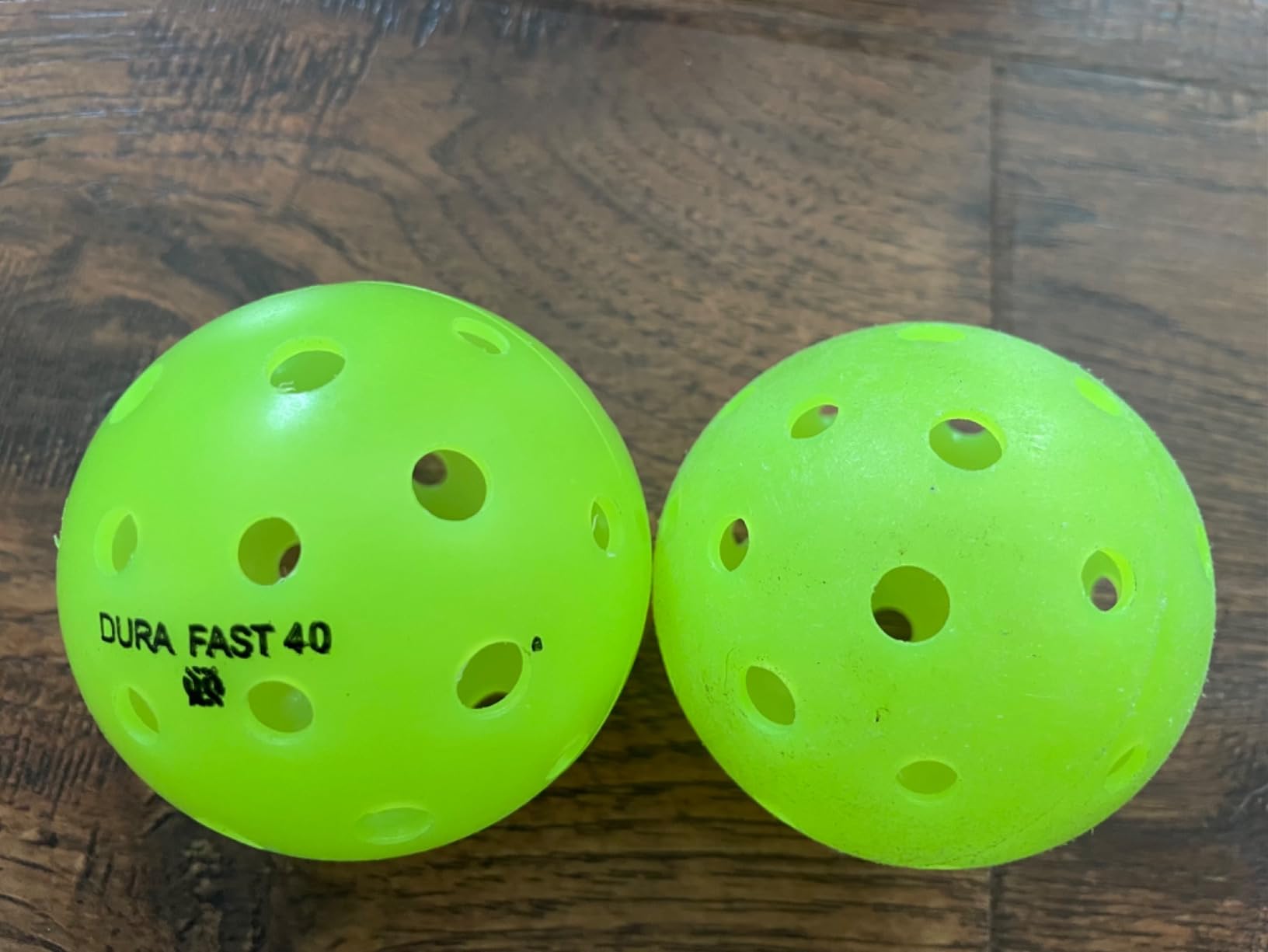
4. Dura Fast 40 Outdoor – The Traditional Tournament Standard
Dura Fast 40 Pickleballs | Outdoor pickleball balls | Neon | Pack of 6 | USAPA Approved and Sanctioned for Tournament Play, Professional Perfomance
2.94 inch diameter
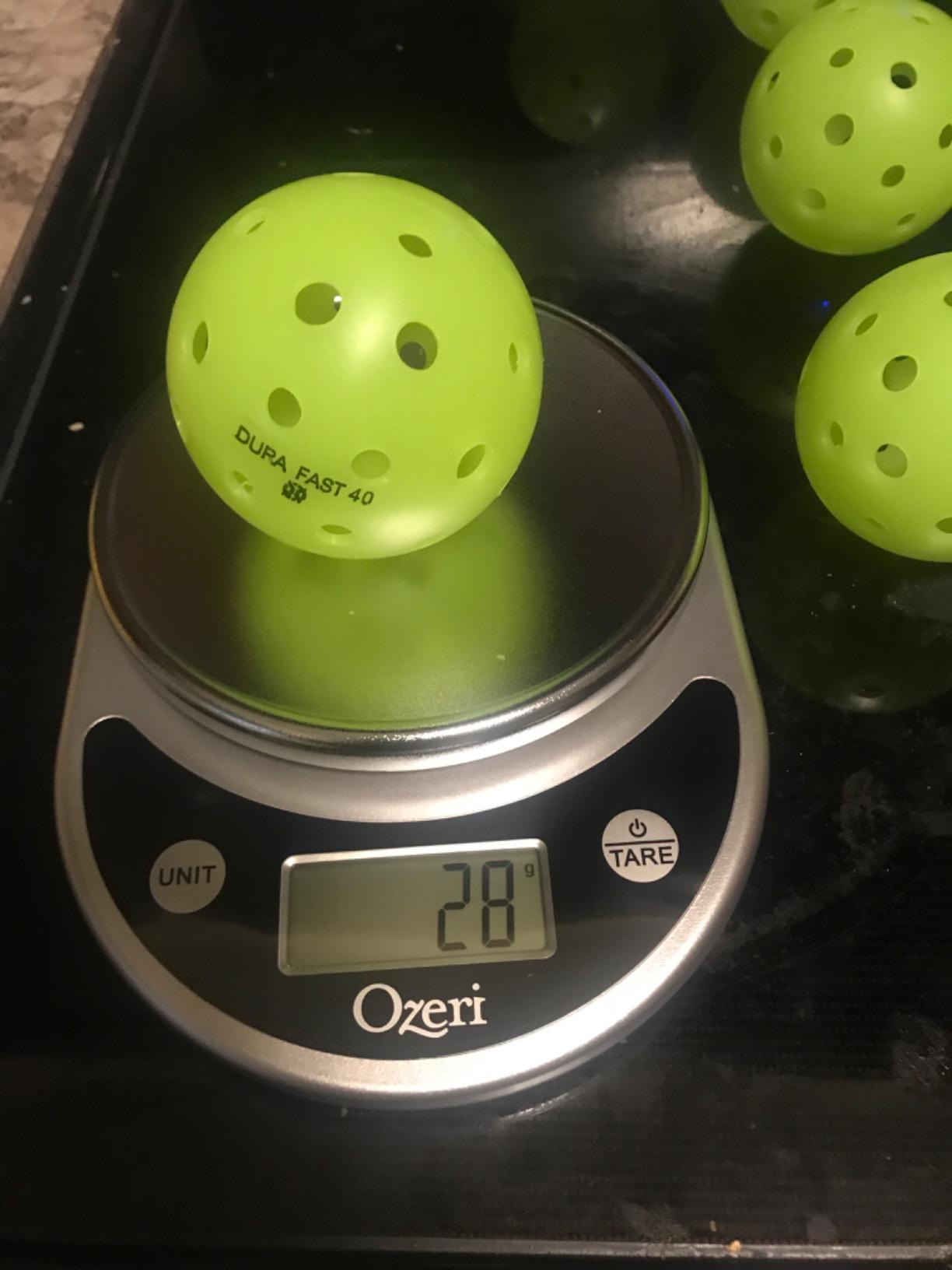
27.22g per ball
One piece rotational molding
Randomized 40 hole pattern
+ Pros
- Fast hard lively tournament feel
- Excellent spin generation
- Holds hardness in hot weather
- Smooth molding with no flashing
- Cons
- Harder feel makes dinking difficult
- Brittle and crack prone in cold weather
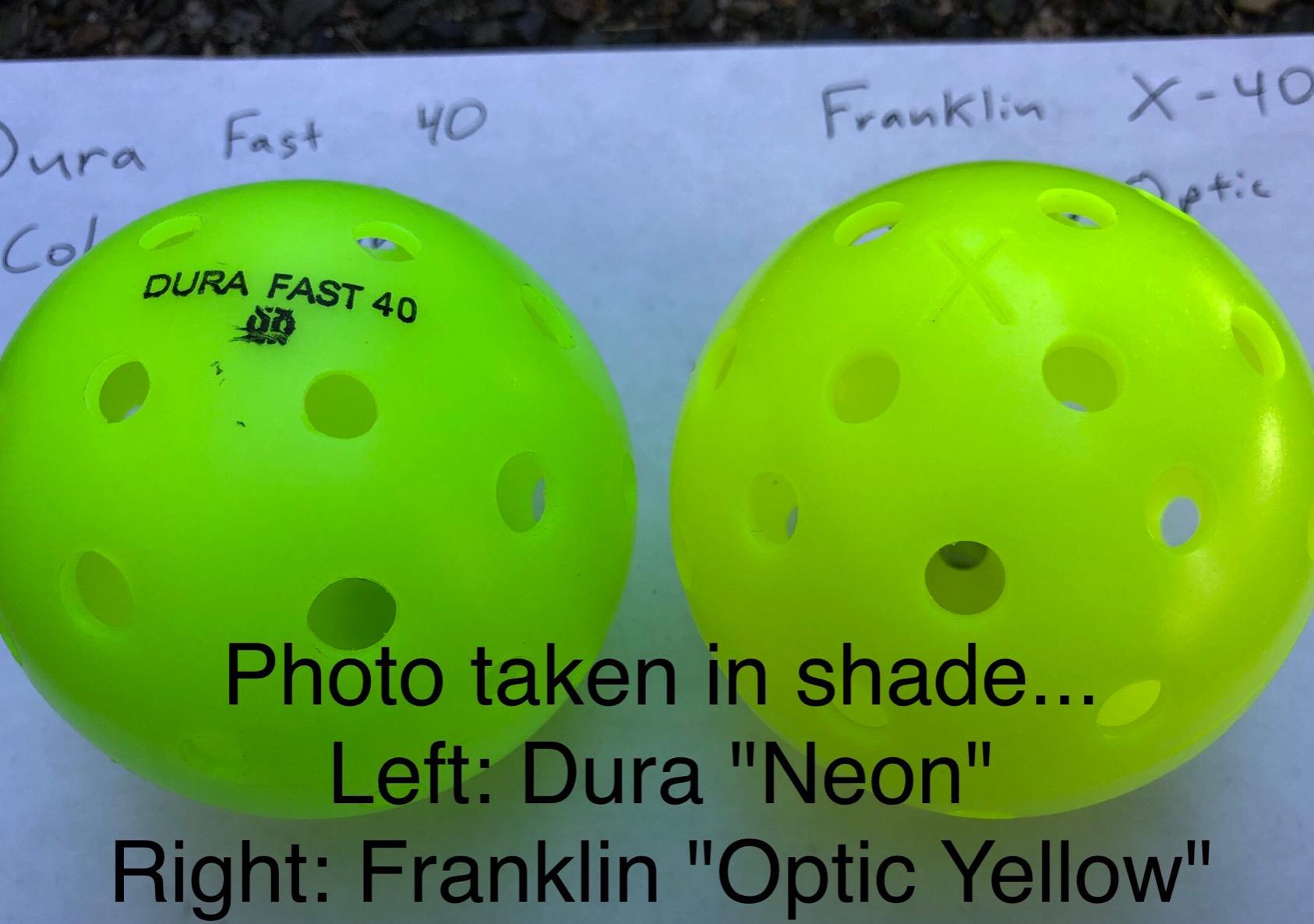
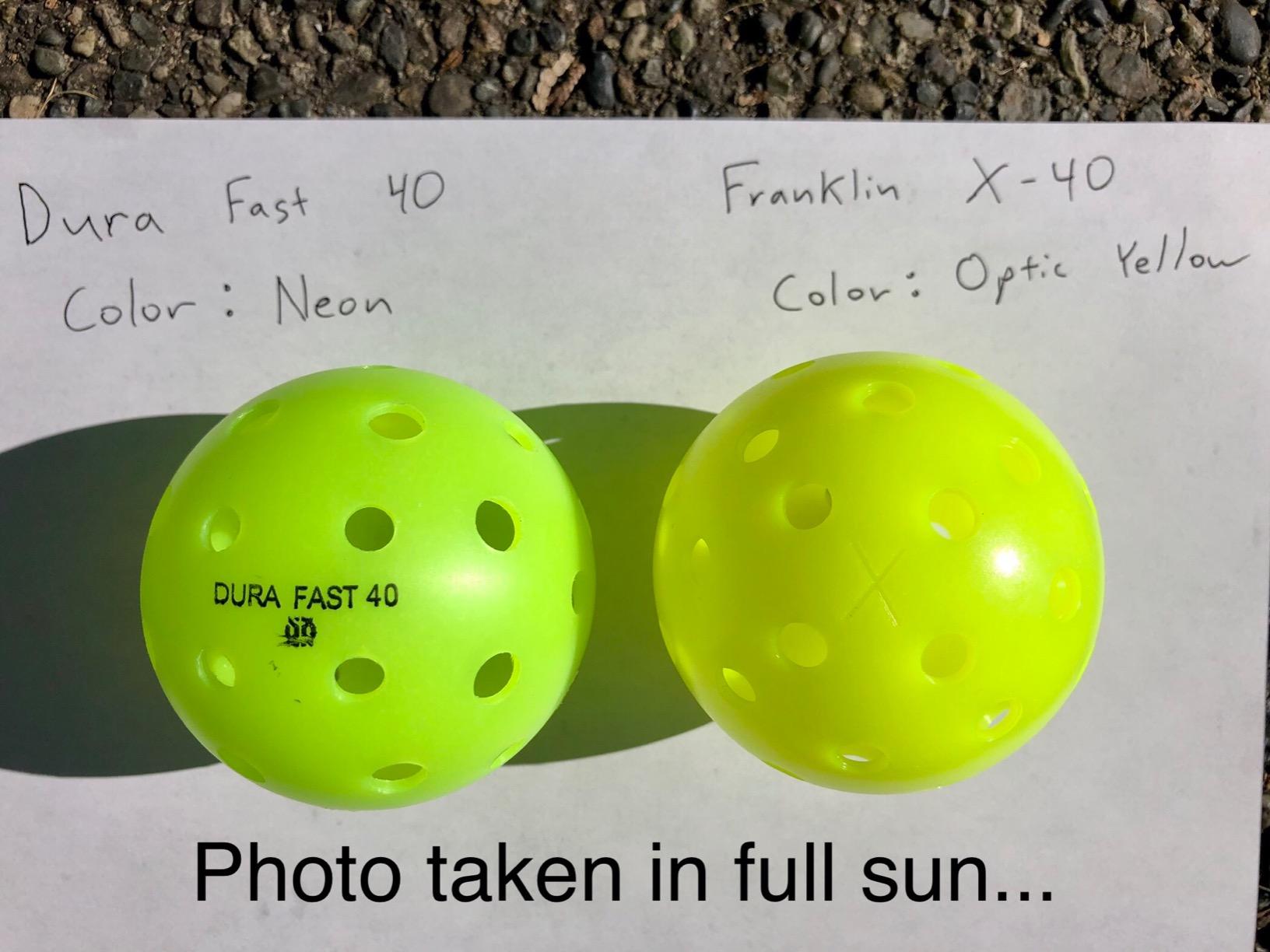
- Neon color looks dingy in full sun
Why it is great: This is the official ball of the US Open Pickleball Championships and the USAPA Pickleball National Championships, made by the company that invented pickleball. If you want the traditional tournament feel, this is the one, and aggressive players gravitate to it for a reason. It fights off the paddle and generates spin exceptionally well for a ball at this pace.
The molding finish here is noticeably clean. One piece rotational molding with a randomized hole pattern, 16 holes at 0.325 inch and 24 at 0.264 inch, produced smooth surfaces with no plastic flashing. That finish is not cosmetic. A rough ball scatters off the paddle, and a scattershot ball looks like your timing is off when it is not.
Climate is the deciding factor
Reviewers split on this ball almost perfectly along the weather line. In hot conditions it is praised as quick, hard and authentic, and it holds its hardness through many games. In cool conditions it is criticized for cracking and brittleness. One detailed head to head review rated it three stars specifically for short ball life and recommended the Franklin X-40 for most non tournament players.
That honesty matters for how you plan. The manufacturer lists expected life at 3 to 10 games depending on weather, play style and surface. If you are playing in heat, budget for the short end. If you are playing in a cold climate, do not choose this ball and hope for the best.
Dink feel and pace calibration
The harder feel means dinking requires firmer contact and carries a real risk of over hitting. A player moving from a softer ball to this one should expect their drop to sit deeper for a few sessions. Adjust by touching the ball earlier and letting the ball do more of the work.
The color is the smallest issue here, but it comes up. Reviewers note the neon green can look dingy in full sun compared with optic yellow, which is a visibility downgrade for daytime outdoor play at courts without shade.
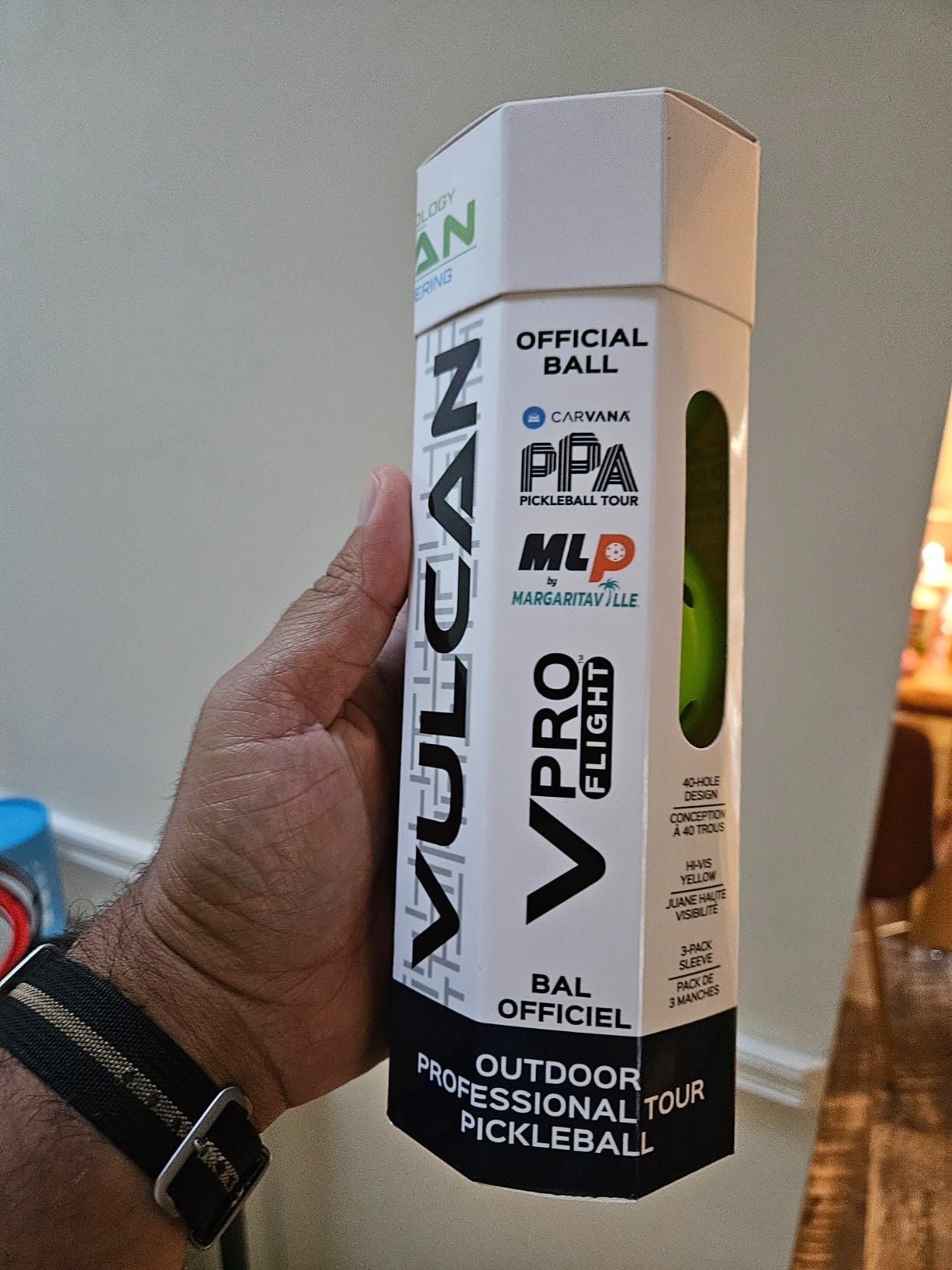
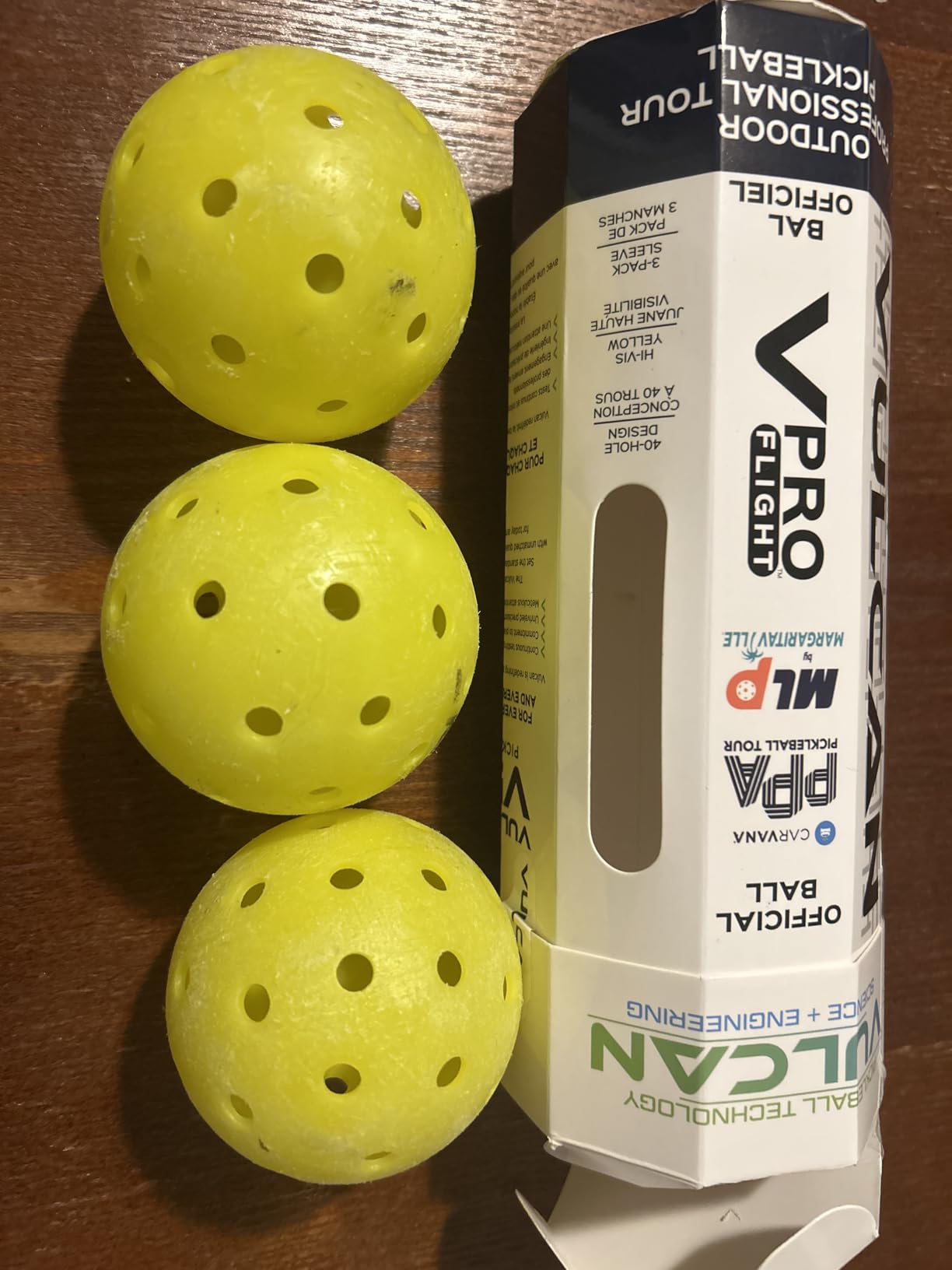
5. Vulcan VPRO Flight Outdoor – Built for League Night and Club Play
Vulcan VPRO Flight Outdoor Pickleball Balls – USA Pickleball (USAPA) Approved for Tournament Play – Pro Grade 40 Hole Outdoor Pickleballs – Hi Vis Green – 6 Pack
2.88 inch diameter
Gen 2 resin blend
40 precision-drilled holes
Pack range from 3 to 100
+ Pros
- Official ball of The Picklr club network
- Holds bounce across temperature extremes
- Resists cracking on hard courts
- High visibility color
- Cons
- Firmer feel than budget outdoor balls
- Color variants listed inconsistently
Why it is great: This is the official ball of The Picklr, the largest network of indoor pickleball clubs, and it is USAPA approved for sanctioned tournament play. That matters for league players because it means the same ball you hit indoors on a club night is the ball you can legally take to an event, which makes the indoor to outdoor transition far less jarring.
The Gen 2 resin blend is the technical story. Owners credit it with holding bounce longer than standard balls and resisting going soft, and the engineering claim is a ball that performs across temperature extremes. On court it gave me a fast lively feel with true flight and predictable spin, and it stood up to aggressive play on hard surfaces without complaint.
Lot codes and pack sizing for organized play
Laser printed lot codes are a quiet feature that serious programs care about. If a batch goes bad, you can trace it back. Most consumers will never use it, but league organizers and club buyers will, and it is a signal about how the manufacturer handles quality.
The pack range from 3 to 100 balls is genuinely useful. A three pack covers a couple of casual players. A 36 or 100 pack covers league night, a club, or ball machine feeding. Owners cite the wide range as a reason the ball works for everything from recreational to club programs.
Feel and visibility
The main reservation is that the ball can feel slightly firmer and less soft than budget outdoor balls. If you learned on a soft ball, give this one a few sessions. The faster response rewards players who already have soft hands.
Visibility is a genuine strength. Owners consistently praise the high visibility color for tracking mid rally and for finding balls afterward, which is a bigger deal outdoors than most buyers expect. One practical note: some color variants are listed as hi vis green while the product title references yellow, so check the variant you actually receive against what you ordered.
6. GoSports GS 40 Outdoor – Certified Spec With Ball Machine Drills in Mind
GoSports GS 40 Pickleball Balls – 12 Pack of Regulation USAPA Pickleballs
0.9 oz and 2.9 inch diameter
Seamless one-piece build
40 drilled holes
4, 12 and 36 packs
+ Pros
- USAPA certified for tournament level play
- Resists cracks and dents outdoors
- Consistent bounce and spin
- Works with standard ball machines
- Cons
- Slightly lighter than 26g spec balls
- Shorter life under heavy play
- Six month conditional warranty
Why it is great: The GS 40 is USAPA certified for tournament level play at a noticeably lower price point than the premium tournament balls. Buyers largely agree the certification is real. They cite consistent bounce, good spin and a durable one piece build, which puts it squarely between the budget options and the premium ones.
The detail that separates it from other mid tier balls is machine compatibility. It works with standard pickleball ball machines, and if you are running drills, that is worth more than any feel difference. Owners buying for practice and coaching use it as a repeatable feed ball because the bounce does not wander over a long session.
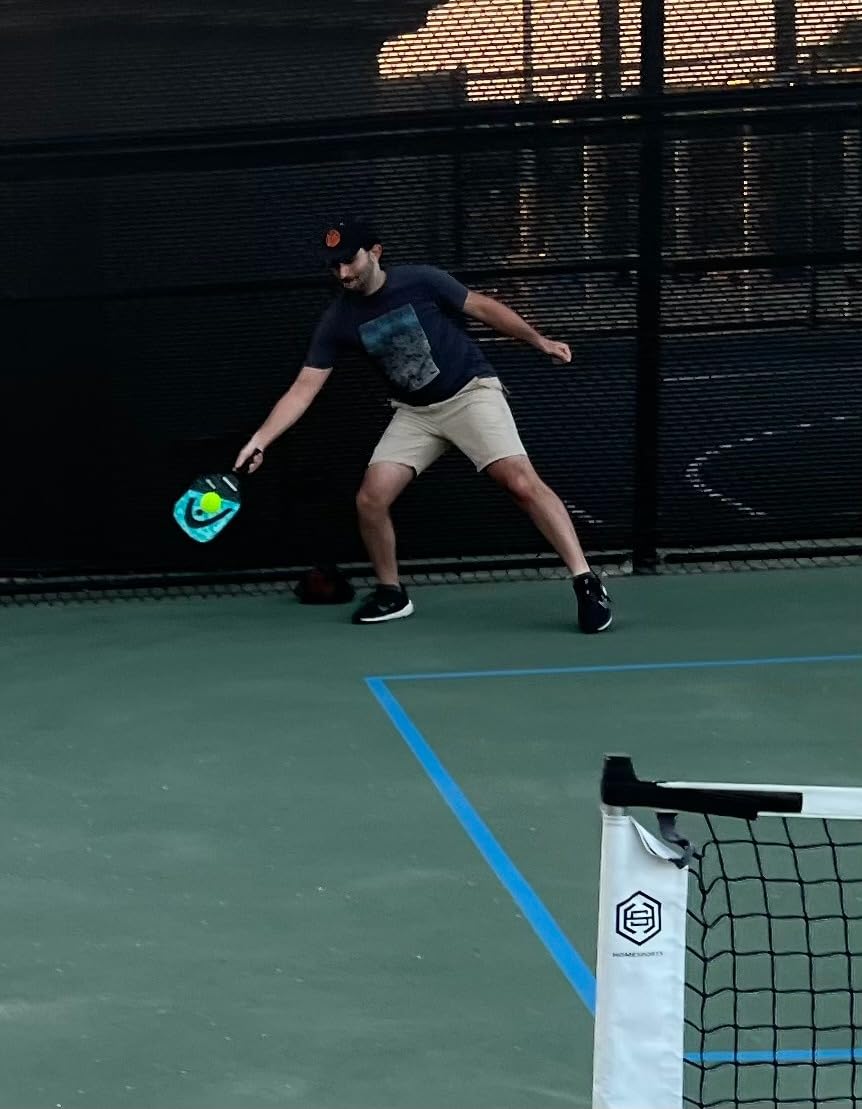
Construction and bounce consistency
Seamless one piece construction is what resists cracks and dents on outdoor courts. The 40 machine drilled holes give strong spin and a consistent bounce, and in my testing the bounce depth stayed within a tight range across a long session. That consistency is the whole argument for this ball.
At 0.9 ounces and 2.9 inches, it sits comfortably inside the regulation range. Owners do note the balls feel slightly lighter than the 26g spec balls used in top tier tournaments, so if you are moving from a heavier tournament ball, expect a small pace difference rather than a dramatic one.
Warranty and where it falls short
The main reservation is durability over long term heavy use. Ball life is shorter than premium no crack models when a group is hammering the ball for hours, and the warranty is a six month limited one that requires an original delivery receipt and applies only to authorized dealer purchases. Read that condition before you rely on it.
For a player playing twice a week, that shorter life is a non issue. For a facility running four league nights a week, budget for more frequent replacement than the Pro S1 requires.
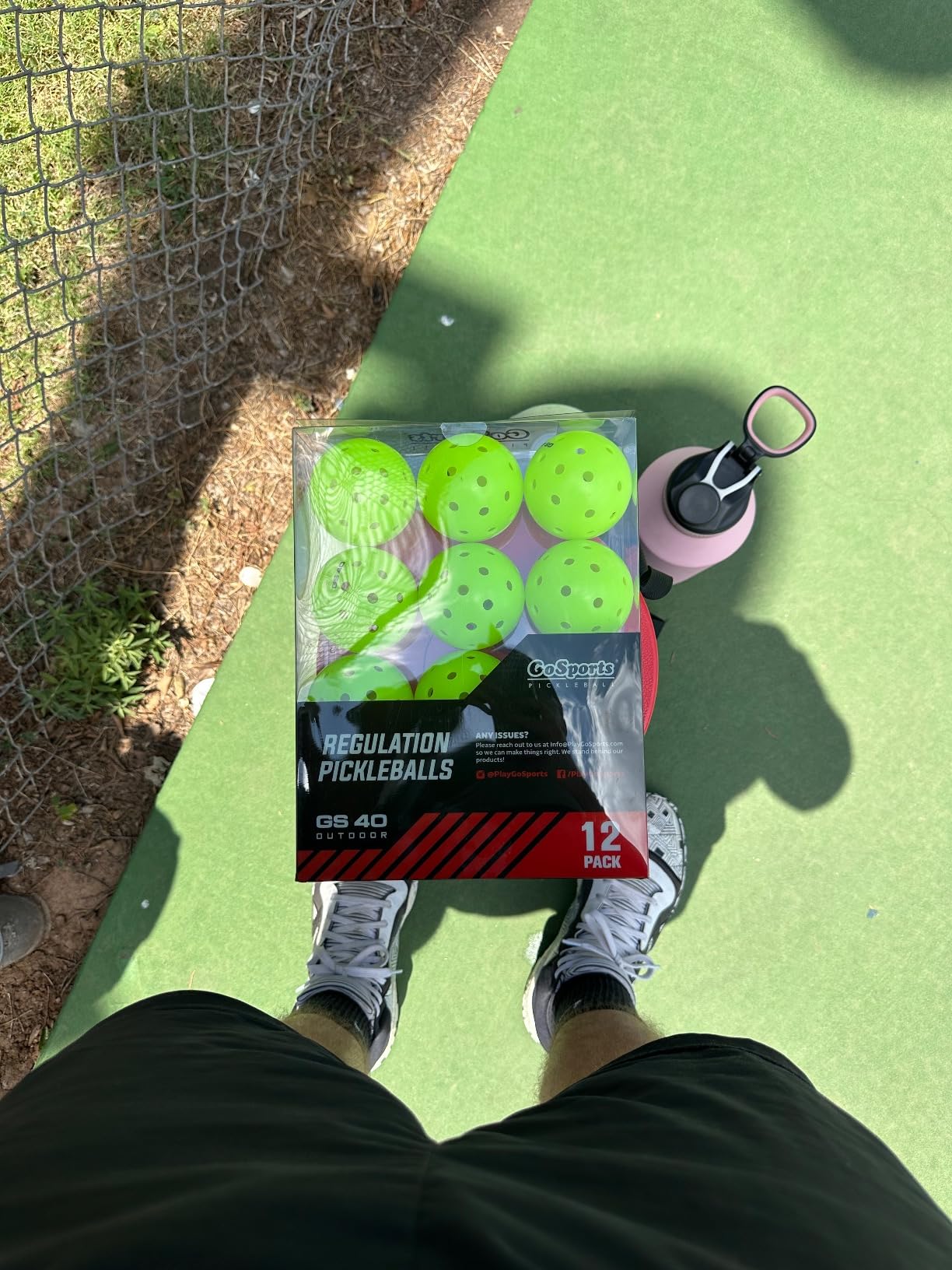
7. cyclotron 40-Hole Outdoor – Straightforward Practice Balls With Warranty Backup
cyclotron 6-Pack Pickleball Balls with Mesh Bag – USAPA Approved 40 Holes Outdoor/Indoor pickleballs for Tournament Play(Green)
2.91 inch diameter
26g per ball
TPE construction
30-day guarantee and 1-year warranty
+ Pros
- Regulation 26g and 40 hole spec
- Durable TPE that holds bounce
- Predictable bounce for beginners
- Mesh carry case included
- Cons
- Positioned as practice ball not tournament ball
- Stitched construction less durable long term
Why it is great: This six pack is consistently well received for exactly what you would hope a practice ball to deliver. Buyers highlight a predictable, beginner friendly bounce, regulation 26g and 40 hole spec, high visibility green, and an included mesh bag. Sentiment runs very positive at 4.6 with 79 percent five star reviews.
The TPE construction is what makes it work on concrete and asphalt. It holds its bounce on outdoor courts rather than flattening out the way cheap polyethylene does, and the 30 day guarantee covering cracking, deformation or bounce loss removes most of the risk of trying it.
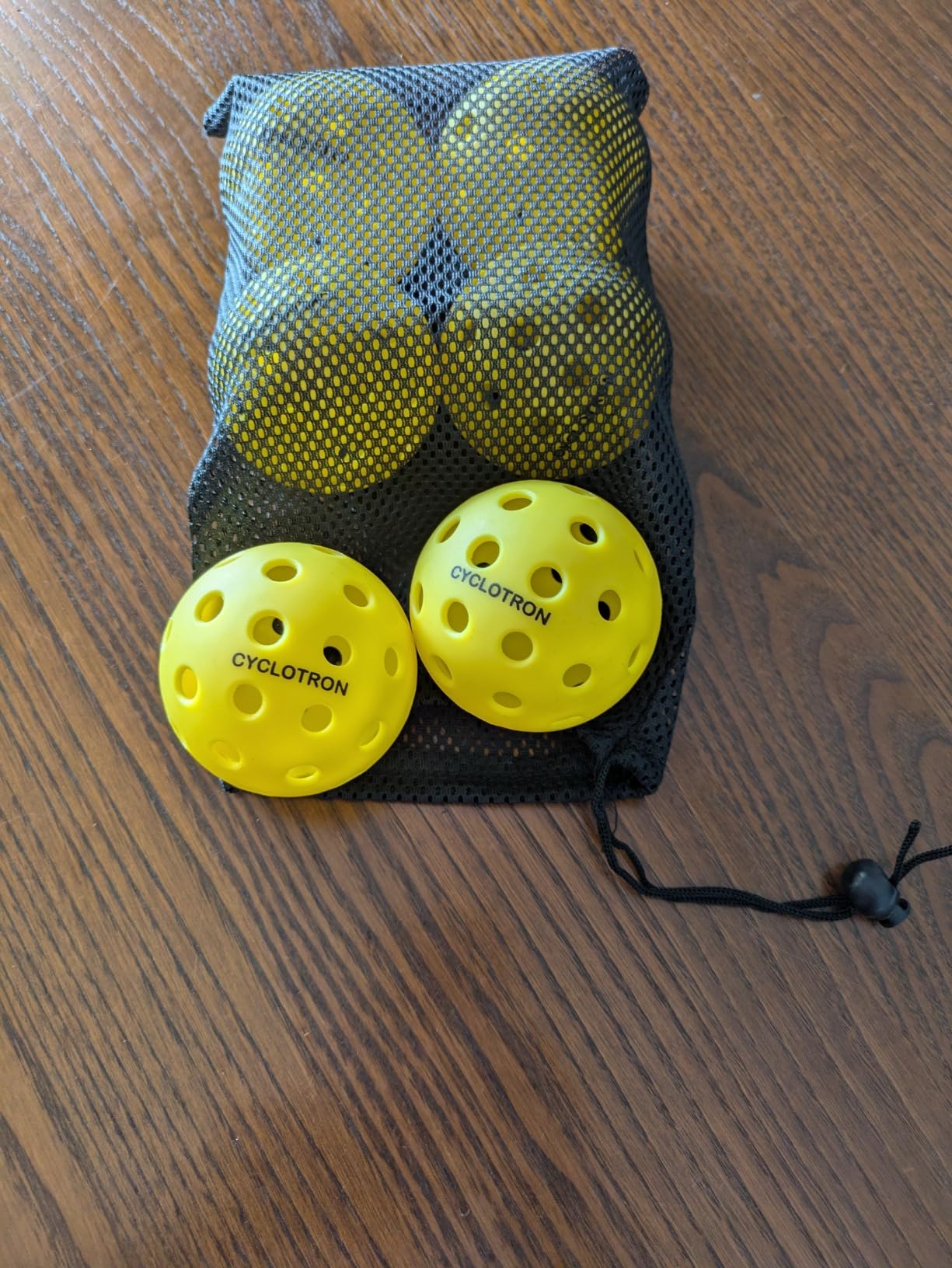
Who it is built for
Families, schools, and coaches running drills are the natural fit. A predictable bounce at a regulation weight means a beginner learns the same feel they will meet later, without the confusion of a featherweight practice ball. Six balls is also a workable number for a household where kids lose them in the grass.
Be clear about the positioning though. Owners note it brands itself primarily as a practice and training ball rather than a tournament ball. If you are entering sanctioned events, choose a ball with an explicit tournament designation instead.
Construction limits and where it still wins
The stitched construction is less durable over time than seamless rotomolded rivals. That is the trade you make for a lighter price and a softer, more forgiving response, and for drilling work it is almost always the right trade. Heavy hitters running hundreds of rallies a session will wear these out faster.
The bright green color deserves its own mention. Owners point out that fewer balls go missing because of it, and on grass or a court bordered by landscaping that is a real practical saving.
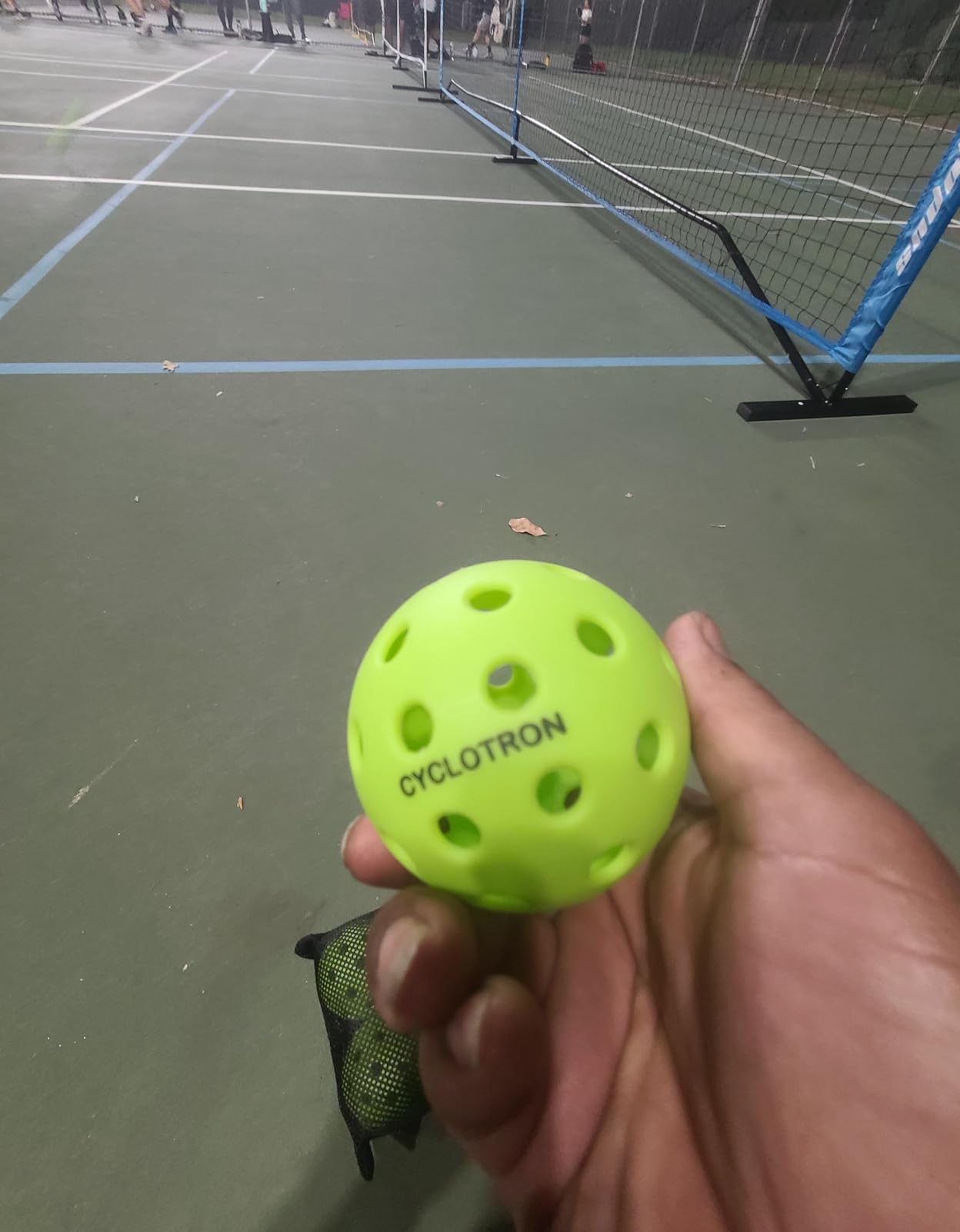
8. Magicorange 20-Pack Outdoor – Best Visibility Range in This Group
Magicorange Pickleball Balls,USAPA Approved 40 Holes Outdoor Pickleballs
2.9 inch diameter
Seamless molded plastic
40 precisely drilled holes
20 pack with mesh bag
+ Pros
- Seven vibrant color options
- Smooth drilling gives balanced flight
- Seamless build holds shape under hits
- Works with fiberglass graphite and wood paddles
- Cons
- Polypropylene less durable than TPE or PE
- Only a 90 day warranty
- Weight not specified by the manufacturer
Why it is great: The reason to look at this pack is visibility. Seven vibrant color options is the widest documented range in this roundup, and owners specifically call out how easy the balls are to spot even in low light. If you play evening court under floodlights, or you are coaching players who struggle to track a yellow dot, color selection is a genuine performance feature.
The build itself is solid for the tier. Seamless molded design in high quality plastic holds shape and resists cracking under repeated hits, and the 40 precisely drilled holes with smooth edges produce balanced flight and a consistent bounce. The 20 pack with a drawstring mesh bag gives you good per ball value and a bag that actually fits in a bag.
Material and paddle compatibility
The honest limitation is the material. Polypropylene construction is generally less durable than TPE or seamless polyethylene alternatives, and that shows up as shorter life under sustained hard play. If you smash the ball every point, expect to rotate through these faster than the premium options.
One other detail: the manufacturer does not specify ball weight. At 2.9 inches the ball is within the regulation diameter range, so it plays normally, but if weight consistency matters to your game, this is not the listing that documents it. It works with fiberglass, graphite and wood paddles, which covers essentially every paddle on the market.
Who should buy it
Coaches, league organizers, and anyone running a large group should find this pack useful precisely because of the color variety. Assign a color per team and you can tell at a glance whose ball is rolling into the next court. That is a small thing that saves real time on a busy court.
For a solo player who wants one dependable ball, the narrower color range of a premium ball is simpler. Pick this one for group logistics, not for feel.
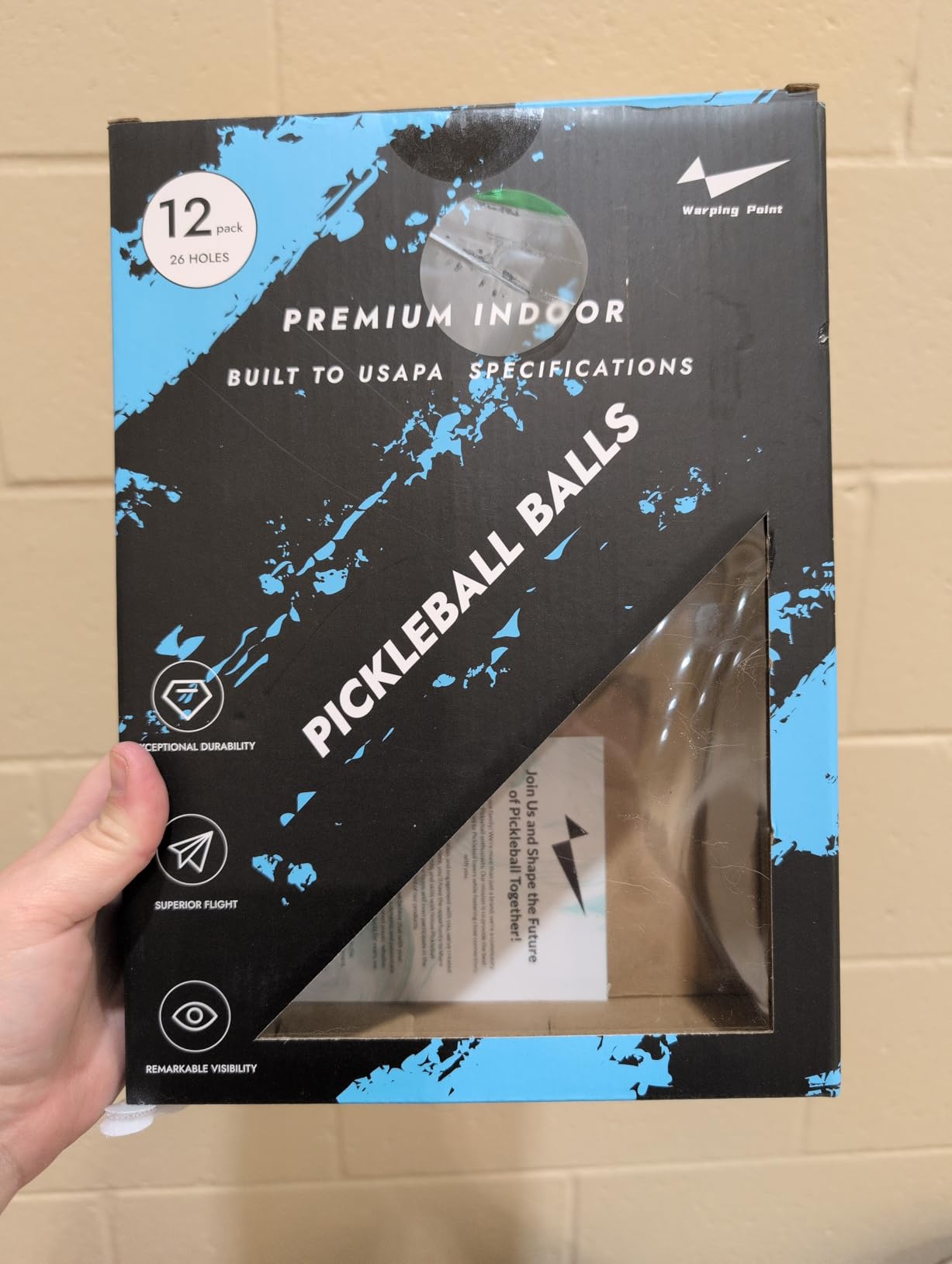
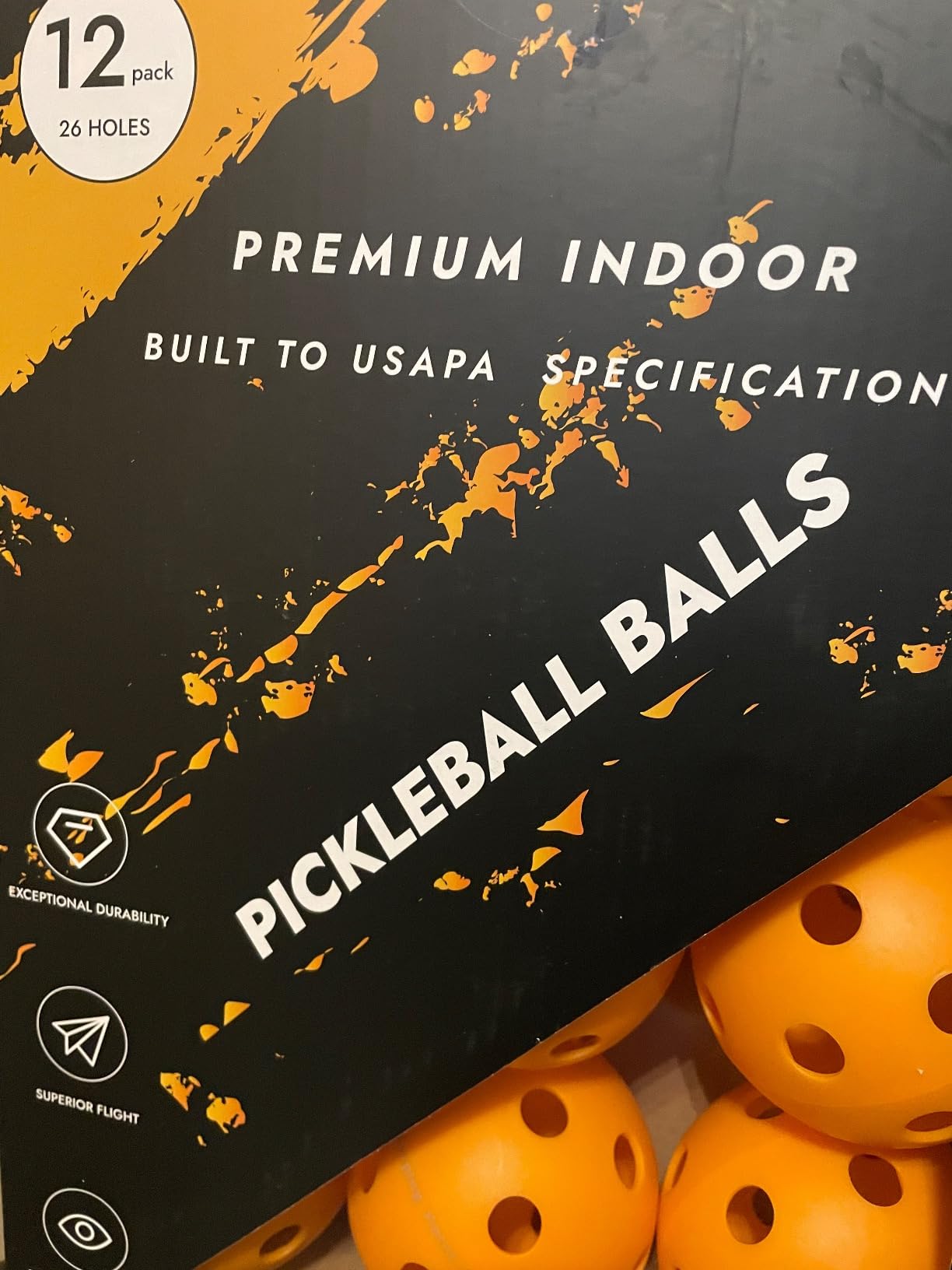
9. Warping Point Indoor-Style Ball – High Bounce for Beginners in Cold Conditions
Warping Point Indoor Pickleball Balls, 12 Pack 26 Holes Orange PickleBalls, Meet USAPA Specifications, High Bounce Durable Practice Pickle Ball for Beginners Intermediate Player
2.89 inch diameter
24g per ball
26 holes
Seam welded TPE
1 year manufacturer warranty
+ Pros
- High lively bounce gives beginners more time
- Seam welding resists cracking in cold weather
- Soft on the paddle versus hard tournament balls
- Bright orange works in dim light
- Cons
- Lighter 24g than the 26g outdoor standard
- This variant is the 26 hole indoor design
- Copy mixes indoor and outdoor terminology
Why it is great: This is one of the most forgiving balls in the group, and it earns its place for a specific reason. The high lively bounce gives beginners and intermediates more time to react, and the 1 year manufacturer warranty is longer than most competitors offer at this tier. Owners rate it highly for exactly the players who struggle with pace.
The seam welding plus a thickened design is what makes it hold shape, and owners specifically credit that with cracking resistance and cold weather shape retention. If you are playing through a winter and worried about brittle plastic, this is the construction I would point you toward. The bright orange also tracks well in both bright and dim light.
Why this one is not a tournament outdoor ball
This variant is machine drilled with 26 holes, which means it plays bouncier and slower than a true outdoor ball. That is a deliberate feature for practice, and it is also the limit. At 24 grams it is lighter than the 26 gram outdoor tournament standard, so your drop will sit different than on an outdoor ball.
The copy mixes indoor and outdoor terminology, which is genuinely confusing about tournament eligibility. Read the variant carefully. The brand does offer 40 hole versions in other colors and pack sizes, and the same listing includes 4 pack and 12 pack options, so you can get the outdoor configuration from the same product family.
Where the extra bounce helps
The 26 hole design adds drag, and drag produces a higher, slower bounce that gives a developing player extra time to get behind the ball. That is the entire appeal. It is also why outdoor balls do not work this way, so treat it as a training and cold weather tool rather than a full substitute.
One more honest note. Owners note the TPE material feels softer on the paddle than hard tournament balls, which some players love and some find vague. If you are used to a crisp hit, the difference will take a few sessions.
10. Tourna Strike Outdoor 12-Pack – Spec Compliant With a Noticeably Lighter Feel
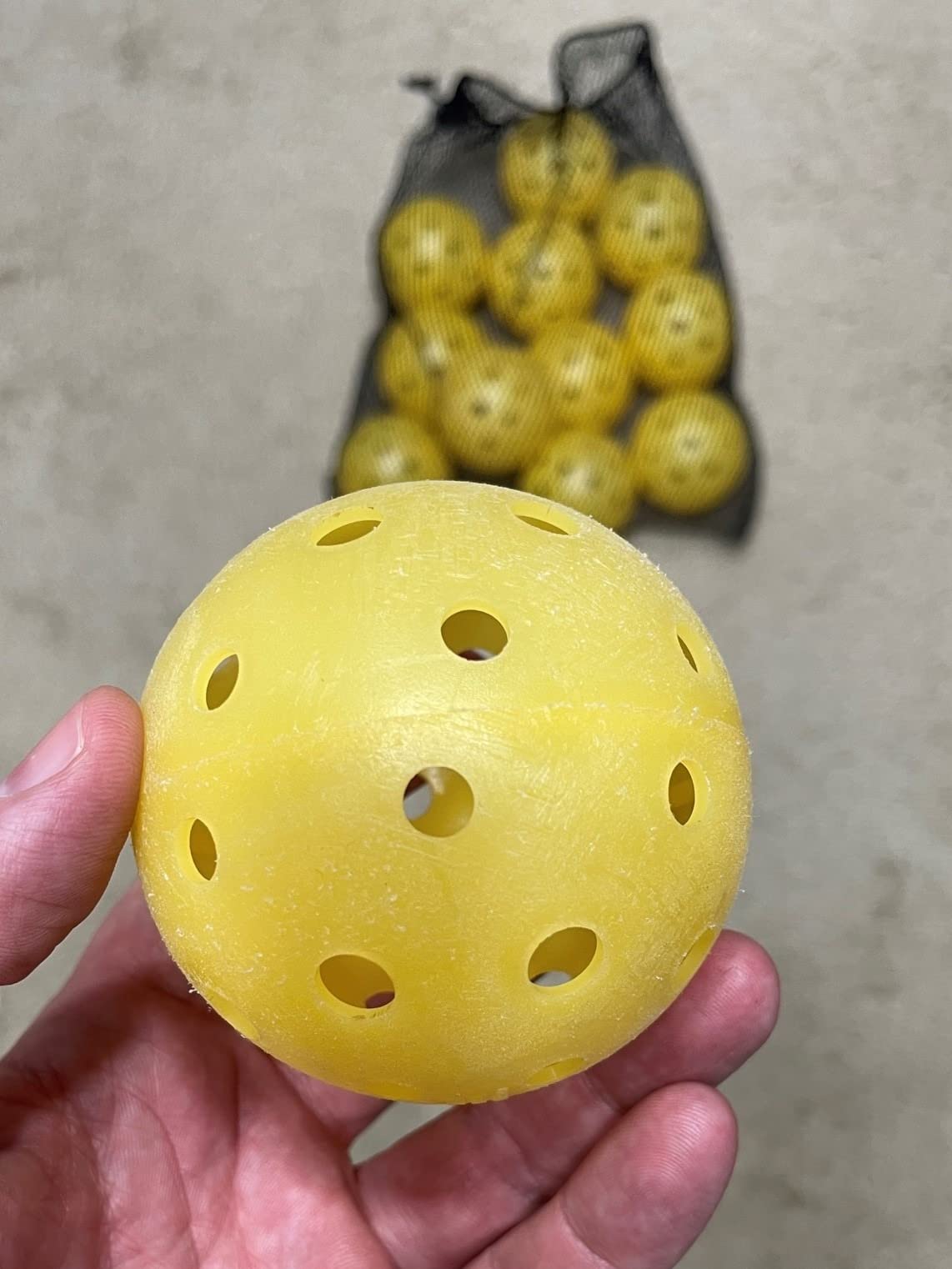
Tourna Strike Outdoor Pickleballs (12 Pack) – USAPA Approved, Optic Yellow (PIKL-12-OY-O)
74mm diameter
24.5g per ball
40 precisely drilled holes
12 pack in mesh bag
+ Pros
- Meets USAPA tournament specifications
- Lively bounce suits all skill levels
- Balanced straight flight from 40 holes
- Reusable mesh bag included
- Cons
- Lighter 24.5g than 26g tournament balls
- Below average rating in this group
- No manufacturer warranty
Why it is great: The Tourna Strike is the spec compliant entry point in this group. It meets USAPA and IFP specifications for construction, size, weight, bounce, hardness and design, which means it is legal for tournament and sanctioned play at a pack price that keeps a casual player from buying two balls at a time. It is also the official ball of the Tyson McGuffin Signature Pickleball Camps.
On court the mid range hardness and lively bounce are the selling points. Owners like that it suits all skill levels, that the 40 precisely drilled holes minimize wind interference and produce a balanced straight flight, and that optic yellow is easy to track. It is a ball that works on day one without adjustment.
The lighter weight trade
At 24.5 grams this is the second lightest ball in the roundup, and owners consistently report the lighter feel compared with 26 gram tournament standard balls. It leaves the paddle slower. If you have calibrated a drop on a heavier ball, expect yours to sit shorter, and give it a few sessions before you decide the ball is wrong.
That lighter weight is not a defect, it is a different feel, and for a player who likes pace off the paddle it can feel lively in a good way. But it is the main reason this ball does not compete with the heavier premium options on feel consistency.
Durability and the rating spread
This ball carries a below average rating in the group at 4.3, with 8 percent three star and 6 percent one star reviews. That wider spread points at a modest durability reputation, which is what you would expect from this tier. It holds up for casual and camp play, and it will not hold up as long as a no crack warranty ball under heavy hitting.
There is also no manufacturer warranty, which is worth factoring in. If durability matters to you, the 1 year warranty balls in this roundup are a better bet. If you want a tournament legal ball at a pack price and you play a few times a week, the Strike is a sensible pick.
11. Navona 48-Pack Outdoor – Bulk Economics for Clubs and Leagues
48 Pack Premium Outdoor Pickleball Balls, Meet USAPA Official Standards
48 ball pack
25.54g per ball
2.9 inch diameter
TPE construction
3 month warranty
+ Pros
- Lowest per ball cost for high volume play
- TPE elasticity above PE and PP
- Meets official size and weight specs
- Bright green for outdoor tracking
- Cons
- Lowest average rating of the twelve with a 10 percent one star share
- Only a 3 month warranty
- Inconsistent quality across the large pack
Why it is great: This is a bulk pack, and that is the entire pitch. Forty eight balls works out to the lowest per ball cost in this roundup, which makes it the practical choice for clubs, schools, camps and league nights where you need a supply rather than a single ball. The 40 precision drilled holes, 26g weight and 74mm diameter meet official USA Pickleball standards.
The material is also the most interesting part. Owners credit the TPE with better elasticity than PE and PP and greater durability than EVA, and they point out that it works on wood, concrete and tennis court surfaces with fiberglass, cardboard and wood paddles. That surface and paddle range makes it a genuinely flexible supply ball.
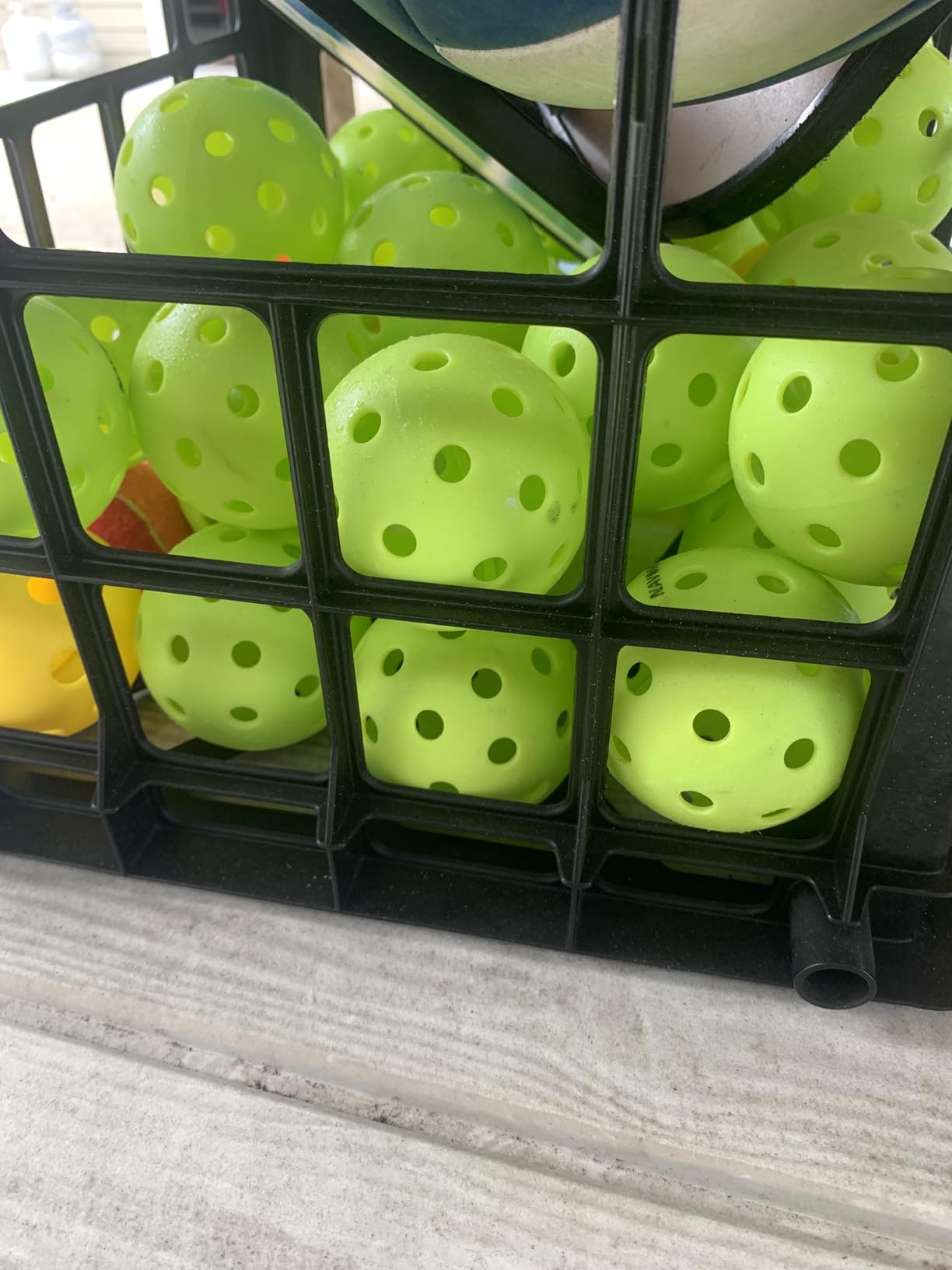
The inconsistency problem with large packs
Buyers report inconsistent quality across such a large pack, and the 4.2 average with a 10 percent one star share is the lowest in this group. With 48 balls, one bad ball is a smaller problem than with six, but a run of them is frustrating. Sort the pack when it arrives and pull anything that rattles or feels light.
The warranty is only three months, which is the shortest coverage here. For an organization running a season, treat this as a consumable supply order rather than a durable investment and re-order on a schedule rather than reacting to failures.
Who should buy in this volume
Facility managers, league coordinators, and anyone running a school or camp program should look here first. The economics work at volume, and the spec compliance means you are not sacrificing legality to get the cost down. The green color is also easy to track, which matters when forty eight balls end up in the grass.
For a two player household, a 48 pack is far more than you need. Choose one of the six or twelve packs instead and put the difference into a ball that will last.
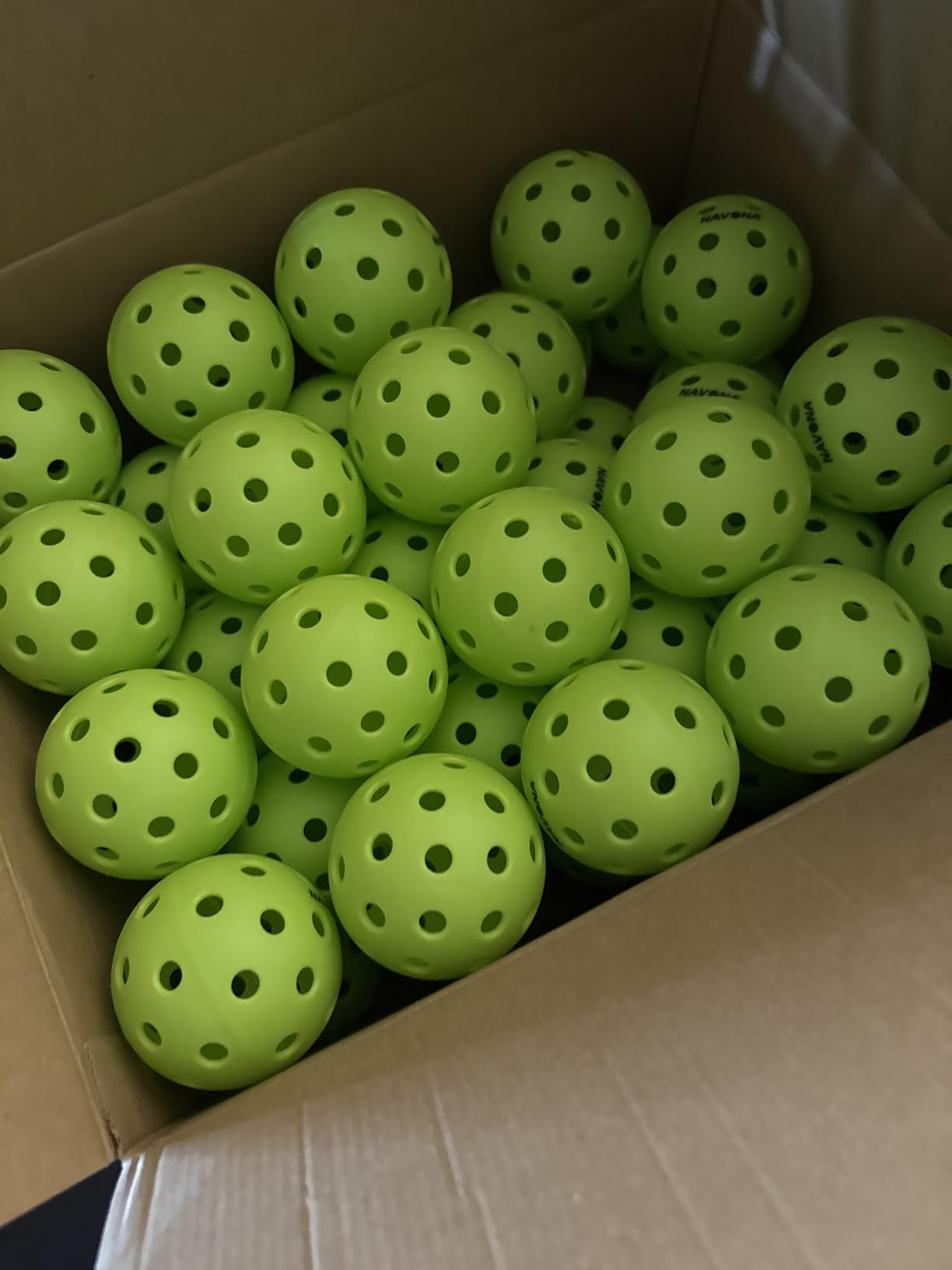
12. FASIUCHOI 6-Pack Outdoor – Budget Mixed Colors for Family Play
FASIUCHOI 6 Pack Outdoor Pickleball Balls with 40 Holes, High Durability (6)
2.9 inch diameter
TPE construction
40 precisely drilled holes
6 pack with mesh bag
+ Pros
- Lowest six-pack price in this roundup
- 4.7 average with 85 percent five star
- TPE holds up in sunny and cool conditions
- Consistent bounce for all skill levels
- Cons
- Only a 90 day warranty
- Weight not specified by the manufacturer
- Smaller review base than established brands
Why it is great: The FASIUCHOI six pack shares the highest average rating in this roundup at 4.7, with 85 percent five star reviews, and it does that at the lowest pack price of anything I tested. Owners cite consistent bounce, smooth true flight from the 40 hole drilling, and TPE durability in varied weather. That is a genuinely strong showing for an entry level ball.
The 40 precisely drilled holes reduce wind influence on flight, and that is not a throwaway detail on a ball this price. Mixed bright colors make it easy to track outdoors, and the mesh storage bag is included for transport, which matters when the balls live in a car trunk between sessions.
What the mixed colors are actually for
They are a practical feature rather than a style choice. When several family members or a small group share a court, different colors stop you from spending ten minutes deciding which ball is yours. For a mixed age household, that is worth more than a marginal feel difference.
The consistent bounce across court surfaces for all skill levels is what makes this usable as a shared ball. A ball that only plays well for advanced players forces groups to split up. This one does not.
Where the limits are
The warranty is a 90 day limited term, which is the second shortest here, and the manufacturer does not specify ball weight. At 2.9 inches the diameter sits inside the regulation range, so it plays normally, but the undocumented weight is a small gap for anyone who cares about exact spec.
The review base is also thinner, at 310 reviews compared with the tens of thousands behind the premium balls. Long term durability is simply less well documented here. I would use these as a family and casual court supply, and upgrade to a warranty backed ball once someone in the group starts playing regularly.
How to Choose an Outdoor Pickleball Ball Without Guessing
Work through these in order and the decision makes itself. Starting with brand is how people end up with a ball that fights their game.
Start with the surface, not the brand
Asphalt and concrete are the standard outdoor surfaces, and they are hard on plastic. A smooth painted or sealed acrylic court behaves a little more like a gym floor, and a rough or cracked court is the worst case for ball life. On rough surfaces, prioritize balls with a no crack warranty and rotomolded construction.
A general rule I use: if your court is rough, buy durability. If your court is smooth and well maintained, you can spend your attention on feel and pace instead.
Match the ball to your climate
Below roughly 50 degrees, outdoor plastic becomes brittle and cracking within minutes becomes likely. Above 80 degrees, hard balls hold their character while softer ones can go dead, and heat is also when out of round warping shows up most. A welded seam or TPE construction is the safer bet in cold, and a hard rotational molded ball is the safer bet in heat.
Do not leave balls in a car overnight in winter. Polymer that cycles through freezing and thawing repeatedly will crack faster than balls stored indoors, and a trunk is exactly that environment.
Control versus power, and where skill level fits
Soft and high bouncing balls, like the Onix Pure 2 and the Warping Point 26 hole, buy you time and cost you pace. Hard and fast balls, like the Dura Fast 40 and the X-40, reward timing and punish a late swing. Beginners usually want the first group. Competitive players almost always want the second.
Pick one ball and stay with it for a season. Players notice when their game changes with a new ball, and recalibrating a third shot drop every time you switch brands is pure wasted practice.
Visibility, quiet play and pack size
For visibility, optic yellow and neon green both work outdoors, and wider light conditions are where the difference shows. If you play at dusk, a pack with several color options is more useful than a single color. Wider color ranges also solve group logistics on a shared court.
On quiet play, be realistic. A harder plastic ball on a rough surface is louder than a softer ball on smooth acrylic, and no outdoor ball is silent. If neighbors are a concern, the more effective lever is playing hours and surfaces rather than the brand you choose.
Pack size follows play frequency. Two or three days a week is fine with a six or twelve pack. Four or more sessions a week, or a league that shares balls, changes the math entirely and bulk economics start to matter.
How to tell when a ball is dead
A dead ball in pickleball is one that has lost consistent bounce, often with no visible crack at all. Most players blame their own mechanics for weeks before they check. Run these four tests.
First, the rattle test. Hold the ball to your ear and shake it. A healthy outdoor ball is quiet, and a rattle means the shell has separated from the core. Second, the squeeze test. Press the surface firmly. A dead ball feels soft or gives unevenly, and a healthy one feels firm all the way around.
Third, the roll test. Roll the ball along a flat table or court edge. It should track straight without wobbling, and a wobble means it is out of round. Fourth, the bounce test. Drop it from a fixed height and compare. If the bounce sits low or varies shot to shot, retire it.
Cracked balls do not need a funeral. Practice with them until they split, then check whether your local program accepts recycled plastic balls, since a number of community and school programs do.
Warranty length as a durability signal
A warranty is a manufacturer’s statement about how long a ball should survive. The Selkirk Pro S1 carries a 1-Year No-Crack Warranty, which is the strongest durability signal in this roundup. The cyclotron pack adds a 30 day guarantee on cracking, deformation or bounce loss on top of a 1 year warranty.
At the other end, a 90 day warranty or no warranty at all tells you the manufacturer is not making a durability claim. That is not a defect, it is a signal. If you play hard and often, weight the warranty heavily.
Frequently Asked Questions
What is the official pickleball ball for outdoor play?
The official outdoor ball is a hard, hollow molded plastic sphere with 40 small holes, measuring roughly 2.874 to 2.972 inches in diameter and weighing 0.78 to 0.935 ounces. Dropped from 78 inches it must bounce between 30 and 34 inches. USA Pickleball maintains the approved ball list, and balls such as the Franklin X-40, Dura Fast 40 and Vulcan VPRO Flight carry that approval for sanctioned play.
Is there a difference in outdoor pickleballs?
Yes, in three ways. Outdoor balls use 40 small holes for lower drag and better wind resistance, while indoor balls use 26 larger holes for a slower, higher, more controllable bounce. Outdoor plastic is harder so it survives asphalt and concrete, while indoor plastic is softer for feel and dwell time on the paddle. Outdoor balls are also heavier, closer to 26g, against lighter indoor balls.
Which ball do I use for outdoor pickleball?
Use a 40 hole outdoor ball for almost any outdoor court. Choose the Franklin X-40 for a dependable all purpose default, the Selkirk Pro S1 if you need the ball to survive heavy play without cracking, and the Onix Pure 2 if you want a softer, slower, higher bouncing ball that gives beginners and older players more time. Match the ball to your climate, since outdoor plastic becomes brittle below roughly 50 degrees.
What color pickleball is best for outdoor play?
Optic yellow and neon green are the two most common outdoor colors and both track well in daylight. For dusk or floodlit play, or for players with aging eyes, wider color ranges help, and packs such as the Magicorange 20-pack offer seven options so each player or team can use a different color. Avoid very dark colors outdoors, which disappear against grass and shaded courts.
How long do pickleball balls typically last?
It depends on hardness, climate and how hard you hit. Heavy hitters get a few matches from a hard ball such as the Dura Fast 40, which lists an expected life of 3 to 10 games depending on conditions. Cold weather shortens life fastest, because outdoor plastic becomes brittle below roughly 50 degrees. A no crack warranty ball such as the Selkirk Pro S1 lasts longest on rough courts.
How to tell if a pickleball ball is bad?
Run four tests. Rattle it next to your ear, since a healthy outdoor ball is quiet and a rattle means the shell has separated. Squeeze it firmly, since a dead ball feels soft or uneven. Roll it along a flat surface, since a wobble means it is out of round. Drop it from a fixed height, since a low or inconsistent bounce means retire it. A dead ball often has no visible crack at all.
At what temperature will pickleball start cracking outdoor?
Outdoor pickleball plastic becomes noticeably brittle at roughly 50 degrees and below, and cracking within minutes of play becomes likely below that. Cold also deadens the bounce, so a ball that feels flat in winter is often simply stiff rather than worn. Store balls indoors rather than in a car overnight, since repeated freezing and thawing cycle shortens their life.
Final Word on the Best Pickleball Balls for Outdoor Play
Pick your ball by situation. If you want one dependable default that works everywhere from a public park to a club tournament, the Franklin X-40 is the answer, and it is the only ball in this roundup with the combination of tournament credentials, owner volume and consistent ball to ball feel. If you hit hard and play often, the Selkirk Pro S1 is the one that will not crack on you, and the 1-Year No-Crack Warranty is the reason to believe it.
If you are newer to the sport, older than you would like to admit, or recovering from a long layoff, the Onix Pure 2 gives you a softer, slower, higher bounce and more time to reach the ball. For sanctioned competition, the Dura Fast 40 and the Vulcan VPRO Flight both carry the credentials. For cold courts, keep balls indoors and look for welded seams. For a club or league, buy volume and sort it on arrival.
Whatever you choose, play that one ball long enough to calibrate your drop, and check it with the rattle, squeeze, roll and bounce tests before you blame your own swing. That single habit fixes more games than any paddle upgrade, and it is the fastest way to find the best pickleball balls for outdoor play that actually suit you.