
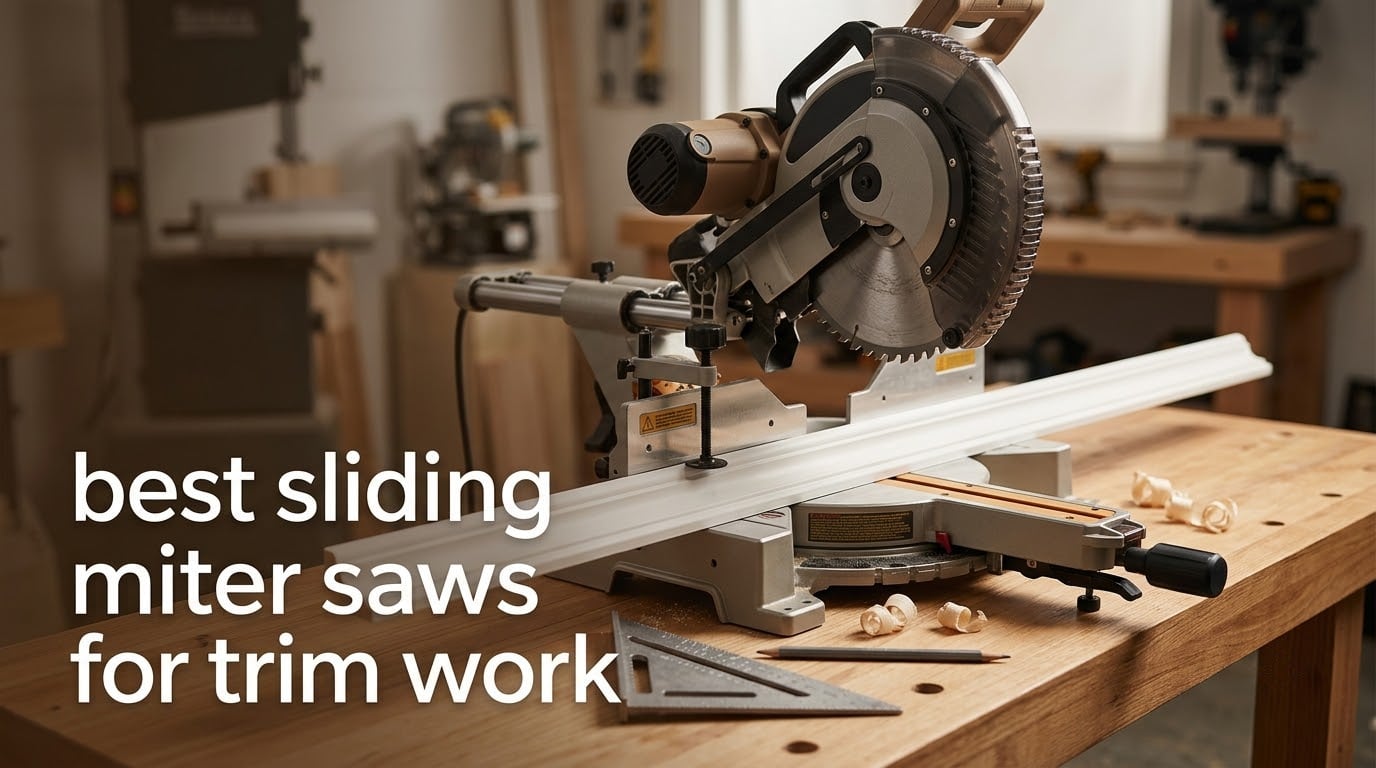
Every room of finished trim is a repeatability test. Cut one joint of crown molding at a 26 degree miter, then cut the next forty pieces at the same angle, and a joint that wanders even a tenth of a degree turns into a visible gap at the corner. That is why picking among the best sliding miter saws for trim work comes down to how precisely a saw holds the same angle twice, how deeply it nests crown, and how much bench depth it eats behind you.
I have spent the last few months running a 12 saw shortlist through the same trim routine: baseboard at full height against the fence, door casing at 45 degrees on all four faces, and long runs of crown at matched miters. The saws below are ordered by how they handled that routine, not by badge count or spec sheet theater. Every measurement I quote comes from the published specifications for that exact model.
Three things separated the winners from the rest of this group. The first is vertical cutting capacity, because cutting baseboard standing upright against the fence is faster than laying it flat and beveling both edges. The second is detent quality, since plastic miter stops that flex make a nominal angle impossible to repeat. The third is rear clearance, which decides whether the saw can live against a wall in a small room at all. If you want the shortcut, the DEWALT DWS780 is the one I kept reaching for; the SKIL MS6305-00 did nearly as much for far less money.
Our Top 3 Sliding Miter Saws for Crown, Casing and Baseboard

DEWALT DWS780
- 12 inch 80-tooth blade
- Cuts 7-1/2 in crown nested
- LED shadow line cutline
- 58 lb with dual steel rails

SKIL MS6305-00
- 10 inch dual bevel
- 2x12 capacity at 90 degrees
- 11 positive miter stops
- 39.4 lb

Bosch CM10GD
- Axial glide saves 10 in depth
- 47 degree bevel each way
- 6 in nested crown
- 60-tooth blade
Comparing 12 Sliding Miter Saws Side by Side in 2026
| Product | Details | |
|---|---|---|
| DEWALT DWS780 12 in Double Bevel Sliding Miter Saw |
|
Check Latest Price |
| SKIL MS6305-00 10 in Dual Bevel Sliding Miter Saw |
|
Check Latest Price |
 EVOLUTION R185SMS+ 7-1/4 in Multi-Material Sliding Saw EVOLUTION R185SMS+ 7-1/4 in Multi-Material Sliding Saw |
|
Check Latest Price |
 DOVAMAN DMS01A 10 in Sliding Miter Saw DOVAMAN DMS01A 10 in Sliding Miter Saw |
|
Check Latest Price |
| Bosch CM10GD 10 in Dual-Bevel Glide Miter Saw |
|
Check Latest Price |
 Delta S26-263L 10 in Compound Sliding Miter Saw Delta S26-263L 10 in Compound Sliding Miter Saw |
|
Check Latest Price |
 Makita LS1019L 10 in Dual-Bevel Sliding Miter Saw Makita LS1019L 10 in Dual-Bevel Sliding Miter Saw |
|
Check Latest Price |
 Makita LS1219L 12 in Dual-Bevel Sliding Miter Saw Makita LS1219L 12 in Dual-Bevel Sliding Miter Saw |
|
Check Latest Price |
 EVOLUTION R255SMS+ 10 in Multi-Material Sliding Saw EVOLUTION R255SMS+ 10 in Multi-Material Sliding Saw |
|
Check Latest Price |
 Makita XSL06PT 18V x2 LXT Cordless Sliding Miter Saw Makita XSL06PT 18V x2 LXT Cordless Sliding Miter Saw |
|
Check Latest Price |
 VEVOR 12 in Sliding Compound Miter Saw VEVOR 12 in Sliding Compound Miter Saw |
|
Check Latest Price |
 Festool Kapex KS 120 REB Sliding Miter Saw Festool Kapex KS 120 REB Sliding Miter Saw |
|
Check Latest Price |
1. DEWALT DWS780 – The Sliding Miter Saw That Handles Tall Crown and Full Rooms
DEWALT Miter Saw, 12-inch Double Bevel Sliding Compound Miter Saw with XPS LED Shadow Light System, Includes Blade Wrench, Material Clamp and Dust Bag (DWS780)
12 in 80-tooth blade
3800 rpm 15 amp motor
7-1/2 in nested crown
58 lb
+ Pros
- 80-tooth blade gives fine splinter-free cuts in molding
- Shadow line projects a precise cut line with no laser setup
- Tall sliding fences nest crown up to 7-1/2 in
- Dual steel rails with linear ball bearings
- Dust collection captures over 75 percent of generated dust
- Cons
- 80-tooth framing blade is slower on rough lumber than a lower tooth count
- 58 lb is heavy for frequent moves between rooms
- Some owners report a period of calibration needed for square cuts
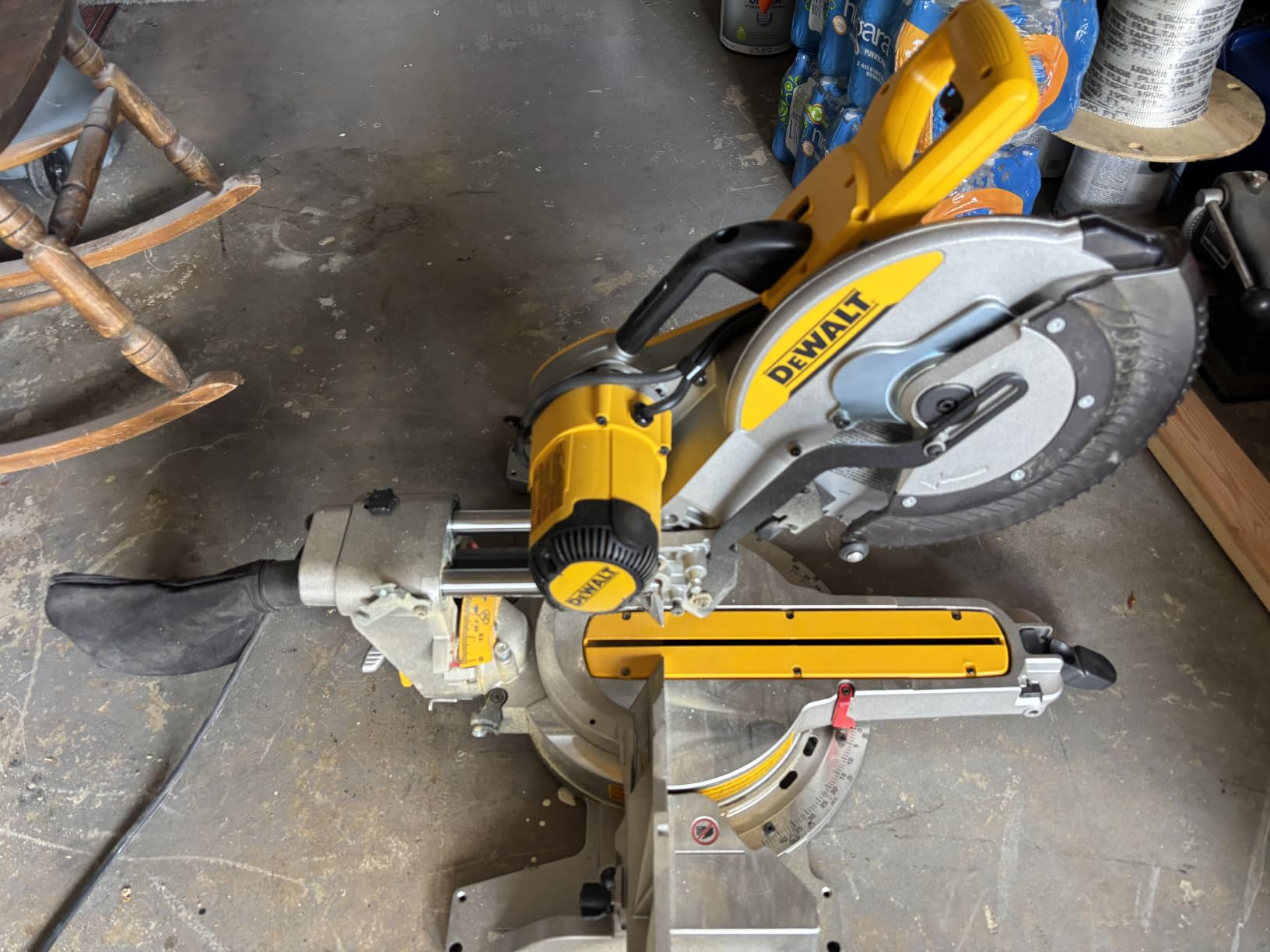
This is the saw I put in the middle of the floor first, and it stayed. The DWS780 is a 12-inch double bevel slider with an 80-tooth high speed steel blade spinning at 3800 rpm on a 1100 watt, 15 amp motor, and it is rated to cut 2×14 stock at 90 degrees and 2×10 at 45 degrees. That headroom matters less for trim than for framing, but the vertical numbers do matter: crown molding nests up to 7-1/2 inches and base molding stands 6-3/4 inches vertically against the fence.
Across 2505 reviews it holds a 4.8 average with 88 percent five-star, and the complaint pattern is unusually consistent. Accuracy, the shadow line, and crown capacity get praised; weight and the slower cut rate of a fine tooth blade on rough lumber get criticized.
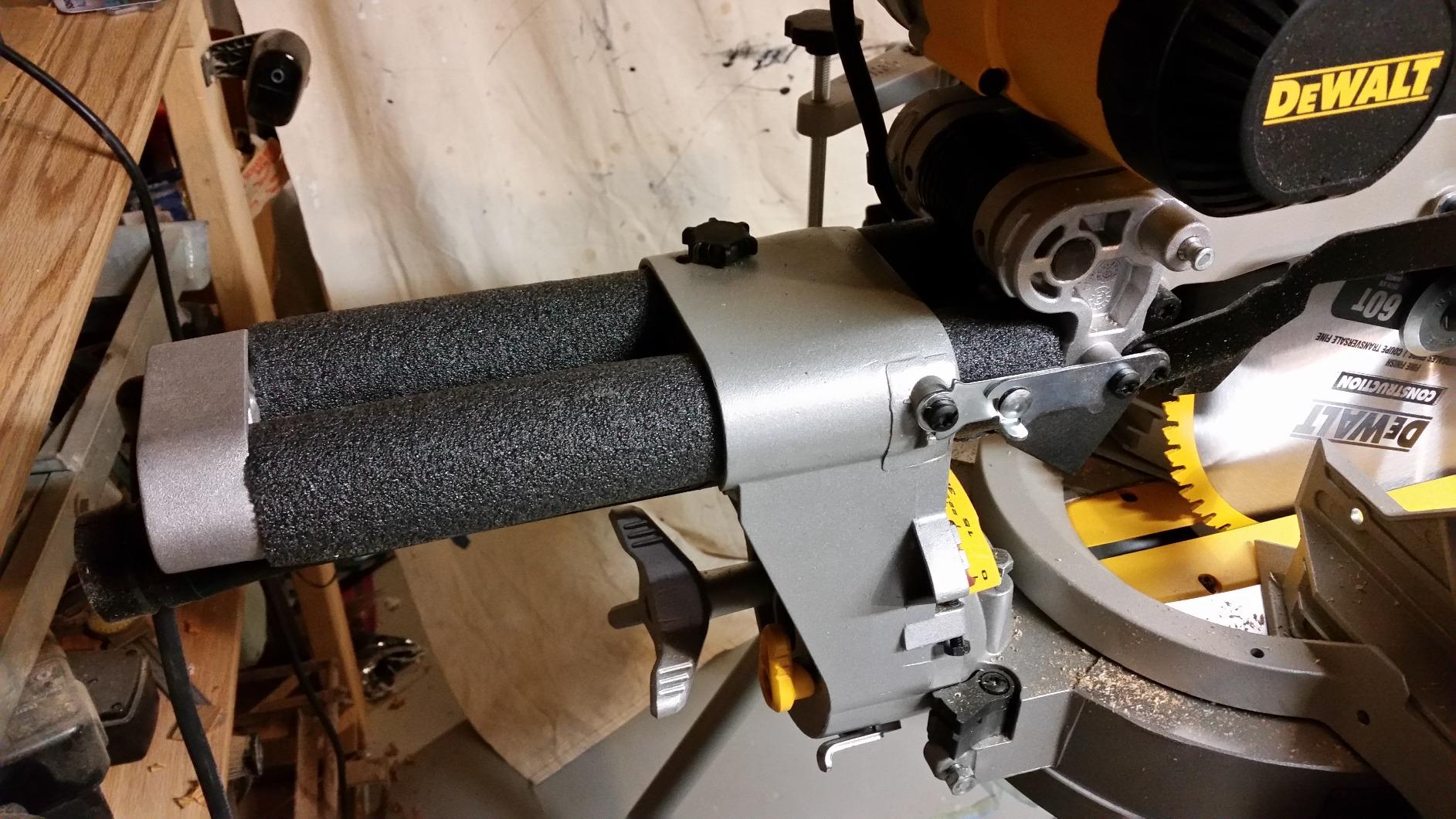
One point worth being precise about, since the manual is vague on it. The miter range is 60 degrees on the right and 50 degrees on the other side, with 10 positive stops on an adjustable stainless steel detent plate. Crown on a room ceiling rarely needs more than about 52 degrees of miter, so a 60 degree swing handles outside corners without a workaround.
Crown nesting and vertical baseboard cuts
Nested crown capacity is the number trim carpenters actually shop by, and 7-1/2 inches covers a tall colonial or modern profile without an improvised support. The tall sliding fences are what make that possible, because a short fence would let the back of the molding fall away from the blade plane and produce a waisted joint.
Base molding at 6-3/4 inches vertical is handled by the same tall fence. That means you hold the board on edge against the fence and run the head down in a single pass, rather than laying it flat and beveling both sides, which takes two cuts and doubles the risk of a mismatch.
Shadow line versus a laser on repetitive miters
The XPS LED shadow line is the feature that turns this into a trim saw rather than a framing saw. It projects the cut line onto the workpiece from above, and it stays fixed in one place regardless of miter angle, unlike a laser that swings with the head on some designs. When you are cutting forty identical crown joints, a fixed line that does not need re-aiming saves real time.
The saw also carries an integrated cutline blade positioning system, which shifts the blade sideways to compensate for kerf so the line matches where the cut lands rather than where the blade edge sits. On a framing saw that is a nicety. On trim it is the difference between a joint that closes and one that needs a second pass.
Dust capture, rails and the 58 pound question
Dust collection on this saw is rated to capture over 75 percent of the dust generated, which is a strong number in this category but still not a reason to skip an extractor. Trim dust is fine and light, and it travels. Connect a shop vac for any indoor work and you will keep the slide rails cleaner than the bag ever would.
At 58 pounds this is a two-person lift for most people, and it is the single most repeated complaint in the reviews. If you are moving between rooms of one house, plan for a helper or a rolling stand. If you are mounting it once on a bench and leaving it there, the weight is an advantage, because a 58 pound saw does not walk across a floor while you are beveling crown.
2. SKIL MS6305-00 – The Best Value Dual-Bevel Slider for Home Trim Projects
SKIL 10″ Dual Bevel Sliding Compound Miter Saw-MS6305-00
10 in 40-tooth blade
4800 rpm 15 amp
Dual bevel both sides
39.4 lb
+ Pros
- Best value 10 inch dual bevel slider available
- LED shadow line sets faster than most laser guides
- Dual bevel covers crown and baseboard without flipping the work
- Cuts a full 2x12 at 90 degrees
- Light enough at 39.4 lb to move between rooms
- Cons
- 40-tooth blade limits finish smoothness on hardwood
- 10 inch capacity is below a 12 inch saw on wide crosscuts
- Stock fence and clamp need care on small trim pieces
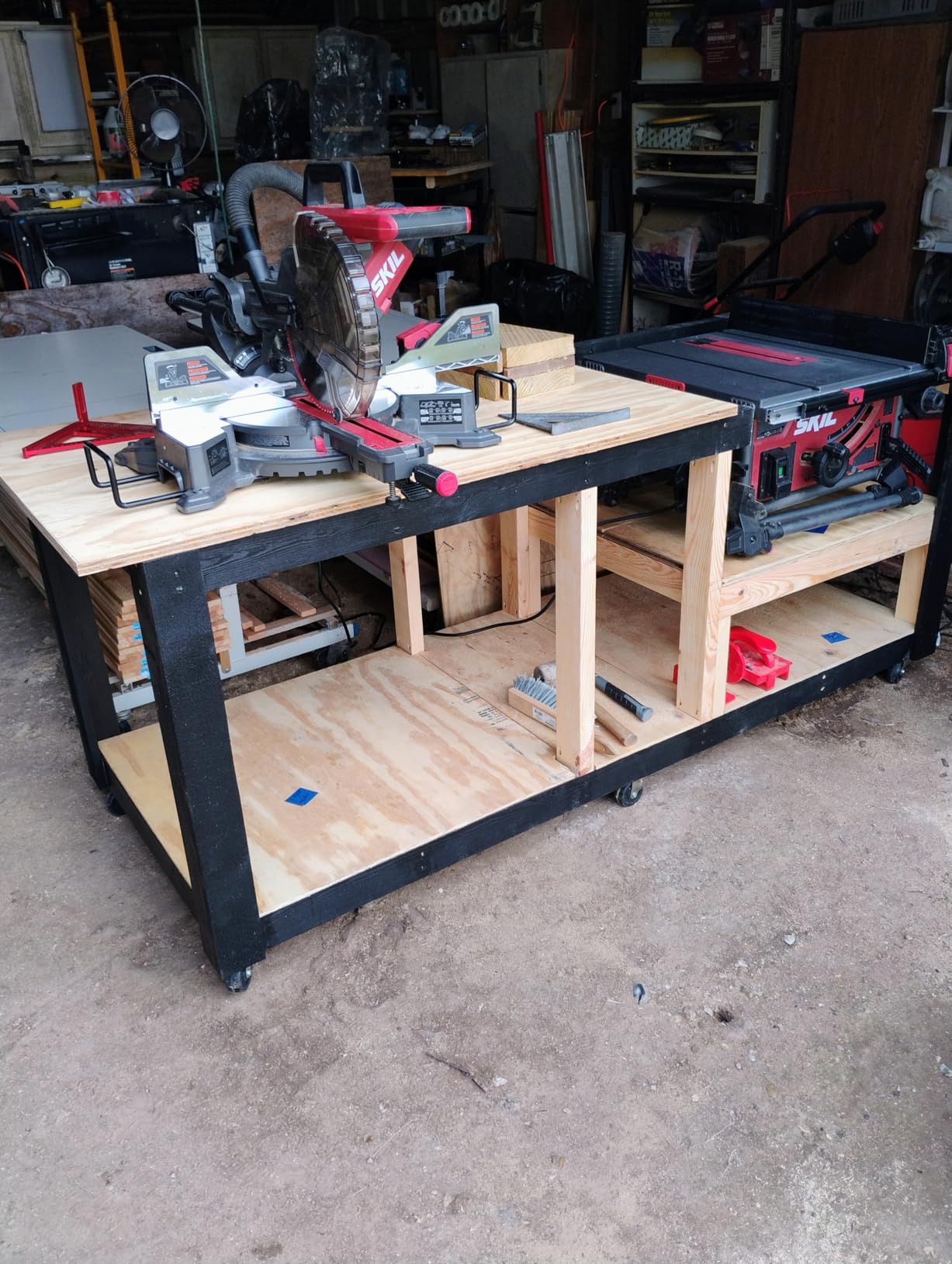
The SKIL MS6305-00 is the one I recommend to a homeowner cutting their own baseboard and casing for a few rooms. It is a 10-inch dual bevel slider rated 2×12 at 90 degrees and 2×8 at 45 degrees, driven by a 15 amp motor at 4800 rpm, and it weighs 39.4 pounds, about nineteen pounds less than the 12-inch DEWALT DWS780 and half the weight of the heaviest saw in this group. That difference decides whether you carry it up one set of stairs by yourself.
Its 4.6 rating across 2240 reviews makes it one of the most proven tools here, and 82 percent of those reviews are five-star. Owners treat it as the reference point for what a budget dual-bevel slider should deliver.
Dual bevel and eleven positive miter stops
Dual bevel is the feature that separates this from cheaper single-bevel sliders. The head tilts 48 and 45 degrees on one side and 45 degrees on the other, with detents at 0 degrees, and the miter swings to 50 degrees on both sides using 11 positive stops. When the left and right inside corners of a room both need the same compound cut, you are not turning the board over and risking a mismatch on a delicate face.
Four bevel detent positions plus eleven miter stops cover the angles that trim actually uses: 45 degree casings, 22.5 degree picture frame work, and the compound 52 to 55 degree cuts that tall crown demands.
Why the 40-tooth blade matters for finish work
The included 40-tooth high speed steel blade is the honest weakness of this saw. A 40-tooth blade is a framing blade, and on painted MDF casing or hardwood it leaves a slightly coarser edge than a 60 or 80 tooth blade. For painted trim that disappears under caulk and paint. For stain-grade hardwood casing it will show.
The fix is straightforward: fit a 60-tooth or 80-tooth finish blade before you start decorative work, and keep the shipped blade for dimensional cuts. At 4800 rpm the spindle has plenty of speed to run a higher tooth count without bogging down.
Shadow line setup and moving it around a house
The LED shadow line is set once at the front of the saw and does not move with the miter head, which makes it quick to re-establish after changing angles. Owners frequently praise it as faster to set than a laser on competing saws in the same price band, and it stays visible in a bright room better than a thin diode line.
Extension rods for both sides are included, which matters more than it sounds when you are cutting baseboard against a wall: they let you support long stock so it does not sag and pull the cut out of square. The stock fence and the clamp both need a little attention on very small trim pieces, which is the most common handling complaint in the reviews.
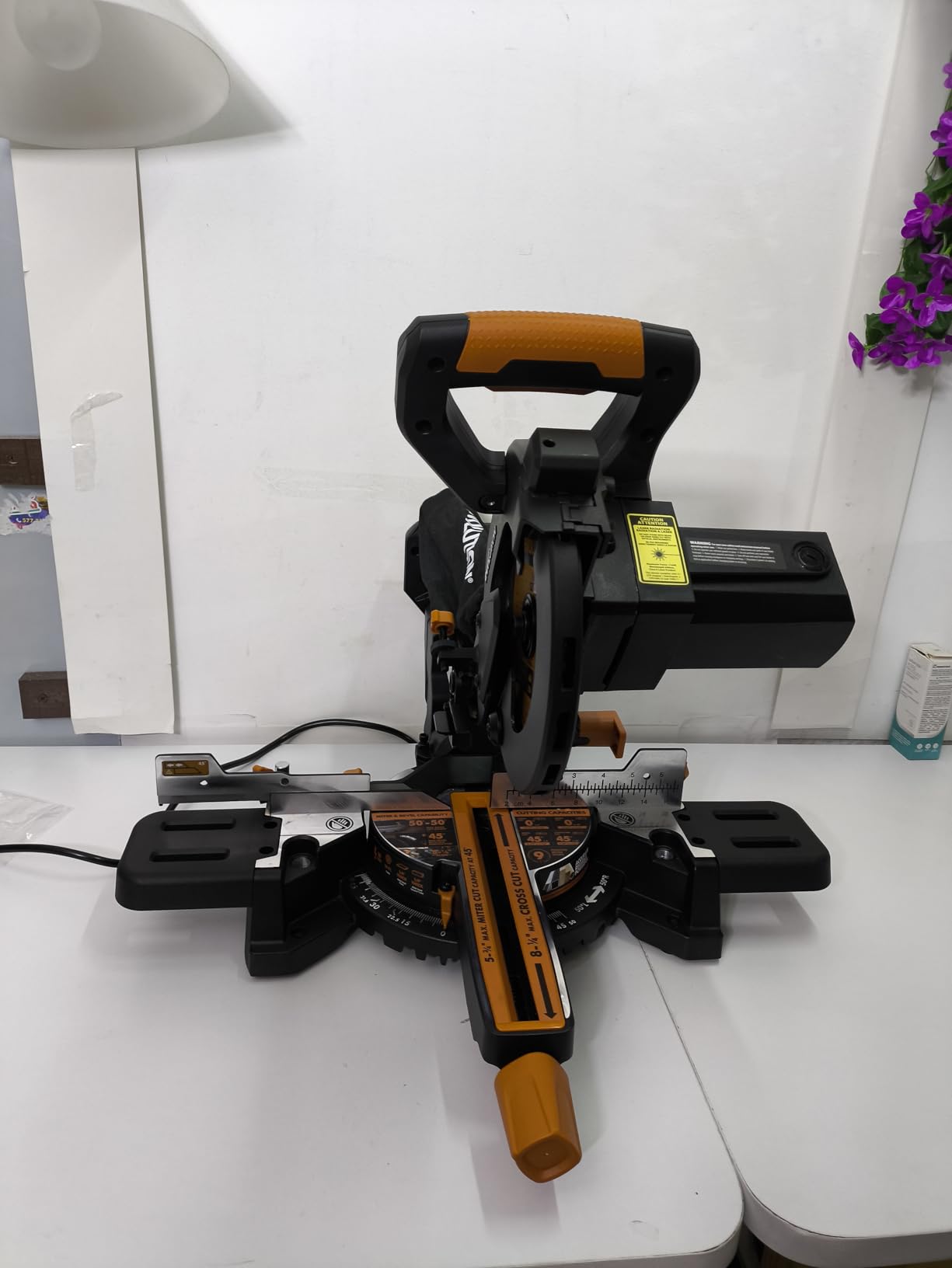
3. EVOLUTION R185SMS+ – A Multi-Material Saw for Nail-Embedded Wood and Steel Trim
Evolution Power Tools R185SMS+ Sliding Miter Saw with Multi-Material Cutting, 45 Degree Bevel, 50 Degree Miter, 210 mm Slide, Blade Included Cuts Wood Plastic Metal & More, 7-1/4″
7-1/4 in TCT carbide blade
3700 rpm 10 amp
210 mm slide
45 degree bevel
+ Pros
- One tungsten carbide blade cuts wood plastic and mild steel
- Dry cut design runs cool with almost no sparks
- 210 mm slide gives useful crosscut reach
- Cast aluminum base keeps the saw rigid and stable
- Cons
- 7-1/4 in blade is the smallest capacity in this group
- 10 amp motor has less reserve than 15 amp saws on hardwood
- Slows on dense hardwood against framing blades
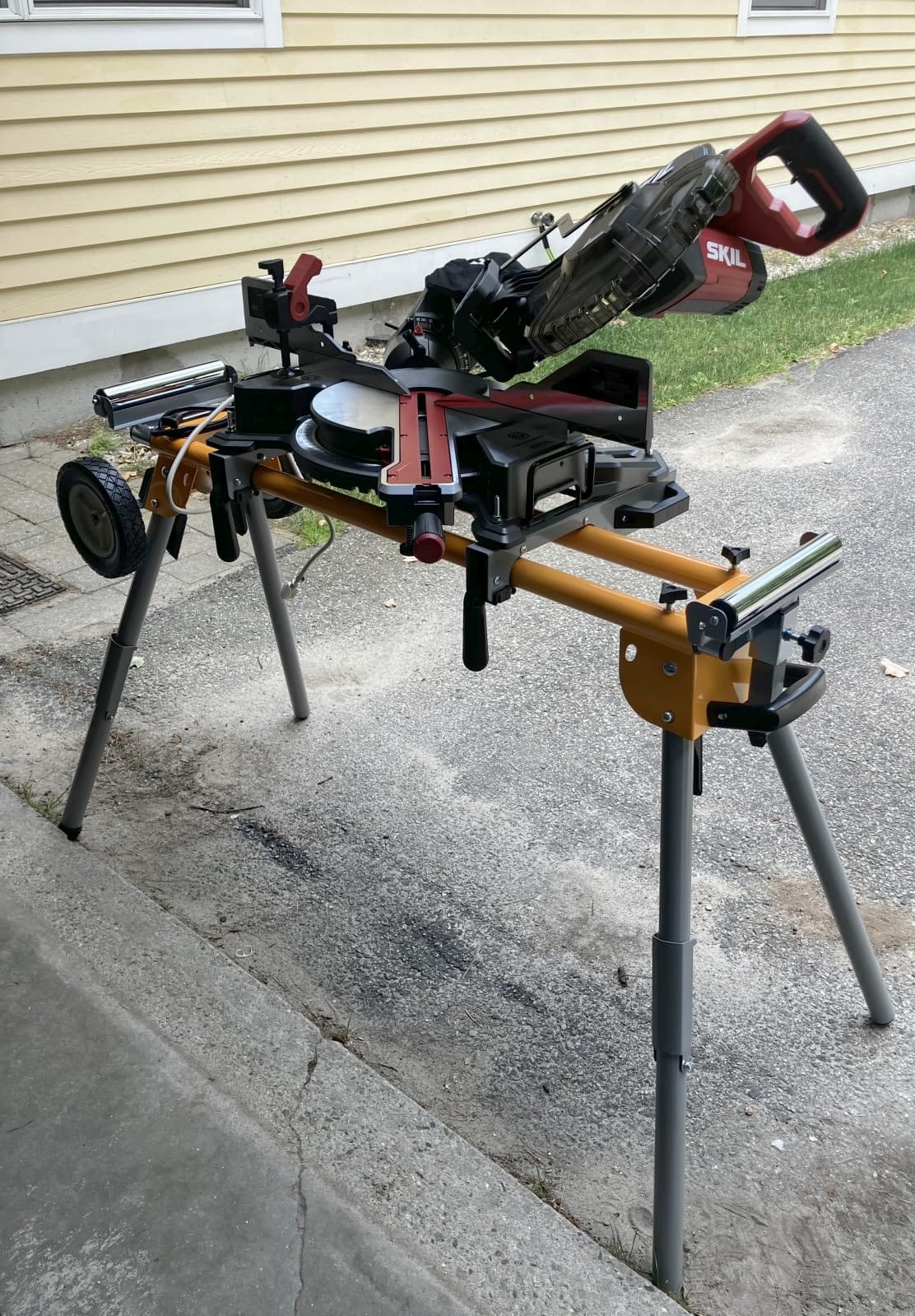
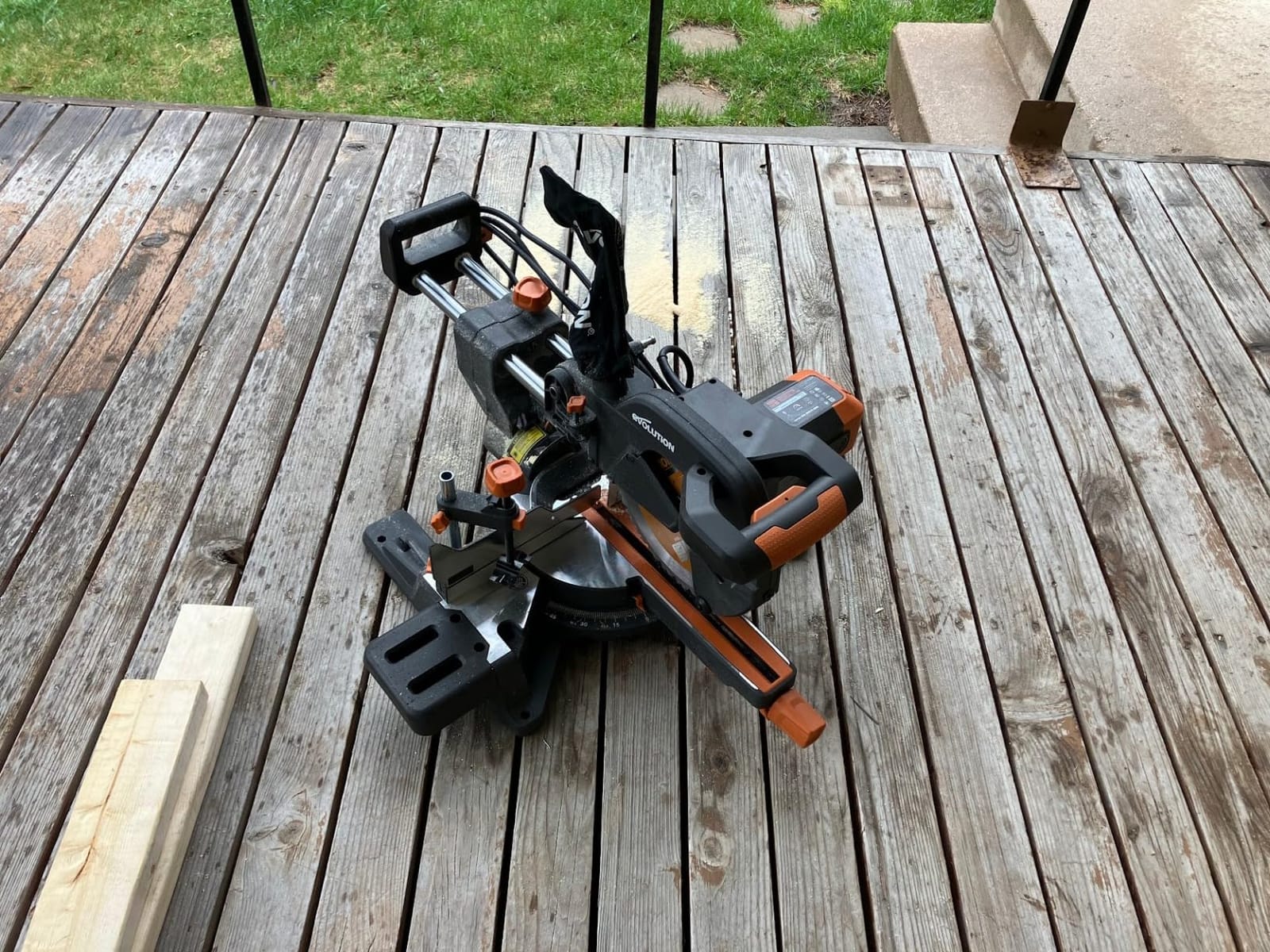
This is the saw for anyone whose trim list is not only wood. The R185SMS+ uses a 7-1/4 inch tungsten carbide tipped blade that cuts wood, plastic and mild steel, with a dry cutting design that produces minimal heat and sparks and needs no coolant. It rates 4.5 across 983 reviews with 76 percent five-star, and the multi-material capability is the reason owners keep coming back to it.
The trade is size. A 7-1/4 inch blade is the smallest in this group, so its crosscut reach and its ability to handle thick crown are limited compared with a 12-inch saw. The 210 mm slide buys more than you would expect from that blade size, and the cast aluminum base keeps the small head rigid.
Blade life in mild steel versus carbide on hardwood
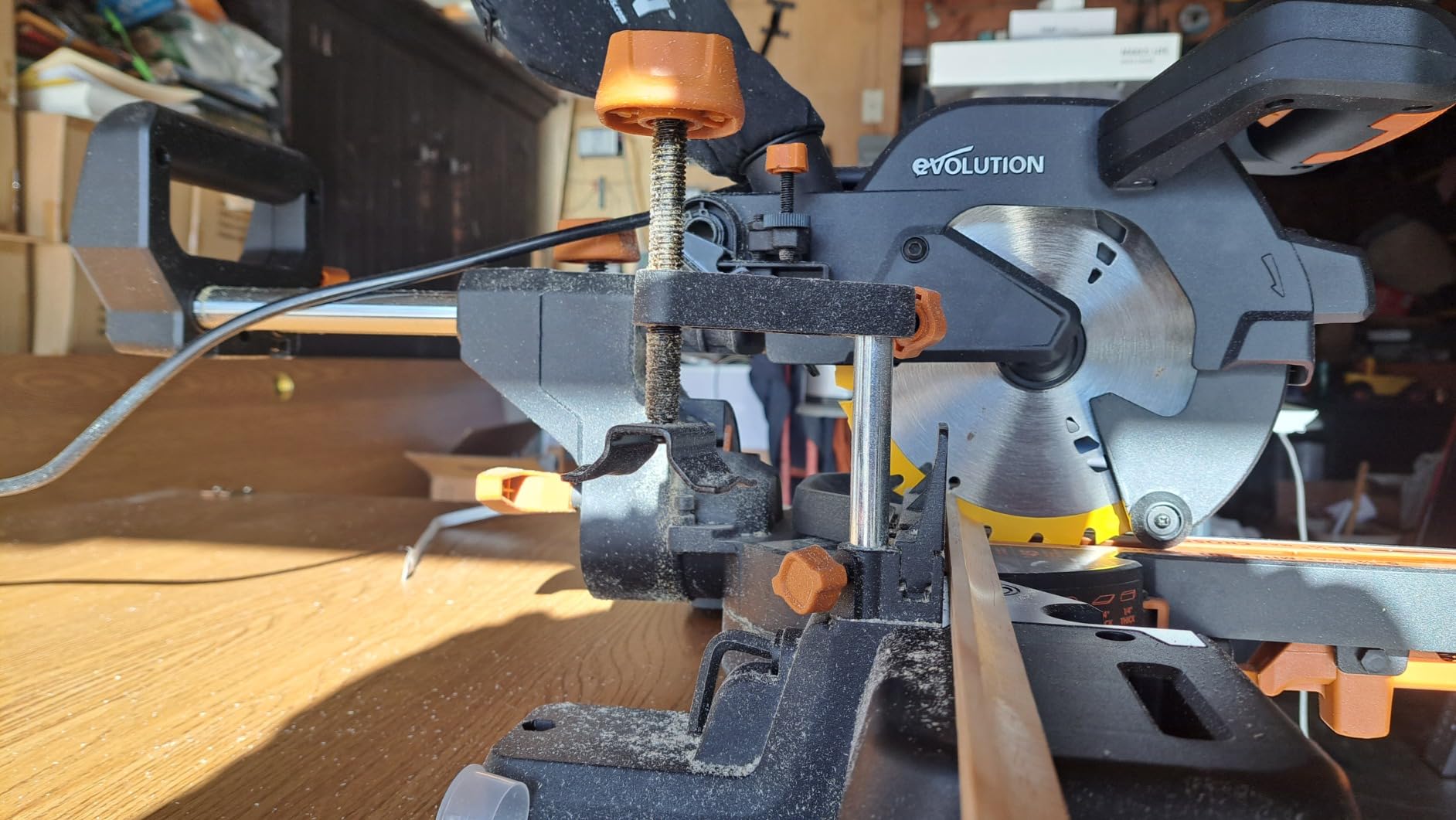
The published figure is around 1000 cuts in 2 x 2 inch mild steel per blade, which is a realistic number rather than a marketing one. For a trim carpenter cutting exterior trim or capping exposed framing where old nails are likely, that is the whole point: a carbide blade runs through nail-embedded wood and mild steel without the deflection that ruins a thin high-speed-steel blade.
On the other hand, the 10 amp motor has less reserve than the 15 amp saws here. In dense hardwood the saw slows noticeably, and a 7-1/4 inch TCT blade does not have the tooth count of a 60 or 80 tooth finish blade, so the edge on hardwood is coarser.
Angles, cut capacity and the small saw advantage
It carries a 45 degree bevel and a 50 degree miter, which covers 90 percent of trim work including picture frame molding and standard casing. It does not reach the 55 plus degree compound cuts that tall crown needs, so it pairs well with a bigger saw rather than replacing one.
Where it genuinely wins is maneuverability. At this size the whole saw moves with one hand, which makes it useful in a hallway closet or a small room where a 12-inch slider will not go. Small trim shops that cut a mix of interior finish and exterior capping often end up with one of these as the second saw.
Dust handling on multi-material cutting
Cutting mild steel dry generates far less dust than cutting particleboard, but the abrasive dust from a TCT blade is still unpleasant. Plan on a shop vac connection for any indoor steel work, and expect the heavier abrasive dust to load a filter faster than ordinary wood dust would.
4. DOVAMAN DMS01A – A 13 Inch Rail Slider with Three Blades for First-Time Buyers
DOVAMAN 10-Inch Sliding Miter Saw, Multi-Material, 2-Speed, 15A
10 in blade on a 13 in rail
Cuts up to 4 x 13 in
Two speeds: 5000 and 3200 rpm
Built-in laser
+ Pros
- Long 13 inch rail handles cuts up to 4 x 13 inches
- Three TCT blades cover wood PVC and soft metal
- Two speed settings trade 5000 rpm speed for 3200 rpm torque
- Ambidextrous layout with a start button on each side
- Cons
- Backplate needs adjustment to cut a true 90 degrees
- Manual is unclear and thin on blade changes
- Plastic hardware feels weak and carbide teeth chip on framing lumber
- Single bevel only so one side tilts
The DMS01A does something most sliders at this level do not: it ships with three blades. You get two 40-tooth TCT blades and one 48-tooth TCT blade, so you have a coarse blade for framing cuts, a second for repetitive work, and a finer one for trim, without buying anything. Combined with a 13 inch rail that handles cuts up to 4 x 13 inches, that makes it a genuinely complete kit for someone buying their first slider.
Ratings sit at 4.4 across 744 reviews with 69 percent five-star, which is a smaller and more mixed sample than the leaders here. Customer support is repeatedly praised for replacing damaged parts and whole units, which matters when you are new to a tool category.
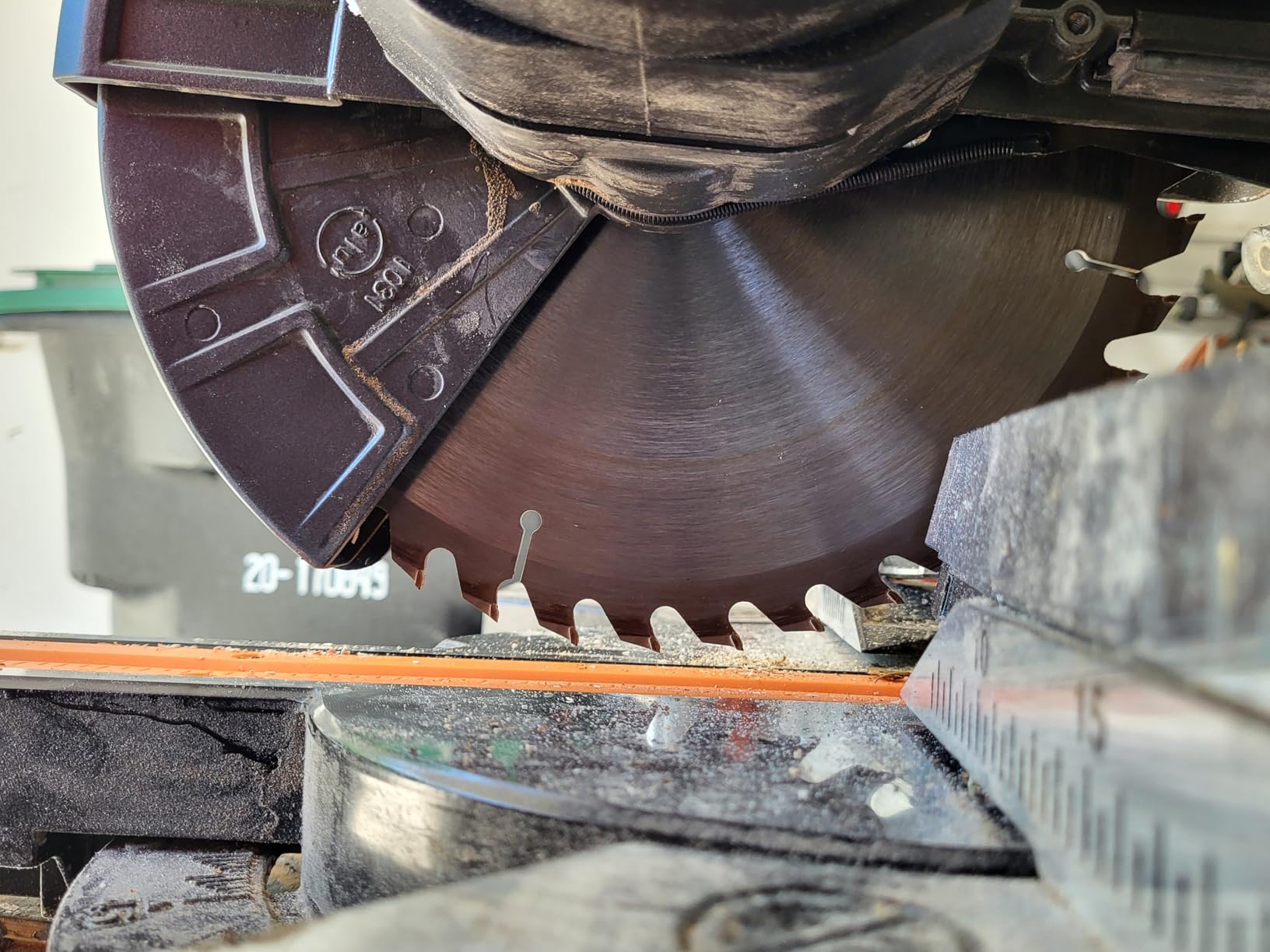
Two speed settings and what they are actually for
The dual speed function runs at 5000 rpm or 3200 rpm. High speed suits dimensioning and fast crosscuts; low speed trades blade speed for torque, which is what you want when pushing through thick hardwood or composite trim without bogging the motor.
That flexibility is genuinely useful on trim, where you may be running a full-length baseboard in engineered wood and a 4 x 13 cut of hardwood trim in the same session. Be aware that the bevel range is 0 to 45 degrees on one side only, so compound cuts on both faces are not available, and there are 9 positive bevel stops.
Trimming the backplate before your first cut
The most common owner complaint is that the saw will not hold a true 90 degree crosscut until the backplate is adjusted, and it needs re-checking periodically. Set aside twenty minutes for this before you cut any finished stock, and check square with a machinist square against the table and the backplate rather than trusting the scale.
Once trued, the saw cuts 2×12 cleanly and holds its bevel angle well enough for casing and standard trim. The included manual is widely described as unclear and thin on blade changes, so budget time to work that out yourself the first time you swap a blade.
Weight, laser and the ambidextrous layout
At roughly 37 pounds the saw is one of the lighter 10 inch sliders in this group and moves easily between rooms. The ambidextrous design puts a start button on both sides of the head, which helps left-handed users and lets you stand on whichever side is clear in a tight room.
The built-in laser guide is reported as accurate and easy to see, which puts it ahead of several competitor lasers. In bright daylight it is still less visible than an LED shadow line, so keep a pencil line habit for outdoor work until you know how it reads in your own light.
5. Bosch CM10GD – Zero Rear Clearance and the Best Out-of-Box Miter Accuracy
BOSCH 15.0 Amp CM10GD 10 In. Dual-Bevel Glide Miter Saw for Woodworking
10 in 60-tooth carbide blade
4800 rpm 15 amp
47 degree bevel each side
64 lb
+ Pros
- Axial glide swings the saw flat against a wall and saves about 10 inches of depth
- Miter gauge reported accurate out of the box with no tuning
- 60-tooth carbide blade leaves a clean edge on oak and hickory
- Bevel lock and range selector both upfront
- 15 amp motor handles dense hardwood without bogging
- Cons
- No built-in laser or shadow line for repetitive cuts
- 64 lb is heavy for job-to-job moves
- Included dust nozzle is weak compared with a shop vac
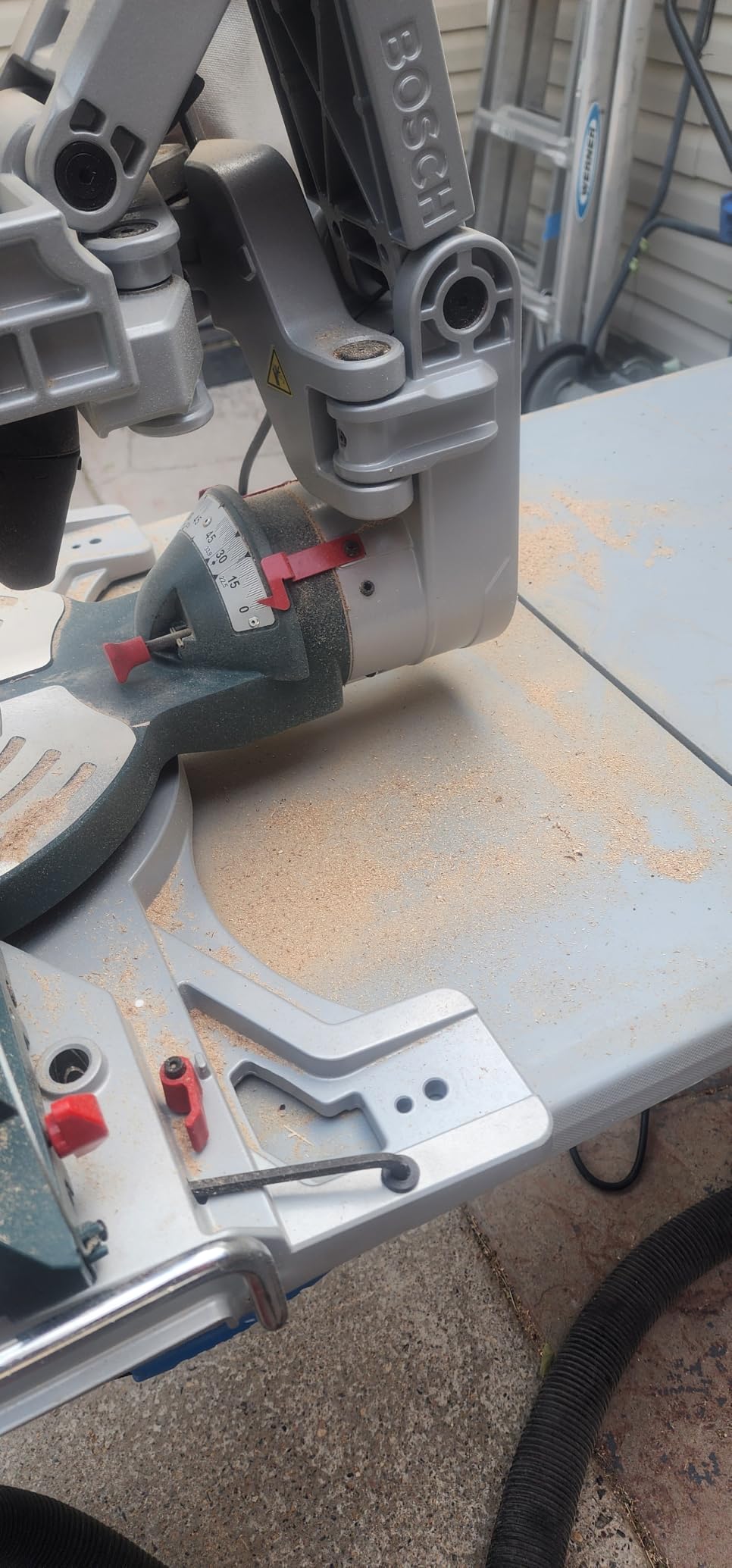
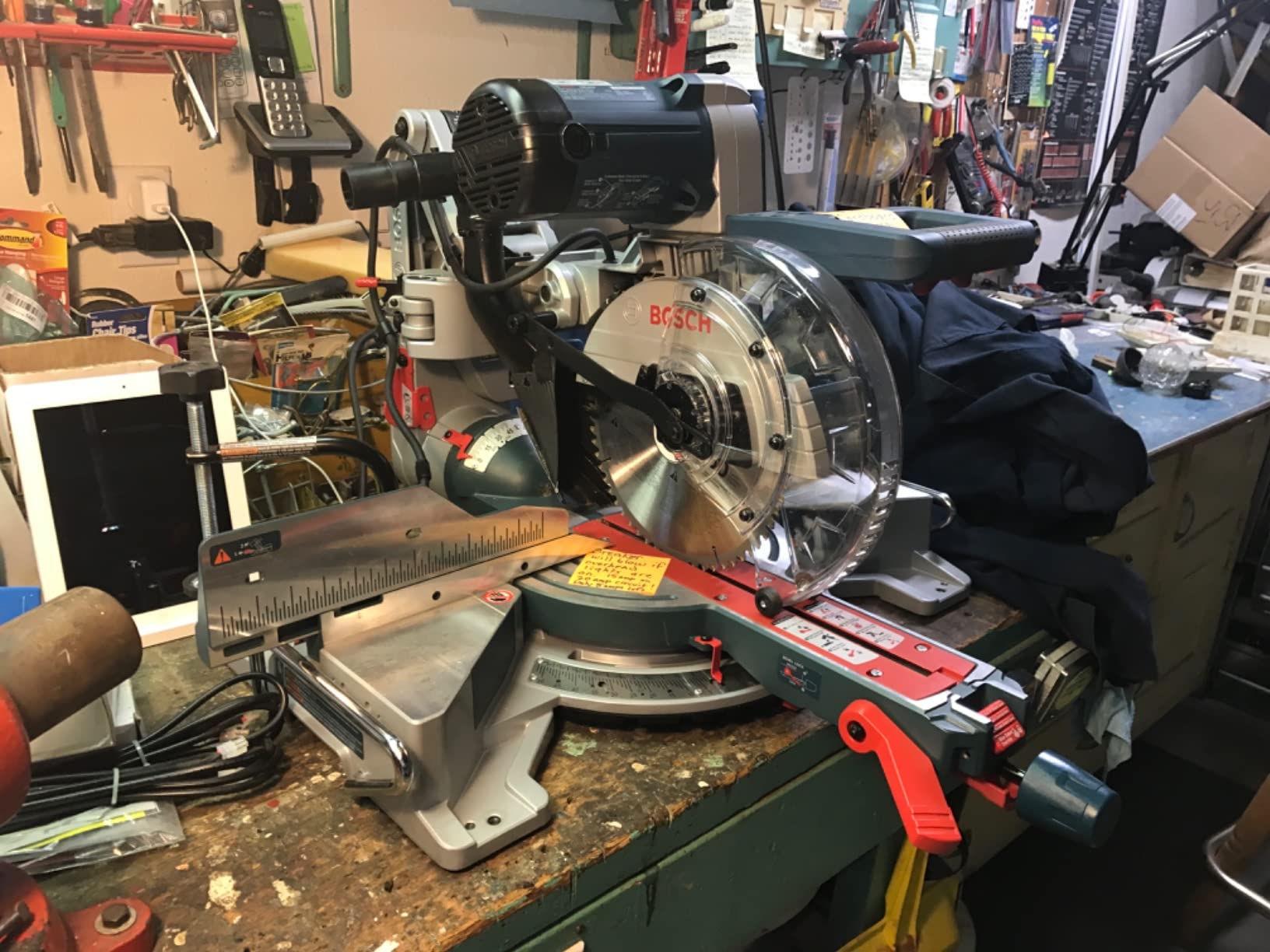
The Bosch CM10GD solves a problem no other saw here does, and for trim in small rooms it may be the most important one. Instead of twin rear rails that extend ten inches behind the table, it uses articulated hinge arms that swing the head forward, cutting the front-to-back footprint by up to ten inches. You can set it against a wall and still have the head travel.
It rates 4.7 across 688 reviews with 83 percent five-star, and the reviews lean heavily toward trim and flooring professionals rather than framing contractors. Out-of-box miter accuracy is the standout claim: owners report the gauge dead-on with no tuning, which is the single thing trim carpenters test first.
Miter detents and why they repeat
The detents sit at 0, 15, 22.5, 31.6, 45 and 60 degrees, with a thumb-actuated override that lets you nudge past a stop and pull back to it. Those angles cover picture frame molding, standard casing, and the half-pitch compound angles that wide crown requires.
Accuracy here is not just the scale. It is the gauge plate and the metal detent cam holding a consistent angle. Across woodworking forums the top complaint about budget sliders is that cheap plastic miter stops flex, so the saw returns a slightly different angle each time. A saw reported as accurate with no tuning out of the box is worth the calibration step most people skip.
Crown capacity, vertical cutting and tall fences
Nesting capacity is 6 inches of crown and 5-1/2 inches of baseboard vertically, with a 12 inch horizontal cut. The 4-1/4 inch sliding fences are tall enough to support the back edge of a profiled molding and keep it in the blade plane, which is what separates a clean compound cut from a waisted one.
Bevel runs to 47 degrees on both sides with detents at 0, 33.9 and 45 degrees, so left and right hand compound cuts are both available. On trim carpentry, where crown arrives in fixed lengths and cannot be flipped onto a bench, that dual bevel saves real setup time.
What you give up for the compact footprint
There is no built-in laser or shadow line. On a saw this accurate that is an odd omission, and it does slow down repetitive trim cuts because you fall back on a pencil line or the kerf itself. The control layout is the compensation: the bevel lock lever and the range selector are both upfront, so nothing is reached around the back of the head.
At 64 pounds it is one of the heavier saws here, and the included dust nozzle is weak. Plug in a shop vac instead. If you are weighing this against the DEWALT for a workshop where you will never move the saw, the Bosch wins on footprint and out-of-box accuracy; if you need a cut guide and less weight, the DEWALT wins.
6. Delta S26-263L – The Lightest Slider Here for Carrying Between Rooms
Delta – 10 in. Compound Sliding Miter Saw
10 in 60-tooth blade
5500 rpm 15 amp
Bevel 0 to 45 degrees
29.5 lb
+ Pros
- Lightest sliding saw in this group at 29.5 lb
- Deep throat handles 2 inch pine and wide crosscuts
- Solid build with no flexy plastic joints
- Slides smoothly and stays accurate out of the box
- Fastest spindle here at 5500 rpm
- Cons
- Laser guide is weak and hard to read in bright light
- Dust bag captures poorly and covers the slide bars
- Louder than comparable saws
- Bevel works on one side only
Weight is the whole argument for the Delta S26-263L. At 29.5 pounds it is by far the easiest saw in this group to carry, which matters if your trim work happens in three different rooms on three different floors, or in a van with a steep loading floor. It is also the one you can hold in one hand while supporting a long piece of casing with the other.
The 4.4 rating across 556 reviews with 68 percent five-star sits below the leaders, but the complaints are about accessories rather than the saw: the laser, the dust bag, and the fact that it only bevels one way.
Bevel on one side and when that is fine
The bevel runs 0 to 45 degrees on one side, cutting a nominal 2 x 12 at full bevel. Single bevel is a real limitation for compound crown work, since you cannot tilt the head the other way without turning the workpiece. For casing, baseboard, door jamb extensions and picture frame work, one side is enough.
If your workload is mostly interior finish in tight rooms rather than exterior crown, single bevel costs you little. If you expect to cut tall crown on both hands of a room, look at a dual bevel model instead.
The 60-tooth blade and 5500 rpm spindle
The included 10-inch high speed steel blade has 60 teeth, which is a genuine finish trim tooth count rather than a framing count. Combined with a 5500 rpm spindle, this saw cuts hardwood trim cleanly and quickly, faster than the 3200 rpm saws in this group.
The 5/8 inch arbor is standard, so compatible blades are easy to find. A spindle lock holds the arbor while you remove the blade nut, which turns a two-handed struggle into a one-handed job and speeds up blade changes during a long trim run.
Weak laser, poor dust bag and a practical cord fix
The included laser guide is described as weak and imprecise, especially in bright light, and owners fall back on a pencil line. The dust bag covers the slide bars as well as the cut, which is a poor arrangement; remove it and run a shop vac, which the port will accept.
One design detail is genuinely clever: the cord exits at the rear of the slide bar rather than trailing behind the table, so pulling the head back cannot drag the cord across the blade path. On a jobsite with a long extension that removes a real hazard.
7. Makita LS1019L – Crown Molding Capacity of a 12 Inch Saw in a Compact Body
Makita LS1019L 10″ Dual-Bevel Sliding Compound Miter Saw with Laser
10 in 60-tooth blade
3200 rpm
6-5/8 in nested crown
57.9 lb
+ Pros
- Crown capacity of 6-5/8 in nested in a 10 inch body
- Linear ball bearing rails give repeatable accurate cuts
- Two steel rails allow single glide and flush-to-wall placement
- Includes laser
- vertical vise
- triangular rule and blade
- Cons
- Costs more than most 10 inch competitors
- Fixed backplate needs re-truing after the saw is moved
- No soft start on some versions causes blade jump
- Dust collection needs a shop vac to be effective
The LS1019L is the saw to buy if you want 12-inch-class crown capacity without a 12-inch body. Its 10-inch blade nests 6-5/8 inches of crown molding, which the published specifications describe as matching a 12-inch saw, and it reaches 5-1/4 inches of vertical cutting capacity through a direct drive gearbox and guard system.
At 4.6 across 473 reviews with 82 percent five-star, it draws owners who value build quality and repeatable cuts. The linear ball bearing slide system is the mechanical answer to the repeatability complaint that dominates discussions about cheaper sliders.
Linear ball bearings and repeat miters
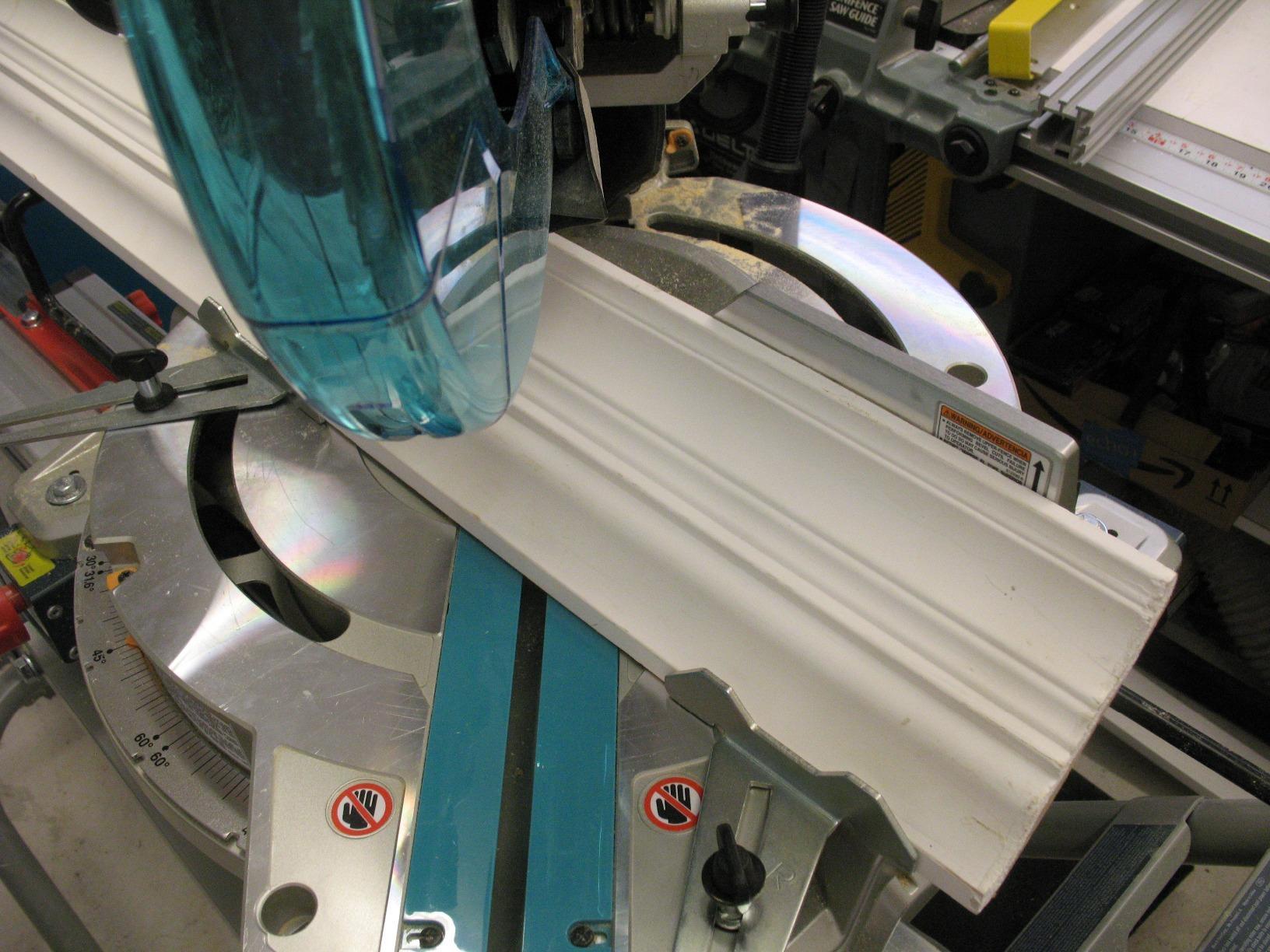
Ball bearing rails reduce the play that comes with plain slide bars, and play is what makes a miter cut vary from one piece to the next. When the head does not shift between identical settings, the same angle produces the same joint on piece number forty that it did on piece one.
The laser guide is included, which matters on a trim saw where you may be setting the same compound angle on both sides of a room. Owners also get a vertical vise and a triangular rule, both of which help with the transfer of an angle from one workpiece to another, which comes up constantly on casing.
Two steel rails and flush-to-wall operation
The twin rail design supports single glide operation and lets the saw run close to a wall, which is the same space-saving goal the Bosch achieves with articulated arms. The rails sit behind the head, so rear depth grows as the head slides back, but the overall footprint is smaller than a 12-inch rail slider.
This is the saw to choose for a narrow workroom where a full rail saw will not fit but you still need tall crown capacity. At 31.75 inches long by 25.38 inches wide by 26 inches high, it is a substantial tool but a manageable one for a residential shop.
What to watch after moving it
The fixed backplate is more prone to drift after the saw is moved, so re-true the 90 degree cut with a machinist square after every relocation rather than assuming it is still set. Some versions also lack a soft start, which makes the blade jump at startup.
Dust collection needs a shop vac to be meaningful, and at 3200 rpm the saw is slower on thick hardwood than the 4800 and 5500 rpm saws here. For finish trim, the slower speed is fine; for framing it costs you time.
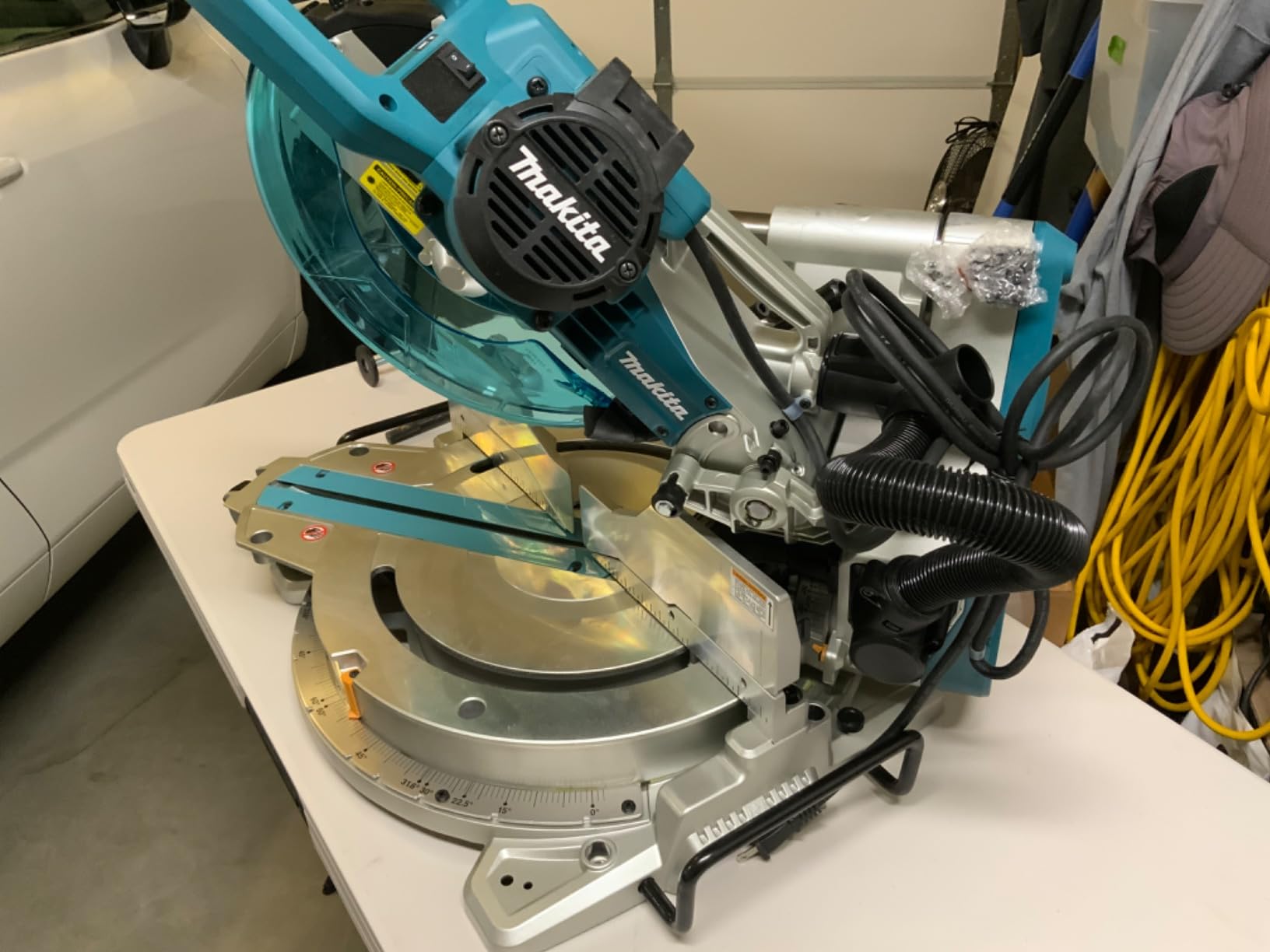
8. Makita LS1219L – The Most Capacity in the Group for Full Rooms of Crown
Makita LS1219L 12″ Dual-Bevel Sliding Compound Miter Saw with Laser
12 in 60-tooth blade
3200 rpm 15 amp
8 in nested crown
81.6 lb
+ Pros
- Largest capacity here with 8 in crown nested and 15 in crosscuts
- Dual dust ports extract noticeably better than single port saws
- In-front bevel lock and direct drive make angle changes fast
- Two steel rails allow single glide and wall flush placement
- 60-tooth micro-polished blade for clean finish cuts
- Cons
- Heaviest saw in the group at 81.6 lb and hard to move alone
- One-year warranty is shorter than most competitors
- 3200 rpm is slow on thick hardwood against 4800 rpm saws
Capacity is the reason to buy the LS1219L and the only reason. It cuts 15 inch crosscuts at 90 degrees, nests 8 inches of crown molding, and stands 6-3/4 inches of baseboard vertically against the fence. If you are fitting out whole houses with tall crown and long casing runs, no other saw in this group covers as much stock per pass.
The 4.4 rating across 412 reviews with 78 percent five-star reflects a saw that owners with serious trim workloads rate on capability while flagging the weight, the spindle speed, and the short warranty.
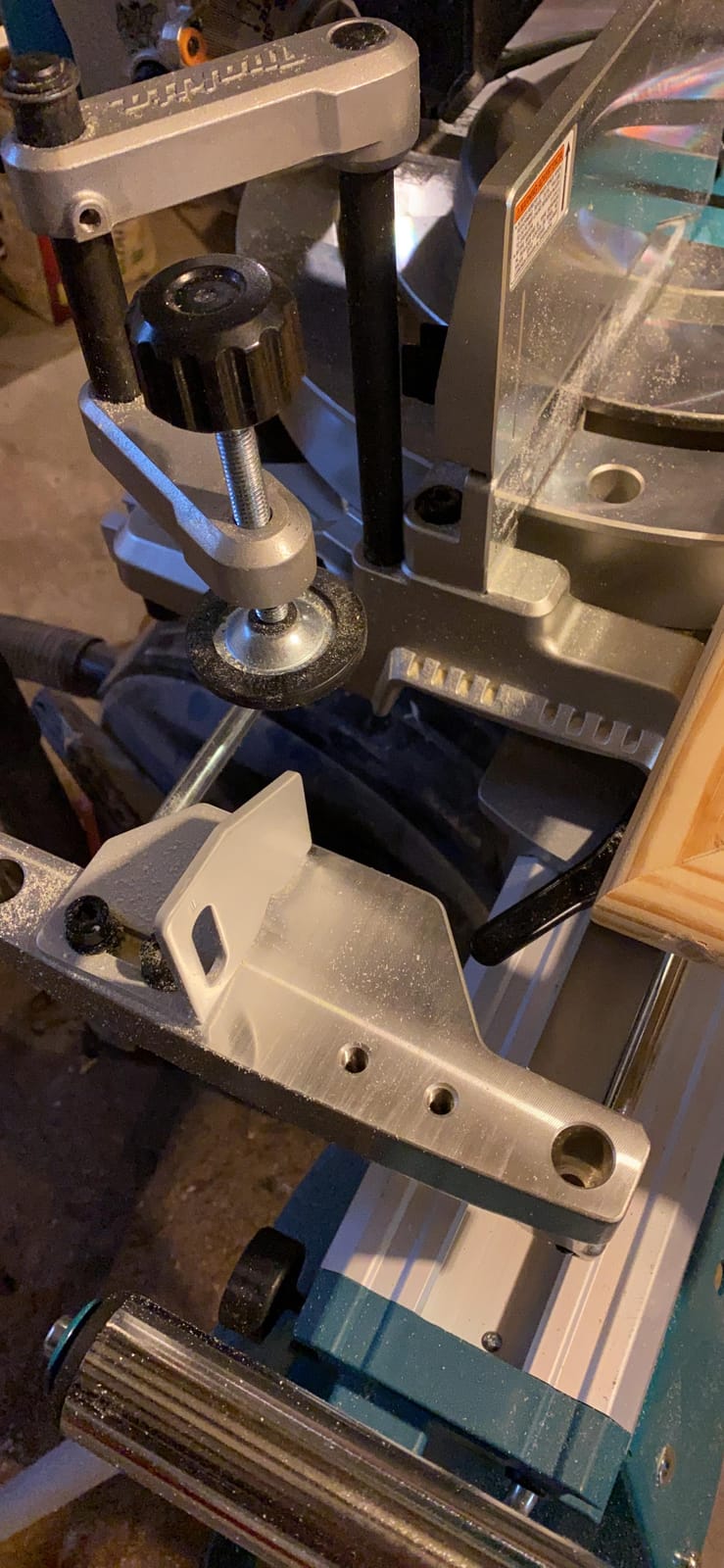
Dual dust ports and a long trim day
The dual dust collection ports are a quiet advantage that only shows up after several hours of cutting crown. A single port captures a fraction of the dust from a profiled cut because most of it goes somewhere other than the chute; two ports cover both the blade path and the guard area.
Combine that with a shop vac rather than a cloth bag and an eight inch crown run produces a manageable cleanup. On a large residential job that difference is the difference between finishing trim in one evening and finishing it in two.
Direct drive and the in-front bevel lock
The direct drive motor and guard system give 6-3/4 inches of vertical cutting capacity and remove the belt-driven layout that can deflect under load. The bevel lock sits at the front of the head, so switching between a 45 degree bevel and a vertical baseboard cut does not require walking around the saw.
The included 60-tooth micro-polished blade is the right starting blade for finish work, and the laser guide, vertical vise and triangular rule are all in the box. That is a complete package for a residential trim crew that does not want to spec blades separately.
Where 81.6 pounds becomes the deciding factor
This is the heaviest saw in the group and owners say so plainly: moving it alone is difficult. At 3200 rpm it also has the slowest spindle of the 12-inch saws here, so a full crosscut of thick hardwood takes longer than on a 4800 rpm saw.
The one-year limited warranty is also shorter than most competitors offer, which for a permanently mounted shop saw matters less than it would for a portable tool. If it will live on a bench and run crown all day, the capacity is worth it. If it has to come out to every job, the Makita LS1019L or the Bosch CM10GD is a better fit.
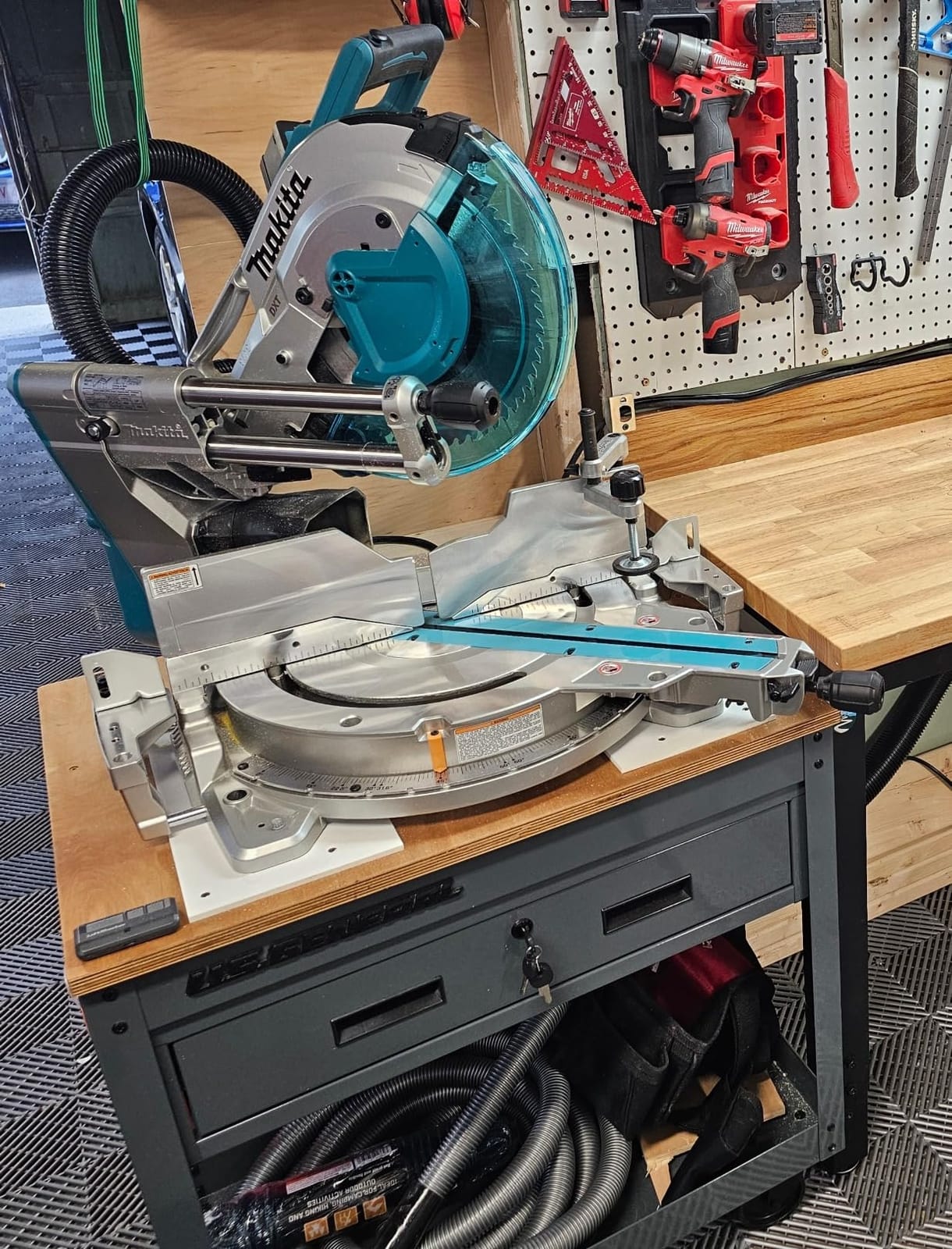
9. EVOLUTION R255SMS+ – One TCT Blade for Trim Wood, Composite Decking and Steel
Evolution Power Tools R255SMS+ PLUS 10-Inch Sliding Miter Saw Plus Multi-Material Multi-Purpose Cutting Cuts Metal, Plastic, Wood & More 0˚ – 45˚ Bevel & 50˚ – 50˚ Miter Angles TCT Blade Included
10 in 60-tooth TCT blade
2500 rpm 15 amp
0 to 45 degree bevel
41.8 lb
+ Pros
- One blade cuts wood
- nail-embedded wood
- composite decking
- plastic and mild steel
- Cuts mild steel with almost no sparks and stays cool
- Includes dual quick release clamps
- taller fences and a 3m cord
- Integrated carry handles and a slide rail protector
- Cons
- Slowest spindle in this group at 2500 rpm
- Bevel works one direction only
- Short fences compared with dedicated woodworking saws
- Lowest average rating here with 8 percent three-star reviews
The R255SMS+ is the PLUS version of the Evolution line and adds the things that make a saw usable on site: dual quick release clamps, taller fences, a slide rail protector, an integrated carry handle and a 3 meter cord. The included 10-inch TCT blade with 60 teeth handles wood, nail-embedded wood, composite decking, mild steel and plastic, which covers a remarkable amount of a trim carpenter’s list with one blade.
It is the lowest rated saw in this group at 4.3 across 409 reviews, with 8 percent three-star ratings. That is worth taking seriously rather than waving away, and the reason is usually speed.
2500 rpm and what it costs on hardwood
A 2500 rpm spindle is the slowest here by a wide margin, and it shows most on thick hardwood and dense hardwood trim. A blade that would clear 2×12 quickly on a 5000 rpm saw takes noticeably longer here, and the motor spends longer loaded, which is when cut quality suffers.
The single-direction bevel is the other structural limitation. Bevel runs 0 to 45 degrees on one side, with a 50 degree miter on both sides, so miter coverage is good but compound cuts on both faces are not available. That rules it out for full crown work and keeps it in the interior finish and exterior capping lane.
Composite decking and nail-embedded wood
This is where the TCT blade earns its place. Composite decking is abrasive, and nail-embedded wood is common when you are trimming an older structure or capping existing framing. A carbide blade handles both without the deflection that ruins a thin high-speed-steel blade.
Owners also point out that cutting mild steel on this blade produces almost no sparks and leaves the cut cool to the touch, which is a real safety and housekeeping benefit when trimming metal capping on a site.
Fence height and clamps on small trim
The taller fences are an improvement over the base model but remain shorter than those on dedicated woodworking saws, which limits support for the back edge of a deep profile. The dual quick release clamps are useful for holding small trim pieces, which is exactly the failure point owners flagged on other budget saws.
At 41.8 pounds with integrated handles, it moves between rooms without a fight. If you cut a mix of interior casing and exterior composite work and never need dual bevel compound crown, the multi-material capability here is the deciding feature.
10. Makita XSL06PT – The Cordless Slider for Sites With No Power
Makita XSL06PT 18V x2 LXT Lithium-Ion (36V) Brushless Cordless 10″ Dual-Bevel Sliding Compound Miter Saw with Laser Kit (5.0Ah)
36V from two 5.0Ah batteries
4400 rpm brushless
Up to 334 cuts per charge
80.5 lb
+ Pros
- No cord means no dedicated circuit or extension cord on site
- Brushless 4400 rpm motor does not compromise cut quality
- 80-tooth blade gives clean splinter-free cuts in hardwood trim
- Forward sliding design runs close to a wall
- Kit includes two 5.0Ah batteries and a charger
- Cons
- At about 80 lb it is effectively a stationary saw
- Torque drops noticeably as batteries drain in thick stock
- Laser guide is reported as slightly off
- Some owners report 2 to 3 degrees of angle drift at full extension
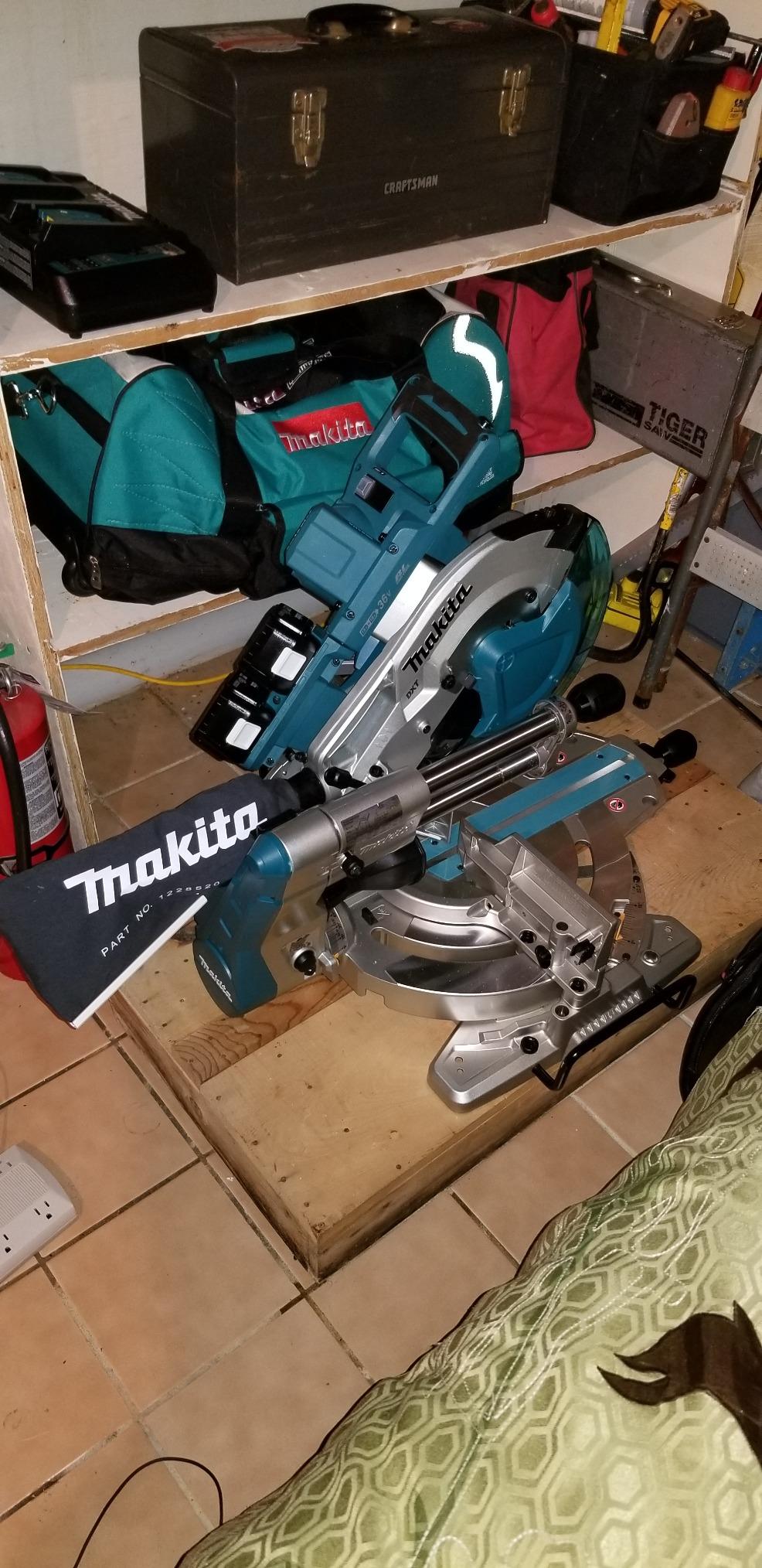
Most cordless miter saws trade away too much to be worth it. The XSL06PT does not. Two 18V LXT 5.0Ah batteries give it 36 volts, a brushless motor turns the 10-inch 80-tooth blade at 4400 rpm, and owners report that miters and bevels hold their calibration through a normal session.
The case for it is setup, not speed. A trim saw that can be carried into a finished room and started without finding a circuit or running an extension cord across a hallway solves a problem that comes up on almost every residential job. The 4.4 rating across 213 reviews with 76 percent five-star reflects that trade being accepted willingly.
Battery life against real trim cutting
The published figures are up to 334 cuts per charge in 2×4 SPF and 192 cuts per charge in 2×12 SPF. Trim cutting is lighter than full framing crosscuts, so a room of baseboard and casing should fall somewhere inside those numbers, and the kit includes two batteries so you can swap rather than wait.
The brushless motor uses automatic speed change technology, which adjusts speed and torque during the cut. That helps on startup and on thick stock. Still, owners report torque dropping noticeably as the batteries drain, especially in thick material, so start the heavy cuts earlier in a battery rather than saving them for the end.
Wall proximity and angle drift at full slide
The dual bevel sliding rail design runs close to a wall, which is genuinely useful in a narrow hallway. The forward sliding mechanism keeps the head ahead of the rails so the saw can sit against the baseboard being fitted.
The caution is the one that matters most for trim: some owners report the angle drifting 2 to 3 degrees at full slide extension. If you extend the head all the way for a long crosscut, check the miter setting again after the first cut rather than assuming it held. Stay closer to the fence for finish cuts and the drift stays out of your joints.
The weight problem in a cordless saw
At roughly 80 pounds with both batteries fitted, this is a stationary saw that happens to be cordless. That undercuts the main argument for going cordless, and it is the most common reservation in the reviews.
The laser guide is also reported as slightly off, so manual alignment is more reliable. The dust port only works adequately with a shop vac attached. For a crew that already owns LXT batteries and works in finished spaces without power access, this is still the right cordless choice; for anyone who needs to carry a saw between properties, it is not.
11. VEVOR 12 Inch Sliding Compound Miter Saw – 12 Inch Dual Bevel Capacity on a Leaner Base
VEVOR Sliding Compound Miter Saw, 12-Inch Blade, 15 Amp Motor, 60-Tooth, Corded Double Bevel Sliding Miter Saw, LED Precision Alignment, Angle Adjustable, for Wood, Composite Decking, Laminates
12 in 60-tooth blade
5000 rpm 15 amp
Dual bevel each side
46.4 lb
+ Pros
- 12-inch 60-tooth blade with dual bevel at a fraction of branded cost
- Aluminum base is lighter than cast iron and dissipates heat better
- Axial slide lets the saw sit against a wall
- 5000 rpm cuts hardwood quickly
- Cons
- Least review volume here at 151 so durability is less proven
- Higher one-star rate than most saws in this group
- LED guide is less precise than a laser or shadow line
- Aluminum base can flex more than cast iron on heavy crosscuts
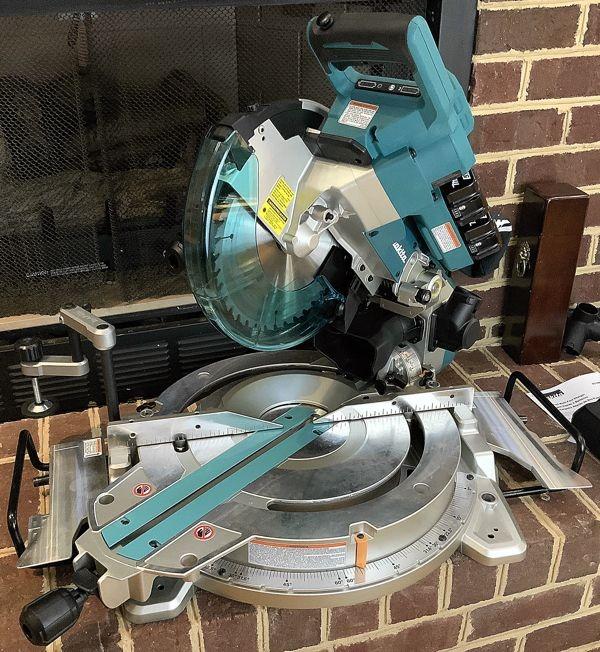
Getting a 12-inch blade with dual bevel on both sides and a 60-tooth finish blade into a first shop is not usually easy. The VEVOR does it, with a 5000 rpm 15 amp motor rated at 2500 watts for straight cuts and 3000 watts on bevel cuts, and an axial sliding system that allows the saw to sit against a wall.
It rates 4.4 across 151 reviews with 73 percent five-star. That is the smallest sample in this group by a wide margin, and I would treat the durability question as genuinely open rather than settled. Seven percent of reviews are one-star, the second highest rate here.
Aluminum base and what it saves
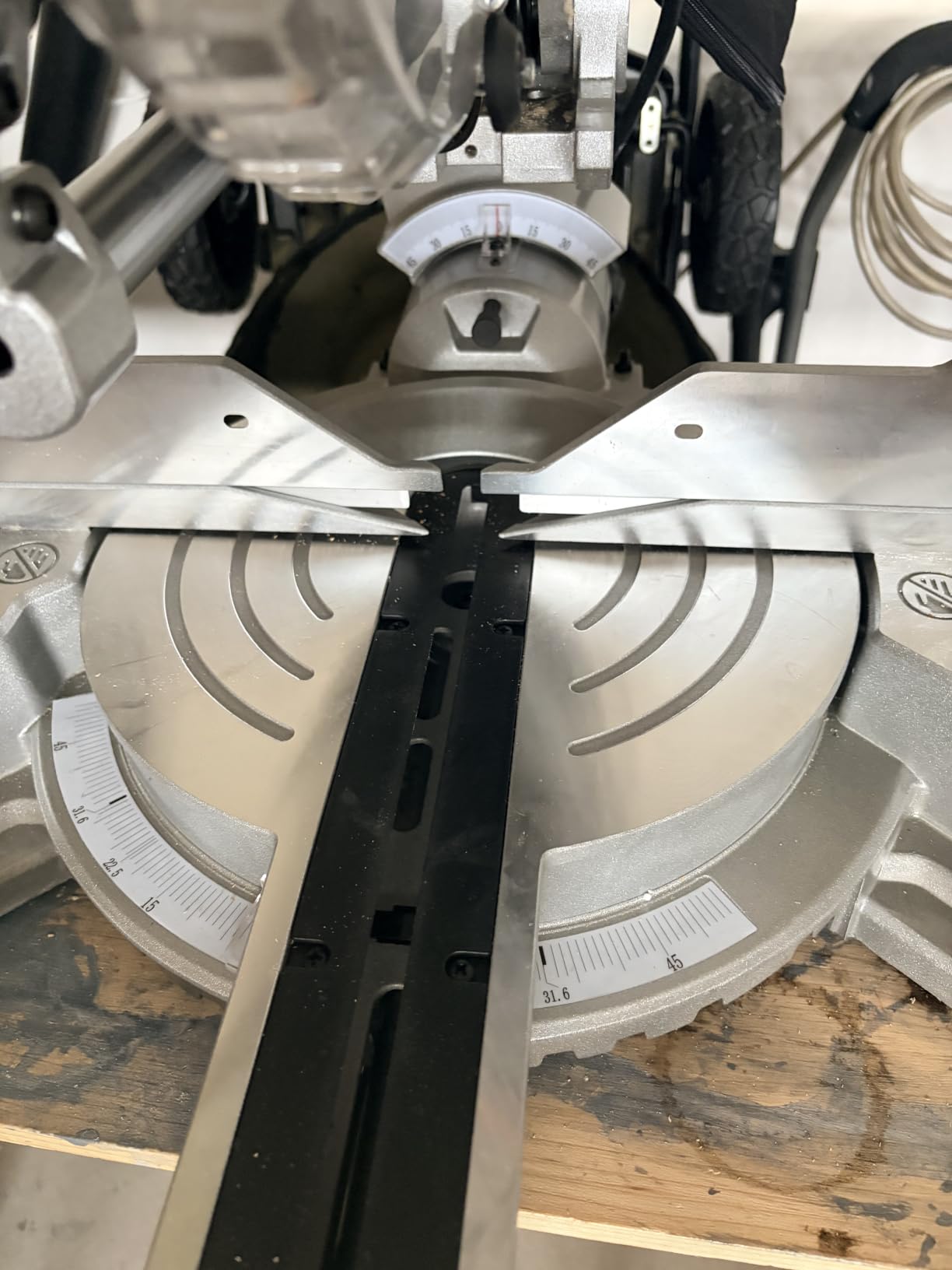
The aluminum base is meaningfully lighter than the cast iron used on most 12-inch saws, and the saw comes in at 46.4 pounds. Heat dissipation is better too, which matters less on finish trim than on repeated crosscuts but is a real advantage when you are running a saw hard for hours.
The trade is stiffness. Cast iron resists deflection better, and on heavy crosscuts the aluminum base can flex more, which shows up as a cut that is square at the front of the table and out at the back. Support long stock properly and you will never see it, but do not rely on overhang alone.
Dual bevel, 60-tooth blade and cut guide accuracy
Dual bevel from 0 to 45 degrees on both sides covers picture frame molding, casing and standard compound trim without flipping the workpiece. The 60-tooth blade is the right count for finish work, so unlike several competitors here there is no blade swap needed before you start on casing.
The LED guide system projects cut lines and adds a precision scale and angle lock. It is less precise than a laser or a shadow line for fine trim, so for visible painted work, pencil the line and treat the LED as a confirmation aid rather than the primary reference.
Support and long-term durability
Accessories and support are more limited than with major brands, which is the practical concern. Replacement fences, clamps and dust components can take longer to source, so if the saw will be worked daily, factor that into the decision rather than buying on capability alone.
At 151 reviews there is no long-term data to lean on. Treat this as a capable first trim saw or a light secondary saw for a shop that already owns a proven machine, not as the one saw a working trim carpenter depends on.
12. Festool Kapex KS 120 REB – Repeatable Angles and the Best Dust Extraction
Festool 575306 Sliding Compound Miter Saw KAPEX KS 120 REB
10 in 60-tooth blade
Rail forward design
Dual lasers
Dust extraction up to 91 percent
+ Pros
- Dual lasers work from either side and show the material removed
- Rail forward design resists head play and holds accuracy
- Best dust extraction in the group at up to 91 percent
- Micro-adjustable bevel knob with fine pointers
- Three-year wear-and-tear warranty with a two-day standard repair turnaround
- Cons
- Highest cost in the group by a wide margin
- 13 amp motor has less reserve than 15 amp saws on thick hardwood
- Proprietary accessories and limited resale value
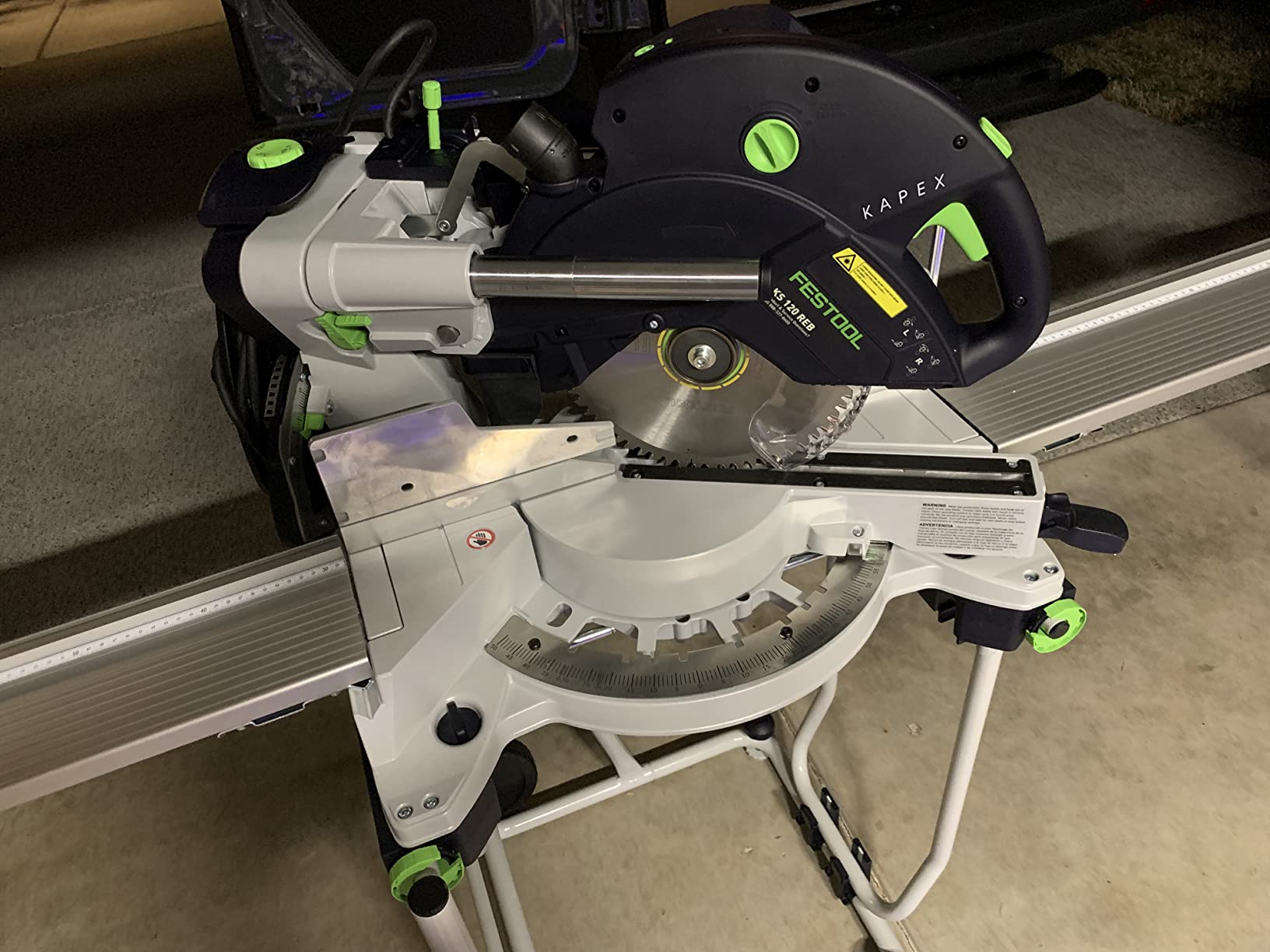
The Kapex KS 120 REB is the enthusiast choice, and it earns the description on mechanics rather than marketing. The rail forward design moves the rails behind the head, which increases precision and prevents head play, and that is the mechanism behind its reputation for holding the same angle over a long session. At 4.6 across 146 reviews with 83 percent five-star, it draws from serious woodworkers rather than occasional buyers.
It is also the most expensive saw here by a wide margin, and it is worth being clear that the premium buys a specific set of behaviors: repeatable angles, excellent dust control and fast setup, not raw cutting capacity.
Dual lasers and the micro-adjust bevel
Two lasers align cuts from either side of the saw and show the material being removed, which means you are cutting to the line the material will leave rather than to where the blade currently sits. For repetitive trim this is faster than a single laser, because you can approach from whichever side the workpiece is on.
The micro-adjustable bevel angle uses an up-front rotary knob with a large scale and fine pointers. You can dial a compound angle in from a reference line rather than reading a small scale, which is the difference between setting a 52 degree crown miter quickly and setting it approximately. The included angle transfer device lets you carry an angle from one workpiece directly to the saw.
Dust extraction and why it changes the workflow
Rated extraction of up to 91 percent is the best figure in this group, and it comes from a behind-the-cut dust hood with a pivoting 36 mm hose. The hood sits behind the cut rather than beside it, so it catches dust at the point of generation instead of chasing it.
That matters more than the number suggests. Trim dust is fine and it coats everything within a few feet, so a saw that keeps the room clear lets you keep cutting without stopping to sweep. The pivot on the hose port also means you can route the hose from any direction, which is what you need when the saw sits against a wall.
Where the premium does not apply
The motor is 13 amps, which is less reserve than the 15 amp saws here. On thick hardwood it will not have the same headroom, and for a shop cutting a lot of dimensional lumber that matters. For finish trim, where most cuts are profiled and moderate, it is not a limitation.
Accessories are proprietary and the resale value is limited. If you are furnishing a first shop and expect to grow into a better saw later, that is wasted money. If you trim for a living and measure your joints against a set of identical pieces every week, the head play resistance and the extraction pay for themselves quickly.
How to Choose a Sliding Miter Saw for Trim Work
Trim saw buying is not framing saw buying. A framing saw is optimized for one thing: getting through dimensional lumber fast. A trim saw is optimized for holding an angle and producing a clean face. Every choice below is filtered through that difference.
Blade size sets your crown and baseboard capacity
Nesting crown capacity is the first filter, because it is the spec that quietly determines whether you can cut a profile in one pass. Look at published nesting capacity rather than blade diameter, since a 10-inch saw with tall fences can beat a 12-inch saw with short ones. In this group, nesting crown runs from 6 inches on the Bosch CM10GD up to 8 inches on the Makita LS1219L, and the SKIL MS6305-00 is smaller still.
For standard interior residential trim, 6 inches of nesting crown and 5-1/2 inches of vertical baseboard is enough for most profiles. Tall colonial or modern ceiling crown is where 7-1/2 inches and up starts to matter.
Dual bevel is the feature trim carpenters pay for
Dual bevel means the head tilts both ways, so you can cut both faces of a molding in place. On any workpiece too long to comfortably turn on a bench, that removes an entire handling step and the risk of a mismatch between two setups. Single bevel saws like the Delta S26-263L and the EVOLUTION R255SMS+ force you to flip the work, which is fine for short casing and frustrating for crown.
Compounding dual bevel with a miter range past 45 degrees gives you the compound angles tall crown requires. Beyond that, understand the split between the two angles: the miter angle is the saw head rotating left or right in the horizontal plane, and the bevel angle is the head tilting left or right in the vertical plane. Crown needs both, which is why compound crown cuts are calculated from two numbers rather than one.
Crown miter math is just division
For a standard crown profile with a 52 degree included angle, the miter angle is 26 degrees, because the molding sits in the corner and half of that angle is what each piece needs. The same rule gives 22.5 degrees for 45 degree crown and 30 degrees for 60 degree crown. Measure the included angle of the back of the molding with an inexpensive bevel gauge or protractor, divide by two, and set the miter.
Set the bevel only when the molding is too wide to nest against the fence, which happens with wide flat-on-flat back profiles. Narrower profiles should be nested, because nesting holds the back edge in the blade plane and produces a flat, true joint instead of a twisted one.
Miter detent quality decides whether the saw is trustworthy
This is the issue that comes up most often in discussions among trim carpenters, and almost no roundup addresses it directly. Cheap sliders use plastic miter detent stops that flex under load, so the angle you set drifts while you make the cut, and the same setting produces a different joint next time. Metal detent mechanisms with a pull-back override are meaningfully better.
Check out-of-box accuracy before you trust a saw. Square a machinist square or a combination square against the table and the backplate and check the fence against the table, then verify each detent against a protractor. If a saw needs adjustment, do it before any finished work rather than after the first bad joint.
Rear clearance is a layout decision, not a spec
Traditional rail sliders grow roughly ten inches deeper when the head slides fully back. In a small room, that is the difference between setting the saw against a wall and setting it out in the middle of the floor. Two approaches solve it: articulated hinge arms that swing the head forward, as on the Bosch CM10GD, saving up to ten inches, or twin rail designs positioned so the saw can run flush to a wall, as on the Makita LS1019L and LS1219L. Check your room depth before you commit.
Cut guides: laser, shadow line, or pencil
A shadow line, which projects the blade outline onto the workpiece, stays in one place regardless of miter angle. A laser typically swings with the head and has to be re-aimed every time you change the miter. For repetitive trim, the shadow line is faster. The DEWALT DWS780, the SKIL MS6305-00, the Bosch’s detent accuracy, and the Festool’s dual lasers each solve this differently, and the weakest guides in this group are the small diode lasers that wash out in daylight.
Weight, dust and blade tooth count
Weight decides whether you can move the saw alone. It ranges from 29.5 pounds on the Delta up to 81.6 pounds on the Makita LS1219L. Many trim carpenters buy two saws on purpose: an accurate saw mounted permanently on a bench, and a lighter one for framing and decking.
On blades, a 60-tooth or 80-tooth blade is the finish trim answer, because high tooth counts leave a smoother face and less splintering on profiled edges. A 40-tooth blade is a framing blade and shows on finished casing. A TCT multi-material blade earns its place when your list includes composite decking or mild steel. For dust, plan on a shop vac through the port; bags fill quickly and rarely keep up on profiled trim.
Frequently Asked Questions
What is the best sliding miter saw for trim work?
The u003cstrongu003eDEWALT DWS780u003c/strongu003e is the best all-around choice for trim. It is a 12 inch double bevel slider that nests 7-1/2 inches of crown molding and cuts 6-3/4 inches of baseboard vertically, with an XPS LED shadow line that stays fixed as the miter angle changes. It holds a 4.8 rating across 2505 reviews. For a tighter budget, the u003cstrongu003eSKIL MS6305-00u003c/strongu003e offers dual bevel and 2×12 capacity at a much lower cost, and the u003cstrongu003eBosch CM10GDu003c/strongu003e wins when rear clearance matters in a small room.
Is a sliding miter saw worth it for trim work?
Yes, mainly for two reasons. Dual bevel heads cut both faces of a molding without flipping the workpiece, which matters when the piece is too long to turn on a bench. Sliding rails add crosscut capacity, so the same saw handles wide boards as well as profiled trim. That said, trim carpenters frequently keep a fixed compound saw as a second machine because a fixed head has no slide play and repeats angles extremely well. If you only cut short casing and baseboard, a fixed compound saw is enough.
What is the most accurate sliding miter saw?
Accuracy comes from the rail or glide system and the detent mechanism, not from the brand name. The u003cstrongu003eBosch CM10GDu003c/strongu003e is frequently reported as dead-on out of the box with no tuning, and the u003cstrongu003eFestool Kapex KS 120u003c/strongu003e uses a rail forward design specifically to resist head play over long sessions. Whichever saw you buy, verify the 90 degree cut, the fence against the table, and each miter detent against a protractor before cutting finished stock.
What size miter saw blade do I need for trim work?
For most interior residential trim, a 10 inch blade with at least 6 inches of nesting crown capacity is enough, and it is easier to carry. Choose a 12 inch blade when you cut tall crown profiles, wide casing, or long baseboard runs in volume, since it gives roughly two inches more nesting capacity. The blade tooth count matters as much as the diameter: 60 teeth for finish trim, 80 teeth for the cleanest profiled edges, 40 teeth only for framing, and TCT multi-material blades when cutting composite or mild steel.
Do I need a laser guide on a miter saw for trim?
A guide helps, but an LED shadow line is usually better for trim than a laser. A shadow line is projected from a fixed point and does not move when you change the miter angle, so it does not need re-aiming between identical cuts. A laser typically swings with the head and becomes hard to see in bright daylight. If you buy a saw without either, a pencil line snapped from the blade edge to the workpiece works well once you learn the kerf offset.
Which Sliding Miter Saw Should You Buy in 2026?
If you want one saw to handle crown, casing and baseboard for the next decade, choose the DEWALT DWS780. It has the best combination of rating, review volume, crown nesting capacity and a cut guide that does not need re-aiming, and at 58 pounds it belongs on a bench rather than in a truck bed.
If your budget is the deciding factor, the SKIL MS6305-00 does the same job on a 10-inch blade at 39.4 pounds. Swap its 40-tooth blade for a 60-tooth before any stain-grade work and it is a genuinely capable trim saw.
If you are working in tight rooms, the Bosch CM10GD wins on footprint and out-of-box miter accuracy, and the Makita LS1019L is the alternative if you also want a laser and a ball bearing slide. If you cut maximum crown all day, the Makita LS1219L nests 8 inches but weighs 81.6 pounds.
Whichever you pick, calibrate the detents and the fence before the first piece of finished trim, fit a 60-tooth or 80-tooth blade, and hook up a shop vac. Those three steps do more for the quality of your joints than any spec on the box.