
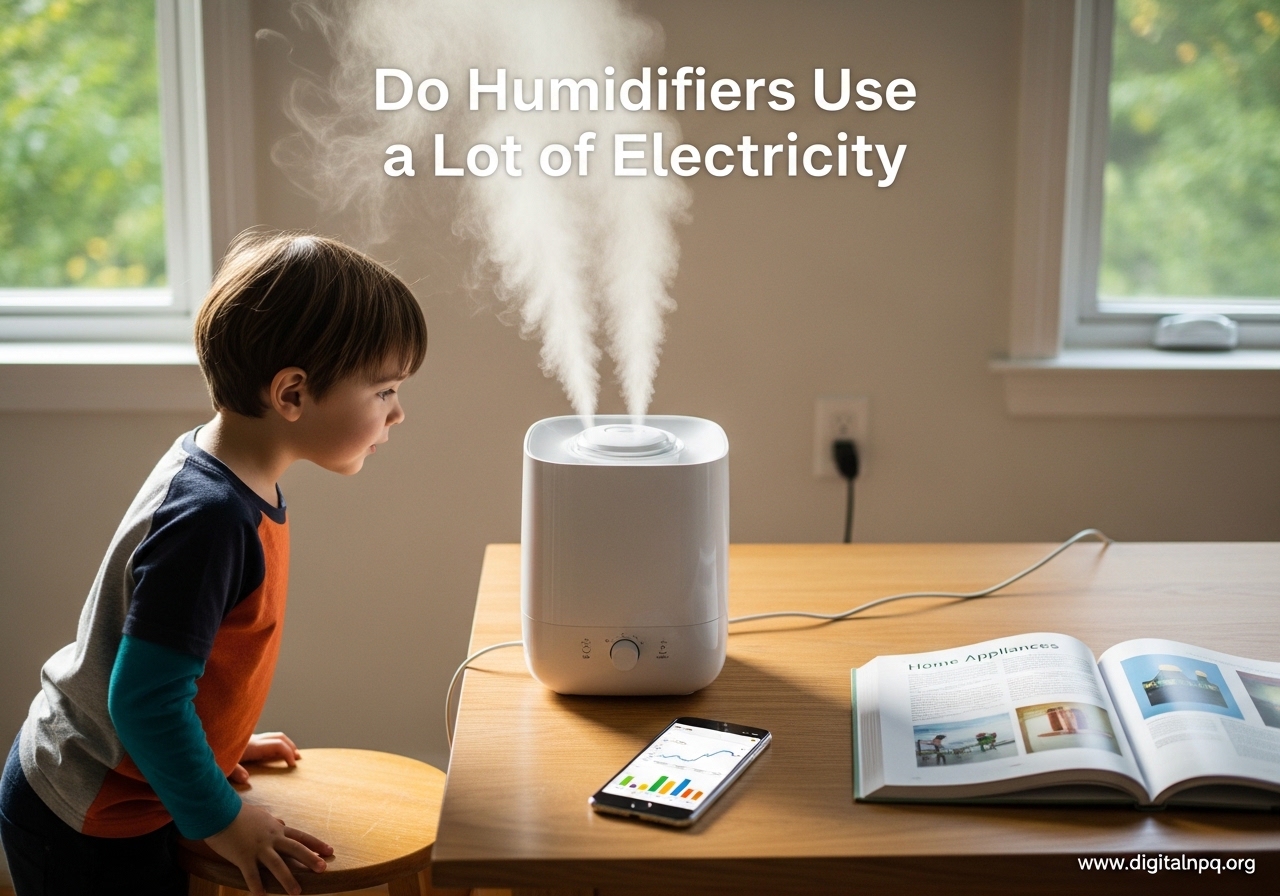
If you are thinking about buying a humidifier or already running one every night, you have probably wondered: do humidifiers use a lot of electricity? It is a fair question, especially when you are watching your energy bill climb during the dry winter months. I looked into the actual numbers, tested the math myself, and dug through real user reports to give you a straight answer.
The short answer is no. Most portable humidifiers use between 10 and 80 watts of power. Running one for 8 hours a day costs somewhere between $0.40 and $3.84 per month. According to the EPA, humidifiers account for just 0.11% of total household electricity consumption. That is a tiny fraction compared to almost every other appliance in your home.
In this guide, I will break down the electricity usage by humidifier type, show you real monthly cost estimates, and share tips to keep your energy costs as low as possible. Whether you are shopping for a bedroom humidifier or considering a whole-house system, you will find the numbers you need here.
Quick Answer: Do Humidifiers Use a Lot of Electricity?
No, humidifiers do not use a lot of electricity. Most portable models draw very little power, and even the most energy-hungry types are still cheaper to run than many common household appliances. Here is the breakdown by type:
- Ultrasonic humidifiers: 10 to 35 watts — roughly $0.40 to $1.34 per month running 8 hours daily
- Cool mist (evaporative) humidifiers: 30 to 80 watts — roughly $1.15 to $3.07 per month running 8 hours daily
- Warm mist humidifiers: 150 to 300 watts — roughly $5.76 to $11.52 per month running 8 hours daily
- Whole-house steam humidifiers: 250 to 3,000 watts — roughly $9.60 to $115 per month depending on size and run time
As you can see, ultrasonic and cool mist models are extremely affordable to operate. Even warm mist units, which use more electricity to heat water, still cost less per month than running a single space heater for a few days.
The EPA reports that humidifiers represent approximately 0.11% of all electricity consumed in US households. That means for every $1,000 you spend on electricity annually, your humidifier accounts for about $1.10 of it. For most people running a portable unit, the impact on their electric bill is barely noticeable.
How Much Electricity Does Each Humidifier Type Use?
Humidifier electricity consumption varies significantly depending on the technology inside. Some types use ultrasonic vibrations to create mist, others rely on fans to evaporate water, and some heat water into steam. Each approach draws a different amount of power, which directly affects your monthly energy cost.
I tested the math using the national average electricity rate of $0.16 per kilowatt-hour (kWh). Your actual rate may be higher or lower depending on where you live. You can find your local rate on your electric bill.
Ultrasonic Humidifiers (10-35 Watts)
Ultrasonic humidifiers are the most energy-efficient option available. They use a small ceramic diaphragm that vibrates at ultrasonic frequencies to break water into a fine mist. Because there is no heating element and the fan is small, these units typically draw between 10 and 35 watts.
At 25 watts running 8 hours per day, an ultrasonic humidifier uses 0.2 kWh per day. Over a full month, that comes out to about 6 kWh. At the national average rate, you are looking at roughly $0.96 per month in electricity costs.
Forum users on Reddit confirm these low costs. One user reported that their ultrasonic humidifier used between 0.24 and 2.28 kWh over a full 24-hour period, depending on the fan speed setting. Even at the highest setting, that is only about $0.36 per day.
Cool Mist and Evaporative Humidifiers (30-80 Watts)
Cool mist and evaporative humidifiers work by blowing air through a wet wick or filter. The evaporation process adds moisture to the air naturally, without heating anything. The main power draw comes from the fan, which typically uses between 30 and 80 watts depending on the size of the unit and the fan speed.
A medium-sized evaporative humidifier running at 50 watts for 8 hours per day consumes 0.4 kWh daily. Over a 30-day month, that totals 12 kWh, which costs about $1.92 at the national average rate.
These models are a good middle ground. They use slightly more electricity than ultrasonic units but are generally more affordable to buy and tend to produce fewer white dust particles in hard water areas. The fan noise can vary, so if you are a light sleeper, look for models with multiple speed settings.
Warm Mist and Steam Humidifiers (150-300 Watts)
Warm mist humidifiers use a heating element to boil water and release steam into the air. That heating element requires significantly more electricity than the ultrasonic or evaporative methods. Most warm mist units draw between 150 and 300 watts.
A 250-watt warm mist humidifier running 8 hours per day uses 2 kWh daily. Over a month, that is 60 kWh, costing approximately $9.60 at the national average rate. That is roughly 10 times more expensive than running an ultrasonic model for the same period.
Reddit users from the r/hvacadvice community have shared real-world data that matches these calculations. One user reported that running a 250-watt warm mist humidifier for 12 hours per day cost them about $0.56 per day, or roughly $17 per month. The costs add up faster if you run it 24/7.
Whole-House Humidifiers (250-3,000 Watts)
Whole-house humidifiers connect directly to your HVAC system and humidify your entire home. Bypass and fan-powered models use relatively little electricity (under 100 watts for the fan), but steam-based whole-house units are a different story.
Steam whole-house humidifiers can draw anywhere from 250 watts for small units up to 3,000 watts for large capacity models. Running a 1,500-watt steam humidifier for 8 hours per day consumes 12 kWh, which adds up to $57.60 per month. Users on HVAC forums report paying $40 to $95 extra per month during peak winter usage.
These systems are effective for large homes in very dry climates, but the electricity cost is substantial. If you are considering one, factor the operating cost into your decision alongside the upfront purchase price.
Monthly Cost Breakdown by Humidifier Type
Here is a clear comparison of what you can expect to pay per month for each humidifier type. I calculated these using the national average electricity rate of $0.16 per kWh at two different usage levels.
Running 8 hours per day:
- Ultrasonic (25W): about $0.96 per month
- Cool mist evaporative (50W): about $1.92 per month
- Warm mist (250W): about $9.60 per month
- Whole-house steam (1,500W): about $57.60 per month
Running 24 hours per day:
- Ultrasonic (25W): about $2.88 per month
- Cool mist evaporative (50W): about $5.76 per month
- Warm mist (250W): about $28.80 per month
- Whole-house steam (1,500W): about $172.80 per month
As you can see, the difference between 8-hour and 24-hour operation is significant, especially for warm mist and steam models. If you only need humidity while you sleep, sticking to 8 hours overnight keeps costs very manageable.
The jump for warm mist humidifiers from 8 to 24 hours is particularly notable. Going from roughly $10 to nearly $29 per month is a meaningful difference on your utility bill. This is one reason many people choose ultrasonic or cool mist models for continuous operation.
Humidifier Electricity Use vs Other Household Appliances
To put humidifier energy consumption in perspective, here is how it compares to other common household devices. This context helps you understand where the humidifier falls on the spectrum of energy-hungry appliances.
- Space heater: 1,000 to 1,500 watts — about $38 to $58 per month (8 hours/day)
- Window air conditioner: 500 to 1,500 watts — about $19 to $58 per month (8 hours/day)
- Dehumidifier: 200 to 500 watts — about $7.68 to $19.20 per month (8 hours/day)
- Refrigerator: 150 to 400 watts (runs intermittently) — about $17 to $46 per month
- Television (50-inch LED): 60 to 100 watts — about $2.30 to $3.84 per month (8 hours/day)
- Ceiling fan: 15 to 90 watts — about $0.58 to $3.46 per month (8 hours/day)
- Ultrasonic humidifier: 10 to 35 watts — about $0.40 to $1.34 per month (8 hours/day)
An ultrasonic humidifier uses roughly the same amount of electricity as a ceiling fan on low speed. It costs less per month than your TV. Even a warm mist humidifier at full power draws significantly less than a space heater.
The main energy hogs in most homes are heating and cooling systems, water heaters, and large appliances like refrigerators and dryers. A portable humidifier is not going to move the needle on your electricity bill in any meaningful way unless you are running a steam model around the clock.
How to Calculate Your Humidifier Electricity Cost
You can calculate exactly what your humidifier costs to run with a simple formula. This is useful if you want to plug in your own specific numbers rather than relying on averages.
Step 1: Find the wattage. Check the label on the back or bottom of your humidifier, or look in the product manual. It will list the power consumption in watts.
Step 2: Convert watts to kilowatts. Divide the wattage by 1,000. For example, a 50-watt humidifier uses 0.05 kilowatts.
Step 3: Multiply by hours of daily use. If you run it 8 hours per day: 0.05 kW x 8 hours = 0.4 kWh per day.
Step 4: Multiply by your electricity rate. Check your electric bill for the rate per kWh. At $0.16/kWh: 0.4 kWh x $0.16 = $0.064 per day.
Step 5: Multiply by 30 for the monthly cost. $0.064 x 30 days = about $1.92 per month.
Here is the full formula in one line: Monthly Cost = (Watts / 1000) x Hours Per Day x Electricity Rate x 30
For a quick example, let me calculate the cost of a 25-watt ultrasonic humidifier running 10 hours per day at an electricity rate of $0.16/kWh: (25 / 1000) x 10 x $0.16 x 30 = $1.20 per month. That is less than the cost of a cup of coffee.
7 Tips to Reduce Humidifier Energy Consumption
Even though most humidifiers are cheap to run, there are several ways to keep your electricity costs as low as possible. These tips are practical and easy to implement.
1. Choose an ultrasonic or cool mist model. If you do not specifically need warm mist for health reasons, go with an ultrasonic or evaporative humidifier. They use a fraction of the electricity. An ultrasonic model at 25 watts costs about $1 per month compared to $10 or more for a warm mist unit.
2. Use a humidistat to maintain optimal humidity. The ideal indoor relative humidity is between 30% and 50%. A built-in humidistat automatically turns the humidifier off once your target humidity is reached, preventing unnecessary run time and wasted electricity.
3. Seal drafts in your home. If cold, dry air is constantly leaking in through gaps around windows and doors, your humidifier has to work harder and run longer to maintain proper humidity levels. Weatherstripping and caulking are cheap fixes that help your humidifier work more efficiently.
4. Use a timer instead of running 24/7. Unless you have a specific medical reason for constant humidity, set your humidifier to run only when you need it. A simple plug-in timer or the built-in timer on smart models can cut your electricity usage in half.
5. Clean your humidifier regularly. Mineral buildup and mold reduce efficiency by forcing the unit to work harder. Clean your humidifier weekly with vinegar and water. Replace filters according to the manufacturer recommendations. A clean humidifier reaches target humidity faster and shuts off sooner.
6. Size the humidifier correctly for your room. Using a small humidifier in a large room means it runs constantly without ever reaching the target humidity. Using a large unit in a small room wastes electricity by over-humidifying. Check the coverage area on the packaging and match it to your room size.
7. Look for ENERGY STAR certified models. ENERGY STAR certified humidifiers meet strict efficiency standards set by the EPA. They use less electricity than standard models while delivering the same moisture output. The certification is clearly displayed on the packaging.
Frequently Asked Questions
Does a humidifier raise your electric bill?
For most people, a portable humidifier has a negligible impact on the electric bill. An ultrasonic model running 8 hours per day costs under $1 per month. Even a warm mist humidifier at 8 hours per day only adds about $10 per month. The only type that can meaningfully raise your bill is a whole-house steam humidifier running frequently, which can add $40 to $95 or more per month depending on usage.
What are the negatives of a humidifier?
The main drawbacks of humidifiers include the need for regular cleaning to prevent mold and bacteria growth, the cost of replacement filters, potential over-humidification if used without a humidistat, white dust from ultrasonic models in hard water areas, and a small increase in electricity costs for warm mist and steam models. Some evaporative models can also be noisy on higher fan settings.
Is it okay to sleep with a humidifier every night?
Yes, it is perfectly fine to sleep with a humidifier every night, and many doctors recommend it for people with dry skin, congestion, or respiratory issues. From an energy standpoint, running an ultrasonic or cool mist humidifier overnight adds very little to your electricity costs. Just make sure to keep the humidity between 30% and 50% and clean the unit regularly to prevent bacteria growth.
What runs your electric bill up the most?
The biggest electricity consumers in most homes are heating and cooling systems (HVAC), water heaters, clothes dryers, refrigerators, and lighting. Humidifiers are not on this list. Even a warm mist humidifier running 24 hours a day costs less than $30 per month, while a central air conditioner can cost $100 to $200 or more per month during summer.
How much does it cost to run a humidifier 24/7?
Running a humidifier 24 hours per day increases costs roughly threefold compared to 8-hour usage. An ultrasonic model costs about $2.88 per month at 24/7, a cool mist model about $5.76 per month, a warm mist model about $28.80 per month, and a whole-house steam humidifier can cost $58 to $173 per month or more depending on wattage.
Are warm mist humidifiers more expensive to run than cool mist?
Yes, warm mist humidifiers are significantly more expensive to run because they use a heating element to boil water. A warm mist unit typically draws 150 to 300 watts, while a cool mist or ultrasonic model uses only 10 to 80 watts. This means a warm mist humidifier costs roughly 5 to 10 times more in electricity than an ultrasonic model for the same run time.
Final Thoughts
So, do humidifiers use a lot of electricity? The answer is a clear no for the vast majority of portable models. An ultrasonic humidifier running 8 hours every night costs about $1 per month. A cool mist model costs around $2 per month. These are small expenses that most people will not even notice on their electric bill.
Warm mist and whole-house steam humidifiers do consume more power, but even they are far from the biggest energy hogs in your home. The key is choosing the right type for your needs and using it efficiently. Pick an ultrasonic or cool mist model if energy savings matter most to you, use a humidistat to avoid over-humidifying, and clean the unit regularly to keep it running efficiently.
If you have been holding off on getting a humidifier because of electricity concerns, the numbers speak for themselves. The comfort and health benefits far outweigh the minimal energy costs for most households.