
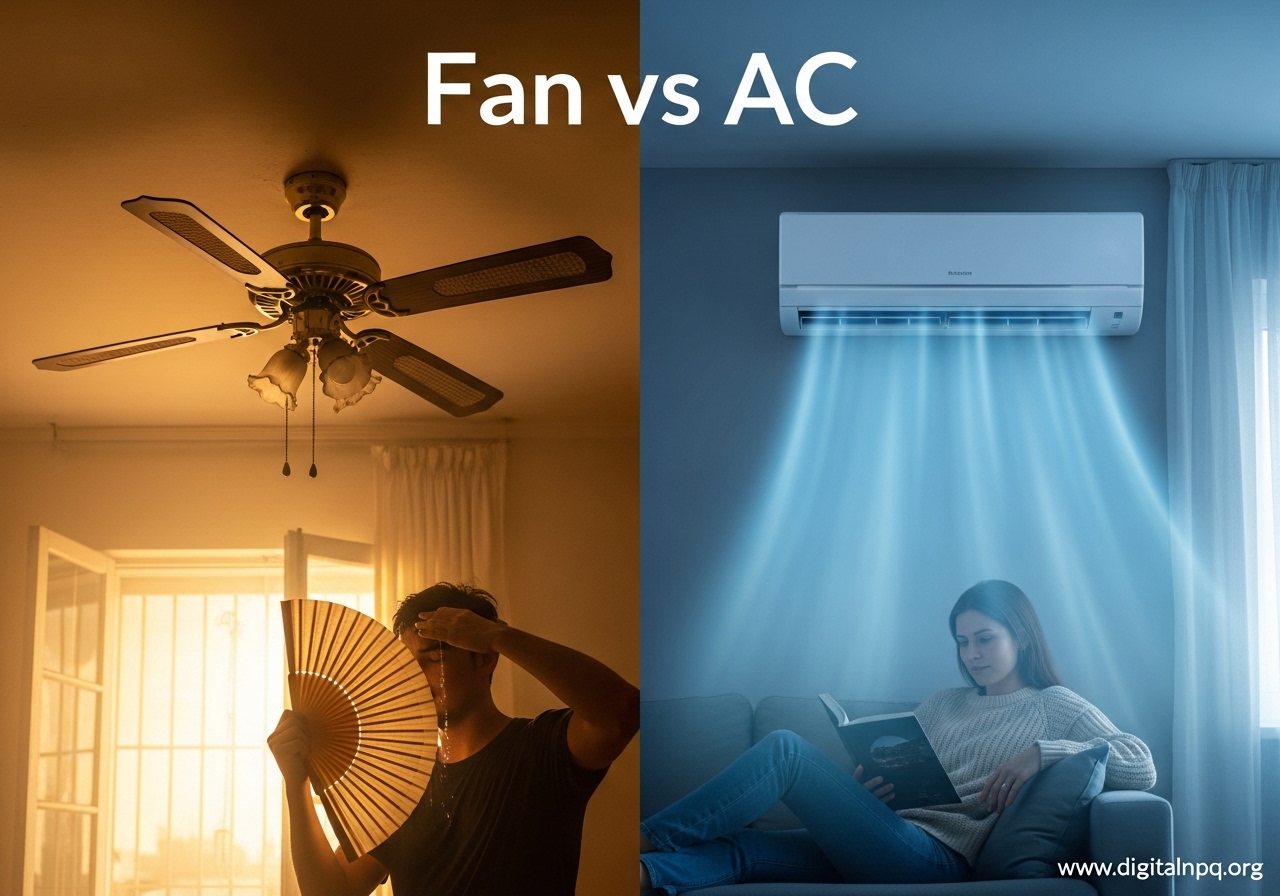
Every summer, the same debate plays out in homes across the country: fan vs AC, which one should you rely on to stay cool? Our team dug into the science, the costs, and the health implications to give you a clear answer. The truth is, neither one is universally better. The right choice depends on your climate, your health, your budget, and how hot it actually gets where you live.
In this guide, we break down exactly how fans and air conditioners work, compare their energy consumption and operating costs, address health concerns like whether AC is safe for bronchitis or heart patients, and give you specific temperature and humidity thresholds to help you decide. By the end, you will know exactly when to flip on the fan, when to crank the AC, and when using both together makes the most sense.
How Fans and Air Conditioners Cool Differently
Fans and air conditioners tackle the heat problem in two completely different ways. Understanding this difference is the key to making smart cooling decisions all summer long.
How Fans Work: The Wind-Chill Effect
A fan does not actually lower the temperature in your room. Not even a single degree. What a fan does is move air across your skin, which speeds up sweat evaporation. That evaporation pulls heat away from your body, creating a wind-chill effect that makes you feel cooler than the actual room temperature. A good ceiling fan can make an 80-degree room feel closer to 76 degrees on your skin.
Because fans only move existing air, they use very little electricity. A typical ceiling fan draws between 50 and 75 watts. A desk or box fan uses even less, around 40 to 60 watts. But here is the catch: fans only cool people, not rooms. If you leave a fan running in an empty room, nothing gets cooler. You are just wasting electricity.
How Air Conditioners Work: Active Heat Removal
An air conditioner works on a completely different principle. It actively removes heat from indoor air and dumps it outside. The process relies on a chemical refrigerant that cycles through a closed loop of coils. Warm indoor air passes over the evaporator coil inside your home, where the refrigerant absorbs the heat. The compressor then pumps that heated refrigerant to the condenser coil outside, where the heat is released. The cooled air gets circulated back inside.
This cycle also pulls moisture from the air as a side effect, which is why AC rooms feel less humid. The result is actual temperature reduction, not just perceived cooling. A window AC unit uses 500 to 1,500 watts, while a central air system draws 3,000 to 3,500 watts. That is roughly 20 to 50 times more electricity than a ceiling fan.
The bottom line in the fan vs AC debate on cooling power: fans make you feel cooler without changing the room, while air conditioners physically remove heat and lower the actual temperature.
Fan vs AC Energy Efficiency and Electricity Consumption
Energy consumption is where the fan vs AC cost comparison gets really dramatic. The difference is not small. It is massive.
Wattage and Hourly Cost Breakdown
Here is how the numbers stack up for a typical summer day of cooling. A ceiling fan running on medium speed uses about 60 watts and costs roughly $0.01 per hour to operate. Over a full 24-hour day, that comes out to about $0.24. Run it all month and you are looking at around $3 to $5 added to your electricity bill.
A window air conditioner uses between 500 and 1,500 watts depending on the size and efficiency rating. At the national average electricity rate, running a window AC costs about $0.08 to $0.20 per hour. If you run it for 8 hours a day, that adds up to $19 to $55 per month. A central air conditioning system is even more demanding, using 3,000 to 3,500 watts and costing $0.30 to $0.50 per hour. Monthly central AC costs typically range from $30 to $270 depending on your climate, home size, and thermostat settings.
To put it simply, running a fan costs about 1% of what it costs to run an air conditioner. Over a full summer season, choosing fans over AC in appropriate conditions could save you hundreds of dollars.
Calculating Your Own Cooling Costs
You can estimate your own cooling costs with a simple formula. Multiply the wattage of your device by the number of hours you run it per day, then divide by 1,000 to get kilowatt-hours. Multiply that by your electricity rate (the national average is about $0.14 per kWh). For example, a 75-watt fan running 12 hours per day uses 0.9 kWh, costing about $0.13 per day or $3.84 per month. A 1,500-watt window AC running 8 hours per day uses 12 kWh, costing about $1.68 per day or $50 per month.
Fan vs AC Pros and Cons Comparison
Here is a straightforward side-by-side look at the advantages and disadvantages of each option.
Advantages of Fans
- Extremely low energy consumption (50-75 watts for ceiling fans)
- Very low operating cost, roughly $0.01 per hour
- Portable and easy to move between rooms
- Simple installation with no professional help needed
- Quieter operation than most AC units
- Better air circulation that prevents stale air buildup
- No refrigerants or chemical coolants involved
Disadvantages of Fans
- Do not reduce actual room temperature
- Ineffective when temperatures exceed 95 degrees Fahrenheit
- Cannot control indoor humidity levels
- No air filtration capability
- Provide zero cooling benefit in an unoccupied room
- Can blow dust and allergens around if filters are not clean
Advantages of Air Conditioners
- Actively lower room temperature by removing heat
- Control humidity by pulling moisture from the air
- Filter indoor air, removing dust, pollen, and some pollutants
- Effective in any temperature, even extreme heat above 100 degrees
- Provide consistent comfort regardless of outdoor conditions
- Essential for vulnerable populations during heat waves
Disadvantages of Air Conditioners
- High energy consumption (500-3,500 watts depending on type)
- Significantly higher operating costs, $30-$270 per month
- Professional installation required for central and split systems
- Regular maintenance needed (filter changes, coil cleaning, refrigerant checks)
- Can dry out indoor air, causing skin, eye, and throat irritation
- Contribute to peak electricity demand and grid strain during summer
- Contain refrigerants with global warming potential
Health Considerations: Fan vs AC for Different Conditions
The health angle of the fan vs AC question comes up more often than you might think. People with respiratory conditions, heart problems, and other health concerns need to think carefully about their cooling choices. Here is what the evidence and medical guidance suggest.
AC and Bronchitis
Air conditioning can be a double-edged sword for people with bronchitis or other respiratory conditions. On one hand, AC removes humidity and filters out some airborne particles, which can help people who are sensitive to mold or dust mites. On the other hand, cold, dry air from an AC unit can irritate already inflamed airways and trigger coughing spells. If you have bronchitis, the best approach is to keep your AC set to a moderate temperature, around 72 to 75 degrees, and avoid sitting directly in the cold airflow. Using a humidifier alongside your AC can also help counteract the drying effect.
Fans and Heart Patients
Fans are generally safe and even recommended for heart patients during hot weather. The key concern for people with cardiovascular conditions is avoiding heat stress, which puts extra strain on the heart. During moderate heat, a fan provides sufficient cooling without the sudden temperature shocks that air conditioning can sometimes cause. However, during extreme heat events when indoor temperatures rise above 95 degrees, fans alone may not provide enough cooling, and air conditioning becomes necessary to prevent heat-related illness.
Fan vs AC for Cough and Throat Issues
If you are dealing with a cough or sore throat, the dry air produced by air conditioning can make things worse by drying out your mucous membranes. A fan set on low or oscillating mode is usually the gentler option because it moves air without drastically changing humidity or temperature. That said, avoid pointing a fan directly at your face while sleeping, as the constant airflow can dry out your throat overnight. The best setup for cough relief is often a fan on low speed with a bowl of water or a small humidifier nearby.
Dehydration and Heat Stroke Prevention
Both fans and AC can contribute to dehydration if you are not careful. Fans speed up sweat evaporation, which means you lose water faster without necessarily noticing. Air conditioners dry the air, which can lead to gradual dehydration over hours. In either case, drinking water regularly is essential. For heat stroke prevention during extreme heat, air conditioning is the safer choice because it actually lowers the ambient temperature. Fans cannot protect you once the air temperature exceeds your body temperature.
When to Use a Fan vs AC: Temperature and Humidity Guide
This is where theory meets practice. You need a simple, actionable framework for deciding between a fan and AC on any given day. Here are the thresholds our team recommends based on climate data and energy research.
Use a Fan When:
- Indoor or outdoor temperature is below 90 degrees Fahrenheit
- Relative humidity is below 50 percent
- You only need to cool one or two people in a room, not the entire space
- It is a mild climate evening or overnight when temperatures naturally drop
- You want to supplement AC by allowing a higher thermostat setting
Use AC When:
- Temperature exceeds 90 degrees Fahrenheit
- Relative humidity is above 60 percent
- Anyone in the household is elderly, very young, or has a health condition affected by heat
- Indoor air quality is poor due to smoke, pollen, or pollution
- You need to cool multiple rooms simultaneously
Can You Run a Fan and AC Together?
Yes, and it is actually a smart strategy. Running a ceiling fan alongside your air conditioner lets you raise your thermostat setting by about 4 degrees without any loss of comfort. The fan helps distribute the cooled air more evenly throughout the room, preventing hot spots and reducing how hard the AC has to work. If your AC normally costs $100 per month to run, this combination approach could cut that by 15 to 20 percent, saving you $15 to $20 monthly while keeping you just as comfortable.
Room Size Considerations
Fans work best in small to medium rooms where air can circulate effectively. In large open-plan spaces, a single fan may not provide adequate cooling even in moderate heat. Air conditioners, especially window units, are rated by BTU capacity for specific room sizes. A 5,000 BTU window unit handles a 150-square-foot room, while a 10,000 BTU unit covers about 450 square feet. Match your cooling method to the space for the best results.
Environmental Impact of Fans vs Air Conditioners
The environmental footprint of your cooling choice matters more than most people realize. Air conditioners account for roughly 6 percent of all electricity use in the United States, releasing about 117 million metric tons of carbon dioxide annually. Fans account for a tiny fraction of that.
Beyond electricity consumption, air conditioners use refrigerants like HFCs that have a global warming potential thousands of times greater than carbon dioxide. Even though modern units use lower-impact refrigerants, leaks during operation and disposal remain an environmental concern. Fans have no refrigerants, no chemical coolants, and a manufacturing footprint that is a fraction of an AC unit’s.
If environmental impact is a priority, the strategy is simple: use fans as your primary cooling method whenever conditions allow, and reserve AC for the hottest, most humid days. This combined approach can reduce your cooling-related carbon footprint by 40 to 60 percent over a summer season.
FAQ
Is it better to have a fan or AC?
Neither is universally better. Fans are ideal for mild heat (below 90F) with low humidity because they use very little energy and provide comfortable cooling through air movement. Air conditioners are necessary when temperatures exceed 90F or humidity rises above 60%, because they actively remove heat and moisture from the air. Most households benefit from using both: fans for everyday mild conditions and AC for extreme heat.
Is AC harmful for bronchitis?
AC can irritate bronchitis symptoms for some people because cold, dry air triggers coughing and inflames sensitive airways. However, AC also removes humidity and filters airborne particles, which can help people sensitive to mold or dust. If you have bronchitis, keep your AC at a moderate setting (72-75F), avoid directing cold airflow at your face, and consider using a humidifier to counteract the dry air.
How many fans are equal to 1 AC?
No number of fans can truly equal one air conditioner because they cool in fundamentally different ways. Fans create a perceived cooling effect through air movement but do not lower actual room temperature. AC units physically remove heat from the air. In energy terms, you could run roughly 40 to 50 ceiling fans for the same electricity cost as one central AC unit, but in extreme heat above 95F, no number of fans will match the cooling power of AC.
Is AC good for heart patients?
Air conditioning is generally beneficial and often necessary for heart patients during hot weather. Heat stress forces the cardiovascular system to work harder, which is dangerous for people with heart conditions. AC prevents this by maintaining a safe indoor temperature. During extreme heat waves, AC can be life-saving for heart patients. The main precaution is avoiding very cold settings that might cause sudden temperature shifts when moving between indoor and outdoor environments.
Is it actually cheaper to run a fan AND the AC at the same time?
Yes, running a fan alongside your AC is cheaper than running the AC alone at a lower temperature. A ceiling fan lets you raise your AC thermostat by about 4 degrees while maintaining the same comfort level. Since the fan costs only $0.01 per hour to run, the electricity savings from reducing your AC workload more than offset the fan’s cost. Most households save 15 to 20 percent on cooling costs with this combination approach.
Conclusion
The fan vs AC question does not have a single right answer, but it does have a smart strategy. Use fans as your everyday cooling tool when temperatures are below 90 degrees and humidity is manageable. Switch to air conditioning when the heat or humidity crosses those thresholds, especially if anyone in your home is elderly, very young, or managing a health condition. And whenever you run the AC, pair it with a ceiling fan so you can set the thermostat a few degrees higher without sacrificing comfort.
This combined approach gives you the best of both worlds: lower energy bills, a smaller environmental footprint, and reliable comfort no matter what the summer throws at you. Take a look at your local climate patterns, assess your household’s specific needs, and build a cooling plan that works for your situation.