
Summer heat shows up fast, and picking the wrong cooling system turns your home into an uncomfortable place to wait it out. Understanding the different types of air conditioners helps you match the right system to your space, budget, and climate. Whether you own a house with existing ductwork or rent a studio apartment with slide-out windows, there is an AC solution built for your exact situation.
In this guide, our team walks through every major air conditioning type available in 2026. You will learn how each system works, where it performs best, and what trade-offs to expect. By the end, you will have a clear picture of which AC type fits your home and your lifestyle.
Quick Overview: Main Types of Air Conditioners
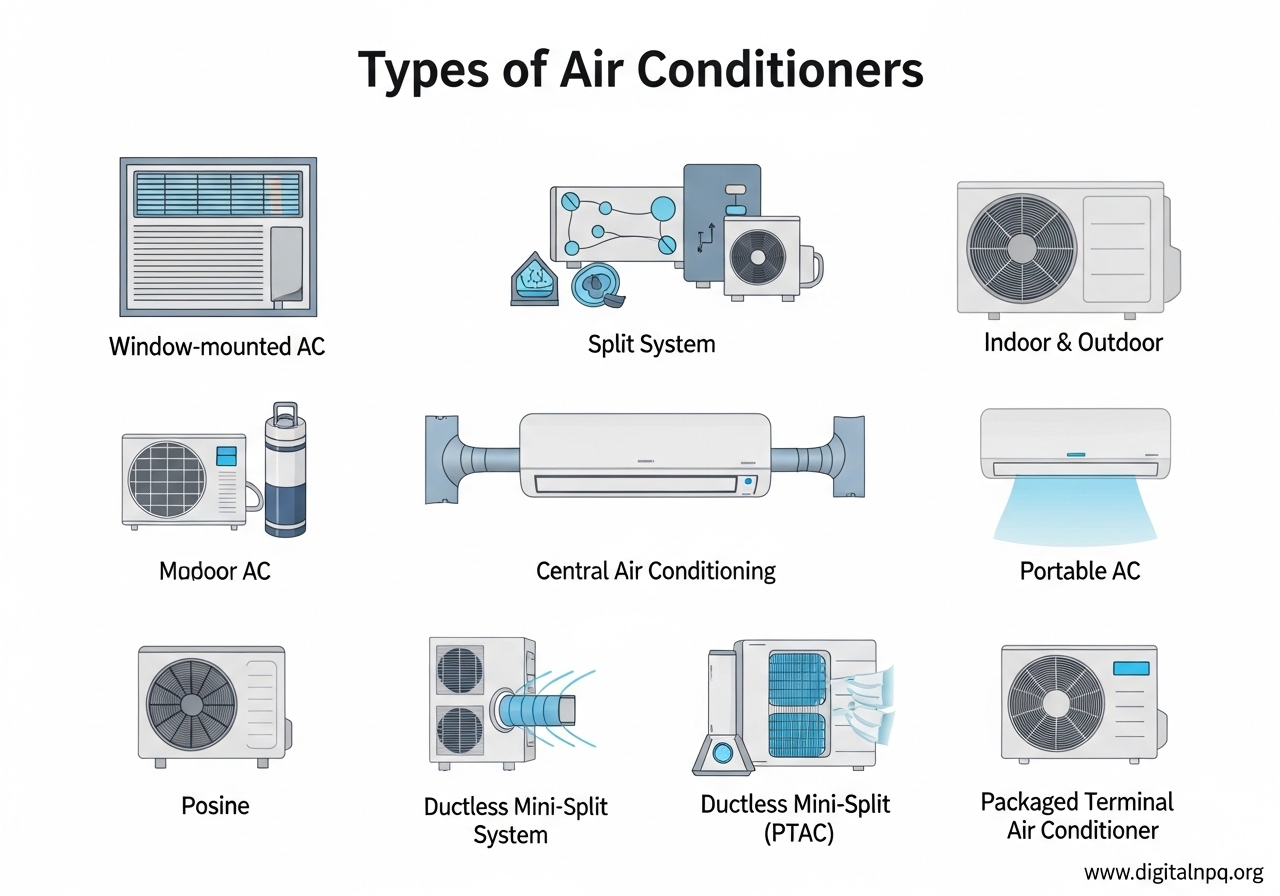
There are seven primary types of air conditioners for residential use. Each one serves a different cooling need, from whole-home comfort to spot cooling a single room:
- Central Air Conditioning — Best for whole-home cooling in houses with ductwork
- Window Air Conditioners — Best for affordable single-room cooling
- Portable Air Conditioners — Best for renters who cannot install window units
- Ductless Mini-Split Systems — Best for homes without ductwork needing zoned cooling
- Packaged Systems — Best for homes with limited indoor space for equipment
- Geothermal Heat Pumps — Best for maximum long-term energy savings
- Evaporative Coolers — Best for dry climates where humidity is low
We cover each type in detail below, including how they work, their advantages, and their limitations.
1. Central Air Conditioning Systems
Central air conditioning is the most common whole-home cooling system in the United States. It uses a split design with an outdoor unit housing the compressor and condenser coil, and an indoor unit connected to your furnace or air handler that contains the evaporator coil. Refrigerant circulates between the two units, absorbing heat from inside your home and releasing it outside.
Cooled air travels through your existing ductwork and exits through vents in every room, creating even temperatures throughout the house. A thermostat controls the system, and modern units achieve SEER2 ratings of 14 to 26, which measures cooling output relative to energy consumed.
Best for: Homeowners with existing ductwork who want consistent, whole-house cooling.
Advantages:
- Cools every room evenly from a single system
- Operates quietly since the compressor sits outside
- Improves indoor air quality with built-in filtration
- Adds resale value to your home
Drawbacks:
- Requires ductwork — expensive to install if your home lacks it
- Professional installation is mandatory
- Higher upfront cost compared to room-specific units
Installation typically takes one to three days with a licensed HVAC contractor. The technician performs a load calculation to determine the right size unit for your square footage, insulation, and climate zone. Proper sizing matters — an oversized unit short-cycles and wastes energy, while an undersized unit runs constantly without reaching your target temperature.
2. Window Air Conditioners
Window air conditioners are self-contained units that mount in a window frame or through a wall opening. All the components — compressor, condenser, evaporator coil, and fan — fit inside a single metal housing. The unit draws warm indoor air across the evaporator coil, removes heat and humidity, then blows cooled air back into the room while exhausting heat outside through the back of the unit.
Best for: Budget-conscious cooling of individual rooms, especially bedrooms and small living spaces.
Advantages:
- Most affordable option for room-by-room cooling
- No professional installation needed — most people install one themselves
- Available in sizes from 5,000 to 25,000 BTU to match room dimensions
- Easy to remove and store during winter months
Drawbacks:
- Blocks the window it occupies
- Can be noisy compared to split systems
- Only cools a single room or open area
Forum users consistently recommend window ACs over portable units for raw cooling power. A popular recent development is the U-shaped window air conditioner, which frames around your windowpane instead of sitting on the sill. Users praise U-shaped models for running noticeably quieter and still allowing the window to open partially, solving two common complaints about traditional window units. If you want specific model recommendations, check our guide to the best window air conditioners for detailed reviews.
For sizing, a general rule is 20 BTU per square foot of living space. A 150-square-foot bedroom needs roughly 5,000 BTU, while a 450-square-foot living room calls for about 10,000 BTU. Going slightly larger is fine, but avoid drastically oversizing — it causes the unit to cycle on and off too quickly without properly dehumidifying the air.
3. Portable Air Conditioners
Portable air conditioners are freestanding units on wheels that sit inside your room and exhaust hot air through a hose connected to a window kit. Unlike window units, they do not mount inside the window opening — they sit on the floor and take up floor space. The exhaust hose is the key component: it vents the heat removed from your air to the outside.
Best for: Renters in apartments where window units are not allowed, or rooms with casement windows that standard window ACs cannot fit.
Advantages:
- No window mounting required — only needs a small vent opening
- Roll from room to room as needed
- Works with window types that reject standard window ACs
Drawbacks:
- Lower cooling efficiency than window units of the same BTU rating
- Takes up floor space in your room
- Noiser than other options because the compressor sits inside the room
- Requires venting setup each time you move it
Here is an important detail many buyers miss: portable ACs come in single-hose and dual-hose configurations. Single-hose units pull air from your room to cool their condenser, then exhaust it outside. This creates negative pressure, drawing warm air in from other rooms or hallways and reducing overall efficiency. Dual-hose units solve this problem by using a second hose to pull outside air for condenser cooling, keeping your room pressure neutral. Forum users report that dual-hose models cool more effectively, though the difference is modest.
Real user feedback on forums is consistent: portable ACs provide convenient cooling but underperform compared to window units. If you have the option to install a window unit, you will get better results for less money.
4. Ductless Mini-Split Systems
Ductless mini-split systems consist of an outdoor compressor unit connected to one or more indoor air handlers by refrigerant lines and electrical wiring. A small hole in the wall — usually about three inches — routes the lines between the indoor and outdoor components. No ductwork is needed at all. Each indoor handler cools the room it is installed in, and you can run multiple handlers off a single outdoor unit.
Best for: Homes without ductwork, room additions, garages, and spaces where you want independent temperature control in each room.
Advantages:
- Zoned cooling — set different temperatures for different rooms
- High energy efficiency — many models reach SEER2 ratings above 20
- Extremely quiet indoor operation
- No ductwork required
- Many models also provide heating (heat pump function)
Drawbacks:
- Higher upfront cost than window or portable units
- Indoor air handlers are visible on your wall or ceiling
- Professional installation recommended for refrigerant line handling
The zoning capability is what sets mini-splits apart from central systems. You can cool your bedroom to 68 degrees at night while leaving the living room handler off, saving significant energy. Multi-zone setups support up to eight indoor handlers from one outdoor compressor, making them practical for whole-home cooling without ducts.
Installation involves mounting the indoor handler high on a wall, drilling the conduit hole, running refrigerant lines to the outdoor unit, and charging the system. While some handy homeowners attempt it, improper refrigerant handling and line sizing can reduce efficiency and void warranties. Professional installation is the safer route.
5. Packaged Air Conditioning Systems
Packaged systems house all components — compressor, condenser, evaporator coil, and fan — in a single outdoor metal cabinet, typically placed on a concrete slab next to the house or on a flat roof. Ductwork connects directly from the outdoor unit into the home through a wall or roof penetration. This is the opposite of a split system, where components live in two separate locations.
Best for: Homes with limited indoor mechanical space, commercial buildings, and residences in regions where rooftop installation is common.
Advantages:
- All mechanical components stay outside — frees up indoor space
- Simpler installation than split systems since everything ships in one unit
- Available in gas-electric and all-electric configurations
Drawbacks:
- Exposed to weather year-round, which can reduce component lifespan
- Harder to access for maintenance compared to indoor air handlers
- Less common in residential settings — fewer model options
Packaged units range from 2 to 5 tons of cooling capacity, covering homes from 1,000 to 3,000 square feet. They are most popular in the southern and southwestern United States, where rooftop installations are common in new construction.
6. Geothermal Heat Pump Systems
Geothermal heat pumps use the stable underground temperature — which stays between 45 and 75 degrees year-round regardless of surface weather — to cool your home. A loop of buried pipes circulates a fluid that absorbs heat from your indoor air and transfers it into the ground. Since the earth acts as a heat sink, the system moves heat more efficiently than an air-source unit that must fight against hot outdoor air.
Best for: Homeowners planning to stay in their home for 15-plus years who want the lowest possible operating costs and environmental impact.
Advantages:
- Highest efficiency of any cooling system — up to 50 percent less energy than conventional AC
- Provides both heating and cooling from the same system
- Extremely long lifespan — ground loops last 50-plus years
- Very quiet operation with no outdoor compressor noise
Drawbacks:
- Very high upfront cost — installation involves excavation or well drilling
- Requires sufficient yard space for ground loops
- Installation takes several days to weeks depending on loop type
Forum users consistently mention geothermal as the gold standard for efficiency but caution that the upfront investment is steep. The payback period runs 5 to 10 years depending on your local energy rates and climate. Federal tax credits and local rebates can offset a significant portion of the installation cost, making geothermal more accessible than the sticker price suggests.
7. Evaporative Coolers (Swamp Coolers)
Evaporative coolers work on a completely different principle than refrigerant-based systems. They pull warm outside air through water-saturated pads, and as the air passes through, water evaporation absorbs heat, dropping the air temperature by 15 to 40 degrees. A fan then pushes this cooled air into your home. No compressor, no refrigerant, and no sealed system.
Best for: Arid and semi-arid climates where relative humidity stays below 50 percent during the cooling season.
Advantages:
- Uses 50 to 75 percent less electricity than refrigerant-based AC
- Adds moisture to dry air — beneficial in arid climates
- Much lower purchase and installation cost than central AC
- Fresh air ventilation — does not recirculate indoor air
Drawbacks:
- Ineffective in humid climates — performance drops as humidity rises
- Requires a constant water supply and regular pad replacement
- Needs windows partially open for airflow, which some homeowners dislike
- Does not dehumidify — a drawback in already-moist environments
If you live in the desert Southwest or high plains where summers are hot and dry, evaporative coolers deliver impressive cooling at a fraction of the energy cost. In humid regions like the Southeast, they provide minimal relief and are not recommended.
Comparing AC Types: What Sets Each Apart
Choosing between AC types comes down to four practical factors: noise, installation complexity, maintenance, and climate suitability.
Noise Levels
Noise matters more than most people expect — it affects sleep quality, concentration, and general comfort. Here is how the types rank from quietest to loudest:
- Geothermal: Nearly silent — only a quiet circulation pump
- Central AC: Quiet indoors — compressor is outside
- Mini-split: Very quiet indoors — indoor handlers use low-speed fans
- Packaged: Moderate — outdoor noise only, but close to living spaces
- Window AC: Moderate to loud — compressor sits in the room (U-shaped models are quieter)
- Evaporative cooler: Moderate — fan noise comparable to a box fan
- Portable AC: Loudest — compressor and fan both inside the room
Installation Difficulty
Some AC types you can set up in under an hour. Others require professional crews and permits:
- Portable AC: DIY — plug in and attach window vent kit (15 minutes)
- Window AC: DIY — mount in window, plug in (30 to 60 minutes)
- Evaporative cooler: DIY to light professional — depends on unit size
- Mini-split: Professional recommended — refrigerant lines, electrical, mounting
- Central AC: Professional required — ductwork, electrical, refrigerant charging
- Packaged: Professional required — duct connections, electrical, roof/slab work
- Geothermal: Professional required — excavation or drilling, ground loop, interior connections
Maintenance Requirements
All air conditioners need regular maintenance, but the workload varies by type:
- Window and portable ACs: Clean the filter monthly, wipe down coils seasonally
- Central and packaged systems: Replace air filters every 1 to 3 months, schedule annual professional tune-ups
- Mini-splits: Clean indoor filters monthly, schedule annual professional check for refrigerant levels
- Geothermal: Minimal — annual loop inspection and filter changes
- Evaporative coolers: Replace pads twice per season, clean water reservoir regularly, winterize before freezing temperatures
Climate-Specific Recommendations
Your local climate should heavily influence your AC choice:
- Hot and humid (Southeast, Midwest): Central AC or mini-split for dehumidification. Avoid evaporative coolers.
- Hot and dry (Southwest, high plains): Evaporative coolers shine here. Central AC and mini-splits also work well.
- Moderate summers (Pacific Northwest, Northeast): Window units or mini-splits for targeted cooling without whole-home investment.
- Cold winters with hot summers: Mini-split heat pumps that handle both heating and cooling, or geothermal for year-round efficiency.
How to Choose the Right Type of Air Conditioner
Selecting the right AC type becomes straightforward when you break it into five steps.
Step 1: Assess Your Space
Measure the square footage of the area you need to cool. For single rooms, a window or portable unit rated for that room size works. For whole-home cooling, you need central AC, a multi-zone mini-split, or a packaged system. A rough sizing guide: 20 BTU per square foot for room-specific units, and 1 ton of cooling per 400 to 500 square feet for whole-home systems.
Step 2: Check Your Infrastructure
Does your home have ductwork? If yes, central AC is your most straightforward option. If no, ductless mini-splits avoid the expense of adding ducts. Do you have standard double-hung windows? Window units fit them. Casement or slide-out windows may require portable units or through-the-wall installations.
Step 3: Consider Your Climate
Humid climates demand refrigerant-based systems that dehumidify as they cool. Dry climates open the door to evaporative coolers for significant energy savings. Check the reference above in the climate-specific recommendations section for your region.
Step 4: Factor in Energy Efficiency
Look at the SEER2 rating — higher numbers mean lower operating costs. The minimum SEER2 rating for new central AC units is 14 in northern states and 15 in southern states. Mini-splits often reach 20 to 30 SEER2. Geothermal systems achieve equivalent ratings above 30. Higher efficiency costs more upfront but saves money every month on your electric bill.
Step 5: Match to Your Budget and Timeline
Window and portable units provide immediate relief at low cost. Mini-splits and central systems require professional installation and a larger budget but deliver superior comfort and efficiency. Geothermal demands the biggest upfront investment but delivers the lowest lifetime operating cost. Balance what you can spend today against what you want to save over the next decade.
Smart Features to Look for in 2026
Modern air conditioners across all types increasingly include connected features that add convenience and can reduce energy use:
- Wi-Fi connectivity: Control your AC from anywhere using a smartphone app
- Programmable schedules: Set cooling times to match your daily routine
- Energy monitoring: Track power consumption in real time through the app
- Voice assistant integration: Adjust temperature with Alexa, Google Assistant, or Siri
- Geofencing: AC adjusts when your phone detects you are leaving or approaching home
Smart features are available on window units, portable models, mini-splits, and central systems. They typically add a modest amount to the purchase price but pay for themselves through smarter energy usage over time.
FAQ
What are the four types of air conditioners?
The four main types of air conditioners are central air conditioning systems, window air conditioners, portable air conditioners, and ductless mini-split systems. These four cover the vast majority of residential cooling needs, from whole-home comfort to single-room spot cooling.
What is the $5000 rule for AC?
The $5000 rule suggests that if your air conditioner repair estimate exceeds $5000, you should replace the entire system instead of repairing it. This is especially true for units older than 10 years, since a new system with higher SEER2 ratings will likely save enough on energy bills to offset the replacement cost over time.
What type of air conditioner is most energy efficient?
Geothermal heat pump systems are the most energy efficient type of air conditioner, using 25 to 50 percent less electricity than conventional systems. Among standard types, ductless mini-splits are the most efficient, with many models achieving SEER2 ratings above 25. Variable-speed compressors in any system type boost efficiency by running at lower speeds when full cooling power is not needed.
Can I install a ductless mini-split myself?
While physically mounting the indoor and outdoor units is within reach of experienced DIYers, handling refrigerant lines, vacuum pumping the system, and proper charging require specialized tools and EPA certification in the United States. Improper installation can reduce efficiency by 20 to 30 percent and void the manufacturer warranty. Professional installation is strongly recommended.
What is the difference between a single-hose and dual-hose portable AC?
A single-hose portable AC uses one hose to exhaust hot air outside, which creates negative pressure in your room and draws warm air in from adjacent spaces. A dual-hose model adds a second intake hose that pulls outside air to cool the compressor, keeping room pressure neutral and improving cooling efficiency by 10 to 15 percent. Dual-hose units cool faster and more consistently.
What type of AC is best for an apartment?
For apartments, window air conditioners are usually the best choice because they cool effectively, cost less, and fit standard windows. If your lease or window type prevents window installation, a portable air conditioner with a window vent kit is the next best option. Always check your lease agreement and building rules before purchasing, since some buildings restrict window units or require specific installation methods.
Final Thoughts
Every home and every climate demands a different cooling approach, and that is exactly why so many types of air conditioners exist. Central AC dominates for whole-home comfort where ductwork is present. Window units deliver the best value for single rooms. Mini-splits bridge the gap for homes without ducts. Geothermal leads on efficiency for long-term homeowners. Portable units and evaporative coolers fill specific niches where other options fall short.
The right choice comes down to your space, your infrastructure, and your budget. Measure your rooms, check your windows and ductwork, consider your local climate, and use the step-by-step guide above to narrow your options. If you want to explore specific models, our best window air conditioners guide covers top-rated units with detailed performance data.