
If your upstairs turns into an oven every summer and your energy bills keep climbing, you have probably considered adding ventilation beyond your central air system. Two popular options come up again and again: whole house fans and attic fans. They sound similar, they both live near the roof, and they both move air. But they do completely different jobs for your home.
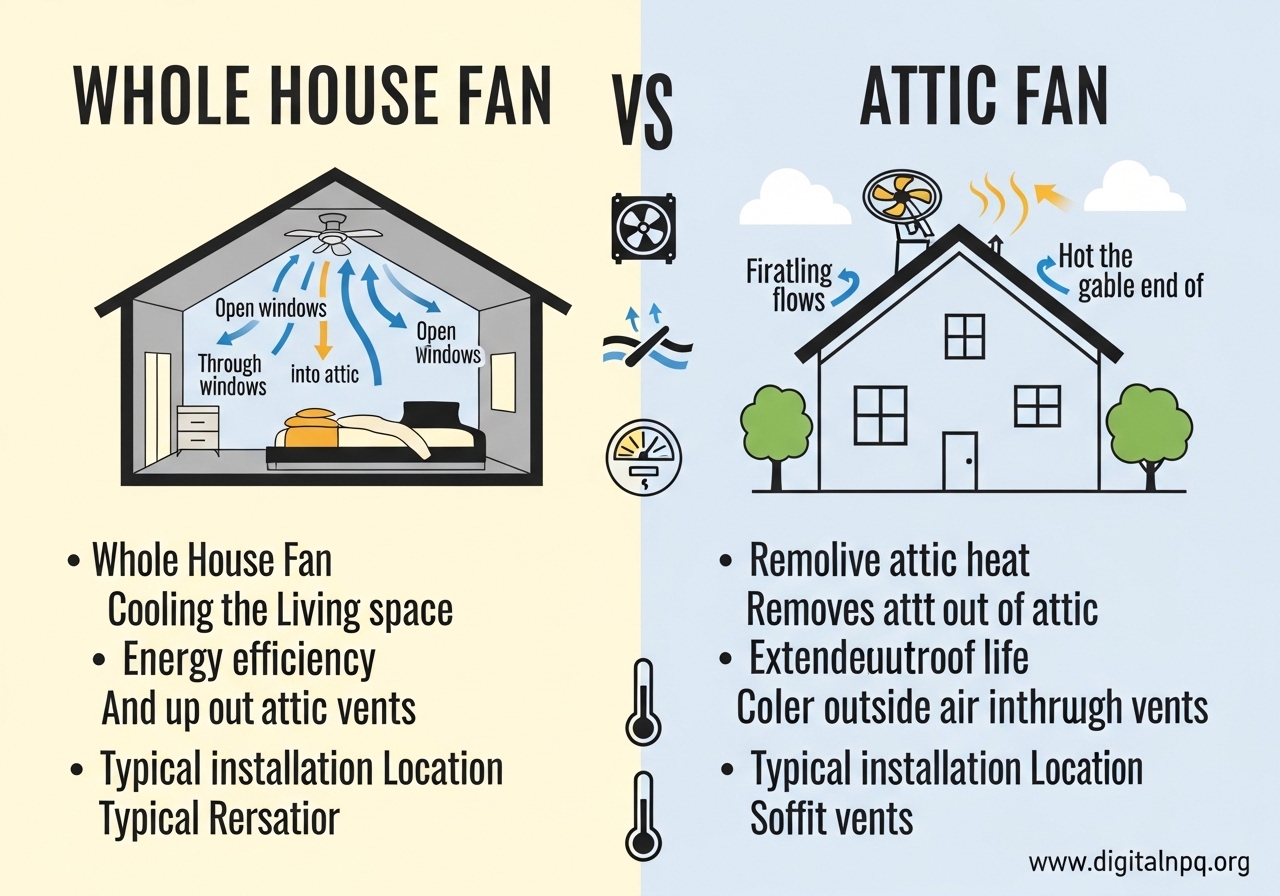
The whole house fan vs attic fan question comes down to what you are trying to accomplish. A whole house fan cools your living space by pulling fresh outdoor air through open windows and exhausting stale air through attic vents. An attic fan sits in your attic and only vents hot air from the attic to the outside. One cools people. The other protects your roof and insulation.
Here is the quick breakdown of how they differ:
- Purpose: Whole house fans cool living spaces; attic fans ventilate attic spaces only
- Airflow: Whole house fans pull air from outside through windows; attic fans push attic air out through roof vents
- Best time to run: Whole house fans work best after sundown when outdoor air is cool; attic fans run during the day when attic temperatures peak
- Energy impact: Whole house fans can reduce AC usage by 50-90%; attic fans lower attic heat load on your insulation
- Installation: Whole house fans need a ceiling cut between living space and attic; attic fans mount on the roof or gable wall
- Cost: Whole house fans typically cost more upfront; attic fans are simpler and less expensive to install
In this guide, I will break down everything you need to know about each fan type so you can make the right call for your home, climate, and budget.
What Is a Whole House Fan?
A whole house fan is a large ventilation fan installed in the ceiling between your top-floor living space and the attic. When you turn it on, it creates negative pressure inside your home, pulling cool outdoor air through open windows and pushing warm indoor air up into the attic and out through attic vents.
Think of it like opening every window in your house while a giant exhaust fan clears out the hot air that has been trapped inside all day. The effect is immediate. Within minutes, you can feel the temperature drop as fresh air replaces the stale, overheated air that was sitting in your rooms.
Here is how the process works step by step:
- You open several windows in your home (typically 4 to 6 inches each)
- The fan draws cool outdoor air inside through those open windows
- Air moves through your hallways and rooms, picking up heat
- The fan pushes that warmed air into the attic
- The air exits through existing attic vents like soffit vents, ridge vents, or gable vents
Whole house fans are rated by CFM (cubic feet per minute), which tells you how much air they can move. A typical residential unit moves between 3,000 and 7,000 CFM. The general rule of thumb is that you want enough CFM to replace all the air in your home every 2 to 3 minutes. For a 2,000-square-foot home with 8-foot ceilings, that means you need roughly 5,300 to 8,000 CFM.
The best time to run a whole house fan is after the sun goes down and the outside temperature drops below your indoor temperature. In dry climates with significant day-to-night temperature swings, this strategy works incredibly well. You can cool your entire house overnight and then close everything up in the morning to trap that cool air inside.
What Is an Attic Fan?
An attic fan is a smaller ventilation fan installed in your attic space. Its only job is to exhaust hot air from the attic to the outside. It does not touch the air in your living space at all. Instead, it focuses on keeping attic temperatures from building up to extreme levels during hot days.
Without an attic fan, your attic can easily reach 150 to 160 degrees Fahrenheit on a hot summer day. That superheated air sits right above your ceiling insulation, working against your air conditioning system. Even with good insulation, heat radiates downward into your living space, forcing your AC to work harder and longer.
An attic fan solves this by actively pulling hot air out of the attic and replacing it with cooler outside air drawn through intake vents. Here is how it works:
- A thermostat mounted in the attic monitors the temperature
- When the attic reaches a set temperature (usually 100 to 110 degrees), the fan turns on automatically
- The fan exhausts hot air through a roof vent or gable vent
- Cooler outside air enters through soffit vents or other intake vents
- Once the attic cools to the thermostat shutoff point, the fan stops
Attic fans come in three main types. Gable-mounted fans install on the triangular wall at the end of your attic and are the easiest to service. Roof-mounted fans sit directly on the roof surface and are more visible but very effective at exhausting heat. Solar-powered attic fans use a small solar panel to run the motor, which means zero operating cost but limited power on cloudy days.
You will also see attic fans called power attic ventilators or PAVs. They typically move between 800 and 1,600 CFM, which is plenty for an attic space but far less than a whole house fan needs to move. Most models include a thermostat and some include a humidistat for winter moisture control.
Whole House Fan vs Attic Fan: Key Differences
Now that you understand what each fan does on its own, let me put them side by side. The table below covers the most important differences at a glance.
- Primary Purpose: Whole house fan cools your living space; attic fan cools the attic only
- Airflow Direction: Whole house fan pulls outdoor air through windows and up into attic; attic fan pushes attic air out through roof vents
- What Gets Cooled: Whole house fan targets rooms and hallways where people live; attic fan targets the attic cavity above insulation
- Installation Spot: Whole house fan mounts in the ceiling between top floor and attic; attic fan mounts on the roof or gable wall
- Operation Timing: Whole house fan runs at night when outdoor air is cool; attic fan runs during the day when attic heat peaks
- Window Requirement: Whole house fan requires open windows to draw in air; attic fan needs no windows opened in living space
- Thermostat Control: Whole house fan is manually switched on and off; attic fan runs automatically on a thermostat
- CFM Range: Whole house fan moves 3,000 to 7,000+ CFM; attic fan moves 800 to 1,600 CFM
- DIY Friendly: Whole house fan usually needs professional installation; attic fan can be a DIY project for experienced homeowners
The biggest distinction to remember is simple: a whole house fan affects the air you breathe in your rooms, while an attic fan only affects the air trapped above your ceiling. They serve different purposes and solve different problems. In many homes, using both together actually makes a lot of sense.
Cooling Effectiveness: Which Fan Cools Better?
If your main goal is to feel cooler in your living room, bedroom, or kitchen, the whole house fan wins by a wide margin. Nothing about an attic fan directly cools the air you experience. Let me explain why.
A properly sized whole house fan can lower your indoor temperature by 10 to 20 degrees within minutes of turning it on. In the right climate, this can eliminate the need for air conditioning entirely during spring and fall, and significantly reduce it during summer. Users on home improvement forums consistently report that their whole house fan makes their home comfortable within 15 to 30 minutes after sunset.
An attic fan works indirectly. By keeping your attic cooler (typically reducing attic temperatures by 30 to 50 degrees), it reduces the heat that radiates down through your ceiling. This means your air conditioner does not have to work as hard. Studies show that a cooler attic can reduce your cooling energy costs by about 10 percent. But you still need your AC running on hot days because the attic fan does not replace it.
For real temperature reduction in living spaces, the whole house fan is far more effective. It replaces hot indoor air with cool outdoor air. An attic fan only reduces the heat load from above, which helps but cannot match the direct cooling effect of moving fresh air through your home.
When a Whole House Fan Outperforms
Whole house fans work best in areas where the nighttime temperature drops at least 15 to 20 degrees below the daytime high. If you live somewhere that hits 95 degrees during the day but cools to 65 at night, a whole house fan can flush all that heat out overnight. This covers much of the western United States, mountain states, and inland areas with dry heat.
When an Attic Fan Makes More Sense
In humid regions where nighttime temperatures stay high (think Gulf Coast, Southeast, or tropical areas), a whole house fan would just pull in warm, sticky air. An attic fan is the better investment here because it reduces your attic heat without requiring open windows or cool outside air. It simply helps your existing AC system run more efficiently.
Installation Requirements and Complexity
Installation is one of the biggest differences between these two fan types, and it directly affects your total cost.
Whole House Fan Installation
Installing a whole house fan is a significant project. The fan gets mounted in the ceiling of your top floor, which means cutting a hole in the drywall or plaster, framing an opening between the ceiling joists, and sealing everything properly. You also need adequate attic venting for all that air to escape. Most homes need additional soffit vents, ridge vents, or gable vents to handle the volume of air a whole house fan pushes.
The electrical work usually requires a dedicated circuit, especially for larger models. Some modern units plug into a standard outlet, but many need hardwiring by a licensed electrician. A professional installation typically takes 4 to 8 hours and involves framing, electrical work, drywall repair, and sealing.
I strongly recommend professional installation for whole house fans. The ceiling cut needs to be precise, the unit needs proper support framing, and the electrical connection must meet local codes. A poor installation can lead to air leaks, vibration noise, and even structural issues.
Attic Fan Installation
Attic fan installation is much simpler. A gable-mounted fan requires cutting an opening in the gable wall, mounting the fan, and running wiring to a thermostat. A roof-mounted fan involves cutting a hole in the roof, flashing it properly to prevent leaks, and securing the fan housing. Both types need basic electrical work to connect the thermostat and power.
Many experienced DIYers handle attic fan installation over a weekend. The main challenge with roof-mounted models is ensuring the flashing is done correctly to prevent water intrusion. If you are not comfortable working on your roof or with basic electrical wiring, hire a professional. A typical professional installation takes 2 to 4 hours.
Solar attic fans are the simplest to install because they do not require electrical wiring. You mount the fan, attach the small solar panel, and you are done. The tradeoff is that they only run when the sun is shining, which is actually when you need them most.
Cost Comparison: Product and Installation
Cost is often the deciding factor when homeowners choose between these two options. Here is what you can expect to pay for each.
Whole House Fan Costs
The fan unit itself typically costs between $400 and $1,200 depending on size, features, and brand. Professional installation adds another $500 to $1,500, bringing the total project cost to roughly $900 to $2,700. Higher-end models with insulated doors, variable speed motors, and smart controls sit at the top of that range.
Additional attic venting, if needed, can add $200 to $600 to the project. Your installer should evaluate whether your existing vents provide enough exhaust area for the fan to work properly.
Attic Fan Costs
Attic fans are considerably less expensive. A standard electric attic fan costs $80 to $350 for the unit itself. Solar models run $150 to $600. Professional installation adds $150 to $500, bringing the total to $230 to $850 for electric models and $300 to $1,100 for solar models.
The payback period is also different. A whole house fan can pay for itself in 1 to 3 years through reduced AC usage. An attic fan typically takes 3 to 5 years to recoup its cost through lower cooling bills. Both add value to your home, with whole house fans generally having a higher perceived value among homebuyers.
Energy Efficiency and Savings
Both fans save energy compared to running central air conditioning, but they do it in different ways and at different scales.
Whole House Fan Energy Savings
A whole house fan uses roughly 200 to 700 watts of electricity while running. Compare that to a central air conditioner that uses 3,500 to 5,000 watts. In the right climate, a whole house fan can reduce your air conditioning costs by 50 to 90 percent during the cooling season. That translates to real dollar savings.
For a homeowner spending $150 per month on cooling, switching to a whole house fan strategy could cut that to $15 to $75 per month. The savings depend on your climate, electricity rates, and how consistently you use the fan instead of the AC.
Attic Fan Energy Savings
A standard attic fan uses 100 to 300 watts while running. Solar models use zero grid electricity. The savings come from reducing your attic temperature, which lightens the load on your air conditioner. Most studies estimate a 5 to 15 percent reduction in cooling costs when an attic fan is properly installed and adequate intake vents are in place.
The savings are modest compared to a whole house fan, but the investment is also much smaller. If your attic is poorly ventilated and your AC runs constantly in summer, an attic fan can make a noticeable difference in both comfort and energy bills.
Environmental Impact
Both fans reduce your carbon footprint by cutting AC usage. Whole house fans have the larger environmental benefit because they can replace AC entirely during certain months. Solar attic fans are the greenest option of all since they run entirely on sunlight.
Noise Levels: What to Expect
Noise is the number one complaint I see in forum discussions about whole house fans. It is worth understanding what to expect from each fan type before you commit.
Whole House Fan Noise
Older whole house fan models are genuinely loud. We are talking 60 to 80 decibels, which is comparable to a dishwasher or garbage disposal running in your ceiling. The noise comes from the large blades moving massive amounts of air, plus vibration transferred through the ceiling framing.
Modern whole house fans have gotten much quieter. Newer belt-drive models and direct-drive units with variable speed controls typically produce 40 to 55 decibels on low to medium speeds. On high speed, they still generate noticeable noise, but it is manageable. Insulated dampers and vibration isolators help reduce the racket significantly.
Many users on Reddit report running their whole house fan on high for 30 minutes to flush the hot air, then dropping to low speed for the rest of the night. On low, most people sleep right through it.
Attic Fan Noise
Attic fans are generally quieter because they are smaller and separated from your living space by the ceiling and attic floor insulation. You might hear a low hum when standing directly below the fan, but it rarely disturbs daily activities or sleep. Typical noise levels range from 30 to 50 decibels depending on the model and mounting type.
Gable-mounted fans tend to be the quietest because the gable wall provides some sound buffering. Roof-mounted models can create a slight vibration that travels through the roof framing. Solar attic fans are nearly silent since they use small, low-speed motors.
Best Climates for Each Fan Type
Your local climate is the single most important factor in choosing between these two fans. What works perfectly in Arizona might be useless in Florida.
Whole House Fan: Best Climates
Whole house fans perform best in areas with these characteristics:
- Large day-to-night temperature swings (20+ degrees)
- Low to moderate humidity levels
- Summer nighttime temperatures below 70 degrees
- Dry heat rather than muggy conditions
This covers most of the western US including California, Nevada, Arizona (higher elevations), Oregon, Washington (eastern), Colorado, Utah, Idaho, Montana, and parts of Texas. Users from San Diego on Reddit consistently praise their whole house fans for keeping homes comfortable without AC from April through October.
Attic Fan: Best Climates
Attic fans work well everywhere because they do not depend on cool outdoor air. They just need a hot attic and adequate intake venting. However, they provide the most benefit in these situations:
- Hot, humid climates where whole house fans are less effective
- Homes with poor existing attic ventilation
- Areas with intense sun exposure on the roof
- Regions where ice dams form in winter
In the Southeast, Gulf Coast, and Midwest, attic fans are usually the more practical investment. They help your AC work better without requiring you to open windows in humid weather.
Mixed Climate Strategy
If you live in a transitional climate that has dry stretches and humid stretches, an attic fan is your safe baseline choice. It helps year-round without any special operating requirements. If you also have a few months of cool, dry nights, you could add a whole house fan for those shoulder seasons when it really shines.
Pros and Cons of Whole House Fans
Pros
- Cools your entire living space quickly and effectively
- Reduces or eliminates AC usage in suitable climates
- Brings fresh outdoor air inside, improving indoor air quality
- Uses a fraction of the electricity that central AC requires
- Fast payback period of 1 to 3 years in the right climate
Cons
- Requires opening windows, which raises security concerns at night
- Not effective in humid climates where outdoor air is warm and sticky
- Older models can be quite loud, especially on high speed
- Professional installation is recommended, adding to the cost
- Only works when outdoor temperature is cooler than indoor temperature
Pros and Cons of Attic Fans
Pros
- Works in all climates since it does not depend on cool outdoor air
- Runs automatically with thermostat control
- Lower upfront cost and simpler installation
- Solar options available for zero operating cost
- Helps extend roof life by reducing heat and moisture buildup
Cons
- Does not directly cool living spaces
- Provides modest energy savings compared to whole house fans
- Can cause negative pressure issues if intake venting is inadequate
- Roof-mounted models require careful flashing to prevent leaks
Negative Pressure and Safety Concerns
This is a topic most articles skip, but it matters for your safety. Negative pressure happens when a fan exhausts more air from a space than can be replaced through intake vents. Both fan types can create this problem, but attic fans are the bigger concern.
When an attic fan runs without enough soffit vents or other intake vents to supply replacement air, it creates negative pressure in the attic. This vacuum effect can pull conditioned air from your living space through cracks around light fixtures, plumbing penetrations, and the attic access hatch. You end up sucking cool air out of your home and into the attic, which works against your AC system.
More seriously, negative pressure can cause backdrafting with gas appliances like water heaters and furnaces. If your attic fan pulls hard enough, it can draw combustion gases like carbon monoxide back down the flue instead of letting them vent outside. This is a real safety hazard.
To prevent these issues:
- Make sure your attic has at least 1 square foot of net free vent area for every 300 CFM of fan capacity (intake vents plus exhaust vents combined)
- Ensure soffit vents are clear and unblocked by insulation
- Have your gas appliances checked for proper venting if you install an attic fan
- Consider a sealed combustion chamber for gas appliances near the attic
Whole house fans create negative pressure too, but since you intentionally open windows to supply air, the pressure equalizes naturally. Just make sure you open enough windows when running the fan to allow adequate airflow.
Can You Use Both Fans Together?
Yes, and many homeowners do. A whole house fan and an attic fan serve different purposes, so there is no conflict in running both. In fact, they complement each other nicely.
During the day, your attic fan runs on its thermostat, keeping the attic from overheating while your AC handles the living space. After sunset, when the outdoor temperature drops, you turn on the whole house fan to flush out the hot indoor air and replace it with cool fresh air. The whole house fan actually does double duty here because it pushes air through the attic on its way out, helping with attic ventilation at the same time.
Forum users on r/HomeImprovement frequently recommend this dual-fan approach, especially for homes in dry climates. The attic fan handles daytime heat reduction, and the whole house fan takes over for nighttime cooling. Together, they can dramatically cut your AC usage throughout the entire cooling season.
If you can afford both installations, this combination gives you the most comprehensive ventilation strategy. Just make sure your attic has enough total vent area to handle the airflow from both fans.
Which Fan Is Right for Your Home?
By now you should have a good sense of which direction fits your situation. Here is a simple decision framework to help you choose.
Choose a Whole House Fan If:
- You live in a dry climate with cool nights (western US, mountain states)
- Your main goal is to reduce or eliminate air conditioning costs
- You want to cool your living space directly, not just your attic
- You are comfortable opening windows at night for airflow
- You want the fastest payback on your investment
Choose an Attic Fan If:
- You live in a humid climate where opening windows at night does not help
- You want to protect your roof and extend shingle life
- You prefer a set-it-and-forget-it solution with automatic operation
- Your budget is tighter and you want a simpler installation
- You are concerned about ice dams forming in winter
Get Both If:
- You live in a dry climate and want maximum cooling efficiency
- Your attic runs extremely hot and your AC struggles to keep up
- You want daytime attic ventilation plus nighttime whole-house cooling
Still not sure? Start with an attic fan. It is the lower-cost option, it works in any climate, and you can always add a whole house fan later if your climate supports it.
Frequently Asked Questions
Why don’t people use whole house fans anymore?
Whole house fans declined in popularity as central air conditioning became standard in new homes. Many homeowners prefer the convenience of AC, which cools without requiring open windows. Older whole house fans also developed a reputation for being loud, which turned people off. However, modern models are significantly quieter and more efficient, and whole house fans are making a comeback as homeowners look for ways to cut energy costs.
What are the disadvantages of a whole house fan?
The main disadvantages are: you must open windows for the fan to work, which can be a security concern at night. The fan is ineffective in humid climates because it pulls outdoor air inside. Older models can be quite loud. Installation typically requires a professional. The fan only works when outdoor air is cooler than indoor air, so it cannot help during the hottest part of the day.
Can I leave my whole house fan on all night?
Yes, you can run a whole house fan all night in most situations. Many homeowners do exactly that during summer, running the fan on low speed to maintain cool airflow throughout the night. Just make sure you have enough windows open to supply adequate air and that the windows you leave open are secure. If noise is an issue, run it on high for 30 minutes before bed to cool the house, then switch to low for the night.
Do you leave windows open when using a whole house fan?
Yes, windows must be open for a whole house fan to work. The fan pulls air in through open windows and exhausts it through the attic. Without open windows, the fan would create negative pressure and struggle to move air effectively. You typically need to open 4 to 6 windows about 4 to 6 inches each. Open windows on the lower floors and opposite sides of the house for the best airflow.
How much energy does a whole house fan save compared to AC?
A whole house fan uses 200 to 700 watts compared to a central AC unit that uses 3,500 to 5,000 watts. In the right climate with cool nights, a whole house fan can reduce cooling costs by 50 to 90 percent. For a household spending $150 per month on cooling, that could mean savings of $75 to $135 per month during the cooling season.
Is an attic fan worth the investment?
An attic fan is generally worth the investment if your attic gets excessively hot or has ventilation problems. For the relatively low cost of $230 to $850 installed, an attic fan can reduce attic temperatures by 30 to 50 degrees, lower your cooling costs by 5 to 15 percent, extend the life of your roof, and help prevent ice dams in cold climates. Solar models add the benefit of zero operating costs.
Final Thoughts
The whole house fan vs attic fan decision comes down to your climate, your budget, and what you want to accomplish. A whole house fan is the clear winner for direct cooling in dry climates with cool nights. It can slash your AC costs in half or more and pay for itself within a few years. An attic fan is the practical choice for humid regions, budget-conscious homeowners, and anyone who wants a simple, automatic solution that works everywhere.
Neither fan replaces the other. If your home and budget allow, running both gives you the best of both worlds: attic heat reduction during the day and whole-house cooling at night. Whatever you choose, proper installation and adequate venting are essential for safety and performance.
Before making your final decision, talk to a local HVAC professional who understands your regional climate. They can evaluate your attic ventilation, electrical capacity, and home layout to recommend the right fan type and size for your specific situation.