
If you have ever wondered why some air conditioners run whisper-quiet while others rumble through the night, the answer usually comes down to one component: the compressor. The types of AC compressors used in a cooling system determine everything from energy efficiency and noise levels to how long the unit will last before needing replacement.
Our team has spent years working with residential and commercial HVAC systems, and we have seen firsthand how the right compressor makes or breaks an installation. Whether you are a homeowner comparing central air units, a technician preparing for certification, or a building manager planning a commercial upgrade, understanding the different types of AC compressors helps you make better decisions.
In this guide, we break down all five main compressor types, explain how each one works in plain language, and show you exactly which type belongs in which application. By the end, you will know which compressor matches your needs and why.
What Is an AC Compressor?
An AC compressor is the pump that drives the entire cooling process in an air conditioning system. Think of it as the heart of your AC unit. Just like your heart circulates blood through your body, the compressor circulates refrigerant through the system, enabling your air conditioner to absorb heat from indoors and release it outside.
Without a functioning compressor, no cooling happens. The refrigerant would sit still, the evaporator coil would warm up, and your home would stay hot. Every air conditioning system, from a small window unit to a massive commercial chiller, relies on a compressor to keep the refrigerant moving and the cooling cycle going.
The compressor sits in the outdoor condensing unit of a central AC system. It draws in low-pressure refrigerant gas from the evaporator coil inside your home, squeezes it into a high-pressure state, and sends it to the condenser coil where the heat gets released. This continuous loop is what keeps your indoor space comfortable year-round.
How AC Compressors Work
The cooling cycle in an air conditioner follows a simple but effective four-step process. Understanding this cycle makes it much easier to see why different types of AC compressors exist and why certain types work better for specific applications.
Step 1: Evaporation. Inside your home, the evaporator coil contains liquid refrigerant at low pressure. Warm indoor air blows across this coil, and the refrigerant absorbs the heat, evaporating from a liquid into a gas. This is what cools the air that gets circulated back into your rooms.
Step 2: Compression. The low-pressure refrigerant gas travels through the suction line to the compressor. Here, the compressor squeezes the gas, dramatically raising both its pressure and temperature. This step is critical because the refrigerant needs to be hotter than the outdoor air for the next step to work.
Step 3: Condensation. The hot, high-pressure gas flows into the condenser coil outside. A fan blows outdoor air across the coil, and the refrigerant releases its heat to the outside environment. As it loses heat, the refrigerant condenses back into a high-pressure liquid.
Step 4: Expansion. The high-pressure liquid passes through an expansion valve or metering device, which drops the pressure suddenly. This causes the refrigerant to cool rapidly, turning into a cold, low-pressure mixture ready to absorb more indoor heat. The cycle then repeats.
The compressor is the only component that actively adds energy to this cycle. Everything else is passive heat exchange. That is why the compressor type matters so much. It directly affects how efficiently the system runs, how much energy it consumes, and how much noise it makes.
Types of AC Compressors: Complete Overview
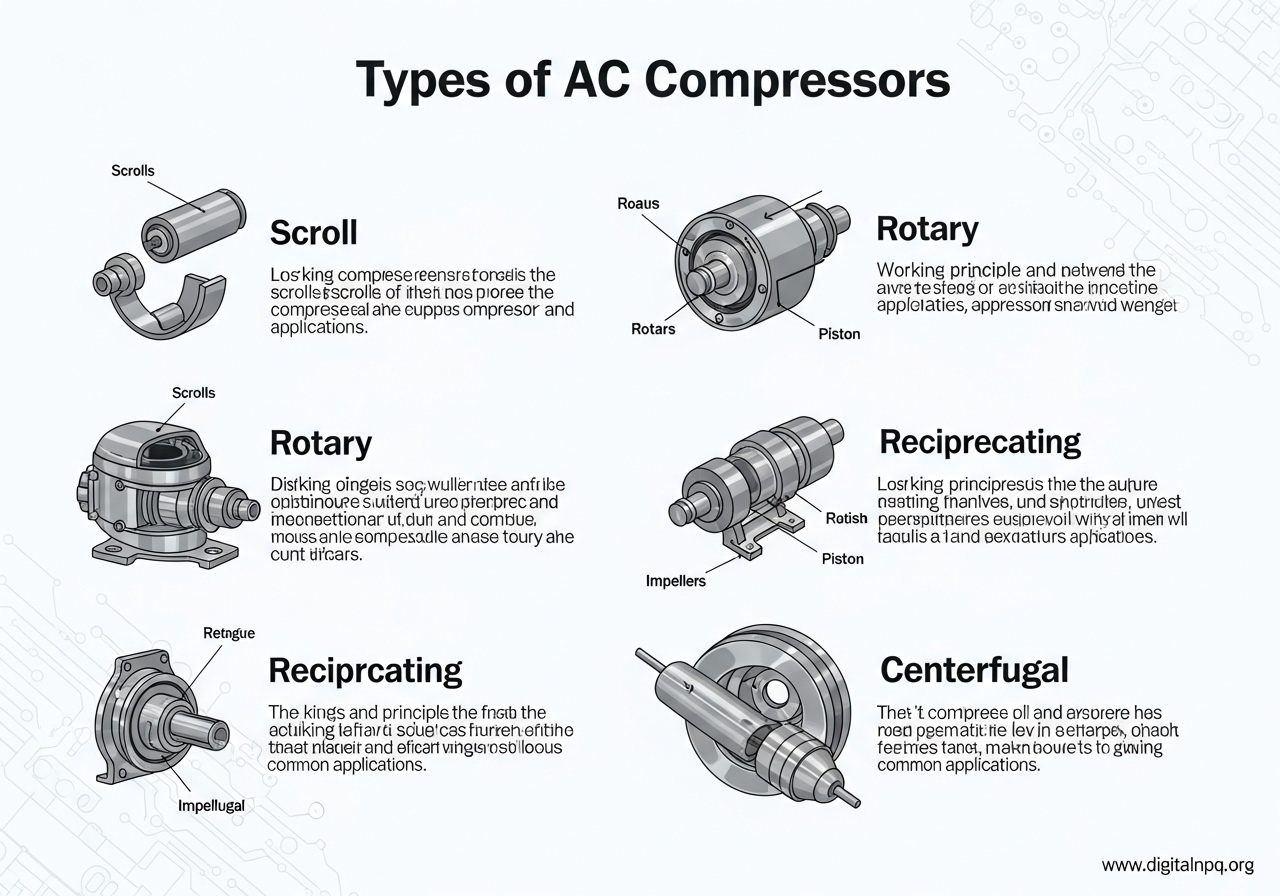
There are five main types of AC compressors used in modern cooling systems. Each type uses a different mechanical method to compress refrigerant gas, and each has distinct advantages that make it suitable for specific applications.
Here are the five types of AC compressors you will encounter:
- Scroll Compressor – Uses two spiral-shaped scrolls to compress refrigerant; quiet and efficient; dominates residential central AC
- Rotary Compressor – Uses a rotating mechanism inside a cylinder; compact and affordable; common in window units and mini-splits
- Reciprocating Compressor – Uses pistons moving up and down in cylinders; widely available and easy to service; found in residential and light commercial AC
- Screw Compressor – Uses interlocking helical rotors; handles large capacities with continuous output; built for commercial and industrial systems
- Centrifugal Compressor – Uses a high-speed rotating impeller; designed for massive cooling loads; used in hospitals, data centers, and large campuses
The key distinction among these types comes down to how they compress the refrigerant. Scroll, rotary, reciprocating, and screw compressors are all positive displacement compressors, meaning they physically reduce the volume of the gas to increase pressure. Centrifugal compressors use kinetic energy instead, accelerating the gas with an impeller and then converting that velocity into pressure.
Let us look at each type in detail.
1. Scroll Compressor
Scroll compressors are the most popular type found in residential air conditioning systems today. If you have a central AC unit or a heat pump installed at home in the last 10 years, it most likely uses a scroll compressor.
How a Scroll Compressor Works
A scroll compressor contains two interleaving spiral-shaped scrolls. One scroll stays fixed in place while the other orbits around it in a circular motion. As the orbiting scroll moves, it creates crescent-shaped gas pockets between the two spirals.
These gas pockets start large at the outer edge of the scrolls where the refrigerant enters. As the orbiting scroll continues its motion, the pockets gradually shrink in size, squeezing the refrigerant gas into higher and higher pressure. By the time the gas reaches the center of the scrolls, it has been fully compressed and is discharged into the condenser.
Because the compression happens continuously and smoothly, scroll compressors produce very little vibration compared to piston-based designs. This smooth operation is what makes them notably quieter than many other compressor types.
Advantages of Scroll Compressors
Scroll compressors offer several benefits that make them the go-to choice for residential HVAC systems. They operate at noise levels between 60 and 72 decibels, which is noticeably quieter than reciprocating compressors. Their simple design with fewer moving parts means fewer points of failure and longer typical lifespans of 12 to 20 years.
They also handle liquid refrigerant better than piston compressors, reducing the risk of damage from liquid slugging. Many modern scroll compressors come with variable-speed technology, allowing them to adjust output based on cooling demand. This translates to better humidity control and lower energy consumption during mild weather.
Disadvantages of Scroll Compressors
The main drawback of scroll compressors is that they are generally more expensive upfront than reciprocating models. They are also more difficult to repair when something goes wrong. If a scroll mechanism fails, the entire compressor usually needs replacement rather than an in-place repair.
Additionally, scroll compressors are not well-suited for extremely large cooling loads. Most residential scroll compressors top out around 5 tons of cooling capacity, which covers homes up to about 3,000 square feet but falls short for commercial applications.
Best Applications
Scroll compressors are ideal for residential central air conditioning systems, residential heat pumps, ductless mini-split systems, and light commercial applications up to about 5 tons. Brands like Copeland dominate the scroll compressor market, and many major AC manufacturers including Trane, Carrier, and Lennox use Copeland scrolls in their residential units.
2. Rotary Compressor
Rotary compressors are compact workhorses commonly found in smaller cooling systems. If you own a window air conditioner, a portable AC unit, or a ductless mini-split, there is a strong chance it uses a rotary compressor.
How a Rotary Compressor Works
A rotary compressor uses a rotating mechanism inside a cylindrical chamber to compress refrigerant. The most common design uses an eccentric roller mounted on a shaft inside the cylinder. As the shaft spins, the roller pushes against the cylinder wall, creating a shrinking space that compresses the refrigerant gas.
Another rotary design uses sliding vanes that extend from a central rotor. As the rotor spins, the vanes slide in and out, creating variable-size pockets that compress the gas. Both designs achieve compression through continuous rotation rather than the back-and-forth pumping action of pistons.
The continuous rotary motion makes these compressors small, lightweight, and relatively inexpensive to manufacture. That is why they dominate the market for compact AC units where space and cost are primary concerns.
Advantages of Rotary Compressors
Rotary compressors shine in small spaces. Their compact design allows manufacturers to build them into window units, portable ACs, and wall-mounted mini-split indoor units where larger compressors simply would not fit.
They are also among the quietest compressor types available, typically operating between 50 and 65 decibels. This makes them ideal for bedroom installations and other noise-sensitive areas. Rotary compressors tend to have fewer vibration issues as well, which further reduces noise and wear on surrounding components.
From a cost perspective, rotary compressors are affordable to manufacture and replace, making them a practical choice for budget-friendly cooling equipment.
Disadvantages of Rotary Compressors
The primary limitation of rotary compressors is capacity. They are generally limited to small and medium-sized cooling systems, typically under 2.5 tons. If you need to cool a large home or a commercial space, a rotary compressor simply will not deliver enough output.
Rotary compressors also tend to have slightly shorter lifespans than scroll or reciprocating models, typically lasting 8 to 15 years depending on usage and maintenance. They can be sensitive to debris and contamination in the refrigerant system, which can cause premature wear on the rotating components.
Best Applications
Rotary compressors are the standard choice for window air conditioners, portable AC units, wall-mounted ductless mini-splits, and small through-the-wall AC units. They are the compressor you will find in most room-level cooling products sold at major retailers.
3. Reciprocating Compressor
Reciprocating compressors are one of the oldest and most widely recognized compressor designs in the HVAC industry. They use a piston-and-cylinder arrangement that works much like a car engine, except instead of burning fuel, they compress refrigerant gas.
How a Reciprocating Compressor Works
Inside a reciprocating compressor, one or more pistons move up and down inside cylinders. On the downstroke, an intake valve opens and low-pressure refrigerant gas enters the cylinder. On the upstroke, the intake valve closes and the piston compresses the gas. When the pressure reaches the discharge threshold, the exhaust valve opens and the high-pressure gas flows out to the condenser.
Multi-cylinder reciprocating compressors can have 2, 4, 6, or even 8 cylinders working together, allowing them to handle larger cooling capacities than single-cylinder models. Each cylinder operates on its own compression cycle, staggered to provide more even output.
This design has been around for over a century and is well-understood by HVAC technicians everywhere. That familiarity is one of its biggest strengths when it comes to serviceability.
Advantages of Reciprocating Compressors
Reciprocating compressors are widely available and typically cost less than scroll compressors of comparable capacity. Because the design is so common, nearly every HVAC technician knows how to diagnose and repair them, which keeps service costs down.
They also offer good flexibility in terms of operating conditions. Reciprocating compressors can handle a wide range of refrigerants and work well across different pressure ratios. Many models allow for capacity control by unloading individual cylinders, which helps with efficiency at partial loads.
For automotive air conditioning, the reciprocating design (in swash-plate or wobble-plate variations) remains the standard because it handles the vibration and temperature extremes found under a car hood.
Disadvantages of Reciprocating Compressors
The main downsides of reciprocating compressors are noise and vibration. The start-and-stop piston motion creates more vibration than the smooth scrolling or rotating action of other designs. Noise levels typically range from 70 to 80 decibels, making them the loudest common compressor type for residential use.
Reciprocating compressors also have more moving parts than scroll or rotary designs. More parts mean more potential points of failure, including piston rings, valves, connecting rods, and bearings. They also tend to be slightly less energy efficient than scroll compressors at typical residential operating conditions.
Best Applications
Reciprocating compressors are commonly used in residential central AC units, light commercial systems, automotive air conditioning, and refrigeration applications. They remain popular where cost is a primary concern and where serviceability by a wide range of technicians is important.
4. Screw Compressor
Screw compressors step up into the world of commercial and industrial cooling. These compressors use a pair of interlocking helical rotors to compress refrigerant continuously, making them well-suited for applications that demand high cooling capacity around the clock.
How a Screw Compressor Works
A screw compressor contains two meshing helical rotors inside a precisely machined housing. One rotor has helical lobes (the male rotor) and the other has matching grooves (the female rotor). As the male rotor turns, it drives the female rotor in the opposite direction.
Refrigerant gas enters through an intake port at one end of the rotors. As the rotors turn, the lobes and grooves mesh together, trapping the gas in progressively smaller pockets. By the time the gas reaches the discharge port at the other end, it has been compressed to the target pressure.
This process happens continuously without the pulsation that comes from piston-based designs. The result is a smooth, steady flow of compressed refrigerant that is ideal for large systems running at constant load.
Advantages of Screw Compressors
Screw compressors excel at high-capacity cooling. They can handle systems ranging from about 20 tons up to several hundred tons of cooling capacity, making them a staple in medium-to-large commercial buildings.
They offer excellent reliability for continuous operation. With fewer wearing surfaces than reciprocating compressors, screw compressors can run 24 hours a day, 7 days a week without the frequent maintenance that piston designs demand. Many screw compressors operate for 15 to 25 years in commercial installations.
Modern screw compressors also feature variable capacity control through slide valves or variable-speed drives. This allows them to modulate output efficiently, reducing energy consumption during periods of lower cooling demand.
Disadvantages of Screw Compressors
The biggest barrier for screw compressors is cost. They are significantly more expensive than scroll or reciprocating compressors, both in upfront purchase price and in installation requirements. They also require professional maintenance by technicians with specific training in screw compressor service.
Screw compressors are not practical for residential applications. Their smallest capacities still far exceed what a typical home needs, and the installation requirements including three-phase electrical service make them unsuitable for most residential settings.
Best Applications
Screw compressors are the standard choice for medium and large commercial buildings, hospitals, hotels, industrial process cooling, and large refrigeration plants. They handle the heavy lifting that smaller compressor types simply cannot manage.
5. Centrifugal Compressor
Centrifugal compressors represent the heavyweights of the AC compressor world. They are designed for the largest cooling installations on the planet, from hospital complexes to university campuses to skyscrapers.
How a Centrifugal Compressor Works
Unlike the other four compressor types that mechanically squeeze refrigerant gas, centrifugal compressors use speed and momentum. A high-speed rotating impeller spins the refrigerant gas outward at tremendous velocity, similar to how a centrifuge separates materials in a laboratory.
The high-velocity gas exits the impeller and enters a diffuser section, where the passage widens and the gas slows down. As the velocity drops, the kinetic energy converts into pressure energy. This is the same basic principle used in turbochargers and jet engines.
Large centrifugal chillers often use multiple stages, passing the gas through several impeller and diffuser sections in sequence to achieve very high pressure ratios. These machines can be enormous, sometimes the size of a delivery truck, and they require specialized engineering to install and maintain.
Advantages of Centrifugal Compressors
Centrifugal compressors offer unmatched cooling capacity. A single centrifugal chiller can provide hundreds or even thousands of tons of cooling, enough to air condition an entire building complex. They are the only practical choice for the largest cooling installations.
At scale, they are remarkably energy efficient. Large centrifugal chillers routinely achieve coefficient of performance (COP) ratings that smaller compressor types cannot match. When you are moving enough air and water to cool a 50-story building, even small efficiency gains translate to significant energy and cost savings.
They also have very few wearing parts compared to positive displacement compressors. The rotating impeller runs on bearings, and with proper maintenance, centrifugal compressors can operate for 25 to 30 years or more.
Disadvantages of Centrifugal Compressors
The drawbacks are straightforward: size, cost, and complexity. Centrifugal compressors are extremely expensive, often costing hundreds of thousands of dollars for the compressor alone. They require specialized three-phase electrical service, concrete mounting pads, and extensive piping infrastructure.
Maintenance requires specially trained technicians and often involves working with the original manufacturer. A failure in a centrifugal compressor is not a quick fix. It typically means shutting down a major portion of a building’s cooling system while repairs are completed.
They are also sensitive to operating conditions. Running a centrifugal compressor too far from its design point can cause surge, a potentially damaging condition where the gas flow reverses rapidly. Modern controls help prevent surge, but it remains a design consideration.
Best Applications
Centrifugal compressors are used exclusively in large commercial and industrial applications. You will find them in hospital complexes, university campuses, data centers, shopping malls, large office towers, and district cooling plants. They are never used in residential or small commercial settings.
Comparing the Types of AC Compressors Side by Side
With all five types of AC compressors covered, let us put them head to head. The following comparison breaks down the key differences across efficiency, noise, capacity, and typical applications.
- Scroll: High efficiency, 60-72 dB noise, up to 5 tons, residential central AC and heat pumps, moderate cost, 12-20 year lifespan
- Rotary: Good efficiency, 50-65 dB noise, up to 2.5 tons, window units and mini-splits, low cost, 8-15 year lifespan
- Reciprocating: Moderate efficiency, 70-80 dB noise, up to 10 tons, residential and light commercial, low to moderate cost, 10-15 year lifespan
- Screw: High efficiency at scale, 65-75 dB noise, 20-500+ tons, commercial and industrial, high cost, 15-25 year lifespan
- Centrifugal: Highest efficiency at scale, 70-85 dB noise, 100-5000+ tons, large commercial and industrial, very high cost, 25-30+ year lifespan
Notice the pattern: smaller compressor types (rotary, reciprocating) serve homes and small businesses. Mid-range types (scroll) handle most residential and light commercial needs. Large types (screw, centrifugal) serve commercial and industrial applications. Matching the right compressor type to your cooling load is the single most important factor in getting an efficient, reliable system.
For energy efficiency, scroll compressors lead the residential market with SEER ratings commonly reaching 18-22 in modern units. At the commercial scale, centrifugal chillers achieve the best efficiency per ton of cooling, but only when running at or near full capacity. Variable-speed technology has improved partial-load efficiency across all compressor types in recent years.
On noise, rotary compressors are the quietest, making them ideal for bedrooms and living spaces. Reciprocating compressors are the loudest in typical residential applications. If noise sensitivity is a concern for your installation, scroll or rotary compressors are the better choices.
Which Compressor Type Is Right for You?
Choosing among the types of AC compressors comes down to three factors: the size of the space you need to cool, your budget, and how much noise you can tolerate.
For a home or apartment (up to about 3,000 sq ft): A scroll compressor in a central AC or heat pump system is the most common and efficient choice. For individual rooms, a rotary compressor in a mini-split or window unit provides quiet, affordable cooling.
For a small business or light commercial space: Scroll or reciprocating compressors handle loads up to about 10 tons. Scroll compressors offer better efficiency and quieter operation, while reciprocating compressors cost less upfront and are easier to service.
For a medium-to-large commercial building: Screw compressors are the standard choice for cooling loads between 20 and several hundred tons. They offer the reliability and capacity that commercial operations demand.
For industrial facilities, hospitals, or campus-scale cooling: Centrifugal compressors are the only practical option for these massive cooling loads. Their efficiency at scale and long service life justify the high upfront investment.
One important consideration that comes up in forum discussions is the distinction between rotary compressors as a specific type versus a broad category. In HVAC terminology, “rotary compressor” refers to the specific vane or roller design used in window units and mini-splits. It is not a general category that includes all rotating compressors. Scroll and screw compressors also use rotary motion but are classified separately based on their distinct compression mechanisms.
AC Compressor Maintenance Tips
Regardless of which type of AC compressor you have, proper maintenance extends its life and keeps it running efficiently. Here are the practices that matter most.
Keep coils clean. Dirty condenser coils force the compressor to work harder, raising discharge pressure and energy consumption. Hose down your outdoor unit monthly during cooling season, and schedule a professional coil cleaning annually.
Change air filters regularly. Clogged filters restrict airflow across the evaporator coil, which can cause the coil to freeze and send liquid refrigerant back to the compressor. Liquid slugging is one of the most common causes of compressor failure, especially in reciprocating models.
Maintain proper refrigerant charge. Both undercharged and overcharged systems stress the compressor. A system low on refrigerant runs longer cycles and may overheat the compressor motor. An overcharged system raises discharge pressure beyond design limits. Have a qualified technician check refrigerant levels once a year.
Listen for unusual sounds. Each compressor type has a characteristic sound during normal operation. If you notice new rattling, buzzing, clicking, or grinding noises, shut the system off and call a technician. Early intervention on bearing wear or valve issues can prevent total compressor failure.
Schedule annual professional inspections. An HVAC technician can measure compressor amperage, check superheat and subcooling, inspect electrical connections, and identify developing problems before they cause a breakdown. This annual checkup typically costs between $75 and $200 and can save thousands in premature compressor replacement.
Common Signs of AC Compressor Problems
Catching compressor issues early can be the difference between a repair and a full system replacement. Here are the warning signs to watch for.
Loud or unusual noises: A sudden increase in noise, especially metallic banging, clanking, or buzzing, often indicates internal mechanical damage. In scroll compressors, a high-pitched squeal can mean the scroll set is failing. In reciprocating models, knocking sounds usually point to worn piston pins or connecting rods.
Warm air from vents: If your AC is running but the air coming from your vents is not cool, the compressor may not be circulating refrigerant. This could be caused by an electrical failure, a bad capacitor, or a seized compressor motor.
Hard starting or short cycling: If the outdoor unit struggles to start, hums for several seconds before kicking on, or turns off after just a few minutes, the compressor may be overheating or failing electrically. A hard start kit sometimes helps, but persistent short cycling usually indicates a more serious problem.
Rising energy bills: A compressor that is losing efficiency draws more power to deliver the same cooling output. If your electric bills climb without a change in usage patterns, have a technician check compressor performance.
Circuit breaker tripping: A compressor that trips the breaker repeatedly is drawing excessive current, which can mean an internal short, a failing start winding, or a grounded compressor. Do not keep resetting the breaker. Call a professional.
FAQ
What are the 4 types of AC compressors?
The four main types of AC compressors are scroll, rotary, reciprocating, and centrifugal. Some classifications include screw compressors as a fifth type. Scroll compressors dominate residential central AC, rotary compressors are common in window units and mini-splits, reciprocating compressors are used in residential and automotive AC, and centrifugal compressors handle large commercial and industrial cooling loads.
What are the different types of air conditioner compressors?
Air conditioner compressors fall into two categories: positive displacement and dynamic. Positive displacement types include scroll (spiral-shaped scrolls compress gas), rotary (rotating mechanism inside a cylinder), reciprocating (pistons in cylinders), and screw (interlocking helical rotors). The dynamic type is the centrifugal compressor, which uses a high-speed impeller. Each type is designed for specific capacity ranges and applications, from small window units to industrial chillers.
What are the 5 types of refrigerant compressors?
The five types of refrigerant compressors are scroll, rotary, reciprocating, screw, and centrifugal. Scroll and rotary are most common in residential systems, reciprocating is used in residential and automotive applications, screw handles commercial and industrial loads, and centrifugal is reserved for the largest cooling installations such as hospitals and campus buildings.
Which AC compressor type is most efficient?
For residential use, scroll compressors are the most efficient, especially variable-speed models that adjust output to match cooling demand. At commercial and industrial scales, centrifugal compressors offer the highest efficiency per ton of cooling. Rotary compressors are efficient for their small size in window units and mini-splits. The key to maximum efficiency is matching the compressor type to the application and ensuring proper installation and refrigerant charge.
How long do AC compressors last?
AC compressor lifespans vary by type. Rotary compressors typically last 8 to 15 years. Reciprocating compressors average 10 to 15 years. Scroll compressors last 12 to 20 years. Screw compressors run 15 to 25 years in commercial settings. Centrifugal compressors can exceed 25 to 30 years with proper maintenance. Regular maintenance including annual inspections, proper refrigerant charge, and clean coils significantly extends compressor life across all types.
Which compressor is best for home AC?
For home air conditioning, scroll compressors are the best choice for central AC and heat pump systems. They offer the best combination of efficiency, quiet operation, and reliability for residential use. For individual rooms or small apartments, rotary compressors in ductless mini-splits or window units provide affordable and quiet cooling. Reciprocating compressors are still used in some residential units but are gradually being replaced by scroll designs in newer systems.
Final Thoughts
Understanding the types of AC compressors gives you a real advantage whether you are buying a new system, maintaining an existing one, or troubleshooting a problem. Each of the five main types serves a specific purpose. Scroll compressors lead residential installations with their quiet and efficient operation. Rotary compressors power compact units like window ACs and mini-splits. Reciprocating compressors offer affordable and serviceable cooling for homes and small businesses. Screw and centrifugal compressors handle the heavy lifting in commercial and industrial environments.
The most important takeaway is that there is no single best compressor. There is only the right compressor for your specific application and budget. If you are selecting a new AC system, ask the installer what compressor type it uses and why that choice fits your home or building. If you are maintaining an existing system, follow the maintenance tips in this guide to keep your compressor running strong for its full expected lifespan.
For any installation, replacement, or major repair, always work with a licensed HVAC professional. Compressors operate under high pressure and involve refrigerants that require EPA certification to handle. A qualified technician ensures the job is done safely and correctly the first time.