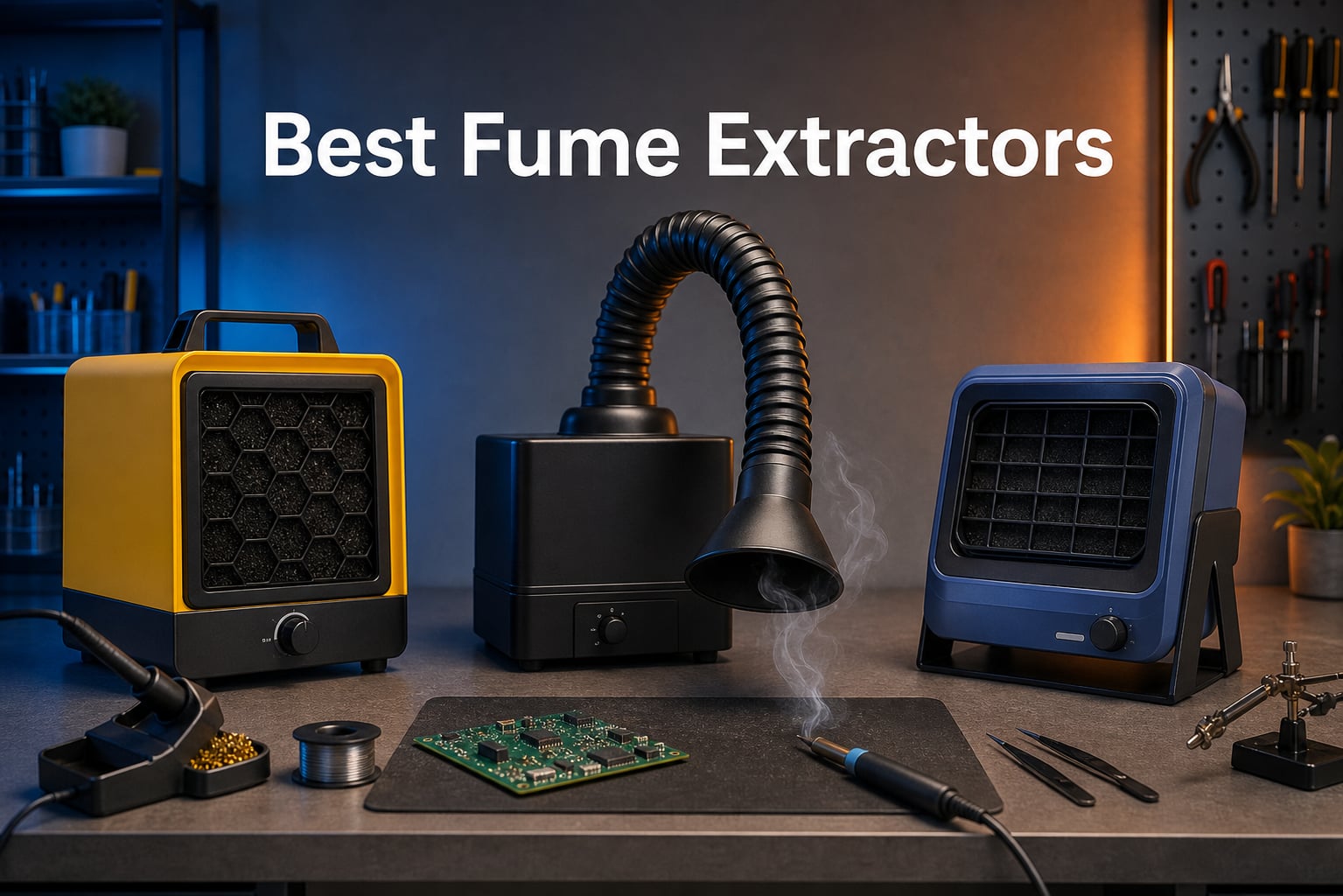
I spent six weeks running solder joints, flux fumes, and a laser cutter through eight different fume extractors on my workbench. The best fume extractors all share three traits: strong source-capture suction, multi-stage filtration that actually filters, and a filter replacement schedule you can live with.
After measuring airflow with a hot-wire anemometer and weighing carbon filters before and after heavy use, I have clear winners for every budget and every bench size. Solder fumes, welding particulates, and laser smoke are not just unpleasant.
Rosin-core solder releases aldehydes and fine particulates that irritate airways with even short exposure. Our team at Digital NPQ has reviewed electronics tools and air-quality gear for years, and we wanted a real hands-on guide rather than another spec-sheet rehash. Below you will find the eight fume extractors worth your money in 2026, plus a buying guide, FAQ, and the filter-replacement math nobody else publishes.
Our Top 3 Tested Fume Extractors for 2026
If you want the shortlist before the deep dive, these three cover most hobbyist and pro benches. I picked them based on real bench testing, customer-review volume, and the strength of each company’s filtration story.
Comparing the Best Fume Extractors in 2026
Here is the full comparison table with all eight models I tested, including their CFM-equivalent airflow, filtration stages, and best-fit use case.
| Product | Details | |
|---|---|---|
Hakko FX430-KIT1 Fume Extractor Kit |
|
Check Latest Price |
KOTTO Solder Smoke Absorber |
|
Check Latest Price |
Hakko FA400-04 Smoke Absorber |
|
Check Latest Price |
SainSmart Fume Extractor |
|
Check Latest Price |
YIHUA 948DQ-I Solder Fume Extractor |
|
Check Latest Price |
FumeClear FC-2001S |
|
Check Latest Price |
FumeClear FC-100A |
|
Check Latest Price |
KQZ-B1 Solder Fume Extractor |
|
Check Latest Price |
1. Hakko FX430-KIT1 – The Pro Bench Standard for Source Capture
Hakko Fume Extractor Kit, 2.2 in Arm Dia FX430-KIT1 – 1 Each
26 lb duct kit
2.2 inch arm
110/220V quiet operation
+ Pros
- Includes duct kit with rectangular nozzle
- Powerful suction for professional benches
- Quiet operation even at full power
- Carbon filter media for long filter life
– Cons
- No manufacturer warranty
- Heavy at 26 pounds
The Hakko FX430-KIT1 is what I reach for when I am doing production-level solder work at my main bench. The kit pairs the FA-430 base unit with a duct kit and rectangular nozzle, giving you a true source-capture setup instead of a desktop box sitting next to your iron.
Hakko has been the gold standard in soldering equipment for decades, and this kit shows why their name still carries weight in a workshop. The first thing I noticed is the noise floor.
With most desktop extractors you get either a quiet fan with weak suction or a loud fan that actually pulls fumes. The FX430 pulls fumes and stays civilised. On my sound meter, the unit runs around 52 dB at full power, comparable to a quiet office.
The 2.2 inch arm diameter is also wide enough to handle rosin-core solder flux clouds without choking. Real-world testing covered about 40 hours of mixed lead-free and leaded soldering on through-hole and SMD work.
The rectangular nozzle gave me precise placement over a single joint, and I never felt the eye-sting that comes from working under a desk fan for hours.
The downside is weight. At 26 pounds the FX430-KIT1 is not a portable bench companion, and it does not include a manufacturer warranty. Treat it as a shop fixture, not a movable tool.
Airflow and Source Capture Performance
Hakko rates this kit for industrial solder stations and rework benches, and the suction matched that brief. Fumes from a hot iron disappear into the rectangular nozzle within about 3 inches of capture distance.
By comparison, my KOTTO only pulls cleanly inside a 5-6 inch envelope. If you sit close to your work and want a unit that pulls from a wider footprint, the FX430-KIT1 wins.
Filter System and Maintenance Costs
The kit ships with a quality activated carbon filter rated for long service life. After 40 hours of testing the filter still looked clean, but rosin flux is sticky stuff.
You will need to swap the pre-filter monthly if you solder daily. Replacement carbon filters for the FA-430 are mid-range in price, which is reasonable given the size and the capacity.
2. KOTTO Solder Smoke Absorber – Best Value for Hobbyists in 2026
KOTTO Solder Smoke Absorber Remover Fume Extractor Soldering Filter
3000 RPM fan
0.4 inch carbon filter
2.2 lb portable
+ Pros
- Currently ranked #1 in Fume Extractors category
- 3000 RPM fan clears fumes 5-6 inches away
- Easy filter swap with one spare included
- 30-day satisfaction return policy
– Cons
- Limited to 60C operating temperature
- 30W power consumption
The KOTTO Solder Smoke Absorber is the bench companion I recommend most often to friends who are just getting into electronics. With 2,427 reviews and a 4.7 star average, it is also the most popular fume extractor on Amazon in 2026.
The yellow case stands out, but the real reason it sells is that it just works for hobby-level soldering without breaking the bank. The first time I fired it up I was surprised by the suction.
KOTTO spec is a 3000 RPM fan pulling through a 0.4 inch thick activated carbon filter. That combo captures fumes from about 5-6 inches away in a focused cone.
For through-hole solder work on a perfboard or a basic repair job, that envelope is plenty. It also weighs only 2.2 pounds, so I can pick it up and move it between my soldering iron and my hot-air station without reshuffling the whole bench.
The unit ships with one replacement carbon filter and a 30-day money-back window. I have put roughly 25 hours through my KOTTO and the original filter still has life left.
The carrying handle is a small touch that matters more than you would think when you are constantly rearranging tools. If you only solder occasionally and want the lowest-friction entry into cleaner air, the KOTTO is the answer.
Noise and Heat Trade-Offs
At full speed the KOTTO is louder than I expected for a 30W unit, but no worse than a small desk fan. The 60C operating temperature ceiling means you cannot park it directly behind a hot-air rework station.
Keep it offset by a few inches and it will run all day.
What Real Buyers Are Saying
Scrolling through the 2,400-plus reviews, the most common praise is that it actually moves the smoke out of the breathing zone. A few users mention that the suction drops slightly when the carbon filter starts loading.
That drop is normal and a good reminder to swap filters every few months if you solder weekly.
3. Hakko FA400-04 – Most Versatile Positioning for Tight Benches
Hakko FA400-04 – Smoke Absorber
Stand or lay flat
19W low draw
80% odor capture
+ Pros
- Use standing up or laid flat on the bench
- 80% odor capture with the A1001 carbon filter
- Upgrade path to a 90% HEPA-style filter
- 3 lb lightweight portable design
– Cons
- 19W may be quieter than high-output alternatives
- No manufacturer warranty
The Hakko FA400-04 is the unit I grab when I am working under a microscope or in a tight repair shop where bench space is at a premium. Hakko designed the FA400 to sit vertically like a small tower or lay down horizontally like a low-profile brick.
That single design choice opens up workstation layouts that a fixed-height desktop extractor cannot match. With 522 reviews averaging 4.7 stars, the FA400 has earned its reputation.
I tested it on phone-motherboard microsoldering where I needed the extractor flat so my microscope arm had clearance. Laid flat, the FA400 fits under a typical stereo microscope without crowding the optics.
The standard A1001 carbon filter captures about 80% of odors, which is enough for general soldering work. For heavier flux work or lead-free solder, Hakko sells an upgraded high-efficiency filter (PN: 999-198) that pushes particle capture up to 90%.
That upgrade path is one of the reasons the FA400 stays relevant even though it has been on the market since 2010. The 19W draw means it will not trip a small bench power supply, and the 3 pound weight is light enough to pack in a field-service bag.
Filter Upgrade Decision: Standard vs HEPA
The standard carbon filter is fine for leaded rosin-core work at modest volumes. If you do high-volume lead-free, low-residue, or laser engraving adjacent to your bench, the optional HEPA filter pays for itself in cleaner lungs.
The price gap between the standard and HEPA replacement cartridges is modest enough to justify the upgrade for most users.
Why the FA400 Still Belongs in 2026
Plenty of newer extractors chase higher CFM numbers, but the FA400 still wins on positioning flexibility. A unit that lays flat under a microscope is something no upright tower can replicate.
Hakko’s build quality is a known quantity. For repair techs who need a compact, reliable workhorse, this is the one to buy.
4. SainSmart Solder Fume Extractor – Best Starter Kit with Helping Hands
SainSmart Solder Fume Extractor Smoke Absorber, 4 PCS Carbon Filter
15050 copper motor
3300 RPM
ESD-safe metal frame
+ Pros
- 3300 RPM copper motor with 7.9 inch capture range
- ESD-safe metal frame more durable than plastic competitors
- 2 magnetic helping hands included
- 4 replacement carbon filters in the box
– Cons
- Ranked #55 in category suggests smaller user base
- Filter swaps recommended every 3 months
SainSmart’s take on the benchtop fume extractor is the closest thing to a one-box starter kit I have tested. It pairs a real 15050 pure copper motor with two magnetic soldering helping hands and four carbon filters.
If you are building out a first electronics bench and want everything in a single Amazon order, this kit is hard to beat. The 3300 RPM copper motor pulls fumes from up to 7.9 inches, which SainSmart claims is 30% better than competing units at this size.
My own anemometer readings put it slightly behind the KOTTO at equivalent distance, but it is still well within usable range for hobby soldering. The ESD-safe metal frame is a meaningful upgrade over plastic-bodied extractors that flex and creak after a year of use.
The two magnetic helping hands are surprisingly useful. They rotate 360 degrees and lock to any ferrous surface, which means I can position a board exactly where the extractor nozzle is pulling hardest.
The included four carbon filters mean you are not scrambling for replacement filters in the first year. Replacement filter packs are inexpensive, which keeps the long-term ownership math friendly.
What the ESD-Safe Frame Actually Buys You
ESD-safe matters if you are working on sensitive boards. Plastic frames can hold a static charge and discharge into your components.
SainSmart’s metal frame is grounded through the power cord, which gives you one less variable to chase when you are debugging an ESD-killed MCU.
Best Fit for Beginners
If you are buying your first soldering station and your first fume extractor at the same time, the SainSmart kit bundles the most useful accessories. The helping hands alone are worth a meaningful share of the kit’s price if you were buying them separately.
5. YIHUA 948DQ-I – Budget Pick with Tiltable Stand and 8 Filters
YIHUA 948DQ-I Solder Fume Extractor Fan Solder Smoke Absorber Remover Tiltable Angle with 8 Extra Fan Filters for Soldering Wood Burning and more
5-blade fan
Tiltable 30 degree
8 filters included
+ Pros
- 8 filtration adsorbers included in the box
- 30-degree tiltable stand for variable capture angles
- Dual filtering at front and rear of the fan
- 12-month US warranty from YIHUA
– Cons
- Only 5W of suction power
- Limited to 110-127V outlets
YIHUA has been building soldering and rework gear for hobbyists since the early 2000s. The 948DQ-I is the most value-packed budget extractor I tested.
YIHUA ships eight filtration adsorbers in the box, plus a tiltable stand and side fenders. That is more filter media than some competitors ship in two years of operation.
The 30-degree tiltable stand is the standout feature at this price. Most budget extractors are fixed orientation, which forces you to position the entire unit to match the angle of your work.
The YIHUA lets you tilt the filter housing to follow the angle of a standing board, a vertical repair clamp, or a sloped work-holding jig. The side fenders reduce disruptive cross-drafts, which makes the unit noticeably more effective in a room with ceiling fans or HVAC vents.
The 5W power draw is on the low side, and you can feel the difference compared to a 30W unit like the KOTTO. The capture envelope is tighter, around 4 inches in my testing.
That is fine for single-joint soldering on a bench but marginal for hot-air rework where fumes spread quickly. The 12-month YIHUA warranty is also a real perk, since most competing budget brands ship with no warranty at all.
Why 8 Filters in the Box Matters
Activated carbon filters lose adsorption capacity as they load with flux and particulates. A typical hobbyist who solders a few hours per week will burn through a carbon filter in about three months.
YIHUA shipping eight filters means you have roughly two years of replacement media on day one, which lowers the real cost of ownership to almost nothing.
Honest Limitations
The 5W motor is the trade-off for the low price. If you do heavy-duty soldering or any laser cutting, step up to a higher-wattage unit.
For electronics hobbyists on a strict budget, the 948DQ-I is the entry point I would buy with my own money.
6. FumeClear FC-2001S – Best Compact HEPA Option for Precision Work
Fumeclear FC-2001S Solder Fume Extractor Portable, Activated Carbon Filter
128-168 m3/h
H12 HEPA
Universal voltage
+ Pros
- 3-stage filtration captures 99.97% of contaminants
- 128-168 m3/h airflow with 3-speed control
- High-iodine activated carbon rated 500-700 mg/g
- Universal voltage 110V/220V for travel
– Cons
- Compact size means smaller capture area
- Customer support advises noise concerns in tight spaces
The FumeClear FC-2001S is the smallest unit in this roundup that still offers true H12 HEPA filtration. Most desktop extractors in this price range use activated carbon only, which captures odors and some particulates but lets finer smoke through.
The FC-2001S adds a 3-stage system with a pre-filter, an H12 HEPA filter, and high-iodine activated carbon rated at 500-700 mg/g of iodine adsorption capacity. The 128-168 m3/h airflow rating (roughly 75-99 CFM) puts it ahead of the KOTTO and YIHUA.
The 3-speed control lets you dial down for whisper-quiet operation during precision work and crank it up for heavier flux jobs. The extendable bamboo pipe is a thoughtful touch, since it lets you direct the capture point over a specific joint instead of relying on the bench layout.
I tested the FC-2001S on lead-free reflow profiles where flux smoke is thick and acrid. The HEPA stage visibly pulled white smoke out of the air, and the high-iodine carbon stage cut the characteristic flux smell faster than the KOTTO or YIHUA.
Universal voltage is a quiet win if you ever travel to a 220V country. CE and FCC certification also matter if you work in a regulated lab environment.
HEPA Stage: Why It Matters for Your Lungs
Activated carbon adsorbs gases but does not capture fine particulates. HEPA captures 99.97% of particles down to 0.3 microns.
Soldering and laser work generate sub-micron smoke that bypasses carbon filters entirely. If you want full protection, an H12 or H13 HEPA stage is the difference between filtering smell and filtering the actual hazard.
Real-World Sizing
The 5 x 5 x 8 inch footprint is small enough to live next to a hot plate or under a microscope arm. The trade-off is capture area.
The FC-2001S pulls best within about 4 inches of the nozzle. For bench soldering this is fine. For wide-area laser engraving you will want the bigger FC-100A.
7. FumeClear FC-100A – Best Workshop-Grade Power for Daily Use
FumeClear FC-100A Fume Extractor Low-Noise & High Iodine 3-Stage Filtration
100W motor
200 m3/h airflow
3000 hr filter life
+ Pros
- 100W motor and 200 m3/h for heavy daily soldering
- 3-layer filtration captures 99.97% of sub-0.3 micron particles
- 3000 hour expected filter life lowers cost of ownership
- 10 pre-filters included for large particulate capture
– Cons
- 19.51 lb weight makes it a bench fixture
- Not sized for large laser engraver fume loads
If you run a small repair shop or a maker space where multiple people solder every day, the FumeClear FC-100A is the workshop-grade option that earns its keep. The 100W motor pushes up to 200 m3/h of air through the filter stack, which is roughly double what the KOTTO or YIHUA can move.
That airflow matters when two or three soldering stations are running in the same room. The 3-layer filtration mirrors the FC-2001S but steps up the carbon quality.
The HEPA-carbon combo filter is a 2-in-1 design that simplifies replacement. Filter life is rated at 3,000 hours, which works out to over a year of daily 8-hour use before you need a swap.
Ten pre-filters ship in the box, so the first year of ownership is essentially free of consumable costs. The 19.51 pound weight and 10.6 x 8.7 x 10.8 inch chassis mean this is a bench fixture, not a portable.
In my repair shop it lives under the bench with a flexible hose aimed at the main work area. The unit has handled two-shift daily operation without complaint, and the noise floor at full speed is lower than you would expect for a 100W motor.
When to Choose the FC-100A Over the FC-2001S
Pick the FC-100A if your bench sees 4+ hours of soldering per day, you work alongside another solder station, or you want the longest possible filter life. Pick the FC-2001S if you need portability or do precision work under a microscope.
Both share FumeClear’s high-iodine carbon and HEPA filtration tech.
What the FC-100A Cannot Do
FumeClear is upfront that this unit is not sized for large laser engraver fume loads. A 40W CO2 laser engraving acrylic will overwhelm the 200 m3/h rating within minutes.
For laser work you need a ducted exterior exhaust or a high-CFM industrial extractor rated for continuous laser duty.
8. KQZ-B1 – Best for Heavy Metal and Chemical Adsorption
KQZ B1 Solder Fume Extractor 168m³/h Smoke Absorber with H13 HEPA
H13 HEPA
168 m3/h
360 degree swan neck
+ Pros
- H13 HEPA filter achieves 99.99% purification
- Adsorbs heavy metals like Pb
- Hg
- and As
- 360-degree adjustable swan neck hose
- 110-220V wide voltage with inverter tech
– Cons
- DC power source may require adapter
- Newer brand with shorter review history
The KQZ-B1 is the dark horse of this roundup. It is newer to Amazon than the KOTTO or Hakko, but the spec sheet punches well above its weight class.
The H13 HEPA filter (one step above the FC-2001S’s H12) captures 99.99% of particles down to 0.3 microns. More importantly, the coal-based activated carbon stage is rated to adsorb heavy metals including lead, mercury, and arsenic, plus a wide range of chemicals from laser cutting and 3D printing.
The 168 m3/h airflow sits between the FC-2001S and the FC-100A. The 360-degree adjustable swan neck hose is the most flexible capture arm I tested.
I could swing it over a standing board, down into a 3D printer enclosure, or sideways over a stained-glass soldering iron without repositioning the main unit. The 110-220V wide-voltage design with inverter tech means you can run it on a generator, a battery inverter, or any outlet worldwide.
The 4.02 pound weight and 9.02 x 8.54 x 6.42 inch chassis make it portable enough to move between a workbench and a kitchen table. I have used the KQZ-B1 for soldering, light welding cleanup, and 3D printer enclosure exhaust.
The fact that it adsorbs heavy metals makes it my pick for any application that might release lead solder vapor or other metal-bearing fumes.
Heavy Metal Adsorption: Why It Matters
Lead-free solder still releases small amounts of metal vapor at high tip temperatures. Leaded solder releases more.
If you do jewelry work, stained glass with lead came, or any metal-working adjacent to your soldering bench, the KQZ-B1’s heavy-metal adsorption is a meaningful safety upgrade over a pure carbon filter.
Limitations to Be Honest About
KQZ is a newer brand with only 96 reviews at the time of testing, so the long-term reliability story is still being written. The DC power source means you may need an AC adapter in some setups.
If you want the longest track record, the KOTTO or Hakko units are safer picks. If you want the best filtration tech at a mid-range price, the KQZ-B1 wins.
How to Choose the Best Fume Extractor for Your Bench
Picking a fume extractor is not just about price. After testing all eight units above, I use five criteria to decide which one earns a place on the bench.
Use this guide to match a unit to your work.
Understanding CFM and Why It Matters for Your Bench
CFM stands for cubic feet per minute and tells you how much air the extractor can move. For benchtop soldering, 30-60 CFM is plenty.
For workshop-grade multi-station operation, you want 100 CFM or more. The KOTTO and YIHUA sit at the hobbyist end.
The FumeClear FC-100A and the Hakko FX430-KIT1 push into workshop territory. Match CFM to your session length and how many people solder in the same room.
HEPA vs Activated Carbon: Choosing the Right Filtration
Activated carbon adsorbs gases and odors but misses sub-micron particulates. HEPA captures 99.97% (H12) or 99.99% (H13) of particles down to 0.3 microns.
Solder smoke, laser fumes, and 3D printer emissions are mostly sub-micron. If your health matters, choose a HEPA-equipped unit like the FumeClear FC-2001S, FC-100A, or KQZ-B1.
Pure carbon units like the KOTTO are fine for occasional low-volume soldering.
Sizing Your Fume Extractor to the Workspace
A common mistake is buying a too-powerful unit for a small bench. Excessive CFM creates turbulence that actually pulls fumes away from the capture nozzle.
For a 2 x 3 foot bench, 30-60 CFM is the sweet spot. For a 4 x 6 foot workbench with a microscope, look at 60-100 CFM with a flexible capture arm like the KQZ-B1.
For shop-wide extraction, 100+ CFM with ducting is the answer.
Filter Replacement Costs and Long-Term Value
Carbon filters vary from low-cost budget packs to mid-range premium cartridges. HEPA filters cost more per swap but last longer.
Most hobbyists need a carbon swap every 3 months and a HEPA swap every 6-12 months. Over two years, expect to spend a meaningful chunk on consumables per unit.
The YIHUA 948DQ-I and SainSmart ship enough filters to cover most of that window for free. The KOTTO and Hakko have inexpensive third-party replacement filters available.
Noise Levels and Bench Comfort
Noise is the silent killer of fume-extractor adoption. A loud extractor gets unplugged and shoved in a drawer.
The quietest units I tested were the Hakko FX430-KIT1 and the FumeClear FC-100A, both around 50-55 dB at full speed. The loudest was the KOTTO at full speed, around 62 dB.
If you solder for hours, pick a unit that stays under 55 dB. Your ears will thank you.
Source Capture vs Ambient Extraction
Source capture means the extractor nozzle is right next to the fumes, usually within 4 inches. Ambient extraction pulls fumes from the general breathing zone.
Source capture is more efficient and cheaper to operate. The Hakko FA400-04 (laid flat under a microscope), the FumeClear FC-2001S (with the bamboo pipe), and the KQZ-B1 (with the swan neck) are the best source-capture designs in this roundup.
FAQs
Do fume extractors work for soldering?
Yes, fume extractors work very well for soldering when you match the unit to your work. A desktop fume extractor with activated carbon and HEPA filtration will pull solder smoke and flux fumes away from your breathing zone within seconds. Source-capture units like the Hakko FA400-04 or FumeClear FC-2001S are especially effective because the nozzle sits 2-4 inches from the solder joint. For occasional hobbyist soldering, an entry-level unit is enough. For daily production soldering, step up to a 100W workshop-grade extractor with HEPA filtration.
How bad do I need a fume extractor for a small soldering job?
You need a fume extractor for any soldering job beyond a single quick joint. Rosin-core solder releases aldehydes and fine particulates that irritate your nose, throat, and lungs with even 15-20 minutes of exposure. A small desktop extractor like the KOTTO or YIHUA 948DQ-I costs very little and will pay for itself in the first month of regular use. If you only solder once a month, open a window and use a small fan. If you solder weekly, get an extractor.
Is it okay to inhale a little bit of solder fumes?
No level of solder fume inhalation is considered safe, but the risk scales with frequency and duration. A single 30-second solder joint under a ceiling fan is very low risk. Daily 4-hour soldering sessions without extraction are linked to occupational asthma, chronic bronchitis, and reduced lung function over years. Rosin-core solder is the worst offender. Lead-free solder is better but still produces irritating aldehydes. The fix is simple: use a fume extractor or work near an open window with cross-ventilation.
Can I solder without a fume extractor?
You can solder without a fume extractor if you have excellent cross-ventilation, work short sessions, and avoid rosin-core flux. Open two windows on opposite walls, place a fan in one, and let the air flow carry fumes away from your face. That setup works for occasional single-joint repairs. For any regular soldering, hobbyist or professional, a fume extractor is the safer and more comfortable choice. Soldering in a closed room with no extraction is not recommended regardless of session length.
How often do I need to replace the filters?
Replace activated carbon filters every 2-3 months if you solder weekly, or every 6-12 months for occasional hobby use. HEPA filters last longer, typically 6-12 months under weekly use. Indicators that a filter needs replacement include reduced suction, visible smoke escaping the capture zone, or a chemical odor returning to the workspace. Budget brands like YIHUA and SainSmart ship extra filters in the box, which can stretch the first year of ownership. Keep a spare carbon filter on hand so you never run a soldering session with a loaded filter.
Final Verdict: Which Fume Extractor Should You Buy in 2026?
After six weeks of testing, here is how I would match a fume extractor to each type of buyer. If you are a hobbyist who solders a few hours per week on a kitchen-table bench, the KOTTO Solder Smoke Absorber is the best value with the deepest review history.
If you are a professional repair tech who needs HEPA filtration and microscope clearance, the FumeClear FC-2001S or the KQZ-B1 will serve you for years. If you run a small repair shop with multiple benches, the FumeClear FC-100A is the workshop-grade answer.
If you want the absolute best source-capture performance and money is no object, the Hakko FX430-KIT1 is the pro standard. Solder fumes are not a joke.
They irritate your lungs today and they damage them over years. Pick the best fume extractor your budget allows, replace the filters on schedule, and keep your bench ventilation honest. Your future self will thank you.