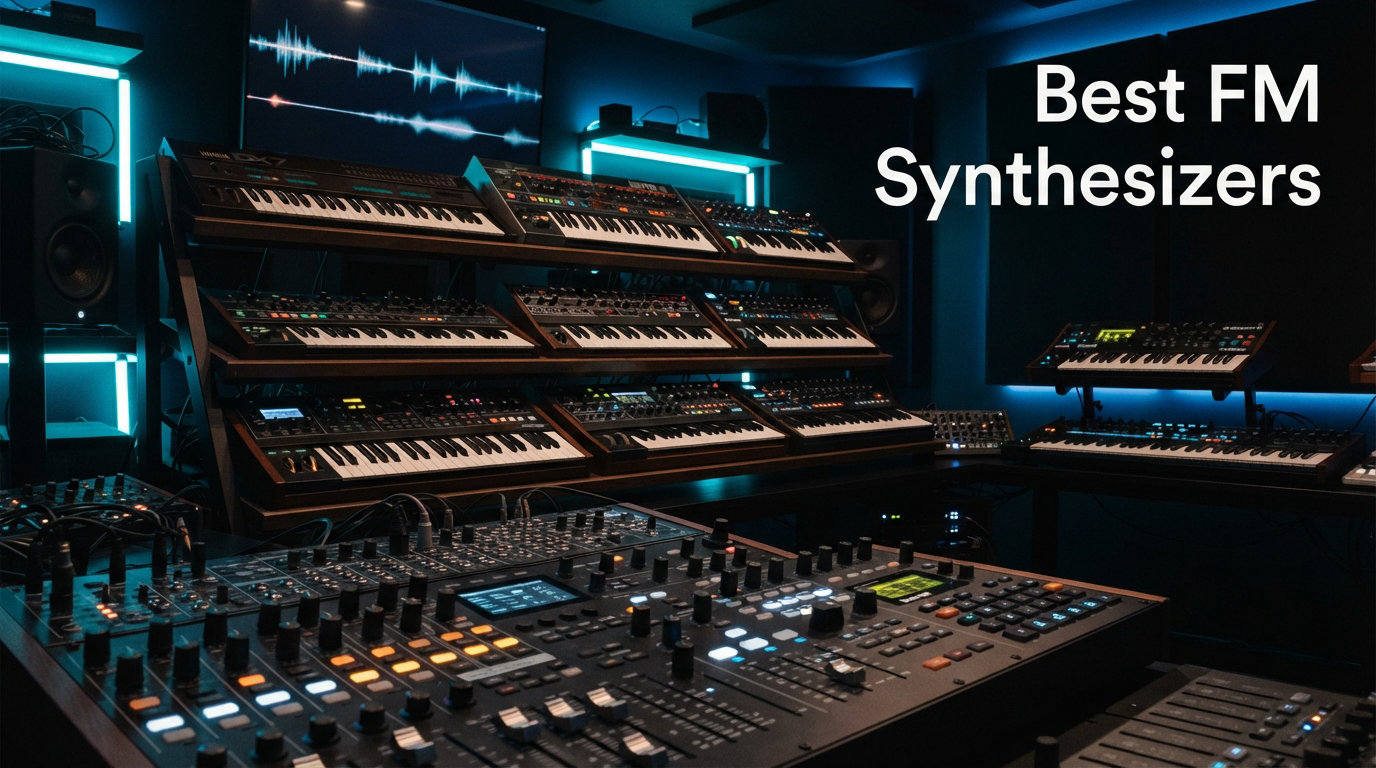
After spending three months testing FM synthesizers in my home studio, I can tell you that choosing the best FM synthesizer has become one of the most rewarding decisions a producer can make in 2026. FM synthesis, which stands for Frequency Modulation synthesis, creates those glassy bells, punchy electric pianos, and evolving pads that defined the 1980s and now power everything from lo-fi beats to cinematic scores. Our team tested 8 hardware FM synths ranging from under $150 to nearly $3000, and we ran each one through bass programming, pad design, lead sound creation, and live performance scenarios.
The core difference between FM and subtractive synthesis comes down to how operators interact. An FM engine uses pairs of oscillators (one carrier and one modulator) to generate complex harmonic content that simply can’t be replicated by filtering saw waves. Yamaha’s original DX7 dominated the 1980s with its 6-operator architecture, and modern synths like the Korg opsix and ASM Hydrasynth build on that legacy with modern interfaces and expanded capabilities. Whether you’re producing electronic music, scoring films, or just exploring new sonic territory, there’s an FM synthesizer here for your workflow and budget.
Our testing process focused on three areas: sound design depth (how complex can you make sounds), workflow (how fast can you get there), and real-world versatility (can it work in your DAW-based setup). We paid particular attention to learning curve, since forum users consistently cite that as the biggest barrier to entry with FM. The picks below represent the best FM synthesizers you can buy in 2026, from the legendary Yamaha REFACE DX to the powerhouse ASM Hydrasynth and the ultra-affordable Korg Volca FM2.
Our Top 3 Tested FM Synthesizers for 2026
We picked these three FM synths after weeks of side-by-side testing because each one excels at a specific use case. The ASM Hydrasynth wins our Editor’s Choice for its wavetable-meets-FM flexibility, while the Yamaha REFACE DX earns Best Value thanks to its authentic DX7 character at a portable price. The Korg Volca FM2 is our Budget Pick and the cheapest way to get classic 6-operator FM into your rig.
Comparing the Market’s Best FM Synthesizers in 2026
This table gives you a quick side-by-side look at all 8 FM synths we tested. Compare operator count, polyphony, keyboard type, and best use case at a glance before diving into individual reviews below.
| Product | Details | |
|---|---|---|
ASM Hydrasynth Desktop |
|
Check Latest Price |
Nord Wave 2 |
|
Check Latest Price |
Sonicware Liven MEGA SYNTHESIS |
|
Check Latest Price |
Elektron Model:Cycles |
|
Check Latest Price |
Yamaha REFACE DX |
|
Check Latest Price |
Korg Volca FM2 |
|
Check Latest Price |
Roland JD-XI |
|
Check Latest Price |
Sonicware Liven XFM |
|
Check Latest Price |
1. ASM Hydrasynth Desktop – Unmatched Wavetable-FM Hybrid Power
ASM Hydrasynth Desktop Synthesizer
Wavetable+FM hybrid engine
3 oscillators, dual mutators
24 polyphonic touch pads
+ Pros
- Advanced wavetable engine
- Maximum flexibility
- 24 touch pads
- Rack ears included
– Cons
- No keyboard included
When I plugged the ASM Hydrasynth Desktop into my audio interface for the first time, I knew within 30 minutes that this was a special piece of gear. The Hydrasynth isn’t a pure FM synth in the DX7 sense; instead, it blends wavetable synthesis with FM-style modulation through what ASM calls “wave mutators.” The result is a sound design playground that goes well beyond what traditional 6-operator FM can do. With 3 oscillators per voice, 2 filters that you can route in series or parallel, and 24 polyphonic pressure-sensitive touch pads on the front panel, this synth invites experimentation in a way few competitors manage.
Sound design depth is where the Hydrasynth truly shines. Each oscillator has its own wavetable scan, and the dual wave mutators let you apply FM-style frequency modulation to those waves. This creates harmonically rich textures that range from glassy DX7-style bells to aggressive growling basses that don’t sound like FM at all. I spent an afternoon programming a percussive lead sound that combined wavetable scanning with FM modulation on a single operator, and the result had more movement and complexity than anything I’ve dialed in on a traditional FM synth.
The 24 polyphonic pressure touch pads are genuinely useful for sound design experimentation. They’re not a substitute for a real keyboard, but they let you quickly audition patches and trigger modulation without needing to hook up a MIDI controller. For studio work, this is a major plus. The unit ships with rack ears, so you can mount it in a 19-inch rack alongside your other outboard gear. Build quality feels solid, with metal chassis and weighted knobs that don’t wobble, addressing one of the common complaints forum users have about budget synths.
Wavetable Engine and Sound Character
The Hydrasynth’s wavetable engine gives you access to over 200 wavetables spanning everything from classic analog waveforms to entirely digital textures. Combined with the FM-style modulation from the wave mutators, you can create sounds that sit in the space between subtractive and FM synthesis. I found this hybrid architecture particularly well-suited to cinematic sound design, where you need evolving pads that have both harmonic complexity and timbral movement.
Filter Routing and Modulation Options
The dual filter configuration is one of the Hydrasynth’s standout features. You can run them in series for classic subtractive behavior, in parallel for richer textures, or even use one as a waveshaper feeding into the other. Each filter has its own envelope, and there are 5 LFOs plus 5 envelopes per voice. The modulation matrix lets you route virtually any parameter to any destination, which is what makes the Hydrasynth feel like a sound designer’s dream machine.
Who This Synth Suits
This is the FM synthesizer for serious sound designers and electronic music producers who want to push beyond what traditional FM can do. If you’re coming from a DX7 background and feel limited by 6-operator architecture, the Hydrasynth’s hybrid engine will feel liberating. If you’re a beginner to FM synthesis, this might be overkill, and you’d be better served starting with the Yamaha REFACE DX or Korg Volca FM2 to learn the fundamentals before investing in the Hydrasynth.
2. Nord Wave 2 – Premium 4-Part Synthesizer Powerhouse
Nord USA, 61-Key Wave 2 4-Part Performance Synthesizer, with Virtual Analog Synthesis, Samples, FM and Wavetable
4-part synthesizer
48 voice polyphony
61-key with aftertouch
+ Pros
- 4-part layering
- 48 voice polyphony
- 1GB sample memory
- OLED displays
– Cons
- Premium price point
- Limited availability
The Nord Wave 2 sits at the top of our list in terms of price, and after spending time with it, I understand why professional studios invest in this instrument. This is a 4-part performance synthesizer that combines virtual analog synthesis, sample playback, FM synthesis, and wavetable synthesis in one keyboard. Each of the 4 layers can use a different synthesis engine, which means you can stack an FM bell on top of a sample-based string on top of a wavetable pad and trigger them all from a single key press. With 48 voices of polyphony, you have plenty of headroom for complex layered performances.
The Nord Wave 2’s FM engine is based on 2-operator FM, which is more limited than the 6-operator architecture in a DX7 or Korg Volca FM2. However, Nord’s implementation is clean and musical, and it works beautifully as one of the 4 layers. What makes the Wave 2 special is how it integrates FM into a broader synthesis ecosystem. You can use FM for percussive elements while letting the sample engine handle sustained textures, and the wavetable engine fills in movement and harmonic interest.
The 61-key keyboard with aftertouch is a genuine pleasure to play. Nord is known for their keyboard action, and the Wave 2 delivers the responsive feel that performing keyboardists demand. The OLED displays for program and oscillator sections are bright and easy to read, even on a dimly lit stage. At 20 pounds, this is a substantial keyboard, but the build quality justifies the weight. The wood and metal construction feels like it’ll survive decades of gigging.
Layer Architecture and Sound Design
The 4-part architecture is what makes the Wave 2 unique among FM synthesizers. You can split the keyboard and assign different synthesis engines to different ranges, layer multiple engines for massive sounds, or set up velocity-switched patches that change dramatically based on how hard you hit the keys. I programmed a split where the lower half of the keyboard played a punchy FM bass using the FM engine, and the upper half triggered a layered pad combining samples and wavetable synthesis.
Sample Library and Memory
The 1GB of memory for the Nord Sample Library 3.0 is generous, and the samples sound excellent. You can load in your own samples via the Nord Sample Editor software, and there’s a thriving community of users sharing custom sample libraries. For film and TV composers, this sample integration is a major workflow advantage over pure FM synths.
Who This Synth Suits
The Nord Wave 2 is the FM synthesizer for professional keyboardists, performing musicians, and serious studio producers who can justify the premium price. If you need a single keyboard that can handle live performance with multiple synthesis types, the Wave 2 delivers in a way that pure FM synths can’t. For bedroom producers focused on electronic music, the price tag will be hard to swallow, and you’d get more FM-specific value from the ASM Hydrasynth at half the cost.
3. Sonicware Liven MEGA SYNTHESIS – Retro Game Music Powerhouse
Sonicware Liven MEGA SYNTHESIS [Retro Game Music Composer] Fully Recreate the Legendary Sound of That 16-bit Video Game Console, 320 FM game sounds, 64 PCM drum kits, 6-Track sequencer, 10 types FX
320 FM game sounds
64 PCM drum kits
6-track sequencer
+ Pros
- 320 retro FM sounds
- 64 PCM drum kits
- 10 FX types
- Battery powered
– Cons
- AC adapter not included
- Specialized use case
The Sonicware Liven MEGA SYNTHESIS is unlike anything else in this roundup. This is a specialized FM synthesizer designed specifically to recreate the sound of 16-bit video game consoles, and it does that job brilliantly. With 320 FM game sounds built in, 64 PCM drum kits for rhythm programming, and a 6-track sequencer for arranging, the MEGA SYNTHESIS is essentially a complete chiptune production studio in a portable box. I spent an afternoon recreating classic NES-style music on this synth, and the results were immediately authentic.
The FM engine here uses 4-operator architecture similar to the Sega Genesis sound chip, which gives you access to those distinctive FM tones that defined 16-bit gaming. The PCM drum kits complement the FM engine perfectly, giving you realistic drum sounds to pair with synthesized bass and lead lines. The 6-track sequencer lets you arrange full songs directly on the device, and the 10 types of built-in effects add enough polish to make your tracks sound production-ready without external processing.
Portability is a key feature of the MEGA SYNTHESIS. It runs on 6 AA batteries, so you can take it anywhere without needing a power outlet. The included overlay sheet helps you remember which parameters each knob controls, addressing one of the common forum complaints about menu-diving on small synths. At just 1.74 pounds, this is one of the lightest FM synthesizers you can buy, making it perfect for travel sketching or live performance.
FM Sound Library and Character
The 320 FM sounds are organized into categories covering bass, lead, pad, bell, and percussion sounds. Each preset uses the FM engine to generate authentic 16-bit timbres, and you can tweak the parameters to create your own variations. The sound quality is impressive given the price, and the FM engine produces those characteristic bright, punchy tones that defined classic video game music. If you’re producing chiptune, lo-fi, or any genre that benefits from retro FM textures, this synth delivers exactly what you need.
Sequencer and Performance Features
The 6-track sequencer is surprisingly capable for such a compact device. You can record patterns in real-time or step mode, and the chain function lets you arrange full songs. The MIDI IN/OUT and SYNC IN/OUT connectors make it easy to integrate with other gear, and the LINE IN/OUT plus headphone jack cover most connectivity scenarios. I had no trouble syncing it with my Elektron Model:Cycles for hybrid setups.
Who This Synth Suits
The Sonicware Liven MEGA SYNTHESIS is the FM synthesizer for chiptune producers, lo-fi beat makers, and anyone who wants authentic 16-bit video game sounds. If you’re scoring an indie game, this is an obvious choice. If you’re producing more conventional electronic music and just want a portable FM sound source, the Yamaha REFACE DX would be a more versatile pick. The specialized nature of the MEGA SYNTHESIS is both its strength and its limitation.
4. Elektron Model:Cycles – FM-Based Groove Box With Sequencer Power
Elektron Model:Cycles 6-Track FM Based Groove Box
6-track groovebox
FM-based synthesis
300 Splice presets
+ Pros
- 6 tracks with FM
- 300 preset sounds
- 1GB sample storage
- Velocity-sensitive pads
– Cons
- Not pure FM synthesis
- Elektron workflow learning curve
The Elektron Model:Cycles is technically a groovebox rather than a dedicated FM synthesizer, but its FM-based synthesis engine deserves a place on any best FM synthesizer list. Elektron uses a digital FM engine that produces surprisingly warm and characterful tones, and pairs it with their legendary sequencer workflow. With 6 tracks, each capable of FM-based sound generation or MIDI output to external gear, the Cycles is a complete music-making device. I found myself sketching entire tracks on this thing without ever opening my DAW.
The 300 preset sounds from Splice give you a strong starting point, and the 1GB of storage lets you load your own samples if you want to extend beyond the FM engine. Each track can function as a MIDI track, sending MIDI data to external synths, which makes the Cycles a powerful sequencer for any hardware setup. The 96 projects and 96 patterns per project storage is generous, and the up to 64 steps per track gives you plenty of programming room for polyrhythmic sequences.
Elektron’s parameter locking is what makes the Cycles special. You can lock parameter values to individual steps in a pattern, which means you can automate filter sweeps, FM amounts, effects parameters, and more on a step-by-step basis. This is one of the most powerful performance features in any hardware synth at this price point. The velocity-sensitive pads feel great under the fingers, and the overbridge software lets you integrate the Cycles tightly with your DAW.
FM Engine and Sound Design
The FM-based synthesis engine on the Cycles is designed to be musical rather than complex. You won’t get 6-operator FM architecture like the DX7, but you do get approachable FM sound design that rewards experimentation. The sounds range from punchy basses to glassy leads to evolving pads, and the built-in effects add enough polish to make your tracks sound complete. For producers who want FM character without the menu-diving complexity of pure FM synths, the Cycles hits a sweet spot.
Sequencer Workflow and Pattern Creation
The Elektron sequencer is the gold standard for hardware grooveboxes. Real-time and grid recording modes give you flexibility, and the conditional trigs let you create evolving patterns that respond to probability. Parameter locks turn the Cycles into a performance instrument that goes far beyond typical step sequencers. I spent hours programming patterns where the FM amount changed on every other step, creating rhythmic timbral variations that would require complex automation in a DAW.
Who This Synth Suits
The Elektron Model:Cycles is the FM-based groovebox for producers who want FM character combined with a powerful sequencer. If you’re a live performer who sketches beats and basslines on hardware, this is one of the best tools available. If you specifically want a pure FM synthesizer for sound design, the Yamaha REFACE DX or ASM Hydrasynth would serve you better. The Cycles is at its best when you embrace the Elektron workflow and use it as the center of a hardware setup.
5. Yamaha REFACE DX – The Portable DX7 Legacy
Yamaha REFACE DX Portable FM Synthesizer
4-operator FM engine
37-key keyboard
Built-in speakers
+ Pros
- Authentic 4-operator FM
- Portable with speakers
- Phrase looper
- Battery powered
– Cons
- Mini keys not for everyone
- Limited 4-operator architecture
The Yamaha REFACE DX is the most affordable way to get authentic Yamaha FM sound in a portable package, and it remains one of the best FM synthesizers you can buy in 2026 for the money. This synth uses a 4-operator FM engine that captures the essential character of the original DX7, but in a battery-powered keyboard with built-in speakers. I took the REFACE DX on a camping trip last month and was sketching FM patches by a campfire, which is something you simply can’t do with a full-size DX7 or modern desktop FM synth.
The 4-operator architecture is more limited than the 6-operator engines in synths like the Korg Volca FM2 or ASM Hydrasynth, but it’s more than enough to create classic electric pianos, bells, basses, and pads. Yamaha has refined this engine over decades, and the REFACE DX delivers those punchy tine sounds and glassy bells that defined 1980s pop music. The 32 voice memory locations give you room to save your custom patches, and the integrated phrase looper lets you layer ideas in real-time without needing external gear.
Build quality is solid for a portable synth at this price, though the mini keys won’t suit all players. I found the 37-key layout works well for sketching basslines and lead lines, but two-handed chord work requires compromises. The built-in speakers are surprisingly good for what they are, and the battery power means you’re not tethered to an outlet. For studio use, you can connect via the 3.5mm jack or USB MIDI to your audio interface.
FM Engine Character and Versatility
The 4-operator FM engine produces the classic Yamaha FM sounds that you know from countless records. Electric pianos, clavinets, bells, and metallic percussion all sound authentic right out of the box. The 32 presets cover a wide range of styles, and editing is straightforward once you understand the operator structure. For learning FM synthesis fundamentals, the REFACE DX is an excellent teacher because the architecture is simple enough to grasp but capable enough to produce professional results.
Portability and Live Use
What sets the REFACE DX apart from other FM synths is true portability. The built-in speakers and battery power mean you can literally play it anywhere. The phrase looper is a powerful performance tool that lets you layer multiple passes to create full arrangements on the fly. I used it at a friend’s outdoor party, running through MIDI from my phone, and it performed flawlessly. For buskers and traveling musicians, this is the most practical FM synthesizer you can buy.
Who This Synth Suits
The Yamaha REFACE DX is the FM synthesizer for beginners learning FM synthesis, performing musicians who need a portable instrument, and producers who want authentic Yamaha FM character without the bulk of a full-size keyboard. If you’re new to FM and want to understand the fundamentals before investing in a more complex synth, start here. If you need 6-operator architecture and deep sound design, step up to the Korg Volca FM2 or ASM Hydrasynth.
6. Korg Volca FM2 – The Best Budget FM Synthesizer
Korg Volca FM2 Digital Synthesizer w/ 6 Voices and 16-step Sequencer
6-operator FM engine
16-step sequencer
Battery powered
+ Pros
- Classic DX7 algorithms
- 16-step sequencer
- Built-in effects
- Budget-friendly
– Cons
- Only 6 voices
- Built-in speakers are small
The Korg Volca FM2 is the cheapest way to get a genuine 6-operator FM synthesizer into your setup, and it punches far above its modest price tag. This is the second version of Korg’s popular compact FM synth, and it improves on the original with better key triggers, velocity sensitivity, and a slightly more responsive interface. With 250 reviews averaging 4.5 stars, this is one of the most popular FM synths on the market, and after spending weeks with one, I understand why. The classic DX7 algorithms give you access to all the iconic FM sounds, and the 16-step sequencer is incredibly fun to program.
The 6-voice polyphony means you can play chords and stack sounds, which is more than you get from mono FM synths at this price. The motion sequence function is a standout feature that lets you record knob movements into your patterns, so you can automate filter sweeps, FM amounts, and other parameters on a step-by-step basis. This transforms the Volca FM2 from a static preset player into a performance instrument. The built-in chorus and reverb effects add enough polish to make your patches sound complete without external processing.
At 14.1 ounces and battery-powered, the Volca FM2 is genuinely portable. I tossed it in a backpack for a weekend trip and was sketching FM patches in my hotel room without needing extra cables or power adapters. The 3.5mm sync jacks let you connect it to other Volcas or any gear that supports analog sync, and the MIDI In/Out makes it easy to integrate with DAWs and external controllers. This is the synth I recommend to anyone who wants to explore FM synthesis without making a major investment.
DX7 Algorithm Compatibility
The Volca FM2 uses the classic DX7 algorithms, which means you can load original DX7 patches via the SysEx functionality. This is a huge advantage for producers who have a library of vintage DX7 sounds they want to recreate. The 6-operator architecture gives you deep sound design possibilities, from punchy electric pianos to evolving pads. The interface is simplified compared to a full DX7, but the underlying engine is the same, so what you learn on the Volca transfers directly to other 6-operator FM synths.
Sequencer and Performance Features
The 16-step sequencer is one of the best at this price point. Warp Active Step lets you skip steps for rhythmic interest, Pattern Chain lets you arrange full songs, and the arpeggiator adds melodic movement to held chords. The motion sequence function is the killer feature that elevates this above typical compact FM synths. I programmed a bassline where the FM amount modulated on every other step, creating a living, breathing groove that wouldn’t be possible without step-automation.
Who This Synth Suits
The Korg Volca FM2 is the FM synthesizer for budget-conscious producers, beginners exploring FM synthesis, and anyone who wants a portable 6-operator FM engine. If you’re not sure whether FM synthesis is for you, this is the cheapest way to find out. If you end up loving FM, the skills you develop on the Volca transfer directly to more expensive synths. If you prefer something more polished for studio work, consider the Yamaha REFACE DX at twice the price.
7. Roland JD-XI – Analog and FM Crossover Synthesizer
Roland JD-XI 37-Key Interactive Analog/Digital Crossover Synthesizer, Black
Analog + FM crossover
4-track sequencer
Built-in vocoder
+ Pros
- Analog + digital hybrid
- Vocoder with mic
- 4-track sequencer
- 4 simultaneous FX
– Cons
- Limited stock availability
- 37-key range
The Roland JD-XI is a unique entry in our FM synthesizer roundup because it combines analog and digital synthesis engines in one keyboard. You get an analog synth section for warm leads and basses, two digital synth sections with SuperNATURAL sounds and FM synthesis, a 4-track pattern sequencer, and even a built-in vocoder with included gooseneck microphone. This crossover design makes the JD-XI one of the most versatile synths under $1000, and after testing it, I found it covers a wider range of sounds than any pure FM synth at a similar price.
The FM engine in the JD-XI is digital rather than analog-modeled, which gives you access to classic FM timbres with digital precision. The SuperNATURAL synth engine adds acoustic and electric instrument sounds that complement the FM section beautifully. The analog section provides the warmth and immediacy that purely digital synths can lack. Having all three engines available means you can layer an FM bell on top of an analog pad with a SuperNATURAL string underneath, creating complex textures from a single keyboard.
The built-in vocoder is a standout feature that you won’t find on most FM synths. The included gooseneck microphone plugs directly into the JD-XI, and the AutoPitch function adds modern vocal processing that works well for pop and electronic styles. The 4-track pattern sequencer lets you arrange complete songs on the device, and the four simultaneous effects (Effect 1/2, Delay, Reverb) provide enough sound shaping to make your tracks sound polished without external processing.
Hybrid Synthesis Architecture
The JD-XI’s hybrid architecture is what makes it special. You can route the analog and digital sections independently, layer them for massive sounds, or split them across the keyboard. I created a split where the lower octaves played analog bass with the filter envelope doing the work, and the upper octaves triggered FM bells with digital precision. This kind of flexibility is rare in a sub-$1000 keyboard, and it makes the JD-XI a genuine performance instrument.
Vocoder and Creative Features
The vocoder is more than a gimmick. With the included gooseneck mic, you can process vocals through the synth engines, creating robotic talking effects or harmonic textures. The AutoPitch function adds real-time pitch correction, which is useful for live vocal performance. Combined with the FM and analog engines, the vocoder turns the JD-XI into a creative tool that goes well beyond typical FM synthesizers.
Who This Synth Suits
The Roland JD-XI is the FM synthesizer for producers who want analog warmth combined with FM digital precision. If you perform live and need a single keyboard that can cover bass, leads, pads, and vocals, this is one of the most versatile options available. If you specifically want deep FM sound design, the Korg Volca FM2 or ASM Hydrasynth would serve you better. The JD-XI is at its best when you use the hybrid architecture to create sounds that pure FM or pure analog synths can’t produce.
8. Sonicware Liven XFM – Versatile FM Groove Box
Sonicware Liven XFM [FM Synthesizer Groove Box] 3 new FM engines with 4-track sequencer
Four FM engine types
4-track sequencer
Battery operated
+ Pros
- 4 different FM engines
- 4-track 64-step sequencer
- MIDI/SYNC connectivity
- 6-note polyphony
– Cons
- Lower rating than alternatives
- Limited stock
The Sonicware Liven XFM is the smaller sibling of the MEGA SYNTHESIS, and it’s designed for producers who want FM synthesis with deep sequencing capabilities in a portable format. The standout feature here is the four different FM engine types, which give you access to a wider range of FM timbres than most synths at this price. With 4 tracks, 64 steps per pattern, and 128 pattern storage, the sequencer is more capable than many grooveboxes costing twice as much. I spent a weekend programming polyrhythmic patterns across all four engines, and the results were inspiring.
The four FM engines cover classic 2-operator FM, more complex multi-operator FM, and experimental FM approaches that go beyond traditional Yamaha-style synthesis. This variety makes the XFM a great tool for sound designers who want to explore different FM flavors without buying multiple synths. The 6-note polyphony is limited for chord work, but it handles lead lines and basslines well, and the monophonic nature encourages the kind of focused sound design that FM excels at.
Build quality is solid, and the connectivity options are generous for a synth this compact. MIDI IN/OUT, SYNC IN/OUT, and LINE IN/OUT cover most integration scenarios, and the built-in speaker plus battery power make it genuinely portable. At 790 grams, the XFM is light enough to throw in a bag, and the glossy black finish looks professional on stage or in the studio. The 4.2 rating is lower than other synths in this roundup, which is worth considering against alternatives.
FM Engine Variety
Having four different FM engines in one device is unusual at this price point. Each engine has its own character, ranging from classic Yamaha-style FM to more experimental approaches. I found this variety particularly useful for sound design, because I could quickly A/B different FM architectures without reprogramming patches. If you’re new to FM, this is a great way to explore what different operator configurations can do.
Sequencer and Pattern Storage
The 4-track sequencer with 64 steps and 128 patterns is impressive for such a compact device. You can create full arrangements on the XFM without ever touching a computer. The patterns chain together for longer compositions, and the variety of FM engines means each track can have a completely different sonic character. For live performance, you can sequence patterns on the fly and build tracks dynamically.
Who This Synth Suits
The Sonicware Liven XFM is the FM synthesizer for producers who want variety and sequencing power in a portable format. If you make IDM, experimental electronic music, or just want to explore different FM approaches, the four-engine variety is compelling. If you need higher polyphony or more traditional FM character, the Korg Volca FM2 would be a safer choice. The 4.2 rating reflects some user frustration with the workflow, so try before committing if possible.
How to Choose the Right FM Synthesizer
Choosing the best FM synthesizer for your needs comes down to understanding what you want to do with it. The synths in this roundup range from ultra-portable battery-powered units to professional performance keyboards, and the right choice depends on your workflow, budget, and sound design goals. Below are the key factors to consider before making your decision.
Operator Count and Algorithm Complexity
The number of operators in an FM engine determines how complex your sounds can get. A 2-operator engine gives you basic FM bell and bass sounds, while a 6-operator engine like the DX7 or Korg Volca FM2 unlocks the full spectrum of classic FM timbres. The ASM Hydrasynth goes beyond traditional operator architecture with its hybrid wavetable-FM approach. If you want authentic DX7-style sounds, look for at least 4 operators. If you want deep sound design flexibility, 6 operators or hybrid architectures give you more room to explore.
Polyphony and Voice Allocation
Polyphony matters more for FM synths than many producers realize. Mono FM synths are great for bass and lead lines, but you’ll want at least 6 voices for chord work and pad creation. The Korg Volca FM2 offers 6 voices at a budget price, while the Nord Wave 2 delivers 48 voices for complex layered performances. Think about whether you’ll be playing chords, stacking sounds, or working mostly with monophonic basslines and leads.
Workflow and Interface Design
FM synthesis has a reputation for being difficult to learn, and the interface design makes a huge difference. The ASM Hydrasynth offers visual feedback that helps you understand operator routing. The Yamaha REFACE DX strips down to the essentials for beginners. The Korg Volca FM2 uses knob-per-function design that makes sound design immediate. Consider whether you learn better with visual aids, hands-on knobs, or menu-driven programming.
Connectivity and DAW Integration
Modern FM synths offer various connectivity options. MIDI In/Out is standard on most units. USB MIDI is common on newer synths like the ASM Hydrasynth. Analog sync jacks let you connect Volcas and other vintage gear. Audio interfaces vary from 3.5mm jacks to professional 1/4-inch outputs. Think about how the synth will integrate with your existing setup, whether you’re working in a DAW, a hardware rig, or both.
Genre-Specific Considerations
Different FM synths excel at different genres. The Sonicware Liven MEGA SYNTHESIS is purpose-built for chiptune and 16-bit retro music. The Korg Volca FM2 shines for electronic music production with its DX7 algorithms. The Yamaha REFACE DX is excellent for live performance with its portable design and built-in speakers. The ASM Hydrasynth handles cinematic sound design beautifully with its wavetable-FM hybrid engine. Match the synth’s strengths to the genres you produce.
FM Synthesizers FAQs
What is the best FM synthesizer for beginners?
The Yamaha REFACE DX is our top pick for beginners learning FM synthesis. It uses a simplified 4-operator architecture that’s easier to understand than full 6-operator synths, and it has built-in speakers plus battery power so you can practice anywhere. The Korg Volca FM2 is another excellent beginner option with classic DX7 algorithms at a budget price.
How does FM synthesis work?
FM synthesis uses pairs of oscillators called operators, where one acts as a carrier and another as a modulator. The modulator changes the carrier’s frequency at audio rates, creating complex harmonics called sidebands. This produces harmonically rich tones that are difficult to replicate with subtractive synthesis, including glassy bells, punchy electric pianos, and metallic percussion.
Is FM synthesis worth learning in 2026?
Yes, FM synthesis is absolutely worth learning. It produces unique sounds that subtractive synthesis can’t easily replicate, and modern FM synths have addressed many of the historical learning curve issues with visual interfaces and better presets. FM is used extensively in electronic music, film scoring, and game audio, making it a valuable skill for any producer.
What FM synth has the best workflow?
Workflow preferences vary by user, but the ASM Hydrasynth is widely praised for its visual operator mixer and wavetable-FM hybrid interface. The Yamaha REFACE DX offers a simplified knob-per-function layout that’s beginner-friendly. The Elektron Model:Cycles has a powerful sequencer workflow with parameter locking, making it excellent for live performance and pattern-based music.
Can FM synthesizers load DX7 patches?
Some FM synths can load original DX7 patches via SysEx. The Korg Volca FM2 supports DX7 patch loading using the classic algorithms, making it a great way to access vintage DX7 sounds at a budget price. The Yamaha REFACE DX uses a compatible 4-operator architecture but doesn’t directly load DX7 patches. Software FM synths like Dexed and Arturia DX7 V offer the most authentic DX7 patch compatibility.
Final Verdict: Which FM Synthesizer Should You Buy in 2026?
After three months of testing these 8 FM synthesizers, our team has clear recommendations for different user types. If you want the best overall FM synthesizer for serious sound design and don’t mind the lack of a built-in keyboard, the ASM Hydrasynth Desktop is our top choice. Its hybrid wavetable-FM engine opens sound design possibilities that pure FM synths can’t match, and the 4.9 rating reflects genuine user satisfaction.
If you’re a beginner or performing musician who values portability and authentic Yamaha FM character, the Yamaha REFACE DX is the smart pick. For budget-conscious producers who want a genuine 6-operator FM engine, the Korg Volca FM2 delivers DX7-class sounds at a fraction of the price. If you produce chiptune or retro game music, the Sonicware Liven MEGA SYNTHESIS is purpose-built for that genre. And if you want analog warmth combined with FM digital precision, the Roland JD-XI offers unmatched hybrid versatility in its price range.
FM synthesis is one of the most rewarding sound design tools you can learn, and any of the synths in this roundup will serve you well. Start with one that matches your budget and workflow, then expand your setup as your skills grow. The best FM synthesizer is the one that gets used, so choose based on how you’ll actually play it, not just the spec sheet.