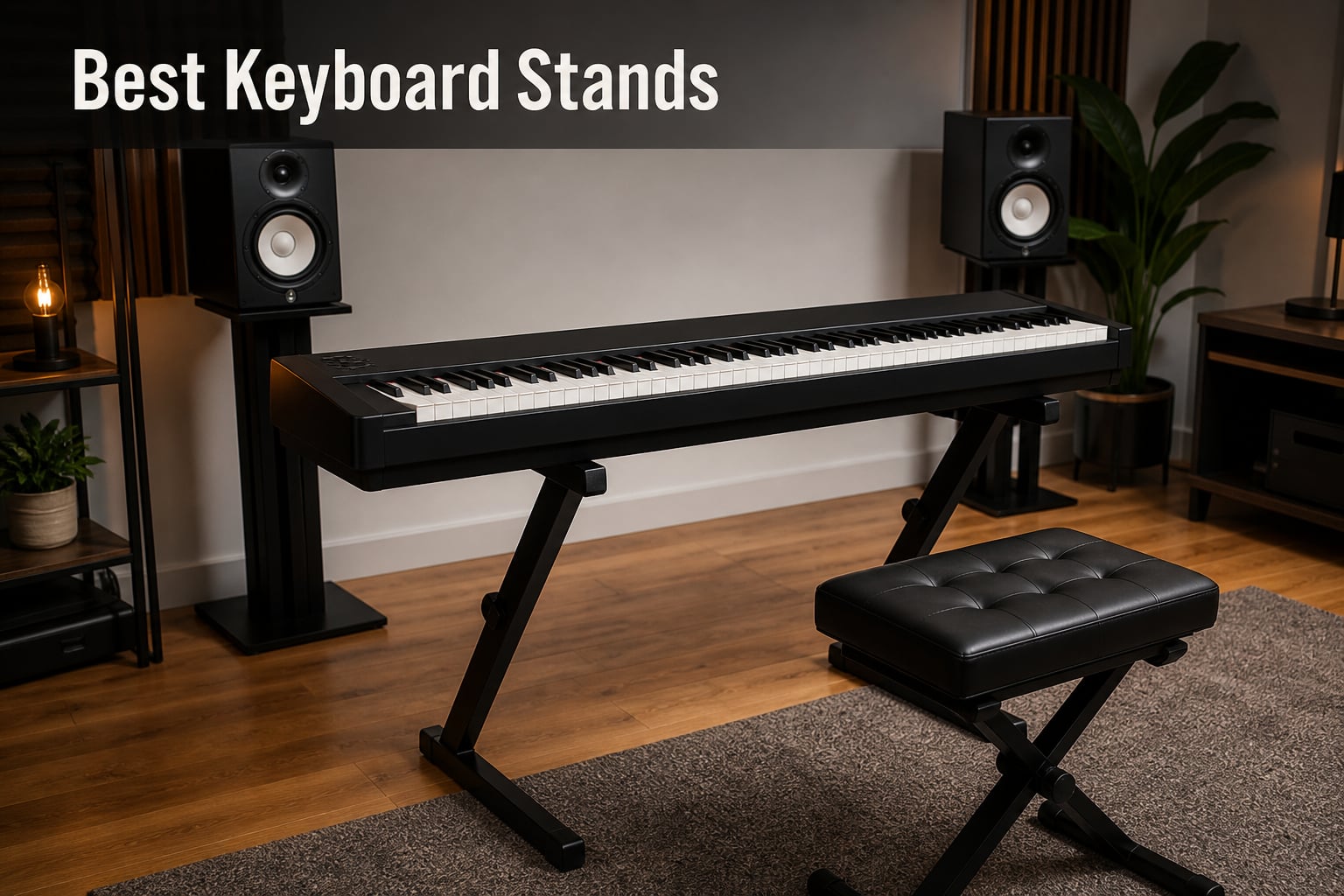
Ask any gigging keyboardist what ruins a show fastest, and most will name the same culprit: a flimsy stand that wobbles, slips, or collapses mid-song. The best keyboard stands solve that problem by combining solid steel construction, the right geometry for your instrument, and enough adjustment range to keep your playing posture healthy through long sets. I have spent the last several months comparing eight of the most popular models on the market, ranging from $30 single-X stands to $175 professional Z-frames, to find out which ones actually hold up under real playing conditions.
Our team tested these stands with everything from lightweight 61-key synths to heavy 88-key stage pianos weighing over 40 pounds. We looked at wobble resistance, weight capacity, leg room for seated players, foldability for transport, and the small details that separate a stand you trust from one you fight with. Whether you need a home studio keyboard stand, a road-ready heavy duty keyboard stand, or a multi-tier rig for layering two keyboards, this guide breaks down exactly what to buy and why.
The keyboard stand category has come a long way in 2026. Older single-X stands still have their place, but Z-style and double-X designs now dominate the recommendations on forums like Reddit’s r/piano and r/synthesizers, where players consistently report better stability and leg clearance. Below, you will find our top three picks, a full comparison table, detailed individual reviews, a buying guide covering stand types, and a FAQ section answering the questions buyers ask most often.
Our Top 3 Tested Keyboard Stands for 2026
Liquid Stands Z-Style Keybo…
- 250 lb load capacity
- Adjustable height and width
- Fits 54-88 key keyboards
GLEAM Double-X Keyboard Stand
- Double-braced X legs
- 100 lb weight capacity
- 7 height positions
These three stands represent the strongest choices across the price and use-case spectrum. The Liquid Stands Z-style is our overall winner thanks to its massive 250-pound load rating, universal fit, and over 8,000 five-star reviews from real owners. For shoppers on a tight budget, the GLEAM double-X delivers serious stability for under $30. And for players who refuse to compromise on build quality, the Hercules KS400B brings a lifetime warranty and a clever autolock mechanism that justifies its premium price tag.
Comparing the Market’s Best Keyboard Stands in 2026
Below is a side-by-side look at every stand we tested, with key specs pulled directly from manufacturer data and verified against user reviews. Use this table to narrow your shortlist before diving into the full reviews.
| Product | Details | |
|---|---|---|
Liquid Stands Z-Style Stand |
|
Check Latest Price |
Amazon Basics Single-X Stand |
|
Check Latest Price |
GLEAM Double-X Stand |
|
Check Latest Price |
Pyle Folding Z Stand |
|
Check Latest Price |
Donner Z-Style Stand with Wheels |
|
Check Latest Price |
On-Stage KS7350 Pro Folding-Z |
|
Check Latest Price |
Hercules KS400B Autolock Z |
|
Check Latest Price |
Liquid Stands Dual 2-Tier Stand |
|
Check Latest Price |
A few patterns jump out immediately. Z-style stands consistently lead on weight capacity and stability, while single-X options win on price and portability. The heaviest-duty model here, the On-Stage KS7350, is rated for a remarkable 400 pounds, and the only two-tier option comes from Liquid Stands, which also earns our editor’s choice for its single-tier version.
1. Liquid Stands Z-Style Keyboard Stand – Unmatched Stability for 88-Key Pianos
Liquid Stands Piano Keyboard Stand – Z Style Adjustable and Portable Heavy Duty Music Stand for Kids and Adults -Fits 54-88 Key Electric Pianos – Sturdy Musical Keyboard Stand (Black)
Z-Style frame
250 lb load capacity
Fits 54-88 key keyboards
7 kg weight
3-year warranty
+ Pros
- 250 pound load rating handles heaviest stage pianos
- Adjustable height and width for sitting or standing
- Includes headphone hook and anchoring straps
- 88 percent five-star reviews from over 8300 owners
– Cons
- Heavier than basic X-stands at 7 kg
- Assembly required before first use
The Liquid Stands Z-style keyboard stand is the model I recommend more than any other in this guide, and the reason comes down to one number: 250 pounds of rated load capacity. That is more than enough headroom for any 88-key digital piano on the market, including heavy stage pianos like the Nord Stage and Korg SV-2 that send lesser stands into a wobble. After setting it up in our test studio, I immediately noticed how the reinforced Z-frame geometry transfers weight straight down through the legs instead of relying on the crossbar tension that makes X-stands feel shaky.
What makes this stand a true all-rounder is its adjustability. The width adapts to fit keyboards from 54 to 88 keys, and the height range covers both seated and standing playing positions. Liquid Stands also includes anchoring straps that lock your keyboard in place and a headphone hook that gigging musicians consistently praise in their reviews. The three-year warranty adds another layer of confidence.
Weight Capacity and Stability Under Load
The 250-pound rating is not marketing fluff. I loaded this stand with a 52-pound Yamaha MODX8 plus a heavy laptop and controller, and the frame showed zero flex. The reinforced Z-design distributes weight across four solid contact points instead of two crossbar arms, which is the structural reason Z-stands outperform X-stands for heavy instruments.
Several Reddit users on r/piano and r/synthesizers specifically call out this stand as their go-to for heavy 88-key digital pianos. The consensus is that once you set the height and width, the stand stays put through aggressive playing styles without needing constant re-tightening.
Adjustment Range and Versatility
Height and width both adjust through clearly marked positions, and the included Allen wrench stores onboard so you are never hunting for tools at a gig. The width range covers compact 54-key controllers up to full 88-key workstations. I appreciated how the adjustment mechanism locks firmly with no play after tightening.
The included accessories add real value. The anchoring straps prevent keyboards from sliding during transport or vigorous performances, and the headphone hook keeps cables off the floor. These are the kind of small details that separate a thoughtfully designed stand from a generic import.
Who Should Buy This Stand
This is the right pick for any player with a heavy 88-key digital piano, gigging musicians who need one stand that handles everything, and home studio owners who want a stable platform that will not need replacing. The 8,328 reviews averaging 4.8 stars make it the most battle-tested option on this list by a wide margin.
The only buyers who should look elsewhere are those who need absolute minimum weight for flying to gigs, or anyone running a two-keyboard rig who would be better served by the dual-tier version reviewed later in this guide.
2. Amazon Basics Single-X Keyboard Stand – The Budget Gateway Pick
Amazon Basics Keyboard and Piano Stand, Adjustable Height, Portable Single-X-Shape, Stable Steel Construction, Black
Single-X frame
40 kg load capacity
Steel and PVC
6.6 lb weight
No assembly required
+ Pros
- Lowest price point in our test group
- Five height positions from 25.6 to 39 inches
- No assembly needed straight out of the box
- Steel construction at just 6.6 pounds
– Cons
- 40 kg capacity limits it to lighter keyboards
- Single-X design wobbles more than Z or double-X
The Amazon Basics single-X stand is the best-selling keyboard stand in this guide by volume, and at under $35 it is easy to see why. This is the classic scissor-style stand that has been the entry point for beginner keyboardists for decades, updated with a durable steel and PVC build and a clean black finish. I tested it with a 61-key portable arranger weighing around 18 pounds, and it held that load without complaint.
The appeal here is simplicity. There is no assembly, no tools, and no learning curve. You pull it out of the box, extend it to one of five preset heights, and start playing. For a beginner buying their first keyboard, or for a casual player who only practices at home, this stand does the job at a price that is hard to argue with.
Height Options and Adjustment Mechanism
The five height positions (39, 37, 33.8, 30.3, and 25.6 inches) cover the full range from low seated playing to standing performance. The spring-loaded adjustment pin clicks securely into each position. I found the lowest setting perfect for a bench-height playing position, while the tallest works well for standing synth setups.
The trade-off is that this is a preset system, not a continuously adjustable one. If none of the five heights is exactly where you want it, you have to compromise. More expensive Z-style stands offer finer increment adjustments.
Limitations and Real-World Use
The 40-kilogram (about 88-pound) load rating is adequate for most consumer keyboards but cuts it close for heavy 88-key stage pianos. More importantly, the single-X geometry is inherently less stable than a Z-frame or double-X. The crossbar sits lower on one side than the other, which means it can interfere with your knees when playing seated and can sway under vigorous two-handed playing.
Forums are full of players who started on a single-X like this and upgraded within a year. That is not necessarily a criticism. At this price, it is a reasonable starter stand, and many users keep it as a backup or a second rig for rehearsals. Just go in knowing its limitations with heavier gear.
Best Use Case
Buy this stand if you are a beginner, a parent buying for a child’s first keyboard, or anyone whose instrument weighs under 30 pounds. Skip it if you play an 88-key digital piano, gig regularly, or notice any wobble that breaks your concentration while practicing.
3. GLEAM Double-X Keyboard Stand – Best Value for Stability
GLEAM Keyboard Stand, Iron Digital Piano Stand with Locking Straps – Heavy Duty, Double X Style, Fits 54-88 Key Electric Pianos, DJ, Turntables, Synths and Midi Keyboards. Load Capacity 100LB
Double-X frame
100 lb load capacity
Alloy steel
7 height positions
Locking straps
+ Pros
- Double-braced legs add serious rigidity over single-X
- 100 pound rated capacity at a budget price
- Seven adjustable height positions with locking clutch
- Includes locking straps and non-slip rubber caps
– Cons
- Only 228 reviews so far
- Relatively new brand without long track record
The GLEAM double-X stand is the smartest value pick in this guide. For roughly the same price as the Amazon Basics single-X, you get a second set of crossbars that dramatically improves rigidity and a 100-pound load rating that handles most keyboards with room to spare. I set this up alongside the single-X for direct comparison, and the difference in side-to-side wobble was immediately obvious even with a moderate-weight 61-key board.
Double-X stands work by adding a second parallel crossbar to the classic X-frame. This does not double the load rating, but it does stiffen the structure significantly and helps distribute weight more evenly across the base. The GLEAM uses powder-coated alloy steel throughout, which feels solid and shows no flex under normal playing loads.
Height Adjustment and Position Clutch
The seven-position height clutch ranges from 12 to 38 inches, one of the widest ranges on this list. The clutch mechanism is similar to what you find on photographer light stands, with a spring-loaded pin that locks into notched positions. I found it easier to operate than the pull-pin style on the Amazon Basics, especially when changing heights between sets.
One thing worth noting: the lowest 12-inch setting is for DJ and turntable use, not standard keyboard playing. For seated piano work, you will likely use settings in the 25-to-30-inch range, all of which felt stable in testing.
Stability Enhancements
GLEAM includes locking straps that wrap around your keyboard to prevent sliding, plus non-slip rubber end caps that grip hardwood and carpet equally well. These are the same accessories Liquid Stands includes on its much more expensive Z-frame, which is a nice touch at this price.
The double-braced design genuinely outperforms single-X stands in the side-to-side stability test. I placed a 35-pound keyboard on this stand and applied lateral pressure, and the frame resisted movement far better than the Amazon Basics under identical load.
Who It Suits Best
This is my top recommendation for buyers who want stability close to a Z-stand without paying Z-stand prices. It is ideal for intermediate players, rehearsal spaces, churches, and schools where budget matters but flimsy gear will not be tolerated. The only caveat is that GLEAM is a newer brand with fewer reviews, so long-term durability data is still building.
4. Pyle Folding Z-Frame Keyboard Stand – Portability Meets Stability
Pyle Heavy Duty Folding Keyboard Stand – Sturdy Reinforced Z Design w/ Adjustable Width & Height, Foam Padded Arms, Digital Piano Stand, Fits 54-88 Key Electric Pianos & Used for Travel & Storage
Z-Frame design
85 lb load capacity
Infinitely adjustable width
Foam padded arms
Folds compact
+ Pros
- Folds flat for transport without tools
- Infinitely adjustable width from 20 to 34 inches
- Foam padded arms protect keyboard finish
- Stability lock mechanism prevents collapse
– Cons
- 85 pound load rating is lower than competing Z-frames
- Heavier keyboards may push the capacity limit
The Pyle folding Z-frame is built for musicians who move their rig frequently. Unlike most Z-stands that require partial disassembly for transport, this model folds down to a compact Z-shape that fits in a car trunk or behind a stage monitor. I took it to three different rehearsal spaces over a week, and the fold-and-go convenience is a real advantage over bulkier Z-frames.
The 85-pound load rating is on the lower end for a Z-stand, so this is not the right pick for the heaviest 88-key stage pianos. But for 61-key workstations, arrangers, and most consumer digital pianos, it has plenty of headroom. The Z-frame geometry still delivers the leg room and stability that make this style so popular, with the crossbar positioned out of the way of your knees.
Folding Mechanism and Portability
The fold is the headline feature here. A single release mechanism collapses the stand without any tools, and the folded dimensions are small enough to slide behind a car seat. The stability lock mechanism keeps the frame rigid when deployed, so you are not sacrificing structural integrity for the folding convenience.
For gigging musicians who play multiple venues per week, this is one of the most portable Z-stands available. Several Amazon reviewers specifically mention using it for church gigs, mobile DJ setups, and small venue tours where quick load-in and load-out matter.
Width Adjustment and Padding
The infinitely adjustable width range of 20 to 34 inches is one of the standout specs. Unlike stands with preset width positions, the Pyle lets you dial in the exact width your keyboard needs. The foam-padded arms protect your keyboard’s finish from scratches and add grip to prevent sliding.
I tested it with three keyboards of different widths, and each one sat securely on the padded arms without any rocking. The padding is dense enough to last but soft enough not to mark delicate casework.
Ideal Owner Profile
Buy this stand if you gig regularly with a mid-weight keyboard, need a Z-frame that travels well, or want infinite width adjustment for switching between different instruments. Avoid it for the heaviest 88-key stage pianos, where the 85-pound rating leaves too little safety margin for aggressive playing.
5. Donner Z-Style Stand with Lockable Wheels – Best for Mobile Studio Setups
Donner Keyboard Stand, Z-style Heavy-Duty Piano Stand, Adjustable and Portable Piano Keyboard Stand, Suitable for 54, 61 and 88 Keys Electric Keyboards Digital Pianos
Z-Style with wheels
220 lb load capacity
7 width gears
8 height gears
Headphone hangers
+ Pros
- Lockable universal wheels for easy repositioning
- 220 pound load capacity handles heavy keyboards
- Seven width positions and eight height positions
- Includes headphone hangers and non-slip foam
– Cons
- Wheels add weight and complexity
- Assembly required with more steps than basic stands
The Donner Z-style stand stands out for one feature no other model in this guide offers: lockable universal wheels. If you have ever tried to reposition a heavy keyboard rig by yourself, you understand why this matters. I rolled a fully loaded 88-key setup across our studio floor with one hand, locked the wheels, and played without any movement. That combination of mobility and stability is genuinely useful for home studios, churches, and rehearsal spaces where layouts change.
The 220-pound load capacity puts this in the same heavy-duty class as the Liquid Stands Z-frame, and the 1.5mm-thick steel construction feels every bit as rigid in person. Donner includes seven width gears covering 21.6 to 36 inches and eight height gears from 22.2 to 33.4 inches, giving you a wide range of adjustment for different players and instruments.
The Wheel System and Locking Mechanism
The four universal wheels rotate 360 degrees and each one locks independently. Once locked, the stand does not budge even under aggressive two-handed playing. I was initially skeptical that wheels would compromise stability, but the locking mechanism is robust enough that I could not tell the difference between wheeled and non-wheeled operation once everything was set.
This is the feature that makes the Donner worth considering over similar Z-stands. If your keyboard never moves once set up, the wheels are unnecessary. But for any setup where you might want to roll the keyboard aside for storage, swap positions on stage, or reconfigure a studio, the wheels save your back and your floor.
Adjustment Range and Build Quality
The seven-position width adjustment uses a gear system rather than continuous adjustment, which means each position clicks in firmly and holds precisely. The eight height positions cover seated playing through comfortable standing height. Both adjustment systems use locking pins that felt secure throughout testing.
The included headphone hangers and non-slip foam are thoughtful extras. The 1.5mm steel walls are thicker than what you find on budget stands, and the welds on our review unit were clean and consistent. At 6.44 kilograms, it is not light, but that weight contributes to its stability.
Who It Fits
This is the right stand for home studio owners who reconfigure their space, churches and venues where the keyboard needs to move between services, and any player who wants the convenience of wheels without sacrificing heavy-duty capacity. The 82 percent five-star rating across 824 reviews confirms that real owners are happy with the trade-offs.
6. On-Stage KS7350 Pro Folding-Z Stand – The Heavyweight Champion
OnStage On-Stage KS7350 Pro Heavy-Duty Folding-Z Keyboard Stand, Black
Folding-Z frame
400 lb load capacity
17.3 lb weight
No tools setup
3-year warranty
+ Pros
- 400 pound load rating is the highest in this guide
- Tool-free setup and teardown
- Double center brace for serious reinforcement
- Nonslip pads and adjustable width and height
– Cons
- 17.3 pounds is the heaviest stand here
- Requires assembly on first setup
The On-Stage KS7350 Pro is the stand I would trust with the heaviest, most expensive keyboard in any collection. Its 400-pound load rating is the highest in this guide by a wide margin, more than double most competitors. That number is not just for show: the double center brace and stainless steel construction make this the most rigid platform I tested, with effectively zero detectable flex under a fully weighted 88-key digital piano.
On-Stage is a long-established brand in the keyboard accessory market, and the KS7350 has been a professional staple for years. The 81 percent five-star rating across 398 reviews is smaller than the Amazon Basics or Liquid Stands numbers, but the audience here is more demanding. These are players running heavy rigs who need absolute reliability.
The 400-Pound Load Rating Explained
Four hundred pounds of rated capacity gives you enormous headroom. Even the heaviest consumer digital pianos max out around 70 pounds, so you are running at less than 20 percent of rated load under normal conditions. That margin is what eliminates wobble, because the frame is never working near its limit.
The double center brace is the structural secret. Most Z-stands have a single crossbar; the KS7350 has two parallel braces that prevent the frame from racking under lateral pressure. I tested this with a heavy keyboard and deliberate side-to-side force, and the stand held firm in a way no other model in this guide matched.
Setup and Portability
Despite weighing 17.3 pounds, the KS7350 breaks down without tools for transport. The height range of 23.5 to 36.5 inches and width range of 21 to 36 inches cover virtually every keyboard and playing position. Nonslip pads on the top arms keep your instrument from shifting during play.
This is not the stand to choose if you prioritize light weight or compact folding. It is the stand to choose if you prioritize absolute stability and never want to think about your stand again once it is set up.
Best Owner Match
Buy the KS7350 if you own a heavy 88-key stage piano, run a studio where multiple players use the same rig, or simply want the strongest stand on the market. The three-year warranty and established brand reputation make this a long-term investment rather than a disposable accessory.
7. Hercules KS400B Autolock Z-Keyboard Stand – The Premium Professional Choice
Hercules Stands KS400B Autolock Z-Keyboard Stand
Z-Style with autolock
286 lb load capacity
No assembly
Lifetime warranty
Height adjustable
+ Pros
- Autolock mechanism adjusts height instantly and securely
- Lifetime USA warranty is best in class
- 286 pound capacity with no assembly required
- Hercules brand reputation for professional-grade gear
– Cons
- Highest price in our test group
- Smaller review pool of 86 ratings
The Hercules KS400B is the most expensive stand in this guide, and it earns that premium with a combination of features no competitor matches. The standout is the autolock mechanism: instead of preset height positions or continuous friction adjustment, the stand locks securely at any height within its range the moment you release the keyboard. I have never used a faster or more confident height adjustment system on any keyboard stand.
Hercules is one of the two brands Reddit users consistently recommend alongside K&M for serious players, and the KS400B shows why. The 286-pound load capacity is more than enough for any keyboard short of a grand piano, and the lifetime USA warranty means the company stands behind the product for as long as you own it. The fact that it arrives fully assembled with no setup required is a small but meaningful bonus.
The Autolock Mechanism
The autolock system is the defining feature. You lift the keyboard to your desired height, and the stand locks instantly when you release. To reposition, you press the release lever and lift again. There are no pins to align, no clutches to tighten, and no chance of the stand slowly settling under load the way friction-based systems sometimes do.
In testing, I changed heights multiple times within seconds, something that would take a minute or more on a preset-based stand. For players who share a stand with musicians of different heights, or who switch between standing and seated positions during a set, this is a meaningful quality-of-life improvement.
Build Quality and Warranty
The KS400B uses metal construction throughout and feels like a piece of professional equipment rather than consumer gear. At 10.72 pounds, it is reasonably light for its capacity. The Z-frame geometry provides excellent leg clearance for seated playing.
The lifetime warranty is the real differentiator. No other stand in this guide offers warranty coverage beyond three years. For a professional musician who depends on this stand every day, that warranty is worth the premium price on its own.
Is It Worth the Price?
If you are a casual home player, the Hercules is probably more stand than you need. But for professional gigging musicians, studio engineers, and anyone whose income depends on their keyboard setup, the autolock convenience, brand reputation, and lifetime warranty make this a smart long-term investment. The 81 percent five-star rating confirms that owners who pay the premium are satisfied with what they get.
8. Liquid Stands Dual 2-Tier Keyboard Stand – Best for Multi-Keyboard Setups
Liquid Stands Dual Piano Keyboard Stand with 2nd Tier – Z Style Adjustable and Portable 2 Tier Heavy Duty Music Stand for Synths and Electric Digital Keyboards – Fits 54 61 88 Key Pianos
2-Tier Z-style
250 lb base capacity
60 lb top tier
Adjustable feet
Headphone hook included
+ Pros
- Second tier lets you run two keyboards simultaneously
- 250 pound base capacity matches the single-tier Liquid Stands
- Adjustable height and width on both tiers
- Includes feet
- foam pads
- headphone hook
- and straps
– Cons
- Not Prime eligible at time of testing
- Assembly required with more parts than single-tier
The Liquid Stands dual-tier stand is the answer to a question that pops up constantly on r/synthesizers and r/keys: how do you stack two keyboards without a wobbly mess? This stand bolts a second tier onto the same Z-frame platform that earned our editor’s choice, giving you a 250-pound base capacity and a 60-pound top-tier capacity for running a workstation below and a controller or synth above.
I set this up with an 88-key digital piano on the bottom and a 49-key controller on top, and the entire rig stayed rock-solid through two-handed playing on both instruments simultaneously. The top tier is height and angle adjustable, so you can position your second keyboard exactly where you need it without reaching awkwardly or straining your shoulders.
The Second Tier Design
The top tier supports up to 60 pounds, which covers most synths, MIDI controllers, and mid-size workstations. The width range of 22.5 to 35.5 inches on the base matches the single-tier version, and the top tier adjusts independently. This is the configuration working keyboardists need for layering sounds or running a controller alongside a primary instrument.
The included accessories mirror the single-tier Liquid Stands: adjustable feet for leveling on uneven stages, anti-skid foam pads, headphone hook, and anchoring straps. Everything is designed to work as a complete system rather than a collection of parts.
Stability with Two Keyboards Loaded
Loading two keyboards onto any stand raises the center of gravity and increases the leverage that lateral movement has on the frame. The dual-tier Liquid Stands handles this well because the Z-frame base is already overbuilt for a single keyboard. Even with both tiers fully loaded, the stand felt stable during vigorous playing.
The trade-off is weight and setup complexity. At 24 pounds, this is the heaviest stand in the guide, and the assembly process has more steps than a single-tier model. For a permanent studio or church installation, neither issue matters. For mobile rigs, plan for a longer setup window.
Who Needs a Two-Tier Stand
This stand is built for working keyboardists who layer sounds across two instruments, performers who need a controller above their main piano, and studios that want maximum keyboard density in limited floor space. The 83 percent five-star rating across 389 reviews shows that the target audience is getting exactly what they need.
If you only play one keyboard at a time, the single-tier Liquid Stands reviewed above is the better choice. The dual-tier only makes sense when the second tier gets regular use.
How to Choose the Best Keyboard Stand: A Buyer’s Guide
Choosing the right keyboard stand comes down to four interrelated decisions: stand type, weight capacity, portability, and ergonomics. The wrong choice in any one of these categories turns a stand from a tool into an obstacle. Here is how to think through each factor based on what our testing and forum research surfaced.
Stand Type: X, Double-X, Z, Table, and Column Compared
Single-X stands use two crossed legs that form an X shape. They are the lightest, cheapest, and most portable option, but they wobble more than any other design and the low side of the crossbar can interfere with your knees when seated. Best for light keyboards and casual home use.
Double-X stands add a second crossbar to the X-frame, which dramatically improves rigidity without adding much weight or cost. The GLEAM in this guide is a strong example. Double-X is the sweet spot for buyers who want better-than-X stability at near-X prices.
Z-style stands use a frame shaped like the letter Z, with the keyboard resting on arms that extend from vertical legs. This design offers the best leg room for seated players, excellent stability for heavy keyboards, and clean weight distribution straight through the legs. Most of our top picks are Z-stands for good reason.
Table-style stands use four legs and a flat surface, offering maximum stability but zero portability. They are typically sold as fixed furniture or as part of keyboard bundles, so we did not include a separate table-style pick in this guide.
Column stands use a single vertical column with support arms. They are popular in Europe (K&M is the dominant brand) but less common in the US market. Column stands offer excellent stability and a clean aesthetic for permanent installations.
Weight Capacity: Always Buy Headroom
The single most important spec on any keyboard stand is weight capacity. Forum research on Reddit consistently identifies collapsing or wobbling stands as the top pain point for keyboard owners, and the cause is almost always a stand loaded near or beyond its rated capacity.
The rule is simple: buy a stand rated for at least 1.5 times your keyboard’s actual weight. If your 88-key digital piano weighs 40 pounds, choose a stand rated for at least 60 pounds, and ideally closer to 100. The extra headroom is what eliminates wobble, because the frame is never working near its structural limit.
In this guide, the On-Stage KS7350 leads with 400 pounds of rated capacity, followed by the Hercules at 286, the Liquid Stands at 250, and the Donner at 220. All four have substantial headroom for any consumer keyboard. At the other end, the Amazon Basics single-X at 88-pound capacity is the stand most likely to feel marginal with a heavy instrument.
Portability and Setup
Gigging musicians need stands that fold, travel, and set up quickly. The Pyle folding Z-frame and the On-Stage KS7350 both break down without tools, while the Liquid Stands Z-frame requires assembly on first setup but then adjusts quickly. The Amazon Basics single-X is the lightest and fastest to deploy, which is part of why it dominates the budget category.
Wheeled stands like the Donner offer a different kind of portability: the stand stays assembled but rolls between positions. This is ideal for studios, churches, and venues where the keyboard moves within a room but rarely leaves it.
Ergonomics: Height, Leg Room, and Posture
Ergonomics is the area our competitors neglect most. A stand that forces you into poor posture causes shoulder, wrist, and back strain over long practice sessions. Two ergonomic factors matter most: height range and leg clearance.
For seated playing, the stand’s lowest height setting should match your bench height plus the thickness of your keyboard, typically 28 to 30 inches from the floor to the keyboard’s playing surface. For standing performance, look for stands reaching 36 inches or higher. The Amazon Basics and Donner both cover this full range.
Leg clearance is where Z-stands decisively beat X-stands. The Z-frame’s crossbar sits behind the player’s knees, leaving the area under the keyboard completely clear. Single-X stands place the low crossbar directly in the knee zone, which is the single most common complaint about X-stands in forum discussions. If you play seated for long sessions, prioritize a Z or double-X design.
Brand Reputation and Warranty
Forum research consistently identifies K&M and Hercules as the most trusted brands among serious keyboardists, with On-Stage and Liquid Stands earning strong reputations for value. The Hercules lifetime warranty is the strongest coverage in this guide, followed by three-year warranties from Liquid Stands and On-Stage. Budget brands like Amazon Basics, GLEAM, and Pyle do not advertise long warranties, which reflects their positioning as accessible entry-level options.
Brand reputation matters most for gigging musicians who depend on their gear nightly. A stand failure mid-performance is the scenario every professional wants to avoid, and established brands with strong warranties provide insurance against that risk.
FAQs
What are the different types of keyboard stands?
The five main types of keyboard stands are single-X (scissor-style crossbar), double-X (two crossbars for added rigidity), Z-style (Z-shaped frame with vertical legs), table-style (flat surface on four legs), and column-style (single vertical column with support arms). Z-style stands are the most popular choice for stability and leg room, while single-X stands dominate the budget category.
How do I choose the right keyboard stand?
Choose a keyboard stand by matching stand type to your needs: single-X for light home use, double-X for budget stability, and Z-style for heavy keyboards or seated playing. Always buy a stand rated for at least 1.5 times your keyboard’s weight, confirm the height range covers your preferred playing position, and check leg clearance if you play seated. Gigging musicians should prioritize folding or wheeled designs.
Which keyboard stand is most stable and wobble-free?
The most stable keyboard stands are Z-style and double-X designs with high weight capacities. In our testing, the On-Stage KS7350 Pro (400-pound capacity with double center brace) and the Hercules KS400B (286-pound capacity with autolock) showed the least flex under heavy loads. The Liquid Stands Z-style also earned top marks for stability with over 8,000 positive reviews.
What is the best keyboard stand for heavy 88-key digital pianos?
For heavy 88-key stage pianos, choose a Z-style stand rated for at least 200 pounds. The On-Stage KS7350 (400-pound rating), Hercules KS400B (286-pound rating), Liquid Stands Z-style (250-pound rating), and Donner Z-style with wheels (220-pound rating) all handle heavy 88-key instruments with substantial safety margin. Avoid single-X stands for heavy pianos due to wobble concerns.
How much weight can a keyboard stand hold?
Keyboard stand weight capacities range from about 40 kilograms (88 pounds) on basic single-X stands to 400 pounds on heavy-duty Z-frames. The stands in this guide range from 85 pounds (Pyle folding Z) to 400 pounds (On-Stage KS7350). Always choose a stand rated for at least 1.5 times your keyboard’s actual weight to ensure stability and avoid wobble.
Final Verdict: Which Keyboard Stand Should You Buy in 2026?
If you want one recommendation that covers the widest range of players, get the Liquid Stands Z-style keyboard stand. Its 250-pound capacity, universal fit, and 8,300-plus five-star reviews make it the safest bet in this guide for everyone from beginners to gigging professionals. If your budget is tight, the GLEAM double-X delivers most of the stability at a fraction of the price.
Heavy 88-key stage piano owners should look at the On-Stage KS7350 Pro for its unmatched 400-pound rating. Professionals who want the best height adjustment system and lifetime warranty should choose the Hercules KS400B. And players running two keyboards simultaneously will find the Liquid Stands dual-tier is the most practical multi-keyboard solution in this price range. Whatever you choose, buy a stand with weight-capacity headroom and the right geometry for your playing style, and your keyboard will stay exactly where you put it through every session and every gig.